Newsletter – December 2021-January 2022
Would you like to receive this newsletter in your email inbox? Sign up for a free AAG account now and select AAG Newsletter under your communication preferences.
PRESIDENT’S COLUMN
The Pandemic, the Scale of ‘We’, and the Fortress-Individual: Geographies of Responsibility

By Emily Yeh
Last year, now-Past President Amy Lobben titled her first newsletter column, “The Spatial Scale of ‘We,’” to reflect on the rapid shrinking of who counts as ‘we’ “to a remarkably small spatial and social scale” in the context of the COVID-19 pandemic. Her phrase has resonated with me over the past few weeks as I consider the global pandemic that is soon to enter its third year.
PERSPECTIVES
Advanced Placement Human Geography: Time for a Reappraisal?
By Michael Solem, Richard G. Boehm, and Joann Zadrozny
The conversation we need to have about AP Human Geography requires a shift in perspective from growth metrics to quality metrics, so that we begin to acquire a clear understanding of the things that really matter: the extent that APHG is effective for the students who participate in the course and whether APHG is delivering on its potential for geography in higher education.
ANNUAL MEETING
Now Recruiting: Employers and Job Seekers for AAG’s Virtual Career Fair
 Are you searching for that perfect job candidate? Are you looking to land a great internship or find your dream job? For the first time, the AAG will be holding a virtual career fair during the Annual Meeting. Employers and Job Seekers will have the opportunity to connect on February 28th from 12-3 PM ET in private, one-on-one conversations.
For companies and organizations, spots are filling up quickly, so reserve your booth today.
For Job Seekers, register today for the AAG Virtual Career Fair.
Be a Career Mentor at the 2022 AAG Annual Meeting

The AAG seeks professional geographers representing the business, government, nonprofit and academic sectors to serve as volunteer “Career Mentors” during the 2022 AAG Annual Meeting. Career mentoring provides an open forum for students and job seekers to receive one-on-one and small-group consultation about geography careers in a variety of industries and employment sectors. Sessions will be held each morning from 9:40-11:00 ET, February 25-February 28, 2021. Please note that the sessions will be in-person only.
For additional questions and to volunteer, please contact Mark Revell at the AAG mrevell [at] aag [dot] org as soon as possible, and no later than January 31, 2022.
Register Today for the 2022 AAG Annual Meeting
Mark your calendar for the AAG Annual Meeting in the Big Apple, February 25 – March 1, 2022. The hybrid meeting will take place both online and at the NY Hilton Midtown and the Sheraton New York Times Square Hotel. While paper abstract submission is closed, AAG will accept abstracts for poster presentations until January 6, 2022. We look forward to seeing you in New York City!
- Stay up to date on the annual meeting
- Register for the 2022 AAG Annual Meeting
- Submit your poster abstract
- Reserve your Hotel Stay
PUBLICATIONS
NEW GeoHumanities Issue Alert: Articles with topics ranging from festivals to urban change to the petrochemical industrial complex
 The most recent issue of GeoHumanities has been published online (Volume 7, Issue 2, December 2021) with 17 new research articles and creative pieces on subjects within geography. Topics in this issue include sand’s effects on settlement in Hong Kong; transnational agrarian movements; migration child detention; drawing as an ethno-political practice; Roden Crater; the depiction of bodies on maps; processing biological and geologic time; and decolonizing geology. Articles also explore mediums such as vignettes; poetry; photo essays; and film. Authors are from a variety of research institutions including Cardiff University; Dartmouth College; University of Cambridge; University of Southern California; and Michigan Technological University.
All AAG members have full online access to all issues of GeoHumanities through the Members Only page. In every issue, the editors choose one article to make freely available. In this issue you can read Normalized Alterity: Visualizing Black Spatial Humanities by Darius Scott for free.
Questions about GeoHumanities? Contact geohumanities [at] aag [dot] org.
NEW Annals Alert: Articles with topics ranging from river restoration to the political ecology of volcanic sand mining, from dust events in Iran to high Arctic coastal systems
The most recent issue of the Annals of the American Association of Geographers has been published online (Volume 112, Issue 1) with 15 new articles on contemporary geographic research. Topics in this issue include the glyphosate assemblage; Chinese megacities; paraglacial typology; mobility during COVID-19; dust events over time; wayfinding in virtual reality; and postwar occupational mobility. Locational areas of interest include Wisconsin; urban China; the Mississippi delta; Western Norway; and rural Sweden. Authors are from a variety of research institutions including National Taiwan University and Tokyo Institute of Technology; Dartmouth College; Queens University; and National University of Singapore.
Each issue, the Editors choose one article to make freely available for two months. In this issue you can read A New Paraglacial Typology of High Arctic Coastal Systems: Application to Recherchefjorden, Svalbard by Kamila Jarosz, Piotr Zagórski, Mateusz Moskalik, Michael Lim, Jan Rodzik and Karolina Mędrek for free.
Questions about the Annals? Contact annals [at] aag [dot] org.
In addition to the most recently published journal, read the latest issue of the other AAG journals online:
• Annals of the American Association of Geographers
• The Professional Geographer
• GeoHumanities
• The AAG Review of Books
AAG Seeks GeoHumanities co-editor
The AAG seeks applications for the position of co-editor of GeoHumanities. The new co-editor, whose responsibilities include overseeing the solicitation, review, and publication of scholarly articles for the journal, will be appointed for a four-year editorial term beginning January 1, 2023.
Learn more about the position.
ASSOCIATION NEWS
AAG Is Proud to Announce the 2022 AAG Honors
Since 1951, AAG Honors have been offered annually to recognize outstanding accomplishments by members in research and scholarship, teaching, education, service to the discipline, public service outside academe, and for lifetime achievement. Each year, the AAG invites nominations for AAG Honors to be conferred in recognition of outstanding contributions to the advancement or welfare of the profession. The AAG Honors Committee is charged with making award recommendations for each category, with no more than two awards given in any one category. The AAG is proud to officially announce the 2022 AAG Honors.
AAG Announces Diversity & Inclusion, Mentoring, Rose, & Brunn Awards
The American Association of Geographers congratulates the individuals and entities named to receive an AAG Award. The 2022 Diversity and Inclusion Award is presented to the team of Beverley Mullings, Kate Parizeau, and Linda Peake for their combined work on mental health as well as to Austin Mardon for his advocacy of those with chronic mental disorders. David Lopez-Carr from UC Santa Barbara has received the 2022 Susan Hardwick Excellence in Mentoring Award. The 2022 Harold M. Rose Award for Anti-Racism Research and Practice is awarded to Caroline Faria of the University of Texas Austin. Kathryn Yusoff of Queen Mary University London is the 2022 awardee of the Stanley Brunn Award for Creativity in Geography.
Support AAG and Help Geographers Thrive
Giving Tuesday, celebrated on November 30, 2021, is a national day devoted to supporting the charities that mean the most to you. We are delighted that many members and friends supported AAG with gifts totaling $7,340. Giving Tuesday kicked-off AAG’s end-of-year fund-raising effort. If you haven’t made your 2021 gift, please donate now and help AAG continue to take action to support geography.
You can make a difference by supporting:
- The Area of Greatest Needs Fund and help support the Association’s most pressing needs as they arise and evolve, and to expand offerings for learning, connection, and professional growth.
- The Enhancing Diversity Fund and help AAG, and the broader geography community, to enhance diversity, promote equity, and foster a more inclusive culture.
- The Student Travel Fund that makes it more affordable for students to attend, in person, the AAG Annual Meeting.
No matter the size of your gift, it will truly make a difference. Donate now to help support geographers and the discipline in the year ahead.
Congratulations to Outstanding Graduate Student Papers from Regional Meetings
The AAG is proud to announce the Fall 2021 student winners of the AAG Council Award for Outstanding Graduate Student Paper at a Regional Meeting. The annual award, designed to both encourage regional meeting participation and support AAG Annual Meeting travel, is granted to one student from each division as decided by regional division board members. The winners from each region will present their work in a dedicated session at the 2022 AAG Annual Meeting. Congratulations to all of the students who participated!
Get ready for the 2022 AAG Election
The AAG election will be conducted online again, and voting will take place January 6-27, 2022. Each member who has an email address on record with the AAG will receive a special email with a code that will allow them to sign in to our AAG SimplyVoting website and vote. It’s important to update your email address in your AAG account to ensure you receive the email ballot. The 2022 election slate will be published on the AAG website soon.
POLICY CORNER
Redistricting Roundtable at NYC Annual Meeting
 The AAG’s Redistricting Panel Series that took place this September aimed to answer the question, “What can geographers do to get involved in 2021 redistricting?” Thanks to geographers from around the country who stepped up as hosts and organizers, the AAG conducted 14 different virtual and in-person panels in as many states.
While some states have nearly finished their new district maps, many others are still in the middle of the redistricting process. Even among the completed maps, some have already faced legal challenges based on fairness and equity in representation. Public input is a crucial component of this process but taking the right steps to get involved proves difficult for most people. Join the AAG for a Redistricting Roundtable Discussion on Sat, Feb 26th at the NYC Annual Meeting as we reflect on our panel series and look forward to how geographers can stay involved in their states as district maps are drawn, reviewed, and challenged.
In the News:
- On Friday, Nov. 19, the House passed the Build Back Better reconciliation bill, 220-213, on a near-party line vote, with only Democratic Rep. Jared Golden of Maine joining all Republicans in opposing the measure. Negotiations continue in the Senate as the White House holds out hope for full passage by year’s end.
- On November 16, Representatives Diana DeGette (D-CO) and Fred Upton (R-MI) introduced the Cures 2.0 Act. In addition to authorization for Advanced Research Projects Agency for Health (ARPA-H), the Cures 2.0 Act includes the Research Investment to Spark the Economy (RISE) Act, legislation that would authorize relief funding for federal research agencies to help strengthen U.S. research in the aftermath of the COVID-19 pandemic.
- Throughout the end of 2021 and early 2022, the National Institutes of Health (NIH) will be holding a series of listening sessions to gather stakeholder feedback on achieving racial equity as part of the agency’s UNITE Initiative. The UNITE Initiative, which was launched by NIH in March 2021, is intended to analyze and address the agency’s practices to better foster diversity, equity, and inclusion in the biomedical research enterprise.
RESOURCES AND OPPORTUNITIES
Paid Positions: Be Part of the AAG Summer Series
The 2022 summer series will be the first of its kind for AAG. It is an expansion of the 2020-2021 Learning Series. The need for such a program beyond the pandemic became clear based on testimonies from the Learning Series, which is why the AAG Council re-committed support for another year and increased its budget.
With an increased program budget, and based on community input during the Learning Series and from an all-day event on September 10, we changed the format of this program in four major ways. First, the main audience for the series remains graduate students, but we are also developing a few offerings that will target recently graduated geographers in- or outside of academia, and a few undergraduate students. Second, we will continue having graduate-level advanced workshops, but we are also developing other offering types such as basic-level workshops, graduate-led working groups, and a seminar series. Third, we are collaborating with the AAG Affinity Groups for Graduate Students (GSAG) to offer informal graduate forums. Fourth, the series will happen throughout the summer months (May through August), rather than all year long.
We are seeking geography faculty and graduate students to submit proposals for workshops and for working groups (respectively). The call for proposals for the 2022 summer series remains open until Thursday, January 13, 2022.
Symposium on Hurricane Risk in a Changing Climate – Registration Open
Join scholars and practitioners in Key Largo, FL June 5-9, 2022 for the Symposium on Hurricane Risk in a Changing Climate. The main objective of this symposium is to foster communication among scientists, engineers, and practitioners in order to increase understanding of and better ways to deal with tropical cyclone risks. This Symposium differs from a traditional conference in that there is greater time allocated for each speaker to present and have Q and A in order to obtain greater depth to the discussion and there is a greater emphasis on networking to bring participants together for future collaborations.
Registration and more information available here.
Two Fellowships Available from the Society of Woman Geographers
The Society of Woman Geographers (SWG) invites applications for its Evelyn L. Pruitt doctoral dissertation research fellowships for 2022-2023 for women in geography and geographical aspects of other fields, as well as the Evelyn L. Pruitt National Minority Fellowship for 2022-2023 for minority women who have been admitted to and plan to enroll or are enrolled in a Masters program in geography or a related field. Applicants must be students in US or Canadian universities. Applications are due February 1, 2022. For more information, application guidelines, and details for submission of proposals see the Society of Woman Geographers website.
Geography Education National Implementation Project (GENIP) CHAIR SEARCH
The Geography Education National Implementation Project (GENIP) is a committee to support communication and collaboration regarding K-12 geography education by the four national geography organizations (American Association of Geographers; American Geographical Society; National Council for Geographic Education; and National Geographic Society). GENIP is conducting a search for a new Chair of the committee.
The Chair is responsible for coordinating and administrating the activities of the GENIP. Nominees should be knowledgeable about issues related to geography education, especially at the K-12 level. Preferred candidates will have experience with geography education, related policy issues, state and national standards, curricula, and assessments, and other cognate non-profit, educational organizations. This is a paid position lasting for a two-year term, which may be renewed. For a full description, responsibilities, and details on how to apply, click here.
Request for Proposals for Entrepreneurship Researchers Opening Jan. 18, 2022
This January, the Ewing Marion Kauffman Foundation will launch the 2022 Kauffman Knowledge Challenge Request for Proposals (RFP). The goal of this RFP is to support research that improves our understanding of entrepreneurship and generates practical, actionable, and rigorous evidence to inform decision-making and change systems. There are two focus areas that applicants will be asked to choose from: Systems and structures to support inclusive prosperity, which will explore the infrastructure needed to support entrepreneurs and entrepreneurship, and Equitable opportunities and the future of work, which will explore how entrepreneurial activity might be structured as the economy emerges from the COVID-19 pandemic. Research findings will be shared with entrepreneurs, entrepreneurial support organizations, community leaders, and policymakers. The RFP opens Jan. 18, 2022 and closes Feb. 28, 2022.
More information about this RFP is available here.
Redistricting Data Hub Opportunities
The 2021 redistricting cycle is at the halfway mark, and it’s not too late to get involved! If you were inspired by one of the AAG Redistricting Panel Series, check out the nonpartisan Redistricting Data Hub for free, high-quality data that can be used for analysis, as well as free trainings on how to analyze maps for consideration of COIs and racially polarized voting (RPV) analyses.
If you have an idea for a training or a group that might be interested, or any redistricting-related question, email the Hub’s Help Desk. Among other activities, the Redistricting Data Hub is currently collecting all submitted community of interest (COI) maps to make publicly available in a database to facilitate analysis, learn more here.
GEOGRAPHERS IN THE NEWS
- UCLA’s Marilyn Raphael on Climate and Justice, AAG Vice President Marilyn Raphael explores themes of climate justice, how geographers are equipped to help vulnerable people all over the globe, and discusses her recent trip to Antarctica to explore climate modeling.
- Revitalizing Black Neighborhoods by Preserving Their History, Brandi Summers of UC Berkeley Geography writes about Black developers and the revitalization of historically decimated black communities.
EVENTS CALENDAR
- February 25 – March 1, 2022 – 2022 AAG Annual Meeting
- June 7-11, 2020 – 2020 Symposium on Hurricane Risk in a Changing Climate
Submit News to the AAG Newsletter. To share your news, email us!
 Fraught Times
 The AAG has a long history of engaging in and supporting climate change policy and research. Since climate change is the existential threat and crisis of our age, the need to continue this engagement and reduce our contribution to carbon emissions is clear. We will continue to seek policy action on behalf of our members–actions designed to influence the societal and governmental change required for durable solutions. For example, the AAG recently updated its climate statement, and just last week, our name appeared on a list of 80 societies calling for global action ahead of COP26.
  In the wake of protests for racial justice following George Floyd’s murder in Minneapolis by police in 2020, New York City Mayor Bill de Blasio pledged to rename five streets, one in each borough, in honor of the movement. In Manhattan, Black Lives Matter Boulevard was co-named at 1 Centre Street, a block that is home to the city’s Municipal Building, City Hall, and the Department of Education. In addition to these namings, the city funded a Black Lives Matter Mural on Fifth Avenue in front of Trump Tower, a mere five blocks (and six-minute walk) from the AAG’s Hilton Midtown hotel conference center.
 Mark your calendar for the AAG Annual Meeting in the Big Apple, February 25 – March 1, 2022. The hybrid meeting will take place both online and at the NY Hilton Midtown and the Sheraton New York Times Square Hotel. While paper abstract submission is closed, AAG will accept abstracts for poster presentations until January 6, 2022. We look forward to seeing you in New York City!
 NEW Fall Issue of the AAG Review of Books Published
 In addition to the most recently published journal, read the latest issue of the other AAG journals online:
 The latest issue of the journal of the Africa Specialty Group of the AAG, the
  Geography Awareness Week is Almost Here

 This year’s Geography 2050 Symposium from the American Geographical Society will have the theme ”Towards a More Equitable Future”. Held virtually November 15-219, 2021, geographers, thought leaders, and policymakers will engage in dialog during this free, virtual event to address the geographical dimensions of inequality and move to create a more vibrant global society.

 The Vernacular Architecture Forum invites paper and poster proposals for its 43rd Annual Conference, May 18 to May 21, 2022 in San Antonio, Texas. Papers may address topics relating to vernacular and everyday buildings, sites, or cultural landscapes worldwide and how people use these sites. Papers could also explore new methodologies for researching vernacular architecture, or new pedagogies for engaging students in the analysis of everyday buildings and cultural landscapes. All topics are welcome and papers focusing on issues of migration, displacement, de/colonialism, segregation, resistance, gender, sexuality, identity, heritage, equity, and/or justice in the everyday built environment are encouraged.
 With summer almost here, I’m about to head into my last year as an academic. I’m “retiring” June 2022, although in truth I’ll work full time running my family’s winery and nonprofit, both built around the mission of providing training, jobs, and community for those with disabilities. As I transition from academics, Andrew and I are encountering many things we didn’t know were part of running a small business. This transition has prompted me to reflect on my transition from student to faculty member and, in turn, on how we prepare our graduate students for major life and career transitions.
 In May, we introduced a new column to the AAG Newsletter called Perspectives, replacing AAG’s former Op-Ed feature. Perspectives will share the opinions and ideas of members on issues of relevance to geography. We encourage submissions that stimulate dialogue, get members thinking, and challenge our discipline to take new approaches to the social, political, and environmental issues confronting geographers and the public.

 In addition to the most recently published journal, read the latest issue of the other AAG journals online:
 During our virtual annual meeting, we gave a sneak peek of our new website currently in the design process. If you missed the session or weren’t able to attend the conference, you still have a chance to see the recording. Our website agency, Free Range, revealed some of the exciting changes in store for this completely accessible, innovative, and mobile friendly website launching later this spring. Please send us your questions and thoughts at
  Please consider nominating outstanding colleagues for the AAG Honors, the highest awards offered by the American Association of Geographers. Individual AAG members, specialty groups, affinity groups, departments, and other interested parties are encouraged to nominate outstanding colleagues. Deadlines for nominations will be later this year – on September 15th. The new nomination portal will be open for nominations starting later this summer.

 The 2021 issue of you are here: bodies & politics has been published. This issue focuses on the significance and political potentials of bodies and embodiment in the current political moment. you are here is an annual publication produced by graduate students at the University of Arizona School of Geography, Development, and Environment. The journal seeks to explore geographic themes through poetry, creative writing, maps, photographs, visual art, sonic art, film, and other imaginable genres.
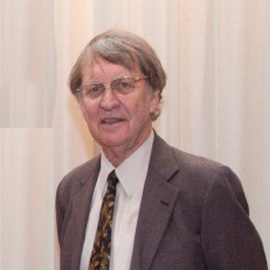 Roger Kasperson passed away in his home in Washington, D.C. on Saturday, April 10, 2021. A former Clark Graduate School of Geography faculty member, Kasperson also received his B.A. in geography from Clark and his M.A. and PhD from University of Chicago. Kasperson was a major figure in risk analysis, resilience, and sustainability and was an elected member of the National Academy of Sciences, the American Academy of Arts and Sciences, and the American Association for the Advancement of Science.
 In June 2020, the Association for Asian American Studies issued an open call for putting an immediate end to anti-Black racism and advancing efforts toward achieving global social justice. The murders of Ahmaud Arbery, Breonna Taylor, Tony McDade, and George Floyd pulled a painful trigger for many Asian Americans… Since January 2020, the lives of Asian-heritage people in the U.S. and likely the same for those in other countries have been violently shaken. Asian Americans were among the first to help local communities combat Covid-19, while racist attacks were increasing in cities like Los Angeles…

 The most recent issue of The Professional Geographer has been published online (
 In addition to the most recently published journal, read the latest issue of the other AAG journals online:
 The J. Warren Nystrom Award, established by a former AAG President to annually recognize a paper based on a recent dissertation in geography, is awarded during a special session at the AAG Annual Meeting. Two recipients were chosen for the 2021 AAG Nystrom Award: Daniela Aiella, currently a Postdoc at Queen’s University (PhD University of Georgia), for “A colonial genealogy of eviction: racialized dispossession in Atlanta and Vancouver” and Ziqi Li, a Visiting Assistant Professor at University of Illinois Urbana-Champaign (PhD Arizona State University), for “Computational Improvements to Multiscale Geographically Weighted Regression.” The Nystrom Award session recording is available to watch in the Annual Meeting program until May 11.
 During our virtual annual meeting, we gave a sneak peek of our new website currently in the design process. If you missed the session or weren’t able to attend the conference, you still have a chance to see the recording. Our website agency, Free Range, revealed some of the exciting changes in store for this completely accessible, innovative, and mobile friendly website launching later this spring. Please send us your questions and thoughts at

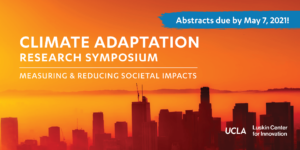 The UCLA Luskin Center for Innovation is delighted to invite abstracts for our 2021
  The American Geosciences Institute’s Geoscience COVID-19 Impacts study has been extended into a second phase that will continue the longitudinal study through March 2022, thanks to continued support by the National Science Foundation (Award #2029570). The second phase of this study will focus on how the COVID-19 pandemic has permanently changed the way in which geoscientists work and study and how workplace and instructional environments transition into post-pandemic configurations. The study will continue to accept new participants through January 2022 and is open to all geoscientists, including students, retirees, and those not currently employed, who reside in the United States, and are at least 18 years old.
 Nancy B. Hultquist, retired Central Washington University (CWU) geography professor, died March 30th, 2021. Nancy is remembered fondly by students, friends, and colleagues. Starting out using computer punch cards, Hultquist eventually moved to using GIS, ultimately introducing countless K-12 teachers to the early iterations of making maps and GIS through NCGE workshops she participated in. She was quick to assist junior faculty and devoted countless hours to helping students find employment, including maintaining a jobs list of employment opportunities across the Pacific Northwest which currently has over 800 subscribers.
 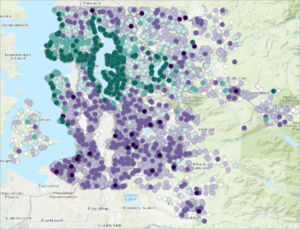 “Data science is the study of data. Data science involves developing methods of recording, storing, and analyzing data to effectively extract useful information. The discipline of geography has always been focused on data science, because geographers have always been keen to gather, analyze, and make sense of large volumes of data across a wide variety of scales and covering a wide variety of themes, from ecoregions to individual census blocks. Those using GIS are spatial data scientists: They combine their data with theoretical foundations such as Tobler’s First Law to explain and predict. As they visualize and analyze data, they detect patterns and relationships, testing real-world phenomena against hypotheses.
 We are about 3 weeks away from the Annual Meeting! The completely virtual 2021 Annual Meeting, April 7-11, will feature 800+ paper sessions and panels on a wide range of topics as well as 27 poster sessions. Browse the
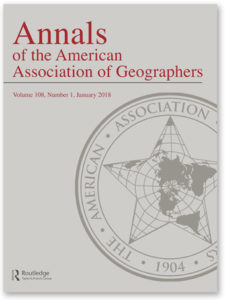 The most recent issue of the Annals of the AAG has been published online (
 In addition to the most recently published journal, read the latest issue of the other AAG journals online: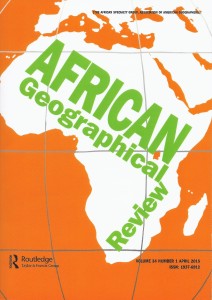


 Two virtual events are upcoming that may be of interest to AAG members:
 The William T. Pecora Award is presented annually to individuals or teams using satellite or aerial remote sensing that make outstanding contributions toward understanding the Earth (land, oceans and air), educating the next generation of scientists, informing decision makers or supporting natural or human-induced disaster response. Sponsored jointly by the Department of the Interior (DOI) and the National Aeronautics and Space Administration (NASA) and established in 1974, the award honors the memory of Dr. William T. Pecora, former Director of the U.S. Geological Survey and Under Secretary, Department of the Interior, whose early vision and support helped establish the Landsat satellite program. Nominations for the 2021 awards must be received by the Award Committee by May 14, 2021.
 The most recent issue of The Professional Geographer has been published online (
 The 2023 Special Issue of the Annals invites new and emerging geographic scholarship situated at the crossroads of Race, Nature, and the Environment. In seeking contributions from across the discipline, we welcome submissions that advance critical geographic thinking about race and the environment from diverse perspectives and locations; that utilize a broad array of geographic data, theories, and methods; and that cultivate geographic insights that cut across time, place, and space. Abstracts of no more than 250 words should be submitted by e-mail to
  The American Association of Geographers, in partnership with the Center for Spatial Studies at the University of California Santa Barbara and with support from Esri, will launch a series of webinars on key considerations for GeoEthics. The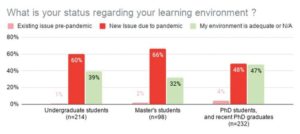
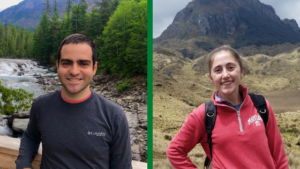 The AAG is excited to welcome two new interns coming aboard our staff for the Spring 2021 semester! Joining us this semester are Ilan Gritzman, a recent graduate from University of Central Florida, and Jennifer Church, senior at The University of Maryland.
 Linda Peters was inspired by her work with the March of Dimes Birth Defect Foundation to integrate geography and GIS in finding solutions for fundraising in areas of need. Today Linda holds a B.A. in Geography and Certificate in GIS/Cartography from University of Maryland Baltimore County and works as a Global Business Development Manager for Esri. Linda knows that most issues she comes across with her customers can benefit from spatial analysis, so she recommends strong communication skills and a willingness to put in the work and listen as keys for a successful career.
 The National Center for Research in Geography Education is organizing a research group to conduct a comprehensive analysis of AP Human Geography course data. Grants of $4,000 each are available for up to four researchers to join the study. For more information on how to apply, see this Dear Colleague Letter:
 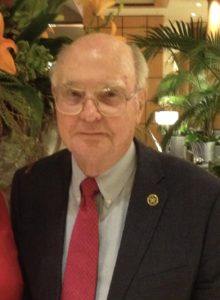 William Dando, 50 year AAG member and longtime chair of the Bible Geography specialty group, passed away on January 1, 2021. Throughout his career Dando received numerous awards for his teaching and service throughout his career, exemplifying an academic life that was a balance between scholarship and community service. He leaves behind his wife and co-writer/editor Caroline Z. Dando; children Christina, Lara, and Bill (all geographers); four grandchildren — Emmaline, Anna, Alex, and John; and thousands of former students and mentees.