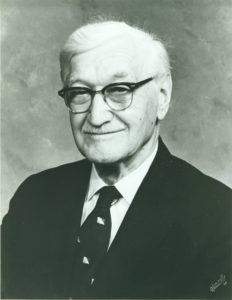
Curtis C. Roseman

Curtis C. Roseman, professor emeritus of geography at University of Southern California-Dornsife, died on December 13, 2020 at the age of 79. He earned a bachelor’s degree from Augustana College in Rock Island, Illinois; a master’s degree from Southern Illinois University in Carbondale; and a Ph.D. from the University of Iowa. He was a professor in the Department of Geography at the University of Southern California from 1985 to 2004, serving as Department Chair from 1985 to 1992. He also held appointments at the University of Nebraska Omaha, University of Kansas, University of Auckland, New Zealand, University of Canterbury, New Zealand, and the University of Illinois at Urbana-Champaign. During his academic career, he did research in population geography, human migration, geography of ethnic populations, and the upper Mississippi River. In addition to his membership in the Association of American Geographers, he belonged to the Population Association of America. Among the many honors and awards he received over the years were the USC Community Service Award, the USC Faculty Volunteer Good Neighbor Award, Distinguished Scholar Award from the Ethnic Geography Specialty Group of the American Association of American Geographers, and a 1989 Fulbright Fellowship to New Zealand. He is survived by his wife, Elizabeth Mercer, and their two children Charles and Eric, and his daughter Suzanne, from his first marriage to Joanne Darras.

    Share

Newsletter – December 2020

PRESIDENT’S COLUMN

Advocate for Geography in Austerity

By Amy Lobben
Better_Days_Ahead_IanTaylor_Unsplash-300x169-1This month I will begin a two-part column on what geography departments can do (and should not do) to advocate for their work in budget talks, which are all the more crucial during the COVID-19 pandemic. These points are largely derived from answers I received from geographers in upper administrative positions at universities.

If 2020 has taught us nothing else, it is that geography is a crucial discipline for grasping and addressing the dire issues our earth faces. Yet in a year that has demonstrated our value, some of our geography departments continue to struggle for relevancy of university campuses.

Continue Reading.

ANNUAL MEETING

AAG Annual Meeting Goes Virtual for 2021
AM2021V-1000X1000sq-290x290-1

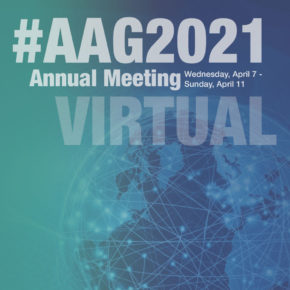
In mid-November, AAG made the difficult but necessary decision to shift the 2021 annual meeting to a completely virtual experience. While we are encouraged by recent news of breakthrough treatment and prevention options for COVID-19, the pandemic’s current trajectory indicates that it won’t be fully resolved by April. A streamlined process is in place to help session and activity organizers bring their programming to the virtual environment, with the assistance of AAG staff. The shift to virtual does not affect any of our existing deadlines for registration, submissions, or session organizing. We want to thank you for being part of the AAG community. Your presence and support mean the world to us.

PUBLICATIONS
Journals-newsletter-100-1Read the latest issues of all of the AAG journals online:

• Annals of the American Association of Geographers
• The Professional Geographer
• GeoHumanities
• The AAG Review of Books

New issue of African Geographical Review

African-Geographical-Review-cvr-212x300-1The latest issue of the journal of the Africa Specialty Group of the AAG, the African Geographical Review, has recently been published. Volume 39, Issue 4 (December 2020) is available online for subscribers and members of the Africa Specialty Group. The latest issue contains six articles covering all sub-fields of geography and one article commentary, to enhance the standing of African regional geography, and to promote a better representation of African scholarship.

See more about the journal.

ASSOCIATION NEWS

Thank you for your support of the Bridging the Digital Divide Fund
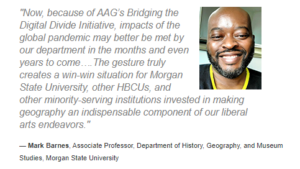
BDD_testamony-300x169-1Our thanks to members and supporters who made gifts on Giving Tuesday, December 1st, to AAG’s Bridging the Digital Divide Fund. We received 37 donations, and hope to reach 100 by the end of the month.

Bridging the Digital Divide addresses the technology gap that affects too many students–particularly those who are enrolled at minority-serving institutions–who cannot afford personal computers, software, and internet access. The pandemic interfered with the education of many geography students at minority-serving institutions, affecting their ability to complete or even enroll in classes, and causing them to postpone their education as they were unable to connect remotely to the classroom.

Right now, AAG is working with faculty at eight Tribal Colleges and Universities, fourteen Historically Black Colleges and Universities, and one predominantly Black institution to close the technology gap. AAG has provided funds for these geography programs to purchase laptops, software, and internet connections for their students. More than 200 geography students benefited this semester, and we hope to expand the program.

The digital divide existed before COVID-19 and will not go away even as solutions to the pandemic begin to emerge. There’s still time to make a gift. Our collective action will help to leverage industry and foundation partners. No matter the size of your gift, it will make a difference.

Give Now to Bridging the Digital Divide.

Congratulations to Outstanding Graduate Student Papers from Regional Meetings
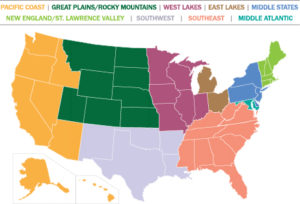
Regional_Divisions_interactive_map467-300x204-1The AAG is proud to announce the Fall 2020 student winners of the AAG Council Award for Outstanding Graduate Student Paper at a Regional Meeting. The annual award, designed to both encourage regional meeting participation and support AAG Annual Meeting attendance, is granted to one student from each division as decided by regional division board members. The winners from each region will present their work in two dedicated sessions at the 2021 AAG Annual Meeting. Congratulations to all of the students who participated!

Read more about the recipients.

Call for Proposals: AAG Learning Series on Graduate Research Methods in COVID-19

Geography-Methods-during-a-Pandemic-flipped-300x124-1AAG has issued a new call for proposals, seeking instructors and graduate assistants for its  Learning Series for Graduate Students this spring. To support graduate students in adapting in their research during COVID-19, AAG seeks instructors at all levels and in all sectors (professionals  lecturers, and faculty from early to advanced career) to develop virtual seminars or workshops.

For workshops and seminars developed by one instructor, AAG will pay the instructor $1,500, and for those developed by more than one instructor, AAG will pay $1,000 per instructor. Proposals with multiple instructors must include clearly defined roles and responsibilities. AAG is also offering a $100 stipend for up to four graduate students to assist instructor(s) during interactive sessions. If selected, the instructor(s) will be able to pick a week between March and June 2021 during which they will offer the seminar or workshop.

The deadline to apply is on or before Thursday, January 14, 2021. See more details and apply here.

Get ready for the 2021 AAG Election

Election-button-1

The AAG election will be conducted online again, and voting will take place January 7-28, 2021. Each member who has an email address on record with the AAG will receive a special email with a code that will allow them to sign in to our AAG SimplyVoting website and vote. It’s important to update your email address in your AAG account to ensure you receive the email ballot. The 2021 election slate will be published soon.

Be prepared for the election.

POLICY CORNER

2021 Redistricting: How Geographers Can Get Involved

US_Capitol-2

The U.S. Census Bureau is quickly approaching their Dec. 31st deadline to report all population counts in order for states to proceed with the 2021 redistricting process. Due to complications and some irregularities revealed from the 2020 Census, however, the bureau runs a real risk of missing that deadline. These “processing anomalies” have shown some major inconsistencies that could take weeks to rectify. But once disclosed, the state population reports signify the kickoff of next year’s nationwide redistricting.

Geographers have been conducting extensive work on gerrymandering and the redistricting process for years. While these researchers demonstrate great expertise and experience, it is clear that anyone with strong geospatial understanding has something to contribute to the redistricting process. It’s a perspective that redistricting officials sorely need, but often lack. And you do not have to be a GIS expert to get involved.

If you have as little as 15 minutes, you can make an impact. The AAG has compiled the following guide on Four Ways You Can Make an Impact on Gerrymandering and Redistricting.

In the News:

  • Congress is voting to extend government funding at current FY20 levels to avert a government shutdown Friday. The extension will last only one week with the goal of finalizing FY21 appropriations before adjourning for the holiday recess. 
  • Negotiations continue for a COVID relief package that both parties can agree on. A bipartisan group of Senators is working on a compromise bill that comes in at $908 billion. If a deal can be reached, it will be considered as part of the FY21 appropriations package.
  • NSF is inviting proposals for new SBE-led initiatives on strengthening infrastructure, broadening participation in entrepreneurship, and enhancing social science capacity at minority-serving institutions.
MEMBER NEWS

Profiles of Professional Geographers
Trang_VoPham_crop2_1-225x300-1

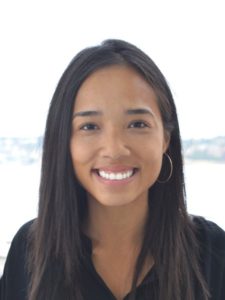
In her position as an Assistant Professor of Epidemiology in the Epidemiology Program, Division of Public Health Sciences, at Fred Hutchinson Cancer Research Center, Trang VoPham investigates environmental risk factors for cancer using geospatial methods to understand how place or location might impact health. VoPham has seen a recent emphasis on geospatial science in jobs advertisements for cancer centers, a sign that geospatial skills can be “highly valuable and useful in careers related to epidemiology and environmental health.”

Learn more about Geography Careers on the recently updated AAG Jobs & Careers website.

December Member Updates

The latest news about AAG Members.

Guo Chen (Michigan State University) received an Outstanding Service Award from AAG-China Geography Specialty Group. This award is presented to the individuals who provided significant services to the China Geography Specialty Group or made important contributions to the advancement of China geography studies.

The China Geography Specialty Group also presented the Student Paper Award to Ronghao Jiang (Hong Kong University), and two Student Travel Awards to Samuel Kay (Ohio State University) and Jiang Chang (Michigan State University). These student awards recognize excellent student papers presented in CGSG-sponsored sessions at the AAG annual meeting, and testify to the hard work invested by students, mentors and institutions supporting them, to generate outstanding research.

RESOURCES AND OPPORTUNITIES

Free Access: 49 Articles on Black Geographies and Racial Justice

In response to the call for more open access to vital scholarship on anti-Blackness and racism, issued by the Black Geographies Specialty Group last June and supported by 37 other AAG Specialty and Affinity Groups in their own letters, AAG and Taylor & Francis are providing free access to 49 articles from our journals through December 31, 2020. AAG acknowledges that this is but one action we must take toward creating a more representative discipline that fully responds to the urgency of confronting and defeating systemic racism, within our discipline and in society at large.

See the articles.

End of Year Deadlines for Grants and Awards, Students and Professionals

awards_hi-res-300x160-1

As the calendar year comes to a close, several deadlines for grants and awards are approaching. December 31st marks the deadline for multiple student awards such as the AAG Dissertation Research Grants  or the Hess Community College Geography Scholarship. Students and professionals are invited to apply for fieldwork related awards through either an AAG Research Grant or the Anne White Fund, both also due on December 31st. Nominations are currently being solicited for a variety of books in geography awards including the Globe Book Award, the Jackson Prize, and the Meridian Book Award, all of which are due on December 31st. Members may also nominate their colleagues for the Glenda Laws Award for social justice and the Harold M. Rose Award for anti-racism research and practice as well as the AAG Wilbanks Prize for Transformational Research in Geography. For colleagues who have made contributions to geography in teaching, consider nominations to the Harm J. de Blij Award for Excellence in Undergraduate Geography Teaching or the AAG E. Willard and Ruby S. Miller Award, both also due December 31st.

See all grants and awards deadlines.

Call for Submissions for you are here

you-are-here-290x290-1

you are here: the journal of creative geography is now accepting submissions for the 2021 issue: bodies & politics. This issue will focus on the significance and political potentials of bodies and embodiment in the current political moment. Please see the full call for submissions on the you are here website. you are here is an annual publication produced by graduate students at the University of Arizona School of Geography, Development, and Environment. The journal seeks to explore geographic themes through poetry, creative writing, maps, photographs, visual art, sonic art, film, and other imaginable genres. you are here encourages submissions from geographers, historians, anthropologists, architects, scientists, writers, artists, activists and anyone else interested in exploring creative geography.

Submissions are due January 12, 2021, by the end of the day. For details of submission guidelines and process, visit the website.

December Kauffman Foundation Early-stage Researcher Professional Development Series

Kauffmann-300x110-1

The next virtual Early-Stage Research Professional Development session will take place 1 p.m. CST December 11, 2020 with mentors Jason P. Brown, a Research and Policy Officer in the Economic Research Department of the Federal Reserve Bank of Kansas City and Peter G. Klein, W. W. Caruth Endowed Chair, Professor of Entrepreneurship, and Chair of the Department of Entrepreneurship and Corporate Innovation at Baylor University Hankamer School of Business. This series is open to 15 early-stage researchers to connect with research mentors to discuss research approaches, professional development and the research career trajectory.

Register here for the December session.

IN MEMORIAM

The AAG is saddened to hear of the passing of these colleagues.

Alex Trebek, the Jeopardy! host, passed away on November 8, 2020 at the age of 80 surrounded by family and friends. The broadcaster turned game show host was endeared by millions. Trebek was a lifelong lover of geography and hosted the National Geographic Bee for 25 years from 1989 to 2013. He championed for geographic education and encouraged students to be knowledgeable on the world around them.

Jan Morris, the Welsh historian and travel writer died November 20, 2020 at the age of 94. Morris wrote extensively about history, the details of place, and her life as a transgender woman. Morris covered the first ascent of Mount Everest with Edmund Hillary in 1953 and continued to write about some of the most important moments in history. Her work reinvented travel writing and her book, Conundrum discusses transexuality and opened doors to pioneering gender geographies.

FEATURED ARTICLES

The Advancement of Location Analytics in Business Schools

By Joseph Kerski
insurance-300x126-1

A quiet geographic revolution is occurring on many university and college campuses around the world. Faculty and students in schools and colleges of business are increasingly turning to GIS tools and data in instruction and research. Given that business has always been about “location, location, location,” it makes sense that educators seeking to prepare their students for the workplace are doing so. Yet location analytics, as it is most often called in business schools, took some years to gain a firm foothold. Why is this the case, what are the implications, and how can the geography community assist with these exciting developments?

Continue reading.

GEOGRAPHERS IN THE NEWS
  • Danny Dorling, Halford Mackinder professor of human geography at Oxford University, discusses the geographies of COVID-19 in England in The Guardian
  • Stefan Gössling, a Swedish professor at the Linnaeus University School of Business and Economics produced studies on how global aviation is contributing to the climate crisis and is interviewed by The Guardian
  • Marynia Kolak, a health geographer at the University of Chicago claims social determinants are key to understanding the pandemic in The Chicago Maroon
  • Jola Ajibade, assistant professor at Portland State University, is interviewed by Yale Environment 360 about how managed retreat programs need to adapt and become equitable amongst rising seas and the increasing risks of living on the world’s coasts.
  • Ruth DeFries, an environmental geographer and professor at Columbia University is interviewed in State of the Planet about her new book on adopting strategies from the natural world to solve world problems.
EVENTS CALENDAR
    Share

Newsletter – November 2020

PRESIDENT’S COLUMN

Advocate for Geography in Austerity

By Amy Lobben

Better_Days_Ahead_IanTaylor_Unsplash-300x169-1This month I will begin a two-part column on what geography departments can do (and should not do) to advocate for their work in budget talks, which are all the more crucial during the COVID-19 pandemic. These points are largely derived from answers I received from geographers in upper administrative positions at universities.

If 2020 has taught us nothing else, it is that geography is a crucial discipline for grasping and addressing the dire issues our earth faces. Yet in a year that has demonstrated our value, some of our geography departments continue to struggle for relevancy of university campuses.

Continue Reading.

ANNUAL MEETING

AAG Annual Meeting Goes Virtual for 2021

AM2021V-1000X1000sq-290x290-1

In mid-November, AAG made the difficult but necessary decision to shift the 2021 annual meeting to a completely virtual experience. While we are encouraged by recent news of breakthrough treatment and prevention options for COVID-19, the pandemic’s current trajectory indicates that it won’t be fully resolved by April. A streamlined process is in place to help session and activity organizers bring their programming to the virtual environment, with the assistance of AAG staff. The shift to virtual does not affect any of our existing deadlines for registration, submissions, or session organizing. We want to thank you for being part of the AAG community. Your presence and support mean the world to us.

PUBLICATIONS

Journals-newsletter-100-1Read the latest issues of all of the AAG journals online:

• Annals of the American Association of Geographers
• The Professional Geographer
• GeoHumanities
• The AAG Review of Books

New issue of African Geographical Review

African-Geographical-Review-cvr-212x300-1The latest issue of the journal of the Africa Specialty Group of the AAG, the African Geographical Review, has recently been published. Volume 39, Issue 4 (December 2020) is available online for subscribers and members of the Africa Specialty Group. The latest issue contains six articles covering all sub-fields of geography and one article commentary, to enhance the standing of African regional geography, and to promote a better representation of African scholarship.

See more about the journal.

ASSOCIATION NEWS

Thank you for your support of the Bridging the Digital Divide Fund

BDD_testamony-300x169-1Our thanks to members and supporters who made gifts on Giving Tuesday, December 1st, to AAG’s Bridging the Digital Divide Fund. We received 37 donations, and hope to reach 100 by the end of the month.

Bridging the Digital Divide addresses the technology gap that affects too many students–particularly those who are enrolled at minority-serving institutions–who cannot afford personal computers, software, and internet access. The pandemic interfered with the education of many geography students at minority-serving institutions, affecting their ability to complete or even enroll in classes, and causing them to postpone their education as they were unable to connect remotely to the classroom.

Right now, AAG is working with faculty at eight Tribal Colleges and Universities, fourteen Historically Black Colleges and Universities, and one predominantly Black institution to close the technology gap. AAG has provided funds for these geography programs to purchase laptops, software, and internet connections for their students. More than 200 geography students benefited this semester, and we hope to expand the program.

The digital divide existed before COVID-19 and will not go away even as solutions to the pandemic begin to emerge. There’s still time to make a gift. Our collective action will help to leverage industry and foundation partners. No matter the size of your gift, it will make a difference.

Give Now to Bridging the Digital Divide.

Congratulations to Outstanding Graduate Student Papers from Regional Meetings

Regional_Divisions_interactive_map467-300x204-1The AAG is proud to announce the Fall 2020 student winners of the AAG Council Award for Outstanding Graduate Student Paper at a Regional Meeting. The annual award, designed to both encourage regional meeting participation and support AAG Annual Meeting attendance, is granted to one student from each division as decided by regional division board members. The winners from each region will present their work in two dedicated sessions at the 2021 AAG Annual Meeting. Congratulations to all of the students who participated!

Read more about the recipients.

Call for Proposals: AAG Learning Series on Graduate Research Methods in COVID-19

Geography-Methods-during-a-Pandemic-flipped-300x124-1AAG has issued a new call for proposals, seeking instructors and graduate assistants for its  Learning Series for Graduate Students this spring. To support graduate students in adapting in their research during COVID-19, AAG seeks instructors at all levels and in all sectors (professionals  lecturers, and faculty from early to advanced career) to develop virtual seminars or workshops.

For workshops and seminars developed by one instructor, AAG will pay the instructor $1,500, and for those developed by more than one instructor, AAG will pay $1,000 per instructor. Proposals with multiple instructors must include clearly defined roles and responsibilities. AAG is also offering a $100 stipend for up to four graduate students to assist instructor(s) during interactive sessions. If selected, the instructor(s) will be able to pick a week between March and June 2021 during which they will offer the seminar or workshop.

The deadline to apply is on or before Thursday, January 14, 2021. See more details and apply here.

Get ready for the 2021 AAG Election

Election-button-1

The AAG election will be conducted online again, and voting will take place January 7-28, 2021. Each member who has an email address on record with the AAG will receive a special email with a code that will allow them to sign in to our AAG SimplyVoting website and vote. It’s important to update your email address in your AAG account to ensure you receive the email ballot. The 2021 election slate will be published soon.

Be prepared for the election.

POLICY CORNER

2021 Redistricting: How Geographers Can Get Involved

US_Capitol-2

The U.S. Census Bureau is quickly approaching their Dec. 31st deadline to report all population counts in order for states to proceed with the 2021 redistricting process. Due to complications and some irregularities revealed from the 2020 Census, however, the bureau runs a real risk of missing that deadline. These “processing anomalies” have shown some major inconsistencies that could take weeks to rectify. But once disclosed, the state population reports signify the kickoff of next year’s nationwide redistricting.

Geographers have been conducting extensive work on gerrymandering and the redistricting process for years. While these researchers demonstrate great expertise and experience, it is clear that anyone with strong geospatial understanding has something to contribute to the redistricting process. It’s a perspective that redistricting officials sorely need, but often lack. And you do not have to be a GIS expert to get involved.

If you have as little as 15 minutes, you can make an impact. The AAG has compiled the following guide on Four Ways You Can Make an Impact on Gerrymandering and Redistricting.

In the News:

  • Congress is voting to extend government funding at current FY20 levels to avert a government shutdown Friday. The extension will last only one week with the goal of finalizing FY21 appropriations before adjourning for the holiday recess. 
  • Negotiations continue for a COVID relief package that both parties can agree on. A bipartisan group of Senators is working on a compromise bill that comes in at $908 billion. If a deal can be reached, it will be considered as part of the FY21 appropriations package.
  • NSF is inviting proposals for new SBE-led initiatives on strengthening infrastructure, broadening participation in entrepreneurship, and enhancing social science capacity at minority-serving institutions.
MEMBER NEWS

Profiles of Professional Geographers

Trang_VoPham_crop2_1-225x300-1

In her position as an Assistant Professor of Epidemiology in the Epidemiology Program, Division of Public Health Sciences, at Fred Hutchinson Cancer Research Center, Trang VoPham investigates environmental risk factors for cancer using geospatial methods to understand how place or location might impact health. VoPham has seen a recent emphasis on geospatial science in jobs advertisements for cancer centers, a sign that geospatial skills can be “highly valuable and useful in careers related to epidemiology and environmental health.”

Learn more about Geography Careers on the recently updated AAG Jobs & Careers website.

December Member Updates

The latest news about AAG Members.

Guo Chen (Michigan State University) received an Outstanding Service Award from AAG-China Geography Specialty Group. This award is presented to the individuals who provided significant services to the China Geography Specialty Group or made important contributions to the advancement of China geography studies.

The China Geography Specialty Group also presented the Student Paper Award to Ronghao Jiang (Hong Kong University), and two Student Travel Awards to Samuel Kay (Ohio State University) and Jiang Chang (Michigan State University). These student awards recognize excellent student papers presented in CGSG-sponsored sessions at the AAG annual meeting, and testify to the hard work invested by students, mentors and institutions supporting them, to generate outstanding research.

RESOURCES AND OPPORTUNITIES

Free Access: 49 Articles on Black Geographies and Racial Justice

In response to the call for more open access to vital scholarship on anti-Blackness and racism, issued by the Black Geographies Specialty Group last June and supported by 37 other AAG Specialty and Affinity Groups in their own letters, AAG and Taylor & Francis are providing free access to 49 articles from our journals through December 31, 2020. AAG acknowledges that this is but one action we must take toward creating a more representative discipline that fully responds to the urgency of confronting and defeating systemic racism, within our discipline and in society at large.

See the articles.

End of Year Deadlines for Grants and Awards, Students and Professionals

awards_hi-res-300x160-1

As the calendar year comes to a close, several deadlines for grants and awards are approaching. December 31st marks the deadline for multiple student awards such as the AAG Dissertation Research Grants  or the Hess Community College Geography Scholarship. Students and professionals are invited to apply for fieldwork related awards through either an AAG Research Grant or the Anne White Fund, both also due on December 31st. Nominations are currently being solicited for a variety of books in geography awards including the Globe Book Award, the Jackson Prize, and the Meridian Book Award, all of which are due on December 31st. Members may also nominate their colleagues for the Glenda Laws Award for social justice and the Harold M. Rose Award for anti-racism research and practice as well as the AAG Wilbanks Prize for Transformational Research in Geography. For colleagues who have made contributions to geography in teaching, consider nominations to the Harm J. de Blij Award for Excellence in Undergraduate Geography Teaching or the AAG E. Willard and Ruby S. Miller Award, both also due December 31st.

See all grants and awards deadlines.

Call for Submissions for you are here

you-are-here-290x290-1

you are here: the journal of creative geography is now accepting submissions for the 2021 issue: bodies & politics. This issue will focus on the significance and political potentials of bodies and embodiment in the current political moment. Please see the full call for submissions on the you are here website. you are here is an annual publication produced by graduate students at the University of Arizona School of Geography, Development, and Environment. The journal seeks to explore geographic themes through poetry, creative writing, maps, photographs, visual art, sonic art, film, and other imaginable genres. you are here encourages submissions from geographers, historians, anthropologists, architects, scientists, writers, artists, activists and anyone else interested in exploring creative geography.

Submissions are due January 12, 2021, by the end of the day. For details of submission guidelines and process, visit the website.

December Kauffman Foundation Early-stage Researcher Professional Development Series

Kauffmann-300x110-1

The next virtual Early-Stage Research Professional Development session will take place 1 p.m. CST December 11, 2020 with mentors Jason P. Brown, a Research and Policy Officer in the Economic Research Department of the Federal Reserve Bank of Kansas City and Peter G. Klein, W. W. Caruth Endowed Chair, Professor of Entrepreneurship, and Chair of the Department of Entrepreneurship and Corporate Innovation at Baylor University Hankamer School of Business. This series is open to 15 early-stage researchers to connect with research mentors to discuss research approaches, professional development and the research career trajectory.

Register here for the December session.

IN MEMORIAM

The AAG is saddened to hear of the passing of these colleagues.

Alex Trebek, the Jeopardy! host, passed away on November 8, 2020 at the age of 80 surrounded by family and friends. The broadcaster turned game show host was endeared by millions. Trebek was a lifelong lover of geography and hosted the National Geographic Bee for 25 years from 1989 to 2013. He championed for geographic education and encouraged students to be knowledgeable on the world around them.

Jan Morris, the Welsh historian and travel writer died November 20, 2020 at the age of 94. Morris wrote extensively about history, the details of place, and her life as a transgender woman. Morris covered the first ascent of Mount Everest with Edmund Hillary in 1953 and continued to write about some of the most important moments in history. Her work reinvented travel writing and her book, Conundrum discusses transexuality and opened doors to pioneering gender geographies.

FEATURED ARTICLES

The Advancement of Location Analytics in Business Schools

By Joseph Kerski

insurance-300x126-1

A quiet geographic revolution is occurring on many university and college campuses around the world. Faculty and students in schools and colleges of business are increasingly turning to GIS tools and data in instruction and research. Given that business has always been about “location, location, location,” it makes sense that educators seeking to prepare their students for the workplace are doing so. Yet location analytics, as it is most often called in business schools, took some years to gain a firm foothold. Why is this the case, what are the implications, and how can the geography community assist with these exciting developments?

Continue reading.

GEOGRAPHERS IN THE NEWS
  • Danny Dorling, Halford Mackinder professor of human geography at Oxford University, discusses the geographies of COVID-19 in England in The Guardian
  • Stefan Gössling, a Swedish professor at the Linnaeus University School of Business and Economics produced studies on how global aviation is contributing to the climate crisis and is interviewed by The Guardian
  • Marynia Kolak, a health geographer at the University of Chicago claims social determinants are key to understanding the pandemic in The Chicago Maroon
  • Jola Ajibade, assistant professor at Portland State University, is interviewed by Yale Environment 360 about how managed retreat programs need to adapt and become equitable amongst rising seas and the increasing risks of living on the world’s coasts.
  • Ruth DeFries, an environmental geographer and professor at Columbia University is interviewed in State of the Planet about her new book on adopting strategies from the natural world to solve world problems.
EVENTS CALENDAR
    Share

Vote for Geography

No matter what happens with this week’s election, the United States will pivot.

Four years ago, most people in my life expressed horror, shock, and disgust following the presidential election in the United States. The day after the election, I shared with my husband my apprehensive relief following the results. I’ll explain.

I grew-up in Atlanta. Looking back, it seems that I may never again live in a place with such diversity. I spent my primary, secondary, and post-secondary school life living in a world of open sexism and racism. Then I moved, first to East Lansing, Michigan and then to Eugene, Oregon. My children mostly grew-up in Eugene. While beautiful, I often say that my biggest parenting regret has been raising my children in a loaf of Wonder Bread—white, white, white—slice after homogeneous slice.

I realized that once out of the south, sexism and racism still exist. They’re just packaged differently. Their insidiousness is delivered with smiles and well-meaning comments. I have had different versions of this conversation many times:

Person: “Oh, you’re from the south. They’re so racist down there.”

Amy: “Yes. But, there’s racism here too.”

Person (a counter argument, usually centered around a sentiment like): “How can we be racist when there aren’t many Black people here” or, “I am color blind in my beliefs.”

How indeed can we participate in “-isms if our gut, our heart tells us we are not that way? Remember Stephen Colbert’s “truthiness”? Try googling it if you do not.

That’s when I realized that the most sneaky and powerful form of racism…the one that perpetuates it…is the one that refuses to be acknowledged: the denied racism.

I’ve heard some people argue that the reason behind denied racism, denied sexism, denied ableism, and denied other-isms is as simple as not having the lived experience. Maybe Harper Lee sums it up well: “You never really understand a person until you consider things from his point of view.” (Atticus to Scout in To Kill a Mockingbird).

My proposition for the real reason behind denied bias is less merciful. The denial of racism, just like the denial of sexism, ableism, and any other “-ism” is what gives those biases their core strength. We know that denial is not merely human nature. In fact, the human brain uses denial as a way of helping us process difficult truths, such as when we experience a traumatic event. We are literally programmed to use denial as a tool to protect ourselves from the reality that is happening in our lives.

Denial of existing biases is about identity. Denial allows us to look away from reality and see what we need to see. We use denial so that we don’t feel bad about our own identify, our self-respect, our global understanding, and our society. Confronting such deeply-entrenched denial requires something extraordinarily powerful to happen.

So, thinking that the election results may be the extraordinarily powerful event to wake people from their denied-bias slumber, I experienced apprehensive relief following the 2016 election. Relief because the election would reveal, finally, how broadly and deeply rooted many forms of bias are in America. Apprehensive because pulling off that big ugly bandage would uncover a festering and extremely painful wound.

Four years later, it is now critical to ensure that another denial doesn’t take hold—the denial of root causes and our responsibility.

There are so many specific events over the past four years for which we can be angry with current leadership: hideous comments about women, refusal to condemn white supremacy, overtly racist practices, publicly mocking people with disabilities…there have been so many atrocious acts these past four years that it’s impossible to provide a complete list. But…

I believe that anger at leadership for causing these rifts is largely misplaced. Our current leadership did not create the painful wounds of bias: racism, sexism, ableism…fill-in-the-blank-ism. Rather, our current leadership simply reflects America’s long-standing EverythingOtherThanAbleBodiedWhiteMale-ism. Leadership merely gives voice to a widely accepted set of beliefs based in collective biases.

It is those shared biases that deserve our introspection and disgust.

In moving forward, the emotional healing process includes four to seven stages, depending on whom you ask. Regardless of the source, stages present in a sequence similar to this: 1) Denial, 2) Anger/Expression, 3) Reflection, 4) Transformation, and 5) Corrective Experiences.

Our current leadership has been very effective in starting the process to move us out of Stage 1 and into Stage 2. And, now his work is done. We need a new form of leadership to continue. The next Stages are harder. We held on to and denied our biases for too long to think that they will magically transform to Corrective Experiences. For those difficult Stages, we need leadership that demonstrates decency, maturity, integrity, grace, strength, and empathy.

We need leadership who understands that we cannot stay in the Stage of Anger/Expression without causing new wounds. We also need leadership that understands interconnectedness of social foundations, and that moving toward Corrective Experiences has to happen through strong societal infrastructure.

But that is not all. Just as compelling (especially for geography) is the need to vote for science. In the past four years, science has experienced a marked uptick in interference, contempt, dismantling of research data, personal attacks, and an overall assault on validity of scientific research from our leadership. Much of the American public has followed.

Now, read that paragraph once more and substitute “education” for “science.”

Again, leaders don’t create EverythingOtherThanAbleBodiedWhiteMale-ism. Rather it’s the persistent existence of -isms that creates leaders who mirror those biases. Voters choose leaders who best represent their beliefs. In response to outcries of racism- and sexism-motivated voting in the last election, how often did you hear angry, defensive words such as “I voted for leadership because of x,y,z policy. I don’t support their sexist, racist, ableist views.”

Bullshit.

Acceptance of sexism IS sexism. Acceptance of racism IS racism. Acceptance of ableism IS ableism. And…voting for a sexist is sexism. Voting for a racist is racism. Voting for an ableist is ableism.

So, regardless of the outcome of this election, we will pivot—backward or forward.

The bandage has already been yanked off. We don’t need to go back.

I plan to…Vote for science. Vote for education. Vote for decency, empathy, grace and intelligence. Vote for geography.

—Amy Lobben
AAG President and Professor at University of Oregon
lobben [at] uoregon [dot] edu

DOI: 10.14433/2017.0080


Please note: The ideas expressed in the AAG President’s column are not necessarily the views of the AAG as a whole. This column is traditionally a space in which the president may talk about their views or focus during their tenure as president of AAG, or spotlight their areas of professional work. Please feel free to email the president directly at lobben [at] uoregon [dot] edu to enable a constructive discussion.

    Share

Tim Fullman

Education: Ph.D. in Geography (University of Florida), M.S. in Interdisciplinary Ecology (University of Florida), B.S. in Animal Biology (University of California, Davis)

Describe your job. What are some of the most important tasks or duties for which you are responsible?
My job can be broadly defined in two buckets: 1) conducting novel research to better understand wildlife species and their behavior as a means of informing management and conservation, and 2) reviewing and commenting on development proposals or other management actions to advocate for use of the best available scientific information in decision-making.

My current research focuses on caribou movement, habitat use and response to human activities in northern Alaska. In partnership with scientists from federal, state, and regional agencies, industry, and non-governmental organizations, I conduct primary research to identify key caribou migration areas and seasonal habitats and to understand what impacts development may have on caribou populations and the people that rely on them. This information is shared with policy makers to inform decisions about new development proposals, helping to identify where negative impacts to caribou and people can be reduced and what areas should be avoided to provide habitat for caribou and other species. We also publish our findings in peer-reviewed scientific journals to share the information with the broader scientific community.

When new development proposals or management plans, such as environmental impact statements, are made available for public comment by the government, I review them to see how the current state of science regarding caribou is represented. If there are statements or conclusions that appear contrary to scientific understanding, then I make this clear as part of public comments submitted by my organization or other partner groups. For example, during the recent planning process to open the coastal plain of the Arctic National Wildlife Refuge for oil and gas leasing, I provided thorough review and numerous comments about ways that impacts to important caribou calving and post-calving habitat was misrepresented and made suggestions for improvement. The hope is that such efforts will lead to stronger final decisions that balance the needs of people, wildlife, and a healthy environment.

What attracted you to this career path?
In many ways I stumbled into my career field. As I was nearing completion of my Ph.D. I sought a job as a professor. I applied for various jobs, but nothing came of it. Then I saw a posting for a large herbivore ecologist to study caribou movement in Alaska. I had never been to Alaska, nor studied caribou, but having studied elephants in southern Africa I knew something about large herbivore movement, so I applied and got the job. I am so glad that I did!

Working for a non-profit conservation organization has been an excellent fit for me. I get to do research that is tangibly applied to make a difference for conservation. I also have greatly appreciated the flexibility and emphasis on work-life balance shown by my organization. With two young children, I am grateful to avoid the publish or perish mentality faced by friends in academia. I still do scientific research and publish, but do not face the same pressures of possibly losing my job if I do not publish enough.

I also get to step into other opportunities, like serving on the Western Arctic Caribou Herd Working Group. This advisory group of Alaska Native subsistence hunters, reindeer herders, hunting guides, transporters and conservationists works together to ensure the long-term conservation of the Western Arctic Caribou Herd and the people who rely upon it. I have also been able to pursue my interest in building bridges between the scientific and faith communities in Alaska, such as with a series of talks by Dr. Katharine Hayhoe about climate change, energy development and Anchorage that I helped organize in 2019. These opportunities add variety to my work.

How has your education/background in geography prepared you for this position?
I pursued a degree in geography to add a spatial mindset and tools to my wildlife ecology background. This training served me well and was a large part of why I got my job, even without having experience in Alaska or with caribou. Over the last six years working in Alaska, I have met several other geographers working broadly in the field of conservation for universities, agencies and non-profit groups. Our ability as geographers to think spatially about challenges and solutions is very important to enabling us to serve as problem solvers, especially when it comes to land management over broad spatial scales. In addition to the spatial perspective, the specific tools I honed during my geography degree continue to be critically important in both my research and other conservation activities. Whether it is analyzing spatial animal movement datasets or creating maps of areas where caribou calving habitat is expected to be lost under different development proposals, my geography training features strongly in my current work.

What geographic skills and information do you use most often in your work? What general skills and information do you use most often?
I use GIS skills regularly – obtaining/creating spatial data, analyzing it with respect to other data, and creating visualizations to share with colleagues or for publications. I also spend a great deal of my time working in R to conduct analyses, many of which are spatial in nature. While not an exclusively geographic skill, this is one that I learned while earning my geography degree. General skills include scientific writing and communication, strategic thinking and problem solving, and public engagement – from meeting with resource managers, to stakeholders, to community members in the region where I do my research, to members of the general public.

Are there any skills or information you need for your work that you did not obtain through your academic training? If so, how/where did you obtain them?
Yes. Wildlife ecology is a rapidly changing field, with new tools and technologies being developed frequently. One of the most important things I took away from my geography Ph.D. is learning how to learn – the ability to teach myself new things. Now, I may need to learn a new statistical approach, or about a new remote sensing data source, or how to use a platform like Google Earth Engine, yet the baseline of skills I have built during my academic training and the wide array of resources available on the internet, along with the knowledge sets of colleagues who are willing to share their expertise, have been invaluable in allowing me to attain these things.

Do you participate in hiring, screening, or training of new employees? If so, what qualities and/or skills do you look for?
I have served on one hiring committee as well as in the onboarding of new employees. Specific skills vary widely depending on the position. In general, however, we want someone who is passionate about the mission of our organization to unite people to protect America’s wild places. We want someone who thinks strategically and creatively about how to fulfil that mission. We also want someone who cares about doing these things in an equitable and inclusive manner, recognizing that this unfortunately has not been the case too often in the past.

What advice would you give to someone interested in a job like yours?
Build a strong toolkit that includes both analytical skills and a demonstrated ability to communicate clearly in both written and spoken formats. It is important to show what you can do through experiences working with people in communities, even as you conduct research. This shows that you can not only do sound science, but also engage well with stakeholders and other interested parties. In the past, getting hired in many non-profit groups was strongly influenced by who you knew and the connections you had. While this still may be important for many organizations, I am noticing a trend away from this in my organization and some others. There is a recognition that such a perspective reinforces the lack of diversity in many conservation organizations and that we need to be more intentional about casting a wider net and really focusing on must-have skills, rather than prior relationships, when making hiring decisions. This could create new opportunities for job seekers. In light of this, search widely for potential positions that may fit your interests and do not give up even if you do not have specific experience in the field to which you are applying. If you have the necessary skills you still could be very successful in a given role.

What is the occupational outlook for career opportunities in your field/organization, esp. for geographers? At our organization, jobs for researchers are relatively rare. We have hired only one other scientist in the six years that I have been here. There are, however, other opportunities for geographers. For example, we hired both a Cartographer and Enterprise GIS Manager since I started working for The Wilderness Society and have two GIS analysts on staff. While people seem to like working for our organization and turnover is low, there will undoubtedly be other opportunities from time to time in the future. Other organizations may have additional opportunities, both in scientific and non-scientific positions. For example, one of our partner organizations posted both permanent positions for GIS analyst/data managers and short-term positions for staff to work on a specific project over the last few years.

    Share

Newsletter – October 2020

PRESIDENT’S COLUMN

Advocate for Geography in Austerity

By Amy Lobben

Better_Days_Ahead_IanTaylor_Unsplash-300x169-1This month I will begin a two-part column on what geography departments can do (and should not do) to advocate for their work in budget talks, which are all the more crucial during the COVID-19 pandemic. These points are largely derived from answers I received from geographers in upper administrative positions at universities.

If 2020 has taught us nothing else, it is that geography is a crucial discipline for grasping and addressing the dire issues our earth faces. Yet in a year that has demonstrated our value, some of our geography departments continue to struggle for relevancy of university campuses.

Continue Reading.

ANNUAL MEETING

AAG Annual Meeting Goes Virtual for 2021

AM2021V-1000X1000sq-290x290-1

In mid-November, AAG made the difficult but necessary decision to shift the 2021 annual meeting to a completely virtual experience. While we are encouraged by recent news of breakthrough treatment and prevention options for COVID-19, the pandemic’s current trajectory indicates that it won’t be fully resolved by April. A streamlined process is in place to help session and activity organizers bring their programming to the virtual environment, with the assistance of AAG staff. The shift to virtual does not affect any of our existing deadlines for registration, submissions, or session organizing. We want to thank you for being part of the AAG community. Your presence and support mean the world to us.

PUBLICATIONS

Journals-newsletter-100-1Read the latest issues of all of the AAG journals online:

• Annals of the American Association of Geographers
• The Professional Geographer
• GeoHumanities
• The AAG Review of Books

New issue of African Geographical Review

African-Geographical-Review-cvr-212x300-1The latest issue of the journal of the Africa Specialty Group of the AAG, the African Geographical Review, has recently been published. Volume 39, Issue 4 (December 2020) is available online for subscribers and members of the Africa Specialty Group. The latest issue contains six articles covering all sub-fields of geography and one article commentary, to enhance the standing of African regional geography, and to promote a better representation of African scholarship.

See more about the journal.

ASSOCIATION NEWS

Thank you for your support of the Bridging the Digital Divide Fund

BDD_testamony-300x169-1Our thanks to members and supporters who made gifts on Giving Tuesday, December 1st, to AAG’s Bridging the Digital Divide Fund. We received 37 donations, and hope to reach 100 by the end of the month.

Bridging the Digital Divide addresses the technology gap that affects too many students–particularly those who are enrolled at minority-serving institutions–who cannot afford personal computers, software, and internet access. The pandemic interfered with the education of many geography students at minority-serving institutions, affecting their ability to complete or even enroll in classes, and causing them to postpone their education as they were unable to connect remotely to the classroom.

Right now, AAG is working with faculty at eight Tribal Colleges and Universities, fourteen Historically Black Colleges and Universities, and one predominantly Black institution to close the technology gap. AAG has provided funds for these geography programs to purchase laptops, software, and internet connections for their students. More than 200 geography students benefited this semester, and we hope to expand the program.

The digital divide existed before COVID-19 and will not go away even as solutions to the pandemic begin to emerge. There’s still time to make a gift. Our collective action will help to leverage industry and foundation partners. No matter the size of your gift, it will make a difference.

Give Now to Bridging the Digital Divide.

Congratulations to Outstanding Graduate Student Papers from Regional Meetings

Regional_Divisions_interactive_map467-300x204-1The AAG is proud to announce the Fall 2020 student winners of the AAG Council Award for Outstanding Graduate Student Paper at a Regional Meeting. The annual award, designed to both encourage regional meeting participation and support AAG Annual Meeting attendance, is granted to one student from each division as decided by regional division board members. The winners from each region will present their work in two dedicated sessions at the 2021 AAG Annual Meeting. Congratulations to all of the students who participated!

Read more about the recipients.

Call for Proposals: AAG Learning Series on Graduate Research Methods in COVID-19

Geography-Methods-during-a-Pandemic-flipped-300x124-1AAG has issued a new call for proposals, seeking instructors and graduate assistants for its  Learning Series for Graduate Students this spring. To support graduate students in adapting in their research during COVID-19, AAG seeks instructors at all levels and in all sectors (professionals  lecturers, and faculty from early to advanced career) to develop virtual seminars or workshops.

For workshops and seminars developed by one instructor, AAG will pay the instructor $1,500, and for those developed by more than one instructor, AAG will pay $1,000 per instructor. Proposals with multiple instructors must include clearly defined roles and responsibilities. AAG is also offering a $100 stipend for up to four graduate students to assist instructor(s) during interactive sessions. If selected, the instructor(s) will be able to pick a week between March and June 2021 during which they will offer the seminar or workshop.

The deadline to apply is on or before Thursday, January 14, 2021. See more details and apply here.

Get ready for the 2021 AAG Election

Election-button-1

The AAG election will be conducted online again, and voting will take place January 7-28, 2021. Each member who has an email address on record with the AAG will receive a special email with a code that will allow them to sign in to our AAG SimplyVoting website and vote. It’s important to update your email address in your AAG account to ensure you receive the email ballot. The 2021 election slate will be published soon.

Be prepared for the election.

POLICY CORNER

2021 Redistricting: How Geographers Can Get Involved

US_Capitol-2

The U.S. Census Bureau is quickly approaching their Dec. 31st deadline to report all population counts in order for states to proceed with the 2021 redistricting process. Due to complications and some irregularities revealed from the 2020 Census, however, the bureau runs a real risk of missing that deadline. These “processing anomalies” have shown some major inconsistencies that could take weeks to rectify. But once disclosed, the state population reports signify the kickoff of next year’s nationwide redistricting.

Geographers have been conducting extensive work on gerrymandering and the redistricting process for years. While these researchers demonstrate great expertise and experience, it is clear that anyone with strong geospatial understanding has something to contribute to the redistricting process. It’s a perspective that redistricting officials sorely need, but often lack. And you do not have to be a GIS expert to get involved.

If you have as little as 15 minutes, you can make an impact. The AAG has compiled the following guide on Four Ways You Can Make an Impact on Gerrymandering and Redistricting.

In the News:

  • Congress is voting to extend government funding at current FY20 levels to avert a government shutdown Friday. The extension will last only one week with the goal of finalizing FY21 appropriations before adjourning for the holiday recess. 
  • Negotiations continue for a COVID relief package that both parties can agree on. A bipartisan group of Senators is working on a compromise bill that comes in at $908 billion. If a deal can be reached, it will be considered as part of the FY21 appropriations package.
  • NSF is inviting proposals for new SBE-led initiatives on strengthening infrastructure, broadening participation in entrepreneurship, and enhancing social science capacity at minority-serving institutions.
MEMBER NEWS

Profiles of Professional Geographers

Trang_VoPham_crop2_1-225x300-1

In her position as an Assistant Professor of Epidemiology in the Epidemiology Program, Division of Public Health Sciences, at Fred Hutchinson Cancer Research Center, Trang VoPham investigates environmental risk factors for cancer using geospatial methods to understand how place or location might impact health. VoPham has seen a recent emphasis on geospatial science in jobs advertisements for cancer centers, a sign that geospatial skills can be “highly valuable and useful in careers related to epidemiology and environmental health.”

Learn more about Geography Careers on the recently updated AAG Jobs & Careers website.

December Member Updates

The latest news about AAG Members.

Guo Chen (Michigan State University) received an Outstanding Service Award from AAG-China Geography Specialty Group. This award is presented to the individuals who provided significant services to the China Geography Specialty Group or made important contributions to the advancement of China geography studies.

The China Geography Specialty Group also presented the Student Paper Award to Ronghao Jiang (Hong Kong University), and two Student Travel Awards to Samuel Kay (Ohio State University) and Jiang Chang (Michigan State University). These student awards recognize excellent student papers presented in CGSG-sponsored sessions at the AAG annual meeting, and testify to the hard work invested by students, mentors and institutions supporting them, to generate outstanding research.

RESOURCES AND OPPORTUNITIES

Free Access: 49 Articles on Black Geographies and Racial Justice

In response to the call for more open access to vital scholarship on anti-Blackness and racism, issued by the Black Geographies Specialty Group last June and supported by 37 other AAG Specialty and Affinity Groups in their own letters, AAG and Taylor & Francis are providing free access to 49 articles from our journals through December 31, 2020. AAG acknowledges that this is but one action we must take toward creating a more representative discipline that fully responds to the urgency of confronting and defeating systemic racism, within our discipline and in society at large.

See the articles.

End of Year Deadlines for Grants and Awards, Students and Professionals

awards_hi-res-300x160-1

As the calendar year comes to a close, several deadlines for grants and awards are approaching. December 31st marks the deadline for multiple student awards such as the AAG Dissertation Research Grants  or the Hess Community College Geography Scholarship. Students and professionals are invited to apply for fieldwork related awards through either an AAG Research Grant or the Anne White Fund, both also due on December 31st. Nominations are currently being solicited for a variety of books in geography awards including the Globe Book Award, the Jackson Prize, and the Meridian Book Award, all of which are due on December 31st. Members may also nominate their colleagues for the Glenda Laws Award for social justice and the Harold M. Rose Award for anti-racism research and practice as well as the AAG Wilbanks Prize for Transformational Research in Geography. For colleagues who have made contributions to geography in teaching, consider nominations to the Harm J. de Blij Award for Excellence in Undergraduate Geography Teaching or the AAG E. Willard and Ruby S. Miller Award, both also due December 31st.

See all grants and awards deadlines.

Call for Submissions for you are here

you-are-here-290x290-1

you are here: the journal of creative geography is now accepting submissions for the 2021 issue: bodies & politics. This issue will focus on the significance and political potentials of bodies and embodiment in the current political moment. Please see the full call for submissions on the you are here website. you are here is an annual publication produced by graduate students at the University of Arizona School of Geography, Development, and Environment. The journal seeks to explore geographic themes through poetry, creative writing, maps, photographs, visual art, sonic art, film, and other imaginable genres. you are here encourages submissions from geographers, historians, anthropologists, architects, scientists, writers, artists, activists and anyone else interested in exploring creative geography.

Submissions are due January 12, 2021, by the end of the day. For details of submission guidelines and process, visit the website.

December Kauffman Foundation Early-stage Researcher Professional Development Series

Kauffmann-300x110-1

The next virtual Early-Stage Research Professional Development session will take place 1 p.m. CST December 11, 2020 with mentors Jason P. Brown, a Research and Policy Officer in the Economic Research Department of the Federal Reserve Bank of Kansas City and Peter G. Klein, W. W. Caruth Endowed Chair, Professor of Entrepreneurship, and Chair of the Department of Entrepreneurship and Corporate Innovation at Baylor University Hankamer School of Business. This series is open to 15 early-stage researchers to connect with research mentors to discuss research approaches, professional development and the research career trajectory.

Register here for the December session.

IN MEMORIAM

The AAG is saddened to hear of the passing of these colleagues.

Alex Trebek, the Jeopardy! host, passed away on November 8, 2020 at the age of 80 surrounded by family and friends. The broadcaster turned game show host was endeared by millions. Trebek was a lifelong lover of geography and hosted the National Geographic Bee for 25 years from 1989 to 2013. He championed for geographic education and encouraged students to be knowledgeable on the world around them.

Jan Morris, the Welsh historian and travel writer died November 20, 2020 at the age of 94. Morris wrote extensively about history, the details of place, and her life as a transgender woman. Morris covered the first ascent of Mount Everest with Edmund Hillary in 1953 and continued to write about some of the most important moments in history. Her work reinvented travel writing and her book, Conundrum discusses transexuality and opened doors to pioneering gender geographies.

FEATURED ARTICLES

The Advancement of Location Analytics in Business Schools

By Joseph Kerski

insurance-300x126-1

A quiet geographic revolution is occurring on many university and college campuses around the world. Faculty and students in schools and colleges of business are increasingly turning to GIS tools and data in instruction and research. Given that business has always been about “location, location, location,” it makes sense that educators seeking to prepare their students for the workplace are doing so. Yet location analytics, as it is most often called in business schools, took some years to gain a firm foothold. Why is this the case, what are the implications, and how can the geography community assist with these exciting developments?

Continue reading.

GEOGRAPHERS IN THE NEWS
  • Danny Dorling, Halford Mackinder professor of human geography at Oxford University, discusses the geographies of COVID-19 in England in The Guardian
  • Stefan Gössling, a Swedish professor at the Linnaeus University School of Business and Economics produced studies on how global aviation is contributing to the climate crisis and is interviewed by The Guardian
  • Marynia Kolak, a health geographer at the University of Chicago claims social determinants are key to understanding the pandemic in The Chicago Maroon
  • Jola Ajibade, assistant professor at Portland State University, is interviewed by Yale Environment 360 about how managed retreat programs need to adapt and become equitable amongst rising seas and the increasing risks of living on the world’s coasts.
  • Ruth DeFries, an environmental geographer and professor at Columbia University is interviewed in State of the Planet about her new book on adopting strategies from the natural world to solve world problems.
EVENTS CALENDAR
    Share

AAG Highlights Advancing Discipline Diversity During Geography Awareness Week at Michigan State University

Photo 1 Yoruba Richen, filmmaker and director, speaks during the AAG ceremony at MSU during Geography Awareness Week in 2019. (Photo credit: Jacqueline Hawthorne)

As part of its annual celebration of Geography Awareness Week, the Department of Geography, Environment, and Spatial Sciences at Michigan State University (MSU), featured a screening of The Smithsonian Channel’s The Green Book: A Guide to Freedom followed by an engaging Q & A session with filmmaker and director Yoruba Richen. Richen’s film takes an in-depth look into the real story of Victor H. Green’s The Negro Motorist Green Book, during the Jim Crow era and beyond.

A $10,000 check was presented to the department on behalf of the American Association of Geographers (AAG) during the event held at the Clifton & Dolores Wharton Center for Performing Arts on the campus of MSU on November 14, 2019. This award denoted the first installment of a $30,000 gift in support of the Advancing Geography Through Diversity Program (AGTDP) initiative to support underrepresented graduate students who are African-American, Latinx, and Native American.

Photo 2 Dr. Karen Johnson-Webb speaks during the AAG ceremony at MSU during Geography Awareness Week in 2019. Johnson-Webb is a Professor of Geography at Bowling Green State University (BGSU) and serves as the elected secretary to the executive committee of the American Association of Geographers (AAG). Before earning her Ph.D. from the University of North Carolina at Chapel Hill, Johnson-Webb, a human geographer specializing in health and medical geography, earned a BA and an MA in Geography from MSU. (Photo credit: Jacqueline Hawthorne)

The Advancing Geography Through Diversity Program (AGTDP) at MSU is a nationally recognized initiative facilitating diversity within the discipline of Geography. The program’s goal is to recruit and support outstanding graduate students from key underrepresented groups, who are seeking to obtain either a Master’s or Doctorate in Geography. Students admitted to the MSU Department of Geography, Environment, and Spatial Sciences via AGTDP receive full funding.

Following a few brief remarks by Richen, Dr. Karen Johnson-Webb, Associate Professor of Geography at Bowling Green State University, and elected secretary to the executive committee of the AAG, presented the check in support of the professional development of underrepresented graduate students within the department. Before earning her Ph.D. from the University of North Carolina at Chapel Hill, Johnson-Webb, a human geographer specializing in health and medical geography, earned a BA and an MA in Geography from MSU. “Shortly before the presentation, I was told that I was the first African-American (U.S.-born) to earn a Master’s degree (1994) in Geography at MSU. This seemed hard to believe,” said Johnson-Webb. “Geography is a very diverse discipline in terms of ethnicity and nationality. However, scholars of African American, Hispanic American, and American Indian heritage are grossly underrepresented.”

Dr. Johnson-Webb commended the department for making a concerted effort to recruit and fund underrepresented scholars in geography. She also praised MSU’s Dr. Joe Darden, a professor of Geography for nearly 50 years and recipient of the 2019 AAG Lifetime Achievement Award, for his tireless efforts both in the department and in the discipline to increase diversity. Darden has served as a mentor to countless students and is also the recipient of MSU’s Distinguished Faculty Award (1984), the Ethnic Geography Specialty Group’s Distinguished Scholar Award (2006), the AAG Enhancing Diversity Award (2006), and the Distinguished Ethnic Geography Career Award (2015), and was elected to the inaugural cohort of AAG Fellows in 2018.

Photo 3 Rachel Croson, Former Dean of the College of Social Science, accepts a check presented by Dr. Karen Webb-Johnson on behalf of AAG. From left to right: Dr. Karen Johnson-Webb, Professor of Geography at BGSU and AAG Secretary; Rachel Croson, former Dean of the College of Social Science, Dr. Joe T Darden, Professor of Geography; and Dr. Dee Jordan, recent Ph.D. graduate and second African-American woman to receive a doctorate from the Department of Geography. (Photo Courtesy of Dee Jordan)

“I am honored to be a member of this pioneering initiative. AGTDP has facilitated the building of a lifelong network of support,” said Cordelia Martin, a health geographer pursuing her Ph.D. in MSU’s Global Urban Studies Program (GUSP). “I am inspired by the talent and passion of my fellow members, and I know they will go forward and be forces of progressive change within their local and global communities.”

Angie Sanchez, a Ph.D. student, says she has benefitted from AGTDP in several ways. “First off, the camaraderie build with other AGTDP scholars has been lifesaving during my first year as a Ph.D. student,” she said. “We have built a system of folks that understand the issues that go on in our lives as minorities, as minority scholars, and as minorities in a predominantly non-diverse field. We support each other through things as simple as having a social hour together, to having write-ins and study groups for classes we end up taking together.” Sanchez also appreciates the access AGTDP has provided to guest speakers such as Dr. Beronda Montgomery. “She has helped guide me through her words and is a support and source of encouragement.”

Funding through AGTDP helps lessen the financial stressors many graduate students face allowing them to focus on their studies. “Because of the financial assistance and support from the AAG, I was able to complete my first year as a doctoral student with a 4.0 and make numerous academic and professional connections,” said Kionna Henderson, pursuing a Ph.D. in Geography after receiving a Master of Public Health degree.

Photo 5 (From left to right) Rachel Croson, former Dean of the College of Social Science, Dr. Joe T Darden, Professor of Geography; and Dr. Dee Jordan, recent Ph.D. graduate and second African-American woman to receive a doctorate from the Department of Geography. (Photo credit: Jacqueline Hawthorne)

MSU is grateful for the ongoing support of AAG and is committed to AGTDP and to expanding the impact of scholars of African American, Hispanic American, and American Indian heritage in the discipline of Geography. For additional information about AGTDP, please visit geo.msu.edu.


    Share

An Interview with AAG Executive Director Gary Langham (Part 2)

Last month I shared Part 1 of an interview I conducted with AAG’s Executive Director Gary Langham to help the membership learn a bit about his perspectives, goals, and personal history that led him to AAG.

We met on August 19, close to the one-year anniversary of his first week in this role—half of which has been during the coronavirus pandemic. The interview lasted for over an hour, generating far too much to publish as a single column. This is the second part, which has been edited for content and clarity.

AMY: What drew you to AAG?

GARY: For the last nine years, I had worked for an environmental and conservation non-profit, the National Audubon Society, where I was Vice President and Chief Scientist. I managed a similar-sized budget and almost twice as many staff. Staff was spread all over the country and worked in different research programs, ranging from marine conservation to climate change research. Many people like birds, but they’re also great for setting conservation priorities and monitoring environmental health. You can use science to show policymakers the connection between bird populations and protected areas, like marine reserves. If the fish-eating birds like puffins aren’t doing well, then the fish stocks aren’t either.

It was a great job with great staff, so the truth is I wasn’t looking for a new position. The AAG’s headhunters called, and they asked me who I thought would be right for the job. So, I gave them some recommendations, and then they said, how come you’re not applying for the job? And I said, what? I’m not a geographer. And they said, no, you should look at the job description again because of your experience—with management, media, fundraising, policy, and non-profits—is what they’re looking for. And I realized that as a trained ecologist, I really am a physical geographer of sorts—I should have been going to the Annual Meeting all along!

AMY: So we had some good headhunters. Excellent! Let’s just stay within the vein of AAG. This is a question that I never really thought about until I took on my current role. AAG just sort of seemed opaque to me until I stepped in as vice president. So what does the AAG Executive Director actually do?

GARY: That’s a great question. My job is to lead our fantastic staff: to help them succeed if they need it and stay out of their way when they don’t. I also oversee our budget and enter into contracts. Council approves the annual budget. It’s my job to keep revenues and expenses in line, develop and maintain partnerships, and ensure that staff is enacting the strategic plan and the long-term vision set by Council.

Those are the nuts and bolts of the job, but I also think about the value proposition for members. How can AAG be the best organization possible for all geographers? For 100 years, it was enough to hold the Annual Meeting and deliver the journals in the mail every month. AAG is at its best when it connects members to each other and to the rest of the world—public, professional, and government. We can help them make connections at any stage of their careers and provide professional services. Our members’ research and ideas are essential to shaping a just and diverse world. AAG must ensure that geographers’ interests are represented in conversations about ethics, policy debates, public perception, and higher education. Geographers are influencers. And, we need to expand our membership base.

AMY: Well, a new model, depending on how it’s structured, would do exactly that: expand and broaden the membership base. As an aside, I have to admit one of the things that I used to love so much about my AAG membership was exactly what you mentioned—getting the journal in the mail. I loved that. But, then that journal just turned into a stack of guilt because I would get them in the mail, and I‘d say, “I’m reading this cover to cover today.” But, eventually, I would put it on top of the previous one, and they all just became this stack of guilt. I still always loved getting it in the mail.

I don’t want to put words into your mouth, so correct me if I’m wrong. But, it sounds like over the past year, you have been thinking that there need to be new models, new approaches to modernize the AAG, so it can be relevant to more groups of geographers. Currently, what do you think that we’re doing well, and where is there an opportunity to grow?

GARY: We have to continue fostering the multi-generational sense of belonging to the AAG. The glue that seems to hold us together is the bonds between mentor and student stretching back in time. We represent 364 academic departments, and I want us to consider this our core to protect and maintain. At the same time, we can offer more to professional geographers and grow our base. When I was interviewing and reading everything online about AAG to understand it, I noticed significant growth in membership numbers over the last 15 years. I thought it must be GIS professionals, and I was shocked to learn that wasn’t true. Instead, it was our international expansion, another area where I think we have lots of growth potential. My biggest regret by far is that I haven’t been to an Annual Meeting yet. So many members to meet and sessions to attend. I can’t wait to do that.

AMY: Okay. Let’s pivot a bit. I’m going to give you the question that I, along with, I assume, many academic geographers get from students and parents. And I’m curious how you answer it. What do you say when someone asks you, “what do geographers actually do?”

GARY: I think of geography as the intersection of people, place, and the environment, though it doesn’t have to be all those things all the time. Truly, you can’t understand anything in this world, past, present or future, without understanding places and spaces. Part of what makes geography so compelling to me is the endless number of ways to explore place and space—you can never run out of new things to learn.

That question and answer then naturally progressed to a discussion about academia and the relevance of geography. I will bring some of the remaining discussion into future columns, though not as an interview transcript. Until we can all meet again in person, I hope that these two parts of the interview allow you to know a bit more about the person who is now running the American Association of Geographers.

—Amy Lobben
AAG President and Professor at University of Oregon
lobben [at] uoregon [dot] edu

DOI: 10.14433/2017.0079

    Share

Xiaohui Liu

Website: https://xiaohuiliu.com/

Education: Ph.D. in Geography (University of Southern Mississippi), M.S. in Geology (Bowling Green State University), B.S. in GIS (Shandong University of Architecture and Engineering, China)

Describe your job. What are some of the most important tasks or duties for which you are responsible?
My job as a geospatial analyst and health disparity researcher aims to identify geographical/environmental factors leading to health disparities, and novel ways to characterize and explain them. Health disparities exist as a result of multiple social, environmental, geopolitical, and economic factors, so a geographical or spatial perspective is indispensable in examining, analyzing, and addressing these disparities.

My routine tasks include proposing research questions, designing research methods, identifying datasets (both spatial and aspatial), conducting analysis, and preparing research manuscripts. My research questions are mostly developed based on identified research gaps and my curiosity about where health disparities exist, among which populations, how they change over time, as well as the potential reasons that cause these disparities. Given the complexity of these questions, integrating and analyzing data from multiple sources is always necessary. For instance, spatial data, survey data, census data, social media data, and biomarker data are often used to support my research.

What attracted you to this career path?
Geography became my favorite subject in middle school. Being the student with the most geographic knowledge in my class helped me build great confidence, which eventually led me to explore a career in geography. After choosing GIS as my undergraduate major, my determination to choose a career as a geographer was enhanced by the joy of creating knowledge from data. Ever since then, I have been consecutively involved in multiple projects funded by U.S. Department of Homeland Security, U.S. National Science Foundation, and Canadian Institutes of Health Research to apply my geospatial knowledge and skills to analyze, model, and visualize problems resulting from the interaction of social and physical environments.

How has your education/background in geography prepared you for this position?
My training in geography has helped me to identify research topics with spatial components and provided me with the skills to conduct research independently. I have also become proficient in performing desktop geospatial analysis, building web-based applications, and developed a self-motivation to keep learning new skills. I believe that all the learning and training experiences have improved my competency in the job market.

What geographic skills and information do you use most often in your work? What general skills and information do you use most often?
Spatial thinking is the core of my geographic skills. On top of that, I am always ready to learn and adopt new approaches, i.e., spatial data science practices, which have helped me to work more efficiently. I use oral and written communication skills daily. I also appreciate teamwork and being able to learn from others.

Are there any skills or information you need for your work that you did not obtain through your academic training? If so, how/where did you obtain them?
Yes; the skills I learned at school have only provided me with a foundation, while those I learned and developed through my work have been key in helping me thrive. I actively seek information from all sorts of platforms to help me understand research trends and position my research focus, i.e., signing up for National Science Academy professional training workshops and subscribing to the latest research publication mailing lists. At the same time, I have sought out additional opportunities for learning new technical skills, including learning on Coursera, Data Camp, Data Incubator, among other platforms, to keep up with the latest geospatial science technologies and tools. I also signed up for all the workshops that were relevant to my research at AAG annual meetings when I was able to attend them.

Do you participate in hiring, screening, or training of new employees? If so, what qualities and/or skills do you look for?
Yes. Being involved in screening and training of new employees has helped me realize that a clear vision of career development and self-awareness of personal strengths and weaknesses can often make candidates stand out. A solid domain knowledge, technical proficiency, and experience are equally important qualifications.

What advice would you give to someone interested in a job like yours?
My advice for geographers who are interested in being a geospatial analyst/researcher in an interdisciplinary field is to follow your own passion and always balance your expertise and passion when making career choices. It’s likely that the first few jobs may not be ideal for many people, so being able to follow your heart when making career changes is very important. Be flexible and always be willing to learn — this is extremely important in interdisciplinary work.

What is the occupational outlook for career opportunities in your field/organization, esp. for geographers?
I’m very positive about the career opportunities for positions like geospatial analysts in government organizations like the NIH. Given the fact that a lot of social and environmental issues have spatial components, implementation of geospatial solutions could greatly help address these issues. In the era of fourth industry revolution, we also have more spatial data, and more powerful, mobile, and easy-to-use tools to identify new spatial knowledge and solve problems. With that said, we need a workforce willing to roll up their sleeves to make the world a more sustainable and harmonious place.

    Share

Newsletter – September 2020

PRESIDENT’S COLUMN

Advocate for Geography in Austerity

By Amy Lobben

Better_Days_Ahead_IanTaylor_Unsplash-300x169-1This month I will begin a two-part column on what geography departments can do (and should not do) to advocate for their work in budget talks, which are all the more crucial during the COVID-19 pandemic. These points are largely derived from answers I received from geographers in upper administrative positions at universities.

If 2020 has taught us nothing else, it is that geography is a crucial discipline for grasping and addressing the dire issues our earth faces. Yet in a year that has demonstrated our value, some of our geography departments continue to struggle for relevancy of university campuses.

Continue Reading.

ANNUAL MEETING

AAG Annual Meeting Goes Virtual for 2021

AM2021V-1000X1000sq-290x290-1

In mid-November, AAG made the difficult but necessary decision to shift the 2021 annual meeting to a completely virtual experience. While we are encouraged by recent news of breakthrough treatment and prevention options for COVID-19, the pandemic’s current trajectory indicates that it won’t be fully resolved by April. A streamlined process is in place to help session and activity organizers bring their programming to the virtual environment, with the assistance of AAG staff. The shift to virtual does not affect any of our existing deadlines for registration, submissions, or session organizing. We want to thank you for being part of the AAG community. Your presence and support mean the world to us.

PUBLICATIONS

Journals-newsletter-100-1Read the latest issues of all of the AAG journals online:

• Annals of the American Association of Geographers
• The Professional Geographer
• GeoHumanities
• The AAG Review of Books

New issue of African Geographical Review

African-Geographical-Review-cvr-212x300-1The latest issue of the journal of the Africa Specialty Group of the AAG, the African Geographical Review, has recently been published. Volume 39, Issue 4 (December 2020) is available online for subscribers and members of the Africa Specialty Group. The latest issue contains six articles covering all sub-fields of geography and one article commentary, to enhance the standing of African regional geography, and to promote a better representation of African scholarship.

See more about the journal.

ASSOCIATION NEWS

Thank you for your support of the Bridging the Digital Divide Fund

BDD_testamony-300x169-1Our thanks to members and supporters who made gifts on Giving Tuesday, December 1st, to AAG’s Bridging the Digital Divide Fund. We received 37 donations, and hope to reach 100 by the end of the month.

Bridging the Digital Divide addresses the technology gap that affects too many students–particularly those who are enrolled at minority-serving institutions–who cannot afford personal computers, software, and internet access. The pandemic interfered with the education of many geography students at minority-serving institutions, affecting their ability to complete or even enroll in classes, and causing them to postpone their education as they were unable to connect remotely to the classroom.

Right now, AAG is working with faculty at eight Tribal Colleges and Universities, fourteen Historically Black Colleges and Universities, and one predominantly Black institution to close the technology gap. AAG has provided funds for these geography programs to purchase laptops, software, and internet connections for their students. More than 200 geography students benefited this semester, and we hope to expand the program.

The digital divide existed before COVID-19 and will not go away even as solutions to the pandemic begin to emerge. There’s still time to make a gift. Our collective action will help to leverage industry and foundation partners. No matter the size of your gift, it will make a difference.

Give Now to Bridging the Digital Divide.

Congratulations to Outstanding Graduate Student Papers from Regional Meetings

Regional_Divisions_interactive_map467-300x204-1The AAG is proud to announce the Fall 2020 student winners of the AAG Council Award for Outstanding Graduate Student Paper at a Regional Meeting. The annual award, designed to both encourage regional meeting participation and support AAG Annual Meeting attendance, is granted to one student from each division as decided by regional division board members. The winners from each region will present their work in two dedicated sessions at the 2021 AAG Annual Meeting. Congratulations to all of the students who participated!

Read more about the recipients.

Call for Proposals: AAG Learning Series on Graduate Research Methods in COVID-19

Geography-Methods-during-a-Pandemic-flipped-300x124-1AAG has issued a new call for proposals, seeking instructors and graduate assistants for its  Learning Series for Graduate Students this spring. To support graduate students in adapting in their research during COVID-19, AAG seeks instructors at all levels and in all sectors (professionals  lecturers, and faculty from early to advanced career) to develop virtual seminars or workshops.

For workshops and seminars developed by one instructor, AAG will pay the instructor $1,500, and for those developed by more than one instructor, AAG will pay $1,000 per instructor. Proposals with multiple instructors must include clearly defined roles and responsibilities. AAG is also offering a $100 stipend for up to four graduate students to assist instructor(s) during interactive sessions. If selected, the instructor(s) will be able to pick a week between March and June 2021 during which they will offer the seminar or workshop.

The deadline to apply is on or before Thursday, January 14, 2021. See more details and apply here.

Get ready for the 2021 AAG Election

Election-button-1

The AAG election will be conducted online again, and voting will take place January 7-28, 2021. Each member who has an email address on record with the AAG will receive a special email with a code that will allow them to sign in to our AAG SimplyVoting website and vote. It’s important to update your email address in your AAG account to ensure you receive the email ballot. The 2021 election slate will be published soon.

Be prepared for the election.

POLICY CORNER

2021 Redistricting: How Geographers Can Get Involved

US_Capitol-2

The U.S. Census Bureau is quickly approaching their Dec. 31st deadline to report all population counts in order for states to proceed with the 2021 redistricting process. Due to complications and some irregularities revealed from the 2020 Census, however, the bureau runs a real risk of missing that deadline. These “processing anomalies” have shown some major inconsistencies that could take weeks to rectify. But once disclosed, the state population reports signify the kickoff of next year’s nationwide redistricting.

Geographers have been conducting extensive work on gerrymandering and the redistricting process for years. While these researchers demonstrate great expertise and experience, it is clear that anyone with strong geospatial understanding has something to contribute to the redistricting process. It’s a perspective that redistricting officials sorely need, but often lack. And you do not have to be a GIS expert to get involved.

If you have as little as 15 minutes, you can make an impact. The AAG has compiled the following guide on Four Ways You Can Make an Impact on Gerrymandering and Redistricting.

In the News:

  • Congress is voting to extend government funding at current FY20 levels to avert a government shutdown Friday. The extension will last only one week with the goal of finalizing FY21 appropriations before adjourning for the holiday recess. 
  • Negotiations continue for a COVID relief package that both parties can agree on. A bipartisan group of Senators is working on a compromise bill that comes in at $908 billion. If a deal can be reached, it will be considered as part of the FY21 appropriations package.
  • NSF is inviting proposals for new SBE-led initiatives on strengthening infrastructure, broadening participation in entrepreneurship, and enhancing social science capacity at minority-serving institutions.
MEMBER NEWS

Profiles of Professional Geographers

Trang_VoPham_crop2_1-225x300-1

In her position as an Assistant Professor of Epidemiology in the Epidemiology Program, Division of Public Health Sciences, at Fred Hutchinson Cancer Research Center, Trang VoPham investigates environmental risk factors for cancer using geospatial methods to understand how place or location might impact health. VoPham has seen a recent emphasis on geospatial science in jobs advertisements for cancer centers, a sign that geospatial skills can be “highly valuable and useful in careers related to epidemiology and environmental health.”

Learn more about Geography Careers on the recently updated AAG Jobs & Careers website.

December Member Updates

The latest news about AAG Members.

Guo Chen (Michigan State University) received an Outstanding Service Award from AAG-China Geography Specialty Group. This award is presented to the individuals who provided significant services to the China Geography Specialty Group or made important contributions to the advancement of China geography studies.

The China Geography Specialty Group also presented the Student Paper Award to Ronghao Jiang (Hong Kong University), and two Student Travel Awards to Samuel Kay (Ohio State University) and Jiang Chang (Michigan State University). These student awards recognize excellent student papers presented in CGSG-sponsored sessions at the AAG annual meeting, and testify to the hard work invested by students, mentors and institutions supporting them, to generate outstanding research.

RESOURCES AND OPPORTUNITIES

Free Access: 49 Articles on Black Geographies and Racial Justice

In response to the call for more open access to vital scholarship on anti-Blackness and racism, issued by the Black Geographies Specialty Group last June and supported by 37 other AAG Specialty and Affinity Groups in their own letters, AAG and Taylor & Francis are providing free access to 49 articles from our journals through December 31, 2020. AAG acknowledges that this is but one action we must take toward creating a more representative discipline that fully responds to the urgency of confronting and defeating systemic racism, within our discipline and in society at large.

See the articles.

End of Year Deadlines for Grants and Awards, Students and Professionals

awards_hi-res-300x160-1

As the calendar year comes to a close, several deadlines for grants and awards are approaching. December 31st marks the deadline for multiple student awards such as the AAG Dissertation Research Grants  or the Hess Community College Geography Scholarship. Students and professionals are invited to apply for fieldwork related awards through either an AAG Research Grant or the Anne White Fund, both also due on December 31st. Nominations are currently being solicited for a variety of books in geography awards including the Globe Book Award, the Jackson Prize, and the Meridian Book Award, all of which are due on December 31st. Members may also nominate their colleagues for the Glenda Laws Award for social justice and the Harold M. Rose Award for anti-racism research and practice as well as the AAG Wilbanks Prize for Transformational Research in Geography. For colleagues who have made contributions to geography in teaching, consider nominations to the Harm J. de Blij Award for Excellence in Undergraduate Geography Teaching or the AAG E. Willard and Ruby S. Miller Award, both also due December 31st.

See all grants and awards deadlines.

Call for Submissions for you are here

you-are-here-290x290-1

you are here: the journal of creative geography is now accepting submissions for the 2021 issue: bodies & politics. This issue will focus on the significance and political potentials of bodies and embodiment in the current political moment. Please see the full call for submissions on the you are here website. you are here is an annual publication produced by graduate students at the University of Arizona School of Geography, Development, and Environment. The journal seeks to explore geographic themes through poetry, creative writing, maps, photographs, visual art, sonic art, film, and other imaginable genres. you are here encourages submissions from geographers, historians, anthropologists, architects, scientists, writers, artists, activists and anyone else interested in exploring creative geography.

Submissions are due January 12, 2021, by the end of the day. For details of submission guidelines and process, visit the website.

December Kauffman Foundation Early-stage Researcher Professional Development Series

Kauffmann-300x110-1

The next virtual Early-Stage Research Professional Development session will take place 1 p.m. CST December 11, 2020 with mentors Jason P. Brown, a Research and Policy Officer in the Economic Research Department of the Federal Reserve Bank of Kansas City and Peter G. Klein, W. W. Caruth Endowed Chair, Professor of Entrepreneurship, and Chair of the Department of Entrepreneurship and Corporate Innovation at Baylor University Hankamer School of Business. This series is open to 15 early-stage researchers to connect with research mentors to discuss research approaches, professional development and the research career trajectory.

Register here for the December session.

IN MEMORIAM

The AAG is saddened to hear of the passing of these colleagues.

Alex Trebek, the Jeopardy! host, passed away on November 8, 2020 at the age of 80 surrounded by family and friends. The broadcaster turned game show host was endeared by millions. Trebek was a lifelong lover of geography and hosted the National Geographic Bee for 25 years from 1989 to 2013. He championed for geographic education and encouraged students to be knowledgeable on the world around them.

Jan Morris, the Welsh historian and travel writer died November 20, 2020 at the age of 94. Morris wrote extensively about history, the details of place, and her life as a transgender woman. Morris covered the first ascent of Mount Everest with Edmund Hillary in 1953 and continued to write about some of the most important moments in history. Her work reinvented travel writing and her book, Conundrum discusses transexuality and opened doors to pioneering gender geographies.

FEATURED ARTICLES

The Advancement of Location Analytics in Business Schools

By Joseph Kerski

insurance-300x126-1

A quiet geographic revolution is occurring on many university and college campuses around the world. Faculty and students in schools and colleges of business are increasingly turning to GIS tools and data in instruction and research. Given that business has always been about “location, location, location,” it makes sense that educators seeking to prepare their students for the workplace are doing so. Yet location analytics, as it is most often called in business schools, took some years to gain a firm foothold. Why is this the case, what are the implications, and how can the geography community assist with these exciting developments?

Continue reading.

GEOGRAPHERS IN THE NEWS
  • Danny Dorling, Halford Mackinder professor of human geography at Oxford University, discusses the geographies of COVID-19 in England in The Guardian
  • Stefan Gössling, a Swedish professor at the Linnaeus University School of Business and Economics produced studies on how global aviation is contributing to the climate crisis and is interviewed by The Guardian
  • Marynia Kolak, a health geographer at the University of Chicago claims social determinants are key to understanding the pandemic in The Chicago Maroon
  • Jola Ajibade, assistant professor at Portland State University, is interviewed by Yale Environment 360 about how managed retreat programs need to adapt and become equitable amongst rising seas and the increasing risks of living on the world’s coasts.
  • Ruth DeFries, an environmental geographer and professor at Columbia University is interviewed in State of the Planet about her new book on adopting strategies from the natural world to solve world problems.
EVENTS CALENDAR
    Share