Advocate for Geography in Austerity

This is Part 1 of a two-part column on what geography departments can do (and should not do) to advocate for their work in budget talks, which are all the more crucial during the COVID-19 pandemic. These points are largely derived from answers I received from geographers in upper administrative positions at universities.

At the end of October, the Chronicle of Higher Education covered the looming budget woes for colleges and universities across the country, with many states expecting 10% budget cuts. Public higher education likely will be disproportionally affected by state budget cuts as they face “two crises: the impact of Covid-19 on their operations and a downturn in state funding brought on by the current recession.” In addition, as reported in a June article in Nature, the response to the Coronavirus pandemic will also force universities to address growing challenges in higher education, such as mounting tuition costs, public perception of relevancy, and a demographically driven decrease in numbers of graduating high school seniors.  Yet, as we know, tuition increases are a direct result of more than a decade’s worth of states balancing their budgets on the backs of public colleges and universities that were once the lifeblood of the U.S.’s affordable higher education.  Further, in an article just released in Inside Higher Ed, the coronavirus pandemic has caused more than one-third of prospective college students to reconsider higher education (see Doubts About Going to College).

In short, the COVID-19 crisis has aggravated problems we have known about for some time. As a 2019 Gallup poll showed, there was already a marked decrease in public confidence in higher education in the U.S. going into this pandemic as a result of soaring tuition and barriers to access.  If 2020 has taught us nothing else, it is that geography is a crucial discipline for grasping and addressing the dire issues our earth faces. Yet in a year that has demonstrated our value, some of our geography departments continue to struggle for relevancy on university campuses.

What’s a Geography Department To Do (or Not Do)?

While geography departments do not control university budgets, we can think and act strategically to remain relevant to students, the public, and university and college administration. In this light, I have received a growing number of requests from department chairs as well as individual members asking for AAG assistance in demonstrating geography departments’ relevancy to key stakeholders. Those requests have varied, but range from advocating for lost positions to requesting brochures/videos to show to administration to demonstrate geography’s relevancy. I reflected on my experience as department chair and I was fairly certain that deans, provosts, and presidents wouldn’t be swayed by (or even take the time to view) brochures or videos from AAG.  I also knew that the time to act is before positions are cut, not after.
I therefore drafted an email and sent it to several geographers in administrative positions around the U.S.  My request was fairly simple… “please list your ‘Top 3 Dos’ and ‘Top 3 Not Dos’ in order to develop highly effective, impactful, and well-functioning geography departments (from the perspective of deans and provosts).”  The responses were remarkably consistent.

I’ll go in reverse order and start with the “Top 3 Don’ts,” mostly because these are relatively straightforward and require little additional discussion—the “Do’s” will have a column of their own next month.  Some of these Don’ts harken back to Ron Abler’s Five Steps to Oblivion.

1.  Don’t Prolong and Disseminate Department Conflict and In-fighting. Unless you’re a one-person department, you can’t escape departmental politics, one of the primary dynamics in academic departments. In a broader sense, conflict is an unavoidable and sometimes-necessary aspect of academic life. Yet persistent, unresolved in-fighting is not healthy for departments and, if tolerated, will hurt your department’s chances of success in budget battles. As one of the respondents to my request said: “No provost or president wants to become embroiled in personnel problems in a department.  I had the very negative experience of being an external “visitor” at a major university to look at the issues in a particular department (not geography).  The department members had done almost everything they could have done to bring negative attention to themselves and place themselves on the cutting block.”

While we have our moments, I’m fortunate to work in a functional and collegial department.  But I’ve experienced and heard tales about departments that are not as fortunate…slamming doors, stomping out of meetings, pouting, insulting…  Is this behavior rooted in academics’ quest for intellectual discussion, our passion for our sub-disciplines, or because we care so much for our students?

No.

Clearly, some conflicts can be helpful.  For example, conflicts around marginalization because of disability, race, or gender are necessary for departments to grow.  The  destructive conflicts, however—the ones that divide departments—always seem to be personal.  Petty turf wars, feelings of being slighted, resentment about small merit pay differences, irritation at office assignments, frustration over teaching assistant selection, and on and on.  We all know the many examples.  Airing these grievances may offer temporary relief and validation, but can in the long term crowd out the space for collaboration where the exploration of healthy, generative differences can be daylighted and lead to stronger visions for a department that addresses different views about direction, vision, power, and the future of the discipline.  Worse yet, airing these grievances outside the department creates a large billboard to the world stating “This department is dysfunctional.”

In short, work out difficulties and leave the personal battles at the door when visiting your dean or provost with requests on behalf of the department.  As intelligent, hyper-educated academics, we should know better than to pee in our own pool.

2. Don’t be unrealistic in demands for central resource investments. In my experience, this issue often arises when departments discuss graduate student support and new or replacement faculty lines. I’m always surprised when I hear something along the lines of… “central administration has to know how important it is for us to replace our position in fill-in-the-blank sub-discipline.”

No, they don’t have to know that.  In fact, they may not even care about disciplines; their focus is on the overall health of the home institution.  It’s our job to collect, analyze, and summarize the data and demonstrate the relevance of our needs to the entire university, not just to Geography.  Usually, but not always, university budgets are rather immobile.  And inadequate.  It’s strategic and realistic to realize that a finite and inadequate budget is applied to all units across campus.  Departments should continue to be visionary and ambitious, but recognize the broader realities and adjust arguments accordingly.  Every other department on campus is also asking for resources.  And, many colleges and universities have precarious structures which are not designed to withstand the level of disruption that the collective COVID response has thrown at them.

3. Don’t whine. 

The them-versus-us paradigm between faculty and administrators plays out across campuses throughout the world.  Faculty complain about the familiar issues: poor student preparation, equity in teaching loads, poor facilities, lack of equipment, competition for inadequate resources, underfunded initiatives…  This paradigm has become its own social construct in which faculty often see administrators as obstructionists.

Yet, often the reality is that both faculty and administrators care deeply about the students and institution.  The disconnect comes because administrators are the policy and budgetary gatekeepers, with the unappealing task of trying to stretch inadequate resources across an entire campus.  They are often (but not always) aware of the shortfalls that result.  Departments and faculty, then, often feel that they’re at the bottom of the hill, shoveling the proverbial dung.

While it’s important to advocate for the needs of our departments to higher administration, perpetuating institutional cynicism is not strategic.  One of the best lessons I learned from all of my years serving on review panels throughout the National Science Foundation is the importance of positively stating negative critiques:  “this proposal would be improved if the PI did…”.  I shamelessly borrowed this approach from NSF during my time as department chair, making the argument to the administration that specific productivity and metrics would be enhanced with identified allocation improvements.

Don’t bring a problem to your administrators.  Bring a solution.

.  .  .

In hindsight, I realize that the lists of Dos and Don’ts I received rather mirror each other.  But, I parsed them out and summarize the Don’ts above.  Next month, I’ll share the Dos.  As a preview, the three Dos, which have been expanded into four Dos, include: strategic alignment, communication, partnership, and productivity.

—Amy Lobben
AAG President and Professor at University of Oregon
lobben [at] uoregon [dot] edu

DOI: 10.14433/2017.0082


Please note: The ideas expressed in the AAG President’s column are not necessarily the views of the AAG as a whole. This column is traditionally a space in which the president may talk about their views or focus during their tenure as president of AAG, or spotlight their areas of professional work. Please feel free to email the president directly at lobben [at] uoregon [dot] edu to enable a constructive discussion.

Featured Image: “Better Days Ahead” painted in a bright blue arrow directly on a street. Photographer Ian Taylor, Unsplash

    Share

Newsletter – November 2020

PRESIDENT’S COLUMN

Vote for Geography

By Amy Lobben

lobben_amyw-1No matter what happens with this week’s election, the United States will pivot…We need leadership who understands that we cannot stay in the Stage of Anger/Expression without causing new wounds. We also need leadership that understands interconnectedness of social foundations, and that moving toward Corrective Experiences has to happen through strong societal infrastructure.

Continue Reading.

ANNUAL MEETING

More Time in an Unprecedented time: Deadlines Extended for 2021 AAG Annual Meeting

Dusk view of the skyline, Seattle, Washington

The deadline for paper abstract submissions has been extended to November 19, 2020. All abstracts for both in-person and virtual presentations will be accepted. Registration fees will also not increase until after November 19. The deadlines for session organizers and panels have also been extended by a month, to December 18. We hope these changes are helpful to all our members given the current circumstances. Our ability to have a great Annual Meeting–and a great organization–depends on you.

PUBLICATIONS

NEW Annals Alert: Articles with topics ranging from ecological networks to wildfire hazards on federal lands to electric vehicles

The most recent issue of the Annals of the AAG has been published online (Volume 110, Issue 6, November 2020) with 18 new research articles on contemporary geographic research and the 2017 AAG Presidential Address. Article topics in this issue include lifeworlds, the Japanese solar energy industry, neighborhood effects on career choice, urban environmental justice, world city networks, CyberGIS, mobile workers, urban well-being. Locational areas of interest include Indonesia and the Philippines; the South China Sea; São Tomé and Príncipe; Ecuador; Romania; and Mozambique. Authors are from a variety of research institutions including University College London, the Ohio State University, Portland Forestry Services, and San Francisco State University.

All AAG members have full online access to all issues of the Annals through the Members Only page. Each issue, the Editors choose one article to make freely available. In this issue you can read Family Name Origins and Intergenerational Demographic Change in Great Britain by Jens Kandt, Justin van Dijk, and Paul A. Longley for free for the next two months.

Questions about the Annals? Contact annals [at] aag [dot] org.

NEW The Professional Geographer Issue Alert:
Articles with topics ranging from big transport data to public scholarship to antiprotest legislation

The most recent issue of The Professional Geographer has been published online (Volume  72, Issue 4, November 2020) with 16 new research articles on current geographic research and an introduction to the 2019 Nystrom Competition papers. Topics in this issue include whale shark habitat, coastal restoration, the Feminist Geographies AAG Specialty Group, Sherlock Holmes, the suburbs, urban sprawl, video store closures, and geospatial technology in geography instruction. Locational areas of interest include Brazil and Italy. Authors are from a variety of research institutions including University of Maryland, University of Texas at El Paso, University of Waterloo, and University of Illinois.

All AAG members have full online access to all issues of The PG through the Members Only page. Each issue, the Editors choose one article to make freely available. In this issue you can read Urban Household Water Insecurity from the Margins: Perspectives from Northeast Brazil by Paula Tomaz, Wendy Jepson, and Jader de Oliveira Santos for free for the next 3 months.

Questions about The PG? Contact PG [at] aag [dot] org

NEW Fall Issue of the AAG Review of Books Published

AAG-RoB-fall-8-4-cvr-babyThe latest issue of The AAG Review of Books is now available (Volume 8, Issue 4, Fall 2020) with 11 book reviews on recent books related to geography, public policy and international affairs. The Fall 2020 issue also includes two book review fora. Two free access articles have been selected by the Editor for the Fall 2020 issue: The Ethnobotany of Eden: Rethinking the Jungle Medicine Narrative reviewed by Michael K. Steinberg and Spatial Histories of Radical Geography: North America and Beyond from Sidaway et al.

Questions about The AAG Review of Books? Contact aagreview [at] aag [dot] org.

Read the latest issues of all of the AAG journals online:

• Annals of the American Association of Geographers
• The Professional Geographer
• GeoHumanities
• The AAG Review of Books

ASSOCIATION NEWS

Geography Awareness Week is Almost Here

Geography Awareness Week (#GeoWeek) starts on November 16. The AAG has prepared materials that suit celebration and awareness at a physical distance. Check out our resources:

Use the hashtags #GeoWeek and #GeoWeek2020 so we can pick up your news and share it with our followers. Visit our Geography Awareness Week web page for more information.

AAG Careers and Professional Development Series

This fall the AAG is piloting two new webinar series on early careers and geography leadership as a service to AAG members and the wider geography community. The freely available November webinars will focus on careers in geotechnology (November 6); naming Geography Departments (November 17); and careers in business, government, and non-profit sectors (November 20). Recordings of past webinars are also available. The leadership series was organized by Shannon O’Lear (University of Kansas) and Ken Foote (UConn) and the early career series was organized by Mark Revell (AAG) and Ken Foote.

Learn more.

Ethical Research in the Age of COVID-19: A Participatory Forum

Conversations and collaborations on ethics can not wait! The AAG, with the help of members Libby Lunstrum, Junghwan Kim, Ranu Basu, and Sheryl Luzzadder-Beach, hosted a participatory forum on ethical science in a rapid research environment. The forum was later presented as a workshop during the AAAS Science, Technology and Human Rights Conference 2020. Discussions from the virtual events have been summarized to continue the exchange of ideas on these vital topics.

Read more.

POLICY CORNER

AAG Endorses the Reconciliation in Place Names Act

“American place names should be equitable and just, honor America’s cultural diversity, and advance dignity for all Americans.” This text can be found in the Reconciliation in Place Names Act, a bill recently introduced in Congress by Rep. Deb Haaland (D-NM) and Rep. Al Green (D-TX). The AAG is proud to have endorsed this bill intended to address racist names of land units and geographic features across the country. Currently the United States Board on Geographic Names oversees all naming procedures and decisions, but the board’s process is a reactionary one. Name change proposals must be brought to the board’s attention directly, and the ultimate decision-making is lengthy and lacks transparency. This bill seeks to appoint an Advisory Committee on Reconciliation in Place Names which would make recommendations to both the existing board and to Congress in order to tackle the considerable number of offensive U.S. place names that deserve prompt attention. Notably, this board would be composed of tribal members and organizations, individuals with backgrounds in civil rights and race relations, and individuals with expertise in geography.

Changing place names in response to a better understanding of their origin and meaning is hardly a new movement, but one that has gained momentum this year. Just this week, voters agreed to drop “Providence Plantations” from their state’s official name, “Rhode Island and Providence Plantations,” in recognition of its racist connotations. The Reconciliation in Place Names Act seeks to add to that momentum at the national level, providing the structure to confront long overdue changes and give some dignity back to the individuals for whom these place names invoke painful memories. As the bill states, “No geographic feature in the United States should have a name which disparages racial minorities, perpetuates prejudice or honors those who committed or supported atrocities against racial minorities.” The AAG will continue to track this bill’s progress and seek ways for geographers to be meaningfully involved in its development.

In the News:

  • As the presidential election hangs in the balance, Congress must look ahead to the final weeks of 2020. No matter the outcome, the current Continuing Resolution (CR) that has extended FY20 spending levels will expire on December 11th. Unless weeks worth of appropriations work can be done within the month, Congress will have to extend their deadline with another CR or face a possible government shutdown.
  • Senate Majority Leader Mitch McConnell has indicated that passing another coronavirus stimulus bill will be a top priority when the Senate returns to session next week. He has suggested that Republicans may be willing to budge on previously non-starter issues, saying “It’s a possibility we will do more for state and local governments.”
MEMBER NEWS

Profiles of Professional Geographers


For Melanie Vanderhoof, Research Geographer at U.S. Geological Survey, “geography is a way of thinking. Instead of thinking about a topic in isolation, geography embraces complexity, looking for patterns across space and time, making connections across disciplines, and seeking to understand the global context in which a phenomenon occurs.” Explore why Melanie thinks that “geography is an exciting place to be right now” in this month’s profiles of professional geographers.

Learn more about Geography Careers on the recently updated AAG Jobs & Careers website.

Geographers Recognized for National Research on COVID-19


Eleven AAG members have been recognized in 16 research and educational fellowships from The Geospatial Software Institute (GSI) Conceptualization Project. The 14 funded projects will tackle spatial challenges associated with COVID-19 such as public health, social networks and contact tracing, housing stability, and disparities due to age, race, and disabilities, using geospatial software and advanced capabilities in cyberinfrastructure and data science.

Learn more.

RESOURCES AND OPPORTUNITIES

Free Access: 49 Articles on Black Geographies and Racial Justice

In response to the call for more open access to vital scholarship on anti-Blackness and racism, issued by the Black Geographies Specialty Group last June and supported by 37 other AAG Specialty and Affinity Groups in their own letters, AAG and Taylor & Francis are providing free access to 49 articles from our journals through December 31, 2020. AAG acknowledges that this is but one action we must take toward creating a more representative discipline that fully responds to the urgency of confronting and defeating systemic racism, within our discipline and in society at large.

See the articles.

End of Year Deadlines for Grants and Awards, Students and Professionals

awards

As the calendar year comes to a close, several deadlines for grants and awards are approaching. December 31st marks the deadline for multiple student awards such as the AAG Dissertation Research Grants, the Hess Community College Geography Scholarship, and the Marcus Fund for Physical Geography. Students and professionals are invited to apply for fieldwork related awards through either an AAG Research Grant or the Anne White Fund, both also due on December 31st. Nominations are currently being solicited for a variety of books in geography awards including the Globe Book Award, the Jackson Prize, and the Meridian Book Award, all of which are due on December 31st. Members may also nominate their colleagues for the Glenda Laws Award for social justice as well as the AAG Wilbanks Prize for Transformational Research in Geography. For colleagues who have made contributions to geography in teaching, consider nominations to the Harm J. de Blij Award for Excellence in Undergraduate Geography Teaching or the AAG E. Willard and Ruby S. Miller Award, both also due December 31st.

See all grants and awards deadlines.

Volunteer as a Career Mentor at the 2021 AAG Annual Meeting 

The AAG seeks panelists, career mentors, workshop leaders and session organizers for careers and professional development activities at the 2021 AAG Annual Meeting in Seattle, WA. Individuals representing a broad range of employment sectors, organizations, academic and professional backgrounds, and racial/ethnic/gender perspectives are encouraged to apply. If interested, email careers [at] aag [dot] org, specifying topic(s) and activity(s) of interest, and attach a current C.V. or resume. For best consideration, please submit your information by November 20, 2020.

Get involved with the AAG Jobs and Careers Center.

AGS to Host Annual Geography 2050 Online

AAG is proud to sponsor Geography 2050: The Future of the World Ocean from the American Geographical Society. Held virtually November 16-20, 2020 and free to register, the event features 7 themes related to vital trends shaping oceans worldwide and will host a wide range of speakers from government agencies, industry leaders, and academia.

Learn more.

Kauffman Foundation Special Edition Entrepreneurship Issue Forum

Join the Kauffman Foundation for a special Entrepreneurship Issue Forum on “Diversity and Inclusion in the Entrepreneurship Research Community” at 1 p.m. CST on November 13, 2020. The Forum will bring together advisors on inclusion to the Kauffman Foundation’s research team, who will discuss questions of diversity, inclusion, and equity as they affect researchers who study entrepreneurship. Confirmed participants include: Robert Fairlie, Economics (UC Santa Cruz); Kimberly Griffin, Counseling, Higher Education, and Special Education (University of Maryland); Faye Harrison, Anthropology (University of Illinois); Joshua Lerner, Business (Harvard University); Maria Minniti, Management (Syracuse University); and Antoinette Schoar, Finance (Massachusetts Institute of Technology).

Register for the Forum.

Research and Teaching Fellowships in Landscape Studies Available

The Mellon Initiative in Urban Landscape Studies at Dumbarton Oaks produces and disseminates scholarship that reframes the narratives of landscape history through a deeper inquiry into the legacies of race, identity, and difference as they shape the practice of democracy, while acknowledging the importance of sustainability, adaptability, and resilience. Apply by December 1, 2020 for either a Mellon Fellowship in Urban Landscape Studies to support academic research projects or a Mellon History Teaching Fellowship in Landscape Studies to support syllabi and pedagogy development.

Learn more.

FEATURED ARTICLES

Resilience in GIS Education

By Michael Gould, Esri Global Education Manager 

COVID-19 Cases across the United States.

Bang. The spring semester was cut short, everyone was sent home, and the fall semester is still morphing. The COVID-19 pandemic has caused a reset in the way we think about teaching and learning. Distance learning is not new, of course, but forced distance learning on a global scale—that’s a different story. This causes disruption and tension in all disciplines but is more acutely felt in disciplines that are dependent on hardware laboratories, as in the case of GIS. Can we–educators and learners—adapt?

Continue reading.

GEOGRAPHERS IN THE NEWS
  • Recent Annals article from Ron Johnston, David Manley, and Kelvyn Jones on the polarization of US presidential voting cited by The Times of Israel
  • Francisca Rockey, founder of Black Geographers in the United Kingdom, in euronews. on launching the movement
  • Tim Wallace, a UW-Madison PhD alum and formerly of Descartes Labs, returns to the New York Times to continue leading innovative projects in spatial visualization
EVENTS CALENDAR
    Share

Newsletter – October 2020

PRESIDENT’S COLUMN

Vote for Geography

By Amy Lobben

lobben_amyw-1No matter what happens with this week’s election, the United States will pivot…We need leadership who understands that we cannot stay in the Stage of Anger/Expression without causing new wounds. We also need leadership that understands interconnectedness of social foundations, and that moving toward Corrective Experiences has to happen through strong societal infrastructure.

Continue Reading.

ANNUAL MEETING

More Time in an Unprecedented time: Deadlines Extended for 2021 AAG Annual Meeting

Dusk view of the skyline, Seattle, Washington

The deadline for paper abstract submissions has been extended to November 19, 2020. All abstracts for both in-person and virtual presentations will be accepted. Registration fees will also not increase until after November 19. The deadlines for session organizers and panels have also been extended by a month, to December 18. We hope these changes are helpful to all our members given the current circumstances. Our ability to have a great Annual Meeting–and a great organization–depends on you.

PUBLICATIONS

NEW Annals Alert: Articles with topics ranging from ecological networks to wildfire hazards on federal lands to electric vehicles

The most recent issue of the Annals of the AAG has been published online (Volume 110, Issue 6, November 2020) with 18 new research articles on contemporary geographic research and the 2017 AAG Presidential Address. Article topics in this issue include lifeworlds, the Japanese solar energy industry, neighborhood effects on career choice, urban environmental justice, world city networks, CyberGIS, mobile workers, urban well-being. Locational areas of interest include Indonesia and the Philippines; the South China Sea; São Tomé and Príncipe; Ecuador; Romania; and Mozambique. Authors are from a variety of research institutions including University College London, the Ohio State University, Portland Forestry Services, and San Francisco State University.

All AAG members have full online access to all issues of the Annals through the Members Only page. Each issue, the Editors choose one article to make freely available. In this issue you can read Family Name Origins and Intergenerational Demographic Change in Great Britain by Jens Kandt, Justin van Dijk, and Paul A. Longley for free for the next two months.

Questions about the Annals? Contact annals [at] aag [dot] org.

NEW The Professional Geographer Issue Alert:
Articles with topics ranging from big transport data to public scholarship to antiprotest legislation

The most recent issue of The Professional Geographer has been published online (Volume  72, Issue 4, November 2020) with 16 new research articles on current geographic research and an introduction to the 2019 Nystrom Competition papers. Topics in this issue include whale shark habitat, coastal restoration, the Feminist Geographies AAG Specialty Group, Sherlock Holmes, the suburbs, urban sprawl, video store closures, and geospatial technology in geography instruction. Locational areas of interest include Brazil and Italy. Authors are from a variety of research institutions including University of Maryland, University of Texas at El Paso, University of Waterloo, and University of Illinois.

All AAG members have full online access to all issues of The PG through the Members Only page. Each issue, the Editors choose one article to make freely available. In this issue you can read Urban Household Water Insecurity from the Margins: Perspectives from Northeast Brazil by Paula Tomaz, Wendy Jepson, and Jader de Oliveira Santos for free for the next 3 months.

Questions about The PG? Contact PG [at] aag [dot] org

NEW Fall Issue of the AAG Review of Books Published

AAG-RoB-fall-8-4-cvr-babyThe latest issue of The AAG Review of Books is now available (Volume 8, Issue 4, Fall 2020) with 11 book reviews on recent books related to geography, public policy and international affairs. The Fall 2020 issue also includes two book review fora. Two free access articles have been selected by the Editor for the Fall 2020 issue: The Ethnobotany of Eden: Rethinking the Jungle Medicine Narrative reviewed by Michael K. Steinberg and Spatial Histories of Radical Geography: North America and Beyond from Sidaway et al.

Questions about The AAG Review of Books? Contact aagreview [at] aag [dot] org.

Read the latest issues of all of the AAG journals online:

• Annals of the American Association of Geographers
• The Professional Geographer
• GeoHumanities
• The AAG Review of Books

ASSOCIATION NEWS

Geography Awareness Week is Almost Here

Geography Awareness Week (#GeoWeek) starts on November 16. The AAG has prepared materials that suit celebration and awareness at a physical distance. Check out our resources:

Use the hashtags #GeoWeek and #GeoWeek2020 so we can pick up your news and share it with our followers. Visit our Geography Awareness Week web page for more information.

AAG Careers and Professional Development Series

This fall the AAG is piloting two new webinar series on early careers and geography leadership as a service to AAG members and the wider geography community. The freely available November webinars will focus on careers in geotechnology (November 6); naming Geography Departments (November 17); and careers in business, government, and non-profit sectors (November 20). Recordings of past webinars are also available. The leadership series was organized by Shannon O’Lear (University of Kansas) and Ken Foote (UConn) and the early career series was organized by Mark Revell (AAG) and Ken Foote.

Learn more.

Ethical Research in the Age of COVID-19: A Participatory Forum

Conversations and collaborations on ethics can not wait! The AAG, with the help of members Libby Lunstrum, Junghwan Kim, Ranu Basu, and Sheryl Luzzadder-Beach, hosted a participatory forum on ethical science in a rapid research environment. The forum was later presented as a workshop during the AAAS Science, Technology and Human Rights Conference 2020. Discussions from the virtual events have been summarized to continue the exchange of ideas on these vital topics.

Read more.

POLICY CORNER

AAG Endorses the Reconciliation in Place Names Act

“American place names should be equitable and just, honor America’s cultural diversity, and advance dignity for all Americans.” This text can be found in the Reconciliation in Place Names Act, a bill recently introduced in Congress by Rep. Deb Haaland (D-NM) and Rep. Al Green (D-TX). The AAG is proud to have endorsed this bill intended to address racist names of land units and geographic features across the country. Currently the United States Board on Geographic Names oversees all naming procedures and decisions, but the board’s process is a reactionary one. Name change proposals must be brought to the board’s attention directly, and the ultimate decision-making is lengthy and lacks transparency. This bill seeks to appoint an Advisory Committee on Reconciliation in Place Names which would make recommendations to both the existing board and to Congress in order to tackle the considerable number of offensive U.S. place names that deserve prompt attention. Notably, this board would be composed of tribal members and organizations, individuals with backgrounds in civil rights and race relations, and individuals with expertise in geography.

Changing place names in response to a better understanding of their origin and meaning is hardly a new movement, but one that has gained momentum this year. Just this week, voters agreed to drop “Providence Plantations” from their state’s official name, “Rhode Island and Providence Plantations,” in recognition of its racist connotations. The Reconciliation in Place Names Act seeks to add to that momentum at the national level, providing the structure to confront long overdue changes and give some dignity back to the individuals for whom these place names invoke painful memories. As the bill states, “No geographic feature in the United States should have a name which disparages racial minorities, perpetuates prejudice or honors those who committed or supported atrocities against racial minorities.” The AAG will continue to track this bill’s progress and seek ways for geographers to be meaningfully involved in its development.

In the News:

  • As the presidential election hangs in the balance, Congress must look ahead to the final weeks of 2020. No matter the outcome, the current Continuing Resolution (CR) that has extended FY20 spending levels will expire on December 11th. Unless weeks worth of appropriations work can be done within the month, Congress will have to extend their deadline with another CR or face a possible government shutdown.
  • Senate Majority Leader Mitch McConnell has indicated that passing another coronavirus stimulus bill will be a top priority when the Senate returns to session next week. He has suggested that Republicans may be willing to budge on previously non-starter issues, saying “It’s a possibility we will do more for state and local governments.”
MEMBER NEWS

Profiles of Professional Geographers


For Melanie Vanderhoof, Research Geographer at U.S. Geological Survey, “geography is a way of thinking. Instead of thinking about a topic in isolation, geography embraces complexity, looking for patterns across space and time, making connections across disciplines, and seeking to understand the global context in which a phenomenon occurs.” Explore why Melanie thinks that “geography is an exciting place to be right now” in this month’s profiles of professional geographers.

Learn more about Geography Careers on the recently updated AAG Jobs & Careers website.

Geographers Recognized for National Research on COVID-19


Eleven AAG members have been recognized in 16 research and educational fellowships from The Geospatial Software Institute (GSI) Conceptualization Project. The 14 funded projects will tackle spatial challenges associated with COVID-19 such as public health, social networks and contact tracing, housing stability, and disparities due to age, race, and disabilities, using geospatial software and advanced capabilities in cyberinfrastructure and data science.

Learn more.

RESOURCES AND OPPORTUNITIES

Free Access: 49 Articles on Black Geographies and Racial Justice

In response to the call for more open access to vital scholarship on anti-Blackness and racism, issued by the Black Geographies Specialty Group last June and supported by 37 other AAG Specialty and Affinity Groups in their own letters, AAG and Taylor & Francis are providing free access to 49 articles from our journals through December 31, 2020. AAG acknowledges that this is but one action we must take toward creating a more representative discipline that fully responds to the urgency of confronting and defeating systemic racism, within our discipline and in society at large.

See the articles.

End of Year Deadlines for Grants and Awards, Students and Professionals

awards

As the calendar year comes to a close, several deadlines for grants and awards are approaching. December 31st marks the deadline for multiple student awards such as the AAG Dissertation Research Grants, the Hess Community College Geography Scholarship, and the Marcus Fund for Physical Geography. Students and professionals are invited to apply for fieldwork related awards through either an AAG Research Grant or the Anne White Fund, both also due on December 31st. Nominations are currently being solicited for a variety of books in geography awards including the Globe Book Award, the Jackson Prize, and the Meridian Book Award, all of which are due on December 31st. Members may also nominate their colleagues for the Glenda Laws Award for social justice as well as the AAG Wilbanks Prize for Transformational Research in Geography. For colleagues who have made contributions to geography in teaching, consider nominations to the Harm J. de Blij Award for Excellence in Undergraduate Geography Teaching or the AAG E. Willard and Ruby S. Miller Award, both also due December 31st.

See all grants and awards deadlines.

Volunteer as a Career Mentor at the 2021 AAG Annual Meeting 

The AAG seeks panelists, career mentors, workshop leaders and session organizers for careers and professional development activities at the 2021 AAG Annual Meeting in Seattle, WA. Individuals representing a broad range of employment sectors, organizations, academic and professional backgrounds, and racial/ethnic/gender perspectives are encouraged to apply. If interested, email careers [at] aag [dot] org, specifying topic(s) and activity(s) of interest, and attach a current C.V. or resume. For best consideration, please submit your information by November 20, 2020.

Get involved with the AAG Jobs and Careers Center.

AGS to Host Annual Geography 2050 Online

AAG is proud to sponsor Geography 2050: The Future of the World Ocean from the American Geographical Society. Held virtually November 16-20, 2020 and free to register, the event features 7 themes related to vital trends shaping oceans worldwide and will host a wide range of speakers from government agencies, industry leaders, and academia.

Learn more.

Kauffman Foundation Special Edition Entrepreneurship Issue Forum

Join the Kauffman Foundation for a special Entrepreneurship Issue Forum on “Diversity and Inclusion in the Entrepreneurship Research Community” at 1 p.m. CST on November 13, 2020. The Forum will bring together advisors on inclusion to the Kauffman Foundation’s research team, who will discuss questions of diversity, inclusion, and equity as they affect researchers who study entrepreneurship. Confirmed participants include: Robert Fairlie, Economics (UC Santa Cruz); Kimberly Griffin, Counseling, Higher Education, and Special Education (University of Maryland); Faye Harrison, Anthropology (University of Illinois); Joshua Lerner, Business (Harvard University); Maria Minniti, Management (Syracuse University); and Antoinette Schoar, Finance (Massachusetts Institute of Technology).

Register for the Forum.

Research and Teaching Fellowships in Landscape Studies Available

The Mellon Initiative in Urban Landscape Studies at Dumbarton Oaks produces and disseminates scholarship that reframes the narratives of landscape history through a deeper inquiry into the legacies of race, identity, and difference as they shape the practice of democracy, while acknowledging the importance of sustainability, adaptability, and resilience. Apply by December 1, 2020 for either a Mellon Fellowship in Urban Landscape Studies to support academic research projects or a Mellon History Teaching Fellowship in Landscape Studies to support syllabi and pedagogy development.

Learn more.

FEATURED ARTICLES

Resilience in GIS Education

By Michael Gould, Esri Global Education Manager 

COVID-19 Cases across the United States.

Bang. The spring semester was cut short, everyone was sent home, and the fall semester is still morphing. The COVID-19 pandemic has caused a reset in the way we think about teaching and learning. Distance learning is not new, of course, but forced distance learning on a global scale—that’s a different story. This causes disruption and tension in all disciplines but is more acutely felt in disciplines that are dependent on hardware laboratories, as in the case of GIS. Can we–educators and learners—adapt?

Continue reading.

GEOGRAPHERS IN THE NEWS
  • Recent Annals article from Ron Johnston, David Manley, and Kelvyn Jones on the polarization of US presidential voting cited by The Times of Israel
  • Francisca Rockey, founder of Black Geographers in the United Kingdom, in euronews. on launching the movement
  • Tim Wallace, a UW-Madison PhD alum and formerly of Descartes Labs, returns to the New York Times to continue leading innovative projects in spatial visualization
EVENTS CALENDAR
    Share

AAG Welcomes Fall 2020 Interns

Two new interns have joined the AAG staff this fall! The AAG would like to welcome Jenna and Mei to the organization. We are also grateful to have one of our summer interns, Sekour, continue working with us this semester.

Jenna Pulice is a senior at Penn State University pursuing a Bachelor of Science in geography, with a minor in climatology, and certificates in GIS and human/societal geographies. She is beginning the process of applying to graduate programs in geography and/or climate science and is also considering spending time abroad on a work visa to continue exploring new places. She is passionate about climate change, and enjoys traveling, scuba diving, and doing anything outdoors, especially when she can photograph it.

Mei Harrison is a junior at The George Washington University, pursuing a B.A. in Geography and International Affairs with a concentration in international development. Mei has previously interned for the Peace Corps as a communications intern and has collaborated as a technical research assistant with a professor writing a children’s U.S. geography book. After graduation, she intends to work with NGOs that focus on development in Africa before continuing to graduate or law school. In her spare time, Mei enjoys skiing, writing, trying out new restaurants, and going on walks around D.C.

Sekour Mason recently graduated from the University of Maryland, College Park with a Bachelor’s of Science degree in Geographical Sciences: GIS and Computer Cartography. He hopes to secure a full-time career in the near future and return to UMD later to obtain his Master’s degree. Sekour was born in Washington, DC and currently resides in Laurel, Maryland. In his spare time, Sekour likes to watch sports, play video games, and be in the company of his friends.

If you or someone you know is interested in applying for an internship at the AAG, the AAG seeks interns on a year-round basis for the spring, summer, and fall semesters. More information on internships at the AAG is also available on the Jobs & Careers section of the AAG website at: https://www.aag.org/internships.

    Share

An Interview with AAG Executive Director Gary Langham (Part 1)

While the AAG membership elects some of its governance (i.e. president, vice president, Council), the temporal constant in leadership is the Executive Director (ED). Historically, his tenure spans multiple presidents and many dozens of councilors. Since COVID-19 has prevented our new ED, Gary Langham, from meeting the membership and vice versa, I decided to interview him as an introduction into learning a bit about his perspectives, goals and personal history that led him to AAG.
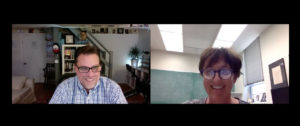

We met on Wednesday, Aug. 19, which not coincidentally is the one-year anniversary of his first week in this role—half of which has been during the coronavirus pandemic. The interview lasted for over an hour, generating far too much to publish as a single column. So, I will cover the interview in two columns beginning with this piece as a summary of his path that led him to AAG. I have edited my questions and Gary’s comments below for brevity and clarity.

AMY: Let’s just start with some basics, like your background, the area of your formal training, and your experiences that led you to AAG.

GARY: I grew up in Sacramento, CA, within an academic family. My dad was a Ph.D. botanist and his father had a Ph.D. in plant genetics, so acquiring my own Ph.D. seemed natural to me. Looking into the future one could never know, but in hindsight this makes sense.

My dad and grandfather had interesting backgrounds. My grandfather, originally an Iowa farm boy, had to find a new path when the family farm was lost during the depression. Eventually, he ended up at Cornell University in Ithaca, NY, in the early 1930s where he was the first Ph.D. recipient in plant genetics. Upon graduation, the government of Venezuela asked him to move there and lead a program for crops and genetics. He agreed and asked my grandmother, then a nurse, to marry him. They decided to go, despite speaking no Spanish at the time, and had four children there over the next 20 years.

During this time, he also became known as the father of the sesame seed. Sesame lays down its seed in pods that shatter when ripe, making it very time consuming to harvest. My grandfather was the first to find a variety that would open enough for machine harvesting, but not enough to lose the seeds. This side of the family continued researching and perfecting varieties of sesame for many years.

In addition to his scholarly abilities, my grandfather had an entrepreneurial spirit. Soon after he got there, oil production was booming in Venezuela, leading to a massive economic boom. He founded four large plant nurseries, supplying the growing numbers of businesses, hotels and factories around the country.

My dad was born and raised in Venezuela working in his dad’s plant nurseries. When my dad was 15, he went to the United States for the first time to finish school and later attend college. Inspired by what he learned from my grandfather, he sought his Ph.D. in plant biology and ecology. My father then taught at California State University in Sacramento for 38 years. He preferred teaching much more than research. I had the good fortune of growing up accompanying him on his botany and ecology field trips. We were around college students all of the time. During the summers, they would visit one day a week, so I grew up immersed in his love of teaching.

When I was seven years old, my dad discovered birding. He had been playing semi-pro ice hockey for fun, but he was getting too old and he wanted something else to do. He was also tired of the students asking what all the birds were on the field trips. So, he took this bird watching class. And it sounds silly to go from hockey to birding, but there is a whole world of competitive birding. Who knew?

What that meant for me, because he was so competitive, is whether I felt like it or not, I was in the back of a car going to look for birds every weekend from age seven to 13, and going all over the country traveling a lot with my parents. It was a lot of driving though, and I didn’t always love it. And of course, when you’re a kid, you absorb everything that you’re exposed to. So, now I was getting exposed to people, showing slides about birds and these professors would come over and they talk about their trips around the world. And, it was a great way to grow up. When I was 15, I started going back to Venezuela with my father. That was the first time my dad had been back in 30 years, and I kept going back for at least a month every year for the next 20 years.

Soon, he and I started leading birdwatching tours. Surprisingly, many people want to see birds bad enough that they will hire experts to show them all the species. Because I had spent so much time doing this, by the time I was 18 I was able to do it professionally. That’s how I put myself through college, leading trips all summer and over winter break. And, I did that for many years. When I came to my own schooling, I started off as an English major, finished that coursework and thought I was going to go to law school and do environmental law.

So, I was doing these birding tours, often with lawyers, and they’re like, “yeah, don’t do law school. Don’t do what I do. You should do birds or something like that. You should do ecology or conservation.” And, so I stayed on in college for a whole other major in biology. And, because I was putting myself through school with these tours, I could. I wasn’t in a hurry because I was getting paid to travel four months a year. In your twenties that’s really fun. Then I went back to college and took a class in, say, mammalogy, and then went all over the Americas seeing the mammals in the field. We were working all over the Americas: Canada, Costa Rica, and California in summer, and seven different trips in Venezuela that would rotate three per year over winter break.

This was an awesome way to grow up and go to college. But, eventually, I thought I’m just going to get a Ph.D. too. And what was great is because I had so much experience in South America already, it was easy to convince my advisers that I could go off and do research in South America because I’d already been doing it, essentially, for years. And it didn’t sound like a big risk. So, I got lucky and got into, arguably, the best ornithology program in the world at Cornell University. That was just a great experience. Although my Ph.D. is in ecology and evolutionary biology, I studied birds in South America.

Ecology spoke to my wide range of interests. And, just like with geography, you can never get bored with it because there’s so many different facets to it. After seven field seasons in Venezuela, Bolivia, and Peru, I wanted to go somewhere else. So, I did an NSF bioinformatics postdoc through UC Berkeley, with two years in the field and Queensland, Australia doing climate change research in the Wet Tropics and then a year back at Berkeley. Finally, I started working at Audubon, bringing birds, biology and policy together in conservation. Audubon was my job for 12 years before I started at AAG.

AMY: Actually, that was great. As you were relaying your story, I kept thinking about how your path seemed to be laid out for you. And, I feel like I just fell into geography. I spent my early life walking around in circles trying to figure out what I was going to do until I found this magic thing called geography. It just basically landed in my lap in college. And, then it transformed me.

At this point, our conversation transitioned to AAG, Geography, and higher education. I’ll continue the interview in a later column in which Gary will highlight his vision and goals for AAG.

—Amy Lobben
AAG President and Professor at University of Oregon
lobben [at] uoregon [dot] edu

DOI: 10.14433/2017.0078

    Share

News from the Human-Environment and Geographical Sciences (HEGS) Program at the National Science Foundation (NSF), September 2020

Update 9/15/2020: In response to concerns raised by members of the AAG, the NSF has clarified its announced changes to the Human-Environment and Geographical Sciences program (HEGS), formerly known as the Geography and Spatial Sciences program (GSS). 

AAG appreciates the time many of our members have taken to bring  questions and concerns about the program changes to light. The NSF’s Program Officers are available to provide answers and assistance in preparing proposals (email for the program and program guidelines are at the end of this clarification). 

Clarification from National Science Foundation: The repositioning of the Geography and Spatial Sciences program (GSS) to the Human-Environment and Geographical Sciences program (HEGS)

Over the past several years, NSF’s Directorate for Social, Behavioral and Economic Sciences (SBE) has repositioned several programs to better reflect the science supported by those programs and to make their value more apparent to a broader audience. Nearly all NSF program names draw attention to what researchers do or why it matters. As a result, most programs are no longer named solely after disciplines. These changes bring SBE into closer alignment with long-held program naming practices at the rest of NSF. This provides more opportunities for researchers to conduct innovative and valuable work and for NSF to more effectively communicate the value of the research that it supports.

The name change from Geography and Spatial Sciences (GSS) to Human-Environment and Geographical Sciences (HEGS) represents a more holistic perspective that considers the broad range of topics that enhance fundamental geographical knowledge, concepts, theories, methods and their application to societal problems and concerns. With the increase in convergent programs across NSF directorates such as Dynamics of Integrated Socio-Environmental Systems (DISES), Coastlines and People (CoPe), Sustainable Regional Systems (SRS) and Navigating the New Arctic (NNA), geographers stand uniquely situated to participate in such endeavors. At the same time, the inclusion of the term “Geographical Sciences” in the new program title signals the sustained and continued support of geography. In line with NSF’s mandate to support basic scientific research, HEGS-supported projects are expected to yield results that enhance, expand, and transform fundamental geographical/spatial theory and methods, and produce broader impacts that benefit society.

HEGS (previously GSS, and before that Geography and Regional Science-GRS) recognizes that geography is a broad discipline that includes the natural sciences, the social sciences and the humanities. While HEGS continues to consider proposals that cover research in human geography, HEGS does not fund research that engages predominantly humanistic, non-scientific framings and methods. This has always been the case and is not a new policy or a change in requirements for proposals submitted to NSF. HEGS has always stressed to PIs that their proposals must focus on the scientific aspects of a project, including clearly articulated questions or hypotheses, methods and a corresponding data analysis plan that can provide answers to those questions. HEGS program staff have noted a steady increase in predominantly non-science-oriented proposals. It is important to note that this repositioning is not a judgement on the value of such scholarship or its practitioners. HEGS will continue to accept proposals that creatively integrate scientific and critical approaches. Prospective PIs are encouraged to visit the HEGS website and explore the diverse research and PIs that have been recently funded by the program.

The repositioning of HEGS also reflects the breadth of research appropriate for submission to the programs. HEGS is situated in the Behavioral and Cognitive Sciences Division of SBE and thus research projects submitted to the program must illustrate their relevance and importance to people and societies. If a proposal is not well-connected to social or human dimensions, the proposal could be more appropriate for other programs at NSF. For example, bio-physical science is supported by programs in the Division of Environmental Biology in NSF’s Biological Sciences Directorate, and physical science is supported by programs in the Division of Earth Sciences (e.g. the Geomorphology and Land-use Dynamics Program) in the Geosciences Directorate.

Potential investigators are encouraged to contact a HEGS program officer with questions about whether their proposal would be considered by HEGS. Email hegs-info [at] nsf [dot] gov with a two-page (maximum) attachment outlining the research question(s) or hypotheses, the intellectual merit and anticipated broader impacts of the project, as well as the methods and anticipated data and analysis.

Scott M. Freundschuh, HEGS Program Officer

Sharmistha Bagchi-Sen, HEGS Program Officer

Antoinette WinklerPrins, Former GSS Program Officer and current Deputy Division Director in BCS

FAQs 

overview of guidance 

detailed guideline

***
Original announcement: Announcing Staff Changes in HEGS

Scott Freundschuh continues as HEGS Program Director.
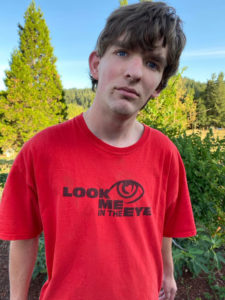
BIO: Scott M. Freundschuh holds a Ph.D. in geography from SUNY Buffalo. Scott is a cognitive geographer, specializing in spatial cognition as it relates to types of spatial knowledge and their structures, geographic scale, spatial concept development and understanding, and spatial skills development. He is a faculty member at the University of New Mexico.

Sharmistha Bagchi-Sen joins HEGS as new Program Director.

BIO: Sharmistha Bagchi-Sen holds a Ph.D. in geography from the University of Georgia. Her research interests include the geography of innovation, geographic implications of industrial evolution with a focus on bio-pharmaceuticals, agri-bio, and bioenergy sectors, energy transitions, foreign direct investment in the United States, and socioeconomic implications of urban-regional population shrinkage. She is a faculty member at the State University of New York-Buffalo.

Kendra McLauchlan is now a permanent Program Director in the Division of Environmental Biology and works closely with HEGS.

BIO: Kendra K. McLauchlan holds a Ph.D. in ecology from University of Minnesota. Kendra is a physical geographer, specializing in reconstructing North American paleoenvironments as recorded in lacustrine sediments and dendrochronological records. She holds an adjunct appointment as a faculty member in Geography and Geospatial Sciences at Kansas State University.

HEGS Program Director Jacqueline (Jackie) Vadjunec has returned to Oklahoma State University where she has been promoted to full professor. Congratulations Jackie!

From GSS to HEGS – Why the Change?

The change from Geography and Spatial Sciences to Human-Environment and Geographical Sciences at NSF is the result of efforts within the Social and Behavioral Sciences Directorate to reposition programs so that they align with the mission of the Directorate. Geography is a broad discipline, spanning multiple paradigms and topics ranging from purely process-oriented biophysical geography to post-modern, humanistic geography. However, not all geographic scholarship is a good fit at the National Science Foundation (NSF). The name change articulates more clearly the human, environmental, and geographical sciences that are appropriate for funding at NSF. This change reflects NSF’s mission to “promote the progress of science; to advance the national health, prosperity, and welfare; and to secure the national defense” and also HEGS’s location in the Division of Behavioral and Cognitive Sciences (BCS) in the Directorate for Social, Behavioral, and Economic Sciences (SBE).

In general, research that is predominantly post-modern, post-structural, humanistic etc., is not a good fit for NSF. As noted in the solicitation, “A proposal to the HEGS Program must explain how the research will contribute to geographic and spatial scientific theory and/or methods development, and how the results are generalizable beyond the case study.” If research is more biophysical or process oriented, but aspatial and/or not well-connected to social or human dimensions, the proposal could be more appropriate for other programs at NSF. For example, bio-physical science is supported by the programs in the Division of Environmental Biology (DEB) directorate, and physical science is supported by the Geomorphology and Land-use Dynamics (GLD) program. When considering the fit of research at NSF, it is useful to understand the overall institutional architecture of the Foundation.

Potential investigators are encouraged to contact a HEGS program officer with questions regarding the fit of their research in HEGS. Please send an email inquiry to hegs-info [at] nsf [dot] gov with no more than a two page attachment that outlines the research question(s) or hypotheses, the intellectual merit and anticipated broader impacts of the project, as well as the methods and anticipated data and analysis.

You can find the new HEGS solicitation here.

You can find the HEGS FAQ here.

Other Funding Opportunities at NSF

Dynamics of Integrated Socio-Environmental Systems (DISES) Program

Navigating the New Arctic (NNA) Program

Coastlines and People (CoPe) Program

Build and Broaden DLC

Contact information for HEGS Program Directors is hegs-info [at] nsf [dot] gov.

    Share

Marvin Creamer

Marvin Creamer, a geographer and skilled sailor who completed a two-year circumnavigation of the globe in 1984, without any instruments at all, died on August 12, 2020 in Raleigh, North Carolina, after a brief illness. He was 104 years old.

Creamer, born in 1916 in Salem County, New Jersey, was a graduate of Glassboro State College, now known as Rowan University. He stayed on as a professor, establishing the Geography Department as its first chair in 1970 and received numerous honors up until his retirement in 1977. He was awarded an honorary doctorate degree in the humanities in 1980. Creamer also had graduate degrees in education and geography from the University of Pennsylvania and the University of Wisconsin.

An avid traveler by both land or sea, Creamer was best known for his extraordinary sailing feet aboard the 26-foot Globerstar, a voyage that he completed when he was nearly 70 years old. His life and adventure were covered by the New York Times, The Economist, and perhaps most importantly, Cruising World.

He was married to Blanche Layton Creamer in 1946 (deceased 2005) and is survived by his sister Evelyn Creamer Daniels; children Andra Creamer Hohler James (David), Lynn Creamer Borstelmann (Tim), and Kurt Creamer (Melissa); grandchildren and step-grandchildren Peggy James, Star Schreier Nixon (Matt), Evan Schreier, Vaughn Creamer, John Borstelmann, Kathryn Jeffery, Maggie Creamer, and Daniel Borstelmann; great-grandchildren Charlotte Nixon and Logan Nixon. He is survived also by his wife of 10 years, Elaine Gillam Creamer.


    Share

The Invisible and The Silent

I am the parent of an adult child with intellectual and developmental disabilities and have spent the past two decades watching how society (dis)engages with him. People avert their eyes. People pretend not to see him.  People give him a wide berth in store aisles.

Some adults demonstrate shockingly bad behavior when he makes his noises or rocks back-and-forth. They display disapproval of his imperfect body and social conduct with facial expressions, comments, or gestures—such as picking up their groceries and moving to another checkout line. My reaction is a swift but reasonably (I think) calm tongue-lashing. Then, I always tell myself I won’t make a public display again. But I do.

Believe it or not, I’m happy when kids stare. At least they’re acknowledging his presence. And Jeffrey loves social interaction, if given the chance.

Amy Lobben’s son, Jeffrey, is wearing one of his favorite shirts.

That Jeffrey is singled out like this reflects how our society is obsessed with physical perfection. Examples are too numerous to list. Vanity sizing is just one example. Is that international? If not, I’ll explain. In America, as bodies get larger, sizing gets smaller. A women’s size 6 today was a size 12 fifty years ago. Because…we cannot have socially defined “imperfections” in our bodies. So, the fashion industry wisely adjusts their sizing over the years. It is remarkable how I have been a size 6 my entire adult life (I hope you hear the sarcasm regarding myself).

Society trains us to have low tolerance of imperfections in our own and others’ bodies. It’s no wonder that in the race to perfection, those with physical imperfections are ultra marginalized by society. And if we are intolerant of weight gain or imperfect eyebrows, imagine how intolerant we are with non-functioning eyes or legs. We have been taught to actively ignore those imperfections and the bodies they’re attached to. Even being near such a person in a grocery line is unendurable. The only distance at which this imperfection can be tolerated is so far away as to be indiscernible. It is the spatial scale of exclusion.

And that’s when it happens. People with disabilities become invisible. Through able-ism, they are silenced, left alone past the detectable edges of the universe that able-bodies and able-minded individuals inhabit.

Fortunately, an increasing number of countries have laws that protect the invisible and silent. In the United States, for example, organizations are required by law to make reasonable accommodations for people with disabilities.

Of course, “reasonable” is vague and open to opinion. For example, under the cover of “reasonable,” the state of Alabama developed their ventilator rationing policy, which said: “Persons with severe or profound mental retardation, moderate to severe dementia, or catastrophic neurological complications such as persistent vegetative state are unlikely candidates for ventilator support.”

Horrible, right? Let us not cast our righteous stones. Alabama was not alone in developing policies for ventilator support that excluded people with imperfections. Fortunately, disability advocacy groups and the U.S. Health and Human Services Department have now ensured that ventilator policies don’t discriminate based on imperfection.

The American Association of Geographers is not immune; historically, it has not been welcoming of people with disabilities. At the same time, we have mostly not been overtly discriminatory. There is no need for intervention by the U.S. Department of Health and Human Services. But we have created a culture and a structure that presents barriers to inclusion and participation of people with disabilities. For example:

  1. Cost of our annual meeting remains a persistent (and often vocal) concern for many AAG members. AAG responds to this concern and attempts to defray costs when possible. Some strategies include:  booking venues off-season, booking older venues, and including multiple locations in a single meeting. All of these strategies address membership demands to keep costs down. But, the result is an increase in barriers to participation for people with disabilities.  Remember Denver 2005? Or Las Vegas 2009? Even without disabilities, it’s pretty hard to get around in a blizzard or between venues that are over 1km apart. How many times have you experienced overcrowded stairwells between sessions because the elevators were unable to support capacity? These are trade-offs that most membership welcomes in AAG’s responsive efforts to defray conference fees.
  2. The AAG website is a disaster and does not come close to providing Universal Access. It’s not even screen-reader compliant. We are unique in our antiquatedness relative to most other large, professional organizations. This is ethically unacceptable and, for an organization that is always worried about recruiting more people to Geography, it’s not even good business.
  3. The physical headquarters of AAG is Meridian Place. It’s far from being ADA compliant. People who use manual or motorized wheelchairs cannot enter the front door.

Why is this the current state of AAG?  Historically, our collective membership has relegated issues of accessibility to the margins in favor of other priorities, such as saving money.

Fortunately, many accessibility issues are now being addressed by our new Executive Director, Gary Langham, and the AAG staff. For example, for the first time in my over 25 years in attending AAG meetings, child care for older children with disabilities was offered for the Denver 2020 meeting. Unfortunately, because of Covid, no one attended that meeting in person. But, the precedent was set. Don’t underestimate how big of a game-changer this support is for parents of older children with disabilities. For me, traveling as a parent of an older child with intellectual and developmental disabilities frequently represents an impossible obstacle. I’ve missed AAG meetings over the years because I couldn’t find support at home and because my son was too old for the child care provided by AAG.

As for examples two and three, though no concrete designs are yet in place, both website and Meridian Place renovations are actively being planned. ADA compliance and Universal Access are major parts of the discussion.

I am also delighted to announce that the AAG Council has unanimously supported the formation of a new AAG Accessibility Task Force. The members will identify the most pressing barriers to access within the AAG and develop strategies and guidelines to inform website design, building renovation, conference venue choices, and practices at conferences that enhance access.

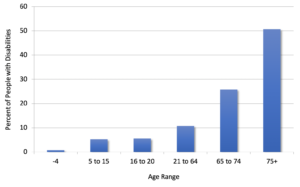
I will always argue that supporting access for even one person with disability justifies great effort. However, if numbers are important to justifying the effort, we should consider why persons with disability are such a small proportion of AAG membership and conference attendance. For example, each year prior to the annual conference, AAG asks members for accommodation requests. Few requests are made. But, according to the Institute on Disability, the overall rate of people with disabilities (in the U.S.) is almost 13%. Disaggregated, disability increases dramatically by age. The most common disability reported is ambulatory.

But, AAG does not receive accommodation requests from 13 percent of the attendees (i.e. equivalent to disability prevalence in the overall population). Perhaps the disability rate for geographers is shockingly low? I doubt it.

July 26 was Disability Independence Day, commemorating the signing of the Americans with Disabilities Act that was signed on the same day in 1990. Yet, this day seemed to come and go with little notice. How many people did you hear talking about it, marching about it, let alone celebrating it? As we experience the wave of social justice demanding amplification of marginalized voices, an important perspective is missing.

For too long AAG members with disabilities have been kept invisible and silent. Based on my brief tenure as Vice President and President, I have learned that many such individuals left the organization or stopped coming to conferences when barriers become too overwhelming. The Accessibility Task Force will advocate for AAG members with former and current disabilities, as well as that large portion of us who will, based purely on statistics, develop future disabilities. If we wish to have true lifetime members, we need to get ready now.

The task force’s charge over the next two years is to identify barriers and develop remediation recommendations, to move beyond the ADA and what is required by law to create true opportunities for access and inclusion for people with disabilities. We’re at the start of new AAG leadership and experiencing a nationwide awakening to the damages of exclusion and social injustice. Yes, there is much work to be done. But as we enter the dawn of the new decade, I am profoundly optimistic that this dawn will cast a bright light that makes us see those with disability and the barriers that prevent them from being in the AAG, the discipline of geography, and our society at large.

This is when the invisible become visible.

And that is when we as individuals and the AAG become true facilitators to access.

— Amy Lobben
AAG President

DOI: 10.14433/2017.0077

    Share

Leonard Kouba

Geographer Leonard Kouba died on July 15, 2020. A longtime  professor at Northern Illinois University until 1993, he was 82.

Kouba, who specialized in African geography, was an avid traveler, fisherman, and big-game hunter. He visited approximately 120 countries in his lifetime. He was a past recipient of NIU’s Excellence in Undergraduate Teaching Award. He established the Leonard J. Kouba Geography Graduate Student Fund to provide scholarships and other resources for graduate students in his home department at NIU.

    Share

Brian Robson

Brian Robson–a geographer who helped to develop the British Index of Multiple Deprivatio and changed the way British governments dealt with socio-economic decline in towns, cities and regions–died on July 2, 2020 at the age of 81.

Robson’s research and design of the index provided an integrated, extensive and fine-grained understanding of poverty and financial mechanisms for relieving it in Great Britain, crafted around an area-based regeneration approach that Brian focused on the needs of towns and small cities, not only large urban areas. In the words of colleague Noel Castree, writing in The Guardian, Robson’s approach also “promoted a multi-agency approach, supporting integrated regeneration that was more attuned to local circumstances.”

Robson was born in Rothbury in Northumberland and attended Cambridge University, graduating in 1961. He completed a full-time PhD in urban social geography at Cambridge in 1964. In 1969 he published Urban Analysis, followed by Urban Social Areas in 1975. These two books led to his work on government policy.

Robson was a lecturer in geography at Aberystwyth University, leaving in 1967 to become a Harkness Fellow at the University of Chicago, working with planner Jack Meltzer at the interdisciplinary Center for Urban Studies. He returned to Cambridge in 1968 as a lecturer in human geography, staying for a decade until taking a post at Manchester University in 1977, where he established the Centre for Urban Policy Studies (CUPS) in 1983. His 1988 book Those Inner Cities identified the failings of British urban policy and shaped the design of the Single Regeneration Budget.

Robson’s career was built on a strong commitment to equality of opportunity. The Royal Geographical Society awarded him its Founders medal in 2000; he was honored with the Order of British Empire in 2010. He is survived by his wife, Glenna Ransom (nee Conway), and Glenna’s two sons from a previous marriage, Mark and Peter.

    Share