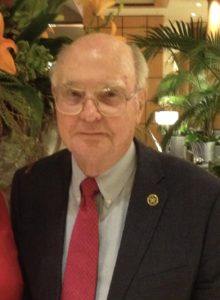
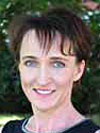
William A. Dando

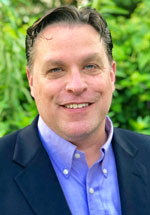
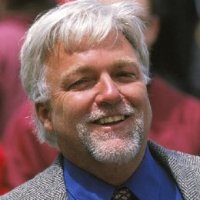
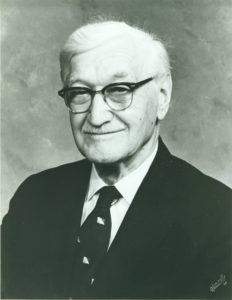
William A. Dando, Distinguished Professor of Geography and professor emeritus at Indiana State University, passed away on January 1, 2021, at the age of 86, after a brief illness. Throughout his life, he was an exemplar of a balanced academic life, excelling at research and teaching while also serving his communities: a true “gentleman” of geography.

William Arthur Dando was born in Newell, Pennsylvania on June 13, 1934 and grew up exploring the surrounding hills and valleys. He served in the Air Force from 1954-6, including a stint in Iceland. Under the G.I. Bill, Dando attended California University (PA), just across the river from Newell, earning his B.S in Geography and Mathematics in 1959. He received his M.S. in 1962 and Ph.D. in 1969 from the University of Minnesota, working with John Borchert. His dissertation was entitled “Grain or Dust; A Study of the Soviet New Lands Program 1954-1963.” This work began a lifelong interest in food production and Soviet agriculture.

Dando’s first teaching position was at the University of Maryland. In 1970, he received a Danforth Associateship, “awarded in recognition of good teaching and in humanizing the education process.” In 1972, he was awarded a Fulbright-Hays Postdoctoral Research Grant to study Romanian agriculture, becoming one of the first Americans to spend time on a communist collective farm.

Beginning in the early 1970s, he started leading geography field courses to the Soviet Union, allowing him to gather data behind the Iron Curtain while giving hundreds of students memorable field experiences. In addition to university students, he also took teachers and farmers on educational trips to the Soviet Union, making over twenty trips.

In 1975, Dando accepted a position at the Geography Department at the University of North Dakota, becoming chair of the program.

In 1980, Dando published The Geography of Famine (1980) which received international acclaim. In 1982, he contributed a chapter on “Man Made Famines” to Famine: Its Causes, Effects and Management which was recognized with the World Hunger Media Award by the United Nations.

Dando spent the 1981-82 academic year as a Senior Scholar at Chung Chi College of the Chinese University of Hong Kong.

Dando moved to Terre Haute in 1989 where he was the chair of the Department of Geography, Geology, and Anthropology at Indiana State University until his retirement in 2002. After retirement, he founded the “Senior Scholars Academy” at ISU, a pre- and post-retirement think-tank for retired faculty members dedicated to regional enhancement and community revitalization.

Throughout his years at the Universities of Maryland and North Dakota and then at Indiana State University he taught undergraduate and graduate classes, mentoring students of all levels as well as faculty. Michael DeMers, a beloved student and friend, dedicated his first book to Dando, writing: “I offer this work first to William A. Dando, who put my feet on the path of geographical knowledge and who has been an unwavering supporter of my work. He not only shared his knowledge and skills with me but, more importantly, he shared his time, his family and, above all, his love. No student ever received so much from an advisor. His has been the pattern that I have tried to emulate” (Fundamentals of Geographic Information Systems, 1997).

Dando was a prolific researcher and author, publishing over 29 books and monographs, 79 articles, book chapters, and encyclopedia entries, and two atlases. A scholar to the end, he continued to publish books and articles after his retirement, including Food and Famine in the 21st Century (2012) and Geography of the Holy Land: Jerusalem, Regional Cities, Small Towns, and Rural Places (2020). He had a knack for grant-writing and had numerous grants over his academic career, adding up to millions of dollars in funded research.

He received numerous awards for teaching, research and service from a variety of institutions and organizations, including from the University of Maryland, University of North Dakota, Indiana State University, the NCGE, the West Lakes Division of the AAG, and from the AAG.

At all the universities he worked at, Dando was active on campus, serving on university committees. He also gave numerous presentations to local organizations and advised various state offices on geography-related topics, including at one point the governor of North Dakota.

He worked with teachers to help improve the teaching of geography in schools in Maryland, North Dakota, and Indiana. His contributions to geographic education were recognized by awards from the Geographic Educators of Indiana, the National Council for Geographic Education, and the AAG.

Dando was a member of the AAG 60 years. He served the AAG in a variety of capacities: vice-chairman (1971) and chairman (1973-4) of the Middle Atlantic Division; as treasurer (1977-8) and chairperson (1978-9) for the Great Plains-Rocky Mountain Division; as a chairperson (1994-5) and regional councilor (1997-2000) for the West Lakes Division; on the AAG Proposal Writing Committee 1990-3; and chairperson of the Bible Specialty Group (1993-2021).

Former Executive Director of the AAG, Doug Richardson, a long-term friend of Bill Dando, noted that “Bill’s curiosity, energy, and wide-ranging scholarship, coupled with a deep commitment to his students, have made significant and enduring contributions to the discipline of geography. His big heart and his expansive vision will be missed by all.”

His deep interest in food and famine issues was not just academic. He was an active member of Centenary United Methodist Church of Terre Haute and he and wife Caroline worked its monthly “Fourth Monday” luncheon, a free meal to whoever needs it, just two days before his passing.

He leaves behind his wife and co-writer/editor Caroline Z. Dando; children Christina, Lara, and Bill (all geographers); four grandchildren — Emmaline, Anna, Alex, and John; and thousands of former students and mentees.

    Share
    Share
    Share
    Share

Lynn Staeheli

Lynn Staeheli, a professor and former head of the School of Geography and Regional Development at the University of Arizona, passed away December 20, 2020 at her home in Tucson, AZ. Professor Staeheli studied at Penn State and went on to complete her PhD at the University of Washington in 1989. She joined the Geography Department of the University of Colorado-Boulder as an assistant professor in 1989, eventually promoted to full professor. She taught urban, political, and feminist geography and was graduate advisor for over a dozen PhD graduates while at CU. In 2005, Staeheli joined the faculty at the University of Edinburgh in Scotland, and was subsequently a professor at the University of Durham in the UK. In 2015, Staeheli became the head of the School of Geography and Regional Development at the University of Arizona, a post she held for four years. In addition to her distinguished research, she had an admirable commitment to social justice and to mentoring students and early career scholars around the world. Her research focused on what she called the “big, contentious topics” such as the nature and spatial dimensions of democracy, citizenship, and politics. More concretely, her research topics included publicly accessible space, protest and activism, immigration and refugees, and the role of faith, religion, and spirituality in public life. At the time of her death, Staeheli was working on three projects: public life and democracy in the US and UK; youth and politics in divided societies (Bosnia-Herzegovina, Lebanon, and South Africa); and refugees from the MENA region to Europe. She is survived by her husband, retired Professor of Geography, Nel Caine, and her sons.

    Share

AAG Announces 2021 AAG Award Recipients

The American Association of Geographers congratulates the individuals and entities named to receive an AAG Award. The awardees represent outstanding contributions to and accomplishments in the geographic field.

2021 Diversity and Inclusion Award

The AAG Diversity and Inclusion Award (formerly the Enhancing Diversity Award) honors those geographers who have pioneered efforts toward, or actively participate in efforts towards encouraging a more diverse discipline.

Raynah Kamau and Whitney Kotlewski, Esri

Raynah Kamau and Whitney Kotlewski are both Esri employees and grassroots activists whose collaborative work has fostered increased visibility for community- engaged geography and greater inclusion within GIS professional culture.

The AAG is impressed by their work beyond academia, especially their service as role models for aspiring BIPOC and female geographers. They deploy an effectivene public outreach strategy using StoryMaps to support Black Lives Matter and other social justice causes. Ms. Kamau’s and Ms. Kotlewski’s co-founding of “Black Girls M.A.P.P.” and “People 4 the People” are two such examples.

Equally important is their work in changing GIS and tech culture at Esri to incorporate a more diverse set of voices (e.g., women, women of color, the LBGTQ+ community). Within a few short years, these two awardees have built a bridge between geography and these diverse communities, which is a testament to their interpersonal skills and steadfast dedication to community members.

Ms. Kamau’s and Ms. Kotlewski’s efforts champion the ideals of diversity and inclusion of this AAG award, while demonstrating the transformative potential of geography. Read more from Esri here.

Jovan Lewis, University of California Berkeley

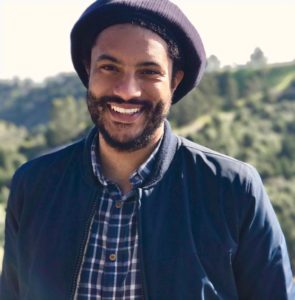
Dr. Jovan Lewis is an Assistant Professor at the University of California Berkeley whose efforts in research, teaching, mentorship, and service are bringing Black geographies (and Black geographers) to the forefront of the discipline.

We commend his integration of multiple facets of work to leverage and amplify Black Geographies within the AAG: he has taken a leadership position in the Black Geographies Specialty Group and led a symposium that resulted in the inclusion of Black Geographies as a theme of the 2018 AAG Annual Meeting. Locally, Dr. Lewis is changing UC Berkeley Geography’s intellectual culture in emphasizing Black studies and Black geographies. He has worked across departments and programs on his campus and beyond, to engage public groups. He is integrating this work into his teaching (e.g., he developed a symposium on the topic and is recruiting black students to his program), research (e.g., his co-edited volume, The Black Geographic), and service (e.g., his mentorship of other faculty and students).

His efforts are comprehensive and effective at multiple levels and with different audiences. Dr. Lewis’s dedication to his students and to the larger community is remarkable for a junior scholar and reflects the best of what Black geographies and the discipline have to offer.

2021 Susan Hardwick Excellence in Mentoring Award

The AAG bestows an annual award recognizing an individual geographer, group, or department, who demonstrates extraordinary leadership in building supportive academic and professional environments and in guiding the academic or professional growth of their students and junior colleagues. The late Susan Hardwick was the inaugural Excellence in Mentoring awardee. The Award was renamed in her honor and memory, soon after her passing.

Hilda Kurtz, University of Georgia

Dr. Hilda Kurtz’s mentorship strategies demonstrate variety, replicability, novelty, inclusivity, and community creation both within and beyond geography.

Her students benefit from her hands-on facilitation of quality research papers and proposals, with a high track record of funding success. Through journal editorship, she mentored diverse early career scholars with regard to academic publishing. Dr. Kurtz is co-Founder of the Franklin College Diversity and Inclusion Graduate Fellows Program, which establishes a local community of engagement around social justice. Multiple individuals commented on her success in mentoring focused on work-life balance through both formal and informal channels.

Finally, Kurtz developed a quasi-formal professional development workshop series in 2015, emphasizing job market preparation and tangible skills for success in academe. The workshops have since been integrated formally into the University of Georgia Geography Department’s required first year graduate student seminar.

For all these reasons, the AAG is proud and pleased to recognize Hilda Kurtz as the recipient of the 2021 AAG Susan Hardwick Excellence in Mentoring Award.

The 2021 Marble-Boyle Undergraduate Achievement Award in Geographic Science
The Marble-Boyle Undergraduate Achievement Award recognizes excellence in academic performance by undergraduate students from the U.S. and Canada who are putting forth a strong effort to bridge geographic science and computer science as well as to encourage other students to embark upon similar programs. The award is an activity of the Marble Fund for Geographic Science of the AAG.

Jessica Embury, San Diego State University

Daniel Council, Ball State University

    Share

Advocate for Geography in Austerity

This is Part 1 of a two-part column on what geography departments can do (and should not do) to advocate for their work in budget talks, which are all the more crucial during the COVID-19 pandemic. These points are largely derived from answers I received from geographers in upper administrative positions at universities.

At the end of October, the Chronicle of Higher Education covered the looming budget woes for colleges and universities across the country, with many states expecting 10% budget cuts. Public higher education likely will be disproportionally affected by state budget cuts as they face “two crises: the impact of Covid-19 on their operations and a downturn in state funding brought on by the current recession.” In addition, as reported in a June article in Nature, the response to the Coronavirus pandemic will also force universities to address growing challenges in higher education, such as mounting tuition costs, public perception of relevancy, and a demographically driven decrease in numbers of graduating high school seniors.  Yet, as we know, tuition increases are a direct result of more than a decade’s worth of states balancing their budgets on the backs of public colleges and universities that were once the lifeblood of the U.S.’s affordable higher education.  Further, in an article just released in Inside Higher Ed, the coronavirus pandemic has caused more than one-third of prospective college students to reconsider higher education (see Doubts About Going to College).

In short, the COVID-19 crisis has aggravated problems we have known about for some time. As a 2019 Gallup poll showed, there was already a marked decrease in public confidence in higher education in the U.S. going into this pandemic as a result of soaring tuition and barriers to access.  If 2020 has taught us nothing else, it is that geography is a crucial discipline for grasping and addressing the dire issues our earth faces. Yet in a year that has demonstrated our value, some of our geography departments continue to struggle for relevancy on university campuses.

What’s a Geography Department To Do (or Not Do)?

While geography departments do not control university budgets, we can think and act strategically to remain relevant to students, the public, and university and college administration. In this light, I have received a growing number of requests from department chairs as well as individual members asking for AAG assistance in demonstrating geography departments’ relevancy to key stakeholders. Those requests have varied, but range from advocating for lost positions to requesting brochures/videos to show to administration to demonstrate geography’s relevancy. I reflected on my experience as department chair and I was fairly certain that deans, provosts, and presidents wouldn’t be swayed by (or even take the time to view) brochures or videos from AAG.  I also knew that the time to act is before positions are cut, not after.

I therefore drafted an email and sent it to several geographers in administrative positions around the U.S.  My request was fairly simple… “please list your ‘Top 3 Dos’ and ‘Top 3 Not Dos’ in order to develop highly effective, impactful, and well-functioning geography departments (from the perspective of deans and provosts).”  The responses were remarkably consistent.

I’ll go in reverse order and start with the “Top 3 Don’ts,” mostly because these are relatively straightforward and require little additional discussion—the “Do’s” will have a column of their own next month.  Some of these Don’ts harken back to Ron Abler’s Five Steps to Oblivion.

1.  Don’t Prolong and Disseminate Department Conflict and In-fighting. Unless you’re a one-person department, you can’t escape departmental politics, one of the primary dynamics in academic departments. In a broader sense, conflict is an unavoidable and sometimes-necessary aspect of academic life. Yet persistent, unresolved in-fighting is not healthy for departments and, if tolerated, will hurt your department’s chances of success in budget battles. As one of the respondents to my request said: “No provost or president wants to become embroiled in personnel problems in a department.  I had the very negative experience of being an external “visitor” at a major university to look at the issues in a particular department (not geography).  The department members had done almost everything they could have done to bring negative attention to themselves and place themselves on the cutting block.”

While we have our moments, I’m fortunate to work in a functional and collegial department.  But I’ve experienced and heard tales about departments that are not as fortunate…slamming doors, stomping out of meetings, pouting, insulting…  Is this behavior rooted in academics’ quest for intellectual discussion, our passion for our sub-disciplines, or because we care so much for our students?

No.

Clearly, some conflicts can be helpful.  For example, conflicts around marginalization because of disability, race, or gender are necessary for departments to grow.  The  destructive conflicts, however—the ones that divide departments—always seem to be personal.  Petty turf wars, feelings of being slighted, resentment about small merit pay differences, irritation at office assignments, frustration over teaching assistant selection, and on and on.  We all know the many examples.  Airing these grievances may offer temporary relief and validation, but can in the long term crowd out the space for collaboration where the exploration of healthy, generative differences can be daylighted and lead to stronger visions for a department that addresses different views about direction, vision, power, and the future of the discipline.  Worse yet, airing these grievances outside the department creates a large billboard to the world stating “This department is dysfunctional.”

In short, work out difficulties and leave the personal battles at the door when visiting your dean or provost with requests on behalf of the department.  As intelligent, hyper-educated academics, we should know better than to pee in our own pool.

2. Don’t be unrealistic in demands for central resource investments. In my experience, this issue often arises when departments discuss graduate student support and new or replacement faculty lines. I’m always surprised when I hear something along the lines of… “central administration has to know how important it is for us to replace our position in fill-in-the-blank sub-discipline.”

No, they don’t have to know that.  In fact, they may not even care about disciplines; their focus is on the overall health of the home institution.  It’s our job to collect, analyze, and summarize the data and demonstrate the relevance of our needs to the entire university, not just to Geography.  Usually, but not always, university budgets are rather immobile.  And inadequate.  It’s strategic and realistic to realize that a finite and inadequate budget is applied to all units across campus.  Departments should continue to be visionary and ambitious, but recognize the broader realities and adjust arguments accordingly.  Every other department on campus is also asking for resources.  And, many colleges and universities have precarious structures which are not designed to withstand the level of disruption that the collective COVID response has thrown at them.

3. Don’t whine. 

The them-versus-us paradigm between faculty and administrators plays out across campuses throughout the world.  Faculty complain about the familiar issues: poor student preparation, equity in teaching loads, poor facilities, lack of equipment, competition for inadequate resources, underfunded initiatives…  This paradigm has become its own social construct in which faculty often see administrators as obstructionists.

Yet, often the reality is that both faculty and administrators care deeply about the students and institution.  The disconnect comes because administrators are the policy and budgetary gatekeepers, with the unappealing task of trying to stretch inadequate resources across an entire campus.  They are often (but not always) aware of the shortfalls that result.  Departments and faculty, then, often feel that they’re at the bottom of the hill, shoveling the proverbial dung.

While it’s important to advocate for the needs of our departments to higher administration, perpetuating institutional cynicism is not strategic.  One of the best lessons I learned from all of my years serving on review panels throughout the National Science Foundation is the importance of positively stating negative critiques:  “this proposal would be improved if the PI did…”.  I shamelessly borrowed this approach from NSF during my time as department chair, making the argument to the administration that specific productivity and metrics would be enhanced with identified allocation improvements.

Don’t bring a problem to your administrators.  Bring a solution.

.  .  .

In hindsight, I realize that the lists of Dos and Don’ts I received rather mirror each other.  But, I parsed them out and summarize the Don’ts above.  Next month, I’ll share the Dos.  As a preview, the three Dos, which have been expanded into four Dos, include: strategic alignment, communication, partnership, and productivity.

—Amy Lobben
AAG President and Professor at University of Oregon
lobben [at] uoregon [dot] edu

DOI: 10.14433/2017.0082


Please note: The ideas expressed in the AAG President’s column are not necessarily the views of the AAG as a whole. This column is traditionally a space in which the president may talk about their views or focus during their tenure as president of AAG, or spotlight their areas of professional work. Please feel free to email the president directly at lobben [at] uoregon [dot] edu to enable a constructive discussion.

Featured Image: “Better Days Ahead” painted in a bright blue arrow directly on a street. Photographer Ian Taylor, Unsplash

    Share

Newsletter – November 2020

PRESIDENT’S COLUMN

Vote for Geography

By Amy Lobben

lobben_amyw-1No matter what happens with this week’s election, the United States will pivot…We need leadership who understands that we cannot stay in the Stage of Anger/Expression without causing new wounds. We also need leadership that understands interconnectedness of social foundations, and that moving toward Corrective Experiences has to happen through strong societal infrastructure.

Continue Reading.

ANNUAL MEETING

More Time in an Unprecedented time: Deadlines Extended for 2021 AAG Annual Meeting

Dusk view of the skyline, Seattle, Washington

The deadline for paper abstract submissions has been extended to November 19, 2020. All abstracts for both in-person and virtual presentations will be accepted. Registration fees will also not increase until after November 19. The deadlines for session organizers and panels have also been extended by a month, to December 18. We hope these changes are helpful to all our members given the current circumstances. Our ability to have a great Annual Meeting–and a great organization–depends on you.

PUBLICATIONS

NEW Annals Alert: Articles with topics ranging from ecological networks to wildfire hazards on federal lands to electric vehicles

The most recent issue of the Annals of the AAG has been published online (Volume 110, Issue 6, November 2020) with 18 new research articles on contemporary geographic research and the 2017 AAG Presidential Address. Article topics in this issue include lifeworlds, the Japanese solar energy industry, neighborhood effects on career choice, urban environmental justice, world city networks, CyberGIS, mobile workers, urban well-being. Locational areas of interest include Indonesia and the Philippines; the South China Sea; São Tomé and Príncipe; Ecuador; Romania; and Mozambique. Authors are from a variety of research institutions including University College London, the Ohio State University, Portland Forestry Services, and San Francisco State University.

All AAG members have full online access to all issues of the Annals through the Members Only page. Each issue, the Editors choose one article to make freely available. In this issue you can read Family Name Origins and Intergenerational Demographic Change in Great Britain by Jens Kandt, Justin van Dijk, and Paul A. Longley for free for the next two months.

Questions about the Annals? Contact annals [at] aag [dot] org.

NEW The Professional Geographer Issue Alert:
Articles with topics ranging from big transport data to public scholarship to antiprotest legislation

The most recent issue of The Professional Geographer has been published online (Volume  72, Issue 4, November 2020) with 16 new research articles on current geographic research and an introduction to the 2019 Nystrom Competition papers. Topics in this issue include whale shark habitat, coastal restoration, the Feminist Geographies AAG Specialty Group, Sherlock Holmes, the suburbs, urban sprawl, video store closures, and geospatial technology in geography instruction. Locational areas of interest include Brazil and Italy. Authors are from a variety of research institutions including University of Maryland, University of Texas at El Paso, University of Waterloo, and University of Illinois.
All AAG members have full online access to all issues of The PG through the Members Only page. Each issue, the Editors choose one article to make freely available. In this issue you can read Urban Household Water Insecurity from the Margins: Perspectives from Northeast Brazil by Paula Tomaz, Wendy Jepson, and Jader de Oliveira Santos for free for the next 3 months.

Questions about The PG? Contact PG [at] aag [dot] org

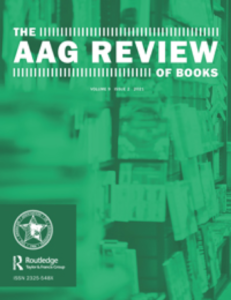
NEW Fall Issue of the AAG Review of Books Published

AAG-RoB-fall-8-4-cvr-babyThe latest issue of The AAG Review of Books is now available (Volume 8, Issue 4, Fall 2020) with 11 book reviews on recent books related to geography, public policy and international affairs. The Fall 2020 issue also includes two book review fora. Two free access articles have been selected by the Editor for the Fall 2020 issue: The Ethnobotany of Eden: Rethinking the Jungle Medicine Narrative reviewed by Michael K. Steinberg and Spatial Histories of Radical Geography: North America and Beyond from Sidaway et al.

Questions about The AAG Review of Books? Contact aagreview [at] aag [dot] org.

Read the latest issues of all of the AAG journals online:

• Annals of the American Association of Geographers
• The Professional Geographer
• GeoHumanities
• The AAG Review of Books

ASSOCIATION NEWS

Geography Awareness Week is Almost Here

Geography Awareness Week (#GeoWeek) starts on November 16. The AAG has prepared materials that suit celebration and awareness at a physical distance. Check out our resources:

Use the hashtags #GeoWeek and #GeoWeek2020 so we can pick up your news and share it with our followers. Visit our Geography Awareness Week web page for more information.

AAG Careers and Professional Development Series

This fall the AAG is piloting two new webinar series on early careers and geography leadership as a service to AAG members and the wider geography community. The freely available November webinars will focus on careers in geotechnology (November 6); naming Geography Departments (November 17); and careers in business, government, and non-profit sectors (November 20). Recordings of past webinars are also available. The leadership series was organized by Shannon O’Lear (University of Kansas) and Ken Foote (UConn) and the early career series was organized by Mark Revell (AAG) and Ken Foote.

Learn more.

Ethical Research in the Age of COVID-19: A Participatory Forum

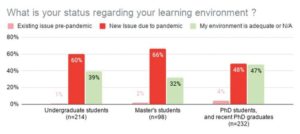
Conversations and collaborations on ethics can not wait! The AAG, with the help of members Libby Lunstrum, Junghwan Kim, Ranu Basu, and Sheryl Luzzadder-Beach, hosted a participatory forum on ethical science in a rapid research environment. The forum was later presented as a workshop during the AAAS Science, Technology and Human Rights Conference 2020. Discussions from the virtual events have been summarized to continue the exchange of ideas on these vital topics.

Read more.

POLICY CORNER

AAG Endorses the Reconciliation in Place Names Act

“American place names should be equitable and just, honor America’s cultural diversity, and advance dignity for all Americans.” This text can be found in the Reconciliation in Place Names Act, a bill recently introduced in Congress by Rep. Deb Haaland (D-NM) and Rep. Al Green (D-TX). The AAG is proud to have endorsed this bill intended to address racist names of land units and geographic features across the country. Currently the United States Board on Geographic Names oversees all naming procedures and decisions, but the board’s process is a reactionary one. Name change proposals must be brought to the board’s attention directly, and the ultimate decision-making is lengthy and lacks transparency. This bill seeks to appoint an Advisory Committee on Reconciliation in Place Names which would make recommendations to both the existing board and to Congress in order to tackle the considerable number of offensive U.S. place names that deserve prompt attention. Notably, this board would be composed of tribal members and organizations, individuals with backgrounds in civil rights and race relations, and individuals with expertise in geography.

Changing place names in response to a better understanding of their origin and meaning is hardly a new movement, but one that has gained momentum this year. Just this week, voters agreed to drop “Providence Plantations” from their state’s official name, “Rhode Island and Providence Plantations,” in recognition of its racist connotations. The Reconciliation in Place Names Act seeks to add to that momentum at the national level, providing the structure to confront long overdue changes and give some dignity back to the individuals for whom these place names invoke painful memories. As the bill states, “No geographic feature in the United States should have a name which disparages racial minorities, perpetuates prejudice or honors those who committed or supported atrocities against racial minorities.” The AAG will continue to track this bill’s progress and seek ways for geographers to be meaningfully involved in its development.

In the News:

  • As the presidential election hangs in the balance, Congress must look ahead to the final weeks of 2020. No matter the outcome, the current Continuing Resolution (CR) that has extended FY20 spending levels will expire on December 11th. Unless weeks worth of appropriations work can be done within the month, Congress will have to extend their deadline with another CR or face a possible government shutdown.
  • Senate Majority Leader Mitch McConnell has indicated that passing another coronavirus stimulus bill will be a top priority when the Senate returns to session next week. He has suggested that Republicans may be willing to budge on previously non-starter issues, saying “It’s a possibility we will do more for state and local governments.”
MEMBER NEWS

Profiles of Professional Geographers


For Melanie Vanderhoof, Research Geographer at U.S. Geological Survey, “geography is a way of thinking. Instead of thinking about a topic in isolation, geography embraces complexity, looking for patterns across space and time, making connections across disciplines, and seeking to understand the global context in which a phenomenon occurs.” Explore why Melanie thinks that “geography is an exciting place to be right now” in this month’s profiles of professional geographers.

Learn more about Geography Careers on the recently updated AAG Jobs & Careers website.

Geographers Recognized for National Research on COVID-19


Eleven AAG members have been recognized in 16 research and educational fellowships from The Geospatial Software Institute (GSI) Conceptualization Project. The 14 funded projects will tackle spatial challenges associated with COVID-19 such as public health, social networks and contact tracing, housing stability, and disparities due to age, race, and disabilities, using geospatial software and advanced capabilities in cyberinfrastructure and data science.

Learn more.

RESOURCES AND OPPORTUNITIES

Free Access: 49 Articles on Black Geographies and Racial Justice

In response to the call for more open access to vital scholarship on anti-Blackness and racism, issued by the Black Geographies Specialty Group last June and supported by 37 other AAG Specialty and Affinity Groups in their own letters, AAG and Taylor & Francis are providing free access to 49 articles from our journals through December 31, 2020. AAG acknowledges that this is but one action we must take toward creating a more representative discipline that fully responds to the urgency of confronting and defeating systemic racism, within our discipline and in society at large.

See the articles.

End of Year Deadlines for Grants and Awards, Students and Professionals

awards

As the calendar year comes to a close, several deadlines for grants and awards are approaching. December 31st marks the deadline for multiple student awards such as the AAG Dissertation Research Grants, the Hess Community College Geography Scholarship, and the Marcus Fund for Physical Geography. Students and professionals are invited to apply for fieldwork related awards through either an AAG Research Grant or the Anne White Fund, both also due on December 31st. Nominations are currently being solicited for a variety of books in geography awards including the Globe Book Award, the Jackson Prize, and the Meridian Book Award, all of which are due on December 31st. Members may also nominate their colleagues for the Glenda Laws Award for social justice as well as the AAG Wilbanks Prize for Transformational Research in Geography. For colleagues who have made contributions to geography in teaching, consider nominations to the Harm J. de Blij Award for Excellence in Undergraduate Geography Teaching or the AAG E. Willard and Ruby S. Miller Award, both also due December 31st.

See all grants and awards deadlines.

Volunteer as a Career Mentor at the 2021 AAG Annual Meeting 

The AAG seeks panelists, career mentors, workshop leaders and session organizers for careers and professional development activities at the 2021 AAG Annual Meeting in Seattle, WA. Individuals representing a broad range of employment sectors, organizations, academic and professional backgrounds, and racial/ethnic/gender perspectives are encouraged to apply. If interested, email careers [at] aag [dot] org, specifying topic(s) and activity(s) of interest, and attach a current C.V. or resume. For best consideration, please submit your information by November 20, 2020.

Get involved with the AAG Jobs and Careers Center.

AGS to Host Annual Geography 2050 Online

AAG is proud to sponsor Geography 2050: The Future of the World Ocean from the American Geographical Society. Held virtually November 16-20, 2020 and free to register, the event features 7 themes related to vital trends shaping oceans worldwide and will host a wide range of speakers from government agencies, industry leaders, and academia.

Learn more.

Kauffman Foundation Special Edition Entrepreneurship Issue Forum

Join the Kauffman Foundation for a special Entrepreneurship Issue Forum on “Diversity and Inclusion in the Entrepreneurship Research Community” at 1 p.m. CST on November 13, 2020. The Forum will bring together advisors on inclusion to the Kauffman Foundation’s research team, who will discuss questions of diversity, inclusion, and equity as they affect researchers who study entrepreneurship. Confirmed participants include: Robert Fairlie, Economics (UC Santa Cruz); Kimberly Griffin, Counseling, Higher Education, and Special Education (University of Maryland); Faye Harrison, Anthropology (University of Illinois); Joshua Lerner, Business (Harvard University); Maria Minniti, Management (Syracuse University); and Antoinette Schoar, Finance (Massachusetts Institute of Technology).

Register for the Forum.

Research and Teaching Fellowships in Landscape Studies Available

The Mellon Initiative in Urban Landscape Studies at Dumbarton Oaks produces and disseminates scholarship that reframes the narratives of landscape history through a deeper inquiry into the legacies of race, identity, and difference as they shape the practice of democracy, while acknowledging the importance of sustainability, adaptability, and resilience. Apply by December 1, 2020 for either a Mellon Fellowship in Urban Landscape Studies to support academic research projects or a Mellon History Teaching Fellowship in Landscape Studies to support syllabi and pedagogy development.

Learn more.

FEATURED ARTICLES

Resilience in GIS Education

By Michael Gould, Esri Global Education Manager 

COVID-19 Cases across the United States.

Bang. The spring semester was cut short, everyone was sent home, and the fall semester is still morphing. The COVID-19 pandemic has caused a reset in the way we think about teaching and learning. Distance learning is not new, of course, but forced distance learning on a global scale—that’s a different story. This causes disruption and tension in all disciplines but is more acutely felt in disciplines that are dependent on hardware laboratories, as in the case of GIS. Can we–educators and learners—adapt?

Continue reading.

GEOGRAPHERS IN THE NEWS
  • Recent Annals article from Ron Johnston, David Manley, and Kelvyn Jones on the polarization of US presidential voting cited by The Times of Israel
  • Francisca Rockey, founder of Black Geographers in the United Kingdom, in euronews. on launching the movement
  • Tim Wallace, a UW-Madison PhD alum and formerly of Descartes Labs, returns to the New York Times to continue leading innovative projects in spatial visualization
EVENTS CALENDAR
    Share

Newsletter – October 2020

PRESIDENT’S COLUMN

Vote for Geography

By Amy Lobben

lobben_amyw-1No matter what happens with this week’s election, the United States will pivot…We need leadership who understands that we cannot stay in the Stage of Anger/Expression without causing new wounds. We also need leadership that understands interconnectedness of social foundations, and that moving toward Corrective Experiences has to happen through strong societal infrastructure.

Continue Reading.

ANNUAL MEETING

More Time in an Unprecedented time: Deadlines Extended for 2021 AAG Annual Meeting

Dusk view of the skyline, Seattle, Washington

The deadline for paper abstract submissions has been extended to November 19, 2020. All abstracts for both in-person and virtual presentations will be accepted. Registration fees will also not increase until after November 19. The deadlines for session organizers and panels have also been extended by a month, to December 18. We hope these changes are helpful to all our members given the current circumstances. Our ability to have a great Annual Meeting–and a great organization–depends on you.

PUBLICATIONS

NEW Annals Alert: Articles with topics ranging from ecological networks to wildfire hazards on federal lands to electric vehicles

The most recent issue of the Annals of the AAG has been published online (Volume 110, Issue 6, November 2020) with 18 new research articles on contemporary geographic research and the 2017 AAG Presidential Address. Article topics in this issue include lifeworlds, the Japanese solar energy industry, neighborhood effects on career choice, urban environmental justice, world city networks, CyberGIS, mobile workers, urban well-being. Locational areas of interest include Indonesia and the Philippines; the South China Sea; São Tomé and Príncipe; Ecuador; Romania; and Mozambique. Authors are from a variety of research institutions including University College London, the Ohio State University, Portland Forestry Services, and San Francisco State University.

All AAG members have full online access to all issues of the Annals through the Members Only page. Each issue, the Editors choose one article to make freely available. In this issue you can read Family Name Origins and Intergenerational Demographic Change in Great Britain by Jens Kandt, Justin van Dijk, and Paul A. Longley for free for the next two months.

Questions about the Annals? Contact annals [at] aag [dot] org.

NEW The Professional Geographer Issue Alert:
Articles with topics ranging from big transport data to public scholarship to antiprotest legislation

The most recent issue of The Professional Geographer has been published online (Volume  72, Issue 4, November 2020) with 16 new research articles on current geographic research and an introduction to the 2019 Nystrom Competition papers. Topics in this issue include whale shark habitat, coastal restoration, the Feminist Geographies AAG Specialty Group, Sherlock Holmes, the suburbs, urban sprawl, video store closures, and geospatial technology in geography instruction. Locational areas of interest include Brazil and Italy. Authors are from a variety of research institutions including University of Maryland, University of Texas at El Paso, University of Waterloo, and University of Illinois.

All AAG members have full online access to all issues of The PG through the Members Only page. Each issue, the Editors choose one article to make freely available. In this issue you can read Urban Household Water Insecurity from the Margins: Perspectives from Northeast Brazil by Paula Tomaz, Wendy Jepson, and Jader de Oliveira Santos for free for the next 3 months.

Questions about The PG? Contact PG [at] aag [dot] org

NEW Fall Issue of the AAG Review of Books Published

AAG-RoB-fall-8-4-cvr-babyThe latest issue of The AAG Review of Books is now available (Volume 8, Issue 4, Fall 2020) with 11 book reviews on recent books related to geography, public policy and international affairs. The Fall 2020 issue also includes two book review fora. Two free access articles have been selected by the Editor for the Fall 2020 issue: The Ethnobotany of Eden: Rethinking the Jungle Medicine Narrative reviewed by Michael K. Steinberg and Spatial Histories of Radical Geography: North America and Beyond from Sidaway et al.

Questions about The AAG Review of Books? Contact aagreview [at] aag [dot] org.

Read the latest issues of all of the AAG journals online:

• Annals of the American Association of Geographers
• The Professional Geographer
• GeoHumanities
• The AAG Review of Books

ASSOCIATION NEWS

Geography Awareness Week is Almost Here

Geography Awareness Week (#GeoWeek) starts on November 16. The AAG has prepared materials that suit celebration and awareness at a physical distance. Check out our resources:

Use the hashtags #GeoWeek and #GeoWeek2020 so we can pick up your news and share it with our followers. Visit our Geography Awareness Week web page for more information.

AAG Careers and Professional Development Series

This fall the AAG is piloting two new webinar series on early careers and geography leadership as a service to AAG members and the wider geography community. The freely available November webinars will focus on careers in geotechnology (November 6); naming Geography Departments (November 17); and careers in business, government, and non-profit sectors (November 20). Recordings of past webinars are also available. The leadership series was organized by Shannon O’Lear (University of Kansas) and Ken Foote (UConn) and the early career series was organized by Mark Revell (AAG) and Ken Foote.

Learn more.

Ethical Research in the Age of COVID-19: A Participatory Forum

Conversations and collaborations on ethics can not wait! The AAG, with the help of members Libby Lunstrum, Junghwan Kim, Ranu Basu, and Sheryl Luzzadder-Beach, hosted a participatory forum on ethical science in a rapid research environment. The forum was later presented as a workshop during the AAAS Science, Technology and Human Rights Conference 2020. Discussions from the virtual events have been summarized to continue the exchange of ideas on these vital topics.

Read more.

POLICY CORNER

AAG Endorses the Reconciliation in Place Names Act

“American place names should be equitable and just, honor America’s cultural diversity, and advance dignity for all Americans.” This text can be found in the Reconciliation in Place Names Act, a bill recently introduced in Congress by Rep. Deb Haaland (D-NM) and Rep. Al Green (D-TX). The AAG is proud to have endorsed this bill intended to address racist names of land units and geographic features across the country. Currently the United States Board on Geographic Names oversees all naming procedures and decisions, but the board’s process is a reactionary one. Name change proposals must be brought to the board’s attention directly, and the ultimate decision-making is lengthy and lacks transparency. This bill seeks to appoint an Advisory Committee on Reconciliation in Place Names which would make recommendations to both the existing board and to Congress in order to tackle the considerable number of offensive U.S. place names that deserve prompt attention. Notably, this board would be composed of tribal members and organizations, individuals with backgrounds in civil rights and race relations, and individuals with expertise in geography.

Changing place names in response to a better understanding of their origin and meaning is hardly a new movement, but one that has gained momentum this year. Just this week, voters agreed to drop “Providence Plantations” from their state’s official name, “Rhode Island and Providence Plantations,” in recognition of its racist connotations. The Reconciliation in Place Names Act seeks to add to that momentum at the national level, providing the structure to confront long overdue changes and give some dignity back to the individuals for whom these place names invoke painful memories. As the bill states, “No geographic feature in the United States should have a name which disparages racial minorities, perpetuates prejudice or honors those who committed or supported atrocities against racial minorities.” The AAG will continue to track this bill’s progress and seek ways for geographers to be meaningfully involved in its development.

In the News:

  • As the presidential election hangs in the balance, Congress must look ahead to the final weeks of 2020. No matter the outcome, the current Continuing Resolution (CR) that has extended FY20 spending levels will expire on December 11th. Unless weeks worth of appropriations work can be done within the month, Congress will have to extend their deadline with another CR or face a possible government shutdown.
  • Senate Majority Leader Mitch McConnell has indicated that passing another coronavirus stimulus bill will be a top priority when the Senate returns to session next week. He has suggested that Republicans may be willing to budge on previously non-starter issues, saying “It’s a possibility we will do more for state and local governments.”
MEMBER NEWS

Profiles of Professional Geographers


For Melanie Vanderhoof, Research Geographer at U.S. Geological Survey, “geography is a way of thinking. Instead of thinking about a topic in isolation, geography embraces complexity, looking for patterns across space and time, making connections across disciplines, and seeking to understand the global context in which a phenomenon occurs.” Explore why Melanie thinks that “geography is an exciting place to be right now” in this month’s profiles of professional geographers.

Learn more about Geography Careers on the recently updated AAG Jobs & Careers website.

Geographers Recognized for National Research on COVID-19


Eleven AAG members have been recognized in 16 research and educational fellowships from The Geospatial Software Institute (GSI) Conceptualization Project. The 14 funded projects will tackle spatial challenges associated with COVID-19 such as public health, social networks and contact tracing, housing stability, and disparities due to age, race, and disabilities, using geospatial software and advanced capabilities in cyberinfrastructure and data science.

Learn more.

RESOURCES AND OPPORTUNITIES

Free Access: 49 Articles on Black Geographies and Racial Justice

In response to the call for more open access to vital scholarship on anti-Blackness and racism, issued by the Black Geographies Specialty Group last June and supported by 37 other AAG Specialty and Affinity Groups in their own letters, AAG and Taylor & Francis are providing free access to 49 articles from our journals through December 31, 2020. AAG acknowledges that this is but one action we must take toward creating a more representative discipline that fully responds to the urgency of confronting and defeating systemic racism, within our discipline and in society at large.

See the articles.

End of Year Deadlines for Grants and Awards, Students and Professionals

awards

As the calendar year comes to a close, several deadlines for grants and awards are approaching. December 31st marks the deadline for multiple student awards such as the AAG Dissertation Research Grants, the Hess Community College Geography Scholarship, and the Marcus Fund for Physical Geography. Students and professionals are invited to apply for fieldwork related awards through either an AAG Research Grant or the Anne White Fund, both also due on December 31st. Nominations are currently being solicited for a variety of books in geography awards including the Globe Book Award, the Jackson Prize, and the Meridian Book Award, all of which are due on December 31st. Members may also nominate their colleagues for the Glenda Laws Award for social justice as well as the AAG Wilbanks Prize for Transformational Research in Geography. For colleagues who have made contributions to geography in teaching, consider nominations to the Harm J. de Blij Award for Excellence in Undergraduate Geography Teaching or the AAG E. Willard and Ruby S. Miller Award, both also due December 31st.

See all grants and awards deadlines.

Volunteer as a Career Mentor at the 2021 AAG Annual Meeting 

The AAG seeks panelists, career mentors, workshop leaders and session organizers for careers and professional development activities at the 2021 AAG Annual Meeting in Seattle, WA. Individuals representing a broad range of employment sectors, organizations, academic and professional backgrounds, and racial/ethnic/gender perspectives are encouraged to apply. If interested, email careers [at] aag [dot] org, specifying topic(s) and activity(s) of interest, and attach a current C.V. or resume. For best consideration, please submit your information by November 20, 2020.

Get involved with the AAG Jobs and Careers Center.

AGS to Host Annual Geography 2050 Online

AAG is proud to sponsor Geography 2050: The Future of the World Ocean from the American Geographical Society. Held virtually November 16-20, 2020 and free to register, the event features 7 themes related to vital trends shaping oceans worldwide and will host a wide range of speakers from government agencies, industry leaders, and academia.

Learn more.

Kauffman Foundation Special Edition Entrepreneurship Issue Forum

Join the Kauffman Foundation for a special Entrepreneurship Issue Forum on “Diversity and Inclusion in the Entrepreneurship Research Community” at 1 p.m. CST on November 13, 2020. The Forum will bring together advisors on inclusion to the Kauffman Foundation’s research team, who will discuss questions of diversity, inclusion, and equity as they affect researchers who study entrepreneurship. Confirmed participants include: Robert Fairlie, Economics (UC Santa Cruz); Kimberly Griffin, Counseling, Higher Education, and Special Education (University of Maryland); Faye Harrison, Anthropology (University of Illinois); Joshua Lerner, Business (Harvard University); Maria Minniti, Management (Syracuse University); and Antoinette Schoar, Finance (Massachusetts Institute of Technology).

Register for the Forum.

Research and Teaching Fellowships in Landscape Studies Available

The Mellon Initiative in Urban Landscape Studies at Dumbarton Oaks produces and disseminates scholarship that reframes the narratives of landscape history through a deeper inquiry into the legacies of race, identity, and difference as they shape the practice of democracy, while acknowledging the importance of sustainability, adaptability, and resilience. Apply by December 1, 2020 for either a Mellon Fellowship in Urban Landscape Studies to support academic research projects or a Mellon History Teaching Fellowship in Landscape Studies to support syllabi and pedagogy development.

Learn more.

FEATURED ARTICLES

Resilience in GIS Education

By Michael Gould, Esri Global Education Manager 

COVID-19 Cases across the United States.

Bang. The spring semester was cut short, everyone was sent home, and the fall semester is still morphing. The COVID-19 pandemic has caused a reset in the way we think about teaching and learning. Distance learning is not new, of course, but forced distance learning on a global scale—that’s a different story. This causes disruption and tension in all disciplines but is more acutely felt in disciplines that are dependent on hardware laboratories, as in the case of GIS. Can we–educators and learners—adapt?

Continue reading.

GEOGRAPHERS IN THE NEWS
  • Recent Annals article from Ron Johnston, David Manley, and Kelvyn Jones on the polarization of US presidential voting cited by The Times of Israel
  • Francisca Rockey, founder of Black Geographers in the United Kingdom, in euronews. on launching the movement
  • Tim Wallace, a UW-Madison PhD alum and formerly of Descartes Labs, returns to the New York Times to continue leading innovative projects in spatial visualization
EVENTS CALENDAR
    Share

AAG Welcomes Fall 2020 Interns

Two new interns have joined the AAG staff this fall! The AAG would like to welcome Jenna and Mei to the organization. We are also grateful to have one of our summer interns, Sekour, continue working with us this semester.

Jenna Pulice is a senior at Penn State University pursuing a Bachelor of Science in geography, with a minor in climatology, and certificates in GIS and human/societal geographies. She is beginning the process of applying to graduate programs in geography and/or climate science and is also considering spending time abroad on a work visa to continue exploring new places. She is passionate about climate change, and enjoys traveling, scuba diving, and doing anything outdoors, especially when she can photograph it.

Mei Harrison is a junior at The George Washington University, pursuing a B.A. in Geography and International Affairs with a concentration in international development. Mei has previously interned for the Peace Corps as a communications intern and has collaborated as a technical research assistant with a professor writing a children’s U.S. geography book. After graduation, she intends to work with NGOs that focus on development in Africa before continuing to graduate or law school. In her spare time, Mei enjoys skiing, writing, trying out new restaurants, and going on walks around D.C.

Sekour Mason recently graduated from the University of Maryland, College Park with a Bachelor’s of Science degree in Geographical Sciences: GIS and Computer Cartography. He hopes to secure a full-time career in the near future and return to UMD later to obtain his Master’s degree. Sekour was born in Washington, DC and currently resides in Laurel, Maryland. In his spare time, Sekour likes to watch sports, play video games, and be in the company of his friends.

If you or someone you know is interested in applying for an internship at the AAG, the AAG seeks interns on a year-round basis for the spring, summer, and fall semesters. More information on internships at the AAG is also available on the Jobs & Careers section of the AAG website at: https://www.aag.org/internships.

    Share