Geographers do their research at a distance, build their toolkits… and find community
Scaling up AAG’s Support for Students and Early-Career Geographers
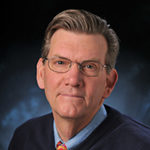
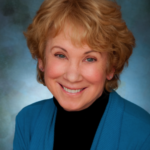
By Julaiti Nilupaer and Coline Dony
By definition, geographers study such a variety of places and spaces. Some choose to do their research about geographies near their university, and others are drawn to distant geographies. These choices were seriously challenged or derailed during the 2020-2021 academic year, which coincided with the rise of COVID-19.
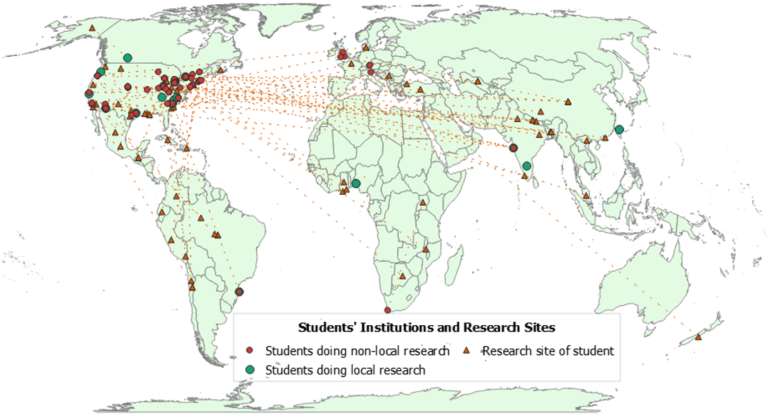
Locations of about 100 students who participated in the “AAG Learning Series for Graduate Students” and their respective research sites. Dots represent the locations of students’ current universities. Triangles represent the general locations of students’ research sites.
“Focus group discussions and oral history interviews have been put on a halt. The pandemic and lockdown has made fieldwork impossible.”
“My dissertation proposal includes interviews and focus groups, all interaction moved online, getting attention is difficult.”
“The plan was in-person landscape analysis & participant observation of historic Black spaces and I cannot due to IRB guidelines.”
“This process has been very challenging for me given the isolation and precariousness of the funding situation.”
These are just a sampling from among more than 800 graduate students who registered for at least one of the limited-capacity workshops in the “AAG Learning Series for Graduate Students.” Many also shared feelings of extreme isolation, beyond the already-difficult isolation graduate students often confront; some felt obstructed in the research they had planned, proposed, defended, or already started; some felt disoriented as their programs faced budgetary cuts, their travel plans were cancelled, or their advisors asked them to change research topics or questions; some experienced all of the above or had set graduate school aside to shift their entire focus to personal circumstances.
Learning Series for Graduate Students (2020-2021)
In the Spring of 2020, two AAG members – Brittany Lauren Wheeler (Clark University) and Dydia DeLyser (California State University, Fullerton) – volunteered for AAG’s COVID-19 Rapid Response Task Force. They had the foresight to see these challenges approaching. Wheeler and DeLyser co-wrote a proposal for the Task Force that suggested a “Methods Training program” to support graduate students in adapting their research to the new realities of pandemic life. Their idea turned into the Learning Series for Graduate Students, a virtual series accessible to graduate students with an AAG membership. With the help of a Selection Committee, a CFP was developed to call upon instructors to propose virtual workshops and seminars. The selection committee was composed of faculty at all levels and a graduate student: Lindsay Naylor (Chair, University of Delaware), Dydia DeLyser (California State University, Fullerton), Adriana E. Martinez (Southern Illinois University Edwardsville), Skye Naslund (University of Washington), and Yuqin Jiang (University of South Carolina). They selected 14 proposal ideas out of 28.
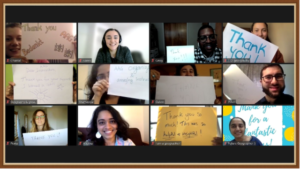
The 12 completed workshops and seminars in the series thus far, have served some 10% of AAG’s graduate student membership, or a total of 243 graduate students. During these workshops, graduate student participants gained or advanced their knowledge and skills in writing, mixed-methods research, qualitative research; used social media and its data; or learned to work with different tools, such as Jupyter Notebook, Google Colab, GeoPandas, SaTScan, ATLAS.ti, Miro, Google Maps, and ArcGIS StoryMaps. Besides that, each offering had a social or networking component, which allowed students to connect with each other. Their experiences were generally positive (see the photo below, find more student quotes here, and Tweets related to the #GradResearchDuringCOVID# here).
A screen capture from Dr. Aparna Parikh and Dr. Karen Paiva Henrique’s workshop on “Critical Visual Methods for Fieldwork at a Distance.”
The series also included two workshops offered by Beverley Mullings and Linda Peake, who are among the co-founders of the AAG Mental Health Affinity Group. Although they did not cover a geography method, the selection committee for the series wanted to add workshops on mental health and acknowledge that what was being asked of our community of graduate students was more than just to simply “adapt” their research during the pandemic: they also needed support for maintaining their mental health and wellbeing.
Throughout this program, the geographers in training have shown resilience and perseverance, openness to sharing their struggles with others, and the fortitude to see past the precious time they felt was lost.
Building Your Geographer’s Toolkit and Community (2022)
The 2020-2021 COVID-19 Task Force program barely reached the tip of the iceberg. Only 1 in 4 registrants gained access, due to the limited seats. The good news is that the AAG Council renewed and increased funding for this program for 2022.
To scale this program up, AAG is taking a number of steps in the coming months. For example, we plan to create several selection committees (instead of just one), each with a particular focus, such as computational methods, and methods for qualitative data, mixed data, collecting data, visualizing data, and so on.
The renewed program could also potentially create offerings for new audiences, such as recently graduated students in non-academic jobs who are looking to continue to receive career advice, learn new tools, hear about the unique perspective they can bring in terms of advocacy or professional ethics, and most of all, keep in touch with a community of geographers.
To make sure graduate students are involved in this program beyond just being workshop participants, AAG is building this scaled-up program with input and support from the AAG Graduate Student Affinity Group (GSAG). AAG is also thinking about funding Graduate-Led Working Groups and hiring an AAG Graduate Intern to help facilitate the program.
AAG is planning an all-day event on Friday, September 10, 2021. If you have ideas, suggestions, or are interested in being involved in this program as a graduate student, instructor, selection committee member, or as an AAG Specialty Group leader, find more details and how to register at this link (free for anyone, members and non-members).
“The whole world turned upside down in the last year, and none of us are untouched,” said Gary Langham, our Executive Director. And yet, invoking former AAG president Will Graf’s favorite line, Gary reminds us, “it’s a good day for Geography.” Indeed, we believe, and we strive to lighten up another day, for another young geographer, who belongs to our global community of geographers.
The AAG has a long history of engaging in and supporting climate change policy and research. Since climate change is the existential threat and crisis of our age, the need to continue this engagement and reduce our contribution to carbon emissions is clear. We will continue to seek policy action on behalf of our members–actions designed to influence the societal and governmental change required for durable solutions. For example, the AAG recently updated its climate statement, and just last week, our name appeared on a list of 80 societies calling for global action ahead of COP26.
Since climate change is the existential threat and crisis of our age, the need to continue this engagement and reduce our contribution to carbon emissions is clear.
A joint declaration from nearly all the world’s geography societies is a powerful thing. It calls upon our community to apply its considerable skills to the urgent consequences of climate change. One passage especially resonated with me in the week leading up to COP26:
Geographers have unique opportunities and responsibilities in the face of the global biodiversity and climate crises. […] Geographers can do much more than present an analysis of these challenges. They also have a vantage point from which they can point to the kinds of thought and action that can deliver a better tomorrow for every person on Earth.
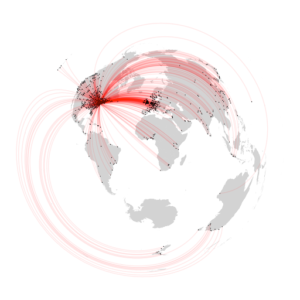
Worldwide travel distances to the 2019 AAG meeting. By Justin Schuetz
The AAG has 16 members as part of a delegation to observe the proceedings in Glasgow, and we are proud to participate in this crucial meeting of world leaders.
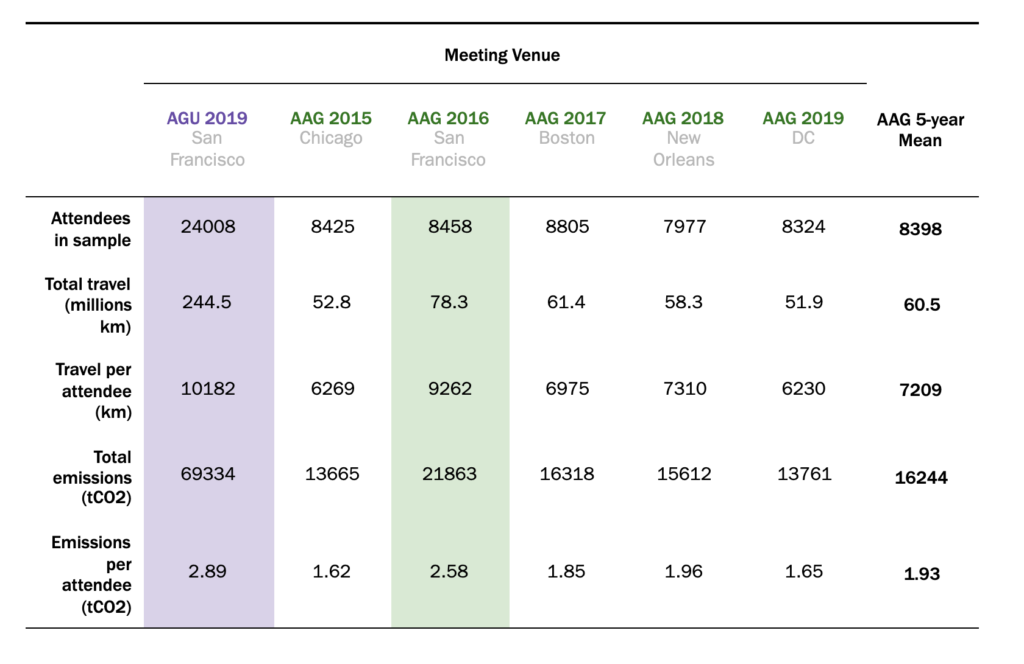
However, what actions can we take to reduce carbon emissions arising from AAG activities? The Climate Action Task Force members have worked tirelessly to explore new approaches to AAG meetings with a goal of reducing emissions by 50% by 2030 (and net zero by 2050). To assist in this process and to help us set baselines and explore future options, I am pleased to release an internal AAG reportestimating the carbon emissions and the annual meeting. Using the same methods as Klöwer, Hopkins et al., we applied estimates of emissions from travelfrom the last five in-person meetings (2015-2019). This method, which assumes direct travel from each participant’s home institution to the meeting site, allows us to calculate a baseline of emissions to compare future scenarios. Here is a good summary table of the results.
This table offers summary statistics for five AAG meetings and one AGU meeting. On average, AAG meetings from 2015-2019 had carbon footprints that were approximately 23% the size of the AGU footprint for 2019. This difference was due to AAG having, on average, 34% the number of attendees as AGU. In addition, the average AAG attendee traveled only 71% as far as the average AGU attendee. The AAG meeting in San Francisco was closest to the AGU conference in terms of travel and emissions. Source: AAG (2021) Carbon Emissions Associated with Travel to AAG Annual Meetings. Unpublished analyses prepared for the American Association of Geographers by JGS Projects, October 2021, 28 pp.
We also looked at future meetings. As with all academic societies and organizations with large meetings, the AAG signs hotel contracts five or more years in advance. Our contracted meetings are Denver (2023), Honolulu (2024), and Detroit (2025). Based on our projections, AAG 2024 in Honolulu will have much higher emissions than typical meetings (35k vs. 16.5k tCO2). Our contracts make cancellation prohibitive and encourage us to look for alternative solutions. For these reasons, we seek to partner with another geography society to offer additional locations or ‘hubs,’ perhaps in Europe or Canada. Surprisingly, adding additional hubs can reduce emissions impacts dramatically, even well below our five-year average (9k vs. 35k tCO2).
To cut carbon emissions, we will need to experiment with new ways of conducting our meetings to meet our emission goals. And, by all indications, AAG members are eager to embrace new ways to meet and create knowledge together. This eagerness is evident on so many fronts, ranging from the strong registration rates for AAG 2022 to the enthusiastic participation in AAG Regions Connect in October and virtual webinars throughout the year. Being willing to try new solutions is not a recipe for getting everything right the first time, yet it is the best and only way to get things right in the end.
Please note: The ideas expressed by Executive Director Gary Langham are not necessarily the views of the AAG as a whole. Please feel free to email him at glangham [at] aag [dot] org.
Share
News
A Walk Down NYC’s Re-Named Streets
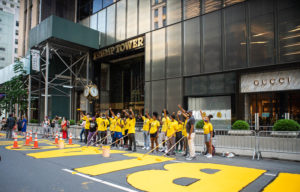
In the wake of protests for racial justice following George Floyd’s murder in Minneapolis by police in 2020, New York City Mayor Bill de Blasio pledged to rename five streets, one in each borough, in honor of the movement. In Manhattan, Black Lives Matter Boulevard was co-named at 1 Centre Street, a block that is home to the city’s Municipal Building, City Hall, and the Department of Education. In addition to these namings, the city funded a Black Lives Matter Mural on Fifth Avenue in front of Trump Tower, a mere five blocks (and six-minute walk) from the AAG’s Hilton Midtown hotel conference center. University of California Berkeley Professor Brandi Thompson Summers has examined Black Lives Matter murals like these around the country, and notes many of them are “visually stunning.” Yet she writes with concern how they “superficially stylize Blackness rather than respond to Black demands for justice” and employ what she calls “Black aesthetic emplacement,” coopting struggles for justice while political and economic elites obscure historic and ongoing structural injustices that hurt communities of color. Indeed, the first Black Lives Matter street painting in New York City was on Fulton Street, in the historically Black Brooklyn neighborhood of Bedford-Stuyvesant, organized not by city leaders but by a local nonprofit theater and designed and completed by local activists and artists.
Painters of Black Lives Matter mural on Fifth Avenue, New York City. By Anthony Quintano, Flickr. Creative Commons license
Also at 1 Centre Street is the eastern historic extent of the African Burial Ground National Monument, the resting site for the remains of over 15,000 free and enslaved African-American and Black New Yorkers; it was in use from the 1630s through 1795. The visitors’ center at the site, on the ground floor of the Federal building built there in the 1990s, has a section on the extensive activism from that same period, which led to the establishment of the National Monument.
New York City’s efforts to engage its layered history through street renaming is characteristic of efforts around the country in recent years, where geographer and past AAG president Derek Alderman—who has tracked nationwide street renamings to honor Martin Luther King and other Black leaders1—has noted in an interview with Bloomberg City Lab,“a bit of catch-up going on.” Founded on the systematic dispossession of the Indigenous Lenape People, New York City has quite a lot of catching up to do, especially in light of its long history of ties to slavery and the slave trade, repressive violence against Black New Yorkers such as during the 1863 Draft Riots, and systematic Black dispossession and erasure during Title I Urban Renewal and today as residents face eviction and displacement. Indeed – many of the city’s central streets—Houston (pronounced How-ston), Stuyvesant, Delancey, Duane, Mott, and Schermerhorn, to mention but a few—have connections to and profited from the slave trade. Although these street names remain, racial-justice movements are among the key catalysts in contemporary street renamings. We can see these contestations unfold, in various layers, by walking New York City’s named and renamed streets.
New York City has renamed over 1,600 of its streets, parks, plazas, highways, and other public infrastructure, according to retired urban planner Gilbert Tauber.2 In his recent book, Names of New York, Joshua Jelly-Schapiro, an American geographer and writer, connects street names with stories of how various populations leave their mark on the city. Writes Jelly-Schapiro in The New York Review of Books: “If landscape is history made visible, the names we call its places are the words we use to forge maps of meaning in the city.”
Leonard Bernstein Place, named by Mayor Dinkins in 1993. Wally Gobetz / Creative Commons License
Types and Forms of NYC Street Renamings
New York City is in a constant state of flux and remaking, with street renamings no exception. In the 18th and 19th centuries, as encroaching colonization overrode the ancestral landscapes and place-names of the Lenape people, and then the succeeding pastoral places of New York like Bloomingdale, functions and landscapes of place were entirely transformed and renamed (to what we know as the Upper West Side, in the case of Bloomingdale).3 Starting in the 20th century, distinctive city procedures evolved for renaming processes, with distinct purposes, politics, and means of recognition.
Co-names (sometimes known as secondary names) for community leaders, as defined by Community Boards, are named for local activists who have passed away. Those outside the neighborhood might not know them, but residents from the area will have appreciation for their work, and these community leaders represent New York City’s diverse populations. For example, consider the portion of Morningside Drive in Manhattan, co-named Marie Runyon Way. Runyon was a tenant activist who fought the wholesale demolition of Single-Room Occupancy (SRO) buildings on her street. Many of Morningside Drive’s SROs have since been demolished, but her legacy remains on this street sign.
Co-names for well-known public figures, by contrast, can boost property values and accelerate processes of dispossession and erasure through place-making and what Bourdieu might refer to as ”distinction.”4Brian Goldstein’s bookRoots of the Urban Renaissance examines the coalition of racially inclusive economic-development boosterism that emerged from initial 1960s’ battles between capitalist developers and radical social movements in Harlem. Rose-Redwood looks at name changes in Harlem including the changes from 125th Street to Dr. Martin Luther King Jr. Boulevard in 1984, and from Lenox Avenue/Sixth Avenue to Malcolm X Boulevard in 1987. Note both Goldstein and Rose-Redwood, renaming in Harlem was part of a nationwide movement calling for the cultural recognition of African Americans, even as this movement saw re-naming as a device for economic-development and increasing property values elsewhere in New York City, including on the city’s Upper West Side.
Finally, honorific re-namings might serve as placemaking devices or commemorate city history, even when not named for an individual or institution. This was precisely the impetus for renaming 6th Avenue “Avenue of the Americas” in 1945, to highlight the establishment of the United Nations and the location of its headquarters several avenues east, and as a nod to the Organization of American States. In the context of the World Trade Center, collective memory of trauma and loss loom large in renaming processes across the city that memorialize those lost in 9/11.
Analysis of Renaming and Its Functions in New York City
Lessons emerge from the different types of NYC street renamings and co-namings. First, (1), co-naming rarely replaces the old (and renaming does not always do so, either); the old name often lingers on as a palimpsest. (2) Name changes are often advanced for placemaking and economic-development boosterism. And (3) Name changes can emerge from genuine efforts to foster a more inclusive city, honoring local communities and advocates.
1) renaming as palimpsest
Street renamings – whether co-names, secondary names, or, in some cases, full renamings – do not always fully “replace” the city streets’ original names. Indeed, by contrast, the new names often layer on top of the old. In some cases, residents will continue to refer to streets by their original names, including Harlem residents who say “Lenox” and not “Malcolm X” Boulevard (Google Maps, perhaps an arbiter of authority, recognizes both). With community co-names, there are typically two street signs, one placed atop the other, to designate the simultaneous presence of multiple names. Palimpsests, as scholars like Schein and Bloch discuss, are layered tapestries where the past never disappears but melds or joins with new layers to produce a different image or subjective experience (Schein explores “erasure and over-writing and co-existence” of American suburban landscape imaginaries in the Lexington, KY suburb of Ashland Park, and Bloch considers layers of mural and graffiti art in Los Angeles). Likewise, New York City names have residues informed by residents’ memories and life experiences; they cannot easily be decreed away. Yet just as how “modern” New York and its residents are in constant and rapid flux – experiencing new development, large-scale projects, and displacement – city streets change. That longtime residents in particular sometimes resist name changes speaks to their embodied memories of times before name changes, and community resistance to top-down government or developer tactics (as in section 2, below). Street renamings also speak to residents’ political struggles and activism. As an example, renaming 125th Street in Harlem to Martin Luther King Jr. Blvd. speaks to the activism and experiences of central Harlem residents, and resident efforts to prevent developer-backed name changes like “South of Harlem,” or SoHa, have largely been successful. General Lee Avenue (named for Confederate General Robert E. Lee), which runs through the Fort Hamilton military base in Bay Ridge, Brooklyn, has yet to be changed. Yet some renamings do successfully and fully replace former names. The horrific subway wreck on Malbone Street in Brooklyn in 1919 led to the renaming of that street to Empire Boulevard, and with time, the new name stuck. Fully renaming streets may affect memory different than secondary or co-naming actions, as might the conditions under which the renaming takes place (in this case, a tragedy).
2) renaming for profit
As Rose-Redwood explores, renaming numbered streets such as Amsterdam Avenue in the Upper West Side helped cultivate a sense of “place” in the neighborhood, which drove up property values. Such placemaking efforts also explained the city council’s impetus for renaming 6th Avenue “Avenue of the Americas.” Today, apartment-hunting websites like Street Easy are keen to explore street renamings and their roles in city placemaking.
Perhaps even more cynically, we could think of renamings by New York City public officials as small-scale symbolic politics that distract from material politics of inequality and redistribution. The New York City Department of Transportation has comparatively full control over streets, and name changes can be more affordable and less politically controversial “wins” for city leaders than major changes to political economy or democratic representation. Sharine Taylor, writing on the case of Toronto, worries that renamings might even be employed to “quell concerns” by residents demanding more structural material changes.
3) renaming for inclusion
In a city that is majority nonwhite and nearly 37% foreign-born, changing street names can make New York City feel less alienating and more inclusive, especially when streets are co-named for community heroes with local ties. In that frame, and especially when the changes are demanded by local residents, a renaming can be an act of cultural citizenship. Renaming also offers an important opportunity to think about the gender politics of street names in the past and present.5 And importantly, long after name changes are enacted, we are all left with an intricate palimpsest of street names that better reflects the demographic diversity of New York City.
Conclusion
Even in the context of over 1,600 streets, parks, plazas, and highways that have been re-named in just the past 200 years of New York City’s history, we might consider just how many streets have not been renamed. Houston, Stuyvesant, Delancey, Duane, Mott, and Schermerhorn are just some names intimately tied into New York City’s identity that are also associated with Dutch and English settler colonialism and the trans-Atlantic slave trade. These names are not peripheral to the city’s political geography: Peter Stuyvesant, as one example, enslaved over 40 people and was a renowned bigot, with white supremacist values and a desire to expand slavery across the hemisphere. NYC places continue to bear Stuyvesant’s name: the Stuyvesant Town housing developments, the historically Black (and gentrifying) Bedford-Stuyvesant neighborhood of Brooklyn, and the top-performing Stuyvesant High School.6
A full renaming of problematic New York streets or public infrastructure is not possible or likely. Instead, they present New Yorkers and visitors an opportunity to examine the city’s origins, which reveal how racism, genocidal projects against Indigenous Peoples, and the slave trade played major roles in structuring the city and its place-making. Yet street renamings also reveal efforts by city residents and elected officials to create a more just city and built environment, adding to that history. When in town for the 2022 AAG Annual Meeting, come discover the contradictions and narratives of New York City’s many streets and places for yourself.
Stefan Norgaard is a PhD candidate in Urban Planning at Columbia University and a member of the AAG2022 Arrangements Committee. The author would like to thank his colleagues on the committee, Tamar Y. Rothenberg, Professor and Chair of theDepartment of History at Bronx Community College-CUNY; and Jason B. Greenberg, Professor of Geography at Sullivan University, for their reading and suggestions for this article.
Footnotes
1“Street names and the scaling of memory: the politics of commemorating Martin Luther King, Jr within the African American community,” Area 35(2): 163–173).
2 For a map showing the long churn of renaming in New York since the colony was founded, see Constantine Valhouli’smap of early place names.
3 The story of the Bloomingdale district is related to the 1811 Commissioners’ street grid plan and the eventual development of Manhattan and 125th St. Thus, renamings erased the informal farm-and-estate community when development crept north.
4Indeed, notes Rose-Redwood (2008) in his article “From Number to Name: Symbolic Capital, Placesof Memory and the Politics of Street Renaming in New York City”: street (re)-naming can advance an “elite project of symbolic erasure and forced eviction, on the one hand, and the cultural recognition of a historically marginalized group, on the other” (438).
5 There is a nascent, yet growing interest in scholarly literature at the intersection of street naming and gendering the urban streetscape. Scholars and activists in recent years are exploringefforts at naming more streets after women. Bigon and Zuvalinyenga offer a review of such efforts in Global South city streets, and Rose-Redwood in his article “Number to Name” considers the NYC-specific example of Mary McLeod Bethune Place.
6Stuyvesant Town was built over demolished gas tanks in what was called the Gas House District (now there’s a renaming for development reasons!) in a public-private partnership with Metropolitan Life Insurance. The complex was offered as affordable housing for returning WWII veterans and their families and has its own racist history, as African-Americans were barred from renting there; activists sued, and lost. Bedford-Stuyvesant slightly overlaps the northern extent of Weeksville, a village of free Black property owners founded in the 1830s that is mostly in Crown Heights, but with overlap. 3. Stuyvesant High School, established 1904, is one of NYC’s so-called specialized public high schools, and requires an extremely competitive entrance test; this policy is very controversial, as very few Black students qualify for admission, and the percentage is declining.
NEW YORK CITY PLANS: A BRIEF BACKGROUND Two massive planning efforts in New York during the 19th and 20th century framed the direction for the city’s intensive development during the next two centuries. First, New York’s 1811 street grid plan mapped out Manhattan’s transformation from mostly bucolic field and farmland to rapidly growing city. Among other things, the grid plan established Manhattan’s system of numbered streets and avenues from south to north. Coming about 100 years later, “the insane 1915 renumbering system in Queens,” says AAG member, geographer, and historian Tamar Rothenberg, “was intended to create borough-wide order from the independently developed merged towns and villages of Queens and Brooklyn,” the two western boroughs/counties on Long Island that were incorporated into New York City in 1898. By that time, the City of Brooklyn had already incorporated all of Kings County, but Queens was still a county of separate cities, towns, and villages. Rothenberg says, “There are some funny takes on how that plays out today,” and recommends this overview from 2000 in the New York Times. —compiled with information provided by Tamar Rothenberg
For further reading, consider:
Names of New York, by Joshua Jelly-Schapiro (Penguin Random House, 2021).
The award is named for Dr. Duane Marble, creator of the Marble Fund, and for the late Dr. A. R. (Ray) Boyle who was a major contributor to the early development of both computer cartography and geographic information systems. Dr. Ray Boyle was born in England in 1920 and served with the British Admiralty during World War II. After the war, he developed and patented many graphic systems for plotting and digitizing and was the inventor of the “free cursor” digitizing system that was the basis for the digital entry of much early spatial data. After moving to Canada in 1965 he was appointed Professor of Electrical Engineering at the University of Saskatchewan where, among many other achievements, he developed the first digital system for nautical chart production for the Canadian Hydrographic Service. He worked for many years with Dr. Roger Tomlinson on the technical evaluation of GIS software and was also an active member of the IGU Commission on Geographical Data Sensing & Processing for many years.
Duane Marble and Ray Boyle in Honolulu at the Joint U.S.–Australia GIS Meeting in 1982
The Award
This award aims to recognize excellence in academic performance by undergraduate students from the United States and Canada who are putting forth a strong effort to bridge geographic science and computer science as well as to encourage other students to embark upon similar programs.
Each of the Marble-Boyle Undergraduate Achievement Awards consists of a cash prize of $1,500 and a certificate of recognition. Additionally, a $1,000 travel grant will be provided to recipients who attend the AAG Annual Meeting in person.
Initially, up to three awards will be made available each year. Formal presentation of the awards will be made at the AAG Annual Meeting. Awardees are encouraged, but not required, to attend.
Applications will be reviewed by the Marble-Boyle Undergraduate Achievement Award Committee. After review, the committee will recommend up to three applications to the Marble Fund Trustees as winners. Final awards will be made by the Trustees.
Eligibility
Applicants must be enrolled in a full–time program of undergraduate study at an accredited United States or Canadian college or university.
At the time of the application, the applicant must be no more than twelve months from graduation.
Applicants must demonstrate a reasonable intent to embark upon a career or further education that will make use of their joint geographic science and computer science knowledge.
There is no limit with respect to the number of students who can apply from a single institution.
Applicants do not need to be members of the Association of American Geographers, but they are strongly encouraged to consider membership.
As with all other AAG awards, eligibility also rests on the candidate being in compliance with the AAG Professional Conduct Policy. Nominations may be rescinded, and the award may also be revoked for any candidate or awardee who is found in violation of the AAG’s Professional Conduct Policy.
Applications
A complete application must be received no later than the close of business on the deadline (Eastern Time).
Applicants must provide:
An essay (800 word limit) that identifies the individual’s areas of interest within geographic science and computer science, a description of his or her career goals, and a statement as to how his or her joint background in geographic science and computer science will help to meet these goals.
A letter of recommendation from the student’s faculty advisor, department chair or program director. The letter should clearly address both the applicant’s academic performance as well as their potential for a career or further education that utilizes their geographic science and computer science background. Recommendation letters must be signed and written on institutional letterhead as a PDF. Applicants will make a direct request for a letter of recommendation within the application portal.
An official or unofficial copy of the applicant’s transcript(s) with all relevant courses in geographic science and computer science, and grades received in these courses, highlighted.
For each highlighted course, the applicant must provide a one- or two-sentence description of the course content, the textbook(s) used (if applicable), and the name(s) of the instructor(s).
Mauris non tempor quam, et lacinia sapien. Mauris accumsan eros eget libero posuere vulputate. Etiam elit elit, elementum sed varius at, adipiscing vitae est. Sed nec felis pellentesque, lacinia dui sed, ultricies sapien. Pellentesque orci lectus, consectetur vel posuere.
2026
Rachel Loftus
Rachel Loftus, University of Illinois Urbana-Champaign
2026 AAG Marble-Boyle Undergraduate Achievement Award
Rachel Loftus
2026 AAG Marble-Boyle Undergraduate Achievement Award
Rachel Loftus, University of Illinois Urbana-Champaign
2025
Jorre Dahl
Jorre Dahl, Middlebury College
2025 AAG Marble-Boyle Undergraduate Achievement Award
Jorre Dahl
2025 AAG Marble-Boyle Undergraduate Achievement Award
Jorre Dahl, Middlebury College
2024
Teagan Duenkel
Teagan Duenkel, Florida Atlantic University
2024 AAG Marble-Boyle Undergraduate Achievement Award
Teagan Duenkel
2024 AAG Marble-Boyle Undergraduate Achievement Award
Teagan Duenkel, Florida Atlantic University
2024
Cecelia Kaufmann
Cecelia Kaufmann, Macalester College
2024 AAG Marble-Boyle Undergraduate Achievement Award
Cecelia Kaufmann
2024 AAG Marble-Boyle Undergraduate Achievement Award
Cecelia Kaufmann, Macalester College
2024
Liam Smith
Liam Smith, Middlebury College
2024 AAG Marble-Boyle Undergraduate Achievement Award
Liam Smith
2024 AAG Marble-Boyle Undergraduate Achievement Award
Liam Smith, Middlebury College
2023
Rachel de Sobrino
Rachel de Sobrino, University of Minnesota
2023 AAG Marble-Boyle Undergraduate Achievement Award
Rachel de Sobrino
2023 AAG Marble-Boyle Undergraduate Achievement Award
Rachel de Sobrino, University of Minnesota
2023
Laurel Sparks
Laurel Sparks, Georgia State University
2023 AAG Marble-Boyle Undergraduate Achievement Award
Laurel Sparks
2023 AAG Marble-Boyle Undergraduate Achievement Award
Laurel Sparks, Georgia State University
2022
Matthew DeWitte
Matthew DeWitte, University of Wisconsin Eau Claire
2022 AAG Marble-Boyle Undergraduate Achievement Award
Matthew DeWitte
2022 AAG Marble-Boyle Undergraduate Achievement Award
Matthew DeWitte, University of Wisconsin Eau Claire
2022
Keegan Moynahan
Keegan Moynahan, University of Massachusetts Amherst
2022 AAG Marble-Boyle Undergraduate Achievement Award
Keegan Moynahan
2022 AAG Marble-Boyle Undergraduate Achievement Award
Keegan Moynahan, University of Massachusetts Amherst
2022
Zimo Xiao
Zimo Xiao, University of Illinois
2022 AAG Marble-Boyle Undergraduate Achievement Award
Zimo Xiao
2022 AAG Marble-Boyle Undergraduate Achievement Award
Zimo Xiao, University of Illinois
2021
Jessica Embury
Jessica Embury, San Diego State University
2021 AAG Marble-Boyle Undergraduate Achievement Award
Jessica Embury
2021 AAG Marble-Boyle Undergraduate Achievement Award
Jessica Embury, San Diego State University
2021
Daniel Council
Daniel Council, Ball State University
2021 AAG Marble-Boyle Undergraduate Achievement Award
Daniel Council
2021 AAG Marble-Boyle Undergraduate Achievement Award
Daniel Council, Ball State University
2020
Jacob Bostick
Jacob Bostick, University of Colorado-Colorado Springs
2020 AAG Marble-Boyle Undergraduate Achievement Award
Jacob Bostick
2020 AAG Marble-Boyle Undergraduate Achievement Award
Jacob Bostick, University of Colorado-Colorado Springs
2020
Nathan Fiscus
Nathan Fiscus, University of North Alabama
2020 AAG Marble-Boyle Undergraduate Achievement Award
Nathan Fiscus
2020 AAG Marble-Boyle Undergraduate Achievement Award
Nathan Fiscus, University of North Alabama
2020
Chelsie Perkins
Chelsie Perkins, East Tennessee State University
2020 AAG Marble-Boyle Undergraduate Achievement Award
Chelsie Perkins
2020 AAG Marble-Boyle Undergraduate Achievement Award
Chelsie Perkins, East Tennessee State University
2019
Katherine Jolly
Katherine Jolly, Macalester College
2019 AAG Marble-Boyle Undergraduate Achievement Award
Katherine Jolly
2019 AAG Marble-Boyle Undergraduate Achievement Award
Katherine Jolly, Macalester College
2019
Pearl Leff
Pearl Leff, Hunter College – CUNY
2019 AAG Marble-Boyle Undergraduate Achievement Award
Pearl Leff
2019 AAG Marble-Boyle Undergraduate Achievement Award
Pearl Leff, Hunter College – CUNY
2019
Rachel Pierstorff
Rachel Pierstorff, University of Denver
2019 AAG Marble-Boyle Undergraduate Achievement Award
Rachel Pierstorff
2019 AAG Marble-Boyle Undergraduate Achievement Award
Rachel Pierstorff, University of Denver
2018
Noah Irby
Noah Irby, University of North Dakota
2018 AAG Marble-Boyle Undergraduate Achievement Award
Noah Irby
2018 AAG Marble-Boyle Undergraduate Achievement Award
Noah Irby, University of North Dakota
2017
Coty Welch
Coty Welch, University of North Alabama
2017 AAG Marble-Boyle Undergraduate Achievement Award
Coty Welch
2017 AAG Marble-Boyle Undergraduate Achievement Award
Coty Welch, University of North Alabama
2016
Andrew Green
Andrew Green, Jacksonville State University
2016 AAG Marble-Boyle Undergraduate Achievement Award
Andrew Green
2016 AAG Marble-Boyle Undergraduate Achievement Award
Andrew Green, Jacksonville State University
2016
Jeffrey King
Jeffrey King, University of Missouri
2016 AAG Marble-Boyle Undergraduate Achievement Award
Jeffrey King
2016 AAG Marble-Boyle Undergraduate Achievement Award
Jeffrey King, University of Missouri
2016
Taylor Mckeeman
Taylor Mckeeman, University of Calgary
2016 AAG Marble-Boyle Undergraduate Achievement Award
Taylor Mckeeman
2016 AAG Marble-Boyle Undergraduate Achievement Award
Taylor Mckeeman, University of Calgary
2015
Angel Pitts
Angel Pitts, University of South Carolina
2015 AAG Marble-Boyle Undergraduate Achievement Award
Angel Pitts
2015 AAG Marble-Boyle Undergraduate Achievement Award
Angel Pitts, University of South Carolina
2013
Andrew Ortego
Andrew Ortego, The University at Buffalo
2013 AAG Marble-Boyle Undergraduate Achievement Award
Andrew Ortego
2013 AAG Marble-Boyle Undergraduate Achievement Award
Andrew Ortego, The University at Buffalo
2012
Sergey Reid
Sergey Reid, Texas A&M University – Corpus Christi
2012 AAG Marble-Boyle Undergraduate Achievement Award
Sergey Reid
2012 AAG Marble-Boyle Undergraduate Achievement Award
Sergey Reid, Texas A&M University – Corpus Christi
2011
Darren Boss
Darren Boss, University of Victoria
2011 AAG Marble-Boyle Undergraduate Achievement Award
Darren Boss
2011 AAG Marble-Boyle Undergraduate Achievement Award
Darren Boss, University of Victoria
2010
Rheannon Brooks
Rheannon Brooks, University of Victoria
2010 AAG Marble-Boyle Undergraduate Achievement Award
Rheannon Brooks
2010 AAG Marble-Boyle Undergraduate Achievement Award
Rheannon Brooks, University of Victoria
2010
Jason Jones
Jason Jones, University of Southern Mississippi
2010 AAG Marble-Boyle Undergraduate Achievement Award
Jason Jones
2010 AAG Marble-Boyle Undergraduate Achievement Award
Jason Jones, University of Southern Mississippi
2010
Brandon Zook
Brandon Zook, University of Wyoming
2010 AAG Marble-Boyle Undergraduate Achievement Award
Brandon Zook
2010 AAG Marble-Boyle Undergraduate Achievement Award
Brandon Zook, University of Wyoming
2009
Joanna Merson
Joanna Merson, University of Victoria and MFSA Supplemental Research Fellowship for September 2009 – February 2010 at the MicrGIS Foundation in Switzerland.
2009 AAG Marble-Boyle Undergraduate Achievement Award
Joanna Merson
2009 AAG Marble-Boyle Undergraduate Achievement Award
Joanna Merson, University of Victoria and MFSA Supplemental Research Fellowship for September 2009 – February 2010 at the MicrGIS Foundation in Switzerland.
2009
Kenneth Robertson
Kenneth Robertson, Central Michigan University
2009 AAG Marble-Boyle Undergraduate Achievement Award
Kenneth Robertson
2009 AAG Marble-Boyle Undergraduate Achievement Award
Kenneth Robertson, Central Michigan University
2009
Doris Lam
Doris Lam, York University honorable mention
2009 AAG Marble-Boyle Undergraduate Achievement Award
Doris Lam
2009 AAG Marble-Boyle Undergraduate Achievement Award
The AAG Susan Hardwick Excellence in Mentoring Award
The deadline for the upcoming 2027 AAG awards has passed.
The AAG Susan Hardwick Excellence in Mentoring award is given annually to an individual geographer, group, or department who has demonstrated extraordinary leadership in building supportive academic and professional environments in their departments, associations, and institutions and guiding the academic and or professional growth of their students and junior colleagues. It is named in honor and memory of the late Susan Hardwick, the inaugural recipient of this award and a beloved mentor, scholar and colleague.
Nominations are sought to recognize individuals, groups, or departments who have increased the number of students and faculty from underrepresented groups, improved the quality of their participation in geography or who have impacted the climate of a department, college, or institution toward greater inclusion. Self nominations are also welcomed.
The Awardee(s) will be invited to participate in an interview or contribute a publication for Journal of Geography in Higher Education that identifies and promotes specific mentoring practices that are replicable, effective and highly valued in order for these actions to be shared with the broader AAG community.
Eligibility
Individual geographers, groups, or departments are eligible for nomination. Nominations from a wide spectrum of mentors in the geography community are encouraged, including from academic, public, private, and non-profit sectors. The relationship may be between mentor and students or mentor and junior faculty or employees. Posthumous nominations are generally not accepted.
Criteria
The award will honor individuals, groups, or departments who consistently do one or more of the following:
Have succeeded in establishing formal, informal, or quasi formal channels for providing support to students, junior faculty and/or employees
Help to create a vital and engaged geography community at their home Institution or association.
Demonstrate a commitment to inclusion and to the particular advising and mentoring needs of individuals from traditionally underrepresented groups.
Have developed and carried out specific practices that are replicable, effective and highly valued.
Nominations
Nominations for the AAG Susan Hardwick Excellence in Mentoring Awardmust be received by the deadline (Eastern Time). Complete nominations will include:
the nominee’s curriculum vitae, only if the nominee is an individual geographer
a concise (500 words maximum) yet specific description of the accomplishments that warrant selection according to the above criteria;
No more than three (3) letters of recommendation from other individuals (including mentees) The strongest applications will feature at least one supporting letter from a senior colleague.
As with all other AAG awards, eligibility also rests on the candidate being in compliance with the AAG Professional Conduct Policy. Nominations may be rescinded, and the award may also be revoked for any candidate or awardee who is found in violation of the AAG’s Professional Conduct Policy.
For questions or difficulties, please contact grantsawards@aag.org or call the AAG at 202-234-1450.
Selections
Nominations for the AAG Susan Hardwick Excellence in Mentoring Award will be reviewed jointly by the AAG JEDI Committee and the Committee on the Status of Women in Geography. A single awardee will be recommended to be approved by the AAG Council at their Fall meeting. No monetary prize is provided. Awards are presented at the Awards Ceremony during the AAG’s Annual Meeting.
AAG Susan Hardwick Excellence in Mentoring Award Recipients
Mauris non tempor quam, et lacinia sapien. Mauris accumsan eros eget libero posuere vulputate. Etiam elit elit, elementum sed varius at, adipiscing vitae est. Sed nec felis pellentesque, lacinia dui sed, ultricies sapien. Pellentesque orci lectus, consectetur vel posuere.
2026
Sarah Holloway
The American Association of Geographers recognizes ProfessorSarah Holloway with the Susan Hardwick Excellence in Mentoring Award for her longstanding commitment to supporting students and colleagues, and her role in fostering a positive, inclusive academic environment. Over more than 30 years at Loughborough University, she has contributed to meaningful improvements in departmental and institutional culture through her teaching, mentorship, and dedication to equitable practices.
Professor Holloway has provided guidance to individuals at many career stages, including undergraduate and graduate students as well as early and midcareer faculty. Her thoughtful, individualized approach has helped many scholars grow in confidence, navigate key career transitions, and develop leadership skills. Her mentorship has supported people from a wide range of backgrounds, including first-generation students, international scholars, and those facing social or economic barriers.
Her work has also contributed to broader structural change. Professor Holloway played an important role in advancing maternity leave and part-time employment policies at her university and supported the first researchers to benefit from these improvements. She introduced new topics into the curriculum early in her career and helped shape courses that broaden students’ perspectives and strengthen the learning environment. Her contributions to equity and inclusion were further acknowledged when she received her School’s inaugural EDI Champion Award.
Across her career, Professor Holloway has helped build a more supportive and inclusive academic community. Her sustained contributions have positively influenced individuals, programs, and the wider field. The American Association of Geographers is pleased to honor her with the 2026 Susan Hardwick Excellence in Mentoring Award.
2026 AAG Susan Hardwick Excellence in Mentoring Award
Sarah Holloway
2026 AAG Susan Hardwick Excellence in Mentoring Award
The American Association of Geographers recognizes ProfessorSarah Holloway with the Susan Hardwick Excellence in Mentoring Award for her longstanding commitment to supporting students and colleagues, and her role in fostering a positive, inclusive academic environment. Over more than 30 years at Loughborough University, she has contributed to meaningful improvements in departmental and institutional culture through her teaching, mentorship, and dedication to equitable practices.
Professor Holloway has provided guidance to individuals at many career stages, including undergraduate and graduate students as well as early and midcareer faculty. Her thoughtful, individualized approach has helped many scholars grow in confidence, navigate key career transitions, and develop leadership skills. Her mentorship has supported people from a wide range of backgrounds, including first-generation students, international scholars, and those facing social or economic barriers.
Her work has also contributed to broader structural change. Professor Holloway played an important role in advancing maternity leave and part-time employment policies at her university and supported the first researchers to benefit from these improvements. She introduced new topics into the curriculum early in her career and helped shape courses that broaden students’ perspectives and strengthen the learning environment. Her contributions to equity and inclusion were further acknowledged when she received her School’s inaugural EDI Champion Award.
Across her career, Professor Holloway has helped build a more supportive and inclusive academic community. Her sustained contributions have positively influenced individuals, programs, and the wider field. The American Association of Geographers is pleased to honor her with the 2026 Susan Hardwick Excellence in Mentoring Award.
2025
Leslie Duram
AAG’s Susan Hardwick Excellence in Mentoring Award acknowledges Dr. Leslie Duram’s remarkable mentorship and lasting impact on students and colleagues. Dr. Duram, Professor of Geography and Environmental Resources and Director of the Environmental Studies minor at Southern Illinois University, has advised numerous graduate students, including those from underrepresented backgrounds and helped them achieve career success. Her unparalleled dedication to mentoring students extends to undergraduate students in the Environmental Studies minor as she provides all aspects of professional development opportunities. Dr. Duram’s exceptional mentorship and unwavering support has reached many of her colleagues and contributed to fostering a vibrant and engaged community in her department, university, and the geography discipline. As the department chair, she has been a supportive and inspirational colleague and mentor to her faculty colleagues for personal and professional growth. Her remarkable mentorship was highly recognized by prestigious awards such as Teaching Excellence Award and University Women’s Professional Advancement (UWPA) Mentorship Award by her institution (SIU).
Students and colleagues of Dr. Duram have extensively shared the deep impacts of her genuine compassion for their personal well-being and continued growth into successful scholars, educators, and professionals. With an innate understanding of each individual’s strengths and potential, Dr. Duram has skillfully provided the tools and opportunities necessary for success. Her dedication to caring for varied needs, nurturing talent, and promoting a culture of continuous learning has made an indelible impact on her students and peers. Dr. Duram’s mentorship is a shining example of dedication and excellence.
2025 AAG Susan Hardwick Excellence in Mentoring Award
Leslie Duram
2025 AAG Susan Hardwick Excellence in Mentoring Award
AAG’s Susan Hardwick Excellence in Mentoring Award acknowledges Dr. Leslie Duram’s remarkable mentorship and lasting impact on students and colleagues. Dr. Duram, Professor of Geography and Environmental Resources and Director of the Environmental Studies minor at Southern Illinois University, has advised numerous graduate students, including those from underrepresented backgrounds and helped them achieve career success. Her unparalleled dedication to mentoring students extends to undergraduate students in the Environmental Studies minor as she provides all aspects of professional development opportunities. Dr. Duram’s exceptional mentorship and unwavering support has reached many of her colleagues and contributed to fostering a vibrant and engaged community in her department, university, and the geography discipline. As the department chair, she has been a supportive and inspirational colleague and mentor to her faculty colleagues for personal and professional growth. Her remarkable mentorship was highly recognized by prestigious awards such as Teaching Excellence Award and University Women’s Professional Advancement (UWPA) Mentorship Award by her institution (SIU).
Students and colleagues of Dr. Duram have extensively shared the deep impacts of her genuine compassion for their personal well-being and continued growth into successful scholars, educators, and professionals. With an innate understanding of each individual’s strengths and potential, Dr. Duram has skillfully provided the tools and opportunities necessary for success. Her dedication to caring for varied needs, nurturing talent, and promoting a culture of continuous learning has made an indelible impact on her students and peers. Dr. Duram’s mentorship is a shining example of dedication and excellence.
2024
Derek Alderman
Dr. Derek Alderman is recognized for his outstanding and impactful contributions to mentorship of students and early career faculty colleagues. The committee particularly noted the caring and inclusive environment Dr. Alderman creates which supports a highly valued climate of collegiality within the University of Tennessee Department of Geography and Sustainability, the impressive number of students mentored throughout his career, his holistic “coaching up” mentorship style that centers diversity, equity, and inclusion, draws upon his own life experience, and goes far beyond a one-size-fits-all mentorship approach. The committee was moved by the testimonies and letters of support submitted by Dr. Alderman’s mentees which embody the spirit, memory, and legacy of the late Dr. Susan Hardwick.
2024 AAG Susan Hardwick Excellence in Mentoring Award
Derek Alderman
2024 AAG Susan Hardwick Excellence in Mentoring Award
Dr. Derek Alderman is recognized for his outstanding and impactful contributions to mentorship of students and early career faculty colleagues. The committee particularly noted the caring and inclusive environment Dr. Alderman creates which supports a highly valued climate of collegiality within the University of Tennessee Department of Geography and Sustainability, the impressive number of students mentored throughout his career, his holistic “coaching up” mentorship style that centers diversity, equity, and inclusion, draws upon his own life experience, and goes far beyond a one-size-fits-all mentorship approach. The committee was moved by the testimonies and letters of support submitted by Dr. Alderman’s mentees which embody the spirit, memory, and legacy of the late Dr. Susan Hardwick.
2023
Heather A. Smith
Heather A. Smith, University of North Carolina Charlotte, is recognized for her outstanding style of mentorship that emulates, honors, and embodies the spirit, memory and legacy of the late Dr. Susan Hardwick.
Students and colleagues of Dr. Smith praise her generosity, inclusivity and focus on collaboration, service, and leadership. Dr. Smith is recognized for her commitment to providing more access, more opportunity, more attention, more care, more critical engagement, and more professional development than is typical in academia, all while exemplifying high standards for excellence and engagement. Further, she has provided students with the skills and resources they need to succeed as scholars and practitioners. She shows sustained interest in the continued growth, well-being, and success of current and former students and faculty colleagues. The far-reaching impacts of her style of mentorship are carried forward by her mentees into other spaces and places.
Dr. Smith’s professional interests and mentoring strengths have guided a generation of geography students in effective community engagement and in the ethical conduct of engaged research. Through highly impactful professional development meetings and other structured mentoring spaces and activities, Dr. Smith engages and guides students at every level, from undergraduate to Ph.D. She also sustains junior colleagues in effectively and successfully navigating academia and beyond. Her mentorship is exemplary and invaluable.
2023 AAG Susan Hardwick Excellence in Mentoring Award
Heather A. Smith
2023 AAG Susan Hardwick Excellence in Mentoring Award
Heather A. Smith, University of North Carolina Charlotte, is recognized for her outstanding style of mentorship that emulates, honors, and embodies the spirit, memory and legacy of the late Dr. Susan Hardwick.
Students and colleagues of Dr. Smith praise her generosity, inclusivity and focus on collaboration, service, and leadership. Dr. Smith is recognized for her commitment to providing more access, more opportunity, more attention, more care, more critical engagement, and more professional development than is typical in academia, all while exemplifying high standards for excellence and engagement. Further, she has provided students with the skills and resources they need to succeed as scholars and practitioners. She shows sustained interest in the continued growth, well-being, and success of current and former students and faculty colleagues. The far-reaching impacts of her style of mentorship are carried forward by her mentees into other spaces and places.
Dr. Smith’s professional interests and mentoring strengths have guided a generation of geography students in effective community engagement and in the ethical conduct of engaged research. Through highly impactful professional development meetings and other structured mentoring spaces and activities, Dr. Smith engages and guides students at every level, from undergraduate to Ph.D. She also sustains junior colleagues in effectively and successfully navigating academia and beyond. Her mentorship is exemplary and invaluable.
2022
David Lopez-Carr
David Lopez-Carr, UC Santa Barbara, for his demonstrated outstanding leadership in creating effective, structured mentorship avenues and for his clear, intentional work to diversify the discipline.
2022 AAG Susan Hardwick Excellence in Mentoring Award
David Lopez-Carr
2022 AAG Susan Hardwick Excellence in Mentoring Award
David Lopez-Carr, UC Santa Barbara, for his demonstrated outstanding leadership in creating effective, structured mentorship avenues and for his clear, intentional work to diversify the discipline.
2021
Hilda Kurtz
2021 Hilda Kurtz of the University of Georgia has mentored her students with hands-on facilitation of quality research papers and proposals with a high track record of funding success. Through journal editorship, she has mentored diverse early career scholars in academic publishing. She also co-founded the Franklin College Diversity and Inclusion Graduate Fellows Program, which establishes a local community of engagement around social justice. Kurtz has also developed a workshop series focused on work-life balance, emphasizing job market preparation and tanglible skills for success in academe, which have been forally integrated into the Geography Department’s required first year graduate student seminar.
2021 AAG Susan Hardwick Excellence in Mentoring Award
Hilda Kurtz
2021 AAG Susan Hardwick Excellence in Mentoring Award
2021 Hilda Kurtz of the University of Georgia has mentored her students with hands-on facilitation of quality research papers and proposals with a high track record of funding success. Through journal editorship, she has mentored diverse early career scholars in academic publishing. She also co-founded the Franklin College Diversity and Inclusion Graduate Fellows Program, which establishes a local community of engagement around social justice. Kurtz has also developed a workshop series focused on work-life balance, emphasizing job market preparation and tanglible skills for success in academe, which have been forally integrated into the Geography Department’s required first year graduate student seminar.
2020
Dr. Jeffery Roth
2020 Dr. Jeffery Roth of Stephen F. Austin State University is an excellent mentor, who advises students from a variety of backgrounds. He has demonstrated commitment to supporting students both professionally and personally, thus embodying the exemplary legacy of the late Susan Hardwick. Dr. Roth has served as Geography Club advisor, he continues to create lifelong learners, has received teaching awards, and actively participates, and encourages students to participate in, community activities. It is clear that Dr. Roth has shaped the lives of faculty, students, and members of the community in remarkable ways.
2020 AAG Susan Hardwick Excellence in Mentoring Award
Dr. Jeffery Roth
2020 AAG Susan Hardwick Excellence in Mentoring Award
2020 Dr. Jeffery Roth of Stephen F. Austin State University is an excellent mentor, who advises students from a variety of backgrounds. He has demonstrated commitment to supporting students both professionally and personally, thus embodying the exemplary legacy of the late Susan Hardwick. Dr. Roth has served as Geography Club advisor, he continues to create lifelong learners, has received teaching awards, and actively participates, and encourages students to participate in, community activities. It is clear that Dr. Roth has shaped the lives of faculty, students, and members of the community in remarkable ways.
2019
Lorraine Dowler
2019 Lorraine Dowler not only mentors at all levels, but is a strong advocate for her mentees. She is committed to the holistic development of her advisees (students or colleagues), and pays particular attention to the mental, physical, and emotional well-being of those with whom she interacts, especially new faculty learning to balance academia. Dr. Dowler’s advocacy of students and colleagues goes above and beyond the criteria listed for this AAG award. Besides her tireless advocacy for students and colleagues, she also continues to advise, research, publish, and contribute to the field of geography. For the qualities and characteristics that Dr. Dowler puts forth, and for her genuine concern for all those that work with her, she is a most deserving recipient of this award.
2019 AAG Susan Hardwick Excellence in Mentoring Award
Lorraine Dowler
2019 AAG Susan Hardwick Excellence in Mentoring Award
2019 Lorraine Dowler not only mentors at all levels, but is a strong advocate for her mentees. She is committed to the holistic development of her advisees (students or colleagues), and pays particular attention to the mental, physical, and emotional well-being of those with whom she interacts, especially new faculty learning to balance academia. Dr. Dowler’s advocacy of students and colleagues goes above and beyond the criteria listed for this AAG award. Besides her tireless advocacy for students and colleagues, she also continues to advise, research, publish, and contribute to the field of geography. For the qualities and characteristics that Dr. Dowler puts forth, and for her genuine concern for all those that work with her, she is a most deserving recipient of this award.
2018
David Kaplan
2018
David Kaplan of Kent State University is an exceptional mentor, serving as principal advisor to over 20 master’s thesis student committees and 11 PhD student committees, as well as serving on the committees of dozens of other student projects. Recent advisees refer to him as a “lifelong advisor” who has “enduring and genuine concern” for his students. In addition, his support of junior peers at his institution and elsewhere speaks to his commitment to offer sound counsel and valuable advice to others to advance their academic and professional paths. Kaplan’s extraordinary dedication and service to his department, institution and the AAG exemplify the many ways that he is committed to enhancing diversity and inclusion in geography.
2018 AAG Susan Hardwick Excellence in Mentoring Award
David Kaplan
2018 AAG Susan Hardwick Excellence in Mentoring Award
2018
David Kaplan of Kent State University is an exceptional mentor, serving as principal advisor to over 20 master’s thesis student committees and 11 PhD student committees, as well as serving on the committees of dozens of other student projects. Recent advisees refer to him as a “lifelong advisor” who has “enduring and genuine concern” for his students. In addition, his support of junior peers at his institution and elsewhere speaks to his commitment to offer sound counsel and valuable advice to others to advance their academic and professional paths. Kaplan’s extraordinary dedication and service to his department, institution and the AAG exemplify the many ways that he is committed to enhancing diversity and inclusion in geography.
2017
Beverly Mullings
2017 Beverly Mullings is a trailblazer in supporting mental health in academia through both her purposeful, strategic, and actionable advice to the people she supports and platforms she has built for individuals who have been afraid to speak out about mental health. Through her creation of a list serve on mental health and the academy and kickstarting the AAG’s mental health initiative she has been a persistent advocate for those most marginalized in our discipline. Dr. Mullings has also been integral in revitalizing both the Gender Studies program at Queen’s University and the Journal of Critical Race Inquiry.
2017 AAG Susan Hardwick Excellence in Mentoring Award
Beverly Mullings
2017 AAG Susan Hardwick Excellence in Mentoring Award
2017 Beverly Mullings is a trailblazer in supporting mental health in academia through both her purposeful, strategic, and actionable advice to the people she supports and platforms she has built for individuals who have been afraid to speak out about mental health. Through her creation of a list serve on mental health and the academy and kickstarting the AAG’s mental health initiative she has been a persistent advocate for those most marginalized in our discipline. Dr. Mullings has also been integral in revitalizing both the Gender Studies program at Queen’s University and the Journal of Critical Race Inquiry.
2016
Kenneth E. Foote
2016
Kenneth E. Foote, in recognition of his career-long dedication to being a mentor, but also in helping other to be successful mentors themselves. He has worked diligently to mentor department chairs and other leaders. He has tirelessly promoted and encouraged colleagues along their career paths, and he has been particularly committed to sharing effective means of mentoring graduate students and faculty. He was co-leader of the AAG’s Enhancing Departments and Graduate Education (EDGE) programs, and for more than 10 years he has organized and hosted Graduate Faculty Development Alliance workshops and Department Leadership workshops.
2016 AAG Susan Hardwick Excellence in Mentoring Award
Kenneth E. Foote
2016 AAG Susan Hardwick Excellence in Mentoring Award
2016
Kenneth E. Foote, in recognition of his career-long dedication to being a mentor, but also in helping other to be successful mentors themselves. He has worked diligently to mentor department chairs and other leaders. He has tirelessly promoted and encouraged colleagues along their career paths, and he has been particularly committed to sharing effective means of mentoring graduate students and faculty. He was co-leader of the AAG’s Enhancing Departments and Graduate Education (EDGE) programs, and for more than 10 years he has organized and hosted Graduate Faculty Development Alliance workshops and Department Leadership workshops.
2015
Susan Hardwick
2015
Susan Hardwick has, throughout her long and meritorious career, served as primary mentor or advisor to countless graduate and undergraduate students, as well as supporting K-12 geography teachers in Oregon, Texas, California and elsewhere. Through her service within the AAG and other professional organizations, she has contributed greatly to the mentoring of junior faculty members and graduate students. She has helped many young people enter into and pursue rewarding paths within our discipline, and has been an especially valuable mentor to women in geography. Besides directly mentoring women in the discipline, she has also worked to raise awareness of the experiences of women as they seek to become successful in their careers as geographers.
2015 AAG Susan Hardwick Excellence in Mentoring Award
Susan Hardwick
2015 AAG Susan Hardwick Excellence in Mentoring Award
2015
Susan Hardwick has, throughout her long and meritorious career, served as primary mentor or advisor to countless graduate and undergraduate students, as well as supporting K-12 geography teachers in Oregon, Texas, California and elsewhere. Through her service within the AAG and other professional organizations, she has contributed greatly to the mentoring of junior faculty members and graduate students. She has helped many young people enter into and pursue rewarding paths within our discipline, and has been an especially valuable mentor to women in geography. Besides directly mentoring women in the discipline, she has also worked to raise awareness of the experiences of women as they seek to become successful in their careers as geographers.
AAG Members get exclusive access to publications, prominent journals, unique advocacy, grant, scholarship and professional opportunities with access to industry focus communities, and event discounts, including our annual meeting.
Some content may only be accessible if you belong to specific Specialty or Affinity Groups. You can still update your membership below. You will need to go through the Join flow, but you do not need to repurchase your membership unless it is expired or about to expire.
To provide the best experiences, we use technologies like cookies to store and/or access device information. Consenting to these technologies will allow us to process data such as browsing behavior or unique IDs on this site. Not consenting or withdrawing consent, may adversely affect certain features and functions.
Functional
Always active
The technical storage or access is strictly necessary for the legitimate purpose of enabling the use of a specific service explicitly requested by the subscriber or user, or for the sole purpose of carrying out the transmission of a communication over an electronic communications network.
Preferences
The technical storage or access is necessary for the legitimate purpose of storing preferences that are not requested by the subscriber or user.
Statistics
The technical storage or access that is used exclusively for statistical purposes.The technical storage or access that is used exclusively for anonymous statistical purposes. Without a subpoena, voluntary compliance on the part of your Internet Service Provider, or additional records from a third party, information stored or retrieved for this purpose alone cannot usually be used to identify you.
Marketing
The technical storage or access is required to create user profiles to send advertising, or to track the user on a website or across several websites for similar marketing purposes.
To provide the best experiences, we use technologies like cookies to store and/or access device information. Consenting to these technologies will allow us to process data such as browsing behavior or unique IDs on this site. Not consenting or withdrawing consent, may adversely affect certain features and functions.
Functional
Always active
The technical storage or access is strictly necessary for the legitimate purpose of enabling the use of a specific service explicitly requested by the subscriber or user, or for the sole purpose of carrying out the transmission of a communication over an electronic communications network.
Preferences
The technical storage or access is necessary for the legitimate purpose of storing preferences that are not requested by the subscriber or user.
Statistics
The technical storage or access that is used exclusively for statistical purposes.The technical storage or access that is used exclusively for anonymous statistical purposes. Without a subpoena, voluntary compliance on the part of your Internet Service Provider, or additional records from a third party, information stored or retrieved for this purpose alone cannot usually be used to identify you.
Marketing
The technical storage or access is required to create user profiles to send advertising, or to track the user on a website or across several websites for similar marketing purposes.


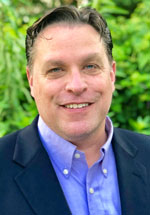 The AAG has a long history of engaging in and supporting climate change policy and research. Since climate change is the existential threat and crisis of our age, the need to continue this engagement and reduce our contribution to carbon emissions is clear. We will continue to seek policy action on behalf of our members–actions designed to influence the societal and governmental change required for durable solutions. For example, the AAG recently