Wayfinding: In the Philippines, Local Knowledge Makes a Global Impact
Philippine pangolin by Lucy Archer, ZSL Philippines
The shy, nocturnal pangolin — an animal that looks like a cross between an anteater and an artichoke — is hard to forget if you happen to see one. That’s what researchers from the United Kingdom and Philippines relied on when they sought out 1,296 residents of the Province of Palawan to describe their interactions with the critically endangered Philippine pangolins (Manis culionensis). Researcher Lucy Archer of the Zoological Society of London joined with the Philippines-based research team of Charity Apale, Darlyn Corona, Josefa Gacilos, and Ronald Amada to conduct interviews across the Palawan province in several languages, greatly enhancing their understanding of pangolin habitat and its interactions with human settlements.
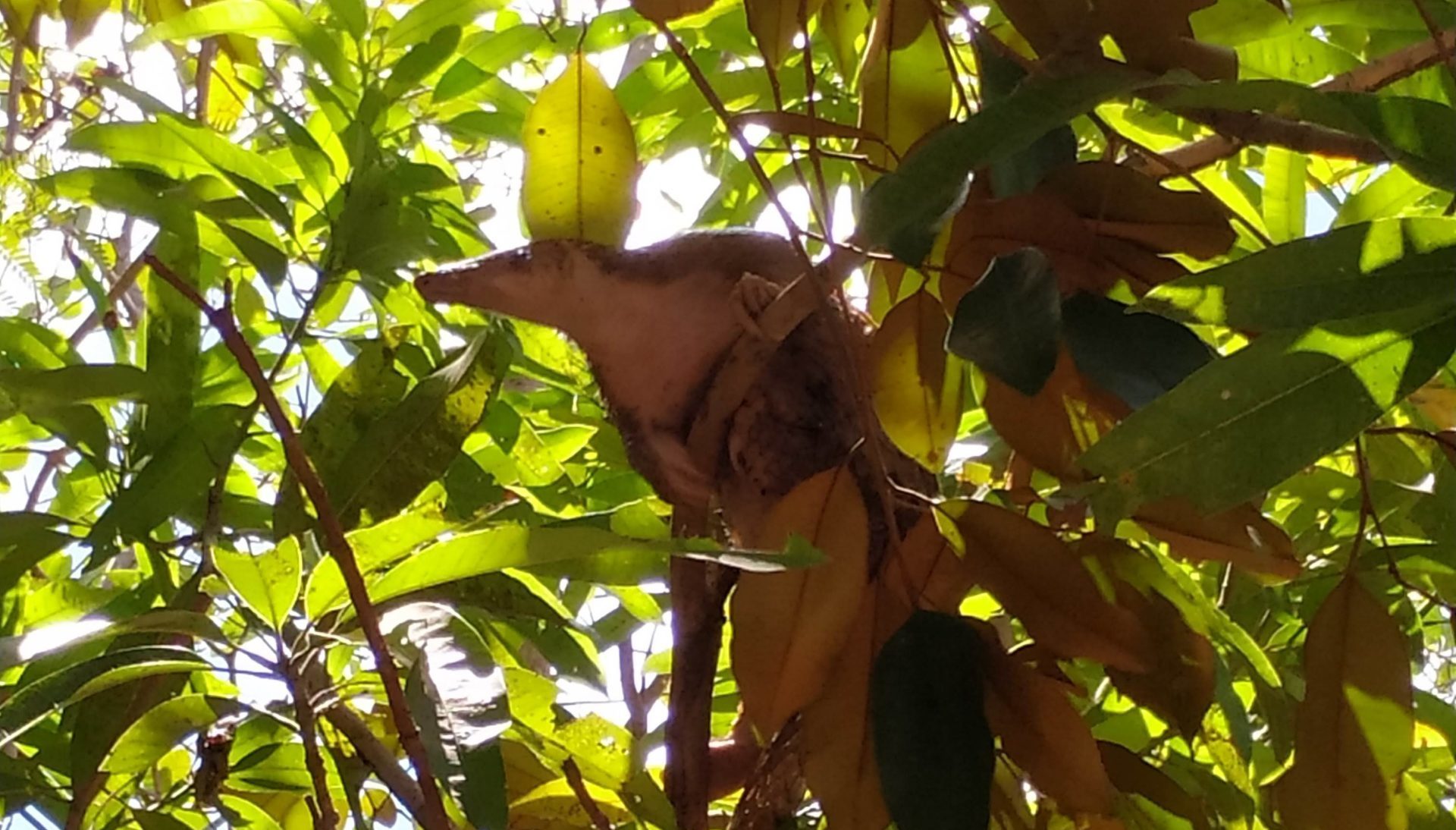
Close-up photo of a pangolin in the Philippines by Lucy Archer, ZSL Philippines
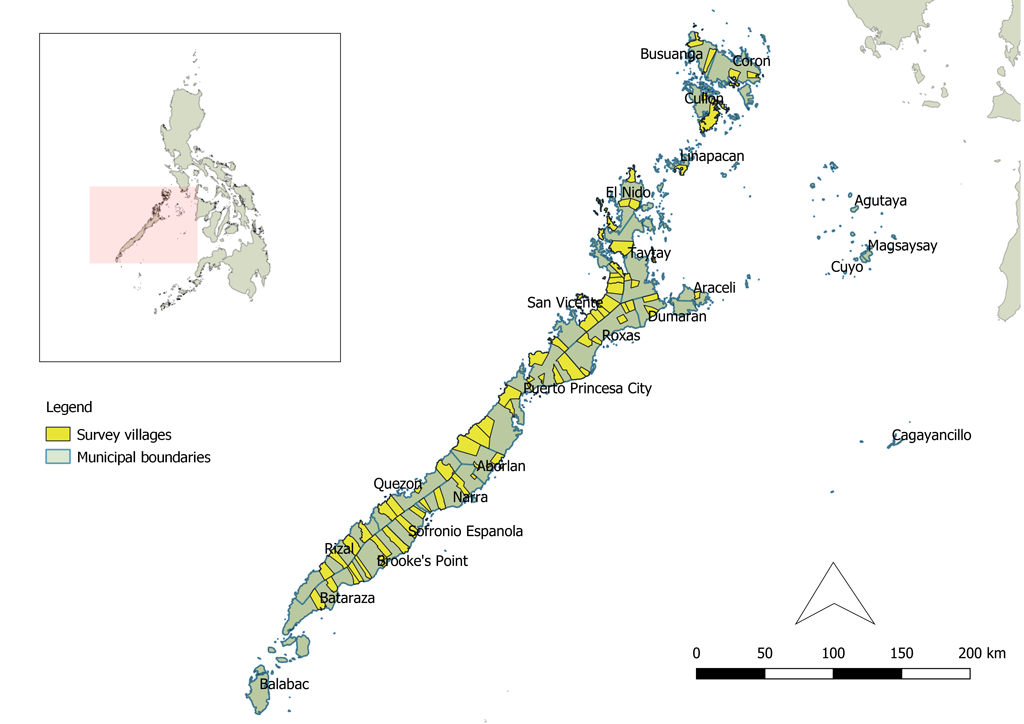
Traditional wildlife surveys can take significant amounts of time and are relatively expensive to perform at large spatial scales. In addition, they are often unreliable for rare, nocturnal, and semi-arboreal species that are difficult to detect, like the Philippine pangolin. So, Archer and her collaborators turned to people living throughout the historical range of the species for information. By recording when and where people had last seen a Philippine pangolin, and whether they thought populations were increasing or decreasing in size, the group was able to establish important baseline information about the geographic distribution and status of pangolin populations. At the same time, and just as importantly, this approach yielded an understanding of differences in threats to pangolins across local geographies, and in attitudes of local residents about engaging in conservation.
Map of pangolin survey sites in the Philippines
“Aside from providing us with much clearer perspective on where pangolins still exist, the people we interviewed also expressed their willingness to conserve the species,” says project manage Charity Apale. “This gives us hope, knowing that the local people in Palawan show inclination towards conserving and protecting the Critically Endangered Philippine pangolin.”
Archer agrees. “Local people living throughout Palawan province have provided us with a much clearer perspective on where pangolins still occur, and the differences in pangolin status throughout their geographic range,” she says. “With 87 percent of respondents able to recognize and provide further information on pangolins, we believe local people are well placed to help guide and co-develop conservation efforts for the species.”
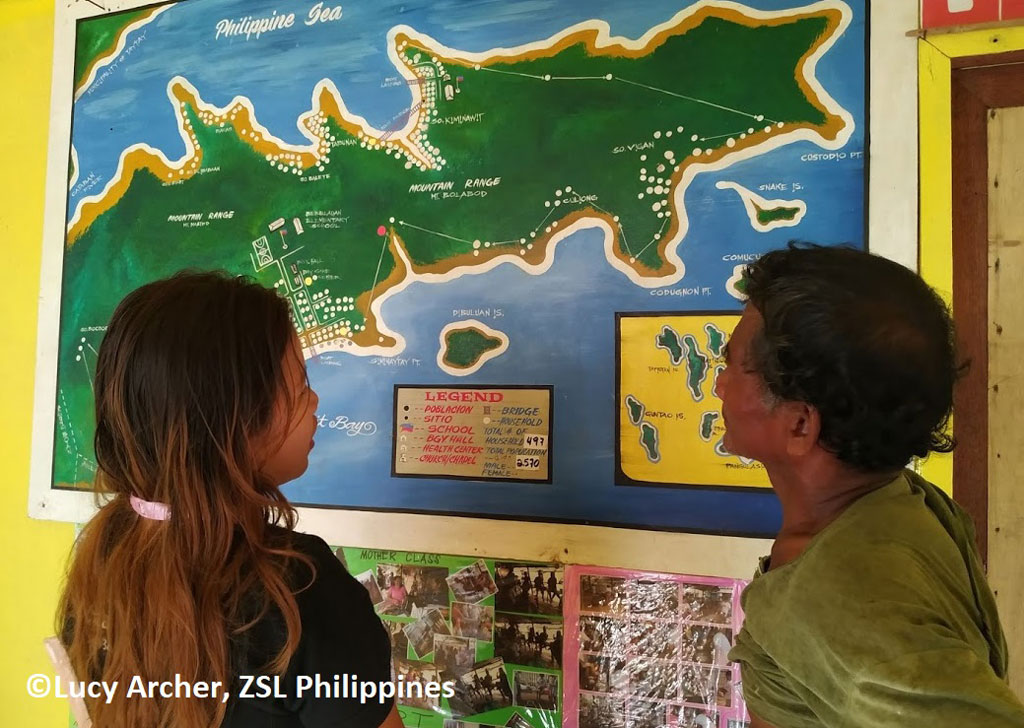
Researchers study a map of the Philippines where pangolins are natively found by Lucy Archer, ZSL Philippines
Unfortunately, this work is urgently needed. The Philippine pangolin is one of eight extant pangolin species worldwide, all of which have been placed on the IUCN Red List of Threatened Species, are hunted for meat, and are covered in scales that are trafficked for traditional medicines. Beyond the direct threats posed by trapping and hunting, palm oil plantations are supplanting pangolin habitats at a rapid rate, and climate change poses a diverse set of indirect threats to populations.
Despite the challenges faced by Philippine pangolin populations, Archer and her collaborators are optimistic that their study results will enable conservation action. People living throughout Palawan have provided them with a much clearer perspective on where pangolins occur and on differences in local perceptions of pangolins throughout their geographic range. Both kinds of geographic information will be essential as conservation efforts for pangolins continue to take shape.
Archer, L. J., Papworth, S. K., Apale, C. M., Corona, D. B., Gacilos, J. T., Amada, R. L., Waterman, C., & Turvey, S. T. (2020). Scaling up local ecological knowledge to prioritise areas for protection: Determining Philippine pangolin distribution, status and threats. Global Ecology and Conservation, 24, e01395.
Share
President's Column
The Pandemic, the Scale of ‘We’, and the Fortress-Individual: Geographies of Responsibility
Credit: BP Miller, Unsplash
Last year, now-Past President Amy Lobben titled her first newsletter column, “The Spatial Scale of ‘We,’” to reflect on the rapid shrinking of who counts as ‘we’ “to a remarkably small spatial and social scale” in the context of the COVID-19 pandemic. Her phrase has resonated with me over the past few weeks as I consider the global pandemic that is soon to enter its third year.
As I write, the Omicron variant dominates the news. Many countries have imposed bans on travel from southern Africa – measures that the World Health Organization (WHO) and African leaders alike describe as counterproductive because such measures penalize transparency and swift scientific work, while failing to stop Omicron’s spread. Instead, public health experts have argued that the world will not cease to reel from new variants until mass vaccination is accomplished globally. However, because of vaccine nationalism — the hoarding of vaccines by wealthy nations, the blocking of patent waivers on COVID-19 vaccines and other technologies, and the underfunding of COVAX – as of November 2021, only 7% of the population of Africa is fully vaccinated. Roughly 54% of the global population had received at least one COVID-19 vaccine dose, an order of magnitude greater than in low-income countries, where the rate is 5.8%. Wealthier countries have ignored WHO pleas to hold off on booster shots until people in lower income countries can receive their initial vaccinations. By the end of this month, 10 high income countries are projected to have 870 million excess doses even after boosters are given.
This short-sighted view of the “we” that must be protected from severe illness and death not only exacerbates long-standing patterns of global inequity, but is ultimately foolish, both in terms of human health and economically. The more the virus spreads, the more likely new variants will appear that evade current vaccines, further prolonging the pandemic.
This short-sighted view of the “we” that must be protected from severe illness and death not only exacerbates long-standing patterns of global inequity, but is ultimately foolish, both in terms of human health and economically.
One study estimates that the cost of global vaccination is about $23 billion (much less with patent waivers), compared to many trillion dollars in costs of the disease to date. Yet, as with global climate change, another problem that can only be solved with a recognition of the responsibility to address long-standing inequalities along with true global cooperation, the inability to stretch understandings of who is a “deserving-other” beyond the borders of the nation-state and beyond the imperatives of the corporate boardroom will result in a great deal of preventable suffering.
Series of signs asking passerby to wear a mask for the protection of essential workers. Credit: BP Miller
The same failure to imagine a more robust “we” to whom one has responsibility, reproduces itself at smaller scales. For the last two months my home state of Colorado has been in the grips of a COVID surge that has overwhelmed hospitals. Though 63% of the state’s population is fully vaccinated, this average hides significant spatial variation, with some county rates as low as 40%. Combine this with a governor unwilling to impose another mask mandate and the highly transmissible delta variant, and by early November, the state was forced to activate an emergency protocol, “crisis standards of care,” which further increases nurse to patient ratios and allows workers to care for sicker patients than they normally would. Even with these measures in place, 94% of ICU beds across the state are currently full; in some counties, it is greater than 100%, meaning doubling up on space or sending patients to distant locations.
My husband is a registered nurse who works on a hospital medical/surgical floor, so I’ve gotten a sense of what this feels like for health care workers. For the past several months, his hospital’s ICU has been so full that many patients who require intensive care — where the patient: nurse ratio is 2:1 — have been put instead in the general medical floor, where the ratio is more than twice that. The profit-driven hospital company in the meantime has prioritized earnings by continuing truly elective surgeries, ignoring pleas from nurses that their workloads are simply unbearable and, increasingly, unsafe. Highly experienced and skilled nurses are quitting in droves out of exhaustion and frustration, and hospital turnover is high. Indeed, across the US, nearly one in five health care workers have quit since the start of the pandemic. After one particularly harrowing day with too many patients needing intensive care, and only one nurse assistant available for an entire floor, my husband too considered leaving the profession he loves.
The neoliberal restructuring of health care as a profit-making industry beholden to shareholders led to a “just in time” business model that entailed an almost 40% decline in hospital beds between 1981 and 1999; even before the pandemic, hospitals were maxed out.
As with all crises, there are many contributing factors. The neoliberal restructuring of health care as a profit-making industry beholden to shareholders led to a “just in time” business model that entailed an almost 40% decline in hospital beds between 1981 and 1999; even before the pandemic, hospitals were maxed out. Vaccine reluctance stems from a host of understandable social factors including distrust of government and skepticism of medical expertise that has indeed often been flawed and arrogant. But in the face of overwhelming evidence at this point in the pandemic, continuing vaccine refusal translates into the suffering of others – including those who cannot get vaccinated (mostly children under 5), those who cannot receive adequate treatment for other medical conditions, whether heart failure or cancer, because hospitals are full of COVID patients, and health care workers struggling with the “crushing downward spiral” of exhaustion.
Vaccine refusals beg the question not only of who counts as “we,” but also of the extent to which some people still believe in a society at all. Margaret Thatcher famously proclaimed that there is no such thing as society, only individual men, women, and their families. Increasingly, acknowledging any kind of responsibility to the well-being of strangers in society has become unthinkable in the constitution of a certain brand of individualism in which the individual self is conceptualized as a fortress. This fortress-individual does not believe that the virus can breach its defenses, and cares not for the argument that vaccination can help protect others.
The apotheosis of the fortress-individual is…also found in the strange idea, unique to the US, that there is simply nothing that can be done to stop gun violence… that the dead and maimed must pay for the sacrosanct freedom of fortress individuals to carry lethal weapons far beyond the imagination of the crafters of the US Constitution.
The apotheosis of the fortress-individual is perhaps the “stand your ground” self-defense statute that exists in 30 US states and the ways in which it has been used to justify racialized vigilantism, from George Zimmerman’s acquittal in the murder of Trayvon Martin to the acquittal of Kyle Rittenhouse for the murders of Joseph Rosenbaum and Anthony Huber, and the wounding of Gaige Grosskreutz — the latter even in a state without a full-fledged stand-your-ground law. But it’s also found in the strange idea, unique to the US, that there is simply nothing that can be done to stop gun violence, that the 651 mass shootings, including 222 school shootings to date in the US in 2021, are inevitable, the price that the dead and maimed must pay for the sacrosanct freedom of fortress individuals to carry lethal weapons far beyond the imagination of the crafters of the U.S. Constitution. This strikes particularly close to home for me because a mass shooting took place this March in a grocery store a few short blocks from my house, a place where my family and many colleagues and their children frequented, and where high school students regularly hung out. Ten people were killed, including several of my sister-in-law’s former co-workers at the store.
Geography is “earth writing” — its purview is the globe, and geographers are uniquely equipped to examine not only spatial patterns (whether of gun violence or pandemic-related hospitalizations and responses) but also to think beyond methodological nationalism. Celebrated human geographer Doreen Massey conceptualized space as the product of interrelations, a discrete multiplicity that is dynamic rather than static, open rather than closed. Spatiality is about relationality; thus Massey argued that people of particular places have a responsibility towards the wider relations on which they invariably both depend and have an effect. Former AAG president Victoria Lawson stated in her presidential address that Geography is a caring discipline, and advocated for “research and practice that begins from a critical ethic of care and responsibility.” I suggest that this responsibility can only be fulfilled by geographers who are not lone fortresses, and who have the capacity to care for a capacious “we.”
**** *
On December 3, you should have received an email inviting you to take the “AAG Annual Meetings and Climate Action” survey. I’m sure you are as tired of surveys as I am, but I’d like to ask that you please take a few minutes if you have not already; it is also available at this link. Extensive member participation is crucial to shaping how AAG moves forward to meet low/net-zero carbon goals related to travel to annual meetings. AAG seeks to reduce these emissions in line with IPCC recommendations, while continuing to provide benefits to all members, increasing access to meetings for those who have faced past barriers to participation, and keeping AAG fiscally sound. These are a lot of considerations to juggle, and AAG can only successfully navigate into our collective climate change-shaped future with your input.
Please note: The ideas expressed in the AAG President’s column are not necessarily the views of the AAG as a whole. This column is traditionally a space in which the president may talk about their views or focus during their tenure as president of AAG, or spotlight their areas of professional work. Please feel free to email the president directly at emily [dot] yeh [at] colorado [dot] edu to enable a constructive discussion.
Share
Resources
Explore careers in geography—download the brochure
Geography is more than maps—it’s a powerful way to understand the world and shape its future. From climate science and urban planning to business analytics and public health, geographers bring critical insights to today’s most pressing challenges.
AAG Globe Book Award for Public Understanding of Geography
The deadline for the upcoming 2027 AAG awards has passed.
A committee awards the annual prize for a book that conveys most powerfully the nature and importance of geography to the non-academic world. An award of $1,000 will be made to the author(s). In any given cycle, the Globe Book Award Committee may also select a second title from the pool of nominations to be recognized with an Honorable Mention.
Eligibility
Books must be written or co-authored by a geographer. Books published for the first time in English, in any country, between October of the previous year and September of the current year, are now eligible for the award. Please submit your title for consideration for only one of the three AAG book awards (i.e., J.B. Jackson Prize, Globe Book Award or Meridian Book Award).
As with all other AAG awards, eligibility also rests on the candidate being in compliance with the AAG Professional Conduct Policy. Nominations may be rescinded, and the award may also be revoked for any candidate or awardee who is found in violation of the AAG’s Professional Conduct Policy.
Submissions
Nomination statements (two-page maximum length) should provide full contact information for the author(s) and the nominator(s), including email addresses, and should document the ways the nominated work conveys the nature and importance of geography to the non-academic world.
Mauris non tempor quam, et lacinia sapien. Mauris accumsan eros eget libero posuere vulputate. Etiam elit elit, elementum sed varius at, adipiscing vitae est. Sed nec felis pellentesque, lacinia dui sed, ultricies sapien. Pellentesque orci lectus, consectetur vel posuere.
2026
David L. Prytherch
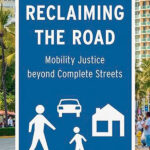
What would our streets, cities, and neighborhoods look like if urban plans took geographers and their studies seriously? With Reclaiming the Road (University of Minnesota Press), David Prytherch shows us the promise of communities planned, designed, and built for humans, rather than solely cars. Through rich case studies, extensive historical-geographical contexts, and delightful prose, the book offers an indispensable guide for re-engineering urban space through best practices, human-centered designs and policies, and abiding attention to intersectional concepts of equity and justice. In-depth interviews with transportation advocates, city planners, and community leaders across nine U.S. cities meld with interdisciplinary yet accessible theoretical discussions to ground the analysis in both lived experience and insightful scholarship. Immersed in dialogues linking practice, advocacy, and scholarship, Reclaiming the Road wields the powers of geography to ask more of urban design and to reimagine our communities as spaces of mobility and justice.
2026 AAG Globe Book Award for Public Understanding of Geography
David L. Prytherch
2026 AAG Globe Book Award for Public Understanding of Geography
What would our streets, cities, and neighborhoods look like if urban plans took geographers and their studies seriously? With Reclaiming the Road (University of Minnesota Press), David Prytherch shows us the promise of communities planned, designed, and built for humans, rather than solely cars. Through rich case studies, extensive historical-geographical contexts, and delightful prose, the book offers an indispensable guide for re-engineering urban space through best practices, human-centered designs and policies, and abiding attention to intersectional concepts of equity and justice. In-depth interviews with transportation advocates, city planners, and community leaders across nine U.S. cities meld with interdisciplinary yet accessible theoretical discussions to ground the analysis in both lived experience and insightful scholarship. Immersed in dialogues linking practice, advocacy, and scholarship, Reclaiming the Road wields the powers of geography to ask more of urban design and to reimagine our communities as spaces of mobility and justice.
2025
Christopher F. Meindl
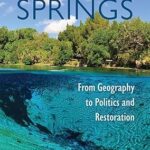
Florida Springs: From Geography to Politics and Restoration by Christopher F. Meindl
Freshwater springs represent sparkling trifles to the casual tourist, cherished landscapes to neighboring residents, and sources of live-giving water for everyone else. Dr. Meindl’s Florida Springs systematically unpacks the immense depth and complexity of these features to expose “competing narratives about springs, what ails them, and how we might repair the damage” (xxiii). A skilled geographic storyteller, Meindl writes in an engaging and approachable style, accessible to both lay readers and policymakers, while navigating across the breadth of geography in remarkable ways. Blending nuanced discussions of physical science, historical geography, and public policy, Meindl masterfully illustrates the unique power of geography to synthesize a wide range of subfields and concepts to produce clear and useful understandings of landscapes and ecosystems of vital importance to all.
Published by University Press of Florida
2025 AAG Globe Book Award for Public Understanding of Geography
Christopher F. Meindl
2025 AAG Globe Book Award for Public Understanding of Geography
Florida Springs: From Geography to Politics and Restoration by Christopher F. Meindl
Freshwater springs represent sparkling trifles to the casual tourist, cherished landscapes to neighboring residents, and sources of live-giving water for everyone else. Dr. Meindl’s Florida Springs systematically unpacks the immense depth and complexity of these features to expose “competing narratives about springs, what ails them, and how we might repair the damage” (xxiii). A skilled geographic storyteller, Meindl writes in an engaging and approachable style, accessible to both lay readers and policymakers, while navigating across the breadth of geography in remarkable ways. Blending nuanced discussions of physical science, historical geography, and public policy, Meindl masterfully illustrates the unique power of geography to synthesize a wide range of subfields and concepts to produce clear and useful understandings of landscapes and ecosystems of vital importance to all.
Published by University Press of Florida
2024
Charlotte Wrigley
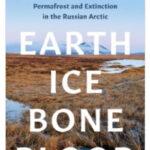
Earth, Ice, Bone, Blood is the first of its kind in that it takes a largely unstudied substance — permafrost — and applies it to one of the most pressing issues of the Anthropocene, extinction. The book considers how permafrost disrupts the normative definition of extinction by way of its becoming discontinuous — not just materially, but as a heterogenous and dynamical social category that has implications for all life on Earth. By situating the study in the Russian Arctic, the book also encompasses the fraught history and crucial ecological future of a nation that comprises 65% permafrost.
Published by University of Minnesota Press
2024 AAG Globe Book Award for Public Understanding of Geography
Charlotte Wrigley
2024 AAG Globe Book Award for Public Understanding of Geography
Earth, Ice, Bone, Blood is the first of its kind in that it takes a largely unstudied substance — permafrost — and applies it to one of the most pressing issues of the Anthropocene, extinction. The book considers how permafrost disrupts the normative definition of extinction by way of its becoming discontinuous — not just materially, but as a heterogenous and dynamical social category that has implications for all life on Earth. By situating the study in the Russian Arctic, the book also encompasses the fraught history and crucial ecological future of a nation that comprises 65% permafrost.
Published by University of Minnesota Press
2024
Honorable mentions to Jared D. Margulies and to Colin McFarlane
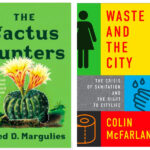
Honorable mentions to Jared D. Margulies, University of Minnesota Press, “The Cactus Hunters” and to Colin McFarlane, Verso, “Waste and the City: The Crisis of Sanitation and the Right to Citylife.”
2024 AAG Globe Book Award for Public Understanding of Geography
Honorable mentions to Jared D. Margulies and to Colin McFarlane
2024 AAG Globe Book Award for Public Understanding of Geography
Honorable mentions to Jared D. Margulies, University of Minnesota Press, “The Cactus Hunters” and to Colin McFarlane, Verso, “Waste and the City: The Crisis of Sanitation and the Right to Citylife.”
2023
Daniel D. Arreola
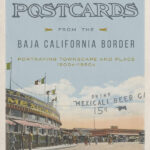
Postcards from the Baja California Border (University of Arizona Press, October 2021) by Daniel D. Arreola (Arizona State University) offers a window into the historical and geographical past of storied Mexican border communities. Once-popular tourist destinations from the 1900s through the 1950s, the border communities explored in Postcards from the Baja California Border used to be filled with revelers, cabarets, curio shops, and more. The postcards in this book show the bright and dynamic past of California’s borderlands while diving deep into the historic and geographic significance of the imagery found on the postcards.
This form of place study calls attention to how we can see a past through a serial view of places, by the nature of repetition, and the photographing of the same place over and over again. Arreola draws our focus to townscapes, or built landscapes, of four border towns—Tijuana, Mexicali, Tecate, and Algodones—during the first half of the twentieth century. With an emphasis on the tourist’s view of these places, this book creates a vivid picture of what life was like for tourists and residents of these towns in the early and mid-twentieth century.
Postcards from the Baja California Border is a rich and fascinating experience, one that will take readers on a time-travel journey through border town histories and geographies while celebrating the visual intrigue of postcards.
2023 AAG Globe Book Award for Public Understanding of Geography
Daniel D. Arreola
2023 AAG Globe Book Award for Public Understanding of Geography
Postcards from the Baja California Border (University of Arizona Press, October 2021) by Daniel D. Arreola (Arizona State University) offers a window into the historical and geographical past of storied Mexican border communities. Once-popular tourist destinations from the 1900s through the 1950s, the border communities explored in Postcards from the Baja California Border used to be filled with revelers, cabarets, curio shops, and more. The postcards in this book show the bright and dynamic past of California’s borderlands while diving deep into the historic and geographic significance of the imagery found on the postcards.
This form of place study calls attention to how we can see a past through a serial view of places, by the nature of repetition, and the photographing of the same place over and over again. Arreola draws our focus to townscapes, or built landscapes, of four border towns—Tijuana, Mexicali, Tecate, and Algodones—during the first half of the twentieth century. With an emphasis on the tourist’s view of these places, this book creates a vivid picture of what life was like for tourists and residents of these towns in the early and mid-twentieth century.
Postcards from the Baja California Border is a rich and fascinating experience, one that will take readers on a time-travel journey through border town histories and geographies while celebrating the visual intrigue of postcards.
2023
Honorable Mention: Adam Mathews and Chris Ferrie
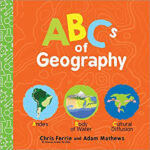
ABCs of Geography (Sourcebooks, 2022) by Adam Mathews (Western Michigan University) and Chris Ferrie (Centre for Quantum Software and Information) is a fun, accessible, and informative book about the fundamentals of geography aimed at children and, by extension, their caregivers.
2023 AAG Globe Book Award for Public Understanding of Geography
Honorable Mention: Adam Mathews and Chris Ferrie
2023 AAG Globe Book Award for Public Understanding of Geography
ABCs of Geography (Sourcebooks, 2022) by Adam Mathews (Western Michigan University) and Chris Ferrie (Centre for Quantum Software and Information) is a fun, accessible, and informative book about the fundamentals of geography aimed at children and, by extension, their caregivers.
2022
James Cheshire and Oliver Uberti
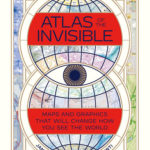
James Cheshire and Oliver Uberti for Atlas of the Invisible (W.W. Norton & Company, 2021) for creating a stunning collection of maps and visualizations that tells the stories of our past, present, and future – turning massive datasets into inviting, intriguing, and sometimes disturbing presentations for both geographers and a broader audience.
2022 AAG Globe Book Award for Public Understanding of Geography
James Cheshire and Oliver Uberti
2022 AAG Globe Book Award for Public Understanding of Geography
James Cheshire and Oliver Uberti for Atlas of the Invisible (W.W. Norton & Company, 2021) for creating a stunning collection of maps and visualizations that tells the stories of our past, present, and future – turning massive datasets into inviting, intriguing, and sometimes disturbing presentations for both geographers and a broader audience.
2021
Alison Mountz
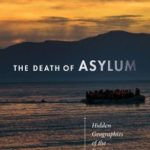
2020 Alison Mountz, The Death of Asylum: Hidden Geographies of the Enforcement Archipelago, University of Minnesota Press, 2020
2021 AAG Globe Book Award for Public Understanding of Geography
Alison Mountz
2021 AAG Globe Book Award for Public Understanding of Geography
2020 Alison Mountz, The Death of Asylum: Hidden Geographies of the Enforcement Archipelago, University of Minnesota Press, 2020
2020
Adam Moore
2019 Adam Moore, Empire’s Labor: The Global Army that Supports U.S. Wars, Ithaca: Cornell University Press, 2019
2020 AAG Globe Book Award for Public Understanding of Geography
Adam Moore
2020 AAG Globe Book Award for Public Understanding of Geography
2019 Adam Moore, Empire’s Labor: The Global Army that Supports U.S. Wars, Ithaca: Cornell University Press, 2019
2019
Tara Patricia Cookson
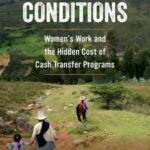
2018 Tara Patricia Cookson, Unjust Conditions: Women’s Work and the Hidden Cost of Cash Transfer Programs, University of California Press, 2018
2019 AAG Globe Book Award for Public Understanding of Geography
Tara Patricia Cookson
2019 AAG Globe Book Award for Public Understanding of Geography
2018 Tara Patricia Cookson, Unjust Conditions: Women’s Work and the Hidden Cost of Cash Transfer Programs, University of California Press, 2018
2018
Clyde Woods
The late Clyde Woods for developing a one-of-a-kind research program engaging social and public policy issues by examining the cultural practices of those oppressed by such policies. His book, Development Arrested, was highly acclaimed and a model of interdisciplinary research. Woods will be remembered as an important mentor to many, and as a public intellectual challenging how we understand race and human geographic knowledge production.
2018 AAG Globe Book Award for Public Understanding of Geography
Clyde Woods
2018 AAG Globe Book Award for Public Understanding of Geography
The late Clyde Woods for developing a one-of-a-kind research program engaging social and public policy issues by examining the cultural practices of those oppressed by such policies. His book, Development Arrested, was highly acclaimed and a model of interdisciplinary research. Woods will be remembered as an important mentor to many, and as a public intellectual challenging how we understand race and human geographic knowledge production.
2017
Nicole Nguyen
2016 Nicole Nguyen, A Curriculum of Fear, University of Minnesota Press
2017 AAG Globe Book Award for Public Understanding of Geography
Nicole Nguyen
2017 AAG Globe Book Award for Public Understanding of Geography
2016 Nicole Nguyen, A Curriculum of Fear, University of Minnesota Press
2016
Stephen J. Hornsby and Richard W. Judd, Eds
2015 Stephen J. Hornsby and Richard W. Judd, Eds; Michael J. Hermann (Cartographic Designer), Historical Atlas of Maine, University of Maine Press
2016 AAG Globe Book Award for Public Understanding of Geography
Stephen J. Hornsby and Richard W. Judd, Eds
2016 AAG Globe Book Award for Public Understanding of Geography
2015 Stephen J. Hornsby and Richard W. Judd, Eds; Michael J. Hermann (Cartographic Designer), Historical Atlas of Maine, University of Maine Press
2015
Paul Knox
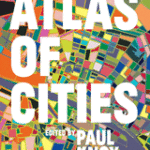
2014 Paul Knox, Atlas of Cities, Princeton University Press
2015 AAG Globe Book Award for Public Understanding of Geography
Paul Knox
2015 AAG Globe Book Award for Public Understanding of Geography
2014 Paul Knox, Atlas of Cities, Princeton University Press
2014
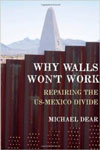
Michael Dear
2013 Michael Dear, Why Walls Won’t Work: Repairing the US-Mexico Divide, Oxford University Press
2014 AAG Globe Book Award for Public Understanding of Geography
Michael Dear
2014 AAG Globe Book Award for Public Understanding of Geography
2013 Michael Dear, Why Walls Won’t Work: Repairing the US-Mexico Divide, Oxford University Press
2013
Laura Pulido
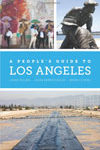
2012 Laura Pulido, Laura Barraclough and Wendy Cheng, A People’s Guide to Los Angeles, University of California Press.
2013 AAG Globe Book Award for Public Understanding of Geography
Laura Pulido
2013 AAG Globe Book Award for Public Understanding of Geography
2012 Laura Pulido, Laura Barraclough and Wendy Cheng, A People’s Guide to Los Angeles, University of California Press.
2012
Jim Kimmel and Jerry Touchstone Kimmel
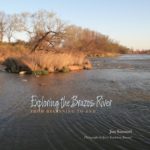
2011 Jim Kimmel and Jerry Touchstone Kimmel (photographs), Exloring the Brazos River from Beginning to End, Texas A&M University.
2012 AAG Globe Book Award for Public Understanding of Geography
Jim Kimmel and Jerry Touchstone Kimmel
2012 AAG Globe Book Award for Public Understanding of Geography
2011 Jim Kimmel and Jerry Touchstone Kimmel (photographs), Exloring the Brazos River from Beginning to End, Texas A&M University.
2011
Esther Jacobson-Tepfer and James E. Meacham
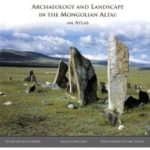
2010 Esther Jacobson-Tepfer and James E. Meacham, Archeology and Landscape in the Mongolian Altai (Gary Tepfer, Photography), Esri Press
2011 AAG Globe Book Award for Public Understanding of Geography
Esther Jacobson-Tepfer and James E. Meacham
2011 AAG Globe Book Award for Public Understanding of Geography
2010 Esther Jacobson-Tepfer and James E. Meacham, Archeology and Landscape in the Mongolian Altai (Gary Tepfer, Photography), Esri Press
2010
Stuart Elden
2009 Stuart Elden, Terror and Territory, The Spatial Extent of Sovereignty, University of Minnesota Press.
2010 AAG Globe Book Award for Public Understanding of Geography
Stuart Elden
2010 AAG Globe Book Award for Public Understanding of Geography
2009 Stuart Elden, Terror and Territory, The Spatial Extent of Sovereignty, University of Minnesota Press.
2009
Owen J. Dwyer and Derek H. Alderman
2008 Owen J. Dwyer and Derek H. Alderman, Civil Rights Memorials and the Geography of Memory, Center for American Places.
2009 AAG Globe Book Award for Public Understanding of Geography
Owen J. Dwyer and Derek H. Alderman
2009 AAG Globe Book Award for Public Understanding of Geography
2008 Owen J. Dwyer and Derek H. Alderman, Civil Rights Memorials and the Geography of Memory, Center for American Places.
2008
Trudy A. Suchan, Marc J. Perry, James D. Fitzsimmons, Anika E. Juhn, Alexander M. Tait and Cynthia A. Brewer
2007 Trudy A. Suchan, Marc J. Perry, James D. Fitzsimmons, Anika E. Juhn, Alexander M. Tait and Cynthia A. Brewer, Census Atlas of the United States, Washington, DC: US Census Bureau Press.
2008 AAG Globe Book Award for Public Understanding of Geography
Trudy A. Suchan, Marc J. Perry, James D. Fitzsimmons, Anika E. Juhn, Alexander M. Tait and Cynthia A. Brewer
2008 AAG Globe Book Award for Public Understanding of Geography
2007 Trudy A. Suchan, Marc J. Perry, James D. Fitzsimmons, Anika E. Juhn, Alexander M. Tait and Cynthia A. Brewer, Census Atlas of the United States, Washington, DC: US Census Bureau Press.
2007
Bruce D'Arcus
2006 Bruce D’Arcus, Boudaries of Dissent: Protest and State Power in the Media Age, New York, NY. Routledge Taylor and Francis Group, LLC.
2007 AAG Globe Book Award for Public Understanding of Geography
Bruce D'Arcus
2007 AAG Globe Book Award for Public Understanding of Geography
2006 Bruce D’Arcus, Boudaries of Dissent: Protest and State Power in the Media Age, New York, NY. Routledge Taylor and Francis Group, LLC.
2006
Dydia DeLyser
2005 Dydia DeLyser, Ramona Memories: Tourism and the Shaping of Southern California, University of Minnesota Press.
2006 AAG Globe Book Award for Public Understanding of Geography
Dydia DeLyser
2006 AAG Globe Book Award for Public Understanding of Geography
2005 Dydia DeLyser, Ramona Memories: Tourism and the Shaping of Southern California, University of Minnesota Press.
2005
James R. "Pete" Shortridge
2004 James R. “Pete” Shortridge, Cities on the Plains: The Evolution of Urban Kansas, University of Kansas Press.
2005 AAG Globe Book Award for Public Understanding of Geography
James R. "Pete" Shortridge
2005 AAG Globe Book Award for Public Understanding of Geography
2004 James R. “Pete” Shortridge, Cities on the Plains: The Evolution of Urban Kansas, University of Kansas Press.
2004
Neil Smith, American Empire
2003 Neil Smith, American Empire, Roosevelt’s Geographer and the Prelude to Globalization, University of California Press.
2004 AAG Globe Book Award for Public Understanding of Geography
Neil Smith, American Empire
2004 AAG Globe Book Award for Public Understanding of Geography
2003 Neil Smith, American Empire, Roosevelt’s Geographer and the Prelude to Globalization, University of California Press.
2003
Mark Monmonier
2002 Mark Monmonier, Spying with Maps: Surveillance Technologies and Future of Privacy, University of Chicago Press.
2003 AAG Globe Book Award for Public Understanding of Geography
Mark Monmonier
2003 AAG Globe Book Award for Public Understanding of Geography
2002 Mark Monmonier, Spying with Maps: Surveillance Technologies and Future of Privacy, University of Chicago Press.
2002
William G. Loy
2001 William G. Loy, Atlas of Oregon, University of Oregon Press
2002 AAG Globe Book Award for Public Understanding of Geography
William G. Loy
2002 AAG Globe Book Award for Public Understanding of Geography
2001 William G. Loy, Atlas of Oregon, University of Oregon Press
2001
James R. "Pete" Shortridge
2004 James R. “Pete” Shortridge, Cities on the Plains: The Evolution of Urban Kansas, University of Kansas Press.
2001 AAG Globe Book Award for Public Understanding of Geography
James R. "Pete" Shortridge
2001 AAG Globe Book Award for Public Understanding of Geography
2004 James R. “Pete” Shortridge, Cities on the Plains: The Evolution of Urban Kansas, University of Kansas Press.
AAG Members get exclusive access to publications, prominent journals, unique advocacy, grant, scholarship and professional opportunities with access to industry focus communities, and event discounts, including our annual meeting.
Some content may only be accessible if you belong to specific Specialty or Affinity Groups. You can still update your membership below. You will need to go through the Join flow, but you do not need to repurchase your membership unless it is expired or about to expire.
To provide the best experiences, we use technologies like cookies to store and/or access device information. Consenting to these technologies will allow us to process data such as browsing behavior or unique IDs on this site. Not consenting or withdrawing consent, may adversely affect certain features and functions.
Functional
Always active
The technical storage or access is strictly necessary for the legitimate purpose of enabling the use of a specific service explicitly requested by the subscriber or user, or for the sole purpose of carrying out the transmission of a communication over an electronic communications network.
Preferences
The technical storage or access is necessary for the legitimate purpose of storing preferences that are not requested by the subscriber or user.
Statistics
The technical storage or access that is used exclusively for statistical purposes.The technical storage or access that is used exclusively for anonymous statistical purposes. Without a subpoena, voluntary compliance on the part of your Internet Service Provider, or additional records from a third party, information stored or retrieved for this purpose alone cannot usually be used to identify you.
Marketing
The technical storage or access is required to create user profiles to send advertising, or to track the user on a website or across several websites for similar marketing purposes.
To provide the best experiences, we use technologies like cookies to store and/or access device information. Consenting to these technologies will allow us to process data such as browsing behavior or unique IDs on this site. Not consenting or withdrawing consent, may adversely affect certain features and functions.
Functional
Always active
The technical storage or access is strictly necessary for the legitimate purpose of enabling the use of a specific service explicitly requested by the subscriber or user, or for the sole purpose of carrying out the transmission of a communication over an electronic communications network.
Preferences
The technical storage or access is necessary for the legitimate purpose of storing preferences that are not requested by the subscriber or user.
Statistics
The technical storage or access that is used exclusively for statistical purposes.The technical storage or access that is used exclusively for anonymous statistical purposes. Without a subpoena, voluntary compliance on the part of your Internet Service Provider, or additional records from a third party, information stored or retrieved for this purpose alone cannot usually be used to identify you.
Marketing
The technical storage or access is required to create user profiles to send advertising, or to track the user on a website or across several websites for similar marketing purposes.



 Geography is more than maps—it’s a powerful way to understand the world and shape its future. From climate science and urban planning to business analytics and public health, geographers bring critical insights to today’s most pressing challenges.