AAG Selects Paul Knox for AAG Globe Book Award

The AAG Globe Book Award for Public Understanding of Geography will be given for a book written or co-authored by a geographer that conveys most powerfully the nature and importance of geography to the non-academic world.  This distinction for 2015 is presented to Paul Knox (editor) for the book, Atlas of Cities, published by Princeton University Press.

The Atlas of Cities is a comprehensive and timely overview of urban geography classifications and considerations across time using inviting maps, charts, diagrams, tables, and photographs.  Knox’s categories are innovative, not only advancing the literature, but resonating with a broader audience.  The “Celebrity City” chapter is engaging, while simultaneously introducing network analysis and systems science.   The “Megacity” chapter visually demonstrates the disproportionate number of cities and agglomerations in Asia and along coastlines.  The scale of recent rural-urban migrations and human suffering in densely-populated, infrastructure-challenged slums is made plain.  This atlas would be equally at home in a university urban geography course or awaiting leisurely examination on a coffee table.

    Share

Newsletter – April 2015

PRESIDENT’S COLUMN

ec189f98-c150-48ab-8081-6d219da7af06-2
Domosh

The Costs (and Benefits?) of Constant Counting

By Mona Domosh

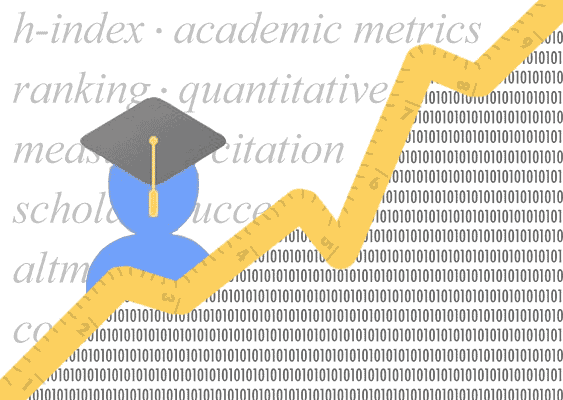
I’m a 24; well, only on Google scholar (the more inclusive research “platform”). Otherwise, on Thomson Reuters’ Web of Science, I’m a 12. For those fluent in the language of academic metrics you will know immediately what I am referring to: my h-index, a number that is calculated based on the subset of my publications such that h publications have been cited h times. In other words, according to Google scholar, I have 24 publications that have been cited 24 times. The h-index, therefore, provides a shorthand metric of academic “success,” a way of combining an assessment of productivity and purported impact all in one number. Continue Reading

Recent columns from the President

Get the Most From Your AAG Annual Meeting Experience with the Mobile App

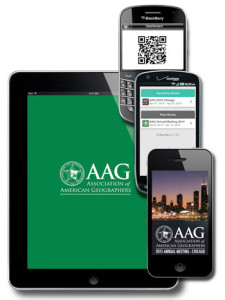
AAGQuad-225x300-1The AAG mobile app will help you balance your schedule of preferred sessions, events and meetings with friends and colleagues, while keeping you informed with daily Geograms and social media updates. Networking features offer colleagues tools to share schedules and exchange contact information.

The AAG mobile app also integrates with social media networks on Twitter, Facebook, and LinkedIn. And, it will help you collect and share important notes and information from sessions and exhibitors.

Learn More.

ANNUAL MEETING

Illinois Secretary of Education to Speak at Annual Meeting

Beth Purvis, Secretary of Education of the State of Illinois, will be a featured speaker during an AAG Annual Meeting panel on K-12 policy. The session will be held on Friday, April 24, from 8:00 – 9:40 a.m. and speakers representing various U.S. Senate and House offices have also been invited. The panel will focus primarily on the possibility of Congressional reauthorization of the Elementary and Secondary Education Act (ESEA; currently known as No Child Left Behind) in 2015 and related opportunities for geography. Learn More.

River-Walk-Chicago-300x201-1Family Activities in Chicago

Learn, explore, and enjoy Chicago with the family

By Euan Hague

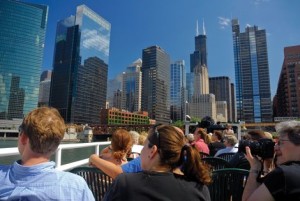
Within a few minutes walk of the Hyatt, there are a number of museums and things to do with children. The best place to start your visit to Chicago is downtown at the Cultural Center. Not only does the Center offer free art exhibitions and musical performances, often at lunch times or early evenings, it is also the site of Chicago’s main tourism information office. The Cultural Center has spectacular interior decoration, including a Tiffany Glass dome roof. There are numerous attractions in Chicago and the CityPass offers a combined multi-ticket discount to many of the most popular museums and experiences. Continue Reading.

FOCUS ON CHICAGO

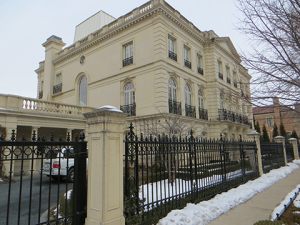
4March2015_1932_north_Burling_01-480px-300x225-1.The new mansion at 1932 North Burling, built in 2009. Courtesy Euan Hague.

Chicago’s North Burling Street, 2005-2015: From Public Housing to Mega-mansions

By Euan Hague

On Wednesday 30 March 2011, demolition began at 1230 North Burling Street, the last remaining high-rise block of public housing of the Cabrini-Green complex that, at its peak, had been home to over 15,000 people. The 23 high rise public housing blocks of Cabrini-Green, built between 1958 and 1962 and ranging from seven to nineteen floors in height, came to symbolize all that was bad about public housing, not just in Chicago but in the United States more generally. Cabrini-Green, like all of Chicago’s public housing, was conceived, designed, constructed and administered by the Chicago Housing Authority (CHA). In 1969 the CHA was found by the Supreme Court to have acted unconstitutionally in using race to determine where to build, and how to allocate apartments in, the city’s public housing projects. Continue Reading.

4550797008_6e96a560fd-300x200-1
Geraint Rowland via Compfight

Surveillance and Policing in Chicago…and its Discontents

By Brendan McQuade

In the aftermath of the 2013 Boston Marathon Bombing, Chicago received national attention for its comprehensive network of surveillance cameras. One of the first U.S. cities to make extensive use of surveillance cameras, beginning in June 2003, the Chicago Police had launched “Operation Disruption,” a multi-phased plan to install “blue-light” Police Observation Device cameras (PODs) in high crime areas. Able to rotate 360 degree and zoom to a fine level of detail, bullet proof, operable in any weather condition, these cameras record continuously and switch into night vision mode after dark. They are used to monitor street crimes and direct police deployment. Continue Reading.

[Focus on Chicago is an on-going series curated by the Local Arrangements Committee to provide insight on and understanding of the geographies of Chicago]

NEWS

Credit: EsriGive Back By Becoming a GeoMentor

AAG Announces ConnectED GeoMentors Program

Esri and the Association of American Geographers (AAG) are working together to develop a nationwide network of GeoMentors to support the U.S. Department of Education’s ConnectED Program, for which Esri has agreed to donate free GIS software to all K–12 schools in the U.S. GeoMentors will help schools and teachers introduce GIS and associated geographic concepts into classrooms across the country. Learn More.

2015 Honorary Geographer: Peter Bol

The Association of American Geographers has named Peter Bol as its 2015 Honorary Geographer. Bol is the Vice Provost for Advances in Learning and the Charles H. Carswell Professor of East Asian Languages and Civilizations at Harvard University. In making its selection, the AAG recognized Bol’s leadership role and engagement with the AAG to build university-wide support for geospatial analysis in teaching and research at Harvard University, and the resulting establishment of the Harvard Center for Geographic Analysis, of which he was its first and extraordinarily successful director. Learn More.

AAG Selects Paul Knox for AAG Globe Book Award

The AAG Globe Book Award for Public Understanding of Geography will be given for a book written or co-authored by a geographer that conveys most powerfully the nature and importance of geography to the non-academic world. This distinction for 2015 is presented to Paul Knox (editor) for the book, Atlas of Cities, published by Princeton University Press. Learn More.

AAG Members Elect New Councillors and Committee Members

A list of newly elected officers and committee members is available online. Learn more.

MEMBER & DEPARTMENT NEWS

USGS Scientist Roger Sayre Honored for Public Service with Esri Award

U.S. Geological Survey scientist Dr. Roger Sayre was honored with the annual Making A Difference Award at the Esri Federal Users Conference in Washington, DC, on February 9, 2015. The award recognized Sayre’s vision and leadership in recent collaboration between the USGS and Esri to produce a new map of global ecosystems at an unprecedented level of detail. Read More.

AAG Member David López-Carr Named AAAS Fellow for 2014

AAG member and UC Santa Barbara Geography Professor David López-Carr has been named a fellow of the American Association for the Advancement of Science (AAAS) for 2014. He is being recognized for advancing the scientific understanding of the couple process of human population dynamics and environmental change. Dr. López-Carr’s work focuses on population dynamics, particularly the links between migration and fertility and terrestrial and marine resource use in Latin America and between population and health vulnerabilities to climate change in America. He integrates diverse data sources from the United Nations and World Bank, working with anything from socioeconomic and demographic data to remotely sensed imagery with field-based surveys. Read More.

IN MEMORIAM

Chiao-Min Hsieh
James W. Merchant
Richard R. Randall
Stephen E. White

POLICY UPDATES

White House Announces New STEM Education Funds

The following news piece from AAAS details an Obama Administration STEM initiative. The AAG has been working hard to ensure that federal programs focused on STEM science and education opportunities are open to geographers and GIScientists.

During the White House Science Fair on March 23, President Obama announced a commitment to invest over $240 million to encourage students in the STEM fields, as part of his “Educate to Innovate” campaign. New funding will include: $150 million fund to help early-career scientists stay on track; $90 million to the “Let Everyone Dream” campaign, which aims to increase STEM opportunities for underrepresented youth; and $25 million for a competition within the Department of Energy to inspire students to create media about science and literacy. Read More.

Public Access to NSF-Funded Research

On March 18, the National Science Foundation (NSF) announced its plan to promote public access to the results of NSF-sponsored research. While the agency is not building its own public archive, NSF states that accepted manuscripts or versions of record must be publicly available in an approved repository within 12 months of publication. Availability signifies that any user can download, read, and analyze the data free of charge. This will apply to “new awards resulting from proposals submitted, or due, on or after the effective date of the Proposal & Award Policies & Procedures Guide (PAPPG) that will be issued in January 2016.” Read More.

PUBLICATIONS

Call for Papers: GeoHumanities

GeoHumanities is a new journal being launched by the Association of American Geographers and will be published by Taylor and Francis. Its editors are Tim Cresswell (Northeastern University, Boston) and Deborah Dixon (University of Glasgow). GeoHumanities publishes original peer-reviewed articles that span conceptual and methodological debates in geography and the humanities; critical reflections on analog and digital artistic productions; and new scholarly interactions occurring at the intersections of geography and multiple humanities disciplines. Read More.

MORE HEADLINES

Op-Ed: A Graduate Student Perspective on Geography

By Courtney Reents

I started my first semester as a geography graduate student with a geographic background comprised only of GIS and remote sensing, exclusively covering geospatial technology and its applications with little consideration for the discipline that nurtured its growth. Prior to taking this course on contemporary geographic thought, I would have dismissed references to various paradigms and worldviews, to determinism and mechanistic materialism and the quantitative revolution, as the purview of philosophy and meta-theory, relics of the irrelevant discourses of another century. I was operating under the mistaken assumption that the way things are is the way they’ve always been, and that no particular sequence of historical events was required to forge the discipline of Geography as it exists today. Read More.

Submit News to the AAG Newsletter. To share your news, submit announcements to newsletter [at] aag [dot] org.

    Share

2015 Honorary Geographer: Peter Bol

The Association of American Geographers has named Peter Bol as its 2015 Honorary Geographer. Bol is the Vice Provost for Advances in Learning and the Charles H. Carswell Professor of East Asian Languages and Civilizations at Harvard University. In making its selection, the AAG recognized Bol’s leadership role and engagement with the AAG to build university-wide support for geospatial analysis in teaching and research at Harvard University, and the resulting establishment of the Harvard Center for Geographic Analysis, of which he was its first and extraordinarily successful director.

In addition to founding and developing the CGA, Bol’s long career of distinguished scholarship on the history and geography of China is of great interest to geographers and has contributed to a better understanding of China among geographers. Finally, his sustained and innovative research and scholarship in the field of historical GIS has helped shape and advance the discipline of geography. As director of the China Historical Geographic Information Systems project, a collaboration between Harvard and Fudan University in Shanghai to create a GIS for 2000 years of Chinese history, Bol pioneered interdisciplinary tools, methods, and approaches that have opened fruitful new pathways for discovery and understanding for both historians and geographers.

AAG Executive Director Douglas Richardson will confer the 2015 AAG Honorary Geographer Award upon Peter K. Bol at the 2015 AAG Annual Meeting in Chicago during the “Launch of the AAG GeoHumanities Journal” session on Thursday, April 23. The session begins at 1:20 p.m. in the Gold Coast room at the Hyatt Regency Chicago. Learn more.

Every year, AAG bestows its Honorary Geographer Award on an individual to recognize excellence in the arts, research, teaching, and writing on geographic topics by non-geographers. Previous awardees have included biologist Stephen J. Gould, architect Maya Lin, Nobel Laureate in economics Paul Krugman, sociologist Saskia Sassen, economist Jeffrey Sachs, and authors Calvin Trillin, Charles Mann, Barbara Kingsolver and Barry Lopez, among others.

    Share

Chicago’s North Burling Street, 2005-2015: From Public Housing to Mega-mansions

On Wednesday 30 March 2011, demolition began at 1230 North Burling Street, the last remaining high-rise block of public housing of the Cabrini-Green complex that, at its peak, had been home to over 15,000 people. The 23 high rise public housing blocks of Cabrini-Green, built between 1958 and 1962 and ranging from seven to nineteen floors in height, came to symbolize all that was bad about public housing, not just in Chicago but in the United States more generally. Cabrini-Green, like all of Chicago’s public housing, was conceived, designed, constructed and administered by the Chicago Housing Authority (CHA). In 1969 the CHA was found by the Supreme Court to have acted unconstitutionally in using race to determine where to build, and how to allocate apartments in, the city’s public housing projects. Within two decades of their completion, Cabrini-Green was notorious for its gangs and violence. In an effort to change this violent image of the Cabrini-Green projects, Mayor Jane Byrne spent a night in an apartment there in 1981. But horrific events continued after she moved out, like the shooting of seven-year-old Dantrell Davis in 1992, killed as he walked to school, and the 1997 rape of nine-year-old ‘Girl X.’ Yet less prominently featured in the media was the reality that Cabrini-Green was home to thousands of people. There was a community there: friendships, relationships, multi-generational families, memories, sports teams, schools, small businesses and a church. Today this is all gone.

In 2000 the CHA announced its $1.5bn Plan for Transformation that aimed to raze over fifty public housing high rises city-wide and relocate almost 35,000 people. A year later in 2001 demolition began on the Cabrini-Green high rises whose occupants, at the time, were almost 100% African-American. Residents protested again the destruction of their community and groups like the Coalition to Protect Public Housing led efforts to pressure the City and CHA to stop the demolitions and recognize housing as a human right. The City responded with Section 8 housing vouchers for some Cabrini-Green residents, a promise to keep “affordable” some of the new condominiums being built following the demolitions, and offered former residents a ‘right to return’ to new or rehabbed CHA properties. But demand outstripped supply, and there has just not been enough housing provided to meet the needs of the thousands who left Cabrini-Green. Most former residents have moved into Chicago’s poorest, most violent and under-served neighborhoods on Chicago’s south and west sides, others have moved beyond the city. Very few have found alternative housing in the neighborhood they once called home.


1832 North Burling, built in 1891. Courtesy Euan Hague.
The new mansion at 1932 North Burling, built in 2009. Courtesy Euan Hague.
The NewCity development rises at the intersection of Halsted and Clybourn, just north of the former site of Cabrini-Green. Courtesy Euan Hague.

As the Cabrini-Green enclave of public housing on Chicago’s otherwise wealthy near north side was being removed, a new phenomenon was occurring just a few blocks further along North Burling Street. About a mile away from Cabrini-Green, property addressed between 1800-2000 North Burling was also being fundamentally transformed in the mid-2000s. An area of late-Nineteenth Century houses and two-flats, these were bring bought and torn down as buyers sought to purchase multiple adjacent lots to enable the construction of palatial mansions. Built in 2009 with around 26,000 sq. ft. of floor space, the 12 bedroom, 10 bathroom house at 1932 North Burling epitomizes this type of development. Numerous other examples of multi-million dollar homes now line North Burling as some of Chicago’s wealthiest residents and best known philanthropists have moved in. A century ago, this area of Chicago housed German immigrants and their descendents; over a generation ago it began gentrifying, but the demolition of Cabrini-Green seem to unleash an ever more rapacious real estate market on North Burling. Mega-mansions adorned with classical columns, pilasters, ironwork, and numerous other flourishes were built and the sidewalk and curbs are now cut at regular intervals to allow access to below street garages. The last few remaining Victorian cottages, such as 1832 North Burling, will likely soon be torn down and replaced by another new multi-million dollar mansion on the block.

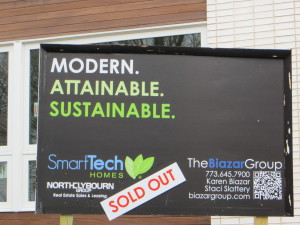
Now that the high rises have gone from Cabrini-Green, and with them their residents, the land on which the public housing project once stood has become highly valued real estate. As if to emphasize the changing urban geography and public policy priorities of Chicago, in 2013 Target opened its latest Chicago superstore on the footprint of one of the Cabrini-Green high rises. On the northern edge of the Cabrini-Green site, a luxury retail, entertainment and residential complex is currently under construction. Built by Structured Development, LLC, and scheduled to open in Fall 2015, “NewCity” will bring 370,000 sq. ft. of retail, a multiplex movie theater, a bowling alley and 200 of the most expensive rental apartments in Chicago, all under environmentally friendly green roofs. The website advertising NewCity, “a hot, new destination… Its landscaped design invites you to shop, dine alfresco or strike up a conversation in view of the dynamic water feature,” depicts attractive young people (one couple holding a smiling toddler), sushi, shopping bags, and a cute bulldog. Promising “one of the most vibrant neighborhoods in America,” where “fashionista meet[s] foodie” and “modern amenities, great shops and the ultimate in style inside and out, NewCity is where hip meets high standards.” It is ironic that Chicago already has a community called New City: south of the Chicago River and once home of the meatpacking stockyards and their immigrant labor force made famous in Upton Sinclair’s The Jungle over a century ago (an area that too, is now much transformed).

Some traces of Cabrini-Green remain. There are footpaths that lead to nowhere, pipes and wires occasionally protrude from concrete slabs surrounded by grass, and gaps in fences show where thousands of people once walked from the Division Street sidewalk to their high rise home. Like the low income residents who once lived there, however, these too will soon be gone: replaced by a new vision of North Burling, of NewCity, of a new Chicago: one that is high-cost, offering luxury lifestyles for those able to afford them, and little remaining for those who cannot.

—Euan Hague
DePaul University

DOI: 10.14433/2015.0010

    Share

USGS Scientist Roger Sayre Honored for Public Service with Esri Award

U.S. Geological Survey scientist Dr. Roger Sayre was honored with the annual Making A Difference Award at the Esri Federal Users Conference in Washington, DC, on February 9, 2015. The award recognized Sayre’s vision and leadership in recent collaboration between the USGS and Esri to produce a new map of global ecosystems at an unprecedented level of detail. An industry leader in mapping and GIS technology around the globe, Esri established the annual award to honor people or organizations that have used GIS to bring about meaningful change in the world.

The new Global Ecological Land Units Map provides the most detailed characterization of ecologically defined landscapes around the world produced to date. Combining a vast array of ground-based observations with imagery from Earth-observing satellites, the map integrates global bioclimate regions, global landforms, global geology, and global land cover at 250-meter spatial resolution worldwide. The information can be used to provide a framework for assessments of ecosystem services such as carbon storage and soil formation, as well as important risks to ecosystems like environmental change or degradation.

Developed collaboratively between USGS and Esri, the map was commissioned by the international Group on Earth Observations (GEO) and published in print format by the Association of American Geographers (AAG).

Dr. Sayre is the Senior Scientist for Ecosystems in the Land Change Science program at USGS.

    Share

The Costs (and Benefits?) of Constant Counting

I’m a 24; well, only on Google scholar (the more inclusive research “platform”). Otherwise, on Thomson Reuters’ Web of Science, I’m a 12. For those fluent in the language of academic metrics you will know immediately what I am referring to: my h-index, a number that is calculated based on the subset of my publications such that h publications have been cited h times. In other words, according to Google scholar, I have 24 publications that have been cited 24 times. The h-index, therefore, provides a shorthand metric of academic “success,” a way of combining an assessment of productivity and purported impact all in one number. Given that companies like Google and Thomson Reuters make these h-indices very easy to calculate online (in fact, they calculate them for you) and therefore very easy to compare yourself to your friends and colleagues, they are particularly seductive. But like all forms of seduction, our involvement in these comparisons brings both pleasure and pain, and can disguise truths as well as reveal them. In this column I reflect on the growing trend of using metrics to evaluate academic success, summarize what I learned from asking department chairs about the role of metrics within their departments, think through the costs of constant counting, and discuss ways of keeping metrics “in their place.”

Certainly using quantitative tools to measure research productivity and impact is nothing new. A recent Professional Geographer[1] article traces the first attempts to quantify rankings of departments and influence of individual faculty members to the 1960s; before that comparisons were based on reputations and judgments of scholars. Tracking citations of articles was originally a tool for understanding the history of ideas; it was only with the development of commercial online databases such as Thomson Reuters’ Web of Science in the late 20th century (and later Elsevier’s Scopus and Google Scholar) that these measures took on a salient currency within the global, neo-liberal, academic marketplace.[2] Much has been written about the ways these “platforms” differ (e.g. the Web of Science has only recently and very selectively started including books, hence the reason my h-index is considerably lower than on Google Scholar, a database that includes books and book chapters), their biases (e.g. limited if any inclusion of non-English language journals), and their inherent limitations (e.g. counting citations is only a measure of popularity, not necessarily impact). As geographers it is particularly important to understand these differences/biases/limitations, given that we inhabit a world that includes different forms of knowledge production and dissemination and different cultures of citation.

To begin to understand the impact of these metrics on Geography I sent out a message on the department chair’s listserv asking whether they had noticed an increased attention to metrics in their department and university, and if so, in what ways those metrics were impacting their department. I heard from 25 department chairs, and overwhelmingly (70%) the response to the first question was yes (a noticeable increase in attention to metrics); some smaller universities and/or more teaching-oriented universities were the only ones to respond no. For those who answered affirmatively, the impact of using these metrics varied considerably; most interesting was the ways in which they could be manipulated to support particular goals. Not surprisingly, some strong geography departments were happy to use measures like the h-index to promote their department vis-à-vis other less strong departments within their universities; while departments that are hoping to move into the ranks of the top-tier are using metrics to gain national attention by comparing their faculty and department to nationally-ranked departments. So it was the level at which these metrics were being used as forms of comparison and competition that was important. Many department chairs were vehement that the most detrimental form of comparison was intra-departmental; that is, using metrics to compare faculty with each other. The seduction of metrics like the h-index is the ease with which differences in citation cultures and forms of knowledge production can be flattened within a second, creating false comparisons – what one department chair referred to as “caustic” problems – and thereby undermining a key strength of geography, its intra-disciplinarity.

All department chairs mentioned the ways in which such metrics need to be “put in their place” and considered against and within other, more holistic and qualitative forms of judgment and comparison. Some questioned their use all together. Are there alternatives? Well, don’t be fooled by the interestingly named altmetrics, a fairly new term that refers to metrics based on, for example, the number of times an article has been viewed online, downloaded, tweeted about, mentioned in blogs or Google+ (for more see: http://chronicle.com/article/Rise-of-Altmetrics-Revives/139557/). These metrics certainly provide data much faster than citation indices, but the issue of what really is being measured is even harder to discern.

Some have questioned what living within an audit culture and the fast-paced neoliberal academy is doing to us as scholars and people. Sociologist Roger Burrows suggests that at the root of many feelings of discomfort about this constant counting and comparison is that we are all implicated in it. Even when we “attempt to resist,” Burrows argues, “we know that not playing the ‘numbers game’ will have implications for us and our colleagues: ‘play’ or ‘be played.’”[3] Geographers too have questioned the costs of counting in terms of the quality of scholarship that it produces and the potential harm it can cause to ourselves and our communities as metrics push us to work faster with instrumental goals (to publish a lot in high impact journals), and to be constantly comparing ourselves to our peers. Working and writing collectives have been formed to challenge the individualism and competitiveness built into metrics like the h-index by emphasizing how all scholarship is ultimately collaborative (see for example the SIGJ2 Writing Collective: http://onlinelibrary.wiley.com/doi/10.1111/j.1467-8330.2012.01011.x/full). And members of The Great Lakes Feminist Collective (http://gpow.org/collective/) have analyzed the sources and effects of living with constant counting, and put forward 11 strategies for slow scholarship as collective action in order to, in their words, “recalibrate and change academic culture.”[4]

As discussed in previous columns, we are a discipline that must always act strategically to be in the ‘game’ (and therefore we are compelled to keep counting), while understanding that our strengths lie in our differences. Some of us work individually, some in teams; some work on books that have relatively lengthy gestation periods, while others can produce articles within weeks. Some will compete for the highest impact, while others will challenge the system that creates the competition. As long as we avoid the “caustic” and invidious interpersonal and intra-departmental comparisons and as long as we understand and carefully weigh the costs and benefits of constant counting and comparing, we should be able to live and care for each other in this academic community we call geography.

In the course of writing this column I found errors in my Google scholar list of publications; some articles were included that are not authored by me (my name was associated with the pieces, and somehow the name was re-formatted as an author). When I figure out how to edit it, I believe I will no longer be a 24. I can live with that, but then I’m an established scholar and I don’t have the weight of tenure or promotion hanging around my neck. For many others, the costs of constant counting are indeed very high. I’m interested in hearing your stories and your thoughts on this important matter.

DOI: 10.14433/2015.0009


    Share

Richard R. Randall

Dick Randall, geographer, cartographer, and former executive secretary of the US Board on Geographic Names, passed away on March 14, 2015, at the age of 89.

Richard Rainier Randall was born on July 21, 1925, in Toledo, Ohio, into a family of surveyors and cartographers. His middle name came from his relative Admiral Peter Rainier, after whom Mount Rainier was named. Several decades later Richard found himself on the map too.

His father, Robert H. Randall Sr., initially worked as a surveyor with the US Geological Survey in Ohio. Then in 1917 he founded a geodetic and topographic surveying company and his contracts resulted in the first large-scale topographic maps of about 35 cities in the US that were to prove invaluable for local city-planning programs.

In 1936, Robert moved his family to Washington, DC, and joined the US National Resources Board as an adviser in natural resources and cartography. He was then appointed as Coordinator of Maps with the Bureau of the Budget, responsible for liaising with different federal agencies to coordinate cartographic programs and reduce the duplication of map and chart production. He was also instrumental in creating the American Congress of Surveying and Mapping in 1941, a national body for professional surveyors and mappers, and was its first president.

Robert’s career had a significant impact on his three sons. The eldest, Robert H. Randall Jr., received a degree in civil engineering and became an ensign with the US Coast and Geodetic Survey. He served on ships surveying US coastal and undersea areas to produce or revise maritime charts. He later joined the US Navy Hydrographic Office. The middle son, William E. Randall, also studied civil engineering then worked with the US Coast and Geodetic Survey from 1943 to 1974. He spent many years on survey ships in the Atlantic, Pacific and Caribbean, as well as doing aerial photogrammetric mapping in Alaska. The youngest son, Richard R. Randall, was to follow in a similar vein.

During the summer of 1943, 18-year old Richard was employed by the Alaska Branch of the US Geological Survey in Washington. Its mission was to work with aerial photographs and stereoscopic instruments to plot principal points as the basis for detailed topographic maps.

This was followed by a stint in the US Army, serving with the 94th Infantry Division in Europe during the Second World War. He was awarded the Combat Infantryman badge, the Bronze Star, and four Battle Stars.

After the war, Randall entered George Washington University and followed in his brothers’ footsteps to study civil engineering, but soon changed his major to geography. He received his bachelor’s degree in 1948 and master’s degree in 1949. After working for a year as a geographer with the Army Map Service, he entered Clark University Graduate School of Geography. His period of studies included a Fulbright Scholarship to Austria (1953-54) which shaped his doctoral thesis on The Political Geography of the Klagenfurt Plebiscite Area.

After gaining his PhD in 1955, Randall worked with the Central Intelligence Agency for the next six years, first specializing in editorial work in its Geography Division and later developing studies of Eastern European countries from a geographical perspective.

In 1961 he became the Washington representative for publishers Rand McNally and Company. He was responsible for collecting maps and related geographical data from federal and foreign sources to support the company’s extensive program of producing maps, atlases, globes, textbooks and other products.

One of Rand McNally’s flagship products was the Cosmopolitan World Atlas. In 1969 Randall developed the first series of maps showing the world’s oceans and water bodies for inclusion in the atlas. He secured the collaboration of William Menard, a leading academic expert in oceanography, to identify sea-bottom features, while he obtained photographs of deep-sea creatures and other features, and wrote descriptions of them.

After eleven years with Rand McNally, Randall moved back into government service. In 1973 he became the geographer of the Defense Mapping Agency (now the National Geospatial-Intelligence Agency) and the executive secretary of the US Board on Geographic Names (BGN).

The BGN is the arbiter of the nation’s nearly four million place names and of the federally-accepted version of the uncounted millions of foreign names, including the labels for topographic features on sea-beds and on extraterrestrial bodies. Its mandate extends from the smallest crossroads hamlet to the far side of distant planets, and its decisions affect legal, political, economic, academic, and military matters.

In these positions, Randall worked with representatives of many foreign countries and international bodies such as the United Nations.

His interest in oceanography continued while at the BGN. One of the programs that he administered related to naming undersea features. This required work with the United Nations Working Group on Undersea and Maritime Feature Names and the International Hydrographic Organization. He was active in formulating definitions of features being revealed by US sea-bottom surveys and establishing the conventions for naming them.


The latter period of his time at the BGN saw particularly dramatic boundary and mapping issues relating to the break-up of the Soviet Union, to which Randall made a significant contribution.

After 20 years at the helm of the BGN, Randall retired in 1993. A year later, the Advisory Committee on Antarctic Names named a 3,000-meter mountain in Antarctica as Mount Randall in recognition of his contributions to geographic nomenclature.

In retirement, he wrote a book entitled Place Names: How they Define the World – and More (Scarecrow Press, 2001). Drawing from his life’s experience, he explored how place names influence many aspects of people’s lives and shape the way people view the world around them. He demonstrated how place names have become essential elements of our everyday vocabulary, and are ingredients of music and literature. He explored the political importance of place names in military and diplomatic matters and described various disputed and controversial location names. There was also space in the book to share some of his work on the importance of identifying and naming undersea features.

Randall was a member of American Congress on Surveying and Mapping and established its first press relations program in 1966. He joined the Association of American Geographers in 1956, and was also a member of the American Geographical Society, the American Names Society, the Cosmos Club, and the Explorers Club.

During his retirement years in Washington, DC, Randall remained occupied with various professional and civic organizations. This included contributing to the AAG’s Careers in Geography program. He held his own career up as an example of how to be a practical geographer outside of academia and teaching.

In recognition of his contributions to geographic naming, Randall was inducted into the Hall of Fame of the NGA in 2008. Further honor came in 2009 when the BGN named a group of four seamounts located southeast of the Marshall Islands in the Pacific Ocean as the Randall Seamount Group after a father and his three sons who made such a distinguished contribution to surveying, cartography and geographical nomenclature.

Randall was fascinated by the world and the people in it. He relished meeting new people, learning about their lives, sharing his experience, and exchanging ideas.

He was also actively engaged in his local community, both the Cleveland Park neighborhood in Washington, DC, where he and his wife lived since 1966, and the West Virginia farmlands where they owned a family retreat. He absorbed all he could about history, points of interest, and local issues.

Dick leaves behind his wife of 52 years, Patricia; their children, Allison, Susan and Richard Rainier Jr.; and grandchildren Lily, Felix, Hazel, Kumari and Truman.

    Share

Theme and Events Planned Around the Launch of AAG’s New ‘GeoHumanities’ Journal

GeoHumanities, the AAG’s new interdisciplinary scholarly journal, co-edited by Tim Cresswell (History and International Affairs, Northeastern University) and Deborah Dixon (Geography, University of Glasgow) will begin publication in fall 2015. GeoHumanitites seeks to publish peer-reviewed articles that span conceptual and methodological debates in geography and the humanities; critical reflections on analog and digital artistic productions; and new scholarly interactions occurring at the intersections of geography and multiple humanities disciplines.

GeoHumanities will include full length scholarly articles of around 8,000 words in the GeoHumanities Articles section and shorter creative pieces of around 2,000-40,000 words that cross over between the academy and creative practice in the Practices and Curations section.

Submissions to GeoHumanities will undergo the same double-blind peer review process as other AAG journals on a dedicated ScholarOne Manuscript Central site. The AAG will begin accepting papers for review in the coming weeks. The call for papers will be announced online at www.aag.org.

Several sessions have been organized around the theme of “GeoHumanities” and the launch of the new AAG journal.

Learn More

Launch of GeoHumanities Journal

Thursday, April 23, 2015
1:20 p.m.-3:00 p.m.
Location: Gold Coast Room, Hyatt Regency, Chicago

The AAG will launch its new journal, GeoHumanities, at the AAG Annual Meeting in Chicago during this special panel session. The co-editors will discuss their visions for the journal.

Chair: Douglas Richardson, Association of American Geographers

Panelists:

  • Douglas Richardson, Association of American Geographers
  • J Nicholas Entrikin, University of Notre Dame
  • Tim Cresswell, Northeastern University
  • Deborah Dixon, University of Glasgow
  • Peter Bol, Harvard University

GeoHumanities Journal Reception

Routledge will host a special reception following the panel session to commemorate and celebrate the launch of the new GeoHumanities journal. Look for more details soon.

    Share

Newsletter – March 2015

PRESIDENT’S COLUMN

ec189f98-c150-48ab-8081-6d219da7af06
Domosh

Curating the AAG

By Mona Domosh

Even more accurate than the first daffodil as a mark of spring’s approach is the onset of my recurring anxiety dream. It goes like this: I’m walking quickly through endless corridors, becoming more and more filled with dread as I just can’t seem to find the room in which I am about to present a paper. It is my “AAG” nightmare. About 15 years ago or so it replaced my “exam” nightmare, the one in which I’m in a room about to take an exam and realize that I know nothing about the subject. I’ve been told these types of anxiety dreams are common and “normal” and, at least for me, as our annual conference approaches, they are always tempered by the anticipation of connecting with old friends and the excitement of encountering new ideas. And Chicago 2015 promises to fulfill those expectations in spades. Continue Reading

Recent columns from the President

Theme and Events Planned Around the Launch of AAG’s New ‘GeoHumanities’ Journal

The AAG has organized a panel session at its annual meeting to launch its new journal, GeoHumanities, which will be published by Routledge. GeoHumanities will draw on and further explore the multifaceted scholarly conversations between geography and the humanities that have been evolving over the past decade, and it will serve as a home for critical and creative interdisciplinary works. The session begins at 1:20 p.m. on April 23, 2015, at the Hyatt Regency Chicago. Panelists will include the journal’s editors, who will discuss their visions for the journal. A reception hosted by Routledge will follow. Learn More.

ANNUAL MEETING

Tiede_Hans-Joerg_400px-150x150-1
Hans-Joerg Tiede

AAG Announces Centennial Celebration for Professors’ Association (AAUP)

The AAG is pleased to announce a special session at the 2015 AAG Annual Meeting in celebration of the American Association of University Professors (AAUP) Centennial.

Hans-Joerg Tiede, Professor of Computer Science at Illinois Wesleyan University, will address the principles of academic freedom: what academic freedom is, why it matters, and how it is safeguarded. The presentation will include a discussion of relevant AAUP policies for protecting academic freedom. Learn More.

FOCUS ON CHICAGO

1808_S_Morgan_03_28_2014A-300x225-1Pilsen – The Gentrification Frontier

By Euan Hague

On the night of January 22-23, 2015, the windows of Bow Truss Coffee at 1641 West 18th Street on Chicago’s Lower West Side were covered with handwritten posters declaring “Wake up and smell the gentrification … ¿Sabes dondes estas? ¡La raza vive aqui! … Sugar with your gentrification?” An artisanal coffee roaster that has two other locations in the city, Bow Truss had opened on 18th Street a few months previously in summer 2014. To many residents of this Pilsen neighborhood, the arrival of Bow Truss and its gourmet coffee, priced at more than double that sold at Dunkin Donuts on the same block, symbolized what had long been feared: gentrification was fundamentally changing their community, remaking it into a place where they could no longer afford to live. Continue Reading.

14308433463_5f2562761d_z-300x199-1What’s in a Nickname? In the case of Chiraq, a Whole Lot
By Derek Alderman and Janna Caspersen

Chicago goes by many nicknames—from the widely recognized “Windy City” and “Second City” to more obscure and seemingly puzzling associations, such as “Paris on the Prairie” and “The Smelly Onion.” Nicknames are important branding strategies used by civic boosters, and Chicago’s namesakes are frequently employed to market the city and its surrounding region as “The Jewel of the Midwest” and “Heart of America.” At the same time, urban monikers can arise from the wider public and they have sometimes been used to draw attention to negative qualities of Chicago life. With the help of a NWS meteorologist and social media, the city was rechristened “Chi-beria” during the record-breaking cold weather of 2013-14. The Wall Street Journal identified Chicago as “Beirut by the Lake” when reporting on the intense political infighting on the city council in the early- and mid-1980s. Continue Reading.

[Focus on Chicago is an on-going series curated by the Local Arrangements Committee to provide insight on and understanding of the geographies of Chicago]

About Featured Themes

Each year, the AAG identifies a few themes for its Annual Meeting to help focus discussion and provide a fresh and engaging structure to the conference program. Current themes include:

Learn More.

NEWS

NGEF-NCRGE-Alliance-300x200-1AAG Receives Grant for New Research with Geographic Alliances
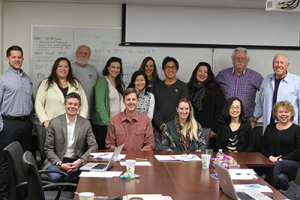
The National Geographic Society’s Education Foundation has awarded the AAG a grant to involve several Geographic Alliances in the work of the National Center for Research in Geography Education, a research consortium led by the AAG and Texas State University.

Last month, the Coordinators of the Alabama, California, Iowa, and Kansas Geographic Alliances met over two days with the NCRGE Co-Directors, Michael Solem and Richard Boehm, and several researchers associated with two current NCRGE research initiatives funded by the National Science Foundation: GeoProgressions, a capacity-buidling project for learning progressions research, and GeoSTEM (GeoSpatial Teaching Enrichment Modules), a pilot project that is supporting the Esri-ConnectED initiative by creating ArcGIS Online-based resources, materials and tools for STEM teacher education programs. Read More.

FUNDING OPPORTUNITIES

Charles Redd Center for Western Studies Offers Multiple Awards for 2015

The Charles Redd Center for Western Studies has announced multiple awards for 2015 that are available for scholars conducting research related to Arizona, Colorado, Idaho, Montana, Nevada, New Mexico, Utah, or/and Wyoming. Follow the link to https://reddcenter.byu.edu/Pages/Apply-for-an-Award.aspx for further information and application instructions. Applications for 2015 are due by 11:59 p.m. MST on March 15. Learn More.

Call For Submissions: 2015 IPSG Graduate Student Paper Competition

The Indigenous Peoples Specialty Group (IPSG) invites submissions for its annual Graduate Student Paper Competition, in conjunction with the 2015 AAG general meeting. We invite graduate student papers addressing indigenous critical cartography, geographic research, education, methodologies, and/or theory. Learn More.

MEMBER & DEPARTMENT NEWS

Dale Quattrochi Receives Helmut Landsberg Award for Research in Urban Heat Island Effect

Dale A. Quattrochi, a geographer and senior research scientist at the NASA Marshall Space Flight Center in Huntsville, AL, is the recipient of The Helmut Landsberg Award given by the American Meteorological Society (AMS) at the society’s annual meeting held in Phoenix, AZ, on January 4-8, 2015. Read More.

Susan Hanson to Serve on National Academy of Sciences Governing Council

Susan Hanson, Distinguished University Professor Emerita in the School of Geography at Clark University, has been elected by the members of the National Academy of Sciences to serve a three-year term on its governing council. Hanson currently serves as Chair of the Transportation Research Board’s (TRB) Subcommittee for National Research Council Oversight (NRC) and is a member of the TRB Executive Committee. Read More.

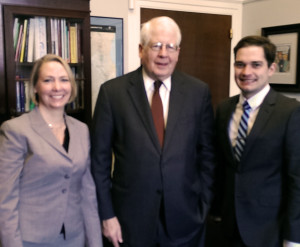
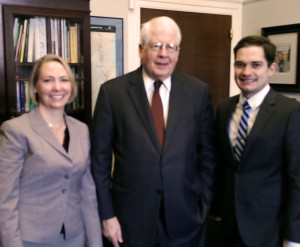
Webb-and-Frescoln-with-Rep.-Price-300x247-1Michael Webb Publishes Report on U.S. Department of Housing and Urban Development Moving to Work Demonstration
AAG member Michael Webb has recently published a report on the Moving to Work demonstration, a program introduced by the Department of Housing and Urban Development (HUD) in 1996 that allows high-performing housing authorities the flexibility to respond to local housing needs. This report offers comments meant to guide current debates about the extension of the Moving to Work agreements and providing a basis for future evaluations. Read More.

IN MEMORIAM

Graeme Hugo
C. Gregory Knight
Ruth Shirey
Joseph Sonnenfeld

POLICY UPDATES

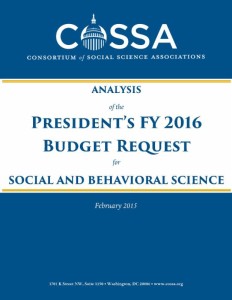
Presidents-FY-2016-Budget-Request-232x300-1COSSA Reviews President’s Budget Request for Social and Behavioral Science
COSSA announced last week that President Obama released his fiscal year (FY) 2016 budget request to Congress on February 2, officially kicking off the FY 2016 appropriations process. In turn, COSSA has released its analysis of the President’s budget request. The 62-page report provides funding details for all federal departments, agencies, and programs important to social and behavioral science research. It outlines the President’s funding proposals as they compare to current (FY 2015) levels. In addition, the document serves as a helpful catalog of social science programs and initiatives across the federal government. Read More.

Courtesy COSSA Washington Update

PUBLICATIONS

New Books Received — February 2015

The AAG Review of Books office has released the list of the books received during the month of February.  Read More.

People, Place, and Region Section Editor Sought for ‘Annals of the AAG’

The Association of American Geographers seeks applications and nominations for the People, Place, and Region section editor for the Annals of the Association of American Geographers. The new section editor will be appointed for a four-year editorial term that will commence on January 1, 2016. The appointment will be made by fall 2015. Read More.

Nature and Society Section Editor Sought for ‘Annals of the AAG’

The Association of American Geographers seeks applications and nominations for the Nature and Society section editor for the Annals of the Association of American Geographers. The new section editor will be appointed for a four-year editorial term that will commence on January 1, 2016. The appointment will be made by fall 2015. Read More.

New AAG Position Opening: Editorial Associate

The Association of American Geographers (AAG) has an immediate opening for the position of Editorial Associate, to be located at the AAG’s central office in Washington, DC. In collaboration with the Managing Editor and the Production Editor, the Editorial Associate will contribute to the day-to-day operations of the AAG’s four scholarly journals: Annals of the Association of American GeographersThe Professional GeographerThe AAG Review of Books, and GeoHumanitiesRead More.

JOBS & CAREERS

Jobs and Careers Center at the 2015 AAG Annual Meeting

In recent years, careers and professional development activities at the AAG’s Annual Meeting have been expanding and broadening. Thanks in part to positive feedback and attendance, the 2015 Annual Meeting in Chicago will continue to feature the Jobs and Careers Center, a centralized location where conference attendees can attend panel discussions, participate in workshops, receive free career mentoring, view job postings, network with other geographers, and browse a variety of information and educational materials.

This year’s track of careers sessions will kick off on Tuesday, April 21 with a panel discussion for newcomers to the conference and a workshop on teaching with the book Practicing Geography: Careers for Enhancing Society and the Environment. Read More.

MORE HEADLINES

Op-Ed: Preemption and Scalar Politics, from Living Wages to Hydraulic Fracturing

By Christian Brannstrom and Matthew Fry

If municipal political geographies seem boring, think again. In Texas, where we study municipal oil and gas drilling ordinances with support from the National Science Foundation (and live in cities with active drilling), fundamental questions are being raised: What are state governments for? What are municipalities for? How do opposing sides frame their struggles to determine the locus of regulation and control over activities like oil and gas drilling and hydraulic fracturing (fracking)? Read More.

GISCI Announces Changes to the GISP Certification Process

The GIS Certification Institute (GISCI) is changing the GIS Professional (GISP) certification process following decisions made during its first 2015 meeting. These changes affect both current and future GISP certification holders and were made in order to increase the value, recognition and long term viability of the GISP certification and the GISCI organization. Changes are schedule to go into effect on July 1, 2015. Read More.

Submit News to the AAG Newsletter. To share your news, submit announcements to newsletter [at] aag [dot] org.

    Share

Michael Webb Publishes Report on U.S. Department of Housing and Urban Development Moving to Work Demonstration

AAG member Michael Webb has recently published a report on the Moving to Work demonstration, a program introduced by the Department of Housing and Urban Development (HUD) in 1996 that allows high-performing housing authorities the flexibility to respond to local housing needs. This report offers comments meant to guide current debates about the extension of the Moving to Work agreements and providing a basis for future evaluations. Webb and Kirstin Frescoln, one of the co-authors of the report, recently met with Rep. David Price, the ranking member of the House Transportation-HUD subcommittee, to discuss their findings.

Webb and Frescoln will make a presentation on the Moving to Work demonstration at the 2015 AAG Annual Meeting in Chicago.

Webb is a research associate at the Center for Urban and Regional Studies (CURS) at the University of North Carolina at Chapel Hill. He serves as project manager for two evaluations of the Charlotte Housing Authority – one of its Moving Forward program and another concerning the HOPE VI redevelopment of the former Boulevard Homes.

For more information and to read the report, click here.

    Share