AAG Receives Grant for New Research with Geographic Alliances
The National Geographic Society’s Education Foundation has awarded the AAG a grant to involve several Geographic Alliances in the work of the National Center for Research in Geography Education, a research consortium led by the AAG and Texas State University.

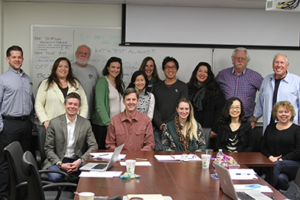
Last month, the Coordinators of the Alabama, California, Iowa, and Kansas Geographic Alliances met over two days with the NCRGE Co-Directors, Michael Solem and Richard Boehm, and several researchers associated with two current NCRGE research initiatives funded by the National Science Foundation: GeoProgressions, a capacity-buidling project for learning progressions research, and GeoSTEM (GeoSpatial Teaching Enrichment Modules), a pilot project that is supporting the Esri-ConnectED initiative by creating ArcGIS Online-based resources, materials and tools for STEM teacher education programs. The meeting produced plans for leveraging the participating Alliances’ extensive teacher networks in both projects.

For GeoProgressions, the Alliances will begin to lay the groundwork for the research activities planned for the project’s second phase that is tentatively scheduled to begin in the fall of 2015. This preparatory work will include geography and STEM teacher recruitment, submission of IRB research applications and engagement with the state education policymakers who oversee standards development and implementation. The goal is for the Geographic Alliances to help develop a diverse pool of teachers in several states who will be available to participate in GeoProgressions research on learning progressions for maps, geospatial technology and spatial thinking. This effort will also include Geographic Alliances from the states of Colorado, South Carolina and Texas.

Alliance Coordinators also proposed new research with the GeoSTEM project. At the Kansas Geographic Alliance, John Harrington will lead a three-year effort to develop and test a GeoSTEM module on agriculture. The goal is to increase the confidence and ability of pre-service agricultural science teachers in Kansas to deploy ArcGIS Online and other mapping technologies for spatial analysis and reasoning.

Dr. Alex Oberle, Coordinator of the Iowa Geographic Alliance, will extend the GeoSTEM project through new research partnerships with the Center for Educational Transformation at the University of Northern Iowa, the Iowa Department of Education, the Mid-Iowa School Improvement Consortium that provides curriculum and assessment for approximately 150 school districts, and the Governor’s STEM Advisory Council which includes six STEM “hubs” across Iowa. These relationships will considerably increase the number of pre-service teachers and schools impacted by the GeoSTEM project.

The California Geographic Alliance will build a geography education portal, rich in GeoSTEM curriculum and content in order to help connect K-12 classrooms to exciting online maps and mapping tools. Titled Geo-Quest, this education portal will take advantage of new web-based geospatial technologies to incorporate broad topical coverage, a high level of interactivity, and embedded content that will help teachers address standards and also meet the expectations of the Common Core standards. This work will be led by Kate Swanson (Alliance Coordinator), Thomas Herman (Director), Ming-Hsiang Tsou (Geospatial Technology Coordinator), Emily Schell (Education Program Coordinator), and Stuart Aitken (Academic Advisor).

The Alabama Geographic Alliance is creating a “GIS-Enhanced World Regional Geography” course which they are offering in partnership with the Department of Geography at the University of North Alabama, the Alliance’s host department and institution. Alliance Coordinator Dr. Lisa Keys-Mathews and two graduate students are creating the course which will be offered to high school juniors and seniors for college credit at three high schools in the fall 2015; a pilot study course was successfully offered in the fall 2014 to one high school. The course involves students in problem-based learning activities using geospatial technology tools, most frequently ArcGIS Online, to study and understand world regions and geographic concepts such as population growth, urbanization, economic development and globalization. The course is taught as a hybrid course where content and geospatial technology exercises are delivered online while a Teacher-Facilitator in the classroom leads student discussions and provides geospatial technology job shadowing and service learning opportunities. Student learning data from this project will inform future GeoSTEM materials aimed at high school teachers.

The mission of the National Center for Research in Geography Education is to build capacity, coalitions and scholarly networks for broad-scale research in geography education. At present the NCRGE research coordination network includes researchers affiliated with 32 universities in the U.S. as well as leading geography education research centers based in the U.K., Singapore, China and Turkey. The AAG and Texas State University welcome inquiries from other Geographic Alliances, research institutions, universities and scholars interested in learning more about how to get involved and contribute to the NCRGE mission. Additional information about NCRGE projects and events can be found online at www.ncrge.org.

    Share

New Books: February 2015

Every month the AAG compiles a list of newly-published books in geography and related areas. Some are selected for review in the AAG Review of Books.

Publishers are welcome to send new volumes to the Editor-in-Chief (Kent Mathewson, Editor-in-Chief, AAG Review of BooksDepartment of Geography and Anthropology, Louisiana State University, Baton Rouge, LA 70803).

Anyone interested in reviewing these or other titles should also contact the Editor-in-Chief.

February, 2015


    Share

Elin Thorlund Interns at AAG for Winter Semester

Elin Thorlund is a senior at Michigan State University pursuing a B.A. in Geography with minors in Spanish and Global Studies in the Arts and Humanities. Her interests include human and environment interaction, sustainability and climate change. After graduation, she is interested in working on research projects involving communities and their environment interaction and sustainability before attending graduate school. In her free time she enjoys backpacking and rock climbing.

    Share

Joe Chestnut Interns at AAG for Winter Semester

Joe Chestnut, a senior at The George Washington University, is double majoring in international affairs with a concentration in international development and geography. His area of interest include urban geography in under-developed countries, slums and environmental disasters. His future aspirations include working within disaster management and working towards a masters degree in geography.

In his spare time, Joe enjoys playing and watching basketball.

    Share

Elizabeth A. Frederic

Elizabeth “Liz” A. Frederic, a leader in environmental education, passed away on January 11, 2015, aged 73, after a struggle with illness.

Frederic was born in 1941 in Long Island City, NY, and grew up in Floral Park, NY. She earned four college degrees: B.S. in Home Economics from State University of New York at Oneonta, B.A. in Geography from University of Maine at Farmington, M.A. in Nutrition from New York University, and M.A. in Geography from University of Connecticut.

She had a varied early career which included teaching home economics in Greenlawn, NY, working as a social services consultant for New York City, being a day care inspector in Nassau County, NY, and acting as office manager for her first husband’s chiropractic practice in Skowhegan, ME.

From 1994 to 2003, Frederic worked as adjunct geography faculty at the University of Maine at Farmington. During this time, she was Education Coordinator for the Maine Association of Conservation Districts and developed and strengthened the Envirothon Program for high school students. Her work in conservation and environmental education was recognized in 2001 when she received the Outstanding Forest Stewardship Award from the Maine Forest Service.

Meanwhile Frederic was a member of the Association of American Geographers and the New England–St. Lawrence Valley Geographical Society, and served as Maine Geographic Alliance Advisor. She also owned Liz Maps, a cartography business, and published many maps.

She loved to travel, both for work and pleasure, visiting Cuba, the Caribbean, southern Africa, China, Mongolia, Vietnam, Europe and North America. She spent time at the University of Namibia and Beijing University of Technology acting as teaching assistant for her second husband. She participated in academic conferences around the world, presenting on topics as diverse as the reuse of dairy barns, water quality and African land ownership. Her professional publications were also varied, including work on the Cuban sugar industry, grazing systems in Namibia and Mongolia, and natural resource related education in Maine.

Closer to home, Frederic was a great supporter of community organizations and activities ranging from the state fair and cub scouts to the library and women’s club. She also loved gardening, cooking, reading, and time with the family.

Liz lived life as an adventure and will be missed by all who knew her. She is survived by her second husband, Dr. Paul Frederic, son Bradford Anderson, three step-children, and several step-grandchildren and step-great-grandchildren.

    Share

Justice and Place

In this forum and with this audience I doubt that it will be at all controversial to state that justice and place are intimately connected. After all, geographers are typically quite aware of such relationships. Or at least one hopes that they are typically quite aware of this. The dynamics between geography and justice is readily apparent in a wide array of situations, from the segregation policies of the old American South to the occupation policies of Israel vis-à-vis Palestine to the variance in death penalty laws among the various states in America. What is amazing, though, is how often issues of justice and place appear in the news as well as in cultural products and how just as often they are not recognized as such by the majority of people or, perhaps, even by the majority of geographers. My best supposition of why this is so is that geographical connections become obscure and opaque as readers and viewers pay attention to what may seem like more immediate factors, such as the glaring inequities of injustice or the seemingly random enactment and enforcement of laws. However, a simple analysis of a small sample of items will demonstrate that the link between geography and justice is extremely dynamic and must be taken into account for even a superficial understanding of most events.

For example, if we open up the New York Times of December 19 2014 to page 20, we will find three separate stories that show completely different yet equally taut relationships between geography and justice. The first story is titled “2 Neighbors of Colorado Sue over Marijuana Laws.” Upon perusing this article, we discover that the States of Nebraska and Oklahoma are suing the State of Colorado, which recently passed a law legalizing marijuana. Nebraska and Oklahoma are basing their cases on a worry that the pestilence of pot will spill over their borders and cause havoc in their territories. Here, we obviously have an issue with a geographical turn to it, for if there were no states and no borders between them, then this would not be an issue at all and, thus, not a story. But it seems to me that most readers will go through this story without realizing that the connection between geography and justice is the prime element in this article, as that link is so obvious that it is masked, hiding in plain sight, as it were.

The second story is titled “Contesting Traffic Fines, Missouri Sues 13 Suburbs.” Here, we have the attorney general of the State of Missouri suing thirteen St. Louis suburbs for allegedly profiteering off of minorities and the poor by overzealous enforcement of parking fines and traffic violations. So instead of co-equal entities such as states going to battle, as in the first story, we have here a state turning its jurisdictional focus on smaller entities, municipalities within that state. Again, a clear geographical focus is paramount in this case, as it is only through the organization of the states and municipalities and their court systems along geographical lines that such a suit could even be filed. But, once again, geography as such is lost here as attention is shifted to the alleged injustices which the governments of the various St. Louis municipalities perpetrated upon their citizens.

The final story on page 20 of the December 19 edition of the New York Times, “Shooting Spurs Debates Over Race and Guns In a Gingerbread Town,” concerns a Muslim woman, Mary Araim, who had been sworn in as a U.S. citizen just days before she was shot and killed in the German-themed tourist town of Helen in White County, Georgia, by one Glenn Lampien. Here the geographical locus is a bit more complicated. First, we have a Georgia town which , for touristic purposes, presents itself as a simulacrum of a German village replete with such establishments as the Hansel & Gretel Candy Kitchen, Lindenhaus Imports, and the Old Bavarian Inn. Ms. Araim, a native of Iraq, where she had been a teacher and an assistant principal, had moved to the United States and settled in Houston. She was in Georgia to visit relatives in nearby Lawrenceville and was wearing a headscarf when she was walking down the streets of Helen where she was killed. Lampien of Jasper, Georgia, was in Helen seemingly to become intoxicated. He had been drinking in a local bar, King Ludwig’s Biergarten, before he ducked out on the bill and then allegedly shot and killed Ms. Araim. According to the article, Lampien contends that he shot his gun accidentally and that in no way did he target Ms. Araim because she was Muslim and wearing a headscarf. So perhaps here we could draw lines of destiny and fate between Iraq, Texas, and Georgia to delineate the lineaments of geography in this case. The extra factor of the German touristic layer adds a surreal plane to the mix, giving the tragic death of Ms. Araim a bizarre quality. We could also add in the fact that Ms. Araim was more liable to be shot in the United States than in almost any other country, including perhaps even Iraq, given our penchant for weapons and our lax laws regarding the purchase of ammunition and guns, and especially in states such as Georgia, which passed a law in March allowing gun owners to carry their weapons in bars, restaurants, churches, schools, and restaurants.

A quick look at a selection of classic plays and movies also yields a sampling of cultural documents reflecting a tight connection between geography and ethics. For instance, Shakespeare’s King Lear hinges on the division of Lear’s kingdom into three equal parts which he bequeaths to his three daughters. The geographical backdrop of the play is quite explicit as in Act One, Scene One, Lear declaims to his children:

Give me the map there. Know we have divided
In three our kingdom; and `tis our fast intent
To shake all cares and business from our age,
Conferring them on younger strengths while we
Unburthen’d crawl toward death.

Obviously geographical in nature, this passage even refers to the paramount technical instrument of geography, a map. The consequences of Lear’s recklessly fateful decision ends up casting Lear and his youngest daughter, Cordelia, against his other two children, Goneril and Regan, in a pitched battle over territory, authority, and familial devotion or the lack thereof. Yet here as well, the salience of geographical concerns gets lost amidst what seem to be more significant psychological and metaphysical issues. Lear tips towards madness and plumbs the depths of the geography of the Inferno: “Beneath is all the fiends. There’s hell, there’s darkness, there’s the sulphurous pit; burning, scalding, stench, consumption. Fie, fie fie! pah, pah!” But the linchpin and the catalyst of the tragedy is that geographical parsing out of his kingdom to his daughters, the division of territory leading to all that ensues in Shakespeare’s drama.

One of Hollywood’s most celebrated classics, A Wonderful Life, directed by Frank Capra, is also centered on quite obvious geographical concerns. In this rather smaltzy yet still powerful drama, George Bailey, played by the always earnest James Stewart, struggles to keep his hometown of Bedford Falls and his housing development from falling into the evils clutches of Henry Potter, played by a very creepy Lionel Barrymore. The story is all geography through and through, with opposite versions of the town, Bailey’s idyllic Bedford Hills versus Potter’s satanic Pottersville, set against one another, the former a blissful vision of an almost communal-like Americana suburb, the latter reeking with every form of degeneracy and sin. Of course, this being a Hollywood picture, Bailey wins out in the end but not before receiving a copy of The Adventures of Tom Sawyer from his guardian angel, Clarence, thus tying Bailey into the great mother of American rivers and therefore connecting the film to a geography (and a history) of a more expansive kind.

These examples of the importance of geography in cultural products are not singular: there are scores of others which could just as easily prove the point. For instance, Chekov’s The Cherry Orchard concerns the estate of a family of aristocrats turned over to member of the noveau riche, while Ibsen’s The Enemy of the People focuses on the polluted waters of a spa. Or consider the Oscar winners for best picture in the last two years. In 2013, the Oscar for best picture went to 12 Years A Slave while in 2012 Argo received the nod. Both movies are framed by a strong geographical context, with the former set in the South when the mode of production of slavery was dividing the United States in two and the latter having much to do with borders, nation-states, and attempts to transcend those borders through subterfuge and cunning.

My point here, though, is not to insert geography into various things, as if draping our discipline about the necks of this or that entity, but to demonstrate that geography is pervasive, especially in terms of the realms of justice and ethics. Where you are makes a great difference, in fact as well as in fiction. That we as geographers should be especially aware of this seems to be the least we can demand of ourselves.

—Rob Sullivan

DOI:10.14433/2015.0003

    Share

2015 AAG Honors Announced

The AAG will confer AAG Honors, the Association’s highest honors, to eight individuals for their outstanding contributions to the advancement or welfare of geography. Each year, the AAG invites nominations from the membership, which are then presented to the AAG Honors Committee for consideration.

The AAG Honors will be presented at the upcoming AAG Annual Meeting in Chicago, Ill., during a special awards luncheon on Saturday, April 25, 2015.

The AAG Honors will presented in the following categories (select a name to view citations):

AAG Lifetime Achievement Honors:
John P. Jones, III, University of Arizona
Bobby Wilson, University of Alabama

AAG Distinguished Scholarship Honors
Tony Bebbington, Clark University
Ruth DeFries, Columbia University

AAG Gilbert White Public Service Honors:
Elizabeth Oglesby
, University of Arizona

AAG Ronald F. Abler Distinguished Service Honors:
John Frazier
, Binghamton University, State University of New York
Rita Gardner, Royal Geographical Society (with the Institute of British Geographers)

AAG Gilbert Grosvenor Geographic Education Honors:
Michael Solem
, Association of American Geographers

AAG Distinguished Teaching Honors:
No award will be presented in this category this year.

    Share

University of California Press Selected for AAG Publication Award

The University of California Press is awarded the Association of American Geographers’ Publication Award in recognition of their long-term support of geographic scholarship and publishing and overall excellence in publishing.

The relationship between the University of California Press and the discipline of geography goes back over a hundred years. Their University of California Publications in Geography series began in 1913. They published many of the major works of prominent geographer Carl Ortwin Sauer, a member of the University of California-Berkeley faculty and past President of the Association of American Geographers. And they continue to publish cutting-edge work in geography, spanning the discipline from physical to critical human geography.

Today, the geographic works published by the University of California Press are recognized with major awards, including the Association of American Geographers own Meridian Book Award, the John Brinckerhoff Jackson Prize, and Globe Book Award for Public Understanding of Geography. For example, their Atlas of Yellowstone (2012) has been recognized with no less than four publication awards.

For their long-term commitment to publishing excellent research in geography, we honor the University of California Press.

    Share

AAG Ronald F. Abler Distinguished Service Honors: John Frazier, Rita Gardner

The AAG is pleased to award the 2015 AAG Ronald F. Abler Distinguished Service Honors to Dr. John Frazier and Dr. Rita Gardner.

This award will be presented to Frazier for his sustained and exceptional dedication to furthering the public good through applied academic and intellectual pursuits. Frazier has worked consistently and steadily to encourage departments and universities to recognize the importance of applying scholarship to practice. The applied geography conference which he was instrumental in bringing to fruition is now in its 35th year. More recently he has expended similar energies toward funding and organizing biennial Race, Ethnicity, and Place conferences which succeed largely because of his vision to preserve a place for intellectually divergent ideas on the some of the most vexing and complicated issues in the world today.

Gardner receives the Distinguished Service Honor in recognition of the leadership and support for the discipline of geography worldwide. As Director of the Royal Geographical Society with the Institute of British Geographers since 1996, Gardner has worked tirelessly to advance geographic research; improve geography at all levels of education; broaden outreach to diverse publics; and promote the interests of geography on numerous national and international committees.

Citations for John Frazier and Rita Garner follow. 


John Frazier, Binghamton University, State University of New York

Frazier

Professor John Frazier was selected for the 2015 AAG Distinguished Service Honors from a field of noteworthy candidates because of the enthusiastic and compelling support he received from a large and diverse group of academics and practitioners.


A number of common themes stand out in their endorsement. They consistently note his “unselfish commitment to advancing knowledge and serving others through creative initiatives and sustained engagement, . . . he rarely puts himself in the forefront, but by actively following through on good ideas, he has had a transformative impact on our discipline and our profession.” “The mark he has made on the reputation of the Department of Geography at Binghamton University, which under his guidance has become one of finest Masters level departments in the country is worthy of note not by just by his students – many of whom wrote letters in support of his nomination – but by the University system which last year, awarded him the Chancellor’s Award for Excellence in Distinguished Service. Along with this honor, he was promoted to the rank of University Distinguished Service Professor.

His work mentoring students and early career geographers has made geography a far more diverse and welcoming field for racial, ethnic and foreign-born minorities,” due in large part to his pragmatic approach, which inspired many young professionals to use geographic skills and toolkits to make a difference in the world.

In addition to his work in the academy, Frazier has also been appointed a member of several interdisciplinary teams involved with local and regional comprehensive planning agencies, HUD, and the U.S. Census Bureau. Through this work, he has been a champion of geography and helped to educate many outside the field of its value – and centrality – in understanding topics such as gentrification, epidemiology, migration, and housing.

Frazier has also served as a National Councillor for the Association of American Geographers and a Councilor for the American Geographical Society. The AGS strives to connect geographers in academics, government and business. Given his critical role in outreach to applied geographers, Dr. Frazier has been particularly active in the AGS Council to make certain the work of applied geographers is promoted and recognized. His work was recognized by the Association in awarding him the James Anderson medal for Applied Geography.

One supporter noted that remarkably few geographers have been able to make significant contributions to more than one subfield within the discipline. Dr. Frazier has been a founder, leader, and energizer of two: one in applied geography, and one in race and ethnicity. . . his record reflects someone with a patient, enduring commitment to the discipline, to teaching, and to addressing pressing social problems.   When we look back on geography some decades from now, and in doing so see discipline that supports those who give unselfishly and generously to the discipline, we will be pleased that we recognized John Frazier for his tireless efforts.

Rita Gardner, Royal Geographical Society with the Institute of British Geographers

Gardner

Dr. Rita Gardner is awarded the 2015 Association of American Geographers Ronald F. Abler Distinguished Service Honors in recognition of the leadership and support for the discipline of geography worldwide that she has provided as Director of the Royal Geographical Society and Institute of British Geographers especially her promotion of geography at all levels of education, her outreach to diverse public, and her service on national and international committees.

Gardner has served as Director of the Royal Geographical Society and the Institute of British Geographers since 1996, the internationally respected learned society and professional body for geography and geographers in the UK. Under her leadership the Society has modernized and expanded its activities reaching out to more than 16,000 members and fellows from 160 different countries as well as millions of people worldwide through research, expeditions, education and public engagement.

Among her many accomplishments are the Action Plan for Geography to support and expand geography in UK schools and projects to engage public audiences in geography including public understanding of Britain’s geography from the air and walking and community partnerships and programs for diaspora groups and young people from disadvantaged backgrounds. She has also been a strong supporter of research, raising funds for early career grants, and encouraging greater awareness of the value of geographic research to government.

Her support of research and fieldwork reflects her interests and achievements as geomorphologist prior to her appointment with RGS holding academic posts at King’s College London and Queen Mary College. Her research and publications include results from international field research programs studying environmental change, including soil erosion in Nepal and dunes in India.

Dr. Gardner has served on many national and international committees including for the British Antarctic Survey; the Academy of Social Sciences; and British Council. She was Secretary General of the European Association of Geographical Societies and the advisor for Geography to the UK Secretary of State for Education and Skills. She was awarded a CBE (Commander of the British Empire) for ‘Services to Geography’ in 2003. She holds Honorary Doctorates from the Universities of Gloucestershire and Southampton, and an Honorary Fellowship of Queen Mary College London.

    Share

AAG Lifetime Achievement Honors: John Paul Jones III, Bobby M. Wilson

The 2015 AAG Lifetime Achievement Award is awarded to John Paul Jones III and Bobby M. Wilson.

The AAG Honors Committee selected Jones for his exciting and theoretically rich intellectual forays into a broad range of topics and areas of inquiry especially socio-spatial theory and geographic methods; his innovative teaching and mentoring; his record of service within the discipline as editor of the Annals and other journals, and his creative and inspirational leadership at the universities where he has taught.

The Lifetime Achievement Award is presented to Wilson in recognition of his extraordinary contributions to scholarship, teaching, leadership, and service to the discipline of geography. Wilson’s career-long dedication to anti-racist scholarship, as well as his mentorship of many students and colleagues have had a lasting impact on contemporary geography.

Citations for John Paul Jones and Bobby Wilson follow below. 


John Paul Jones, III, University of Arizona

Jones

Since beginning of his first faculty appointment Dr. John Paul Jones, III has brought his rigorous methodological and theoretical insights to various aspects of the field ranging from positivist spatial science to post-structuralist spatial theory. One supporter noted that although the topics he engages may seem highly cerebral and abstract, he approaches them with a wit, humor, and playfulness that have engaged broad audiences inside and outside geography.

A hallmark of Jones’s work is a spirit of collegial collaboration with scholars who, like himself have helped to shape contemporary geography in many ways. His work is intellectually rich; exuberant in its critique of geographic thought, history, and methodology; and constantly considering the ‘big picture’ in advancing the field of geography. His letters of support stressed how important his work has been in bridging the many subfields of geography — having a tremendous impact on connecting and reconciling diverse epistemological communities across the discipline. Jones’s understanding and curiosity about areas as diverse as physical geography and critical social theory have been of tremendous value to all. The letters of support included with Jones’s nomination stress repeatedly his passion for new ideas, his generosity, and his vital sense of collegiality.

Jones is an imaginative scholar with a strong reputation both in the United States and internationally. His edited books, book chapters, encyclopedia entries, and journal articles have played and continue to play a central role in key theoretical debates in geography. He is particularly noted for his strong influence on the field of critical geographical studies including such topics as the importance of poststructural and feminist approaches and scale and the production of social space in human geography.

In addition to his own scholarship and influence on the discipline, Jones is considered an outstanding teacher and mentor. He has supervised 23 Ph.D. dissertations, 20 master’s theses and currently supervises six doctoral candidates even as he served as chair of Geography and Development and then as Dean of the College of Social and Behavioral Sciences at University of Arizona. His students routinely receive NSF funding and have secured positions at outstanding research and teaching institutions around the world. He has an outstanding record of service within universities and the discipline, editing the Annals of the Association of American Geographers, serving on editorial boards, on numerous committees and visiting and speaking and universities around the world.

For these many reasons the 2015 AAG Lifetime Achievement Award is presented to Dr. John Paul Jones, III for his many contributions to the discipline throughout his career.]

Bobby M. Wilson, University of Alabama

Wilson

Dr. Bobby M. Wilson is awarded the Association of American Geographers 2015 Lifetime Achievement Award in recognition of his extraordinary contributions to the scholarship of urban and social geography, urban studies, and anti-racist theory and practice; his teaching and mentoring; as well as his exemplary leadership in support of geography.

In a career spanning more than four decades, Wilson has established a reputation for empirically rich, politically engaged, and theoretically sophisticated scholarship on issues of housing, urban revitalization, economic development, and social justice for Black communities. His numerous publications offer sophisticated theoretical appraisals of capitalist processes, social engineering, and neoliberalism and have led directly to a sharper scholarly perspective on spatial dimensions of the Black experience in the urban South.

Wilson’s two major works, America’s Johannesburg: Industrialization and Racial Transformation in Birmingham (2000) and Race and Place in Birmingham: The Civil Rights and Neighborhood Movements (2000) exemplify these contributions in their analysis of the geography of Birmingham, Alabama. As these titles suggest, his concern is both the large-scale processes of economic, political, social transformation as well as the on-the-ground social movements that respond to these forces.

At the regional and national levels, Wilson has been a leader in helping to address questions of racism and access within the institutional framework of the discipline. In the mid-1980s, he was a member of the AAG’s Commission on Afro-American Geography, the first such group to address racism and anti-racism with geography. He played a similar leadership role within the Southeastern Division of the AAG. He has also had a constant presence at the local level where his commitment to anti-racist scholarship has played out in contributions to his own community by working as a board member for many local agencies devoted to community wellbeing, and in a large number of community-based research projects.

As AAG president Audrey Kobayashi noted when presenting Wilson with the association’s Presidential Achievement Award in 2012: “Professor Wilson’s contributions to anti-racist practice in advancing the discipline of Geography have been unflagging. As an educator, he has constantly striven both to develop anti-racist practices in the classroom in general, and to contribute to the educational context, including historically black institutions, in which minority students can thrive.”

Based on these extraordinary achievements and contributions to geography, it is an honor to recognize Dr. Bobby M. Wilson with the 2015 Association of American Geographer’s Lifetime Achievement Award.


    Share