Michigan Central Station: “The Sublime Object” of Detroit

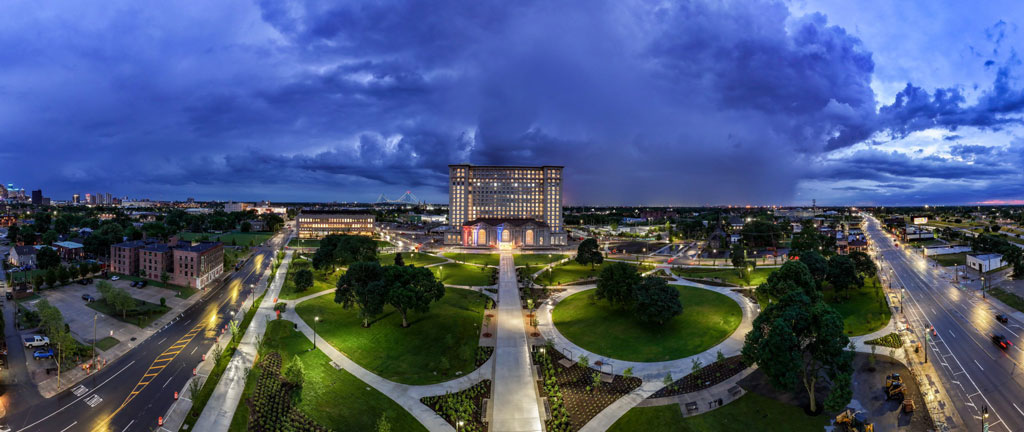
An exterior panoramic view of Michigan Central Station and surrounding areas in Detroit. Credit: Stephen McGee

In 2019, as the renovation of Michigan Central Station (MCS) in Detroit was getting underway, geographer Lucas Pohl captured some of the mythology and mystery that arose around the station in its more than forty years of decline:

One of the first lessons I learned while visiting Detroit is that you cannot speak about the city without facing its past. While this could be said of most places, it is a particular obsession of Detroiters to point to the city’s history in order to explain its present (and future). If you base Detroit solely on ‘what you see’, you do not get the ‘whole thing’.”

—Lucas Pohl,The sublime object of Detroit,” in Social and Cultural Geography (2021, Vol. 22, No. 8)

In 2015, Detroiters had described to Pohl the special place that the 1913 Beaux Arts-style Michigan Central Station has occupied in their minds—reflections of awe that speak from the last decade to its era of grandeur, its painful descent into ruins, and its 2024 reopening as a community and commercial hub once more:

Michigan Central Station is a special case. We have lots of skyscrapers that were empty for a long time, but the train station has a special place in the people’s hearts.”

“It’s just the One.”

“It’s a thing for everyone . . . I see it and I’m like, ‘Oh, I love Detroit.’”


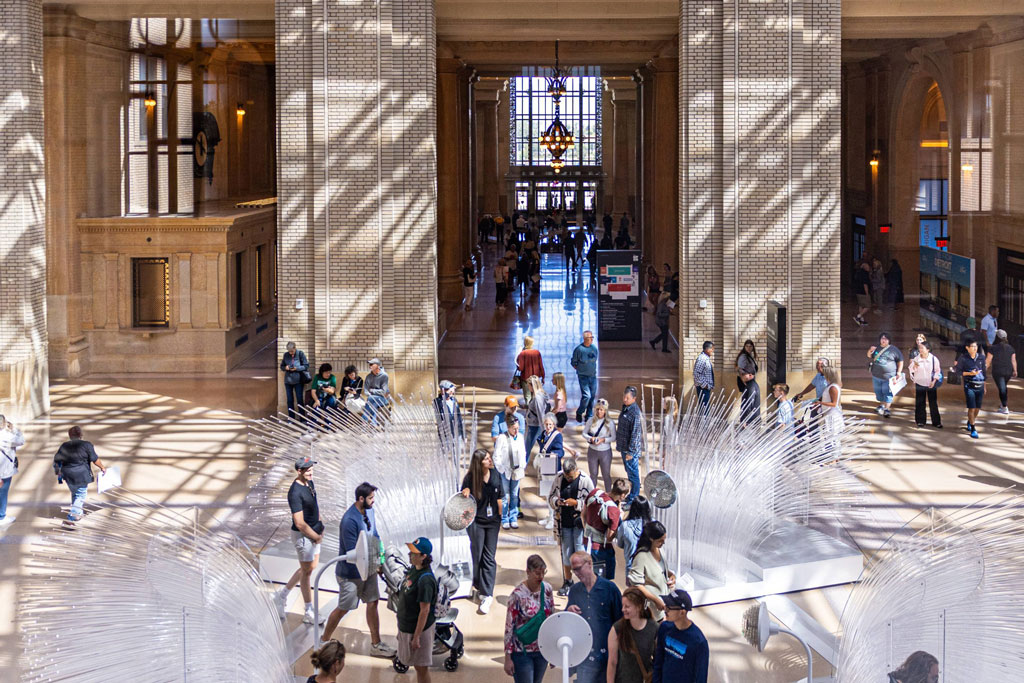
People walk through the interior hall of Michigan Central Station in Detroit. Credit: Stephanie Rhoades Hume, Michigan Center

New Life for the MCS

The recent renovation of the Michigan Central Station focuses on its future as a tech and mobility hub on 30 acres, with 1.2 million square feet of public and commercial space. Ford Motor Company was the lead on its renovation, with partners like Google and Newlab joining the State of Michigan and the City of Detroit. Yet this building also lives within more than 100 years of shared memories and history. Its presence in the public imagination remains a central element in its new life.

Just as there is plenty to remark on in the rebirth of the station, from the craftsmanship brought back to life to the careful planning for a mix of uses and inclusion of skills and jobs programming, Detroit historian Jamon Jordan also sheds light on the many reasons the station’s history is important to the city’s life.

On the grand reopening in June 2024, Jordan shared an op ed published in the Detroit Free Press, detailing the rich history of Michigan Central. From his childhood memories of the station in 1977, about a decade before it closed—many believed for good—Jordan traces back to the people, events, and stories that made Michigan Central a nerve center of city and Black history long before it became an emblem of decay during Detroit’s tough years at the end of the 20th century.

When the Erie Canal opened in 1825, Jordan recounts, it sparked a mass migration from the East Coast, either with Detroit as their destination, or through the city to Chicago. Starting in the 1830s, the railroad became a feature of the landscape, and the Michigan Central Railroad became a fixture by 1846.

One of the most consequential figures Jordan brings to life is Elijah McCoy, an African American engineer who began working for the Michigan Central Railroad in 1866. Born in Ontario, Canada, in 1844 to parents who escaped on the Underground Railroad, McCoy was trained in Scotland, but was “allowed only to be a lubricator and fireman on the railroad” because he was Black, says Jordan. This talented engineer was relegated to oiling the train’s moving parts and shoveling coal.

Undeterred, McCoy invented “an automatic lubricator that could oil the train’s moving parts as it was moving, eliminating the need for trains to make frequent stops,” says Jordan, thus gaining the last laugh and transforming the capacity of the railroad industry.

An era came to an end when the old 1884 Central Station was destroyed in a fire in 1913. The present building occupies a different site at 14th and Michigan. Until it closed in 1988–due to declining rail ridership nationwide and the attrition in both employers and residents in Detroit–its vast grandeur greeted thousands of travelers, including the hopeful members of the African American Great Migration. Many of them, migrating from the segregated South, had only dreamed of an arrival like this one, into a public train station without a single set of discriminating signs for “Whites” and “Coloreds.”

Jordan brings together touchstones of history through the station’s life, from international fame to personal connection: from Ossian Sweet to Joe Louis to Lucinda Ruffin—Jordan’s own grandmother.

Once, Michigan Central Station had 10 gates for trains, and its 18-story tower held 500 offices. In the station’s heyday in the 1940s, more than 4,000 passengers passed through each day. The six-year renovation preserves many of the original structures exterior and interior architectural details, and also addresses renovations at two nearby buildings, which will now house an innovation space called NewLab, and a mobility hub that incorporates greenspace, pedestrian, and bicycle connections. The result may well be a new Detroit place that is still worthy of Jacques Lacan’s somber definition of a “sublime object,” as Pohl describes it: “a remainder of loss that triggers a strong nostalgia,” yet that also can contribute to the city’s future.

Find out more about Detroit history from Black Scroll Network. Read an analysis of the fall and rise of Michigan Central in this article by Wayne State University’s Mila Puccini and Jeffrey Horner. 

Register today
    Share

Where We Stand: AAG’s Current Finances

Two people review and discuss financial documents

By Antoinette WinklerPrins, AAG Council Treasurer

Photo of Antoinette WinklerPrinsThis is the first of a short series of perspectives by 2024-2026 Council Treasurer Antoinette WinklerPrins. In this first column, she offers the overview of AAG’s recovery and lessons from the hard hits of COVID-19 and annual meeting cancellations. Future columns will look at topics from a member’s perspective—Have you ever wondered why having a conference hotel is so important? What the costs for a hybrid or virtual meeting are? Dr. WinklerPrins will take up those questions in future issues of the Newsletter.


When I stepped up to become AAG’s Council Treasurer this year, I had already been a devoted member of AAG for more than 25 years, and had served on the AAG Council since 2023, and as East Lakes Regional Councilor from 2009-2012. Now I am fulfilling the position of Treasurer, learning more every day about what it entails. It is teaching me valuable lessons that I’d like to share with you about how I and the rest of the AAG Council can serve you, the AAG members. Becoming Treasurer has also given me a sense of purpose to explain aspects of AAG’s budgetary and fiscal responsibilities that help provide context for AAG’s decisions on members’ behalf.

In my professional life, I am a geographer serving as the Deputy Division Director of the Division of Behavioral and Cognitive Sciences in the Directorate for Social, Behavioral, and Economic Sciences at the U.S. National Science Foundation. I served as a Program Director in the Geography and Spatial Science/Human-Environmental and Geographical Sciences prior to becoming a Deputy Division Director. I have served on the faculty of Michigan State University and retain an adjunct appointment at the Johns Hopkins University’s Environmental Sciences and Policy Program.

As a member of AAG, I already understood that the governing body of the AAG, the AAG Council, has fiduciary responsibility for the organization. As Treasurer, I have come to appreciate the considerable time that the Council devotes to reviewing the state of AAG financials during each of its meetings.  I have learned how to work closely with the AAG Executive Director and Director of Finance and Accounting, and how to head the AAG Finance Committee.

When I joined Council in July 2023, AAG was emerging from the worst of the pandemic and absorbing the costs of cancelling three in-person meetings in a row. Along with that loss came significant investment in hosting virtual meetings. Because the Annual Meeting has long been the AAG’s main source of revenue, these three years of cancelled meetings were very hard on the financial wellbeing of the organization.

One of the major shifts AAG made soon after the pandemic was not only fiscally sound but in line with its climate goals: the move to a new headquarters that is LEED Gold and highly rated for accessibility and walkability. AAG’s staff work hybrid schedules to reduce trips, and the move resulted in a significant rainy day fund from the sale of the old headquarters.

In 2023, Council approved several more steps to stabilize AAG:

  • Membership dues were increased on July 1, after a six-week campaign to make sure current members had the chance to renew at existing rates and take advantage of multi-year membership for up to three years. AAG had not increased membership dues since 2008, even though inflation-linked incremental increases are the norm in many organizations such as the AAG. This adjustment has aligned dues with current costs for member services—and AAG added two discounted membership categories for faculty and staff of Minority-Serving Institutions and K-12 teachers.
  • AAG has adopted a break-even model for registration pricing for its annual meeting, opting to retain the hybrid option for maximum choices for all members. To reflect the true costs of a hybrid option while protecting discounted rates as much as possible, AAG raised registration rates, but not uniformly across all categories. Additional discount categories were added here, also.
  • AAG reluctantly undertook a staff reduction last summer to reduce fixed costs, and has sought other cost-cutting opportunities in its operating expenses.
  • Because many of AAG’s fiscal measures will take time to have full effect, the Association has needed to use money from Council-restricted reserves to make up the shortfalls. Now, AAG must shift emphasis and rebuild these reserves. Therefore, September, Council voted to prioritize building up our reserves and endowment again before embarking on costly or risky initiatives.
  • As part of its work to diversify revenue beyond the annual meeting, AAG has embarked on a major internal effort to seek and secure grants. Two projects—the Convening of Care and the new GAIA project—have already received funding from the National Science Foundation, with eight more proposals currently in play.

I am confident in the management of AAG and can assure you that the decisions the Council has made recently are stabilizing AAG’s financials, ensuring the organization’s continued viability. Plans for prudent fiscal management for the next few years are critical to helping the organization build up future reserves so that it can sustain its important work supporting its members and the discipline of geography. We appreciate your patience and understanding as we rebuild. Please feel free to reach out to me or Gary Langham, AAG’s ED with questions, comments, or concerns. Send your comments and questions with the subject line “Treasurer’s Corner” to [email protected].

    Share

Richard L. Morrill

Professor Emeritus Richard L. Morrill passed away on March 28, 2024. He had been ill for several years and passed away with his wife and best friend at his bedside.

Dick was born in Los Angeles California in 1935. He received his B.A. in Geography from Dartmouth in 1955. He moved to the University of Washington in Seattle that year to pursue a master’s degree under Edward Ullman. Ullman was about to undertake fieldwork in Italy, however, so he moved to work with William Garrison, who was a pioneer in statistical methods and analysis. Dick and his cohort became known as the “Space Cadets.” During the Quantitative Revolution, Dick was part of a group of geographers who sought to transform the discipline from an idiographic regional tradition to a modern, mature spatial science.

After receiving his Ph.D. from Washington in 1959 (on the effects of the U.S interstate highway system on the use of medical services) he became an assistant professor of Geography at Northwestern University. In 1961 he became a post-doctoral researcher at the University of Lund, Sweden. That year he returned to the University of Washington in Seattle as an assistant professor. He would spend the rest of his career there, retiring in 1997. He was a founder of the Institute of Environmental Studies at UW and the first director of the Ph.D. program in Urban Design and Planning. He held appointments in Health Sciences, the Center for Demography and Ecology, and the Graduate School of Public Affairs.

Across his vast career, Dick published eight monographs, over 80 journal articles, as well as 54 chapters in books and proceedings. His books include The Geography of Poverty in the United States (1971), The Spatial Organization of Society (1972), and Political Redistricting and Geographic Theory (1981). He received eight NSF grants, a Guggenheim fellowship (1983-1984), and the University of Washington Distinguished Retiree Excellence in Community Service Award in 2014, amongst many other awards and recognition.

Dick chaired the Washington Geography Department from 1973 to 1983. He was president of the Western Regional Science Association (1992-1994). He served as AAG President in 1983. His presidential address “The Responsibility of Geography” was published in the Annals in 1984, volume 74, issue 1.

Dick’s interests were wide ranging. He was an economic geographer interested in location theory, transportation, regional planning and development. He was a socio-political geographer interested in inequality, segregation, health services, redistricting and local government reform. He was an urban geographer interested in population and migration, growth management, and regional planning. He was a methodologist interested in quantitative and spatial analysis, location and movement models. Finally, Dick was a geographer with regional expertise in the United States, the Pacific Northwest, and the Seattle metropolitan area. He taught in all these areas. He supervised 22 M.A. students and 30 Ph.D. students.

He was appointed as Special Master to the Federal District Court in Seattle to redraw Washington state legislative and congressional electoral districts in 1972. This led to work in major Supreme Court cases on political gerrymandering, and with the U.S. Justice Department on redistricting in Mississippi. Other professional service included serving on the Hanford Environmental Dose Reconstruction Project (1986-1996), drawing maps for the Seattle School District to desegregate schools (1987-1989), conducting a Branch Campus Demographic Analysis for the State of Washington (1988-1989), and drawing proposed City Council districts for a (successful) ballot initiative to shift the City of Seattle from an all at-large Council to a mostly district-based one (2012-2013). He did numerous demographic and spatial analyses including issues of Native fishing rights (the Boldt decision), and the gentrification and African-American displacement of Seattle’s Central District neighborhood.

Dick always melded his political activism with his teaching and scholarship. Besides teaching Garrison’s Geography 426 Quantitative Methods in Geography, Dick created Geography 342 Geography and Inequality (both of which are still on the books in the department!).

Dick was a member of Students for a Democratic Society, and the UW Student Peace Union. He refused to sign the anti-Communist loyalty oath at UW in the early 1960s, and was part of a court case to abolish it. He was the first single man in Washington to be allowed to adopt a child. He worked over three years with the Congress of Racial Equality (CORE) from 1960 to 1964 doing research, legal, and street action. His chapter of CORE chartered a bus to the Student Non-violent Coordinating Committee (SNCC) for the 1964 March on Washington. He worked with the American Friends Service Committee on peace issues and reform of mental institutions. He was also a member of the North Cascades Conservation council.

Amidst all this, Dick was a kind, compassionate, caring, and upbeat person. In a 1998 talk he referred to himself as a “uncurable idealist.”  He is survived by his wife Joanne, sons Lee and Andrew, and his daughter Jean and her husband Dave.

    Share

AAG Travel Policy

    Share

Remaking Hawaiʻi Into Someone Else’s Paradise

Dennis James Dingemans

Dennis James Dingemans was born and grew up in rural southern Minnesota, graduating from Albert Lea High School. He received his B.A. in History from the University of Chicago and then drove his 1949 Cadillac to San Francisco.

In 1968, Dennis was part of a diverse cohort accepted into the geography graduate program at the University of California Berkeley. Carl Sauer enjoyed Dennis’s stories about his Dutch immigrant father and growing up in Midwestern farming country, yet Dennis was attracted to the urban geography and planning courses at UCB. He became an advisee of Jay Vance. His dissertation (1975) was a study of how the morphology of the East Bay suburbs was being changed by the spread of townhouses, a house type from the central city. In short, his work focused on a piece of Vance’s model of a “city of realms.”  In addition to supping at Vance’s table of urban and transportation geography, Dennis also found his ideas shaped by Professors Glacken, Hooson, Luten, Parsons, Pred, and (in planning) Webber. A summer study tour to Yugoslavia reinforced an interest in the geography of Eastern Europe and the Soviet Union.

Dennis spent his professional career (1972-2005) at the University of California Davis. He taught topical courses on urban and economic geography, regional courses on Eastern Europe, China, and the world, and techniques courses on quantitative methods and urban field geography.  He won teaching awards from the UCD Academic Senate and the National Council for Geographic Education, and his lively lectures sprinkled with humor and bon mots were popular. He taught freshman seminars on Davis, the Bay Area, and Northern California, incorporating field experiences and works of both nonfiction and fiction, a favorite being Ecotopia.

Dennis’s research included work on townhouses, land use controls, redlining, defensible space, billboards, gasoline purchasing behavior, and (with his wife and fellow geographer Robin Datel) historic preservation and ethnic and immigrant geographies in American cities. The latter interest emerged from supervising the dissertation of his advisee Susan Hardwick on patterns of Russian settlement in the Sacramento region. Field inventories and cultural landscape slides were hallmarks of Dennis’s engaging scholarship. Dennis did a lot of university service, recognizing it as an important way to grow awareness and understanding of geography on campus. He served on and chaired numerous college and academic senate committees. He was a popular adviser for several programs in addition to Geography—International Relations, Community Development, and Environmental Planning and Management.

The Association of Pacific Coast Geographers, the AAG’s westernmost division, was Dennis’s favorite professional organization for fostering and enjoying the discipline that shaped his life. He gave 22 papers at annual meetings stretching across five decades. He served on many committees, co-organized the 1987 annual meeting, led field trips, mentored student participants, co-edited the APCG Yearbook, and was vice-president and president of the association.

Dennis lived an important life of service outside academic circles. He served on the City of Davis Design Review Commission and Planning Commission, as well as other city-appointed committees related to housing and economic development.  He worked for or against numerous local ballot measures related to planning, housing, open space, transportation, and energy issues. For a decade he served as Director of the Hattie Weber Museum of Davis, the local history museum, creating space for visitors to share their own stories. Dennis led the museum’s long and successful campaign to preserve Davis’s only WPA-financed building. He guided field excursions under the auspices of the Yolo County Historical Society, providing geographical perspectives on local people and places.

In addition to Dennis’s contributions to geography via his research, teaching, and service, his interest in the discipline was shared with his two sons. Theodore, a paleoecologist, earned a Ph.D. in Geography from the University of Nevada Reno and Franklin, a data engineer, obtained a B.A. in Geography from UC Berkeley.

Submitted with permission by Robin E. Datel and the Davis Enterprise

    Share

Harrison Campbell, Jr.

Harrison Sherwood Campbell, Jr., who lived a thoughtful, love-filled life, now rests at peace, passing away at age 60 on Saturday, October 8, 2022.

Harry, as he was known by his family, friends, and colleagues, was born on February 25, 1962, in Encino, California. He spent his formative years in Briarcliff Manor, New York, and graduated from Wellesley High School in 1980, where he lettered in baseball all four years and played clarinet in the concert band and orchestra. Left to cherish his memory are his loving wife, Terry Albanese, his stepsons, Jacob and Benjamin Gefell, his brothers, Alan (Marcia) Campbell and Drew (Karen) Campbell, sister-in-law, Connie Lappa, and nieces and nephews, Katharine and Elizabeth Campbell, Colin and Megan Campbell, and Peter and Joseph Campbell. Harry was predeceased by his first wife, Jama Mooney, his father, Harrison Sherwood Campbell, Sr., his mother, Joyce Campbell, and his brother Bruce (Connie) Campbell.

Harry received a B.A. in Economics and Geography (1985) from Clark University and an M.A. in Geography (1987) and Ph.D. in Geography (1994) from the University of Illinois. As an economic geographer at UNC Charlotte for nearly 25 years, Harry was focused on understanding the nature of place, and, more importantly, communicating what he learned to his community, students, and colleagues. In addition to his often pathbreaking scholarship, his partnership with the Charlotte Chamber of Commerce to project local economic growth helped to shape modern Charlotte. In this partnership, Harry was author of Charlotte’s Business Growth Index for many years. As an administrator, he played a significant role in developing new degree programs in Geography, Public Policy, and Environmental Sciences. Harry’s most significant professional accomplishment was, by far, the contributions he made to students and colleagues.

Always generous with his time, and unfailingly supportive, Harry impacted the lives of thousands via his teaching, mentoring, and friendship.

Above all, family and friendship were most important to Harry. He adored his wife and embraced his stepsons with open arms and incomparable generosity, always looking forward to holidays and extended visits with the only kids he had. He went to lunch with neighbors and stayed connected with friends across the country and globe. He loved to banter about baseball with his brothers, always kept up with his nieces and nephews, and wrote notes to his mother that she described as “the sweetest ever.” Harry was a man of meaningful relationships.

Harrison Campbell with mountains in backgroundAlso an adventurer, Harry enjoyed traveling the world. He explored Indonesia, swam the oceans of Nicaragua, walked the streets of Buenos Aires, hiked the mountains of Argentina, and explored the high desert plains of Colorado. He visited many national parks, here and abroad, sharing a love of nature and the outdoors with his wife and best friend, Terry. He sought to learn about these places and was an active observer and researcher, never forfeiting a chance to gain insight or perspective about how our planet and its people work.

At home he enjoyed quiet mornings sipping coffee on the porch, watching birds at the feeder, and laughing at the Sunday comics. As much bad news as there was around, Harry always made space for jokes; there was always room to squeeze in a zinger.

Baseball was a special pastime for Harry. Whether watching from home or going to minor league or professional games — counting strikes and hoping for homeruns never got old. One of his favorite pastimes was going to Charlotte Knights games with his good friend and colleague, Bill Graves.

Husband, brother, son, stepfather, friend, professor, traveler, thinker, enjoyer-of-life, Harry brought smiles to our world, and he will be missed dearly by many.


Published with permission from Terry Albanese.

    Share

Ross O’Ceallaigh

By Annie Liu, AAG Intern

Ross O’Ceallaigh, host of the Green Urbanist podcast, discusses amplifying green ideas and how that is an important step in fighting climate change. In High School, his favorite subject was geography, but he didn’t want to end up teaching geography after getting a degree. Thankfully, he found a course that offered him the chance to start exploring both planning and geography, which opened him up to the world of urban design and development. Ironically, he ended up becoming an educator in both his day job and podcast anyway!

We all know you run a very popular podcast [The Green Urbanist], but tell us some more about your day job and your responsibilities

My day job, which I do four days a week, is working as a Learning Program Manager at a nonprofit called Design South East, which is based in the Southeast of England. We exist to try and improve the quality of design and development and places in general across that region of the southeast of England…My role is running training programs and learning events for built environment practitioners like planners who work in local authorities so they can upskill in design, urban design, sustainability, and just whatever is like the latest planning reform that is happening, which we’re having a lot of the last couple of years in the UK basically.

A non-linear career path

I’ve been sort of having a bit of a squiggly career in that I went on to study urban design at a master’s level, and I got a job as a planner in a local authority working on very small-scale stuff in in the South of England. Then I moved into a job in London that was working for a big multidisciplinary practice and working on international projects. The two main projects I worked on in my year and a half were in Nigeria, and one of them was for a spatial plan for a city of 6 million people. I went from assessing people’s applications to change their windows on their house to working on this massive spatial plan and still being quite inexperienced. I went on to work for a nice small urban design consultancy called Urban Initiatives Studio and worked much more in the UK and Ireland and on projects with local authorities doing things like urban design strategies for town centers or for London boroughs so they could plan their growth and get the best results out of coordinating the development that was coming forward.

“I just thought I quite like speaking, I quite like doing podcasting and sort of teaching people; I wonder, is there a way I can get into that?”

How does geography play a role in your job?

I think having a joint geography and planning background is very useful in terms of understanding the big picture and the natural systems that influence planning and urban design.

How did you end up starting your podcast?

I think it’s a familiar story for many podcasters in that when the pandemic happens, we’re all stuck at home, we had loads of free time…Then lots of people thought, ‘Ah, I’m gonna start that podcast I’ve always wanted to.

Ross realized that the climate crisis is incredibly serious and that he and many people in the built environment sector were unprepared for the challenge. He decided to teach himself and read up on the topics of interest in sustainability, leading him to start a podcast to share the knowledge that he was learning and keep learning from expert interviews.

“The podcast is as much for my education as for anyone else’s, and it really has been a great opportunity to sort of open up a conversation with people that you wouldn’t necessarily have access to…”

In your podcast, how do you perceive the value and importance of geographic knowledge?

I think something that’s become really clear to me over the last two years of podcasting is that sustainability solutions are really geographically focused and that a sustainable approach to, say, architecture in London, will be different to Boston or Sydney or Lagos, Nigeria. I think that’s been such a frustration–that we try to find really blanket solutions and really broad solutions to things that actually should be really location specific. It comes down all sorts of things, like traditional knowledge systems and indigenous knowledge perspectives of people who have actually lived sustainably for thousands of years in a place. Through the processes of colonialism and globalization, that knowledge has been sort of swept aside. Now we’re looking back on it, and we need to relearn the sustainable ways that are specific to this place.

What do you think are the most important issues you discuss on your podcast? And how do you hope your audience reacts to the issues discussed?

I think the topics have shifted over the course of the three years I’ve done it. I started talking about mitigation and being like ‘Here’s what net zero means’, ‘Here’s how we can get to net zero’, and while that is still at the front of our mind and very important, I’ve sort of moved on to thinking, ‘OK climate change is here, how do we adapt.’ Climate adaptation, particularly in the built environment, is flying under the radar quite a lot. People talk about things like overheating, but I think [there are] profound changes that we need to do to adapt.

[I hope] to share more about transformative climate responses, such as urban rewilding, or sustainable co-housing—alternative methods of doing things that step outside the developer profit-seeking model.

“I hope that then inspires other people to see what other possibilities are out there, and then hopefully those possibilities can be implemented.”

What is your favorite part of your day job and the podcast?

I’m always learning and I’m always getting a chance to learn from people. When I run training events in my day job, I’m often bringing in the best speakers to talk about something they’re quite expert in and I get to sit there in the audience and learn from them for that moment as well. I think also getting feedback from people who come and say that was really helpful…That’s the gratification of being in an educational role.

I think with my podcast, my perspective has changed so much over the last three years just from all the people I’ve been able to talk to. I think that thing of like keeping an open mind and being open to saying like, “Whoa, like, you know, the way I saw the world is a bit different and actually I’m gonna sort of move forward with a different perspective on this.

What do your coworkers think about the podcast? Is it kind of a double life, are you pulling a Hannah Montana situation, or are they interested and involved?

I think it helped me get this job actually, because I was doing the podcast for about a year before I decided to change from my consulting job and then I decided to try something else. It’s actually been really useful because I have a lot of contacts that I can call on from the podcast to come and do events in my day job that I’m running… So, it’s definitely not a double life and I’m lucky in a sense that my employer and my colleagues have been very supportive of it because it has so many parallels and it supports the day job. I don’t think they worry that I’m getting distracted by it.

Would be what advice do you have for undergrads, grads and early career professionals interested in your day job…or starting a podcast?

[Regarding a podcast], I think the answer is to say just do it and you learn by doing it and start by recording a couple of episodes, and if you think they’re awful, you don’t have to publish them. The only way you get good at something is by doing it…like you need to get started scripting or interviewing people or just chatting with your friend with the microphones and that that will make it much easier over time.

I would honestly say that even if nobody listens to your podcast, it’s still worth doing because it’s really enjoyable, it’s really good fun and you’ll probably learn a lot doing it and you’ll learn skills that can then be transferred and that kind of thing.

[As for jobs in general,] I would say if you have the luxury, pick your employer wisely, and don’t be afraid to jump around jobs a little bit. If you have the option to try out a couple of different jobs that are very different in scale and very different in context. In your early career, I think that’s really, really useful to do actually and will give you a really wide perspective. Then, you can say after a couple years’ experience, “Actually, you know what, what I really like and what I’m really good at is this thing and I’m gonna now focus in on this a bit more.

Don’t be afraid of jumping in and doing a job that maybe you’re a bit unsure about with the knowledge that it won’t last forever if you don’t want it to.

    Share

Richard L. Forstall

Richard L. Forstall died on May 30, 2023, while in palliative care at Goodwin House for heart disease since March. His passing was sudden and peaceful with family present. He was born October 8, 1926, in Chicago, the son of James Jackson Forstall and Nellie Louise (Lothrop) Forstall. He lived in Alexandria for 48 years. He is preceded in death by his parents and also his siblings, Jackson L. Forstall, Philip L. Forstall, and Jean (Forstall) Peneff, and survived by nieces Marilyn J. Peneff, Anne (Peneff) Albert, nephew Nicholas J. Peneff, and many cousins.

Mr. Forstall’s achievements include the development of official standards for defining United States metropolitan areas for the U.S. Census Bureau from 1972 -1995 based on extended work for Rand McNally & Co. since 1951.

    Share