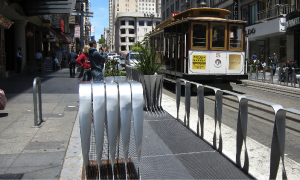
When geographers descend on San Francisco next year for the annual American Association for Geography meeting, most will undoubtedly stroll past one of the Powell Street parklets, located near the downtown conference hotels. Designed by landscape architect Walter Hood, with funding from Audi, the parklets are celebrated by Dwell magazine for beautifying one of the city’s most trod upon blocks with “torqued aluminum railing, drought-tolerant plants, and enough space for pedestrian-choked Powell Street to breathe” (Britt 2011). One of Dwell’s favorite aspects of the parks’ design is how they narrow the cable-car lined Powell Street to two lanes, effectively prohibiting automobile traffic. The Powell Street parklets are hardly an unusual sight in bike-friendly San Francisco – the city’s Pavement to Parks program has supported sixty similar sidewalk spaces (See San Francisco’s Pavement to Parks Program for a map of the city’s parklets). While most parklets don’t take over car lanes, they do occupy parking spaces, and most include bike racks – encouraging this “greener” mode of travel. As popular, year-round destinations, many parklets are sponsored by neighborhood businesses, as they facilitate other kinds of green circulation and consumption.
Are the parklets an example of sustainable urbanism? They are according to the city-planning department, which describes its Sustainable Development Program as exploring “new options for growth that protects the environment while laying a foundation for prosperity.” Here planners may be taking a page from San Francisco’s Rebar design collective, which is credited with inventing the concept in November 2005, when they fed a parking meter on Mission Street for two hours, rolled out sod, set up benches, and demonstrated how easily urban “niche spaces” could be “revalued” as public parks. Rebar dubbed this DIY intervention “tactical urbanism,” and spread the brand through a free online manifesto, manual, posters, and $20 t-shirts. Ten months later, the first “Park(ing) Day” was held in 13 other cities, spawning a tradition that continues today on the third week of September in hundreds of cities around the world, and that many credit with democratizing sustainable urbanism, albeit on a temporary, small scale. (On the global spread of San Francisco’s parklets, see King 2015)
Yet opinion on the parklets’ sustainable credentials is by no means unanimous, and nowhere less so than in their hometown. San Francisco “complete streets” advocates, for example, noting that sponsoring businesses are responsible for parklet design and maintenance, critique them for privatizing public space, and providing unfair advantage to those with the social capital and entrepreneurial ability to propose and manage them (Morhayim 2014). Chinese American businesses on San Francisco’s Clement Street see the conversion of scarce parking spaces into “outdoor café-style seating” as a threat to their economic survival, as well as a “harbinger of the city’s laid-back youth culture” replacing the street-life of an ethnic enclave (Lee 2014).
Then consider the city’s inability to hire enough public school teachers for the 2015-2016 school year, due in large part to an extremely high cost of living in San Francisco. How is this related to parklets, we might ask? The city’s teacher gap is indicative of its declining middle and working-class residential populations overall, as the city becomes a bedroom community of Silicon Valley, begging the question of exactly who is able to enjoy its new parks program. Further, there is the question of whether this form of urban greening is actually contributing to the problem of unaffordability by driving up local rents. Zephyr Real Estates’ 2015 calendar, featuring a different parklet for every month alongside “the renowned properties sold by Zephyr” nearby, would seem to support this concern.
Thus a growing number of “right to the city” advocates argue these parklets—together with market-oriented forms of urban greening and tactical urbanism generally, are better understood as a form of “environmental gentrification.” (See e.g. Melissa Checker (2013) on environmental gentrification. For related critiques of DIY and tactical urbanism by an urban sociologist and critical geographer, see Gordon Douglass, 2014 and Brenner, 2015). Further, these local effects can be tied to a wider dynamic of uneven development, as eco-gentrification drives displacement, which pushes out low income and mostly non-white residents to sprawling, car-dependent suburbs, which expands the carbon footprint of cities and regions. (Pollack et al, ; Chapple et al. On how this is linked to uneven development see Greenberg, forthcoming).
The most oft-cited definition of “sustainable development” is helpful in thinking through this parklet conundrum. As conceptualized by the 1987 Bruntland Report, Our Common Future, sustainable development seeks a balance between the 3 E’s of equity, ecology, and economy. According to this framework, San Francisco’s parks program and the planning department more generally—which does not account for the higher property values that their greening projects indirectly cause nor for the exclusion built into their decentralized management structure—can be understood as a failure of sustainable urbanism, in that it privileges the economy over both ecology and equity, to the detriment of all three.
The parklets example and the questions it raises showcase some of the deep ambiguities of the discourse and practices of “sustainability,” which is arguably one of the most influential keywords of our time. In September 2015, as San Francisco deals with its teacher crisis, the UN will adopt its Sustainable Development Goals, replacing the Millennium Development Goals (MDGs), which were established in 2000 and had targeted global poverty. Through the SDGs the UN refocuses on the concept it popularized in 1987, yet in a moment in which “sustainability” has become a household term – guiding public policies, consumption habits, and social movements. The parklets example also raises the question of how to think about and evaluate the myriad sustainability projects that are a consequential part of everyday life. What kinds of environments—ecological, economic, social—do they seek to sustain? What unintended consequences may they entail? Who gets to design them, and to evaluate their impacts?
For the past three years, a research group based at the University of California Santa Cruz has developed a “critical sustainabilities” [CS] framework as a way of analyzing the competition between different sustainability discourses and practices. A core premise of the group is that there is not one monolithic version of “sustainability,” but rather that we are living in a time in which multiple sustainabilities circulate – some more powerfully than others, and often with contradictory effects. These issues, we think, are not purely ‘academic,’ nor are they straightforward. While some argue that “sustainability” is simply neoliberal capitalism in disguise—and while prevalent forms of sustainability conceived of and managed by the private sector are indeed shaped by neoliberal logics— the CS framework attends to multiple approaches, exploring their distinctive epistemologies, ideals, and potentialities. For example, we contrast and look for linkages between “market-oriented sustainability” and alternative approaches that are primarily vernacular, ecologically-oriented, and/or justice-oriented (Greenberg 2013). In this way we hope to examine when and under what circumstances a balance between the “3 E’s” may be achieved, or when it might not.
We created a website —https://critical-sustainabilities.ucsc.edu—through which to trace the roots of the multiple sustainabilities circulating in our region today, as well as to explore the lively and productive debates arising over how we use the term—in the Bay Area and beyond. The website, still in its early stages, features site-specific projects —clustered around San Francisco, Oakland, and Berkeley, but throughout California as well —that are linked and locatable via an interactive map, as well as connected to a list of “keywords” that explore underlying concepts. Through visiting multiple keywords and sites on the map—virtually and on foot—you can learn from local researchers about how distinct approaches to sustainability have been produced, as well as where and how conflicts over rival approaches have played out.
We believe that the sustainable urban imaginary of the San Francisco Bay Area provides an invaluable laboratory for research—and for conference attendees interested in exploring these issues beyond the parklets on Powell Street. As explored on the site, the region has long figured as “Ecotopia” in the popular imagination —from its starring role in the eponymus cult novel, now in its 40th anniversary printing (Callenbach 2015); innumerable science fiction films, both utopian and dystopian (Miller 2013); and eco-oriented media and cultural movements that captured the zeitgeist, from the Whole Earth Catalogue to Dwell (Kirk 2007; Sadler, 2015). Underlying and feeding these representations, the Bay region has been a standard-bearer for California’s famously progressive environmental policies, planning efforts, and political movements (Walker, 2009). Influences can be traced to Oakland’s long history of environmental and food justice organizing, from the Black Panther free food program to the Mandela Marketplace; Berkeley’s embrace of “counterculture green” and “hippie holism,” from the Integral Urban House to the North Berkeley Farmers Market; and now Silicon Valley’s merger of eco-radicalism and tech-futurism, as seen at Googleplex in Mountain View and soon to open Apple 2 in Cupertino, celebrated as the greenest buildings on the planet (On history behind Silicon Valley’s pastoral tech campuses see Mozingo, 2011).
And now we find the region at the cutting edge once again, this time however for controversy over what activists, planners, and many geographers argue is the inequity and negative environmental impacts of dominant models of sustainability policy and planning. As contributors to our site explore, this includes the question of the agro-ecology and labor practices of “organic” and “locavore” cuisine (Guthman 2003, 2004); the debate surrounding “Google buses” and their impacts on public transit and rents (Brahinsky 2014, Henderson, 2013); as well as the potential for urban greening projects of all kinds, when disconnected from affordable housing, to exacerbate gentrification, displacement, and sprawl—as seen at the Cesar Chavez Greenway, 16th and Mission BART Plaza, and Bayview Hunters Point Redevelopment. (Chapple et al. 2007; Great Communities Collaborative, 2007; Dillon 2014).
We believe that the sustainable urban imaginary of the San Francisco Bay Area provides an invaluable laboratory for research—and for conference attendees interested in exploring these issues beyond the parklets on Powell Street. As explored on the site, the region has long figured as “Ecotopia” in the popular imagination —from its starring role in the eponymus cult novel, now in its 40th anniversary printing (Callenbach 2015); innumerable science fiction films, both utopian and dystopian (Miller 2013); and eco-oriented media and cultural movements that captured the zeitgeist, from the Whole Earth Catalogue to Dwell (Kirk 2007; Sadler, 2015). Underlying and feeding these representations, the Bay region has been a standard-bearer for California’s famously progressive environmental policies, planning efforts, and political movements (Walker, 2009). Influences can be traced to Oakland’s long history of environmental and food justice organizing, from the Black Panther free food program to the Mandela Marketplace; Berkeley’s embrace of “counterculture green” and “hippie holism,” from the Integral Urban House to the North Berkeley Farmers Market; and now Silicon Valley’s merger of eco-radicalism and tech-futurism, as seen at Googleplex in Mountain View and soon to open Apple 2 in Cupertino, celebrated as the greenest buildings on the planet (On history behind Silicon Valley’s pastoral tech campuses see Mozingo, 2011).
And now we find the region at the cutting edge once again, this time however for controversy over what activists, planners, and many geographers argue is the inequity and negative environmental impacts of dominant models of sustainability policy and planning. As contributors to our site explore, this includes the question of the agro-ecology and labor practices of “organic” and “locavore” cuisine (Guthman 2003, 2004); the debate surrounding “Google buses” and their impacts on public transit and rents (Brahinsky 2014, Henderson, 2013); as well as the potential for urban greening projects of all kinds, when disconnected from affordable housing, to exacerbate gentrification, displacement, and sprawl—as seen at the Cesar Chavez Greenway, 16th and Mission BART Plaza, and Bayview Hunters Point Redevelopment. (Chapple et al. 2007; Great Communities Collaborative, 2007; Dillon 2014).
- Site: Integral Urban House (Sabrina Richard)
Keyword: “Eco-City” (Miriam Greenberg and Julie Sze)
- Site: North Berkeley Farmers Market (Alison Alkon)
Keyword: “Locavore” (Michelle Glowa)
Oakland
- Site: Mandela Marketplace, Oakland (Alison Alkon and Julie Guthman)
Keywords: “Food Justice” (Julie Guthman) and “Race and Agriculture” (Alison Alkon)
- Site: Fruitvale Transit Village, Oakland (Jen Gray O’Connor)
Keyword: “Transit Oriented Development” (Jen Gray O’Connor)
San Francisco
- Site Bayview Hunters Point Redevelopment (Rachel Brahinsky)
Keyword: “Redevelopment” (Rachel Brahinsky)
- Site: Cesar Chavez Street Greenway (Susie Smith)
Keyword: “Environmental Gentrification” (Susie Smith) and “Bicycling” (Adonia Lugo)
- Site: BART Plaza at 16th and Mission (Elsa Ramos)
Keyword: “Google Bus” (Kristin Miller)
- Site: Former site of the Haight Ashbury Neighborhood Council Recycling Center, and currently the Golden Gate Park CommUNITY Garden (Mary Beth Pudup)
Keyword: “Environmental Gentrification” (Susie Smith)
Suggested Itinerary:
From downtown San Francisco Hilton (AAG meeting headquarters) to the Integral Urban House (1576 5th Street, in Berkeley) walk to the Powell Street BART station and take the train to the North Berkeley BART station. From there take the AC Transit Bus 52 toward San Pablo, and exit at Cedar Street and San Pablo. The Integral House is a 10 minute walk from that intersection.
If you plan your trip for Thursday afternoon, you can catch the North Berkeley Farmer’s Market, located at the intersection of Shattuck and Rose Streets in Berkeley on Thursday afternoons. The farmer’s market is a 15 minute walk from either the Downtown Berkeley or North Berkeley BART stations.
From the North Berkeley BART station, we recommend catching the Fremont train to the Fruitvale Transit Village, which also a BART station. Then, on your way back into the city, stop at the Mandela Marketplace, which is a block east of the West Berkeley BART station. From the West Berkeley BART station, head into San Francisco and get off at the first BART stop – Embarcadero. From there you can catch the MUNI T-line to
Bayview-Hunters Point’s Third Street commercial area. We recommend checking out the Quesada Street Garden, on the 1700 block of Quesada Street, just west of Third Street.
From Bayview-Hunters Point, take the MUNI T-Line back to the BART Embarcadero Station, and then transfer onto a San Francisco-bound BART train to the Powell Street station (from which you can also walk back to the conference hotel). If you’d like to see the Cesar Chavez Greenway, take the MUNI 27 bus, and get off at the corner of Bryant and Cesar Chavez Street. Or, stay on the BART train to the 16th and Mission BART Plaza. To reach the CommUNITY Garden at the former Haight Ashbury Recycling Center from the conference center, walk to Market Street and catch MUNI-N light rail toward Judah/La Playa/Ocean beach; get off at the Irving St. and 2nd Avenue Station. Golden Gate Park and the CommUNITY garden are located two blocks north of that intersection.
Miriam Greenberg is Associate Professor of Sociology and Director of the Urban Studies Research Cluster at UC Santa Cruz. She is author of Branding New York: How a City in Crisis was Sold to the World and Crisis Cities: Disaster and Redevelopment in New York and New Orleans (with Kevin Fox Gotham). She also developed and coordinates the UC-wide research group Critical Sustainabilities.
Lindsey Dillon is a postdoctoral fellow in the American Studies Program at UC Davis. She received her Ph.D. in Geography from UC Berkeley in 2014 and joins the UC Santa Cruz Sociology department in 2016. Her research focuses on environmental justice in U.S. cities.
DOI: 10.14433/2015.0023
Works Cited
Brahinsky, Rachel, “Death of a City?” Boom, Summer 2014, Vol 4, Number 2. DOI: 10.1525/boom.2014.4.2.43
Brenner, Neil, “Is ‘Tactical Urbanism’ an Alternative to Neoliberal Urbanism?,” Post: Notes on Modern and Contemporary Art Around the Globe (MOMA), March 24, 2015
Britt, Aaron. “Powell Street Parklet”. Dwell Magazine, July 14, 2011
Callenbach, Ernest. Ecotopia. (40th Anniversary Edition) San Francisco: Heydey, 2015.
Great Communities Collaborative, “Transit-Oriented for All: The Case for Mixed-Income Transit-Oriented Communities in the Bay Area.” 2007
Chapple, Karen, Erica Spaid and Bill Lester, “Shaping a Mixed-Income Future: Lessons from the San Francisco Bay Area,” Center for Community Innovation Working Paper, Institute for Urban and Regional Development: 2007.
Checker, Melissa. 2011. ‘Wiped out by the green wave: Environmental gentrification and the paradoxical politics of urban sustainability’, City & Community, vol 23, no. 2, pp. 201-229. DOI: 10.1111/j.1548-744X.2011.01063.x
Dillon, Lindsey, “Race, Waste, and Space: Brownfield Redevelopment and Environmental Justice at the Hunters Point Shipyard.” Antipode, 2014, pp 1205-1221. DOI: 10.1111/anti.12009
Douglass, Gordon C.C., “Do-It-Yourself Urban Design: The Social Practice of Informal “Improvement” Through Unauthorized Alteration.” City and Community, Vol 13, Issue 1, pp 5-25, March 2014. DOI: 10.1111/cico.12029
Greenberg, Miriam, “What on Earth is Sustainable?” Boom: Journal of California, Vol 3, Number 4, Winter 2013. DOI: 10.1525/boom.2013.3.4.54
—— “Whose Ecotopia? The Challenge of Equity in Urban Sustainability Planning.” in Julie Sze, editor, Situating Sustainability: Sciences/Humanities/Societies, Scales, and Social Justice. New York: New York University Press, 2016
Guthman, Julie. “Fast Food/Organic Food: Reflexive Tastes and the Making of ‘Yuppie Chow’.” Social & Cultural Geography 4, no. 1 (2003): 45-58. DOI:10.1080/1464936032000049306
—— Agrarian Dreams: The Paradox of Organic Farming in California. Vol. 11. Univ of California Press, 2004.
Henderson, Jason, Street Fight: The Politics of Mobility in San Francisco. Amherst: University of Massachusetts Press, 2013.
King, John. “How S.F.’s Parklet Movement Has Grown Across Globe.” San Francisco Chronicle, March 30, 2015.
Kirk, Andrew, Counterculture Green: The Whole Earth Catalogue and American Environmentalism. University of Kansas, 2007
David Lee, “Clement Street.” Boom: A Journal of California, Vol 4, Number 4, Summer 2014. DOI: 10.1525/boom.2014.4.2.20
Miller, Kristin, “Postcards from the Future.” Boom: A Journal of California, Vol 3, Number 4, Winter 2013. DOI: 10.1525/boom.2013.3.4.12
Lusi Morhayim, “Fixing the City in the Context of Neoliberalism: Institutionalized DIY,” In Steven Zavestoski and Julian Agyeman, eds. Incomplete Streets: Processes, Practices, and Possibilities. Routledge, 2014. Pp 225-244. DOI: 10.4324/9781315856537
Mozingo, Louise, Pastoral Capitalism: A History of Suburban Corporate Landscapes. Cambridge: MIT Press, 2011.
Pollack, Stephanie, Barry Bluestone and Chase Billingham, “Maintaining Diversity In America’s. Transit-Rich Neighborhoods: Tools for Equitable Neighborhood Change.” Dukakis Center for Urban and Regional Policy, 2010.
Sadler, Simon, “Mandalas or Raised Fists? Hippie Holism, Panther Totality, and Another Modernism.” Walker Art Center Magazine, forthcoming 2015
Walker, Richard. The Country in the City: The Greening of the San Francisco Bay Area. University of Washington Press, 2009.







 The AAG is pleased to announce that Jolene Keen has joined the AAG staff as a research associate at the association’s headquarters in Washington, D.C. She has a Bachelor’s of Science in anthropology and geography from Middle Tennessee State University and a Master’s of Science in geographic and cartographic science from George Mason University. Her Master’s thesis utilized geographic information systems (GIS) to analyze historic records from a spatial perspective in order to identify the location of ancient Maya sites. Her work experience includes land cover/land use change analysis, energy resource assessment, cultural resource management (CRM), museum collections management, environmental impact studies and geodatabase development and maintenance. Her research focus is on the application of GIS and remote sensing technologies for the documentation and analysis of archaeological resources.