A Day in the Life of a Geographer
Every month the AAG compiles a list of newly-published books in geography and related areas. Some are selected for review in the AAG Review of Books.
Publishers are welcome to send new volumes to the Editor-in-Chief (Kent Mathewson, Editor-in-Chief, AAG Review of Books, Department of Geography and Anthropology, Louisiana State University, Baton Rouge, LA 70803).
Anyone interested in reviewing these or other titles should also contact the Editor-in-Chief.
PLEASE NOTE: Due to current public health policies which have prompted the closing of most offices, we are unable to access incoming books at this time. We are working on a solution during this transition and will continue our new books processing as soon as we can. In the meantime, please feel free to peruse previous books from our archived lists.
China’s Asian Dream: Empire Building along the New Silk Road (Revised and Expanded Edition) by Tom Miller (Zed Books 2019)
Conspiracy Theories: Philosophers Connect the Dots by Richard Greene and Rachel Robinson-Greene, eds (Open Court 2020)
The Digital City: Media and the Social Production of Place by Germaine R. Halegoua (New York University Press 2020)
Futureproof: Security Aesthetics and the Management of Life by D. Asher Ghertner, Hudson McFann, Daniel M. Goldstein, eds (Duke University Press 2020)
Geocultural Power: China’s Quest to Revive the Silk Roads for the Twenty-First Century by Tim Winter (University of Chicago Press 2019)
Motorbike People: Power and Politics on Rwandan Streets by Will Rollason (Rowman and Littlefield 2019)
Multispecies Households in the Saian Mountains: Ecology at the Russia-Mongolia Border by Alex Oehler and Anna Varfolomeeva, eds (Rowman and Littlefield 2020)
The Ocean Reader: History, Culture, Politics by Eric Paul Roorda, ed (Duke University Press 2020)
Propositions for Non-Fascist Living: Tentative and Urgent by Maria Hlavajova and Wietske Maas, eds (MIT Press 2019)
Stagnant Dreamers: How the Inner City Shapes the Integration of Second-Generation Latinos by María G. Rendón (Russel Sage Foundation 2019)
This Pilgrim Nation: The Making of the Portuguese Diaspora in Postwar North America by Gilberto Fernandes (University of Toronto Press 2020)
Traces of J. B. Jackson: The Man Who Taught Us to See Everyday America by Helen L. Horowitz (University of Virginia Press 2020)
Traveling With Sugar: Chronicles of a Global Epidemic by Amy Moran-Thomas (University of Califonia Press 2019)
Urban Mountain Beings: History, Indigeneity, and Geographies of Time in Quito, Ecuador by Kathleen S. Fine-Dare (Rowman and Littlefield 2019)
The Wari Civilization and Their Descendants: Imperial Transformation in Pre-Inca Cuzco by Mary Glowacki and Gordon F. McEwan, eds (Rowman and Littlefield 2020)
PRESIDENT’S COLUMN
By David Kaplan

Among the familiar litany of New Year’s resolutions, many of you may have promised yourselves that 2020 would be the year to finally finish that book or write that article. In other words: to PUBLISH. Publishing is a huge part of academic life, the coin of the realm… Fast forward to our day. Rare is the PhD who lands a job without a CV listing several publications. And institutions of all stripes demand a quiver of accepted articles from their tenure-track hopefuls.
ANNUAL MEETING

The #aagDENVER preliminary program is ready to view online. Search the schedule by author name, session type, key words, author affiliation, specialty group sponsorship, and more. For those presenting posters, the poster presentations will take place April 7, 8, and 9, 2020.
From kid-friendly activities to multicultural attractions, there is a wide variety of spaces and places to investigate in Denver, Colorado during your downtime at the 2020 AAG Annual Meeting. Denver Convention Services has curated a website for #aagDENVER attendees with a list of innovative restaurants, local culture and arts sites, and transportation information to get AAG members excited for a trip to the Mile High City!

The advice of a mentor can be instrumental in preparing young geographers for success in today’s competitive job market. The AAG seeks professional geographers representing the business, government, nonprofit and academic sectors to serve as volunteer Career Mentors during the 2020 AAG Annual Meeting in Denver, CO. During sessions held each morning of the conference, mentors will answer questions and provide general career advice to students and job seekers interested in learning more about industries that employ geographers, the work geographers perform and strategies for getting into the field. For additional questions and to volunteer, please contact Mark Revell at the AAG.
More information about the Jobs & Careers Center.
Present a poster at the 2020 AAG Annual Meeting. As soon as your poster is ready, upload the electronic file to our Poster Portal so it can be viewed online well before and beyond your presentation session. In addition, the AAG has set up printing partnerships for discounts on paper poster printing to help you save.
PUBLICATIONS
The most recent issue of GeoHumanities has been published online (Volume 5, Issue 2, December 2019) with 18 new research articles and creative pieces on subjects within geography including a Forum on Auto-Methods in Feminist Geography. Article topics in this issue include auto-methods, homelessness, sexism, Brexit, Nepali identity, religion and hazards, and human-water interactions. Articles also explore mediums such as stage plays, story telling, collective walking, memes, scents, and photography. Authors are from a variety of research institutions including University of Victoria, Kent State University, King’s College London, University of New South Wales, and Keele University.
All AAG members have full online access to all issues of GeoHumanities through the Members Only page. In every issue, the editors choose one article to make freely available. In this issue you can read Adding Spatial Context to the April 17, 1975 Evacuation of Phnom Penh: How Spatial Video Geonarratives Can Geographically Enrich Genocide Testimony by Andrew Curtis, James Tyner, Jayakrishnan Ajayakumar, Sokvisal Kimsroy & Kok-Chhay Ly for free.
Questions about GeoHumanities? Contact geohumanities [at] aag [dot] org.
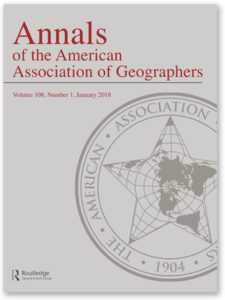
The most recent issue of the Annals of the AAG has been published online (Volume 110, Issue 1, January 2020) with 17 new research articles on contemporary geographic research. Topics in this issue include alpine treelines, offshore wind farms, visual storytelling, oak savannas, sustainable development, the spatial fix, transboundary commons, and cartographically visualizing tornadoes. Locational areas of interest include Israel and Palestine, New York City, the Sonoran Desert, Kenya, and Florida’s Lake Okeechobee. Authors are from a variety of research institutions including University of Georgia, University of Gothenburg, University of Chicago, and University of Illinois.
All AAG members have full online access to all issues of the Annals through the Members Only page. Each issue, the Editors choose one article to make freely available. In this issue you can read Assessing Social Vulnerability through a Local Lens: An Integrated Geovisual Approach by David S. Rickless, Xiaobai A. Yao, Brian Orland & Meredith Welch-Devine for free for the next two months.
Questions about the Annals? Contact annals [at] aag [dot] org.
In addition to the most recently published journal, read the latest issue of the other AAG journals online:

• Annals of the American Association of Geographers
• The Professional Geographer
• GeoHumanities
• The AAG Review of Books
Read the latest titles in geography and related disciplines as found on the New Books in Geography list. Some of these books will be reviewed in The AAG Review of Books. The editors of The AAG Review of Books are happy to receive suggestions for potential reviews and potential reviewers. Reviews are commissioned by the editors, based on the appropriateness and qualifications of the reviewer, observing the usual avoidances of conflict of interest. Persons wishing to volunteer their reviewing services should have the requisite qualifications and demonstrable prior knowledge and engagement with the subject area, preferably through publications. Please contact the editors at aagrb [at] lsu [dot] edu.
Browse the full list of new books.
ASSOCIATION NEWS
The American Association of Geographers congratulates the individuals and entities named to receive an AAG Award. The awardees represent outstanding contributions to and accomplishments in the geographic field. Formal recognition of the awardees will occur at the 2020 AAG Annual Meeting in Denver, CO during the AAG Awards Luncheon on Friday, April 10, 2020.
The AAG announces two new editors to the Annals of the American Association of Geographers – Kendra Strauss who will be taking over for Human Geography Editor Nik Heynen and Katie Meehan who will assume the role of Nature & Society Editor as James McCarthy’s term ends. The AAG would like to thank Nik Heynen and James McCarthy for their years of service while congratulating Kendra Strauss and Katie Meehan.

The AAG election will be conducted online again, and voting will take place January 8-30, 2020. Each member who has an email address on record with the AAG will receive a special email with a code that will allow them to sign in to our AAG SimplyVoting website and vote. It’s important to update your email address in your AAG account to ensure you receive the email ballot. The 2020 election slate is published online.

The 2019 Special Issue of the Annals of the American Association of Geographers has been published as an edited volume by Routledge Taylor and Francis. The volume, edited by Annals Nature & Society editor James McCarthy, is divided into six parts that explore the interconnections between the recent rise of authoritarian governments worldwide and government relations to the environment and environmental policy. Originally published in March 2019 as volume 109, issue 2 of the Annals, it can now be purchased online.
POLICY CORNER
Last month marked the four year anniversary of President Obama signing into law the Every Student Succeeds Act (ESSA). Replacing the No Child Left Behind Act of 2002, the ESSA overhauled the nation’s K-12 education system and required much compromise from lawmakers in order to improve the many shortcomings of the previous law. The final product was a bill that delegated a lot of power and decision-making back to the states. The ESSA defined the parameters and expectations under which states and their local education agencies (LEAs) could implement education processes that best fit their needs. Thanks to the hard work of the AAG and other stakeholders at that time, geography was specifically identified in several sections of the law including as a topic eligible for several grant programs and as a “core academic subject.”
Given the extensive effort that went into crafting the ESSA, another overhaul of the federal K-12 education structure will be unlikely in the near future. At present, Congress is more focused on putting forth a comprehensive reauthorization of the Higher Education Act and reforming the current system with a focus on college affordability. However, with the ESSA’s implementation well underway we are beginning to glean useful information from the policy’s results. As outlined in the law’s text, these results are collected by way of student assessments which serve as our strongest and most consistent indicator of success. The AAG hopes to engage further in utilizing these results to take a more critical look at improving K-12 geography education. In addition to the work currently being done within the National Center for Research in Geography Education (NCRGE), the AAG will encourage the proliferation of research using student assessment results and continue to serve as a leader in the K-12 geography education research space.
In the News:
RESOURCES AND OPPORTUNITIES

The AAG’s Geography Faculty Development Alliance (GFDA) will once again offer a valuable in-depth opportunity for early career professionals and department leaders in Geography to learn and engage during its annual workshops June 21-27, 2020, at the George Washington University in Washington, D.C. The shorter four-day workshop for department leaders (June 24-27) will overlap with the week-long conference for early career attendees providing a full career spectrum of exercises and activities.
Geographers may find the data archive from the Inter-university Consortium for Political and Social Research (ICPSR) of interest. ICPSR maintains an archive of more than 250,000 research data files in the social and behavioral sciences. It hosts specialized collections related to education, aging, criminal justice, substance abuse, arts, and more. The ninety-percent that are public-use data files can be accessed and downloaded from individual study home pages.
Learn more about this curated data source.
The Visiting Geographical Scientist Program (VGSP) sponsors visits by prominent geographers to small departments or institutions that do not have the resources to bring in well-known speakers. The purpose of this program is to stimulate interest in geography, targeted for students, faculty members, and administrative officers. Participating institutions select and make arrangements with the visiting geographer. A list of pre-approved speakers is available on the website. VGSP is funded by Gamma Theta Upsilon (GTU), the international honors society for geographers.
Learn more about the program and how to apply.
IN MEMORIAM

The AAG is saddened to hear of the death of Doug Amedeo, a professor emeritus of geography at the University of Nebraska – Lincoln. A prolific writer, Amedeo was a mainstay at the University of Nebraska – Lincoln since 1973, advising nearly 20 PhD students during his tenure. A veteran of the Korean War, he went on to earn a bachelor’s in economics and a master’s and doctorate in geography, focusing his research on environmental perception and behavioral geography.
The AAG is saddened to hear of the passing of several colleagues this past month with written tributes forthcoming.
FEATURED ARTICLES
You may be aware of a couple of facts about entrepreneurship already…
Collectively, these trends are concerning.
It’s difficult, but not impossible to picture a “missing generation” of businesses that were not created due to lower startup rates and the lack of accessibility to entrepreneurial resources for women and entrepreneurs of color… This is why the Entrepreneurship Research team at Kauffman is focused on answering questions based on real-world problems facing entrepreneurs and their communities.

A group of researchers from six American universities are studying what effect spatial education has on the development of the spatial thinking and reasoning skills of high school students. The research team wants to find out how the students, who use GIS technology for class projects, go about solving complex reasoning problems and whether their brains are physically changing in response to spatial learning.
GEOGRAPHERS IN THE NEWS
EVENTS CALENDAR
Among the familiar litany of New Year’s resolutions, many of you may have promised yourselves that 2020 would be the year to finally finish that book or write that article. In other words: to PUBLISH.
Publishing is a huge part of academic life, the coin of the realm. There may have been some mythical past when graduate students could obtain their PhD and land a decent academic job without having to publish a single thing. When tenure in research universities required just a few thoughtful articles or perhaps a book. And when those in predominantly teaching institutions could get by with producing something once or twice in a career.
Fast forward to our day. Rare is the PhD who lands a job without a CV listing several publications. And institutions of all stripes demand a quiver of accepted articles from their tenure=track hopefuls. It is not unusual to see professors within research universities generating several articles every single year, racking up Google Scholar hits and the citations to go with them. Some twitter posts look like “to-do” lists of publishing projects promised and completed. Working over weekends and holidays has become the norm.
This greater frenzy of publication is borne out by the magnificent growth in journal publications each year. The most recent figure showed some 2.5 million articles published in 28,000 journals. This is driven in part by an increase in articles per capita. The chart below shows the number of scientific publications for full professors at research universities in geography and area studies between 1996 and 2014. It shows that average article generation more than doubled, and this for a group with few worries about tenure and promotion.

All those would-be articles cycle through a publication system that has remained the same at its research core: authors who submit academic papers, other professors who kindly examine these submissions and provide comprehensive reviews, editors who orchestrate the whole process from beginning to end, and an audience of mostly academics ready to consume the scholarly output.
The truly dramatic changes have occurred in the larger publication universe. Two decades ago, there were many publishers such as Carfax, VH Winston, Pion, and Blackwell. In addition, there were still a number of independently published society journals. Many professors would take out personal subscriptions.
Today, most journal publishing has steadily consolidated into five or six big houses. The chart below shows the situation for all English-language journals. For just the social sciences, the top five publishers account for about 70 percent of all articles, compared to 15 percent in the early 1990s. These publishers sell journals to academic libraries as part of a package, but the costs of the packages can be stratospheric. Elsevier was recently embroiled in controversy because European libraries and the University of California felt that it charged far too much per article. Adding salt to these wounds is information that Elsevier makes about a 37 percent profit margin—selling back to academics content that these same academics have already produced. The other publishing houses employ the same basic model of selling to professors what the professors have already produced for free [full disclaimer, I am an editor for two journals published by Taylor & Francis].

Very little of the publishing profits—which can be staggering—dribbles down to the people who are the beating heart of the publication process. To be sure, publishing houses offer major benefits in production, allowing articles to be copy edited, proofread, typeset and put online in a matter of days. The ability of the average scholar to access thousands of titles—crisp and in full color—without ever having to leave her office is nothing short of phenomenal. Archives can be summoned with the click of a mouse. For those who can afford it, these companies expedite the smooth transmission of information. But by acting as consolidators and distributors, journal publishers position themselves to sell scientific knowledge provided to them for free.
Of these, the only person within the research circle who gets paid—maybe a few thousand dollars a year—is the editor, mainly to cover expenses. The authors sometimes have to pay to cover page charges, especially if they want their article to be freely available to the readership. (The promotion of open access, which journals have jumped all over, can be quite costly with fees in excess of $2000 per paper.) In all but rare occasions, the reviewers review for absolutely nothing (and in some disturbing situations will get junior colleagues and students to review in their name), and merit or promotion committees seldom bestow academic credit for this consuming labor.
Added to the morass has been the proliferation of so-called predatory journals. I am sure that every one of you has received a solicitation, perhaps several times a week, asking whether you want to publish in a journal with a fishy title (International Journal of Global Technology and Science Research anyone?). These journals come with all the trappings—submission guidelines and editorial boards—and they promise a lot: super-fast review (within days!) and sometimes offers to write the paper for you. Yet the fees are onerous and the articles themselves rarely get circulated. With so many legitimate journals out there encouraging open access fees, and the pressure to publish, it is little wonder that such journals are seen as viable options.
Of course, there are a host of ethical issues that involve societies like the American Association of Geographers. We have been able to negotiate some lucrative contracts with our publisher, Taylor & Francis, which pay many of our bills. But this also perpetuates the high prices academic institutions are charged for subscriptions, and can put scientific knowledge out of reach for people without access.
So given the fact that journal publishing is not only here to stay but proliferating, how do we make the process better? Some journals have chosen to avoid the big presses: Acme, Focus, and Fennia to name three. Especially if tenure committees can come unshackled from the need for metrics, such publications provide a place for solid and alternative scholarship.
We can also devise better ways to validate the process of peer review. As an editor, I badger experts in various topics to take several hours of their time to provide a critical service to an anonymous someone. There is no monetary compensation for this, nor does it make a mark on most CVs. Yet at least half say yes, and many of the others apologize and promise to review at a different time. The entire edifice of scholarly publishing would crash without peer reviewers, yet they are often as taken-for-granted as wall studs. It would be nice if there was also a way to reward peer reviewers in some fashion and perhaps the whole process might be revamped.
The paradox of publishing is threefold. We require graduate students and professors to publish in academic journals if they hope to advance. Yet authors and peer reviewers work for free and journal editors for very little, while article fees increase and publishing houses accrue the profits. Academic societies such as the AAG rely on contracts with journal publishers to secure some of these profits, essentially benefitting from the free labor of their members.
To abandon the system would mean altering the rewards intrinsic to academia and forgoing the revenues now vital to scholarly associations. But the University of California’s termination of their contract with Elsevier earlier this year demonstrates that this system may not be sustainable in the long term. We all have a stake in the outcome. I hope that geographers will lead the way in developing a fairer and more reasonable model for journal publishing.
— Dave Kaplan
AAG President
DOI: 10.14433/2017.0066
David Schwarz (1936-2019) was a professor of geography at San Jose State University. He passed away in Gilroy, CA, aged 82, after a long struggle with Parkinson’s disease.
William L. Graf one of the nation’s leading geomorphologists and riverine policy scholars passed away on December 27, 2019 at the age of 72. At the time of his death, he was working on a book length manuscript on American Rivers using multiple lenses—arts, history, science, engineering, public policy, and philosophy.
Graf was a Foundation University Professor Emeritus at the University of South Carolina. Before coming to the University of South Carolina in 2001, he was the Regents’ Professor at Arizona State University. Graf received his Ph.D. from the University of Wisconsin in 1974 with his first academic appointment at the University of Iowa after a brief stint as an intelligence officer in the U.S. Air Force.
Dr. Graf published 14 books, his most notable are Fluvial Processes in Dryland Rivers, Wilderness Preservation and Sagebrush Rebellions, Plutonium and the Rio Grande (which won the Kirk Bryan Award from the Geological Society of America), and Dam Removal: Science and Decision Making. Among his more than 150 publications are his seminal articles on the hydrologic and geomorphic effects of hydroelectric dams on American rivers (“Dam nation: A geographic census of American dams and their large-scale hydrologic impacts” in Water Resources Research (1999) and “Downstream hydrologic and geomorphic effects of large dams on American rivers” appearing in Geomorphology (2006)).
Dr. Graf received numerous awards throughout his distinguished career from the AAG (G.K. Gilbert Award, Research Honors, Meredith F. Burrill Award, Mel Marcus Career Achievement Award, Water Resources Distinguished Career Award), the Geological Society of America (Kirk Bryan Award), and the British Geomorphological Research Group (David Linton Research Award). He also received the Founder’s Metal of the Royal Geographical Society of Great Britain, the John Wesley Powell Award from the U.S. Geological Survey, and the U.S. Army Outstanding Civilian Service Medal for his contributions to the U.S. Army Corps of Engineers. This was in addition to his receipt of the National Associate award from the National Academy of Sciences and his election as a fellow of the American Association for the Advancement of Science (AAAS).
Equally impressive is Dr. Graf’s service record to the AAG and the Geological Society of America’s, Quaternary Geology and Geomorphology Division. For the former he served as Vice-President and President, a Council member, and on numerous committees. For the GSA he was also Vice-President and President as well as serving on additional committees. During his career, Graf served as an associate editor for the Annals, PG, GSA Bulletin, and Environmental and Engineering Geosciences.
Throughout his distinguished career, Dr. Graf never lost sight of his intellectual home in Geography. He supervised 38 PhD and master’s students and served on many more graduate committees. While trained in physical geography with a minor in water resources management, Graf’s perspective and interest in the intersection of science and policy for public land and water made him one of the country’s most sought after science advisors and expert witness in resolving conflicts between environmental preservation and economic development, and the interaction between science and natural resources decision-making. Most of these policy consultations engaged his expertise on human impacts on river morphology, processes of contaminant transport and storage in river sediments, downstream impacts of large dams, and riparian habitat changes in rivers. He advised local, state, and federal agencies (including the Bureau of Reclamation, U.S. Army Corps of Engineers, Department of Energy, and the National Park Service), as well as non-profits. He served as a consultant and expert witness in 30 legal cases on wetland and river processes and the effects of hydroelectric dams on downstream rivers. President Clinton appointed him to the Presidential Commission on American Heritage Rivers, and Secretary of Defense Chuck Hagel confirmed him as Chair of the Environmental Advisory Board of the U.S. Army Corps of Engineers.
Dr. Graf felt that professional service to the non-governmental entities such as the Heinz Center and the National Academies of Sciences, Engineering, and Medicine was critical in fostering the intersection between science and public policy. Not only was he a member of many different Boards but also standing committees including chairing the Geographical Sciences Committee, four committees overseeing science for the restoration of Florida Everglades, the committee on sediment issues in the Missouri River. His longstanding advocacy for geographical science to support public policy decision making on rivers and land management have left their mark and opened doors for other geographers to carry his prospective forward.
While his core was geography, the discipline never bounded his identity and scholarship. His willingness to seek knowledge, ideas, and approaches and integrate these into his study of rivers, public lands, and policy has enriched our discipline in a myriad of ways both large and small. Dr. Graf was among the staunchest supporters of geography and never shied away from his identification as a geographer, especially in his public policy and advocacy work. He was the leading light of his generation of geographical scholars and the consummate professional. We will miss his wise counsel, his sense of humor, and most of all his all-encompassing selfless spirit and encouragement to press on.
—Members of the University of South Carolina Geography Department
The Inter-university Consortium for Political and Social Research (ICPSR) is an international, member-based association of more than 780 academic institutions and research organizations. ICPSR maintains an archive of more than 250,000 research data files in the social and behavioral sciences. It hosts specialized collections related to education, aging, criminal justice, substance abuse, arts, and more. ICPSR members include academic, nonprofit, government, and commercial organizations. Members have full access to ICPSR’s data archive and other scholarly services. ICPSR’s website contains a list of member institutions, as well as information about how organizations can join ICPSR (1).
Geographers may find ICPSR’s data archive of interest. Its data resources often contain spatial information, opening the potential for mapping, geocoding, and spatial analysis. About ten percent of the ICPSR collection is restricted to protect data confidentiality. The ninety-percent that are public-use data files can be accessed and downloaded from individual study home pages. Restricted data files can be accessed by researchers using ICPSR’s virtual data enclave (VDE) system or other safe computing environments.
ICPSR offers a geospatial VDE infrastructure with geospatial tools to facilitate spatial data analysis and discovery. This geospatial VDE is supported by current and prior NSF-funded collaborations between ICPSR and AAG (2). In addition, ICPSR is developing infrastructure for depositing geographic data and tools that facilitate spatial data analysis and discovery. ICPSR encourages geography researchers to use these services, deposit their own data, and in doing so, collaboratively build a spatial data infrastructure for interdisciplinary studies.
Five ways to find Geography-related data in ICPSR’s archive
There are many ways to find data that are of interest to geography researchers. Start your search at ICPSR’s online study catalog and refine your search using the five approaches below.

First, users can refine their searches by typing geography-related keywords. The geography search filter is controlled by a curated list of place names (3) and allows users to type a place name such as “Pittsburgh,” (4) which will return over 2,000 studies related to the city. By clicking on a study title, such as “Examination of Crime Guns and Homicide in Pittsburgh, Pennsylvania, 1987-1998” (study number 2895), users can find more details about the study, its associated data files, and descriptive metadata, as shown in Figure 1. This particular study is for public use and users can download the study data in formats that include shapefiles, Stata, SPSS, SAS, and more.
Second, the subject terms filter provides a way to narrow search results. For example, one of the studies available by filtering with the term “transportation” is the study titled “Historical Transportation of Navigable Rivers, Canals, and Railroads in the United States” (5) (study number 36353). This study contains GIS materials covering the spread of different modes of transportation in the lower 48 states from America’s founding to 1911. Geographers may be interested in the spatial patterns contained in this study that describe historical transportation networks.
Third, users can search by geography-related concepts. Searching for “land cover,” for example, returns more than 3,900 studies, as shown in Figure 2. One of the top results is the “National Neighborhood Data Archive (NaNDA): Land Use and Land Cover by Census Tract, United States, 2001-2016,” which contains measures of land cover (e.g., low-, medium-, or high-density development, forest, wetland, open water) derived from the National Land Cover Database (NLCD). These data are aggregated by U.S. census tract.

Fourth, the data type filter (on the left side of the page in Figure 2) allows users to narrow search results to GIS formats. The study titled “Exploratory Spatial Data Approach to Identify the Context of Unemployment-Crime Linkages in Virginia, 1995-2000” (study number 4546) contains ESRI shapefiles that can be used for mapping and spatial analysis.
Finally, users can narrow their search by exploring individual topical archives. The study in Figure 1, for example, is part of ICPSR’s National Archive of Criminal Justice Data (NACJD) (6). NACJD is a grouping of studies that relate to criminal justice and many associated data files contain geographic information. A list of topical archives is available on the ICPSR website.
The five methods above are good ways to refine your search for data in ICPSR’s study archive. In the results page, users can further refine their search by time period, data collection method, release date, and other filters (see filters on the left side in Figure 2).
To track the thousands of works that build on the data from ICPSR’s archive, a “Bibliography of Data-related Literature” is continuously updated. Listed works include journal articles, books, book chapters, government and agency reports, working papers, dissertations, conference papers, meeting presentations, unpublished manuscripts, magazine and newspaper articles, and audiovisual materials.
Other scholarly services at ICPSR
ICPSR provides leadership and training for the social science research community in data access, curation, and methods of research data analysis. ICPSR advances and expands social and behavioral research, acting as a global leader in data stewardship, while providing rich data resources and responsive educational opportunities for present and future generations.
In addition, ICPSR stores, curates, and provides access to scientific data so others can reuse it and validate research findings. Curation, from the Latin “to care,” is the process ICPSR uses to add value to data, maximize access, and ensure long-term data preservation. ICPSR provides guidance to members about managing their data responsibly and ethically to support transparent and reproducible research.
Since 1963, ICPSR has offered the ICPSR Summer Program as a complement to its data services, and members receive discounted tuition rates for these courses. This program provides rigorous, hands-on training in statistical techniques, research methodologies, and data analysis. Courses such as “Regression Analysis for Spatial Data” and “Spatial Econometrics” are specifically designed for spatial studies in the social sciences. The AAG is now also exploring new offerings with ICPSR to deliver courses about geographic research methods and best practices to allow scholars to leverage geospatial information in ICPSR’s collections.
References:
(1)https://www.icpsr.umich.edu/icpsrweb/membership/administration/institutions
(2)https://www.nsf.gov/awardsearch/showAward?AWD_ID=1832465&HistoricalAwards=false and https://www.nsf.gov/awardsearch/showAward?AWD_ID=1244691&HistoricalAwards=false
(3)https://www.icpsr.umich.edu/icpsrweb/ICPSR/browse/facet/studies/geographies
(4)https://www.icpsr.umich.edu/icpsrweb/ICPSR/search/studies?q=Pittsburgh
(5)https://www.icpsr.umich.edu/icpsrweb/ICPSR/studies/36353
(6)https://www.icpsr.umich.edu/icpsrweb/NACJD/discover-data.jsp
The career of feminist development geographer Sylvia Chant was cut short on December 18, 2019 at age 60, when she died of pancreatic cancer. As reported in her obituary in The Guardian,during her career, Chant challenged the received notion that households headed by women in developing countries were automatically more likely to live in poverty than those headed by men. Chant argued that multiple household responsibilities and obligations in relation to men were the greater challenge to women’s lives and success.
Her books include Women-headed Households(1997) and Gender, Generation and Poverty(2007). Writing of her in The Guardian, colleague Cathy McIlwaine described Chant as “keen to work with other researchers[. S]he co-authored and edited 11 of her 18 books, including four that we wrote together, of which the most recent was Cities, Slums and Gender in the Global South (2016). She edited the International Handbook of Gender and Poverty (2010), whose more than 100 chapters came from 125 established and early career authors.
As a professor at the London School of Economics, Chant was known as an inspiring and generous teacher, who influenced many PhD students to work on gender and international development around the world.
Her ideas around women-headed households and wider gender inequalities helped shape the policies of international agencies such as the Commonwealth Secretariat, UN-Habitat, the International Labour Organization, UN Women, and the World Bank. Her work with the Gambia Committee on Traditional Practices Affecting the Health of Women and Children contributed to the country’s final outlawing of female genital mutilation in 2015.
Born in Dundee, Chant grew up in London and earned a geography degree from King’s College, Cambridge in 1981. She attained her PhD at University College London in 1984, studying the role of women in the construction of housing in Querétaro, Mexico. McIlwaine noted, “This was among the first studies that recognised women as key actors in self-build housing in poor urban communities in countries of the global south.”
She is survived by her husband Chris Mogridge, her mother, June, and two sisters, Adrienne and Yvonne.
The AAG welcomes two new editors to take the positions of the Human Geography and Nature & Society editorships for the Annals of the American Association of Geographers. Kendra Strauss of Simon Fraser University will be taking over for Human Geography Editor Nik Heynen while Katie Meehan of King’s College London will assume the role of the Nature & Society Editor as James McCarthy’s term ends. The AAG sincerely thanks Nik Heynen and James McCarthy for their four years of exemplary service in these positions.
Kendra Strauss is both an Associate Professor and Director of the Labour Studies Program and The SFU Morgan Centre for Labour Research as well as an Associate Member of the Department of Geography at Simon Fraser University. Before taking on her current position, Strauss was an Urban Studies Postdoctoral Fellow at the University of Glasgow and then held a permanent lectureship in the Department of Geography at the University of Cambridge from 2012 to 2014. Her focus as a geographer and feminist political economist revolves around labor politics, the definition of work, the regulation of labor markets, and geographical imaginations of environmental change. Strauss brings to the Annals a background in editing as the co-editor of two books, Precarious Worlds: Contested Geographies of Social Reproduction and Temporary work, agencies, and unfree labour: Insecurity in the new world of work. She has also served on the editorial boards of six journals in geography, labor studies, and political economy.
A human-environment geographer and water policy specialist by training, Katie Meehan is Senior Lecturer in Human Geography at King’s College London and the lead PI of the Plumbing Poverty project. Prior to King’s, she was Assistant and then Associate Professor in the Department of Geography at the University of Oregon, from 2010 to 2019. Her expertise includes urban political ecology, infrastructure and social inequality, water insecurity and development, science and technology studies, climate change adaptation, and the politics of environmental knowledge at the science-policy interface. Meehan is a mixed methodologist, combining data from diverse sources such as ethnography, household surveys, Q method, and census data. Her research has appeared in journals such as Annals of the American Association of Geographers, Science, Geoforum, Environment and Planning D, Water International, Environmental Science and Policy, and WIREs Climate Change. Meehan is on the leadership team of the NSF-sponsored Household Water Insecurity Experiences Network.
The AAG would like to express its appreciation for the work of Nik Heynen as the past Human Geography Editor for the Annals. Heynen, a Professor in the Department of Geography at the University of Georgia, contributed his valuable experience as past Editor of Antipode and founding editor of the Geographies of Justice and Social Transformation Book Series to the AAG, ensuring the Annals remained a journal held in high regard by the Geography community.
A sincere thank you to James McCarthy as he leaves his post as the Nature & Society Editor for the Annals. A Professor of Geography at Clark University, McCarthy edited the most recent Special Issue of the Annals on Environmental Governance in a Populist/Authoritarian Era, which is now available as a stand-alone edited volume from Routledge. As the Nature & Society Editor since January 2016, McCarthy’s dedication has continued the tradition of publishing research of high quality and rigor expected from the AAG.
Strauss and Meehan will begin their service in these roles on January 1, 2020.
The American Association of Geographers congratulates the individuals and entities named to receive an AAG Award. The awardees represent outstanding contributions to and accomplishments in the geographic field. Formal recognition of the awardees will occur at the 2020 AAG Annual Meeting in Denver, CO during the AAG Awards Luncheon on Friday, April 10, 2020.
2020 Susan Hardwick Excellence in Mentoring Award
The AAG bestows an annual award recognizing an individual geographer, group, or department, who demonstrates extraordinary leadership in building supportive academic and professional environments and in guiding the academic or professional growth of their students and junior colleagues. The late Susan Hardwick was the inaugural Excellence in Mentoring awardee. The Award was renamed in her honor and memory, soon after her passing.
Jeffery Roth, Stephen F. Austin State University
The AAG Enhancing Diversity Committee, and the Committee on the Status of Women in Geography have selected Dr. Jeffery Roth of Stephen F. Austin State University to receive the 2020 AAG Susan Hardwick Excellence in Mentoring Award.
Dr. Roth’s nomination materials speak to his excellent mentoring abilities in advising students from a variety of backgrounds and his commitment to supporting students both professionally and personally. He truly embodies the exemplary legacy of the late Susan Hardwick. Dr. Roth has served as Geography Club advisor, he continues to create lifelong learners, has received teaching awards, and actively participates, and encourages students to participate in community activities. It is clear that Dr. Roth has shaped the lives of faculty, students, and members of the community in remarkable ways.
The AAG is proud and pleased to present the 2020 AAG Susan Hardwick Excellence in Mentoring Award to Dr. Jeffery Roth.
2020 Enhancing Diversity Award
The AAG Enhancing Diversity Award honors those geographers who have pioneered efforts toward, or actively participate in efforts towards encouraging a more diverse discipline.
Demetrice Jordan, Michigan State University
Demetrice (Dee) Jordan, has been a true change agent for diversity in our discipline.
Among Ms. Jordan’s many notable accomplishments, she founded and co-leads the Michigan State University Geography Department’s graduate student diversity recruitment initiative “Advancing Geography through Diversity,” which actively recruits and increases application submissions and acceptance among underrepresented minorities. Dee is a tireless mentor and advocate for creating an institutional climate that encourages the development of under-represented minorities as leaders in our discipline.
Ms. Jordan was named MSU’s 2018 Excellence in Diversity, Individual Emerging Progress recipient, as well as the 2018 Black Faculty, Staff and Administrators Association’s Graduate Student Emerging Leader recipient, becoming the first Geographer at MSU to hold these honors.
The AAG is proud and pleased to award Ms. Demetrice Jordan its 2020 AAG Enhancing Diversity Award.
2020 AAG Stanley Brunn Award for Creativity in Geography
The AAG Stanley Brunn Award for Creativity in Geography is given annually to an individual geographer or team of geographers that has demonstrated originality, creativity and significant intellectual breakthroughs in geography. The award includes a prize of $1,000.
2020 AAG Stanley Brunn Award for Creativity in Geography
The AAG Stanley Brunn Award for Creativity in Geography is given annually to an individual geographer or team of geographers that has demonstrated originality, creativity and significant intellectual breakthroughs in geography. The award includes a prize of $1,000.
Brian J. L. Berry, Lloyd Viel Berkner Regental Professor and Dean of the School of Economic, Political and Policy Sciences at The University of Texas at Dallas
Professor Berry is one of the most influential figures in the disciplines of geography, urban studies, and regional planning. Berry’s early urban and regional research helped spark the quantitative revolution that occurred in geography and urban research in the early 1960s, making him the world’s most frequently cited geographer for more than 25 years. Throughout Professor Berry’s distinguished career he has successfully bridged theory and practice and has been heavily involved in urban and regional planning in both developed and developing countries.
In addition, the AAG recognizes Dr. Berry’s service to the discipline, including as AAG President (1978-1979) and as dean of the former University of Texas at Dallas School of Social Sciences, transforming it during a period of rapid growth into the (now) School of Economic, Political and Policy Sciences. Professor Berry’s over 500 books and countless significant awards speak volumes on the impact of his research in geography, and its recognition in other scientific fields.
2020 AAG Honorary Geographer
The AAG annually selects an individual as the year’s Honorary Geographer. The award recognizes excellence in research, teaching, or writing on geographic topics by non-geographers. Past recipients include Stephen Jay Gould, Jeffrey Sachs, Paul Krugman, Barry Lopez, Saskia Sassen and Maya Lin.
Kathryn Dwyer Sullivan, geologist, former NASA astronaut, NOAA Scientist, and 2017 Charles A. Lindbergh Chair of Aerospace History
The AAG Executive Committee recognizes Kathryn Sullivan’s distinguished career, including being the first American woman to walk in space, serving as Under Secretary of Commerce for Oceans and Atmosphere, and as a NOAA Administrator. The direction in which Sullivan steered Administration and NOAA priority work in the areas of weather and water services, climate science, integrated mapping services and Earth-observing capabilities is immediately recognized and welcomed by geographers. Sullivan also led NOAA with regard to satellites, space weather, water, and ocean observations and forecasts to best serve American communities and businesses. As a woman scientist and role model, Kathryn Sullivan mirrors many of the values the AAG also actively pursues in our discipline and our association.
2020 AAG Harold M. Rose Award for Anti-Racism Research and Practice
The Rose Award was created to honor Harold M. Rose, who was a pioneer in conducting research on the condition faced by African Americans. The award honors geographers who have a demonstrated record of this type of research and active contributions to society, and is awarded to individuals who have served to advance the discipline through their research, and who have also had an impact on anti-racist practice.
Dr. Audrey Kobayashi, Queen’s University
Dr. Kobayashi exemplifies the ideals of the AAG Harold Rose Award, with a decades-long commitment to anti-racist research that has reshaped the discipline with impact far beyond university walls. In terms of research, Kobayashi has published on anti-racist practice in top field journals and in her Presidential addresses to the AAG “The Idea of Race in Geography,” and to CAG “What’s Race Got to Do with it? The Geography of Racialization in Canada.”
Kobayashi’s writing is frequently taught in graduate courses, thus impacting the next generation of geographers in the project of building an anti-racist geography. She is an impressive model of anti-racist praxis, from her work advocating for employment equity in Canada to her involvement authoring commissioned reports on anti-racist practice, to her mentoring of early career underrepresented scholars and efforts to consult with university administrators. We will end with the words of one of the letters of support, “Rose’s effort to confront the “Geography of Despair” remains unfinished. However, as exemplified by the steadfast work of scholar-activists such as Professor Kobayashi, this work continues.
The 2020 Marble-Boyle Undergraduate Achievement Award in Geographic Science
The Marble-Boyle Undergraduate Achievement Award recognizes excellence in academic performance by undergraduate students from the U.S. and Canada who are putting forth a strong effort to bridge geographic science and computer science as well as to encourage other students to embark upon similar programs. The award is an activity of the Marble Fund for Geographic Science of the AAG.
Jacob Bostick, University of Colorado – Colorado Springs
Nathan Fiscus, University of North Alabama
Chelsie Perkins, East Tennessee State University
2020 Community College Travel Grants
Provides financial support for students from community colleges, junior colleges, city colleges, or two-year educational institutions to attend the Annual Meeting.
Martha (Kennedy) Masanzi, Santa Barbara City College
Ozer Ozturk, Lone Star College
Brenna Strawn, Lone Star College
Stuart Watts, Montgomery College