

Why is our Geography Curriculum so White?
Many of us teach courses that are shaped by anti-colonial and antiracist scholarship. We include readings and topics in our classes that provide our students with frameworks for better understanding issues of inequality. We have compelling ‘how-to’ stories of what it means to incorporate race, ethnicity and anti-colonial perspectives into our classrooms.[1] We have monographs, edited collections, special issues, and a lengthy list of pertinent journal articles that explicitly and implicitly interrogate the social construction of race, black geographies, and anti-colonial struggles.[2] But I would argue that still, with all of this, for the most part, we are writing, teaching, and recreating white geographies: by ‘we’ I mean almost all of us (including me); by ‘white’ I mean ways of seeing, understanding, and interrogating the world that are based on racialized and colonial assumptions that are unremarked, normalized, and perpetuated.

I understand that what I am saying is provocative. According to the Merriam Webster online dictionary, to provoke is, “to cause the occurrence of (a feeling or action): to make (something) happen,” and that is indeed what I hope this column will do. I want to raise the question of the whiteness of geography’s curriculum as part of the larger picture of geography’s whiteness, and to ask what we (as individuals, as geographers, as departments, as the AAG) have done about it and what we can do. As Audrey Kobayashi and Linda Peake noted 15 years ago, “no understanding of geography is complete, no understanding of place and landscape comprehensive, without recognizing that . . . geography, both as discipline and spatial expression . . . is racialized.”[3] I’m suggesting that we are still working with an incomplete and non-comprehensive understanding of geography, and I’m hoping to provoke us to change that.
I’ve borrowed the title of this column from an initiative based at University College London [4] that struck a deep chord with me for many reasons. First, we all know that demographically speaking geography is indeed a very white discipline,[5] and changing that fact – despite the whole-hearted and resourced efforts on the part of many folks through many years – has proven quite difficult.[6] As one of our AAG councillors noted at our recent meeting, there are many interlocking pieces that need to be addressed and it’s difficult to know where and how to intervene. But rethinking what we teach – an important piece of that puzzle – seems a very tangible and do-able thing; in fact, if we consider ourselves any good at all as teachers, this rethinking is something we do all the time. Second, the provocation of calling a curriculum ‘white’ works to shake up our notion of the purported objectivity of the scholarship we make and teach, of the unremarked and therefore normalizing assumptions built into our syllabi, and at least for me, serves to question how I’ve conceptualized my courses including my choice of topics and readings. And third, the timing is right; we now have a considerable body of scholarly literature within geography to draw on (in addition to literature in related fields), and, equally important, the energy and commitment to do the work from key parts of our discipline – from graduate students through academic leaders.
I’m certainly not the first person, of course, to raise this important issue. Drawing on an already active movement, the AAG diversity task force recommended in its 2006 report that “departments should review their curricula to determine the degree of commitment to diversity and, if necessary, create courses that make the curricula more relevant to today’s racially diverse society. Courses that address certain areas may be needed, for example:
- Race and space in the maintenance of structures of domination, subordination, and inequality
- Intersectionality and space (i.e. the intersection of race, class, gender, sexuality)
- The ideology of white supremacy and the use of space to maintain it
- The spatialities of white privilege
- Racial residential segregation and racial inequality: the causes and consequences
- The ghetto, barrio and ethnic enclave: their origin, persistence, and consequences
- The racialization of immigrants of color
- Environmental racism
- Critical race theory
- Space-and race-based public policies
- Race, concentrated poverty and economic restructuring”[7]
Following through on this recommendation, in conjunction with the others made in this important report, is vital to addressing the whiteness of geography and its curriculum. But since 2006, our departments and universities have faced severe financial and organizational challenges concomitant with the global recession and the increasing neoliberalization of academic life. As I’ve noted in previous columns, the pressures on us as teachers, scholars and mentors are often immense; academic success is counted in numbers of publications, not numbers of students that we’ve challenged.
And so we need help. We can start by sharing syllabi, readings, bibliographies, topics, relevant media, etc. But this alone won’t lead to change; we need assistance in learning to recognize our ‘white’ assumptions, and we need training in how to take those new understandings into the classroom. It’s been clear to me for a while that teaching/mentoring is by far the most political act – in the sense of enacting social change – that I can ever hope to accomplish. I will be able to accomplish more with a less ‘white’ geography curriculum. How should we proceed? I’m looking forward to hearing your responses.








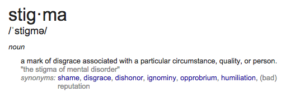
 If one googles the word ‘stigma’ the definition that appears first on your screen (“a mark of disgrace associated with a particular circumstance, quality, or person”) is followed, as most definitions are, by a phrase showing how that word is commonly used; in this case the phrase that google uses is “the stigma of mental disorder.” I know that I shouldn’t be surprised by this, particularly given the recent publicity about Robin Williams and his secret battles with depression, but I was. I had assumed (obviously incorrectly) that in popular parlance a mental disorder was no longer considered a character flaw or mark of disgrace, but rather an illness that afflicts certain people and families and that is treated (like any illness) therapeutically. I have had several bouts of depression that have left me drained and feeling vulnerable, and anxiety is something I’ve come to live with but only after years of therapy and different forms of treatment. I haven’t felt ashamed of this, but then again I don’t make a habit of talking about my illness or mental health in general. But prompted by some wonderful colleagues who are proposing a new AAG committee on mental health in the discipline, that’s exactly what I want to do in this column.
 For many of us October represents the midpoint of fall term when one can literally feel the anxiety level within our classrooms and hallways begin to rise. According to the American College Health Association’s 2013 survey
 In my case, it was only after I left graduate school that my mental health became a concern. Unmoored from the networks of friends and colleagues from graduate school and living through the constant insecurities of one-year positions, my taken-for-granted coping strategies disintegrated and eventually disappeared, leaving me in a very dark world of despair. It literally was a struggle each day to make it through my classes and meetings without breaking down into tears, while at home I found it impossible to sleep (thus further deteriorating my mental health). I of course told no one, exacerbating my feelings of loneliness and estrangement and plunging me deeper into depression. Apparently my story is a fairly common one; a
  It was a pleasure to open our Spring 2014 AAG council meeting by welcoming our new and first graduate student representative to the table. The council had agreed last year to support the idea of a graduate student representative to council; after all, graduate students comprise around 40% of the AAG membership and so having someone on our governing council that represents their interests seemed a no-brainer. And indeed even in the first few hours (yes, to those uninitiated, council meetings go on, literally, for days!) we began to realize the importance of having the voice of graduate students heard within the not-so-hallow halls of the AAG. The representative raised the important issue of AAG funding for dissertation research, querying our policy of limiting awards to $500; by the end of the meeting, we had agreed to raise that amount to $1000 for a three-year trial period, good news all around. In this column I want to highlight the crucial role that graduate students play in our association, discuss the important academic labor they perform in our departments, universities and discipline, and raise the question of how best to recognize and support that work.
 It was within this context of students struggling to attain more of a voice in the running of academic institutions, particularly around issues of academic labor, that the Graduate Student Affinity Group (GSAG) of the AAG was formed in the late 1990s. According to the co-founders, geography graduate students working to unionize at their own institutions began to realize that having a platform for voicing their concerns within the AAG was an important step in recognizing and confronting graduate student issues; forming an affinity group seemed the logical move. Two graduate students from the University of Washington filed the papers to form