Newsletter – June 2021
PRESIDENT’S COLUMN
On Teaching, Time Management, Mentoring, and Service
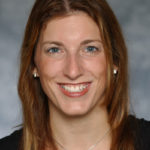
By Amy Lobben
 With summer almost here, I’m about to head into my last year as an academic. I’m “retiring” June 2022, although in truth I’ll work full time running my family’s winery and nonprofit, both built around the mission of providing training, jobs, and community for those with disabilities. As I transition from academics, Andrew and I are encountering many things we didn’t know were part of running a small business. This transition has prompted me to reflect on my transition from student to faculty member and, in turn, on how we prepare our graduate students for major life and career transitions.
FROM THE MERIDIAN
Perspectives: A New Column in the AAG Newsletter
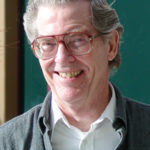
By Gary Langham
 In May, we introduced a new column to the AAG Newsletter called Perspectives, replacing AAG’s former Op-Ed feature. Perspectives will share the opinions and ideas of members on issues of relevance to geography. We encourage submissions that stimulate dialogue, get members thinking, and challenge our discipline to take new approaches to the social, political, and environmental issues confronting geographers and the public.
ANNUAL MEETING
New York City to host 2022 AAG Annual Meeting
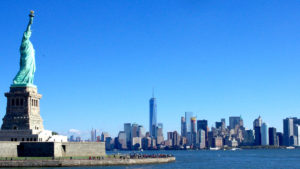
Mark your calendar for the AAG Annual Meeting in the Big Apple, February 25 – March 1, 2022. The hybrid meeting will take place both online and at the NY Hilton Midtown and the Sheraton New York Times Square Hotel. Registration and the call for papers for #AAG2022 will be announced this summer and we invite you to organize and participate in sessions, workshops, field trips, special events, and activities. We look forward to seeing you in New York City!
PUBLICATIONS
NEW Annals Alert: Articles with topics ranging from the 2016 U.S. presidential election to meteorological data in the Antarctic

The most recent issue of the Annals of the AAG has been published online (Volume 111, Issue 4) with 17 new articles on contemporary geographic research plus one commentary on social vulnerability models and a related response. Topics in this issue include location spoofing at Standing Rock; biodiversity and coffee plantations; postremoval of Mexican deportees; WWII geographies; geography’s involvement with the military; the Teachers Teaching Teachers GIS Institute; Dollar Stores; and distance in geographical analysis. Locational areas of interest include Cambodia; Bangladesh; Ecuador; the North Antarctic Peninsula; and Jakarta. Authors are from a variety of research institutions including University of Colombo; University of Texas – Austin; University College Dublin; and Central China Normal University.
All AAG members have full online access to all issues of the Annals through the Members Only page. Each issue, the Editors choose one article to make freely available. In this issue you can read On Geography and War: New Perspectives on the Ardennes Campaigns of 1940 and 1944 by Stephan Harrison and David G. Passmore for free for the next two months.
Questions about the Annals? Contact annals [at] aag [dot] org.
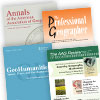 In addition to the most recently published journal, read the latest issue of the other AAG journals online:
• Annals of the American Association of Geographers
• The Professional Geographer
• GeoHumanities
• The AAG Review of Books
ASSOCIATION NEWS
Get a Glimpse of AAG’s New Website
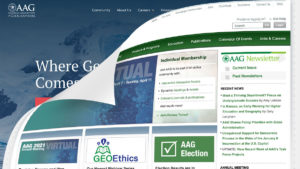 During our virtual annual meeting, we gave a sneak peek of our new website currently in the design process. If you missed the session or weren’t able to attend the conference, you still have a chance to see the recording. Our website agency, Free Range, revealed some of the exciting changes in store for this completely accessible, innovative, and mobile friendly website launching later this spring. Please send us your questions and thoughts at feedback [at] aag [dot] org. We’d love to hear from you! View the recording.
We are also looking for some fresh taglines to appear on the new AAG website when it launches this summer! What does AAG mean to you in a few words? Submit your suggestion here.
Prepare to Nominate Colleagues for AAG Honors
 Please consider nominating outstanding colleagues for the AAG Honors, the highest awards offered by the American Association of Geographers. Individual AAG members, specialty groups, affinity groups, departments, and other interested parties are encouraged to nominate outstanding colleagues. Deadlines for nominations will be later this year – on September 15th. The new nomination portal will be open for nominations starting later this summer.
More information about AAG Honors
Symposium on COVID-19’s Impacts
On June 22-25, AAG will co-sponsor a symposium on COVID-19’s second-order impacts on cities throughout the world. Register to find out more about the Cities’ COVID Mitigation Mapping (C2M2) program, a program of the Office of the Geographer and Global Issues at the U.S. Department of State through its MapGive open mapping initiative. Join C2M2, AAG, and Harvard University’s Center for Geographic Analysis to hear from experts at the forefront of monitoring the pandemic, producing critical data on local economies, and providing an understanding of critical needs for societies to adapt to the conditions imposed by pandemic strategies, seen through the lenses of migration, livelihoods, and gender. Registration is now open. This symposium is free and open to the public. Find out more and reserve your place here.
For more information about the Cities’ COVID Mitigation Mapping (C2M2) program, please go to mapgive.state.gov/c2m2. To RSVP to the June 22-25 Symposium, visit this link.
Open Plenaries during this Week’s AAG GFDA Workshops
The AAG is pleased to announce the return of the Geography Faculty Development Alliance (GFDA) Department Leadership workshop this week. Two of the virtual plenary sessions will be FREE to all interested parties.
Thursday, June 3 from 2:30-3:45pm ET the Women in leadership in geography panel will include perspectives from Kavita Pandit, Georgia State University; Marilyn Raphael, University of California Los Angeles; Joanna Regulska, University of California Davis; and Emily Ting Yeh, University of Colorado at Boulder and AAG President. Register here.
Saturday, June 5 from 1:00-2:15pm ET the Visioning and leading for an inclusive future panel invites contributions from Jacqueline Housel, Sinclair Community College; Adriana Martinez, Southern Illinois-Edwardsville; Rashad Shabazz, Arizona State University; Shaowen Wang, University of Illinois Champaign-Urbana; and moderated by Gary Langham, Executive Director of AAG. Register here.
POLICY CORNER
Pennsylvania State Bill Threatens Geographers’ Work

A bill is moving through the Pennsylvania General Assembly that threatens work opportunities for geospatial professionals in the state, and has been described by others in the geospatial community as a “solution without a problem.” HB609 attempts to provide further definitions for licensing and surveying by encompassing a wide array of mapping activities, including broadly-characterized geospatial data collection that has been successfully done by skilled and trained GIS and mapping professionals for years. If passed, this bill will exclude from market opportunities professional geographers, GIS practitioners and geospatial technology businesses, both large and small, unless they opt to acquire a surveying license.
When property boundaries are called into question, those in our community appreciate and understand the necessary work of land surveyors. But this overreaching piece of legislation fails to acknowledge the innovative, high-quality work done by geographers and GIS practitioners far outside the realm of land surveying. The AAG will continue to track this critical issue in PA, and will monitor for similar bills in other states. Click here to learn more about the bill and how you can get involved.
In the News:
- The AAG is planning a series of state-level panels to encourage geographers to get involved in the 2021 redistricting process, and we need your help. To get involved or simply learn more, please reach out to Michelle Kinzer, mkinzer [at] aag [dot] org.
- During the May 20-21 meeting of the Council of Councils at the National Institutes of Health (NIH), a Working Group on Basic Behavioral and Social Science Research (bBSSR) presented a report analyzing past support for basic research on behavioral and social phenomena related to health and areas ripe for additional study.
- On May 17, the House of Representatives approved a group of bills introduced in the House Science, Space, and Technology Committee that aim to make the U.S. science enterprise more equitable, safe, and fair. Four bills, the Supporting Early-Career Researchers Act (H.R. 144), the STEM Opportunities Act (H.R. 204), the MSI STEM Achievement Act (H.R. 2027), and the Combatting Sexual Harassment in Science Act (H.R. 2695) were introduced by Science Committee Chair Eddie Bernice Johnson and were endorsed by COSSA.
MEMBER NEWS
Profiles of Professional Geographers
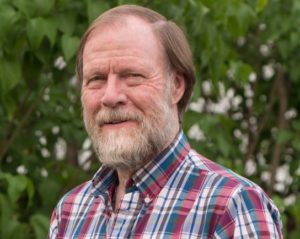
Daniel Cole began his career as a research cartographer at the National Museum of Natural History. Today he is the GIS Coordinator & Chief Cartographer at the Smithsonian Institution and oversees over 400 GIS and Storymap users and developers working on scientific projects. Cole recommends geographers not only develop good cartographic design skills for public communication, but also that students take courses in related fields of interest such as conservation, anthropology, or computer science to best be able to jump in on cartographic projects in other fields.
Learn more about Geography Careers on the recently updated AAG Jobs & Careers website.
June Member Updates
The latest news about AAG Members.
Mark Monmonier has received the Chancellor’s Citation for Excellence Lifetime Achievement Award from Syracuse University. Monmonier, known best for “How to Lie with Maps,” retired from the Maxwell School at Syracuse University this May. More.
Craig E. Colten, Carl O. Sauer Professor in Louisiana State University’s Department of Geography & Anthropology, was granted the prestigious Senior Scholar Rainmaker Award winner for 2020 from Louisiana State University. The Rainmaker Awards are given each year to faculty who have demonstrated outstanding research, scholarship, and creative activity for their respective ranks and discipline. More.
Laura Szymanski, geography PhD candidate at University of Wisconsin – Madison, was named the 2021-2022 William L. Fisher Congressional Geoscience Fellow from the American Geosciences Institute. Szymanski will spend a year working in Congress on intersections of geoscience and policy. More.
RESOURCES AND OPPORTUNITIES
New issue of you are here
 The 2021 issue of you are here: bodies & politics has been published. This issue focuses on the significance and political potentials of bodies and embodiment in the current political moment. you are here is an annual publication produced by graduate students at the University of Arizona School of Geography, Development, and Environment. The journal seeks to explore geographic themes through poetry, creative writing, maps, photographs, visual art, sonic art, film, and other imaginable genres.
Learn more about you are here.
Call for Participation: Developing Geospatial Expertise Symposium
You are invited to submit papers discussing your perspectives and/or research on geospatial expertise as part of the Spatial Cognition 2020/21 Conference. Ten to twelve of those papers will be selected by the organizers for 15-minute presentations plus Q&A. Background, links to registration, paper submission via EasyChair, and details of this can be found at: http://burtelab.sites.tamu.edu/developing-geospatial-expertise-symposium/
IN MEMORIAM
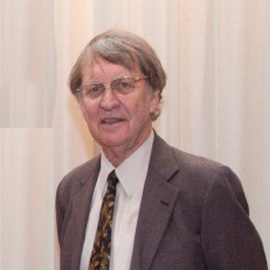 Roger Kasperson passed away in his home in Washington, D.C. on Saturday, April 10, 2021. A former Clark Graduate School of Geography faculty member, Kasperson also received his B.A. in geography from Clark and his M.A. and PhD from University of Chicago. Kasperson was a major figure in risk analysis, resilience, and sustainability and was an elected member of the National Academy of Sciences, the American Academy of Arts and Sciences, and the American Association for the Advancement of Science. More.
The AAG is also saddened to hear of the passing of Jene McKnight.
GEOGRAPHERS IN THE NEWS
- Geographer Mirella Leis develops a new app, Fish Market, to connect harvesters to buyers and address food insecurity from CBC News
- Derek Jackson, coastal geographer helping to map the surface of Mars, honored with membership of the Royal Irish Academy
- University of Washington’s Bo Zhao discusses the implications of deepfake satellite imagery and geographic data in Big Think
EVENTS CALENDAR
- June 3, 2021, 2:30-3:45 pm ET – Women in leadership in geography
- June 4, 2021, 6:00-7:00 pm ET – Virtual Happy Hour for Graduate Students
- June 5, 2021, 1:00-2:15 pm ET – Visioning and leading for an inclusive future
- June 14, 2021, 4-5 pm CT – Measuring Spatial Accessibility in the Context of COVID-19 (1 of 2)
- June 22-25, 2021 – Cities’ COVID Mitigation and Mapping (C2M2) Symposium
- June 24, 2021, 2-5 pm 3-6 pm (CET) – AAG Shorts 2021 Online Film Screening
- June 28, 2021, 4-5 pm CT – Understanding the impact of COVID-19 and its social and economic contexts
 “You Baby.” It’s Saturday morning. Jeffrey, who is chronologically well out of his early teenage years, but very much still there in spirit, is awake and calling to me with his favorite insult. He’s mostly non-verbal, but this particular phrase is one that he articulates well enough for anyone to understand.
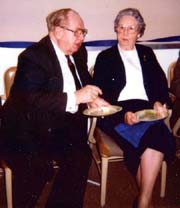 Ruby S. Skinner and E. Willard “Will” Miller were married for more than sixty years and collaborated in life and work. When World War II broke out, they both went to work in Washington, DC. At the end of the war, they went to Pennsylvania State University where Dr. Miller started the Geography Department and Ruby became the maps librarian. Ruby established and developed the map collection, and taught classes on the use of maps until her retirement. After retirement in 1977, she and her husband co-authored more than 20 books and continued to travel in Europe, Asia, Africa, and South America. Ruby graduated from Kittanning High School and Chatham College in Pittsburgh, attended Clarion University, and did graduate work at the University of Pittsburgh. Will was also founder of the Pennsylvania Geographical Society and played important leadership roles in the Association of American Geographers, American Geographical Society, and the National Council for Geographic Education. Will and Ruby Miller received countless awards and in turn were generous with their time, talent, energy, and funds to a wide range of professional and community organizations.