Bridging Difficult Conversations

Illustration showing a group of diverse hands connecting to form a bridge.

William Moseley

I grew up in the Midwest, a cultural region where we stereotypically avoid difficult conversations. While my people might famously say ‘that’s interesting’ when we disagree, or ‘I’m not mad’ when we are furious, such conflict avoidance is not a healthy approach for a large and diverse organization such as the AAG.

Nearly a year ago (April 2025), the AAG Council received a successful membership petition asking that we hold a special meeting to discuss a proposal for “the AAG to endorse the campaign for an academic boycott of Israeli academic institutions, and for financial disclosure and divestment of any AAG funds invested in corporations or state institutions profiting from the ongoing oppression of the Palestinian people.” Just a few weeks ago (February 12), AAG members received an email with the AAG Council’s response to the petition, a response which reflects nearly a year of deep conversations with a membership that was often sharply divided on this issue, and on the most appropriate response. I am proud to say that the AAG did not avoid this issue, but tackled it head on in a thoughtful and comprehensive manner. Below I discuss our process for arriving at this response, the response itself, and some common reactions and concerns I have heard from the membership.


Our Process

In receiving and reflecting on the petition, the challenge for the AAG Council was to create a space where all member voices could be heard on this important topic. A one- or two-hour online meeting where the petitioners shared their views would have privileged some perspectives over others and not been accessible to a diverse membership on different schedules and across multiple time zones. After careful thought, Council resolved to hear member input on the petition via two pathways last fall:

  1. to create a background document on the topic (including the AAG’s history of dealing with divisive issues, pros and cons of different actions, etc.) which members could comment on over a 60-day period (a two-month asynchronous meeting if you will); and
  2. to offer two online sessions (one closed and the other open to a member audience) where members could directly share their relevant insights with Council.

While this approach was far from perfect, it was appreciated by many. As one AAG member wrote: “We are a community. A community with different viewpoints, research areas, life experiences, and belief systems, which is what makes our community so vibrant. It is also what makes our community, expertise, and ability to constructively debate with one another critical in a time when misinformation, ignorance, and hate are rampant in public discourse.”


The Response

As explained in the February 12 email to the membership, there are four components of the AAG response to the petition: 1) an ESG Investment Framework and Implementation Policy; 2) an International Partnership Framework and Due Diligence Policy; 3) a Displaced Scholars Support Program and Fund; and 4) a Statement on Palestine and Higher Education. Below I briefly discuss each of these components in turn.

ESG Investment Framework and Implementation Policy. This policy obligates the AAG to more actively manage and monitor the Environmental, Social, and Governance (ESG) investment filters that guide its endowment investments. Some of these screens existed beforehand as a result of our climate change work and we added additional screens related to the military weapons industry. As a result, the AAG currently holds no investments in companies listed on the American Friends Service Committee or UN human rights lists. This approach is meant to keep our investments aligned with our values over time, while taking care to sustain our relatively modest endowment in support of our mission. Moving forward, we will review our investments annually, with flags being raised if more than 5% of our investments fall outside of these screens. This policy addresses the divestment concerns of the petitioners without being country specific (we want to avoid investments in problematic companies regardless of where they are operating).

International Partnership Framework and Due Diligence Policy. This policy will help guide new international partnerships (such as formal MOUs, joint programs, or co-sponsored events) with organizations based in countries where there are significant human rights or academic freedom concerns. Using a third-party list of countries where there are concerns as a trigger, the AAG Council will review and vote on potential new partnerships (leaving an official record of the decision). This extra level of scrutiny will also allow Council to make nuanced decisions. For example, Council could decide to collaborate with an organization fighting against oppression in country X, but not to do so with institutions in the same country that are complicit in human rights abuses. While the specific third-party list(s) Council will use to trigger a review is to be determined by a working group in the near future (e.g., Human Rights Watch World Report, Amnesty International Annual Report), it is important to have such a list because Council should not be deciding when or when not to undertake a review on an ad hoc basis. It would also be impractical and cumbersome for Council to review all such partnerships. For example, AAG staff should have the liberty to allow the Canadian Association of Geographers (not on any human rights watch list) to contract for a booth at the annual meeting without Council micromanaging the process. To be clear, the AAG has not had a partnership with any Israeli organization or institution since 2005. This policy, while also not country specific, is essentially a boycott of organizations in other countries that have been complicit in human rights abuses.

Displaced Scholars Support Program and Fund. This is a new AAG program and related fund to support displaced scholars around the world, including those from Gaza and other conflict zones. The program will provide selected displaced scholars with: (1) free AAG membership, (2) waived registration for AAG annual meetings, (3) eligibility to apply for relocation or travel funds, and (4) connections to aid organizations (e.g., IIE Scholar Rescue Fund, Scholars at Risk). A working group will develop the program details over the next year. We currently have three displaced scholars participating in a pilot program, and four internationally recognized experts advising its development. The program provides real and tangible support to geographers whose human rights and academic freedom have been compromised.

Statement on Palestine and Higher Education. The AAG released a statement on February 12 affirming commitments to Palestinian educational rights, human rights, academic freedom, and self-determination. The statement affirms that Palestinian and Israeli scholars, and all members of our community, have the right to pursue higher education and research free from violence, harassment, or discrimination. The statement addresses the destruction of higher-education infrastructure in Gaza, barriers to Palestinian scholars’ mobility and access to education, and threats to campus safety and academic freedom affecting both Palestinian and Israeli scholars. The statement also affirms that criticism of state policy must be clearly distinguished from antisemitism, Islamophobia, or other forms of racism.


Member Reactions and Concerns

While it has only been a few weeks since the AAG released its response, so far member reactions have largely been affirming and recognize the challenge of having such a difficult conversation. One member wrote: “It is notable for the way it [the AAG response] advocates positive and cooperative measures that support our shared values in universal human rights and academic freedom, instead of antagonistic and confrontational actions.” Another member wrote: “While the call for a referendum, and ensuing discussion, were sparked by the events in Gaza, the AAG took a meaningful step in negotiating a series of actions that signal institutional change and a responsiveness to member concerns. I appreciate the clear condemnation of violence and repeated focus on human rights, academic freedom, and education, and rejection of racism, that underpins each of the planned and implemented responses.” Of course, not all AAG members have been happy with the process Council undertook to broker this conversation. Let me speak to a few of those concerns here, concerns that were shared with me before the AAG shared its official response.

Since the time we initially received the member petition, I heard from some members that they would like to have had a yes or no vote on the petitioners’ demands. I would first note that such a vote was not called for in the original petition; it was requested later (without the support of the official petition). Second, such votes are not a part of the AAG bylaws (the membership votes on bylaw changes or in instances where the Council requests a vote). Thirdly, such an approach would have circumvented the AAG Council, a body which is elected by the membership and charged with considering issues in a way that reflects the long-term interests of the association (aka fiduciary responsibility, which is broader than financial considerations). Lastly, a yes or no vote on the original proposal was inherently limiting in terms of choices and would not have resulted in the more nuanced response that eventually emerged after considerable deliberation.

Other members have suggested that our process was undemocratic. I would argue that just because there was not a direct vote on the issue does not mean that the process was undemocratic. The AAG is an indirect democracy in that we elect Council members and special committee members (such as the nominations committee) to act on our behalf. Most of us do not have the time to consider all sides of an issue, so we elect representatives to do this work for us. Furthermore, the AAG Council went to great pains to hear member concerns on this issue and in a way that did not privilege the loudest voices in the room.

In sum, I am proud of the way the AAG has handled this difficult conversation. We have not sidestepped a potentially contentious issue, but addressed the main concerns of the petitioners re: divestment and collaboration, stuck to our core values and heard the views of a diverse membership, while not succumbing to divisive language or putting the organization in legal jeopardy. While I am certain that some of you will remain unhappy with this outcome, being part of a big family often entails compromise, working through challenging issues, and building bridges to arrive at a shared understanding and best possible outcome under the circumstances. Our community is stronger for meeting this moment.


Please note: The ideas expressed in the AAG President’s column are not necessarily the views of the AAG as a whole. This column is traditionally a space in which the president may talk about their views or focus during their tenure as president of AAG, or spotlight their areas of professional work. Please feel free to email the president directly at moseley@macalester.edu to enable a constructive discussion.

 

    Share

The Wetlands of San Francisco Bay: Shifting Sediments and Murky Histories

Disrespect for the Rule of Law Undermines Science and Fundamental Social Norms

Mass turnout in Minneapolis on Jan 23, 2026. Credit: Bill Moseley

William Moseley

A world and society ruled through suppression and intimidation is fundamentally incompatible with academic pursuits, both in terms of science-informed policy and the social environment needed for good science. While scholarship ranges from basic to applied, and from deeply critical to more constructive, an explicit end goal, or positive byproduct, is often rules and regulations that are informed by a solid understanding of the world. The academy also does not do well when findings are distorted by politics, or the free flow of ideas and people across borders is impeded. A thriving geography depends on the rule of law at home, and strong norms and multilateral institutions internationally.

The current U.S. administration’s “might makes right” approach to domestic and international politics cannot coexist with or support a thriving academy and discipline of geography. How can it, when it undermines the very basic tenets of society? Daily life in my hometown of Minneapolis-Saint Paul has been deeply disrupted by the presence of 2,000-plus federal Immigrations and Customs Enforcement (ICE) agents in recent weeks. Renee Nicole Good and Alex Jeffrey Pretti were murdered in broad daylight for practicing legitimate and constitutionally protected passive resistance, high school students have been tear-gassed when leaving schools, child day care centers have become targets of aggressive military tactics, and people of color (including Native Americans ironically) have been consistently harassed and detained, regardless of their citizenship status. Among a myriad of other impacts, education is being disrupted, local schools have shifted to online learning, and foreign-born faculty and students at local universities and colleges (including my geography department) are understandably afraid and concerned. This is not okay. A federal security force has been weaponized against a particular geography (a state and city it deems a political enemy), the rule of law is not being respected, and ICE agents feel like foreign occupying forces who have no understanding of good community policing.

The administration’s coercive tactics in Minnesota are mirrored in their approach to international affairs (i.e., they are two sides of the same coin). On January 3, 2026, the U.S. President unleashed a dangerous genie when he authorized a mission to capture Venezuelan president Nicolás Maduro in Caracas, Venezuela, violating international law and another country’s territorial sovereignty. This attack signals a return to a 19th century multipolar world where great powers do as they please in their own backyards. While I am not naïve enough to believe that late 20th century multilateralism was perfect, at least there was a promise of strong international institutions, the rule of law, and fact-based policymaking. Geographers of all stripes, and from around the world, have made key contributions in studying the problems of our colonial past and foreign adventurism, as well the strengths and weaknesses of post WWII multilateralism and science-based policymaking. While I am clearly an idealist as opposed to a realist (in international relations terms), I believe geographers have an interest in promoting global cooperation and respect for human rights and international law.

Whatever you may think of Nicolás Maduro, the U.S. violated international law, and another country’s territorial sovereignty, when it sent troops into Caracas to capture him. Worse yet, these actions essentially give other military powers a green light to exact their wills on their neighbors, be it China in Taiwan or Russia in Ukraine. We have been here before and it does not end well. While the U.S. was not a formal colonial power like its European counterparts, its own territorial expansion, and 19th/20th century foreign adventurism, essentially constituted a U.S. imperial era. The atrocities of 20th century wars created a space for multilateralism, the rise of international institutions like the United Nations, the forging of international agreements on basic human rights, and scientific commissions on climate change, food security, and natural disaster mitigation. These hard-fought gains for a more peaceful, humane and sustainable world, in which many geographers played a critical role, must not be relinquished.

The atrocities of 20th century wars created a space for multilateralism, the rise of international institutions like the United Nations, the forging of international agreements on basic human rights, and scientific commissions on climate change, food security, and natural disaster mitigation. These hard-fought gains for a more peaceful, humane and sustainable world, in which many geographers played a critical role, must not be relinquished.

The aggression of the U.S. against its own citizens and residents, as well as the emerging multi-polar world being cemented by recent U.S. actions, are bad for science for at least two reasons. First, authoritarian politics contort scholarly priorities, emphasizing some areas (defense, surveillance and control) and downplaying others (healthy critique of government programs and actions, examination of troublesome histories, self-reflection on colonial assumptions in our disciplines). Second, the fear-based and isolationist tactics of authoritarianism undermine the international institutions that develop science-based policies and facilitate scientific collaboration and exchange.

Mapping the Path Forward

At some point, this moment will pass, and we will be faced with creating a post-Trump world. In the U.S., basic civic education and an appreciation for the rule of law are fundamental to a well-functioning society. While Trump has done much to weaken democratic norms, the vocational drift in U.S. education arguably contributed to the problem with a decline in the development of critical thinking skills and civic engagement. The growing economic divide in the U.S., brought on by neoliberalism, also did much to undermine public trust in higher education and research. In addition to important governance reforms to address campaign finance and the overreach of executive power, we need to address underlying structural problems (eroding public support for democracy and declining access to education) and think big about opening up quality K-12 and higher education in the U.S. to all income groups if we are to have a durable democracy.

On the international stage, multilateralism is clearly not dead, but it has been ailing for some time and the Trump Administration’s actions have wounded it further. Strong international institutions and norms are an antidote to a multipolar world that is a danger to science. While I acknowledge that the United Nations is in need of serious reform, something like it must persist and evolve into a more robust and participatory global forum which supports fundamental rights and brokers international agreements on the environment, health, nutrition and peace-building to name a few. Despite domestic political pressures, geographers must avoid nationalist traps and continue to engage with and support international institutions and exchange.

I don’t like bullies, I never have. It is hard to be thoughtful and productive when you are concerned about your own safety. Furthermore, it is challenging to have a generative scholarly exchange when people are concerned about political censorship or repression. In order to better the human condition and build a more sustainable world, we need strong democratic norms and institutions at home and abroad, i.e., civic nationalism and internationalism.


Please note: The ideas expressed in the AAG President’s column are not necessarily the views of the AAG as a whole. This column is traditionally a space in which the president may talk about their views or focus during their tenure as president of AAG, or spotlight their areas of professional work. Please feel free to email the president directly at moseley@macalester.edu to enable a constructive discussion.

 

    Share

LGBTQ Cultural Districts: Landscapes of Progress

Unseen struggles; Immigrant workers, creative expression and the hidden costs of workplace abuse

Beyond the Tourist Gaze: Power, Place, and Organizing in San Francisco Chinatown

Upgrading AAG’s Investment Portfolio and Benchmarks

White curved arrow painted on green background (decorative); Credit: Donald Giannatti zHPTMNZz-NM, Unsplash
Credit: Donald Giannatti, Unsplash

Photo of Gary Langham

In June 2022, AAG made a significant change to its investment approach by adding ESG screens to its portfolio. ESG stands for environment, social, and governance, and it offers investors a way to align their values with decisions about their stock holdings.

While it has always been possible to screen holdings actively, there are several reasons this approach is challenging for professional academic organizations like AAG. Active management of funds costs 2-3% more, and unless it allows one to chase the highest-performing stocks, it does not make financial sense. All other things being equal, over 30 years a difference like this results in a 74% reduction in returns. Active management also requires some way to avoid risk in investments and to make informed selections of stock holdings.

So, why don’t we just invest in bonds or something safe? In fact, there is a law that requires organizations like AAG to seek a reasonable return on endowed funds called UPMIFA. When AAG agrees to manage endowments for awards and other member benefits, it agrees to seek returns sufficient to fund them in perpetuity. In addition, we must remind ourselves that these funds are used to pay for things closely aligned with our mission. In 2025, for example, AAG funds helped 471 students attend the annual meeting. Investments pay for mission-related support like this.

To generate sufficient returns over time, investment earnings must exceed the costs of the investment platform and inflation in addition to the awards themselves. A typical approach is to maintain a broad portfolio that buffers against market downturns (as in 2023) and benefits from market upturns (as in 2024-5). AAG has done this for many years with a 50/50 split of bonds and diversified stock holdings. To avoid paying active management fees, it works with an investment advisor and automatically rebalances its stock holdings to seek returns and diversification.

ESG screens are a relatively new option that has the lower costs of passive investing while still allowing for values-based approaches. When AAG switched over to an ESG approach in 2022, we had to choose up to three screens from a list of 20. We selected fossil fuels, environment, and social justice. The returns over the next two years tracked the broader market closely, allowing us to meet our UPMIFA obligations and secure good returns for our mission awards and programming.

This fall, AAG added a fourth investment screen to guide its portfolio of endowed and board-restricted funds. As part of the due diligence in response to the recent member petition, our analyses revealed eight military weapons investments in our portfolio. One of the 20 screens offered by our investment company is military weapons. I enquired about whether adding that screen would cover the eight companies in question. In addition to affirming that the new screen would cover the companies in question, we also analyzed whether adding this as a fourth screen, rather than swapping one of the original three, was possible. This analysis yields a “tracking error” estimate that the industry uses to assess whether the options in the remaining funds after screening are likely to produce sufficient returns. Thankfully, the tracking error was low enough to add it as a fourth screen, which we did immediately. Once the screens were reflected in AAG holdings, I compared them with two human rights divestment benchmarks (the UN human rights and the American Friends Service Committee). Happily, we were now completely aligned with both funds.

This exercise brought up a new question. How do we know whether the ESG screens are performing as intended? Indeed, the ESG ratings are based on detailed compilations of Morningstar, a large, national investment firm. However, even a well-established company like this is susceptible to political pressure. Recently, it reported that it altered its human rights assessments and ratings in response to a coalition of states raising objections to its methods. Even without this example, we know all methods like this are fallible in one way or another. So, how can we continue with ESG screens but assess their performance?

To accomplish this, I recently proposed to the Finance Committee that we adopt external benchmarks to provide a thorough evaluation. The AAG Finance Committee assists AAG in overseeing its budget and investments. For each screen, we will work with stakeholder groups at AAG to identify the best possible benchmarks and then compare our holdings. In addition to the two mentioned above, we are considering Gogel for oil, coal, and gas, and Norges Bank for environment, social justice, and fossil fuels. Collectively, these four benchmarks offer us a way to monitor our ESG screens. Performance would be calculated at least once a year and reported to the Finance Committee and Council. From time to time, AAG would also conduct a more in-depth review of options for value-based screening options.

Collectively, these approaches help AAG set a new standard in investments for professional societies. Our efforts to conduct due diligence as part of the petition process have pushed AAG to define these practices. We remain fully committed to balancing our responsibilities to achieve funding for our awards and member services, while maintaining our values-based organization.


Please note: The ideas expressed by Executive Director Gary Langham are not necessarily the views of the AAG as a whole. Please feel free to email him at glangham [at] aag [dot] org.

    Share

Harlem of the West: Jazz, People, and Place in the Fillmore

By Mirembe Ddumba

Stand on Fillmore and Geary streets on a Saturday evening, and you can almost hear it. Neon humming against the dusk, a saxophone warming up behind a church door, the ghost of Billie Holiday’s voice floating between the streetlights. In these few streets, jazz wrote itself onto San Francisco’s grid.

The sound arrived by train.

The Sound of Migration

During World War II, African Americans from Louisiana, Texas, and across the South boarded trains bound for San Francisco’s shipyards. Between 1940 and 1950, the city’s Black population grew tenfold, from 4,800 to 43,000, filling apartments left empty when Japanese American families were forced into internment camps.

Musicians arrived with guitars slung over shoulders, horns wrapped in cloth. They transformed twenty blocks into the “Harlem of the West.” By the late 1940s, you could walk Fillmore Street on any night and hear Dizzy Gillespie bleeding through one door, smell barbecue from the next, watch Cadillacs pull up to drop off couples dressed for Jimbo’s Bop City.

Bop City at 1690 Post Street ran after-hours sessions until sunrise. Charlie Parker traded choruses with Dexter Gordon while Billie Holiday sat in a corner booth. Down the street, Ella Fitzgerald sang at the Champagne Supper Club and tried on hats between sets. The Blue Mirror. Club Flamingo. Jack’s Tavern. Two dozen venues within one square mile, each separated by a five-minute walk.

John Coltrane, Duke Ellington, Count Basie, Louis Armstrong, and Thelonious Monk rented rooms above the clubs, ate at soul food diners, bought records at local shops, and shaped the neighborhood’s sonic identity night after night. This wasn’t accidental. The grid itself made it possible.

Black-and-white photo showing Fillmore Street, south of Post Street, late 1940s. The neighborhood’s dense grid and constant traffic fueled the energy of the "Harlem of the West." Credit: David Johnson
Fillmore Street, south of Post Street, late 1940s. The neighborhood’s dense grid and constant traffic fueled the energy of the “Harlem of the West.” Credit: David Johnson


Geography as Destiny

The Fillmore’s layout made this density possible. Narrow Victorian storefronts, twenty feet wide, meant multiple clubs per block. Short blocks with corner entries created constant foot traffic. The 22-Fillmore streetcar brought audiences from downtown, turning the neighborhood into one continuous jazz experience.

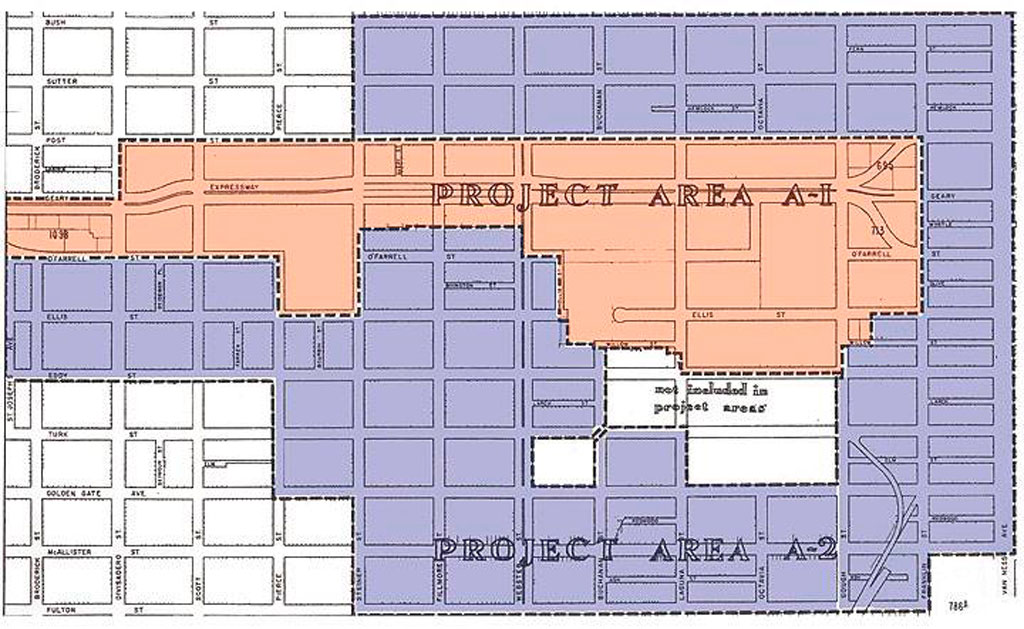
In 1948, city planners declared the Fillmore “blighted.” Under Redevelopment Agency director M. Justin Herman, bulldozers arrived. The Western Addition A-1 and A-2 projects demolished Victorian homes and shuttered clubs across 104 blocks. Geary Street, once lined with music venues, became Geary Boulevard, a four-lane expressway cutting the neighborhood in half.

By 1964, authorities had displaced 4,000 residents from A-1 alone. Jazz musicians scattered to Oakland, the East Bay, and Los Angeles. Residents gave urban renewal a different name: “Negro Removal”.


You could go out on Friday night and not come home until Sunday night because there is so much to do.”

Elizabeth Pepin Silva, filmmaker and author of Harlem of the West


The clubs closed. The musicians left. But the music never completely died.


Map showing Western Addition redevelopment zones A-1 and A-2, which demolished 104 blocks and displaced thousands of residents. Credit: San Francisco Redevelopment Agency archives
Western Addition redevelopment zones A-1 and A-2, which demolished 104 blocks and displaced thousands of residents. Credit: San Francisco Redevelopment Agency archives


Still Playing

Walk Fillmore Street now, and commemorative plaques mark where Bop City stood, where the barbershop was, where musicians bought their reeds. Listen closely, though. The Fillmore Auditorium still books acts, its walls papered with decades of concert posters. Calvary Presbyterian Church hosts Sunday jazz services. Jones Memorial United Methodist Church opens its doors for Friday night sessions.

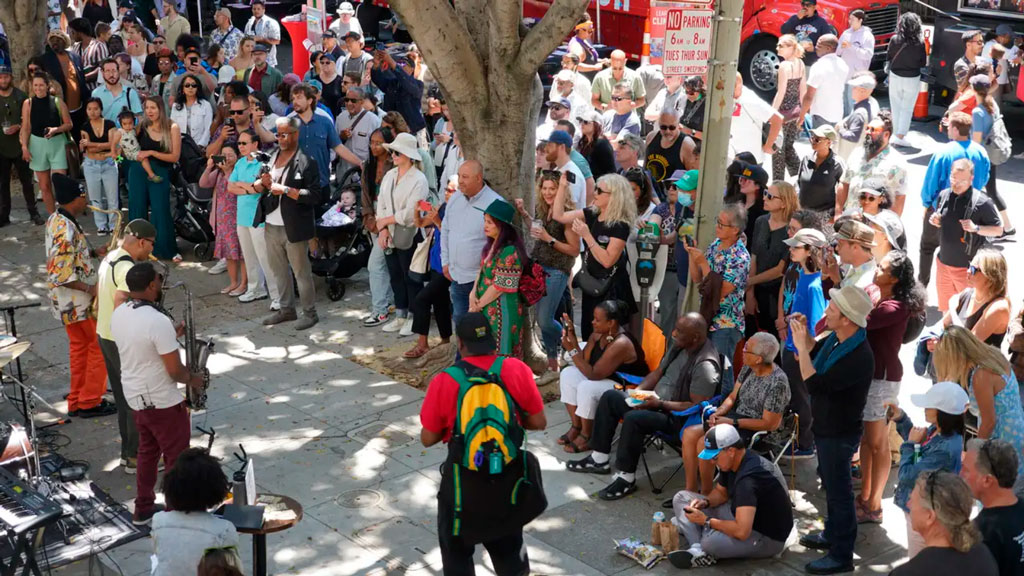
Every July since 1986, the Fillmore Jazz Festival closes twelve blocks to cars. Over 50,000 people flooded the streets for two days. Five stages. Artisan booths. The smell of Ethiopian food mixing with New Orleans-style barbecue. For one weekend, the neighborhood becomes what it was, pedestrians moving from stage to stage, music echoing off Victorian facades.

On other nights, the music lives in smaller rooms. 1300 on Fillmore books jazz acts in an intimate room with velvet couches. The Boom Boom Room sits on the corner where John Lee Hooker used to own a club. Rasselas Ethiopian Restaurant serves injera and hosts live music Thursday through Sunday. The building that housed Jimbo’s Bop City was literally picked up and moved two blocks west. It’s Marcus Books now, an Afrocentric bookstore that archives what redevelopment tried to erase.

Stand at Fillmore and Geary on Saturday evening. Close your eyes. Past the bus engines and car horns, you can still hear it. A saxophone warming up. The ghost of a neighborhood that jazz built, that policy tried to destroy, and that memory refuses to let die.

Photo showing an overhead view of musicians playing to a packed crowd at the Fillmore Jazz Festival. Credit: Fillmore Jazz Festival
Musicians play to a packed crowd at the Fillmore Jazz Festival, which brings over 50,000 people annually to celebrate the neighborhood’s musical legacy. Credit: Fillmore Jazz Festival


Learn More
    Share

AAG Honorary Geographer: Jennifer Clapp

Jennifer ClappJennifer Clapp is this year’s AAG Honorary Geographer. She is recognized for her groundbreaking work at the intersection of global economy, food systems, and food security, along with her commitment to praxis, including her current service as a member of the International Panel of Experts on Sustainable Food Systems (IPES-Food), and her previous service on the Steering Committee of the High-Level Panel of Experts on Food Security and Nutrition (HLPE-FSN) of the United Nations Committee on World Food Security (CFS) from 2019-2023 (vice chair 2021-2023).

She is a professor and Canada Research Chair in Global Food Security and Sustainability in the School of Environment, Resources and Sustainability at the University of Waterloo. Her recent books include Titans of Industrial Agriculture: How a Few Giant Corporations Came to Dominate the Farm Sector and Why it Matters (MIT Press, 2025), Food, 3rd edition (Polity, 2020), Speculative Harvests: Financialization, Food, and Agriculture (Fernwood Press, 2018), and Hunger in the Balance: The New Politics of International Food Aid (Cornell University Press, 2012).

Dr. Clapp is a Fellow of the Royal Society of Canada and an International Fellow of the Swedish Royal Academy of Agriculture and Forestry. She has also received numerous awards for her interdisciplinary research, including a Killam Research Fellowship, the Innis-Gérin Medal for contributions to Social Sciences from the Royal Society of Canada, a Pierre Elliott Trudeau Foundation Fellowship, the Canada Council for the Arts Molson Prize, and the Canadian Association for Food Studies Award for Excellence in Research.

We are honored to recognize Dr. Jennifer Clapp as Honorary Geographer, 2026.

    Share

Announcing a New Specialty Group at AAG: Critical Islands, Archipelagos, and Oceans (CIAO)

From the CIAO Specialty Group’s Organizing Committee

We are thrilled to announce the launch of the AAG’s newest specialty group, Critical Islands, Archipelagos, and Oceans (CIAO). CIAO is a scholarly and community committed to advancing the study of islands, archipelagos, and oceans as lived spaces and geographic forms enabling for critical thought. In the present moment of environmental injustice, capitalist failure, and the enduring realities of colonialism that work to divide us, we are dedicated to building solidarities across—and through—oceanic space.

CIAO’S vision

We envision CIAO as a dynamic space for geographers, Islanders, and others committed to social justice to convene in the co-creation of knowledge specific to islands, archipelagos, and oceans. In this spirit, we invite diverse perspectives that adopt a critical lens to interrogate the following topics:

  • Migration, mobility, and transoceanic networks
  • Archipelagic relationalities
  • Indigenous sovereignty
  • Island economies
  • Oceanic borders, territorialities, and governance
  • Responses to climate change
  • Militarism and militarization
  • Island feminism and island-based social movements
  • Indigenous futurisms

These topics are starting points rather than constraints and we welcome scholarly engagement beyond these themes.

CIAO’S activities

Upon joining CIAO, members can look forward to the following activities:

  • Virtual and in-person networking opportunities
  • Professional development and peer mentoring
  • Student travel grants
  • Awards for outstanding papers and creative scholarship
  • Conference activities at the AAG Annual Meeting including paper/panel sessions, social gatherings, and organized field trips.
  • At AAG 2026, CIAO will sponsor:
    • A session titled “Island Feminisms: Anti-racist and Decolonial Scholar-Activist Solidarities for Social and Environmental Justice/Feminismos isleños: solidaridades antirracistas y decoloniales entre académicas/os activistas por la justicia social y ambiental”
    • A panel
    • Any relevant sessions that AAG members suggest!

CIAO’S commitments

As a Specialty Group that explicitly recognizes the colonial legacy of the geography discipline, as well as the myriad ways that academia reinforces social, political, and economic inequalities, CIAO is committed to building an inclusive space safe from discrimination and violence. In addition to the professional benefits of CIAO membership, CIAO is committed to:

  • Celebrating and amplifying the voices of Islander and coastal communities; Indigenous peoples, women, people of color, and other marginalized communities
  • Upholding academic freedom within CIAO activities;
  • Facilitating transparent and accountable governance; and
  • Aligning with the AAG’s ethics of care for creating safe space at AAG Meetings, its Statement of Professional Ethics, and Professional Conduct Policies and Procedures

Join CIAO today

We warmly invite all geographers conducting critical work on islands, archipelagos, and oceans to join the CIAO community.

  1. Go to  aag.org and log in.
  2. From My AAG Dashboard, click on the red “Add a Group” link in the My Communities section.
  3. Review your current groups, then click the grey “Continue” button in the lower right.
  4. When the Specialty Groups list appears (it may take a minute), check the box next to “Critical Islands, Archipelagos, and Oceans,” then click “Continue.”
  5. Continue through the Affinity Groups and Communities of Practice screens until you reach your Shopping Cart, then proceed to Checkout. Fees are $20 for regular members and $5 for students.
  6. Once payment is complete, you’ll see a confirmation message. Allow up to 15 minutes for your dashboard to update. If the update doesn’t appear, try logging out and back in—or use a private browser window to clear any caching issues.

Questions? Contact us at CIAOSG@communities.aag.org.

We are so excited to host this new space, and we can’t wait to build the CIAO community with you!

    Share