Every month the AAG compiles a list of newly-published books in geography and related areas. Some are selected for review in the AAG Review of Books.
Publishers are welcome to send new volumes to the Editor-in-Chief (Kent Mathewson, Editor-in-Chief, AAG Review of Books, Department of Geography and Anthropology, Louisiana State University, Baton Rouge, LA 70803).
Anyone interested in reviewing these or other titles should also contact the Editor-in-Chief.
April, 2014
The Age of Ecology by Radkau, Joachim (Polity Books 2014)
At Pyramid Lake by Mergen, Bernard (University of Nevada Press 2014)
Beyond Discrimination: Racial Inequality in a Postracist Era by Harris, Fredrick C. and Robert C. Lieberman (Russell Sage Foundation 2013)
Clear Skies, Deep Water: A Chautauqua Memoir by Peyton, Beth (State University of New York Press 2014)
Contested Spaces of Early America by Barr, Juliana and Edward Countryman (University of Pennsylvania Press 2014)
Dealing with Darwin: Place, Politics, and Rhetoric in Religious Engagements with Evolution by Livingstone, David N. (John Hopkins University Press 2014)
Development, Security, and Aid: Geopolitics and Geoeconomics at the U.S. Agency for International Development by Essex, Jamey (University of Georgia Press 2014)
DeWitt Clinton and Amos Eaton: Geology and Power in Early New York by Spanagel, David I. (University of John Hopkins Press 2014)
Encountering Ellis Island: How European Immigrants Entered America by Bayor, Ronald H. (John Hopkins University Press 2014)
Eurasian Corridors of Interconnection: From the South China to the Caspian Sea by Walcott, Susan M. and Corey Johnson (Routledge 2013)
Expulsions: Brutality and Complexity in the Global Economy by Sassen, Saskia (Harvard University Press 2014)
Green Consumption:The Global Rise of Eco-Chic by Barendregt, Bart and Rivke Jaffe (Bloomsbury 2014)
The Greenest Nation?: A New History of German Environmentalism by Uekötter, Frank (MIT Press 2014)
Green Utopianism: Perspectives, Politics and Micro-Practices by Bradley, Karin and Johan Hedrén (Routledge 2014)
Haiti: From Revolutionary Slaves to Powerless Citizens Essays on the Politics and Economics of Underdevelopment, 1804-2013 by Dupuy, Alex (Routledge 2014)
Indigenous Discourses on Knowledge and Development in Africa by Shizha, Edward and Ali A. Abdi (Routledge 2013)
Jamestown, New York: A Guide to the City and Its Urban Landscape by Lombardi, Peter A. (State University of New York Press 2014)
Land and Wine: The French Terroir by Frankel, Charles (University of Chicago Press 2014)
Malthus: The Life and Legacies of an Untimely Prophet by Mayhew, Robert J. (Harvard University Press 2014)
Mapping in the Cloud by Peterson, Michael P. (Guilford Press, 2014)
Modern Geopolitics and Security: Strategies for Unwinnable Conflicts by Guiora, Amos N. (CRC Press 2013)
North American Odyssey: Historical Geographies for the Twenty-first Century by Colten, Craig E. and Geoffrey L. Buckley (Rowman and Littlefield 2014)
The People, Place, and Space Reader by Gieseking, Jen Jack, William Mangold, Cindi Katz, Setha Low, Susan Saegert (Routledge 2014)
The Politics of the Encounter: Urban Theory and Protest under Planetary Urbanization by Merrifield, Andy (University of Georgia Press 2014)
The Politics of Narcotic Drugs: A Survey by Buxton, Julia (Routledge 2014)
Properties of Violence: Law and Land Grant Struggle in Northern New Mexico by David Correia (University of Georgia Press 2014)
Rethinking the South African Crisis: Nationalism, Populism, Hegemony by Hart, Gillian (University of Georgia Press 2014)
Successful Adaptation to Climate Change by Moser, Susanne C. and Maxwell T. Boykoff (Routledge 2013)
The Sub-Saharan Africa Map Book by Esri (ESRI Press 2013)
Toward Spatial Humanities: Historical GIS and Spatial History by Gregory, Ian N., and Alistair Geddes (Indiana University Press 2014)
Travel Writing by Thompson, Carl (Routledge, 2014)
Water Worlds: Human Geographies of the Ocean by Anderson, Jon and Kimberly Peters (Ashgate 2014)
Yucatán: Recipes from a Culinary Expedition by Sterling, David (University of Texas Press 2014)
The Wiley-Blackwell Companion to Cultural Geography by Johnson, Nuala C., Richard H. Schein, and Jamie Winders (Wiley-Blackwell 2014)
A World After Climate Change and Culture-Shift by Norwine, Jim (Springer 2014)
Share
Post
International Student-Fellows to Present Climate Impact Studies at NASA
Fourteen students from Africa, Southeast Asia, and the Himalayas have learned to use satellite data and mapping technologies to address climate change issues in their regions. On Thursday, April 3, 2014, those students will present and discuss their efforts at NASA Headquarters.
The public event will begin at 9 a.m. in the James E. Webb Auditorium at 300 E St. SW, Washington. NASA Television will simulcast the event live.
The students and their resulting work are a part of the My Community, Our Earth/SERVIR program, a global fellowship program sponsored by NASA, the U.S. Agency for International Development (USAID), and the Association of American Geographers (AAG). Students participating in the MyCOE/SERVIR program receive long-term training to use Earth observations, geography, and geospatial technologies to address climate change issues in developing regions.
The My Community, Our Earth program is a public-private partnership administered by the Association of American Geographers to provide the mentorship, networking, and professional development necessary to transform innovators into scholars with the skills to connect their science results to the public and decision makers.
SERVIR, an acronym meaning “to serve” in Spanish, is a joint venture between NASA and USAID. SERVIR works in partnership with leading regional organizations around the globe to help developing countries use information provided by Earth-observing satellites and geospatial technologies to better manage climate risks and sustainability of natural resources.
The student-led projects address a range of issues including agricultural productivity, water resources, sea level change, food safety, forest conservation, and natural disaster planning. During the hour of short presentations, students will be taking questions via Twitter using the hashtag #askNASA. Presentations also will be streamed live online.
For NASA TV streaming video, downlink and scheduling information, visit www.nasa.gov/nasatv.
After the presentations, students and program sponsors will be available from 10-11 a.m. in the auditorium lobby to discuss their projects.
For more information on the fellowship program, visit www.aag.org/mycoe.servir.
Additional information about the SERVIR program is available at www.servirglobal.net and www.nasa.gov/servir.
Share
Harm Jan de Blij
Harm de Blij of Sarasota, Florida and Chatham, Massachusetts died on March 25, 2014, at The Moffitt Cancer Center in Tampa, Florida.
Born in the Netherlands, de Blij received his early schooling in Europe, his undergraduate education in Africa from the University of the Witwatersrand and his graduate degrees in the United States from Northwestern University. Dr. de Blij taught at Michigan State University as a Professor from 1960 to 1969 and then moved to the University of Miami where he served as Chairperson of the Department of Geography. He served on the National Geographic Society’s Committee for Research and Exploration for more than 20 years, was founding editor of its journal National Geographic Research and was awarded National Geographic’s Distinguished Geography Educator Award and lifetime membership for his advocacy of geography. He received the highest recognitions from the Association of American Geographers, the American Geographical Society and the National Council for Geographic Education. Dr. de Blij has also held the George Landegger Chair in Georgetown University’s School of Foreign Service and the John Deaver Drinko Chair of Geography at Marshall University and was Presidential Scholar at the Colorado School of Mines. Dr. de Blij returned to MSU in 2000 as a Distinguished Professor and was subsequently named the John A. Hannah Professor of Geography. His scholarly work has been recognized through honorary degrees awarded by Marshall University, Rhode Island College, Grand Valley State University, North Carolina State University and Michigan State University.
Dr. de Blij specialized in geopolitical and environmental issues and has published more than 30 books including scientific, educational, and trade titles, and over 100 articles. His textbook Geography: Realms, Regions and Concepts (Wiley) has exceeded 1.3 million copies in 15 editions since 1970. Another book, Wine: a Geographic Appreciation (Rowman & Allanheld) was awarded a medal by the French wine organization, OIV, in Paris. His books have been translated into several foreign languages. Over the past 40 years, de Blij was also one of the few academic geographers of his generation to make a major and lasting impact in the public arena. He was the popular Geography Editor on ABC’s “Good Morning America” from 1989 to 1996. In 1996, he joined NBC News as Geography Analyst, appearing mostly on MSNBC. He was writer of and commentator for the original PBS Series “The Power of Place”. Dr. de Blij was much in demand on the lecture circuit and his extraordinary communication skills were widely recognized. He gave over 400 presentations since 2001 with lecture titles such as; Confronting Militant Islam: the changing Geography of Terrorism, Why Geography Matters: the Cost of Geographic Illiteracy, and Climate Change Forever: Truth and Consequences.
Harm de Blij ‘s parents were both distinguished musicians and he remained a violinist and chamber-music participant through the end of his life. He was an avid wine collector, lifelong soccer (Holland) and baseball (Cubs) fan. His second love after geography was animals, all animals but a special place in his heart was always kept for his own.
Harm is survived by his wife of 37 years, Bonnie of Chatham and his only son Hugh James of Maryland and beloved sister in law Patti Mc Culley of North Chatham. He was predeceased by his Mother Nelly and Father Hendrik and his daughter Tanya Powers de Blij.
Memorial contributions may be made to The de Blij Geography Scholars, Department of Geography, Michigan State University, 673 Auditorium Road, Room 116, East Lansing, MI 48824 or to The Wildlife Center of Venice, Inc. 3252 Border Road, Venice, FL 34292
Race, Ethnicity and Place Conference in Ft. Worth, Texas
The “Call for Papers” is now open for the seventh bi-annual Race, Ethnicity and Place Conference. Information is available at the REP website. The REP VII will be held October 22-24, 2014 in Ft. Worth, Texas. The event is hosted by Texas Christian University’s ADDRAN College of Arts and Sciences and the conference venue is The Sheraton Hotel, Downtown Ft. Worth.
More than 100 students, faculty, and other professionals representing a wide range of disciplines from numerous states and nations have already committed to REP VII. These scholars share an interest in racial and ethnic transformation of places worldwide and reflect a mix of applied and theoretical perspectives, often within a spatial framework.
Along with hundreds of paper, poster, and panel presentations, the conference will feature a welcoming reception at the beautiful Ashton Depot in Downtown Ft. Worth and a regional band, The SWAG. There will be speakers from the region at two lunches.
Thursday’s luncheon will begin with entertainment by the “Word of Truth Gospel Singers” and is followed by a talk by Mr. Bob Ray Sanders, an award winning journalist who will discuss “From a Dream Deferred to Dream Variations to I’ve Known Rivers.” His talk will address the future of Ft. Worth by contextualizing three phases of American racial history.
Friday’s luncheon begins by entertainment with Mr. Gonzalo Mata, a Mexican Harpist, followed by Mr. Reinaldo “Renny” Rosa, a community activist and organizer who will speak of “America in Transition: From Anglo Pale to Golden Brown.” Mr. Rosa will discuss the historical development of Ft. Worth’s Mexican neighborhoods and his personal experiences in community organizing related to inequalities.
The REP VII Conference closes on a traditional festive note with a gala dinner that provides entertainment by a Mariachi Band and Dancers. This promises to be a fun event without speakers. Attendees are encouraged to wear ethnic dress.
For geographers and those of similar interests, the conference site is almost as interesting and important as the scholarly content of any meeting, so the REP planning committee has organized a number of opportunities to explore local landscapes and experience the sights, sounds, and tastes of Cowboy culture, as well as historic and ethnic places. All conference participants and their accompanying family members are invited to partake in a self-directed tour of Ft. worth. TCU will provide maps, directions, and other information for these personalized excursions at the Conference hotel.
In addition to self-directed tours, three fieldtrip options are available on the days of the conference. In all cases, spaces are limited and additional fees arerequired(see the website for details but do not wait very long, registrations have begun!). An afternoon, pre-conference excursion to Dealy Plaza and the Sixth Floor Museum (site of JFK assassination) by train from Ft. Worth will occur at Noon on Wednesday and return prior to the evening reception at the Ashton Depot.
A local field trip entitled “African-American History and Neighborhoods of Ft. Worth” follows Mr. Sanders Luncheon talk at the Thursday luncheon and includes a tour of the Evans Avenue Mall and the Como area, as well as a stop at the Tarrant County Black Historical Society.
On Friday, and following the luncheon talk by Mr. Rosas, a fieldtrip that tours Latino Ft. Worth is available on a first-come, first served basis. This tour examines historic neighborhoods, businesses and organizations. A stop is included at La Gran Plaza, a Mexican –themed Mall that opened in 2004 and resembles colonial Mexican city. PLEASE REMEMBER THAT SPACE IS LIMITED.
For additional information about the REP conferences, including REP VII registration information, highlighted sessions, field trips, and accommodations, visit: https://rep-conference.binghamton.edu (or just query REP Conference 2014).
Every month the AAG compiles a list of newly-published books in geography and related areas. Some are selected for review in the AAG Review of Books.
Publishers are welcome to send new volumes to the Editor-in-Chief (Kent Mathewson, Editor-in-Chief, AAG Review of Books, Department of Geography and Anthropology, Louisiana State University, Baton Rouge, LA 70803).
Anyone interested in reviewing these or other titles should also contact the Editor-in-Chief.
Architecturalized Asia: Mapping Continent through History by Rujivacharakul, Vimalin, H. Hazel Hahn, Ken Tadashi Oshima, and Peter Christensen (Hong Kong University Press/ University of Hawai’I Press 2013)
Food Systems in an Unequal World: Pesticides, Vegetables, and Agrarian Capitalism in Costa Rica by Galt, Ryane (University of Arizona Press 2014, http://www.uapress.arizona.edu/Books/bid2466.htm)
A Landscape of Travel: The Work of Tourism in Rural Ethnic China by Chio, Jenny (University of Washington Press 2014, http://www.washington.edu/uwpress/search/books/CHILAN.html)
Surfing Places, Surfboard Makers: Craft, Creativity, and Cultural Heritage in Hawaii, California, and Australia by Warren, Andrew and Chris Gibson (University of Hawai’i Press 2014, http://www.uhpress.hawaii.edu/p-9116-9780824839437.aspx)
Wild Frenchmen and Frenchified Indians:Material Culture and Race in Colonial Louisiana by White, Sophie (University of Pennsylvania Press 2012, http://www.upenn.edu/pennpress/book/15041.html)
Share
President's Column
The Challenge of Giving Credit Where Credit is Due: “Who’s on First?”
Earlier this winter, I had dinner with a friend who is a senior scientist at a federal data and research center. At one point during the evening, our conversation turned to authorship practices and the diffusion of disciplinary-specific authorship styles to other disciplines. This diffusion was leading to some concern and even confusion among my friend’s colleagues, as many were initially unaware of, or did not fully appreciate, the disciplinary differences in authorship practice that exist. Furthermore, some were concerned that their contribution to a particular research effort may not be fully recognized by their peers if the ordering of the authorship differed from that expected by disciplinary standards. On the other hand, others acknowledged that the practices of different disciplines provided additional alternatives for handling the sometimes difficult issue of authorship order, especially for research efforts involving numerous junior and senior investigators.
As geographers become more and more involved in interdisciplinary research, we, too, are exposed to, and even participate in, a broader range of authorship practices. In this column, I explore authorship styles, drawing attention to the range of practices that exist and highlighting how geography can draw on the practices of other disciplines to allow for a broader range of options for conveying authors’ relative contributions. Please note this column is about authorship order, and I assume that the authorship list has been appropriately determined. Disciplinary differences can also exist in who is considered an author, but that topic merits separate discussion.
For most social sciences and many physical sciences, authorship order reflects the nature and quantity of the effort expended, with the first author position awarded to the author who contributed most to the conceptualization of the research design, performed the bulk of the data analysis, and drafted much of the manuscript. Subsequent authors are listed in order of their relative contribution. One exception is economics where alphabetical ordering of the authors has long been the tradition, a practice that other disciplines may frown upon or even consider a “cop out” to determining authorship order. A considerably different authorship practice has developed in the biological sciences. The student or postdoctoral associate who performed the majority of the analyses is typically awarded first authorship, whereas the last author position, referred to as “corresponding author”, is reserved for the senior scientist who provided overall direction and garnered funding for the research effort. Most often, in addition to being placed last, the corresponding author is defined as such in a footnote. Several variants on this style are seen. Co-first authorship is often used if the manuscript communicates approximately equally the efforts of more than one student, or a student and a postdoctoral associate, and co-corresponding authorship reflects that two or more research teams jointly contributed to the research. Such co-crediting is generally defined in a footnote to the author list. A “professor sandwich,” where senior scientists occupy both the first and last authorship positions, and are listed as co-corresponding authors, is an alternative when a manuscript reflects primarily the efforts of the senior rather than junior scientists on a team.
As I become more involved in extramurally-funded and interdisciplinary research, I find the authorship practice used in the biological sciences increasingly more appealing, and in some ways more honest, than alternative styles, including the “effort-based” ordering traditionally employed in geography. By definition, a funded research project was conceptualized by the principal investigators (i.e., the senior scientists), who also carefully laid out the initial research design and methods. These contributions should be reflected in the authorship of the manuscripts conveying project findings. The corresponding author (or co-corresponding authors) position at the end of the author list clearly communicates who was responsible for initial conceptualization without infringing on the contributions of the often junior scientists who performed the majority of the data collection and analysis. At the same time, as a research project progresses, it evolves substantially from its initial conception, and the first author (or co-first author) position acknowledges the creativity and the unique contributions of the junior scientists and their efforts to ensure the success of the project in addition to their data collection and analysis efforts. This authorship style also fits better my conception of a research team as a mentoring unit, with everyone (junior and senior scientists alike) actively contributing to all aspects of the project, from brainstorming on new directions to problem solving to data analysis and interpretation and eventually to manuscript preparation and revision. To this is added the recognition that the senior scientist(s) has the added responsibility to ensure that the needed resources are available to conduct the research and that the final project outcomes are significant, scientifically sound, and publishable.
Although I have experimented with this authorship style on a few publications, I have not used it extensively, primarily out of concern that many within geography are unfamiliar with this practice. I have been particularly reluctant to list myself as a corresponding author on manuscripts involving PhD students, even when the work was funded from grants on which I was the lead principal investigator, as I do not want the corresponding author designation to inadvertently detract from the student’s contribution in the eyes of the geography community. In this case, my research group uses the more familiar “effort based” authorship style, and I am typically listed as second author in the string of authors. But this style can also detract from the student’s contribution, as it does not as clearly distinguish my expected supervisory role, rather conflating it with my other contributions to the research effort. However, even if my students and I rarely employ this authorship practice for our own work, this style is showing up more often on our curricula vitae because of our participation in large research projects involving disciplines where this is the standard practice. In fact, my next task for this morning, after I submit this column, is to edit a manuscript from a multi-disciplinary effort that is employing a “professor sandwich” authorship style.
At the very least, geographers need to familiarize themselves with the range of authorship practices employed in the scientific literature, so that they do not misinterpret the contributions of other scientists, including some of their geography colleagues, who use alternative authorship styles than those common to geography. Geographers also should become familiar with differing authorship styles so that they can anticipate issues and concerns that may arise regarding authorship order as they participate in research teams involving disciplines with different authorship practices. I would also argue that in some situations the authorship practices of other disciplines may be more appropriate and more meaningful than the standard effort-based style used in geography, and that geography as a discipline should be open to these alternative practices. An initial first step could be simply to better accommodate the option of a corresponding author designation in the AAG’s journals, the Annals and the Professional Geographer. This might also make these journals more attractive outlets for publishing the synthetic findings of large interdisciplinary research efforts. In sum, I am arguing that geography and geographers should be open to exploring a range of authorship practices.
For those of you who may be thinking that authorship practice is a nerdy conversation topic for dinner with a good friend, I assure you that most of the evening was spent catching up on family and mutual friends and enjoying a very nice bottle of wine. But it is admittedly hard to leave work at the office …
I look forward to hearing your thoughts on authorship practices.
Candice Luebbering Joins AAG Staff as Research Geographer
The AAG is pleased to announce that Candice Luebbering has joined the AAG staff as a Research Geographer at the association’s headquarters in Washington, D.C. Candice has served as a Visiting Assistant Professor in the Department of Geography at Virginia Tech, teaching undergraduate courses in cartography, map reading, human geography, and environmental issues, while also mentoring and supervising students participating in the undergraduate research program. In her new role she will contribute to AAG research and policy projects.
Candice holds a bachelor’s degree in Sociology and Anthropology from Truman State University, a master’s in Geography from Virginia Tech, and a PhD in Geospatial and Environmental Analysis from Virginia Tech. Her research interests in human geography, GIS, and cartography were combined in her dissertation work focusing on the cartography of language maps, including language map construction and visualizing language diversity. Through teaching, research, and work opportunities, she has experience in a broad spectrum of topics including human-computer interaction, medical geography, international development, geography education, and uncertainty in GIS.
When not working, Candice enjoys biking and dining her way through DC with her husband, thrifting for vintage geography-related items, and spending time with her geographically-named Boston Terrier Ala-Mo (named after the home states of her and her husband, both geographers, Alabama and Missouri).
Share
Annual Meeting
Water, Growth and Tampa Bay
Florida is practically synonymous with water and at first blush it seems inconceivable that the Sunshine State could have water problems typical of drier western states. After all, Florida averages 54 inches of rainfall each year and despite more than a century of drainage, it still has more acres of wetlands than any state except Alaska. It also has nearly 8,000 lakes at least one acre in extent, more than 1,700 streams of all lengths and widths, and it is underlain by the Floridan aquifer, one of the most productive groundwater formations in the world. Given this, it probably comes as no surprise that peninsular Florida has more than 700 springs—the largest concentration of freshwater springs in the world. Indeed, for much of Florida’s history, people have struggled with too much water.
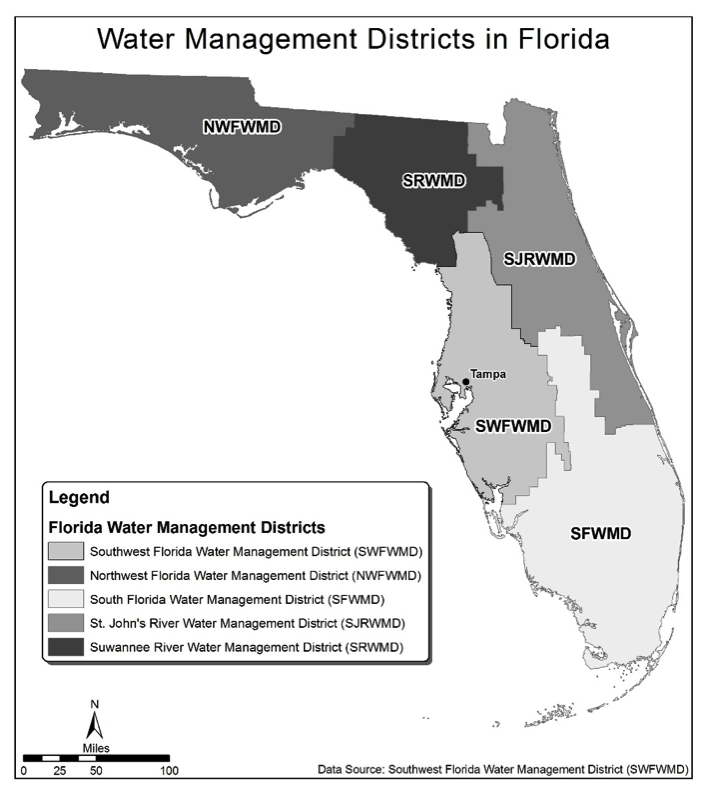
By the 1970s, however, rapid population growth in the Tampa Bay region and elsewhere stressed the state’s water resources. In response, the Florida legislature created five water management districts (WMDs), encompassing the entire state (figure 1). Water management district boundaries are based on surface water hydrologic divides, which is better than political boundaries, but less helpful in a state dominated by groundwater use. Florida’s water management districts are quasi state agencies, under the supervision of the Florida Department of Environmental Protection—and the state constitution demands that they manage water resources sustainably while accommodating all current and future uses (at best, a difficult balancing act).
Figure 1
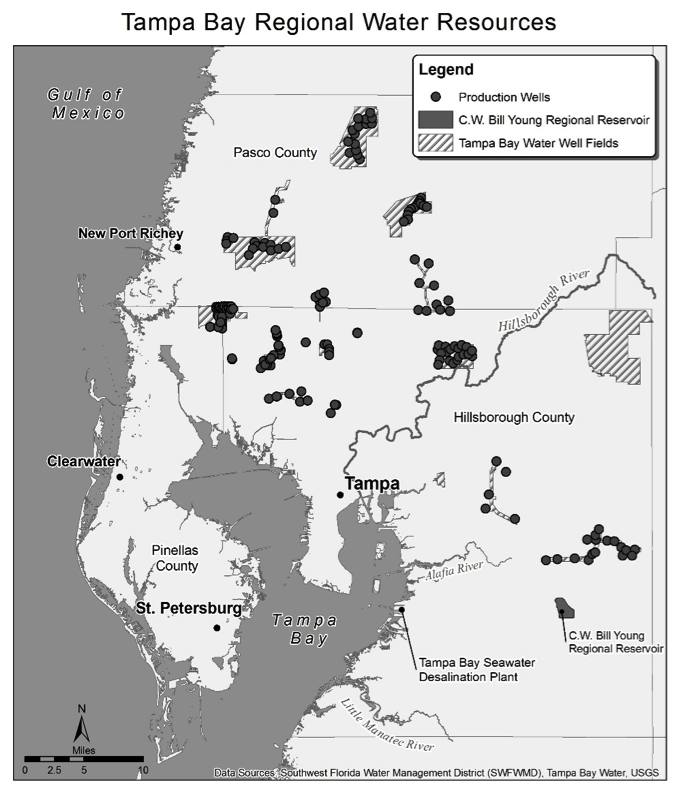
As is true for the rest of Florida, growth and development in the greater Tampa Bay region has long depended on water control. For nearly a century, the City of Tampa has tapped the Hillsborough River as a water supply. As late as the 1960s, flooding along portions of the 54-mile Hillsborough River remained the most critical water issue in Tampa. Meanwhile, continued population growth throughout the region, especially on the western side of Tampa Bay (in Pinellas County, featuring St. Petersburg and Clearwater; Figure 2), relied on access to inexpensive but high quality groundwater. Saltwater intrusion into Pinellas County well fields has been a problem since the 1920s, so Pinellas authorities ultimately bought land for well fields in rural but inland portions of neighboring Pasco and Hillsborough counties. Yet by the 1980s, many people living in these rural areas began to see the negative impacts of excessive groundwater pumping. Specifically, wetlands and lakes began drying up, much to the chagrin of property owners who built docks and boathouses that eventually extended to dry land.
While some officials blamed drought for disappearing surface water, the Southwest Florida Water Management District (often called Swiftmud) eventually demanded that Pinellas utilities reduce groundwater pumping. Swiftmud’s stance threatened the region’s growth coalition: politicians, realtors, home builders and other business leaders who believed that continued access to inexpensive groundwater remained vital to sustain continued population growth and economic development. After more than a decade of costly political and legal wrangling between Swiftmud and Pinellas County leaders (known locally as the Tampa Bay Water Wars), a settlement finally emerged in 1997. Swiftmud agreed to help a new regional water wholesaler (Tampa Bay Water) build new and expensive water infrastructure that would eventually reduce the pressure on groundwater resources while accommodating future growth and development.
Figure 2
As a result, Tampa Bay is now home to the largest desalination plant in the western hemisphere (even if water managers in California may soon claim this distinction). Plagued by serious technical problems and cost overruns, the $158 million plant finally achieved peak production of 25 million gallons per day (mgd) in late 2007. To put this in perspective, the three Tampa Bay area counties of Hillsborough, Pinellas and Pasco used 432 mgd of fresh water in 2005. Despite the advantages of flat topography (which keeps distribution costs low compared to regions with more hilly topography), drawing water from the Tampa Bay estuary (which is somewhat less salty than sea water, so it reduces treatment costs), and a location adjacent to a power plant that discharges higher temperature water used for cooling (further reducing treatment costs)—despite these advantages, the desalination plant often operates well below capacity because it produces water that costs more than other sources.
That is not all. Swiftmud also agreed to subsidize the construction of the 15 billion gallon C.W. Bill Young Regional Reservoir that would store excess surface water from local streams during the summer rainy season for use during the region’s relatively dry winter and spring. This $146 million facility developed cracks soon after opening in 2005, and, after spending several million dollars trying to make repairs and suing the original contractor, not only did Tampa Bay Water lose the lawsuit but its customers now have to pay $129 million to rebuild the reservoir. Finally, Tampa Bay Water also spent $144 million on a surface water treatment facility, which makes potable water from a variety of surface sources including the broken reservoir, the desalination plant, and local streams. Like the other projects, this treatment plant experienced problems at first, but is now functioning properly.
On top of all of this, several Tampa Bay communities continue to invest millions of dollars laying pipes and building pump stations to distribute treated wastewater from sewage treatment plants (often called reclaimed water) for use in irrigating golf courses, parks, and yards, as well as for industrial and limited agricultural use. Making use of treated wastewater is not only drought resistant, it reduces the use of drinking water for growing grass. In 1977, Tampa’s neighbor, St. Petersburg, initiated the first large urban water reuse system in the United States. Florida (along with California) leads the nation in its use of reclaimed water; data from a May 2013 Florida Department of Environmental Protection report show that the Sunshine State now reuses about 45% of treated wastewater discharged from sewage treatment plants. Similarly, Swiftmud contends that 44% of all the treated wastewater leaving sewage treatment plants in the district is now reused.
For Tampa Bay and most of the rest of Florida, authorities are already making maximum use of inexpensive groundwater, and they have begun to tap more expensive water in order to continue fanning the flames of population growth and development. Few would argue with calls to reduce water use by using water more efficiently. Yet many people are annoyed that they have to reduce their water use in order to provide water to support continued development. Worse, major water utilities investing in expensive infrastructure depend on a certain level of water sales to pay for such infrastructure; when people buy less water (conserve!), utilities often have to charge more (per unit) for what they sell. In the U.S., costs associated with public water provision are often distributed evenly among a population, with the occasional exception of instituting progressively higher rates for larger amounts of consumption/use. Certainly those who benefit the most from constant population and economic growth favor this approach. What might make more sense, however, is assigning a larger percentage of the cost of developing more expensive sources of water to those who create that need in the first place. Regardless, future water use will almost certainly be more expensive; the remaining questions are how much will it cost and who will foot the bill?
Christopher Meindl
University of South Florida – St. Petersburg
Maps by Andy Hayslip
University of South Florida – St. Petersburg
Elizabeth D. Purdum, Peter A. Kraft, Edward A. Fernald, and James R. Anderson (eds.). 1998. Water Resources Atlas of Florida. Tallahassee: Florida State University, Institute of Science and Public Affairs.
Every month the AAG compiles a list of newly-published books in geography and related areas. Some are selected for review in the AAG Review of Books.
Publishers are welcome to send new volumes to the Editor-in-Chief (Kent Mathewson, Editor-in-Chief, AAG Review of Books, Department of Geography and Anthropology, Louisiana State University, Baton Rouge, LA 70803).
Anyone interested in reviewing these or other titles should also contact the Editor-in-Chief.
African Americans and Gentrification in Washington, D.C.: Race, Class and Social Justice in the Nation’s Capital by Prince, Sabiyha (Ashgate 2014, http://www.ashgate.com/isbn/9781409446125)
The Atlas of Economic Complexity: Mapping Paths to Prosperity by Hausmann, Ricardo, and Cesar A. Hidalgo, et al (MIT Press 2013, http://atlas.media.mit.edu/atlas/)
Island Life: Or, the Phenomena and Casuses of Insular Faunas and Floras, Including a Revision and Attempted Solution of the Problem of Geological Climates by Wallace, Alfred Russel (University of Chicago Press 2013, http://www.press.uchicago.edu/ucp/books/book/chicago/I/bo15584113.html)
The omnibus appropriations bill for Fiscal Year 2014 that was signed into law by President Obama on January 17 was widely hailed as a rare departure from the recent cycle of federal budget battles. The legislation received significant bipartisan support in both houses of Congress and headed off any chance of a government shutdown until at least October.
Significantly for geographers and the wider social science community, the bill does not contain the so-called “Coburn Amendment,” which passed in March 2013 and prevented the National Science Foundation (NSF) from funding political science studies other than research “certified as promoting national security or the economic interests of the United States.” Enactment of the Coburn Amendment prompted the AAG to work with our friends at the American Political Science Association (APSA) and many others in the science and higher education communities to promote the importance of political and social science research, and urge Congress to undo the restrictions.
Over the last several months, we at the AAG have worked closely with the APSA (see letter: https://www.aag.org/galleries/govt-relations/Thank_you_letter_to_AAG.pdf), the American Association for the Advancement of Science (AAAS), the Consortium of Social Science Associations (COSSA), the Coalition for National Science Funding (CNSF), and many other key organizations in an effort to undo the damage caused by the Coburn Amendment and to prevent the possibility of wider-reaching restrictions blocking funding for the social sciences broadly. As part of these efforts, the AAG has:
Adopted an AAG Council resolution opposing the Coburn Amendment
Sent multiple calls to action to all AAG members detailing concerns related to sequestration and issues such as the Coburn Amendment
Coordinated closely with the APSA agenda, per their request, in our response to the Coburn Amendment
Signed onto numerous letters, including a AAAS-organized letter urging the House Science Committee to protect the integrity of the merit-review process for all disciplines, including the social and behavioral sciences; and a CNSF-organized letter urging the House Science Committee to fully fund programs that support social science research
While we are delighted that the recently-passed omnibus spending bill does not contain the Coburn Amendment or any related restrictions on the social and behavioral sciences, we recognize that we must remain vigilant to protect this funding in the coming months. As part of these efforts, we urge AAG members to contact your Senators and Representative to express your views about federal funding for the social sciences.
The omnibus bill also marked a win for National Science Foundation (NSF) funding overall. The Foundation will receive $7.17 billion for FY 2014, which represents a 4.2 percent increase when accounting for the sequestration cuts that were applied last year.
The links below provide information about contacting members of Congress through the phone or internet. AAG members may also wish to use social media, such as Twitter or Facebook, to share their perspectives with elected officials, friends, colleagues, and the wider community.
If you have any questions, please do not hesitate to contact John Wertman, the AAG’s Senior Program Manager for Government Relations, at jwertman [at] aag [dot] org, or Doug Richardson, AAG Executive Director, at drichardson [at] aag [dot] org.
Share
Register for Free
Create an account to get free access to exclusive AAG content.
AAG Members get exclusive access to publications, prominent journals, unique advocacy, grant, scholarship and professional opportunities with access to industry focus communities, and event discounts, including our annual meeting.
Some content may only be accessible if you belong to specific Specialty or Affinity Groups. You can still update your membership below. You will need to go through the Join flow, but you do not need to repurchase your membership unless it is expired or about to expire.
To provide the best experiences, we use technologies like cookies to store and/or access device information. Consenting to these technologies will allow us to process data such as browsing behavior or unique IDs on this site. Not consenting or withdrawing consent, may adversely affect certain features and functions.
Functional
Always active
The technical storage or access is strictly necessary for the legitimate purpose of enabling the use of a specific service explicitly requested by the subscriber or user, or for the sole purpose of carrying out the transmission of a communication over an electronic communications network.
Preferences
The technical storage or access is necessary for the legitimate purpose of storing preferences that are not requested by the subscriber or user.
Statistics
The technical storage or access that is used exclusively for statistical purposes.The technical storage or access that is used exclusively for anonymous statistical purposes. Without a subpoena, voluntary compliance on the part of your Internet Service Provider, or additional records from a third party, information stored or retrieved for this purpose alone cannot usually be used to identify you.
Marketing
The technical storage or access is required to create user profiles to send advertising, or to track the user on a website or across several websites for similar marketing purposes.
To provide the best experiences, we use technologies like cookies to store and/or access device information. Consenting to these technologies will allow us to process data such as browsing behavior or unique IDs on this site. Not consenting or withdrawing consent, may adversely affect certain features and functions.
Functional
Always active
The technical storage or access is strictly necessary for the legitimate purpose of enabling the use of a specific service explicitly requested by the subscriber or user, or for the sole purpose of carrying out the transmission of a communication over an electronic communications network.
Preferences
The technical storage or access is necessary for the legitimate purpose of storing preferences that are not requested by the subscriber or user.
Statistics
The technical storage or access that is used exclusively for statistical purposes.The technical storage or access that is used exclusively for anonymous statistical purposes. Without a subpoena, voluntary compliance on the part of your Internet Service Provider, or additional records from a third party, information stored or retrieved for this purpose alone cannot usually be used to identify you.
Marketing
The technical storage or access is required to create user profiles to send advertising, or to track the user on a website or across several websites for similar marketing purposes.



 The AAG is pleased to announce that Candice Luebbering has joined the AAG staff as a Research Geographer at the association’s headquarters in Washington, D.C. Candice has served as a Visiting Assistant Professor in the Department of Geography at Virginia Tech, teaching undergraduate courses in cartography, map reading, human geography, and environmental issues, while also mentoring and supervising students participating in the undergraduate research program. In her new role she will contribute to AAG research and policy projects.