Getting Ready for AAG 2027 in New York
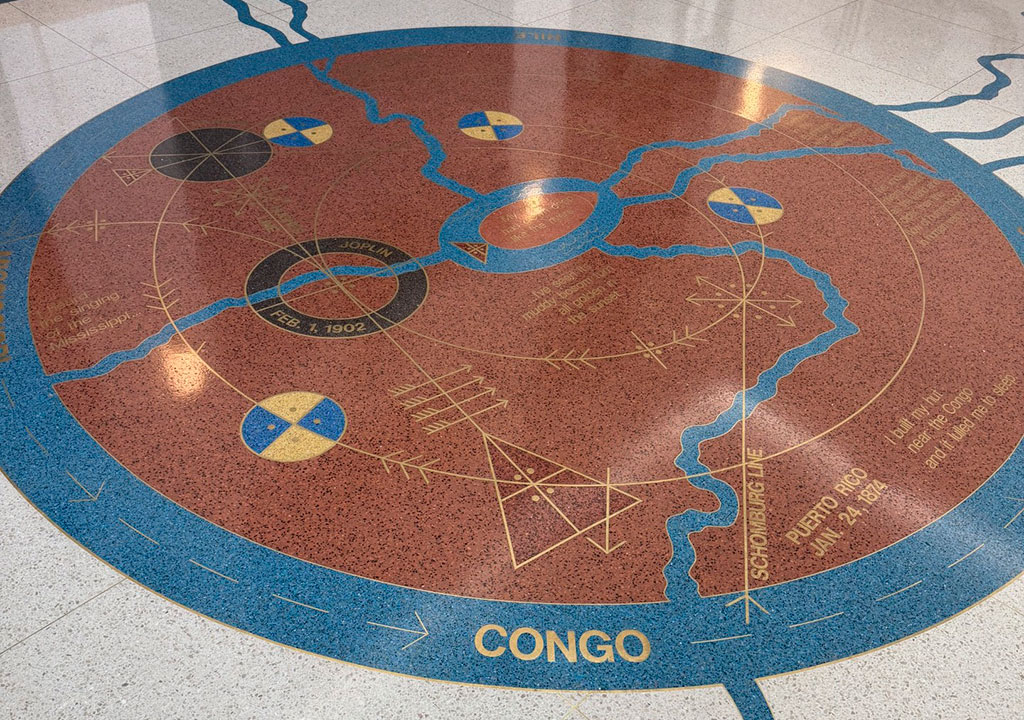

In May I was thrilled when Tashi Dekyid Monet invited me to participate in her event “Living with Climate Change in the Himalayas and on the Tibetan Plateau” at Columbia University. I hadn’t had the opportunity to visit New York since the 2013 AAG meeting. I booked a hotel last minute based on cost, not realizing I had gotten a place just a few doors down from the Apollo Theater. Every day on our way to the conference or after, my daughter, Sasha Kunzes, and I visited a few sites on a Harlem walking tour, moved by thinking about the writers and artists and thinkers who had walked these same sidewalks. It was my first time visiting the Schomberg Center for Research in Black Culture at the New York Public Library, and we ran late that day because the story and exhibits were riveting. But at the same time, we were getting to know Himalayan New York – seeing friends from Ladakh, Tibet, and the broader Himalaya region as we seek to build up a network of scholars from the region (led by Mabel Gergan, Pasang Yangjee Sherpa, Elspeth Iralu, and others). We were getting momo recommendations and attending an event with Pasang to celebrate Sherpa histories and futures for Everest Day. We learned that there is a Himalayan New York tour, and Nawang Gurung welcomed us into his home to feed us dinner. My former student, Carlos Serrano, had generously given us tickets to see Romeo and Juliet in Central Park — a free Public Theater event — in this case it was a reimagining of the play at the border wall, and Sasha was thrilled to get to practice her Spanish, explaining the plot to Tashi Dekyid. With the new mayor and a slew of social programs being unveiled, the city feels full of life.
This is the New York we can’t wait to visit in February with all of you — a New York comprised of land layered by cultural and political histories that are distinct across each neighborhood, and places that contain whole worlds on a single city block. I was thinking back to the May visit after a recent generative and moving meeting set by Lisa Schamess with Joe Baker and Hadrien Coumans of the Lenape Center, and Meredith Palmer (Six Nations Tuscarora), from the Grounded Relations and Repair Taskforce. The Lenape Center will be our collaborator during the meeting, providing a living link to Lenapehoking, the homeland we now call Manhattan.
I can’t imagine a better city to think about Grounded Relations and Desirable Futures than New York. These days, if you work at a university, small talk can quickly take awkward turns and even a simple “how are you?” can come with a disclaimer that you expect they aren’t doing so great. What kind of a time is this to wax poetic about the future? But New York right now, with its new political leadership and long history, feels like a city fully in the fight for our future, and this is the perfect time and the only time to build ourselves up for what’s next. It’s with this in mind that I have curated our annual meeting conference themes, with generous help and assistance from AAG staff, especially Lisa Schamess, and my taskforce members — especially Elspeth Iralu, LaToya Eaves, Jovan Scott Lewis, and Andrew Curley.
Our overarching theme — one which I hope every geographer can see themselves in — is Grounded Relations and Desirable Futures. In our current moment, tomorrow is uncertain, and each day we ask ourselves how to protect the values that make us human — care for life, love of beauty, appreciation for the earth. As geographers we both inherit and transform a discipline: methods, techniques, and tools that were made for exploration and empire. We are working collectively to build a disciplinary home in which all people can find community and develop science, techniques, and technologies for liberation and the protection of our planet.
My hope is that we can assess and further our ethical relations to one another and the institutions we are part of, and strengthen our core values to make a world in which all people can thrive and live with dignity and without fear. Geographers are well positioned to think across disciplinary boundaries, to create and use tools critically and in partnership with local communities, and to take up carefully the most important questions of our day:
What are universities for? How do we manage rapidly developing technologies like generative Artificial Intelligence? What is the role of teaching and pedagogy in preparing young people for rapidly changing political, technological, and environmental climates? How can we protect human and nonhuman life when many of the frameworks developed for that protection are at risk?
This year as we gather in New York, on the homelands of the Lenape People and in a place
that has a rich history and cultural tradition for many of this country’s peoples, we invite you to participate with these questions in mind.
- Geographies of Repair and Liberation: In conversation with the work of the presidential taskforce, we seek to continue conversations in our discipline on our institutional and disciplinary relations to Indigenous dispossession, the afterlives of slavery, and other forms of accountability. Whose land are we on? Who built and maintains our buildings? How do we depend on international research relations? This theme invites geographers to consider our ethical relations to the places and people who make life possible.
- Geographic methods, tools, and techniques for knowledge and justice: As geographers we lay claim to wide ranging and extensive space and place-based methods. When the tools and techniques of our discipline are used for violence and surveillance we must intervene, and we also must step up when our methods can be of service for liberation.
- Science for people and the planet: We are facing planetary scale ecological crisis layered on politically-generated challenges of cuts to funding and restrictions on data access. Rapidly developing technologies such as AI raise new ethical and environmental equity questions for us. Let’s convene to learn from another how we can best respond to these challenges and put our collective expertise to work for the planet.
- Desirable Futures: Who is included in our future visions? Time is both a method for liberation and a weapon of domination. What do we learn when we make it part of our means of analysis? This theme invites us to reflect and build on the temporal turn in geography, but is also a call to reshape the intimate geopolitics of our relations through how we take up and allocate time in community with one another..
Our May visit to the city reminded me that so many of us have New York stories. We would love to hear yours, and for you to join us in February to make more. Many of our specialty groups — from Black Geographies (celebrating their 10th Anniversary!) to Latinx Geographies to Queer and Trans Geographies view the city as their city — and we want this to feel like your conference. Please reach out to AAG to plan fieldtrips, offer webinars, or suggest other ways for us to build community this February. As always, reach out to me with your reflections and ideas.
NOTE: As it has every year since 2024, AAG will again offer a free series of informational webinars that shed light on the geography, histories, and current moment of our Annual Meeting city, New York City.
Some webinars are still being confirmed, but please mark your calendars for the hour-long free online presentations and discussion we will announce in mid-September.
Please note: The ideas expressed in the AAG President’s column are not necessarily the views of the AAG as a whole. This column is traditionally a space in which the president may talk about their views or focus during their tenure as president of AAG, or spotlight their areas of professional work. Please feel free to email AAG President Sara Smith directly to enable a constructive discussion.