Newsletter – March 2020

PRESIDENT’S COLUMN

Going Global or How Best to Recognize the Internationalization of the AAG

By David Kaplan
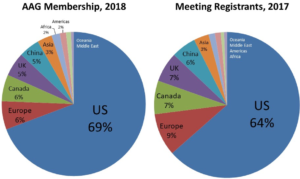
We have always been the “AAG” but five years ago the membership overwhelmingly decided to change the full title from the Association of American Geographers to the American Association of Geographers. I remember being part of the Council when this change was discussed. It went beyond verbal tweaking and reflected our best efforts to recognize that the AAG was no longer just an organization of U.S.-based geographers. Instead we had become a community in which geographers from many countries gather.

Continue Reading.


ANNUAL MEETING

2020 AAG Annual Meeting Past-President’s Address Announced

AAG Past President Sheryl Luzzadder-Beach will focus on the theme of Science, Geography, and Human Rights for her address at the 2020 AAG Annual Meeting. The AAG is a founding member of the AAAS Science and Human Rights Coalition, which just celebrated its 10th anniversary in Fall 2019. This address will highlight the roles played by AAG and Geography in the coalition, and address the broader impacts that geographers can and do contribute to promoting Science and Human Rights. To open the Past President’s Session, Luzzadder-Beach will present the 2020 AAG Presidential Achievement Awards to Sally P. Horn, professor of Geography at the University of Tennessee, and Nicholas P. Dunning, professor and head of Geography at the University of Cincinnati, for their long-term, major contributions to the discipline.

Learn more.

#aagDENVER and COVID-19 Updates

The AAG is following World Health Organization (WHO) guidelines for preparing for large gatherings, and is proceeding as scheduled with its plans for the 2020 Annual Meeting. Updates on this developing situation will be posted on our website as they become available.

Stay informed.

Download the AAG Mobile App Today!

Tired of carrying a large printed program around the AAG Annual Meeting? Want to easily organize your AAG session schedule in a digital calendar format? Make the most of your AAG annual meeting experience by downloading the AAG mobile app. Don’t wait until you’re standing in the registration line. Get the app now and start planning your schedule.

Go green with the AAG Mobile App.

What will be Presented at the 2020 AAG Meeting?
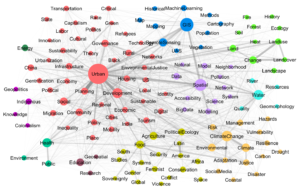
Curious about all 4,893 papers and posters that will be presented during the 2020 AAG Annual Meeting in Denver, CO next month? Geographers Jeong Chang Seong, Chul Sue Hwang, Ana Stanescue, Yubin Lee, and Youngho Lee used keywords network analysis to create a visual summary of the research that meeting attendees can expect to see in April. Based on presentation keywords, urban stood out the most!

See the full network analysis.

Jobs and Careers Center at the 2020 AAG Annual Meeting

During #aagDENVER, the AAG Jobs & Careers Center will be located in Mineral Hall A, B/C and D/E on the Third Floor of the Hyatt. It provides a central location for job seekers, students, and professionals to interact and to learn more about careers and professional development for geographers. A careers information table will be staffed and accessible each day for general questions, information, and resources.

Learn about the Center’s offerings

Don’t delay – book your room for #aagDENVER today!

AAG has negotiated a discounted block of hotel rooms at the 2020 AAG Annual Meeting headquarters hotels, the Sheraton Denver Downtown and the Hyatt Regency – Denver. This rate is available on a first come, first served basis until March 13. Now that the preliminary program has been released, rooms will start going fast.


PUBLICATIONS

NEW Annals of the American Association of Geographers Issue Alert:
The 2020 Special Issue of the Annals on Smart Spaces and Places
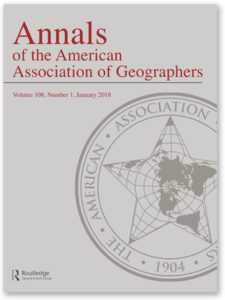
Annals-generic-225x300-1The Annals publishes a special issue each year to highlight research around a specific theme of global importance. The twelfth annual special issue includes 21 articles on smart spaces and places and is guest edited by Ling Bian. The articles are divided into four sections: spaces, places, and smart-ness; analytical smartness; critical smartness; and smart sustainability and policy. Throughout the issue, the authors explore theoretical, methodological, and empirical approaches to address questions such as how to make spaces and places ‘smart’, how the ‘smartness’ affects the way we perceive, analyze, and visualize spaces and places, and what role geographies play in knowledge production and decision making in such a ‘smart’ era. The 2020 special issue serves as a critical discussion of smartness as society moves into a new era.

Read more about the 2020 Special Issue.

Questions about the Annals? Contact annals [at] aag [dot] org.

Journals-newsletter-100In addition to the most recently published journal, read the latest issue of the other AAG journals online:

• Annals of the American Association of Geographers
• The Professional Geographer
• GeoHumanities
• The AAG Review of Books

New Books in Geography — January Available

ATTACHMENT DETAILS New-books1-1-1From Silk Roads to Rwandan streets, there are always new titles in geography and related disciplines to be found on the New Books in Geography list. Some of these books will be reviewed in the AAG Review of Books. Persons wishing to volunteer their reviewing services for new books should have the requisite qualifications and demonstrable prior knowledge and engagement with the subject area, preferably through publications. Please contact the editors at aagrb [at] lsu [dot] edu if you are interested in being a reviewer.

Browse the full list of new books.

New issue of African Geographical Review

African-Geographical-Review-cvr-212x300-1The latest issue of the journal of the Africa Specialty Group of the AAG, the African Geographical Review, has recently been published. Volume 39, Issue 1 (January 2020) is available online for subscribers and members of the Africa Specialty Group. The latest issue contains five articles covering all sub-fields of geography, to enhance the standing of African regional geography, and to promote a better representation of African scholarship.

See more about the journal.


ASSOCIATION NEWS

2020 AAG Election Results

Election-button-1The AAG members have spoken and the candidates running for various AAG governance positions have been selected. Election results for the 2020 AAG Election have been posted. Congratulations to all who will be assuming their new roles on July 1st. The AAG thanks those whose terms will be concluding later this year.

See the results.

AAG Policies and Practices for Inclusion and Respect

AAG’s commitment to safe, welcoming, and inclusive gatherings is a direct outgrowth of our support and service to the geography profession. Building on the work of the AAG’s Anti-Harassment taskforce, the AAG has strengthened its policy on Anti-Discrimination and Anti-Harassment established during the 2019 AAG Annual Meeting, and added to its practices for inclusion and respect at the AAG Annual Meeting. The AAG takes seriously its responsibility to inclusion and respect for members of the Association and the geography profession.

Read more.

AAG Announces Additional 2020 AAG Award Recipients

Congratulations to the recipients of 2020 AAG Awards including the AAG Harm de Blij Award for Excellence in Undergraduate Teaching, the AAG Presidential Achievement Award, the new AAG-Kauffman Awards for Best Paper and Best Student Paper in Geography & Entrepreneurship, the AAG Marcus Fund for Physical Geography Award, the 2020 William L. Garrison Award for Best Dissertation in Computational Geography, the 2020 Anne U. White Grant, the 2020 Dissertation Research Grant recipients, and the 2020 Research Grant recipients! Formal recognition of the awardees will occur during the AAG Awards Luncheon at the Annual Meeting on Friday, April 10, 2020.

Learn more about the awardees.

AAG Announces 2019 Book Awards

The AAG is pleased to announce the recipients of the three 2019 AAG Book Awards: the John Brinckerhoff Jackson Prize, the AAG Globe Book Award for Public Understanding of Geography, and the AAG Meridian Book Award for Outstanding Scholarly Work in Geography. The AAG Book Awards mark distinguished and outstanding works published by geography authors during the previous year, 2019. Formal recognition of the awardees will occur during the AAG Awards Luncheon at the Annual Meeting on Friday, April 10, 2020.

See the Book Awards.


POLICY CORNER

Understanding the President’s Budget Request
Image-118 capitol building

The Trump Administration released its proposed fiscal year (FY) 2021 budget request to Congress last month on February 10th, thus kicking off the annual Congressional appropriations process. In some good news, last year’s bipartisan budget agreement provided relief on FY 2020 and FY 2021 spending from previously outdated budget caps. But even with those caps raised, FY 2021 appropriations are still having to be crafted under only marginally higher limits.

At first glance, President Trump’s budget raises some serious concerns. The suggested funding numbers see significant cuts for agencies that support scientific research and development including the National Science Foundation (NSF), the National Institutes of Health (NIH), the Department of Education (DOE), and some basic research within the Department of Defense (DOD). But when it comes to actual funding numbers reached at the end of the lengthy appropriations process, how much does this suggested budget matter? The answer is, not much. Traditionally, the President’s Budget Request has been an opportunity for the White House to start the year off by outlining its priorities. However, once Congress takes the reigns these numbers serve merely as suggestions. The real groundwork happens in House and Senate committees that spend the next several months negotiating all the finer details of a comprehensive appropriations package. In recent years when these negotiations run up against the September 30th fiscal year deadline, we see Congress extend current fiscal year numbers with a “Continuing Resolution” to allow themselves more time. In most cases, the final appropriations bill passed looks vastly different than the President’s Budget Request.

As this annual appropriations cycle kicks off, the AAG continues to serve members by advocating for full Congressional funding of agencies that support programs and administer grants for scientific research and development in the discipline and many subdisciplines of geography.

In the News:

  • For a deeper dive on the President’s FY 2021 Budget Request and the proposed cuts for the broader scientific research community, feel free to check out analyses from the American Association for the Advancement Science (AAAS) or the Consortium of Social Science Associations (COSSA).
  • Call for Comments: The White House Office of Science and Technology Policy (OSTP) recently issued a Request for Public Comment entitled “Draft Desirable Characteristics of Repositories for Managing and Sharing Data Resulting from Federally Funded Research.” OSTP is collecting this feedback in order to develop common characteristics that agencies can use to improve the management and sharing of data from federally funded research. You can go through the Federal Register to submit comments as an individual or institution. The comment period closes March 6th, 2020.
  • Save the Date: Looking for more on how to get involved in public policy and advocacy? Attend Speaking up for Science: Your Advocacy and Legal Toolkit on Wednesday, April 8th at the AAG Annual Meeting in Denver.

MEMBER NEWS

Profiles of Professional Geographers

This month, we checked in with Patricia Syvrud, the Minerals, Materials and Society Program Manager at University of Delaware! What advice does Syvrud give to those looking to develop their geography career? “Follow your passion and think outside the box. If you can’t find a job in your area of interest, don’t be afraid to volunteer your time which can lead to employment opportunities.”

Learn more about Geography Careers.


RESOURCES AND OPPORTUNITIES

Webinar & #aagDENVER Session on harnessing the geospatial components in social science research data

In March, the AAG will partner with the Inter-university Consortium for Political and Social Research (ICPSR) to offer a free webinar to explore the geospatial components of ICPSR’s data and research services. ICPSR is an international, member-based association of more than 780 academic institutions and research organizations that maintains an archive of more than 250,000 research data files in the social and behavioral sciences. It hosts specialized collections related to education, aging, criminal justice, substance abuse, arts, and more. This free webinar explores how much ICPSR’s data archive has to offer geographers, with spatial information that opens up the potential for mapping, geocoding, and spatial analysis. The webinar will examine how the data archive can influence geographic research.

Register and secure your seat in the webinar.

Geography Education Research at the AAG Annual Meeting
NCRGE_logoEach year for the AAG Annual Meeting, the National Center for Research in Geography Education (NCRGE) organizes and compiles a track of papers, posters, and panels focusing on geography education research. NCRGE is sponsoring this track to raise the visibility of research in geography education, grow the NCRGE research coordination network, and provide productive spaces for discussion about geography education research and what makes research in the field potentially transformative.

View the NCRGE track schedule at the 2020 AAG Annual Meeting in Denver

New NSF Human-Environment and Geographical Sciences (HEGS) solicitation

national science foundation nsfThe NSF announced the issuance of a new program name and solicitation, Human-Environment and Geographical Sciences (HEGS, NSF 20-547), replacing Geography and Spatial Sciences (GSS, NSF 17-566). The name change articulates more clearly the human, environmental, and geographical sciences that are appropriate for funding at the National Science Foundation (NSF) as the name change better reflects the agency’s mission to “promote the progress of science; to advance the national health, prosperity, and welfare; and to secure the national defense,” as well as HEGS’s location in the Division of Behavioral and Cognitive Sciences in the Directorate for Social, Behavioral, and Economic Sciences. Note that the program will be accepting proposals two times per year, in August and January, with the 2020 deadline falling on August 18, 2020. The program will continue to accept Doctoral Dissertation Research Improvement (DDRI) proposals under the existing GSS DDRI solicitation (NSF 17-567).

More information.


IN MEMORIAM

Carl Lewis Johannessen

The AAG is saddened to hear of the passing of Carl Lewis Johannessen, a Professor Emeritus and former chair of the Department of Geography at the University of Oregon. Johannessen, who had been a part of the University of Oregon since 1959, was most interested in cultural-plant geography, especially that of pre-Columbian plant diffusion. A student of the Berkeley School under Carl Sauer, Johannessen’s horticultural work took him throughout Central American and South Asia.

Continue reading.

GEOGRAPHERS IN THE NEWS
EVENTS CALENDAR
    Share

Newsletter – February 2020

PRESIDENT’S COLUMN

Going Global or How Best to Recognize the Internationalization of the AAG

By David Kaplan

We have always been the “AAG” but five years ago the membership overwhelmingly decided to change the full title from the Association of American Geographers to the American Association of Geographers. I remember being part of the Council when this change was discussed. It went beyond verbal tweaking and reflected our best efforts to recognize that the AAG was no longer just an organization of U.S.-based geographers. Instead we had become a community in which geographers from many countries gather.

Continue Reading.


ANNUAL MEETING

2020 AAG Annual Meeting Past-President’s Address Announced

AAG Past President Sheryl Luzzadder-Beach will focus on the theme of Science, Geography, and Human Rights for her address at the 2020 AAG Annual Meeting. The AAG is a founding member of the AAAS Science and Human Rights Coalition, which just celebrated its 10th anniversary in Fall 2019. This address will highlight the roles played by AAG and Geography in the coalition, and address the broader impacts that geographers can and do contribute to promoting Science and Human Rights. To open the Past President’s Session, Luzzadder-Beach will present the 2020 AAG Presidential Achievement Awards to Sally P. Horn, professor of Geography at the University of Tennessee, and Nicholas P. Dunning, professor and head of Geography at the University of Cincinnati, for their long-term, major contributions to the discipline.

Learn more.

#aagDENVER and COVID-19 Updates

The AAG is following World Health Organization (WHO) guidelines for preparing for large gatherings, and is proceeding as scheduled with its plans for the 2020 Annual Meeting. Updates on this developing situation will be posted on our website as they become available.

Stay informed.

Download the AAG Mobile App Today!

Tired of carrying a large printed program around the AAG Annual Meeting? Want to easily organize your AAG session schedule in a digital calendar format? Make the most of your AAG annual meeting experience by downloading the AAG mobile app. Don’t wait until you’re standing in the registration line. Get the app now and start planning your schedule.

Go green with the AAG Mobile App.

What will be Presented at the 2020 AAG Meeting?

Curious about all 4,893 papers and posters that will be presented during the 2020 AAG Annual Meeting in Denver, CO next month? Geographers Jeong Chang Seong, Chul Sue Hwang, Ana Stanescue, Yubin Lee, and Youngho Lee used keywords network analysis to create a visual summary of the research that meeting attendees can expect to see in April. Based on presentation keywords, urban stood out the most!

See the full network analysis.

Jobs and Careers Center at the 2020 AAG Annual Meeting

During #aagDENVER, the AAG Jobs & Careers Center will be located in Mineral Hall A, B/C and D/E on the Third Floor of the Hyatt. It provides a central location for job seekers, students, and professionals to interact and to learn more about careers and professional development for geographers. A careers information table will be staffed and accessible each day for general questions, information, and resources.

Learn about the Center’s offerings

Don’t delay – book your room for #aagDENVER today!

AAG has negotiated a discounted block of hotel rooms at the 2020 AAG Annual Meeting headquarters hotels, the Sheraton Denver Downtown and the Hyatt Regency – Denver. This rate is available on a first come, first served basis until March 13. Now that the preliminary program has been released, rooms will start going fast.


PUBLICATIONS

NEW Annals of the American Association of Geographers Issue Alert:
The 2020 Special Issue of the Annals on Smart Spaces and Places

Annals-generic-225x300-1The Annals publishes a special issue each year to highlight research around a specific theme of global importance. The twelfth annual special issue includes 21 articles on smart spaces and places and is guest edited by Ling Bian. The articles are divided into four sections: spaces, places, and smart-ness; analytical smartness; critical smartness; and smart sustainability and policy. Throughout the issue, the authors explore theoretical, methodological, and empirical approaches to address questions such as how to make spaces and places ‘smart’, how the ‘smartness’ affects the way we perceive, analyze, and visualize spaces and places, and what role geographies play in knowledge production and decision making in such a ‘smart’ era. The 2020 special issue serves as a critical discussion of smartness as society moves into a new era.

Read more about the 2020 Special Issue.

Questions about the Annals? Contact annals [at] aag [dot] org.

Journals-newsletter-100In addition to the most recently published journal, read the latest issue of the other AAG journals online:

• Annals of the American Association of Geographers
• The Professional Geographer
• GeoHumanities
• The AAG Review of Books

New Books in Geography — January Available

ATTACHMENT DETAILS New-books1-1-1From Silk Roads to Rwandan streets, there are always new titles in geography and related disciplines to be found on the New Books in Geography list. Some of these books will be reviewed in the AAG Review of Books. Persons wishing to volunteer their reviewing services for new books should have the requisite qualifications and demonstrable prior knowledge and engagement with the subject area, preferably through publications. Please contact the editors at aagrb [at] lsu [dot] edu if you are interested in being a reviewer.

Browse the full list of new books.

New issue of African Geographical Review

African-Geographical-Review-cvr-212x300-1The latest issue of the journal of the Africa Specialty Group of the AAG, the African Geographical Review, has recently been published. Volume 39, Issue 1 (January 2020) is available online for subscribers and members of the Africa Specialty Group. The latest issue contains five articles covering all sub-fields of geography, to enhance the standing of African regional geography, and to promote a better representation of African scholarship.

See more about the journal.


ASSOCIATION NEWS

2020 AAG Election Results

Election-button-1The AAG members have spoken and the candidates running for various AAG governance positions have been selected. Election results for the 2020 AAG Election have been posted. Congratulations to all who will be assuming their new roles on July 1st. The AAG thanks those whose terms will be concluding later this year.

See the results.

AAG Policies and Practices for Inclusion and Respect

AAG’s commitment to safe, welcoming, and inclusive gatherings is a direct outgrowth of our support and service to the geography profession. Building on the work of the AAG’s Anti-Harassment taskforce, the AAG has strengthened its policy on Anti-Discrimination and Anti-Harassment established during the 2019 AAG Annual Meeting, and added to its practices for inclusion and respect at the AAG Annual Meeting. The AAG takes seriously its responsibility to inclusion and respect for members of the Association and the geography profession.

Read more.

AAG Announces Additional 2020 AAG Award Recipients

Congratulations to the recipients of 2020 AAG Awards including the AAG Harm de Blij Award for Excellence in Undergraduate Teaching, the AAG Presidential Achievement Award, the new AAG-Kauffman Awards for Best Paper and Best Student Paper in Geography & Entrepreneurship, the AAG Marcus Fund for Physical Geography Award, the 2020 William L. Garrison Award for Best Dissertation in Computational Geography, the 2020 Anne U. White Grant, the 2020 Dissertation Research Grant recipients, and the 2020 Research Grant recipients! Formal recognition of the awardees will occur during the AAG Awards Luncheon at the Annual Meeting on Friday, April 10, 2020.

Learn more about the awardees.

AAG Announces 2019 Book Awards

The AAG is pleased to announce the recipients of the three 2019 AAG Book Awards: the John Brinckerhoff Jackson Prize, the AAG Globe Book Award for Public Understanding of Geography, and the AAG Meridian Book Award for Outstanding Scholarly Work in Geography. The AAG Book Awards mark distinguished and outstanding works published by geography authors during the previous year, 2019. Formal recognition of the awardees will occur during the AAG Awards Luncheon at the Annual Meeting on Friday, April 10, 2020.

See the Book Awards.


POLICY CORNER

Understanding the President’s Budget Request

Image-118 capitol building

The Trump Administration released its proposed fiscal year (FY) 2021 budget request to Congress last month on February 10th, thus kicking off the annual Congressional appropriations process. In some good news, last year’s bipartisan budget agreement provided relief on FY 2020 and FY 2021 spending from previously outdated budget caps. But even with those caps raised, FY 2021 appropriations are still having to be crafted under only marginally higher limits.

At first glance, President Trump’s budget raises some serious concerns. The suggested funding numbers see significant cuts for agencies that support scientific research and development including the National Science Foundation (NSF), the National Institutes of Health (NIH), the Department of Education (DOE), and some basic research within the Department of Defense (DOD). But when it comes to actual funding numbers reached at the end of the lengthy appropriations process, how much does this suggested budget matter? The answer is, not much. Traditionally, the President’s Budget Request has been an opportunity for the White House to start the year off by outlining its priorities. However, once Congress takes the reigns these numbers serve merely as suggestions. The real groundwork happens in House and Senate committees that spend the next several months negotiating all the finer details of a comprehensive appropriations package. In recent years when these negotiations run up against the September 30th fiscal year deadline, we see Congress extend current fiscal year numbers with a “Continuing Resolution” to allow themselves more time. In most cases, the final appropriations bill passed looks vastly different than the President’s Budget Request.

As this annual appropriations cycle kicks off, the AAG continues to serve members by advocating for full Congressional funding of agencies that support programs and administer grants for scientific research and development in the discipline and many subdisciplines of geography.

In the News:

  • For a deeper dive on the President’s FY 2021 Budget Request and the proposed cuts for the broader scientific research community, feel free to check out analyses from the American Association for the Advancement Science (AAAS) or the Consortium of Social Science Associations (COSSA).
  • Call for Comments: The White House Office of Science and Technology Policy (OSTP) recently issued a Request for Public Comment entitled “Draft Desirable Characteristics of Repositories for Managing and Sharing Data Resulting from Federally Funded Research.” OSTP is collecting this feedback in order to develop common characteristics that agencies can use to improve the management and sharing of data from federally funded research. You can go through the Federal Register to submit comments as an individual or institution. The comment period closes March 6th, 2020.
  • Save the Date: Looking for more on how to get involved in public policy and advocacy? Attend Speaking up for Science: Your Advocacy and Legal Toolkit on Wednesday, April 8th at the AAG Annual Meeting in Denver.

MEMBER NEWS

Profiles of Professional Geographers

This month, we checked in with Patricia Syvrud, the Minerals, Materials and Society Program Manager at University of Delaware! What advice does Syvrud give to those looking to develop their geography career? “Follow your passion and think outside the box. If you can’t find a job in your area of interest, don’t be afraid to volunteer your time which can lead to employment opportunities.”

Learn more about Geography Careers.


RESOURCES AND OPPORTUNITIES

Webinar & #aagDENVER Session on harnessing the geospatial components in social science research data

In March, the AAG will partner with the Inter-university Consortium for Political and Social Research (ICPSR) to offer a free webinar to explore the geospatial components of ICPSR’s data and research services. ICPSR is an international, member-based association of more than 780 academic institutions and research organizations that maintains an archive of more than 250,000 research data files in the social and behavioral sciences. It hosts specialized collections related to education, aging, criminal justice, substance abuse, arts, and more. This free webinar explores how much ICPSR’s data archive has to offer geographers, with spatial information that opens up the potential for mapping, geocoding, and spatial analysis. The webinar will examine how the data archive can influence geographic research.

Register and secure your seat in the webinar.

Geography Education Research at the AAG Annual Meeting

NCRGE_logoEach year for the AAG Annual Meeting, the National Center for Research in Geography Education (NCRGE) organizes and compiles a track of papers, posters, and panels focusing on geography education research. NCRGE is sponsoring this track to raise the visibility of research in geography education, grow the NCRGE research coordination network, and provide productive spaces for discussion about geography education research and what makes research in the field potentially transformative.

View the NCRGE track schedule at the 2020 AAG Annual Meeting in Denver

New NSF Human-Environment and Geographical Sciences (HEGS) solicitation

national science foundation nsfThe NSF announced the issuance of a new program name and solicitation, Human-Environment and Geographical Sciences (HEGS, NSF 20-547), replacing Geography and Spatial Sciences (GSS, NSF 17-566). The name change articulates more clearly the human, environmental, and geographical sciences that are appropriate for funding at the National Science Foundation (NSF) as the name change better reflects the agency’s mission to “promote the progress of science; to advance the national health, prosperity, and welfare; and to secure the national defense,” as well as HEGS’s location in the Division of Behavioral and Cognitive Sciences in the Directorate for Social, Behavioral, and Economic Sciences. Note that the program will be accepting proposals two times per year, in August and January, with the 2020 deadline falling on August 18, 2020. The program will continue to accept Doctoral Dissertation Research Improvement (DDRI) proposals under the existing GSS DDRI solicitation (NSF 17-567).

More information.


IN MEMORIAM

Carl Lewis Johannessen

The AAG is saddened to hear of the passing of Carl Lewis Johannessen, a Professor Emeritus and former chair of the Department of Geography at the University of Oregon. Johannessen, who had been a part of the University of Oregon since 1959, was most interested in cultural-plant geography, especially that of pre-Columbian plant diffusion. A student of the Berkeley School under Carl Sauer, Johannessen’s horticultural work took him throughout Central American and South Asia.

Continue reading.

GEOGRAPHERS IN THE NEWS
EVENTS CALENDAR
    Share

Newsletter – January 2020

PRESIDENT’S COLUMN

Going Global or How Best to Recognize the Internationalization of the AAG

By David Kaplan

We have always been the “AAG” but five years ago the membership overwhelmingly decided to change the full title from the Association of American Geographers to the American Association of Geographers. I remember being part of the Council when this change was discussed. It went beyond verbal tweaking and reflected our best efforts to recognize that the AAG was no longer just an organization of U.S.-based geographers. Instead we had become a community in which geographers from many countries gather.

Continue Reading.


ANNUAL MEETING

2020 AAG Annual Meeting Past-President’s Address Announced

AAG Past President Sheryl Luzzadder-Beach will focus on the theme of Science, Geography, and Human Rights for her address at the 2020 AAG Annual Meeting. The AAG is a founding member of the AAAS Science and Human Rights Coalition, which just celebrated its 10th anniversary in Fall 2019. This address will highlight the roles played by AAG and Geography in the coalition, and address the broader impacts that geographers can and do contribute to promoting Science and Human Rights. To open the Past President’s Session, Luzzadder-Beach will present the 2020 AAG Presidential Achievement Awards to Sally P. Horn, professor of Geography at the University of Tennessee, and Nicholas P. Dunning, professor and head of Geography at the University of Cincinnati, for their long-term, major contributions to the discipline.

Learn more.

#aagDENVER and COVID-19 Updates

The AAG is following World Health Organization (WHO) guidelines for preparing for large gatherings, and is proceeding as scheduled with its plans for the 2020 Annual Meeting. Updates on this developing situation will be posted on our website as they become available.

Stay informed.

Download the AAG Mobile App Today!

Tired of carrying a large printed program around the AAG Annual Meeting? Want to easily organize your AAG session schedule in a digital calendar format? Make the most of your AAG annual meeting experience by downloading the AAG mobile app. Don’t wait until you’re standing in the registration line. Get the app now and start planning your schedule.

Go green with the AAG Mobile App.

What will be Presented at the 2020 AAG Meeting?

Curious about all 4,893 papers and posters that will be presented during the 2020 AAG Annual Meeting in Denver, CO next month? Geographers Jeong Chang Seong, Chul Sue Hwang, Ana Stanescue, Yubin Lee, and Youngho Lee used keywords network analysis to create a visual summary of the research that meeting attendees can expect to see in April. Based on presentation keywords, urban stood out the most!

See the full network analysis.

Jobs and Careers Center at the 2020 AAG Annual Meeting

During #aagDENVER, the AAG Jobs & Careers Center will be located in Mineral Hall A, B/C and D/E on the Third Floor of the Hyatt. It provides a central location for job seekers, students, and professionals to interact and to learn more about careers and professional development for geographers. A careers information table will be staffed and accessible each day for general questions, information, and resources.

Learn about the Center’s offerings

Don’t delay – book your room for #aagDENVER today!

AAG has negotiated a discounted block of hotel rooms at the 2020 AAG Annual Meeting headquarters hotels, the Sheraton Denver Downtown and the Hyatt Regency – Denver. This rate is available on a first come, first served basis until March 13. Now that the preliminary program has been released, rooms will start going fast.


PUBLICATIONS

NEW Annals of the American Association of Geographers Issue Alert:
The 2020 Special Issue of the Annals on Smart Spaces and Places

Annals-generic-225x300-1The Annals publishes a special issue each year to highlight research around a specific theme of global importance. The twelfth annual special issue includes 21 articles on smart spaces and places and is guest edited by Ling Bian. The articles are divided into four sections: spaces, places, and smart-ness; analytical smartness; critical smartness; and smart sustainability and policy. Throughout the issue, the authors explore theoretical, methodological, and empirical approaches to address questions such as how to make spaces and places ‘smart’, how the ‘smartness’ affects the way we perceive, analyze, and visualize spaces and places, and what role geographies play in knowledge production and decision making in such a ‘smart’ era. The 2020 special issue serves as a critical discussion of smartness as society moves into a new era.

Read more about the 2020 Special Issue.

Questions about the Annals? Contact annals [at] aag [dot] org.

Journals-newsletter-100In addition to the most recently published journal, read the latest issue of the other AAG journals online:

• Annals of the American Association of Geographers
• The Professional Geographer
• GeoHumanities
• The AAG Review of Books

New Books in Geography — January Available

ATTACHMENT DETAILS New-books1-1-1From Silk Roads to Rwandan streets, there are always new titles in geography and related disciplines to be found on the New Books in Geography list. Some of these books will be reviewed in the AAG Review of Books. Persons wishing to volunteer their reviewing services for new books should have the requisite qualifications and demonstrable prior knowledge and engagement with the subject area, preferably through publications. Please contact the editors at aagrb [at] lsu [dot] edu if you are interested in being a reviewer.

Browse the full list of new books.

New issue of African Geographical Review

African-Geographical-Review-cvr-212x300-1The latest issue of the journal of the Africa Specialty Group of the AAG, the African Geographical Review, has recently been published. Volume 39, Issue 1 (January 2020) is available online for subscribers and members of the Africa Specialty Group. The latest issue contains five articles covering all sub-fields of geography, to enhance the standing of African regional geography, and to promote a better representation of African scholarship.

See more about the journal.


ASSOCIATION NEWS

2020 AAG Election Results

Election-button-1The AAG members have spoken and the candidates running for various AAG governance positions have been selected. Election results for the 2020 AAG Election have been posted. Congratulations to all who will be assuming their new roles on July 1st. The AAG thanks those whose terms will be concluding later this year.

See the results.

AAG Policies and Practices for Inclusion and Respect

AAG’s commitment to safe, welcoming, and inclusive gatherings is a direct outgrowth of our support and service to the geography profession. Building on the work of the AAG’s Anti-Harassment taskforce, the AAG has strengthened its policy on Anti-Discrimination and Anti-Harassment established during the 2019 AAG Annual Meeting, and added to its practices for inclusion and respect at the AAG Annual Meeting. The AAG takes seriously its responsibility to inclusion and respect for members of the Association and the geography profession.

Read more.

AAG Announces Additional 2020 AAG Award Recipients

Congratulations to the recipients of 2020 AAG Awards including the AAG Harm de Blij Award for Excellence in Undergraduate Teaching, the AAG Presidential Achievement Award, the new AAG-Kauffman Awards for Best Paper and Best Student Paper in Geography & Entrepreneurship, the AAG Marcus Fund for Physical Geography Award, the 2020 William L. Garrison Award for Best Dissertation in Computational Geography, the 2020 Anne U. White Grant, the 2020 Dissertation Research Grant recipients, and the 2020 Research Grant recipients! Formal recognition of the awardees will occur during the AAG Awards Luncheon at the Annual Meeting on Friday, April 10, 2020.

Learn more about the awardees.

AAG Announces 2019 Book Awards

The AAG is pleased to announce the recipients of the three 2019 AAG Book Awards: the John Brinckerhoff Jackson Prize, the AAG Globe Book Award for Public Understanding of Geography, and the AAG Meridian Book Award for Outstanding Scholarly Work in Geography. The AAG Book Awards mark distinguished and outstanding works published by geography authors during the previous year, 2019. Formal recognition of the awardees will occur during the AAG Awards Luncheon at the Annual Meeting on Friday, April 10, 2020.

See the Book Awards.


POLICY CORNER

Understanding the President’s Budget Request

Image-118 capitol building

The Trump Administration released its proposed fiscal year (FY) 2021 budget request to Congress last month on February 10th, thus kicking off the annual Congressional appropriations process. In some good news, last year’s bipartisan budget agreement provided relief on FY 2020 and FY 2021 spending from previously outdated budget caps. But even with those caps raised, FY 2021 appropriations are still having to be crafted under only marginally higher limits.

At first glance, President Trump’s budget raises some serious concerns. The suggested funding numbers see significant cuts for agencies that support scientific research and development including the National Science Foundation (NSF), the National Institutes of Health (NIH), the Department of Education (DOE), and some basic research within the Department of Defense (DOD). But when it comes to actual funding numbers reached at the end of the lengthy appropriations process, how much does this suggested budget matter? The answer is, not much. Traditionally, the President’s Budget Request has been an opportunity for the White House to start the year off by outlining its priorities. However, once Congress takes the reigns these numbers serve merely as suggestions. The real groundwork happens in House and Senate committees that spend the next several months negotiating all the finer details of a comprehensive appropriations package. In recent years when these negotiations run up against the September 30th fiscal year deadline, we see Congress extend current fiscal year numbers with a “Continuing Resolution” to allow themselves more time. In most cases, the final appropriations bill passed looks vastly different than the President’s Budget Request.

As this annual appropriations cycle kicks off, the AAG continues to serve members by advocating for full Congressional funding of agencies that support programs and administer grants for scientific research and development in the discipline and many subdisciplines of geography.

In the News:

  • For a deeper dive on the President’s FY 2021 Budget Request and the proposed cuts for the broader scientific research community, feel free to check out analyses from the American Association for the Advancement Science (AAAS) or the Consortium of Social Science Associations (COSSA).
  • Call for Comments: The White House Office of Science and Technology Policy (OSTP) recently issued a Request for Public Comment entitled “Draft Desirable Characteristics of Repositories for Managing and Sharing Data Resulting from Federally Funded Research.” OSTP is collecting this feedback in order to develop common characteristics that agencies can use to improve the management and sharing of data from federally funded research. You can go through the Federal Register to submit comments as an individual or institution. The comment period closes March 6th, 2020.
  • Save the Date: Looking for more on how to get involved in public policy and advocacy? Attend Speaking up for Science: Your Advocacy and Legal Toolkit on Wednesday, April 8th at the AAG Annual Meeting in Denver.

MEMBER NEWS

Profiles of Professional Geographers

This month, we checked in with Patricia Syvrud, the Minerals, Materials and Society Program Manager at University of Delaware! What advice does Syvrud give to those looking to develop their geography career? “Follow your passion and think outside the box. If you can’t find a job in your area of interest, don’t be afraid to volunteer your time which can lead to employment opportunities.”

Learn more about Geography Careers.


RESOURCES AND OPPORTUNITIES

Webinar & #aagDENVER Session on harnessing the geospatial components in social science research data

In March, the AAG will partner with the Inter-university Consortium for Political and Social Research (ICPSR) to offer a free webinar to explore the geospatial components of ICPSR’s data and research services. ICPSR is an international, member-based association of more than 780 academic institutions and research organizations that maintains an archive of more than 250,000 research data files in the social and behavioral sciences. It hosts specialized collections related to education, aging, criminal justice, substance abuse, arts, and more. This free webinar explores how much ICPSR’s data archive has to offer geographers, with spatial information that opens up the potential for mapping, geocoding, and spatial analysis. The webinar will examine how the data archive can influence geographic research.

Register and secure your seat in the webinar.

Geography Education Research at the AAG Annual Meeting

NCRGE_logoEach year for the AAG Annual Meeting, the National Center for Research in Geography Education (NCRGE) organizes and compiles a track of papers, posters, and panels focusing on geography education research. NCRGE is sponsoring this track to raise the visibility of research in geography education, grow the NCRGE research coordination network, and provide productive spaces for discussion about geography education research and what makes research in the field potentially transformative.

View the NCRGE track schedule at the 2020 AAG Annual Meeting in Denver

New NSF Human-Environment and Geographical Sciences (HEGS) solicitation

national science foundation nsfThe NSF announced the issuance of a new program name and solicitation, Human-Environment and Geographical Sciences (HEGS, NSF 20-547), replacing Geography and Spatial Sciences (GSS, NSF 17-566). The name change articulates more clearly the human, environmental, and geographical sciences that are appropriate for funding at the National Science Foundation (NSF) as the name change better reflects the agency’s mission to “promote the progress of science; to advance the national health, prosperity, and welfare; and to secure the national defense,” as well as HEGS’s location in the Division of Behavioral and Cognitive Sciences in the Directorate for Social, Behavioral, and Economic Sciences. Note that the program will be accepting proposals two times per year, in August and January, with the 2020 deadline falling on August 18, 2020. The program will continue to accept Doctoral Dissertation Research Improvement (DDRI) proposals under the existing GSS DDRI solicitation (NSF 17-567).

More information.


IN MEMORIAM

Carl Lewis Johannessen

The AAG is saddened to hear of the passing of Carl Lewis Johannessen, a Professor Emeritus and former chair of the Department of Geography at the University of Oregon. Johannessen, who had been a part of the University of Oregon since 1959, was most interested in cultural-plant geography, especially that of pre-Columbian plant diffusion. A student of the Berkeley School under Carl Sauer, Johannessen’s horticultural work took him throughout Central American and South Asia.

Continue reading.

GEOGRAPHERS IN THE NEWS
EVENTS CALENDAR
    Share

Newsletter – December 2019

PRESIDENT’S COLUMN

Going Global or How Best to Recognize the Internationalization of the AAG

By David Kaplan

We have always been the “AAG” but five years ago the membership overwhelmingly decided to change the full title from the Association of American Geographers to the American Association of Geographers. I remember being part of the Council when this change was discussed. It went beyond verbal tweaking and reflected our best efforts to recognize that the AAG was no longer just an organization of U.S.-based geographers. Instead we had become a community in which geographers from many countries gather.

Continue Reading.


ANNUAL MEETING

2020 AAG Annual Meeting Past-President’s Address Announced

AAG Past President Sheryl Luzzadder-Beach will focus on the theme of Science, Geography, and Human Rights for her address at the 2020 AAG Annual Meeting. The AAG is a founding member of the AAAS Science and Human Rights Coalition, which just celebrated its 10th anniversary in Fall 2019. This address will highlight the roles played by AAG and Geography in the coalition, and address the broader impacts that geographers can and do contribute to promoting Science and Human Rights. To open the Past President’s Session, Luzzadder-Beach will present the 2020 AAG Presidential Achievement Awards to Sally P. Horn, professor of Geography at the University of Tennessee, and Nicholas P. Dunning, professor and head of Geography at the University of Cincinnati, for their long-term, major contributions to the discipline.

Learn more.

#aagDENVER and COVID-19 Updates

The AAG is following World Health Organization (WHO) guidelines for preparing for large gatherings, and is proceeding as scheduled with its plans for the 2020 Annual Meeting. Updates on this developing situation will be posted on our website as they become available.

Stay informed.

Download the AAG Mobile App Today!

Tired of carrying a large printed program around the AAG Annual Meeting? Want to easily organize your AAG session schedule in a digital calendar format? Make the most of your AAG annual meeting experience by downloading the AAG mobile app. Don’t wait until you’re standing in the registration line. Get the app now and start planning your schedule.

Go green with the AAG Mobile App.

What will be Presented at the 2020 AAG Meeting?

Curious about all 4,893 papers and posters that will be presented during the 2020 AAG Annual Meeting in Denver, CO next month? Geographers Jeong Chang Seong, Chul Sue Hwang, Ana Stanescue, Yubin Lee, and Youngho Lee used keywords network analysis to create a visual summary of the research that meeting attendees can expect to see in April. Based on presentation keywords, urban stood out the most!

See the full network analysis.

Jobs and Careers Center at the 2020 AAG Annual Meeting

During #aagDENVER, the AAG Jobs & Careers Center will be located in Mineral Hall A, B/C and D/E on the Third Floor of the Hyatt. It provides a central location for job seekers, students, and professionals to interact and to learn more about careers and professional development for geographers. A careers information table will be staffed and accessible each day for general questions, information, and resources.

Learn about the Center’s offerings

Don’t delay – book your room for #aagDENVER today!

AAG has negotiated a discounted block of hotel rooms at the 2020 AAG Annual Meeting headquarters hotels, the Sheraton Denver Downtown and the Hyatt Regency – Denver. This rate is available on a first come, first served basis until March 13. Now that the preliminary program has been released, rooms will start going fast.


PUBLICATIONS

NEW Annals of the American Association of Geographers Issue Alert:
The 2020 Special Issue of the Annals on Smart Spaces and Places

Annals-generic-225x300-1The Annals publishes a special issue each year to highlight research around a specific theme of global importance. The twelfth annual special issue includes 21 articles on smart spaces and places and is guest edited by Ling Bian. The articles are divided into four sections: spaces, places, and smart-ness; analytical smartness; critical smartness; and smart sustainability and policy. Throughout the issue, the authors explore theoretical, methodological, and empirical approaches to address questions such as how to make spaces and places ‘smart’, how the ‘smartness’ affects the way we perceive, analyze, and visualize spaces and places, and what role geographies play in knowledge production and decision making in such a ‘smart’ era. The 2020 special issue serves as a critical discussion of smartness as society moves into a new era.

Read more about the 2020 Special Issue.

Questions about the Annals? Contact annals [at] aag [dot] org.

Journals-newsletter-100In addition to the most recently published journal, read the latest issue of the other AAG journals online:

• Annals of the American Association of Geographers
• The Professional Geographer
• GeoHumanities
• The AAG Review of Books

New Books in Geography — January Available

ATTACHMENT DETAILS New-books1-1-1From Silk Roads to Rwandan streets, there are always new titles in geography and related disciplines to be found on the New Books in Geography list. Some of these books will be reviewed in the AAG Review of Books. Persons wishing to volunteer their reviewing services for new books should have the requisite qualifications and demonstrable prior knowledge and engagement with the subject area, preferably through publications. Please contact the editors at aagrb [at] lsu [dot] edu if you are interested in being a reviewer.

Browse the full list of new books.

New issue of African Geographical Review

African-Geographical-Review-cvr-212x300-1The latest issue of the journal of the Africa Specialty Group of the AAG, the African Geographical Review, has recently been published. Volume 39, Issue 1 (January 2020) is available online for subscribers and members of the Africa Specialty Group. The latest issue contains five articles covering all sub-fields of geography, to enhance the standing of African regional geography, and to promote a better representation of African scholarship.

See more about the journal.


ASSOCIATION NEWS

2020 AAG Election Results

Election-button-1The AAG members have spoken and the candidates running for various AAG governance positions have been selected. Election results for the 2020 AAG Election have been posted. Congratulations to all who will be assuming their new roles on July 1st. The AAG thanks those whose terms will be concluding later this year.

See the results.

AAG Policies and Practices for Inclusion and Respect

AAG’s commitment to safe, welcoming, and inclusive gatherings is a direct outgrowth of our support and service to the geography profession. Building on the work of the AAG’s Anti-Harassment taskforce, the AAG has strengthened its policy on Anti-Discrimination and Anti-Harassment established during the 2019 AAG Annual Meeting, and added to its practices for inclusion and respect at the AAG Annual Meeting. The AAG takes seriously its responsibility to inclusion and respect for members of the Association and the geography profession.

Read more.

AAG Announces Additional 2020 AAG Award Recipients

Congratulations to the recipients of 2020 AAG Awards including the AAG Harm de Blij Award for Excellence in Undergraduate Teaching, the AAG Presidential Achievement Award, the new AAG-Kauffman Awards for Best Paper and Best Student Paper in Geography & Entrepreneurship, the AAG Marcus Fund for Physical Geography Award, the 2020 William L. Garrison Award for Best Dissertation in Computational Geography, the 2020 Anne U. White Grant, the 2020 Dissertation Research Grant recipients, and the 2020 Research Grant recipients! Formal recognition of the awardees will occur during the AAG Awards Luncheon at the Annual Meeting on Friday, April 10, 2020.

Learn more about the awardees.

AAG Announces 2019 Book Awards

The AAG is pleased to announce the recipients of the three 2019 AAG Book Awards: the John Brinckerhoff Jackson Prize, the AAG Globe Book Award for Public Understanding of Geography, and the AAG Meridian Book Award for Outstanding Scholarly Work in Geography. The AAG Book Awards mark distinguished and outstanding works published by geography authors during the previous year, 2019. Formal recognition of the awardees will occur during the AAG Awards Luncheon at the Annual Meeting on Friday, April 10, 2020.

See the Book Awards.


POLICY CORNER

Understanding the President’s Budget Request

Image-118 capitol building

The Trump Administration released its proposed fiscal year (FY) 2021 budget request to Congress last month on February 10th, thus kicking off the annual Congressional appropriations process. In some good news, last year’s bipartisan budget agreement provided relief on FY 2020 and FY 2021 spending from previously outdated budget caps. But even with those caps raised, FY 2021 appropriations are still having to be crafted under only marginally higher limits.

At first glance, President Trump’s budget raises some serious concerns. The suggested funding numbers see significant cuts for agencies that support scientific research and development including the National Science Foundation (NSF), the National Institutes of Health (NIH), the Department of Education (DOE), and some basic research within the Department of Defense (DOD). But when it comes to actual funding numbers reached at the end of the lengthy appropriations process, how much does this suggested budget matter? The answer is, not much. Traditionally, the President’s Budget Request has been an opportunity for the White House to start the year off by outlining its priorities. However, once Congress takes the reigns these numbers serve merely as suggestions. The real groundwork happens in House and Senate committees that spend the next several months negotiating all the finer details of a comprehensive appropriations package. In recent years when these negotiations run up against the September 30th fiscal year deadline, we see Congress extend current fiscal year numbers with a “Continuing Resolution” to allow themselves more time. In most cases, the final appropriations bill passed looks vastly different than the President’s Budget Request.

As this annual appropriations cycle kicks off, the AAG continues to serve members by advocating for full Congressional funding of agencies that support programs and administer grants for scientific research and development in the discipline and many subdisciplines of geography.

In the News:

  • For a deeper dive on the President’s FY 2021 Budget Request and the proposed cuts for the broader scientific research community, feel free to check out analyses from the American Association for the Advancement Science (AAAS) or the Consortium of Social Science Associations (COSSA).
  • Call for Comments: The White House Office of Science and Technology Policy (OSTP) recently issued a Request for Public Comment entitled “Draft Desirable Characteristics of Repositories for Managing and Sharing Data Resulting from Federally Funded Research.” OSTP is collecting this feedback in order to develop common characteristics that agencies can use to improve the management and sharing of data from federally funded research. You can go through the Federal Register to submit comments as an individual or institution. The comment period closes March 6th, 2020.
  • Save the Date: Looking for more on how to get involved in public policy and advocacy? Attend Speaking up for Science: Your Advocacy and Legal Toolkit on Wednesday, April 8th at the AAG Annual Meeting in Denver.

MEMBER NEWS

Profiles of Professional Geographers

This month, we checked in with Patricia Syvrud, the Minerals, Materials and Society Program Manager at University of Delaware! What advice does Syvrud give to those looking to develop their geography career? “Follow your passion and think outside the box. If you can’t find a job in your area of interest, don’t be afraid to volunteer your time which can lead to employment opportunities.”

Learn more about Geography Careers.


RESOURCES AND OPPORTUNITIES

Webinar & #aagDENVER Session on harnessing the geospatial components in social science research data

In March, the AAG will partner with the Inter-university Consortium for Political and Social Research (ICPSR) to offer a free webinar to explore the geospatial components of ICPSR’s data and research services. ICPSR is an international, member-based association of more than 780 academic institutions and research organizations that maintains an archive of more than 250,000 research data files in the social and behavioral sciences. It hosts specialized collections related to education, aging, criminal justice, substance abuse, arts, and more. This free webinar explores how much ICPSR’s data archive has to offer geographers, with spatial information that opens up the potential for mapping, geocoding, and spatial analysis. The webinar will examine how the data archive can influence geographic research.

Register and secure your seat in the webinar.

Geography Education Research at the AAG Annual Meeting

NCRGE_logoEach year for the AAG Annual Meeting, the National Center for Research in Geography Education (NCRGE) organizes and compiles a track of papers, posters, and panels focusing on geography education research. NCRGE is sponsoring this track to raise the visibility of research in geography education, grow the NCRGE research coordination network, and provide productive spaces for discussion about geography education research and what makes research in the field potentially transformative.

View the NCRGE track schedule at the 2020 AAG Annual Meeting in Denver

New NSF Human-Environment and Geographical Sciences (HEGS) solicitation

national science foundation nsfThe NSF announced the issuance of a new program name and solicitation, Human-Environment and Geographical Sciences (HEGS, NSF 20-547), replacing Geography and Spatial Sciences (GSS, NSF 17-566). The name change articulates more clearly the human, environmental, and geographical sciences that are appropriate for funding at the National Science Foundation (NSF) as the name change better reflects the agency’s mission to “promote the progress of science; to advance the national health, prosperity, and welfare; and to secure the national defense,” as well as HEGS’s location in the Division of Behavioral and Cognitive Sciences in the Directorate for Social, Behavioral, and Economic Sciences. Note that the program will be accepting proposals two times per year, in August and January, with the 2020 deadline falling on August 18, 2020. The program will continue to accept Doctoral Dissertation Research Improvement (DDRI) proposals under the existing GSS DDRI solicitation (NSF 17-567).

More information.


IN MEMORIAM

Carl Lewis Johannessen

The AAG is saddened to hear of the passing of Carl Lewis Johannessen, a Professor Emeritus and former chair of the Department of Geography at the University of Oregon. Johannessen, who had been a part of the University of Oregon since 1959, was most interested in cultural-plant geography, especially that of pre-Columbian plant diffusion. A student of the Berkeley School under Carl Sauer, Johannessen’s horticultural work took him throughout Central American and South Asia.

Continue reading.

GEOGRAPHERS IN THE NEWS
EVENTS CALENDAR
    Share

Newsletter – November 2019

PRESIDENT’S COLUMN

Going Global or How Best to Recognize the Internationalization of the AAG

By David Kaplan

We have always been the “AAG” but five years ago the membership overwhelmingly decided to change the full title from the Association of American Geographers to the American Association of Geographers. I remember being part of the Council when this change was discussed. It went beyond verbal tweaking and reflected our best efforts to recognize that the AAG was no longer just an organization of U.S.-based geographers. Instead we had become a community in which geographers from many countries gather.

Continue Reading.


ANNUAL MEETING

2020 AAG Annual Meeting Past-President’s Address Announced

AAG Past President Sheryl Luzzadder-Beach will focus on the theme of Science, Geography, and Human Rights for her address at the 2020 AAG Annual Meeting. The AAG is a founding member of the AAAS Science and Human Rights Coalition, which just celebrated its 10th anniversary in Fall 2019. This address will highlight the roles played by AAG and Geography in the coalition, and address the broader impacts that geographers can and do contribute to promoting Science and Human Rights. To open the Past President’s Session, Luzzadder-Beach will present the 2020 AAG Presidential Achievement Awards to Sally P. Horn, professor of Geography at the University of Tennessee, and Nicholas P. Dunning, professor and head of Geography at the University of Cincinnati, for their long-term, major contributions to the discipline.

Learn more.

#aagDENVER and COVID-19 Updates

The AAG is following World Health Organization (WHO) guidelines for preparing for large gatherings, and is proceeding as scheduled with its plans for the 2020 Annual Meeting. Updates on this developing situation will be posted on our website as they become available.

Stay informed.

Download the AAG Mobile App Today!

Tired of carrying a large printed program around the AAG Annual Meeting? Want to easily organize your AAG session schedule in a digital calendar format? Make the most of your AAG annual meeting experience by downloading the AAG mobile app. Don’t wait until you’re standing in the registration line. Get the app now and start planning your schedule.

Go green with the AAG Mobile App.

What will be Presented at the 2020 AAG Meeting?

Curious about all 4,893 papers and posters that will be presented during the 2020 AAG Annual Meeting in Denver, CO next month? Geographers Jeong Chang Seong, Chul Sue Hwang, Ana Stanescue, Yubin Lee, and Youngho Lee used keywords network analysis to create a visual summary of the research that meeting attendees can expect to see in April. Based on presentation keywords, urban stood out the most!

See the full network analysis.

Jobs and Careers Center at the 2020 AAG Annual Meeting

During #aagDENVER, the AAG Jobs & Careers Center will be located in Mineral Hall A, B/C and D/E on the Third Floor of the Hyatt. It provides a central location for job seekers, students, and professionals to interact and to learn more about careers and professional development for geographers. A careers information table will be staffed and accessible each day for general questions, information, and resources.

Learn about the Center’s offerings

Don’t delay – book your room for #aagDENVER today!

AAG has negotiated a discounted block of hotel rooms at the 2020 AAG Annual Meeting headquarters hotels, the Sheraton Denver Downtown and the Hyatt Regency – Denver. This rate is available on a first come, first served basis until March 13. Now that the preliminary program has been released, rooms will start going fast.


PUBLICATIONS

NEW Annals of the American Association of Geographers Issue Alert:
The 2020 Special Issue of the Annals on Smart Spaces and Places

Annals-generic-225x300-1The Annals publishes a special issue each year to highlight research around a specific theme of global importance. The twelfth annual special issue includes 21 articles on smart spaces and places and is guest edited by Ling Bian. The articles are divided into four sections: spaces, places, and smart-ness; analytical smartness; critical smartness; and smart sustainability and policy. Throughout the issue, the authors explore theoretical, methodological, and empirical approaches to address questions such as how to make spaces and places ‘smart’, how the ‘smartness’ affects the way we perceive, analyze, and visualize spaces and places, and what role geographies play in knowledge production and decision making in such a ‘smart’ era. The 2020 special issue serves as a critical discussion of smartness as society moves into a new era.

Read more about the 2020 Special Issue.

Questions about the Annals? Contact annals [at] aag [dot] org.

Journals-newsletter-100In addition to the most recently published journal, read the latest issue of the other AAG journals online:

• Annals of the American Association of Geographers
• The Professional Geographer
• GeoHumanities
• The AAG Review of Books

New Books in Geography — January Available

ATTACHMENT DETAILS New-books1-1-1From Silk Roads to Rwandan streets, there are always new titles in geography and related disciplines to be found on the New Books in Geography list. Some of these books will be reviewed in the AAG Review of Books. Persons wishing to volunteer their reviewing services for new books should have the requisite qualifications and demonstrable prior knowledge and engagement with the subject area, preferably through publications. Please contact the editors at aagrb [at] lsu [dot] edu if you are interested in being a reviewer.

Browse the full list of new books.

New issue of African Geographical Review

African-Geographical-Review-cvr-212x300-1The latest issue of the journal of the Africa Specialty Group of the AAG, the African Geographical Review, has recently been published. Volume 39, Issue 1 (January 2020) is available online for subscribers and members of the Africa Specialty Group. The latest issue contains five articles covering all sub-fields of geography, to enhance the standing of African regional geography, and to promote a better representation of African scholarship.

See more about the journal.


ASSOCIATION NEWS

2020 AAG Election Results

Election-button-1The AAG members have spoken and the candidates running for various AAG governance positions have been selected. Election results for the 2020 AAG Election have been posted. Congratulations to all who will be assuming their new roles on July 1st. The AAG thanks those whose terms will be concluding later this year.

See the results.

AAG Policies and Practices for Inclusion and Respect

AAG’s commitment to safe, welcoming, and inclusive gatherings is a direct outgrowth of our support and service to the geography profession. Building on the work of the AAG’s Anti-Harassment taskforce, the AAG has strengthened its policy on Anti-Discrimination and Anti-Harassment established during the 2019 AAG Annual Meeting, and added to its practices for inclusion and respect at the AAG Annual Meeting. The AAG takes seriously its responsibility to inclusion and respect for members of the Association and the geography profession.

Read more.

AAG Announces Additional 2020 AAG Award Recipients

Congratulations to the recipients of 2020 AAG Awards including the AAG Harm de Blij Award for Excellence in Undergraduate Teaching, the AAG Presidential Achievement Award, the new AAG-Kauffman Awards for Best Paper and Best Student Paper in Geography & Entrepreneurship, the AAG Marcus Fund for Physical Geography Award, the 2020 William L. Garrison Award for Best Dissertation in Computational Geography, the 2020 Anne U. White Grant, the 2020 Dissertation Research Grant recipients, and the 2020 Research Grant recipients! Formal recognition of the awardees will occur during the AAG Awards Luncheon at the Annual Meeting on Friday, April 10, 2020.

Learn more about the awardees.

AAG Announces 2019 Book Awards

The AAG is pleased to announce the recipients of the three 2019 AAG Book Awards: the John Brinckerhoff Jackson Prize, the AAG Globe Book Award for Public Understanding of Geography, and the AAG Meridian Book Award for Outstanding Scholarly Work in Geography. The AAG Book Awards mark distinguished and outstanding works published by geography authors during the previous year, 2019. Formal recognition of the awardees will occur during the AAG Awards Luncheon at the Annual Meeting on Friday, April 10, 2020.

See the Book Awards.


POLICY CORNER

Understanding the President’s Budget Request

Image-118 capitol building

The Trump Administration released its proposed fiscal year (FY) 2021 budget request to Congress last month on February 10th, thus kicking off the annual Congressional appropriations process. In some good news, last year’s bipartisan budget agreement provided relief on FY 2020 and FY 2021 spending from previously outdated budget caps. But even with those caps raised, FY 2021 appropriations are still having to be crafted under only marginally higher limits.

At first glance, President Trump’s budget raises some serious concerns. The suggested funding numbers see significant cuts for agencies that support scientific research and development including the National Science Foundation (NSF), the National Institutes of Health (NIH), the Department of Education (DOE), and some basic research within the Department of Defense (DOD). But when it comes to actual funding numbers reached at the end of the lengthy appropriations process, how much does this suggested budget matter? The answer is, not much. Traditionally, the President’s Budget Request has been an opportunity for the White House to start the year off by outlining its priorities. However, once Congress takes the reigns these numbers serve merely as suggestions. The real groundwork happens in House and Senate committees that spend the next several months negotiating all the finer details of a comprehensive appropriations package. In recent years when these negotiations run up against the September 30th fiscal year deadline, we see Congress extend current fiscal year numbers with a “Continuing Resolution” to allow themselves more time. In most cases, the final appropriations bill passed looks vastly different than the President’s Budget Request.

As this annual appropriations cycle kicks off, the AAG continues to serve members by advocating for full Congressional funding of agencies that support programs and administer grants for scientific research and development in the discipline and many subdisciplines of geography.

In the News:

  • For a deeper dive on the President’s FY 2021 Budget Request and the proposed cuts for the broader scientific research community, feel free to check out analyses from the American Association for the Advancement Science (AAAS) or the Consortium of Social Science Associations (COSSA).
  • Call for Comments: The White House Office of Science and Technology Policy (OSTP) recently issued a Request for Public Comment entitled “Draft Desirable Characteristics of Repositories for Managing and Sharing Data Resulting from Federally Funded Research.” OSTP is collecting this feedback in order to develop common characteristics that agencies can use to improve the management and sharing of data from federally funded research. You can go through the Federal Register to submit comments as an individual or institution. The comment period closes March 6th, 2020.
  • Save the Date: Looking for more on how to get involved in public policy and advocacy? Attend Speaking up for Science: Your Advocacy and Legal Toolkit on Wednesday, April 8th at the AAG Annual Meeting in Denver.

MEMBER NEWS

Profiles of Professional Geographers

This month, we checked in with Patricia Syvrud, the Minerals, Materials and Society Program Manager at University of Delaware! What advice does Syvrud give to those looking to develop their geography career? “Follow your passion and think outside the box. If you can’t find a job in your area of interest, don’t be afraid to volunteer your time which can lead to employment opportunities.”

Learn more about Geography Careers.


RESOURCES AND OPPORTUNITIES

Webinar & #aagDENVER Session on harnessing the geospatial components in social science research data

In March, the AAG will partner with the Inter-university Consortium for Political and Social Research (ICPSR) to offer a free webinar to explore the geospatial components of ICPSR’s data and research services. ICPSR is an international, member-based association of more than 780 academic institutions and research organizations that maintains an archive of more than 250,000 research data files in the social and behavioral sciences. It hosts specialized collections related to education, aging, criminal justice, substance abuse, arts, and more. This free webinar explores how much ICPSR’s data archive has to offer geographers, with spatial information that opens up the potential for mapping, geocoding, and spatial analysis. The webinar will examine how the data archive can influence geographic research.

Register and secure your seat in the webinar.

Geography Education Research at the AAG Annual Meeting

NCRGE_logoEach year for the AAG Annual Meeting, the National Center for Research in Geography Education (NCRGE) organizes and compiles a track of papers, posters, and panels focusing on geography education research. NCRGE is sponsoring this track to raise the visibility of research in geography education, grow the NCRGE research coordination network, and provide productive spaces for discussion about geography education research and what makes research in the field potentially transformative.

View the NCRGE track schedule at the 2020 AAG Annual Meeting in Denver

New NSF Human-Environment and Geographical Sciences (HEGS) solicitation

national science foundation nsfThe NSF announced the issuance of a new program name and solicitation, Human-Environment and Geographical Sciences (HEGS, NSF 20-547), replacing Geography and Spatial Sciences (GSS, NSF 17-566). The name change articulates more clearly the human, environmental, and geographical sciences that are appropriate for funding at the National Science Foundation (NSF) as the name change better reflects the agency’s mission to “promote the progress of science; to advance the national health, prosperity, and welfare; and to secure the national defense,” as well as HEGS’s location in the Division of Behavioral and Cognitive Sciences in the Directorate for Social, Behavioral, and Economic Sciences. Note that the program will be accepting proposals two times per year, in August and January, with the 2020 deadline falling on August 18, 2020. The program will continue to accept Doctoral Dissertation Research Improvement (DDRI) proposals under the existing GSS DDRI solicitation (NSF 17-567).

More information.


IN MEMORIAM

Carl Lewis Johannessen

The AAG is saddened to hear of the passing of Carl Lewis Johannessen, a Professor Emeritus and former chair of the Department of Geography at the University of Oregon. Johannessen, who had been a part of the University of Oregon since 1959, was most interested in cultural-plant geography, especially that of pre-Columbian plant diffusion. A student of the Berkeley School under Carl Sauer, Johannessen’s horticultural work took him throughout Central American and South Asia.

Continue reading.

GEOGRAPHERS IN THE NEWS
EVENTS CALENDAR
    Share

Newsletter – October 2019

PRESIDENT’S COLUMN

Going Global or How Best to Recognize the Internationalization of the AAG

By David Kaplan

We have always been the “AAG” but five years ago the membership overwhelmingly decided to change the full title from the Association of American Geographers to the American Association of Geographers. I remember being part of the Council when this change was discussed. It went beyond verbal tweaking and reflected our best efforts to recognize that the AAG was no longer just an organization of U.S.-based geographers. Instead we had become a community in which geographers from many countries gather.

Continue Reading.


ANNUAL MEETING

2020 AAG Annual Meeting Past-President’s Address Announced

AAG Past President Sheryl Luzzadder-Beach will focus on the theme of Science, Geography, and Human Rights for her address at the 2020 AAG Annual Meeting. The AAG is a founding member of the AAAS Science and Human Rights Coalition, which just celebrated its 10th anniversary in Fall 2019. This address will highlight the roles played by AAG and Geography in the coalition, and address the broader impacts that geographers can and do contribute to promoting Science and Human Rights. To open the Past President’s Session, Luzzadder-Beach will present the 2020 AAG Presidential Achievement Awards to Sally P. Horn, professor of Geography at the University of Tennessee, and Nicholas P. Dunning, professor and head of Geography at the University of Cincinnati, for their long-term, major contributions to the discipline.

Learn more.

#aagDENVER and COVID-19 Updates

The AAG is following World Health Organization (WHO) guidelines for preparing for large gatherings, and is proceeding as scheduled with its plans for the 2020 Annual Meeting. Updates on this developing situation will be posted on our website as they become available.

Stay informed.

Download the AAG Mobile App Today!

Tired of carrying a large printed program around the AAG Annual Meeting? Want to easily organize your AAG session schedule in a digital calendar format? Make the most of your AAG annual meeting experience by downloading the AAG mobile app. Don’t wait until you’re standing in the registration line. Get the app now and start planning your schedule.

Go green with the AAG Mobile App.

What will be Presented at the 2020 AAG Meeting?

Curious about all 4,893 papers and posters that will be presented during the 2020 AAG Annual Meeting in Denver, CO next month? Geographers Jeong Chang Seong, Chul Sue Hwang, Ana Stanescue, Yubin Lee, and Youngho Lee used keywords network analysis to create a visual summary of the research that meeting attendees can expect to see in April. Based on presentation keywords, urban stood out the most!

See the full network analysis.

Jobs and Careers Center at the 2020 AAG Annual Meeting

During #aagDENVER, the AAG Jobs & Careers Center will be located in Mineral Hall A, B/C and D/E on the Third Floor of the Hyatt. It provides a central location for job seekers, students, and professionals to interact and to learn more about careers and professional development for geographers. A careers information table will be staffed and accessible each day for general questions, information, and resources.

Learn about the Center’s offerings

Don’t delay – book your room for #aagDENVER today!

AAG has negotiated a discounted block of hotel rooms at the 2020 AAG Annual Meeting headquarters hotels, the Sheraton Denver Downtown and the Hyatt Regency – Denver. This rate is available on a first come, first served basis until March 13. Now that the preliminary program has been released, rooms will start going fast.


PUBLICATIONS

NEW Annals of the American Association of Geographers Issue Alert:
The 2020 Special Issue of the Annals on Smart Spaces and Places

Annals-generic-225x300-1The Annals publishes a special issue each year to highlight research around a specific theme of global importance. The twelfth annual special issue includes 21 articles on smart spaces and places and is guest edited by Ling Bian. The articles are divided into four sections: spaces, places, and smart-ness; analytical smartness; critical smartness; and smart sustainability and policy. Throughout the issue, the authors explore theoretical, methodological, and empirical approaches to address questions such as how to make spaces and places ‘smart’, how the ‘smartness’ affects the way we perceive, analyze, and visualize spaces and places, and what role geographies play in knowledge production and decision making in such a ‘smart’ era. The 2020 special issue serves as a critical discussion of smartness as society moves into a new era.

Read more about the 2020 Special Issue.

Questions about the Annals? Contact annals [at] aag [dot] org.

Journals-newsletter-100In addition to the most recently published journal, read the latest issue of the other AAG journals online:

• Annals of the American Association of Geographers
• The Professional Geographer
• GeoHumanities
• The AAG Review of Books

New Books in Geography — January Available

ATTACHMENT DETAILS New-books1-1-1From Silk Roads to Rwandan streets, there are always new titles in geography and related disciplines to be found on the New Books in Geography list. Some of these books will be reviewed in the AAG Review of Books. Persons wishing to volunteer their reviewing services for new books should have the requisite qualifications and demonstrable prior knowledge and engagement with the subject area, preferably through publications. Please contact the editors at aagrb [at] lsu [dot] edu if you are interested in being a reviewer.

Browse the full list of new books.

New issue of African Geographical Review

African-Geographical-Review-cvr-212x300-1The latest issue of the journal of the Africa Specialty Group of the AAG, the African Geographical Review, has recently been published. Volume 39, Issue 1 (January 2020) is available online for subscribers and members of the Africa Specialty Group. The latest issue contains five articles covering all sub-fields of geography, to enhance the standing of African regional geography, and to promote a better representation of African scholarship.

See more about the journal.


ASSOCIATION NEWS

2020 AAG Election Results

Election-button-1The AAG members have spoken and the candidates running for various AAG governance positions have been selected. Election results for the 2020 AAG Election have been posted. Congratulations to all who will be assuming their new roles on July 1st. The AAG thanks those whose terms will be concluding later this year.

See the results.

AAG Policies and Practices for Inclusion and Respect

AAG’s commitment to safe, welcoming, and inclusive gatherings is a direct outgrowth of our support and service to the geography profession. Building on the work of the AAG’s Anti-Harassment taskforce, the AAG has strengthened its policy on Anti-Discrimination and Anti-Harassment established during the 2019 AAG Annual Meeting, and added to its practices for inclusion and respect at the AAG Annual Meeting. The AAG takes seriously its responsibility to inclusion and respect for members of the Association and the geography profession.

Read more.

AAG Announces Additional 2020 AAG Award Recipients

Congratulations to the recipients of 2020 AAG Awards including the AAG Harm de Blij Award for Excellence in Undergraduate Teaching, the AAG Presidential Achievement Award, the new AAG-Kauffman Awards for Best Paper and Best Student Paper in Geography & Entrepreneurship, the AAG Marcus Fund for Physical Geography Award, the 2020 William L. Garrison Award for Best Dissertation in Computational Geography, the 2020 Anne U. White Grant, the 2020 Dissertation Research Grant recipients, and the 2020 Research Grant recipients! Formal recognition of the awardees will occur during the AAG Awards Luncheon at the Annual Meeting on Friday, April 10, 2020.

Learn more about the awardees.

AAG Announces 2019 Book Awards

The AAG is pleased to announce the recipients of the three 2019 AAG Book Awards: the John Brinckerhoff Jackson Prize, the AAG Globe Book Award for Public Understanding of Geography, and the AAG Meridian Book Award for Outstanding Scholarly Work in Geography. The AAG Book Awards mark distinguished and outstanding works published by geography authors during the previous year, 2019. Formal recognition of the awardees will occur during the AAG Awards Luncheon at the Annual Meeting on Friday, April 10, 2020.

See the Book Awards.


POLICY CORNER

Understanding the President’s Budget Request

Image-118 capitol building

The Trump Administration released its proposed fiscal year (FY) 2021 budget request to Congress last month on February 10th, thus kicking off the annual Congressional appropriations process. In some good news, last year’s bipartisan budget agreement provided relief on FY 2020 and FY 2021 spending from previously outdated budget caps. But even with those caps raised, FY 2021 appropriations are still having to be crafted under only marginally higher limits.

At first glance, President Trump’s budget raises some serious concerns. The suggested funding numbers see significant cuts for agencies that support scientific research and development including the National Science Foundation (NSF), the National Institutes of Health (NIH), the Department of Education (DOE), and some basic research within the Department of Defense (DOD). But when it comes to actual funding numbers reached at the end of the lengthy appropriations process, how much does this suggested budget matter? The answer is, not much. Traditionally, the President’s Budget Request has been an opportunity for the White House to start the year off by outlining its priorities. However, once Congress takes the reigns these numbers serve merely as suggestions. The real groundwork happens in House and Senate committees that spend the next several months negotiating all the finer details of a comprehensive appropriations package. In recent years when these negotiations run up against the September 30th fiscal year deadline, we see Congress extend current fiscal year numbers with a “Continuing Resolution” to allow themselves more time. In most cases, the final appropriations bill passed looks vastly different than the President’s Budget Request.

As this annual appropriations cycle kicks off, the AAG continues to serve members by advocating for full Congressional funding of agencies that support programs and administer grants for scientific research and development in the discipline and many subdisciplines of geography.

In the News:

  • For a deeper dive on the President’s FY 2021 Budget Request and the proposed cuts for the broader scientific research community, feel free to check out analyses from the American Association for the Advancement Science (AAAS) or the Consortium of Social Science Associations (COSSA).
  • Call for Comments: The White House Office of Science and Technology Policy (OSTP) recently issued a Request for Public Comment entitled “Draft Desirable Characteristics of Repositories for Managing and Sharing Data Resulting from Federally Funded Research.” OSTP is collecting this feedback in order to develop common characteristics that agencies can use to improve the management and sharing of data from federally funded research. You can go through the Federal Register to submit comments as an individual or institution. The comment period closes March 6th, 2020.
  • Save the Date: Looking for more on how to get involved in public policy and advocacy? Attend Speaking up for Science: Your Advocacy and Legal Toolkit on Wednesday, April 8th at the AAG Annual Meeting in Denver.

MEMBER NEWS

Profiles of Professional Geographers

This month, we checked in with Patricia Syvrud, the Minerals, Materials and Society Program Manager at University of Delaware! What advice does Syvrud give to those looking to develop their geography career? “Follow your passion and think outside the box. If you can’t find a job in your area of interest, don’t be afraid to volunteer your time which can lead to employment opportunities.”

Learn more about Geography Careers.


RESOURCES AND OPPORTUNITIES

Webinar & #aagDENVER Session on harnessing the geospatial components in social science research data

In March, the AAG will partner with the Inter-university Consortium for Political and Social Research (ICPSR) to offer a free webinar to explore the geospatial components of ICPSR’s data and research services. ICPSR is an international, member-based association of more than 780 academic institutions and research organizations that maintains an archive of more than 250,000 research data files in the social and behavioral sciences. It hosts specialized collections related to education, aging, criminal justice, substance abuse, arts, and more. This free webinar explores how much ICPSR’s data archive has to offer geographers, with spatial information that opens up the potential for mapping, geocoding, and spatial analysis. The webinar will examine how the data archive can influence geographic research.

Register and secure your seat in the webinar.

Geography Education Research at the AAG Annual Meeting

NCRGE_logoEach year for the AAG Annual Meeting, the National Center for Research in Geography Education (NCRGE) organizes and compiles a track of papers, posters, and panels focusing on geography education research. NCRGE is sponsoring this track to raise the visibility of research in geography education, grow the NCRGE research coordination network, and provide productive spaces for discussion about geography education research and what makes research in the field potentially transformative.

View the NCRGE track schedule at the 2020 AAG Annual Meeting in Denver

New NSF Human-Environment and Geographical Sciences (HEGS) solicitation

national science foundation nsfThe NSF announced the issuance of a new program name and solicitation, Human-Environment and Geographical Sciences (HEGS, NSF 20-547), replacing Geography and Spatial Sciences (GSS, NSF 17-566). The name change articulates more clearly the human, environmental, and geographical sciences that are appropriate for funding at the National Science Foundation (NSF) as the name change better reflects the agency’s mission to “promote the progress of science; to advance the national health, prosperity, and welfare; and to secure the national defense,” as well as HEGS’s location in the Division of Behavioral and Cognitive Sciences in the Directorate for Social, Behavioral, and Economic Sciences. Note that the program will be accepting proposals two times per year, in August and January, with the 2020 deadline falling on August 18, 2020. The program will continue to accept Doctoral Dissertation Research Improvement (DDRI) proposals under the existing GSS DDRI solicitation (NSF 17-567).

More information.


IN MEMORIAM

Carl Lewis Johannessen

The AAG is saddened to hear of the passing of Carl Lewis Johannessen, a Professor Emeritus and former chair of the Department of Geography at the University of Oregon. Johannessen, who had been a part of the University of Oregon since 1959, was most interested in cultural-plant geography, especially that of pre-Columbian plant diffusion. A student of the Berkeley School under Carl Sauer, Johannessen’s horticultural work took him throughout Central American and South Asia.

Continue reading.

GEOGRAPHERS IN THE NEWS
EVENTS CALENDAR
    Share

Newsletter – September 2019

PRESIDENT’S COLUMN

Going Global or How Best to Recognize the Internationalization of the AAG

By David Kaplan

We have always been the “AAG” but five years ago the membership overwhelmingly decided to change the full title from the Association of American Geographers to the American Association of Geographers. I remember being part of the Council when this change was discussed. It went beyond verbal tweaking and reflected our best efforts to recognize that the AAG was no longer just an organization of U.S.-based geographers. Instead we had become a community in which geographers from many countries gather.

Continue Reading.


ANNUAL MEETING

2020 AAG Annual Meeting Past-President’s Address Announced

AAG Past President Sheryl Luzzadder-Beach will focus on the theme of Science, Geography, and Human Rights for her address at the 2020 AAG Annual Meeting. The AAG is a founding member of the AAAS Science and Human Rights Coalition, which just celebrated its 10th anniversary in Fall 2019. This address will highlight the roles played by AAG and Geography in the coalition, and address the broader impacts that geographers can and do contribute to promoting Science and Human Rights. To open the Past President’s Session, Luzzadder-Beach will present the 2020 AAG Presidential Achievement Awards to Sally P. Horn, professor of Geography at the University of Tennessee, and Nicholas P. Dunning, professor and head of Geography at the University of Cincinnati, for their long-term, major contributions to the discipline.

Learn more.

#aagDENVER and COVID-19 Updates

The AAG is following World Health Organization (WHO) guidelines for preparing for large gatherings, and is proceeding as scheduled with its plans for the 2020 Annual Meeting. Updates on this developing situation will be posted on our website as they become available.

Stay informed.

Download the AAG Mobile App Today!

Tired of carrying a large printed program around the AAG Annual Meeting? Want to easily organize your AAG session schedule in a digital calendar format? Make the most of your AAG annual meeting experience by downloading the AAG mobile app. Don’t wait until you’re standing in the registration line. Get the app now and start planning your schedule.

Go green with the AAG Mobile App.

What will be Presented at the 2020 AAG Meeting?

Curious about all 4,893 papers and posters that will be presented during the 2020 AAG Annual Meeting in Denver, CO next month? Geographers Jeong Chang Seong, Chul Sue Hwang, Ana Stanescue, Yubin Lee, and Youngho Lee used keywords network analysis to create a visual summary of the research that meeting attendees can expect to see in April. Based on presentation keywords, urban stood out the most!

See the full network analysis.

Jobs and Careers Center at the 2020 AAG Annual Meeting

During #aagDENVER, the AAG Jobs & Careers Center will be located in Mineral Hall A, B/C and D/E on the Third Floor of the Hyatt. It provides a central location for job seekers, students, and professionals to interact and to learn more about careers and professional development for geographers. A careers information table will be staffed and accessible each day for general questions, information, and resources.

Learn about the Center’s offerings

Don’t delay – book your room for #aagDENVER today!

AAG has negotiated a discounted block of hotel rooms at the 2020 AAG Annual Meeting headquarters hotels, the Sheraton Denver Downtown and the Hyatt Regency – Denver. This rate is available on a first come, first served basis until March 13. Now that the preliminary program has been released, rooms will start going fast.


PUBLICATIONS

NEW Annals of the American Association of Geographers Issue Alert:
The 2020 Special Issue of the Annals on Smart Spaces and Places

Annals-generic-225x300-1The Annals publishes a special issue each year to highlight research around a specific theme of global importance. The twelfth annual special issue includes 21 articles on smart spaces and places and is guest edited by Ling Bian. The articles are divided into four sections: spaces, places, and smart-ness; analytical smartness; critical smartness; and smart sustainability and policy. Throughout the issue, the authors explore theoretical, methodological, and empirical approaches to address questions such as how to make spaces and places ‘smart’, how the ‘smartness’ affects the way we perceive, analyze, and visualize spaces and places, and what role geographies play in knowledge production and decision making in such a ‘smart’ era. The 2020 special issue serves as a critical discussion of smartness as society moves into a new era.

Read more about the 2020 Special Issue.

Questions about the Annals? Contact annals [at] aag [dot] org.

Journals-newsletter-100In addition to the most recently published journal, read the latest issue of the other AAG journals online:

• Annals of the American Association of Geographers
• The Professional Geographer
• GeoHumanities
• The AAG Review of Books

New Books in Geography — January Available

ATTACHMENT DETAILS New-books1-1-1From Silk Roads to Rwandan streets, there are always new titles in geography and related disciplines to be found on the New Books in Geography list. Some of these books will be reviewed in the AAG Review of Books. Persons wishing to volunteer their reviewing services for new books should have the requisite qualifications and demonstrable prior knowledge and engagement with the subject area, preferably through publications. Please contact the editors at aagrb [at] lsu [dot] edu if you are interested in being a reviewer.

Browse the full list of new books.

New issue of African Geographical Review

African-Geographical-Review-cvr-212x300-1The latest issue of the journal of the Africa Specialty Group of the AAG, the African Geographical Review, has recently been published. Volume 39, Issue 1 (January 2020) is available online for subscribers and members of the Africa Specialty Group. The latest issue contains five articles covering all sub-fields of geography, to enhance the standing of African regional geography, and to promote a better representation of African scholarship.

See more about the journal.


ASSOCIATION NEWS

2020 AAG Election Results

Election-button-1The AAG members have spoken and the candidates running for various AAG governance positions have been selected. Election results for the 2020 AAG Election have been posted. Congratulations to all who will be assuming their new roles on July 1st. The AAG thanks those whose terms will be concluding later this year.

See the results.

AAG Policies and Practices for Inclusion and Respect

AAG’s commitment to safe, welcoming, and inclusive gatherings is a direct outgrowth of our support and service to the geography profession. Building on the work of the AAG’s Anti-Harassment taskforce, the AAG has strengthened its policy on Anti-Discrimination and Anti-Harassment established during the 2019 AAG Annual Meeting, and added to its practices for inclusion and respect at the AAG Annual Meeting. The AAG takes seriously its responsibility to inclusion and respect for members of the Association and the geography profession.

Read more.

AAG Announces Additional 2020 AAG Award Recipients

Congratulations to the recipients of 2020 AAG Awards including the AAG Harm de Blij Award for Excellence in Undergraduate Teaching, the AAG Presidential Achievement Award, the new AAG-Kauffman Awards for Best Paper and Best Student Paper in Geography & Entrepreneurship, the AAG Marcus Fund for Physical Geography Award, the 2020 William L. Garrison Award for Best Dissertation in Computational Geography, the 2020 Anne U. White Grant, the 2020 Dissertation Research Grant recipients, and the 2020 Research Grant recipients! Formal recognition of the awardees will occur during the AAG Awards Luncheon at the Annual Meeting on Friday, April 10, 2020.

Learn more about the awardees.

AAG Announces 2019 Book Awards

The AAG is pleased to announce the recipients of the three 2019 AAG Book Awards: the John Brinckerhoff Jackson Prize, the AAG Globe Book Award for Public Understanding of Geography, and the AAG Meridian Book Award for Outstanding Scholarly Work in Geography. The AAG Book Awards mark distinguished and outstanding works published by geography authors during the previous year, 2019. Formal recognition of the awardees will occur during the AAG Awards Luncheon at the Annual Meeting on Friday, April 10, 2020.

See the Book Awards.


POLICY CORNER

Understanding the President’s Budget Request

Image-118 capitol building

The Trump Administration released its proposed fiscal year (FY) 2021 budget request to Congress last month on February 10th, thus kicking off the annual Congressional appropriations process. In some good news, last year’s bipartisan budget agreement provided relief on FY 2020 and FY 2021 spending from previously outdated budget caps. But even with those caps raised, FY 2021 appropriations are still having to be crafted under only marginally higher limits.

At first glance, President Trump’s budget raises some serious concerns. The suggested funding numbers see significant cuts for agencies that support scientific research and development including the National Science Foundation (NSF), the National Institutes of Health (NIH), the Department of Education (DOE), and some basic research within the Department of Defense (DOD). But when it comes to actual funding numbers reached at the end of the lengthy appropriations process, how much does this suggested budget matter? The answer is, not much. Traditionally, the President’s Budget Request has been an opportunity for the White House to start the year off by outlining its priorities. However, once Congress takes the reigns these numbers serve merely as suggestions. The real groundwork happens in House and Senate committees that spend the next several months negotiating all the finer details of a comprehensive appropriations package. In recent years when these negotiations run up against the September 30th fiscal year deadline, we see Congress extend current fiscal year numbers with a “Continuing Resolution” to allow themselves more time. In most cases, the final appropriations bill passed looks vastly different than the President’s Budget Request.

As this annual appropriations cycle kicks off, the AAG continues to serve members by advocating for full Congressional funding of agencies that support programs and administer grants for scientific research and development in the discipline and many subdisciplines of geography.

In the News:

  • For a deeper dive on the President’s FY 2021 Budget Request and the proposed cuts for the broader scientific research community, feel free to check out analyses from the American Association for the Advancement Science (AAAS) or the Consortium of Social Science Associations (COSSA).
  • Call for Comments: The White House Office of Science and Technology Policy (OSTP) recently issued a Request for Public Comment entitled “Draft Desirable Characteristics of Repositories for Managing and Sharing Data Resulting from Federally Funded Research.” OSTP is collecting this feedback in order to develop common characteristics that agencies can use to improve the management and sharing of data from federally funded research. You can go through the Federal Register to submit comments as an individual or institution. The comment period closes March 6th, 2020.
  • Save the Date: Looking for more on how to get involved in public policy and advocacy? Attend Speaking up for Science: Your Advocacy and Legal Toolkit on Wednesday, April 8th at the AAG Annual Meeting in Denver.

MEMBER NEWS

Profiles of Professional Geographers

This month, we checked in with Patricia Syvrud, the Minerals, Materials and Society Program Manager at University of Delaware! What advice does Syvrud give to those looking to develop their geography career? “Follow your passion and think outside the box. If you can’t find a job in your area of interest, don’t be afraid to volunteer your time which can lead to employment opportunities.”

Learn more about Geography Careers.


RESOURCES AND OPPORTUNITIES

Webinar & #aagDENVER Session on harnessing the geospatial components in social science research data

In March, the AAG will partner with the Inter-university Consortium for Political and Social Research (ICPSR) to offer a free webinar to explore the geospatial components of ICPSR’s data and research services. ICPSR is an international, member-based association of more than 780 academic institutions and research organizations that maintains an archive of more than 250,000 research data files in the social and behavioral sciences. It hosts specialized collections related to education, aging, criminal justice, substance abuse, arts, and more. This free webinar explores how much ICPSR’s data archive has to offer geographers, with spatial information that opens up the potential for mapping, geocoding, and spatial analysis. The webinar will examine how the data archive can influence geographic research.

Register and secure your seat in the webinar.

Geography Education Research at the AAG Annual Meeting

NCRGE_logoEach year for the AAG Annual Meeting, the National Center for Research in Geography Education (NCRGE) organizes and compiles a track of papers, posters, and panels focusing on geography education research. NCRGE is sponsoring this track to raise the visibility of research in geography education, grow the NCRGE research coordination network, and provide productive spaces for discussion about geography education research and what makes research in the field potentially transformative.

View the NCRGE track schedule at the 2020 AAG Annual Meeting in Denver

New NSF Human-Environment and Geographical Sciences (HEGS) solicitation

national science foundation nsfThe NSF announced the issuance of a new program name and solicitation, Human-Environment and Geographical Sciences (HEGS, NSF 20-547), replacing Geography and Spatial Sciences (GSS, NSF 17-566). The name change articulates more clearly the human, environmental, and geographical sciences that are appropriate for funding at the National Science Foundation (NSF) as the name change better reflects the agency’s mission to “promote the progress of science; to advance the national health, prosperity, and welfare; and to secure the national defense,” as well as HEGS’s location in the Division of Behavioral and Cognitive Sciences in the Directorate for Social, Behavioral, and Economic Sciences. Note that the program will be accepting proposals two times per year, in August and January, with the 2020 deadline falling on August 18, 2020. The program will continue to accept Doctoral Dissertation Research Improvement (DDRI) proposals under the existing GSS DDRI solicitation (NSF 17-567).

More information.


IN MEMORIAM

Carl Lewis Johannessen

The AAG is saddened to hear of the passing of Carl Lewis Johannessen, a Professor Emeritus and former chair of the Department of Geography at the University of Oregon. Johannessen, who had been a part of the University of Oregon since 1959, was most interested in cultural-plant geography, especially that of pre-Columbian plant diffusion. A student of the Berkeley School under Carl Sauer, Johannessen’s horticultural work took him throughout Central American and South Asia.

Continue reading.

GEOGRAPHERS IN THE NEWS
EVENTS CALENDAR
    Share

Newsletter – August 2019

PRESIDENT’S COLUMN

Going Global or How Best to Recognize the Internationalization of the AAG

By David Kaplan

We have always been the “AAG” but five years ago the membership overwhelmingly decided to change the full title from the Association of American Geographers to the American Association of Geographers. I remember being part of the Council when this change was discussed. It went beyond verbal tweaking and reflected our best efforts to recognize that the AAG was no longer just an organization of U.S.-based geographers. Instead we had become a community in which geographers from many countries gather.

Continue Reading.


ANNUAL MEETING

2020 AAG Annual Meeting Past-President’s Address Announced

AAG Past President Sheryl Luzzadder-Beach will focus on the theme of Science, Geography, and Human Rights for her address at the 2020 AAG Annual Meeting. The AAG is a founding member of the AAAS Science and Human Rights Coalition, which just celebrated its 10th anniversary in Fall 2019. This address will highlight the roles played by AAG and Geography in the coalition, and address the broader impacts that geographers can and do contribute to promoting Science and Human Rights. To open the Past President’s Session, Luzzadder-Beach will present the 2020 AAG Presidential Achievement Awards to Sally P. Horn, professor of Geography at the University of Tennessee, and Nicholas P. Dunning, professor and head of Geography at the University of Cincinnati, for their long-term, major contributions to the discipline.

Learn more.

#aagDENVER and COVID-19 Updates

The AAG is following World Health Organization (WHO) guidelines for preparing for large gatherings, and is proceeding as scheduled with its plans for the 2020 Annual Meeting. Updates on this developing situation will be posted on our website as they become available.

Stay informed.

Download the AAG Mobile App Today!

Tired of carrying a large printed program around the AAG Annual Meeting? Want to easily organize your AAG session schedule in a digital calendar format? Make the most of your AAG annual meeting experience by downloading the AAG mobile app. Don’t wait until you’re standing in the registration line. Get the app now and start planning your schedule.

Go green with the AAG Mobile App.

What will be Presented at the 2020 AAG Meeting?

Curious about all 4,893 papers and posters that will be presented during the 2020 AAG Annual Meeting in Denver, CO next month? Geographers Jeong Chang Seong, Chul Sue Hwang, Ana Stanescue, Yubin Lee, and Youngho Lee used keywords network analysis to create a visual summary of the research that meeting attendees can expect to see in April. Based on presentation keywords, urban stood out the most!

See the full network analysis.

Jobs and Careers Center at the 2020 AAG Annual Meeting

During #aagDENVER, the AAG Jobs & Careers Center will be located in Mineral Hall A, B/C and D/E on the Third Floor of the Hyatt. It provides a central location for job seekers, students, and professionals to interact and to learn more about careers and professional development for geographers. A careers information table will be staffed and accessible each day for general questions, information, and resources.

Learn about the Center’s offerings

Don’t delay – book your room for #aagDENVER today!

AAG has negotiated a discounted block of hotel rooms at the 2020 AAG Annual Meeting headquarters hotels, the Sheraton Denver Downtown and the Hyatt Regency – Denver. This rate is available on a first come, first served basis until March 13. Now that the preliminary program has been released, rooms will start going fast.


PUBLICATIONS

NEW Annals of the American Association of Geographers Issue Alert:
The 2020 Special Issue of the Annals on Smart Spaces and Places

Annals-generic-225x300-1The Annals publishes a special issue each year to highlight research around a specific theme of global importance. The twelfth annual special issue includes 21 articles on smart spaces and places and is guest edited by Ling Bian. The articles are divided into four sections: spaces, places, and smart-ness; analytical smartness; critical smartness; and smart sustainability and policy. Throughout the issue, the authors explore theoretical, methodological, and empirical approaches to address questions such as how to make spaces and places ‘smart’, how the ‘smartness’ affects the way we perceive, analyze, and visualize spaces and places, and what role geographies play in knowledge production and decision making in such a ‘smart’ era. The 2020 special issue serves as a critical discussion of smartness as society moves into a new era.

Read more about the 2020 Special Issue.

Questions about the Annals? Contact annals [at] aag [dot] org.

Journals-newsletter-100In addition to the most recently published journal, read the latest issue of the other AAG journals online:

• Annals of the American Association of Geographers
• The Professional Geographer
• GeoHumanities
• The AAG Review of Books

New Books in Geography — January Available

ATTACHMENT DETAILS New-books1-1-1From Silk Roads to Rwandan streets, there are always new titles in geography and related disciplines to be found on the New Books in Geography list. Some of these books will be reviewed in the AAG Review of Books. Persons wishing to volunteer their reviewing services for new books should have the requisite qualifications and demonstrable prior knowledge and engagement with the subject area, preferably through publications. Please contact the editors at aagrb [at] lsu [dot] edu if you are interested in being a reviewer.

Browse the full list of new books.

New issue of African Geographical Review

African-Geographical-Review-cvr-212x300-1The latest issue of the journal of the Africa Specialty Group of the AAG, the African Geographical Review, has recently been published. Volume 39, Issue 1 (January 2020) is available online for subscribers and members of the Africa Specialty Group. The latest issue contains five articles covering all sub-fields of geography, to enhance the standing of African regional geography, and to promote a better representation of African scholarship.

See more about the journal.


ASSOCIATION NEWS

2020 AAG Election Results

Election-button-1The AAG members have spoken and the candidates running for various AAG governance positions have been selected. Election results for the 2020 AAG Election have been posted. Congratulations to all who will be assuming their new roles on July 1st. The AAG thanks those whose terms will be concluding later this year.

See the results.

AAG Policies and Practices for Inclusion and Respect

AAG’s commitment to safe, welcoming, and inclusive gatherings is a direct outgrowth of our support and service to the geography profession. Building on the work of the AAG’s Anti-Harassment taskforce, the AAG has strengthened its policy on Anti-Discrimination and Anti-Harassment established during the 2019 AAG Annual Meeting, and added to its practices for inclusion and respect at the AAG Annual Meeting. The AAG takes seriously its responsibility to inclusion and respect for members of the Association and the geography profession.

Read more.

AAG Announces Additional 2020 AAG Award Recipients

Congratulations to the recipients of 2020 AAG Awards including the AAG Harm de Blij Award for Excellence in Undergraduate Teaching, the AAG Presidential Achievement Award, the new AAG-Kauffman Awards for Best Paper and Best Student Paper in Geography & Entrepreneurship, the AAG Marcus Fund for Physical Geography Award, the 2020 William L. Garrison Award for Best Dissertation in Computational Geography, the 2020 Anne U. White Grant, the 2020 Dissertation Research Grant recipients, and the 2020 Research Grant recipients! Formal recognition of the awardees will occur during the AAG Awards Luncheon at the Annual Meeting on Friday, April 10, 2020.

Learn more about the awardees.

AAG Announces 2019 Book Awards

The AAG is pleased to announce the recipients of the three 2019 AAG Book Awards: the John Brinckerhoff Jackson Prize, the AAG Globe Book Award for Public Understanding of Geography, and the AAG Meridian Book Award for Outstanding Scholarly Work in Geography. The AAG Book Awards mark distinguished and outstanding works published by geography authors during the previous year, 2019. Formal recognition of the awardees will occur during the AAG Awards Luncheon at the Annual Meeting on Friday, April 10, 2020.

See the Book Awards.


POLICY CORNER

Understanding the President’s Budget Request

Image-118 capitol building

The Trump Administration released its proposed fiscal year (FY) 2021 budget request to Congress last month on February 10th, thus kicking off the annual Congressional appropriations process. In some good news, last year’s bipartisan budget agreement provided relief on FY 2020 and FY 2021 spending from previously outdated budget caps. But even with those caps raised, FY 2021 appropriations are still having to be crafted under only marginally higher limits.

At first glance, President Trump’s budget raises some serious concerns. The suggested funding numbers see significant cuts for agencies that support scientific research and development including the National Science Foundation (NSF), the National Institutes of Health (NIH), the Department of Education (DOE), and some basic research within the Department of Defense (DOD). But when it comes to actual funding numbers reached at the end of the lengthy appropriations process, how much does this suggested budget matter? The answer is, not much. Traditionally, the President’s Budget Request has been an opportunity for the White House to start the year off by outlining its priorities. However, once Congress takes the reigns these numbers serve merely as suggestions. The real groundwork happens in House and Senate committees that spend the next several months negotiating all the finer details of a comprehensive appropriations package. In recent years when these negotiations run up against the September 30th fiscal year deadline, we see Congress extend current fiscal year numbers with a “Continuing Resolution” to allow themselves more time. In most cases, the final appropriations bill passed looks vastly different than the President’s Budget Request.

As this annual appropriations cycle kicks off, the AAG continues to serve members by advocating for full Congressional funding of agencies that support programs and administer grants for scientific research and development in the discipline and many subdisciplines of geography.

In the News:

  • For a deeper dive on the President’s FY 2021 Budget Request and the proposed cuts for the broader scientific research community, feel free to check out analyses from the American Association for the Advancement Science (AAAS) or the Consortium of Social Science Associations (COSSA).
  • Call for Comments: The White House Office of Science and Technology Policy (OSTP) recently issued a Request for Public Comment entitled “Draft Desirable Characteristics of Repositories for Managing and Sharing Data Resulting from Federally Funded Research.” OSTP is collecting this feedback in order to develop common characteristics that agencies can use to improve the management and sharing of data from federally funded research. You can go through the Federal Register to submit comments as an individual or institution. The comment period closes March 6th, 2020.
  • Save the Date: Looking for more on how to get involved in public policy and advocacy? Attend Speaking up for Science: Your Advocacy and Legal Toolkit on Wednesday, April 8th at the AAG Annual Meeting in Denver.

MEMBER NEWS

Profiles of Professional Geographers

This month, we checked in with Patricia Syvrud, the Minerals, Materials and Society Program Manager at University of Delaware! What advice does Syvrud give to those looking to develop their geography career? “Follow your passion and think outside the box. If you can’t find a job in your area of interest, don’t be afraid to volunteer your time which can lead to employment opportunities.”

Learn more about Geography Careers.


RESOURCES AND OPPORTUNITIES

Webinar & #aagDENVER Session on harnessing the geospatial components in social science research data

In March, the AAG will partner with the Inter-university Consortium for Political and Social Research (ICPSR) to offer a free webinar to explore the geospatial components of ICPSR’s data and research services. ICPSR is an international, member-based association of more than 780 academic institutions and research organizations that maintains an archive of more than 250,000 research data files in the social and behavioral sciences. It hosts specialized collections related to education, aging, criminal justice, substance abuse, arts, and more. This free webinar explores how much ICPSR’s data archive has to offer geographers, with spatial information that opens up the potential for mapping, geocoding, and spatial analysis. The webinar will examine how the data archive can influence geographic research.

Register and secure your seat in the webinar.

Geography Education Research at the AAG Annual Meeting

NCRGE_logoEach year for the AAG Annual Meeting, the National Center for Research in Geography Education (NCRGE) organizes and compiles a track of papers, posters, and panels focusing on geography education research. NCRGE is sponsoring this track to raise the visibility of research in geography education, grow the NCRGE research coordination network, and provide productive spaces for discussion about geography education research and what makes research in the field potentially transformative.

View the NCRGE track schedule at the 2020 AAG Annual Meeting in Denver

New NSF Human-Environment and Geographical Sciences (HEGS) solicitation

national science foundation nsfThe NSF announced the issuance of a new program name and solicitation, Human-Environment and Geographical Sciences (HEGS, NSF 20-547), replacing Geography and Spatial Sciences (GSS, NSF 17-566). The name change articulates more clearly the human, environmental, and geographical sciences that are appropriate for funding at the National Science Foundation (NSF) as the name change better reflects the agency’s mission to “promote the progress of science; to advance the national health, prosperity, and welfare; and to secure the national defense,” as well as HEGS’s location in the Division of Behavioral and Cognitive Sciences in the Directorate for Social, Behavioral, and Economic Sciences. Note that the program will be accepting proposals two times per year, in August and January, with the 2020 deadline falling on August 18, 2020. The program will continue to accept Doctoral Dissertation Research Improvement (DDRI) proposals under the existing GSS DDRI solicitation (NSF 17-567).

More information.


IN MEMORIAM

Carl Lewis Johannessen

The AAG is saddened to hear of the passing of Carl Lewis Johannessen, a Professor Emeritus and former chair of the Department of Geography at the University of Oregon. Johannessen, who had been a part of the University of Oregon since 1959, was most interested in cultural-plant geography, especially that of pre-Columbian plant diffusion. A student of the Berkeley School under Carl Sauer, Johannessen’s horticultural work took him throughout Central American and South Asia.

Continue reading.

GEOGRAPHERS IN THE NEWS
EVENTS CALENDAR
    Share

Newsletter – August 2019

PRESIDENT’S COLUMN

Going Global or How Best to Recognize the Internationalization of the AAG

By David Kaplan

We have always been the “AAG” but five years ago the membership overwhelmingly decided to change the full title from the Association of American Geographers to the American Association of Geographers. I remember being part of the Council when this change was discussed. It went beyond verbal tweaking and reflected our best efforts to recognize that the AAG was no longer just an organization of U.S.-based geographers. Instead we had become a community in which geographers from many countries gather.

Continue Reading.


ANNUAL MEETING

2020 AAG Annual Meeting Past-President’s Address Announced

AAG Past President Sheryl Luzzadder-Beach will focus on the theme of Science, Geography, and Human Rights for her address at the 2020 AAG Annual Meeting. The AAG is a founding member of the AAAS Science and Human Rights Coalition, which just celebrated its 10th anniversary in Fall 2019. This address will highlight the roles played by AAG and Geography in the coalition, and address the broader impacts that geographers can and do contribute to promoting Science and Human Rights. To open the Past President’s Session, Luzzadder-Beach will present the 2020 AAG Presidential Achievement Awards to Sally P. Horn, professor of Geography at the University of Tennessee, and Nicholas P. Dunning, professor and head of Geography at the University of Cincinnati, for their long-term, major contributions to the discipline.

Learn more.

#aagDENVER and COVID-19 Updates

The AAG is following World Health Organization (WHO) guidelines for preparing for large gatherings, and is proceeding as scheduled with its plans for the 2020 Annual Meeting. Updates on this developing situation will be posted on our website as they become available.

Stay informed.

Download the AAG Mobile App Today!

Tired of carrying a large printed program around the AAG Annual Meeting? Want to easily organize your AAG session schedule in a digital calendar format? Make the most of your AAG annual meeting experience by downloading the AAG mobile app. Don’t wait until you’re standing in the registration line. Get the app now and start planning your schedule.

Go green with the AAG Mobile App.

What will be Presented at the 2020 AAG Meeting?

Curious about all 4,893 papers and posters that will be presented during the 2020 AAG Annual Meeting in Denver, CO next month? Geographers Jeong Chang Seong, Chul Sue Hwang, Ana Stanescue, Yubin Lee, and Youngho Lee used keywords network analysis to create a visual summary of the research that meeting attendees can expect to see in April. Based on presentation keywords, urban stood out the most!

See the full network analysis.

Jobs and Careers Center at the 2020 AAG Annual Meeting

During #aagDENVER, the AAG Jobs & Careers Center will be located in Mineral Hall A, B/C and D/E on the Third Floor of the Hyatt. It provides a central location for job seekers, students, and professionals to interact and to learn more about careers and professional development for geographers. A careers information table will be staffed and accessible each day for general questions, information, and resources.

Learn about the Center’s offerings

Don’t delay – book your room for #aagDENVER today!

AAG has negotiated a discounted block of hotel rooms at the 2020 AAG Annual Meeting headquarters hotels, the Sheraton Denver Downtown and the Hyatt Regency – Denver. This rate is available on a first come, first served basis until March 13. Now that the preliminary program has been released, rooms will start going fast.


PUBLICATIONS

NEW Annals of the American Association of Geographers Issue Alert:
The 2020 Special Issue of the Annals on Smart Spaces and Places

Annals-generic-225x300-1The Annals publishes a special issue each year to highlight research around a specific theme of global importance. The twelfth annual special issue includes 21 articles on smart spaces and places and is guest edited by Ling Bian. The articles are divided into four sections: spaces, places, and smart-ness; analytical smartness; critical smartness; and smart sustainability and policy. Throughout the issue, the authors explore theoretical, methodological, and empirical approaches to address questions such as how to make spaces and places ‘smart’, how the ‘smartness’ affects the way we perceive, analyze, and visualize spaces and places, and what role geographies play in knowledge production and decision making in such a ‘smart’ era. The 2020 special issue serves as a critical discussion of smartness as society moves into a new era.

Read more about the 2020 Special Issue.

Questions about the Annals? Contact annals [at] aag [dot] org.

Journals-newsletter-100In addition to the most recently published journal, read the latest issue of the other AAG journals online:

• Annals of the American Association of Geographers
• The Professional Geographer
• GeoHumanities
• The AAG Review of Books

New Books in Geography — January Available

ATTACHMENT DETAILS New-books1-1-1From Silk Roads to Rwandan streets, there are always new titles in geography and related disciplines to be found on the New Books in Geography list. Some of these books will be reviewed in the AAG Review of Books. Persons wishing to volunteer their reviewing services for new books should have the requisite qualifications and demonstrable prior knowledge and engagement with the subject area, preferably through publications. Please contact the editors at aagrb [at] lsu [dot] edu if you are interested in being a reviewer.

Browse the full list of new books.

New issue of African Geographical Review

African-Geographical-Review-cvr-212x300-1The latest issue of the journal of the Africa Specialty Group of the AAG, the African Geographical Review, has recently been published. Volume 39, Issue 1 (January 2020) is available online for subscribers and members of the Africa Specialty Group. The latest issue contains five articles covering all sub-fields of geography, to enhance the standing of African regional geography, and to promote a better representation of African scholarship.

See more about the journal.


ASSOCIATION NEWS

2020 AAG Election Results

Election-button-1The AAG members have spoken and the candidates running for various AAG governance positions have been selected. Election results for the 2020 AAG Election have been posted. Congratulations to all who will be assuming their new roles on July 1st. The AAG thanks those whose terms will be concluding later this year.

See the results.

AAG Policies and Practices for Inclusion and Respect

AAG’s commitment to safe, welcoming, and inclusive gatherings is a direct outgrowth of our support and service to the geography profession. Building on the work of the AAG’s Anti-Harassment taskforce, the AAG has strengthened its policy on Anti-Discrimination and Anti-Harassment established during the 2019 AAG Annual Meeting, and added to its practices for inclusion and respect at the AAG Annual Meeting. The AAG takes seriously its responsibility to inclusion and respect for members of the Association and the geography profession.

Read more.

AAG Announces Additional 2020 AAG Award Recipients

Congratulations to the recipients of 2020 AAG Awards including the AAG Harm de Blij Award for Excellence in Undergraduate Teaching, the AAG Presidential Achievement Award, the new AAG-Kauffman Awards for Best Paper and Best Student Paper in Geography & Entrepreneurship, the AAG Marcus Fund for Physical Geography Award, the 2020 William L. Garrison Award for Best Dissertation in Computational Geography, the 2020 Anne U. White Grant, the 2020 Dissertation Research Grant recipients, and the 2020 Research Grant recipients! Formal recognition of the awardees will occur during the AAG Awards Luncheon at the Annual Meeting on Friday, April 10, 2020.

Learn more about the awardees.

AAG Announces 2019 Book Awards

The AAG is pleased to announce the recipients of the three 2019 AAG Book Awards: the John Brinckerhoff Jackson Prize, the AAG Globe Book Award for Public Understanding of Geography, and the AAG Meridian Book Award for Outstanding Scholarly Work in Geography. The AAG Book Awards mark distinguished and outstanding works published by geography authors during the previous year, 2019. Formal recognition of the awardees will occur during the AAG Awards Luncheon at the Annual Meeting on Friday, April 10, 2020.

See the Book Awards.


POLICY CORNER

Understanding the President’s Budget Request

Image-118 capitol building

The Trump Administration released its proposed fiscal year (FY) 2021 budget request to Congress last month on February 10th, thus kicking off the annual Congressional appropriations process. In some good news, last year’s bipartisan budget agreement provided relief on FY 2020 and FY 2021 spending from previously outdated budget caps. But even with those caps raised, FY 2021 appropriations are still having to be crafted under only marginally higher limits.

At first glance, President Trump’s budget raises some serious concerns. The suggested funding numbers see significant cuts for agencies that support scientific research and development including the National Science Foundation (NSF), the National Institutes of Health (NIH), the Department of Education (DOE), and some basic research within the Department of Defense (DOD). But when it comes to actual funding numbers reached at the end of the lengthy appropriations process, how much does this suggested budget matter? The answer is, not much. Traditionally, the President’s Budget Request has been an opportunity for the White House to start the year off by outlining its priorities. However, once Congress takes the reigns these numbers serve merely as suggestions. The real groundwork happens in House and Senate committees that spend the next several months negotiating all the finer details of a comprehensive appropriations package. In recent years when these negotiations run up against the September 30th fiscal year deadline, we see Congress extend current fiscal year numbers with a “Continuing Resolution” to allow themselves more time. In most cases, the final appropriations bill passed looks vastly different than the President’s Budget Request.

As this annual appropriations cycle kicks off, the AAG continues to serve members by advocating for full Congressional funding of agencies that support programs and administer grants for scientific research and development in the discipline and many subdisciplines of geography.

In the News:

  • For a deeper dive on the President’s FY 2021 Budget Request and the proposed cuts for the broader scientific research community, feel free to check out analyses from the American Association for the Advancement Science (AAAS) or the Consortium of Social Science Associations (COSSA).
  • Call for Comments: The White House Office of Science and Technology Policy (OSTP) recently issued a Request for Public Comment entitled “Draft Desirable Characteristics of Repositories for Managing and Sharing Data Resulting from Federally Funded Research.” OSTP is collecting this feedback in order to develop common characteristics that agencies can use to improve the management and sharing of data from federally funded research. You can go through the Federal Register to submit comments as an individual or institution. The comment period closes March 6th, 2020.
  • Save the Date: Looking for more on how to get involved in public policy and advocacy? Attend Speaking up for Science: Your Advocacy and Legal Toolkit on Wednesday, April 8th at the AAG Annual Meeting in Denver.

MEMBER NEWS

Profiles of Professional Geographers

This month, we checked in with Patricia Syvrud, the Minerals, Materials and Society Program Manager at University of Delaware! What advice does Syvrud give to those looking to develop their geography career? “Follow your passion and think outside the box. If you can’t find a job in your area of interest, don’t be afraid to volunteer your time which can lead to employment opportunities.”

Learn more about Geography Careers.


RESOURCES AND OPPORTUNITIES

Webinar & #aagDENVER Session on harnessing the geospatial components in social science research data

In March, the AAG will partner with the Inter-university Consortium for Political and Social Research (ICPSR) to offer a free webinar to explore the geospatial components of ICPSR’s data and research services. ICPSR is an international, member-based association of more than 780 academic institutions and research organizations that maintains an archive of more than 250,000 research data files in the social and behavioral sciences. It hosts specialized collections related to education, aging, criminal justice, substance abuse, arts, and more. This free webinar explores how much ICPSR’s data archive has to offer geographers, with spatial information that opens up the potential for mapping, geocoding, and spatial analysis. The webinar will examine how the data archive can influence geographic research.

Register and secure your seat in the webinar.

Geography Education Research at the AAG Annual Meeting

NCRGE_logoEach year for the AAG Annual Meeting, the National Center for Research in Geography Education (NCRGE) organizes and compiles a track of papers, posters, and panels focusing on geography education research. NCRGE is sponsoring this track to raise the visibility of research in geography education, grow the NCRGE research coordination network, and provide productive spaces for discussion about geography education research and what makes research in the field potentially transformative.

View the NCRGE track schedule at the 2020 AAG Annual Meeting in Denver

New NSF Human-Environment and Geographical Sciences (HEGS) solicitation

national science foundation nsfThe NSF announced the issuance of a new program name and solicitation, Human-Environment and Geographical Sciences (HEGS, NSF 20-547), replacing Geography and Spatial Sciences (GSS, NSF 17-566). The name change articulates more clearly the human, environmental, and geographical sciences that are appropriate for funding at the National Science Foundation (NSF) as the name change better reflects the agency’s mission to “promote the progress of science; to advance the national health, prosperity, and welfare; and to secure the national defense,” as well as HEGS’s location in the Division of Behavioral and Cognitive Sciences in the Directorate for Social, Behavioral, and Economic Sciences. Note that the program will be accepting proposals two times per year, in August and January, with the 2020 deadline falling on August 18, 2020. The program will continue to accept Doctoral Dissertation Research Improvement (DDRI) proposals under the existing GSS DDRI solicitation (NSF 17-567).

More information.


IN MEMORIAM

Carl Lewis Johannessen

The AAG is saddened to hear of the passing of Carl Lewis Johannessen, a Professor Emeritus and former chair of the Department of Geography at the University of Oregon. Johannessen, who had been a part of the University of Oregon since 1959, was most interested in cultural-plant geography, especially that of pre-Columbian plant diffusion. A student of the Berkeley School under Carl Sauer, Johannessen’s horticultural work took him throughout Central American and South Asia.

Continue reading.

GEOGRAPHERS IN THE NEWS
EVENTS CALENDAR
POLICY UPDATE

AAG Supports Geographer Defending Scientific Integrity Before House Committee

U.S. Capitol by Martin Falbisoner

Long-time AAG member, Maria Caffrey, testified before the full House Natural Resources committee for an oversight hearing entitled “When Science Gets Trumped: Scientific Integrity at the Department of the Interior.” She released an op-ed in The Guardian explaining her story in advance of the hearing.

Caffrey testified on scientific integrity violations by the current administration on Thursday, July 25, 2019. Click here to read more or feel free to contact AAG Government Relations Manager, Michelle Kinzer.

MEMBER NEWS

Profiles of Professional Geographers

Jane DanielsJane Daniels, Director of Preservation Programs at Colorado Preservation, Inc., attributes much of her current career path to her undergraduate education in geography. For Jane, geography is the natural fit to bring together the environmental, cultural, and historic factors involved in preserving historic sites. Geographers “look at the world in a broad sense,” giving them the perfect perspective to combine the variety of data necessary to build successful historic preservation landscapes.

Learn more about Geography Careers.

July Member Updates

The latest news about AAG Members.

Two geographers were recently awarded the 28th Annual Blue Planet Prize from The Asahi Glass Foundation including long time AAG member Eric Lambin, a professor at Université catholique de Louvain. The 2019 Blue Planet Prize, awarded to individuals or organizations each year that make outstanding achievements in scientific research and its application, and in so doing help to solve global environmental problems, was also awarded to Jared Diamond at University of California, Los Angeles. More.

RESOURCES AND OPPORTUNITIES

Help AAG Share Geography Career Materials to High Schools

As part of the American Association of Geographers’ ongoing efforts to inform students at earlier educational stages about opportunities in geography, the AAG has compiled geography career information packets that are available to mail to high school guidance counselors. The packets include materials about career opportunities and paths in geography, how to learn about the different college and university geography programs and degrees available, jobs and careers resources on the AAG website, and information on the GeoMentors program which can connect K-12 teachers with volunteers to assist with geospatial technology and provide career presentations.

Would you like a packet to be sent to schools in your area? Use the online form to provide contact information for counselors and teachers that you would like to receive a packet. If you have any questions, contact the AAG’s Director of Outreach and Engagement, Candice Luebbering.

Attention Students: USGS/GISCI GIS Summer Intern Program (for 2020)

GISCI logoGISCI has entered into a partnership with USGS to help select top geospatial student applicants to fill summer internships throughout the agency. Students who register on the GISCI site and start filling out a Portfolio Application (all for free) are eligible to have their names forwarded to the USGS in October to be considered for GIS Internship positions that will be created and filled in the following calendar year.

Visit this link for more detailed information on this program.

National Geospatial-Intelligence Agency Launches Innovation Challenge

National Geospatial Intelligence Agency LogoThe National Geospatial-Intelligency Agency (NGA) is beginning Phase II of its competition to solve the issue of monitoring changes in earth magnetometry. Phase I of this challenge was completed on June 20, 2019 with the announcement of 10 winners each receiving a $20,000 prize. Phase II of the project is open to all, regardless of participation status in Phase I, with a cash prize budget of $1 million.

Enter the competition.

Nominations Sought for Attendance at 2019 UN Climate Change Conference

The American Association of Geographers has been granted Observer Organization status to the UN Framework Convention on Climate Change. With this formal designation, the AAG is permitted to submit to the UNFCCC Secretariat its nominations for representatives to attend the United Nations Climate Change Conference (COP-25) that will take place from December 2-13, 2019 in Santiago, Chile. Nominations are being accepted until August 23, 2019.

Details on the nomination process.

IN MEMORIAM

Claire Dwyer

Claire DwyerThe AAG was saddened to hear of the passing of Claire Dwyer, who had been working at University College London since 1995. Dwyer was very active in critical feminist geographies, innovating qualitative methods, and was a highly dedicated professor. Her specific research, while varied, was centered on gender, identity, and religion and she served as a mentor to 20 PhD students and an informal mentor to many others.

Read more.

FEATURED ARTICLES

The Geography of Access to Health Services

By Estella M. Geraghty, MD, MS, MPH, CPH, GISP, Chief Medical Officer, Esri

healthcare facility buffersAccording to a 1993 Institute of Medicine report, access to health services means “the timely use of personal health services to achieve the best health outcomes.” Geographic access is listed as one of three distinct components of access (along with insurance coverage and finding a trusted provider). Without adequate access to healthcare and health services, people run the risk of having their health needs unmet, sometimes delaying care in a way that lands them in a hospital when preventive care options or primary care services could have helped.

Continue reading.

    Share

Newsletter – July 2019

PRESIDENT’S COLUMN

Going Global or How Best to Recognize the Internationalization of the AAG

By David Kaplan

We have always been the “AAG” but five years ago the membership overwhelmingly decided to change the full title from the Association of American Geographers to the American Association of Geographers. I remember being part of the Council when this change was discussed. It went beyond verbal tweaking and reflected our best efforts to recognize that the AAG was no longer just an organization of U.S.-based geographers. Instead we had become a community in which geographers from many countries gather.

Continue Reading.


ANNUAL MEETING

2020 AAG Annual Meeting Past-President’s Address Announced

AAG Past President Sheryl Luzzadder-Beach will focus on the theme of Science, Geography, and Human Rights for her address at the 2020 AAG Annual Meeting. The AAG is a founding member of the AAAS Science and Human Rights Coalition, which just celebrated its 10th anniversary in Fall 2019. This address will highlight the roles played by AAG and Geography in the coalition, and address the broader impacts that geographers can and do contribute to promoting Science and Human Rights. To open the Past President’s Session, Luzzadder-Beach will present the 2020 AAG Presidential Achievement Awards to Sally P. Horn, professor of Geography at the University of Tennessee, and Nicholas P. Dunning, professor and head of Geography at the University of Cincinnati, for their long-term, major contributions to the discipline.

Learn more.

#aagDENVER and COVID-19 Updates

The AAG is following World Health Organization (WHO) guidelines for preparing for large gatherings, and is proceeding as scheduled with its plans for the 2020 Annual Meeting. Updates on this developing situation will be posted on our website as they become available.

Stay informed.

Download the AAG Mobile App Today!

Tired of carrying a large printed program around the AAG Annual Meeting? Want to easily organize your AAG session schedule in a digital calendar format? Make the most of your AAG annual meeting experience by downloading the AAG mobile app. Don’t wait until you’re standing in the registration line. Get the app now and start planning your schedule.

Go green with the AAG Mobile App.

What will be Presented at the 2020 AAG Meeting?

Curious about all 4,893 papers and posters that will be presented during the 2020 AAG Annual Meeting in Denver, CO next month? Geographers Jeong Chang Seong, Chul Sue Hwang, Ana Stanescue, Yubin Lee, and Youngho Lee used keywords network analysis to create a visual summary of the research that meeting attendees can expect to see in April. Based on presentation keywords, urban stood out the most!

See the full network analysis.

Jobs and Careers Center at the 2020 AAG Annual Meeting

During #aagDENVER, the AAG Jobs & Careers Center will be located in Mineral Hall A, B/C and D/E on the Third Floor of the Hyatt. It provides a central location for job seekers, students, and professionals to interact and to learn more about careers and professional development for geographers. A careers information table will be staffed and accessible each day for general questions, information, and resources.

Learn about the Center’s offerings

Don’t delay – book your room for #aagDENVER today!

AAG has negotiated a discounted block of hotel rooms at the 2020 AAG Annual Meeting headquarters hotels, the Sheraton Denver Downtown and the Hyatt Regency – Denver. This rate is available on a first come, first served basis until March 13. Now that the preliminary program has been released, rooms will start going fast.


PUBLICATIONS

NEW Annals of the American Association of Geographers Issue Alert:
The 2020 Special Issue of the Annals on Smart Spaces and Places

Annals-generic-225x300-1The Annals publishes a special issue each year to highlight research around a specific theme of global importance. The twelfth annual special issue includes 21 articles on smart spaces and places and is guest edited by Ling Bian. The articles are divided into four sections: spaces, places, and smart-ness; analytical smartness; critical smartness; and smart sustainability and policy. Throughout the issue, the authors explore theoretical, methodological, and empirical approaches to address questions such as how to make spaces and places ‘smart’, how the ‘smartness’ affects the way we perceive, analyze, and visualize spaces and places, and what role geographies play in knowledge production and decision making in such a ‘smart’ era. The 2020 special issue serves as a critical discussion of smartness as society moves into a new era.

Read more about the 2020 Special Issue.

Questions about the Annals? Contact annals [at] aag [dot] org.

Journals-newsletter-100In addition to the most recently published journal, read the latest issue of the other AAG journals online:

• Annals of the American Association of Geographers
• The Professional Geographer
• GeoHumanities
• The AAG Review of Books

New Books in Geography — January Available

ATTACHMENT DETAILS New-books1-1-1From Silk Roads to Rwandan streets, there are always new titles in geography and related disciplines to be found on the New Books in Geography list. Some of these books will be reviewed in the AAG Review of Books. Persons wishing to volunteer their reviewing services for new books should have the requisite qualifications and demonstrable prior knowledge and engagement with the subject area, preferably through publications. Please contact the editors at aagrb [at] lsu [dot] edu if you are interested in being a reviewer.

Browse the full list of new books.

New issue of African Geographical Review

African-Geographical-Review-cvr-212x300-1The latest issue of the journal of the Africa Specialty Group of the AAG, the African Geographical Review, has recently been published. Volume 39, Issue 1 (January 2020) is available online for subscribers and members of the Africa Specialty Group. The latest issue contains five articles covering all sub-fields of geography, to enhance the standing of African regional geography, and to promote a better representation of African scholarship.

See more about the journal.


ASSOCIATION NEWS

2020 AAG Election Results

Election-button-1The AAG members have spoken and the candidates running for various AAG governance positions have been selected. Election results for the 2020 AAG Election have been posted. Congratulations to all who will be assuming their new roles on July 1st. The AAG thanks those whose terms will be concluding later this year.

See the results.

AAG Policies and Practices for Inclusion and Respect

AAG’s commitment to safe, welcoming, and inclusive gatherings is a direct outgrowth of our support and service to the geography profession. Building on the work of the AAG’s Anti-Harassment taskforce, the AAG has strengthened its policy on Anti-Discrimination and Anti-Harassment established during the 2019 AAG Annual Meeting, and added to its practices for inclusion and respect at the AAG Annual Meeting. The AAG takes seriously its responsibility to inclusion and respect for members of the Association and the geography profession.

Read more.

AAG Announces Additional 2020 AAG Award Recipients

Congratulations to the recipients of 2020 AAG Awards including the AAG Harm de Blij Award for Excellence in Undergraduate Teaching, the AAG Presidential Achievement Award, the new AAG-Kauffman Awards for Best Paper and Best Student Paper in Geography & Entrepreneurship, the AAG Marcus Fund for Physical Geography Award, the 2020 William L. Garrison Award for Best Dissertation in Computational Geography, the 2020 Anne U. White Grant, the 2020 Dissertation Research Grant recipients, and the 2020 Research Grant recipients! Formal recognition of the awardees will occur during the AAG Awards Luncheon at the Annual Meeting on Friday, April 10, 2020.

Learn more about the awardees.

AAG Announces 2019 Book Awards

The AAG is pleased to announce the recipients of the three 2019 AAG Book Awards: the John Brinckerhoff Jackson Prize, the AAG Globe Book Award for Public Understanding of Geography, and the AAG Meridian Book Award for Outstanding Scholarly Work in Geography. The AAG Book Awards mark distinguished and outstanding works published by geography authors during the previous year, 2019. Formal recognition of the awardees will occur during the AAG Awards Luncheon at the Annual Meeting on Friday, April 10, 2020.

See the Book Awards.


POLICY CORNER

Understanding the President’s Budget Request

Image-118 capitol building

The Trump Administration released its proposed fiscal year (FY) 2021 budget request to Congress last month on February 10th, thus kicking off the annual Congressional appropriations process. In some good news, last year’s bipartisan budget agreement provided relief on FY 2020 and FY 2021 spending from previously outdated budget caps. But even with those caps raised, FY 2021 appropriations are still having to be crafted under only marginally higher limits.

At first glance, President Trump’s budget raises some serious concerns. The suggested funding numbers see significant cuts for agencies that support scientific research and development including the National Science Foundation (NSF), the National Institutes of Health (NIH), the Department of Education (DOE), and some basic research within the Department of Defense (DOD). But when it comes to actual funding numbers reached at the end of the lengthy appropriations process, how much does this suggested budget matter? The answer is, not much. Traditionally, the President’s Budget Request has been an opportunity for the White House to start the year off by outlining its priorities. However, once Congress takes the reigns these numbers serve merely as suggestions. The real groundwork happens in House and Senate committees that spend the next several months negotiating all the finer details of a comprehensive appropriations package. In recent years when these negotiations run up against the September 30th fiscal year deadline, we see Congress extend current fiscal year numbers with a “Continuing Resolution” to allow themselves more time. In most cases, the final appropriations bill passed looks vastly different than the President’s Budget Request.

As this annual appropriations cycle kicks off, the AAG continues to serve members by advocating for full Congressional funding of agencies that support programs and administer grants for scientific research and development in the discipline and many subdisciplines of geography.

In the News:

  • For a deeper dive on the President’s FY 2021 Budget Request and the proposed cuts for the broader scientific research community, feel free to check out analyses from the American Association for the Advancement Science (AAAS) or the Consortium of Social Science Associations (COSSA).
  • Call for Comments: The White House Office of Science and Technology Policy (OSTP) recently issued a Request for Public Comment entitled “Draft Desirable Characteristics of Repositories for Managing and Sharing Data Resulting from Federally Funded Research.” OSTP is collecting this feedback in order to develop common characteristics that agencies can use to improve the management and sharing of data from federally funded research. You can go through the Federal Register to submit comments as an individual or institution. The comment period closes March 6th, 2020.
  • Save the Date: Looking for more on how to get involved in public policy and advocacy? Attend Speaking up for Science: Your Advocacy and Legal Toolkit on Wednesday, April 8th at the AAG Annual Meeting in Denver.

MEMBER NEWS

Profiles of Professional Geographers

This month, we checked in with Patricia Syvrud, the Minerals, Materials and Society Program Manager at University of Delaware! What advice does Syvrud give to those looking to develop their geography career? “Follow your passion and think outside the box. If you can’t find a job in your area of interest, don’t be afraid to volunteer your time which can lead to employment opportunities.”

Learn more about Geography Careers.


RESOURCES AND OPPORTUNITIES

Webinar & #aagDENVER Session on harnessing the geospatial components in social science research data

In March, the AAG will partner with the Inter-university Consortium for Political and Social Research (ICPSR) to offer a free webinar to explore the geospatial components of ICPSR’s data and research services. ICPSR is an international, member-based association of more than 780 academic institutions and research organizations that maintains an archive of more than 250,000 research data files in the social and behavioral sciences. It hosts specialized collections related to education, aging, criminal justice, substance abuse, arts, and more. This free webinar explores how much ICPSR’s data archive has to offer geographers, with spatial information that opens up the potential for mapping, geocoding, and spatial analysis. The webinar will examine how the data archive can influence geographic research.

Register and secure your seat in the webinar.

Geography Education Research at the AAG Annual Meeting

NCRGE_logoEach year for the AAG Annual Meeting, the National Center for Research in Geography Education (NCRGE) organizes and compiles a track of papers, posters, and panels focusing on geography education research. NCRGE is sponsoring this track to raise the visibility of research in geography education, grow the NCRGE research coordination network, and provide productive spaces for discussion about geography education research and what makes research in the field potentially transformative.

View the NCRGE track schedule at the 2020 AAG Annual Meeting in Denver

New NSF Human-Environment and Geographical Sciences (HEGS) solicitation

national science foundation nsfThe NSF announced the issuance of a new program name and solicitation, Human-Environment and Geographical Sciences (HEGS, NSF 20-547), replacing Geography and Spatial Sciences (GSS, NSF 17-566). The name change articulates more clearly the human, environmental, and geographical sciences that are appropriate for funding at the National Science Foundation (NSF) as the name change better reflects the agency’s mission to “promote the progress of science; to advance the national health, prosperity, and welfare; and to secure the national defense,” as well as HEGS’s location in the Division of Behavioral and Cognitive Sciences in the Directorate for Social, Behavioral, and Economic Sciences. Note that the program will be accepting proposals two times per year, in August and January, with the 2020 deadline falling on August 18, 2020. The program will continue to accept Doctoral Dissertation Research Improvement (DDRI) proposals under the existing GSS DDRI solicitation (NSF 17-567).

More information.


IN MEMORIAM

Carl Lewis Johannessen

The AAG is saddened to hear of the passing of Carl Lewis Johannessen, a Professor Emeritus and former chair of the Department of Geography at the University of Oregon. Johannessen, who had been a part of the University of Oregon since 1959, was most interested in cultural-plant geography, especially that of pre-Columbian plant diffusion. A student of the Berkeley School under Carl Sauer, Johannessen’s horticultural work took him throughout Central American and South Asia.

Continue reading.

GEOGRAPHERS IN THE NEWS
EVENTS CALENDAR
    Share