Chicago Wine Bars and Illinois Grape Production

Perhaps surprising, the United States is the leading consumer of wine. Grape production in the United States over the past five years has hovered around one million acres annually. Average yield 2008-2013 ranged from 7.3 to 8.7 tons per acre. This represents five million tons of grapes processed for wine in 2013 and an industry valued today in excess of 6 trillion dollars annually. (National Agricultural Statistics Service, NASS 2015)

We may not think first of Illinois when considering a wine purchase, however, grape and wine production has a long history and recent resurgence in the state. Most grapes grown in Illinois are used to make wine (94%), a few are sold fresh (5%) and some processed into juice (1%). (Sandra Mason, University of Illinois, 2015 news column) Popular winter hardy wine grape cultivars include Chambourcin, Seyval, Vignoles, Chardonel, Norton and Vidal. According to the Illinois Grape Growers and Vintners Association (IGGVA), most of the Illinois wine grapes “…are ‘French Hybrids’ developed by crossing French grapes, such as the Chardonnay often grown in France and California, with native American vines.” (IGGVA) The exception is the Norton grape which has developed from American vines. A University of Minnesota 2011 study summarized the direct and indirect economic effect of vineyards, wineries and winery tourism. Their analysis concluded that vineyards in Illinois provided employment to 4,640 individuals with labor income totaling $59,330,000. The economic production of Illinois vineyards, wineries and winery tourists totaled $164,340,000. A USDA 2011 survey in collaboration with IGGVA counted 175 commercial vineyards in Illinois growing 1066 acres of grapes. The same survey estimated 105 wineries produced 651,800 gallons of wine.

As Illinois expands its grape and wine production, the population of wine drinkers continues to grow and with it wine bars and restaurants offering many wine choices. The only bonded winery in Chicago is CITY WINERY, 1200 West Randolph St. TEL (312) 733-9463 citywinery.com/chicago/ in the West Loop neighborhood. Established by Michael Dorf in 2012, City Winery is not only a winery, but a restaurant and live entertainment venue well worth a visit. Tours of the winery and wine tastings are available. As an urban winery you may wonder where they grow or procure their grapes. Grapes for the wines they produce are sourced from well-respected terroirs, for example, over 15 different world-class vineyards in California, Oregon, Washington and upstate New York, as well as Argentina, Chile and a few from Europe. Head winemaker David Lecomte works his magic with the grapes in the extensive barrel room where you can sample wines directly from the barrel.

Other options include four exceptional Chicago wine bars highlighted by Chicago Magazine:

  • ADA STREET, 1664 N. Ada St. TEL 773-697-7097 adastreetchicago.com extensive wine list, some food items and craft cocktails.
  • BAR PASTORAL, 2947 N. Broadway TEL 773-472-4781 barpastoral.com specializing in wine and cheese;
  • RM CHAMPAGNE SALON 116 N. Green St. TEL 312-243-1199, rmchampagnesalon.com an upscale “hidden Parisian gem” (Chicago Magazine February 2013) cocktail attire recommended, over 280 labels ranging from $35 to $1500;
  • VERA, 1023 W. Lake St. TEL 312-243-9770 verachicago.com with a focus on wines from Spain, Spain’s neighbors and the Americas (interesting geography), various light food items, extensive wine list, moderately priced.

Below are rankings of the ten most reviewed Chicago wine bars, ten highest rated Chicago wine bars, and ten Chicago wine bars that are good for groups. (Yelp online, April 2015)

Ten MOST REVIEWED Chicago Wine Bars* Food Style Telephone
1 AVEC, 615 W. Randolph St. French, Basque (312) 377-2002
2 FORK, 4600 N. Lincoln Ave. American (773) 751-1500
3 POPS for Champagne, 601 N. State St. American (312) 266-7677
4 FRASCA, 3358 N. Paulina St. Italian pizza (773) 248-5222
5 OSTERIA VIA STATO, 620 N. State St. Italian (312) 642-8540
6 FLEMING’S Prime Steakhouse, 25 E. Ohio American (312) 329-9463
7 The 3rd COAST, 1260 N. Dearborn St. American (312) 649-0730
8 VOLO RESTAURANT, 2008 W. Roscoe St. American (773) 348-4600
9 ENOTECA ROMA, 2146 W. Division St. Italian (773) 772-7700
10 VINCENT, 1475 W. Balmoral Ave. American (773) 334-7168
(*source YELP April 2015)


Ten HIGHEST RATED Chicago Wine Bars* Food Style Telephone
1 AVEC, 615 W. Randolph St. French, Basque (312) 377-2002
2 HOUSE RED VINOTECA, 7403 W. Madison** American (708) 771-7733
3 GATHER, 4539 N. Lincoln Ave. American (773) 506-9300
4 VINCENT, 1475 W. Balmoral Ave. American (773) 334-7168
5 ZIA’S LAGO VISTA, 3819 N. Ashland Ave. Italian (773) 883-0808
6 DISOTTO ENOTECA, 200 E. Chestnut St. Italian tapas (312) 482-8727
7 ROOTSTOCK, 954 N. California Ave. American (773) 292-1616
8 BRINDILLE, 534 N. Clark St. French (312) 595-1616
9 RM CHAMPAGNE Salon, 116 N. Green St. International (312) 243-1199
10 The 3rd COAST, 1260 N. Dearborn St. American (312) 649-0730
(*source YELP April 2015)
(** located in Forest Park, IL 60130)


Chicago Wine Bars GOOD FOR GROUPS* Food Style Telephone
1 BASCULE, 1421 W. Taylor St. (new) American (312) 763-6912
2 ENOLO WINE CAFÉ, 450 N. Clark St. Tapas (224) 325-4989
3 TWISTED VINE Chicago, 3530 N. Halsted St. (773) 388-0942
4 GATHER, 4539 N. Lincoln Ave. American (773) 506-9300
5 D.O.C. Wine Bar, 2602 N. Clark St. (773) 883-5101
6 DISOTTO ENOTECA, 200 E. Chestnut St. Italian tapas (312) 482-8727
7 MAX’S Wine Dive, 1482 N. Milwaukee Ave. American (773) 661-6581
8 WEBSTER’S Wine Bar, 2601 N. Milwaukee Ave. American (773) 292-9463
9 TRELLIS, 2426 N. Racine Ave. American (773)644-6441
10 ZIA’S LAGO VISTA, 3819 N. Ashland Ave. Italian (773) 883-0808
(*source YELP April 2015)


Nearly half of the wineries surveyed in 2011 were established after 2005 and the numbers continue to grow. According to DePaul university professor Clara Orban, “On my travels to visit wineries, one young winemaker told me that he and others like him are trying to transform their grandparents’ culture of the sweet Concord grape wine to embrace dry, international-style wines. There will surely be new changes in the future for Illinois wine.” (Orban 2014, p 6)

For those of you interested in visiting a suburban or rural vineyard and/or winery, there are a dozen or more opportunities within a two hour drive of downtown Chicago. I highly recommend the recently published and affordable paperback “Illinois Wines & Wineries: The Essential Guide” by Clara Orban published 2014 by Southern Illinois University Press. Quality winemaking on a commercial scale is well underway in Illinois.

—Betty Elaine Smith
Eastern Illinois University
DOI: 10.14433/2015.0013

    Share

Surveillance and Policing in Chicago…and its Discontents

Geraint Rowland via Compfight

In the aftermath of the 2013 Boston Marathon Bombing, Chicago received national attention for its comprehensive network of surveillance cameras. One of the first U.S. cities to make extensive use of surveillance cameras, beginning in June 2003, the Chicago Police had launched “Operation Disruption,” a multi-phased plan to install “blue-light” Police Observation Device cameras (PODs) in high crime areas. Able to rotate 360 degree and zoom to a fine level of detail, bullet proof, operable in any weather condition, these cameras record continuously and switch into night vision mode after dark. They are used to monitor street crimes and direct police deployment. In 2006, “Operation Disruption” gave way to “Operation Virtual Shield,” a scheme to create the most extensive and integrated video surveillance network in the United States. In January 2007, the city began installing cameras at least 20 high schools. Under Mayor Rahm Emanuel, the city has added 500 more and now has an integrated system of 22,000 cameras citywide (see map). This system includes the “blue-light” street cameras as well as cameras on CTA trains, buses, and public transit stations and cameras installed on public buildings such as schools and Chicago Housing Authority facilities. As part of “Operation Virtual Shield,” the city upgraded cameras to incorporate facial recognition and “automatic tracking” or the ability to follow a person or vehicle from one camera to the next. Today, the data from these cameras is wirelessly transmitted to the Chicago Crime Prevention Center (CPIC) which also can individually control any camera (Chicago Police Department 2013a; 2013b).

CPIC is one of 78 fusion centers recognized and partially funded by the Department of Homeland Security. With a potentially limitless “all crimes, all threats, all hazards” mission, the CPIC operates 24 hours a day from the fourth floor of police headquarters at 3510 S Michigan Ave. It has a regular staff of 30 to 35 people. Personnel from FBI, DHS, and Illinois State Police are assigned full time to the CPIC, while personnel from other agencies including the Illinois Department of Corrections, Cook County Sheriff’s Police, State Department, Metra Police, DHS Customs and Border Protection, U.S. Secret Service, U.S. Attorney’s Northern District of Indiana, Transportation and Security Administration and various suburban police departments also deploy the CPIC as needed (Chicago Police Department 2013b). The CPIC is an information clearinghouse and analytic center that analyzes long term trends, monitors the “threat environment” to achieve real time “situational awareness,” and provides tactical case support. In the latter capacity, the fusion center provides “real-time violent crime detection monitoring and response, continual assessment of available resources for the purpose of possible redeployment of manpower, instantaneous major incident notification, analysis and identification of retaliatory violence and automated construction of enforcement missions to thwart retaliatory violence, crime pattern identification, and immediate access to in-depth background data on persons of investigative interest” (Government Accountability Office 2007: 70).

Fusion centers like the CPIC are associated with intelligence-led policing (ILP). ILP operates on two fronts. One the one hand, ILP is “a top-down management approach” that “uses crime intelligence to objectively direct police resources decisions” and offers a “business model and managerial philosophy where data analysis and crime intelligence are pivotal to an objective, decision-making framework that facilitate crime and problem reduction, disruption and prevention through both strategic management and effective enforcement strategies that target prolific and serious offenders.” On the other hand, ILP reorients policing around intelligence in an effort to shift the profession toward the pre-emptive disruption of crime. This future-oriented mode of policing entails the individual targeting of chronic offenders, using informants and surveillance to identify and track them (Ratcliffee 2008: 6, 83-87). In Chicago for example, analysts at the CPIC evaluate an individual’s parole or warrant status, weapons or drug arrests, arrest histories of the person’s acquaintances, and whether they have been the victim of a shooting to generate a “heat list” of individuals “500 times more likely than average to be involved in violence” (Gorner 2013; Flannery 2014).

While fusion centers and ILP are considered by some to be the future of law enforcement, the centerpiece of the so-called “Homeland Security Era” of policing in the United States, they also raise a series of concerns related to civil liberties violations and political policing. In Chicago, the CPIC has recently been implicated in the illegal surveillance of activists associated with the Black Lives Matter protest. “Police scanner enthusiasts” found evidence that the Chicago Police were using StingRay devices—the brand name of a device made by Harris Corporation to simulate a cell tower’s radio signal and capture data from nearby mobile phones, tablets and similar wireless devices—to monitor the Ferguson solidarity protests. The intercepted communications revealed that this data was being sent to the CPIC (Handley 2014). Like all issues surrounding intelligence generally and fusion centers specifically, these allegations are obscured by official secrecy. The Chicago Police are currently being sued to release documents that would prove that the department owns a Stingray device (Smith 2014).

Such secrecy may not last long. The lawsuit and ongoing protests around police abuses are developing into a broader effort to assert community control over the police. The Chicago Alliance Against Racist and Political Repression (undated) is organizing a drive to pass legislation that would create a Civilian Police Accountability Council with powers to appoint the police commissioner, rewrite the police rule book, investigate police shootings, and otherwise oversee the police department. A coalition of grassroots groups are planning a demonstration this August in support of the legislation and are already pushing alderman to support the legislation. Outside of Chicago, the proposal is attracting attention of other activists in other cities, including Baltimore and St. Louis, who are considering launching similar campaigns.

—Brendan McQuade
International Studies
DePaul University

DOI: 10.14433/2015.0011


References
    Share

Chicago’s North Burling Street, 2005-2015: From Public Housing to Mega-mansions

On Wednesday 30 March 2011, demolition began at 1230 North Burling Street, the last remaining high-rise block of public housing of the Cabrini-Green complex that, at its peak, had been home to over 15,000 people. The 23 high rise public housing blocks of Cabrini-Green, built between 1958 and 1962 and ranging from seven to nineteen floors in height, came to symbolize all that was bad about public housing, not just in Chicago but in the United States more generally. Cabrini-Green, like all of Chicago’s public housing, was conceived, designed, constructed and administered by the Chicago Housing Authority (CHA). In 1969 the CHA was found by the Supreme Court to have acted unconstitutionally in using race to determine where to build, and how to allocate apartments in, the city’s public housing projects. Within two decades of their completion, Cabrini-Green was notorious for its gangs and violence. In an effort to change this violent image of the Cabrini-Green projects, Mayor Jane Byrne spent a night in an apartment there in 1981. But horrific events continued after she moved out, like the shooting of seven-year-old Dantrell Davis in 1992, killed as he walked to school, and the 1997 rape of nine-year-old ‘Girl X.’ Yet less prominently featured in the media was the reality that Cabrini-Green was home to thousands of people. There was a community there: friendships, relationships, multi-generational families, memories, sports teams, schools, small businesses and a church. Today this is all gone.

In 2000 the CHA announced its $1.5bn Plan for Transformation that aimed to raze over fifty public housing high rises city-wide and relocate almost 35,000 people. A year later in 2001 demolition began on the Cabrini-Green high rises whose occupants, at the time, were almost 100% African-American. Residents protested again the destruction of their community and groups like the Coalition to Protect Public Housing led efforts to pressure the City and CHA to stop the demolitions and recognize housing as a human right. The City responded with Section 8 housing vouchers for some Cabrini-Green residents, a promise to keep “affordable” some of the new condominiums being built following the demolitions, and offered former residents a ‘right to return’ to new or rehabbed CHA properties. But demand outstripped supply, and there has just not been enough housing provided to meet the needs of the thousands who left Cabrini-Green. Most former residents have moved into Chicago’s poorest, most violent and under-served neighborhoods on Chicago’s south and west sides, others have moved beyond the city. Very few have found alternative housing in the neighborhood they once called home.


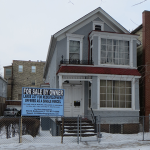
1832 North Burling, built in 1891. Courtesy Euan Hague.
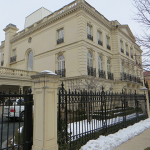
The new mansion at 1932 North Burling, built in 2009. Courtesy Euan Hague.
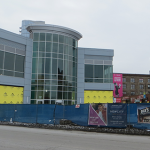
The NewCity development rises at the intersection of Halsted and Clybourn, just north of the former site of Cabrini-Green. Courtesy Euan Hague.

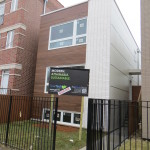
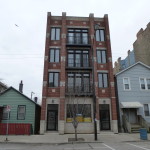
As the Cabrini-Green enclave of public housing on Chicago’s otherwise wealthy near north side was being removed, a new phenomenon was occurring just a few blocks further along North Burling Street. About a mile away from Cabrini-Green, property addressed between 1800-2000 North Burling was also being fundamentally transformed in the mid-2000s. An area of late-Nineteenth Century houses and two-flats, these were bring bought and torn down as buyers sought to purchase multiple adjacent lots to enable the construction of palatial mansions. Built in 2009 with around 26,000 sq. ft. of floor space, the 12 bedroom, 10 bathroom house at 1932 North Burling epitomizes this type of development. Numerous other examples of multi-million dollar homes now line North Burling as some of Chicago’s wealthiest residents and best known philanthropists have moved in. A century ago, this area of Chicago housed German immigrants and their descendents; over a generation ago it began gentrifying, but the demolition of Cabrini-Green seem to unleash an ever more rapacious real estate market on North Burling. Mega-mansions adorned with classical columns, pilasters, ironwork, and numerous other flourishes were built and the sidewalk and curbs are now cut at regular intervals to allow access to below street garages. The last few remaining Victorian cottages, such as 1832 North Burling, will likely soon be torn down and replaced by another new multi-million dollar mansion on the block.

Now that the high rises have gone from Cabrini-Green, and with them their residents, the land on which the public housing project once stood has become highly valued real estate. As if to emphasize the changing urban geography and public policy priorities of Chicago, in 2013 Target opened its latest Chicago superstore on the footprint of one of the Cabrini-Green high rises. On the northern edge of the Cabrini-Green site, a luxury retail, entertainment and residential complex is currently under construction. Built by Structured Development, LLC, and scheduled to open in Fall 2015, “NewCity” will bring 370,000 sq. ft. of retail, a multiplex movie theater, a bowling alley and 200 of the most expensive rental apartments in Chicago, all under environmentally friendly green roofs. The website advertising NewCity, “a hot, new destination… Its landscaped design invites you to shop, dine alfresco or strike up a conversation in view of the dynamic water feature,” depicts attractive young people (one couple holding a smiling toddler), sushi, shopping bags, and a cute bulldog. Promising “one of the most vibrant neighborhoods in America,” where “fashionista meet[s] foodie” and “modern amenities, great shops and the ultimate in style inside and out, NewCity is where hip meets high standards.” It is ironic that Chicago already has a community called New City: south of the Chicago River and once home of the meatpacking stockyards and their immigrant labor force made famous in Upton Sinclair’s The Jungle over a century ago (an area that too, is now much transformed).

Some traces of Cabrini-Green remain. There are footpaths that lead to nowhere, pipes and wires occasionally protrude from concrete slabs surrounded by grass, and gaps in fences show where thousands of people once walked from the Division Street sidewalk to their high rise home. Like the low income residents who once lived there, however, these too will soon be gone: replaced by a new vision of North Burling, of NewCity, of a new Chicago: one that is high-cost, offering luxury lifestyles for those able to afford them, and little remaining for those who cannot.

—Euan Hague
DePaul University

DOI: 10.14433/2015.0010

    Share

Theme and Events Planned Around the Launch of AAG’s New ‘GeoHumanities’ Journal

GeoHumanities, the AAG’s new interdisciplinary scholarly journal, co-edited by Tim Cresswell (History and International Affairs, Northeastern University) and Deborah Dixon (Geography, University of Glasgow) will begin publication in fall 2015. GeoHumanitites seeks to publish peer-reviewed articles that span conceptual and methodological debates in geography and the humanities; critical reflections on analog and digital artistic productions; and new scholarly interactions occurring at the intersections of geography and multiple humanities disciplines.

GeoHumanities will include full length scholarly articles of around 8,000 words in the GeoHumanities Articles section and shorter creative pieces of around 2,000-40,000 words that cross over between the academy and creative practice in the Practices and Curations section.

Submissions to GeoHumanities will undergo the same double-blind peer review process as other AAG journals on a dedicated ScholarOne Manuscript Central site. The AAG will begin accepting papers for review in the coming weeks. The call for papers will be announced online at www.aag.org.

Several sessions have been organized around the theme of “GeoHumanities” and the launch of the new AAG journal.

Learn More

Launch of GeoHumanities Journal

Thursday, April 23, 2015
1:20 p.m.-3:00 p.m.
Location: Gold Coast Room, Hyatt Regency, Chicago

The AAG will launch its new journal, GeoHumanities, at the AAG Annual Meeting in Chicago during this special panel session. The co-editors will discuss their visions for the journal.

Chair: Douglas Richardson, Association of American Geographers

Panelists:

  • Douglas Richardson, Association of American Geographers
  • J Nicholas Entrikin, University of Notre Dame
  • Tim Cresswell, Northeastern University
  • Deborah Dixon, University of Glasgow
  • Peter Bol, Harvard University

GeoHumanities Journal Reception

Routledge will host a special reception following the panel session to commemorate and celebrate the launch of the new GeoHumanities journal. Look for more details soon.

    Share

Pilsen – The Gentrification Frontier

On the night of January 22-23, 2015, the windows of Bow Truss Coffee at 1641 West 18th Street on Chicago’s Lower West Side were covered with handwritten posters declaring “Wake up and smell the gentrification … ¿Sabes dondes estas? ¡La raza vive aqui! … Sugar with your gentrification?” An artisanal coffee roaster that has two other locations in the city, Bow Truss had opened on 18th Street a few months previously in summer 2014. To many residents of this Pilsen neighborhood, the arrival of Bow Truss and its gourmet coffee, priced at more than double that sold at Dunkin Donuts on the same block, symbolized what had long been feared: gentrification was fundamentally changing their community, remaking it into a place where they could no longer afford to live.

Chicago’s Pilsen neighborhood is a fascinating case study in urban geography. It has some of the oldest housing in Chicago, much of it below street level as buildings date back to a time before the city was raised above the water levels of Lake Michigan and its surrounding wetlands. Located just over two miles southwest of the downtown Loop and largely built in the 1870s-1890s by Eastern European immigrants, from whom the neighborhood took the Anglicized ‘Pilsen’ after the Czech city of Plzeň, since the 1950s Pilsen has become known as one of Chicago’s most vibrant Hispanic neighborhoods. Populated primarily by Mexican-Americans and Mexican immigrants, as well as others of Central and South American descent, Pilsen for much of the past fifty years has been a low income neighborhood of bodegas, cheap tacos, tamales sold by street vendors, and low rents. Brass discs representing Mayan calendars are embedded in Pilsen’s sidewalks; the eagle and snake from Mexico’s flag is displayed on lamp posts along 18th Street; and, Aztec-inspired tiling adorns Rudy Lozano library, named after a respected local activist who was shot and killed in the early-1980s.


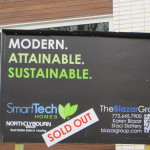
A port of entry for immigrants to Chicago for almost 150 years, Pilsen in the 21st Century is changing. For much of the past two decades, Pilsen has seen old factory buildings converted into condominium lofts (for example, Chantico Lofts at 1061 W. 16th Street), small nineteenth century cottages torn down and replaced by 3 or 4 unit condominiums which tower over adjacent properties (e.g. 953 West 18th Street). Newly built houses, offering lifestyles that are “modern, attainable, sustainable,” now sell for over half a million dollars (e.g. 1808 S. Morgan) and properties assessed as “contributing” to Pilsen’s successful 2005 application to be designated as a National Historic Landmark District have been demolished and replaced by duplexes with rooftop penthouses (e.g. 1111 West 16th Street). Added to this real estate development has been the closing of neighborhood favorites like the folk music performance space Decima Musa in 2012, and the renovation and reopening in 2013 of the historic Thalia Hall theater (1807 S. Allport St.), as an alternative rock venue and restaurant where patrons can enjoy music and, as detailed on its website, “The brine of fresh-shucked shellfish meeting the toast of a Dry Stout, the salted smoke of cured meat balanced by the fruit esthers of a Belgian Dubbel, the complex spice of Vietnamese clay pot fish quenched by a crisp Pilsner.”

In Pilsen today, there are two neighborhoods in one. Immigrant families struggle to meet rising rents and Hispanic-owned businesses seek to retain their Spanish-speaking clientele, while brew pubs and bars selling craft beers and award-winning tater tots cater to a more footloose, younger, and wealthier population intrigued by the neighborhood’s artistic reputation, its proximity to downtown, and hipster appeal. Murals of the Virgen de Guadalupe sit uncomfortably alongside stores selling handmade leather goods for hundreds of dollars and trendy boutiques offering vintage clothing styles. At Bow Truss in January, these divisions along the gentrification frontier came into stark relief. The owner, 35-year old Phil Tadros lamented in the Chicago Tribune, “It’s hard for me to believe we’ve done something bad… Who doesn’t want a good cup of coffee?” The poster he tore down, in contrast declared, “Racism and classism smelllls like your coffee.”

Euan Hague will lead a walking tour of Pilsen on Wednesday, April 22, 2-5 p.m.

Euan Hague
DePaul University

DOI: 10.14433/2015.0007

    Share

What’s in a Nickname? In the case of Chiraq, a Whole Lot

Chicago goes by many nicknames—from the widely recognized “Windy City” and “Second City” to more obscure and seemingly puzzling associations, such as “Paris on the Prairie” and “The Smelly Onion.” Nicknames are important branding strategies used by civic boosters, and Chicago’s namesakes are frequently employed to market the city and its surrounding region as “The Jewel of the Midwest” and “Heart of America.” At the same time, urban monikers can arise from the wider public and they have sometimes been used to draw attention to negative qualities of Chicago life. With the help of a NWS meteorologist and social media, the city was rechristened “Chi-beria” during the record-breaking cold weather of 2013-14. The Wall Street Journal identified Chicago as “Beirut by the Lake” when reporting on the intense political infighting on the city council in the early- and mid-1980s.

Popular culture and artistic expression are important sources of nicknames. Some of Chicago’s best-known monikers are found in poems, such as “City on the Make” from Nelson Algren and “City of Big Shoulders” from Carl Sandburg. Other Chicago nicknames have originated from songs. Frank Sinatra popularized “That Toddling Town” and “My Kind of Town.” Famous blues artist Robert Johnson’s “Sweet Home” captured the emotional geography of the Great Migration of African Americans from the racial oppressive South to presumably better conditions in Chicago. As of late, the local rap/hip-hop music scene has given rise to “Chiraq,” a controversial mash-up of the place names Chicago and Iraq. Chiraq has become shorthand for capturing the life and death struggles and feelings of anger and alienation that poor people of color experience within the city. The nickname stands in marked contrast to the optimism and sense of belonging found in Johnson’s portrayal of Chicago as home.

The emergence of Chiraq is an opportunity to think about the politics of how places are represented and made meaningful within the wider cultural arena of music and naming—both in general and specific to Chicago. City nicknames might appear at first glance to be gimmicky or superficial. Yet, we would suggest that this form of naming, like all toponymic practices, plays a critical role in socially constructing and contesting the identities of urban places and the people associated with those places. As increasingly suggested in research, place names are not confined to official nomenclature on maps, but also include competing, vernacular systems of naming. Chicago’s many nicknames provide insight into the different ways that social actors and groups frame and reconfigure the image of the city for visitors, residents, and the wider world. The case of Chiraq encourages us to recognize that historically marginalized groups such as African Americans can harness the power of naming to articulate a sense of place and a resistant place identity on their own terms and in their own words.

Music is an important signifier of place and the cultural power of hip-hop, or any musical genre for that matter, is the way in which it originates from and gives voice to the specific lived experiences and struggles of its artists. The term Chiraq was coined by local musician, King Louie, and debuted in his 2009 track “Chiraq Drillinois.” Rappers born and reared in the impoverished south and west sides of Chicago have collectively popularized the nickname, most notably Chief Keef, Young Chop, Lil Reese, and Lil Durk. This group of artists along with many others formed what is known as “Drill Music,” a subgenre of hip-hop known for its grim, violent depictions of Chicago street life, especially the Englewood neighbor. Chief Keef drew attention to the Drill music scene in late 2011 with a homemade music video released on YouTube entitled Bang. In 2012, after being signed to Interscope, he released his first album, Finally Rich, which pushed Drill music into the mainstream. In April of 2014, Chiraq become even more nationally recognized when hip-hop star Nicki Minaj featured Drill rapper Lil Herb on a single, titled Chi-Raq.

Chiraq can be understood in part by looking at the lyrics and the commentary that describe it. Lyrics written and performed by Drill artists frequently refer to rampant murder and the wide availability of guns, along with frequent references to Chicago as a militarized and besieged landscape. As King Louie put it in his seminal track: “rocket rocket gun fire, you hear that killer noise, this is…Chiraq Drillinois…we drillen, we killen…” In the recently released track Gang Members, Chief Keef and three other Drill artists employ sound-bites from televisions new reports about crime mixed with their own flows to describe the astounding level of violence and apathy they encounter in Chicago. Because the production and online posting of home-made music videos is a hallmark of Drill artists, Chiraq has opened up a space in social media for sharing the comments, reactions, and life experiences of locals as well as political discussions from observers/listeners well beyond Chicago.

For some commentators, Chiraq exposes the contradictions of living in a country that spends massive amounts of money to intercede in conflicts abroad but places less priority on the “war zones” at home, especially when victims are too easily reduced to the collateral damage of gang violence in minority neighborhoods. Some observers, including the FBI, attribute high levels of violence in Chicago to gang activity, although anecdotal evidence suggests the situation is more complex. Others argue that it was government efforts to dissolve gangs and close down federally subsidized housing that have destabilized communities and the support networks provided by gangs, thus putting already vulnerable African Americans further at risk and intensifying their struggle to survive (1:31-2:23).

As journalists report, a sense of fatalism pervades some of neighborhoods most harshly affected by high levels of violence. When interviewed, twenty-year old Chicago resident Jamal stated that he didn’t expect to live much longer after sharing that only two of his childhood friends were still alive. This message of hopelessness is echoed in an interview with another local resident who goes further to make a suggestion on how Chiraq might be changed, “I believe if people had availability of service, and something to do, more so in the community, if it was more… something to look forward to, maybe it [the violence] would subside” (11:57-12:13).

Renaming Chicago as Chiraq represents a form of resistance initiated by youth who are experiencing a lifetime of hyper-segregation, chronic poverty, poor education in crowded classrooms, and a regular loss of loved ones to both prison cells and gunshots. The nickname’s power, politically, is the way in which naming functions as a form of shaming, a way of challenging Chicagoans, especially those in power, to consider the harsh and dangerous realities of life that are so clearly at odds with the city’s positive promotional image. When a local news station interviewed Chicagoans about their opinion of the Chiraq label, shame was clearly an underlying feeling, as exemplified by this quote, “I don’t want them to think of Chicago, our beautiful city as a war zone.” The willingness of some residents to deny the extreme violence in Chicago, and in fact make excuses for it, are evident in the words of another quoted resident: “It’s a little violent, but then again it’s Chicago…I mean it’s one of the best places in the world.”

Chicago has a long and documented history of police violence against youth. Not surprisingly, the lyric of “F*** the (insert any derogatory term for police officer)” is frequently associated with Chiraq and it is the most blatant way that Drill artists shame local authorities and implicate the state in making Chicago a war zone. But the shaming goes beyond lyrics and musical performance, manifesting itself in the commentary attached to YouTube videos. For example, one observer wrote: “Apparently the police don’t give a f*** and are encouraging it…guess that’s why they inherited the raq in chi.” Comments such as these are not simply directed locally. The capacity of the Chiraq nickname to shame and evoke condemnation is also being exercised nationally. When 82 people were shot over the July 4, 2014 weekend in Chicago, a journalist asked of the city’s most famous resident: “Obama, Why Aren’t You in Chiraq?

Due in part to the exposure given by hip-hop star Nicki Minaj, Chiraq is growing in popularity as a point of identity and even a badge of honor among segments of Chicago’s African American community. The nickname can now be found displayed on an array of posters, T-shirts, and hats—many of which also display images of automatic rifles and handguns. Enthusiasts have gone as far as appropriating the icons of the city’s famed sports franchises, drawing a gas mask on the Bulls’ red charging bull and inserting the name Chiraq in place of “Cubs” within the baseball team’s logo. The growing popularization of Chiraq has sparked opposition to the nickname. Anti-Chiraq activists, including ex-gang members, have argued that Drill artists glorify and encourage violence, even as they speak to the truth of that violence. Some opponents assert that referring to communities as war zones creates a “punishment mentality” that limits how people think about the solutions to the systemic inequality and racism in Chicago. In the words of one commentator, “War can further dehumanize black bodies and count them as casualties.”

Not everyone in the Chicago’s black community has embraced the Chiraq moniker or used it in the same way as Drill artists. K’Valentine is part of a small but vocal group of female rappers using their music to speak out publicly against the nickname. She wrote and performed a track entitled Anti-Chiraq, a loose remix of Nicki Minaj and Lil Herb’s famous Chi-Raq track. Alonzo Jackson, a local fashion designer, sells anti-Chiraq shirts. By scratching out, literally and figuratively, the controversial nickname on apparel, Jackson hopes to alter the direction of the public conversation. On this point, he stated: “So don’t even call it [the city] Chiraq because the power of the tongue and you speak that, it’s like you’re embracing it and we don’t like that at all.”

Chicago activist Julien Drayton founded RIP Chiraq Foundation in 2012 to advocate for peace and to provide employment and career training to underprivileged people in the city. Yet, Drayton’s call for “No More Chiraq” is not necessarily a call to ban the nickname, but actually a call to end the structural conditions (poverty, joblessness, discrimination, and gun proliferation) that have given rise to Chicago’s violence, and he speaks pointedly to a goal of seeing the city growing “out of the shadow” of high death tolls. Chiraq encompasses many complicated layers of resistance and the name has clearly become part of the lexicon for framing discussions of problems in Chicago and broader urban America, even if everyone cannot agree on what the term means, what it is accomplishing, or whether it should be invoked at all.

Chicago is a city of conflicting identities depending on one’s social and geographic position in its networks of power and resources. Chiraq is not merely an alternative nickname for Chicago or hip-hop styling or personae; rather it marks larger geographies of exclusion, violence, and resistance within the city. Chiraq highlights important relations between local music, social media, and the racial and class politics of naming and claiming cities. Chiraq prompts us as geographers to consider the broader social and economic struggles at work in the cities where we hold meetings, helping us move toward a more critical and empathetic understanding of place that is perhaps not possible within conference hotels and session rooms.

Janna Caspersen
Department of Geography
University of Tennessee
@jannacaspersen

Derek Alderman
Department of Geography
University of Tennessee
@MLKStreet

DOI: 10.14433/2015.0006

    Share

Chicago’s Asian Cultures

The Association of American Geographers (AAG) will be holding its next annual meeting April 21-25, 2015, in the American business hub city of Chicago, which can be reached by a direct flight from Beijing, Shanghai, Hong Kong, and many other major Asian cities. It is little wonder that many Asian cultures feel at home here in America’s heartland global city. On December 19 2014, the “25th U.S. – China Joint Commission on Commerce and Trade” concluded in Chicago. The Chicago Tribune reported that Beijing economic development official Cheng Yuhua expected a dingy industrial city, but the real Chicago surprised her: “What I’ve seen here – it completely changed my mind, the city looks young, it’s full of energy (Chicago Tribune, 21 December 2014).” Although the meeting was focused on U.S. trade, local Chicago got a fair bump in marketing itself as a global city open to foreign investment.
Asians in Chicago

In this newsletter article I will describe the residential patterns of six major Asian immigrant groups – Asian Indians, Chinese, Filipinos, Japanese, Koreans, and Vietnamese – in the Chicago metropolitan area. Using the 2010 Census and GIS, I will address two questions: (1) Where are the six major Asian groups most heavily concentrated in the city of Chicago, and in the 13-county metropolitan area? (2) Which of the six Asian groups is more dispersed in the city of Chicago? Mean centers and standard deviational ellipses are employed to describe the concentration differences.

1990 to 2000

This article also provides an update to an earlier study that used 1990 and 2000 census data to describe the geographic distribution of Asian groups (Park, Chung, & Choi, 2006). Their study identified Asian Indians as the fastest growing group, which settled primarily in DuPage County and northern Cook County, while the Chinese remained concentrated in Chinatown with some expansion to the south and southwestern suburbs (Park et al., 2006). Japanese and Koreans were concentrated in the north, while Vietnamese were concentrated in the city and in a few western suburbs (Park et al., 2006). Filipinos were bi-polarized commensurate with their socioeconomic status (Park et al., 2006). Suburbs like Lincolnwood and Skokie were strongly favored by all six Asian groups, due to employment opportunities in those areas. Traditional Asian enclaves in the inner-city area remained port of entry zones, and even expanded geographically over time, while new Asian concentrations emerged in relatively affluent suburbs (Park et al., 2006). According to the study, Asian groups maintained strong social cohesion, indicating that Asian residential patterns were closely linked to economic factors, while keeping close ties with their own respective groups.

2010 Chicago Region and its Suburbs

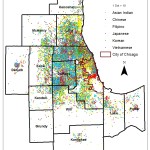
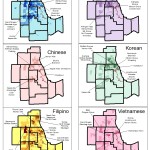
Based on a 13-county definition of the Chicago region, a dot density and graduated color map (fig. 1 and 2) show that the six major Asian groups occupy distinct geographical spaces and have varying spatial distributions. Asian Indians are highly concentrated northwest of Chicago in Buffalo Grove, Hoffman Estates, Schaumburg, Lincolnwood, Skokie, and Devon Avenue. The trend toward concentration in DuPage County and northern Cook County has intensified in 2010 compared to previous years. The Chinese are highly dominant in Chicago’s Chinatown (Photo 1), but have also spread to suburbs like Vernon Hills, Skokie, Evanston, Schaumburg, Hoffman Estates, Naperville and Aurora. Their strong concentration areas remain in the southern half of the Chicago metro area, but communities have developed in northern suburbs, including southern Lake County and northern Kane County. Filipinos are scattered to a greater extent around the metropolitan than many other Asian groups. Their high concentrations are found in Morton Grove, Wilmette, Skokie, Carol Stream, Glendale Heights, Streamwood and Hoffman Estates.

Figure 1: Dot density map of six major Asian groups in the Chicago metropolitan area, 2010
Figure 2: Graduated color maps showing the spatial distribution of 6 major Asian groups in the Chicago metropolitan area, 2010

The Japanese are mostly concentrated northwest of the city, in the suburbs of Elk Grove, Schaumburg, Arlington Heights, Mount Prospect, Inverness, Skokie, Morton Grove, Lincolnwood, Lincoln hire and Buffalo Grove. For Koreans, there is a great dominance around Chicago’s Korea town, but also in north and northwestern suburbs including Lincolnwood, Wilmette, Skokie, Evanston, Northbrook, Glenview, Morton Grove and Wheeling. Japanese are also increasing in Buffalo Groves, Vernon Hills, Inverness, Hoffman Estates, Schaumburg, and Naperville. The Vietnamese are more scattered, but there is a notable concentration on the north side of the city of Chicago.

There are several suburbs in which all six major Asian groups are concentrated, mostly the northern half of the Chicago metropolitan region. Asian Indians and Filipinos, who are relatively more fluent in English, tend to assimilate into the mainstream and are dispersed to a greater extent around the metropolitan area than are other Asian nationalities. Suburbs like Skokie, Lincolnwood, Morton Grove, Hoffman Estates and Schaumburg are popular residential locations among the Asian groups. All six concentrate across the northern limits of the city of Chicago, where many high skilled job opportunities are located. The higher income professionals of Asian Indians, Japanese, and Koreans favor edge cities, such as Schaumburg and Hoffman Estates. One prominent trend is the rise of Asian populations in western suburbs like Carol Stream, Glendale Heights, Elgin and Pingree Grove, as well as in southern suburbs like Naperville and Aurora. Compared to 2000, Elgin, Pingree Grove and Gilberts in Kane County have experienced an influx of all six Asian groups.

2010 City of Chicago

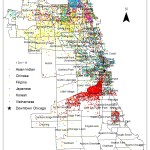
The 2010 Census reported that the city of Chicago had an Asian population of 166,770, placing it as the 7th ranked city in the USA for the number of Asians (Census 2010). In the city of Chicago (fig. 3 and 4), a similar residential pattern is visible among all six groups, with high concentrations in the northeastern part of the city – the neighborhoods of Uptown, Rogers Park, Albany Park, West Ridge, North Park, and Lincoln Square. Asian populations are also dominant near Downtown Chicago, especially in the Loop and Millennium Park neighborhoods. All six groups, especially Chinese, are also concentrated in Hyde Park, which is home to the University of Chicago. Besides Chinatown, Bridgeport, and Armour Square, which all have sizable Chinese populations, Argyle in the Uptown neighborhood is becoming a new Chinatown (Photo 2), as well as a distinctive Vietnamese enclave.

Figure 3: Dot density map of 6 major Asian groups in the city of Chicago, 2010
Figure 4: Graduated color maps showing the spatial distribution, mean centers and standard deviational ellipses of 6 major Asian groups in the city of Chicago, 2010

Spatial Analysis

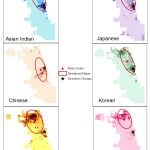
The Chinese mean center is closest to Downtown Chicago, at a distance of 2.76 km. This is followed by the Korean (6.91 km), Asian Indian (7.41 km), and Japanese (7.74 km) mean centers. The Filipino mean center (10.38 km) is relatively far from downtown, and the Vietnamese center is the furthest at 11.74 km. The standard deviational ellipses suggest that the Chinese are the most spatially concentrated, with an ellipse area of 100.3 km2. The Vietnamese and Koreans are also relatively concentrated, with ellipse areas of 112.9 km2 and 119.5 km2 respectively. These are followed by Asian Indians (142.3 km2), Japanese (153.4 km2), and Filipinos, with the greatest spatial dispersion (ellipse area 162.9 km2). The ellipse of each group overlaps with the other five, although Filipinos and Vietnamese are concentrated mostly in the city’s north side, while the Chinese are dominant in neighborhoods around Chinatown spreading toward the southwest. The almost circular shapes of the Filipino and Vietnamese ellipses suggest that these two groups are dispersed in nearly equal directions from their mean centers. The Asian Indian, Chinese, Japanese, and Korean ellipses are elongated, with the Korean ellipse being the most stretched.


In conclusion, Asian groups in Chicago are culturally diverse and occupy different geographical spaces according to their home country. The spatial distribution of the six major Asian groups became more dispersed throughout the Chicago metropolitan area over time, although several suburbs, as well as neighborhoods within the city, are popular among all groups. Besides traditional Asian suburbs like Skokie, new communities in Elgin, Carol Stream and Naperville are on the rise. While visiting Chicago during the AAG annual meeting in 2015, it is worth taking time to appreciate this diverse Asian culture. Choices include dinner in Chinatown, which is a short taxi ride from the convention hotel, or an afternoon in Chicago’s New Chinatown, which can be accessed by the red line train on the Argyle stop. In the suburbs, one can also visit a Chinese grocery store in Naperville or a Japanese grocery store in Schaumburg for a taste of Asian culture!

Jiahe “Caitlyn” Wei
Northwestern University

DOI: 10.14433/2015.0002


References

Chicago Tribune (December 21, 2014). “Chicago’s China challenge.” Section 2, page 3.

Park, S., Chung, S-Y., & Choi, J. (2006). “Asians in Chicago.” In Greene, R. P., Bouman, M. J., & Grammenos, D., Chicago’s Geographies: Metropolis for the 21st century (pp. 217-231). Washington, D.C.: Association of American Geographers.

U.S. Census Bureau (2012). The Asian population: 2010. Available at https://www.census.gov/prod/cen2010/briefs/c2010br-11.pdf

    Share

Show us the best of Chicagoland

Lead a field trip on the geographies of Chicago and the Great Lakes


New and returning visitors to Chicago are looking to learn more about Chicagoland and the Great Lakes region. You can guide them through the rich cultural and physical geographies the area has to offer by organizing and/or leading a field trip. Field trips also allow attendees to learn about different areas of geography in an interactive environment. Share what you know and propose a field trip today. Workshop Proposals

    Share

Drug Policy and Mass Incarceration in Chicago

Chicago’s status as one of the great American cities is well deserved. This remarkable metropolis is justly celebrated as a hub of music and the arts, as home to some of the world’s most iconic architecture, and for its vibrant public life, anchored in its extensive network of parks and beaches. At the same time, however, Chicago also has the dubious distinction of exemplifying some of the worst aspects of the American city. Teachers of urban geography have long drawn on Chicago for examples of racial segregation and red-lining, white flight and decaying public housing, police violence and the suppression of political dissent, gentrification and ghettoization. To this list we can add what is arguably one of the most pressing social justice issues of the day: mass incarceration and the war on drugs that fuels it.

While the “war on drugs” may no longer be as fashionable a term as it once was—President Obama’s former “drug czar” Gil Kerlikowske distanced the administration from the term in 2009—the policies that characterize it continue to be politically expedient. Policies which purport to be “tough” on crime such as mandatory minimum sentences and stop-and-frisk enforcement tactics still represent the standard approach to the issue of drug crime, and politicians of any stripe question them at their peril, such is their continuing appeal with voters. But the war on drugs, now in its fourth decade, is showing increasing signs of strain as governments at all levels grapple with the financial and social costs of a system that has, at this point, incarcerated more people than at any point in history.

It is difficult today to believe that as late as the 1970s, there were so few people in US prisons—under 350,000 in 1972—that mainstream scholarship could predict the end of prisons within a generation. Instead, the US prison population has quintupled since that time, today topping two million people[1]. This dramatic growth is inseparable from the expansion of imprisonment for drug offences: 1.5 million people were arrested for drug violations in 2012—over 80% for simple possession—and more than half of the people currently in federal prison are incarcerated on drug charges[2].

Scholars often point to deindustrialization as an integral component of the phenomenon of mass incarceration. As the American economy sloughed off its industrial workforce, rendering a huge segment of the population superfluous to the economy, the prison system expanded to incorporate this surplus[3]. Jamie Peck and Nik Theodore note that in the starkly racialized West Side of Chicago—an area emblematic of both deindustrialization and mass incarceration—some 59,000 people worked in the area’s factories in 1972, a number that fell to 10,600 by 2006; meanwhile, retail jobs that depended on this sector dropped from 35,000 to 5,200[4]. In these communities, where the official unemployment rate among African-American men exceeds 30%, and where one in seven adult men is incarcerated and fully 70% are burdened with criminal records limiting their employment opportunities, it is easy to see how critical scholars refer to mass incarceration and the war on drugs as nothing less than a system of racial control, or in Michelle Alexander’s formulation: a “new Jim Crow.”

Illinois’ prison system has echoed trends in incarceration nationwide. The state prison population quadrupled from 1973-1991 and increased a further 55% by 2000, overwhelming the system’s capacity despite 21 new prisons being built during that time[5]. As elsewhere, this new prison population comes in significant part from the war on drugs. Nationwide, Illinois incarcerates the greatest proportion of people for marijuana possession compared to higher-level trafficking charges (tied with Texas), and the state boasts the third highest disparity between Blacks and whites in terms of those incarcerated for possession[6].

At the same time, there are voices calling for change, from activists protesting racial disparities in the policing of drug laws and the expansion of stop-and-frisk tactics, to harm reductionists working to mitigate the harms associated with illegal drug use and the criminalization of users, and even fiscal pragmatists concerned with runaway prison budgets. Documentaries such as Eugene Jarecki’s The House I Live In and Michelle Alexander’s popular book The New Jim Crow have raised the profile of these debates. Neverthelessthe current state of drug law reform appears profoundly ambivalent. From Colorado to Alaska to Washington, DC, states are easing penalties, decriminalizing, and even legalizing marijuana. Cities such as Chicago and New York have moved in the direction of marijuana decriminalization, making it a ticketable offense in most cases, and over the past decade, New York State has revised some of the most egregious of its mandatory sentencing laws. New models of substance-abuse treatment prisons are being developed, such as the Sheridan Correctional Center in Illinois. And the Obama administration’s Fair Sentencing Act lowered the sentencing guidelines for crack cocaine in 2010, which had long sentenced (largely African-American) defendants to prison terms 100 times longer than those (largely white) sentenced for powder cocaine. At the same time, however, the federal government continues its ban on federal funding for basic harm reduction measures such as needle exchange programs, and critics have pointed out that many of these progressive developments fail to address the root problems created by mass incarceration and prohibitionist drug policy.

One illustration of how seemingly progressive shifts in policy can reproduce or conceal underlying problems can be seen in Chicago’s recent move toward marijuana decriminalization. In late 2011, a small number of city aldermen called on police to stop arresting people for the possession of small amounts of marijuana, because of the grossly disproportionate effect that enforcement was having on Black and Latino communities. Shortly afterwards, Alderman Danny Solis, a close ally of Mayor Rahm Emmanuel, announced his intention to table an ordinance making low-level possession punishable by fines and community service rather than arrest and jail time. The ordinance passed in 2012 and Chicago now has two years of experience with decriminalized marijuana.

This move, however, has failed to precipitate a sea change in the city’s drug policing. To begin with, the new law still grants police the power to arrest people for possession—the only difference is that it gives them the discretionary authority to opt for ticketing instead. For a variety of reasons, police have been less than eager to forgo arrests in favour of ticketing. While arrest rates have dropped somewhat, they remain troublingly high at 2.3 times the national average[7]. From August 2012 through February 2014, only 1,725 of the new tickets were issued, while 20,844 arrests were made for possession[8]. Researchers at Chicago’s Roosevelt University calculate that 93% of possession violations have resulted in arrest since the passing of the new law, with only 7% leading to a ticket[9]. Worse, these arrests appear to conform to the same racist patterns that initially spawned calls for reform. Prior to the new laws coming into effect, Mick Dumke and Ben Joravsky noted in the Chicago Reader that “African-Americans account for 78% of those arrested, 89% of those convicted, and 92% of those jailed for low-level possession in Chicago”[10]. Put another way, African-Americans were 15 times more likely to be arrested for simple possession than whites—this, despite clear evidence that these groups use marijuana at essentially the same rates[11]. These glaring disparities have not changed appreciably in the wake of the city’s experiment with decriminalization, and some evidence suggests they may have worsened. Since the passing of the law, the Reader reports that 78% of those arrested for possession were Black, 17% were Hispanic and only 4% white[12].

The failure of police to shift from arresting marijuana users to issuing citations may be related in part to administrative and bureaucratic pressures. Officers report that citations require as much police time as arrests do, negating the savings of time and money that were touted as one of the rationales for the shift. However, such considerations do not explain the stark geographical disparities in rates of arrest versus citation across different communities and municipalities. While 93% of possession violations in Chicago resulted in arrest, in suburban Evanston, the majority (69%) of those same violations ended with the issuance of tickets[13]. Within the City of Chicago, disparities in arrest rates between neighborhoods actually increased following the implementation of the new laws, with poor, racialized neighborhoods like Garfield Park having arrest rates seven times higher than the city average and 150 times higher than Edison Park, the overwhelmingly white neighborhood with the lowest rates[14]. In Chicago, such geographical disparities mean racial disparities. The majority of arrests continue to take place in neighborhoods that are more than 90% non-white and the 25 neighborhoods with the highest arrest rates are almost all over 90% African-American[15]. As the authors of the Roosevelt University study pointedly remark, “Geography, not justice, determines whether marijuana possession results in a fine or an arrest.”[16]

It is this racially uneven geographical pattern of arrests that gives us our clearest sense of why the new ticketing ordinance has been so little adopted by police. Scholars critical of domestic drug policy have long argued that the war on drugs has never been about drugs. Rather, drug law enforcement has provided a pretext for intensified policing of racialized communities—communities like those on the West Side of Chicago, described above[17]. Under the aegis of enforcing drug laws, police are given remarkable latitude to stop, search, and arrest (predominantly) young men of color. These police powers have been steadily expanded over the past four decades of the war on drugs, from limitations to the Fourth Amendment such as stop-and-frisk and other warrantless searches, to financial incentives such as drug forfeiture laws and federal policies like the Byrne program which provided military hardware to police departments. Given such a trajectory, and considering the effects that this transformation has had on contemporary policing, it was always unlikely that police in Chicago would suddenly switch to issuing tickets. Possession arrests are a tactic with broader utility than simply controlling substance use—they serve as one of the principle means by which police physically regulate the bodies of young men contained in racialized neighborhoods.

Change to this situation is likely to come only with considerable political will—something conspicuously absent in the Rahm administration, which has seemingly introduced this legislation only to back away from actually implementing it[18]. Beyond the administration, a host of different voices compete to influence the debate. Cook County board president Toni Preckwinkle continues to advance (moderately) progressive legislation around mass incarceration and drugs. Activist groups such as Critical Resistance have established chapters in Illinois, pushing for more radical changes to the “prison industrial complex,” while local organizations like Chicagotorture.org publicize the abuses suffered by people at the hands of the Chicago Police Department. And Chicago police superintendent Garry McCarthy himself recently declared the entire war on drugs to be a “failure” (albeit in the context of calling for tougher sentences for gun crimes—a proposal which would inevitably further criminalize many of same people targeted by drug laws).

In the matter of drug policy, then, as with so many social issues before, Chicago is marked by contradiction, reminding us that even apparently progressive change often retains the most problematic features of that which it replaces. In such a political landscape, it remains to be seen whether—and how—Chicago’s policing of the racialized poor might be transformed for the better. If we are committed to change that is genuinely progressive, we will need confront the fact that the war on drugs and mass incarceration have always been projects of racial and class control, not public safety or public health. Changing the status quo will require not just reform to existing laws, but also a profound reconfiguration of the city’s relationship to so many of the citizens who make Chicago a great American city.

–Jesse Proudfoot

DOI: 10.14433/2014.0024

    Share

James Newman on Illinois Politics

You might say Quinn/Rauner was a squeaker, and Durbin/Oberweis was a cakewalk. Here’s why you’d be wrong.

The outlook was bleak nationwide for Democrats as the nation approached mid-term elections. Despite improvements in employment, troop drawdowns in Afghanistan, and increasing numbers of insured persons under the Affordable Care Act, the public’s confidence in the Obama Administration had sunk to record low levels. Most Democrats facing election contests sought to distance themselves from the very programs they had enthusiastically supported just a few years, or even months, earlier, eager to dissociate themselves from the President’s waning popularity. By the time Election Day rolled around, Democrats had resigned themselves to declining numbers in the House of Representatives with all of its two-year terms in contention; in the Senate, even their most optimistic hopes were for a 50-50 split (in which Vice President Joe Biden would be able to cast deciding votes), while more realistic expectations were that they would become at least a slim minority.

ELECTION NIGHT IN ILLINOIS SELDOM LACKS FOR DRAMA, AND THE 2014 MIDTERM ELECTION WAS NO EXCEPTION.

The Democrats best hopes were to hold on strong at the state level, among governorships and state legislatures. It was in this atmosphere that the party nervously eyed the State of Illinois, whose embattled Democratic governor Pat Quinn continued to be shadowed by the spectre of his predecessor, Rod Blagojevich, who had been ousted amidst a swirl of corruption charges. (Quinn had ascended to the governor’s chair in 2009 upon Blagojevich’s removal, and had eked out a narrow margin over Republican Bill Brady in the 2010 election.) Years of excessive capital spending and increases in public pension commitments had skyrocketed Illinois to a precarious financial position. In 2014 Quinn faced businessman Bruce Rauner, a highly-successful businessman in several private equity firms who had campaigned on the promise of restoring fiscal responsibility and integrity to the state.

Meanwhile, Senate Majority Whip Richard Durbin was considered to have a relatively safe course to re-election against dairy magnate Jim Oberweis, who was perceived by much of the electorate to be closely tied to the Tea Party and held extremely conservative views that were at odds with the extensive “blue” voter base in Illinois. Oberweis had failed twice before in attempts at statewide office, failing to progress past the primaries in a previous US Senate bid and the 2010 governor race. Finally gaining public office in the Illinois Senate, he leveraged that 2012 electoral success to position himself as the Republicans’ 2014 US Senate candidate. Durbin’s status as senior senator, his overall popularity among the electorate, and Chicago’s propensity to deliver massive Democratic margins were expected to propel Durbin to a relatively comfortable victory.

Election night in Illinois seldom lacks for drama, and the 2014 midterm election was no exception. While in the Senate race, challenger Jim Oberweis conceded to incumbent Dick Durbin just hours after the polls closed, incumbent governor Pat Quinn held fast to the possibility of victory, still declining to concede the race as of late Wednesday morning. It’s only reasonable to conclude that Durbin/Oberweis was a cakewalk, and Quinn/Rauner was a squeaker. Reasonable, but wrong – in fact, just the opposite can be argued. Application of geographic analytic tools sheds light on why this is true.

While Quinn had won only four counties in 2010, his vote margins were slim and he was carried to victory on the strength of the overwhelming margin in the perennial Democratic stronghold of Cook County. In 2014, within hours of poll closings, it was clear that this was not to be Quinn’s night – he had lost the downstate Democratic counties of St. Clair & Jackson, and his margin in Cook County was going to fall well short of his 2010 margin, and would not be nearly enough to eke out a victory for him this year.

An analytic tool called Rank-Mobility Index (RMI) helps to explain just how and where Quinn’s support fell apart. Sheer number of votes is not important in itself; rather, the vote margin between the candidates tells the story when viewed on a county-by-county basis. RMI reveals where Democratic vote production succeeded and fell short, and suggests how those changes manifested themselves in the final outcome.

To determine the RMI, the statistic of interest – in this case, vote margin for Quinn over Rauner – is computed for each county. To adjust for the effects of county size, this figure must be normalized to margin per 1000 persons of voting age (MpK). The counties are then ranked 1-102 based on their MpK for the 2010 election, and again for the 2014 election. RMI is then computed as (R2010‑R2014)/(R2010+R2014); the resulting value can range from ‑1.0 to +1.0. The power of the RMI is two-fold:

  • it recognizes that large changes in rank are more significant than small changes, BUT . . .
  • it also recognizes that equal changes are more significant among high ranks than among low

So, for example, in 2014, the ranks for Lake & McHenry counties were 16 and 42, respectively, while in 2010 their ranks had been 7 and 33. Both fell 9 ranks from 2010 to 2014, but Lake County’s RMI of ‑0.391 shows its shift to be more significant than McHenry’s RMI of ‑0.120.

In 2014, Cook was the only county to provide a net positive vote margin for Quinn. Thus, in Table 1, the MpK values are negative, reflecting that Quinn fell short by that number of votes for every 1000 persons of voting age. The county with the best improvement was Fulton, which in 2010 had a negative MpK of ‑35.4073; this improved to ‑6.7540 in 2014, which moved Fulton County up from 8th‑best to 2nd‑best in producing a Democratic margin. Franklin County, on the other hand, declined from ‑21.3725 MpK to ‑117.1895 MpK, dropping it from 6th-best to 43rd-best and resulting in a large negative RMI.

Charting the RMIs on the map thus provides insight into details of Quinn’s performance. The blue counties, denoting improvement in Democratic vote production, form a swath from northwest to east-central Illinois, taking in primarily rural counties with lower voter counts. Meanwhile, Cook County shows a decline in performance (while retaining the number 1 rank, its MpK fell from 126.3259 in 2010 to 98.1427 in 2014), as do the collar counties and southern counties. Significantly, the key downstate counties of St. Clair, Jackson, and Alexander all showed rather strong decreases in Democratic voter production, and indeed all turned from blue to red in the 2014 election.

Turning to the U.S. Senate race, the differences between the 2008 margins and 2014 margins are much more dramatic than the 2010-2014 changes in the governor’s race. As usual, Cook County Democrats turned out in numbers sufficient to offset downstate Republicans and tip the balance to Durbin. But the breadth and depth of the Republican margins, especially when compared to the almost-all-blue map of 2010, is certainly an attention getter. Once again, RMI helps to reveal the story within the story.

The strongest gains in Democratic vote production were in three far-southern counties – Jackson, Alexander, and Pulaski, two of which had already demonstrated a strong Democratic margin in both the 2008 Senate race and the 2010 governor’s race. Central Illinois, from Bureau & LaSalle counties in the north to Effingham & Jasper counties in the south, demonstrated a solid Republican upswing, especially in Putnam, Mason, and Macon counties. Those changes in relatively low population counties may not have been, by themselves, significant – until Democratic bastion Cook County is considered. The effectiveness of Democratic vote production in Cook actually declined relative to the other counties in the state – making it all the more important for Durbin to put in a strong showing downstate. Of the top five counties in voter production in 2008, however, three – Putnam, Gallatin, and Mason – fell to the bottom five in 2014. Lake County, recently more evenly split between the parties than most of the other collar counties, edged into the top five RMI by moving from 27th rank to 11th, but that was primarily by virtue of even worse performance by other counties, as Lake’s MpK fell from 172.8010 to 7.5804.

One last key question is this: How did the candidate perform compared to other candidates of the same party? In particular, with major statewide offices such as Governor and U.S. Senator, did one race either help or hinder the other? Using RMI to compare Democratic vote production for the governor’s race vs. the U.S. Senate race suggests that Durbin, while mostly coasting toward a fairly comfortable victory, may well have been hampered by Quinn’s unpopularity. Those counties showing improved vote production for Senate vis-à-vis all other counties are mainly clustered in the far downstate region of the state. Meanwhile, the populous counties of the north, and particularly the northeast, demonstrated a strong decline in effectiveness in vote production, Lake County being the only significant exception. Perhaps Democrats came out in stronger numbers for Quinn in light of his anticipated contest, while showing disinterest in Durbin’s expected easy cruise to victory.

The only numbers that ultimately matter, of course, are the final statewide vote tallies. But putting the power of the RMI to use helps to show that there’s a lot more to the story than revealed by the raw numbers.

Acknowledgement to Dr. Richard Greene, Department of Geography, Northern Illinois University, for contributions to the methodology included in this analysis.

James W. Newman
Department of Geography
Northern Illinois University

DOI: 10.14433/2014.0022

    Share