Newsletter – July 2019

PRESIDENT’S COLUMN

Should we be worried? Or how to maintain and expand the number of geographers in our schools

By David Kaplan

Dave Kaplan“As geographers, we all know the value of geography. Right? It is a field that provides a unique perspective, an appreciation for particularity, an opportunity to synthesize. But as much as we affirm geography’s value to each other, we also need to look at how geography is perceived outside of our community.”

Continue Reading.

ANNUAL MEETING

Prepare to register for #aagDENVER

fee-schedule-300x105-1The 2020 AAG Annual Meeting takes place from April 6-10, 2020. Similar to the 2019 AAG Annual Meeting, registration rates will be based on the way in which attendees choose to participate in the conference. Please check your email in the coming days for an announcement regarding the 2020 Annual Meeting registration opening dates. And remember, register early for the best rates!

View the registration options.

Denver, Colorado to host 2020 AAG Annual Meeting

Mark your calendar for the AAG Annual Meeting in the Mile High City April 6-10, 2020. Registration and the call for papers for #aagDENVER will be announced this summer. We look forward to seeing you in the Rocky Mountains!

PUBLICATIONS

NEW Annals Issue Alert:
Articles with topics ranging from elephant-based labor and energy poverty, airspace to architecture
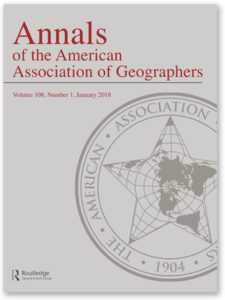
Annals-generic-225x300-1The most recent issue of Annals of the American Association of Geographers has been published online (Volume 109, Issue 4, July 2019) with 16 new research articles on current geographic research. Topics in this issue include tornadoesU.S. water insecuritysocial vulnerability modelsspaces of parentingemotional geopoliticshistorical geographies of the future, and effects of extreme weather on urban environments. Locational areas of interest include New York City neighborhoodsGhana’s Offin RiverMyanmarNorth Dakota, and Chile. Authors are from a variety of research institutions including Dartmouth CollegeUniversity of ManchesterPunjab University, and University of Connecticut.

All AAG members have full online access to all issues of the Annals through the Members Only page. In every issue, the editors choose one article to make freely available. In this issue you can read Plumbing Poverty: Mapping Hot Spots of Racial and Geographic Inequality in U.S. Household Water Insecurity by Shiloh Deitz and Katie Meeha for free for the next two months.

Questions about the Annals? Contact annals [at] aag [dot] org.
Journals-newsletter-100In addition to the most recently published journal, read the latest issue of the other AAG journals online:

• Annals of the American Association of Geographers
• The Professional Geographer
• GeoHumanities
• The AAG Review of Books

New Books in Geography — April and May Available

New-books1-1-2Read the latest titles in geography and related disciplines as found on the New Books in Geography list. Some of these books are chosen to be reviewed for the AAG Review of Books. If you are interested in reviewing any of the books found on the New Books list, please email AAG Review of Books editor Kent Mathewson at kentm [at] lsu [dot] edu. Please take note, the new books list will now be available exclusively on the AAG’s website.

Browse the April list or the May list of new books.

New issue of African Geographical Review

African-Geographical-Review-cvr-212x300-1The latest issue of the journal of the Africa Specialty Group of the AAG, the African Geographical Review, has recently been published. Volume 38, Issue 2 (June 2019) is available online for subscribers and members of the Africa Specialty Group. Each issue, the Editors choose one article to make freely available. In this issue you can read People, place, and animals: using disemplacement to identify invisible losses of conservation near Limpopo National Park, by Michael Strong for free.

See more about the journal.

ASSOCIATION NEWS

‘The Professional Geographer’ Welcomes New Editor

Chang3_web-200x300-1Heejun Chang has assumed the role of editor for The Professional Geographer as of July 1, 2019. A professor and outgoing chair of the department of geography at Portland State University, Heejun seeks to use his experience in interdisciplinary publishing to encourage the submission of fresh ideas and diverse dialogues to the journal. The AAG thanks outgoing editor Barney Warf for his service to the journal over the past eight and a half years.

Learn more about Heejun.

AAG Welcomes 2019 Summer Interns

Summer-2019-Interns-300x169-1

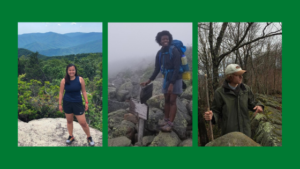
The AAG is excited to welcome three new interns coming aboard our staff for the Summer of 2019! Joining us this summer are Angela Yang, an incoming fourth year student at the University of Toronto majoring in Environmental Science and International Development Studies; Eni Awowale, a rising senior at the University of Maryland, College Park who is majoring in GIS with a concentration in Remote Sensing and also a minor in Astronomy; and Garrett Mogge who is a junior at the University of Maryland, College Park and is double majoring in geographical sciences and broadcast journalism with a minor in Spanish.

Meet the summer interns.

AAG Staff Participate in AP Human Geography Reading

ATTACHMENT DETAILS Alec-Murphy-AP-Reading-300x169-1

Approximately 950 college professors and AP Human Geography high school teachers gathered June 1 to June 9 in Cincinnati, Ohio to evaluate essay exams from over 233,000 high school students. In addition to scoring exams, professional development activities were held such as a keynote from AAG Past President Alec Murphy and a presentation on AAG college and career resources from AAG social media and engagement coordinator Emily Fekete.

Read more about the AP Human Geography event.

POLICY UPDATE

House Approves Additional $10M for Geospatial Mapping to Address Water Quality, Hazard Resilience

US_CapitolThe AAG recently signed onto a statement in conjunction with MAPPS, NSGIC, and ACEC regarding an increase in FY20 Department of Interior funds to support enhanced 3D Elevation Program (3DEP) coverage of the Great Lakes region. This continued mapping work, managed by the U.S. Geological Service (USGS), will provide essential data for better understanding of the region’s most pressing areas of environmental concern. Since this statement’s release, the FY20 funding bill was passed on June 25th by the full House of Representatives as part of a five-bill appropriations package.

Read the full statement.

RESOURCES AND OPPORTUNITIES

Doug D. Nebert National Spatial Data Infrastructure Champion of the Year Award Seeks Nominations

FGDC-logoNominations are being accepted for the Doug D. Nebert National Spatial Data Infrastructure (NSDI) Champion of the Year Award. The award will recognize an individual or a team representing Federal, State, Tribal, regional, and (or) local government, academia, or non­profit and professional organization that has developed an outstanding, innovative, and operational tool, application, or service capability used by multiple organizations that furthers the vision of the NSDI. The deadline to submit nominations is August 15.

More information about the award.

Internships at the AAG

The AAG seeks interns on a year-round basis for the spring, summer, and fall semesters. Interns participate in most AAG programs and projects such as education, outreach, research, website, publications, or the Annual Meeting. A monthly stipend of $500 is provided and interns are expected to make their own housing and related logistical arrangements. Enrollment in a Geography or closely related program is preferred but not a prerequisite for these opportunities. Applicants should forward a resume, brief writing sample, and three references to Candida Mannozzi.

More information about internships.

GEOGRAPHERS IN THE NEWS
EVENTS CALENDAR
    Share

AAG Staff Participate in AP Human Geography Reading

AAG Staff member Emily Fekete recently participated in the AP Human Geography Reading, held annually June 1 to June 9 in Cincinnati, Ohio. The AP Human Geography Reading is a gathering of college professors and AP high school teachers for the purposes of evaluating essays written by students who took the AP Human Geography exam. Throughout the course of the week, individuals will read around 1,000 student essays a piece. To be eligible to score exams, AP readers must have either taught Human Geography at the university level or have taught AP Human Geography for at least 3 years. This was Emily’s seventh consecutive year scoring AP Human Geography exams and her second year attending as an employee of the AAG.

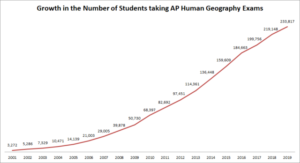
The number of students who took the AP Human Geography Exam from the year the exam started to 2019.


The exam is structured so that it contains a section of multiple choice questions scored with a scantron as well as a free-response section containing three essay style questions. AP Human Geography Readers score the free-response questions throughout the course of seven 8 AM to 5 PM days. The reading days are kept on a strict schedule to keep on pace to ensure that the scoring is complete by 5 PM on June 8. To score the exams, a rubric is developed by a group of question leaders made up of college professors who then train the readers on how to use the rubric to score the questions. This process ensures that readers are scoring as consistently as possible.
The AP Human Geography exam is one of the fastest growing AP exams currently being offered. In 2001, the first year the exam was available, 3,272 students completed the test. In 2019, 233,817 students took the AP Human Geography exam. Because of the growth in the number of exams needing to be scored, the number of readers who attend the event has also grown. In 2019, approximately 950 readers were present to score the AP Human Geography exam, up from 794 in 2018.

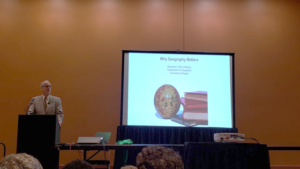
AAG Past President Alec Murphy gives his keynote address at the AP Human Geography Reading

During the evenings at the AP Human Geography Reading, professional development activities ranging from academic speakers to networking to a Human Geography Bowl are organized. Past AAG President Alec Murphy was the 2019 featured keynote speaker with his presentation “Why Geography Matters” where he discussed his role in establishing the AP Human Geography course and the importance of the discipline to create contemporary global citizens. Another popular night is the Night of the Round Tables, an evening to share teaching resources with AP Human Geography high school teachers. During the 2019 Night of the Round Tables, Emily shared the AAG’s Profiles of Professional Geographers and the Guide to Geography Programs in a short presentation. By giving high school teachers these resources, students who have an interest in pursuing a career in geography will be more knowledgeable about which universities have geography programs when deciding where to attend college.

    Share

New Books: June 2019

Every month the AAG compiles a list of newly-published books in geography and related areas. Some are selected for review in the AAG Review of Books.

Publishers are welcome to send new volumes to the Editor-in-Chief (Kent Mathewson, Editor-in-Chief, AAG Review of BooksDepartment of Geography and Anthropology, Louisiana State University, Baton Rouge, LA 70803).

Anyone interested in reviewing these or other titles should also contact the Editor-in-Chief.

PLEASE NOTE: Due to current public health policies which have prompted the closing of most offices, we are unable to access incoming books at this time. We are working on a solution during this transition and will continue our new books processing as soon as we can. In the meantime, please feel free to peruse previous books from our archived lists.

June 2019

Appalachian Reckoning: A Region Responds to Hillbilly Elegy by Anthony Harkins and Meredith McCarroll, eds. (West Virginia University Press 2019)

Between Earth and Empire: From the Necrocene to the Beloved Community by John P. Clark (PM Press 2019)

Cartography: The Ideal and Its History by Matthew H. Edney (University of Chicago Press 2019)

Coal by Mark C. Thurber (Polity Books 2019)

In Defense of Farmers: The Future of Agriculture in the Shadow of Corporate Power by Jane W. Gibson and Sara E. Alexander (eds.) (University of Nebraska Press 2019)

Dream City: Creation, Destruction, and Reinvention in Downtown Detroit by Conrad Kickert (The MIT Press 2019)

Ecologists and Environmental Politics: A History of Contemporary Ecology by Stephen Bocking (West Virginia University Press 2019)

Edges of the State by John Protevi (University of Minnesota Press 2019)

Food by Fabio Parasecoli (The MIT Press 2019)

Giants of the Monsoon Forest: Living and Working with Elephants by Jacob Shell (W. W. Norton & Company, Inc. 2019)

Ibn Khaldun: An Intellectual Biography by Robert Irwin (Princeton University Press 2019)

Imagining Seattle: Social Values in Urban Governance by Serin D. Houston (University of Nebraska Press 2019)

Immigration and the Remaking of Black America by Tod G. Hamilton (Russell Sage Foundation 2019)

Indigenous Struggles for Autonomy: The Caribbean Coast of Nicaragua by Luciano Baracco, ed. (Lexington Books 2019)

The Interior Borderlands: Regional Identity in the Midwest and Great Plains by Jon K. Lauck, ed. (The Center for Western Studies (Augustana University 2019)

Intertwined Histories: Plants in Their Social Contexts by Jim Ellis (ed.) (University of Calgary Press 2019)

Marked, Unmarked, Remembered: A Geography of American Memory by Andrew Lichtenstein (West Virginia University Press 2019)

Mega Cities Mega Challenge: Informal Dynamics of Global Change: Insights from Dhaka, Bangladesh and Pearl River Delta, China by Frauke Kraas, Kirsten Hackenbroch, Harald Sterly, Jost Heintzenberg, Peter Herrle, Volker Kreibich, eds. (Borntraeger Science Publishers 2019)

More than Rural: Textures of Thailand’s Agrarian Transformation by Jonathan Rigg (University of Hawai’i Press 2019)

Outward and Upward Mobilities: International Students in Canada, Their Families, and Structuring Institutions by Ann H. Kim and Min-Jung Kwak, eds. (University of Toronto Press 2019)

The Politics of Lists: Bureaucracy and Genocide under the Khmer Rouge by James A. Tyner (West Virginia University Press 2019)

Power-Lined: Electricity, Landscape, and the American Mind by Daniel L. Wuebben (University of Nebraska Press 2019)

Saints, Statues, and Stories: A Folklorist Looks at the Religious Art of Sonora by James S. Griffith (University of Arizona Press 2020)

Science Be Dammed: How Ignoring Inconvenient Science Drained the Colorado River by Eric Kuhn and John Fleck (University of Arizona Press 2019)

The Science of Breaking Bad by Dave Trumbore and Donna J. Nelson (The MIT Press 2019)

Spiral to the Stars: Mvskoke Tools of Futurity by Laura Harjo (University of Arizona Press 2019)

Street Fights in Copenhagen: Bicycle and Car Politics in a Green Mobility City by Jason Henderson and Natalie Marie Gulsrud (Routledge 2019)

The Taco Truck: How Mexican Street Food Is Transforming the American City by Robert Lemon (University of Illinois Press 2019)

Tambora and the Year without a Summer: How a Volcano Plunged the World into Crisis by Wolfgang Behringer (Polity 2019)

    Share

Newsletter – June 2019

PRESIDENT’S COLUMN

Should we be worried? Or how to maintain and expand the number of geographers in our schools

By David Kaplan

Dave Kaplan“As geographers, we all know the value of geography. Right? It is a field that provides a unique perspective, an appreciation for particularity, an opportunity to synthesize. But as much as we affirm geography’s value to each other, we also need to look at how geography is perceived outside of our community.”

Continue Reading.

ANNUAL MEETING

Prepare to register for #aagDENVER

fee-schedule-300x105-1The 2020 AAG Annual Meeting takes place from April 6-10, 2020. Similar to the 2019 AAG Annual Meeting, registration rates will be based on the way in which attendees choose to participate in the conference. Please check your email in the coming days for an announcement regarding the 2020 Annual Meeting registration opening dates. And remember, register early for the best rates!

View the registration options.

Denver, Colorado to host 2020 AAG Annual Meeting

Mark your calendar for the AAG Annual Meeting in the Mile High City April 6-10, 2020. Registration and the call for papers for #aagDENVER will be announced this summer. We look forward to seeing you in the Rocky Mountains!

PUBLICATIONS

NEW Annals Issue Alert:
Articles with topics ranging from elephant-based labor and energy poverty, airspace to architecture

Annals-generic-225x300-1The most recent issue of Annals of the American Association of Geographers has been published online (Volume 109, Issue 4, July 2019) with 16 new research articles on current geographic research. Topics in this issue include tornadoesU.S. water insecuritysocial vulnerability modelsspaces of parentingemotional geopoliticshistorical geographies of the future, and effects of extreme weather on urban environments. Locational areas of interest include New York City neighborhoodsGhana’s Offin RiverMyanmarNorth Dakota, and Chile. Authors are from a variety of research institutions including Dartmouth CollegeUniversity of ManchesterPunjab University, and University of Connecticut.

All AAG members have full online access to all issues of the Annals through the Members Only page. In every issue, the editors choose one article to make freely available. In this issue you can read Plumbing Poverty: Mapping Hot Spots of Racial and Geographic Inequality in U.S. Household Water Insecurity by Shiloh Deitz and Katie Meeha for free for the next two months.

Questions about the Annals? Contact annals [at] aag [dot] org.

Journals-newsletter-100In addition to the most recently published journal, read the latest issue of the other AAG journals online:

• Annals of the American Association of Geographers
• The Professional Geographer
• GeoHumanities
• The AAG Review of Books

New Books in Geography — April and May Available

New-books1-1-2Read the latest titles in geography and related disciplines as found on the New Books in Geography list. Some of these books are chosen to be reviewed for the AAG Review of Books. If you are interested in reviewing any of the books found on the New Books list, please email AAG Review of Books editor Kent Mathewson at kentm [at] lsu [dot] edu. Please take note, the new books list will now be available exclusively on the AAG’s website.

Browse the April list or the May list of new books.

New issue of African Geographical Review

African-Geographical-Review-cvr-212x300-1The latest issue of the journal of the Africa Specialty Group of the AAG, the African Geographical Review, has recently been published. Volume 38, Issue 2 (June 2019) is available online for subscribers and members of the Africa Specialty Group. Each issue, the Editors choose one article to make freely available. In this issue you can read People, place, and animals: using disemplacement to identify invisible losses of conservation near Limpopo National Park, by Michael Strong for free.

See more about the journal.

ASSOCIATION NEWS

‘The Professional Geographer’ Welcomes New Editor

Chang3_web-200x300-1Heejun Chang has assumed the role of editor for The Professional Geographer as of July 1, 2019. A professor and outgoing chair of the department of geography at Portland State University, Heejun seeks to use his experience in interdisciplinary publishing to encourage the submission of fresh ideas and diverse dialogues to the journal. The AAG thanks outgoing editor Barney Warf for his service to the journal over the past eight and a half years.

Learn more about Heejun.

AAG Welcomes 2019 Summer Interns

Summer-2019-Interns-300x169-1

The AAG is excited to welcome three new interns coming aboard our staff for the Summer of 2019! Joining us this summer are Angela Yang, an incoming fourth year student at the University of Toronto majoring in Environmental Science and International Development Studies; Eni Awowale, a rising senior at the University of Maryland, College Park who is majoring in GIS with a concentration in Remote Sensing and also a minor in Astronomy; and Garrett Mogge who is a junior at the University of Maryland, College Park and is double majoring in geographical sciences and broadcast journalism with a minor in Spanish.

Meet the summer interns.

AAG Staff Participate in AP Human Geography Reading

ATTACHMENT DETAILS Alec-Murphy-AP-Reading-300x169-1

Approximately 950 college professors and AP Human Geography high school teachers gathered June 1 to June 9 in Cincinnati, Ohio to evaluate essay exams from over 233,000 high school students. In addition to scoring exams, professional development activities were held such as a keynote from AAG Past President Alec Murphy and a presentation on AAG college and career resources from AAG social media and engagement coordinator Emily Fekete.

Read more about the AP Human Geography event.

POLICY UPDATE

House Approves Additional $10M for Geospatial Mapping to Address Water Quality, Hazard Resilience

US_CapitolThe AAG recently signed onto a statement in conjunction with MAPPS, NSGIC, and ACEC regarding an increase in FY20 Department of Interior funds to support enhanced 3D Elevation Program (3DEP) coverage of the Great Lakes region. This continued mapping work, managed by the U.S. Geological Service (USGS), will provide essential data for better understanding of the region’s most pressing areas of environmental concern. Since this statement’s release, the FY20 funding bill was passed on June 25th by the full House of Representatives as part of a five-bill appropriations package.

Read the full statement.

RESOURCES AND OPPORTUNITIES

Doug D. Nebert National Spatial Data Infrastructure Champion of the Year Award Seeks Nominations

FGDC-logoNominations are being accepted for the Doug D. Nebert National Spatial Data Infrastructure (NSDI) Champion of the Year Award. The award will recognize an individual or a team representing Federal, State, Tribal, regional, and (or) local government, academia, or non­profit and professional organization that has developed an outstanding, innovative, and operational tool, application, or service capability used by multiple organizations that furthers the vision of the NSDI. The deadline to submit nominations is August 15.

More information about the award.

Internships at the AAG

The AAG seeks interns on a year-round basis for the spring, summer, and fall semesters. Interns participate in most AAG programs and projects such as education, outreach, research, website, publications, or the Annual Meeting. A monthly stipend of $500 is provided and interns are expected to make their own housing and related logistical arrangements. Enrollment in a Geography or closely related program is preferred but not a prerequisite for these opportunities. Applicants should forward a resume, brief writing sample, and three references to Candida Mannozzi.

More information about internships.

GEOGRAPHERS IN THE NEWS
EVENTS CALENDAR
    Share

Taking Steps to Create a Welcoming Discipline for ALL Geographers: A New Resource for Indigenous Students

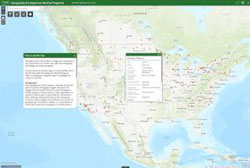
The AAG is pleased to announce the release of a new interactive web map of colleges and universities that offer both Geography Programs and Indigenous Studies Programs. Developed in consultation with members of the AAG’s Indigenous Peoples Specialty Group (IPSG), the map serves to help Indigenous students find safe places to pursue a Geography degree. In this case safe places refer to colleges and universities that have an active Indigenous Studies program, cultural center, or other active organization that can act as a support system for Indigenous students to keep them connected to their traditional communities and provide mentorship to help them achieve their academic goals. In many cases, this also includes colleges and universities that are geographically accessible to students, meaning the school is a commutable distance from their homes or within their home state for the purposes of in-state tuition.

There is a strong record of the application of geography, and specifically GIS, to address the needs of Tribal Governments and associated communities. Tracking land ownership records for resource management and land claims,[1],[2] assisting Tribal Governments with improving medical services, transportation, and economic development, and the preservation of cultural and natural resources[3],[4] represent a few of the ways spatial techniques and GIS have assisted indigenous communities. Coupled with the expectation that the GIS industry will grow by 10% each year through 2023[5], encouraging Indigenous students to pursue Geography could not only present opportunities in a growing field but provide tools and skills to better serve the needs of their own communities.

AAG Membership Data

Since 1981, the AAG has seen a gradual increase in the number of minorities within its membership. In the early 2000s there was a dramatic increase in the number of members who identify as Asian, African American, and Hispanic, however, the number of members who identify as Native Alaskan, Native American, or Pacific Islander has not followed that trend (Graph 1).[6] This suggests that Indigenous people have not been welcomed and included in Geography to the same extent as other underrepresented groups, a concern of the AAG as the Association is dedicated to “promoting inclusion, equity, and social justice across the entire discipline.”[7]

Graph 1: AAG Minority Membership since 1981.[6]

The Interactive WebMap

To address the need for greater Native American, Native Alaskan, and Pacific Islander representation in the AAG, the AAG has developed a database and interactive webmap to help students find schools suited to their needs. The database and interactive webmap was built by cross-referencing the American Indian Higher Education Consortium’s (AIHEC) list of Tribal Colleges,[8] the Guide to Native American Studies Programs in the U.S. and Canada,[9] and the AAG’s Guide to Geography Programs in the Americas[10] to identify schools in the US and Canada that qualify as a safe place. The academic catalog for each school was reviewed to determine if they offered both Geography Programs and Indigenous Studies Programs. Those that did were then added to the database along with information about the level of degrees offered in both fields as well as any cultural centers, administrative departments, or student organizations that would also be beneficial, as well as direct links to those websites.

Some of the identified colleges and universities do not offer degrees in both fields but were still included in the database because they have another structure in place that would also fulfill that need. For example few Tribal Colleges offer degrees in geography but do offer geography courses and, as institutions run by and for their communities, support structures for students are already available. Likewise, a couple of the schools included in this database do not offer an Indigenous Studies degree, but support research centers, cultural centers, or other partnerships with community organizations that would also fulfill that need. The result is a database of 185 colleges and universities across the United States and Canada.

Once the database was completed, a corresponding webmap was made as a method of searching the database spatially and includes filters to help students narrow down potential schools. The map includes two query tools that allow the user to select schools based on the degree they are interested in pursuing. One of these filters selects  programs by the level of Geography degrees and the other sorts by the level of Indigenous Studies degrees. The application also includes a filter tool that allows the user to select schools by country (United States or Canada), State or Province, or highlight only Tribal Colleges.

For more information please contact:

Jolene Keen, Research Associate, American Association of Geographers

[1] Barcus, Holly R., and Laura J. Smith. “Facilitating Native Land Reacquisition in the Rural USA through Collaborative Research and Geographic Information Systems.” Geographical Research 54, no. 2 (12, 2015): 118-28. doi:10.1111/1745-5871.12167.

[2] Chapin, Mac, Zachary Lamb, and Bill Threlkeld. “Mapping Indigenous Lands.” Annual Review of Anthropology 34, no. 1 (10 2005): 619-38. doi:10.1146/annurev.anthro.34.081804.120429.

[3] Horn, Brady P., Gary N. Barragan, Chis Fore, and Caroline A. Bonham. “A Cost Comparison of Travel Models and Behavioural Telemedicine for Rural, Native American Populations in New Mexico.” Journal of Telemedicine and Telecare 22, no. 1 (05, 2015): 47-55. doi:10.1177/1357633×15587171.

[4] Deogawanka, Sangeeta. “How GIS Is Being Used to Help Native Americans ~ GIS Lounge.” GIS Lounge. November 10, 2014. https://www.gislounge.com/gis-used-help-native-americans/

[5] Dempsey, C. (2017, June 23). Global GIS Industry Continues to Grow ~ GIS Lounge. Retrieved from https://www.gislounge.com/global-gis-industry-continues-grow/

[6] Race and Ethnicity in Geography | AAG. (n.d.). Retrieved from https://www.aag.org/cs/disciplinarydata/raceandethnicity

[7] AAG Membership Data | AAG. (2017). Retrieved from https://www.aag.org/cs/disciplinarydata/aagmembershipdata

[8] AIHEC: Who We Serve. American Indian Higher Education Consortium.

[9] Nelson, Robert M., Guide to Native Studies Programs in the U.S. and Canada. (2011)

[10] AAG Guide to Geography Programs in the Americas 2017-2018. American Association of Geographers.

    Share

Beyond Compactness: A New Measure to Evaluate Congressional Districts

Redrawing congressional district boundaries, an activity that happens every ten years following the decennial census, may be the most consequential application of geography in the United States. As congressional elections have become less competitive, many are raising questions about the current boundaries of congressional districts, often citing lack of geographical compactness as their rationale. Geographical compactness generally ranges from 0 to 1, with 1 being a perfect circle. Wyoming’s only district is currently the most geographically compact district with a score of .77.

The U.S. Supreme Court has ruled multiple times that the assertion a district is oddly-shaped is insufficient to claim that the boundaries have been manipulated. In fact, some districts that score low in compactness can also be the most competitive. Odd shapes are sometimes needed to connect communities, to comply with the Voting Rights Act, or result from oddly-shaped states or coastal areas. Furthermore, communities rarely form in circles or squares naturally. Rather, communities rely more on existing administrative boundaries (counties, municipalities), infrastructure, and physical features to form.

A “Natural Communities” Score for District Boundaries

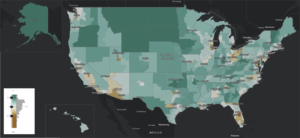
Esri’s Policy Maps team formed the research question: How much are current congressional boundaries defined by physical features (mountains and rivers), infrastructure (highways and railroads), or other existing administrative boundaries (county and place boundaries)? We calculated the percent of perimeter of each district that was a county boundary, a place (city, township, or other municipality) boundary, an interstate highway, a railroad track, a river, or within proximity to a mountain peak, as well as geographical compactness for comparison.

Also available as an interactive web map with detailed information in pop-ups.

Using a statistical technique called factor analysis, we were able to create an index that incorporates all these measures and to determine the optimal weights for capturing as much information possible based on the correlations between variables. We call this the Natural Communities index. Not surprisingly, the results of the factor analysis suggested giving the most weight to sharing a boundary with an existing administrative boundary. The least weight was given to proximity to a mountain peak. Geographical compactness helps the score, but not by much since that measure was given such a low weight. The infrastructure measures both had sizeable negative weights, meaning that having infrastructure as a boundary is somehow negatively associated with our construct of natural communities and thus hurts a district’s score, perhaps because infrastructure is used to bring people together rather than separate them. Using these weights, we can come up with a “natural communities” score for each district. The scores were then standardized to have a mean of zero and a standard deviation of 1, for easy comparison. Districts that score high on our Natural Communities index are shown in green on the map below, whereas districts that score low are shown in brown.

States with only one district (Alaska, Delaware, Montana, North Dakota, South Dakota, Vermont, and Wyoming) generally scored highly, but these districts having different values does not make sense since there were no other options these districts could have used. We gave all these districts a “perfect” score of 2.0, shown in dark green in the map.

A Look at Specific Districts

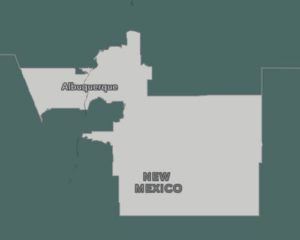
New Mexico’s 1st

New Mexico’s 1st District has a compactness score of .26 (national average was .18).

New Mexico’s 1st District scored average (0). This district has 60.4 percent of its perimeter defined by administrative boundaries (national average was 65.4 percent), and 2.4 percent defined by a major highway (national average was 2.3 percent).

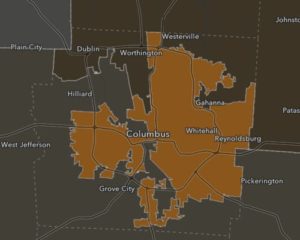
Ohio’s 3rd

Ohio’s 3rd District has a compactness score of .06 (national average was .18).

Ohio’s 3rd District scored very low (-3.5). This district has only 16.3 percent of its perimeter defined by administrative boundaries (national average was 65.4 percent), and high percentages defined by the two infrastructure categories – railroad tracks and major highways – which has a negative impact on the score.

Arkansas’ 2nd

Arkansas’ 2nd District scored very high (+1.4). This district has 100 percent of its perimeter defined by administrative boundaries (national average was 65.4 percent), zero percent defined by infrastructure, and 37.5 percent defined by a river or stream (national average was 18.1%).

Arkansas’ 2nd District has a compactness score of .24 (national average was .18).

Our index adds information by accounting for the existing administrative boundaries as well as considering infrastructure and physical geographic features. This new score provides much more context when evaluating congressional district boundaries than simply geographical compactness. For example, Arkansas’ 2nd District is slightly less compact than New Mexico’s 1st District but scores much higher when taking into account the existing administrative boundaries (counties and places) and physical geographic boundaries (rivers and mountain peaks).

Join the Discussion

Our natural communities score can be used going into the upcoming redistricting exercises when evaluating multiple proposed districts. This score can add to the conversation when communicating proposed plans to the public during briefings and comment periods.

For maps, data, and other resources for creating your own policy maps, visit Esri Maps for Public Policy or watch the video Top 10 Tips for Policy Story Maps.

About the Author

Diana C. Lavery is a product engineer on Esri’s Living Atlas and Policy Maps teams.

    Share

Newsletter – April 2019

PRESIDENT’S COLUMN

Should we be worried? Or how to maintain and expand the number of geographers in our schools

By David Kaplan

Dave Kaplan“As geographers, we all know the value of geography. Right? It is a field that provides a unique perspective, an appreciation for particularity, an opportunity to synthesize. But as much as we affirm geography’s value to each other, we also need to look at how geography is perceived outside of our community.”

Continue Reading.

ANNUAL MEETING

Prepare to register for #aagDENVER

fee-schedule-300x105-1The 2020 AAG Annual Meeting takes place from April 6-10, 2020. Similar to the 2019 AAG Annual Meeting, registration rates will be based on the way in which attendees choose to participate in the conference. Please check your email in the coming days for an announcement regarding the 2020 Annual Meeting registration opening dates. And remember, register early for the best rates!

View the registration options.

Denver, Colorado to host 2020 AAG Annual Meeting

Mark your calendar for the AAG Annual Meeting in the Mile High City April 6-10, 2020. Registration and the call for papers for #aagDENVER will be announced this summer. We look forward to seeing you in the Rocky Mountains!

PUBLICATIONS

NEW Annals Issue Alert:
Articles with topics ranging from elephant-based labor and energy poverty, airspace to architecture

Annals-generic-225x300-1The most recent issue of Annals of the American Association of Geographers has been published online (Volume 109, Issue 4, July 2019) with 16 new research articles on current geographic research. Topics in this issue include tornadoesU.S. water insecuritysocial vulnerability modelsspaces of parentingemotional geopoliticshistorical geographies of the future, and effects of extreme weather on urban environments. Locational areas of interest include New York City neighborhoodsGhana’s Offin RiverMyanmarNorth Dakota, and Chile. Authors are from a variety of research institutions including Dartmouth CollegeUniversity of ManchesterPunjab University, and University of Connecticut.

All AAG members have full online access to all issues of the Annals through the Members Only page. In every issue, the editors choose one article to make freely available. In this issue you can read Plumbing Poverty: Mapping Hot Spots of Racial and Geographic Inequality in U.S. Household Water Insecurity by Shiloh Deitz and Katie Meeha for free for the next two months.

Questions about the Annals? Contact annals [at] aag [dot] org.

Journals-newsletter-100In addition to the most recently published journal, read the latest issue of the other AAG journals online:

• Annals of the American Association of Geographers
• The Professional Geographer
• GeoHumanities
• The AAG Review of Books

New Books in Geography — April and May Available

New-books1-1-2Read the latest titles in geography and related disciplines as found on the New Books in Geography list. Some of these books are chosen to be reviewed for the AAG Review of Books. If you are interested in reviewing any of the books found on the New Books list, please email AAG Review of Books editor Kent Mathewson at kentm [at] lsu [dot] edu. Please take note, the new books list will now be available exclusively on the AAG’s website.

Browse the April list or the May list of new books.

New issue of African Geographical Review

African-Geographical-Review-cvr-212x300-1The latest issue of the journal of the Africa Specialty Group of the AAG, the African Geographical Review, has recently been published. Volume 38, Issue 2 (June 2019) is available online for subscribers and members of the Africa Specialty Group. Each issue, the Editors choose one article to make freely available. In this issue you can read People, place, and animals: using disemplacement to identify invisible losses of conservation near Limpopo National Park, by Michael Strong for free.

See more about the journal.

ASSOCIATION NEWS

‘The Professional Geographer’ Welcomes New Editor

Chang3_web-200x300-1Heejun Chang has assumed the role of editor for The Professional Geographer as of July 1, 2019. A professor and outgoing chair of the department of geography at Portland State University, Heejun seeks to use his experience in interdisciplinary publishing to encourage the submission of fresh ideas and diverse dialogues to the journal. The AAG thanks outgoing editor Barney Warf for his service to the journal over the past eight and a half years.

Learn more about Heejun.

AAG Welcomes 2019 Summer Interns

Summer-2019-Interns-300x169-1

The AAG is excited to welcome three new interns coming aboard our staff for the Summer of 2019! Joining us this summer are Angela Yang, an incoming fourth year student at the University of Toronto majoring in Environmental Science and International Development Studies; Eni Awowale, a rising senior at the University of Maryland, College Park who is majoring in GIS with a concentration in Remote Sensing and also a minor in Astronomy; and Garrett Mogge who is a junior at the University of Maryland, College Park and is double majoring in geographical sciences and broadcast journalism with a minor in Spanish.

Meet the summer interns.

AAG Staff Participate in AP Human Geography Reading

ATTACHMENT DETAILS Alec-Murphy-AP-Reading-300x169-1

Approximately 950 college professors and AP Human Geography high school teachers gathered June 1 to June 9 in Cincinnati, Ohio to evaluate essay exams from over 233,000 high school students. In addition to scoring exams, professional development activities were held such as a keynote from AAG Past President Alec Murphy and a presentation on AAG college and career resources from AAG social media and engagement coordinator Emily Fekete.

Read more about the AP Human Geography event.

POLICY UPDATE

House Approves Additional $10M for Geospatial Mapping to Address Water Quality, Hazard Resilience

US_CapitolThe AAG recently signed onto a statement in conjunction with MAPPS, NSGIC, and ACEC regarding an increase in FY20 Department of Interior funds to support enhanced 3D Elevation Program (3DEP) coverage of the Great Lakes region. This continued mapping work, managed by the U.S. Geological Service (USGS), will provide essential data for better understanding of the region’s most pressing areas of environmental concern. Since this statement’s release, the FY20 funding bill was passed on June 25th by the full House of Representatives as part of a five-bill appropriations package.

Read the full statement.

RESOURCES AND OPPORTUNITIES

Doug D. Nebert National Spatial Data Infrastructure Champion of the Year Award Seeks Nominations

FGDC-logoNominations are being accepted for the Doug D. Nebert National Spatial Data Infrastructure (NSDI) Champion of the Year Award. The award will recognize an individual or a team representing Federal, State, Tribal, regional, and (or) local government, academia, or non­profit and professional organization that has developed an outstanding, innovative, and operational tool, application, or service capability used by multiple organizations that furthers the vision of the NSDI. The deadline to submit nominations is August 15.

More information about the award.

Internships at the AAG

The AAG seeks interns on a year-round basis for the spring, summer, and fall semesters. Interns participate in most AAG programs and projects such as education, outreach, research, website, publications, or the Annual Meeting. A monthly stipend of $500 is provided and interns are expected to make their own housing and related logistical arrangements. Enrollment in a Geography or closely related program is preferred but not a prerequisite for these opportunities. Applicants should forward a resume, brief writing sample, and three references to Candida Mannozzi.

More information about internships.

GEOGRAPHERS IN THE NEWS
EVENTS CALENDAR
    Share

AI and GIS: Finally Delivering on the promise

The field of artificial intelligence (AI) isn’t new, and neither are its grand promises. AI as an academic pursuit has its roots in the 1950s. Early AI researchers were filled with optimism, but—despite some initial work that appeared groundbreaking, such as the first artificial neural networks—the field saw slow progress over the next several decades. By the mid-1970s, the field had hit a bit of a roadblock—there was a loss in interest largely due to inflated expectations as well as the failure to deliver on the promise of AI. This period is known as the first AI winter.

Following the first AI winter, advances in the field saw AI once again, albeit slowly, gaining momentum and funding, but only for a brief time. By the early-1990s, AI had again failed to live up to expectations. While AI had been tightly integrated into people’s everyday lives, it still largely failed on problems that most humans deem simple, such as recognizing features in images or understanding speech. With a 40-year history and a failure to live up to the hype, things appeared bleak for AI.

Then something happened. In the last decade, due to the advent of massive volumes of data gathered from the Internet and powerful graphics processing units (GPUs) capable of supercomputer-like performance on certain tasks, a particular type of AI algorithm has seen massive resurgence. These algorithms are known as artificial neural networks because they loosely resemble biological neural networks such as those in the human brain. Since 2010, these algorithms have experienced exponential increases in performance on numerous benchmarks, including some that were thought to be out of reach by many. Neural networks have even achieved superhuman performance in a few domains. Though still not quite reaching the level of promise visualized during the 1950s, AI is at the point where it is already making a massive impact everywhere. This includes in geographic information system (GIS) technology.

The types of data that we look at in the geospatial realm can be broadly categorized into two types: structured and unstructured. Structured data includes vector data—parcel boundaries, roads, GPS bread crumbs, and so on. Unstructured data refers to raster data, voice, and text, which—while typically very usable by humans—is difficult for machines to extract actionable information from.

This is changing rapidly; major advances in AI have made it possible to unlock the potential of unstructured data, and to do so at scale. Deep learning—so called because it applies “deep” artificial neural networks that often are composed of hundreds of connected layers of calculation—has enabled a new revolution in the processing of unstructured data. For those of us working in GIS, this means massive increases in productivity.

Cartographic Style Transfer Using GAN—Map Style Transferred to a Different Basemap

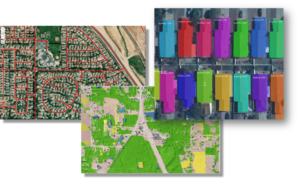
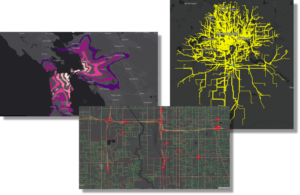
Deep learning has created the ability to very accurately detect objects and classify pixels at scale. Exploitation of aerial, satellite, and street-view images and videos are some of the common uses that we see at Esri. Deep learning enables endeavors such as large-scale high-resolution land cover mapping, the detection and digitization of buildings and roads, and rapid exploitation of drone imagery to detect asset damage, to name a few. Recent advances in processing voice and text by using deep learning allow geospatial analysis without manual extraction of geospatial entities. A fascinating new class of algorithms, called Generative Adversarial Networks (GAN), can generate realistic—but fake—data, including photographs! At Esri, we’ve been investigating numerous applications of GAN, ranging from generating 3D models to simulating spatiotemporal data and even performing automatic cartographic map styling, as shown at right.

AI can also add value to structured data for tasks, including predicting geospatial events such as car crashes or crime, estimating drive times, or helping businesses determine where to construct the next new store. The list goes on—we are nowhere close to tapping all the potential of machine learning.

The thing is, the GIS community has been using AI for a very long time. Performing regression, kriging, clustering, hot-spot analysis—these capabilities have been adopted into a subfield of AI called machine learning. Machine learning, at its core, is composed of approaches that learn from data rather than being explicitly programmed. Machine learning has been changing the world for decades, though it’s only recently that the public has started to become aware. This is mostly due to the emergence of deep learning.
Adoption of newer machine learning approaches into geospatial workflows has been slow. But why? As GIS practitioners know very well, GIS is hard—often, subtly so. While massive advances have been made in machine learning, very little thought has gone into making these approaches spatial. This leaves geographers shaking their heads in disapproval when geospatial processing is not only excluded from machine learning algorithms but may be flat-out ignored! Machine learning researchers and data scientists typically don’t understand the significant challenges that something as ubiquitous as terrain brings to the table when estimating the travel time between two locations. Furthermore, the appropriate distance between objects is often ignored or handled poorly. If close things are more related than distant things, machine learning often doesn’t treat this with any rigor.

To overcome these challenges, GeoAI—the combination of AI and GIS—is beginning to take off. Applying AI within a spatial context requires a new approach, but organizations are beginning to recognize the power that geography brings to the table. Sometimes this may mean preparing data differently to account for spatial challenges, and other times this may require a whole new approach. The AI team at Esri has been actively bringing these two fascinating fields together, but it’s in global action that there will be change.

AI hasn’t yet lived up to the original mission—to produce human-level intelligent machines—but it doesn’t have to! We don’t need human-level intelligence to make a human-level impact. AI is here, and it’s not going away this time.

To learn more about GeoAI, visit GeoAI on Medium or watch this video from the Esri Partner Conference.

    Share

Social Media at #aagDC

We’re getting closer to the 2019 AAG Annual Meeting! Whether you will be attending the meeting all week, for a few days, or looking to follow the action from afar, there are plenty of ways to get involved using social media. Social media is a great way for seasoned conference goers and newcomers alike to network, report on new research, engage in lively debate with those inside and outside of the discipline, and find out what’s going on during the largest geography conference in the world! Start planning your #aagDC social media strategy today with these helpful guidelines!


Twitter

One of the most frequently used social media sites for live events, Twitter is a great place to start scoping out the annual meeting. Twitter is used by geographers to discuss and share research ideas or connect with others, often leading to face to face meet-ups at the annual meeting. As the main social media channel, the AAG annual meeting has had active Twitter users since at least 2011 in Seattle. The hashtag #AAG followed by the year of the event used to be the standard AAG Annual Meeting tag. However, this year we decided to switch it up! Due to increased traffic from other events who are already using #AAG2019 (hat tip to the ASEAN Autism Games) and the fact that as geographers we are always thinking about place and space, we will now use the hashtag #aag followed by the location of the conference. This year the official conference hashtag will be #aagDC! Start using and following #aagDC; posts are already being compiled in anticipation of the meeting! If you are new to Twitter, try these tips to benefit most from the network:

  • Follow @theAAG on Twitter! The official AAG Twitter account will be active throughout the meeting with important announcements, live tweets of events, and fun photos throughout the conference hotels. Due to popularity, the AAG will continue to conduct a Twitter poll once a day for members to choose a session they would like to see live-Tweeted!
  • Use #aagDC on all your meeting related communications. Sometimes it is difficult to fit your thoughts into the (now expanded!) 280 character count, but try to include the hashtag #aagDC in each of your tweets. This will ensure that your tweets are being seen by others both at the conference and following along offsite. If you are new to hashtags, a hashtag is a way to organize a specific topic into one feed. Click on the hashtag to see the conversations happening related to that topic.
  • Whenever possible, try to include Twitter handles. If you are tweeting about a paper, panel, or poster, be sure to attribute the research to the right person by using their Twitter handle. Presenters and panelists should consider including their handles on an opening slide or in a poster corner. Conversely, if you do not want your research to be tweeted, please state that information upfront so the audience is aware of your desires.
  • Unable to attend the meeting this year? Follow the hashtag and join the conversation!

Facebook

Do you prefer Facebook over Twitter as your social media site of choice? While there will be less live coverage of specific sessions, Facebook is a great way to share photos, videos, and news about the annual meeting with your friends, family, and colleagues.

  • Make sure you like the AAG Facebook page (www.facebook.com/geographers) and set the page so that you see it first in your News Feed by clicking on the “Following” dropdown menu on the AAG Facebook page itself. This will ensure that you receive the latest meeting related announcements as soon as you open the Facebook app or website.
  • Be on the lookout for Facebook Live videos from some of the major events like the Exhibition Hall opening and the World Geography Bowl finals!
  • Check on the page each morning for reminders of the day’s schedule of events.

Instagram

The AAG’s newest social media channel, Instagram is a fun place to share your photos of activities at the annual meeting and your daily life as a geographer!

  • Follow @theAAG on Instagram for photos of the annual meeting as well as behind the scenes looks at the work that goes into planning the conference on a yearly basis!
  • Share your photos of the meeting with other attendees using the conference hashtag #aagDC and look for an Instagram collage of #aagDC photos after the meeting ends.
  • Want to be featured in our new Instagram Campaign to meet members of the AAG, #MeettheAAG? Look for AAG Staff throughout the meeting who will be taking photos and collecting information about AAG members that will be showcased during the summer.

General Communications

Because the AAG social media channels will be busy during the annual meeting, AAG staff may not be able to provide a timely reply through these mediums. The AAG Annual Meeting App is a good place to start for conference information with regards to floor plans, session times and locations, and abstracts. If you have questions or concerns and need to contact a staff member, the best option is to find a conference volunteer (wearing a neon yellow t-shirt) or to stop by the AAG Meridian or Registration area in the Atrium of the Marriott Hotel.

    Share

Rights of Nature: The New Paradigm

Rights of Nature is a short-hand term for a form of ecological governance that both provides for and prioritizes Nature’s right to flourish. It also provides for various subsidiary rights, such as the right to restoration, the right to its natural processes, and the right to ecosystem functioning without interference. The term “Rights of Nature” gives the impression that the primary focus is defending Nature’s rights in courts of law. However, the Rights of Nature paradigm aims for a more fundamental shift in governance than only defending rights: placing Nature and its needs before human needs, so that human needs are reconfigured within Nature’s limits. Providing Nature with legal personhood and the guardians to defend its rights in court helps change the framework to a form of ecological governance, rather than laws that provide only for human needs. Currently, American law merely regulates human uses of the natural environment and provides for minimal curbs on overuse by such means as fines for pollution or, more rarely, refusal to grant permits for projects deemed too ecologically damaging.

What is Rights of Nature Governance?

The upsurge in interest in ecological governance is driven by the clear signals worldwide of increasing ecological degradation at systemic levels, ranging from climate change to greatly accelerated species loss across ecosystems. It is clear to many thinkers and advocates that the current industrial paradigm is now threatening ecological integrity worldwide and with it the ability of human communities to live sustainably and support critical needs for food, fresh water, decent shelter and ways of making a living.

Rights of Nature is less a specific template than an overarching ideal of ecological governance, the details of which are fashioned in unique ways in each culture that is seeking to enhance or restore sustainable living within Nature’s limits. This requires that Nature be granted the same rights to flourish and maintain itself as humans grant themselves in their legal structures. But underlying the need for legal protections is the concept that humans and Nature are in a relationship, rather than Nature merely providing a hoard of natural resources for indiscriminate human use. The legal structures discussed in Rights of Nature literature codifies the details of this restored relationship, rather than actually creating it.

Fully implementing a Rights of Nature or similar form of ecological governance, is the only way to reach true sustainability, because it places human activities within the framework of Nature’s laws and limitations, as other forms of governance do not. The problem, however, is how to define “sustainability,” as this overused term has lost both its mooring and meaning. Four criteria need to guide an understanding of the sustainability that a Rights of Nature paradigm aims for: (a) true sustainability prohibits mitigation or substitution for monetary or political gain; (b) sustainable projects create sustainable levels of human use, rather than encouraging continued over-consumption; (c) sustainable use shrinks the human footprint on the earth, not expands it; (d) true sustainability is a flexible and continuous process, as populations, technologies, and needs change, but it always maintains Nature’s biophysical integrity throughout, despite the dynamic changes inherent in ecological processes.

The History of the Rights of Nature Paradigm

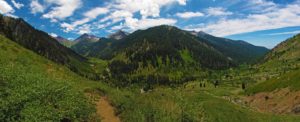
The idea of granting Nature legal rights originated in a court case decided in 1972 by the United States Supreme Court, Sierra Club versus Morton. The Forest Service had issued permits for Disney Enterprises to build a complex of recreation and lodging facilities in Mineral King Valley in the Sierra Nevada of California. The Sierra Club Legal Defense Fund sued to stop the project, but the lower court held that the Fund would not be adversely affected by the project and thus had no legal standing to sue. The United States Supreme Court decided to hear the case. As the case was pending, Christopher Stone, a professor at the University of California School of Law, authored a law review article arguing that natural areas and objects should have legal rights to defend their ecological integrity from harms that would damage them.

Mineral King Valley, now part of Sequoia National Park, California. Photo courtesy of National Park Service.

The country of Ecuador was the first to place Rights of Nature in its governing laws. Section 7 of the new Constitution of Ecuador adopted in 2008 says, “Nature, or Pacha Mama, where life is reproduced and occurs, has the right to integral respect for its existence and for the maintenance and regeneration of its life cycles, structure, functions and evolutionary processes.” The Constitution also grants Nature the right to be restored and requires the government to prevent or restrict activities leading to species extinction, ecosystem destruction, and permanent alteration of natural cycles. Significantly, the Ecuadoran Constitution also protects its people’s rights to food sovereignty, and the right, especially of indigenous peoples, to remain on their ancestral lands, protecting their rights to develop ancestral traditions and societies and retain ownership of their community lands.This article, entitled “Should Trees Have Standing?” caught the attention of Supreme Court Justice William O. Douglas. The Court ruled against the Sierra Club, but Justice Douglas wrote a now-famous dissent in which he said, “Contemporary public concern for protecting nature’s ecological equilibrium should lead to the conferral of standing upon environmental objects to sue for their own preservation.” Ultimately, the Sierra Club was able to prevent the destruction of Mineral King Valley, which is now part of Sequoia National Park. Professor Stone’s provocative article, suggesting that Nature be granted legal personhood to protect its own integrity, slowly began to attract more attention.

This new Constitutional provision on Nature’s Rights is slowly changing the face of Ecuadoran law. The very first lawsuit using the Rights of Nature provision was decided in Ecuador in 2011. It concerned a new road built along the Vilcabamba River in Loja Province and the dumping of construction rubble into the river. The Provincial Justice Court of Loja ruled in favor of the river, noting that damage to nature is generational in extent and that therefore the “precautionary principle” should guide development projects. The court required the government to take immediate corrective actions and appointed a delegation to oversee the cleanup.

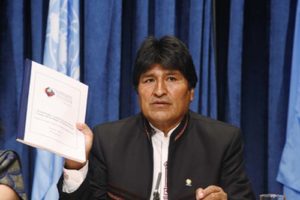
Evo Morales Ayma, President of Bolivia and Rights of Nature advocate, holding up a manual of the World People’s Conference on Climate Change and the Rights of Mother Earth during a press conference at UN Headquarters on May 7, 2010. United Nations photograph by Eskinder Debebe.

Other recent efforts include a state court in India granting legal personhood to the heavily polluted Ganges and Yamuna Rivers, and local Rights of Nature legislation in various regions of the United States. Most recently (in February 2019), the people of Toledo, Ohio passed a Bill of Community Rights and Nature’s Rights to protect Lake Erie, subject to nearly annual toxic algal blooms, mainly as a result of industrial agricultural practices in the lake’s watershed. The legislation passed with 61% of the vote, but is already subject to a lawsuit, as nearly all other such local attempts in the United States have been.Bolivia subsequently, in 2010, enacted a comprehensive Rights of Nature statute, and also hosted an international gathering of concerned organizations from around the world, which led to the founding of the Global Alliance for the Rights of Nature. Advocates and governments worldwide are also experimenting with innovative ways to approach ecosystem protection that reach past the current human-centered legal paradigm. One of the most successful is in New Zealand, where a fusion of Western legal concepts and Maori traditions of the Whanganui River’s importance as an ancestor, and Maori responsibilities to protect and conserve it, led to a formal agreement, finalized in 2012, to grant the river a legal identity. The implementing legislation passed in 2017. The definition of the river is adopted from the Whanganui iwi, the Maori group whose entire history is tied to the river. The river is defined as a living and integral whole, whose life is inseparable from the Whanganui iwi. Appointed guardians from the Whanganui iwi and the New Zealand government now protect the river. This successful project is considered a model for other efforts to blend indigenous law and tradition with Western legal structures for the protection of Nature.

The reason is not hard to seek: a Rights of Nature legal structure, if implemented nationwide, would constitute a monumental shift in the way Americans approach Nature, with relationship to Nature as the foremost goal, and the protection and flourishing of Nature given primacy over natural resources extraction and use. It would change the basis and thrust of the economy. Thus far, all attempts at Rights of Nature legislation in the United States have been local. These locally-approved laws clash with the hierarchical structure of American governance, which pre-empts most natural resources regulation to state or federal levels.

Questions and Challenges for a Rights of Nature Paradigm

Clearly, major changes in human use of the environment must take place; the ecological signals are unmistakable that current levels are unsustainable. The question is how best to move forward. There are many unanswered questions about ecological governance. How would Rights of Nature laws be implemented? What level of Nature would be granted the right to flourish: a watershed, an entire ecosystem, a single river, a valley, the climate of the world? Who would determine whether a given use interferes with Nature’s well-being and how would it be measured? If there are damages, how would they be measured, what would the remedy be, and how would it be implemented? How would human communities reconfigure themselves to live sustainably and stably, without instability, poverty and excessive resource use? How would human needs and Nature’s need to flourish without interference be balanced to create wholeness for both parties?

These questions and many more are being explored in a growing trickle of papers, articles, and books. CRC Press published the first book surveying Rights of Nature activity worldwide since an environmental philosophy work by Roderick Nash in 1989. The new book, released in 2017, begins the conversation on changes needed in human land use patterns (in the United States). It is titled Sustainability and the Rights of Nature: An Introduction, by Cameron La Follette and Chris Maser. The authors recognize that implementing ecological governance and deep sustainability models is something that must be done locally, place by place, region by region. Therefore, they are working on a second book, Sustainability and the Rights of Nature in Practice, in which advocates, scholars, and government officials from around the world discuss the path ahead, and the challenges and opportunities they face, from places as diverse as Germany and Kiribati, Bhutan and Scotland, Nigeria and Venezuela.

The problems humans now face around the world, ranging from marine plastics to climate change to severe soil erosion and ecosystem depletion, require communities and nations to apply every creative means to restore the human relationship with Nature. This requires the best scientific information on ecosystems, geography, hydrology and many other fields. But it also requires collaboration between people of differing traditions who share a landscape and region, to forge new partnerships and models that can govern humans’ return to a relationship with Nature, which sustains all.

Some cultures have retained much of their traditional relationship with Nature, and the customs and laws governing it, especially indigenous peoples in many regions. But the industrial paradigm of extraction and use without limits – or very minimal limits – is commonplace worldwide, and wreaking havoc on ecosystems, income inequality, and environmental health and resilience. It is clear that the existing legal framework, which favors human use and restricts use only to maintain, at best, minimal levels of ecosystem function, must change. Rights of Nature, and other potential forms of ecological governance now being explored, provide the path to a new and vital relationship between humans and Nature.

Cameron La Follette has a Masters in Psychology from New York University, and a Law degree from Columbia University. She is the lead author on Sustainability and the Rights of Nature: An Introduction, and lead editor on the forthcoming book Sustainability and the Rights of Nature in Practice.

    Share