AAG Holds Workshops on Student Recruitment at Regional Division Meetings

AAG President David Kaplan recently outlined the need among geography programs to actively recruit students and to develop further community connections to AP Human Geography teachers. Geography faculty and chairs at colleges and universities, however, share difficulties attracting students to major in geography (or related) degrees mainly because students are unfamiliar with the discipline or associated career paths. To address President Kaplan’s call and better understand how the AAG could assist geography programs with student recruitment, staff members Coline Dony, Emily Fekete, and Mark Revell developed a workshop that built on existing AAG Resources (The Guide to Geography Programs, Profiles of Professional Geographers) and knowledge about existing recruitment strategies across our programs. The “AAG Geography Student Recruitment and Career Resources” Workshop was offered at four Regional Division meetings throughout the Fall: the Great Plains/Rocky Mountain meeting, the Association of Pacifiic Coast Geographers meeting, the Mid-Atlantic Division meeting, and the Southeast Division meeting.

Jpeg

These workshops attracted about 60 members, including program chairs, faculty, and students. Each workshop was introduced by AAG staff with an overview of possible recruitment strategies. Participants were prompted to first think geographically about their program and campus, leveraging our discipline’s very own expertise! For example, geography programs should understand where their own students come from (which schools feed into their college), and where their graduates go (how far and for what positions). The workshop went over a handful of on-campus strategies, such as connecting with undergraduate counselors and ways to showcase career possibilities, which could be implemented relatively easily. Other, more ambitious strategies that look beyond the college campus were also provided, including connecting to AP classrooms as a potential avenue to recruit students. This led to a broader discussion on the need to bolster ties with K-12 geography education in the US and on AAG’s active efforts in this area (e.g., Powerful GeographyEncoding Geography). Funding opportunities that can support those more pioneering and collaborative efforts around education research were also highlighted. Finally, important advice was provided on how to best leverage social media to reach different audiences (e.g., students, parents, or college administrators) and on how to manage social media accounts.

The overview of on- and off-campus approaches was followed by a break-out session providing workshop participants the opportunity to reflect on these suggestions, share their own outlook with us, and raise additional opportunities or challenges. During this break-out session, each group was also charged to create an actionable recruitment plan that would fit their program. Throughout these workshops, AAG staff learned that there is no “one size fits all” strategy to effectively recruit students. Techniques that work in Pennsylvania won’t necessarily work in Montana. By improving your understanding of your program’s “catchment area” (e.g., where are students coming from and where are they going) it will be easier to think critically about strategies. For example, if your program draws largely from a handful of high schools, you should reach out to those schools directly or offer to get involved in their AP Human Geography or AP Environmental Science programs. If your university draws from a community college, try to engage or collaborate with their faculty. Perhaps you can invite students to campus for Geography Awareness Week. If your college or university is drawing from students on a more national scale, you could consider contacting your registrar to see who has completed the AP Human Geography or Environmental Science exams on your campus and proactively reach out to these students. Finally, chairs and faculty need to think ahead and be aware of major demographic shifts impacting the overall demand for a college education in their area or across Institutions of Higher Education in general.

Despite these geographic and administrative differences, there are, however, some tactics that any program can implement to begin developing a recruitment plan. First among these is to ask your majors directly what made them choose geography as a major. Understanding how students make this choice will make your strategies more successful. Second, strive to develop good relations with college or university administrators. An active presence on social media could support this effort. Next, make sure to keep your faculty aware about ongoing events on your campus to leverage opportunities that could have an impact on your program. Fourth, actively connect with the undergraduate counselors and external advisors on your campus and perhaps consider using available funds to send the geography advisor to the AAG Annual Meeting to attend the Jobs & Career Center sessions for a day so they can familiarize themselves with the discipline. Finally, remember that student recruitment and program building takes sustained effort and time. Programs need to stay proactive about recruitment, make sure to assess strategies for their effectiveness, and understand that recruitment never ends (each year a new crop of students needs to be recruited).

We all care about geography and believe in the value of geographic education. If we work towards promoting and changing the cultural perception of geography as a subject, we can work towards building a more sustainable discipline.

While current funding only allowed staff to attend four Regional Division meetings, the workshop will also be offered at the Virtual 2020 AAG Annual Meeting. The free workshop titled “Geography Student Recruitment Workshop: strategies to attract more majors to your geography program” will be offered Wednesday, April 8, 2020, from 1:45 PM – 3:00 PM MDT. To attend the session please join here. A related session of interest to participants “What’s in a Name? Undergraduate Student Perceptions of Geography, Environment, and Sustainability Key Words and Program Names” is being offered by Justin Stoler, University of Miami, beforehand on Wednesday, April 8, 2020 from 11:10 AM – 12:25 PM MDT. In addition to the AAG Annual Meeting, the virtual workshop will be also held Wednesday, May 20, 2020 from 2:00 to 3:30 PM EDT. Those interested in participating in the free online event can register here.


*Funding for travel to present the AAG Student Recruitment and Career Resources Workshop at the four regional meetings outlined above was provided by the National Science Foundation (Award# 1837577). .
    Share

New Books: November 2019

Every month the AAG compiles a list of newly-published books in geography and related areas. Some are selected for review in the AAG Review of Books.

Publishers are welcome to send new volumes to the Editor-in-Chief (Kent Mathewson, Editor-in-Chief, AAG Review of BooksDepartment of Geography and Anthropology, Louisiana State University, Baton Rouge, LA 70803).

Anyone interested in reviewing these or other titles should also contact the Editor-in-Chief.

PLEASE NOTE: Due to current public health policies which have prompted the closing of most offices, we are unable to access incoming books at this time. We are working on a solution during this transition and will continue our new books processing as soon as we can. In the meantime, please feel free to peruse previous books from our archived lists.

November 2019

America’s Johannesburg: Industrialization and Racial Transformation in Birmingham by Bobby M. Wilson (University of Georgia Press 2019)

Deported to Death: How Drug Violence is Changing Migration on the US Border by Jeremy Slack (University of California Press 2019)

Fifty Maps and the Stories they Tellby Jerry Brotton and Nick Millea (Bodleian Library 2019)

For a Politics of the Common Good by Alain Badiou and Peter Engelman (Polity 2019)

Geographies of City Science: Urban Lives and Origin Debates in Late Victorian Dublin by Tanya O’Sullivan (University of Pittsburgh Press 2019)

Infinite Cities: A Trilogy of Atlases—San Francisco, New Orleans, New York by Rebecca Solnit, Joshua Jelly-Schapiro, Rebecca Snedeker (University of California Press 2019)

Islamic Maps by Yossef Rapoport (Bodleian Library 2020)

Limits: Why Malthus Was Wrong and Why Environmentalists Should Care by Giorgos Kallis (Stanford University Press 2019)

Manufacturing Decline: How Racism and the Conservative Movement Crush the American Rust Belt by Jason Hackworth (Columbia University Press 2019)

Mapping Beyond Measure: Art, Cartography and the Space of Global Modernity by Simon Ferdinand (University of Nebraska Press 2019)

On the Backs of Tortoises: Darwin, the Galápagos, and the Fate of an Evolutionary Eden by Elizabeth Hennessy (Yale University Press 2019)

Power, Participation, and Protest in Flint, Michigan: Unpacking the Policy Paradox of Municipal Takeovers by Ashley E. Nickels (Temple University Press 2019)

Public Los Angeles: A Private City’s Activist Futures by Don Parson, edited by Roger Keil and Judy Branfman (University of Georgia Press 2019)

Red, Black, White: The Alabama Communist Party 1930-1950 by Mary Stanton (University of Georgia Press 2019)

Suspect Communities: Anti-Muslim Racism and the Domestic War on Terror by Nicole Nguyen (University of Minnesota Press 2019)

The Company We Keep: Interracial Friendships and Romantic Relationships from Adolescence to Adulthood by Grace Kao, Kara Joyner, and Kelly Stamper Balistreri (Russel Sage Foundation 2019)

The Far Right Today by Cas Mudde (Polity 2019)

The Global Interior: Mineral Frontiers and American Power by Megan Black (Harvard University Press 2018)

The Selden Map of China: A New Understanding of the Ming Dynasty by Hongping Annie Nie (Bodleian Library 2019)

Water, Life, and Profit: Fluid Economies and Cultures of Niamey, Niger by Sarah Beth Keough and Scott M. Youngstedt (Bergahn Books 2019)

Writing Revolution: Hispanic Anarchism in the United States by Christopher J. Castaneda and Montse Feu, eds. (University of Illinois Press 2019)

    Share

Finding your Parachute or The PhD is Not Just for Academics

Graduate students are haunted by the specter of future job uncertainty. Many Master’s students wonder what they will do with their degree. For PhD students, the period between becoming ABD and completing the dissertation elicits a queasy feeling. What will the academic job market be like? Will I land a job in my specialization, will I get a visiting position somewhere, or will I miss out entirely, forced to eke out a living until the next year’s job ads come out? These fears are well founded; academic job commitments for doctoral recipients are under 50%.

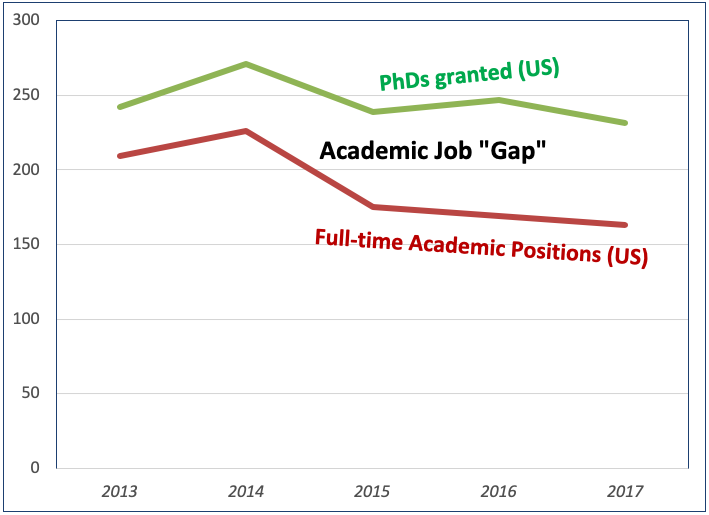
The picture is a bit better in geography. This chart compares the number of U.S.-based entry-level, full-time, permanent academic jobs posted on the AAG website with the number of completed doctorates for the last few years. That still leaves a pretty big deficit between eligible applicants and job availability and does not account for already employed professors on the hunt for something new.

This chart is based on data from the AAG’s Jobs in Geography Master List. All permanent full-time entry-level academic positions and post-docs based in the U.S. were aggregated for each year. Dissertation data comes from an ongoing database maintained by Dave Kaplan and Jennifer Mapes. Details on database construction are available here: https://onlinelibrary.wiley.com/doi/abs/10.1111/j.1931-0846.2014.12045.x

While there will always be job anxiety, part of it stems from the idea that the PhD must inexorably lead to an academic, preferably tenure-track, position. To many, it carries the same connection as MD to physician or JD to attorney. A doctorate is training for academia, so the thinking goes, but not a whole lot else. Departmental culture can bolster this viewpoint as well, exalting those students who land an assistant professor position and ignoring all other job prospects. Graduate school is viewed as an apprenticeship to a singular vocation.

Yet we know that many PhDs do work in non-academic posts, and that such jobs can bring fulfillment, stimulation and financial stability. The NSF’s Survey of Doctoral Recipients shows that half or more of all recent PhD recipients work in business, government, or some other form of non-academic employment We need to say loud and clear that non-academic careers are just as valuable as academic careers. These jobs usually pay better and the level of job satisfaction can also be higher. A popular book on careers outside of academia (Basalla and Debelius 2015) uses anecdotal evidence to show how non-academic positions present interesting challenges, stimulating colleagues, and often less guilt and more accomplishment than their academic counterparts. My last three PhD students have gone on to rewarding careers in government, nonprofits, and business. Such jobs also bring geographical flexibility, allowing them to live with their partners, stay in a place they like, and not follow the holy academic grail across the country and the world.

Beyond this, the demand for the kinds of critical skills achieved by advanced geographers only continues to grow. A recent report by the World Economic Forum touting the “4th Industrial Revolution” forecasts greater demands for creativity and originality, critical thinking, systems analysis, technology programming, and the like. Geography not only gives students the human (creativity, critical thinking) and technical skills predicted to be more valuable—it synthesizes them. Past President Sarah Bednarz has described “Geography’s Secret Powers” as the thinking that harnesses spatial concepts, spatial representations, and reasoning as well as applies this knowledge to using various geospatial technologies. Geography Masters and PhD students come out of universities prepared with spatial and geospatial thinking—ready to take on the future of work.

Students wishing to pursue alt-academic professional opportunities have to change their job search strategies. Getting a tenure-track job is a bear, but it is relatively straightforward and transparent. You need only go to your friendly AAG Jobs in Geography, see the jobs that apply to you, and follow the directions. The types of materials needed—cover letter, CV, letters of recommendation, perhaps a couple of published articles—are also pretty standard.

There are many places to look for jobs outside the halls of ivy, but no single place to look. Positions may be widely advertised or may rely on personal information. Employers are unlikely to ask for a specialty in “global urbanism” or “biogeography” but be more inclined to seek a set of skills and experiences relevant to the job at hand. The emphasis is less on your prospects as a rising professor and more on how well you fit the organization. Companies or agencies may not care about your dissertation or your articles, and will request a 1–2 page resume instead of a multi-page CV. And while academic positions can bring in up to 100 applicants, jobs on the outside can see even more competition, requiring an even greater ability to stand out.

So how can our community facilitate these options? We advisors are remarkably good at instilling geographical skills in our students but not so good at showing them how to market these skills outside the world of colleges and universities. While for some academia is a second career, most of us marched straight into tenure-track jobs after earning our PhDs. University life is all we really know. My fluency in charting the trail to an assistant professor position falters when I try to prepare a student for something that deviates from this very narrow path. Moreover, students may feel anxious about telling advisors that they do not wish to pursue an academic career. This requires a certain degree of sympathy on the advisor’s part, a willingness to acquire knowledge, maybe even participating in and establishing PhD career fairs—in other words, a more sophisticated version of what we do to enhance job prospects for our undergrads.

The department or university can provide resources to their students. One such option is a subscription to Versatile PhD – a website providing examples of jobs, resumes, pep talks, and lots of other material. Some of this is free, but the paywall comes up fast. Developing a network of alumni who have successfully gone into worlds beyond academia could be a fantastic resource, and one that could allow for some early-stage mentoring and connection-building in a chosen field. Knowing somebody in the right place at the right time works. Bringing in geographers in these careers who can talk about them as part of a speaker series or some other event provides insights into potential opportunities.

And let’s not forget our Master’s students. While much of the angst is focused on the doctoral student in search of a job, graduate programs include many people who want to further their love of geography by getting a Master’s degree. Where I went to graduate school, there was an impression (at least I felt it) that the Master’s was just a way station to the doctorate. Some geography departments don’t even require a Master’s and encourage their students to go straight to the PhD. Yet we have far more MA, MS and now MGIS students than PhD students, and the majority do not want a PhD and the academic life. Focusing on this group and their career options after graduate school is a beneficial exercise as several of the strategies used to help them along can also apply to PhD students.

And finally, can the AAG do more? As an academic, one of the nicest aspects of the annual meeting is the opportunity to catch up with old friends. This especially includes former PhD students and MA students who did their PhDs elsewhere. But for geographers who did not go into academia, the incentives are often gone. They may not get money or time from their organization, they may feel like the overall vibe is far too “academic” and ignores their needs, and they may feel more and more cut off from their professor friends. I appreciate the specialty groups—notably the Business SG, Applied SG and the Public/Private Affinity Group—for promoting the non-academic world. But the fact remains that less than 11% of our members come from outside higher education. Data from McKinley showed that AAG members in the non-academic world were far less likely to attend the annual meeting, and those who did attended, did so less frequently. If we confine our appeal to only academic-bound geographers, we risk limiting the reach of the AAG and cramping the opportunities for current AAG members.

Geography is larger than just colleges and universities. The AAG should reflect the entire spectrum of geographic careers.

— Dave Kaplan
AAG President

DOI: 10.14433/2017.0062


    Share

Get Involved in Geography Awareness Week and GIS Day

Geography Awareness Week is quickly approaching, November 10th – 16th, with GIS Day on November 13th. Below you’ll find GeoWeek and GIS Day resources, announcements, and ways to get involved, big and small. Do what you can to promote our wonderful discipline during the week, and also think about how you can support geography year-round!
 

Starting Point: Check out National Geographic’s Geography Awareness Week page to learn the history and mission of the week and discover materials for hosting your own event.


Geography.com: Ever need a resource to share with others for a quick intro to geography? Geography.com is designed for students and the general public to learn more about the field and all it has to offer. Share this site to spread the word! Improving geography awareness can be as simple as a conversation with a friend. We challenge you to talk to one person in your social circle about what you study and what you do. They will get to know both you and our discipline better!

 

Geography Career Materials for High School Counselors: As part of our ongoing efforts to tell students about opportunities in geography, the AAG is mailing career information packets to high school guidance counselors! Want us to share career info with schools in your area? Get contact info for high schools in your area and we’ll send career packets to counselors and teachers about opportunities in geography that they can use with students! Request here or share this sign up with others: https://bit.ly/GeoCareerPacket


Free GIS Software for K-12 Schools and Youth Groups: Did you know that K-12 schools and youth groups WORLDWIDE are eligible for free ArcGIS software? They can simply sign up online! Share this news with schools in your area and teachers you know. Help students engage with GIS at an early age!


GISDay.com: Find local events or add your event to the online map, download GIS Day promotional items, share GIS Day videos, and find hands-on exercises at gisday.com. Also check out the GIS Day in the Classroom Implementation Guide! It’s designed for both volunteers and teachers, so use this for your own outreach efforts and/or share this with people you know in the K-12 community.


GeoReads: What’s your favorite geography-related book that you would suggest to students and non-geographers? Spread geographic literacy one book at a time by donating your favorite geo book to a local school, public library, or local little free library to help others discover our discipline!


Geographer Profiles: Need another great resource to share with students, friends, and others to help them learn about our field and what it has to offer? Check out our Profiles of Geographers which highlight the wide variety of interesting work we do.


Be a GeoMentor: If you don’t have time to get involved in GeoWeek, set yourself up to be involved later by signing up to be a GeoMentor. Help young students discover geography and spatial thinking to better understand the world around them. You can sign up online and check out some of the great work of our volunteers across the country in our case study collection.

 

Guide to Geography Programs: Many students don’t discover geography until undergrad (or even later). To support GeoWeek, consider sharing the AAG’s Guide to Geography Programs in the Americas with high school students and guidance counselors to help students discover our discipline sooner! Available as a PDF and online map.


Ask a Geographer: A great way to support geography awareness is to tell people about the AAG’s Ask a Geographer program. AAG members are available to answer questions in 50+ areas of geography. Share this resource and/or volunteer to be part of it!
 

Donate. Help secure the importance of geography and the work of geographers in understanding our world. Consider donating to the AAG to support the next generation of geographers. Choose among different programs to support student travel, dissertation grants, diversity initiatives, and more.

How are you celebrating or participating in GeoWeek? Reach out to us on Twitter @theAAG and let us know!


    Share

New Books: October 2019

Every month the AAG compiles a list of newly-published books in geography and related areas. Some are selected for review in the AAG Review of Books.

Publishers are welcome to send new volumes to the Editor-in-Chief (Kent Mathewson, Editor-in-Chief, AAG Review of BooksDepartment of Geography and Anthropology, Louisiana State University, Baton Rouge, LA 70803).

Anyone interested in reviewing these or other titles should also contact the Editor-in-Chief.

PLEASE NOTE: Due to current public health policies which have prompted the closing of most offices, we are unable to access incoming books at this time. We are working on a solution during this transition and will continue our new books processing as soon as we can. In the meantime, please feel free to peruse previous books from our archived lists.

October 2019

The Atlas of Boston History by Nancy S. Seasholes. eds. (University of Chicago Press 2019)

Borderless Empire: Dutch Guiana in the Atlantic World, 1750–1800 by Bram Hoonhout (University of Georgia Press 2020)

Building Nazi Germany: Place, Space, Architecture, and Ideology by Joshua Hagen and Robert C. Ostergren (Rowman & Littlefield Publishers 2020)

The City as Power: Urban Space, Place, and National Identity by Alexander C. Diener and Joshua Hagen, eds. (Rowman & Littlefield Publishers 2018)

The Confounding Island: Jamaica and the Postcolonial Predicament by Orlando Patterson (Harvard University Press 2019)

Detours: Travels and the Ethics of Research in the Global South by M. Bianet Castellanos (University of Arizona Press 2019)

Franz Boas: The Emergence of the Anthropologist by Rosemary Lévy Zumwalt (University of Nebraska Press 2019)

The Freedom Of Speech: Talk And Slavery In The Anglo-Caribbean World by Miles Ogborn (University of Chicago Press 2019)

The Global PR Revolution: How Thought Leaders Succeed in the Transformed World of PR by Maxim Behar (Allworth Press 2019)

How Nature Works: Rethinking Labor on a Troubled Planet by Sarah Besky and Alex

Blanchette, eds. (University of New Mexico Press 2019)

Limits: Why Malthus Was Wrong and Why Environmentalists Should Care by Giorgos Kallis (Stanford University Press 2019)

Manufacturing Decline: How Racism and the Conservative Movement Crushed the American Rust Belt by Jason Hackworth (Columbia University Press 2019)

Mapping Populism: Taking Politics to the People by John Agnew and Michael Shin (Rowman & Littlefield Publishers 2019)

Necropolitics by Achille Mbembe (Duke University Press 2019)

Pepper: A Guide to the World’s Favorite Spice by Joe Barth (Rowman & Littlefield Publishers 2019)

Postcards from the Chihuahua Border: Revisiting a Pictorial Past, 1900s–1950s by Daniel D. Arreola (University of Arizona Press 2019)

Racial Alterity, Wixarika Youth Activism, and the Right to the Mexican City by Diana Negrín (University of Arizona Press 2019)

Settler City Limits: Indigenous Resurgence and Colonial Violence in the Urban Prairie West by Heather Dorries, Robert Henry, David Hugill, Tyler McCreary, and Julie Tomiak, eds. (University of Manirova Press 2019)

Silk Roads: Peoples, Cultures, Landscapes by Susan Whitfield, eds. (University of California Press 2019)

Stranger Things and Philosophy: Thus Spake the Demogoron by Jeffrey A. Ewing and Andrew M. Winters, eds. (Open Court Publishing Company 2019)

Transforming Rural Water Governance: The Road from Resource Management to Political Activism in Nicaragua by Sarah T. Romano (University of Arizona Press 2019)

Undocumented Migration by Roberto G. Gonzalez, Nando Sigona, Martha C. Franco, Anna Papoutsi (Polity 2019)

Water Politics: Governance, Justice and the Right to Water by Farhana Sultana and Alex Loftus, eds. (Routledge 2020)

    Share

Call for chapter proposals: New AAG Book on Rocky Mountain West

One of the most anticipated items when I began attending AAG meetings was the annual edited book that came in our packet.  This would be a special volume dedicated to the city and region where the meeting was held.  Within it would be chapters detailing all kinds of interesting aspects of the region, written by geographers with expertise and wisdom.   I still have a large collection of these regional geographies on my book shelf.  The AAG was poorer when we stopped producing this regional compendium and we need to bring it back.
So I am delighted to announce that, for the first time since 2001, the American Association of Geographers will be introducing an edited book entitled Denver and the Rocky Mountain West.  It will be edited by Michael Keables, with an editorial board of local experts.

This will be a fully produced, peer reviewed book, available as a pdf to every conference attendee.  It can also be purchased as a spiral-bound copy for a small fee.

Consider this a call for chapter proposals for anyone who would like to contribute to the excitement of the Rocky Mountain region.  Consider this also a chance to provide all of our attendees with your unique insights about this region.

If you are interested in contributing to this new book, please contact Michael Keables at michael [dot] keables [at] du [dot] edu.  The timeline is short.  Mike will need a title and abstract by October 15.  Final submissions will be due by January 15.

— Dave Kaplan
AAG President

    Share

Powerful Geography: Place & Social Justice

Social Justice and Place-Based Geographic Research

Dr. Naya Jones describes being a health geographer applying scholarship on place and social justice to improve marginalized communities. She is managing director at Get Rooted Consulting. This video is part of NCRGE’s Powerful Geography series.

Directed by: Thomas Larsen, Michael Solem, and Sean Taylor

Filmed by: Thomas Larsen

Sponsors: American Association of Geographers (AAG), National Center for Research in Geography Education (NCRGE)

    Share

Powerful Geography: Mapping and Community Engagement

Social Justice and Place-Based Geographic Research

Dr. Naya Jones describes being a health geographer applying scholarship on place and social justice to improve marginalized communities. She is managing director at Get Rooted Consulting. This video is part of NCRGE’s Powerful Geography series.

Directed by: Thomas Larsen, Michael Solem, and Sean Taylor

Filmed by: Thomas Larsen

Sponsors: American Association of Geographers (AAG), National Center for Research in Geography Education (NCRGE)

    Share

AAG Welcomes Fall 2019 Intern

A new intern has joined the AAG staff this fall semester! The AAG would like to welcome Gavin to the organization.

Gavin Derleth is a Senior at The George Washington University, pursuing a B.A. in Geography and Political Science with a minor in Geographic Information Systems. During his undergraduate studies his focus and research has been on the growth and development of cities, and the effect of this growth on the built environment and equity within the communities that live there. After graduation he hopes to begin working as an Urban Geographer in city planning, community development, or a related field, and eventually get a Masters in Urban Planning.

If you or someone you know is interested in applying for an internship at the AAG, the AAG seeks interns on a year-round basis for the spring, summer, and fall semesters. More information on internships at the AAG is also available on the Jobs & Careers section of the AAG website at: https://www.aag.org/internships.


    Share

Dr. Camelia Kantor

Education: Ph.D. in Geography (Babes-Bolyai University, Romania), Master’s in Business Administration (Claflin University), Master’s in Education Management (“1 December 1918” University, Romania), Master’s in Geography-Regional Development (Babes-Bolyai University, Romania), Bachelor’s in French and English Literature and Grammar (Babes-Bolyai University, Romania), Certificate in Geoinformatics and Tourism Prospecting (Babes-Bolyai University, Romania)

Describe your job. What are some of the most important tasks or duties for which you are responsible?
I am a senior leader managing day-to-day business operations and assuming a variety of key roles to ensure long-term strategic results. My primary role is in educational and professional workforce development and outreach.

Some of my responsibilities include: academic accreditation management; workforce development through training, professional certifications, and bootcamp development, implementation, and evaluation; K-12 STEM outreach; K-12 through college-level curriculum development and dissemination; coordinating, editing, and writing educational publications and press releases; and supervising, leading, and managing all internal and external educational and professional development operations. In addition, I manage the education and professional development budgets (about $1 million/year) and the annual scholarships program (more than $140,000/year). Lastly, I represent the Foundation as a thought leader by developing strategies, serving as a USGIF delegate and spokesperson to other geospatial organizations, and presenting educational offerings and career pathways via webinars, panels, publications, social media, etc.

What attracted you to this industry?
After nine years of college teaching and four years teaching K-12, it was time for a change. I felt like I had hit a wall and reached a point from where I was only making a limited impact on students’ lives, and even less on my own personal and professional growth. When I read the position description for my previous role at USGIF, I felt like it had been written for me. I was particularly attracted by the idea of working for a highly respected non-profit organization committed to building, growing, and sustaining innovation in geospatial intelligence (GEOINT). I liked the idea of leading and managing a variety of programs. It is a very exciting job, full of learning opportunities, and definitely appealing to my personal work habits.

How has your education/background in geography prepared you for this position?
Geospatial intelligence is a rapidly growing field with a lot of innovation occurring in emerging areas such as neural networks/artificial intelligence, machine learning, data science, UAVs/UAS, automation, etc. But geography is at the core of all of it, with GIS, remote sensing, data visualization, human geography, and geospatial data management still representing the foundational competencies needed to become successful in this field. My formal education in geography coupled with my experience as a teacher and curriculum developer have proven extremely valuable in meeting and exceeding the expectations USGIF had for me.

What geographic skills and information do you use most often in your work? What general skills and information do you use most often?
My work is fast-paced and diverse. It requires a strong capacity for adaptation, multi-tasking, quick thinking, and broad knowledge as well an understanding of where to find the information. While not obvious, these are areas where geography skills come in handy. We are great resource finders and tend to be multidisciplinary generalists (human geographers in particular), bridging the gap between “hard” and “soft” sciences. My expertise in geographic principles and geographic technologies were also fundamental in leading, evaluating, and/or approving professional certifications and curriculum development for GEOINT as well as in auditing GEOINT certificate and degree programs at the university level.

Are there any skills or information you need for your work that you did not obtain through your academic training? If so, how/where did you obtain them?
Continuous learning skills are a requirement in today’s workplace. I tend to surround myself with people who are smarter, wiser, and more experienced than I am, and am very fortunate to be in a position to gain that access. Every day is a new learning opportunity for me. My formal education has prepared me to think critically, learn fast, forget fast (smiling), and re-learn. However, I live in such a multidisciplinary community that keeping pace with innovation can become quite challenging. I’ve (finally) come to the conclusion that one cannot be an expert in everything, and that with GEOINT becoming much more connected with areas outside of geography (computer science and engineering, for example) I will not be able to always lead or understand every change in every sub-domain of the discipline. Thus, a wiser me sees a need to try to at least gain basic skills and understanding in those areas (coding, for example) while relying on the real experts when it comes to cross-disciplinary projects. I read a lot, listen to podcasts, participate in Massive Open Online Courses (MOOCs), and even use YouTube to stay informed. There are so many resources and opportunities to stay engaged! It’s just a matter of finding the time and managing it properly.

Do you participate in hiring, screening, or training of new employees? If so, what qualities and/or skills do you look for?
Yes. Based on the project, the skills will vary. For example, internally, I’ve just hired a new Educational and Professional Development Coordinator, Christine MacKrell. I really wanted another geographer by my side who understands education and is passionate about it. Christine just graduated from college with a Master of Science degree in Geography from George Washington University and brings a young, fresh look into our work. But when I look for volunteers, I seek skills that would complement ours, that we might lack or have limited knowledge of such as hands-on expertise in remote sensing, geospatial data science and, very importantly, field knowledge of the GEOINT tradecraft.

What advice would you give to someone interested in a job like yours?
This is a niche job, so there are limited opportunities to find something similar. However, it has transferable skills that could be applied in areas such as academic management, industry or government training and professional development, management of curriculum design, events management, and business. The actual job is not what truly matters in my view, but rather the willingness to put yourself out there, network with the right people, seek mentorship, follow up with ideas, identify problems, and seek/find solutions. Do not just reach out to people on LinkedIn and ask how to get a job or seek mentorship without drafting a plan of your own. After getting a job, be the best you can be, take the initiative, try to do things that may seem too ambitious and, if you fail, learn from those failures and try again. It seems like a simple formula, but it is one now many people follow. While I am a strong supporter of work-life balance, the first years of one’s career should involve hard work and efforts to go above and beyond your usual responsibilities, take the initiative, and show what you can do. I’ve been there, done that, and am still doing it.

What is the occupational outlook for career opportunities in your field/organization, esp. for geographers?
GEOINT is a young discipline and a hot field closely connected to work in defense and intelligence. A quick search on Indeed.com returned more than 1,500 jobs specifically including the term “GEOINT.” In comparison, just over 1,000 students have graduated from USGIF-accredited GEOINT programs in the past 10 years. For those with security clearances or interest in obtaining a clearance, ClearanceJobs.com has a portal specifically designed for them. But GEOINT is now moving beyond the defense and intelligence sectors and the competencies are also valuable in areas such as law enforcement, emergency management, environmental science, business/real estate, financial risk assessment, and much more. The field of GEOINT keeps growing but required skills will continue to evolve.

    Share