
A Decade of Change: AAG Returns to Chicago

The AAG is pleased to be holding its next annual meeting April 21-25, 2015, in the world-class city of Chicago.  The AAG last met in Chicago in 2006, and in the newsletter issues leading up to the 2015 meeting, the Local Arrangements Committee (LAC — chaired by Professor Euan Hague, Chair of the Geography Department at DePaul University) will provide articles that highlight some of the more dramatic changes in Chicago since then. This first article provides an overview of some of the themes of change discussed by the LAC at its first Chicago meeting on May 24, 2015 — these themes will be presented in greater detail in coming issues.

 

The AAG 2015 conference hotel, Hyatt Regency, 151 East Wacker Drive, Chicago


Population Redistribution

The 2010 Census reported that the 16 county multi-state Chicago–Naperville–Michigan City, IL–IN–WI Combined Statistical Area (2004 definition) had a population of 9.68 million.  That means that the Chicago region grew by 4 percent between 2000 and 2010, which was considerably slower growth than the previous decade (1990 to 2000) when the same 16 county metropolitan area grew by 11.1 percent.  The population loss in Chicago proper (with the exception of its Downtown) and the inner suburbs was largely responsible for the growth slowdown, for instance between 2000 and 2010 Chicago lost over 200,000 residents.  Meanwhile, the outer suburbs helped offset these latter declines, for instance the 3 largest outer suburbs of Chicago (Aurora, Joliet, and Naperville) together added 109,616, a little over half the amount that the City of Chicago lost. This reflects a continued long term trend in the Chicago region of population decentralization from Chicago’s core to the edge, despite a slight pause in that trend in the 1990s when the City of Chicago actually gained population for the first time since the 1950 Census.  Meanwhile Downtown Chicago deserves special attention as its population saw a 114 percent increase from 1990 to 2010.  This population increase was paralleled by a residential housing boom that has included the conversion of former Downtown office spaces to residential units and new high-rise apartment buildings and condominiums have sprouted up in and around Downtown – a theme that was highlighted in a special map provided to AAG attendees at the 2006 AAG meeting.

The LAC is working on field trips that will showcase various aspects of Chicago’s recent population redistribution trends and an upcoming newsletter will go into greater detail on these population shifts.

A Greener Chicago

The 2006 AAG meeting publications highlighted Chicago’s efforts to expand upon its rich heritage of city parks and greenways and those efforts have continued.  The Openlands Project was founded in 1963 and since then it has helped secure, protect, and provide public access to more than 55,000 acres of land for parks, forest preserves, land and water greenway corridors, and urban gardens.  Participants of the AAG meeting will be able to link up with this vast network of greenways within walking distance of the conference hotel.  Just blocks away is Millennium Park which is currently celebrating its 10th anniversary and special events continuing into 2015 will celebrate this magnificent park space by showing off its world-class art, music, architecture, and landscape design.  Another “green” milestone reached by Chicago’s is its commitment to bicycling as it has built over 200 miles of on-street bike lanes including one that weaves 1.2 miles through downtown within a buffer that separates it from cars.  Chicago also has a Divvy (divvybikes.com) bike sharing program with the largest number of stations of any city in the United States.
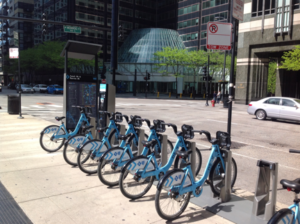
 

Corner of Monroe and Canal Street, Chicago, by author 24 May 2015.


The LAC is already working on field trips that will visit components of the greenway system of Chicago and an upcoming newsletter will go into greater detail on many other aspects of the greening of Chicago.

Chicago’s Food Systems

The Chicago region is the command and control center for U.S. industrial agriculture (center of the Corn Belt) yet it is also a leader in alternative agricultural systems including a very active local food movement that emphasizes organic and natural choices.  The Chicago food theme is one that the LAC is particularly interested in as several members are actively researching the issues, so upcoming newsletter stories will review the status of the region’s ties to traditional industrial agriculture as well as the growth in alternative systems.  As coincidence would have it when the LAC met on Memorial Day 2014 weekend a massive crowd of protestors assembled in the Loop to demonstrate against the use of genetically modified organisms (GMOs) and to promote a call for locally grown organic alternatives.

 

GMO protest at Federal Plaza on Jackson Blvd and Clark Street, Chicago, by author 24 May 2015.


The LAC is working on field trips that will visit parts of the corn-belt within range of Chicago and it will also show case locally grown components of the new Chicago food system including retail configurations that attempt to turn food deserts into food oases.

Lake Michigan and other Regional Water Resources

Chicago sits adjacent to Lake Michigan and the growth of the metropolitan region’s population and spatial extent have caused concern among regional planners over the potential for future water supply shortages.  The Metropolitan Planning Council (MPC) is promoting a regional approach to sustainable water supply planning and management.  Chicago and many of its inner suburbs are already withdrawing Lake Michigan water to meet their needs and as the outer suburbs speculate about their own future shortages from dwindling local ground water supplies they are being warned that Lake Michigan water may not be available.  All of this may seem odd given the vast size of Lake Michigan, but international laws with Canada limit withdrawals.

The LAC is working on the development of a field trip to showcase these and other regional examples of innovations in water resources management.  Views of the Chicago River and Lake Michigan are a close walking distance from the conference hotel and just a little further, just a mile, is Navy Pier which puts you slightly above and out onto the Lake.

Transportation 

Chicago is a large centralized gateway to international trade and traffic for the United States.  Chicago continues to grapple with the growth in freight flows that often test the capacity of the region’s transportation infrastructure.


Photo taken from a freight yard in Southwest Chicago on 28 May 2005.


As in 2006, almost all of the container freight on these railcars is transferred to and from trucks which take up twice the road space of cars on the region’s highways.

On top of the container-freight issue, the Chicago region is grappling with a host of other transportation issues including the goal of expanding public transportation services.  The edge cities toured during the last AAG meeting have matured and exhibit both traditional and reverse commuting patterns.  The Loop is still the dominant job center of the region and the peak commuting flows reflect this, however, there is a growing gentrifying population that works in the suburbs but lives and consumes in the city, which only adds more complexity to the pattern.  New retail configurations in the suburbs like Lifestyle Centers are adding to non-work related trips and suburban gridlock is common place on the weekends.  The Local Arrangements committee is working on field trips that will show-case some of the problems identified here as well as some of the existing plans that are in place to alleviate the problems.  The conference hotel is also directly accessible to public transportation, particularly the “L”, and extensive bicycle paths are within walking distance toward the Lake.

Race, Immigration, and Ethnicity

The LAC will write a newsletter piece prior to the meeting that articulates some of the changing dynamics and patterns of Chicago’s racial and ethnic diversity since the last meeting in 2006.  Topics to be covered will include the degree to which multiethnic neighborhoods have expanded or contracted or whether classic patterns of segregation have reemerged.  The piece will examine the tension that gentrification has posed to the stability of some of the city’s more stable ethnic enclaves.  The geographic dimensions of the growth in Chicago’s China Town will be described.

The Local Arrangements Committee already has plans to visit the Pilson neighborhood, a Latino neighborhood that has seen continued pressure from gentrification since the last meeting in 2006.

So as you plan your trip to Chicago, save time to explore these and many other aspects of change that Chicago has experienced since 2006.  Bring your walking shoes and depending on the weather you may even consider renting a bicycle to tour on the greenways of Chicago accessed in front of the conference hotel.  Venture into some of Chicago’s ethnic neighborhoods for unique dining experiences.  Or possibly even plan a journey from Downtown to the Edgeless exurbs of Chicago.

    Share

FIRST Act Threatens Social Science Funding

As we reported to you in February, the Omnibus Appropriations Bill under which the Federal government is currently operating does not contain the so-called “Coburn Amendment,” which passed in March 2013 and prevented the National Science Foundation (NSF) from funding political science studies other than research “certified as promoting national security or the economic interests of the United States.”

While we were pleased by the exclusion of the Coburn Amendment from this year’s Omnibus, recent activity in the House of Representatives again threatens funding for the social and behavioral sciences. The FIRST (Frontiers in Innovation, Research, Science, and Technology) Act (H.R. 4186) was introduced in March by Rep. Larry Bucshon (R-IN), Chair of the House Science Subcommittee on Research and Technology, and would dramatically reduce funding for NSF’s Social, Behavioral, and Economic (SBE) Sciences Directorate. As many of you are aware, the NSF’s Geography and Spatial Science program is part of the SBE Directorate.

If enacted, the legislation would – for the first time – specify caps on the authorized funding levels for each of the Foundation’s research directorates. The NSF leadership has historically had the ability to prioritize research expenditures by allocating funding from their overall research appropriation to the various directorates as deemed necessary. Currently, SBE is receiving $257 million in Fiscal Year 2014, but this amount would be capped at $150 million in the FIRST Act – a cut of 42 percent.

The AAG continues to work closely with our colleagues at the American Association for the Advancement of Science (AAAS), the Coalition for National Science Funding (CNSF), the Consortium of Social Science Associations (COSSA), and other key groups to express our concerns about the legislation. As part of those efforts, we signed onto a community-wide letter to the House Science Committee leadership two days after the FIRST Act was introduced (https://www.cnsfweb.org/CNSFLetterFIRSTActFINAL.pdf).

Separately, the National Science Board (NSB) took the rare step of issuing a statement signed by all 23 current NSB members that expresses concerns about the caps imposed in the FIRST Act (https://www.nsf.gov/nsb/news/news_summ.jsp?cntn_id=131218&org=NSB&from=news). The statement also highlights a separate and important concern with the legislation – that it would undermine the peer review process for grant awards by requiring NSF program officers to certify that each grant is “worthy of federal funding” and “is in the national interest” (“national interest” is spelled out in six categories).

The FIRST Act was reported out of the House Science Committee on May 28 in a party-line vote. It could be acted upon by the full House at any time and the current thinking is that House leaders may bring the bill up for consideration later this month. If the bill is adopted, it would move on to the Senate. We will continue to monitor the debate on the legislation and will work with fellow science and higher-education organizations to make sure the importance of SBE funding is fully explained.

We always encourage AAG members to contact your Representative and Senators to express your views on issues of importance. The links below provide information about contacting members of Congress through the phone or internet. AAG members may also wish to use social media, such as Twitter or Facebook, to share their perspectives with elected officials, friends, colleagues, and the wider community.

You can locate your member of the House of Representatives by going to: https://www.house.gov/representatives/find/   

Contact information for all U.S. Senators can be found at: https://www.senate.gov/general/contact_information/senators_cfm.cfm.

If you have any questions, please contact John Wertman, the AAG’s Senior Program Manager for Government Relations, at jwertman [at] aag [dot] org, or Doug Richardson, AAG Executive Director, at drichardson [at] aag [dot] org.

    Share

Carolyn J. Merry

Carolyn, a world renowned scholar in remote sensing and geographic information systems, passed away on June 3, 2014. She will be remembered by many at The Ohio State University (Columbus, OH), where she had served as a professor and chair of the Department of Civil, Environmental and Geodetic Engineering. She retired in May 2013 after 25 years at the school. She will also be missed by many for her several leadership positions, including past presidencies at the Imaging and Geospatial Information Society (ASPRS), the University Consortium for Geographic Information Science, the Central Ohio Section of the American Society of Civil Engineering (ASCE), the Coalition of Geospatial Organizations (COGO), as well as chair of the ASCE Civil Engineering Department Heads Coordinating Council. Carolyn was also a member of the National Geospatial Advisory Committee (NGAC) and the National Academy of Science’s Mapping Science Committee. She is survived by her husband, Robert (Bob) Redfield, as well as her sister, Patricia Merry, brothers James (Kim) and Donald (Amber) Merry, as well as her nephews, nieces, and grand-nieces.

    Share

AAG 2014 Tampa: Publishing for Non-Native Speakers of English Sessions Now Online

“Publishing for Non-Native Speakers of English” was a presentation of two sessions held during AAG’s 2014 Tampa annual meeting. The sessions, co-organized by Mei-Po Kwan and Eric S. Sheppard, were designed to bring together editors, reviewers and authors giving perspective to publishing issues for non-native speakers of English.
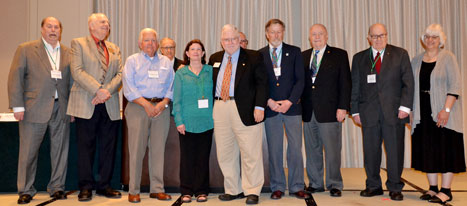
Session I was chaired by Mei-Po Kwan and the panel included Helga Leitner, Bing Xu, Weidong Liu, Padraig Carmody, Barney Warf and Tim Schwanen.

Session II was chaired by Eric Sheppard and the panel included György Csomós, Annelies Zoomers, Canfei He, Henry Yeung, Kent Mathewson and Joseli Maria Silva.

The videos from each session are now available online.

Watch Publishing for Non-Native Speakers of English I

Watch Publishing for Non-Native Speakers of English II

    Share

Esri Donates $1 Billion in GIS Software to US K-12 Schools

Responding to President Barack Obama’s call to help strengthen STEM education through the ConnectED Initiative, Esri president Jack Dangermond announced today that Esri will provide a grant to make its advanced mapping software running on cloud infrastructure provided by Amazon Web Services (AWS) available for free to the more than 100,000 elementary, middle, and high schools in the United States.

ConnectED is a government education program developed to prepare K-12 students throughout the United States for digital learning opportunities and future employment. The Initiative sets four goals to establish digital learning in all K-12 schools in the United States during the next few years. These goals include: high-speed connectivity to the internet, access to affordable mobile devices to facilitate digital learning anytime, anywhere, high-quality software that provides multiple learning opportunities for students, and relevant teacher training to support this effort.

Esri, the world’s leading developer of geographic information system (GIS) software, has offered a free ArcGIS Online account to all K-12 schools in the United States. AWS is supporting this initiative through a three-year commitment to provide cloud infrastructure to support Esri and every school using this product. Because each ArcGIS online account is valued at more than $10,000, the potential value of the contribution to the President’s ConnectED Initiative exceeds $1 billion

“We are proud to be part of the President’s ConnectED Initiative,” says Jack Dangermond, Esri president. “Geographic Information System technology gives students powerful tools for understanding our planet, and teaches them to become problem solvers. It is a perfect complement to STEM courses and many other classroom activities, while preparing students for further education and expanding career opportunities in fields that can help better manage our world, build better lives for more people, and design a better future.”

“The connection between STEM education and a 21st Century career path is undeniable, and early experience with technical skill development will help prepare our K-12 students for high-paying, rewarding careers later in life. Geographic information is part of how we view our world today–-not just how to get from here to there, but also in learning to perform analysis, communications and planning functions. We are excited to support the President’s ConnectED initiative and Esri’s effort to bring information and technology into the lives of students by providing free cloud-based infrastructure to K-12 schools across the country to support the ArcGIS initiative,” said Teresa Carlson, vice president Worldwide Public Sector, Amazon Web Services Inc.

For a related story on the impact this pledge will have on American students, see “The New Space Race” by Thomas Fisher,  Dean of the College of Design, at the University of Minnesota.

    Share

50-Year Members Honored at AAG Annual Meeting

Recognition of 50-Year Members

The Class of 1964 receives a memento in recognition of their loyalty to the Association.  As a tangible token of appreciation, 50-year members also receive lifetime remission of annual dues and annual meeting registration fees from the AAG. 

Ronald F. Abler
James P. Allen
William R. Black
Robert O. Clark
Malcolm L. Comeaux
Gary S. Elbow
John B. Fieser
Robert R. Geppert
Lay J. Gibson
Charles Good, Jr
Janet H. Gritzner
Gilbert M. Grosvenor
Kingsley E. Haynes
John C. Hudson
John A. Jakle
Dr. Wayne E. Kiefer
Max C. Kirkeberg
Charles Kovacik
James S. Kus
Ary J. Lamme, III
Lawrence E. Maxwell
David R. Meyer
M Clare Newman
Philip R. Pryde
Gabriel A. Renzi
Thomas F. Saarinen
David E. Schwarz
George E. Sinnott
James N. Snaden
Clifford E. Tiedemann
Stephen W. Tweedie
George M. Ververides
David Ward
Stephen O. Wilson
Richard D. Wright

    Share

Women in Academia: It’s Not Just About Numbers

    Share

The AAG Review of Books

New Books: May 2014

Every month the AAG compiles a list of newly-published books in geography and related areas. Some are selected for review in the AAG Review of Books.

Publishers are welcome to send new volumes to the Editor-in-Chief (Kent Mathewson, Editor-in-Chief, AAG Review of BooksDepartment of Geography and Anthropology, Louisiana State University, Baton Rouge, LA 70803).

Anyone interested in reviewing these or other titles should also contact the Editor-in-Chief.

May, 2014

    Share

What’s in a Name? The Renaming and Rebranding of Geography Departments

Winkler_JulieIn a recent issue of the Observer magazine, author Eric Jaffe explored the nature and rationale of recent changes in the names of prominent U.S. psychology departments. Jaffe interviewed faculty and administrators from several universities that had changed the departmental name from Psychology to alternative nomenclatures including Psychological SciencesPsychological and Brain SciencesPsychology and Neuroscience, and Cognitive, Linguistic and Psychological Sciences. Some of these name changes reflect the merger of two or more departments, but others were an attempt to rebrand a department and, more generally, the discipline of psychology. For some, the rationale was to portray psychology “as a science, not an art,” whereas for others the motivation was to draw attention to new focus areas and approaches within psychological research.

Does this sound familiar? It sure does to me. A cursory comparison of current geography department listings to those of previous years suggests a recent uptick in the number of departments that have undergone name changes. Some of the more recent renamings share similarities with the name changes seen for psychology, such as Geographical Sciences, Geography and Environmental Sustainability, and Geography, Environment and Society. Also, similar to psychology, some of the name changes were mandated by departmental mergers, but others are a rebranding, intended to portray a geography department in a different light, emphasize new disciplinary developments, convey modernity and relevance, capture new audiences, and/or become more broadly appealing to graduate and undergraduate students (and their parents).

Given the broader implications of these changes for the discipline of geography, the AAG Council chose to use the “challenge question” portion of their meeting earlier this month for an open-ended discussion of the long-term benefits and consequences of renaming and rebranding geography departments. The discussion was insightful and fascinating, and the experiences of the Council members varied widely. This column conveys my impressions of that discussion with the goal to initiate broader dialog and information sharing. One message that I took away from the Council discussion is that, although the contextual and political settings in which these decisions are being made varies markedly from one university to the next, there are sufficiently common circumstances that a greater sharing of experiences would benefit those geography departments considering renaming and rebranding.

A common theme from the discussion was that the decision to rename a department cannot be taken lightly, and the motivations for such a change need to carefully examined and thoroughly debated. Many of us may be reluctant to consider a departmental name change, in part because of what one Council member referred to as the “heart tug” of the name Geography. But, depending on the context, there can be compelling reasons for renaming and/or rebranding, and for some departments, especially those involved in a merger, renaming is inevitable. It is critical that departments ask: “Who are the audiences for the renaming/rebranding?” and “Is renaming/rebranding the most effective means for reaching those audiences?” For some departments, other approaches may be as effective, or at least merit consideration. These might include additional undergraduate degree options, greater external publicity of geography as a discipline and internal publicity of the skills and accomplishments of geography faculty, and additional resources or a reallocation of current resources to ensure that geography faculty are as productive and as highly regarded as faculty from other departments. But for other departments, these measures may not be sufficient or some may not be possible within the university structure, and renaming and rebranding may help ensure that these departments are able to “survive and thrive.”

Timeliness can be important. A repeated message in the marketing literature on renaming and rebranding companies is “don’t procrastinate.” Along those lines, one councillor observed that name changes that originate organically from within a department are likely to be more creative and effective than those that are imposed from higher administration. Consequently, it can be to a department’s advantage to take the initiative on making the difficult decision of whether to rename and/or rebrand. Also, geography is not the only discipline currently undergoing departmental name changes, but rather this is occurring across academia. Consequently, there likely will be competition with other departments on campus for ownership of relevant descriptors (e.g., environment, sustainability, global, geospatial) and/or areas in which geography departments would like to expand. Thus, it behooves us to carefully monitor higher administration’s assessment and expectations of our departments along with developments in other departments, so that we can be proactive rather than reactive. Student input can also be extremely helpful when considering a name change.

A name is more than the sum of its parts and needs to be selected carefully, particularly as it can benefit or disadvantage some subgroups. Often departments, especially merged departments composed of several disciplines, seek integrative names such as Geosciences or Environmental Sciences. However, these particular examples of departmental names can disadvantage the humanities and social science components of geography, such as critical human geography, especially if university administrators and others on campus perceive the department as focusing primarily on the physical environment rather than also on the built environment or the social and political environment. One departmental chair shared with their regional councillor that an interpretation of “environment” as only the physical environment can skew the local perception of geography with potentially negative consequences on hiring and teaching decisions. Similarly, a departmental name such as Global Studies, or even Environmental Studies, can disadvantage physical geography, particularly if the term “studies” is construed as less scientific than the use of the term “sciences.” Keeping “geography” as part of the departmental name can have a number of advantages, as it portrays a more holistic view of geography. It also provides an obvious linkage to the department’s past and to its alumni, and is respectful to those who helped to pioneer the department. Explicitly including “geography” in the departmental name can also provide long-term stability, as geography is an evolving discipline and the other components of the department’s name may change with time as new subfields and interests develop.

Some councillors raised the concern that the renaming and rebranding of departments has the potential to dilute geography’s identity. For example, renaming a department is often accompanied by new or modified degree offerings, and one concern is whether majors will migrate from geography to the other degree options and how resources will be allocated among the different degrees. Also, capturing and communicating geography’s strengths in GIScience can be particularly challenging for geography departments, especially if other departments on campus add terms such as “geospatial” to their names. While geography departments need to strive to be the primary on-campus source of GIScience education and research, they need to be cognizant that students also come to geography for other reasons and that a narrow focus on GIScience can de-emphasize geography as a discipline.

I admit to a particular fascination with this topic of renaming and rebranding geography departments. The position to which I was hired was offered by higher administration as a “carrot” to the geography department to agree to a merger with two other departments, and the heated debates in those early faculty meetings on the name of the merged department are etched into my memory. My impression is that the discipline is now more accepting of renaming and rebranding than in the early days of my career. But at the same time, we need to focus on how to use renaming and rebranding to our advantage, while minimizing potential negatives. Thus, we need to share experiences. We also need to be critical and closely monitor the long-term impacts of departmental name changes on the discipline. And let’s not forget that renaming/rebranding is not a substitute for high quality, high impact geographic teaching and research that makes a difference to students and stakeholders.

My thanks to the members of the AAG Council for the very thought-provoking conversation. I hope that I accurately conveyed their thoughts and remarks in stimulating further discussion of this issue.

Julie Winkler

[The reference to Eric Jaffe’s article is “Identity Shift”, Observer, Association for Psychological Science, 2011, available at http://www.psychologicalscience.org/index.php/publications/observer/2011/september-11/identity-shift.html.]

DOI: 10.14433/2014.0006

    Share