Essential Geographies of New Orleans Music

Part 2: Rhythms, Blues, and the Infinite Potential of Congo Square

What comes after jazz? How does a city reprise its collective creation of the Americas’ most original and distinctive art form? Part 2 of this essay surveys happenings in New Orleans music since the emergence of jazz around the turn of the twentieth century. For a take on earlier developments, check out Part 1 before working your way back here. Each of these essays, it is important to note, are highly personal accounts, framed and embellished by my own encounters and experiences in the Crescent City and points south. In this second part, I work to demonstrate how New Orleans drew from its fundamental links with the African Diaspora and Atlantic Worlds to influence many of the major shifts in American popular music over the twentieth century. I hope these brief discussions help set the mood for geographers attending the 2018 AAG Annual Meeting held in New Orleans as the city fêtes its tricentennial. These accounts also provide context for many of the musical acts and styles on display at the French Quarter Fest, the city’s gratis outdoor music festival that coincides with the AAG meeting.

Jazz is not an only child. On the contrary, the birth of jazz as a musical and economic form and force was but one flare-up in a long and gradual process of musical innovation and exchange in New Orleans. As myriad musical forms collected under a broad jazz umbrella, those various styles steadily evolved and expanded in a never-ending flow of accumulation and origination. Sustaining its status as a globally eminent cultural hearth, New Orleans continues to avail its strategic situation at the confluence of the Mississippi River and the Gulf of Mexico to churn out innovative and influential music.[i]

As the jazz sound bubbled up from the streets around the turn of the century, the city’s (in)famous red-light district, Storyville, provided steady gigs for the growing class of New Orleans musicians. And it was during the district’s twenty-year existence (1897-1917) that two of the city’s stalwart musical institutions assumed their distinctive styles. Brass bands typically played rowdy gin mills, restaurants, and saloons, while solo piano players worked the parlor houses of the district’s many brothels and cabarets. Beginning with legendary forebears Tony Jackson and Jelly Roll Morton, piano “professors” remain an iconic leitmotif in the city’s musical culture. Moreover, a sampling of the city’s more prominent pianists helps trace a particular evolution of New Orleans’ musical innovations over the twentieth century, from Jelly Roll Morton to Tuts Washington to Fats Domino to Allen Toussaint; and from Professor Longhair to Art Neville to James Booker to Dr. John.[ii]

As jazz became an international phenomenon in the early twentieth century, New Orleans maintained its outsized influence by simultaneously nurturing its jazz scene and fomenting new innovative expressions. Emanating from Congo Square in the centuries prior, the syncopated rhythms that became essential in early jazz remained the city’s backbeat, and toward the mid-twentieth century provided the foundation for New Orleans rhythm and blues, and in turn, rock and roll. The diasporic habanera rhythms underlying jazz, what Jelly Roll called “the Spanish tinge,” along with the derivatives rumba and mambo, went on to become key elements in the forerunning rhythm and blues of Professor Longhair. First showcased in his 1949 debut, “Blues Rhumba,” the Fess’s rollicking two-hand piano style melded many of the musical innovations that had traveled down the river or across the Gulf to New Orleans. An admirer of both Hank Williams and the Cuban “Mambo King” Pérez Prado, Longhair kept time with Afro-Cuban clave polyrhythms on his left hand, while riffing barrelhouse blues from the upland South on his right. The Fess thus integrated and indeed embodied the far-flung musical traditions that coalesced in New Orleans, uniting the call-and-response blues of the Mississippi Delta with the Afro-Caribbean rhythms circulating in the broader Atlantic World.[iii]
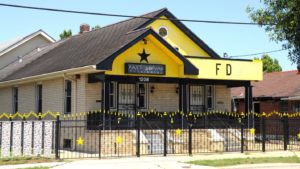
Figure 1: Fats Domino’s home and office on Caffin Avenue in the Lower Ninth Ward (Credit: Kent Kanouse, 2009).

Those rhythms and blues later became fundamental in the early development of yet another popular musical form: rock and roll. In retrospect, writers continue to disagree on the exact origins of what became rock music; however, New Orleans looms large in nearly every interpretation. For his part, Elvis Presley famously insisted in 1956 that New Orleans’ own Fats Domino was “the real king of rock and roll” (see Figure 1). Many writers now look back on Domino’s “The Fat Man,” recorded in 1949, along with Roy Brown’s “Good Rocking Tonight” (1947) and Little Richard’s “Tutti Frutti” (1955), as preeminent contenders for the first unequivocally rock and roll track. Amazingly, each of those records were among the many milestone works recorded and engineered at Cosimo Matassa’s legendary J&M Recording Studio (see Figure 2). Backed by versatile bandleader Dave Bartholomew and drummer Earl Palmer—an early and prolific progenitor of rock and roll’s signature backbeat, the likes of Ray Charles, Sam Cooke, Dr. John, Jerry Lee Lewis, Professor Longhair, Irma Thomas, and Allen Toussaint all cut sides with Matassa at J&M. Housed in his father’s appliance store at the corner of Rampart and Dumaine Streets, J&M sat just one block down from the site now commemorating Congo Square. In 2010, the Rock and Roll Hall of Fame designated the studio one of just eleven nationwide Historic Rock and Roll Landmarks.[iv]

Before co-founding the influential groups the Meters and the Neville Brothers, Art Neville began his recording career at J&M, laying down “Mardi Gras Mambo” with the Hawketts in 1954. The Carnival classic celebrates New Orleans’ enduring camaraderie with the Caribbean and remains a popular seasonal standard. A decade later Neville helped form The Meters, a powerhouse electric rhythm section that drew on syncopated second line rhythms and call-and-response Mardi Gras Indian chants to become an early architect of the style later known as funk (see Figure 2). The Meters became a sturdy foundation of the mid-century New Orleans sound, serving as the house band for Allen Toussaint’s Sansu label and backing renowned New Orleans soul and R&B artists Lee Dorsey, Irma Thomas, and Dr. John, among many others. As independent recording artists the band released several hits that remain New Orleans classics, including Hey Pocky Way, based on Mardi Gras Indian chants, and Cissy Strut, a gritty funk standard now considered an early milestone in the genre.[v]
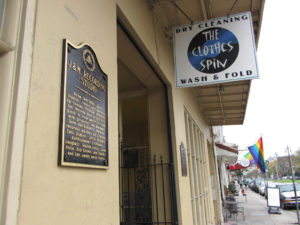
Figure 2: The original location of Cosimo Matassa’s J&M Recording Studio at the corner of Rampart and Dumaine Streets in New Orleans (Credit: Jason Riedy, 2012).

The street culture of Mardi Gras Indians came of age with the city’s popular music, from second line to jazz to R&B to funk. Jelly Roll Morton discussed Indian culture with Alan Lomax at the Library of Congress in 1938, even rapping the traditional patois chant “T’ouwais, bas q’ouwais [tu es pas coller or two way pocky way]” on which the Meters based their mid-century hit. Later groups of Mardi Gras Indians combined their oral traditions with syncopated electric funk to create a popular and enduring sub-genre. A group led by big chiefs Bo Dollis and Monk Boudreaux joined bandleader Willie Tee and blues guitarist Snooks Eaglin to record as the Wild Magnolias in 1970 (see Figure 3). Now an acclaimed New Orleans institution, the Wild Mags continue to perform both as a traditional Indian gang and a funk band on the streets and in venues throughout the city.[vi]

The musical origins of the Neville Brothers lie also in Mardi Gras Indian traditions, leaning on their Uncle Jolly (George Landry), a big chief with the Wild Tchoupitoulas tribe, for musical inspiration and connections. Backing Landry, the four Neville Brothers – Art, Aaron, Charles, and Cyril – joined forces with the Meters in 1976 to cut Wild Tchoupitoulas, produced by Allen Toussaint. That record drew heavily on Mari Gras Indian chants, traditions, and performance, and foreshadowed the rise of the Neville Brothers as a national supergroup. Many Indian groups such as Big Chief Juan Pardo and the Golden Comanche and the 79ers Gang continue to record and perform the Indians’ rhythms and rituals, often emphasizing their profound connections to the Black Atlantic. International hits based on Indian compositions and traditions such as Iko Iko, Handa Wanda, Hey Pocky Way, and Earl King’s Big Chief remain revered New Orleans standards.[vii]
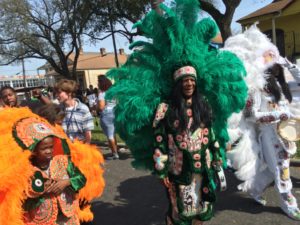
Figure 3: Big Chief Monk Boudreaux of the Golden Eagles Mardi Gras Indians leads his gang through Central City near A.L. Davis Park on “Super Sunday.” (Credit: Mike Connor, 2015).

As New Orleans rhythm and blues morphed into rock and roll and later funk, other influential offshoots were materializing in the city, elevating two queens to global eminence. “New Orleans Soul Queen” Irma Thomas recorded many of her early soul classics at J&M, and continues to perform as a leading figure in the genre. Civil Rights activist and icon Mahalia Jackson got her start singing in the full gospel congregations of Plymouth Rock and Mount Moriah Baptist Churches in Uptown New Orleans (see Figure 4). From there she went on to inspire millions as the “Queen of Gospel,” combining the soulful Black spirituals of the plantation South with syncopated rhythms she learned to tap out on the wood floors of her New Orleans churches.[viii]

In both the background and the forefront of the rich diversity and complexity of twentieth century New Orleans music, piano players remained iconic. There is perhaps no better single example of the multiplicity and centrality of piano players in the city than the irrepressible Mac Rebennack, known worldwide as Dr. John. A celebrated composer and performer from the 1950s to the present, Dr. John remains distinguished as a standard bearer and keeper of the flame for the storied New Orleans piano professor tradition. As a teenager Dr. John drew early inspiration from Fats Domino, Little Richard, and especially Professor Longhair in the clubs and studios around town. His range as a player, however, transcends R&B to traverse a wide array of styles including rock, jazz, funk, and the haunting voodoo-inspired psychedelia for which he became most distinctive.[ix]
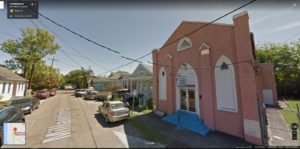
Figure 4: Mt. Moriah Missionary Baptist Church where Mahalia Jackson sang in the choir, 147 Millaudon Street, New Orleans (Google Street View, 2016).

After trouble found him in New Orleans, Mac fled to Los Angeles where the libertine spirit of late-60s California gave him license to experiment with New Orleans music in new and profound ways. There Mac serendipitously came under the wing of New Orleans patriarch Harold Battiste who managed to finagle some free studio time between Sonny and Cher takes in 1967. The duo put together a group of veteran New Orleans musicians to explore a visionary musical concept and stage persona based on nineteenth-century voodoo conjurer and man about town, Dr. John Montaigne (or Jean Montanet). A formerly enslaved native of Senegal, Dr. John the elder regained his freedom in Cuba before rising to prominence as a trusted root doctor in antebellum New Orleans. His 1885 obituary in Harper’s Weekly deemed him “the last of the Voudoos,” that is “the last really important figure of a long line of wizards or witches whose African titles were recognized,” and “the most extraordinary African character that ever obtained celebrity” in New Orleans. Studying the legend of Dr. John, Mac discovered a reference to one Pauline Rebennack, arrested along with Montaigne in the 1840s for her involvement in voodoo and other illicit acts. Realizing a likely familial connection, Mac assumed the stage persona Dr. John the Night Tripper, and with fellow New Orleans musicians in exile cut the classic LP Gris-Gris. That album amounted to a profoundly New Orleanian tribute to the Black Atlantic, melding the syncopated rhythms and bamboula dances of Congo Square with the power and grace of Afro-Caribbean spirituality and the lavish costumes, chants, and performance art of the Mardi Gras Indians. The result was a fantastic if somewhat cryptic masterpiece that conjured a range of New Orleans traditions to stake out the eeriest edges of the psychedelic zeitgeist of the 1960s.[x]

After beginning his career as a guitar player and session musician for J&M, a gunshot to the finger forced Dr. John to switch to the piano. His teacher was the brilliant and irrepressible James Booker, whom Mac later called “the best black, gay, one-eyed junkie piano genius New Orleans has ever produced.” Judging from the testimonies of his peers and scattered live recordings Booker left behind, it is clear that he was among the most talented and original piano players the city ever gave us, notwithstanding Dr. John’s tongue-in-cheek qualifiers. Booker was an undisputed piano genius who brought classical heft to New Orleans rhythm and blues while sacrificing none of its soul. Booker could play it all: R&B, jazz, rock, classical, soul, gospel—often in a single performance, while making it feel deliberate and cohesive. In a town distinguished by a long and storied history of world-class piano players, Booker may have been its most versatile and proficient. Tormented by addiction and inner turmoil, the tragic genius and epicure died in the waiting room of Charity Hospital in 1983, far before his time.[xi]

Note: Click at your own risk! The links in the following section contain content some may consider not safe for work (NSFW).

New Orleans’ elaborate musical traditions allow the city’s art to interact with more broadly popular forms in exciting ways. Beginning in the mid 1980s, for instance, bounce arose as a distinctive form of hip hop in New Orleans before eventually gaining international renown. In bounce, typically flashy performers belt out persistent, call-and-response lyrics over hard-charging, circular beats to create a high-energy electronic dance music and a vibrant cultural scene. Performers DJ Jubilee, Ms. Tee, Cheeky Blakk, and Magnolia Shorty came to prominence in the early scene with hyper-sexualized lyrics and teams of flamboyant twerk dancers. Today queer performance artists such as Katy Red, Big Freedia, and Sissy Nobby enjoy international acclaim, and the genre appears poised for an explosion. Notable New Orleans hip hop artists Lil’ Wayne, the Hot Boys, Mannie Fresh, and the Cash Money record label all got their start in bounce, before pushing its boundaries and climbing the charts in mainstream hip hop.[xii]

Bounce and related forms of New Orleans hip hop arose from roots in the city’s public housing developments, especially the (former) Calliope and Magnolia projects. No Limit brothers Master P, Silkk the Shocker, and C Murder grew up in the former, while Juvenile, Soulja Slim, and “the queen of bounce” Magnolia Shorty, all hail from the latter. Before its demolition and redevelopment in 2014, the Magnolia projects were an important cultural crossroads in the city. Its A.L. Davis Park (formerly known as Shakespeare Park) has served as a historic training ground for second lines and brass bands, and remains an important gathering site for Mardi Gras Indians on Super Sunday. Just across LaSalle Street sits the Dew Drop Inn, a legendary lounge, barbershop, restaurant, hotel, and 24-hour performance venue that hosted a who’s who of soul and R&B acts, including Roy Brown, Dave Bartholomew, Fats Domino, Ray Charles, James Brown, Otis Redding, Little Richard, and so many others in the 1950s and 60s (see Figure 5). The club was a cornerstone of African American society in mid-century New Orleans, serving as a laboratory where late night sonic experiments led to early advances in rhythm and blues and rock and roll.[xiii]
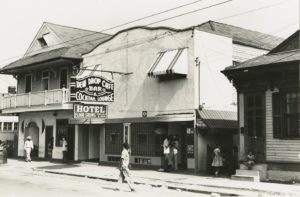
Figure 5: The Dew Drop Inn, at 2836 LaSalle Street, in New Orleans, 1953 (Credit: Ralston Crawford Collection of Jazz Photography, Hogan Jazz Archive, Tulane University.)

In the twenty-first century, as New Orleans continues to innovate new musical forms and styles, the city remains devoted to jazz—its first born. The Preservation Hall Jazz Band and other acts based in traditional jazz sounds continue to pack venues in New Orleans and worldwide. So, too, have the Blues continued to travel down the Mississippi River to New Orleans, at times in the form of legendary artists such as Little Freddie King or turning up in distinctive local interpretations like the mystical Acadiana blues of the late Coco Robicheaux. New Orleans R&B Emperor Ernie K-Doe kept the mid-century sound alive with regular performances (musical and otherwise) in his storied Tremé nightclub, The Mother-in-Law Lounge, until his death in 2001. Shuttered in 2010, the New Orleans institution reopened a year later thanks to the efforts of beloved New Orleans trumpeter and bon vivant Kermit Ruffins.

New Orleans royal families such as the Andrews, the Battistes, and the Marsalises continue to rear and train world-class musicians in the jazz and rhythm and blues traditions. Harold Battiste founded the collective A.F.O. (All For One) Records in 1961, the city’s first label owned and operated by African-American musicians. Before his death in 2015, he had educated hundreds of New Orleans musicians in New Orleans as a public school teacher and later on the faculty in the jazz studies program at the University of New Orleans. There he mentored an impressive list of twenty-first-century jazz luminaries, including Wynton and Branford Marsalis, saxophonist Donald Harrison Jr., trumpeters Nicholas Payton and Terence Blanchard, and pianist Jesse McBride. Hailing from the storied Tremé neighborhood, the Andrews family blurs the boundaries that would otherwise delineate styles of New Orleans music. Cousins James, Glen David, and Troy “Trombone Shorty” Andrews carry on the traditional sounds of the city from second line to jazz to funk.

Jazz saxophonist Donald Harrison Jr. demonstrates both the diversity and complementarity of New Orleans music by interweaving many of the city’s most celebrated styles. Backed by his father—the late Big Chief Donald Harrison Sr.—and Dr. John, Harrison seamlessly melds Mardi Gras Indian chants and percussion with his free flowing, post-bop jazz and Dr. John’s barrelhouse piano on the 1992 Indian Blues. With his Spirits of Congo Square, Harrison presents the collective roots of New Orleans music in the legacies of Congo Square.

In the activist spirit of Mahalia Jackson, Harrison’s nephew Christian Scott aTunde Adjuah “stretches” traditional jazz with hip hop samples and second line rhythms designed to highlight contemporary anti-racist social movements. Local jazz aficionado Irvin Mayfield leads a renowned Latin Jazz group with percussionist Bill Summers. Their Grammy-winning Los Hombres Calientes reaffirms New Orleans’ enduring musical connections to Latin America and the Caribbean. The emerging Tank and the Bangas are among the most exciting groups in New Orleans today. Combing New Orleans jazz, funk, and hip hop with a charismatic slam poetry sensibility, Tank demonstrates, once again, the limitless potential and broad appeal of New Orleans music.

While jazz continues to diversify in infinite directions, brass bands remain essential cultural and economic institutions in the city. Groups such as the Dirty Dozen, the Hot 8, Rebirth, the Soul Rebels, Tremé, and Soul Brass Band perpetually update the tradition with new styles and sounds while maintaining their fundamental connections to the earliest forms of jazz. On any given day in New Orleans, countless brass bands second line through the city’s streets, animating onlookers with a “big noise” that recalls Buddy Bolden at the turn of the twentieth century.
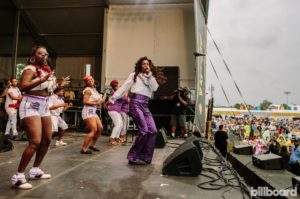
Figure 6: Big Freedia performs at the Congo Square Stage during the New Orleans Jazz and Heritage Festival, 2017 (Credit: William Widmer, Billboard)

In the twelve or so decades following the birth of jazz, a delightful multiplicity of styles and sounds emerged in New Orleans. Despite the ever-expanding diversity and complexity of the city’s music, each of its magnificent innovations emerges from roots in the bedrock of syncopated rhythms and call-and-response lyrical forms given life at Congo Square. Fortunately for us, the essence of Congo Square beats on in two important commemorative spaces: its somber historic landmark in Louis Armstrong Park and as a dedicated stage at the annual New Orleans Jazz and Heritage Festival (see Figure 6). On that stage, when Donald Harrison, Jr., masks in Indian regalia to lead his swinging jazz band over syncopated rhythms, and when Big Freedia directs her twerk team with call-and-response lyrics, they all stir a heaping pot of gumbo that first felt the flame in Place Congo, at the back of town, in New Orleans.

To prepare for your trip to the Crescent City, keep the Guardians of the Groove, New Orleans community radio WWOZ streaming in the background at all times. Take an open online course on New Orleans music from Dr. Matt Sakakeeny, Assistant Professor of Music at Tulane University. Listen to an archive of Mardi Gras Indian performances from 1985 and a more recent writeup hosted by Smithsonian Folkways Magazine. Watch a YouTube playlist of recordings of Mardi Gras Indians compiled by the Alan Lomax archive and a mishmash YouTube playlist curated by the author. Once again, I cannot recommend enough A Closer Walk, an interactive website, map, and series of guided tours of the geographies of New Orleans music, sponsored by WWOZ and others. In the city, visit the Louisiana Music Factory to purchase hard-to-find vinyl, CDs, films, etc. Check out the WWOZ Live Wire page for the most comprehensive listings for live music in the city, and then go find some.

— Case Watkins, James Madison University

DOI: 10.14433/2017.0029


[i] Grace Lichtenstein and Laura Dankner, Musical Gumbo: The Music of New Orleans (New York: W.W. Norton, 1993); Jason Berry, Jonathan Foose, and Tad Jones. Up from the Cradle of Jazz: New Orleans Music Since World War II, revised ed. (Lafayette: University of Louisiana at Lafayette Press, 2009).

[ii] Al Rose, Storyville, New Orleans: Being an Authentic, Illustrated Account of the Notorious Red-Light District (Tuscaloosa: University of Alabama Press, 1974); Lichtenstein and Dankner, Musical Gumbo. See also Part 1 of this essay for more on Storyville and the emergence of Jazz.

[iii] Quotes in Ferdinand “Jelly Roll” Morton, Jelly Roll Morton: The Complete Library of Congress Recordings by Alan Lomax, Music CD (Cambridge, MA: Rounder Records, 2005): Disc 6, Tracks 8 and 9. Lichtenstein and Dankner, Musical Gumbo; Robert Palmer, “Folk, Popular, Jazz, and Classical Elements in New Orleans,” in Folk Music and Modern Sound, ed. William Ferris and Mary L. Hart (Oxford: University Press of Mississippi, 2008), 194-201.

[iv] John Broven, Rhythm and Blues in New Orleans (Gretna, LA: Pelican, 1988); Rick Coleman, Blue Monday: Fats Domino and the Lost Dawn of Rock “n” Roll (Cambridge: Da Capo Press, 2006: p. 246); Jim Cogan and William Clark, Temples of Sound: Inside the Great Recording Studios (San Francisco: Chronicle Books, 2003)

[v] John Storm Roberts, The Latin Tínge: The Impact of Latin American Music on the United States (New York; Oxford: Oxford University Press, 1979); Alexander Stewart, “New Orleans, James Brown and the Rhythmic Transformation of American Popular Music,” Popular Music 19, no. 3 (2000): 293-318; Ned Sublette, The World That Made New Orleans: From Spanish Silver to Congo Square (Chicago: Lawrence Hill Books, 2008). Ned Sublette, Cuba and Its Music: From the First Drums to the Mambo (Chicago: Chicago Review Press, 2004).

[vi] Alan Lomax. Mister Jelly Roll (New York: Grosset & Dunlap, 1950); Berry et al. Up from the Cradle of Jazz.

[vii] Lomax. Mister Jelly Roll; Berry et al. Up from the Cradle of Jazz; David Ritz, Charles Neville, Aaron Neville, and Cyril Neville. The Brothers: An Autobiography (New York: Da Capo Press, 2001).

[viii] Berry et al. Up from the Cradle of Jazz; Jules Victor Schwerin. Got to Tell It: Mahalia Jackson, Queen of Gospel (New York: Oxford University Press, 1992).

[ix] Dr. John (Mac Rebennack) with Jack Rummel. Under a Hoodoo Moon: The Life of the Night Tripper (New York: St. Martin’s Griffin, 1995).

[x] Quotes in Lafcadio Hearn. “The Last of the Voodoos,” Harper’s Weekly 29 (Nov. 7, 1885): 726–27, reprinted in S. Frederick Starr, ed. Inventing New Orleans: Writings of Lafcadio Hearn (Jackson : University Press of Mississippi, 2001): 77-82; Dr. John, Under a Hoodoo Moon.

[xi] Quote aired in Lily Keber, Bayou Maharajah: The Tragic Genius of James Booker (Film: Mairzy Doats Productions, 2016), available on Netflix. Trailer available on Vimeo.

[xii] Matt Miller, Bounce: Rap Music and Local Identity in New Orleans (Amherst: University of Massachusetts Press, 2012); Afropop Worldwide, “Shake It Fo Ya Hood: Bounce, New Orleans Hip-Hop,” (podcast, 2017).

[xiii] Berry et al. Up from the Cradle of Jazz; Coleman, Blue Monday. An illuminative and disturbing documentary (NSFW) of C Murder and the Calliope projects is available here. Super Sunday is a gathering of Indians typically held on the Sunday nearest St. Joseph’s Day. The Calliope and Magnolia are two of the four public housing developments that city and federal authorities demolished and redeveloped following Katrina.
    Share

Continuing Creolization in New Orleans Foodways

Among other points of distinction, New Orleans is often and enthusiastically celebrated as a great place to eat. Boosters of the city’s cuisine point to the same cultural hybridity and cosmopolitanism that enabled the flourishing of jazz music and distinctive architectural styles as explanation for the development of Creole cuisine. Tom Fitzmorris, a prominent restaurant critic and radio host in New Orleans since the 1970s and curator of the website nomenu.com, argues in his book Hungry Town: A Culinary History of New Orleans: “Throughout its history, New Orleans was always a net exporter of culinary innovation; we largely ignored what was going on in other cities around the country. With good reason. Outside New York, San Francisco, and Chicago, no other American city was in league with New Orleans in its culture of cookery. And not even those cities had so well-developed and old a native flavor as we did.”[1] The “native flavor” of which Fitzmorris boasts is a near-proprietary blend of European, African, and Native American preparations that highlight local ingredients, especially seafood and certain fresh produce. The most iconic and classic dishes of the New Orleans culinary canon–gumbo, jambalaya, oysters Rockefeller, red beans and rice, turtle soup, anything with shrimp or crawfish–illustrate the creolization of European, African, and Caribbean cuisines while emphasizing the importance of proximity to the Mississippi river, the Gulf of Mexico, and the bayous that characterize the landscape around New Orleans.

The terms “Creole” and “Cajun” refer to the foodways (and broader cultural characteristics) of urban and rural Southern Louisiana, respectively. Creole describes the population born to settlers in French colonial Louisiana, particularly in New Orleans, as well as native-born people of African descent, both enslaved and free people of color. Like the people, Creole food is a blend of the various cultures of New Orleans (including Spanish, French, African, Italian, German, Caribbean, and Native American, among others), and is typically considered more cosmopolitan and varied than Cajun cuisine. Cajun refers to descendents of the French Canadian settlers forcibly removed from the Acadian region by the British in the mid- 18th century. They settled in the swampy areas of southern Louisiana today known as Acadiana and encompassing four distinct regions: the levees and bayous (Lafourche and Teche), the prairies (Attakapas Native land), swamplands (Atchafalaya Basin), and coastal marshes (New Orleans area and Houma).[2] Cajun cooking continues to draw heavily, in many cases exclusively, from these local landscapes, and has further blended with Creole cuisine to characterize what many believe is “authentic” New Orleans cuisine.

Seafood photo by Cheryl Gerber courtesy New Orleans Convention and Visitors Bureau

The prominence of indigenous ingredients and dishes in the formulation of a distinctive cuisine is “central to ideas about what is specific about New Orleans” argues University of New Orleans anthropologist David Beriss.[3] Prior to Hurricane Katrina, Beriss explains, New Orleans had a “long-standing food culture, a cuisine, built from local products, that is regularly produced in homes and restaurants and frequently discussed around local tables and in the local media.” This food culture, and the celebratory rhetoric surrounding it, seem to indicate that the city’s creolized foodways are more broadly representative of the cultural and ethnic heterogeneity that have long characterized New Orleans. And while contemporary New Orleans foodways continue to claim distinctive terroir[4] (and merroir – the aquatic equivalent of terroir)–ingredients conveying the taste of their place of origin–the late geographer Clyde Woods reminds us that these foodways and the culture that produced them bear legacies often neglected from the dominant celebratory narratives.[5] At risk of vastly oversimplifying complex historical processes, I want to highlight the importance of colonialism and enslavement for the development of contemporary New Orleans foodways. (I also acknowledge that those processes contributed to the formulation of Southern U.S. foodways more broadly.)

Between 2,000 and 600 B.C., long before European colonization, the Poverty Point settlement in Northeast Louisiana and its surrounding villages had a highly developed pre-agricultural subsistence system based on local plants and game, especially aquatic. Maize-based farming seems to have come late to Louisiana compared the rest of the Mississippi Valley and the Eastern U.S. — only a few hundred years before the arrivals of Europeans. This may have been because of the abundance of wild sources of food, again aquatic as well as terrestrial. As indigenous agriculture declined under the pressure of European settlement, war and exploitation increased. French settlers enslaved women from defeated nations and forced them to both grow food and endure a lifetime of sexual exploitation.[6] As European settlement expanded throughout the region, Woods explains, “many of the new immigrants avoided agricultural labor in the fetid, humid, and dangerous bayous. To solve the plantation and farm labor shortages, the Company of the Indies directed the African slave trade toward New Orleans in 1719.”[7] Most of the enslaved Africans who entered the colony between 1717 and 1731 were transported directly from Senegambia, a West African region whose cooking ingredients (rice, okra, various spices, legumes, and seafoods) and techniques took firm hold in the colonies.[8],[9] New Orleans distinctive cuisine, then, is a product not just of local ecologies, but also of legacies of violence, erasure, and enslavement. Those same legacies contributed to disproportionate exposure to violence and death in the wake of Hurricane Katrina, which devastated the city in 2005.[10],[11]

And yet, in the months and years following the storm, a curious thing happened to the city’s culinary landscape: it experienced what many referred to as a “renaissance.”[12][13] For many, the restaurant industry became a barometer for broader recovery within the city. “If eating out was a major part of social life in New Orleans before Katrina, after the disaster, eating in restaurants turned into one of the central ways the city’s fabric was to be rewoven.”[14] Tom Fitzmorris, mentioned earlier, maintained an index of all open restaurants in the city beginning just a few weeks after the levees broke on August 29; less than two years after the storm, there were more restaurants operating in the city then there were prior to it.[15] Among these were the old standard-bearers of traditional Creole and Cajun cuisine–Galatoires, Antoines, Commander’s Palace, and countless po-boy shops and neighborhood eateries. But the post-Katrina landscape saw an influx of new restaurants catering to new tastes, including those of young, mostly white transplants, but also large numbers of Latinos, whose labor was essential to the rebuilding of the city. These new New Orleanians embraced a wider range of cuisines and eating experiences, leading to a potential fracturing of what constitutes New Orleans foodways. It is nearly as possible to obtain a banh mi as a po-boy in present day New Orleans[16],[17], leading some to fret that “authentic” New Orleans cuisine is under assault. Others celebrate the evolution of a cuisine that embraces tradition while welcoming innovation and expansion–essentially, a further creolization of the “original” Creole cuisine.

While there will always be debates over the meaning (and value) of “authenticity” in foodways, it is certainly the case that foodways and food culture, especially in New Orleans, reflect broader historical and geographic trends and processes. Contemporary New Orleans foodways are a result of forced and voluntary migrations to this ecologically unique region over the course of several centuries. Embedded within the region’s foodways are tensions and contradictions: gourmet excesses abut food insecurity; a mostly white male hegemony reigns in the city’s kitchens (where recent revelations of widespread sexual assault perpetrated by perhaps New Orleans’ most beloved chef have sparked national conversations[18]); African American creative and cultural capital remains subject to appropriation (and reclamation)–these are just a few examples. And yet, food remains a central source of pride for New Orleanians. With all its complexity and contradictions, New Orleans is (still/more than ever?) full of good places to eat.

-Catarina Passidomo, University of Mississippi

DOI: 10.14433/2017.0030


[1]     Tom Fitzmorris, Tom Fitzmorris’s Hungry Town: A Culinary History of New Orleans, the City Where Food Is Almost Everything (Abrams, 2014).

[2]     Jay D. Ducote, “Cajun vs. Creole Food – What Is the Difference?,” Louisiana Travel, November 25, 2013, https://www.louisianatravel.com/articles/cajun-vs-creole-food-what-difference.

[3]     David Beriss, “Authentic Creole: Tourism, Style and Calamity in New Orleans Restaurants,” in The Restaurants Book: Ethnographies of Where We Eat, ed. David Beriss and David E. Sutton (New York: Berg Publishers, 2007), 151–66.

[4]     Amy Trubek, The Taste of Place (Berkeley: University of California Press, 2009)

[5]     Clyde Woods, Development Drowned and Reborn: The Blues and Bourbon Restorations of Post-Katrina New Orleans, ed. Jordan T. Camp and Laura Pulido, vol. 35, Geographies of Justice and Social Transformation (Athens, GA: University of Georgia Press, 2017).

[6]     Woods, p. 7

[7]     Woods, p. 9

[8]      Judith Ann Carney and Richard Nicholas Rosomoff, In the Shadow of Slavery: Africa’s Botanical Legacy in the Atlantic World (Berkeley, Calif: University of California Press, 2009), https://www.ucpress.edu/book.php?isbn=9780520269965.

[9]      Michael W. Twitty, The Cooking Gene: A Journey Through African American Culinary History in the Old South (New York, NY: Harper Collins, 2017).

[10]    Michael Eric Dyson, Come Hell or High Water: Hurricane Katrina and the Color of Disaster, 1 edition (New York: Civitas Books, 2007).

[11]     Catarina Passidomo, “Whose Right to (farm) the City? Race and Food Justice Activism in Post-Katrina New Orleans,” Agriculture and Human Values 31, no. 3 (September 2014): 385–96, https://doi.org/10.1007/s10460-014-9490-x.

[12]     Kim Severson, “The New Orleans Restaurant Bounce, After Katrina,” The New York Times, August 4, 2015, sec. Food, https://www.nytimes.com/2015/08/05/dining/new-orleans-restaurants-post-hurricane-katrina.html.

[13]     Brett Anderson, “New Orleans Restaurant Scene Emerging Better after Hurricane Katrina,” The Times-Picayune, August 27, 2010, https://www.nola.com/dining-guide/index.ssf/2010/08/new_orleans_restaurant_scene_h.html.

[14]     Beriss, David and David Sutton, “Starter: Restaurants, Ideal Postmodern Institutions,” in The Restaurants Book: Ethnographies of Where We Eat, ed. David Beriss, and David Sutton (Oxford ; New York: Berg Publishers, 2007), 1–13.

[15]     Fitzmorris, p. 180-181.

[16]     an McNulty, “Orleans Goes Nouvelle,” Gambit, accessed February 23, 2018, https://www.bestofneworleans.com/gambit/orleans-goes-nouvelle/Content?oid=1571316.

[17]    “The Lives and Loaves of New Orleans,” Southern Foodways Alliance (blog), accessed February 23, 2018, https://www.southernfoodways.org/the-lives-and-loaves-of-new-orleans/.

[18]     Brett Anderson, “John Besh Restaurants Fostered Culture of Sexual Harassment, 25 Women Say,” NOLA.com, accessed February 24, 2018, https://www.nola.com/business/index.ssf/2017/10/john_besh_restaurants_fostered.html.

    Share

Newsletter – February 2018

PRESIDENT’S COLUMN

Time for a Radical Geographic Literacy in Trump America

By Derek Alderman

Globe-masked-in-fist-252x300I am sure many of you know of the strong allegations that Mr. Donald Trump—frustrated with a bipartisan immigration proposal—argued that America needs more immigrants from places like Norway and fewer from Haiti, El Salvador and African nations, which the President reportedly called “shithole countries.” More than mere “locker room cartography,” as one late night comic put it, the President’s harmful words project a racialized map of the world that represents Haitians, Salvadorians, and Africans not only as unwelcomed, but also as inferior. By reducing countries and an entire continent to a pejorative label, Mr. Trump denies the complexity, dignity, and richness of life in these countries and the creative resilience and resistant survivability that have always existed amid and in opposition to political oppression and poverty.

Continue Reading.

Read past columns from the current AAG President on our President’s Column page.


ANNUAL MEETING

Preliminary Program for #AAG2018 Available!

Schedule ButtonThe Preliminary Program for #AAG2018 has been released! The online searchable program includes a preliminary agenda of sessions, plenary speakers, and specialty group meetings. You can browse the schedule by author, title, keyword, sponsor group, theme and day.
Browse the program.

Plan Your Trip to #AAG2018

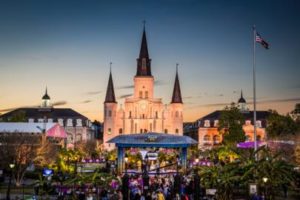
med_20130131_jacksonsquare_014-300x200With the release of the 2018 AAG Annual Meeting Preliminary Program, now is the best time to book your travel to New Orleans. The AAG is pleased to partner with United Airlines, Amtrak, and Super Shuttle to help reduce costs for Annual Meeting attendees traveling to New Orleans by train or airplane. Stay close to the action in the AAG co-headquarter hotels. The Opening Plenary and International Reception will take place in the Sheraton New Orleans and the Exhibition Hall and Registration can be found in theMarriott French Quarter. Limited rooms are still available in the AAG block of rooms in each hotel.
Plan your trip.

Nora Newcombe and David Lambert to Keynote Geography Education Research Track at 2018 AAG Annual Meeting

NCRGE_logoThe National Center for Research in Geography Education (NCRGE) is pleased to announce keynotes by Nora Newcombe and David Lambert for a special track of geography education sessions during the 2018 AAG Annual Meeting in New Orleans. Nora Newcombe’s lecture, “GPS in Our Heads: What Do Behavioral and Neural Data on Navigation Offer to Geography Educators?”, engages the long and controversial proposal that humans can develop cognitive maps of their environment. Following Newcombe’s lecture, David Lambert will deliver a lecture entitled “Nurturing the ‘Garden of Peace’: Powerful Geographical Knowledge and the Pursuit of Real Education.”

Learn more about the NCRGE keynote.

FocusOnNewOrleansLogo

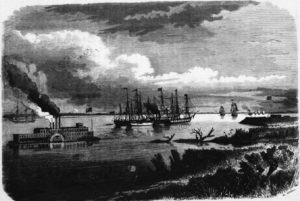
Élisée Reclus in Louisiana (1853-1855): Encounters with racism and slavery

Fig.-2_Reclus

In 1853, New Orleans was second only to New York City as the largest port city in the United States. The early capitalist economy welcomed a young Élisée Reclus, French geographer and future anarchist, to its shores, forever changing the scholar’s philosophical stance. In this article, Federico Ferretti uses Reclus’ accounts of the city to trace the roots of a geographer “later considered as a founding figure in both scientific geography and socialist libertarianism (anarchism).”

Read the full story.

Louisiana’s Turn to Mass Incarceration: The Building of a Carceral State

“The history of the Louisiana penal system is marked through crisis,” states Lydia Pelot-Hobbs in her expose on the decentralization of ‘Angola,’ the state of Louisiana’s only prison, during the late 20th century. The carceral geographies of New Orleans during the 1970s and 1980s are continuing to shape its political geographies today.

Continue reading.

New Orleans: Place Portraits

2018 marks the tricentennial anniversary of the city of New Orleans, site of the 2018 AAG Annual Meeting. Over the course of its 300 years, the Big Easy has experienced quite a few changes. New Orleans’ unofficial “geographer laureate” Richard Campanella of the Tulane School of Architecture chronicles a few in this month’s Place Portraits: how Bourbon Street became a place to publicly imbibe, the shift of the Louisiana state capitol from New Orleans to Baton Rouge, and three centuries of responses to natural and human disasters.

Read all three articles:

“Focus on New Orleans and the Gulf Coast” is an ongoing series curated by the Local Arrangements Committee to provide insight on and understanding of the geographies of New Orleans, Louisiana, and the greater Gulf Coast region in preparation for the 2018 Annual Meeting.


ASSOCIATION NEWS

First Round of 2018 AAG Award Recipients Announced

The American Association of Geographers congratulates the individuals named to receive an AAG Award. The awardees represent outstanding contributions to and accomplishments in the geographic field. Formal recognition of the awardees will occur during the AAG Awards Luncheon at the Annual Meeting on Saturday, April 14, 2018.

See the Awardees.

AAG Welcomes Two Spring Interns

The AAG is excited to have two new interns join our staff for the Spring 2018 semester. Laura Akindo, graduate of Frostburg State University, and Hannah Ellingson, sophomore at The George Washington University, will both be assisting staff on a variety of internal projects in addition to the 2018 AAG Annual Meeting.
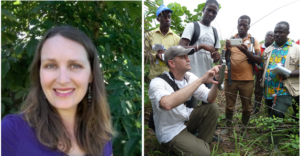
Learn more about Laura and Hannah.

2018 AAG Elections – Now Open!

The 2018 AAG election is being conducted online between January 31 and February 22, 2018. Ballots will be emailed to members based on the email address provided to the AAG. Candidate information is currently available on the AAG website.

Details on the election process.  


MEMBER NEWS

Profiles of Professional Geographers

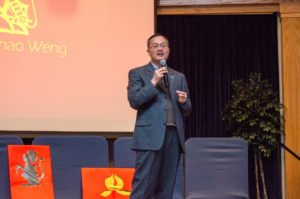
Each month, learn more about the field of geography from people who are working in it! This month, AAG talked to Leslie McLees, Undergraduate Coordinator & Instructor at the University of Oregon Department of Geography, and Pete Chirico, Research Geographer & Associate Director of the Eastern Geology and Paleoclimate Science Center at U.S. Geological Survey. Both discussed the need for effective communication skills on the job market and their passions for geography.
Learn more about Geography careers.

Qihao Weng named fellow by Institute of Electrical and Electronics Engineers 

The Institute of Electrical and Electronics Engineers (IEEE) has named geographer and long time AAG Member, Qihao Weng to its list of fellows. Weng has been a professor at Indiana State University since 2001 where his research focuses on urban remote sensing. The author of 210 articles and 10 books, Weng is the 2015 AAG Willard and Ruby S. Miller Award recipient.
Find out more about Weng and the IEEE.


RESOURCES & OPPORTUNITIES

AAG Snapshot: AAG Journals

snapshot aagLooking to learn more about the four scholarly journals published by the AAG throughout the year? In this month’s AAG Snapshot, delve into the academic publishing sphere as AAG Publications Director Jennifer Cassidento shares tidbits about the Annals of the American Association of Geographers, The Professional Geographer, GeoHumanities, and The AAG Review of Books!

Learn more about AAG journals.


PUBLICATIONS

Winter 2018 Issue of ‘The AAG Review of Books’ Now Available

Volume 6, Issue 1 of The AAG Review of Books has now been published online. In this first issue of 2018 be sure to check out the discussions of Concrete Revolution: Large Dams, Cold War Geopolitics, and the US Bureau of Reclamation, Degraded Work: The Struggle at the Bottom of the Labor Market, and Cities in Global Capitalism.
Read the reviews.

New Books in Geography — December 2017 Available

New Books in Geography illustration of stack of books

Forests and labor and states, oh my! Check out the list of new books in geography that were received by the AAG during the month of December. The New Books list contains recently published titles in geography and related fields.

Browse the whole list of new books.

February 2018 Issue of the ‘Professional Geographer’ Now Available

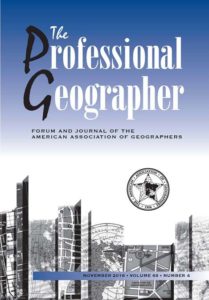
PG coverThe Professional Geographer, Volume 70, Issue 1, has been published. The focus of this journal is on short articles in academic or applied geography, emphasizing empirical studies and methodologies. Volume 70, Issue 1 includes a focus section entitled: Critical Data, Critical Technology.

See the newest issue.

Read the January 2018 Issue of the ‘Annals of the AAG’  

Annals-cover-2016

The first issue of volume 108 of the Annals of the American Association of Geographers has been published. Read articles that span the breadth of the discipline, organized into four major areas: Methods, Models, and Geographic Information Science; Nature and Society; People, Place, and Region; and Physical Geography and Environmental Sciences.

Full article listing available.


OP-ED

Confessions of a Conference Thief

By Mark Fonstad

No-recording-microphone-300x300“I was a thief. A mild thief, but a thief nonetheless. In 1996, the Binghamton Geomorphology Symposium held a series of talks on the topic of “The Scientific Nature of Geomorphology”. As a young a 23-year old graduate student, I registered and then covertly audio-recorded the talks from a cassette recorder hidden in my jacket pocket. Even though it wasn’t stated explicitly, I guessed that doing this would probably constitute theft of intellectual property. But I did it anyway…”

Continue reading.


FEATURED ARTICLES

Teaching Modern GIS

“As educators, we are always faced with challenges on how we structure our curriculum activities to ensure that we are in line with modern industry practices. This is easier said than done—for one, there is likely no consensus on what a “modern geographic information system (GIS)” means; and two, it takes a tremendous amount of time to do curricula updates… Below is an attempt to outline a few important topics amid the massive digital transformation we have experienced.”

Read the list.

Featured Articles is a special section of the AAG Newsletter where AAG sponsors highlight recent programs and activities of significance to geographers and members of the AAG. To sponsor the AAG and submit an article, please contact Oscar Larson olarson [at] aag [dot] org.


GEOGRAPHERS IN THE NEWS

IN THE NEWS

Popular stories from the AAG SmartBrief


EVENTS CALENDAR

Submit News to the AAG Newsletter. To share your news, email us!

    Share

Time for a Radical Geographic Literacy in Trump America


Like many geographers, I have a world map hanging in my office. Last time I looked, I didn’t see any “shitholes” on that map. It does not come easy for me to begin my commentary with an expletive (and I apologize to those who I offend), but our current U.S. President really leaves me no choice. I am sure many of you know of the strong allegations that Mr. Donald Trump—frustrated with a bipartisan immigration proposal—argued that America needs more immigrants from places like Norway and fewer from Haiti, El Salvador and African nations, which the President reportedly called “shithole countries.”

More than mere “locker room cartography,” as one late night comic put it, the President’s harmful words project a racialized map of the world that represents Haitians, Salvadorians, and Africans not only as unwelcomed, but also as inferior. By reducing countries and an entire continent to a pejorative label, Mr. Trump denies the complexity, dignity, and richness of life in these countries and the creative resilience and resistant survivability that have always existed amid and in opposition to political oppression and poverty.

Mr. Trump’s “shithole” remark also works to erases, quite likely by design, a consideration of socio-spatial processes and difficult decisions that make migration necessary for many people, along with the very real contributions that immigrants from these denigrated nations have brought (and continue to bring) to the United States. Also obfuscated in the President’s unjust words is America’s own historical and ongoing complicity in destabilizing the governments and economies of some of these derided countries.

As a global leader and the head of a diverse nation, the President had the responsibility to create and communicate a much more informed and inclusive rendering of the world—regrettably, it appears that he chose not to do so.

There is no shortage of organizations, journalists, and individual citizens condemning Trump’s words as vulgar, racist, and unbecoming of the nation’s highest elected leader. I share in their outrage and feel strongly that the President’s remarks—and the ideology that underlies them—strike at the heart of who and what we are as geographers. His maligning of certain parts of the world runs directly contrary to our Association’s core values regarding scientific knowledge, international collaboration, support for developing regions, human rights, and anti-racism.

Before going any further, I want to be clear that this column, like all of my monthly columns, reflects my opinions and mine alone. They do not represent an official stand or position taken by the American Association of Geographers (AAG). At the same time, the AAG can and does encourage its members to speak out to express their own individual opinions about social and policy issues important to them as geographers.

The President’s recent language and policies regarding immigration are open to question on a variety of economic, diplomatic, and social justice grounds. I wish to focus here on the damage potentially done to the “geographical ethics” that we try to create within our classrooms and communities, specifically the intellectual and moral obligation to develop a sophisticated global understanding, to represent the world in just terms, to care about and develop an empathy for others—as much as that is illusive.

Regrettably, Mr. Trump’s “shithole” reference is not an isolated event, but part of a pattern of regularly degrading people and places as part of the process of governing—whether he is offering defamatory portrayals of people from Mexico, African American communities, or those living in certain Muslim nations.

I encourage members of the AAG to consider what this national ethical crisis means for our discipline—especially in terms of raising the already high stakes of geographic education—and I suggest that now is the time for articulating and promoting a “radical geographic literacy” among a public bombarded with harmful images from the White House.

The High Stakes of Geographic Education, Especially Now

When Mr. Trump uses his bully pulpit to portray an entire country as the equivalent of a toilet, he is single handedly damaging what many of us have spent our careers trying to achieve in the classroom. The full damage comes not from a single comment in a single moment, but in how that remark perpetuates a long history of nativism and white supremacy within the United States while also reinforcing centuries old negative tropes about the Global South. In this regard, we cannot dismiss the President’s words as simply political incorrectness or “Trump just being Trump”—they are part a larger historical and contemporary geography of racial injustice.

The President’s stigmatizing of Haiti, El Salvador, and African countries—and the unwillingness of some elected officials to condemn these actions—threaten not only the global outlook and values of our students, but also potentially the very safety of some of these students and other community members. I join other geographers in being gravely concerned about the wider toxic effect that the ‘shithole” controversy will have on patterns of prejudice, public treatment of targeted immigrant groups, the sense of belonging of people of color in general.

While the President has been criticized (and rightly so) by the media and teachers, the truth is that his offensive comments join a tradition among journalists and even some educators of framing African people and places largely in terms of disaster without carrying out a full and responsible historical and geographic analysis and depiction of the region. Indeed, several months before the President’s infamous “shithole” reference, a number of my colleagues who grade AP Human Geography exams contacted me. They expressed outrage this past year in finding high school student AP essays containing damaging stereotypes about Africa along with clear elements of racism, sexism, and classism. There were also concerns from my colleagues about some of the Eurocentric assumptions written into the AP exam questions and grading rubrics.

If the goal of geographic educators are, according to John Finn, to wage a “ruthless” critique of the taken for granted ways we order and fix the meaning of the world, then our job has always been a tough one and I would argue that it has gotten even tougher in the Trump era. This challenge from the White House, while clearly indicating the need for increased advocacy for geographic education, comes at a difficult time in the discipline. While not discounting significant national and international strides made in educational standards, research, and programs in geography, much of it led by the AAG, and the ever growing pedagogical importance of GIScience, the view seen by some geographers is not so rosy.

We are in a time in which some states are cutting or diluting geography within public school curriculum—a baffling decision given the international challenges and uncertainties facing us. And the National Geographic Network of State Alliances—who for thirty years was the “boots on the ground’ in the battle to train teachers and lobby for geography with state legislatures—learned in 2017 that the university-state alliance model will be de-funded by National Geographic Education for a new, and still not clearly outlined regional model of support. Coordinators of some state alliances are quite certain their offices will close—eliminating important allies in the promotion of geographic education at a most critical time.

The dramatic restructuring of the Alliance Movement, the curriculum challenges facing educators and the recent ethical challenges that I have described suggest that the stakes are especially high for a discipline-wide reinvestment in geographic education and championing what I call a “radical geographic literacy.”

Toward a Radical Geographic Literacy

I choose the word “radical” to characterize geographic literacy for two reasons. First, radical signals a profound change and I am calling for a significant discipline-wide elevation and intensification of geographic education-related outreach and advocacy. The radical approach proselytizes the educational and political necessity of having a broad comprehension and appreciation of the world’s complexity and diversity as a means of countering ongoing national efforts to deny that reality. This enhanced promotion of geographic literacy has always been important, especially given the continuing abysmal base of geographic knowledge among Americans, but particularly needed now when our President, a self-identified “stable genius,” appears unable or unwilling to articulate even the most basic understanding of the world mosaic.

To some degree, this radicalism requires geographers to keep doing what they do well, which is offer critical and accessible learning about the world and how it looks, feels, and works in actuality rather than in political rhetoric. Yet, effective teaching may not be enough. Geographers of all sub-fields should consider additional places where they can push back against unethical portrayals of the world and its people. That could be lobbying for curriculum change, designing lessons, training teachers, attending educational conferences, publishing in pedagogical journals, consulting with colleges of education, participating in community teach-ins, visiting K-12 classrooms, or collaborating, while you can, with your state geographic alliance. This radical mode of advocacy is, in my view, a responsibility of all geographers and not solely the job of those who conduct research in the theories of methods of geographic education.

Second, I use “radical” geographic literacy in a deeper way, recognizing the word’s association with revolutionary change. I believe it is time to redefine, for the public and our profession, what we fundamentally mean by and represent as geographic literacy, while also actively considering what role a revamped version of the concept can and should play in advancing a geographical ethics seemingly missing from the Oval Office.

Geographic literacy is not something that I hear many of my fellow faculty members talk about, perhaps because the public, media, and even some geographers identify it with the rote learning of the names and locations of human and physical features on the earth. There are broader and more useful conceptions of literacy. For example, Geography for Life: National Geography Standards (2nd edition) emphasizes the analytical perspectives, content knowledge, and applied skills needed to be a geographically informed person. Within the “In Brief” version of these standards, what is distributed widely to schools and teachers, geographic literacy is defined as being critical to “economic competiveness,” “quality of life,” “sustaining the environment,” and “national security.”

Absent, at least prominently, within standard definitions of geographic literacy is the relationship between geographic education and the promotion of peace, social and environmental justice, and anti-discrimination—the very matters that seem to matter the most at this historical juncture. Importantly and rigtly, Geography for Life suggests that a geographic education enables students to “engage in ethical action with regard to self, other people, other species, and Earth’s diverse cultures and natural environments,” but it stops short of identifying ethical geographical awareness and action as one of the discipline’s core or essential elements and competencies. At best, it would be subsumed under “the uses of geography.”

Strikingly, Geography for Life suggests that geography can assist in protecting the US economy and its position in defense and international relations (a point that I don’t necessarily disagree with), but it does not appear to say nearly as much about extending that concern and responsibility to a worldwide scale or the efficacy of geographic literacy in promoting international cooperation. Drawing from the writings of Barney Warf, an alternative, radical definition of geographic literacy would be more explicit in creating moments to challenge the privileging of that national order. Such a literacy would be key to “widen[ing] geographical imaginations and circles of compassion, to illustrate how students’ lives are connected to distant others, and to inject issues of empathy and caring into geographic pedagogy.”

In contrast to traditional definitions of geographic literacy, which tend to focus largely on the ability of students to process and apply geographic information, a radical version of geographic competence considers more centrally the affective and emotional aspects of developing a basic but critical knowledge of the world. Again, reading from Warf, such an approach promises to “call attention to students’ positionality, highlight their prejudices, and to make explicit the cultural filters with which they perceive those different from themselves, and thus equip them with tools to negotiate the complex terrain of social difference in meaningful and constructive ways.”

It is this very sort of reflexive engagement with values and attitudes, as part of basic geographic literacy, which is necessary for being sensitive to and standing in solidarity with the differences and legitimacies of other countries—something grossly missing from a Trump worldview.   Importantly, a radical geographic literacy does not abandon the need for foundational content and skill development, but it realizes that these geographical competencies are incomplete if not leveraged to examine, critique, and challenge inequalities—including dehumanizing portrayals of countries and regions. Importantly, this radical geographic literacy is not restricted to our colleagues in critical human geography; it can and should be part of the pedagogical DNA of our whole discipline.

Many of you already engage in and advocate for radical geographic teaching, learning, and outreach, but it is time to institutionalize these values within the promotional materials distributed to K-12 schools, universities, and public groups, the learning objectives of our introductory courses, the way we introduce ourselves to strangers, and national geography definitions and curriculum standards. Perhaps a new edition of Geography for Life is in order. Please share your ideas of how to develop and carry out a radical geographic literacy and your thoughts and experiences on the geographic ethics at work (or not) in Trump America by emailing me (dalderma [at] utk [dot] edu) or share on Twitter #PresidentAAG.

— Derek Alderman @MLKStreet
Professor Geography, University of Tennessee
President, American Association of Geographers

DOI: 10.14433/2017.0026

    Share

AAG Welcomes Two Spring Interns

The AAG is excited to have two new interns join our staff for the Spring 2018 semester. Welcome aboard Laura and Hannah!

Laura Akindo recently graduated from Frostburg State University with a Bachelor’s of Science degree in Earth Science with a Concentration in Environmental Science. She also majored in Geography. Laura is in the process of applying to Graduate Programs and hopes to begin working on her Masters of Science in the Fall in GIS and Environmental Management and Policy. In her spare time, Laura likes to read, visit new exciting outdoor parks, and watch soccer.



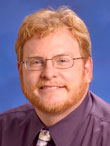
Hannah Ellingson is a sophomore at The George Washington University, pursuing a B.A. in geography and a minor in geographic information systems. Hannah previously interned for the City of Norfolk’s city planning department, where she used GIS to create a map of street-end water access points in Norfolk, VA, in order to support an initiative to increase public water access throughout the city. After graduation, she intends to pursue a M.A. in geography. She attributes her passion for geography to her mother, who instilled an appreciation for geography in Hannah at a young age. In her spare time, she enjoys exploring D.C.’s art museums and restaurants, traveling with her family, and playing with her black lab puppy, Hank.

    Share

Emilio Casetti

Emilio Casetti, who has died at the age of 89, three weeks short of his ninetieth birthday, made important contributions to both geography and regional science. He was honored at Ohio State with the designation Distinguished Research Scholar in 1992, and in 1994 the Association of American Geographers bestowed upon him the Honors Award, the organization’s most prestigious recognition for research excellence. He was also an unforgettable person.

He acquired his bachelor’s degree in law at the Sapienza University in Rome at the early age of 20 and earned a doctorate from the University of Rome in three years. He then practiced law in Rome and had begun work towards a doctorate in geography at the same university before leaving to do a Master’s at McGill. Afterwards, he and his wife Gabriella spent several years in a remote part of Saskatchewan teaching in a very small rural school. He did not have to be pushed to regale the listener with hair raising tales of the winters there, all told with his standard deadpan grin. Quite what had led him in the direction of geography is unclear, but by 1964 he had graduated from Northwestern deeply steeped in the quantitative methods for which the Geography Department there was, at that time, notable. His first appointment was at Toronto but in 1966 he moved to the Department at Ohio State, where he would remain until his retirement.

He would become an important influence in graduate work in the Department and a renowned advisor. What made him so effective was his ability to see the unique strengths of each of his students, help them recognize it, and then allow them to deploy that strength to its fullest advantage.  Not surprisingly, his students – and nine of his twenty-three doctoral students were, significantly for the time, women – have gone on to successful careers of their own, each in a direction that no doubt Emilio saw early on. They speak affectionately of him, and of the time he decided that they must call him ‘Emilio.’ He cared deeply for them and would defend them vigorously against pettiness.

His work was notable for its combination of simplicity, power and imagination. He himself thought that his development of what he called the expansion method was his major contribution. What this involved was taking some relationship, like Fourastié’s model of sectoral shift in a national economy, describing it with a regression model and then expanding it by setting the coefficients as functions of other pertinent variables, like, perhaps, the date at which an economy took off. This would then create a set of relationships that could stimulate further investigation. This would be a precursor to spatial regression models where the coefficients are a function of absolute or relative location.

Emilio’s expansion method led to a number of dissertations at Ohio State in the 1980s and through the 1990s. As he came to view things, however, it was not simply a method but a new paradigm for research, one that challenged scientific geography – of which he was a strong proponent – to entirely rethink the nomothetic (or law-seeking) enterprise. Instead of assuming that parameter instability was an aberration due to model misspecification or systematic biases in data and error terms, Emilio came to see the search for contextual variation in causal processes as part-and-parcel of the explanatory effort itself. For any model, the question of parameter variation opened up new questions, ones often more important than the first order explanatory questions tested in what he called the ‘initial model’.

Though he was well known for the expansion method, he was also the early inventor of what later became popularized as geographically-weighted regression (GWR). In his ‘drift-analysis-of-regression parameters’, or DARP, he constructed a grid across a set of spatially distributed observations and proceeded to run separate cell-by-cell regressions, weighting all observations according to an exponential distance-decay function from the cell’s central point. The result was a moving lattice of regression analyses that varied by the degree of information content from nearby data points, thus producing a series of ‘local’ regressions for which investigators could track and map parameter variation. Depending on the exponents determining the distance-decay of information from near or far away cases, the models could adjusted to be ‘regional’ as opposed to local. The insight led him to argue that spatially weighted regression is not a special case of regression; rather, analyses that don’t explicitly involve weighting are equivalent to assigning each case a value of 1, which is the norm for most models. Hence DARP, or geographically-weighted regression, as it became popularized, was the more general case. It is a sidebar in the history of geography that DARP preceded a now popular GWR by a decade and furthered the development of quantitative geography away from its search for universal laws to something much more sensitive to issues of context.

As a person he was a curious mix of strong views strongly held, and a sweet innocence. He was dedicated to his research but found lots of time for other things, the most notable of which were cats. Emilio was a cat lover, par excellence; not one who hoards them but who, along with his wife, took in strays in sufficiently modest numbers where they could develop an attachment to them. And he was attached. An invitation to dinner would be accepted but on his insistence, he and his wife would arrive in separate cars so that if one was involved in an accident, the cats would not go wanting. He was a very kind man and not just to cats. There are many stories of Emilio’s consideration of those students who had trouble with the quantitative methods that he taught.

There are other interesting stories about him. As a young adult growing up in postwar Italy, Emilio developed a strong aversion to traditional social institutions that he saw as oppressive and antithetical to progress.  He joined the Italian communist party, but after several years concluded that the party itself reproduced the social hierarchies that he opposed.  Many years later when he applied for a U.S. green card, he had to respond to a question about whether he had ever been a communist party member.  He was honest in his response, and attached a statement describing how and why he was no longer a communist: nepotism and cronyism.  He must be the one and only person who was given a green card after openly admitting that he had been a communist party member!

In the late 60s, he acquired, quite cheaply, one of the earlier analog computers and put it in his basement. This meant that he did not have to submit his jobs to the computing facility at the university, as was the custom at that time. The problem was, that it was huge. Being shown it was like walking down the book shelves in a library. Emilio was also an early adopter of  desktops and laptops, and once they became available, getting rid of his heap of metal – whose only real purpose was in solving partial differential equations – was a nightmare. Through it all one could see Emilio’s usual sense of humor and self-deprecation.

He liked people who he judged to be without guile and who he perceived to be honest. He will be deeply missed by those touched by his unique blend of kindness, considerateness and innocent disbelief that you might disagree with him. His life will endure through the major contributions that he made to spatial-quantitative geography and through the affectionate recollections of his students.


    Share

Enacted Tax Bill Protects Tuition Waivers

A massive tax reform package signed into law by President Trump shortly before the holidays drew attention primarily for slashing corporate rates and amending individual filing rules.  The legislation, however, was also of significance for the higher education community.
The original bill that passed the House of Representatives included language that would have counted graduate student tuition waivers as taxable income.  This proposal drew significant protests and press criticism and was ultimately removed by House and Senate negotiators.  The AAG was actively involved in opposing the provision and keeping our student members and departmental leaders informed, and we are pleased with the outcome.

Separately, the new law will apply a new excise tax of 1.4 percent on investment income for certain private colleges.  Institutions with over 500 students and holding assets of $500,000+ per student will be affected.  It is estimated that this new tax will affect approximately 35 institutions including Harvard, Yale, Princeton, and Stanford and will generate close to $2 billion in revenue over ten years.  The House had proposed taxing additional colleges and universities, but Senate negotiators argued for the more narrow language.

Finally, it will bear watching how much of an impact the new law has on financial support for public institutions in high-tax states.  The legislation caps personal deductions of state and local taxes at $10,000, which could apply pressure on certain states to lower taxes.  This, in turn, could force these states to cut budgets, including for public higher-ed institutions.

    Share

Educational GIS Activities in Africa

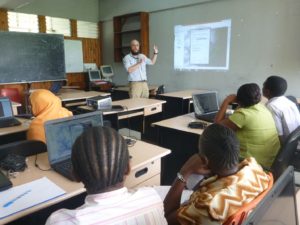
Over the past decade, most universities and some secondary schools across Africa have been exposed to geographic information system (GIS) technology. Teaching about and with GIS on that continent has been both challenging and rewarding.

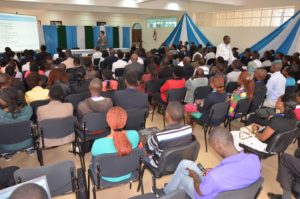
On April 9, 2017, the panel session “Teaching GIS in Africa” was held at the Association of American Geographers (AAG) annual meeting in Boston. Esri organized this session, and speakers came from several nations and spoke of their diverse experiences as teachers and, in one case, as a student in Eastern Africa.

Although every African university and nation has its own unique characteristics, the speakers and audience members coincided on several issues. GIS education across Africa—with exceptions especially in South Africa—has been slow to evolve beyond the teaching of basic GIS theory, in large part due to a lack of sustained resources such as computer labs, Internet connections, and updated local datasets. Often these resources are donated but not maintained in the medium or long term. Software is generally available either as open source or via discounts and donations by Esri and other commercial providers.

The main limiting factor identified was the lack of instructors educated on the latest technologies and methodologies such as mobile data collection, data publishing and sharing, and advanced spatial analysis. Far too many students are still learning GIS from textbooks instead of via hands-on use. Much of the applied GIS being taught is natural resources (and satellite imagery) oriented, with less attention being paid to human geography, urban issues, and cartography. This, again, is due to the limited availability of specialists in these areas and of spatial data such as street networks and geodemographics. Many steps have been taken in the form of short-term, donor-funded projects, but often momentum is lost after project completion.

The University of North Alabama’s Jonathan Fleming, an Esri education ambassador, teaches in the geography department at the University of Dar es Salaam.

Esri is committed to making a long-term difference in GIS education in Africa and, over the past five years, has ramped up its involvement in this endeavor. Esri has sponsored a series of education user conferences (in Eastern Africa), training sessions, and other activities organized by local Esri offices. Additionally, special assistance has come from Esri’s offices in France, Portugal, and Switzerland to support universities in francophone nations, lusophone nations, and Rwanda, respectively. Esri has sponsored a growing group of education ambassadors to travel and conduct teaching and geomentoring missions across the globe. Among them are Jonathan Fleming of the University of North Alabama, who taught in Dar es Salaam in 2013, and Stace Maples from Stanford University, who visited Kenyatta University (KU) in Nairobi in spring 2017. Maples taught several classes and also mentored faculty and the university administration about how to apply and sustain GIS across the entire campus. Feedback from the universities and ambassadors was extremely positive, and so Esri will continue to support these missions in the future.

Among African universities, Kenyatta University has emerged as a star—a lighthouse exemplar—in adopting and promoting GIS. As in many GIS success stories in any field, a GIS champion was involved: Professor Simon Onywere. Onywere had been a GIS and remote-sensing expert for many years, but in 2013 he decided to take his university to the next level. He worked with Esri’s home office and Esri Eastern Africa Limited (in Nairobi) to craft a memorandum of understanding (MOU) whereby both parties would contribute to the success of GIS across the entire KU campus. Under Esri’s 100 Africa Universities program, the MOU included a donation of ArcGIS software to the university. Esri has worked with approximately 70 universities under this program thus far. With software installed in the laboratories, Onywere and Esri personnel trained instructors, students, and administrators on the power of GIS for solving spatial problems in any field of study. Enterprise GIS, including attention to servers and client apps, became available to anyone showing interest in learning on the same platform used by industrial, commercial, and government entities around the world. GIS Day and similar events were run; a GIS club was formed; and, soon, a small army of GIS users and promoters was created.

The first Esri Eastern Africa Education GIS Conference was held in Nairobi in 2013.

KU recently hosted the 2017 Esri Eastern Africa Education GIS Conference. GIS is being taught and used for research by Onywere’s environment science faculty and several others including staff of the recently added tourism and hospitality department and the newly built library. The KU story is a story of hope for GIS at African universities, demonstrating that with personal and collective initiative, anything is possible.

Working with instructors, students, and university/school administrators in Africa has been extremely rewarding and gratifying. We encourage all AAG members to consider lending a helping hand to slowly but surely raising the level of GIS education across the continent. If you’d like to apply to become an Esri Education Ambassador, send a brief CV with teaching experience and a statement of interest to edambassadors [at] esri [dot] com.

By Michael Gould, Global Education Manager, Esri

Featured Articles is a special section of the AAG Newsletter where AAG sponsors highlight recent programs and activities of significance to geographers and members of the AAG. To sponsor the AAG and submit an article, please contact Oscar Larson olarson [at] aag [dot] org.

    Share

Confederate Monument Controversy in New Orleans

Across the U.S. South and beyond, cities are debating the fate of their Confederate monuments. In New Orleans, the May 2017 removal of the Robert E. Lee monument in Lee Circle, the large round-about on St. Charles Avenue, was the culmination of over two years of public and political drama, driven primarily by Mayor Landrieu’s 2015 charge less than a week after the Charleston massacre to “look at the symbols in this city to see if they still have relevance for our future” (Times Picayune June 22, 2015). He explained that a conversation with jazz musician Wynton Marsalis, who when asked to help plan the city’s 2018 Tricentennial Celebration, challenged the mayor to consider Lee Circle through his eyes. “Who is he? What does he represent? And in that most prominent space in the city…does that space reflect who we were, who we want to be or who we are?” (Times Picayune June 24, 2015).

Landrieu proposed the removal of four monuments – statues of Robert E. Lee, P.G.T. Beauregard, Jefferson Davis, and the Battle of Liberty Place Obelisk. Dedicated between the years 1884 and 1915, these four monuments were erected as part of a national trend, particularly in the South, symbolizing the Confederacy’s Lost Cause mythology – a revisionist Civil War narrative intended to transform the South’s military defeat into a political and cultural victory, promoting white dominance and states’ rights, while deifying southern leaders (Gallagher and Nolan 2010).

Using a public nuisance law, the Mayor brought the issue to the city council that ultimately voted six to one to remove the monuments. Yet, unsurprisingly, the issue was far from resolved. While the Mayor’s office moved forward with plans for removal, pro-monument groups such as the Monumental Task Committee deployed multiple legal maneuverings to slow the process. Meanwhile, contractors bidding on the removal contract received death threats. Countless protests occurred, mostly in front of the three figurative memorials which became gathering places for supporters and opponents of removal. At times the protests were small and cordial; others were tense and required police barricades and security. Some were organized by anti-monument organizations such as Take ‘Em Down, Nola, and others by anti-removal groups like Save Our Circle, and still more were informal and grew from people walking by or patrons of local bars and restaurants coming out to engage. Not even during the city’s beloved Jazz Fest was there an escape from the controversy as a plane flew overhead with a banner reading “OUR MONUMENTS OUR HISTORY!”

Site of the Battle of Liberty Place obelisk, removed in the early morning hours of April 24th, 2017. Photograph by Jennifer Speights-Binet

After town hall meetings, hearings, lawsuits, appeals, and protesting, the uprooting of the Confederate statues in New Orleans began in the early morning hours of April 24th with no public notice of the removal. Because of serious security concerns, removal workers masked their faces as well as the company name on their vehicles and wore flak jackets. With snipers overhead in a parking garage, the workers took down the first monument, the Liberty Place obelisk behind a French Quarter shopping mall. Long a controversial monument, the Liberty Place obelisk honored those who fought against political integration of blacks into a white-controlled government (Gill 1997). The White League defeated the much smaller New Orleans’s police force, where 35 people, mostly police officers, died. Nevertheless, protestors rallied to demonstrate their disapproval of the obelisk’s removal.

Removal of Robert E. Lee monument on May 19, 2017.

About two weeks later, the statue of Confederate president Jefferson Davis at the intersection of Jefferson Davis Parkway and Canal Street was taken down in the pre-sunset hours of May 11th. Next, the P.G.T. Beauregard statue, erected at the entrance to City Park in 1915, was removed one week later, again in the morning hours, with a relatively calm crowd. At both sites, protestors for and against monument removal demonstrated, and while the scenes were heated, no physical injuries occurred.

Then on May 19th, in the light of day on a warm New Orleans afternoon, onlookers brought lawn chairs, held parasols while drinking mimosas, played Michael Jackson’s Remember the Time on a boom box; others danced as an impromptu jazz band sounded their instruments. This was the day that the most prominent of the four monuments, the Robert E. Lee northward facing bronzed statue, would be removed from its 60-foot column, where he had been standing for 133 years. This final of four Confederate statues removed seemed to resemble more of a tailgate party than a protest (Times Picayune May 19, 2017). However, contractors again wore masks and protective gear because of the highly contentious Confederate monument controversies. As a crane finally took the Lee statue down, the crowd of hundreds cheered and jeered. Here, New Orleans’s festive culture intersected with serious memory-work, highlighting that such work is always at its root local.

As Lee was descending, just a few blocks away New Orleans Mayor Mitch Landrieu was delivering the speech of a lifetime – now referred to as the Gallier Hall address after the venue where it occurred. (Read entire speech here.) Noted for its rhetorical eloquence engaging pathos, ethos, and logos, Mayor Landrieu’s speech reminded us that like monuments, words matter. Consider the following excerpt:

“America was the place where nearly 4,000 of our fellow citizens were lynched, 540 alone in Louisiana; where the courts enshrined ‘separate but equal’; where Freedom riders coming to New Orleans were beaten to a bloody pulp. So when people say to me that the monuments in question are history, well what I just described is real history as well, and it is the searing truth. And it immediately begs the questions: why there are no slave ship monuments, no prominent markers on public land to remember the lynchings or the slave blocks; nothing to remember this long chapter of our lives; the pain, the sacrifice, the same…all of it happening on the soil of New Orleans. So for those self-appointed defenders of history and the monuments, they are eerily silent on what amounts to this historical malfeasance, a lie by omission.”


Robert E. Lee Statue Currently
The empty plinth where Robert E. Lee stood for 133 years. Photograph by Rebecca Sheehan.

The four monuments are now housed in an undisclosed location with the idea that they will be relocated to a museum where proper contextualizing and interpretation may be provided. Since the beginning of the process, Mayor Landrieu has advocated this as a solution, so that the city may remember but not revere the figures and events that they embody (Times Picayune July 9, 2015). Of course, these monuments are not the only controversial memorializations in New Orleans’s cultural landscape. Take ‘Em Down Nola is advocating for the removal of other monuments such as the Andrew Jackson statue in the beloved French Quarter’s Jackson Square. Jackson, victor at the Battle of New Orleans in the War of 1812, is hailed as the Savior of New Orleans but also a major contributor to the Trail of Tears. Indeed, difficult memory-work lies ahead for the city and the U.S. South as complex histories and how to remember those histories for the present and future continue to come to the fore.

As geographers visiting the city and no doubt partaking in its festive culture, you are also encouraged to walk by the sites where these statues were emplaced for well over a century and consider what is present in their absence—as of this writing, the pedestals of these Confederate monuments remain empty. We suggest that the now empty plinths where these statues once stood are signs of promise not despair. They are part of the process of memory-work that must occur to broaden one form of spatial justice in the landscape.

Jennifer Speights-Binet
Samford University

Rebecca Sheehan
Oklahoma State University

DOI: 10.14433/2017.0022

Gallagher, Gary W and Alan T. Nolan, eds. 2010. The Myth of the Lost Cause and Civil War History. Bloomington: Indiana University Press.
Gill, James, 1997. Lords of Misrule: Mardi Gras and the Politics of Race in New Orleans. Jackson: University Press of Mississippi.

    Share

Peter Meusburger

Peter Meusburger, a professor of human geography at the University of Heidelberg, died on December 18, 2017. He was 75 years old.

Peter was born on March 14, 1942 in Lustenau, Austria and earned his doctorate in geography from the University of Innsbruck.

Meusburger’s research interests were on the geographies of education and skills, labor market research, and regional women’s research. As a scientific advisor to the Vorarlberg state government, Peter studied the emigration of highly qualified people from Vorarlberg. He also examined the state’s educational history.

Peter was appointed to the Ruprecht-Karls-University Heidelberg in 1983, serving as chair in economic and social geography at the Institute of Geography until he retired in 2007. He was named the university’s first Distinguished Senior Professor after his retirement. Meusburger held many positions at the University of Heidelberg, including Dean of the Faculty of Geosciences in 1987-1988 and 1988-1989, Vice-President in 1991-1992 and 1992-1993, and Member of the Senate from 1999 to 2006, as well as Senate spokesman and curator of the University of Heidelberg. He has been a visiting professor at various universities in Japan, China and Brazil.

Between 2001 and 2003, Peter served as president of the German Geography Society. His awards and honors include the 1968 Johann Hampel Prize of the Austrian Geographical Society, 2006 Franz von Hauer Medal of the Austrian Geographical Society, and 2010 Vorarlberg Science Award. In 2010, Peter was named Honorary Doctor of Eötvös Loránd University and Honorary Member of the Hungarian Geographical Society. That same year, Peter was awarded the 2010 AAG Presidential Achievement Award from the American Association of Geographers.

    Share