Gathering Examines Hurricane Risk in a Changing Climate

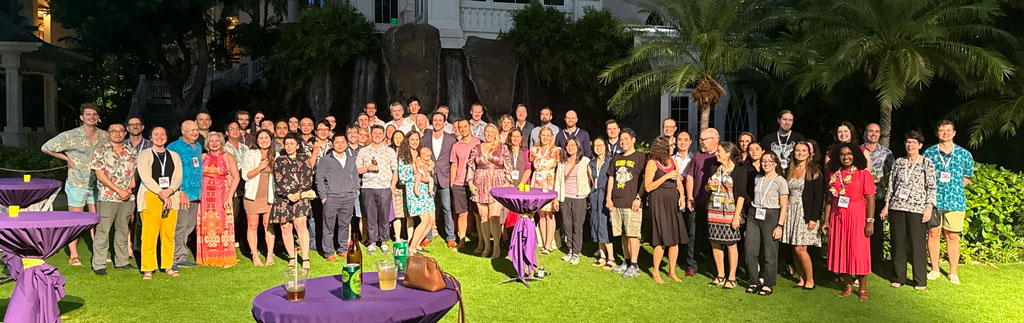
Attendees from the Symposium on Hurricane Risk gather for a group photo outside for the closing reception. Credit: Jennifer Colins

Over almost two decades, the 8th annual Hurricane Risk in a Changing Climate Symposium has grown into a gathering where experts in the public and private sector can grapple together with escalating risks of hurricanes in our warming world. Held in Honolulu, Hawaii, from June 2-6, 2024, this year the symposium drew 75 specialists from diverse fields—meteorologists, social scientists, engineers, and reinsurance professionals—who engaged in in-depth discussions relating to hurricane risk over the course of four days.

Participants discuss their research during a poster session at the Symposium on Hurricane Risk. Credit: Jennifer Colins

The evolution of the symposium’s theme over the years mirrors a deepening understanding of the multifaceted nature of hurricanes and their impacts. This year, the meeting explored evolving challenges, with sessions such as “Signal or noise? Uncertainties in the future tropical cyclone (TC) risk projection,” dissecting the intricacies of risk modeling, debating strategies for mitigation, adaptation, and comprehensive risk management. These critical discussions could help shape policies and practices that affect millions of livelihoods.

“I love the general inquisitiveness of the group that attends,” says Phil Klozbach, research scientist in the Department of Atmospheric Science at Colorado State University, who oversees the university’s seasonal tropical cyclone forecasts. “There’s some really good discussion there. I also learned about a lot more industry folks that use our seasonal forecast too.”

The symposium also served as a meeting place for the next generation of researchers, with students presenting yearlong research and receiving recognition for their contributions. Judges ranging from private industries to academia recognized three students for the presentation of their research:

Katy Hollinger Beatty, North Carolina University (Advisor: Gary Lackmann) for her work titled “Anticipating Future Tropical Cyclone Rainfall and its Influence on Transportation Infrastructure and Flooding”

Cong Gao, Shanghai Jiao Tong University (Advisor: Lei Zhou) for his work titled “Ocean Subsurface has Significant Impacts on Tropical Cyclone Genesis”

Megan Blair, University of South Florida (Advisor: Jennifer Collins) for her work “How Hurricane Ian was Communicated to the Public and How they Perceived their Risk as a Result”

“It was such a great meeting. I am returning to work this week full of new ideas and recharged passion. That’s the best kind of conference,” noted Student Award Chair, Suz Tolwinski-Ward, Director of Climate Statistics at Verisk.

Attendees listen during a welcome session at the Symposium on Hurricane Risk. Credit: Jennifer Colins

As the symposium concluded, it was clear that the collaborative efforts of the attendees would resonate far beyond the conference room. The dialogues initiated here are set to influence research, policy, and practice, steering a global community towards more resilient and adaptive strategies in the face of hurricane risks. As a result of the collective efforts, a peer-reviewed book related to the conference theme, published by Springer, is now available.

This year’s conference was led by AAG member, Fellow, and Distinguished Scholarship Honor Awardee Jennifer Collins (University South Florida), and co-organized by AAG member Yijie-Zhu (Florida Atlantic University). Sponsorships from the American Association of Geographers, the University of South Florida, Gallagher Research Centre, RenaissanceRe, Reask, Moody’s RMS, and FM Global supported the conference. AAG’s support assists up to eight students to receive free registration.

Learn more about the 2024 Symposium on Hurricane Risk in a Changing Climate.

Curious about working with AAG? We are seeking new partnerships for 2025. Find out more.

    Share

Philip W. Porter

We mourn the passing of, but also celebrate the life of, Philip (Phil) Wayland Porter, a stalwart member of the University of Minnesota’s Department of Geography between 1958 and 2000. Phil died in Hanover, New Hampshire on April 24, 2024, just two miles from the place of his birth, surrounded by his family (predeceased by his lifelong life partner Patricia Garrigus Porter in December 2021).

Phil was born on July 9, 1928, in Hanover, the son of Wayland R. and Bertha (La Plante) Porter. He graduated from Kimball Union Academy in 1946, where his father taught mathematics and physics and his mother was a librarian. He then earned his A.B. in Geography at Middlebury College in 1950 (where he also was on the ski-jumping team), his M.A. at Syracuse University in 1955 (after two years in the U.S. Army, 1952-4), and his Ph.D. from the London School of Economics in 1956 (“Population Distribution and Land-use in Liberia”). He immediately joined the University of Minnesota department as an instructor, then assistant professor, advancing to associate professor in 1964 and professor in 1966. He chaired the Department of Geography (1969-71), directed the University’s Office of International Programs (1979-83), served on the National Academy of Sciences Committee on Space Programs for Earth Observations (1967-1971) and was a liaison officer for Midwest Universities Consortium for International Activities (1979-1983).

Phil’s first and enduring scholarly commitment was to understanding Indigenous agricultural practices in east Africa, undertaking career-long ethnographic fieldwork, initially with anthropologists, that began with Walter Goldschmidt’s Culture and Ecology in East Africa Project (1961-2). He taught at the University of Dar Es Salaam for two years (1971-73), overlapping with members of the influential The Dar es Salaam School of African History, introducing his daughters to rural African life through many trips in their Land Rover. This scholarship was summarized in two monographs: Food and Development in the Semi-arid Zone of East Africa (Syracuse: 1979) and Challenging Nature: Local Knowledge, Agroscience, and Food Security in Tanga Region, Tanzania (Chicago: 2006). In recognition, he received the inaugural Robert McC. Netting Award from the AAG Cultural and Political Ecology Specialty Group in 1999. His quiet but firm personal and intellectual support was vital for those students seeking to make a better world.

Phil’s interests in geography ranged far and wide. He was intrigued with John K. Wright and the geography of ideas. He was a passionate and innovative cartographer. Among his many published articles, he wrote on economic potentials, the point of minimum aggregate travel, the impact of climate on human activity, human ecology and agro-ecological modeling. During the last three decades of his career, he became particularly interested in critical development studies. This began with an AAG Resource Paper with Anthony de Souza, “The Underdevelopment and Modernization of the Third World” (AAG: 1974), was deepened through his annual undergraduate course on development, and culminated in the textbook A World of Difference (Guilford: 1998, 2008, with Eric Sheppard, Richa Nagar and David Faust). Former colleagues and advisors have described him as a “towering scholar”, “one of the most amazing polymaths and ‘renaissance men’ I’ve ever met”, “incredibly gracious”, and “genuinely curious rather than threatened by new ideas.”

Phil was a quietly reliable anchor of the department, with the capacity to talk with anyone and a puckish sense of humor. His students adored him, graduate and undergraduate alike, queueing outside his office to seek out his wisdom and bathe in his invariable support. He developed an innovative introductory course, in which students were asked to rotate the globe to a new north pole of their own choosing and tasked as teams to produce and rationalize an atlas reconstructing its human and physical geography of this hypothetical globe. The course on “Third World Underdevelopment and Modernization” was similarly made unforgettable by Phil’s extraordinary teaching style. David Faust, who had a chance to serve as a TA and co-instructor for this course, recalls:

“One day Phil would walk into the classroom and remark, ‘I want to show you something from one of my ancestors. Pay careful attention, because this is from one of your ancestors, too.’ He would hold out what appeared to be an ordinary rock. ‘This is a hand axe. You hold it like this. Try it.’ And he would pass it around. Another day he would enter the class carrying a rickety wooden turntable and a couple of bricks. He would ask for a volunteer to stand on the turntable, take a brick in each hand and be spun, extending their arms to make the spinning slow, and bringing them close to their chest to speed up the spinning, just as a figure skater does. This was to demonstrate conservation of angular momentum as part of a lesson about atmospheric circulation.”

Regents Professor Emeritus Eric Sheppard, lead author of this memorial, recalls:

“I first met Phil when I interviewed for the position at Minnesota in 1976. I had no idea who he was when I arrived; a young, overconfident quantitative turk. The only names familiar to me were Fred Lukermann, John Adams and Yifu Tuan, I was here to transform the department. Prior to my talk, the graduate students took me out for a liquid lunch at what was then Bulwinkles, after which I was put in the chair’s office to prep my presentation on geographic potentials (the topic of my Ph.D.). Idly leafing through old copies of the Annals, I was shocked & disconcerted to find a paper authored by Phil and Fred on … geographic potentials. Needless to say, this was a bit embarrassing. I managed to get through the talk with both Phil or Fred being nice enough not to mention their paper (which I had not read; my article on this topic also appeared in the Annals a couple of years later, after it had been rejected and my advisor had prevailed on the editor, John C. Hudson, to change his mind). In the end it was the department that transformed me, and Phil played a key role. I spent the last decade of my career doing the same kind of qualitative research that characterized his lifelong scholarship.”

Former Ph.D. advisee Richa Nagar notes: “Phil played a major role in molding me as a learner, an educator, and a human, and he taught me to better appreciate the unpredictable poetry of the world we live in.” She recalls a moving incident from Fall 1990:

“Phil’s class on ‘Geography of Africa’ inspired me to undertake a directed study with him on the history of Asian communities in East Africa. That same quarter, I also committed to a two-quarter long course sequence in ‘Historical Sociology’ with Ron Aminzade and Barbara Laslett, who required the students to study primary research documents during the second quarter. I came across an article with a footnote which stated that Robert Gregory, a retired professor at Syracuse University, had boxes full of interviews that his students had conducted with Asians in Kenya, Uganda, and Tanzania in the 1970s. I shared my wish with Phil in our directed study meeting, ‘I would’ve loved to examine those interviews for my Historical Sociology assignment.’ A week later I found a check from him in my department mailbox. It had a Post-it note: ‘Go book your plane ticket to Syracuse and read those interviews.’ I went to Phil in disbelief and asked why he had given me the check. He said, ‘I have some research money but your research is more important at this time. This is your Christmas present.’”

The annual Christmas parties, hosted by Phil and his wife Pat, were the major departmental social event of the year drawing almost everyone to feast and even sing carols, irrespective of their religious affiliations. His annual party invitations were also legendary; each year he would pick a letter of the alphabet, plumb his well-thumbed dictionary, and write a page-long invite using words only beginning with that letter.

Phil’s other abiding passion was music, particularly choral music by J.S. Bach. He regularly sang and performed with Pat, organist and choir director at Minneapolis’ First Congregational Church (1957-1971) and then Grace University Lutheran Church (1976-2000). In choirs, the other basses competed to sit nearby so that they could rely on his ability to read music and sing the right notes. After retirement, Phil and Pat returned to New Hampshire, where their lives alternated between scholarly senior living near Dartmouth College, and summers in the sprawling family cottage on Lake Sunapee. He is survived by three daughters, Janet E. Holmén, Sara L. Porter, and Alice C. Porter, as well as five grandchildren and two great grandchildren.

This memorial was contributed by Eric Sheppard, Richa Nagar, and Abdi Samatar on behalf of the Department of Geography, Environment, & Society, University of Minnesota.

    Share

Arvind Bhuta

By Emily Frisan

Education and Certificates: B.S. Zoology, B.S. Environmental Science, B.A. Geography from Auburn University; M.S. Geography, Ph.D. Geospatial and Environmental Analysis from Virginia Tech; Postdoctoral Fellowship in Forestry at Clemson University; Certified GIS Professional (GISP) and a certified Senior Ecologist through the Ecological Society of America. 

At the U.S. Department of Agriculture Forest Service, Arvind Bhuta works in the State, Private, and Tribal Forestry program to enhance and maintain healthy ecosystems and watersheds. His specific work in the Cooperative Forestry unit is to address landscapes that are outside of what he refers to as “The Green:” the national forests managed by the Forest Service. He specifically works in rural landscapes under the Landowner Assistance department, assisting program managers with geospatial and tabular reporting and data analysis. Bhuta’s training as a geographer brings a valuable perspective to this work: “Thinking about space and place and how different states operate in maintaining those forests is important from a geographical perspective because it helps bring context.”

“I accidentally fell into GIS and then from [there], that was a Pandora’s box into learning about the discipline.”


Geographic Inquiry

The discipline of geography was not immediately obvious or available to Bhuta, but luckily, he happened to be in the right place, at the right time. “When I was a biology major, I found out about GIS. This was the late 90s, and I was very intrigued about what GIS had to offer because obviously biology or ecology wasn’t really doing any of those things.”

Throughout his wide-ranging educational experiences, this inquiry instantly hooked him “to what geography had to offer as a discipline and not really [previously] knowing that it was a major, I could pursue as a career opportunity.” Bringing together biology with elements of human and physical geography helped Bhuta shape and share his professional worldview, future interests, and successes.


Early Opportunities and Exposure

Aligning with the U.S. Forest Service’s mission to protect, balance, and manage natural resources, Bhuta emphasizes how his education in geography has allowed him to think critically and take a holistic approach to the work he does when working with people and programs. In addition to his extensive education, he has gained skills on–the–job through training in past and current positions that he’s held. Whether working in the public, private, or nonprofit sector, Bhuta says, “there will always be challenges to a job that academic training will not prepare you for. More than likely, you’ll get to experience it when and after you get hired.”

Early opportunities exposed Bhuta to a vast array of professional experiences. Early on, he lived in the Everglades National Park as a GIS technician field mapping the endangered Cape Sable Seaside Sparrow. For two years after, he chased gopher tortoises in the field using GPS, radio telemetry units, and cameras to track their population and interactions across different habitats. His first experience as a federal employee as a summer intern at the U.S. Environmental Protection Agency and later as an intern with the U.S. Army Corps of Engineers, exposed him to the world of careers within these agencies.

For those interested in working within the federal government, various opportunities such as internships to fellowships can give young geographers an opportunity to advance their professional journeys. Within the Forest Service, the Research Assistant program allows individuals to come into the agency noncompetitively, which enables some of them to be appointed to federal positions without competing with the general public. Bhuta also suggests networking with people within these agencies who have backgrounds in geography, which can open doors for students. For example, at the 2023 Annual Meeting, Bhuta met with students and young professionals to discuss techniques and answers questions on how to navigate the federal career path: “That’s a great opportunity to network with people who work in the federal government and ask questions like, ‘what do I need to do’ in terms of course work, internships, or other jobs to get my foot in the door to work in the [sector].”

Learn more about what a degree in geography can do for you by reading more AAG Career Profiles and discover the resources we offer for your professional development journey.

    Share

Margaret FitzSimmons

Margaret I. FitzSimmons, a respected geographer in the field of urban planning and environmental studies, died April 3, 2023, in Santa Cruz surrounded by family and friends. She was 76.

Born into a lineage of esteemed geographers, she carried forward the legacy and passion for the environment. Her grandfather, Carl Sauer, a prominent figure in the field, influenced her interest in human-environment interactions. Margaret’s academic journey included undergraduate studies in psychology at Stanford, a master’s degree in geography from California State University, Northridge and a Ph.D. in geography from UCLA.

Her scholarly contributions were both profound and practical, Her dissertation examined the relationship between nature, labor, and capital in California’s agricultural heartlands. Her insights into the political ecologies and environmental history of the Salinas Valley was innovative theoretically but also relevant to understanding and solving real-world problems. She received the Nystrom award from the American Association of Geographers for her dissertation work. Her publications in journals such as Economic Geography and Antipode have been widely cited and respected, especially her Antipode paper on “The matter of nature.” Her book, Thirst for Growth: Water Agencies as Hidden Government in California, co-written with Robert Gottlieb, remains a seminal work in the field, highlighting issues of public accountability and water policy innovation.

In 1980, Margaret was appointed assistant professor in urban planning in UCLA’s Graduate School of Architecture and Urban Planning, where she was instrumental in developing the Environmental Analysis and Policy concentration. In 1994, she moved to UC Santa Cruz’s Environmental Studies program, retiring in 2015.

Margaret’s teaching was characterized by its breadth and depth, reflecting her belief in the power of interdisciplinary approaches to understanding complex environmental issues.  She was a devoted mentor to graduate students and colleagues and a thoughtful and inspiring teacher. In 1991, FitzSimmons received UCLA’s Distinguished Teaching Award and in 2016, her former Ph.D. students organized a gathering and dinner at the AAG annual conference as a tribute to their mentor.

Margaret was a longstanding AAG member who made significant contributions to understanding the geographies of agriculture and water, political economy of environment, and nature-society theory. In 2024, the AAG received initial funding from her trust for an award in her name, administered by the Cultural and Political Ecology Specialty Group. The endowed Margaret Irene Fitzsimmons Early Career Award recognizes the innovative work of an early career scholar in nature-society relations, including research, teaching, and outreach.

Her loss is deeply felt by all who knew her. Margaret’s legacy is one of intellectual curiosity, rigorous scholarship, and a deep commitment to the principles of social and environmental justice.

    Share

Ken Hammond

Kenneth “Ken” Hammond, 90, a beloved faculty member at Central Washington University, passed-away on Tuesday, May 21, 2024.

Ken was born in 1934 along the Columbia River in northeastern Washington. Raised on a farm near Lake Ellen in the Sherman Creek area of Ferry County, he graduated as valedictorian from Marcus High School in 1951, earning a scholarship to Eastern Washington College of Education.

In 1956, Ken earned two Bachelor of Arts degrees from Eastern, one in Geography and one in Education. He taught high school biology for two years in Camas, Washington, before pursuing a Master of Science in Natural Resources at Oregon State College in Corvallis, Oregon. After completing his Master’s degree, he returned to Eastern Washington State College to teach in the Geography Department.

In 1962, Ken joined Central Washington State College in Ellensburg, Washington, teaching in the Geography Department. A year later, he became the Director of Extension and Correspondence for two years. In 1965, he began a doctoral program at the University of Michigan’s Rackham Graduate School, receiving his Ph.D. in Conservation in 1969.

Ken rejoined the Geography Department at Central Washington University in 1967. He taught a wide range of courses from Introductory Physical Geography to graduate-level Policy and Planning. Working with students was his life passion, and he considered effective teaching the most fundamental part of his job. His goal was to help students prepare for employment, citizenship, and graduate school. Ken mentored many graduate students and cherished the ongoing relationships he maintained with them. After 30 years of teaching, he retired in December 1997.

Ken co-edited a book on environmental literature titled “The Sourcebook on the Environment,” funded by the American Association of Geographers and published in 1978.

In 1981, he received the CWU Distinguished University Professor Teaching award. In 1993, the CWU chapter of Phi Kappa Phi named him Scholar of the Year. In 1997, he was granted an Honorary Life Membership by the Northwest Scientific Association in recognition of his outstanding service. In 2001, he received a Distinguished Alumnus Award from Eastern Washington University for his exceptional service.

In retirement, Ken continued to lend his expertise in Conservation and Water Resources Policy. Planning, and Sustainability. He was an early proponent for new and refreshed policies that promoted environmental sustainability. Ken’s attachment to the land began early in life and continued throughout his life.

Ken enjoyed gardening and cultivated a large vegetable garden at his home near the Manastash Ridge trailhead. He happily answered questions and provided advice to visitors and enjoyed encouraging children to grow their own food. He shared his garden’s abundance, regularly stocking a small table outside with a “Fresh Veggies – Free” sign.

Ken is survived by his wife of 70 years, Britta Jo (Torrance) Hammond, and their three children.

    Share

Susan Mary Berta

Dr. Susan Mary Berta passed away Wednesday May 22, 2024, at her residence in Terre Haute, Indiana. She was a professor at Indiana State University’s (ISU) Department of Earth and Environmental Systems, where she retired in 2021. She started her career at ISU in 1986, later serving as the department chairperson from 2002-2009.  She was also the Interim Coordinator of the Science Education Program from 2005-2007. She published over 25 journal articles and reports, with specializations in physical geography, geomorphology, and remote sensing, in addition to supervising the research of and mentoring 13 graduate students.

Born July 29, 1957, in Flint, Michigan, she received a B.A. degree in Physical Geography from the University of Michigan-Flint and graduate degrees in Geography: M.S. from Oklahoma State University and Ph.D. from the University of Oklahoma. Her master’s degree research involved using remote sensing technology and GIS, as well as field verification, to identify prospective locations of “natural areas” throughout Oklahoma for “wilderness” status consideration. Ph.D. work involved using aerial and satellite data to map periglacial landscapes in the Sangre de Cristo Mountains of Colorado. As a graduate student, she assisted in three-week wilderness “research adventures” and later offered field camp at ISU for undergraduate and graduate students for 10 summers. Her favorite part of her professional career was always the research, field trips, and friendships accumulated throughout the years.

Berta’s heart belonged to the Terre Haute Humane Society, where she volunteered for over 30 years and served as a member of their Board of Directors. She also served as a Director on the Board at the Ouabache Land Conservancy, partaking as a member since 2013.

    Share

Pono Science

Gary Manson

Dr. Gary Manson, age 86, of Haslett, Michigan, passed away peacefully on Thursday, December 14, 2023.

Gary received his undergraduate degrees from the University of Montana and his master’s degree and Ph.D. from the University of Washington in 1969. Upon graduation, Gary spent 36 years teaching and holding several academic leadership positions at Michigan State University’s Department of Geography, including chairing the Department during most of the 1980s. In the 1990s, he held various leadership roles, including director of the Landscape Architecture Program, and in 2000, was appointed associate dean for academic and student affairs at the College of Social Science.

Later in his career, his research focused on internal migration within the United States. He explored patterns, causes, and consequences of population movement within the country, publishing in journals such as The Professional Geographer, the Journal of Geography, and The Social Science Journal. Among his academic accolades, he received numerous awards for his contributions and mentorship, including MSU’s William J. Beal Outstanding Faculty Award, Teacher-Scholar Award, and Distinguished Academic Staff Award. Dr. Manson retired in 2006 as the acting dean of Social Science after a distinguished career at MSU.

Gary Manson was born on August 5, 1937, in Monona, Iowa. At the age of 19, he married his high school sweetheart, Patrosenia (Pat) Nonog, and they were happily married for 62 years until her death in 2018. They enjoyed each other’s company while traveling, fishing, cooking, entertaining friends, and loved MSU football and basketball.

    Share

Joseph L. Scarpaci

Joseph L. Scarpaci, professor emeritus at Virginia Tech, died December 30, 2023 after a brief illness. A Pittsburgh native and longtime AAG member, Scarpaci was honored in 2020 with the AAG Kauffman Award for Best Paper in Geography & Entrepreneurship.

At Virginia Tech, he taught in a remarkable range of fields, including geography, urban planning, historic preservation, landscape architecture, and Latin American studies. He was also the Executive Director of the Center for the Study of Cuban Culture + Economy.

Scarpaci earned his bachelor’s degree at Rutgers, a master’s degree from Penn State, and his Ph.D. from The University of Florida. His colleague and former student Sara Beth Keough remembered him this way in a tribute in The Geographical Review: “Joe was a prolific writer and speaker. He published numerous books and was one of those academics who had to include only ‘selected articles and presentations’ on his website because the entire list was so long.” He was a repeat recipient of Fulbright Fellowships, and his work was recognized by organizations such as the AAG, the Conference of Latin American Geography, and the Library of Congress.

Scarpaci’s research focused on the urban and social geographies of international development in Latin America, with a specialization in Cuba. Among his publications is Havana: Two Faces of the Antillean Metropolis, to which the American Library Association awarded the Choice Outstanding Book Award. Scarpaci also opened up new horizons of understanding for students through his 20-year career at Virginia Tech, taking them abroad and introducing many of them to Cuba and Latin America over the years.

Scarpaci also represented the discipline closer to home in the United States: In 2008, the Virginia Social Science Association named him their Geography-Scholar. He was also elected the vice chair of the AAG Latin American Specialty Group from 2008-2011.

He was an enthusiastic traveler and also “curated a milieu of passions and hobbies,” according to the Pittsburgh Post-Gazette, “including cycling, yoga, tennis, bird watching, ESL and Spanish instruction, [and] conservation.” Even after moving to Blacksburg, he remained faithful to his Pittsburgh roots, helping to organize high school class reunions and fundraising for the Pittsburgh-based women’s health research, in memory of his mother Josephine. He was devoted to his family, and doted on his first grandchild, Josephine “Josie” Collier.

Scarpaci is survived by his wife of 47 years, Gilda Machin-Scarpaci; children Cristina Scarpaci (Christopher Collier), Michael Scarpaci (Katie Scarpaci); granddaughters Josephine Collier and Remy Collier (who was born only a month after he passed); and siblings, Darlene Violetta (Bradley Violetta), Josette Scarpaci and Sam Scarpaci.

Sources:

Fleming, Virginia Tech News, 11 Jan. 2024; Obituary, Pittsburgh Post-Gazette, 7 Jan. 2024

Keogh, S. Geographical Review 114, 2.

    Share

Karen Bakker

On August 14, 2023, geography lost a vital voice, Dr. Karen Bakker. She was a professor at the Department of Geography at University of British Columbia since 2002, having earned her Ph.D. at Oxford University, where she was a Rhodes Scholar. She leaves an astonishing record of achievement: as Fellow of the Radcliffe Institute for Advanced Study 2022-3; as recipient of a John Simon Guggenheim Memorial Foundation Fellowship 2022, a SSHRC Connection Award and Trudeau Fellowship in 2017; and as Stanford University’s Annenberg Fellow in Communication, and Fellow of the Royal Society of Canada’s College of New Scholars. She is the author of more than 100 academic publications and seven books.

In 2005, she was recognized with the AAG Glenda Laws Award for her uncompromising commitment to advance understandings of the nature of governance, the significance of natural resources, and the importance of distributive justice in contemporary societies. She organized many panels and presentations at AAG meetings, particularly on the topic of water governance. She also supervised more than 30 graduate students and postdocs, secured funding for indigenous scholars in the department, and oversaw the work of scores of undergraduate students.

In recent years, Dr. Bakker brought her geographical fascinations with environmental perception and scientific world-making to the realm of sound. In The Sounds of Life (Princeton 2021), she builds a prismatic portrait of planetary ecology through the medium of chirps, buzzes, and low cetacean moans. The book garnered immediate critical acclaim, including from the very scientists it featured. It also reaches a broad public through her April 2023 TED Talk. Her next book, Gaia’s Web, (upcoming with MIT Press), explores how interconnected digital and natural networks will impact biodiversity conservation, environmental governance, and cultivate greater empathy for other species. Both books drew from her Smart Earth Project seeking to mobilize digital technologies to address some of the most pressing challenges of the Anthropocene.

Karen Bakker will be remembered too, for her fierce public engagement. She founded the Program on Water Governance at UBC, where she produced insightful analysis about the environmental, social and economic impacts of large dams like Site C and on a range of critical issues including water security, water privatization, Indigenous water sovereignty, and the human right to water. Research results from these studies have circulated widely in the media, and connected diverse academic, policy, and practitioner worlds.

At UBC, and in the community, Dr. Bakker was an outspoken advocate for equity issues, leading the pay equity process as the Chair of the Faculty Association Status of Women committee. She also frequently engaged local politicians on social and environmental issues of concern to the community — hosting meet-the-candidate nights and engaging in debate on key issues.

The faculty and staff of UBC has said, “We will remember Karen as multi-faceted and superbly talented in all realms. Writing, speaking, researching, or chatting about any topic imaginable, Karen always had interesting things to say and could offer incisive commentary and engaged banter — whether it be about cooking, gardening, stand up paddle boarding, or the local food cart scene in Vancouver. Indeed, alongside her academic pursuits she authored award winning books about feeding children healthful food under her nom de plume Karen Le Billon.”

Dr. Bakker was a committed mother, partner, and friend who transformed fields of knowledge related to water governance, neoliberal natures, and digital environmentalism. She also transformed those who worked alongside her. Her immense energy, passion, and intellect will be dearly missed. We join the UBC faculty in its statement, “We grieve together with her family, friends, and all the communities of which she was a part.”

This remembrance draws deeply from “Remembering Karen Bakker” on the University of British Columbia website, and is used with modifications and permissions from Dr. Bakker’s partner Phillip Le Billon.

    Share