Every year the AAG provides support for doctoral research in the form of small grants to PhD candidates of any geographic specialty. Three recipients were chosen this year from among 25 applicants and will each receive $1,000.
Clifton Barrineau from the Department of Geography at Texas A&M University is a quaternary scientist studying a large sand plain of aeolian origin in South Texas. The funds from the grant will be used for Optically Stimulated Luminescence dating of sand samples collected from soil cores. This dating will determine periods of aeolian activation across the sand plain and be used to generate a detailed landscape history of the area. An understanding of the landscape’s history can be used to predict the future response to forecast changes in climate and to mitigate negative side effects of land degradation and soil loss via desertification.
Lucia Hussey from the Department of Geography at Western University in Ontario is seeking to identify the infectious diseases that are likely to have the most severe impacts from climate change in her native Ghana. The funds from the grant will support her field research during summer 2016. Her mixed methodology includes a multi-criteria evaluation approach to prioritize climate sensitive infectious diseases, then a survey, in-depth interviews and focus groups in two ecologically and climatically different districts to assess determinants of current vulnerabilities to endemic diseases. Her findings will inform the development of adaptation measures and policies to minimize infectious disease risks due to climate change in Ghana.
Sandy Wong from the Department of Geography & Geographic Information Science at the University of Illinois at Urbana-Champaign is conducting research on the causes of low rates of employment and overall well-being among individuals who are visually impaired. The funds from the grant will be used to support her travel to and lodging at her fieldwork site in the San Francisco Bay Area. Her fieldwork will involve collecting qualitative data on individual experiences and perspectives through interviews and participant observation. Her study seeks to demonstrate that space actively creates and strengthens social processes that continue to marginalize individuals with disabilities.
The AAG Dissertation Research Grants are supported partly by the AAG and partly from the Robert D. Hodgson Memorial Ph.D. Dissertation Fund, the Paul Vouras Fund, and the Otis Paul Starkey Fund.
Share
Awardees
2016 Harm J. de Blij Award for Excellence in Undergraduate Geography Teaching
The 2016 Harm J. de Blij Award is presented to Donald J. Zeigler of Old Dominion University for his long and distinguished career as a teacher of geography to undergraduate students. The Harm J. de Blij Award recognizes outstanding achievement in teaching undergraduate geography including the use of innovative teaching methods. This award is generously funded by John Wiley & Sons in memory of their long-standing collaboration with the late Harm de Blij on his seminal geography textbooks
Don Zeigler has taught geography to undergraduate students at Old Dominion University, Virginia Beach, Virginia, for the past 36 years. During that period, he has taught nearly 200 sections of geography courses representing more than 25 geographical topics.
Zeigler attended to the ever changing student population and course dynamics by using a variety of pedagogical methods, beginning initially with chalk and talk in 1980 and employing video streaming and virtual reality in 2016. His teaching repertoire includes standard lecture classes (serving small to very large course sections), field-based and study abroad courses, problem based learning, and web-based and televised distance learning courses. Zeigler’s commitment to excellence in teaching has led him to design and teach courses fulfilling key university missions, including writing intensive and service learning courses, each with a geographical perspective.
Zeigler began his career at Old Dominion University as a first year faculty member in a major that had not existed the prior academic year. Zeigler was instrumental in building the undergraduate program in geography to its present size today of seven faculty members and 100 geography majors. He has accompanied students on field study trips to Israel, Jordan, the Bahamas and Mexico. “Simply stated, Don Zeigler is the face of Geography at Old Dominion University,” said Dr. Jonathan Leib, current Director of the Geography Program, “His reputation as a teacher, scholar, and as a genuine person permeates the campus and its student body.”
Donald J. Zeigler is recognized for his accomplishments as a gifted teacher, for his role as a mentor for students both within and outside the classroom, and for his continued passion for teaching geography. The American Association of Geographers, John Wiley & Sons Publishers, his friends and colleagues, and his many students from the past 36 years at Old Dominion University congratulate Don as the 2016 recipient of this award for excellence in undergraduate geography teaching. The Harm J. de Blij Award consists of $2,500 in prize money and an additional $500 in travel expenses to attend the AAG Annual Meeting, where the award is annually conveyed.
The AAG is pleased to announce that the Mel Marcus Fund for Physical Geography is awarded in 2016 to Hannah Cooper from the Department of Geosciences at Florida Atlantic University, Boca Raton. She receives a grant of $2,000 to support field research in Everglades National Park.
Hannah is currently a third-year PhD student developing innovative models for sea level rise applications in the coastal Everglades.
Accurate ground elevation data is vitally important in the low-lying Everglades for various reasons including emergency planning and ecosystem management. However, the two best elevation datasets that are currently available have shortcomings; one did not include enough checkpoints to provide fine-scale mapping while the other lacked an accuracy assessment.
Hannah’s field survey will collect the survey-grade GPS and total station elevation measurements which will be used to validate and calibrate the LiDAR elevation data for different coastal vegetation substrate.
The data collection will focus on the coastal Flamingo district of Everglades National Park, an area consisting of estuarine forested wetland, estuarine scrub/shrub wetland, and estuarine emergent wetland.
Three colleagues from the Department of Geosciences at Florida Atlantic University will be involved in the fieldwork: Assistant Professor Dr Caiyun Zhang, fellow doctoral student Matt Sirianni, and graduate student Pramod Pandey.
The field experience will enable team members to learn new skills in field survey mapping tools and data post processing. They will also gain hands-on experience in the remote coastal Everglades learning about this unique habitat.
The objective of the Mel Marcus Fund for Physical Geography is to carry on the tradition of excellence and humanity in field work espoused by Dr. Melvin G. Marcus. Marcus was an internationally-recognized physical geographer and served as president of the Association of American Geographers in 1978-79. He was committed to making physical geography accessible to everyone with a love of the outdoors, including women, minorities, and the less-privileged. He created and oversaw programs that emphasized excellence in field studies and the translation of field studies into scholarly achievement. He took students on research expeditions to the Yukon and Alaska, the Himalayas, the Southern Alps, the Colorado Rockies, and the Grand Canyon, as well as many other locations. These expeditions were often life-transforming experiences for those students fortunate enough to participate. This award in his name enables faculty to involve students in field-based physical geography research in challenging outdoor environments.
As you head to San Francisco for the AAG with visions of the Golden Gate Bridge, colorful old street cars and steep sloped streets, consider exploring the wines of San Francisco. Although world-renowned Napa and Sonoma Valleys are a short drive north of San Pablo Bay, there are much more convenient options within San Francisco and nearby East Bay (Oakland, Berkeley and Alameda). Better yet, widespread public transportation provide worry free wine tasting. Called the “San Francisco Wine Train” by some, the “T” can take you to Bluxome Street Winery as well as Dogpatch Wine Works and Sutton Cellars, all found in old remodeled industrial spaces. (Jenn Pries, Weekly Dining 2014) Likewise the small family-owned East Bay Wineries are found in former factories, tanneries and one is even in an airline hanger! A trip on the Bay Area Rapid Transit (BART) can get you over to the East Bay in no time.
It may or may not surprise you that the United States is the biggest market for wine in the world, drinking 339 million cases of wine in 2013, ahead of France, Italy, Germany or China. On the other hand in terms of per capita, Italy is the leading consumer, followed by France, Switzerland and Portugal. (Will Lyons, Wall Street Journal 2015) Grape production in the United States has hovered around one million acres annually. Average yield 2008-2013 ranged from 7.3 to 8.7 tons per acre. This represents five million tons of grapes processed for wine in 2013 and an industry valued today in excess of 6 trillion dollars annually. (National Agricultural Statistics Service, NASS 2015) A lion’s share of this tonnage of wine grape production occurs in California. Leading varieties from the fall 2015 harvest include Chardonnay (16.4%), Cabernet Sauvignon (11.8%) and Zinfandel (10%). Thompson Seedless, grown for raisins, account for only 2%. (USDA Feb 2016 report).
The multiyear drought in California has taken a toll on overall volume of production and stiff international competition from places like New Zealand, Australia, Chile and Argentina has kept wine prices low. The 2015 crush of 3.86 million tons was down seven percent from the 2014 crush of 4.14 million tons. Price per ton was also down in 2015 with red wine grapes averaging $784 per ton and white wine grapes $667 per ton. Average price per ton overall was down ten percent year over year. (California Department of Food and Agriculture Feb 2016 report) Of course, this is a broad overview and price per ton varies spatially, depending on source region, vineyard reputation and proximity to buyers. This relates to the idea of terroir, that a particular location produces certain quality grapes because of soil, climate and other environmental factors. These environmental factors in combination with the skills of the winemaker yield certain flavor and quality in wine. Thus, the value of a ton of grapes varies dramatically from place to place … how very geographic!
The United States has a system for designating the geographic origin of the grapes in wine provided at least 85 percent of the grapes used in the wine comes from that geographic region. The Appellation of Origin may designate a county or state of origin or may use a federally approved growing region called American Viticultural Area (AVA). As of March 3, 2016 there are 234 AVAs in the USA, of which 138 are in California. (Alcohol and Tobacco Tax and Trade Bureau, U.S. Department of the Treasury March 2016) San Francisco AVA is large, 1.5 million acres, and includes the counties of Alameda, Contra Costa, Santa Clara, San Francisco and San Mateo as well as parts of Santa Cruz and San Benito Counties. Smaller AVAs are nested within the San Francisco AVA (Livermore Valley, Pacheco Pass, Lamorinda, San Ysidro District and Santa Clara Valley). Pacheco Pass and Lamorinda were just created in March 2016. AVAs are constantly being subdivided into smaller AVAs and, as well, completely new areas are applying for and receiving approval. In California since 2014 there have been 21 new AVAs, more than half in San Luis Obispo County. Most are in the south or central coast region of the state. Exceptions include Fountaingrove District (2015) in Sonoma County and Manton Valley (2014) which straddles Shasta and Tehama County near Lassen Volcanic National Park. If you have time and are up for a road trip north of San Francisco, I recommend the less visited Manton Valley AVA which has six wineries and the bonus of nearby beautiful Mount Lassen.
If you are more interested in staying in San Francisco and drinking some wine at an urban winery with a view, check out this list. Below are rankings of the ten highest rated wineries with a view in San Francisco. (Yelp March 2016)
HIGHEST RATED WINERIES WITH A SF VIEW
Neighborhood
Telephone
1
SAN FRANCISCO MEAD CO, 1180 Shafter Ave
Bayview-Hunters Point
(415) 819-4941
2
BLUXOME STREET WINERY, 53 Bluxome St.
SoMa
(415) 543-5353
3
WATTLE CREEK WINERY, 900 N. Point St
Fisherman’s Wharf
(415) 359-1206
4
JAX VINEYARDS, 326 Brannon St
SoMa
(415) 446-9505
5
SOL ROUGE WINERY, 400 California Ave
Treasure Island
(415) 756-2254
6
SOTTOMARINO WINERY, 400 California Ave
Treasure Island
(415) 967-4200
7
WINERY COLLECTIVE, 485 Jefferson St
Fisherman’s Wharf
(415) 929-9463
8
THE WINERY SF, 200 California Ave
Treasure Island
(415) 735-8423
OTHER HIGHLY RATED WINERIES IN SF
Neighborhood
Telephone
1
TANK18, 1345 Howard St
SoMa
No phone given
2
DOGPATCH WINEWORKS, 2455 3rd St
Dogpatch
(415) 525-4440
3
SUTTON CELLARS, 601 22nd St.
Dogpatch
No phone given
4
SAN FRANCISCO WINE TRADING, 250 Taraval St
West Portal
(415) 819-4941
5
GOLDEN GATE WINE CELLAR, 2337 Ocean Ave
Ingleside Terraces
(415) 337-4083
In addition to the above urban wineries where grapes are purchased and wine produced and aged, there are also simply wine bars where you can sample a variety of wines, have appetizers and perhaps a meal. Below are rankings of the ten most reviewed San Francisco wine bars, the ten highest rated San Francisco wine bars and the ten San Francisco wine bars that are reported as good for groups. (Yelp March 2016)
10 MOST REVIEWED San Francisco Wine Bars
Food Style
Telephone
1
RN74, 301 Mission St
American
(415) 543-7474
2
AMELIE, 1754 Polk St
French
(415) 292-6916
3
PRESS CLUB, 20 Yerba Buena Ln
Mixed
(415) 744-5000
4
DISTRICT SAN FRANCISCO, 216 Townsend St
also Brunch
(415) 896-2120
5
FIRST CRUSH, 101 Cyril Magnin St
American
(628) 400-5998
6
LOCAL KITCHEN & WINE, 330 1st St
American
(415) 777-4200
7
HIDDEN VINE, 408 Merchant St
Mixed
(415) 674-3567
8
BLACKBIRD, 2124 Market St
Bar
(415) 503-0630
9
PAULINE’S PIZZA & WINE, 260 Valencia St
Pizza
(415) 552-2050
10
THE RICHMOND, 615 Balboa St
American
(415) 379-8988
10 HIGHEST RATED San Francisco Wine Bars
Neighborhood
1
ROBBERBARON, 2032 Polk St
Nob Hill
(415) 516-6945
2
HIDDEN VINE, 408 Merchant St
Financial
(415) 674-3567
3
ENO WINE BAR, 320 Geary St
Union Square
(415) 678-5321
4
RESOLUTE, 678 Geary St
Lower Nob Hill
(415) 825-0741
5
THE RICHMOND, 615 Balboa St
Inner Richmond
(415) 379-8988
6
VIN DEBUT, 9 West Portal Ave
West Portal
(415) 987-0414
7
YIELD WINE BAR, 2490 3rd St
Dogpatch
(415) 401-8984
8
20 SPOT, 3565 20TH St.
Mission
(415) 624-3140
9
BLUXOME STREET WINERY, 53 Bluxome St
SoMa
(415) 543-5353
10
AMELIE, 1754 Polk St
Nob Hill
(415) 292-6916
San Francisco Wine Bars GOOD FOR GROUPS
Neighborhood
1
HIGH TREASON, 443 Clement ST
Inner Richmond
(415) 555-1212
2
HIDDEN VINE, 408 Merchant St
Financial
(415) 674-3567
3
ETCETERA WINE BAR, 795 Valencia St
Mission
(415) 926-5477
4
RESOLUTE, 678 Geary St
Lower Nob Hill
(415) 825-0741
5
ENO WINE BAR, 320 Geary St
Union Square
(415) 678-5321
6
L’EMIGRANTE WINE BAR, 2199 Mission St
Mission
(415) 863-4777
7
INNER FOG, 545 Irving St
Inner Sunset
(415) 682-4116
8
20 SPOT, 3565 20TH St.
Mission
(415) 624-3140
9
INTERNOS WINE CAFÉ, 3240 Geary Blvd
Laurel Heights
(415) 751-2661
10
TOFINO WINES, 2696 Geary Blvd
Laurel Heights
(415) 872-5782
Cheers and bon appétit. …
Betty Elaine Smith, Professor
Department of Geology and Geography
Eastern Illinois University
Point Reyes National Seashore: A Brief History of a Working Landscape
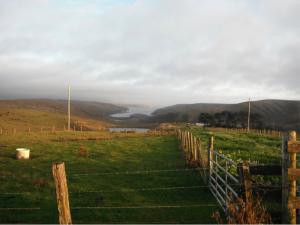
A working landscape of Point Reyes National Seashore.
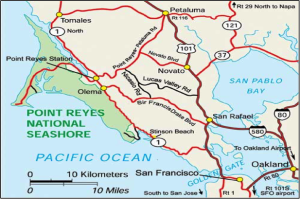
Just a mere forty windy miles north of San Francisco is a popular natural wonder. Point Reyes National Seashore and the Phillip Burton Wilderness Area are prime destinations for visitors near and far. While many visit these places to fulfill their quest to get away from the hustle and bustle of the nearby city life and commune with the natural landscapes, some folks get to call the seashore home. Point Reyes National Seashore is a working landscape, containing dairies and ranches that have been in place for generations. However, with mixed use comes disagreement over the proper use of the space and discussions on the purpose of national park system units.
Long before Point Reyes became a National Seashore and a site for controversy, it was home to the Coast Miwok tribes. Living on the Point Reyes peninsula for centuries, the Coast Miwok found their lives uprooted when they were relocated to nearby Missions in the late 1700s to early 1800s (DeRooy and Livingston 2008). After the Coast Miwoks’ expulsion, Mexican rancheros grazed cattle on the land during the 1830s. When California became part of the United States in 1850, the land was divided by the owners into 32 tenant-run diaries and cattle ranches to keep up with the demand from the urban centers of the San Francisco Bay (Watt 2002; Deur and Mark 2011). World War II even brought mining and military installations to this future “untrammeled” wilderness area.A great deal of the current contention lies around the fundamental issue of working landscapes as park land. While it may be controversial, the presence of grazing on the land at Point Reyes National Seashore has provided a number of ecological benefits, such as a greater number and variety of native grasses as compared to areas that have suffered shrub invasion where grazing was removed (Rilla and Bush 2009). In recent years there have been a number of issues at Point Reyes that have escalated controversy and caused a fracturing between the tenants at Point Reyes National Seashore, the National Park Service, park visitors and environmental groups. Some of the recent issues causing tension include the removal of Drakes Bay Oyster Company from the park, ranchers being denied renewal of their leases at the seashore, Tule elk competing with ranchers’ cattle herds, and an outdated general management plan. However, despite the disputes over the landscape that have been building in the last few years, the parties all agree that Point Reyes is unique place worthy of protection.
After studying the area since the 1930s as a potential location for a public recreational area to serve the residents of the growing city of San Francisco, in 1962 in an attempt to stave off a potential housing development, the National Park Service decided to establish the Point Reyes National Seashore (PRNS) as a 53,000 acre recreational area, including a 21,000 acre pastoral zone, located on the Point Reyes Peninsula in Marin County, California. In 1976 an additional 25,370 acres were designated as the Phillip Burton Wilderness Area at Point Reyes National Seashore. Within the PRNS and wilderness area 8,003 acres were designated as potential wilderness additions. Today PRNS is a 71,028 acre park preserve. As previously mentioned, Point Reyes has continued to be an area of mixed use between commercial and recreational activities, allowing for some agricultural uses to continue on the protected lands.[1] As noted by Deur and Mark, “The continued operations of dairies and ranches became an integral part of the park, and the NPS found itself having to work with ranchers directly as neighbor and often owner. When the NPS carried out purchases of ranch land, it usually granted reservations of use and occupancy for a period of 25 years to those who wished to continue ranching” (Deur and Mark 2011). Although these uses were allowed to remain, they were not without restrictions and remained exceptions, giving less power and control those who worked the land.
Map displaying the location of Point Reyes National Seashore (Point Reyes Getaways, 2015).
In a report on resident communities in national parks, Douglas Deur, University of Washington researcher, and Stephen R. Mark, NPS Historian, note the balancing act that the NPS has been conducting over the years between the expectations of a pristine landscape by park visitors and the need to respect the communities that reside in and help shape the parkland. In reviewing four case studies for the management of agriculture in national parks, Deur and Mark point to Point Reyes National Seashore as an “outstanding example” of a thriving mixture of agriculture and parkland. However, the authors state, “…as landlord at Point Reyes, the NPS continues to be challenged by the complexities inherent with maintaining economically viable ranch operations within a recreation area where visitors see natural values as predominant. Many of the ranchers have nevertheless viewed the NPS presence as beneficial, since the peninsula also represents the only large block of land in Marin County remaining in agricultural production”(Deur and Mark 2011). Deur and Mark conclude with describing Point Reyes as an experiment of sorts between a combination of private and public uses in order to please the multiple stakeholders.The 1964 Wilderness Act, that was used to establish the Phillip Burton Wilderness Area at Point Reyes National Seashore in 1976, envisioned wilderness as an, “…area where the earth and its community of life are untrammeled by man, where man himself is a visitor who does not remain…without permanent improvements or human habitation, which is protected and managed so as to preserve its natural conditions…” (Public Law 88-577). While this was the vision of wilderness seen through the eyes of Wilderness Society’s Howard Zahniser, the author of the Act, the Act also contained many exceptions, such as non-conforming prior uses. Point Reyes never quite fit the ideal model of a wilderness area, as it was the first area to receive the designation of potential wilderness lands. While the NPS may have a history of accepting alternative uses within the park land at Point Reyes, it appears with recent tensions and decisions that they are headed down the traditional path of park management, one that excludes people, other than tourists, from their vision.
Environmental historian, Laura A. Watt, has been researching the case of Point Reyes National Seashore for over a decade. She has written a number of articles on Point Reyes and has a forthcoming book on the subject, The Paradox of Preservation: Wilderness and Working Landscapes at PointReyes National Seashore. Watt’s work explores the controversy over Drakes Bay Oyster Company[2] through the lens of preservation and the ideas that surround what a park ‘ought’ to be. In order to understand the progression of issues at Point Reyes, Watt reviews the ideology that underpins the historical development of the National Park Service and the United States’ ideals of park land and the effect these ideals have had on the establishment and management of PRNS.
Point Reyes is a particularly distinctive unit in the U.S national park system, comprised of both a wilderness area and working landscapes as park land. While the disputes over the space have been increasing recently, much of the root of the tension lies in the designation of the space. The National Park Service has the challenging mission of both protecting the space while also providing for the enjoyment of the visitors and overseeing the commercial uses of the protected land. They have often chosen in the past to view society as separate from nature, fostering the perception that the two are incompatible, and thus dictating who is allowed access to a particular resource. In her article, “The Trouble with Preservation, or, Getting Back to the Wrong Term for Wilderness Protection: A Case Study at Point Reyes National Seashore”, Laura Watt provides several propositions to help counteract the myth of wilderness as separate from that of human use. She proposes the use of a continuum of standards for wilderness determined by the degree to which the area has been inhabited and people have manipulated the land, rather than an all or nothing approach, a sentiment shared by William Cronon (Cronon 1996). Watt also suggests that, “the NPS and other land management agencies could help to heal this disconnect between nature and culture by encouraging the public to understand the human history of natural areas, even while continuing to manage wilderness values”(Watt 2002). Nevertheless, the decisions of who is allowed access, and of what type, in a conserved space can have profound impacts not only on the visitors to the space, but on the residents that depended on that space for their livelihoods.
References
Cronon, William. 1996. “The Trouble with Wilderness; Or, Getting Back to the Wrong Nature.” In Uncommon Ground: Rethinking the Human Place in Nature, edited by William Cronon, 69–90. New York/London: W.W. Norton and Company.
DeRooy, Carola, and Dewey Livingston. 2008. Point Reyes Peninsula: Olema, Point Reyes Station, and Iverness. San Francisco: Arcadia Publishing.
Deur, Douglas, and Stephen R Mark. 2011. Resident Communities and Agriculture in National Parks : An Assessment and Prospectus.
Rilla, Ellie, and Lisa Bush. 2009. The Changing Role of Agriculture in Point Reyes National Seashore. Novato. https://ucanr.org/sites/uccemarin/files/31000.pdf.
Watt, Laura A. 2002. “The Trouble with Preservation, Or, Getting Back to the Wrong Term for Wilderness Protection: A Case Study at Point Reyes National Seashore.” APCG Yearbook 64: 55–77.
Notes
[1]. For further detail on the acts establishing PRNS and the Wilderness area, see Laura A.Watt’s
forthcoming book, The Paradox of Preservation: Wilderness and Working Landscapes at Point Reyes National Seashore.
[2]. The Drakes Bay Oyster Company controversy involves the issue of whether or not the Department of the Interior would reinstate the company’s lease to commercially harvest oysters at PRNS. The decision was made to expel Drakes Bay Oyster Company from the park in December 2014. While outside the scope of this paper, this is a fascinating case that can be explored further in Laura A. Watt’s forthcoming book, The Paradox of Preservation: Wilderness and Working Landscapes at Point Reyes National Seashore.
Kenneth White, a soils geographer and fluvial geomorphologist, who spent many years at Texas A&M University and the Australian National University, passed away on February 15, 2016, at the age of 75.
Kenneth L. White, known to friends as “Kenny,” was born on October 15, 1940, in Chicago. In 1962, while working at Baxter Laboratories, he met Naomi Ellen Fletcher, who was attracted to his sense of humor, and they married in Ingleside, Illinois, the following year. By that time, White was serving in the Air Force and they immediately moved to Whiteman Air Force Base in Missouri.
The next move was to southern California where White studied and taught at California State College at Fullerton then in the Soils Laboratory at the University of California, Riverside. He received a doctorate from there in 1976 and was immediately recruited as assistant professor in the Department of Geography at Texas A&M University. The head of department, Campbell White Pennington, was making a series of hiring decisions to broaden the scope of the department’s narrow cultural focus and White was brought in as a geomorphologist to strengthen the physical geography program.
White and his other new colleagues were tasked with raising undergraduate enrollments in their respective courses, White’s being Physical Geography and Thematic Cartography. These courses were taught every semester and enrollment began to grow. With his enthusiasm for soil science, students affectionately called him “Dr. Dirt.”
In the late 1970s White was tasked with developing new courses in remote sensing. He was also involved in the expanding graduate program in the department. He taught an introductory graduate class on Processes in Physical Geography and, with human geography colleague Peter Hugill, revived a graduate class in Field Geography. In the first year they took students to Arkansas but were ordered to stop spending money on trips to exotic, ‘foreign’ locations so they subsequently changed the destination to Junction, Texas!
White’s primary research interests were soil geography and fluvial geomorphology. He was particularly concerned with the micromorphology and mineralogy of soils, anaylzing their characteristics using scanning electron microscopy. He also conducted research on geomorphic landforms and landscape sculpturing processes, particularly in riverine environments. Many of his field studies were carried out in southern California and Texas. White was also an enthusiastic adopter of remote sensing, digital image processing, and GIS. Among his publications is a 1993 paper on using GIS as an educational tool.
In 1986, White moved across full-time to the Department of Geology at Texas A&M University. During that time, his research also took him to Vicksburg, Mississippi, where he lived for a year.
In 1991 he was awarded a Fulbright Senior Research Fellowship. He spent the first three months in Bangladesh affiliated with the Department of Geology at the University of Dhaka. Unfortunately political unrest caused his stay in Dhaka to be shortened so he finished his scholarship in Australia at the University of Wollongong where he was based in the Department of Geography but also associated with the Faculty of Engineering.
White took to Australia a computer-based Image Processing and Geographical Information System with which to do collaborative research with faculty members and graduate students. His research aimed to identify and mitigate against natural hazards along the eastern Australia coastal strip. This involved a variety of data sources including satellite data obtained from an altitude of 500 miles, published topographic sheets at a scale of 1:25000, specific site engineering data, and other sources. He also spent time looking at fluvial chronologies, the process of fluvial avulsion, and the engineering geology problems of the east coast of Australia.
White and his wife subsequently moved more permanently to Australia and he taught at the Australian National University in Canberra for a number of years. They remained in Australia after retirement until 2003 when they decided to move back to the United States to be closer to their only granddaughter. They made their home in Mountain View, Arkansas, where they volunteered for many years at the Ozark Folk Center.
White was a member of the American Association of Geographers from 1970 to 2004. He was also a certified professional photogrammetrist and member of the American Society for Photogrammetry and Remote Sensing, including serving as president of the Texas-Louisiana Region. In addition, he was a member of the Soil Science Society of America, the Association of Engineering Geologists, Gamma Theta Epsilon, and Sigma Xi.
After his wife’s death in 2014, White moved to Hot Springs Village, Arkansas, where he pursued his hobbies of woodwork, fishing and historic muzzle-loading firearms by joining clubs within the community. He was also involved in Christ Lutheran Church. However, his interest in topography and geoscience never diminished. A few weeks before his death, he took his family to Costa Rica where he insisted on wading into the sea so that he could climb into a fishing boat for a trip beyond the reefs.
In addition to his wife, White was preceded in death by their second daughter, Johanna Sue. He is survived by his sister, Darlene, his two children, Heidi and Kenneth Jr., and his cherished granddaughter, Kelsea Ann.
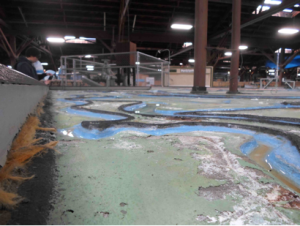
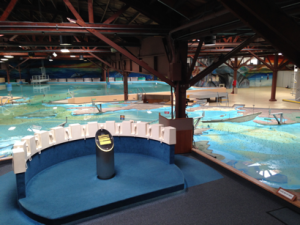
When geographers touch down in San Francisco this spring, they will encounter a socio-natural world produced in part through technical efforts to understand and manage it. As a primary means by which such efforts were pursued in the Bay Area during the postwar years, the San Francisco Bay-Delta Hydraulic Model – located a few miles north of the city in the town of Sausalito – offers a unique window into the formation of the metropolitan region. Built by the Army Corps of Engineers to simulate bay-estuary conditions and test the feasibility of development plans, the physical model now operates as an educational center and public showcase for the accomplishments of the Corps. Spread out over an acre in a former military shipbuilding warehouse and composed of hundreds of 12’ by 12’ concrete slabs, the model also constitutes a richly layered if seemingly anachronistic world onto itself. Passing through the Bay Model Visitor Center means confronting a vast terrain of miniature canals and levees, dikes and bridges, rivers and bays, and technical instruments and appurtenances that collectively target the bay and its watershed. Above the ebb and flow of the model’s mechanized tide, the whir of electric devices punctures the damp stillness of the air. Below it, rust steadily creeps throughout a labyrinth of channels. A landscape to traverse as much as a view to behold, the Bay Model promises to lend unique perspective on the world beyond the walls that house it.
Model Diagram. From McLeod and McLeod, 1983.
At the turn of the millennium, rendered obsolete by advances in computer modeling, the Bay Model ceased operating in any official research capacity. Over its four-decade working life, however, the model generated important new understandings about the San Francisco Bay and Sacramento-San Joaquin Delta as “a complex estuarine system” (USACE 1993). To meet the needs of comprehensive planning, the Corps undertook an extensive survey of the Bay Area and constructed the replica landscape between 1956 and 1957 at a horizontal scale of 1:1,000 and a vertical one of 1:100. Originally encompassing a swath of the Pacific and the entire bay-estuary to the confluence of the Sacramento and San Joaquin rivers, the tool was designed to reproduce an average tidal cycle at a timescale of 14.9 minutes. But before it could be used to either simulate circulation patterns or forecast the effects of various reclamation and barrier proposals – such as the infamous Reber Plan to dam the bay (Wollenberg 2015) – the model had to be verified to known prototype conditions through a series of infrastructural interventions and measurements in the field. With the construction of the delta addition in the late 1960s, the model was mobilized to study the impact of dredging, channel realignment, and fresh-water diversion – still a source of conflict in California – on salinity intrusion and water quality. While running simulations initially required a team of seventy technicians to perform an intricate choreography of measurement and calculation, ongoing processes of instrumentation and the establishment of computerized control and data acquisition systems later allowed for greater operational flexibility. Today the model’s test-bed embodies the sedimentation of over forty years of technical practice.
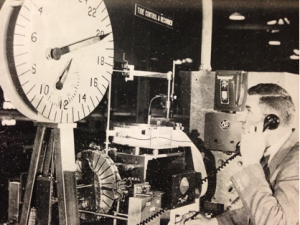
Tide Generator at the Bay Model. From USACE, 1963.
As an engineering and planning tool, the Bay Model produced a number of effects that continue to animate political life the Bay Area. Most notably, it constituted the bay-delta system as an object of sustained inquiry and fixed the region as an appropriate scale of environmental management and administration. As early as 1967, Eugene Huggins and Edward Schultz of the San Francisco Army Engineer District pointed to the model as a primary means by which such realignments were achieved. On the one hand, they argued that simulations run on the model produced “the finest and most comprehensive library of data on the action and environment of the Bay now in existence” and provided “the foundation for almost all regional planning, by practically all agencies, in the Bay Area.” By offering a framework with which to probe the impact of individual projects on the bay-estuary and delta as a whole, the model, in their view, girded a broader scientific and popular shift in conceptions of the San Francisco Bay as an interconnected ecological system. Tellingly, data about the bay-delta system generated on the physical model, programmed into computers, continues to inform contemporary modeling exercises. On the other hand, in highlighting the intertwined fate of different Bay Area communities at the scale of nature, Huggins and Schultz suggested that the information produced on the model proved to be a “major stimulant…for the formation of regional authorities.” Indeed, the Bay Conservation and Development Commission, the Association of Bay Area Governments, and the Bay Area Council, among other regional organizations that guide development and promote policy in the Bay Area today, all drew upon studies conducted at the Bay Model and the expertise of the Corps more generally to support their institutional formation and governance agendas.
The Mississippi River Basin Model. Photo: John Elrick.
While the San Francisco Bay Model was but one of several large-scale hydraulic models built by the Corps of Engineers, it is the only one actively maintained. The outlines of Maryland’s Chesapeake Bay Model, opened in 1970s before rapidly falling into disuse and decay, might be gleaned from satellite images today. Likewise, the ruins of the massive Mississippi River Basin Model, itself a feat of engineering that targeted the Mississippi River and its major tributaries, can still be found in Clinton, Mississippi. Approved in 1943 and constructed with technical assistance from the Waterways Experiment Station and POW labor, the Basin Model – the ‘ur-model’ of the Corps’ mid-century hydraulic engineering program – embodied an important shift in approaches to water management. The Flood Control Act of 1936 charged the Corps with developing a more comprehensive solution to inundation than earlier piecemeal efforts to control individual rivers. “To understand the Mississippi River Basin as a dynamic system of interconnected waterways,” Kristi Dykema Cheramie suggests in an insightful essay, “the Corps needed new, more sophisticated tools” (2011). After successfully predicting the extent and impact of flooding in 1952, the test-bed was vindicated as a forecasting tool and mobilized to simulate flows throughout the watershed as a system. “The model,” Cheramie argues, “allowed the Mississippi River Basin to become, for the purposes of study, an object, a manageable site.” Like the San Francisco Bay Model, it promoted “a new scale of thinking” and demonstrated “the power of visualizations to shape policy through design.” With the development of “computational scripting and planning analysis technologies” in the 1970s, however, the Basin Model was “gradually upstaged by a mainframe computer in Sacramento.” In the 1990s, the Corps abandoned the model altogether, leaving it to be reclaimed by a pine forest.
The Bay Model from on high. Photo: John Elrick.
A combination of factors helps account for the preservation of the San Francisco Bay Model as well as its relative longevity as a research tool. First, unlike the Mississippi River Basin Model, the Bay Model’s test-bed was built upon a network of adjustable jacks in anticipation of seismic disturbances, allowing it to be continually re-calibrated to the shifting topography of the bay. The capacity to tune the model to fit changing conditions, combined with the fact that it remained sheltered within a controlled environment able to accommodate innovations, fostered the formation of a community of engineers willing to advocate for its continued relevance into the 1990s (Sinclaire 2011). Second, and perhaps most importantly, under the stewardship of William Angeloni, the model secured “Operation and Maintenance” funding in 1980. Rather than continuing to seek out financial support from project to project, federal apportionment gave the Bay Model stability as a site. Finally, while this funding provided for both the establishment of the Visitor Center and the facility’s eventual transformation into a tourist attraction, the model – from its inception – was understood to serve a pedagogical function. Built on location due to widespread enthusiasm for the project, it opened to ceremonious fanfare as a demonstration site where the public could learn about “the needs of a balanced ecology” and “hard data” might temper contentious debates over development and water policy (Huggins and Schultz 1967; Weisberg 2013). The model soon became – and still is – a regular stop on the school field-trip circuit. Yet, as Javier Arbona points out, both the aesthetic qualities of the model and the layout of its facility underwent subtle but important changes after 2000. Though framed today as an educational complex highlighting the region’s ecology and the importance of water conservation, the Visitor Center – with the model as its crown jewel – might just as well be understood as “a monument to the Army Corps” itself (Arbona and Woebken 2015).
The Angel of History at Richardson Bay. Photo: John Elrick.
Despite the new layers of paint, the framing devices, and the addition of an observation deck designed to render the structure legible, visiting the model today can still leave one feeling overwhelmed. Indeed, it’s not uncommon to spot marauding bands of children and their adult counterparts hurry past exhibits on natural history and WWII-era shipbuilding only to lose themselves within the abstract landscape of concrete bays and sculpted channels. While the model’s size, shape, and distorted scale combine to produce a sense of disorientation, its character as a relic or technological artifact of some bygone era bolsters this impression. It’s almost as though the model – a mere stone’s throw from the global epicenter of ‘disruptive innovation’ – got swept up in the storm of progress and dumped on shores of Richardson Bay in Sausalito. There’s something fitting, poignant even, about the un-timeliness of the model. After all, upon stepping out of the warehouse, one of the first things to confront visitors is a heaping mountain of wreckage. The Corps continues to run its “floating debris hazard collection” operations out of the Sausalito Base Yard, and it regularly deploys patrols to search for driftwood, sunken vessels, and rotting piers that might hinder navigation. Around ninety tons of detritus is pulled from the bay each month and loaded onto a dock in front of the Bay Model. There it sits, waiting to be trucked offsite for disposal. For the San Francisco District of the Army Corps of Engineers, progress literally entails the piling up of debris.
John Elrick is a PhD candidate at UC Berkeley. The Bay Model is located at 2100 Bridgeway, Sausalito, CA 94965. Additional information about the Bay Model Visitor Center can be found on its website.
US Army Corps of Engineers, San Francisco District, Comprehensive Survey of the San Francisco Bay and Tributaries, California. Appendix ‘H,’ Hydraulic Model Studies to the Interim Report on San Francisco Bay Barriers, Volume I of III (Figure 8). US Government Printing Office, March 1963.
US Army Corps of Engineers, San Francisco District, San Francisco Bay-Delta Tidal Hydraulic Model User’s Manual. US Government Printing Office, 1993.
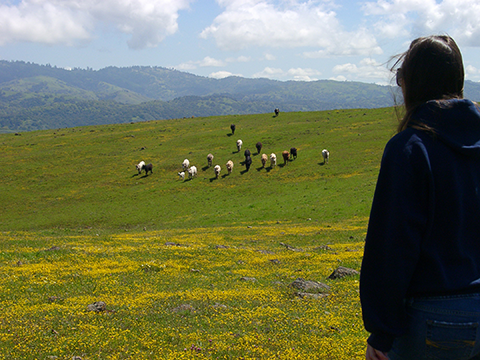
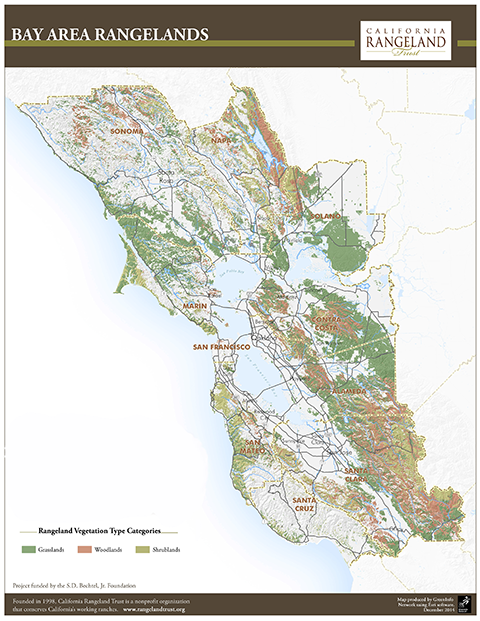
The San Francisco Bay Area has more open space within its borders than any other metropolitan area in the United States, an intriguing state of affairs for a regional population approaching nine million people. While so much open space provides a scenic landscape and exceptional opportunities for outdoor recreation including hiking, biking, horseback riding, and hang gliding, it also supports the area’s most prevalent land use. From Santa Clara to Sonoma County — on private lands, regional parks, on habitat conservation and watershed lands — cattle ranching continues as the number-one land use in this famed tourist destination and hotbed of the knowledge economy and high tech industry. Whether the working ranches are on public or private land, many Bay Area ranchers represent a fourth, fifth, or sixth generation stewarding the land and their livestock, drawing on older traditions and practices of pastoralists and primary producers. Ranching or working rangelands describe the land use of over 1.7 million acres of the Bay Area’s 4.5 million acres of open space (PlanBayArea.org). Rangelands that produce both livestock products and ecosystem services are known as “working landscapes” in the Bay Area (Fig 1).
Fig 1: A hiker takes a landscape of grazing cattle, wildflowers, and broad views, walking through prime Checkerspot Butterfly habitat, Coyote Ridge, south of San Jose, California. (Photograph by Sheila Barry)
Ranching supports the Bay Area’s incredible biological diversity at the landscape and pasture level. Thirty-three percent of California’s natural communities are found in the Bay Area on only five percent of the state’s land, which makes this one of the nation’s most important biological hot spots (Bay Area Open Space 2012). At the landscape level, ranching maintains extensive open landscapes that were originally grassland or a tree-grass mosaic shaped by the burning practices of native Californians (Fig 2) (Diekmann et al. 2007). Oaks that are the most common native tree provide abundant acorns and rich game habitat. Spanish-Mexican colonists used the grasslands and woodlands for extensive livestock grazing well into the 1840s, and established some of the largest ranches in California. The Pt. Reyes National Seashore derives from what was originally a Mexican land grant.
Fig 2: Working landscapes make up a substantial portion of the San Francisco Bay area, as evident in this 2015 map by the California Rangeland Trust.
Large patches of open grazed grassland support a species-rich birdlife community, including along the southern range a slowly recovering population of the California Condor (Gymnogyps californianus). At the pasture level, ranching provides for biodiversity through grazing and associated rancher stewardship. Grazing reduces annual plant biomass, influences vegetation composition, affects vegetation structure, and provides the patches of bare ground needed by some species, such as the Ohlone tiger beetle (Cicindela ohlone) (Cornelisse et al. 2013). The endangered Bay checkerspot butterfly (Euphydryas editha bayensis), California tiger salamander, burrowing owls (Athene cunicularia), and kit fox (Vulpes macrotis mutica) all benefit from livestock grazing, which manages vegetation and preserves needed habitat (Bartolome et al. 2014). In fact, the exclusion of grazing has resulted in the extirpation of some populations of these species from “protected sites” (Barry et al. 2015). Rancher stewardship includes development and maintenance of livestock water sources including stock ponds, pest management, debris clean-up, and forage improvement. In the San Francisco Bay region, ponds developed for livestock water provide half of the available habitat for the endangered tiger salamander (Ambystoma californiense).
Despite being the area’s most prevalent land use, cattle ranching largely goes unnoticed by much of the public. Ranching operations typically need up to 15–20 acres per cow per year. Few people realize that many of the Bay Area’s open spaces are managed with grazing until they come on to cattle grazing in a regional park. While there is support for ranching as a way of life with long traditions, the management of vegetation that without grazing could prove a fire hazard is a shared goal, brought starkly to light by the Oakland-Berkeley firestorm of 1991 that killed 25 people and destroyed some 3,300 dwellings at a cost of more than $1.5 billion. Today, significant areas of the 8,180 acre Stanford University campus are grazed for vegetation control, as are upper reaches of the 1,232 acres UC Berkeley campus, often by hired goat herds (Stein 2015).
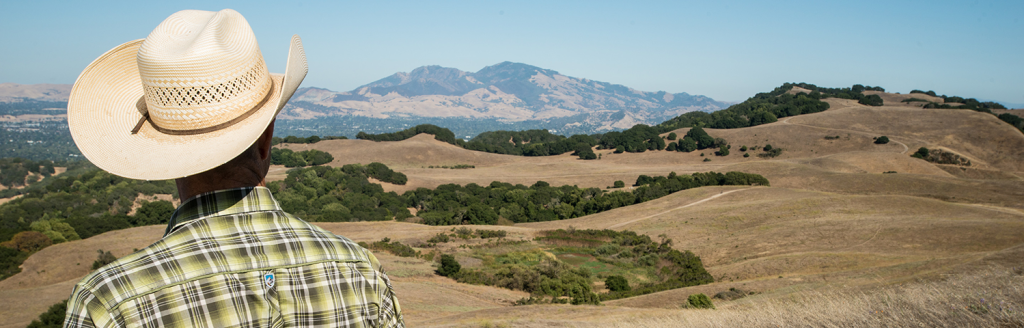
Bay Area ranchers are particularly aware of the public’s interest in the rangelands they manage (Fig 3). At least partly because they often rely on leases from parks and conservation lands to complement their private holdings, many ranchers have learned to manage for native plant and animal species and fire hazard control. The California Rangeland Conservation Coalition, a statewide group focused on bringing ranchers, scientists, environmentalists, range professionals, and agencies together to support ranching and the conservation of grazing lands, enjoys strong support among Bay Area ranchers (https://carangeland.org). Working landscapes are also a prominent part of the Bay Area’s “foodscape,” widely appreciated by food-conscious Bay Area residents. On privately-owned ranch lands, ranchers use wildlife-friendly practices and improvements, sometimes partnering with the Natural Resources Conservation Service, the California Department of Wildlife, or local Conservation Districts. Many have mitigation or conservation easements on their properties, providing more habitat, watershed, and connectivity than can be provided on public lands alone.
Fig 3: Rancher Ned Woods grazes cattle on East Bay Park land, near Mt. Diablo and Walnut Creek, California. (Photograph by Lance Cheung, NRCS, USDA)
A recent study used social media to understand public interest and perceptions of cattle grazing on parklands (Barry 2014). Many park users visiting Bay Area grazed parks shared positive views about cows and grazing on Flickr™ expressing an enjoyment of the pastoral scene and their recognition the grazing animals as “happy cows.” A few negative comments (under two percent) made it clear that some park users, especially those with dogs, are bothered by manure. Of greater concern to park managers, some park users expressed a fear of cows. Some stated a desire to overcome their fear but there seemed to be uncertainty about what could happen or how to respond to the presence of livestock. If you run across cattle on your Bay Area wanderings, give them their space, and keep dogs far away, since to livestock a dog is a predator. Cows really just want to eat the grass and will generally ignore you if you let them. Park managers may be able to overcome negative perceptions and fear of cows on public lands via education. With over 2.5 million visitors to grazed parks per year in the Bay Area, there is a growing opportunity to educate and explain why Bay Area open space is not open space but instead, constitutes well-stewarded places supporting and benefiting from cattle and sheep ranching.
Further Reading and References
Barry, S. (2014). Using Social Media to Discover Public Values, Interests, and Perceptions about Cattle Grazing on Park Lands. Environmental Management 53: 454-464. DOI: 10.1007/s00267-013-0216-4
Bartolome, J., B. Allen-Diaz, B., et al. (2014). Grazing For Biodiversity in California Mediterranean Grasslands. Rangelands 36(5): 36-43. DOI:10.1525/california/9780520252202.003.0020
Cornelisse, T. M., M.K. Bennett, & D. K. Letourneau. (2013). The Implications of Habitat Management on the Population Viability of the Endangered Ohlone Tiger Beetle (Cicindela ohlone) Metapopulation. PLoS ONE, 8(8), e71005. DOI: 10.1371/journal.pone.0071005
Diekmann, L., L. Panich, and C. Striplen. (2007). Native American Management and the Legacy of Working Landscapes in California. Rangelands 29 (3): 46-50. DOI:10.2458/azu_rangelands_v29i3_diekmann
AAG Distinguished Scholarship Honors: Linda Mearns
The 2016 AAG Distinguished Scholarship Honors is presented to Linda Mearns.
The 2016 Distinguished Scholarship Award is going to Linda Mearns for her pioneering and agenda-setting contributions to the field of climate change assessment science, particularly her sustained efforts to understand how climate change will be translated into climate variability and extremes and to model climate change at the regional level. She has made unparalleled contributions to international and national climate change assessment efforts, including authorship on four assessment reports issued by the Intergovernmental Panel on Climate Change; and has led numerous climate assessment projects, including directorship of the North American Regional Climate Change Assessment Program. “Linda’s sustained and impressive record of scholarship makes her highly deserving of this award.”
Citation for Linda Mearns follows.
Linda Mearns, National Center for Atmospheric Research
Linda Mearns is a leading scholar in the fields of geography and climate science. Trained as a Ph.D. geographer at UCLA, she has spent most of her career as a scientist at the National Center for Atmospheric Research in Boulder, Colorado where she serves as Director of NCAR’s Weather and Climate Impacts Assessment Science Program and Head of the Regional Integrated Sciences Collective (RISC).
Linda is a leader in the development of climate change assessment science. Her contributions in this area are numerous and include foundational work on estimation of climate change impacts on agro-ecosystems, pioneering studies of dynamical downscaling in regional climate models, and important contributions to understanding of sources of uncertainty in climate change projections. Her landmark papers include highly cited journal articles in Science, the Journal of Geophysical Research, Journal of Climate and Climatic Change.
Linda has also made major contributions to international climate change assessment efforts, including authorship on the second, third, fourth, and fifth IPCC Assessment reports. It is especially noteworthy that Linda was an author for two chapters of the IPCC Third Assessment report, one for Working Group I (Physical Science) and another for Working Group II (Impacts, Adaptation, and Vulnerability). This accomplishment highlights Linda’s remarkable capacity to bridge the physical and human dimensions of climate change.
The North American Regional Climate Change Program (NARCCAP) represents another of Linda’s invaluable contributions to the climate assessment science. Linda was the lead principal investigator of this recent (>$10 million) effort, coordinating six research teams in the preparation of a suite of dynamically-downscaled projections for North America. Hundreds of research and assessment efforts have employed these high-resolution NARCCAP scenarios, and geographers, in particular, have made extensive use of the scenarios in their research and outreach to stakeholders and policymakers.
Although Linda is at a research center rather than a university, she has also played an important role in fostering the next generation of scientists through her mentorship of junior scholars. For more than three decades, she has supported and encouraged the careers of countless junior scientists, especially women climatologists, many of whom have gone on to pursue highly successful careers in geography and elsewhere. In addition to support of female scientists, Linda has also been an advocate for many other underrepresented groups in science, particularly developing world scientists within the IPCC.
As summarized by one of her letters of support, Linda “demonstrates a brand of sustained, scientific leadership that is expanded by a geographic perspective, and is essential to address the needs of the future.” For these reasons, the 2016 AAG Distinguished Scholarship Award is awarded to Linda Mearns.
University of Tennessee Invites GFDA and Department Leaders for 2016 Workshops
The Department of Geography at the University of Tennessee (Twitter: @UTKGeography) is proud to announce that it will host, in summer 2016, the GFDA (Geography Faculty Development Alliance) Early Career Workshop and the AAG Department Leadership Workshop.
The GFDA workshop is for graduate students and faculty who are beginning their careers in higher education—instructors, lecturers, assistant professors, and other untenured faculty. The workshop is open to faculty from all types of teaching and research institutions inside and outside the US. The workshop, sponsored by the Association of American Geographers, focuses on topics which are frequently the greatest sources of stress in the first years of a faculty appointment.
The AAG leadership workshop is for all geographers interested in improving their programs—chairs/heads, associate chairs/heads, deans, academic advisors, provosts and other administrators, as well as all faculty interested in leadership issues. The workshop is particularly well suited for individuals who may soon assume leadership positions.
Details about workshop dates, cost, and registration will be announced in the coming weeks. Preliminary inquiries about GFDA can be sent to workshop co-leader, Derek Alderman (dalderma [at] utk [dot] edu, Twitter: @MLKStreet). Inquiries about AAG Leadership Workshop can be sent to AAG President Sarah Bednarz (s-bednarz [at] geos [dot] tamu [dot] edu, Twitter: @sarahbednarz).
The University of Tennessee at Knoxville is the preeminent research-based, land-grant university in the state and recently received a Community Engagement Designation from the Carnegie Foundation. The university is the site of the Tennessee Center for Teaching and Learning and located near several area resources, including Oak Ridge National Laboratory, Great Smoky Mountains National Park, Beck African American Museum and Cultural Center, and Ijams Nature Center. Knoxville has a revitalized downtown with shops, restaurants, historic theaters, museums, art galleries, and an outdoor farmer’s market a few blocks from campus.
A stand-alone unit for almost 50 years, the Department of Geography offers B.A., M.S., and Ph.D. degrees. Its award-winning faculty members provide students with the opportunity to study issues that revolve around understanding environmental, social, economic, and technological change—from climate, natural hazards, and ecosystem dynamics to population, urban development, transportation, and human rights.
Workshop activities will be held in the Burchfiel Geography Building, built for the Department in 2000 and centrally located on campus next to the university’s new student union. The Department of Geography operates a GIS Outreach and Community Engagement Laboratory, and hosts the Tennessee Geographic Alliance and laboratories devoted to geo-spatial analysis, paleoenvironmental research, tree-ring science, cosmogenic isotope analysis, as well as the University of Tennessee’s Initiative for Quaternary Paleoclimate Research.
Geographers at the University of Tennessee are excited to invite early career scholar-teachers and departmental leaders to visit Rocky Top!
Share
Register for Free
Create an account to get free access to exclusive AAG content.
AAG Members get exclusive access to publications, prominent journals, unique advocacy, grant, scholarship and professional opportunities with access to industry focus communities, and event discounts, including our annual meeting.
Some content may only be accessible if you belong to specific Specialty or Affinity Groups. You can still update your membership below. You will need to go through the Join flow, but you do not need to repurchase your membership unless it is expired or about to expire.
To provide the best experiences, we use technologies like cookies to store and/or access device information. Consenting to these technologies will allow us to process data such as browsing behavior or unique IDs on this site. Not consenting or withdrawing consent, may adversely affect certain features and functions.
Functional
Always active
The technical storage or access is strictly necessary for the legitimate purpose of enabling the use of a specific service explicitly requested by the subscriber or user, or for the sole purpose of carrying out the transmission of a communication over an electronic communications network.
Preferences
The technical storage or access is necessary for the legitimate purpose of storing preferences that are not requested by the subscriber or user.
Statistics
The technical storage or access that is used exclusively for statistical purposes.The technical storage or access that is used exclusively for anonymous statistical purposes. Without a subpoena, voluntary compliance on the part of your Internet Service Provider, or additional records from a third party, information stored or retrieved for this purpose alone cannot usually be used to identify you.
Marketing
The technical storage or access is required to create user profiles to send advertising, or to track the user on a website or across several websites for similar marketing purposes.
To provide the best experiences, we use technologies like cookies to store and/or access device information. Consenting to these technologies will allow us to process data such as browsing behavior or unique IDs on this site. Not consenting or withdrawing consent, may adversely affect certain features and functions.
Functional
Always active
The technical storage or access is strictly necessary for the legitimate purpose of enabling the use of a specific service explicitly requested by the subscriber or user, or for the sole purpose of carrying out the transmission of a communication over an electronic communications network.
Preferences
The technical storage or access is necessary for the legitimate purpose of storing preferences that are not requested by the subscriber or user.
Statistics
The technical storage or access that is used exclusively for statistical purposes.The technical storage or access that is used exclusively for anonymous statistical purposes. Without a subpoena, voluntary compliance on the part of your Internet Service Provider, or additional records from a third party, information stored or retrieved for this purpose alone cannot usually be used to identify you.
Marketing
The technical storage or access is required to create user profiles to send advertising, or to track the user on a website or across several websites for similar marketing purposes.