AAG State of Geography Dashboard

A New Year, and Mixed Feelings


A small candle burnsin the midst of a dark background Credit: Dagmara Dombrovska, Unsplash
Credit: Dagmara Dombrovska, Unsplash

Photo of Patricia Ehrkamp

As the December solstice approaches and the days promise to get longer for those of us in the northern hemisphere, we often consider this a hopeful time in which to look forward to what comes next. Given how challenging 2024 has been for higher education and for geography in various parts of the world, I do so with mixed feelings. News of potential program and department closures—in the U.S. and in Australia—and reductions in funding for social sciences and humanities research (most recently to New Zealand’s Marsden Fund) combine with uncertainty for higher education more broadly as the next administration of the U.S. appears poised to eliminate the U.S. Department of Education, which administers Federal financial aid for students—among other plans that may impact higher education and research. Attacks on academic freedom and civil society continue. On many occasions, the AAG has written letters in support of individual scholars and departments or advocated for continued funding for scholarly research across the full spectrum of physical and social sciences and the humanities.

But nonprofits and professional associations such as AAG are themselves encountering strong headwinds. Conservative think tanks argue for policies that would effectively reduce funding for organizations like ours, which would make advocacy on behalf of geography and geographers more difficult. Agendas that weaken the work of scientific and professional associations—whose major goals are education and support for knowledge production and exchange—add to legislative efforts aimed at undermining civil society institutions more broadly. Just last month, the U.S. House of Representatives passed H.R. 9495 with 219 to 184 votes, largely along partisan lines, albeit with the support of 15 Democratic representatives. The bill (which has yet to pass in the U.S. Senate and get signed into law) seeks to imbue the Treasury department as part of the country’s executive branch with the discretionary power to declare an association as ‘terrorist’ and no longer eligible for nonprofit status—without requiring a proper inquiry first. This discretion, as the reactions of a large number of non-profit organizations show, is highly problematic because it stands to undermine advocacy and weaken civil society and democracy. And even if non-profit organizations are able to fight such designations, these fights will come at a high cost.

Strengthening the Foundation for Geography

In the context of such challenges, it feels at times daunting to work toward better futures. But that’s what AAG has been doing this year. Over the past several months, with sound advice from the Finance Committee, AAG Council has devised plans to rebuild financial reserves that were depleted in the Covid-19 pandemic. These plans put us in a better position for supporting geographers and geography programs into the future. We are also beginning work on our next long-term plan, which will outline our priorities for the coming 10 years and lay the foundation for our strategic planning process. And we have strengthened our connections to other geographic associations across the globe. This includes renewing our memorandum of understanding with The Geographical Society of China on the occasion of its 115th anniversary in 2024 and renewing our commitments to reciprocal membership with RGS-IBG (while ironing out some bureaucratic wrinkles in such reciprocity along the way.) Our international collaborations on education and knowledge exchange remain critically important because, as geographers well know, the challenges facing the world, including climate change, do not stop at national borders.

Looking beyond the AAG, there are encouraging developments to note as well. For the first time in years, public trust in scientists, which plummeted during the Covid-19 pandemic (in the U.S.), has improved. A new report released by the Pew Research Center in November 2024 indicates the first increase in public trust in scientists since 2020, which is particularly encouraging given continued attacks on science and higher education. The report shows that partisan differences in the public’s perception of scientists remain. But importantly, the majority of the U.S. public views scientists as intelligent and as “focused on solving real-world problems.” A recent panel hosted on the AAAS YouTube channel delves deeper into the report as different experts discuss their take on the data.

A new report released by the Pew Research Center in November 2024 indicates the first increase in public trust in scientists since 2020”

The Pew Research Center’s report identifies communication as one arena where there is room for improvement for scientists. This point shows the timeliness of efforts by AAG to Elevate the Discipline. Public and engaged scholarship is another way of addressing such perceived shortcomings in communicating knowledge beyond scientific venues. In a recent essay in its “Innovation in Action” hub, the American Council of Learned Societies (ACLS) highlights a successful, faculty-led initiative at the University of California, Santa Cruz, to change promotion and tenure guidelines for such scholarship. One lesson from this piece is that “Disciplines, and disciplinary associations, can provide leadership and support by publishing their own guidelines.” Incidentally, the AAG’s Task Force on Public and Engaged Scholarship, led by Past President Rebecca Lave, just concluded its work and, among other products, produced new guidelines for institutions on how to value and evaluate such work. These will be available on the AAG website soon.

Inspiration comes from yet other sources: In a strong rejection of what they term “the siege mentality in higher education,” Heather Hewitt and Stacy M. Hartman detail examples of innovation across undergraduate and graduate curricula in the social sciences and humanities on campuses across the U.S. While not mincing words in their criticism of how universities have been “breaking trust with many constituencies, including students, local communities, and the broader public,” their article emphasizes the dedication of scholar-educators to teaching, and to preparing students for meaningful careers. In advocating for what they consider “humanities vocationalism” for example, Hewitt and Hartman outline alternatives to simplistic notions of workforce preparation (a term that often headlines conservative reform demands for higher education). Their discussions also include interdisciplinary initiatives and innovation in Ph.D. programs that seek to better support Ph.D. students who are envisioning ‘alt-ac careers,’ that is, non-faculty careers in academia or outside of the academy. There is much food for thought here for geographers to think carefully about how we prepare our Ph.D. students, and how we can better serve them given the fact of a declining academic workforce and a wealth of career opportunities outside of the academy. These are important questions for geographers to take up, including at our annual meetings.

As I finalize this column, preparations for our 2025 Annual Meeting in Detroit are well underway. In keeping with AAG’s commitment to building stronger ties to the cities and regions that host our meetings, returning-generation farmer and scholar-educator shakara tyler kicked off our series of webinars with a discussion of Building Black Food Sovereignty in Detroit. This first webinar will be followed by Robert Nelson offering insights into the foodways of Arab Americans and Arab Canadians in the Detroit region on January 22, 2025. On February 13, 2025, Michelle Martinez will discuss environmental justice, climate change, and energy. We have several more webinars planned in the coming months. All of our planned webinars feature scholars or activists with longstanding ties to the city and region. Beyond introducing AAG members in more depth to the host city for our 2025 Annual Meeting, it is my hope that these webinars will serve our members after the conference, for example in their teaching and in outreach that explains why geography matters.

I began this column with mixed feelings in light of the challenges and uncertainty this year has brought. But in the end, one sentiment prevails: profound gratitude. Gratitude for the immense dedication that AAG staff has shown this year despite dealing with difficult cuts and personnel restructuring. Gratitude for the numerous colleagues who have volunteered their time, energy, and wonderful insight as they serve on AAG Council, our numerous standing committees and task forces, and the boards of our specialty and affinity groups. Gratitude, as well, for all the outstanding scholarship, service, and teaching that we are able to honor with our awards. All of this collective work does indeed defy a siege mentality and is deeply encouraging. Thank you.


Please note: The ideas expressed in the AAG President’s column are not necessarily the views of the AAG as a whole. This column is traditionally a space in which the president may talk about their views or focus during their tenure as president of AAG, or spotlight their areas of professional work. Please feel free to email the president directly at P.Ehrkamp@uky.edu to enable a constructive discussion.

    Share

Why Stay at the Conference Hotel?

Two people review and discuss financial documents

By Antoinette WinklerPrins, AAG Council Treasurer


Photo of Antoinette WinklerPrinsThis is the third in a short series of perspectives by 2024-2026 Council Treasurer Antoinette WinklerPrins, a series designed to help illuminate some of the financial challenges a professional organization such as the AAG faces.

As we plan for the next Annual Meeting in Detroit in March 2025, many of us are deciding where to lodge. There are many factors to consider in deciding where to stay, including cost, proximity to the meeting venue, and desired experience (e.g. access to a kitchen, neighborhood vs. downtown, ability to share accommodations). Different kinds of lodging offer different advantages: the conference hotel, nearby hotels, or an option such as AirBnB or VRBO.

AAG reserves discounted rooms in a nearby conference hotel at each annual meeting. How do you know whether it is the best choice for you? In this column, I explore some reasons you already know and maybe a few that you don’t.

Discounts, Convenience, and Collegiality

The AAG conference hotel is always chosen with proximity to the meeting in mind. That’s one important strength in its favor. Most years, events or receptions are even held in the conference hotel. Staying there also offers opportunities to network more intensely, with serendipitous encounters with new and old colleagues in the morning and evenings, opportunities to bring together groups to explore, have meals, or just talk shop.

While the cost of staying at a conference hotel can be higher than at a more modest facility, it is a better overall value at the discounted rate once you factor in this convenience and access to colleagues.

All for One and One for All

Staying at the conference hotel also benefits AAG as your host, and thus the broader community of participants in the meeting. It enables AAG to save on overhead and devote more resources to programming, keynote speakers, and amenities. Here’s how it works:

When AAG plans for and arranges specific annual meetings, we enter into a contract with at least one or several hotels many years in advance. The hotel sets aside conference room space for our meeting in exchange for us guaranteeing a minimum spent on lodging as well as food and beverage at the hotel.

Aside from giving us meeting space, we also lock in conference room rates. And, since the contracts are typically signed 7-8 years in advance, the savings for members can be quite high. And that is where you as members come in.

As we must commit to a specific number of nights that members book hotel rooms and consume food and beverages at the facility. If we fall short, AAG must pay the difference, which can be a substantial cost that then must be absorbed in our operating budget going forward.  At times of budget precarity, this is an expense we prefer to avoid.

Something similar is true for food and beverage obligations. As with lodging, we base this on estimated attendance. The hotel sets meeting rooms aside, and we pay for them through a minimum food and beverage spend. So, the food and drink you see at events is actually part of our “rent” for the rooms we all meet in. If we don’t spend the contractual minimum, AAG must pay the difference. So, if an event seems extravagant, remember that AAG is required to spend the funds and is seeking to maximize the benefit to participants.

We understand that every attendee will seek the best deal for lodging. However, if you are in a position to choose from among many options, we urge you to opt for the lodging that AAG has carefully chosen to suit the meeting location and capacity. Doing so will help us meet contractual obligations that help us host the most successful meeting possible, and it will help maximize opportunities to connect with our AAG worldwide community.

This is the last of my initial short series of Treasurer’s Columns. You might hear from me again in the future when there is a need to clarify financial issues around AAG’s operations.  I appreciate you taking the time to read these and think on the matters I have shared. Please send your comments and questions with the subject line “Treasurer’s Corner” to helloworld@aag.org.

    Share

John S. Adams

John S. Adams, or JSA to those who knew him, was an urban economic geographer at the University of Minnesota. As a researcher, he studied the relationships between housing markets and policy, land use, and transportation in North American metropolitan areas. As a teacher, he taught classes on urban economics, transportation and land use, geography of the Twin Cities, and regional courses on North America and Russia. As a mentor, he advised dozens of graduate students, supporting them through research assistantships, an openness to whatever topic they chose to study, and continuing to be a source of guidance well after graduation. As an administrator, he was happy to take his turn as Department Chair (multiple times), President of the AAG, the first director and later the associate dean of the Humphrey School of Planning, and wherever else he was needed.

While JSA’s academic studies began in economics, he, like so many of us, took a class in geography and was hooked. After finishing his Ph.D. at the University of Minnesota, he taught at Penn State for three years before returning to Minnesota, where he taught for an astonishing 37 years. He spent time at many other institutions as a visiting scholar during that time, including UC Berkeley, Bank of America world headquarters, Moscow State University, and the U.S. Military Academy. During this time, he investigated housing policy and economics across North America, as well as developing a history of the quantitative revolution in urban geography.

Much of his research focused on the Twin Cities, including the Transportation and Regional Growth Study, funded by the Minnesota Department of Transportation, the Metropolitan Council of the Twin Cities, and the Center for Transportation Studies — a somewhat unlikely coalition to support research in the social sciences but reflective of JSA’s integrative approach to understanding the world. He was keen on producing research that was relevant to policymakers and planners in the region — many of whom he also had as students. The Center for Transportation Studies on the University of Minnesota campus established an award in 2009 in his honor for graduate students in planning and public policy, reflecting his contributions to interdisciplinary collaboration and policy-relevant research.

JSA was endlessly curious about the world. He was always asking people to share their stories with him, whether it was where they were from, where their family was from, or what they were interested in. He taught his graduate students that one of the best ways to do research was simply to ask people what they did for a living or what they thought of something, especially when it came to people like government bureaucrats whose stories often weren’t told. Field work was also essential: part of graduate student orientation at Minnesota was a field trip around the Twin Cities led by JSA and Professor Judith Martin, introducing students to their new home through a geographic lens. His willingness to strike up a conversation with anyone was especially on display during the field courses that he led across North America, Europe, and Russia for graduate and undergraduate students, along with his dedication to service no matter where he might be:

On a 1995 field study to cities of the U.S. Midwest and Southeast, it had been another long day of studying urban structure and change. Nobody knew why JSA stopped the van in the left turn lane of a busy thoroughfare during afternoon rush hour and got out of the driver’s seat, until we saw him dragging a fallen streetlight over to the curb and out of the lanes of oncoming traffic. Horns were honking, people were gawking, and we were kind of concerned that he might get electrocuted. But the image was perfect — “Citizen Adams,” in his signature plaid short-sleeve shirt and khakis, taking charge of Nashville’s “crumbling infrastructure” and “apathetic citizenry.”

Last but not least, JSA cared deeply about the institutions of higher education and of geography, arguing that higher education helps build a healthy foundation for the future of our country. He was a strong advocate for regular participation in departmental life and contributions beyond research and teaching. He argued for regular attendance at weekly departmental colloquia, in part to be well informed on the state-of-the-art of geographic research, but also to connect with students and faculty across the department as well as visiting speakers. Similarly, he advocated regular attendance at both national and regional AAG meetings, to hear about cutting edge research but also to learn about the state of the discipline in other departments and as a whole. He enjoyed introducing current and former students to each other, keeping the network of Minnesota alumni active through in-person meetings and also his family newsletter (always sent via the USPS). His sense of humor, concern for students and colleagues, and deep commitment to service are as much his legacy as his research and teaching, for geographers across Minnesota and around the world.


This memorial was prepared by Julie Cidell, Professor and Department Head of the Department of Geography & GIS at the University of Illinois at Urbana-Champaign; and Laura Smith, Associate Professor in the Department of Geography at Macalester College.

    Share

John Fraser Hart

John Fraser Hart, a towering figure in American geography whose career spanned more than seven decades of active research, teaching, and service to the profession, passed away October 14, 2024, in Madison, Wisconsin, at age 100. A meticulous and productive researcher, he authored scores of articles that appeared in the leading journals of geography. Among his books were The Look of the Land (Prentice Hall 1975), The Land that Feeds Us (Norton 1991), and The Changing Scale of American Agriculture (University of Virginia 2003).

Born and raised in southern Virginia and educated at Emory University (A.B. 1943), he returned following his wartime enlistment in the U.S. Navy and enrolled in classes at the University of Georgia in Athens. There he encountered academic geography and was soon recruited into the profession by the department head, Merle Prunty. Hart went on to Northwestern University, earning his Ph.D. in 1950, and also served on the faculty at Georgia.

The research to which he returned time and again over his long career focused on the land and how people used it. His doctoral dissertation, on hill sheep farming in southern Scotland, was a masterpiece of insight and sensitive description. As the years passed, Hart focused his research almost exclusively on the United States and he became increasingly drawn to questions of economic modernization on the farm. He was early to recognize the massive changes that were taking place both in Southern agriculture (“Land Use Change in a Piedmont County,” Annals of the AAG 70(1980) 492-527) and the Corn Belt (“Half a Century of Cropland Change,” Geographical Review 91(2002) 525-543).

He also contributed to national policy debates over the conversion of agricultural land to urban use (“Urban Encroachment on Rural Areas,” Geographical Review 66(1976) 1 – 17). Hart showed that land which went out of agricultural production was actually a surplus in terms of what was needed to maintain farm production. Urban uses were a comparatively less important reason for land conversion. His studies of land use change on the urban fringe typically involved field work and, more often than not, led to lasting acquaintances with the individuals whose farms he studied.

He served on the faculties at Indiana University (1955-1967) and the University of Minnesota (1967-2015) while making prodigious contributions to the American Association of Geographers and to the profession in general. From 1970 through 1980 he was editor of the Annals of the AAG, and regional councilor, vice president, and president of the AAG. In his AAG presidential address, “The Highest Form of the Geographer’s Art” (Annals of the AAG, 72(1982) 1-29, Hart made the case for why regional study has been so important in geography and why it should continue.

Fraser Hart remained a steadfast advocate for geography, geographers, and good scholarship throughout his career. He was a visible, approachable presence at every AAG annual meeting and at West Lakes and Southeast Division meetings until he was past his 90th year. When he retired from the University of Minnesota in 2015, he was the last member of the university’s faculty who had served in World War II.

He was predeceased by his wife, Meredith, and is survived by his children Laird (Kathie) Hart of Washington, D.C., and Anne Hart (Andy van Duym) of Madison, Wisconsin, and by his grandchildren, Dirk and Raina.

This memorial was contributed by Dr. John C. Hudson, professor emeritus of geography, Northwestern University.

    Share

Hybrid Meetings: What Do They Really Cost?

Laptop screen with images of many participants in a virtual session.
Credit: Chris Montgomery, Unsplash

By Antoinette WinklerPrins, AAG Council Treasurer


Photo of Antoinette WinklerPrinsThis is the second of a short series of perspectives by 2024-2026 Council Treasurer Antoinette WinklerPrins—a series designed to help illuminate some of the financial challenges a professional organization such as the AAG faces. In this column, she offers information about the costs of managing a hybrid annual meeting, such as the one AAG has supported since 2023. Read the first installment.

When the pandemic started, we all learned quickly how to use virtual meeting tools to continue to do knowledge work, and to connect socially.  COVID-related social distancing forced us into the virtual meeting space, yet we soon realized that virtual access created opportunities for participation and engagement that had not been available before—a very positive outcome of a disruptive global event.  Since we emerged from the pandemic, the expectation for a virtual option for any meetings is more prevalent, and organizations are responding in varied ways. AAG is one of the relatively few professional organizations that remains committed to a synchronous hybrid annual meeting.

We are making this commitment to make sure this important professional event is accessible to those who cannot travel or who make a personal choice to not travel. At a larger scale, we are also committed to lowering the carbon footprint of our meetings. (We are on track to reduce meeting-related emissions by 45% by 2030.)

Members are sometimes surprised that the virtual option does not result in a lower cost for the meeting, including registration. After all, a virtual meeting seems to be less complicated than traveling in person.  Isn’t it less costly, too?

Unfortunately, no. Let me explain.

Two Words: Tech and Labor

While the participation and engagement components of virtual or hybrid meetings are positive, lower cost is not one of the benefits. The benefits of virtual or hybrid meetings come at a cost, chiefly for technology and in labor.

Tech: The ability to hold a virtual or hybrid meeting depends on technology and IT support to ensure that all functions smoothly.  AAG carefully researches and combines the most complementary and budget-friendly services and platforms possible to support its hybrid meetings, from the platform that hosts meeting submissions and all video-streamed sessions to integrations with meeting software onsite. In addition, hardware is needed: up-to-date computers, video screens, microphones, and equipment with recording capabilities for room set up. There are also critical aspects of a hybrid meeting that are easy to overlook but need a modest financial investment, notably online helpdesk software to approximate in-person responses to questions at registration.

Labor: Qualified people need to be available to run it all, at a scale serving many thousands of participants simultaneously. Both on- and offsite IT assistance is needed, and must be staffed by people who are adept at monitoring and troubleshooting for live gatherings simultaneously with livestreaming for virtual guests.  Skilled labor is the single most important expenditure for a meeting, and is also the most direct way for AAG’s economic activity to benefit people, be it our local host location or offsite locations. Paying fair wages for this expertise is critical: meeting rooms with a hybrid component are a complex visual and aural experience. Virtual meetings, too, are not as simple as “plug and play.” These rooms must be monitored in case of a variety of challenges, from technical issues to participant safety and security. Virtual and hybrid sessions raise the possibility of having to troubleshoot with participants using older versions of applications and programs; this can take a lot of time. Onsite, coordinating with hotels and conference center staff can also add to the cost of labor to support a hybrid meeting.

Cost Proportions for Hybrid Meetings

Nainoa Thompson, AAG Honorary Geographer, speaking at AAG 2024 in Honolulu.
AAG’s 2024 Honorary Geographer plenary with Nainoa Thompson in Honolulu was a hybrid session.

On the basis of AAG’s 2023 and 2024 meetings, we’ve found that registrations for the virtual option cover roughly one-half of its costs. Virtual registration fees contributed about 12% of meeting revenues at the 2023 Annual Meeting, while virtual services accounted for 24% of total meeting costs. In Honolulu, the proportion was similar: 9% revenue to 18% of costs.

The costs above don’t just represent the sessions that occur online. Also included are the costs of live-streaming in-person sessions and providing meeting presenters with the opportunity to hold hybrid sessions (virtual presenter in a streamed in-person session). Since major keynotes and panels are live-streamed, these are the events that make a hybrid conference feel like one conference, instead of two parallel and unequal experiences in-person and online.

We believe the value of maintaining a hybrid and virtual option for the annual meeting transcends the bottom line. Hybrid is the best possible way to make sure the meeting is accessible, not only for those who can register at in-person rates and travel, but for members who cannot travel or wish to reduce their climate impact. It also contributes significantly to AAG’s efforts to shrink our carbon footprint, combined with supportive innovations such as the development of regional nodes that connect with the main meeting.

The annual meeting means a lot to all of us: a time to gather, share knowledge, network, and grow the discipline. When we set new registration fees, we were careful not to do so in a “one size fits all” way. We set the new fees for a proportional cost sharing, rather than trying to pass on all costs to members.  We hope this creates the best possible value for our members at a financially sustainable cost. For all of us.

Please feel free to reach out to me or Gary Langham, AAG’s ED with questions, comments, or concerns. Send your comments and questions with the subject line “Treasurer’s Corner” to helloworld@aag.org.

    Share

John (Jack) Ives

October 15, 1931-September 15, 2024

The mountain geography community mourns the passing of one of its most significant exponents, the bearer of a monumental scientific world in favor of mountain research and development worldwide. Jack D. Ives died on September 15, 2024, at age 93.

As academicians Vladimir Kotlyakov and Yuri Badenkov (2024) indicated, “Professor Jack Ives is a living legend of mountain geography in the second half of the 20th century and the beginning of the 21st. His name is well known not only among scientists, politicians, public figures, but the inhabitants of many mountain settlements of the world, from the Himalaya and Pamir to the Andes and European Alps, from Scotland and the Caucasus to Iceland and China.” In 2015, Bruno Messerli said that Jack “devoted his life not only to mountain research, but also to mountain development, on behalf of the people and communities living in mountain areas.” He drew attention to the plight of indigenous peoples living in mountainous regions and advocated for their inclusion in policy-making processes concerning their lands and resources. His work went beyond academia, influencing international policy on the livelihoods and rights of mountain people.

Jack Ives’ long-term work at the International Geographical Union has played an important role in shaping the global discourse on mountain environments. In 1972 he took over the chairmanship of the Commission on High Altitude Geoecology from then-president Carl Troll, who had established the Commission during the 1968 International Geographical Conference in New Delhi. Jack then alternated with his colleague Bruno Messerli until 1996. This role drew him increasingly into mountain studies. He left an indelible mark within the IGU, in promoting geographical research on mountains and sustainable development. Under his leadership, the Commission focused on interdisciplinary research and worked to improve global understanding of the importance of mountain ecosystems. In this context, in the 1970s Ives became particularly interested in environmental issues in the Himalayas. The increasing international focus on environmental degradation in mountainous regions, such as deforestation, soil erosion and the impact on local communities, led him to advocate for sustainable mountain development. His 1989 book The Himalayan Dilemma: Reconciling Development and Conservation, co-authored with colleague Bruno Messerli, challenged the prevailing understanding of environmental degradation in the Himalayas and changed the trajectory of conservation policy in the region. This work marked a turning point in mountain research and policy and established Ives as a leading figure in the advocacy of mountain sustainability. He played an important role in making mountains a key element in global environmental policy, especially at the Earth Summit in 1992. He was instrumental in shaping the globally recognized “Mountain Agenda” for UNCED at Rio. This agenda called for greater attention to mountain ecosystems and their importance for biodiversity, water resources and human livelihoods. His efforts helped to establish the concept of “sustainable mountain development”, which remains a guiding principle in the field today. Since then, his leadership brought mountain issues to the forefront of the global environmental agenda.

His name is linked to the creation of the International Mountain Society (IMS) and the leading journals of the discipline: Mountain Research and Development, and Arctic, Antarctic, and Alpine Research. He developed “Project 6 (Mountains) of the UNESCO Man and the Biosphere” on “Human Impacts on Mountain Ecosystems” with Bruno Messerli and were key in catalyzing a group of mountain geographers into what he called amicably “the Mountain Mafia” as the movers-and-shakers for the advocacy that culminated incorporating Chapter 13 (Mountains) within the United Nations’ agenda for sustainable development (Agenda 21). They also coedited a book considered by most mountain geographers as the “bible” for mountain studies at the global level in 1997. Mountains of the World: A Global Priority became the framework to start conservation projects, academic projects and international organizations in favor of mountains. The book was translated to many languages with regional appeals. They were also key in formulating the UN-declared 2002 as the “International Year of Mountains” and thereafter November 11th, as “International Mountain Day.”

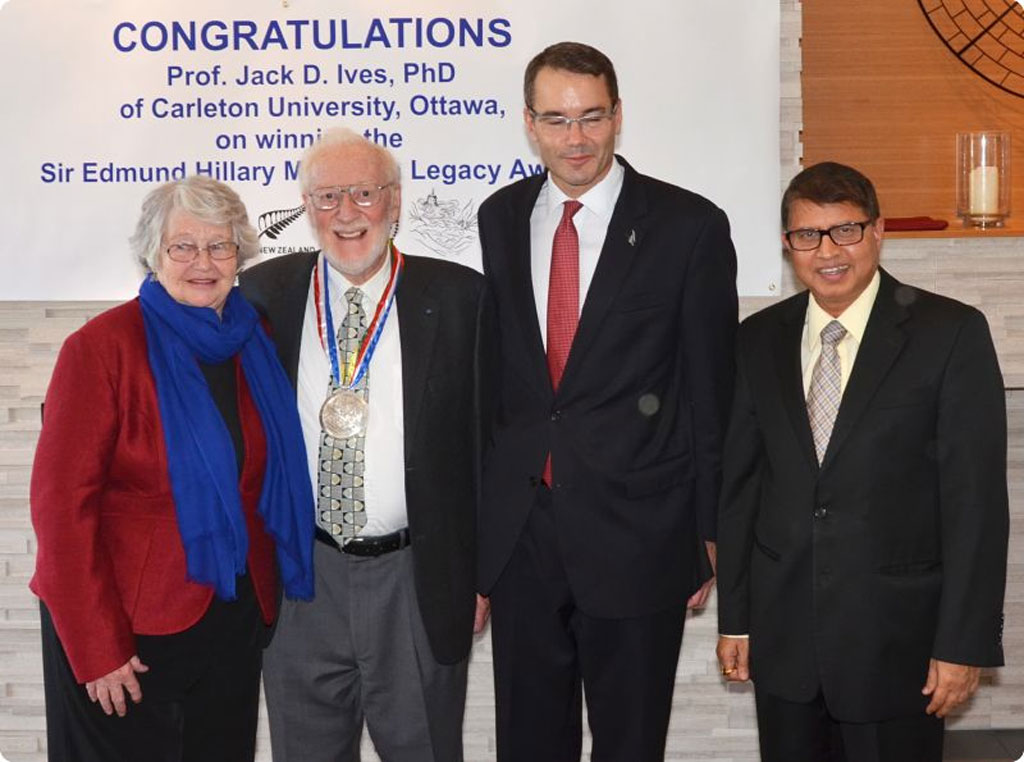
Jack D. Ives’ numerous studies and pioneering initiatives with the United Nations Environment Programme (UNEP), the Mountain Agenda including the International Union for Conservation of Nature (IUCN), ICIMOD, and FAO have been instrumental in shaping international policy on mountain conservation, and his work within the IGU has helped to raise awareness of the academic importance of mountains in global development agendas, drawing attention to the unique challenges facing mountain ecosystems and communities worldwide. He has been honored with many awards, including the King Albert I Gold Medal (2002), the Royal Geographical Society Patron’s Medal (2006), the Icelandic Knight’s Cross of the Order of the Falcon (2007), and two separate Distinguished Career Awards from the Association of American Geographers. The inaugural Sir Edmund Hillary Mountain Heritage Medal Lifetime Achievement Award (2015) was presented to him to recognize lifetime achievement in mountain research and development.

Presentation of 2015 Lifetime Achievement edition of the Hillary Medal, October 29, 2015. L to R: Pauline Ives, Jack Ives, Simon Tucker, New Zealand High Commissioner to Canada, Kali Prasad Pokhrel, ambassador of Nepal to Canada.

He received the Honorary Membership to the Commission of Mountain Studies with a diploma conferred at the 35th International Geographical Congress in Dublin, Ireland just this past summer in 2024, recognizing his fertile and restless work on mountain research and studies. The Diploma, decorated with a gaze from Alexander von Humboldt (Jack’s inspiration) recognizes his pioneering spirit and fruitful work, which will continue to illuminate the path for future montology.

Jack had been the one to suggest the laying of a bronze plaque honoring Humboldt as “the father of Montology” on a cairn at the snowline of Mt. Chimborazo in Ecuador, in December 1998 after the III International Symposium of the Andean Mountains Association (AMA). Indigenous community members, along with Christoph Stadel, Larry Hamilton, Maximina Monasterio, Robert Rhoades, Fausto Sarmiento, the Chimborazo Fauna Reserve administrators, and others, shared in Jack’s admonition that could well be the corollary of his monumental and passionate lifelong advocacy: “For a better balance between mountain environment, development of resources, and the well-being of mountain peoples.”

Colleagues and those who worked closely with him often emphasized his generosity, both in terms of his time and his willingness to mentor and support young mountain geographers. They also admired his ability to blend scientific research with activism as he sought to bring practical, policy-oriented solutions to the environmental problems he studied. It is comforting to know that many of his students, following the exemplary work of this giant, helped to cement transdisciplinary mountain research and study, becoming themselves champions of mountain geography works. Many of them are already retired from teaching, but proudly continue Ives’ model inspiring mountain lore contributing effectively to enrich the genealogy of montology with their emeritus wisdom. After Ives’ retirement, as scholarly recognition of brilliant mentors in academia, a Festschrift was published in his honor (Mainali & Sicroff, 2016) with an apropos title: Montologist.

Now that the discipline of Montology has been firmly positioned as the transdisciplinary mountain research and study, the image of Jack D. Ives will be forever reflected in the deep understanding of mountains as socioecological systems, where consilience and convergence favor decolonized scholarship of mountains, integrating the local knowledge and making real the critical biogeography and political ecology of the many dilemmas that still pervade militarized, marginalized, and exploited mountain communities in the world’s mountainscapes (Sarmiento 2020).  It is with a heavy heart that the Commission of Mountain Studies of the International Geographical Union received the news of his passing, but it is with a hopeful spirit to commit maintaining Jack D. Ives’ lofty goals for the mountains alive and well!


References

Kotlyakov V.M., Badenkov Y.P. (eds). 2024. “History and evolution of the UNESCO MAB-6 mountain project human impact on mountain ecosystems: From ecology to montology.” Preface by Jack D. Ives to the book. Mountain Regions of Russia at the Turn of the Century: Research and Development. Problems of Geography Series, volume 158. Moscow: Media Press.

Mainali K, Sicroff S (eds). 2016. Jack D. Ives, Montologist: Festschrift for a Mountain Advocate. Himalayan Association for the Advancement of Science. pp. 94–97. ISBN 978-9937-0-1567-7.

Sarmiento, F.O.  2020. Montology Manifesto: echoes towards a transdisciplinary science of mountains. Journal of Mountain Science, 17(10): 2512-2527. https://doi.org/10.1007/s11629-019-5536-2.


This memorial was prepared by Fausto Sarmiento, Professor of Geography and Director of the Neotropical Montology Collaboratory at the University of Georgia; Neslihan Dal, Lecturer, Department of Architecture and Urban Planning at Burdur Mehmet Akif Ersoy University; Alexey Gunya, Professor of Geography at the Russian Academy of Sciences; and Christoph Stadel, Emeritus Professor of Geography, at the University of Salzburg.

    Share

Climate Action Task Force Becomes a Permanent Committee

Culminating five years of work to address the carbon impact of the AAG annual meeting and other activities, the Climate Action Task Force has been approved by Council to transition to a permanent committee. In its new capacity, the Climate Action Committee will continue to monitor and address the climate impacts of AAG’s efforts.

The committee was established as a task force in 2019, as the result of a petition signed by over 200 members of AAG, asking the association to take concrete steps toward reducing greenhouse gas emissions related to its activities. A focal point of this request was the AAG annual meeting. Reflecting the recommendations of the IPCC 2018 special report, the petition asked that the AAG cut emissions by 45% by the year 2030 and reach net zero levels by 2050. The petition laid out specific actions that AAG should take in experimenting with low-carbon conferencing and in establishing a systematic measurement and auditing system to emissions related to the annual meeting.

Since then, the committee has collaborated closely with AAG Council and staff to create and implement AAG’s first-ever road map for reducing emissions from the annual meeting. Over the past several years, and in the face of unexpected challenges like COVID-19, the committee gathered recommendations from members, studied the actions other organizations took to reduce their carbon footprints, and helped AAG enact steps to innovate in every aspect of its plans for convening. Among many innovations the committee has introduced are the sponsored local nodes for remote attendance at the meeting, ways to address hybrid and remote convening, and approaches to measuring impact.

Specific accomplishments of the committee to date:

  • Supported AAG’s rapid move to a virtual format in 2020 as the pandemic began;
  • Consulted with AAG on the “Regions Connect” coordination effort to conduct virtual regional division meetings in 2021;
  • Organized special sessions for the AAG annual meeting in 2020, 2021, and 2022, including keynote speeches by Kevin Anderson (2020), Naomi Klein (2021), and Debbie Hopkins (2023), and a 2021 roundtable conversation with members of the Society for Cultural Anthropology, who have organized nearly-carbon-neural conferences, beginning in 2018;
  • Conducted a survey of association members regarding the AAG annual meeting and climate change; this survey indicated that a strong majority (67%) was in favor of reducing carbon emissions related to the annual meeting;
  • Development of a double special issue of the Professional Geographer in 2022 (Volume 74, Issue 1) aimed at imagining alternative, low-carbon futures for the AAG that are environmentally and socially just;
  • Organized two inaugural regional nodes for the annual meeting in 2023, one held across three universities in Montreal and another organized in the Geography Department at CSU-Fullerton; this effort expanded to eleven nodes in 2024; and
  • Worked with AAG staff to experimented with virtual networking;
  • The questionnaire that the committee worked with AAG to conduct has also led to AAG’s full divestiture from fossil fuel-driven investments in 2023.

The Climate Action Committee has provided an important forum for discussion of the responsibility for climate action within academia. In addition to the presentations and convenings noted above, publications have included the Professional Geographer special issue, and the documentation of the 2023 plenary lecture and forum in a special issue of ACME: An International Journal for Critical Geographies.

This questionnaire also affirmed AAG’s decision last year to move from its former headquarters on 16th Street in Washington, DC to a more energy-efficient, LEED Gold and Energy Star certified office suite on Pennsylvania Avenue, near the White House. Remarkably, the cost to maintain the new office is equivalent to the cost of owning and managing the old building, while also adding accessibility, energy efficiency, and larger conference spaces.

“Partnering with the task force has helped the AAG make rapid progress on every aspect recommended by the member survey – we couldn’t have done it without their support and guidance,” says Executive Director, Gary Langham.

Bar chart showing climate member responses
Results from a survey of AAG members. Among the 93% who urged AAG to take leadership on climate change, the top suggestion was that AAG take a role in policy and advocacy for climate action.


As a result of the work of the work by members of the task force and committee, the AAG has committed to attaining the goals set out by the original petition and has taken multiple actions to reach them. Fulfilling these goals (45% carbon reduction by 2030 and net zero by 2050) will be challenging. As the Climate Action Task Force shifts to the standing Climate Action Committee, the center of its work will be to find ways to help AAG and its members make a real and sustained transition to low-carbon conferencing and other professional practices.

For information on additional actions AAG undertook in response to or confirmed by the questionnaire, see executive director Gary’s Langham’s overview. Check the 2020 Task Force Report and 2021 Task Force Report for more fundamental information on the Climate Action Committee’s first five years.

AAG would like to thank all the continuing members of the new committee who will maintain their involvement and Wendy Jepson, co-founder and past chair of the Task Force, to whom we owe a tremendous debt for her time and expertise.

AAG Climate Action Committee Members

  • Pam Martin (co-chair)
  • Betsy Olson (co-chair)
  • Dydia DeLyser
  • John Hayes
  • Rebecca Lave
  • Joe Nevins
  • Tom Ptak
  • Shaina Saidal
  • Ryan Stock
  • Farhana Sultana
  • Emily Yeh
  • Staff Members: Oscar Larson, Elin Thorlund, Gary Langham
Learn more about AAG’s climate action activities
    Share

Where We Stand: AAG’s Current Finances

Two people review and discuss financial documents

By Antoinette WinklerPrins, AAG Council Treasurer


Photo of Antoinette WinklerPrinsThis is the first of a short series of perspectives by 2024-2026 Council Treasurer Antoinette WinklerPrins. In this first column, she offers the overview of AAG’s recovery and lessons from the hard hits of COVID-19 and annual meeting cancellations. Future columns will look at topics from a member’s perspective—Have you ever wondered why having a conference hotel is so important? What the costs for a hybrid or virtual meeting are? Dr. WinklerPrins will take up those questions in future issues of the Newsletter.


When I stepped up to become AAG’s Council Treasurer this year, I had already been a devoted member of AAG for more than 25 years, and had served on the AAG Council since 2023, and as East Lakes Regional Councilor from 2009-2012. Now I am fulfilling the position of Treasurer, learning more every day about what it entails. It is teaching me valuable lessons that I’d like to share with you about how I and the rest of the AAG Council can serve you, the AAG members. Becoming Treasurer has also given me a sense of purpose to explain aspects of AAG’s budgetary and fiscal responsibilities that help provide context for AAG’s decisions on members’ behalf.

In my professional life, I am a geographer serving as the Deputy Division Director of the Division of Behavioral and Cognitive Sciences in the Directorate for Social, Behavioral, and Economic Sciences at the U.S. National Science Foundation. I served as a Program Director in the Geography and Spatial Science/Human-Environmental and Geographical Sciences prior to becoming a Deputy Division Director. I have served on the faculty of Michigan State University and retain an adjunct appointment at the Johns Hopkins University’s Environmental Sciences and Policy Program.

As a member of AAG, I already understood that the governing body of the AAG, the AAG Council, has fiduciary responsibility for the organization. As Treasurer, I have come to appreciate the considerable time that the Council devotes to reviewing the state of AAG financials during each of its meetings.  I have learned how to work closely with the AAG Executive Director and Director of Finance and Accounting, and how to head the AAG Finance Committee.

When I joined Council in July 2023, AAG was emerging from the worst of the pandemic and absorbing the costs of cancelling three in-person meetings in a row. Along with that loss came significant investment in hosting virtual meetings. Because the Annual Meeting has long been the AAG’s main source of revenue, these three years of cancelled meetings were very hard on the financial wellbeing of the organization.

One of the major shifts AAG made soon after the pandemic was not only fiscally sound but in line with its climate goals: the move to a new headquarters that is LEED Gold and highly rated for accessibility and walkability. AAG’s staff work hybrid schedules to reduce trips, and the move resulted in a significant rainy day fund from the sale of the old headquarters.

In 2023, Council approved several more steps to stabilize AAG:

  • Membership dues were increased on July 1, after a six-week campaign to make sure current members had the chance to renew at existing rates and take advantage of multi-year membership for up to three years. AAG had not increased membership dues since 2008, even though inflation-linked incremental increases are the norm in many organizations such as the AAG. This adjustment has aligned dues with current costs for member services—and AAG added two discounted membership categories for faculty and staff of Minority-Serving Institutions and K-12 teachers.
  • AAG has adopted a break-even model for registration pricing for its annual meeting, opting to retain the hybrid option for maximum choices for all members. To reflect the true costs of a hybrid option while protecting discounted rates as much as possible, AAG raised registration rates, but not uniformly across all categories. Additional discount categories were added here, also.
  • AAG reluctantly undertook a staff reduction last summer to reduce fixed costs, and has sought other cost-cutting opportunities in its operating expenses.
  • Because many of AAG’s fiscal measures will take time to have full effect, the Association has needed to use money from Council-restricted reserves to make up the shortfalls. Now, AAG must shift emphasis and rebuild these reserves. Therefore, September, Council voted to prioritize building up our reserves and endowment again before embarking on costly or risky initiatives.
  • As part of its work to diversify revenue beyond the annual meeting, AAG has embarked on a major internal effort to seek and secure grants. Two projects—the Convening of Care and the new GAIA project—have already received funding from the National Science Foundation, with eight more proposals currently in play.

I am confident in the management of AAG and can assure you that the decisions the Council has made recently are stabilizing AAG’s financials, ensuring the organization’s continued viability. Plans for prudent fiscal management for the next few years are critical to helping the organization build up future reserves so that it can sustain its important work supporting its members and the discipline of geography. We appreciate your patience and understanding as we rebuild. Please feel free to reach out to me or Gary Langham, AAG’s ED with questions, comments, or concerns. Send your comments and questions with the subject line “Treasurer’s Corner” to helloworld@aag.org.

    Share