Geographic Ignorance, the Iran War, and the End of US Hegemony

William Moseley

Great powers die when they needlessly fritter away their advantages. While I was never a fan of US hegemony, it did confer benefits to the country’s economy and its citizens. The War in Iran is the crowning blow to a year-long string of reckless moves that effectively destroy American hegemony by undermining the country’s moral positions, weakening its economy, and entangling the nation in an unwinnable war. A deeper understanding of geography could have mitigated such miscalculations, something future political leaders and the US public need to better understand if further missteps are to be avoided.

First, the current US administration has taken a sledgehammer to the existing world order built on multilateralism and a commitment to basic human rights. This system was erected in the mid-20th century by the US and its allies in the wake of two devastating world wars. While the US and other powers violated the rules of engagement in a number of instances, there was enough of a commitment to multilateral institutions and fundamental principles that the system ensured a modicum of stability and shared economic benefits. The current administration’s zero-sum view of the world cannot comprehend the advantages that come with cooperation and soft power—and it has done everything possible to undermine multilateralism and destroy US bilateral foreign assistance.

In unilaterally blundering into the war in Iran, the US administration made no attempt to bring along other allies and then was shocked when European countries were unwilling to assist in the endeavor. The crowning blow came on April 7 when President Trump threatened to destroy Iranian civilization if the regime did not comply with his demands: “A whole civilization will die tonight, never to be brought back again.” Let us be clear that such wanton mass destruction is defined by international law as a war crime. This was a major breach of international moral strictures, shattering whatever remained of principled American leadership, and these statements were swiftly denounced by the Pope and other religious leaders.

Second, the debt-sponsored spending of the current administration has reached historic heights. The US national debt has now hit $39 trillion, and over the past year we have seen the fastest accumulation of a trillion dollars in debt outside of the pandemic. As of early April, the US had spent $28 billion on the war in Iran, a figure that keeps climbing. Such massive debt accumulation, coupled with cuts in research spending, will undoubtedly weaken the US economy for years to come, effectively diminishing economic might as a major component of US power on the world stage.

Geographical Perspective Is Badly Needed

Third, since February 28, the US has actively been engaged in military attacks on Iran (although we are in the midst of a shaky ceasefire as I write). This war of choice is an enormous strategic blunder as the US administration has plunged the country in an unwinnable conflict by failing to comprehend: 1) the cultural geography of Iran, 2) the daunting physical geography of the Strait of Hormuz (a major pinch point through which 20% of global oil and liquified natural gas pass), and 3) the ongoing vulnerability of the US economy to global oil shocks.

The US administration has grossly misread the cultural, social and political geography of Iran. Iran, formerly Persia, is one of the oldest nation states in the world, with organized settlements dating back to 3200-4000 BC and the first Persian Empire emerging in 550 BC (Achaemenid Empire). The result is not just an ancient cultural complex, but a relatively large country (with 90-some million people) with a strong national identity. This is also a region where the US has behaved badly in the past, supporting a covert coup to oust a democratically elected prime minister in 1953, and then installing Shah Mohammad Reza Pahlavi who ruled until the Iranian Revolution in 1979. While there had been social unrest and internal discontent with the Islamic Regime in recent months and years, the lack of a more robust, organized resistance movement, and a formidably repressive regime, meant that a popular uprising in the wake of US and Israeli air attacks was unlikely. Even with an Iranian public that feels deep antipathy towards its rulers, such an uprising became even more unlikely when the US president made genocidal calls for the destruction of Iran’s civilization, effectively alienating a population with a deep sense of pride in its country.

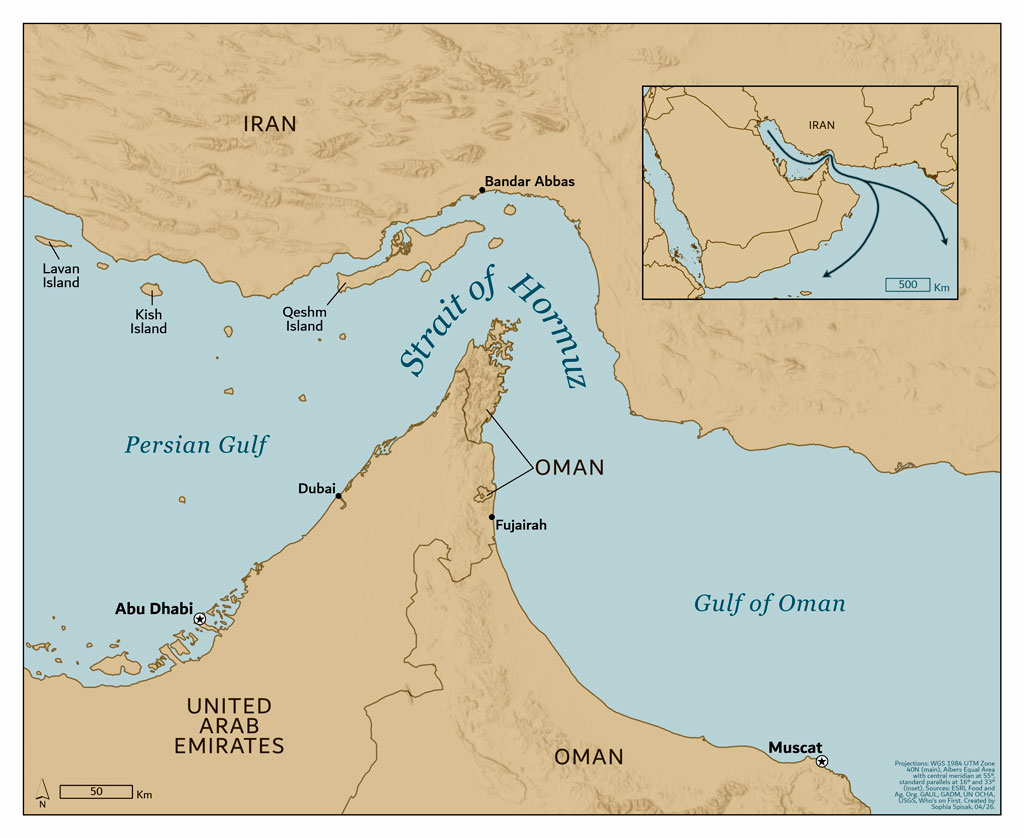
The Strait of Hormuz is a physical pinch point in the global trade of oil and liquified natural gas. Exports originating in the Persian Gulf must pass through this strait controlled by Iran and Oman (although more so by Iran) (see map below). Iran’s extensive coastline is better suited for controlling the Persian Gulf and the Strait compared to its smaller, southern neighbors. More specifically, Iran’s long, continuous and mountainous coastline, coupled with multiple islands, and a relatively narrow deep-water channel through which large ships can pass, allows them to effectively monitor and mount guerrilla attacks on passing ships. As has been noted elsewhere, Iran does not need to halt all shipping, but only sporadically hit a few targets in order to bring a halt to all commercial shipping. It is increasingly clear that the US Administration and its war planners underestimated the import and difficulty of controlling this area.

Map of Straight of Hormuz and surrounding countries
The Strait of Hormuz, within the context of Iran and region. Cartography by Sophia Spisak, Macalester College, adapted from Encyclopedia Brittanica. Data sources: ESRI, Food and Ag. Org. GAUL, GADM, UN OCHA, USGS, Who’s on First.


The United State is still heavily dependent on fossil fuel consumption, with the current administration having abandoned all attempts to build up alternative energy sources. While other countries have worked hard to develop fossil fuel independence, the US administration has refused to understand that a fossil fuel-based economy is not only problematic in environmental terms, but it also leaves the country vulnerable to shocks in the global energy system. Although the US is the largest fossil fuel energy producer in the world, and largely creates what it needs, energy prices are deeply intertwined, meaning that disruptions in one part of the system reverberate throughout the world. As such, the US President’s claim that a closed Strait of Hormuz is not his problem represents a fundamental misunderstanding of how global energy market’s function. It also means that the US is still deeply vulnerable to the energy price shocks created by the closing of the Strait of Hormuz, including less obvious consequences such as higher fertilizer prices for farmers (which will impact food prices) and more profits for oil exporting adversaries such as Russia.

The War in Iran will be a Pyrrhic victory for the US at best. While the US president may eventually claim some sort of win, in the process he will have destroyed the country’s moral credibility and soft power, permanently set back the American economy, and created an unstable quagmire in Iran. The end result will be a hastened end to US hegemony brought about by hubris, cultural arrogance, and ignorance of geography.


Please note: The ideas expressed in the AAG President’s column are not necessarily the views of the AAG as a whole. This column is traditionally a space in which the president may talk about their views or focus during their tenure as president of AAG, or spotlight their areas of professional work. Please feel free to email the president directly at moseley@macalester.edu to enable a constructive discussion.


    Share

Jean-Bernard Racine

Professor Emeritus at the University of Lausanne in Switzerland, Jean-Bernard Racine passed away on March 23, 2026. He was renowned for bridging European and Anglo-American geographical traditions, playing a key role in introducing New Geography to the French-speaking academic world. He received the Vautrin Lud Prize in Geography in 1997.

Born into a Protestant family in Neuchâtel, Switzerland, Racine earned his undergraduate degree in Geography from the University of Aix-en-Provence in France in 1962. He obtained his doctorate in Geography from the same university in 1965 under the supervision of Hildebert Isnard. Inspired by regional geography, Racine coined the term “peri-urban” to describe land changes in Southern France in the late 1960s.

Following a trip to Quebec in 1965, Racine was appointed assistant professor in the Department of Geography at the University of Sherbrooke, which he headed from 1966 to 1969. In 1969, he was appointed associate professor at the University of Ottawa in Canada. His office was next to that of Stanley Gregory, a pioneer in the application of statistical methods to geography.

After his postdoctoral proposal was criticized for its lack of formal rigor, Racine embarked on a tour of American and Canadian universities, meeting Allen J. Scott at UCLA, Larry Bourne (one of his many “great friends”) and Bryn Greer-Wooten in Toronto, David Lowenthal and Alan Pred at Berkeley, and, most importantly, Brian Berry in Chicago, whose work on city networks he would admire for the rest of his life.

While in North America, Racine developed a long-lasting relationship with William (Bill) Bunge, with whom he shared a common interest first for theoretical geography, and later on for social justice and critical analysis of spatial structures. They stayed in touch regularly (and always by phone “for fear of being spied on by the CIA”) until the early 2000s.

Deeply committed to understanding how cities emerge and evolve, Racine shaped the field of urban geography by employing the statistical tools brought to the fore by the New Geography. The guidelines of this “revolution” were formalized in a small but influential book entitled “Quantitative Analysis in Geography” (L’Analyse Quantitative en Géographie) published in 1973 with Henri Reymond. Using Brian Berry’s statistical software, Racine applied quantitative analysis in his monumental second doctoral dissertation, devoted to the peri-urban growth of Greater Montreal in 1975.

At the age of just 33, Racine returned to Switzerland, where he served as director of the Institute of Geography at the University of Lausanne (UNIL) from 1973 to 1982. He was appointed associate professor and later full professor in the Faculty of Arts and at the School of Business and Economics (HEC), where he taught numerous courses in economic geography and epistemology. Racine was a brilliant speaker with a powerful voice that captivated his audience. At UNIL, he served as vice-dean (1980–1982) and dean (1982–1984) of the Faculty of Arts, before resuming the directorship of the Institute from 1986 to 1992 and from 2000 to 2004. He retired as professor emeritus in 2007.

Racine was one of the most influential figures in Francophone geography over the past fifty years. While he is mainly known for having imported quantitative geography from North American to Europe in the 1970s, his most enduring contribution to science is in theoretical geography. Less interested in techniques than in the questions that geography can help to formulate, Racine contributed to the renewal of geographical epistemology, often with other key Francophone geographers.

In 1981, he published “Geographical Questions” (Problématiques de la géographie) with Hildebert Isnard and Henri Reymond, a book that examined the questions that geographers face and how to approach them systematically. Racine published extensively with Claude Raffestin from the University of Geneva, who died in 2025, and with Antoine Bailly, another geographer who returned to Switzerland after living in Canada.

Racine played a decisive role in the culturalist turn that swept through the social sciences beginning in the 1980s. Like many other geographers, his shift toward cultural geography was inspired by the writings of David Ley, Anne Buttimer, Yi-Fu Tuan and, of course, David Harvey, whose book The Condition of Postmodernity was prominently displayed in his Lausanne office.

The son of a pastor, Racine’s approach was deeply rooted in a humanist tradition, which is reflected in a wealth of publications co-authored with his doctoral students, such as Antonio Cunha, Ola Söderström, Etienne Piguet, and Lorenza Mondada. Published in 1993, The City Between God and Man (La Ville entre Dieu et les Hommes) is undoubtedly the book that best combines his deep interest for urban transformation and religious faith.

In the ten years leading up to his retirement in 2007, Racine turned his attention to urban issues, particularly that of Lausanne, a city for which he had a deep passion. Far from resting on its laurels, and always surrounded by many young researchers, he threw himself with seemingly inexhaustible energy into the study of the city’s “fragile” or marginalized users. His humanistic approach to geography, attentive to the voices of young people, people with disabilities, and migrants, anticipates the most recent work in our discipline.

Internationally, Racine served as vice-chair of the International Geographical Union’s Commission on Urban Development and Urban Life from 1992 to 2000. He worked closely with or in parallel to influential French geographers such as Paul Claval, Sylvie Rimbert, René Dumont, Jean Labasse, Pierre Georges, Roger Brunet, and Denise Pumain. He played a leading role in the Dupont Group, founded in 1971 to introduce theoretical and quantitative geography in France, and in the organization of the Géopoint conferences beginning in 1976.

The author of four major books and 250 articles, Racine served as co-editor of Geographica Helvetica for many years and was a member of the editorial board of L’Espace géographique, Géographie et Cultures, and Articulo-Journal of Urban Research, founded by his doctoral students in 2005.

Racine’s influence on modern geography is evident in his ability to bring together geographers from remarkably diverse backgrounds. Based in Quebec and Switzerland, he managed to occupy a central position in our discipline without being located at its geographical center.

One of his most enduring contributions is having mentored two generations of geographers, all of whom, with rare exceptions, hold academic positions in Switzerland, Europe, and the United States. Racine tirelessly devoted his extraordinary intellect to the ideas that underpin modern geography. With his passing, we have lost one of the greatest brokers of Francophone geography.


Written by Olivier Walther

    Share

Tracking the Geography of Diseases: How Epidemiologists Map Infection

Geography In The News logoGeography in the News is an educational series offered by the American Association of Geographers for teachers and students in all subjects. We include vocabulary, discussion, and assignment ideas at the end of each article. 

By Neal Lineback

Have you ever wondered where you caught a cold? If so, you’ve asked the first question epidemologists ask about infectious diseases. Epidemiology is the study of how diseases spread. It relies on geography to find its answers.

You could say that epidemiologists study the “where” of diseases. Specifically, they study the paths of communicable diseases.

What are communicable diseases? They’re the ones you can catch. These illnesses spread through viruses, fungi, or bacteria, typically from person to person, and sometimes from animals to people. Some diseases come from contaminated food, water, or insects. All of these transmissions relate to geography. 

Viruses and bacteria are all around us, particularly in dense human populations. Some are harmless. But dangerous viruses range across a whole host of diseases, from pneumonia and whooping cough to measles, chicken pox, and polio, among others.

Among the least dangerous to healthy individuals is the common cold, or Rhinovirus. Its symptoms are normally mild. The cold is so common that it’s almost impossible to know where you caught it—unless you are an epidemologist. Through contact tracing, distribution maps, and other tools, epidemiologists can find the initial source of an infection. It takes only one or two people for a disease to spread as contacts multiply.

Epidemiology is a science of time as well as space. Once a few people show symptoms, they could infect 50 percent or more of the people they come in contact with, within three to ten days. This makes swift analysis crucial.

A fast-moving virus can cause an epidemic or pandemic. The difference between the two is in distribution. The disease is distributed unevenly in an epidemic, with some communities having few or no cases. In a pandemic, many more people are sick across more areas. Deaths and hospitalizations are elevated too.

This is why the flu virus—which is actually a number of virus types that can mutate over time–and the COVID viruses are carefully tracked by their strain. Flu is also identified by type. If you have ever heard a strain of influenza referred to as A,B,C, or D, you have heard its type, based on its severity. “A” causes pandemics and is the most dangerous. “B” can cause epidemics. “C” causes mild cold-like symptoms. “D” is an animal variety.

The recent COVID outbreak in 2020-2023 was a pandemic in the United States. Ensheng Dong, a Ph.D. student at Johns Hopkins University, was one of the first people in the world to create a map-based dashboard to show the disease’s spread. Using a Geographic Information System (GIS), Dong worked with physicists, geographers, and others at the university to build a map to track outbreaks. Its red-on-black appearance became iconic.

Outbreaks of many viral infections can be mapped. The CDC (Centers of Disease Control) and other international medical institutions maintain huge geographical databases to follow outbreaks around the world. This research is critical in slowing, treating, and containing viral diffusions and concentrations, allowing the medical professionals to predict where intervention (ie. tests, warnings, and vaccinations) can be helpful in reducing deaths and hospitalizations.

Epidemiology is still a young science. Less than 175 years ago, a doctor named John Snow identified the source of the 1854 cholera outbreak in London: a neighborhood water pump. He did this by mapping all of the cholera cases in the area and interviewing the families. Once he identified the common location they’d used to draw water, he removed the handle from the pump. New cases fell.

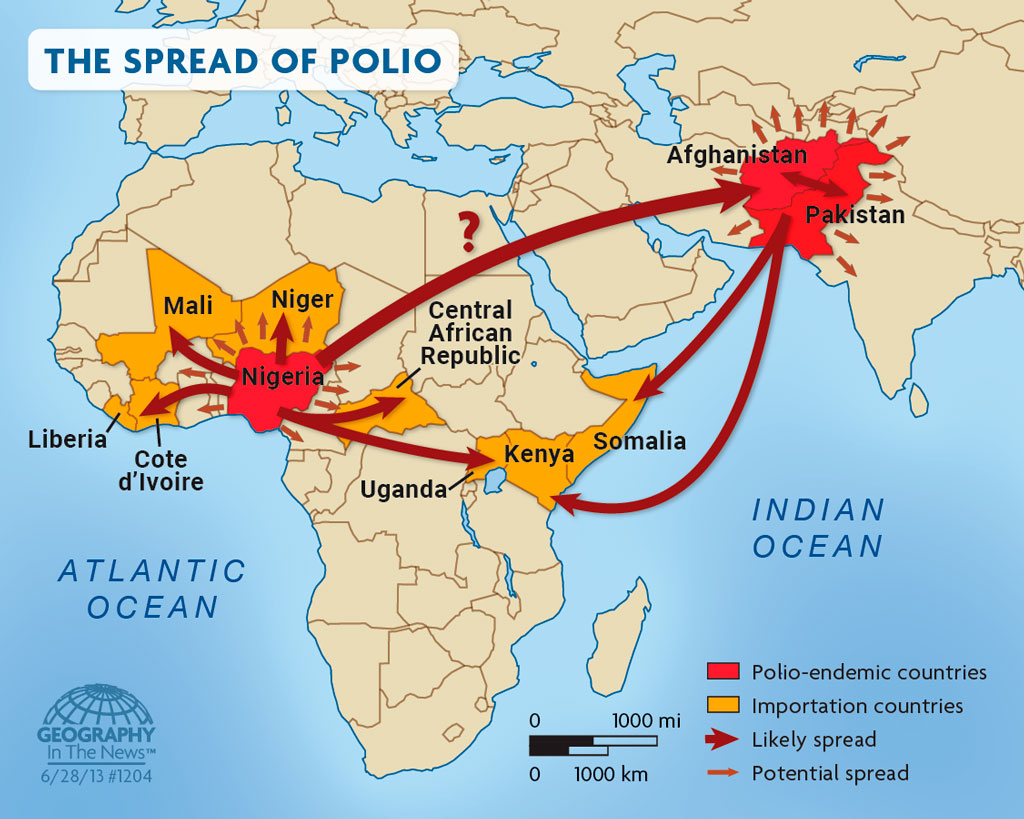
This map shows the 2013 spread of polio worldwide:

This map by Rachael Carpenter indicates that the spread of polio began with a concentration in Afghanistan, then jumped to Somalia, Kenya, and Nigeria. The disease spread to Nigeria’s African neighbors Cote d'Ivoire, Mali, Niger, Central African Republic, Uganda, and Liberia.
In 2013, Geography in the News reported on a severe polio outbreak, showing the path of infection. Map by Rachael Carpenter


Polio cases began with a concentration in Afghanistan, then jumped to Somalia, Kenya, and Nigeria. The disease spread to Nigeria’s neighbors in Africa, before it was finally halted through the efforts of multiple relief organizations’ vaccine programs, including The World Health Organization (WHO),The United Nations Children’s Fund (UNICEF), Rotary International, and the Centers for Disease Control.

So how can a microscopic virus jump thousands of miles from Afghanistan to Nigeria? Clearly, modern technology played a role in moving such great distances over the earth’s surface. What made the countries adjacent to Nigeria so susceptible to the spread of polio? These are geographic questions on the minds of health officials as they battle communicable diseases worldwide everyday.The mobilities of viruses around the world require constant attention.

Note: You can reduce your odds of infection by frequent hand washing, using tissues and avoiding touching your face when you sneeze. Cleaning your work spaces and using a mask, or covering your mouth when you cough, are also good practices.

And that is Geography in the News.


Material in this article comes from “Polio Returns with a Vengeance” (2013), an original article for Geography in the News by Neal Lineback and Mandy Lineback Gritzner.

AAG’s Geography in the News is inspired by the series of the same name founded by Neal Lineback, professor and the chair of Appalachian State University’s Department of Geography and Planning. For nearly 30 years from 1986 to 2013, GITN delivered timely explainer articles to educators and students, relevant to topics in the news. Many of these were published on Maps.com’s educational platforms and in National Geographic’s blogs. AAG is pleased to carry on the series.

Vocabulary
  • Communicable disease
  • Epidemic
  • Fungus/Fungi
  • Iconic
  • Mutate
  • Pandemic
  • Strain
  • Virus
Discussion
  1. What are some of the tools epidemiologists use to track how diseases spread?
  2. Why do we say that epidemiology is a science of time as well as space?
  3. What is the difference between an epidemic and a pandemic?
  4. What are some of the reasons that a virus can “jump” long distances?
Further Reading

“John Snow, Historical Giant in Epidemiology.” UCLA https://epi-snow.ph.ucla.edu/

“Medical Geography and Why We Need It.” University of British Columbia. https://geog.ubc.ca/news/medical-geography-and-why-we-need-it/

Milner, Greg. “Creating the Dashboard for the Pandemic.” Esri ArcUser, Summer 2020. https://www.esri.com/about/newsroom/arcuser/johns-hopkins-covid-19-dashboard

“Notes from the Field: Outbreak of Poliomyelitis — Somalia and Kenya, May 2013,” Centers for Disease Control, Morbidity and Mortality Weekly Report. At https://www.cdc.gov/mmwr/preview/mmwrhtml/mm6223a7.htm

“What Is Epidemiology?” Epidemiology for the Uninitiated. BMJ Group. https://www.bmj.com/about-bmj/resources-readers/publications/epidemiology-uninitiated


    Share

The Status of Women and Underrepresented Groups in Geography – A Multidimensional Analysis

    Share

Educator Resources

AAG Partners with Content With Purpose on new digital series: ‘Unearthing Geography’ video series will reveal the power of geographic thinking

Content with Purpose logo using colored letters CWPWashington, D.C., March 4 — The American Association of Geographers (AAG) is partnering with Content With Purpose (CWP) to produce Unearthing Geography, a new digital series that brings the discipline of geography to life, revealing its relevance, impact and essential role in understanding and addressing today’s most complex challenges.

Too frequently, geography is reduced to maps, place names or the physical features of the Earth alone. In reality, it is an inherently interdisciplinary field, one that connects physical and human systems, science and society, and local realities with global dynamics. Through education grounded in the sciences, social sciences and humanities, geographers are trained to think across boundaries, integrate multiple perspectives, and understand how people, places and environments interact.

At a time of accelerating climate change, social inequity, geopolitical tension, and technological transformation, this connective way of thinking has never been more important.

With cinematic storytelling, expert insight and real-world case studies, Unearthing Geography will showcase the work of geographers across academia, government, industry and communities—applying geographic perspectives to issues such as climate resilience, urban development, environmental justice, public health, migration and technological change.

At its heart, Unearthing Geography positions geographers as connectors—of data and lived experience, of disciplines and sectors, and of science and society—highlighting how geographic thinking helps navigate complexity and support systems-based approaches to the world’s most pressing problems.

The series will also look to the future of the discipline: inspiring students and early-career professionals to explore educational opportunities in geography, re-engaging those who have taken diverse career paths, and helping educators, employers, partners and funders better understand the long-term value of geographic education and training.

“Geography is essential to understanding how the world works—and how we can make it better,” said Gary Langham, Executive Director of the AAG. “Our work with CWP is a timely international collaboration to show how geographers work to shape more just, healthy, and sustainable futures.”

Max Smith, Founder and Managing Director of CWP, commented: “Geography offers one of the most powerful lenses for understanding the interconnected challenges facing society today. Through Unearthing Geography, we’re using our storytelling expertise to elevate the discipline and the people behind it, connecting research with lived experience.”

Unearthing Geography will launch at the AAG Annual Meeting in New York in February 2027, followed by a coordinated digital launch and campaign. The campaign will extend across the AAG’s global network and beyond, reaching geographers, students, educators, policymakers, employers, partners and the wider public.

CWP is a B Corp certified strategic content creator that works in partnership with leading member bodies and associations, engaging professionals in their industries’ role in building a better tomorrow.

Organizations interested in contributing to the series are encouraged to contact Sophie Newboult, Series Development Manager at CWP to learn more: sophie@contentwithpurpose.co.uk.

    Share

Bridging Difficult Conversations

Illustration showing a group of diverse hands connecting to form a bridge.

William Moseley

I grew up in the Midwest, a cultural region where we stereotypically avoid difficult conversations. While my people might famously say ‘that’s interesting’ when we disagree, or ‘I’m not mad’ when we are furious, such conflict avoidance is not a healthy approach for a large and diverse organization such as the AAG.

Nearly a year ago (April 2025), the AAG Council received a successful membership petition asking that we hold a special meeting to discuss a proposal for “the AAG to endorse the campaign for an academic boycott of Israeli academic institutions, and for financial disclosure and divestment of any AAG funds invested in corporations or state institutions profiting from the ongoing oppression of the Palestinian people.” Just a few weeks ago (February 12), AAG members received an email with the AAG Council’s response to the petition, a response which reflects nearly a year of deep conversations with a membership that was often sharply divided on this issue, and on the most appropriate response. I am proud to say that the AAG did not avoid this issue, but tackled it head on in a thoughtful and comprehensive manner. Below I discuss our process for arriving at this response, the response itself, and some common reactions and concerns I have heard from the membership.


Our Process

In receiving and reflecting on the petition, the challenge for the AAG Council was to create a space where all member voices could be heard on this important topic. A one- or two-hour online meeting where the petitioners shared their views would have privileged some perspectives over others and not been accessible to a diverse membership on different schedules and across multiple time zones. After careful thought, Council resolved to hear member input on the petition via two pathways last fall:

  1. to create a background document on the topic (including the AAG’s history of dealing with divisive issues, pros and cons of different actions, etc.) which members could comment on over a 60-day period (a two-month asynchronous meeting if you will); and
  2. to offer two online sessions (one closed and the other open to a member audience) where members could directly share their relevant insights with Council.

While this approach was far from perfect, it was appreciated by many. As one AAG member wrote: “We are a community. A community with different viewpoints, research areas, life experiences, and belief systems, which is what makes our community so vibrant. It is also what makes our community, expertise, and ability to constructively debate with one another critical in a time when misinformation, ignorance, and hate are rampant in public discourse.”


The Response

As explained in the February 12 email to the membership, there are four components of the AAG response to the petition: 1) an ESG Investment Framework and Implementation Policy; 2) an International Partnership Framework and Due Diligence Policy; 3) a Displaced Scholars Support Program and Fund; and 4) a Statement on Palestine and Higher Education. Below I briefly discuss each of these components in turn.

ESG Investment Framework and Implementation Policy. This policy obligates the AAG to more actively manage and monitor the Environmental, Social, and Governance (ESG) investment filters that guide its endowment investments. Some of these screens existed beforehand as a result of our climate change work and we added additional screens related to the military weapons industry. As a result, the AAG currently holds no investments in companies listed on the American Friends Service Committee or UN human rights lists. This approach is meant to keep our investments aligned with our values over time, while taking care to sustain our relatively modest endowment in support of our mission. Moving forward, we will review our investments annually, with flags being raised if more than 5% of our investments fall outside of these screens. This policy addresses the divestment concerns of the petitioners without being country specific (we want to avoid investments in problematic companies regardless of where they are operating).

International Partnership Framework and Due Diligence Policy. This policy will help guide new international partnerships (such as formal MOUs, joint programs, or co-sponsored events) with organizations based in countries where there are significant human rights or academic freedom concerns. Using a third-party list of countries where there are concerns as a trigger, the AAG Council will review and vote on potential new partnerships (leaving an official record of the decision). This extra level of scrutiny will also allow Council to make nuanced decisions. For example, Council could decide to collaborate with an organization fighting against oppression in country X, but not to do so with institutions in the same country that are complicit in human rights abuses. While the specific third-party list(s) Council will use to trigger a review is to be determined by a working group in the near future (e.g., Human Rights Watch World Report, Amnesty International Annual Report), it is important to have such a list because Council should not be deciding when or when not to undertake a review on an ad hoc basis. It would also be impractical and cumbersome for Council to review all such partnerships. For example, AAG staff should have the liberty to allow the Canadian Association of Geographers (not on any human rights watch list) to contract for a booth at the annual meeting without Council micromanaging the process. To be clear, the AAG has not had a partnership with any Israeli organization or institution since 2005. This policy, while also not country specific, is essentially a boycott of organizations in other countries that have been complicit in human rights abuses.

Displaced Scholars Support Program and Fund. This is a new AAG program and related fund to support displaced scholars around the world, including those from Gaza and other conflict zones. The program will provide selected displaced scholars with: (1) free AAG membership, (2) waived registration for AAG annual meetings, (3) eligibility to apply for relocation or travel funds, and (4) connections to aid organizations (e.g., IIE Scholar Rescue Fund, Scholars at Risk). A working group will develop the program details over the next year. We currently have three displaced scholars participating in a pilot program, and four internationally recognized experts advising its development. The program provides real and tangible support to geographers whose human rights and academic freedom have been compromised.

Statement on Palestine and Higher Education. The AAG released a statement on February 12 affirming commitments to Palestinian educational rights, human rights, academic freedom, and self-determination. The statement affirms that Palestinian and Israeli scholars, and all members of our community, have the right to pursue higher education and research free from violence, harassment, or discrimination. The statement addresses the destruction of higher-education infrastructure in Gaza, barriers to Palestinian scholars’ mobility and access to education, and threats to campus safety and academic freedom affecting both Palestinian and Israeli scholars. The statement also affirms that criticism of state policy must be clearly distinguished from antisemitism, Islamophobia, or other forms of racism.


Member Reactions and Concerns

While it has only been a few weeks since the AAG released its response, so far member reactions have largely been affirming and recognize the challenge of having such a difficult conversation. One member wrote: “It is notable for the way it [the AAG response] advocates positive and cooperative measures that support our shared values in universal human rights and academic freedom, instead of antagonistic and confrontational actions.” Another member wrote: “While the call for a referendum, and ensuing discussion, were sparked by the events in Gaza, the AAG took a meaningful step in negotiating a series of actions that signal institutional change and a responsiveness to member concerns. I appreciate the clear condemnation of violence and repeated focus on human rights, academic freedom, and education, and rejection of racism, that underpins each of the planned and implemented responses.” Of course, not all AAG members have been happy with the process Council undertook to broker this conversation. Let me speak to a few of those concerns here, concerns that were shared with me before the AAG shared its official response.

Since the time we initially received the member petition, I heard from some members that they would like to have had a yes or no vote on the petitioners’ demands. I would first note that such a vote was not called for in the original petition; it was requested later (without the support of the official petition). Second, such votes are not a part of the AAG bylaws (the membership votes on bylaw changes or in instances where the Council requests a vote). Thirdly, such an approach would have circumvented the AAG Council, a body which is elected by the membership and charged with considering issues in a way that reflects the long-term interests of the association (aka fiduciary responsibility, which is broader than financial considerations). Lastly, a yes or no vote on the original proposal was inherently limiting in terms of choices and would not have resulted in the more nuanced response that eventually emerged after considerable deliberation.

Other members have suggested that our process was undemocratic. I would argue that just because there was not a direct vote on the issue does not mean that the process was undemocratic. The AAG is an indirect democracy in that we elect Council members and special committee members (such as the nominations committee) to act on our behalf. Most of us do not have the time to consider all sides of an issue, so we elect representatives to do this work for us. Furthermore, the AAG Council went to great pains to hear member concerns on this issue and in a way that did not privilege the loudest voices in the room.

In sum, I am proud of the way the AAG has handled this difficult conversation. We have not sidestepped a potentially contentious issue, but addressed the main concerns of the petitioners re: divestment and collaboration, stuck to our core values and heard the views of a diverse membership, while not succumbing to divisive language or putting the organization in legal jeopardy. While I am certain that some of you will remain unhappy with this outcome, being part of a big family often entails compromise, working through challenging issues, and building bridges to arrive at a shared understanding and best possible outcome under the circumstances. Our community is stronger for meeting this moment.


Please note: The ideas expressed in the AAG President’s column are not necessarily the views of the AAG as a whole. This column is traditionally a space in which the president may talk about their views or focus during their tenure as president of AAG, or spotlight their areas of professional work. Please feel free to email the president directly at moseley@macalester.edu to enable a constructive discussion.


    Share