
Newsletter – April 2017
PRESIDENT’S COLUMN
Advancing Geography and the Association at Boston
By Glen M. MacDonald
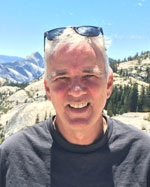
This month geographers from around the country and the world will gather in Boston for the AAG Annual Meeting. This should be a time of celebration for geographers. It is an occasion when we get together for exciting exchanges of ideas, reminisces with old friends and the chance to make new ones. In looking at the recent trajectory of our discipline and the AAG there is much to celebrate. However, it would be naïve to think that we do not also face some challenges. Some of these challenges are external, but some arise internally from the pressures created by the rapid growth and intellectual expansion of our discipline. Let’s take a look at all of this, and then consider some ideas on how at Boston we can derive maximum benefit and mitigate the challenges at hand.
Recent columns from the President
- Telling Our Stories, Speaking Out and Being Heard as Geographers
- Creating and Preserving Actionable and Policy-Relevant Geography
- Strengths and Challenges of Diversity
- Geography in a Post-Truth World
- Geography, Institutions and the Fate of People and Planet in the 21st Century
- More from the President
FEATURES AAG’s Policy ActionsThe AAG continues to actively monitor and respond to key issues that have a clear impact on geography and our membership, as well as topics for which our discipline can serve as a valued stakeholder in shaping viewpoints and policy outcomes. Recent updates include:
For a full, up-to-date list of actions by the AAG so far, visit AAG Policy Action. |
ANNUAL MEETING
Special Policy Events at #AAG2017
 The 2016 U.S. Elections: Implications for Geography and Beyond
This series of sessions will focus on analysis and research on the 2016 U.S. election, and what the results may mean for geography, the nation, and our planet.
- This special track features the session, “The 2016 U.S. Elections: Implications for Geography and Beyond,” a high-profile panel session, chaired and organized by AAG President Glen M. MacDonald, with Sarah Witham Bednarz, Texas A&M University; Alexander B. Murphy, University of Oregon; Douglas Richardson, American Association of Geographers; Derek H. Alderman, University of Tennessee; Victoria A. Lawson, University of Washington; Julie Winkler, Michigan State University, among others. This special session will be held on Saturday, April 8, 2017, from 5:20 p.m. – 7:00 p.m. in Room 312 of the Hynes Convention Center in Boston.
- On, Friday, April 7, from 1:20 p.m. – 3:00 p.m., panelists will address the specific issue of immigration in the session “Trump on Immigration Enforcement: the First 100 Days.” The panel will be up-to-date, research-based, and policy-informed, addressing questions on what immigration enforcement looks like in a Trump administration.
View the full list of sessions.
Discussing the Need for Greater Public Outreach
In addition to the ongoing communication and outreach needed among and within our geography community, there is also a need for increased and improved communication and outreach from our discipline to the greater public. Two featured sessions at the Annual Meeting will discuss this need and the ways in which geographers can contribute their voice to such efforts.
- The panel session, “Need for Public Intellectuals in a Trump America: Strategies for Communication, Engagement, and Advocacy,” organized by AAG Vice President Derek Alderman, will take place on Thursday, April 6, from 10:00 a.m. – 11:40 a.m. in Room 312 of the Hynes Convention Center.
- Rush Holt, chief executive officer of the American Association for the Advancement of Science (AAAS), will deliver a featured talk on “Advancing Science in the Public Arena,” on Thursday, April 6, from 11:50 a.m. – 1:10 p.m. in Room 103 of the Hynes Convention Center.
Mainstreaming Human Rights in Geography and the AAG
 This special theme will feature 50 sessions with more than 250 presentations at the intersection of human rights and geography and will build on the AAG’s decade-long initiatives in this area. Speakers from leading international human rights organizations, academia, government, and NGOs will address human rights challenges around the world.
- In the keynote plenary, “A Continuing Conversation with Noam Chomsky,” Noam Chomsky will engage in a conversational interview with AAG Executive Director Doug Richardson. The audience will also have an opportunity to ask questions following the interview. In addition, Chomsky will receive the 2017 AAG Atlas Award, the association’s highest honor. Be sure and add to your calendar this important keynote session scheduled for Thursday, April 6, 2017, from 5:20 p.m. – 7:00 p.m. in Ballroom B of the Hynes Convention Center.
- Another high-profile Human Rights session, “International Human Rights Priorities: Featured Perspectives,” features panelists Terry Rockefeller, Board of Directors, Amnesty International USA; Michael Posner, NYU Stern Center for Business and Human Rights and former Assistant Secretary of State for the Bureau of Democracy, Human Rights and Labor at the State Department; Beth Simmons, Andrea Mitchell University Professor of Law and Political Science, University of Pennsylvania; Jessica Wyndham, AAAS Scientific Responsibility, Human Rights and Law Program; Tawanda Mutasah, Amnesty International and Douglas Richardson, Executive Director, American Association of Geographers. This session is scheduled on Saturday, April 8, 2017, from 1:20 p.m. – 3:00 p.m. in Room 103, on the Plaza level of the Hynes Convention Center.
View the full list of sessions
 Geographies of Bread and Water
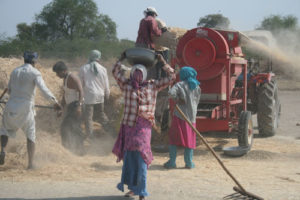
Burgeoning global population along with increasing appetite for high-protein or resource demanding food choices may double demands on world agriculture by 2050. At the same time groundwater depletion and climate change are negatively impacting the availability of sufficient water to meet agricultural and domestic freshwater demands in many regions. Compounding these challenges are socioeconomic forces, including armed conflicts and state collapse that negatively affect agricultural productivity, food transference and water resources. The challenges to food and water security over the 21st century represent an increasing and potentially existential threat to global society. These issues are fundamentally geographical in nature and form a central research and educational focus of geography and the AAG special theme.
- The AAG Opening Session and Presidential Plenary: Bread and Water in the 21st Century will anchor this featured theme. AAG Executive Director Doug Richardson will deliver welcoming remarks to open the meeting. Speakers in this plenary session will be AAGPresident Glen M. MacDonald (UCLA), Ruth DeFries (Columbia University) and Peter Gleick (Pacific Institute). Discussants will be Laura-Anne Minkoff-Zern (Syracuse University) and William G. Moseley (Macalaster College). This plenary session is on Wednesday, April 5, from 6:30 p.m. – 8:30 p.m. in Ballroom B of the Hynes Convention Center.
View the full list of sessions
Uncertainty and Context in Geography and GIScience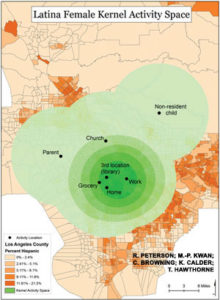
Uncertainty and context pose fundamental challenges in geographic research and GIScience. Geospatial data are imbued with error (e.g., measurement and sampling error), and understanding of the effects of contextual influences on human behavior and experience are often obfuscated by various types of uncertainty (e.g., contextual uncertainties, algorithmic uncertainties, and uncertainty arising from different spatial scales and zonal schemes). To generate reliable geographic knowledge, these uncertainties and contextual issues will be addressed within the special theme.
- The Opening plenary of the Uncertainty and Context theme features keynote presentations by Mei-Po Kwan (University of Illinois at Urbana-Champaign) and Michael Goodchild (University of California) on “New Developments and Perspectives on Context and Uncertainty.” David Berrigan (National Cancer Institute) will be a discussant. Tim Schwanen (University of Oxford) will chair the plenary. This plenary session is on Thursday, April 6, from 10:00 a.m. – 11:40 a.m. in the Independence West room at the Sheraton.
- The Closing plenary features Tim Schwanen, University of Oxford; Wenzhong Shi, The Hong Kong Polytechnic University; Jamie Pearce, University of Edinburgh; and Daniel A. Griffith, U. of Texas at Dallas. This plenary session is on Saturday, April 8, from 11:50 a.m. – 1:10 a.m. in the Independence West room at the Sheraton.
View the full list of sessions
AAG Emerging Workforce Scholars Program
This year, the AAG has launched a unique new initiative called the Emerging Workforce Scholars Program. The program allows aspirational high school and undergraduate students from underserved Boston-area communities to attend the Annual Meeting and interact with geography and geoscience professionals to learn about the work they perform and the preparation needed for careers in their field. The program builds on the AAG’s long-term commitment to enhancing diversity in geography and the geosciences and addressing equity and social justice issues. In support of this program, two special careers sessions will be featured, including Ms. Trinh Nguyen, Director of Boston Mayor Walsh’s Office of Workforce Development, and the Honorable Ronald L. Walker, II, Massachusetts Secretary of Labor and Workforce Development.
AAG Encourages Geographers to March for Science
 The AAG is planning several activities to foster increased participation in the March for Science by AAG members and to provide resources and assistance for geographers who are planning to be in Washington on April 22:
- On the day of the March, the AAG Meridian Place office in Washington (1710 16th Street, N.W.) will remain open as a gathering place for geographers participating in the March. Coffee and refreshments will be available for marchers and the office will serve as a communication center for those taking part.
- The AAG has designed special “Geographers March for Science” hats that will be available at the Annual Meeting in Boston for $7 at the AAG booth, Level 2, Hynes Convention Center; and, at the AAG office leading up to and during the March.
- We have also produced large banners for groups of geographers participating in the March. AAG members will have an opportunity to sign these banners during the Annual Meeting at the AAG Communications Center (near registration).
AAG Council Town Hall Meeting in Boston
 On Wednesday, April 5, the AAG Council will hold a town hall meeting for members to learn more about the association and its activities. This meeting gives an opportunity to ask questions and to provide input. The meeting is from 12-1 p.m., in the Commonwealth Room, Level 3, at the Sheraton.
AAG Snapshots: Learn About the Many Programs, Projects, and Resources the AAG Has to Offer
 There is much more the AAG has to offer beyond its annual meeting! Check out our new AAG Snapshots series at the 2017 Annual Meeting in Boston to learn about the many resources and opportunities available to you through the AAG. Throughout the week, AAG staff will be giving brief (5-10 minute) talks on different aspects of the projects, programs, and resources of the association, with website demonstrations showing how to access more information online. Topics range from making the most of student membership to AAG’s efforts regarding public policy. We encourage everyone to attend these casual presentations and interact with AAG staff, asking your questions and learning more about the association and membership.
Carry the AAG 2017 Annual Meeting Program in Your Pocket
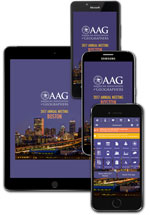 Get the most from your AAG 2017 Boston experience with the mobile app. Enjoy an interactive experience on your Apple, Android, BlackBerry and other mobile devices during the annual meeting. If you’re a laptop user or have a Windows phone, there’s also a Web version for your devices.
Celebrate the International Encyclopedia of Geography in Boston
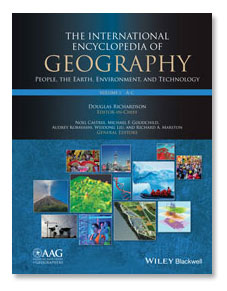 Join us in celebrating the official launch of the International Encyclopedia of Geography: People, the Earth, Environment, and Technologies during an AAG International Reception in Boston! This reception is an opportunity to see old friends and meet colleagues at the outset of the AAG Annual Meeting. There will be food, drinks, music, and interaction with IEG authors and editors. All attendees are invited to attend.
Ideas for the Culture Enthusiast in Boston
Boston’s cultural scene is vibrant in all seasons. From museums and performing arts to interactive festivals and outdoor concerts, Boston is abuzz with activities for cultural enthusiasts. If you love the classics, ensembles such as Handel & Haydn Society and the Boston Symphony Orchestra are reason enough to visit Boston. If you prefer a lighter, contemporary flair then the Boston Pops are your orchestra of choice. Boston’s heralded conservatories, including Boston Conservatory, New England Conservatory, and Berklee College of Music, also performance concerts every week throughout the year.
Family-Friendly Boston
Family fun in Boston is around every corner. From the waterfront to the Fens, and across the river too, Boston is full of family-oriented attractions. We make history fun with tours of the Freedom Trail and interactive exhibits at the Boston Tea Party Ships & Museum and the USS Constitution Museum. Don’t worry about those little feet getting fatigued because everything in Boston is nearby. If you do need a rest hop aboard a Trolley Tour or Boston Duck Tour.
ASSOCIATION NEWS
The AAG Wilbanks Award for Transformational Research in Geography
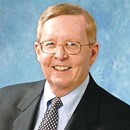 The AAG Wilbanks Award for Transformational Research in Geography has been established in memory of the late Dr. Thomas Wilbanks, a former AAG President and long-standing AAG member. The Wilbanks family has created this new award to honor researchers who have made significant contributions to Geography and GIScience. The family asks that donations be made to the AAG Wilbanks Award for Transformational Research in Geography at this link or by contacting Candida Mannozzi at cmannozzi [at] aag [dot] org or 202-234-1450.
AAG Accepting Registrations for Early Career and Department Leadership Workshops
The University of Tennessee will host two AAG-sponsored workshops in June designed for all geographers interested in 1) improving their programs and 2) graduate students and faculty who are beginning their careers in higher education.
Call for Nominations – AAG Honors
Please consider nominating outstanding colleagues for the AAG Honors, the highest awards offered by the AAG! AAG Honors are offered annually to recognize outstanding accomplishments by members in research and scholarship, teaching, education, service to the discipline, public service outside academe, and for lifetime achievement. Individual AAG members, specialty groups, affinity groups, departments, and other interested parties are encouraged to nominate outstanding colleagues by June 30. Currently, honors are awarded in several categories, including: Distinguished Teaching Honors; Gilbert F. White Distinguished Public Service Honors; Ronald F. Abler Distinguished Service Honors; Gilbert Grosvenor Honors for Geographic Education; Distinguished Scholarship Honors; and Lifetime Achievement Honors. AAG Honors are selected annually by the AAG Honors Committee from a collection of nomination submissions.
The AAG Fellows Program
The AAG is honored to announce it has launched AAG Fellows, a new program to recognize geographers who have made significant contributions to advancing geography. In addition to honoring geographers, AAG Fellows will serve the AAG as an august body to address key AAG initiatives including creating and contributing to AAG initiatives; advising on AAG strategic directions and grand challenges; and mentoring early and mid-career faculty. The deadline for nominations is June 30.
RESOURCES & OPPORTUNITIES
Request for Proposals: Transformative Research in Geography Education
 The National Center for Research in Geography Education (NCRGE) invites proposals to develop new collaborative and interdisciplinary research networks addressing major questions and challenges in geography education. Through this program, NCRGE aspires to strengthen geography education research processes and promote the growth of sustainable, and potentially transformative, lines of research.
Call for Nominations: GeoCUR Undergraduate Research Mentor Award
 The Geosciences Division of the Council on Undergraduate Research (GeoCUR) is now accepting nominations for its annual award that highlights the importance of mentoring undergraduate research activities. The award annually recognizes an individual who serves as a role model for productive and transformative student-faculty mentoring relationships and for maintaining a sustained and innovative approach to the enterprise of undergraduate research.
PUBLICATIONS
The International Encyclopedia of Geography is Here
The AAG and an international team of distinguished editors and authors announce a new major reference work for Geography: The International Encyclopedia of Geography: People, the Earth, Environment, and Technology. Available as an online resource and as a 15-volume full-color print set published by Wiley, this is an invaluable resource for libraries, geographers, GIScientists, students and academic departments around the globe. Updated annually, this Encyclopedia is the authoritative reference work in the field of geography for decades to come.
May 2017 Issue of ‘The Professional Geographer’ Now Available
 The AAG is pleased to announce that Volume 69, Issue 2 (May 2017) of The Professional Geographer is now available. The focus of The Professional Geographer is on short articles in academic or applied geography, emphasizing empirical studies and methodologies. These features may range in content and approach from rigorously analytic to broadly philosophical or prescriptive. The journal provides a forum for new ideas and alternative viewpoints. Each issue, the Editor chooses one article to make freely available. In this issue you can read The Price of Journals in Geography by Oliver T. Coomes, Tim R. Moore, and Sébastien Breau for free for the next three months.
April 2017 Issue of the ‘African Geographical Review’ Now Available
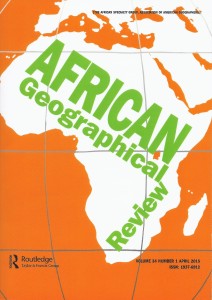 The AAG is pleased to announce that Volume 36, Issue 1 (April 2017) of the African Geographical Review is now available. The African Geographical Review is the journal of the Africa Specialty Group of the American Association of Geographers. It provides a medium for the publication of geographical material relating to Africa, seeks to enhance the standing of African regional geography, and to promote a better representation of African scholarship. Articles cover all sub-fields of geography, and can be theoretical, empirical or applied in nature.
ADDENDA
- U.S. Census Bureau Mapping Tool of County Health Insurance Estimates
- The Maps That Prove the Daylight Saving Cycle Is Ruining Our Lives
- America’s Affordable Housing Shortage, Mapped
- Geodesign Helps Communities Address Growing Pains
IN THE NEWS
Popular stories from the AAG SmartBrief
- Understanding Water Insecurity
- Map Converts Population Density Into Geologic Features
- NOAA Satellite Snaps Images of Lightning Strikes Across Western Hemisphere
- A Search Tool for Satellite Imagery
EVENTS CALENDAR
Submit News to the AAG Newsletter. To share your news, submit announcements to newsletter [at] aag [dot] org.
 This month geographers from around the country and the world will gather in Boston for the AAG Annual Meeting. This should be a time of celebration for geographers. It is an occasion when we get together for exciting exchanges of ideas, reminisces with old friends and the chance to make new ones. In looking at the recent trajectory of our discipline and the AAG there is much to celebrate. However, it would be naïve to think that we do not also face some challenges. Some of these challenges are external, but some arise internally from the pressures created by the rapid growth and intellectual expansion of our discipline. Let’s take a look at all of this, and then consider some ideas on how at Boston we can derive maximum benefit and mitigate the challenges at hand.
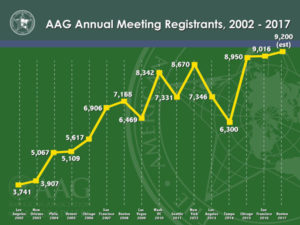 The AAG expects to host well over 9,000 registrants at the Boston meeting. This will be a record for the Association. The registrants come from countries around the world, including many from developing regions to whom the AAG offers special membership assistance. The size of the Boston meeting is not a singular fluke and should be viewed in the context of the remarkable growth of our annual meetings over the 21st century. Just 15 years ago our annual meetings had less than 4,000 attendees. Since that time there has been a strong, albeit sometimes noisy, increase in attendance.
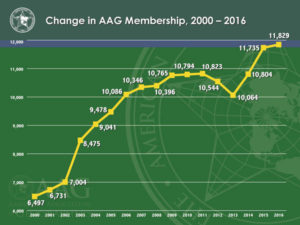 The growth in AAG membership and meeting attendance has occurred hand-in-hand with an increase in what the Association and meetings offer in terms of scholarly and intellectual exchanges and stimulation. At present there are almost 70 AAG Specialty and Affinity Groups – with more being proposed as new areas of geographical scholarship arise. Today these groups range in interest from A (Africa) to W (Water Resources). The astounding breadth of modern geographical enquiry is manifest in the number of oral and poster sessions at the annual meeting. This year in Boston there will be almost 1,800 various sessions. I find this incredible. Surely there will be a plethora of sessions that will appeal to any geographer.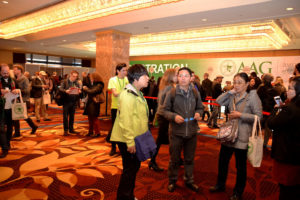
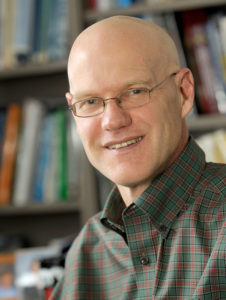
 Nina Feldman, a former intern with AAG and the Geography and Map Division of the Library of Congress, shares why she chose a career in GIS and Geography in a very poignant guest blog post for
 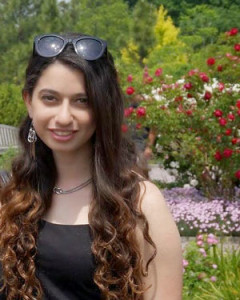 Nina Feldman is a senior pursuing a B.S. in environmental studies with a minor in geographic information systems at George Washington University. Her interests include art, geography and graphic design. After graduation she wants to work for an organization where she can utilize her GIS skills to help mitigate environmental concerns and gain further experience before pursuing her M.A. in geography.