AAG 2017 Boston Special Policy Events — The 2016 U.S. Elections: Implications for Geography and Beyond

AAG 2017 Boston — Special Policy Events

The 2016 U.S. Elections: Implications for Geography and Beyond

This series of sessions will focus on analysis and research on the 2016 U.S. election, and what the results may mean for geography, the nation, and our planet.  

  • This special track features the session, “The 2016 U.S. Elections: Implications for Geography and Beyond,” a high-profile panel session, chaired and organized by AAG President Glen M. MacDonald, with Sarah Witham Bednarz, Texas A&M University; Alexander B. Murphy, University of Oregon; Douglas Richardson, American Association of Geographers; Derek H. Alderman, University of Tennessee; Victoria A. Lawson, University of Washington; Julie Winkler, Michigan State University, among others. This special session will be held on Saturday, April 8, 2017, from 5:20 p.m. – 7:00 p.m. in Room 312 of the Hynes Convention Center in Boston.
  • The panel session, “Need for Public Intellectuals in a Trump America: Strategies for Communication, Engagement, and Advocacy,” organized by AAG Vice President Derek Alderman, will take place on Thursday, April 6, from 10:00 a.m. – 11:40 a.m. in Room 312 of the Hynes Convention Center.

View the full list of sessions within this featured theme.

You can easily add sessions and events of interest to your schedule in the AAG Mobile App or in your online program.

    Share

AAG 2017 Boston Featured Theme — Geographies of Bread and Water in the 21st Century

AAG 2017 Boston — Featured Theme

Geographies of Bread and Water in the 21st Century

Burgeoning global population along with increasing appetite for high-protein or resource demanding food choices may double demands on world agriculture by 2050. At the same time groundwater depletion and climate change are negatively impacting the availability of sufficient water to meet agricultural and domestic freshwater demands in many regions. Compounding these challenges are socioeconomic forces, including armed conflicts and state collapse that negatively affect agricultural productivity, food transference and water resources. The challenges to food and water security over the 21st century represent an increasing and potentially existential threat to global society. These issues are fundamentally geographical in nature and form a central research and educational focus of geography and the AAG special theme.

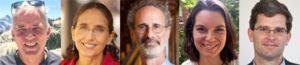
  • The AAG Opening Session and Presidential Plenary: Geographies of Bread and Water in the 21st Century will anchor this featured theme. AAG Executive Director Doug Richardson will deliver welcoming remarks to open the meeting. Speakers in this plenary session will be AAG President Glen M. MacDonald (UCLA), Ruth DeFries (Columbia University) and Peter Gleick (Pacific Institute). Discussants will be Laura-Anne Minkoff-Zern (Syracuse University) and William G. Moseley (Macalaster College). This plenary session is on Wednesday, April 5, from 6:30 p.m. – 8:30 p.m. in Ballroom B of the Hynes Convention Center.

View the full list of sessions within this featured theme.

You can easily add sessions and events of interest to your schedule in the AAG Mobile App or in your online program.

    Share

AAG 2017 Boston Featured Theme — Uncertainty and Context in Geography and GIScience: Advances in Theory, Methods, and Practice

AAG 2017 Boston — Featured Theme

Uncertainty and Context in Geography and GIScience:
Advances in Theory, Methods, and Practice

Uncertainty and context pose fundamental challenges in geographic research and GIScience. Geospatial data are imbued with error (e.g., measurement and sampling error), and understanding of the effects of contextual influences on human behavior and experience are often obfuscated by various types of uncertainty (e.g., contextual uncertainties, algorithmic uncertainties, and uncertainty arising from different spatial scales and zonal schemes). To generate reliable geographic knowledge, these uncertainties and contextual issues will be addressed within the special theme.

  • The Opening plenary of the Uncertainty and Context theme features keynote presentations by Mei-Po Kwan (University of Illinois at Urbana-Champaign) and Michael Goodchild (University of California) on “New Developments and Perspectives on Context and Uncertainty.” David Berrigan (National Cancer Institute) will be a discussant. Tim Schwanen (University of Oxford) will chair the plenary.  This plenary session is on Thursday, April 6, from 10:00 a.m. – 11:40 a.m. in the Independence West room at the Sheraton.
  • The Closing plenary of the Uncertainty and Context theme features Tim Schwanen, University of Oxford; Wenzhong Shi, The Hong Kong Polytechnic University; Jamie Pearce, University of Edinburgh; and Daniel A. Griffith, U. of Texas at Dallas. This plenary session is on Saturday, April 8, from 11:50 a.m. – 1:10 a.m. in the Independence West room at the Sheraton.

View the full list of sessions within this featured theme.

Scientific Committee Co-Chairs

You can easily add sessions and events of interest to your schedule in the AAG Mobile App or in your online program

    Share

Undergraduate Student Activities and Resources at the 2017 Annual Meeting in Boston

The 2017 Annual Meeting is the first since the establishment of the new Undergraduate Student Affinity Group and over 400 undergraduates have already registered to attend! At the Annual Meeting, students are encouraged to network with their peers and colleagues, expand their involvement in and understanding of the discipline of geography, and learn skills to build their careers. To celebrate and engage this important part of the AAG community, there will be events, activities, and resources geared for undergraduate students in attendance in Boston.

• Newcomers’ Guide to the Meeting: Is it your first time attending an Annual Meeting? Check out this guide for tips and tricks to navigating the largest geography conference in the world.

• Suggested Itinerary for Students: Overwhelmed by the thousands of presentations and unsure where to start planning your day? Get started with the suggested itinerary for students, available under “Essentials” in the AAG Mobile app.

• AAG Snapshot Talk on Student Membership: As part of the new AAG Snapshots series at the Annual Meeting, AAG staff will be giving brief informational talks in the AAG Communications Center, including the topic “Make the Most of your Student Membership,” presented on Wed., April 5th at 10 a.m. and Friday, April 7, at 3:20 p.m.

• Scavenger Hunt for Undergrads: Looking for a fun way to explore the Annual Meeting? Tackle our Photo Scavenger Hunt designed for undergraduate attendees to help discover different aspects of the meeting. View and download the “Undergrad Photo Scavenger Hunt” PDF under “Essentials” in the AAG Mobile app. The first two undergraduate students to show their completed photos and checklist to AAG Staff at the AAG Booth will get $20 credit to spend at the AAG Booth (located near registration, 2nd floor of the Hynes Convention Center).

• Undergrad Meetup Area at the International Reception: Music, refreshments, and catching up with colleagues new and old are all features of the International Reception. Find the Undergrad Student Meetup area to connect with fellow undergraduates, entire a raffle for an AAG Swag Pack, learn more about the new Undergraduate Student Affinity Group, and add to our graffiti wall by drawing the logo, mascot, or name of your university! The International Reception takes place Friday, April 7, 7:00 – 9:00 p.m. in Ballroom B, on the third level of the Hynes Convention Center. Don’t miss it!

• Undergraduate Student Affinity Group Business Meeting – Want to help steer the direction of the new Undergraduate Student Affinity Group? Want to build leadership experience and add service activities to your resume? Attend the 1st USAG business meeting and consider running for a position on the board! The USAG Business Meeting is on Thursday, April 6th, from 8:10 to 9:10pm in the Vineyard Room on the 4th Floor of the Marriott.

• AAG Jobs & Careers Center and the AAG Careers in Geography Fair: Looking for career mentoring, career resources, workshops to improve your skills, or even a chance to speak with potential employers? Be sure to check out the numerous sessions and workshops at the Jobs & Careers Center as well as the employers you can speak to on site at the AAG Careers in Geography Fair. Both will be located on the Second Level of the Hynes Convention Center, in and around Rooms 203, 204, and 205.

• World Geography Bowl – Attend and cheer on fellow students competing in this annual event! The bowl takes place on Saturday, April 8, from 7:00 p.m. – 11:00 p.m. in Rooms 101-105 on the Plaza Level of the Hynes Convention Center.

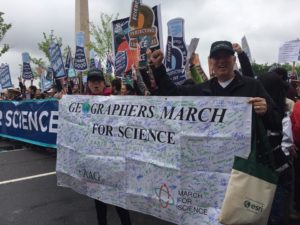
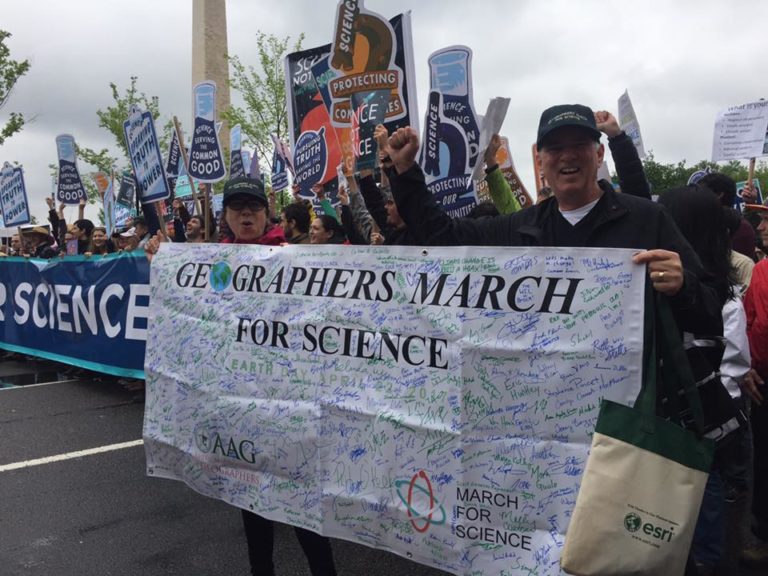
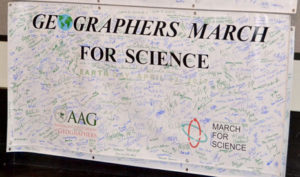
• Geographers March for Science — Sign the Banner: The AAG has partnered with the March for Science. In addition to supporting the march in many ways, the AAG also will have a large banner that will be carried at the March for Science event in Washington, D.C. on Earth Day, April 22. The banner will be in Boston during the Annual Meeting at the AAG Communications Center (near registration) for any attendees who would like to sign their name on the banner to indicate their support. Undergraduates represent the future of geography; we welcome your important signatures to the banner!

In addition to the official meeting hashtag, #AAG2017, consider also using #AAGUndergrads to interact with other undergraduates in attendance and to build your peer and professional network via social media.

Undergraduate students can join the AAG for just $38 per year and receive a range of member benefits including online access to scholarly journals and publications, exclusive access to the Jobs in Geography listings, and reduced rates for Annual Meeting and other event registration. Joining the Undergraduate Student Affinity Group only costs an additional $1 per year. Check out the USAG website and USAG Twitter account for more information.  For questions, contact cluebbering [at] aag [dot] org.

    Share

New Books: March 2017

Every month the AAG compiles a list of newly-published books in geography and related areas. Some are selected for review in the AAG Review of Books.

Publishers are welcome to send new volumes to the Editor-in-Chief (Kent Mathewson, Editor-in-Chief, AAG Review of BooksDepartment of Geography and Anthropology, Louisiana State University, Baton Rouge, LA 70803).

Anyone interested in reviewing these or other titles should also contact the Editor-in-Chief.

PLEASE NOTE: Due to current public health policies which have prompted the closing of most offices, we are unable to access incoming books at this time. We are working on a solution during this transition and will continue our new books processing as soon as we can. In the meantime, please feel free to peruse previous books from our archived lists.

February 2020

The Saguaro Cactus : A Natural History by David Yetman, Alberto Burquez, Kevin Hultine, and Michael Sanderson (University of Arizona Press 2020)

Wild Blue Media: Thinking through Seawater by Melody Jue (Duke University Press 2020)

Intimate Geopolitics: Love, Territory, and the Future on India’s Northern Threshold by Sara Smith (Rutgers University Press 2020)

Panic City: Crime and the Fear Industries in Johannesburg by Martin J. Murray (Stanford University Press 2020)

Assembling Moral Mobilities : Cycling, Cities and the Common Good by Nicholas A Scott (University of Nebraska Press 2020)

    Share

AAG 2017 Featured Theme – Mainstreaming Human Rights in Geography and the AAG

AAAS textual graphic containing many human rights terms

AAG Annual Meeting, Boston, April 5-9, 2017


Nearly all geographers are concerned about human rights, and in their personal and professional lives seek meaningful ways to act on these concerns and values. The AAG and the discipline of geography intersects with human rights in numerous ways. This special theme within the 2017 AAG Annual Meeting will explore intersections of Human Rights and Geography, and will build on the AAG’s decade-long initiatives on Mainstreaming Human Rights in Geography and the AAG.

This theme will feature 50 sessions with more than 250 presentations at the intersection of human rights and geography. Speakers from leading human rights organizations, academia, government, and international organizations will address human rights challenges around the world.

Keynote Address

An Interview with Noam Chomsky by Doug Richardson will keynote this theme at the 2017 Boston Annual Meeting.

Featured Speakers

A sampling of featured speakers includes:

  • Noam Chomsky, Institute Professor and Professor of Linguistics Emeritus, MIT
  • Mike Posner, former Assistant Secretary of State for Human Rights
  • James Hansen, Columbia University
  • Rush Holt, CEO, American Association for the Advancement of Science (AAAS)
  • Terry Rockefeller, Board of Directors, Amnesty International USA
  • Colette Pichon Battle, Executive Director, US Human Rights Network
  • Stéphane Bonamy, Deputy Head, International Committee of the Red Cross
  • Lee Schwartz, Director, Office of the Geographer and Global Issues, US State Department
  • Susannah Sirkin, Director of International Policy and Partnerships, Physicians for Human Rights
  • Jessica Wyndham, Interim Director, Scientific Responsibility, Human Rights and Law Program, AAAS
  • Priscilla Rodriguez, Associate Director for Advocacy, Disability Rights International
  • Douglas Richardson, Executive Director, American Association of Geographers
  • Beth Simmons, U-Penn Law and NAS Committee on Human Rights
  • Harvard Humanitarian Initiative (four presenters from Harvard)
  • Audrey Kobayashi, Queen’s University
  • Hilary Zainab, Research Director, Standby Task Force
  • Kathryn Hanson, Smithsonian Museum Conservation Institute
  • Sheryl Luzzadder-Beach, University  of Texas at Austin
  • Balakrishnan Rajagopal, Head, International Development Group, MIT
  • Colin Kelley, Columbia Center for Climate and Security
  • Stephen Marks, Department of Global Health and Policy, Harvard University
  • Tawanda Mutasah, Senior Director for Law and Policy, Amnesty International

Organizing Committee

Douglas Richardson, Chair (AAG), Sheryl Beach (University of Texas), Jessica Wyndham (American Association for the Advancement of Science), Audrey Kobayashi (Queen’s University)

For more information, please visit www.aag.org/annualmeeting, or contact members of the theme’s organizing committee at GeoHumanRights [at] aag [dot] org.


Session Schedule

Wednesday, April 5

8:00 am – 9:40 am

1105.   Health and human rights
Room: Room 105, Hynes, Plaza Level  (Paper Session)
ORGANIZER(S): Mainstreaming Human Rights
CHAIR(S): SARASWATI KERKETTA, Nistarini College
8:00  Rhoda Mundi, Ph.D.*, University of Abuja, Nigeria, Women’s Empowerment and Demographic and Health Outcomes: Evidence From 2013 Nigeria Demographic and Health Survey.
8:20  SUMAN SINGH, PhD*, Banaras Hindu University, Varanasi, India, The Maternity Benefit (Amendment) Bill, 2016: Is it Half full or Half Empty.
8:40  Calvin P Tribby*, Columbia University Medical Center, Infusing Vision Zero Policies with the Human Rights Perspective to Address the Traffic-related Mortality and Morbidity Epidemic.
9:00  Meghan Smith*, Salem State University, Access to Language Services in Substance Abuse Treatment Facilities in the Commonwealth of Massachusetts.
9:20  SARASWATI KERKETTA*, Nistarini College, Right of Women to Maternal Health Care.

1106.   Crime, brutality, and violence
Room: Room 107, Hynes, Plaza Level  (Paper Session)
ORGANIZER(S): Mainstreaming Human Rights
CHAIR(S): Patricia De La Mata
8:00  Dylan Beatty*, University of Hawaii – Manoa, ‘Pusher na Ako’: First-hand Account of Manila following Duterte’s Election.
8:20  Morten Koch Andersen*, Danish Institute Against Torture, Filtering Information: Human Rights Documentation and that Which is Known.
8:40  Shaul Cohen*, University of Oregon, Transcending Space, Embracing Time: Geographic Imagination From Within a Prison.
9:00  Scott Warren*, Arizona State University, Human Rights, Field Work, and ASU’s Desert Aid Class on the Arizona-Mexico Border.
9:20  Patricia De La Mata*, California State University San Marcos, Worldwide Trafficking.

10:00 am – 11:40 am

1205.   Global Carceral Geographies I: Carceral Experiences (Sponsored by Political Geography Specialty Group, Ethics, Justice, and Human Rights Specialty Group, Sexuality and Space Specialty Group)
Room: Room 105, Hynes, Plaza Level  (Paper Session)
ORGANIZER(S): Austin Kocher, The Ohio State University, Department of Geography; Dominique Moran, University of Birmingham; Nick Gill, Exeter Unviesity
CHAIR(S): Dominique Moran, University of Birmingham 10:00  Anna Schliehe, Dr*, University of Cambridge, Dialogues across carceral space: comparative research and the case of penal exceptionalism.
10:20  Anaïs Tschanz*, University of Montreal, Carceral (im)mobilities and inmate experience of distance in the Canadian province of Quebec.
10:40  Nicolas Sallée*, Université de Montréal, Imprisoned rehabilitation? The carceral nature of a Quebec secure juvenile facility.
11:00  Jennifer Turner*, University of Liverpool; Dominique Moran*, University of Birmingham; Yvonne Jewkes, University of Brighton, Serving time with a sea view: escaping prison via therapeutic blue space.
Discussant(s): Dominique Moran, University of Birmingham

12:40 pm – 2:20 pm

1405.   Global Carceral Geographies II: Carceral Societies (Sponsored by Political Geography Specialty Group, Ethics, Justice, and Human Rights Specialty Group, Sexuality and Space Specialty Group)
Room: Room 105, Hynes, Plaza Level  (Paper Session)
ORGANIZER(S): Austin Kocher, The Ohio State University, Department of Geography; Dominique Moran, University of Birmingham; Nick Gill, Exeter Unviesity
CHAIR(S): Austin Kocher, The Ohio State University, Department of Geography
12:40  Luca Follis*, Lancaster University, Financializing Carceral Spaces: Probation, Parole and Speculative Capital.
1:00  OLIVIER MILHAUD*, University Paris-Sorbonne, UMR ENeC CNRS, A theoretical framework for confinement (prisons, distance, discontinuities, France).
1:20  Steve Herbert*, University of Washington, Banished Forever? Redeeming the Ostracized Life Prisoner.
1:40  Julie De Dardel*, University of Geneva, Ethics in and after the field in prison research.
Discussant(s): Austin Kocher, The Ohio State University, Department of Geography

2:40 pm – 4:20 pm

1505.   Global Carceral Geographies III: Confining the Other (Sponsored by Political Geography Specialty Group, Ethics, Justice, and Human Rights Specialty Group, Sexuality and Space Specialty Group)
Room: Room 105, Hynes, Plaza Level  (Paper Session)
ORGANIZER(S): Austin Kocher, The Ohio State University, Department of Geography; Dominique Moran, University of Birmingham; Nick Gill, Exeter Unviesity
CHAIR(S): Nick Gill, Exeter Unviesity
2:40  Lauren Martin*, Durham University, The Carceral Mobilities of Cash: Outsourcing, Digital Surveillance, and Refused Asylum-seeker Assistance in the United Kingdom.
3:00  Leigh Barrick*, University of British Columbia, Separating families to maintain family unity, and other paradoxes of U.S. deterrence policy.
3:20  Austin Kocher*, The Ohio State University, Department of Geography, The Legal Construction of Space: On the Juridical Relationship Between Immigrant Detention, Immigration Courts, and Border Enforcement in the United States.
3:40  Adam Joseph Barker*, University of Leicester, Carcerality and Indigeneity: the roots of ‘Indian territory’ in Turtle Island (North America).
Discussant(s): Nick Gill, Exeter Unviesity

4:40 pm – 6:20 pm

1605.   Global Carceral Geographies IV: Carceral Intersections (Sponsored by Political Geography Specialty Group, Ethics, Justice, and Human Rights Specialty Group, Sexuality and Space Specialty Group)
Room: Room 105, Hynes, Plaza Level  (Paper Session)
ORGANIZER(S): Austin Kocher, The Ohio State University, Department of Geography; Dominique Moran, University of Birmingham; Nick Gill, Exeter Unviesity
CHAIR(S): Steve Herbert, University of Washington
4:40  Emma Marshall*, University of Exeter, Investigating the possibilities of online activism as a challenge to carceral space.
5:00  Jesse Proudfoot*, Durham University, Scaling Addiction.
5:20  Odilka Sabrina Santiago*, Binghamton University; Odilka Sabrina Santiago, PhD Student, SUNY Binghamton University; odilka Sabrina santiago, PhD, SUNY Binghamton University, Predictive Policing and the Transformation of Carceral Space: Promotes, rather than, Prevents Violence.
5:40  Christophe Mincke*, National Institute for Forensic Science and Criminology, From confinement to monitoring. The carceral as management of the transitory.
Discussant(s): Steve Herbert, University of Washington

1606.   (De)Stigmatising Sexscapes: Politics, Policy and Performance I: Porn, Pleasure & Performance (Sponsored by Sexuality and Space Specialty Group)
Room: Room 107, Hynes, Plaza Level  (Paper Session)
ORGANIZER(S): Paul J. Maginn, University of Western Australia; Emily Cooper, University of Central Lancashire; Erin Sanders-McDonagh, Middlesex University
CHAIR(S): Paul J. Maginn, University of Western Australia
4:40  Gemma Commane, Dr*, Birmingham City University, Kinktrepreneurship and social media: debates, rights and female subjectivity..
5:05  Joanne Bowring*, Liverpool John Moores University, Stigma in the UK Adult Film Industry.
5:30  Jennifer Heineman, PhD*, University of Nebraska at Omaha, Performing the Whore, Performing the Academic.
5:55  Emily Meyer, Esq.*, University of Cincinnati, The Cam Model: Kinship, Community, and Intimacy.


Thursday, April 6

8:00 am – 9:40 am

2103.   Human Rights: Humanitarian Disaster Response and Protecting Cultural Heritage
Room: Room 103, Hynes, Plaza Level  (Panel Session)
ORGANIZER(S): John Wertman, American Association of Geographers
CHAIR(S): Lars Bromley, United Nations Institute for Training and Research
Panelists: Stephane Bonamy, ICRC; Hilary N. Ervin, Payson Center for International Development; Lars Bromley, United Nations Institute for Training and Research

2104.   Right to water and safe environments
Room: Room 104, Hynes, Plaza Level  (Paper Session)
ORGANIZER(S): Mainstreaming Human Rights
CHAIR(S): Jessica J. Goddard, University of California – Berkeley
8:00  Duncan McLaren*, Lancaster Environment Centre, Radicalizing Rights: Recognition and Climate Justice in an Engineered Anthropocene.
8:20  Heba Allah Khalil, Associate Professor*, Cairo University; Carl Philipp Schuck, Deutsche Gesellschaft fuer Internationale Zusammenarbeit (GIZ), Environmental Justice and Geographies of Urban Exclusion: The Case of Cairo.
8:40  Catherine Corson*, Mount Holyoke College, Human Rights Based Conservation: Assembling Universal Rights at the World Conservation Congress.
9:00  Jessica J. Goddard*, University of California – Berkeley; Carolina Balazs, PhD, University of California – Davis, Water Affordability in California’s Human Right to Water.

2106.   (De)Stigmatising Sexscapes: Politics, Policy and Performance II: 2. Rights, Wrongs and Regulations (Sponsored by Sexuality and Space Specialty Group)
Room: Room 107, Hynes, Plaza Level  (Paper Session)
ORGANIZER(S): Paul J. Maginn, University of Western Australia; Emily Cooper, University of Central Lancashire; Erin Sanders-McDonagh, Middlesex University
CHAIR(S): Emily Cooper, University of Central Lancashire
8:00  Laura Graham*, Durham University, The Home Affairs Select Committee Inquiry on Prostitution: Is the time ripe for a Human Rights based approach to sex work?
8:25  Emilia Ljungberg*, Karlstad University, The smiling face of the emotional state.
8:50  Elena Shih*, Brown University; Christine Shio Lim, Brown University; Jordan Rubin-McGregor, Brown University; Imani Herring, Brown University, Building a Movement Against Sex Work in Rhode Island: Anti-Trafficking and Academic Industrial Complexes.
9:15  Billie M Lister, Doctor*, Leeds Beckett University, Time for change? : Indoor sex workers experiences of working under quasi-criminalisation in England and Wales and their ideas for legislative change.

2107.   The 2016 Elections: Analyzing the Data
Room: Room 108, Hynes, Plaza Level  (Paper Session)
ORGANIZER(S): Program Committee; John Wertman, American Association of Geographers
CHAIR(S): James Newman, Northern Illinois University
8:00  James W Newman, Ph.D. Candidate*, Northern Illinois University, Using Rank-Mobility Index to Reveal Significant Patterns in Voter Behavior in the 2016 US Presidential Election.
8:20  Robert Chlala*, University of Southern California, Going Green in 2016? Cannabis Legalization and Remaking California’s Neoliberal Geography.
8:40  Peter E Lenz*, Dstillery, Observing and Modeling Candidate Supporters Using Mobile Phone Signals During the 2016 Iowa Caucus.
9:00  Chenxiao Guo*, University of Georgia; Xiaobai Yao, University of Georgia, Associate Socioeconomic Indicators with Public Sentiments on the US Election 2016: A Case Study of Georgia Based on Geotagged Tweets.
Discussant(s): Helenmary M. Hotz, University of Massachusetts Boston

10:00 am – 11:40 am

2203.   Documenting Evidence for Human Rights Tribunals and Litigation Using Geographic Research and Tools
Room: Room 103, Hynes, Plaza Level  (Panel Session)
ORGANIZER(S): John Wertman, American Association of Geographers; Mainstreaming Human Rights
CHAIR(S): Theresa Harris, AAAS
Panelists: Theresa Harris, AAAS; Susannah Sirkin, Physicians for Human Rights; Wesley J. Reisser, George Washington University; Ryan Burns, University of Calgary

2204.   Mainstreaming Human Rights in Geomorphology and Water Resources (Sponsored by Mainstreaming Human Rights in Geography and the AAG Featured Theme, Geomorphology Specialty Group)
Room: Room 104, Hynes, Plaza Level  (Panel Session)
ORGANIZER(S): Sheryl Luzzadder-Beach, University of Texas-Austin
CHAIR(S): Sheryl Luzzadder-Beach, University of Texas-Austin
Introducer: Sheryl Luzzadder-Beach
Panelists: Mark Giordano, Georgetown University; Michael A. Urban, University of Missouri; Sheryl Luzzadder-Beach, University of Texas-Austin; Richard A. Marston, Kansas State University; Anne Chin, University of Colorado Denver

2206.   (De)Stigmatising Sexscapes: Politics, Policy and Performance III: 3. Governance, Policing and Design (Sponsored by Sexuality and Space Specialty Group)
Room: Room 107, Hynes, Plaza Level  (Paper Session)
ORGANIZER(S): Paul J. Maginn, University of Western Australia; Emily Cooper, University of Central Lancashire; Erin Sanders-McDonagh, Middlesex University
CHAIR(S): Gemma Commane, Birmingham City University
10:00  Nicole Kalms*, Monash University, Sex Shop / Pole Dance / Street Work: Heteronormative Architectures of the Neoliberal City.
10:25  Erin Sanders-McDonagh*, University of Kent, Pushing sex work to the margins: The sanitization of Red Light Districts in Amsterdam and London.
10:50  Paul J. Maginn*, University of Western Australia; Emily Cooper, University of Central Lancashire, On-street, Off-street, And Online: The Dynamic Liminalities Of Sex Work I.
11:15  Alison Better*, Kingsborough Community College, CUNY, Constructing Space and Community for Sexual and Gender Exploration at Sex Toy Boutiques

2207.   The 2016 Elections: Destabilization, Social Forces, and the Media
Room: Room 108, Hynes, Plaza Level  (Paper Session)
ORGANIZER(S): John Wertman, American Association of Geographers
CHAIR(S): Richard M. Medina, University of Utah
10:00  Richard M. Medina*, University of Utah; Emily A Nicolosi, University of Utah, Hate in the US: A Geographical Analysis of Movements and Activities.
10:20  James Andrew Sevitt*, The Graduate Center – CUNY; James Sevitt, PhD Student, The Graduate Center, CUNY, Rethinking Political Subjectivities Amidst the Ongoing Crises of Liberal Democracy.
10:40  Luca Muscarà*, Universita del Molise, Similarities and differences between Trump and Berlusconi: which lessons for their opponents?.
Discussant(s): Laxmi Ramasubramanian, Hunter College; Stephanie Pincetl, UCLA

11:50 am – 1:10 pm

2303.   Special session featuring Rush Holt, CEO of the American Association for the Advancement of Science (AAAS): “Advancing Science in the Public Arena”
Room: Room 103, Hynes, Plaza Level  (Panel Session)
ORGANIZER(S): Douglas Richardson, American Association of Geographers
CHAIR(S): Douglas Richardson, American Association of Geographers
Panelists: Rush Holt, AAAS
Discussants: David Berrigan, Antoinette WinklerPrins

1:20 pm – 3:00 pm

2403.   Integrating Geography & Geospatial Methods Into Humanitarian Response & Human Rights Documentation: Lessons from Five Years of the Signal Program on Human Security & Technology at the Harvard Humanitarian Initiative
Room: Room 103, Hynes, Plaza Level  (Panel Session)
ORGANIZER(S): Mainstreaming Human Rights
CHAIR(S): Nathaniel Raymond, Harvard Humanitarian Initiative
Panelists: Nathaniel Raymond, Harvard Humanitarian Initiative; Isaac Baker, Harvard Humanitarian Initiative; Faine Greenwood, Harvard Humanitarian Initiative

2406.   (De)Stigmatising Sexscapes: Politics, Policy and Performance IV: 4. Production, Consumption and Reflection (Sponsored by Sexuality and Space Specialty Group)
Room: Room 107, Hynes, Plaza Level  (Paper Session)
ORGANIZER(S): Paul J. Maginn, University of Western Australia; Emily Cooper, University of Central Lancashire; Erin Sanders-McDonagh, Middlesex University
CHAIR(S): Emily Cooper, University of Central Lancashire
1:20  Yo-Hsin Yang*, Negotiating/resisting stigma of sexscapes: gay men’s sex moral performances on tour.
1:40  Victor Trofimov*, European University Viadrina, From commercial sex to homonormativity: changing landscape of male street sex work in Berlin.
2:00  Katharine Parker*, Northumbria University, Public Sex Environments in Contemporary Sexscapes: A Case Study from North East England.
2:20  Nick McGlynn*, University of Brighton, Too Fat, Too Thin, Just Right?: Stigmatised Bodies in Bear Spaces.
2:40  Philip Birch*, Western Sydney University, Prostitution and Procuring Sexual Services: Why men buy sex .

2407.   Precarious Times, Precarious Politics: Whiteness, Masculinity, and Working-Class Lives
Room: Room 108, Hynes, Plaza Level  (Paper Session)
ORGANIZER(S): Jamie L. Winders, Syracuse University; Barbara Ellen Smith, Virginia Tech
CHAIR(S): Jamie L. Winders, Syracuse University
1:20  Katie Mazer*, University of Toronto, Vulnerable talent, just-in-time work: The tar sands talent pipeline.
1:40  Jamie L. Winders*, Syracuse University; Barbara Ellen Smith*, Virginia Tech, Whiteness, Masculinity, and Working-Class Lives.
2:00  Sara Dorow*, University of Alberta, The Precarity of Mobile White Masculinities in the Oil Patch.
2:20  Lise Nelson*, Penn State University, Narratives of whiteness and racially transgressive embodiments of place in the rural U.S. South.
Introducer: Barbara Ellen Smith

3:20 pm – 5:00 pm

2503.   Article 15: Understanding the Human Right to the Benefits of Science to Help Progress and Its Applications
Room: Room 103, Hynes, Plaza Level  (Panel Session)
ORGANIZER(S): Jessica Wyndham, AAAS Scientific Responsibility, Human Rights and Law Program; Mainstreaming Human Rights
CHAIR(S): Jessica Wyndham, AAAS Scientific Responsibility, Human Rights and Law Program
Panelists: Jessica Wyndham, AAAS Scientific Responsibility, Human Rights and Law Program; Patricia Carbajales-Dale, Clemson University

2506.   (De)Stigmatising Sexscapes: Politics, Policy and Performance V: 5. Mobilities, Immobilities and Boundaries (Sponsored by Sexuality and Space Specialty Group)
Room: Room 107, Hynes, Plaza Level  (Paper Session)
ORGANIZER(S): Paul J. Maginn, University of Western Australia; Emily Cooper, University of Central Lancashire; Erin Sanders-McDonagh, Middlesex University
CHAIR(S): Erin Sanders-McDonagh, Middlesex University
3:20  Rachel Wotton*, Sex workers who provide services to clients with disability..
3:45  Alison J. Lynch, J.D., M.A.*, Associate Instructor, Mental Disability Law and Policy Associates, Sexuality, Disability and the Law: Beyond the Last Frontier?.
4:10  Bella Robinson*, CoyoteRI; Elena Shih, Brown University, Policing Modern Day Slavery: Sex Work and the Carceral State in Rhode Island.
4:35  Laura Connelly, Dr*, University of Salford, Caring for and controlling the subaltern body: Politics, policy and practice within a rescue industry.

2507.   The 2016 US Elections: Reflections and Predictions from a Geographical Point of View (Sponsored by Political Geography Specialty Group)
Room: Room 108, Hynes, Plaza Level  (Panel Session)
ORGANIZER(S): John Heppen, University of Wisconsin, River Falls
CHAIR(S): John Heppen, University of Wisconsin, River Falls
Panelists: Barney Warf, University of Kansas; John Clark Archer, University of Nebraska; Fred M. Shelley, University of Oklahoma; Erin H. Fouberg, Northern State University; John Wertman, American Association of Geographers

5:20 pm – 7:00 pm

2636.   Noam Chomsky Interview – A Continuing Conversation with Geographers
Room: Ballroom B, Hynes, Third Level  (Panel Session)
ORGANIZER(S): Douglas Richardson, American Association of Geographers
CHAIR(S): Douglas Richardson, American Association of Geographers
Participants: Noam Chomsky, MIT; Douglas Richardson, American Association of Geographers

Watch the video


Friday, April 7

8:00 am – 9:40 am

3105.   Indigenous and marginalized groups
Room: Room 105, Hynes, Plaza Level  (Paper Session) ORGANIZER(S): Mainstreaming Human Rights
CHAIR(S): Hillary Beattie, University of Winnipeg
8:00  Hong Jiang, Dr.*, University Of Hawaii, China’s Persecution of Falun Gong: What Do We Know, and Why Don’t We Hear about It?.
8:20  Sahab Deen, Ph.D*, Jawaharlal Nehru University, The Scheduled Castes, who are Denotified: An Analysis of Socio-Economic Condition of Ex-Criminal in Delhi Metropolitan Area.
8:40  Andrew Curley, Ph.D.*, University of North Carolina at Chapel Hill, “Tó éíí béé íína”: the struggle for water in the Navajo Nation.
9:00  Hillary Beattie*, University of Manitoba; Vina Brown, North West Indian College; Ian Mauro, University of Winnipeg; Frank Brown, Heiltsuk Nation, “Pulling Together to Gather Strength”: Telling Stories of Cultural Resurgence and Resilience in Heiltsuk Territory.

3106.   Geographies of the conservative Other
Room: Room 107, Hynes, Plaza Level  (Panel Session)
ORGANIZER(S): Adam Jadhav, University of California – Berkeley
CHAIR(S): Adam Jadhav, University of California – Berkeley
Introducer: Adam Jadhav
Discussant(s): Chad Newbrough Steacy, University of Georgia
Panelists: Jeffrey Vance Martin, University of California – Berkeley; Gina K. Thornburg, Kansas State University; Annalena Di Giovanni, University of Cambridge

10:00 am – 11:40 am

3205.   Policymaking under a human rights framework
Room: Room 105, Hynes, Plaza Level  (Paper Session)
ORGANIZER(S): Mainstreaming Human Rights
CHAIR(S): Pete Fussey
10:00  Toan Ngoc Dang*, Western Sydney University, The Human Rights based approach to Poverty Reduction in Vietnam.
10:20  Jason M. Angel*, University of Waterloo, Managing Accessibility; a Case Study at the University of Waterloo.
10:40  Natallia Sianko, PhD, Clemson University; Patricia Carbajales-Dale*, Clemson University, Assessing State Action on the Right to Benefit from Scientific Progress: A geographic approach.
11:00  Pete Fussey*, University of Essex, Urban Policing, ‘Big Data’ and Human Rights.

3208.   Brexit, Trump, and the rise of regional discontent: what just happened? (Sponsored by Economic Geography Specialty Group)
Room: Room 109, Hynes, Plaza Level  (Panel Session)
ORGANIZER(S): Betsy Donald, Queen’s University
CHAIR(S): Betsy Donald, Queen’s University
Panelists: Michael Kitson; Mia Gray, University of Cambridge; Betsy Donald, Queen’s University; Linda Lobao, Ohio State University; Gregory Hooks, McMaster University; Amy Glasmeier, Massachusetts Institute of Technology

3219.   Honorary Geographer James Hansen
Room: Room 210, Hynes, Second Level  (Panel Session)
Organizer: American Association of Geographers
Moderator: Glen MacDonald, University of California – Los Angeles
Speaker: James Hansen, Columbia University

3248.   Social Media and Activism: Media and Communication Geography Session IV (Sponsored by Mainstreaming Human Rights in Geography and the AAG Featured Theme, Communication Geography Specialty Group)
Room: Beacon D, Sheraton, Third Floor  (Paper Session)
ORGANIZER(S): Emily Fekete, Oklahoma State University
CHAIR(S): Lorna Emma O’Hara, Department of Geography, Maynooth University Ireland.
10:00  Madeleine Wong*, St. Lawrence University; Rutendo Chabikwa, St. Lawrence Univesity, #FeesMustFall: Engaging youth subjectivities and social movements in South Africa.
10:20  Sara McDowell*, University of Ulster, Networked separatism in a changing Europe: Agency, activism and the social network.
10:40  Frederick Nadeau*, Institut national de la recherche scientifique, Political Engagement and Radicalization: Does Space Still Matters? Activism in a Canadian Extreme Right Mouvement.
11:00  Lorna Emma O’Hara, PhD Candidate*, Department of Geography, Maynooth University Ireland., Feminist art and activism: a study of pro-choice resistance in Ireland.

1:20 pm – 3:00 pm

3403.   Human Rights & Climate Change: A High-Level Discussion
Room: Room 103, Hynes, Plaza Level  (Panel Session)
ORGANIZER(S): Mainstreaming Human Rights; John Wertman, American Association of Geographers
CHAIR(S): John Wertman, American Association of Geographers
Panelists: Colette Pichon Battle, US Human Rights Network; Colin Kelley, International Research Institute for Climate and Society; Balakrishnan Rajagopal

3406.   Trump on Immigration Enforcement: the First 100 Days (Sponsored by Political Geography Specialty Group, Ethics, Justice, and Human Rights Specialty Group, Sexuality and Space Specialty Group)
Room: Room 107, Hynes, Plaza Level  (Panel Session)
ORGANIZER(S): Austin Kocher, The Ohio State University, Department of Geography
CHAIR(S): Austin Kocher, The Ohio State University, Department of Geography
Discussant(s): Deirdre Conlon, University of Leeds / SPU
Panelists: Patricia Ehrkamp, University of Kentucky; Jeremy Slack, University of Texas – El Paso; Austin Kocher, The Ohio State University, Department of Geography; Geoffrey Boyce, University of Arizona; Nancy Hiemstra, Stony Brook University

3468.   Geographies of Disability 1: Mapping & Accessibility (Sponsored by Rural Geography Specialty Group, Health and Medical Geography Specialty Group, Disability Specialty Group)
Room: St. Botolph, Marriott, Second Floor  (Paper Session)
ORGANIZER(S): Sandy Wong, University of Illinois at Urbana-Champaign; Andrew Myers, University of Montana; Susanne Zimmermann-Janschitz, University of Graz
CHAIR(S): Susanne Zimmermann-Janschitz, University of Graz
1:20  Andrew Myers*, University of Montana; Lillie Greiman, University of Montana, Current Disability Patterns in Rural America.
1:40  Nathaniel Bell*, University of South Carolina, Geographical research on spinal cord injury disparities: some thoughts on the census and street-network mapping.
2:00  Martha E. Geores, Associate Professor*, University of Maryland College Park Department of Geographical Sciences, “Way-finding”: How do I get there from here?
2:20  Sandy Wong*, University of Illinois at Urbana-Champaign, Visual impairment & urban mobilities: An evaluation of time geographic techniques to understanding movement.
2:40  Aimi Hamraie*, Vanderbilt University, Mapping Access: from code compliance to intersectional disability justice.

3:20 pm – 5:00 pm

3505.   Refugees, asylum seekers, and IDPs
Room: Room 105, Hynes, Plaza Level  (Paper Session)
ORGANIZER(S): Mainstreaming Human Rights
CHAIR(S): Annette Spellerberg
3:20  Viktoriya Pantyley*, Maria Curie-Sklodowska University; Irina Melnik, Luhansk National Taras Shevchenko University (city Starobilsk), Human Capital of Child Population in the Face of Hidden War: Comparative Analysis of Eastern and Western Regions of Ukraine.
3:40  Jamon Van Den Hoek*, Oregon State University; Paulo Murillo-Sandoval, Oregon State University; Alan Devenish, Oregon State University; Megan Chellew, Oregon State University; Ryan Crumley, Oregon State University; Stephanie Ichien, Oregon State University; Tyler Harris, Oregon State University; Robert Kennedy, Oregon State University; David Wrathall, Oregon State University, The Refugee Archipelago: A satellite image time series assessment of the enviro-climatic marginality of 922 global refugee camps.
4:00  Lajos Boros*, University of Szeged, Refugees, diversity and the politics of fear in Hungary.
4:20  Jussi S. Jauhiainen*, University of Turku, Best Practices and Governance of Asylum Seeking. The Case of Finland..
4:40  Annette Spellerberg*, University of Kaiserslautern, Refugees in Germany: Spatial Patterns and Local Challenges.

3568.   Geographies of Disability 2: Social Perspectives (Sponsored by Mainstreaming Human Rights in Geography and the AAG Featured Theme, Health and Medical Geography Specialty Group, Disability Specialty Group)
Room: St. Botolph, Marriott, Second Floor  (Paper Session)
ORGANIZER(S): Sandy Wong, University of Illinois at Urbana-Champaign; Andrew Myers, University of Montana; Susanne Zimmermann-Janschitz, University of Graz
CHAIR(S): Susanne Zimmermann-Janschitz, University of Graz
3:20  Stine Hansen*, McMaster University, Exploring the Social Geographies of Immigrants with Disabilities: an Intersectional Approach.
3:40  Sylette Henry-Buckmire*, Stony Brook University, Physical disability, personal mobility freedom and resistance.
4:00  Emma Nyman*, Umeå University, Constrained geographical reach for the mobility disabled.
4:20  Benjamin Patrick Butler*, University of Toronto, Encountering disability through airport security practices: security screening as disablement.
Discussant(s): Debanuj DasGupta, University of Connecticut

5:20 pm – 7:00 pm

3605.   Emerging geographies of Post-Apartheid South Africa (Sponsored by Mainstreaming Human Rights in Geography and the AAG Featured Theme, Africa Specialty Group)
Room: Room 105, Hynes, Plaza Level  (Paper Session)
ORGANIZER(S): Joseph Terzungwe Zume, Shippensburg University
CHAIR(S): Ryan Centner, London School of Economics
5:20  Brij Maharaj, UKZN*, School of Agriculture, Earth and Environmental Sciences, Development, Vulnerability and Displacement: The Case of the Proposed Dug-out Port in Durban, South Africa.
5:40  Michael White*, Brown University; Richard Ballard, Gauteng City-Region Observatory, South Africa; Christian Hamann, Gauteng City-Region Observatory, South Africa; Anna Nicole Kreisberg, Brown University, Changing Racial Segregation in the New South Africa.
6:00  Sagie Narsiah, Dr*, University of KwaZulu-Natal, Neoliberalism and Citizenship in Durban, South Africa.
6:20  Edward Ramsamy*, RUTGERS UNIVERSITY, Nelson Mandela: the Making of a Global Icon.
6:40  Ryan Centner*, London School of Economics, Inhabiting showcase urbanism in South Africa & Brazil: Developmental aspirations among increasing heterogeneity

3606.   Human rights education and research practice
Room: Room 107, Hynes, Plaza Level  (Paper Session)
ORGANIZER(S): Mainstreaming Human Rights
CHAIR(S): Pablo S. Bose, University of Vermont
5:20  Pablo Fuentenebro*, Global citizenship, human rights and education.
5:40  Leo L. Hwang, Ph.D.*, Greenfield Community College, Finding a Beacon: a community economies approach to fostering diversity and inclusion at a community college.
6:00  Maureen Ann Kelley*, San Jose State University, Using the Universal Declaration of Human Rights as a foundation for teaching an upper-division general education geography course.
6:20  Pablo S. Bose, Dr*, University of Vermont, Refugee Research in the Shadow of Fear

3668.   Geographies of Disability 3: Inclusive Practices (Sponsored by Mainstreaming Human Rights in Geography and the AAG Featured Theme, Health and Medical Geography Specialty Group, Disability Specialty Group)
Room: St. Botolph, Marriott, Second Floor  (Paper Session)
ORGANIZER(S): Sandy Wong, University of Illinois at Urbana-Champaign; Andrew Myers, University of Montana; Susanne Zimmermann-Janschitz, University of Graz
CHAIR(S): Susanne Zimmermann-Janschitz, University of Graz
5:20  Emma Calgaro*, University of Sydney; Emma Calgaro, Dr, University of Sydney; Dale Dominey-Howes, Ass/Prof., University of Sydney; Leilani Craig, Craigs Consultants International (CCI); Nick Craig, Craigs Consultants International (CCI), Disability and disasters: Steps towards transformation through empowerment.
5:40  Robert Wilton*, McMaster University; Joshua Evans, University of Athabasca, “I don’t know what I would have done without this job”: Exploring workplace geographies of mental health recovery.
6:00  Anja Jørgensen*, Aalborg University, Denmark; Mia Arp Fallov, Aalborg University, The Village as a Social Laboratory.
6:20  Magdalena Ornstein-Sloan, PhD, MPH, MA*, Sarah Lawrence College, A place for respite: Family caregiving and the built environment.


Saturday, April 8

8:00 am – 9:40 am

4105.   Planning the (White) City: Neoliberal Urbanism and the Rise of the Homogenous City, Session I (Sponsored by Mainstreaming Human Rights in Geography and the AAG Featured Theme, Urban Geography Specialty Group, Historical Geography Specialty Group)
Room: Room 105, Hynes, Plaza Level  (Paper Session)
ORGANIZER(S): Aretina Rochelle Hamilton, University of Kentucky
CHAIR(S): Aretina Rochelle Hamilton, University of Kentucky
8:00  Akira Drake Rodriguez*, PennDesign, Demobilization by Demolition: State Suppression of Marginalized Political Spaces in Atlanta.
8:20  Aretina Rochelle Hamilton*, University of Kentucky, “Do Not Panic:” White Resistance to Black Spatialization in Atlanta, Georgia.
8:40  Kevin Keenan*, College of Charleston, What is Terror Violence? Understanding Terrorism Through the Charleston AME Church Massacre.
9:00  Russell L. Stockard*, California Lutheran University, Talking the (White) City in the Neoliberal World Order: Gentrification Discourse in New Orleans.
9:20  Erin Lilli*, City University of New York, Perceptions of Neighborhood Change.

4106.   Territorial Articulations and Shifting Legal Geographies: Indigenous and Native Rights in the Americas 1 (Sponsored by Mainstreaming Human Rights in Geography and the AAG Featured Theme, Cultural and Political Ecology Specialty Group, Indigenous Peoples Specialty Group)
Room: Room 107, Hynes, Plaza Level  (Paper Session)
ORGANIZER(S): Sarah Kelly-Richards, School of Geography and Development, University of Arizona; Joel E. Correia, University of Colorado, Boulder
CHAIR(S): Sarah Kelly-Richards, School of Geography and Development, University of Arizona
8:00  Lucero Radonic, PhD*, Michigan State University, Property and Life: The right to water in Indigenous struggles.
8:20  Isaac Rivera*, The University of Colorado, Vectors of Dispossession: Towards a Quantitative Political Ecology for Indigenous Self Determination in Eastern Nicaragua.
8:40  Deondre Smiles*, The Ohio State University, “…to the grave…”—Biopolitics, Governmentality and Indigenous Counter-Conduct.
9:00  Elizabeth Steyn, BA LL.B. LL.M. LL.D. Candidate, Faculty of Law*, Universite De Montreal, The Winnemem Wintu, Spiritual Warfare, and Legal Formalism, or: The Bureaucrat’s Guide to Sacred Indigenous Sites.
9:20  Kari Forbes-Boyte*, Dakota State University; Kari L Forbes-Boyte, Ph.D., Dakota State University, The Gap in Between: Boundaries and Borders in a Multi-cultural Context.

10:00 am – 11:40 am

4203.   Human Rights and Disabilities: High-Level Perspectives From the Academy and Beyond
Room: Room 103, Hynes, Plaza Level  (Panel Session)
ORGANIZER(S): John Wertman, American Association of Geographers; Mainstreaming Human Rights
CHAIR(S): Audrey L. Kobayashi, Queen’s University
Panelists: Nancy Ellen Hansen, University of Manitoba; Robert Dinerstein, American University, Washington College of Law; Priscilla Rodriguez, Disability Rights International

4205.   Planning the (White) City: Neoliberal Urbanism and the Rise of the Homogenous City, Session II (Sponsored by Urban Geography Specialty Group)
Room: Room 105, Hynes, Plaza Level  (Paper Session)
ORGANIZER(S): Aretina Rochelle Hamilton, University of Kentucky
CHAIR(S): Kaelyn D. Rodriguez, UCLA
10:00  Katera Y Moore, PhD, MES*, University of Pennsylvania, Non-Participatory Planning: Placing Marginal People in Harm’s Way.
10:20  Kaelyn D. Rodriguez, M.A.*, UCLA, Emoji Mapping in Los Angeles: Locating Memories and the Black Spatial Imaginary in Watts.
10:40  Jason Burke Murphy, PhD*, Elms College, Basic Income, Distorted Communication, and the City.
Discussant(s): Aretina Rochelle Hamilton, University of Kentucky

4206.   Territorial Articulations and Shifting Legal Geographies: Indigenous and Native Rights in the Americas 2 (Sponsored by Cultural and Political Ecology Specialty Group, Indigenous Peoples Specialty Group)
Room: Room 107, Hynes, Plaza Level  (Paper Session)
ORGANIZER(S): Sarah Kelly-Richards, School of Geography and Development, University of Arizona; Joel E. Correia, University of Colorado, Boulder
CHAIR(S): Sarah Kelly-Richards, School of Geography and Development, University of Arizona
10:00  Carwil R Bjork-James*, Vanderbilt University, Extractivism Strikes Back: The Administrative Neutralization of Indigenous Territorial Autonomy in Plurinational Bolivia.
10:20  Joel E. Correia*, University of Colorado, Boulder, Living in the gap: Dispossession, indigeneity, and the politics of the possible in Paraguay.
10:40  Sarah Kelly-Richards*, School of Geography and Development, University of Arizona, Fragmented Consultations, Territorial Recuperation: Small Hydropower, Indigenous Rights, and Environmental Institutions in Puelwillimapu Territory (Southern Chile).
11:00  Marcela Velasco*, Colorado State University, Local variation in indigenous self-government in Colombia.
Discussant(s): Tom Perreault, Syracuse University

1:20 pm – 3:00 pm

4403.   International Human Rights Priorities: Featured Perspectives
Room: Room 103, Hynes, Plaza Level  (Panel Session)
ORGANIZER(S): John Wertman, American Association of Geographers; Mainstreaming Human Rights
CHAIR(S): John Wertman, American Association of Geographers
Panelists: Michael Posner, NYU Stern Center for Business and Human Rights; Terry Rockefeller, Amnesty International USA; Beth Simmons, University of Pennsylvania; Jessica Wyndham, AAAS Scientific Responsibility, Human Rights and Law Program; Tawanda Mutasah, Amnesty International

4405.   Confronting the (White) City and White Spatial Imaginaries: A Conversation (Sponsored by Urban Geography Specialty Group)
Room: Room 105, Hynes, Plaza Level  (Panel Session)
ORGANIZER(S): Aretina Rochelle Hamilton, University of Kentucky; Annette Koh, University of Hawaii at Manoa, Urban & Regional Planning
CHAIR(S): Aretina Rochelle Hamilton, University of Kentucky
Panelists: Chad Newbrough Steacy, University of Georgia; Amy Shimshon-Santo, CREO; Aretina Rochelle Hamilton, University of Kentucky; Jason Burke Murphy, Elms College; Annette Koh, University of Hawaii at Manoa, Urban & Regional Planning

4406.   Indigenous Peoples and Climate Change (Sponsored by Human Dimensions of Global Change Specialty Group, Climate Specialty Group, Indigenous Peoples Specialty Group)
Room: Room 107, Hynes, Plaza Level  (Paper Session)
ORGANIZER(S): RDK Herman, National Museum of the American Indian
CHAIR(S): RDK Herman, National Museum of the American Indian
1:20  Pallavi V Das*, Lakehead University, Climate Change Knowledge from Below and Above: Comparison of apple farmers’ and scientists’ views of climate change in the Himalayas.
1:40  Keith Bosak*, The University of Montana; Sarah Halvorson, the University of Montana, Impacts of Climate Change and socio-economic change on indigenous people in the Indian Himalaya.
2:00  Dylan Harris*, Clark University, Mountain-Bodies, Experiential Wisdom: The Kallawaya Cosmovisíon and Climate Change Adaptation.
2:20  Daniel G. Cole, Smithsonian Institution; William Fitzhugh, National Museum of Natural History, Exhibiting the Interconnections between Inuit, Narwhals, and Climate Change.
2:40  Logan Christian*, Utah State University; Forrest Scott Schoessow, Utah State University, Cultural dimensions of climate change impacts in the subtropical Andes Mountains.

4421.   Electoral Geography: Research in Recent Elections (Sponsored by Political Geography Specialty Group, Socialist and Critical Geography Specialty Group)
Room: Room 301, Hynes, Third Level  (Paper Session)
ORGANIZER(S): John Heppen, University of Wisconsin, River Falls
CHAIR(S): John Heppen, University of Wisconsin, River Falls
1:20  Isabel Airas*, University of Durham, Affective Politics and the ‘Corbyn Phenomenon’.
1:40  John Heppen*, University of Wisconsin, River Falls, Changing places of Socialist Voting in US Presidential Elections 1908 to 2016.
2:00  Fiona M. Davidson*, University Of Arkansas, “Nasty” women vote: gender polarization and the 2016 Presidential Election.
2:20  Hannah Zucherman, California State University, Long Beach, Gender, Space and Age in the 2014 Scottish Independence Vote.
2:40  Ryan Douglas Weichelt*, University of Wisconsin-Eau Claire, Latino Vote in the 2016 United States Presidential Election.

3:20 pm – 5:00 pm

4506.   Indigenous Peoples and Climate Change II (Sponsored by Human Dimensions of Global Change Specialty Group, Climate Specialty Group, Indigenous Peoples Specialty Group)
Room: Room 107, Hynes, Plaza Level  (Paper Session)
ORGANIZER(S): RDK Herman, National Museum of the American Indian
CHAIR(S): RDK Herman, National Museum of the American Indian
3:20  Stanislav Ksenofontov*, Department of Geography, University of Zurich, Switzerland; Norman Backhaus, Prof.Dr., Department of Geography, University of Zurich, Switzerland; Gabriela Schaepman-Strub, Dr., Department of Evolutionary Biology and Earth Sciences, University of Zurich, Switzerland, “To fish or not to fish?”: vulnerability of fishing communities of Arctic Siberia to climate change and political transformations.
3:40  Lauren Stuart Withey*, University of California – Berkeley, Commons Conflicts: What experiences in Colombia’s Pacific can teach us about fights for communally-titled lands.
4:00  David Brown*, Coventry University, The Representations of Climate Justice in REDD+ policy on a Multiscalar Level.
4:20  Rishi R. Bastakoti*, University of Calgary; Conny Davidsen, University of Calgary, A Political Ecology of Forest Carbon, Livelihoods and Tenure in Nepal’s REDD+ Climate Change Strategy.
4:40  Carl Norman Meinhardt Bergmann*, Macalester College, Carbon commodity chains: Assessing the political ecology of carbon forestry and the carbon economy.

4507.   Sex and Gender in Election 2016
Room: Room 108, Hynes, Plaza Level  (Panel Session)
ORGANIZER(S): Robert M. Vanderbeck, University of Leeds; Rashad Shabazz, Arizona State University
CHAIR(S): Lawrence Knopp, University of Washington Tacoma
Panelists: Altha J. Cravey, University Of North Carolina; Joni Seager, Bentley College; Matthew G. Hannah, Universität Bayreuth; Laurie Essig, Middlebury College

4521.   Electoral Geography: Research in Recent Elections II (Sponsored by Political Geography Specialty Group)
Room: Room 301, Hynes, Third Level  (Paper Session)
ORGANIZER(S): John Heppen, University of Wisconsin, River Falls
CHAIR(S): John Heppen, University of Wisconsin, River Falls
3:20  Jason Jurjevich*, Portland State University, Who Votes for Mayor? Exploring Voter Turnout in U.S. Mayoral Elections.
3:40  Erin H. Fouberg*, Northern State University, Millennial Self-Efficacy and Presidential Candidate Support.
4:00  Robert Howard Watrel*, South Dakota State University; Fred M. Shelley, University of Oklahoma; John Clark Archer, University of Nebraska, The 2016 Presidential Election in Historical Perspective.
4:20  Levi J. Wolf*, Arizona State University, Spatial Misspecification in Electoral Modeling & Counterfactual Inference.
4:40  Jonathan Leib*, Old Dominion University, Confederate Symbols and ‘Southern’ Identities in Hampton Roads, Virginia after the 2015 Charleston Massacre.

5:20 pm – 7:00 pm

4606.   HGSG Plenary: Audrey Kobayashi – Distinguished Historical Geography Lecture (Sponsored by Historical Geography Specialty Group)
Room: Room 107, Hynes, Plaza Level  (Paper Session)
ORGANIZER(S): Kirsten Greer, Nipissing University
CHAIR(S): Kirsten Greer, Nipissing University
5:20  Audrey L. Kobayashi*, Queen’s University, Historical Geography in the Service of Social Justice.

4632.   Panel with Past AAG Presidents on Election
Room: Room 312, Hynes, Third Level  (Panel Session)
ORGANIZER(S): Douglas Richardson, American Association of Geographers
CHAIR(S): Douglas Richardson, American Association of Geographers
Panelists: Glen MacDonald, UCLA; Sarah Witham Bednarz, Texas A&M University; Alexander B. Murphy, University of Oregon; Douglas Richardson, American Association of Geographers; Derek H. Alderman, University of Tennessee; Victoria A. Lawson, University of Washington; Julie Winkler, Michigan State University


Sunday, April 9

8:00 am – 9:40 am

5106.   Geographies of Aging, Health and Health Care 1 (Sponsored by Mainstreaming Human Rights in Geography and the AAG Featured Theme, Health and Medical Geography Specialty Group)
Room: Room 107, Hynes, Plaza Level  (Paper Session)
ORGANIZER(S): Mark W. Rosenberg, Queen’s University; Jessica Finlay, University of Minnesota; Kyle Plumb, Queens University
CHAIR(S): Jessica Finlay, University of Minnesota
8:00  Alexandra Boyle*, Queen Mary University of London, Exploring the emotio-spatial dimensions of communication technology use among older adults in contemporary London.
8:20  Valorie Crooks*, Simon Fraser University; Melissa Giesbrecht, Simon Fraser University; Heather Castleden, Queen’s University; Nadine Schuurman, Simon Fraser University; Mark Skinner, Trent University; Allison Williams, McMaster University, Palliating inside the lines: The effects of borders and boundaries on palliative care in rural Canada.
8:40  Peiling Zhou*, Michigan State University; Anne K. Hughes, Michigan State University; Sue C., Grady, Michigan State University, Physical activity and chronic disease conditions among older adults in China’s small city: a longitudinal analysis.
9:00  Kyle Plumb*, Queens University, Placing Person-Centred Care.
9:20  Kelly Ann Renwick*, McGill University; Nancy Ross, Professor, McGill University; Claudia Sanmartin, PhD, Statistics Canada, Social Support as a Determinant of Premature Mortality and Hospital Utilization in Canada.

5107.   Spaces of Informality and the Governing of Slums (Sponsored by Mainstreaming Human Rights in Geography and the AAG Featured Theme, Urban Geography Specialty Group, Association of American Geographers)
Room: Room 108, Hynes, Plaza Level  (Paper Session)
ORGANIZER(S): Mona Atia, George Washington University; Zora Kovacic, Universitat Autonoma de Barcelona
CHAIR(S): Mona Atia, George Washington University
8:00  Zora Kovacic*, Universitat Autonoma de Barcelona, The exacerbation of social exclusion through slum upgrading.
8:20  Mona Atia, PhD*, George Washington University; Said Samlali, L’INAU, The Moroccan City without Slums Program: Successes and Limits of the Intervention.
8:40  Ezana Haddis Weldeghebrael*, University of Manchester, Aspiring “Developmental” State’s Spatial Strategy Towards Slum for Accumulation and Hegemonic Purpose: The Case of Addis Ababa.
9:00  Tahire Erman*, Bilkent University, Spatial Clustering of Migrants/Refugees and Slum/Squatter Renewal Projects in the Turkish Context: Multiple Vulnerabilities in Neoliberal Urban Restructuring.
9:20  Amy Richmond, PhD*, USMA West Point, How does Informality influence Household Vulnerability: A Case study of Kampala, Uganda.

10:00 am – 11:40 am

5206.   Geographies of Aging, Health and Health Care 2 (Sponsored by Mainstreaming Human Rights in Geography and the AAG Featured Theme, Health and Medical Geography Specialty Group)
Room: Room 107, Hynes, Plaza Level  (Paper Session)
ORGANIZER(S): Mark W. Rosenberg, Queen’s University; Jessica Finlay, University of Minnesota; Kyle Plumb, Queens University
CHAIR(S): Kyle Plumb, Queens University
10:00  Leon Hoffman*, Simon Fraser University; Valorie A Crooks, Simon Fraser University; Jeremy Snyder, Simon Fraser University, Purchasing Pills in Paradise: Lifestyle and retirement migrants’ perceptions of the pharmaceutical sector on Cozumel Island, Mexico.
10:20  Mengqi Yang*, Queen’s University; Mark W Rosenberg, Queen’s University, The social security system for older people in China.
10:40  Mark W. Rosenberg, Ph.D.*, Queen’s University; Lindsay Herman, M.A. Candidate, University of Saskatchewan; Kathi Wilson, Ph.D., University of Toronto; Ryan Walker, Ph.D., University of Saskatchewan, The Unheard Voices of Age-friendly Communities.
11:00  Jessica Finlay*, University of Minnesota, Socio-Physical Contexts of Aging in Place.
11:20  Nari Kim*; Nari Kim, University of Tennessee, Knpxville, Residential Space Perception of Elderly Welfare Housing Dwellers Based on Ageism.

5207.   Gender, sexual identity, and human rights
Room: Room 108, Hynes, Plaza Level  (Paper Session)
ORGANIZER(S): Mainstreaming Human Rights
CHAIR(S): Hilary N. Ervin, Payson Center for International Development
10:00  PHUNU DAS SARMA*, EDUCATION DEPARTMENT. COTTON COLLEGE. GUWAHATI. INDIA.ASSAM, Violation of Human Rights among the Women with special reference to NE region..
10:20  Heather M. Turcotte, PhD*, UMASS Dartmouth and The Feminist Wire, Legal Geographies and the Politics of Justice: Petroleum, Sexual Violence, and Transnationalisms.
10:40  William J. Payne*, York University, The Abdicating State: Violence, impunity and LGBT rights in Guerrero, Mexico.
11:00  Jakia Rajoana*, University of Hull, UK, Gender and Sustainable Rural Tourism: A study into the experiences and the roles of local women in the Sundarbans area of Bangladesh.
11:20  Hilary N. Ervin*, Payson Center for International Development, Spaces of Vulnerability: Mapping Resilience and Gendered Violence in the Context of Human Rights.

2:00 pm – 3:40 pm

5406.   Geographies of Aging, Health and Health Care 3 (Sponsored by Mainstreaming Human Rights in Geography and the AAG Featured Theme, Health and Medical Geography Specialty Group)
Room: Room 107, Hynes, Plaza Level  (Paper Session)
ORGANIZER(S): Mark W. Rosenberg, Queen’s University; Kyle Plumb, Queens University; Jessica Finlay, University of Minnesota
CHAIR(S): Kyle Plumb, Queens University
2:00  Hamish Robertson*, University of NSW; Nick Nicholas, The Demographer’s Workshop; Joanne Travaglia, PhD, University of Technology Sydney; Andrew Georgiou, PhD, Macquarie University; Andrew Hayen, PhD, University of Technology Sydney, Aging and Cognition in Australia: A Spatial Dashboard Approach.
2:20  Prince Michael Amegbor, M.Phil*, Department of Geography & PLanning, Queen’s University, Kingston, ON; Mark W Rosenberg, Ph.D, Department of Geography & Planning, Queen’s University, ACCESS AND USE OF DENTAL SERVICES IN ALBERTA, MANITOBA, AND NEWFOUNDLAND: A COMPARATIVE ANALYSIS.
2:40  JieLan Xu*, University of Toronto, Neighborhood context of aging-in-place: mapping the spatial patterns of aging in Canada.
3:00  Qiuyi Zhang, MS*, Department of Geography, University at Buffalo, Buffalo, NY; Jessica L. Gilbert, Department of Geography, University at Buffalo, Buffalo, NY; Zhu Jin, MS, PhD Candidate, Department of Geography, University at Buffalo, Buffalo, NY; Mary E. Northridge, MPH, PhD, Department of Epidemiology & Health Promotion, New York University College of Dentistry, New York; Carol Kunzel, PhD, Section of Population Oral Health, Columbia University College of Dental Medicine, New York, NY; Hua Wang, PhD, Department of Communication, University at Buffalo, Buffalo, NY; Sara S. Metcalf, PhD, Department of Geography, University at Buffalo, Buffalo, NY, Modeling the Dynamics of Oral Health Disparities in Aging Adult Populations.
3:20  Pierre-Marie CHAPON*, Efferve’sens, University of Lyon; Kévin PHALIPPON*; Guillaume PETIT, The importance of assessing the environment to determine the most suitable location for seniors’ residences so as to adjust the supply to the needs..

5407.   Land Rights and Colonialism (Sponsored by Ethics, Justice, and Human Rights Specialty Group, Indigenous Peoples Specialty Group)
Room: Room 108, Hynes, Plaza Level  (Paper Session)
ORGANIZER(S): RDK Herman, National Museum of the American Indian
CHAIR(S): Nicholas L. Padilla, University of Wisconsin-Milwaukee
2:00  Maira Irigaray*, University of Florida, Between Connections and Disconnections: Indigenous rights & Resistance in the Amazon Rainforest: The Munduruku People and the Endogenous Ipereg Ayu Movement Case.
2:20  Michael J. Dangerfield, FRGS*, University of Oxford, ILO Convention 169 and the private sector: Understanding the evolving ‘second-life’ of the world’s only binding convention on indigenous rights.
2:40  Susana Estela Valle Garcia*, UNAM; Enrique Pérez Campuzano, Instituto de Geografía Universidad Nacional Autónoma de México, Environmental policies, conservation strategies and indigenous territories in Lacandon Jungle, México.
3:00  Nicholas L. Padilla*, University of Wisconsin-Milwaukee, Decolonizing nature and liberating Madre Tierra – persistent Southern natures.

4:00 pm – 5:40 pm

5506.   Racial Scars that Still Reflected on the Space (Sponsored by Graduate Student Affinity Group, Ethnic Geography Specialty Group)
Room: Room 107, Hynes, Plaza Level  (Paper Session)
ORGANIZER(S): Ana I. Sanchez-Rivera, University of Maryland-College Park
CHAIR(S): Ana I. Sanchez-Rivera, University of Maryland-College Park
4:00  Bradley Hinger*, University of Tennessee, Regional Narratives and Racism Redacted.
4:20  Estraven Lupino-Smith*, Concordia University, Marginalized Aesthetics: Queered Interrogations of Gentrification in Saint-Henri.
4:40  Kelly Sharron*, University of Arizona, The Implications and Enforcement of Race, Space, and Place in Ferguson, Missouri.
5:00  Orly Clerge, Ph.D.*, Assistant Professor of Sociology & Africana Studies, Memories in Black: Slavery in New York’s Forgotten Racial Geography.
5:20  Ana I. Sanchez-Rivera*, University of Maryland-College Park, Gerrymandering in Puerto Rico?: History about Loiza’s split and its outcomes.

5507.   Urban inequalities
Room: Room 108, Hynes, Plaza Level  (Paper Session)
ORGANIZER(S): Mainstreaming Human Rights
CHAIR(S): Oren Yiftachel, Ben-Gurion University
4:00  Aina Landsverk Hagen, Dr.*, Work Research Institute; Bengt Andersen, Dr.*, The Work Research Institute, Oslo and Akershus University College; Ingar Brattbakk*, Work Research Institute, Oslo and Akershus university College, Paying the price: Social bonding and geographies of spatial inequalities in Tøyen, Oslo.
4:20  Beth Nelson*, University of South Carolina, Landscape and Discourse Analysis of Historical Violence in Identity Formation: the case of France and Algerian immigrants.
4:40  Jeffrey R. Masuda*, Queen’s University; Audrey Kobayashi, Queen’s University, Inhabiting the right to the city: Lessons from the battle for the Single Room Occupancy Hotel in Vancouver, Canada.
5:00  Andy Anderson, Ph.D.*, Amherst College, Bias in New Deal Housing Maps.
5:20  Oren Yiftachel*, Ben-Gurion University of the Negev, Human Rights and ‘Gray Spacing’: the Impact of New Urban Regimes.

    Share

Ray Henkel

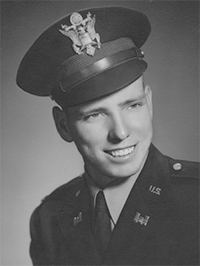
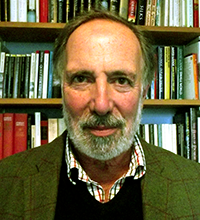
Ray Henkel was born Jan. 28, 1931 on a farm along the Cimarron River about 30 miles west of Tulsa. He died March 11, 2017, at age 86. Ray attended a one-room elementary school, and in 1948 graduated from Kellyville H. S. in a class of 15, earning an A in every class. Ray had a photographic memory, so school work was always easy for him.
Immediately after H.S. graduation in 1948, Ray and his family moved to Arizona to pick cotton. For the next two years, his family followed other laborers, mostly Hispanics, into California and the Northwest to pick fruit, potatoes, vegetables and the like. It was at this time that Ray learned to speak Spanish. Since the family was driving old cars, it was also at this time that he became an excellent mechanic, and for the rest of his life he worked on cars, doing both small and major projects.

He was drafted into the Army in 1950. After basic training, he was sent to the Officer Training School for the Army Corps of Engineers at Ft. Belvoir, VA. There were 21 students in his class, and he was the only one without a college degree or any engineer training, but he graduated 2nd in the class. Upon completion of the course he was commissioned an officer in the Corps of Engineers. He was assigned to Korea, and his unit, the 811th Engineer Battalion, was attached to the 5th Air Force, and he quickly became commander of “A” Company. Ray spent time in Korea and Thailand, mostly locating and building airfields and revetments, and building radar stations on islands off the coast of North Korea. As well, Ray was assigned as the Army Intelligence Officer for his battalion, and solved several major cases (only one remained unsolved). He left the military in 1952 with the rank of Captain.

Ray returned to Arizona to work on cotton farms. With his engineering and organizational skills, he quickly became manager of a large vegetable farm. He earned “very good money,” but eventually decided to attend Arizona State College, starting out part-time. He graduated in 1960 (by then it was ASU) as a geography major, with all “As” except for one “B” (in a class where no one received an “A”).

Ray went to the University of Wisconsin where he completed an M.A. and a Ph.D.   Both degrees were in geography, but he had extensive work in agricultural economics, which greatly helped in his later work, and where most of his interests lay. His dissertation was done in Bolivia on the Amazon side of the Andes, at a time in the mid-1960s when coca production was just beginning. His work was funded by the National Science Foundation, and the title of this work was “The Chapare of Bolivia: A Study of Tropical Agriculture in Transition” (1971). This was the beginning of a lifetime of work on the subject of coca and cocaine, and the tropics in general. He often described many “close calls” with government troops and violent narcotics producers. It was dangerous work, but he developed contacts with the two sides, and luckily managed to survive. He had many stories and slides, and he used both with great effectiveness in classes.

Ray taught at ASU from 1966 to 1995.   He took a leave to teach 2 years in the early 1970s at the U. of Zambia (to help establish their Geography Department), and one year at New Mexico State.   Ray published on all aspects of coca and cocaine. However, all of these publications were in classified government documents without his name on them–as he once explained “I don’t want a bullseye on my back.”  The only publication on cocaine with his name on it was with two co-authors on the use of climate for determining cocaine production (Nature Vol. 361, p. 25).  For many years, during summer months, he worked for various agencies in Latin America on cocaine and varied problems in the tropics (for example, once on road building, where his engineering background came in handy).  He traveled in both high society in cities, and among the poor in the jungles of the Amazon.  He was considered the leading expert on all aspects of cocaine (the growing, processing, transport and distribution), and often was flown to Washington, D.C. for conferences, policy meetings, and for consultations.  All of his work would be considered in the broad area of “applied geography.”

On first meeting him, many underestimated Ray.  He was an “Oakie,” who spoke, dressed, and acted the part.  But not only was he very intelligent, he was exceedingly observant, and quickly able to understand and make connections as to what he was seeing.   He was also–academically and intellectually–a very organized person, and with this trait, he helped many graduate students organize and conceptualize theses and dissertations. He was a humble and quiet person, who never wanted to “stand out” in a crowd. He grew up in a very impoverished family, where everything was always shared, and that background influenced him the rest of his life.

Dr. Henkel contributed to geographic education at Arizona State University in many ways.  He had a true commitment to students.  He was a very compassionate person, who was willing to help any student who wandered into his office.  Ray was always positive, never judgmental, and never had a bad word to say about anyone. He guided 26 MA theses during his career, but he helped many other students at all levels of academic work.  He was also an excellent and very popular teacher.  His classes were always educational and entertaining, and students flocked to them.  He also taught many televised classes that were viewed by many in the community who were not even enrolled.  Ray was involved with the geography honor society (GTU) from the time he returned to ASU to a year or two after he retired.  He organized and led many field trips, held parties and gatherings, and organized an annual picnic that has since evolved into the unit’s annual banquet.  He was liked and respected by all, and will be greatly missed.

Ray is survived by three brothers and numerous nieces and nephews.

    Share

AAG Announces Recipients of 2017 Awards

The American Association of Geographers (AAG) congratulates the individuals and groups named to receive an AAG Award. The awardees represent outstanding contributions to and accomplishments in the geographic field. The awardees will be recognized at the AAG Annual Meeting in Boston during the AAG Awards Luncheon on Sunday, April 9, 2017.

Friends, family, and colleagues are invited to celebrate with the honorees. Admission, which includes a plated lunch, is only $55. Tables for parties of ten are also available. Buy tickets.

* * *

Community College Travel Grants

  • April Shirey, Grand Rapids Community College, Grand Rapids, MI

AAG Darrel Hess Community College Geography Scholarships

  • Amy Kennedy, transferring from Sinclair Community College in Dayton, Ohio to the Ohio State University

Marble-Boyle Undergraduate Achievement Award in Geographic Science

  • Coty Welch, University of North Alabama

AAG Dissertation Research Grants

  • Mia Bennett, University of California Los Angeles
  • Eric Nost, University of Wisconsin-Madison
  • Yoo-Min Park, University of Illinois at Urbana-Champaign
  • Brian Williams, University of Georgia
  • Sheridan Wright Kennedy, Rice University
  • Qunshan Zhao, Arizona State University

AAG Research Grants

  • Sarah Blue, Texas State University
  • Shouraseni Roy, University of Miami
  • Qiusheng Wu, State University of New York at Binghamton

J. Warren Nystrom Award

 Mel Marcus Fund for Physical Geography

  • Dr. Sally Horn, University of Tennessee

*** AAG Book Awards *** 

Humboldt Book Award for Enduring Scholarship in Geography

  • Geoffrey Martin, American Geography and Geographers, Oxford University Press, 2015 

The John Brinckerhoff Jackson Prize 

  • Lisa Benton-Short, The National Mall: No Ordinary Public Space, University of Toronto Press, 2016

The AAG Globe Book Award for Public Understanding of Geography\

  • Niem Nguyen, A Curriculum of Fear, University of Minnesota Press, 2016

The AAG Meridian Book Award for Outstanding Scholarly Work in Geography

  • Eric Sheppard, Limits to Globalization: The Disruptive Geographies of Capitalist Development, Oxford University Press, 2016

* * *

Program Excellence Award

  • The Department of Geography and the Environment, University of North Texas
  • Honorable Mention: The Geography Department, George Washington University

 Susan Hardwick Excellence in Mentoring Award

  • Beverly Mullings, Queen’s University

Glenda Laws Award

  • Sarah Hunt, University of British Columbia

The AAG Harold M. Rose Award for Anti-Racism Research and Practice

  • Melissa Wright, Pennsylvania State University

AAG Enhancing Diversity

  • Leela Viswanathan, Queen’s University

AAG Harm de Blij Award for Excellence in Undergraduate Teaching

  • Ronald Kalafsky,  University of Tennessee

 E. Willard and Ruby S. Miller Award

  • Hui Lin, Chinese University of Hong Kong

 The AAG Stanley Brunn Award for Creativity in Geography

  • David Harvey, City University of New York 

 AAG Honorary Geographer

  • James Hansen, Columbia University 

Atlas Award

  • Noam Chomsky, Massachusetts Institute of Technology 

 AAG Presidential Achievement Award

  • Roger Downs, Pennsylvania State University

*** AAG Honors ***

Distinguished Teaching Honors

  •  Michael Pretes, University of North Alabama

Ron F. Abler Distinguished Service Honors

  •  Julie Winkler, Michigan State University
  • Kent Mathewson

Distinguished Scholarship Honors

  • Patrick Bartlein, University of Oregon
  • Michael Storper, University of California, Los Angeles

Lifetime Achievement Honors

  • Ruth Fincher, University of Melbourne
  • David Robinson, Rutgers University
    Share

Telling Our Stories, Speaking Out and Being Heard as Geographers

Perhaps now more than ever geographers need to tell their stories, speak out and make their voices heard. In a world that seems increasingly divisive politically and socially, and where the fact-based discourse and decision-making we value is under threat, there is much that we find of concern and much with which we feel we should publically engage. In this column I share my thoughts on three aspects of communicating as geographers with the public, policymakers and each other.

Telling Our Stories Beyond Academia

Let me begin with the question: Are the messages that geographers can convey about their research and the geographical perspective of newsworthy interest to the public? Or, is it the case that our studies and perspectives as geographers are generally too specialized and arcane to elicit interest by the press and the general public? A simple online search will soon dispel that latter illusion. Searching Google News for the stories from the past month or so that featured the work of geographers yields a rich and varied trove of newsworthy accomplishments and pronouncements. These broadcast, print and online stories about the work of geographers span a wide spectrum of research interests including topics such as Russian activities in the Arctic, air pollution in Canadian cities, regional benefits of wind-generated electricity, the pervasive role of humans in U.S. wildfire ignitions, Islamic finance practices, and potential problems to U.S. water affordability. Geographers, through their research and informed opinions, have much to say to the public on the myriad challenges facing the world today.

Although geographers do have much to tell the public, academics as a whole have often been reticent to engage with the press for various reasons. Some feel it is unseemly to be seeking public attention and scholars should not be “bragging” about their work. Others feel they do not have the time for public engagement, and besides it is someone else’s job to deal with the press and otherwise communicate beyond the academic community. Some are simply uncomfortable in the spotlight. I would argue that all of the above are excuses in which we cannot afford to indulge. For our discipline, our universities and in support of informed policy-making we have a responsibility to actively engage with the public in regards to our geographical studies and perspectives. My reasoning is as follows. We often decry that geography is not valued by some of our academic colleagues, our administrators or the public. How many times have I heard geographers bemoan that our discipline needs to be seen as more than the memorization of national capitals and the world’s highest mountains? The most expeditious way to influence both the public and policy-makers about the scope and value of geography is through press coverage of our work and findings. We can describe the breadth and depth of geography all we want on our departmental websites, but those pronouncements do not have the wide reach and impact on the public that an article in the newspaper or an appearance in a television documentary does. If you want to make real impact on a politician, get a spot in the newspaper, on television or the radio either contradicting or supporting their position based upon your own research and findings. Also, don’t think that academic administrators or colleagues in other departments are immune to being positively influenced by press coverage of our discipline. A dean or president likes nothing better than to read or view press coverage of the work produced by their university. For our discipline and for the public, geography should be part of the greater discourse on the issues of our times, but it is up to geographers themselves to make sure this happens.

How then do we get our stories heard and retold by the media? First, we must recognize that some things we produce will be of more public interest than others. Stories that are likely to be picked-up are those that relate to contemporary issues of concern to the public and policy makers. To be newsworthy there must also be new information or novel new insights provided. The stories from Google News I cite above provide examples of this. In addition, historical and cultural studies can be of wide public interest. One example is the work of geographer Amy Hessl of the University of West Virginia on climate change and the conquests of Genghis Khan. Her research has received considerable national and international press coverage. Beyond published original research, geographers often have informed perspectives on contemporary issues that can be shared directly by submitting Op Ed pieces to local or national newspapers. These 400- to 600-word pieces are tricky to write, but can have great impact. As an example, let me draw your attention to a 2016 Op Ed on climate change and university divesture strategies which was published in The Salt Lake Tribune by Emily Nicolosi, a Ph.D. student in the University of Utah, Department of Geography.

Second, we have to be proactive in getting our stories and perspectives known. It is important to get to know our campus press officers and inform them about our expertise. The media often is in desperate need of experts to interview on breaking news stories. They will often turn to campus press offices for experts. Geographers should make the effort to ensure they are on those campus lists of experts. In addition, when the call comes for an interview and you feel qualified – take the plunge and speak to the media. If a press officer and the media know you will respond, you are likely to be sought more frequently. In addition to funneling interview requests to geographers, campus press officers can produce press releases on new research. This will help draw media attention to your findings. It is important that you work with the press office well before your study is published online or in print. You will likely need to be involved with developing and editing the release and this takes time. As a start, perhaps invite the appropriate press officer to a faculty meeting to receive a briefing on their roles and inform them of your expertise. For those of you attending the AAG Annual Meeting in Boston, Vice President Derek Alderman will be leading a session on effective communication for geographers. I highly recommend taking advantage of this opportunity, if you can.

Speaking Out

Recent political events in the U.S., such as the current travel ban on citizens of six predominantly Muslim countries, or events outside the country, such as the purge of academics in Turkey, have increased the desire of AAG members to not just tell the story of their own work, but to speak out on political decisions that negatively impact geographers and other academics and students. In addition, as I wrote in an earlier column, certain legislative actions such as Senate Bill 103 take direct aim at denying U.S. Federal funds for selected types of geospatial data and geographical research. Such actions require geographers to speak out. Members often turn to the AAG to be a voice in speaking out on such issues. The AAG takes these matters very seriously and has issued public statements on such troubling actions and joined with other associations to combat them. An example is the effort being made to combat SB 103 and its restriction on geospatial data related to racial inequality. The AAG has not only issued a public statement, but has built a coalition that includes groups such as the NAACP to oppose this Bill. The association will continue to embrace such actions. Because of the need to more effectively convey information on such issues and let members know of AAG actions, we have established an online Policy Action Page and urge you to take advantage of this to stay informed.

Aside from written statements, group rallies have a long history as a mechanism for allowing collective voices to speak out on pressing political and social issues. In this vein, the AAG is partnering with other associations such as the American Association for the Advancement of Science, the American Geophysical Union and the Consortium of Social Science Associations for the March for Science in Washington, D.C., on April 22. This march is organized to allow “people who support scientific research and evidence-based policies to take a public stand” and is based on the premises of support for “all races, all religions, all gender identities, all sexual orientations, all abilities, all socioeconomic backgrounds, all political perspectives, and all nationalities“ and “Our diversity is our greatest strength.” I will be in Washington, D.C., to participate in the March for Science and invite you to join the AAG and me in speaking out in support of the value of science and evidence-based policies. In addition there are 360 satellite events around the world in which geographers who are supportive can take part on April 22. Please do let the AAG know if your department is involved in one of these satellite events or would like to join AAG’s activities in Washington.

However, statements and group actions by an association such as the AAG are not enough for geographers to speak out to their fullest effect. A great deal of impact can be generated by geographers taking individual actions to communicate their views. Such actions include Op Eds and letters to the editor in newspapers and online blogs. We need more geographers to speak up in this manner. In addition, there is great power in many individuals contacting individual policy makers and expressing the same concern. As an association the AAG can produce a single statement on an issue, but our membership has the capacity to issue some 11,000 individual statements. There is strength in such numbers when it comes to public policy, but to realize that strength individual members must accept the responsibility and take the time to themselves add their own voice to the chorus. Members can contact the president and U.S. senators, representatives and state-elected officials using the online USA.GOV portal. With this mechanism you can let your own representative know your concerns and also make your voice heard by the authors of legislation you object to or support. Similar portals are available in other countries such as Canada and the U.K. I urge you to also consider using your voice to speak out by individually contacting policy-makers on the issues about which you have concerns.

Being Heard

The communication goals of an association such as the AAG cannot simply be to provide a platform for issuing public statements and organizing actions such as public rallies. A central responsibility is to provide for communication between members to exchange views on critical issues, develop reasoned positions and then collectively decide on appropriate courses of action. Through our publications, knowledge communities, annual meetings and other activities, the AAG strives to provide this service. Disagreements will inevitably arise on how to deal with contentious issues, but we all benefit from reasoned and respectful exchanges of ideas of developing consensus for our actions. As members of the AAG, we must seek to not just be heard ourselves, but to allow other members to also be heard, even if their perspective or proposed actions may differ from our own.

The annual meeting in Boston will provide many opportunities for members to speak, be heard and be informed on the critical issues we face in the new political world in which we live. Opportunities will range from open discussions with AAG presidential leadership on responses to current U.S. policy changes, many sessions on human rights and talks by international thought leaders such as David Harvey, Noam Chomsky, Rush Holt and Jim Hansen on issues directly related to today’s challenges. Although the AAG has made arrangements for proxy and electronic presentations for citizens of Iran, Libya, Somalia, Sudan, Syria and Yemen so they will not be silenced, I bitterly regret their physical absence, and thank all the AAG members and staff who have worked, and will continue to work, on their behalves. I look forward to meeting with those of you who will be in Boston to join together and help develop strategies for how we as individual members, and the AAG as an association, can tell our stories, speak out and be heard.

Join the conversation on Twitter #PresidentAAG

—Glen M. MacDonald


DOI: 10.14433/2017.0004

    Share

Family-Friendly Boston

Family fun in Boston is around every corner.  From the waterfront to the Fens, and across the river too, Boston is full of family-oriented attractions.  We make history fun with tours of the Freedom Trail and interactive exhibits at the Boston Tea Party Ships & Museum and the USS Constitution Museum.  Don’t worry about those little feet getting fatigued because everything in Boston is nearby.  If you do need a rest hop aboard a Trolley Tour or Boston Duck Tour.

I Was A-Splishing and A-Splashing
Brian Talbot via Compfight

Boston museums are full of adventure.  Start with the Boston Children’s Museum in the Fort Point Channel neighborhood.  The Children’s Museum has been engaging and entertaining young minds for over a century and the museum recently unveiled an artist-in-residence program called Current. Head north along the waterfront and you will arrive at the New England Aquarium on Central Wharf.  Play with the seals, watch the penguins frolic, behold the Giant Ocean Tank, and get hands-on at the Shark and Ray Touch Tank.  Outside the Aquarium you will find an IMAX theater and whale watching excursions depart on the hour.

Adjacent to the Aquarium is the Rose Kennedy Greenway, full of food trucks, water fountains, art installations, open-air market vendors and a unique carousel.  Head into Faneuil Hall Marketplace to peruse food vendors inside Quincy Market and scintillating street performers up and down the corridors of the historic marketplace.

The Museum of Science is conveniently located just off the Green Line T.  Take the T to Science Park and you will see the famous T-Rex looming outside the building.  Explore the Butterfly GardenHall of Human Life and recently opened Yawkey Gallery.  Outside the museum, the iconic Boston Duck Tours have a departure location.  Hop aboard and see Boston from land and water.  Duck Tours also depart from the Prudential Center. If you are boarding from the Pru, head up to the Skywalk Observatory on the 50th floor to take in a bird’s eye of Boston and get a great view of Fenway Park, which is also open for tours.

Across the river, Cambridge is great for families as well.  Tour Harvard University with Trademark Tours and stop by the Harvard Museum of Natural History to see the famous Glass Flowers and new Marine Gallery.  In neighboring Somerville, the Legoland Discovery Center is a one-of-a-kind experience.

Come to Boston! An old city that’s perfect for young families.


Courtesy BostonUSA.com.

    Share