J. Ronald Eyton

It is with heavy hearts that we announce the passing of our faculty colleague, Ron Eyton, on March 14, 2022. His death, in a hospital in Vancouver, BC, following a sudden illness was unexpected.

Ron was raised in Atikokan near present Thunder Bay, Ontario. Ron’s father was a chemist at a local iron mine and helped Ron develop his life-long love of experimentation, photography, and cartography. Summer jobs in and around the mines convinced Ron to pursue a career in academic cartography. In a span of 10 years, Ron completed degrees from Rochester Institute of Technology (AAS photographic science), the University of North Dakota (PhB, MS physical geography and geology), and the University of Illinois (PhD physical geography and photogrammetry). Ron’s dissertation fitting first-degree trend surfaces to the flood plain and two terrace surfaces along a section of the Ohio River to determine if the terraces were of fluvial or lacustrine origin was published in the Geological Society of America Bulletin.

In the 10 years following his doctorate, Ron held a variety of academic appointments at the Assistant (University of Illinois, University of South Carolina) and Associate (Penn State University, University of Alberta) Professor level. He was promoted to Professor of Earth and Atmospheric Sciences at Alberta, however an institutional reorganization brought Ron to Texas State University in the Fall of 1995.

Ron was an important member of the Geography team which resulted in the Department of Geography being awarded the first doctoral program at Texas State University. Two sabbatical opportunities in his career resulted in visiting positions at the University of New South Wales and the University of Pittsburgh Semester at Sea program.

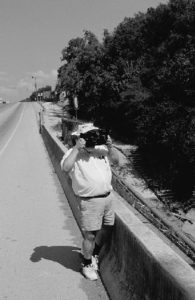
Ron Eyton with his self-built, stereographic multi-spectral camera system photographing flood damage on the Guadalupe River in 2002
Ron Eyton with his self-built, stereographic multi-spectral camera system photographing flood damage on the Guadalupe River in 2002.

At the time of his retirement in 2006, Ron had supervised 10 doctoral and almost 30 master’s students along with serving as a member of numerous doctoral and master’s research advisory committees. Ron was best known to his students for his classes in cartography visualization and remote sensing. Ron wrote most of the analysis software used in these classes and freely shared his code with students. His photography hobby was used in the classroom as his students were encouraged to fly with him for garnering aerial photography, and use his digital multiband camera systems to acquire and process their own data. His most popular class was “Digital Remote Sensing and Terrain Modeling” which he offered at both the undergraduate and graduate level.

Ron was committed to sharing the work of he and his students, publishing over 50 papers, and making over 30 professional presentations, many with his students as co-authors. Ron was in demand to share his expertise at invited lectures as well, making 46 presentations on digital terrain modeling and raster data processing to government and private sector groups in the US, Canada, and Australia. He also served as an instructor in short courses at annual meetings of the American Association of Geographers and the National Council on Geographic Education. His expertise and commitment to sharing was recognized with teaching and service awards at the local level as well as from the Canadian Institute of Geomatics and the American Society for Photogrammetry and Remote Sensing.

Retirement did not slow Ron. Accompanied by his spouse Lynne they traveled throughout the US and Canada, wherever Amtrak or VIA Rail would take them. After brief stops in southwest Minnesota and eastern Washington state , they finally settled in Pemberton in the Sea to Sky country of Western British Columbia. We will all miss their annual Christmas calendar illustrated with images of their many travels. All of us send our best wishes to Lynne and their children Ben and Tammy. Our memory of Ron will always include a short sleeve white shirt, khaki shorts, and if outside, a white Tilley hat.

— Prepared by Richard W. Dixon and David R. Butler, Department of Geography and Environmental Studies, Texas State University

    Share

Duane F. Marble

Dr. Duane F. Marble passed quietly in his sleep Tuesday February 22, 2022 with his wife and children nearby.  He loved his family, geography, his students, the outdoors, travel, good food and wine, good books, great conversation, cats, and the company of friends.

Duane was born to Francis and Beulah Marble in West Seattle, Washington, December 10, 1931. He earned three degrees from the University of Washington, earning his Ph.D. in 1959. He served on the faculties of the University of Oregon, the University of Pennsylvania, Northwestern University, the State University of New York at Buffalo, and The Ohio State University. At Buffalo, he established the first formal research unit dealing with Geographic Information Science (GIS) and the first graduate program in geography that provided a specialization in GIS. After retirement he held a courtesy appointment as Professor of Geosciences at Oregon State University.

What separated Duane from most professors was his active interest and involvement with his graduate students. He took an enthusiastic and supportive role as an advisor, a mentor, and a friend, providing great personal and intellectual encouragement and support, which carried on well past graduation. During his 40-year academic career, more than 75 graduate students completed their degrees under his supervision. His high standards prepared his students for successful careers, with many of these now close friends holding senior positions in academia, government, and industry.

Dr. Marble was instrumental in developing GIS as a strong, scientific academic endeavor. He established the International Symposia on Spatial Data Handling, collaborated on creating instructional software used by over 300 universities worldwide, and led GIS seminars in several countries. In 1993 he received an American Association of Geographers (AAG) Honors award and in 2011 he was awarded University Consortium of Geographical Information Science Fellow status in recognition of his remarkable impact.

After retiring from teaching, Duane and Jackie moved to Oregon and he stayed active in consulting, researching, and guiding scientific research in Geography. His presence in GIS education will continue through the Marble Fund for Geographic Science which he created in 2005. This Fund supports the William L. Garrison Award for Best Dissertation in Computational Geography and the Marble-Boyle Undergraduate Achievement Award, which are administered by the AAG.

Duane is survived by his spouse of 65 years, Jacquelynne, his cousin Kathy Kelley, his children, Kim and Dan Schnell and Doug and Claire Marble, and his grandchildren, Elizabeth and Brendan.

In lieu of flowers, the family wishes any memorial contributions be made to the Marble Fund for Geographic Science, managed by the American Association of Geographers (https://www.aag.org/donate/#/donate, select ‘designate my donation to “other,”’ select the Marble Fund for Geographic Science.)

    Share

William Bjorn “Bill” Beyers

With a great deal of sadness, the University of Washington’s Department of Geography marks the passing of our long-time faculty colleague and former chair, William Bjorn “Bill” Beyers, in early February.

Bill was born in Seattle on March 24, 1940. He attended schools in West Seattle, including an elementary school that was flattened in the April 1949 Seattle earthquake (9-year-old Bill was thrilled to learn that school would be cancelled for at least a week). He was an alums of UW Department of Geography’s undergraduate and graduate programs (B.A. 1958, Ph.D. 1967), and worked his entire career in this department. He retired in 2010 but continued to teach part-time for another 5 years, and remained active in research and public service throughout the rest of his life. Over 52 years as a member of our department, Bill served as the departmental cartographer, a teaching assistant, a research assistant, a faculty member, and two terms as chair. His first publication, with his doctoral advisor Morgan Thomas, appeared in the Annals of the Association of American Geographers in 1965. An economic- and urban geographer and regional scientist, Bill helped develop Seattle’s first “input-output model,” a statistical technique for modeling the inter-dependency of different economic sectors in a region. Over his career, Bill created countless similar models for the State of Washington, finishing his most recent update in 2021. Governor Jay Inslee recognized this accomplishment in a commendation letter, stating “It is a tribute to your foresight and engagement that Washington is one of the only states in the country with a unique version of this tool using state-specific data… I applaud your important contributions, your technical skill and diligence, and your dedication as a public servant.”

As a researcher and educator, Bill lived out his firm conviction that the highest responsibility of a university is public service. This fundamental thread connects all members of the geography department across many generations, and is the facet of our collective identity of which we are most proud. Bill taught thousands of UW undergraduates, typically in very early morning, including his popular Geographies of the Pacific Northwest course that he taught for over 50 years. He supervised countless M.A. and Ph.D. degrees, and remained active in doctoral supervisory committees long after his retirement, including a Ph.D. defense last June. For more on Bill’s research, teaching, and public scholarship, we invite you to visit the following news stories:

Bill was a character in every sense of the word. He loved his wife, their dogs and cats, their garden, this department, the UW, and every square inch of this beautiful place we call home. His hiking adventures with Dick Morrill and generations of faculty and grad students were the stuff of legend, as was his penchant for jogging to campus from his home in West Seattle and then taking the bus back home. Current chair Sarah Elwood recalls visiting the department as a prospective graduate student in the early 1990s and meeting Bill at that time during his first term as chair. Years later, when she visited as a candidate for an assistant professor position, Bill was once again the chair. As they wrapped up the interview exit meeting, Bill said, “You’re an urban geographer! Want to take the bus to the airport?” He proceeded to print and annotate all the necessary bus schedules, dug $1.85 in change out of his pockets, and pointed her in the direction of the bus stop. He was a good neighbor in every sense of the word, sharing plants, tools, home repair advice, bushels of homegrown fruits and vegetables, and countless route suggestions for bicycling to the UW and elsewhere.

Bill’s life was fully and meaningfully lived. For that, all of us in the department, at the University, and across generations of UW alums feel a deep gratitude.

Reprinted from a tribute submitted by Nell Gross and Sarah Elwood on the University of Washington Geography Department’s website.

    Share

Anthony O. Gabriel

Anthony O. Gabriel, professor of geography at Central Washington University, died Tuesday, September 14, 2021, after a valiant 14-month battle with cancer. He was 56. He was called home to God at his home surrounded by his loving family.

Anthony was born to Oswald Gabriel and Ursula Duhr in Vancouver, B.C., Canada in October 1964.  He grew up in Langley, B.C. and attended Trinity Western University.  He went on to complete his Master’s degree at Western Washington University where he met and married his wife, Marikay Douvier.  Anthony continued to complete his Ph.D. in Geography at the University of Guelph in Guelph, Ontario.

Anthony was a professor in the geography departments at Western Washington University, University of Wisconsin-Oshkosh and finally, for the last 20 years, at Central Washington University.  Through is love of teaching and research, he helped to mold the future of many students. He always went over and above to serve his department and his students. He successfully supervised over 30 Masters of Science theses.

Together Anthony and Mari welcomed two children, Katie and Zach. Anthony was very proud and supportive of his children, as he was involved in their education, extra-curricular activities, and life lessons. He always encouraged his children to pursue their dreams and goals.

Anthony was a devout member of St. Andrew’s Catholic Church. He enjoyed camping and fishing, walking his dogs, playing pool in the Ellensburg Pool League and being a 4-H leader for On Target Shooting Sports.

Anthony was a remarkable, very generous, and caring person, completely devoted to his family. He mentored many young faculty members in the department of geography at Central Washington University, helping them navigate work-family balance. He will be especially missed for his hilarious (and unique) sense of humor and how he loved to make people laugh.

Anthony was preceded in death by his father, Oswald Gabriel. Anthony is survived by his wife Mari, daughter Katie, son Zach, mother Ursula Gabriel, sister Angela Gabriel-Morrissey, brother-in-law Chris Morrissey, as well as numerous in-laws (and out-laws), nephews and nieces.

    Share

Bobby M. Wilson

Dr. Bobby M. Wilson, Emeritus Professor of Geography at the University of Alabama, who was a widely recognized leader in anti-racist scholarship, passed away on August 25th, 2021.

Dr. Wilson grew up on a farm in Warrenton, North Carolina where his responsibilities on the farm shaped his character and strength. It was also in Warrenton that he participated in the struggle for civil rights in the early 1960s. Later, he would attend North Carolina Central University, which was one of the few historically Black colleges that offered an undergraduate degree in geography. He earned a B.A. in Geography there and then received a fellowship to attend Clark University, where he earned a M.A. (1973) and Ph.D. (1974).

His first teaching position was in the Department of Urban Studies at the University of Alabama at Birmingham, from 1974-2002. He moved to the University of Alabama (in Tuscaloosa) in 2002, where he stayed for nearly two decades pursuing anti-racist scholarship. He also served as interim chair and retired as professor emeritus in 2015. Fittingly, his office in Farrah Hall was only a few steps away from Malone Hood Plaza on The University of Alabama campus, which celebrates the desegregation of the University of Alabama. His proximity to the plaza is symbolic of Dr. Wilson’s long dedication to anti-racist scholarship.

Wilson was active in several research areas including Urban and Social Geography; Urban Studies; Black Geographies; and the civil rights movement. His publications cover topics including Black perspectives on labor geographies, racial capitalism, urban planning, and residential segregation. His most notable publications were America’s Johannesburg: Industrialization and Racial Transformation in Birmingham, and Race and Place in Birmingham: The Civil Rights and Neighborhood Movements, both published in 2000. These books explore crucial links between the civil rights movement, the unique rise of industrial development in Birmingham, and Alabama’s former slaveholding plantation economy. These books are highly regarded in a variety of disciplines from Urban Studies to Economic Geography for their clear analysis of the spatial dimensions of race and exploitation of Black labor during industrialization. As a testament to the lasting importance of his work, The University of Georgia Press republished America’s Johannesburg in 2019.

In addition to being a member of the American Institute of Certified Planners and the Editorial Board, of AntipodeA Radical Journal of Geography, Dr. Wilson was also a long-time member of the American Association of Geographers and was active in the Southeast Division (SEDAAG). He served on the Editorial Committee, of Southeastern GeographerJournal of the Southeastern Division, Association of American Geographers, the Editorial Board, of Annals of the Association of American Geographers, and AAG’s Commission on Afro-American Geography.

He was recognized by the AAG with a Presidential Achievement Award in 2012, and both a Rose Award for Anti-Racism Research and Practice and the AAG Lifetime Achievement Award in 2015. The latter in “recognition of his extraordinary contributions to the scholarship of urban and social geography, urban studies, and anti-racist theory and practice; his teaching and mentoring; as well as his exemplary leadership in support of geography.”

Dr. Wilson is remembered fondly by many former colleagues and students at the University of Alabama and elsewhere.

    Share

Sanford Bederman

Sanford H. Bederman, 89, of Johns Creek, Georgia, died on 19 August 2021 from complications of cancer. A graduate of the University of Kentucky and a U.S. Army veteran who served in Germany in the 1950s, he received his M.A. from Louisiana State University in 1957, and Ph.D. in Geography from the University of Minnesota in 1973.

Bederman began teaching at Georgia State College of Business Administration in 1959, and in 1974 he was promoted to Full Professor at what became Georgia State University.  His primary area of interest was Africa, with time spent in the field in Nigeria, Cameroon, Tanzania, Kenya and Morocco pursuing research supported by the NSF, the Rockefeller Foundation and Georgia State University. Over the years, Bederman held several visiting professorships including at Queen Mary University, University of London.

Bederman was recognized as a gifted teacher who taught and advised generations of students and was also a prolific writer, with many publications including articles in The Oxford Companion to Exploration for which he served as the Africa Section editor.

Bederman retired from GSU in 1992, concluding 34 years of service. From 1993-95 he was a Visiting Professor at The University of Georgia, and thereafter he continued to teach at the Senior University of Greater Atlanta. Bederman was active in The Society for the History of Discoveries, serving as Executive Secretary in 2006. He was an Honorary Life Member of the Southeastern Division of the Association of American Geographers, and a Fellow of the Royal Geographical Society.

    Share

John Herbert Galloway

John (‘Jock’) Herbert Galloway died on July 27, 2021 in Tweed, Ontario, after suffering several years with Alzheimer’s.

Jock, as he always preferred to be known, graduated with a BA in Geography from McGill University in Montreal in 1960, an MA in Geography from the University of California at Berkeley in 1961, and a PhD from University College London in 1965. His doctoral research, conducted under the supervision of Professor Clifford Darby, focused on the historical geography of Pernambuco in Northeastern Brazil, from 1770 to 1920. Jock was appointed a Lecturer at the University of Toronto, St. George in 1964, and then an Assistant Professor in 1965. He was promoted to Associate- and Full-Professor ranks in 1970 and 1977, respectively. Jock retired from the University in 2005 when he was appointed Professor Emeritus. During his many years at the University of Toronto, Jock was a devoted and much loved and respected member of the Department of Geography & Planning as well as at Victoria College where he was a long-time Fellow.

Jock’s research and publications focused on the historical geography of Brazil and the Caribbean, leading to his monograph, The Sugar Cane Industry. An historical geography from its origins to 1914 published by the Cambridge University Press in 1989.  Exploring the global geographical diffusion of the sugar cane industry and its various branches, it is now considered a classic reference on the subject. Jock was a Fellow of the Royal Geographical Society and the American Geographical Society, and a member, among others, of the Canadian Association of Geographers (CAG) and the Barbados Museum and Historical Society. He served as Associate, Acting-Editor, and then Editor for the Canadian Geographer from 1966 to 1973, and on the editorial board of the Journal of Historical Geography from 1974 to 1978 and again from 1984 to 1994. He was the Review Editor for the Americas for the same journal from 1978 to 1983. From the late 1980s to the 2000s, Jock served on editorial boards for other periodicals including Latin American Studies, and the Luso-Brazilian Review of the University of Wisconsin Press. Pursuing his interest in sugar and his links with similarly minded people around the world, from 1994 to 2005 he co-edited the World Sugar History Newsletter. Over his long academic career, Jock published numerous articles and chapters, and delivered dozens of symposia papers and invited lectures. He also received several awards from his peers, including the Award for Scholarly Distinction from the CAG, and an Outstanding Teaching Award from the University of Toronto.

Jock will be remembered as a wonderful colleague and dedicated teacher. He was in personal life a Renaissance man, urbane, witty, multi-lingual, culturally engaged, and a great cook. Since his retirement, colleagues and students have often reminisced about seeing Jock in the hallways of Sidney Smith Hall, always dressed impeccably, and very often rushing with maps rolled under his arms, on his way to give a lecture. Jock will be remembered as a scholar as well as consummate gentleman who was always supportive of his colleagues and students.

5 August 2021

    Share

Roger Kasperson

Former Clark Graduate School of Geography faculty member Roger Kasperson, passed away on Saturday, April 10. A major scholar in the fields of risk and environmental sustainability, Professor Kasperson had a nearly lifelong relationship with Clark and the GSG: he earned his B.A. in Geography from Clark in 1959, and returned to Clark as a faculty member in Geography and Government in 1968 after earning his M.A. and Ph.D. in Geography at the University of Chicago and teaching elsewhere for several years. He spent the majority of his career at Clark, in a variety of roles: in addition to being an assistant, associate, and full professor in our department, he headed a number of major centers and initiatives at Clark and served at various points as Acting Director of the GSG, Dean of the College, Provost and Vice President for Academic Affairs, and University Professor. He retained an appointment as a Research Faculty member in our department up until the time of his death.

Professor Kasperson was a major figure in the fields of risk analysis and communication, global environmental change, and vulnerability, sustainability, and resilience. As such, he worked closely with a variety of government agencies and NGOs, including the National Research Council, the International Geographical Union, and the Potsdam Institute for Climate Change. Perhaps most notably, he was the Executive Director of the Stockholm Environment Institute from 2000-2004. He was also an elected member of the National Academy of Sciences, the American Academy of Arts and Sciences, and the American Association for the Advancement of Science, and a recipient of honors from both the AAG and the Society for Risk Analysis.

Thank you to the Graduate School of Geography at Clark University for permission to publish this obituary. Original found here.

    Share

Nancy Hultquist

Nancy B. Hultquist, retired Central Washington University (CWU) geography professor, died March 30th, 2021. During her geographic career she was an active member of the American Association of Geographers (over 50 years), the National Council for Geographic Education (NCGE), and the Washington Geographic Alliance (WGA). Nancy is remembered fondly by students, friends, and colleagues. She was quick to assist junior faculty and devoted countless hours to helping students find employment.

Like many geographers, Nancy was drawn to the field early in her academic career. Also, like many geographers, she had many non-academic interests including bowling, raising Brittneys, and playing the fiddle.

Born in 1943, Nancy grew up in Atlanta, GA where she lived near a 32-lane bowling alley. There she worked and became good at the sport. (Nancy holds the record of High Series (679) for Women in Moscow, ID.) She completed her undergraduate degree in 1965 at Georgia State University and then on to Graduate school, first at the University of Cincinnati and then on to the University of Iowa. Along the way she married John (also a geographer) in 1969. From the farming country of Iowa came the first Brittany. Then the University of Idaho beckoned (1974), and the three headed further west.

The Moscow university provided a split position that Nancy and John shared. Along the way she gained knowledge and teaching experience using computers to make detailed maps. Like so many of her contemporaries, Nancy started out with key-punch cards and eventually moved on to Geographic Information Systems (GIS). Countless K-12 teachers were introduced to the early iterations of making maps and GIS through NCGE workshops she participated in with Paul Baumann.

In 1988, Nancy joined the CWU geography department as the first full-time, tenure-track woman faculty member. There, she became involved with an Army initiated (GRASS) GIS program. Initially the program used CWU faculty to do mapping for the Army’s Yakima Firing Center/Training Center. Nancy expanded the program to include undergraduate GIS classes and was instrumental in moving the program along. Her popular classes grew, and she soon had students presenting their GIS projects at professional meetings. It is little wonder that, as an advisor, she supervised more interns than any other geography department faculty.

Other than her love of geography and dogs, (their kennel name – Cedaridge Brittanys – was known throughout the Nation) Nancy was also a talented musician. She first played the fiddle at the age of 4 and, as an additional outlet for her boundless energy, joined a group named Kittitas Valley Fiddlers and Friends. Heart issues from a childhood case of Rheumatic fever ended her academic career, but only interrupted her fiddle playing. Major heart surgery came in 2009. Her surgeon told her she was spared because there was more for her to do on Earth.

As she recovered and gained stamina, Nancy began to take a larger role in the music of the Kittitas Valley Fiddlers and Friends. They played at elder care facilities in Ellensburg and other venues in the area, especially at the Adult Activity Center. The photo accompanying this text is from this period. She considered the entertainment provided to the residents of the valley in these facilities one of her best experiences.

Nancy was known as a great teacher and an even greater supporter of student success. She maintained a jobs list of employment opportunities across the Pacific Northwest which currently has over 800 subscribers. Many CWU alumni credit her tireless work to helping them launch their career. The list will continue, serving as a living memorial to her impact. Please take a moment to remember Nancy B. Hultquist as a shining light to students, colleagues, and friends.

    Share

Allen G. Noble

Dr Allen G. Noble, Professor Emeritus at the University of Akron, Ohio and a longtime AAG member, passed away on March 24. He was 90 years old.

In his early career, Dr. Noble served as a United States Foreign Service Officer in Bombay, India, and Curitiba and Belém, Brazil. He went on to a distinguished academic and publishing career in regional, cultural, and physical geography. His book Wood, Brick, and Stone: The North American Settlement Landscape was nominated for a Pulitzer Prize in 1984. In the late 1980s, AAG recognized Dr. Noble with the AAG Honors, the highest award offered by the AAG. The Ohio Academy of Sciences cited him in their 100th Year Celebration as one of Ohio’s Distinguished Scientists.

Noble’s ability to keep his family goal oriented and organized will be greatly missed. He was predeceased by his daughter and is survived by his wife, two sons, four grandchildren and three great grandchildren

    Share