Southeast Division Team Takes 2016 World Geography Bowl Title

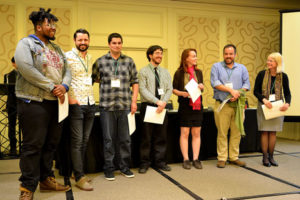
AAG President Sarah Bednarz (far right) presented prizes to winners, including the winning Southeast Division team above. (Photograph for AAG by Becky Pendergast)

The Southeast Division team won first place in the 2016 World Geography Bowl (WGB), an annual quiz competition for teams of college-level geography students representing the AAG’s regional divisions. First runner-up was the Pacific Coast Division team and second runner-up was the Middle Atlantic Division team. This was the 23rd year for AAG hosting during its annual meeting in San Francisco, Calif.

Read more about this year’s event.

Contestants are selected by regional divisions via a competitive process, which in many divisions includes participation in a regional geography bowl held at the regional division’s annual meeting. Each participant in the World Geography Bowl receives a travel stipend, co-sponsored by the AAG and that student’s regional division, greatly offsetting expenses for attendance at the national meeting.

Learn more about the WGB.

The competition is fully staffed by volunteers, who write and edit questions and help run the proceedings as judges, scorekeepers, and moderators. To become involved, read more about the process or contact WGB executive director Jamison Conley, (West Virginia U.) at Jamison [dot] Conley [at] mail [dot] wvu [dot] edu.

Anyone interested in becoming a sponsor or donating prizes of books, gift certificates, software, etc., may contact AAG’s WGB liason Ed Ferguson at eferguson [at] aag [dot] org.

Note: This post was edited to reflect that it was the 23rd annual event. A previous version erroneously stated it was the 27th annual event.

    Share

NSF Funds Research Coordination Network for Geography Education

The National Science Foundation, through its Geography and Spatial Sciences program, has awarded the AAG and Texas State University a five-year, $400,000 grant to develop a research coordination network (RCN) for transformative research in geography education. The RCN will be a project of the National Center for Research in Geography Education (NCRGE) under the direction of Dr. Michael Solem (AAG) and Dr. Richard G. Boehm (Texas State University).

Context

In 2007, NSF adopted the following working definition of “transformative research”:

Transformative research involves ideas, discoveries, or tools that radically change our understanding of an important existing scientific or engineering concept or educational practice or leads to the creation of a new paradigm or field of science, engineering, or education. Such research challenges current understanding or provides pathways to new frontiers.

What might transformative research look like in the context of geography education? This question was given in-depth consideration by The Road Map for 21st Century Geography Education project from 2011-2013. The Road Map Project issued a landmark study that considers many substantive issues as to what research topics, questions, and methods are most critical for ensuring long-term progress and improvements in student achievement. It concludes with a set of recommendations for building research capacity and capability in geography education. These recommendations emphasize scientific approaches to research planning and design as a strategy for moving beyond the descriptive, singular, and anecdotal studies that abound in the geography education literature.

RCN Goals and Activities

NCRGE will facilitate research coordination, collaboration, and information sharing among geographers and educational researchers in other disciplines. Funding from the NSF grant will be invested into the RCN over the next five years to establish research groups and support research planning and networking activities that ultimately result in sustainable lines of research tied to the Road Map Project agenda. The research groups will be interdisciplinary, involving geographers and experts in STEM, the learning sciences, cognitive science, and other fields of educational research. International collaborators will also be included in the RCN.

Any researcher who wishes to support NCRGE’s mission for transformative research in geography education is welcome and encouraged to participate in this project. Students and early career faculty are especially encouraged to get involved.

By joining the RCN, researchers will work together to raise the profile of geography education as a research field, recruit more diverse cohorts of graduate students, and promote the use of research to improve the quality of geography teaching and learning in local communities. The long-term vision is to support the development of evidence-based practices, new knowledge and theory, more robust curricula, better standards and assessments, and expanded access to high-quality teacher training programs in geography. An online RCN membership application is available at www.ncrge.org/rcn.

Upon joining the RCN, new members will receive access to an online social network community that provides a variety of communication tools for growing and sustaining the network. All RCN members will have access to blogs, forums, and many other resources that can be used to cultivate a community of practice.

Upcoming Activities

In the coming months NCRGE will be sponsoring a variety of activities for RCN members. First up is a workshop for early career scholars on May 15-18 in Lafayette, Louisiana. This workshop will draw on NSF- funded research investigating the integration of geospatial content and skills into pre-service teacher training courses in math, science, and social studies. NCRGE is now expanding this research to involve in-service teachers and students. Workshop participants will review content enrichment modules, enhance each module with geospatial technology, and develop questions for a spatial thinking test that aligns with the content modules.

Later this summer the first cohort of research groups established under the Transformative Research grant program will be introduced at the National Conference on Geography Education in Tampa, Florida on July 27-31. This conference will be one of many important stages to launch and showcase the work of RCN members.

Another important activity for NCRGE will involve a collaboration with the National Geographic Society to include the Geographic Alliance Network in research activities. Several Geographic Alliances are already part of the RCN and have proven critical in providing access to schools for data collection on innovative topics such as learning progressions.

Looking ahead toward the 2017 AAG Annual Meeting in Boston, NCRGE will sponsor the 2nd Annual Symposium for Transformative Research in Geography Education on Saturday, April 8. This event will feature plenaries by leading geographers and educational researchers, presentations by NCRGE grant recipients, workshops, and other capacity-building and networking activities.

For more information about the NCRGE research coordination network, visit www.ncrge.org.

    Share

Donna Peuquet named 2016 UCGIS Fellow

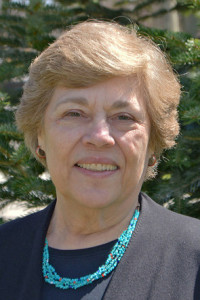
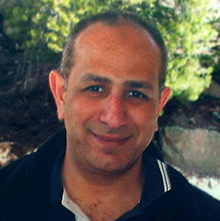
AAG member Donna J. Peuquet, professor of geography in the Penn State Department of Geography, has been selected as a 2016 Fellow by the University Consortium for Geographic Information Science (UCGIS).
Fellows are individuals who have contributed significantly to the advancement of geographic information science education and research. Peuquet was chosen as Fellow for her research and education contributions to the field of GIScience, as well as her leadership in UCGIS and other geospatial organizations. She will be recognized at the 2016 UCGIS Symposium May 24-26 in Scottsdale, Arizona.

“It’s an honor and very flattering to know that my GIScience colleagues value the research I’ve done over the years, as well as my contributions to UCGIS,” Peuquet said.

The UCGIS Fellows Program was created in 2010 to celebrate the extraordinary record of achievements of individuals in a variety of spatial disciplines and communities of practice that use spatial information. Fellows are selected by a review committee comprised of the current UCGIS Fellows and members of the UCGIS board of directors. Learn More.

    Share

Celebrate Earth Day Everyday by Helping Students Discover Our Earth Through Geospatial Technology

Inspire Students By Becoming a GeoMentor
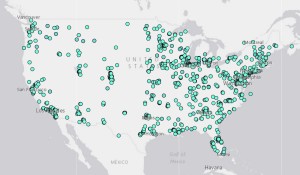
  • Are you passionate about the importance of geography education?  
  • Are you a geographer, cartographer, or educator that can communicate the benefits of GIS for illustrating geographic concepts and context in the classroom?   
  • Have you taken a GIS course, used GIS at your job, or developed educational activities that use GIS?

Then YOU can be a GeoMentor and we could use your help! Register today!

The AAG is building a diverse and talented network of GeoMentors by recruiting from the broad GIS community including all disciplines engaged with GIS, from the social to the physical sciences.  Individuals across all sectors (public, private, academic, NGOs) will be part of this exciting opportunity to build student interest in and enthusiasm for the endless application of GIS.  Whether your expertise is speaking on the general topic of the power of maps and GIS or you are an expert GIS user with advanced spatial analysis skills, you can play an important role as a GeoMentor.  From undergraduate students and GIS technicians, to professors and geographic information scientists, and everyone in between, we welcome the entire GIS community, to volunteer their skills and experience as a GeoMentor.

Previous experience with ArcGIS Online is not required; we have many training resources available to help you quickly gain basic skills that will make you an asset to K-12 classrooms.

Ready to volunteer as a GeoMentor?  Sign up here!

Want to learn more about your fellow GeoMentors? Check out the GeoMentor Spotlight.

    Share

2016 J. Warren Nystrom Award

Four early-career academics presented high-quality research papers in the final of the 2016 Nystrom Competition on March 30, 2016 during a special session at the AAG Annual Meeting in San Francisco.

The Nystrom Award is an annual prize for a paper based upon a recent doctoral dissertation in geography.

In Fall 2015 the Nystrom Award Review Committee considered all the papers submitted and selected four candidates to advance to the final round of the competition.

The finalists and the papers that they presented at the Annual Meeting were:

  • Vena Chu, University of California, Berkeley – “Assessing southwestern Greenland ice sheet moulin distribution and formation from high resolution WorldView-1/2 remote sensing”
  • Kimberley Thomas, University of Pennsylvania – “Bordering non-water flows: Explaining upstream-downstream power asymmetries in the Ganges Basin”
  • Sharon Wilcox, University of Texas at Austin – “Murderous Jaguars, King cats, and Disappearing Tigres: Emergent Rhetoric of Conservation in the early Twentieth Century”
  • Peng Jia, Louisiana State University – “Delineating Hospital Service Areas Based on the Revised Huff Model”

The Committee was looking for original ideas and research that makes a potential contribution to the advancement of knowledge in a particular subfield of geography. Candidates were evaluated on the basis of the clarity and effectiveness of written style in their submitted papers, and the quality and effectiveness of their oral presentation.

After careful deliberation, Kimberley Thomas was chosen as the 2016 winner. She attended the AAG Awards Luncheon on April 2 to collect her certificate and cash prize of $1,000.

All finalists have been invited to submit their papers for consideration for publication in one of the AAG’s journals, The Professional Geographer.

This award is made from a fund established by John Warren Nystrom, who served as the AAG’s Executive Director from 1966 to 1979. Nystrom was an exceptional educator who taught geography for many years at Rhode Island College, University of Pittsburgh, George Washington University, and Florida Atlantic University. He published a number of geography textbooks and periodicals on U.S. relations with the European Community, Canada and Latin America. Beyond academia, he had a long and productive career in international relations as a senior official in the Foreign Policy Department at the U.S. Chamber of Commerce, a partner in the international relations consulting firm of Allen, Murden and Nystrom, and a Senior Fellow at The Brookings Institution. He also represented the United States at UNESCO, the United Nations’ educational, scientific, and cultural organization.

    Share

2016 Annual Specialty and Affinity Group Awards

The AAG has around 65 Specialty and Affinity Groups which bring together AAG members around interests in particular topics, regions or professional communities.

Many of these groups bestow awards for outstanding achievement and service, prizes for papers and posters, and give grants for research and travel to students, faculty and professionals in their respective fields.

Some of these awards were presented at the AAG’s annual Awards Luncheon held in San Francisco on April 2, 2016 and these are listed below. The full list of all 2016 Specialty and Affinity Group Awards will be published on the AAG website in due course.

Special distinctions

Some of the Specialty Groups select established members of their community for their highest recognition.

  • The late Susan Hardwick, who passed away in 2015, was posthumously recognized by the Ethnic Geography Specialty Group for her career accomplishments in ethnic geography scholarship, teaching, and service.
  • Michael Kuby from Arizona State University received the Ullman Award from the Transportation Geography Specialty Group for his outstanding contributions and service to the field of transportation geography.
  • Mei-Po Kwan from the University of Illinois at Urbana-Champaign received the Melinda S. Meade Distinguished Scholarship Award in Health and Medical Geography from the Health and Medical Geography Specialty Group for her outstanding record of research and teaching on health and medical geography, leadership in this area, and service to this community.
  • Dick Marston from Kansas State University received  the Melvin G. Marcus Distinguished Career Award from the Geomorphology Specialty Group.
  • William Moseley from Macalester College received the Kwadwo Konadu-Agyemang Distinguished Scholar on Africa Award
  • John Weeks from San Diego State University received a Lifetime Achievement Award from the Population Specialty Group for his outstanding contributions to the field of population geography through research, teaching, professional services, and mentoring.
  • Julie Winkler from Michigan State University received a Lifetime Achievement Award from the Climate Specialty Group in recognition of her career of excellent research, teaching, and mentoring in climatology, and for outstanding service to the AAG and climate specialty group.
  • Bill Wyckoff from Montana State University was honored as a Distinguished Historical Geographer by the Historical Geography Specialty Group for his research and writing which exemplifies the best in historical geography scholarship.
  • Xinyue Ye from Kent State University was given a Distinguished Service Award from the Regional Development and Planning Specialty Group for his service to the group.

Awards for publications

  • The Geomorphology Specialty Group gave the Grove Karl Gilbert Award for excellence in geomorphological research to Edgardo Latrubesse from the University of Texas at Austin for his paper published in Earth Science Reviews entitled “Large Rivers, Megafans and other Quaternary Avulsive Fluvial Systems: A potential “Who’s Who” in the Geological Record.”
  • The Political Geography Specialty Group gave the Virginia Mamadouh Outstanding Research Award for a journal article or book chapter that makes an innovative, original contribution to the conceptual and/or methodological embrace of political geography to Ian Shaw for his paper published in Area entitled “Force-Full Power, Politics, and Object Oriented Philosophy.” 

Thesis and Dissertation Awards

The Transportation Geography Specialty Group gave two awards to students who completed postgraduate degrees in the last year.

  • Ying Song from the University of Minnesota won the Outstanding Dissertation Award for her doctoral dissertation entitled “Green Accessibility: Measuring the environmental costs of space-time prisms in sustainable transportation planning.”
  • Lea Ravensbergen-Hodgins from the University of Toronto won the Outstanding Master’s Thesis Award for her thesis entitled “Socioeconomic Discrepancies in Children’s Accessibility to Health Promoting Resources: An Activity Space Analysis.”

Student Paper Awards

Many of the Specialty Groups have competitions for student papers or posters given at the AAG Annual Meeting or other events.  The following were awarded with prizes in 2016:

China Geography Specialty Group
  • Yicong Yang, Cornell University “Understanding informal spaces in a Chinese megacity”
Cultural and Political Ecology Specialty Group
  • Lily House-Peters, University of Arizona “Social-Ecological Transformations and Riparian Enclosure: The Production of Spaces of Exclusion and the Uneven Development of Resilience in the Sonoran Borderlands”
Economic Geography Specialty Group
  • Aarti Krishnan, University of Manchester “Expansion of regional value chains: The case of Kenyan horticulture”
Ethnic Geography Specialty Group
  • Scott Markley, University of Tennessee “Examining the Geographies of Infill New Urbanism in Atlanta Suburbs”
European Specialty Group
  • Katherine Newman, University of Victoria “The Gothic Geopolitics of Bram Stoker’s Dracula: Vampires of the Orient in the Jus Publicum Europaeum”
Geographic Information Science and Systems Specialty Group
  • Yoo Min Park, University of Illinois at Urbana-Champaign, 1st Place, Honors Student Paper Competition, “Assessment of Personal Exposure to Air Pollution and Its Effects on Health”
  • Neil Debbage, University of Georgia, 2nd Place, Honors Student Paper Competition, “Sensitivity of Spatial Metrics to Land Use Classification Scheme When Assessing Urban Sprawl Among Large U.S. Metropolitan Areas”
  • Jessica Dozier, San Diego State University, Finalist – Honors Student Paper Competition, “Improve Disaster Communication in Online and Offline Communities Using Social Media (Twitter) and Big Data”
  • Song Gao, UC Santa Barbara, Finalist – Honors Student Paper Competition, “Employing Spatial Analysis in Indoor Positioning and Tracking Using Wi-Fi Access Points”
  • Dapeng Li, University of Utah, Finalist – Honors Student Paper Competition, “Setting Wildfire Evacuation Triggers by Coupling Fire and Traffic Simulation Models: A Spatiotemporal GIS Approach”
Political Geography Specialty Group
  • Amber J. Boll-Bosse (MA Student Paper Award) “Participatory Action Mapping: A pathway for (re)thinking, (re)engaging, and (re)making maps in political geography”
  • Casey Ryan Lynch (PhD Student Paper Award) “Performative Power and Colonizing Assemblages in Post-Coup Honduras”
Population Specialty Group
  • Nathan Trombley, University of Tennessee “Remittance Behavior of US Immigrants”
Qualitative Research Specialty Group
  • Amber Bell-Bosse, University of Kentucky “We are living in a nightmare, and it is so clear to me now”: A Qualitative examination of participatory action mapping”
Regional Development and Planning Specialty Group
  • Yingyu Feng, University of Bristol “The Rise of Inequality? A Spatiotemporal Analysis of Housing Price Disparities in England and Wales During 2001-2015”
Remote Sensing, GIS and Cartography Specialty Groups
  • Laurel Ballanti, San Francisco State University (1st place) “Tree Species Classification Using Hyperspectral Imagery in Muir Woods National Monument and Kent Creek Canyon, California”
  • Fang Fang, West Virginia University (2nd place) “Discriminating tree species using crown-scale measurements: fusing leaf-on Lidar and high-resolution multi-spectral satellite date”
Remote Sensing Specialty Group
  • Wenjie Ji, State University of New York at Buffalo (1st place)
  • Tengyun Hu, Tsinghua University, China (3rd place)
Spatial Analysis and Modeling Specialty Group
  • Debra Blackmore, Portland State University
  • Su Han, San Diego State University
Sexuality and Space Specialty Group
  • Paul Kelaita, University of Sydney, Australia “Queer Infrastructure and Gay Elsewheres”

Awards for research and field study

Jonathan McCombs from the University of Georgia received the Student Field Study Award from the Cultural and Political Ecology Specialty Group for his field research proposal entitled “White Washing Green Spaces: Race and Nature in the Gentrification of Budapest’s Eighth District.”

  • Xiaoyu “Larry” Lu from University of Tennessee received the M. Gordon “Reds” Wolman Doctoral Student Research Award from the Geomorphology Specialty Group for an outstanding research proposal entitled “Connecting Spatio-temporal Domains of Water Erosion Regimes: A Geomorphic Perspective.
  • Kelly Jean Anderson from University of Maryland received the Student Research Award from the Human Dimensions of Global Change Specialty Group for field research entitled “Contextualizing Drivers and Outcomes of Rural to Urban Migration in Sub-Saharan Africa: The Case of Mozambique.”

Other Awards

The Graduate Student Affinity Group gave Professional Development Awards this year to Ningning Chen from National University of Singapore and Mia Renauld from Northeastern University.

The Transportation Geography Specialty Group supported travel to the AAG Annual Meeting to Geoffrey Battista from McGill University and Koos Fransen from Ghent University.

For further information about the annual, periodic and special awards given by Specialty and Affinity Groups, visit their respective webpages. A directory of groups can be found here: https://www.aag.org/cs/about_aag/specialty_groups_2 

    Share

NSF Appoints Daniel Sui as Division Director, Social and Economic Sciences

The National Science Foundation has announced the appointment of Dr. Daniel Sui as Division Director, Social and Economic Sciences, Directorate for Social, Behavioral and Economic Sciences (SBE), effective as of July 25, 2016.

Sui is currently Arts and Sciences Distinguished Professor and Professor of Geography at The Ohio State University, where he served for four years as the Department Chair of Geography. Sui also has courtesy appointments in OSU’s College of Public Affairs, College of Public Health, and City and Regional Planning in the School of Architecture. He has directed OSU’s Geographic Analysis Core in the Institute of Population Research and previously directed the Center for Urban and Regional Analysis at OSU.

Prior to joining Ohio State in 2009, Sui was a faculty member at Texas A&M in the Geography Department, inaugural holder of the Reta A. Haynes Endowed Chair in the College of Geosciences, and an administrator, serving as Assistant VP for Research and Director for Geospatial Information Science and Technology.

Professor Sui has authored approximately 120 books, monographs, articles, reviews, and reports. On numerous occasions he has been an NSF reviewer—in the SaTC, Geography, and IBSS programs, among others—and has been awarded four NSF grants. Additionally, he has provided service to international and association communities from the German Research Foundation to AAAS. He was a Woodrow Wilson Center Public Policy Scholar in 2015, and a Guggenheim Fellow in 2009. He also has served as visiting senior research scientist at the U.S. Centers for Disease Control and Prevention (CDC) in 2007, and at the United Nations’ Food and Agricultural Organization (FAO) from 2000-2001. Daniel earned his doctorate in Geography at the University of Georgia, after receiving his master’s from Beijing University’s Institute of Remote Sensing and GIS.

    Share

Tarek Rashed Announced as New Director of GeoInformatics at The Polis Center at IUPUI

The Polis Center at Indiana University – Purdue University Indianapolis (IUPUI) has announced that Tarek Rashed has joined the Center to direct and further develop the GeoInformatics project portfolio of partners in the fields of emergency management, hazard risk analysis, disaster mitigation, land-use planning, and economic development. The Polis Center at IUPUI specializes in providing place-based research tools to transform data into usable information for more effective local decision-making.

Rashed earned his Ph.D. through the joint doctoral program of San Diego State University and the University of California, Santa Barbara. He spent the past six years at Geospatial Applied Research Experts House (GSAREH), where he was instrumental in helping the company become recognized as a premier provider of geospatial innovation. Prior to that, he served as a faculty member at the Universities of Redlands, Oklahoma, and Southern California. Rashed has been a member of the American Association of Geographers since 1999.

Rashed commented, “I am excited to join The Polis Center and look forward to working with the GeoInformatics team to further develop and diversify our innovative applications of GIS and GIScience to serve the communities of Indiana and our various constituencies within the state and beyond. I am fortunate to be joining a well-recognized academic institution that prides itself on utilizing technologies to strengthen community resilience and civic capabilities.”

Learn More.

    Share

Three Prominent Geographers Honored with Guggenheim Awards

Mei-Po Kwan, Katharyne Mitchell and Laura Pulido have been named 2016 fellows by the John Simon Guggenheim Memorial Foundation.

Mei-Po Kwan, a professor of geography and geographic information science at the University of Illinois at Urbana-Champaign, was selected for her ground-breaking contributions to the discipline of geography in fields spanning environmental health, sustainable cities, human mobility, socio-economic issues in cities, and GIScience. As noted in a recent award citation: “One of the defining characteristics of her research is that it transcends and eschews boundaries” both within geography and beyond.

Kwan plans to use the Guggenheim fellowship to deepen understanding of the uncertain geographic context problem (UGCoP) and to conceive possible methods for mitigating the problem in social science and health research. Read more information about Kwan’s Guggenheim fellowship.

Katharyne Mitchell, a professor of geography at the University of Washington, was selected for her research on xenophobia, citizenship, and the meaning and practices of belonging.

In her time as a Guggenheim Fellow Mitchell will look at the nature of sanctuary and the role of faith-based movements in migration policy and human rights discourse in Europe. Read more information about Mitchell’s Guggenheim fellowship.


Laura Pulido, a professor of American studies and ethnicity at the University of Southern California: Sangre en la Tierra: Towards a Methodology for Engaging with Foundational Racial Violence.

As a Guggenheim Fellow, Pulido will work on a project called, Sangre en la Tierra (Blood in the Soil), which attempts to develop a methodology for encouraging cities to grapple with their histories of foundational racial violence. Read more information about Pulido’s Guggenheim fellowship.

Kwan, Mitchell and Pulido were among 178 scholars, artists, and scientists selected to receive a 2016 Guggenheim fellowship. Guggenheim Fellows are chosen from more than 3,000 highly accomplished applicants “on the basis of prior achievement and exceptional promise.” Guggenheim Fellows “represent the best of the best.”

    Share

Scott Carlin of LIU Post to Co-Chair UN Conference

Dr. Scott Carlin, an associate professor of geography at Long Island University Post, has been named Co-Chair of the 66th United Nations Department of Public Information/Non-Governmental Organization Conference to be held in the city of Gyeongju, Republic of Korea from May 30 – June 1, 2016. The theme of this year’s conference is “Education for Global Citizenship: Achieving the Sustainable Development Goals Together.” This will be the first UN DPI/NGO Conference held in Asia.

The Conference will take place in the first year of the Sustainable Development Goals (SDGs) adopted by the United Nations Member States in September 2015 to end poverty, protect the planet and ensure human rights and prosperous and fulfilling lives for all, as part of a new sustainable development agenda to be achieved by 2030.

About his Co-Chair responsibilities, Dr. Carlin feels that his lifelong work in education, with a focus on geography and climate change, has prepared him to serve: “My sense of this conference is that we have reached a critical threshold, where global citizenship has transitioned from something we might do as individuals to something that we must do as individuals. In this new era of climate change what happens to one, happens to all. The SDGs are a natural extension of this new perspective. With the SDGs, the world affirms that we are all safer and more prosperous when we attend to the wellbeing of all citizens and the planet. The Republic of Korea, the conference setting, highly values education and its transformative impact on individuals, communities and sustainable development. While in 1945, the literacy rate in ROK was 22%, today it is 98%. Education has played a vital role in creating economic development and stability in this country. Education partnered with global citizenship offers the clearest path toward a world of greater economic equality, gender empowerment, sustainability and the peaceful resolution of conflicts.”

Dr. Carlin added: “This Conference will provide an opportunity for non-governmental organizations, governments, educational institutions, business leaders and lay institutions to come together to develop partnerships and more sustainable institutions. Education is a human right, a shared global value, one that we can all improve to help create a world that is more prosperous, peaceful and sustainable, where everyone can fulfill his or her dreams of education.”

Dr. Carlin was chosen as Conference Co-Chair through a global online nomination process. He teaches at LIU Post’s new master’s program in environmental sustainability and coordinates their Campus Sustainability Committee. He has been active in civil society initiatives at the UN for nearly a decade. For the past two decades, Dr. Carlin has worked on a variety of sustainable development projects on Long Island, including breast cancer and environmental mapping, green buildings, wastewater management, climate change and renewable energy. Dr. Carlin is also national advisor to the Graduation Pledge Alliance (of Social and Environmental Responsibility) which is offered at colleges and universities around the world.

    Share