AAG Proposes New AP GIS&T Course

The AAG has issued a proposal for a new Advanced Placement course in Geographic Information Science and Technology (AP GIS&T).

All U.S. high schools, colleges, and universities are encouraged to review and support the proposal by visiting www.apgist.org.

AP GIS&T is designed to introduce high school students to the fundamentals of geographic information science and applications of powerful geospatial technologies for spatial analysis and problem solving. Together with AP Human Geography, AP GIS&T offers an opportunity to engage students in outstanding geographic learning experiences and promote awareness of the many college and career opportunities available in the discipline.

The AP GIS&T course proposal has attracted broad support from prominent scientific and educational organizations, as well as major technology employers such as Google. As a Science, Technology, Engineering, and Mathematics (STEM) offering, AP GIS&T would strongly complement AP Human Geography and provide another means of inspiring students to consider majoring in Geography and GIS in college.

For AP GIS&T to become a reality, the AAG needs to collect attestations from 250 U.S. high schools confirming that they have the interest and capacity to offer the course. Similar assurances are needed from 100 colleges and universities that they would be willing to offer some form of credit to students who demonstrate proficiency on the AP GIS&T exam.

<!–To ensure a timely proposal submission to the College Board, the AAG’s goal is to collect the necessary attestations by October 1, 2016.–>

School principals and department chairpersons can add their institution to the list of AP GIS&T supporters by completing the brief attestation form at www.apgist.org.

Questions about the AP GIS&T proposal may be sent to ap_gist [at] aag [dot] org.

Funding for the AP GIS&T proposal was provided by a grant from the Geography Education National Implementation Project (GENIP).

    Share

GeoCapabilities Launches Site for Developing Teachers as Curriculum Leaders

The GeoCapabilities project[1] has produced a teacher training website (www.geocapabilities.org) that draws on principles of human capability development as an approach to preparing teachers as future curriculum leaders.

The website explains these principles and also features four training modules. The modules are supported with workshop materials, additional key readings, and videos. The website is intended for use in both initial teacher training and the professional development for practicing teachers.

At its core, GeoCapabilities argues that the absence of geographical knowledge in formal education deprives young people of some vital perspectives, ultimately undermining their capabilities as autonomous and independently-minded global citizens. One important outcome of the project, enabled by this new website, is the means to communicate convincingly (and internationally) how the development of geographical knowledge and understanding in young people contributes to the fully educated person. For teachers, the website aims to:

  • Enable critical reflection on the teaching of geography at the level of goals and purposes.
  • Develop ideas of disciplinary rigor in geography education and to link this effectively with enquiry pedagogies.
  • Empower in teachers with new understandings of the significance of their role in ‘enacting’ the curriculum.
  • Inspire teachers of geography internationally to take responsibility for ‘curriculum making’ and to learn from each other.
  • Provide examples of curriculum leadership.

The four modules are intended to be enjoyed and to be professionally rewarding and motivating, contributing to teachers’ lifelong learning as curriculum leaders.

Each training module contains a set of aims and learning outcomes, suggestions for getting started and preparing to teach the module, a discussion of relevant theories of learning and professional development, activities for putting theory and concepts into practice, some questions for reflection, and finally a small bibliography of additional materials and readings.

While users are free to access the training modules in any order they prefer, the modules are intended to build upon each other in order to achieve the broader aims stated above. Module 1 (Capabilities & Powerful Disciplinary Knowledge) introduces the capabilities approach as a productive and practical way to express the significance of geographical knowledge and thought in education. A key resource is a Story Map providing examples or ‘vignettes’ illustrating why geographical knowledge is essential for understanding critical issues of local, national, and global significance. Teachers who complete this module can contribute their own geographical examples of ‘powerful disciplinary knowledge’ to the Story Map.

Module 2 (Curriculum Making by Teachers) explores ideas and practical suggestions for engaging students in a progressive knowledge-led curriculum. Teachers are given an opportunity to analyze examples of ‘curriculum artifacts’ that can help them ‘enact’ the curriculum. These examples are further illustrated by a collection of video case studies in Module 3, designed to encourage teachers’ critical reflection.

Finally, Module 4 (Curriculum Leadership & Advocacy) is designed to provoke and stimulate creative and committed responses from teachers of geography as they consider their roles as subject experts in schools. Key to this is the principle that effective teachers are leaders, not just classroom managers.

In the coming months the new GeoCapabilities teacher training website will be implemented for teacher training and workshops in different countries. Plans are also underway for a “dissemination event” for teacher educators at the 2017 Annual Conference of the Geographical Association in Guildford, U.K.

A note about the Project

The GeoCapabilities website was developed through an international collaborative process involving a considerable amount of original research and pilot testing with teachers and teacher educators. This work began with a pilot study in 2011 funded by a grant to the American Association of Geographers (AAG) from the U.S. National Science Foundation, under the direction of Dr Michael Solem. This mainly theoretical phase led directly to a larger partnership under the direction of Professor David Lambert (UCL Institute of Education) with funding from the EU COMENIUS programme. The full partnership includes Sirpa Tani (University of Helsinki, Finland), Karl Donert (Eurogeo, Belgium) and Duncan Hawley (Geographical Association, UK) as well as four school partners: Elina Särkelä (Viikki Teacher Training School, Finland), Panos Papoutsis (Doukas School, Greece), Richard Bustin (City of London Freemens School, UK), and Kelly Kerrigan (Stafford Grammar School, UK).

Since its inception GeoCapabilities has attracted a lot of interest internationally beyond the formal partnership. Several individuals have declared an active interest, contributing to research, translations, conference presentations, and other key papers. These “Associate Partners” currently hail from countries as diverse as the Netherlands, Sweden, China, Japan, India, Germany, Portugal, Germany, Serbia, Czech Republic, Singapore, Canada, Australia, and New Zealand.

All project partners invite geography teachers and teacher educators to give the modules a try at www.geocapabilities.org.


[1] This is an EU funded project, running from 2013-2017 [reference: 539079-LLP-2013-1-UK-COMENIUS-CMP]

    Share

NCRGE Announces First Round of Transformative Research Grants

The National Center for Research in Geography Education (NCRGE), a research coordination network funded by the National Science Foundation, has announced the first cohort of researchers funded by its Transformative Research grant program. This investment by NCRGE marks the beginning of a long-term and multifaceted project to elevate the quality, relevance, and visibility of geography education research.

The concept of transformative research pervades the Road Map for 21st Century Geography Education project’s landmark report on geography education. By organizing new networks of geographers, educational researchers, and practitioners, NCRGE aims to build capacity for research in areas of geography education that were deemed by the Road Map Project to be highly significant for achieving broad-scale improvement in educational practices.

One research group, originating with Geographic Alliances in Maine, New Hampshire, and Colorado, will receive an NCRGE grant to develop a line of research in the area of assessment, with a specific focus on maps and spatial thinking in elementary school classrooms. Lara Bryant (Associate Professor of Geography, Keene State College) will serve as the Chair of this research group, which will also include Rebecca Theobald (Assistant Research Professor of Geography and Environmental Studies, University of Colorado at Colorado Springs), Steven Jennings (Associate Professor of Geography, University of Colorado at Colorado Springs), Cathleen McAnneny (Professor of Geography, University of Main at Farmington), Sue Lahti (Coordinator of Maine Geographic Alliance), and Beverly Ferrucci (Professor of Mathematics, Keene State College). They will work to develop a framework for understanding how students learn fundamental mathematics and spatial analysis skills using giant floor maps of each state. The primary goal of this project is to structure procedures for interacting with teachers, researchers, and Geographic Alliance Coordinators in order to prepare for future research investigating how experience on giant maps impacts students’ understanding of space and mathematical thinking. The transformative potential of this project is evident in the capacity building afforded by developing and testing research instruments and procedures capable of replication in multiple types of classrooms, schools, and districts. Geography faculty, education faculty, mathematics faculty, graduate students, and elementary school teachers will participate in these development and assessment activities, thereby ensuring a comprehensive approach to the project.

A second research group, to be led by John Harrington (Professor of Geography) and Thomas Larsen (Ph.D. student) at Kansas State University, plans to expand the learning progressions research of the GeoProgressions project. One of the key outcomes of GeoProgressions was the publication of a research handbook on learning progressions for maps, geospatial technology, and spatial thinking. Harrington and Larsen’s research group will build upon this prior work by researching learning progressions in the context of national geography standards for teaching and learning about places and regions. Whereas the literature on spatial cognition is relatively deep and interdisciplinary, much less is known about the ways children develop successively more complex and sophisticated knowledge of the geographic concepts of place and region. To evince a path forward, a workshop scheduled for fall of 2016 will bring together established learning progressions scholars, geography education and cognitive psychology researchers, early career geography education specialists, and teachers affiliated with the Kansas Geographic Alliance. The workshop will be designed to address the current state of knowledge related to K-12 teaching about places and regions, as a prelude to research that enables the development of learning progressions that capture the complexity and contested nature of places and regions. Following the workshop, the research group will collaboratively write a manuscript based on the workshop proceedings. This publication will be contributed to the existing GeoProgressions research clearinghouse as a resource to support future proposals and activities of this research group.

A third research group will focus its activities in the area of project-based learning (PBL).

Patricia Solís (Research Associate Professor of Geography, Texas Tech University) and Niem Tu Huynh (AAG Research Fellow) will co-Chair an interdisciplinary and international group including Daniel Carpenter (Assistant Professor of Science Education, Texas Tech University), Lynn Ojeda (Principal of Academy High School in Plano, Texas), and Manuel Quintero (GIS Specialist, Authority for Governmental Innovation, Panama). Through a series of research meetings, the group will design a pilot study to analyze how authentic project-based learning classrooms can be connected internationally to support geographic and geospatial learning. U.S. secondary school students will engage remotely with Panamanian peers to populate an OpenStreetMap of areas in Panama’s Azuero Peninsula. Through observations of these learning spaces and interactions, the project will identify the key mechanisms and assessments of project-based learning environments using geospatial technologies. As one of the most transformative movements in 21st century education, PBL shows broad promise for effective teaching and learning of geography with geospatial technologies. There is a paucity of research that investigates the value of an international component to PBL for transforming geography learning, particularly linked to national standards and geospatial competencies. This project will build capacity for research of this nature by supporting new collaborations and contributing research instruments and related materials to the NCRGE research clearinghouse.

Representatives from the three research groups receiving NCRGE grants will present their projects during a research roundtable at the National Conference on Geography Education in Tampa on Saturday, July 30 from 11:00 am – 12:15 pm. The groups will also be featured on the program for the NCRGE Transformative Research Symposium that is being planned for the 2017 AAG Annual Meeting in Boston. This symposium will be an all day event on Saturday, April 8 and will feature guest speakers, paper and panel sessions, and grant-writing workshops for geography education research.

For more information about the National Center for Research in Geography Education, please visit www.ncrge.org.

    Share

‘Annals of the AAG’ Among Top 10 Ranked Geography Journals

The Annals of the American Association of Geographers, the flagship journal of the association, has once again been ranked among the top ten geography journals worldwide continuing a 15-year trend. According to the Journal Citation Reports released by Thomson Reuters this month, the Annals of the AAG placed eighth out of 77 journals in the geography category. The 2015 data also reveals that the journal’s Impact Factor increased from 2.291 to 2.756, the second highest score since 2000.

Impact Factor—figures that often confuse students and younger scholars—are an important indicator of a journal’s usage and impact. Being a scholar means engaging in original research that contributes something new to academic knowledge and practice. However, no scholar exists in isolation; they are influenced by the work of others and need to situate their research within context. Citing other people’s work is an important aspect of this. Collectively, data on citations indicate the relative scholarly value of different authors and publications.

Eugene Garfield, an information scientist, first proposed the idea of an international citation index in the mid-1950s. Garfield had observed the growth in scholarly research and was looking for a way to organize it. He felt that categorizing journals on the basis of citations would assist librarians in building their collections but it was 20 years before his ideas reached fruition as the Journal Citation Reports (JCR). “Impact Factor” made its debut in 1975 as a measure of citations and journal influence, and has been published annually ever since.

Put simply, the Impact Factor is a ratio between citable items and actual citations. It is calculated by taking the number of citations in the past year to articles published in the two previous years and dividing it by the total number of items published in those same two years. The items of journal content that are included in the calculation are full-length research articles, short communications, and review papers; other published pieces such as editorials, letters, book reviews, news items, and meeting abstracts are not counted as they do not present substantial research findings.

Academic output has proliferated in the last 40 years since Impact Factor was first launched. More than one billion citations have now been recorded and each year more than 12,000 scientific and scholarly journals and other materials are assessed for the JCR. A range of more sophisticated and nuanced metrics have been created including Eigenfactor and Article Influence Score, and data such as web page visits are also used to measure the significance of published work. Despite some controversies and misuse, however, the simple calculation of Impact Factor remains a prominent measure in journal evaluation.

Its significance lies in the fact that Impact Factor reflects what scholars themselves regard as noteworthy and useful research rather than being a subjective rating imposed by an outsider. In other words, citations are the strongest and most reliable indicator of scholarly value. Collectively, citations of a particular journal signify its relative importance within that scholarly field and the prestige of having a paper published in it.

Although the ranking, Impact Factor and Five-Year Impact Factor of the Annals of the AAG have all risen this year, the editors and the AAG aspire for these figures to increase further. That will be achieved by encouraging high quality manuscripts to be submitted, a dedicated editorial team and the valued contributions of many reviewers, resulting in the publication of excellent papers that contribute to the discipline of geography that, in turn, other scholars cite.

To find out more about the history and development of the Journal Citation Reports, read this excellent article: https://stateofinnovation.thomsonreuters.com/how-to-measure-up-impact-factor-2015

If you would like to consider submitting a paper to the Annals of the AAG, please refer to the Information for Authors. View the latest issue of the Annals of the AAG.

    Share

AAG Seeks Observers To Attend United Nations Climate Change Conference

The American Association of Geographers has been granted Observer Organization status to the United Nations Framework Convention on Climate Change (UNFCCC). With this formal designation, the AAG is permitted to submit to the UNFCCC Secretariat its nominations for representatives to attend the United Nations Climate Change Conference that will take place from November 7-18, 2016 in Marrakesh, Morocco (COP-22/CMP12).
Prior to midnight Monday, July 25, 2016 persons interested in being nominated to attend by the AAG must be a current member of the AAG and provide the following information (in this exact format, please) via email to cmannozzi [at] aag [dot] org along with a copy of these instructions:

Note: All information must be as it appears in the official photo identification which the participant will present at the registration desk.

·      Salutation (Mr. Ms. Dr. etc.):

·      Given / First name:

·      Family name:

·      Functional title:

·      Department:

·      Organization:

·      Date of birth (DD/MM/YYYY):

·      Country which issued Passport:

·      Identification document number (Passport number):

·      E-mail address:

·      Telephone where you can be reached for questions about your application:

·      Dates within the range of November 7 – 18  for which you will be actually attending the COP sessions

·      A very brief paragraph describing your interest and purpose for attending the COP sessions

·      A statement agreeing with the terms of these instructions for nomination

Identification number, date of birth and name are for identification verification only and will not be made available to anyone outside of the AAG or the UNFCCC. Date of birth will also be used to signal nomination of minors.

AAG nominees will be provided with a copy of nomination documentation for eventual presentation at the Conference registration desk in Marrakesh, Morocco. The UN will provide a quota to the AAG which may restrict the number of participants or the dates for which nominees may be approved for attendance. This quota will be provided to the AAG after July 25, 2016.

All nominees must have their own source of financial support to attend and make all necessary travel, insurance, visa, and logistical arrangements for themselves; the AAG is not providing any funds or other support for travel or participation. Nominees also must release the AAG from any and all financial or legal liability during their period of participation and refrain from making proclamations, claims, announcements, or other statements as being the official position of the association or its membership. Attendees must also adhere to the codes of conduct and follow the guidelines for participation as outlined by the United Nations  (see https://unfccc.int/files/parties_and_observers/ngo/application/pdf/coc_guide.pdf).

Upon return, attendees will submit a brief trip report to the AAG Executive Director, Doug Richardson, drichardson [at] aag [dot] org

We will share more information on schedules, logistics, and accommodation for COP-22 as soon as it is made available to us.

    Share

Consultation on sections in the ‘Annals of the AAG’

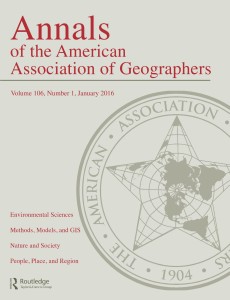
After the AAG meetings in Hawaii in 1999, a new format for the Annals of the Association of American Geographers was introduced wherein four sections and four editors were put in place to represent the breadth of the academic discipline of geography. Four major areas – (i) Environmental Sciences, (ii) Methods, Models, and Geographic Information Sciences, (iii) Nature and Society, and (iv) People, Place, and Region – were introduced as sections in the Annals to offset long-standing concerns about the lack of representation of certain aspects of the discipline (especially physical geography) in one of its flagship journals. Further, concerns about perceived biases accruing to a single editor were allayed by establishing an editorial team, with each editor taking responsibility for one of the four major subject areas.
With an understanding that the discipline is ever changing and defining a core or establishing specific fundamental areas of endeavor is always contentious, the sections were never meant to be immutable or permanent. On the recommendation of the Publications Committee, AAG Council is considering removing the Annals section headings while maintaining the integrity of an editorial team that represents the breadth of the discipline.

This is proposed in light of suggestions that the sections do not represent changes in the discipline and have the potential of characterizing articles in problematic ways. It is also clear that certain kinds of articles (e.g. papers that transcend the four major areas or papers that reflect on the discipline in general) are rarely submitted to the Annals and that the physical and environmental sciences are still underrepresented. Potential authors have raised concerns about not knowing to which section they should submit their work. Moreover, when two section editorships were advertised last year, more than one applicant stated that they were qualified to edit either section.

The proposal to remove the section headings is made with the understanding that the creation of an editorial team that represents the breadth and integrity of the discipline should continue. It is also understood that several substantive areas of geography can reside within the expertise of each editor but no one editor can encompass the whole discipline. The proposal is to remove the confusion and containment that accrues to the establishment of section headings while maintain the disciplinary integrity of an editorial team. The proposal is endorsed by the current four Annals editors and the two most recent past editors.

We would be most grateful for your views on this matter. Please send your thoughts, comments and suggestions to the AAG Publications Committee Chair, Stuart Aitken (saitken [at] mail [dot] sdsu [dot] edu) by 31 July 2016. All responses will be collated and presented to the AAG Council in Fall 2016 for their consideration.

    Share

Maggie Busek Interns at AAG for Summer Semester

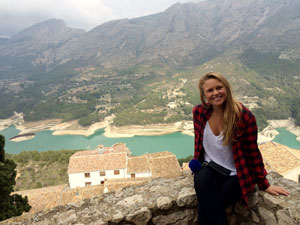
AAG intern Maggie Busek studied abroad in Spain for a semester in 2015. In this photo, she she’s pictured in Guadalest.

Maggie Busek is a junior at George Washington University pursuing a major in international affairs concentrating in contemporary cultures and societies, as well as minors in Spanish and cross-cultural communication. Maggie’s interests include anthropology, world health issues, and international politics. After graduation, Maggie intends to work towards a master’s degree in public health or international development and hopes to eventually work abroad. In her spare time, Maggie enjoys exploring DC, traveling, and kayaking.

    Share

Greg Elmes, Retired WVU geography Professor Receives Lifetime Achievement Award

Greg Elmes, professor emeritus in the Department of Geology and Geography at West Virginia University was recently honored with a Lifetime Achievement award by the West Virginia Association of Geospatial Professionals for his dedication to the study and promotion of geographic information systems (GIS).

Though Elmes retired from teaching courses at West Virginia University in 2015, he remains active in research in the geography department and with the West Virginia GIS Technical Center, housed in the department.

He has more than 30 years of experience in geographic information systems and the application of GIS techniques to societal issues such as public health, industrial geography, forensics, crime mapping, and public safety.

“It is a recognition of the time devoted to both GIS and promoting GIS as an economic development and environmental tool for the state of West Virginia,” said Trevor Harris, Eberly Distinguished Professor of Geography. “Greg has devoted his life to this university, this department, this tech center, and to the state.”

Most recently Elmes co-edited the 2014 book, “Forensic GIS: The Role of Geospatial Technologies for Investigating Crime and Providing Evidence,” a book of case studies written for researchers, practitioners and students.

The book discusses a wide range of technologies and applications for geographic, or location-based, information systems in forensic science, and serves as a review of geospatial technology—the collecting, storing, processing and examining of geographic information—as it applies to criminal justice.

Elmes earned a bachelor’s degree in geography from the University of Newcastle, United Kingdom, in 1972, a master’s degree. in geography from Pennsylvania State University in 1974, a Ph.D. in geography from Pennsylvania State University in 1979, and a master of science degree in Geographical Information Systems from the University of Edinburgh, United Kingdom. He joined the WVU faculty in 1979.

    Share

CJ Burka Interns at AAG for Summer Semester

CJ Burka is a rising senior at Hofstra University triple majoring in Geography, Political Science and Global Studies. She is a second year fellow at the Michael D’Innocenzo Center for Civic Engagement and an office aid in the Department of Global Studies and Geography. She is also the president of Get Global, an organization promoting international diversity on campus as well as being a Global Mentor, helping international students prepare for their time at Hofstra.
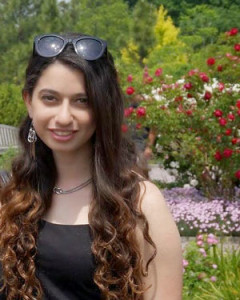
Throughout her studies, most of her time has been spent examining the intersections of public policies, both domestically and internationally, with human rights. In the future she hopes that she will be able to continue to critically assess and analyze these intersections in order to help various organizations make positive changes in the way that people are treated and protected.

Outside of academic schoolwork and her other commitments, she can be found working on an organic farm, hiking with her three-legged and four-legged dogs and exploring new places. She has been able to explore over 20 countries, but road trips with her family are still her favorite way to travel.

CJ Burka is a rising senior at Hofstra University triple majoring in Geography, Political Science and Global Studies. She is a second year fellow at the Michael D’Innocenzo Center for Civic Engagement and an office aid in the Department of Global Studies and Geography. She is also the president of Get Global, an organization promoting international diversity on campus as well as being a Global Mentor, helping international students prepare for their time at Hofstra.

Throughout her studies, most of her time has been spent examining the intersections of public policies, both domestically and internationally, with human rights. In the future she hopes that she will be able to continue to critically assess and analyze these intersections in order to help various organizations make positive changes in the way that people are treated and protected.

Outside of academic schoolwork and her other commitments, she can be found working on an organic farm, hiking with her three-legged and four-legged dogs and exploring new places. She has been able to explore over 20 countries, but road trips with her family are still her favorite way to travel.

    Share

Nina Feldman Interns at AAG for Summer Semester

Nina Feldman is a senior pursuing a B.S. in environmental studies with a minor in geographic information systems at George Washington University. Her interests include art, geography and graphic design. After graduation she wants to work for an organization where she can utilize her GIS skills to help mitigate environmental concerns and gain further experience before pursuing her M.A. in geography.

She has a love for cartography and the process of discovery, which was further sparked last year when she worked for the Smithsonian Museum of Natural History categorizing old maps into a database. She has even started her own map collection of all the places she’s visited!

In her spare time she enjoys exploring amazing outdoor locations throughout the D.C. area, including the National Arboretum and Great Falls in Virginia. She is also a member of Phi Sigma Sigma sorority and is originally from Westchester County, N.Y.


    Share