
Leadership of Color: A Call for JEDI-Based Discussions, Analysis, & Recommendations

Person holding their hands in the shape of a heart with sunlight in background

By Rasul A. Mowatt

This month we welcome Dr. Rasul A. Mowatt, who has served on the AAG JEDI Committee for three years and steps down this month. We appreciate Dr. Mowatt’s perspective on the uphill battle of being a university leader of color, a perspective that is critically important at all times, and especially now.
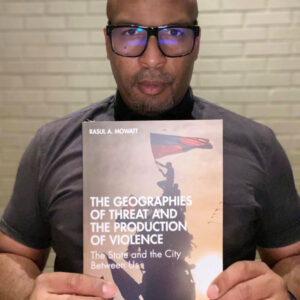
Rasul Mowatt holds his book "The Geographies of Threat and the Production of Violence."There is a strange thing that happens once you are hired or appointed to a leadership post within higher education. You, the racialized you, sit in the chair, hopefully a functional one, and the onslaught begins. The type of onslaught that no orientation program or notes from the previous seat holder can prepare you for, because they are often unprepared to actually provide any assistance to you on such matters. What matters? The matters of Race, the matters of gender, and the matters of difference. At least on matters of Race, becoming and being an administrator of color leaves you with very little insight from literature in higher education (most studies and discussions are pre-2000s: Poussaint, 1974; Wilson, 1989). More contemporary discussions have been focused on the (needed) diversification of leadership in the university (Jackson, 2003; McCurtis, Jackson, & O’Callaghan, 2009) or have been focused on pathways that were undertaken to become leadership of color in the university (Liang, Sottile, & Peters, 2016; McGee, Jett, & White, 2022; Valverde, 2003).

But there is an acknowledged issue with the experiences of those administrators of color, and an acknowledged issue with the scant amount of attention given to studying and understanding the experiences of those administrators (Breeden, 2021; Chun & Evans, 2012; Razzante, 2018; Rolle, Davies, & Banning, 2000; West, 2020 — Breeden and West are the foremost scholars on the subject). While there is a multitude of research on this subject in ProQuest searches for theses and dissertations, the published academic book and article barely reflects 10% of that output. So, this results in so many administrators to sit in those chairs, in those offices, within those units of the university that are already unforgiving to the graduate student of color, the adjuncts of color, the early career scholar of color, and staff of color (within operations, student affairs, and academic affairs), with little to no insight on how to navigate the job and one’s life while doing the job.

In many ways we are still stuck in late-1960 questions of how do we get more students of color and faculty of color to come to our respective institutions, so much so that we have fallen far behind the questions we needed to ask in the 1970s (on curriculum), in the 1980s (on degree programs), in the 1990s (on policies of protection), in the 2000s (on strengthening budgets), and in the 2010s (on legislative safeguards). In the 2020s, we are still calling and fighting for representation, when there were greater collective needs for ideas about expansion and fortification. As we have not been prepared to address those collective needs, we have been ill-equipped to address the individual needs of administrators of color. And not the type of individual need to fortify one’s self against a microaggression that may affect one’s emotional state. No: The individual need to fortify one’s self against joblessness, career-ending incidents, and field-wide ostracization. The type of needs experienced by people who serve as chancellors, provosts, vice-chancellors, vice-provosts, associate vice-chancellors, associate vice-provosts, deans, associate deans, department heads, department chairs, associate department chairs, program directors, head librarians, managers, officers, full professors, associate professors, and faculty serving as chairs of a particularly important committees or task forces.

How do you (the racialized you) handle issues that arise from standard operating problems, hiccups in processes, miscommunication, and errors in tasks that become a bigger issue when the subject [or target] is you?

How do you (the racialized you) handle issues that arise from the sabotaging of paperwork processing (i.e., not submitting faculty reimbursements, missing dates for tenure and promotion letters, never sending letters or other correspondence onward on your behalf)?

How do you (the racialized you) handle issues that arise from the number and frequency of complaints against you, rather than the substance or credibility of any one complaint?

How do you (the racialized you) handle issues that arise from every accusation levied against you requiring regular visits to the office of the next level in the protocol system of a university (even when there is no substance or credibility)?

How do you (the racialized you) handle issues that arise from donors not wishing to give to your unit because you are the person that they must be work with (and so, your very being is a detriment to your unit)?

How do you (the racialized you) handle issues that arise when every unfavorable review, report, and decision that may affect someone employed in your unit invokes a particular set of actions and words against you?

How do you (the racialized you) handle issues that arise from anonymous emails that are directed at you but meant for others to see, messages that question your humanity and being (and yet, information and technology units cannot identify the source or put a stop to them)?

How do you (the racialized you) handle issues that arise from people wanting to hire the idea of you instead of hiring  you — all of you, your scholarship, your ways of thinking?

How do you (the racialized you) handle (potential) issues that arise from the need to be extra aware of how a disaffected student, staff, or faculty may react to your decision that may affect them unfavorably (failing grade, removal from a program, termination of a job, or denial of tenure — not knowing the level of concern you may need to have for your own safety)?

And so many more questions and scenarios that seem to not have answers, much less discussion in any known book, article, workshop, training, tutorial, and the like. You begin to question your sanity when you raise these issues and the particular ways that they occur for you because of the racialized you and not because of the administrating you. It can be argued that some progress has been made on the diversification of the faculty (in certain fields and disciplines, or departments of geography). It can also be argued that there have been some gains, in some places, for some faculty of color in moving through the ranks of the professoriate. But it cannot be argued that we have quite found a way to think of how we can best serve, protect, support, and grow leadership of color.

In the meantime, sitting in such chairs and offices comes with a decreasing quality of health that brings on its own set of issues from long late-night emergency room visits due to dizzy spells, lack of pain relief from constant stomach churning, or the mounting stress that comes with the knowledge of a potential diagnoses of social death.

Such a social death is not inevitable, even at times of much publicized oppressions and increased levels of scrutiny in campus operations. In fact, now is the key time to close the gaps in our literature and discussions, to document and address the plight and experiences of leaders of color in academia. What we do not have today as intellectual resources are a product of what was not explored yesterday, thus, it is our obligation to gift tomorrow with insight. The readings below are an important start in this discussion, yet only a few are recent enough to reflect the pressures and aggressions — micro and macro — that leaders of color confront on campuses right now, in an anti-JEDI, anti-immigrant, anti-difference era. Only by documenting our experiences, and acting on what we know, can we break through and begin to make campuses sites of true learning and liberation.


References

Breeden, R. L (2021). Our presence is resistance: Stories of Black women in senior-level student affairs positions at predominantly White institutions. Journal of Women and Gender in Higher Education14(2), 166–186. https://doi.org/10.1080/26379112.2021.1948860

Chun, E., & Evans, A. (2012). Diverse administrators in peril: The new indentured class in higher education. Boulder, CO: Paradigm Publishers.

Jackson, J. F. L. (2003). Toward administrative diversity: An analysis of the African-American male educational pipeline. The Journal of Men’s Studies12(1), 43-60. https://doi.org/10.3149/jms.1201.43

Liang, J. G., Sottile, J., & Peters, A. L. (2016). Understanding Asian American women’s pathways to school leadership. Gender and Education30(5), 623–641. https://doi.org/10.1080/09540253.2016.1265645

McCurtis, B. R., Jackson, J. F. L., & O’Callaghan, E. M. (2009). Developing leaders of color in higher education: Can contemporary programs address historical employment trends? A. J. Kezar, ed., Rethinking Leadership in a Complex, Multicultural, and Global Environment: New Concepts and Models for Higher Education (pp. 65-91). Routledge.  

McGee, E. O., Jett, C. C., & White, D. T. (2022). Factors contributing to Black engineering and computing faculty’s pathways toward university administration and leadership. Journal of Diversity in Higher Education, 15(5), 643–656. https://doi.org/10.1037/dhe0000407

Poussaint, A. (1974). The Black administrator in the White university. The Black Scholar6(1), 8-14. http://www.jstor.org/stable/41065748

Razzante, R. J. (2018). Intersectional agencies: Navigating predominantly White institutions as an administrator of color. Journal of International and Intercultural Communication11(4), 339–357. https://doi.org/10.1080/17513057.2018.1501082

Rolle, K. A., Davies, T. G., & Banning, J. H. (2000). African American administrators’ experiences in predominantly White colleges and universities. Community College Journal of Research and Practice24(2), 79–94. https://doi.org/10.1080/106689200264222

Valverde, L. A. (2003). Leaders of color in higher education: Unrecognized triumphs in harsh institutions. Rowman Altamira.

West, N. M. (2020). A contemporary portrait of Black women student affairs administrators in the United States. Journal of Women and Gender in Higher Education13(1), 72–92. https://doi.org/10.1080/26379112.2020.1728699

Wilson, R. (1989). Women of color in academic administration: Trends, progress, and barriers. Sex Roles, 21, 85–97. https://doi.org/10.1007/BF00289729

Rasul A. Mowatt, Ph.D., is Department Head and Professor in the Department of Parks, Recreation and Tourism Management, College of Natural Resources, at North Carolina State University (NCSU); and Affiliate Professor in Sociology + Anthropology at NCSU. He earned his Ph.D. from the University of Illinois at Urbana-Champaign. He was formerly Professor in the Departments of American Studies and Geography in the College of Arts + Science at Indiana University. His primary areas of research are Geographies of Race, Geographies of Violence/Threat, The Animation of Public Space, and Critical Leisure Studies. His most recent publication is The City of Hip-Hop: New York City, The Bronx, and a Peace Meetin (Routledge, 2025).


The AAG Culture of Care column is an outreach initiative by the AAG JEDI Committee. Don’t forget to sign up for JEDI Office Hours. The current theme of Office Hours is An Ethos of Care in the Research Enterprise.
    Share

Council Meeting – March 2025

    Share

Where are GIScience Faculty Hired From?

Portion of word cloud graphic showing Wuhan University as the largest entity.

Analyzing Faculty Mobility and Research Themes Through Hiring Networks

The following Perspective is drawn from a paper currently under review at Cartography and Geographic Information Science journal. This research was supported by the CaGIS Rising Award and the GISphere project, which summarizes more than 400 GIS programs and faculty information globally.

By Yanbing Chen, University of Wisconsin, Madison and Yuhao Kang, University of Texas, Austin

Academia is profoundly shaped by the dynamics of faculty hiring networks, acting as a pathway for knowledge dissemination and collaborative research formation in higher education. With rapid technological advances and a surging demand for spatial analysis, GIScience is transforming research and industry alike, underscoring the need to examine how hiring practices influence academic networks and research trajectories. This study addresses the gap by analyzing data provided via the GISphere project (GISphere Institution Guide, 2023) on 946 GIScience faculty members from 384 universities across 27 countries. We employ network and word cloud analyses to demonstrate the connections between PhD-granting institutions and faculty affiliations, revealing global placement patterns, diversity in hiring trends, and the thematic evolution in GIScience research interests between year 1990 and 2024. These findings contribute to the broader discourse on faculty hiring (in)equities and provide insight into the formation of research clusters within the GIScience community.

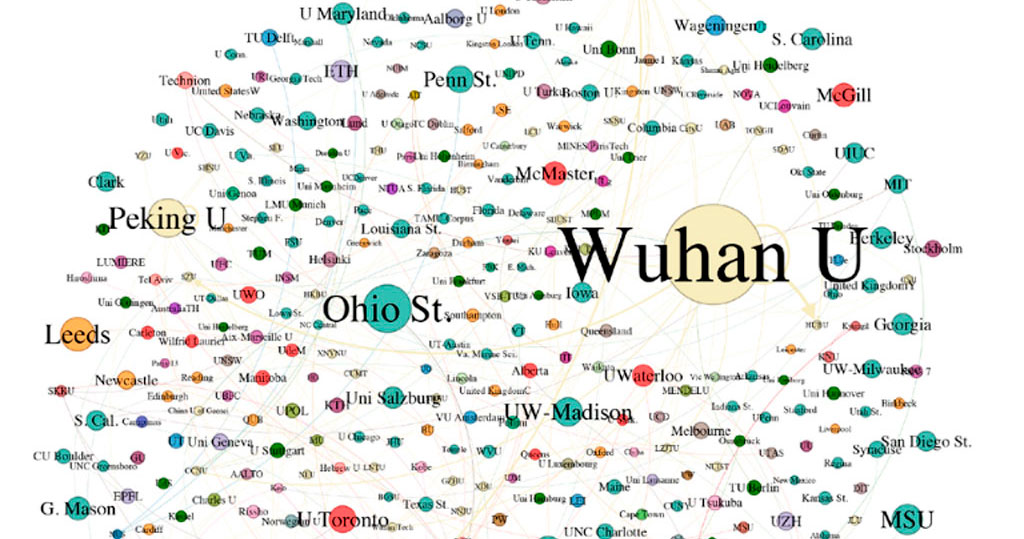
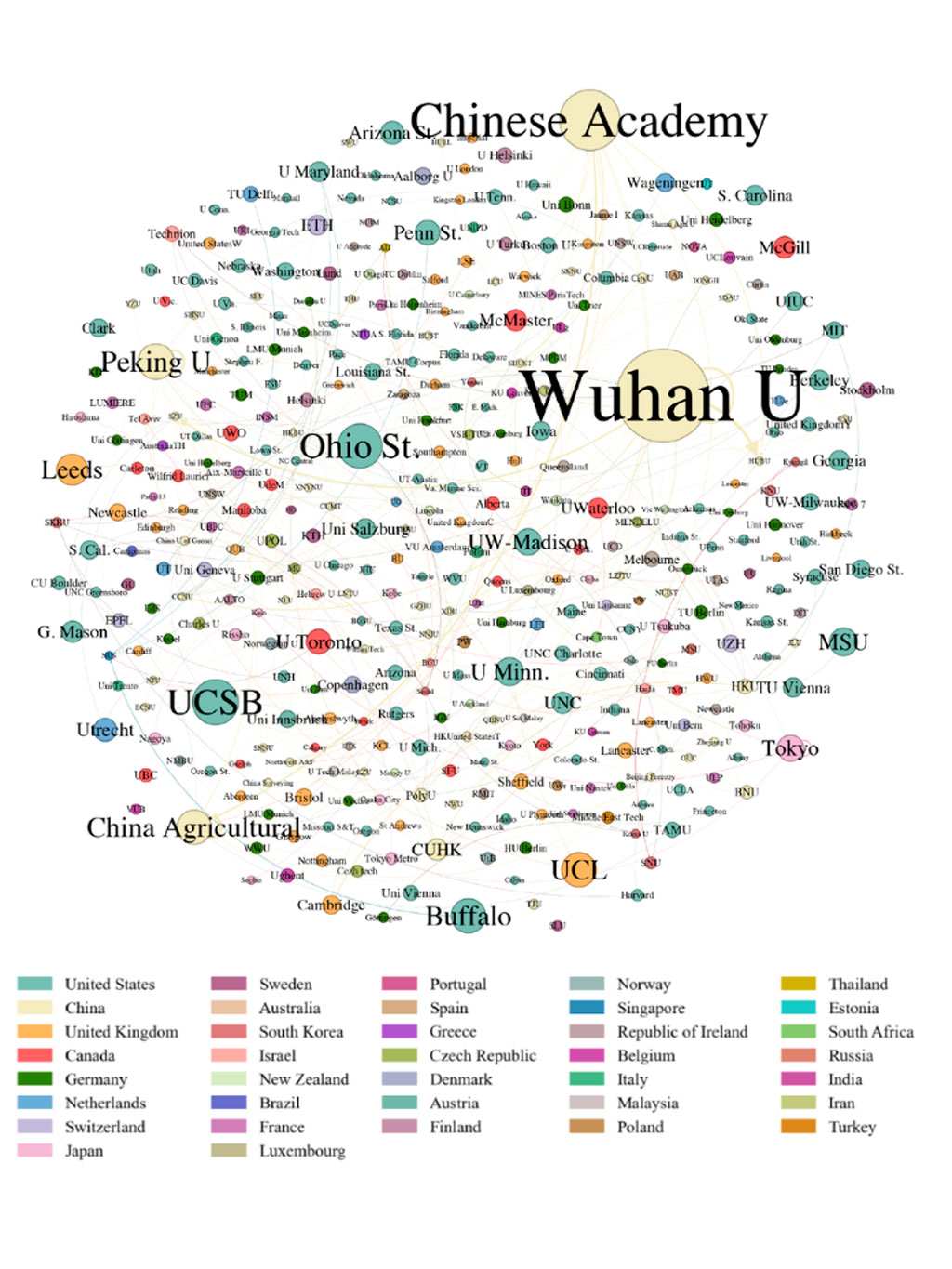
The network analysis of GIScience faculty placements reveals that hiring is predominantly concentrated within the Global North. North America, Asia, and Europe collectively account for 92% of GIS faculty positions, with the United States (28.54%), China (26.74%), and the United Kingdom (8.35%) leading in faculty placements. The analysis shows that certain institutions play a dominant role in the GIS hiring network. For example, Wuhan University, Chinese Academy of Sciences, University of California Santa Barbara, The Ohio State University, and Peking University are responsible for 15.43% of all global GIS faculty placements (Figure 1). While faculty hiring in other fields, such as computer science and economics, follows a clear prestige-driven hierarchy (Clauset et al., 2015; Wapman et al., 2022), the GIS hiring network appears more decentralized, with a wider distribution of contributing institutions. However, this relative decentralization does not eliminate regional inequalities. The network structure reveals localized recruitment patterns within continents. For instance, North American GIS faculty often originate from U.S. or Canadian PhD programs, while European institutions tend to hire graduates from within Europe. This regional clustering reflects the limited cross-continental mobility of GIS faculty, likely influenced by geographic proximity, immigration policies, and reduced recruitment costs for regional candidates.

Word cloud graphic showing Wuhan University as the largest entity.
Figure 1. Network graph of global GIS faculty placement (n=946). Nodes represent universities, color-coded by country. Node size reflects the number of faculty produced, while edge thickness indicates the number of faculty movement between universities.


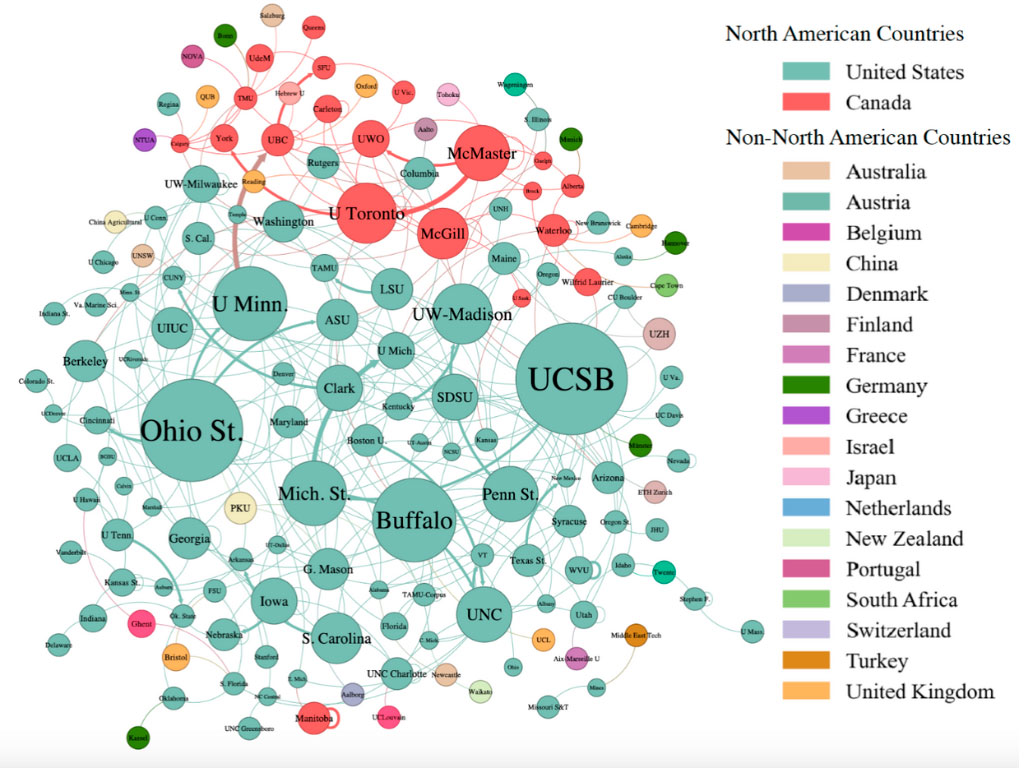
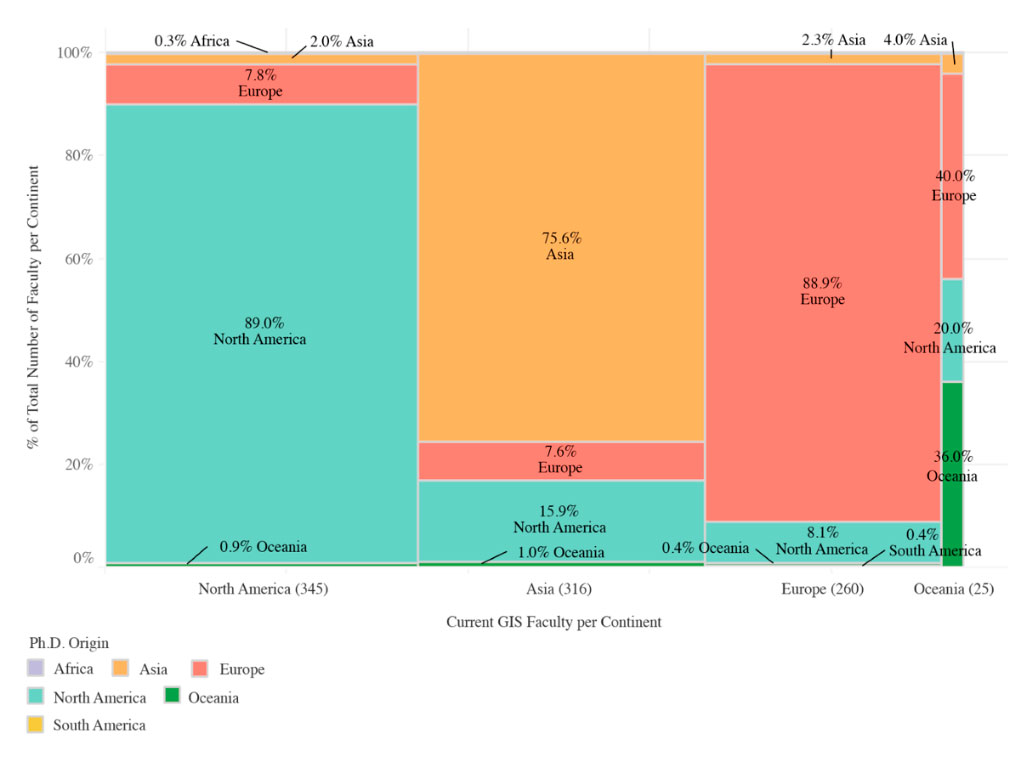
The diversity index refers to the proportion of faculty originating from a particular region relative to the total affiliated faculty within that same region. It examines regional disparities in hiring patterns at the continental, country, and institutional levels. At the continental level, North America has the lowest diversity index, with only 11.01% of GIS faculty holding PhDs from outside the continent (Figure 2). Asia (24.37%) and Oceania (64.00%) show higher cross-continental hiring, though often from neighboring regions or countries with historical ties. Europe reports 11.15% diversity overall, with nine countries having 0% diversity, as all GIS faculty obtained PhDs within Europe. The country-level diversity index highlights varying patterns of domestic retention. For example, in the United States, 87.70% of faculty obtained their PhD domestically, while China exhibits a similar pattern, with 79.45% of GIS faculty holding domestic PhDs. Conversely, Singapore and Thailand have the highest country-level diversity indices (100%), indicating reliance on external academic talent. At the institutional level, external recruitment is common. On average, 60.66% of GIS faculty at global universities were externally recruited. These trends suggest that while universities value external perspectives to promote intellectual diversity, internal recruitment practices persist in countries with smaller academic systems (Figure 3).

Faculty Hiring Networks are predominantly in the United States.
Figure 2. Faculty Hiring Networks in North America. The figure shows all GIS faculty currently employed in North American institutions and indicates whether their doctoral training was obtained in North American countries or other countries.


This chart shows that a total of 345 GIS faculty members are currently affiliated with institutions in North America. Of these, 88.99% obtained their PhDs in North America, 7.83% in Europe, 2.03% in Asia, 0.87% in Oceania, and 0.29% in Africa.
Figure 3: Marimekko chart visualizing the distribution of GIS faculty placements across four continents (North America, Asia, Europe, and Oceania) and their PhD origins. The X-axis represents the total number of current GIS faculty in each continent, while the Y-axis shows the percentage of faculty based on where they obtained their Ph.Ds. The width of each segment on the X-axis corresponds to the number of GIS faculty in that continent. Colored segments represent the proportion of faculty whose PhD origins are from different continents. For example, a total of 345 GIS faculty members are currently affiliated with institutions in North America. Of these, 88.99% obtained their PhDs in North America, 7.83% in Europe, 2.03% in Asia, 0.87% in Oceania, and 0.29% in Africa.


The findings of this study have important implications for GIScience education and hiring policies. The preference for internal recruitment at continental and country levels highlights the need to promote international mobility. Institutions should encourage greater international recruitment, particularly from underrepresented regions like Africa and South America, to diversify the pool of GIS scholars. The role of influential institutions in global GIS hiring also raises concerns about academic equity. While GIS faculty placement appears less hierarchical than in other fields, the concentration of placements within a small subset of universities highlights a potential inequity in access to faculty positions. Universities seeking to foster a more inclusive academic environment should consider promoting mobility pathways for PhD graduates from less influential institutions. In conclusion, hiring patterns and thematic shifts in GIScience highlight the importance of fostering a more inclusive, globalized GIS community, ensuring that ideas from across the world are equitably represented in GIS education and research.


References

Clauset, A., Samuel Arbesman, Daniel Larremore. (2015) Systematic inequality and hierarchy in faculty hiring networks. AAAS Science Advances, 12 Feb 2015, Vol 1, Issue 1. DOI: 10.1126/sciadv.1400005

Wapman, K.H., Sam Zhang, Aaron Clauset, Daniel B. Larremore. 2022. Quantifying hierarchy and dynamics in US faculty hiring and retention. Nature 610, pp. 120–127. Access https://www.nature.com/articles/s41586-022-05222-x

Perspectives is a column intended to give AAG members an opportunity to share ideas relevant to the practice of geography. If you have an idea for a Perspective, see our guidelines for more information.

    Share

Care as Leadership: Sustaining and Strengthening Our Programs in a Time of Stress and Change

Person holding their hands in the shape of a heart with sunlight in background

By Ken Foote

Portrait of Ken FooteFor almost a quarter century, the AAG’s Geography Faculty Development Alliance (GFDA) and Healthy Departments Initiative (HDI) have provided support for our members, from those just getting started in their careers to those leading departments and programs. Summer workshops, symposia at national and regional meetings, webinars, and publications like Thriving in an Academic Career and Practicing Geography are all part of these efforts.

Fundamental to all these activities is the belief that caring for our community strengthens our community. Indeed, hundreds of our members have already benefited from the community-building activities the AAG supports, including those that focus on building mutual respect, empathy, trust, and shared responsibility for the health and progress of our field and all its members.

The need to reaffirm these values this year has been made imperative by rapid-fire policy changes at the national and state levels. These are already having profound impacts on geographical research and education at all levels. This impact has been especially hard on our undergraduate and graduate programs, where changing policies are affecting students, faculty, research, and teaching. This year’s workshop “Maintaining what matters: Strengthening your department in a time of rapid change” has been organized to help our community respond to these challenges by providing a forum for sharing concerns and strategies in a supportive setting. Sessions will touch on:

From crisis to courage: Creating a sustainable future for your department

Planning for improving our departments

Supporting international students

Academic freedom in the face of new, restrictive legislation,

Mentoring, promotion, and tenure in the current climate

Envisioning transformative GenEd curricula in challenging times

Scheduled online for June 23-24, starting at 11:00 a.m. ET, with panels, discussions, and interactive activities throughout each day. The program is free to all AAG members. Non-members pay $250.

Learn more and register


The GFDA and HD Organizing Committee

This year’s Department Leadership workshop has been developed by a capable and experienced organizing committee of leaders within their own institutions, in GFDA and HDI, and at AAG:

  • Patricia Ehrkamp, Arts & Sciences Distinguished Professor, Professor of Geography, University of Kentucky, and 2024-2025 AAG President
  • Ken Foote, Deputy Head and Director of Urban and Community Studies, Department of Geography, Sustainability, Community, and Urban Studies, University of Connecticut, 2010-2011 AAG President
  • David Kaplan, Professor, Department of Geography, Kent State University, 2018-2019 AAG President
  • Rebecca Lave, Associate Dean for Social and Historical Sciences, Professor, Geography, Indiana University-Bloomington, 2024-2025 AAG President
  • Shannon O’Lear, Joint appointment with Environmental Studies Program, Professor, KU Chancellors Club Teaching Professor 2024-2029, University of Kansas
  • Risha RaQuelle, Chief Strategy Officer, AAG

For questions or further guidance about any of these opportunities, please email meeting@aag.org.

Ken Foote is a member of the Department of Geography, Sustainability, Community, and Urban Studies at University of Connecticut. A past president, longtime member, and Fellow of AAG, he founded the Geography Faculty Development Alliance in 2003.


The AAG Culture of Care column is an outreach initiative by the AAG JEDI Committee. Don’t forget to sign up for JEDI Office Hours. The current theme of Office Hours is An Ethos of Care in the Research Enterprise.
    Share

New Books for Geographers: Spring 2025

washington dc Take-a-stroll-along-the-Tidal-Basin-in-the-spring-to-catch-a-glimpse-of-the-Jefferson-Memorial-and-the-iconic-Cherry-Blossom-trees-courtesy-of-washington.org_

The AAG compiles a quarterly list of newly published geography books and books of interest to geographers. The list includes a diversity of books that represents the breadth of the discipline (including key sub-disciplines), but also recognizes the work which takes place at the margins of geography and overlap with other disciplines. While academic texts make up most of the books, we also include popular books, novels, books of poetry, and books published in languages other than English, for example.

Some of these books are selected for review in the AAG Review of Books. Publishers are welcome to contact the AAG Review of Books Editor-in-Chief Joshua L. Conver, as well as anyone interested in reviewing these or other titles.


Apartheid Remains, by Sharad Chari (Duke University Press 2024)

Beginning Again: Stories of Movement and Migration in Appalachia, by Katrina M. Powell (Haymarket Books 2024)

Cartographies of Empire: The Road Novel and American Hegemony, by Myka Tucker-Abramson (Stanford University Press 2025)

City of Wood: San Francisco and the Architecture of the Redwood Lumber Industry, by James Michael Buckley (University of Texas Press 2024)

Conservation and Mobile Indigenous Peoples: Displacement, Forced Settlement and Sustainable Development, Second Edition, by Dawn Chatty and Marcus Colchester (Berghahn Books 2025)

Contested Global Governance Space and Transnational Agrarian Movements, by Mauro Conti (Fernwood Publishing 2023)

Dark Soil: Fictions and Mythographies, by Angie S. Lou and Karen T. Yamashita (Coffee House Press 2024)

Death is Our Business: Russian Mercenaries and the New Era of Private Warfare, by John Lechner (Bloomsbury 2025)

Decolonising Geography? Disciplinary Histories and the End of the British Empire in Africa, 1948-1998, by Ruth Craggs and Hannah Neate (Wiley 2023)

Dispatches From Puerto Nowehere: An American Story of Assimilation and Erasure, by Robert Lopez (Two Dollar Radio 2023)

Dispersed Dispossession: Collective Goods, Appropriation, and Agency in Rural Russia, by Alexander Vorbrugg (University of Georgia Press 2025)

Displacing the ‘Ordinary’ City: Gentrification in Mid-Sized American Metropolitan Areas, by Evelyn D. Ravuri (Bloomsbury Academic 2025)

The Entrepreneurial Scholar: A New Mindset for Success in Academia and Beyond, by Ilana M. Horwitz (Princeton University Press 2025)

Environmentalism from Below: How Global People’s Movements Are Leading the Fight for Our Planet, by Ashley Dawson (Haymarket Books 2024)

Environomics: How the Global Economy is Going Green, by Dharshini David (Elliott & Thompson 2025)

Ethnocracy: Land and Identity Politics in Israel/Palestine, by Oren Yiftachel (University of Pennsylvania Press 2024)

Extractive Capitalism: How Commodities and Cronyism Drive the Global Economy, by Laleh Khalili (Profile Books 2025)

Florida Springs: From Geography to Politics and Restoration, by Christoper F. Meindl (University Press of Florida 2024)

Framing Nature: The Creation of an American Icon at the Grand Canyon, by Yolonda Youngs (University of Nebraska Press 2024)

Freedom Train: Black Politics and the Story of Interracial Labor Solidarity, by Cedric De Leon (University of California Press 2025)

Geographies of Travel: Impressions of America in the Long Nineteenth Century, by Susan L. Robertson (Texas A&M Press 2024)

Geography Is Destiny: Britain and the World: A 10,000-Year History, by Ian Morris (MacMillan Publishers 2023)

The Geography of Transport Systems, Sixth Edition, by Jean-Paul Rodrigue (Routledge 2024)

Holy American Burnout!, by Sean Enfield (Split/Lip Press 2023)

Housing Evolution: Towards Better Medium-Density Design, by Geoffrey London (University of Western Australia Publishing 2023)

The Injustice of Property: Homeless Encampments and the Limits of Liberalism, by Stephen Przybylinski    (University of Georgia Press 2025)

Insurgent Ecologies: Between Environmental Struggles and Postcapitalist Transformations, edited by the Undisciplined Environments Collective (Fernwood Publishing 2024)

Introducing Globalization Theories: A Concise Overview for Students, by Manfred B. Steger (University of California Press 2025)

Introduction to Geographic Information Systems, by Falguni Mukherjee (Rowan & Littleton 2025)

The Jemez Mountains: A Cultural and Natural History, by Thomas W. Swetnam (University of New Mexico Press 2025)

Judicial Territory: Law, Capital, and the Expansion of American Empire, by Shania Potts (Duke University Press 2024)

Leading With Data: A Police Commander’s Guide to GIS & Crime Analysis, by Jonas H. Baughman (Esri Press 2025)

Mapping Partition: Politics, Territory and the End of Empire in India and Pakistan, by Hannah Fitzpatrick (Wiley 2024)

Marginlands: A Journey Into India’s Vanishing Landscapes, by Arati Kumar-Rao (Milkweed Editions 2025)

Migrant Justice in the Age of Removal: Rights, Law, and Resistance against Territory’s Exclusions, by Jacob P. Chamberlain (University of Georgia Press 2025)

Mountain Lexicon: A Corpus of Montology and Innovation, by Fausto O. Sarmiento and Alexey Gunya              (Springer Geography  2024)

New Destinations of Empire: Mobilities, Racial Geographies, and Citizenship in the Transpacific United States, by Emily Mitchell-Eaton (University of Georgia Press 2024)

One Day, Everyone Will Have Always Been Against This, by Omar El Akkad (Knopf 2025)

Patriotism to the Earth: A Quest for Humane Global Governance, by Richard A. Faulk and Sasha Milonova (Rowan & Littleton 2025)

Preserving Our Planet: GIS for Conservation, by David Gadsden and Matt Artz (Esri Press 2023)

Reading Gender and Space in Irish and Literary Studies: Essays for Patricia Coughlan, by Anne Fogarty and Tina O’Toole (Cork University Press 2023)

Rooted: The American Legacy of Land Theft and the Modern Movement for Black Land Ownership, by Brea Baker (Penguin Random House 2024)

Social Resilience and International Migration in the Canadian City, by Valerie Preston, Tim Shields, and Tara Bedard (McGill-Queen’s University Press 2025)

Spaces of Anticolonialism: Delhi’s Urban Governmentalities, by Stephen Legg (University of Georgia Press 2025)

Theory of Water: Nishnaabe Maps to the Times Ahead, by Leanne Betasamosake Simpson (Haymarket Books 2025)

The Unequal Effects of Globalization, by Pinelopi Koujianou Goldberg (MIT Press 2023)

Urban Climate Justice: Theory, Praxis, Resistance, by Jennifer L. Rice, Joshua Long, and Anthony Levenda (University of Georgia Press 2023)

Urban Geography, 4th Edition, by David Kaplan and Steven Holloway (Wiley 2024)

War-Making as Worldmaking: Kenya, the United States, and the War on Terror, by Samar Al-Bulushi (Stanford University Press 2024)

We, the Decolonized, by Hélé Béji (Wiley 2025)

Windswept: Walking the Paths of Trailblazing Women, by Annabel Abbs-Streets (Tin House Publishing 2025)

You Have Been Randomly Selected: A Life Dedicated to Turning Research Findings into Practical Applications, by Don A. Dillman (Washington State University Press 2024)

    Share

A Voice for Geographers

The following statements and actions represent AAG’s work to protect and strengthen geography and geographers, address pressing public issues, and to protect science funding and academic freedom. For a comprehensive look at AAG’s positions over the years, check out our advocacy in the Resource Hub.


Academic Freedom and Commitment to Geography’s Future


Standing Up for Science


Climate Action

    Share

JEDI Is More than an Acronym

Person holding their hands in the shape of a heart with sunlight in background

By Jenna Loyd, JEDI Committee Chair

Jenna Loyd

Justice. Equity. Diversity. Inclusion. These words animate the work of the AAG committee going under the acronym JEDI. These words represent values that are enshrined in AAG’s Statement of Professional Ethics, whose second paragraph reads:

Our discipline of geography is stronger when we uphold equity, human rights, and educational freedom across the breadth of geographic inquiry. We appreciate the diversity of our members’ experiences and backgrounds, as well as the broad variety of ideas and approaches to geographic knowledge production.

When I joined the JEDI Committee in 2023, DEI already had assumed a prominent place in the campus culture wars along with the distortion of critical race theory (CRT). Since then, these acronyms have been unmoored from the meanings found in the scholarly history of critical race theory and social movement histories of the struggles against racial, gender, and disability discrimination. DEI and CRT came to mean reverse discrimination and indoctrination, arguments that situated its proponents on the right side of history and validated their efforts to dismantle it. Since 2023, 19 anti-DEI bills have become law across seven states, according to the Chronicle of Higher Education; another 75 have failed or been tabled. Related pieces of legislation have passed restricting what can be taught in classrooms.

These efforts became an opening salvo in the even broader attacks on higher education and research we are living through right now. Some universities, academic associations, and research nonprofits have scrubbed their websites of DEI. The AAG has not, nor does it intend to do so. In February, the JEDI Committee reiterated its commitments to its principles and reaffirmed the AAG’s 2023 statements of support of educational freedom, critical geography and the well-being of LGBT2QIA+ people, and Black, Indigenous, and People of Color (BIPOC).

We are not backing down because JEDI is more than an acronym. When I was first learning this committee’s history, Meghan Cope explained to me that justice was an important principle informing its initiatives. Justice has more than one meaning for our discipline, a concept that often provides a way of linking issues together, from racial justice to economic justice, environmental justice, disability justice, climate justice, and more. To me, it informs why equity would be a value and suggests that inclusion itself should be just. In the introduction to their new edited collection, How to Foster Diversity, Equity, Inclusion, and Justice in Geography, Guo Chen and LaToya Eaves recount how decades of collective efforts to broaden the scope and societal relevance of geographic inquiry have gone hand in hand with criticisms of the discipline’s systematic forms of exclusion. For Chen and Eaves, our embrace of justice, equity, diversity, and inclusion as interconnected values serves to “enrich the theories and practices that help more and more geographers feel at home and foster passion and inquiry in creating a vibrant world discipline for current and future generations of geographers” (2024, 3-4).

More than an acronym, [TLC-GRAM is] a mnemonic reminding us that care and relationships should guide transformative work in the AAG, departments, and specialty groups.

For just inclusion of groups of people who’ve been neglected or excluded from the discipline, we need to actively change the structure of our collective work as geographers. And this takes cultivating a culture of care. Over the first two years of the JEDI Committee’s existence, the committee worked with over 50 members in seven working groups to synthesize 32 points of its strategic plan into a useable framework for change shorthanded as TLC-GRAM. Like the idea that justice is indivisible, each of the elements of Training, Listening, Communications, Governance, Reports, Advocacy, and Membership are interconnected. More than an acronym, it’s a mnemonic reminding us that care and relationships should guide transformative work in the AAG, departments, and specialty groups. AAG’s Chief Strategy Officer, Risha RaQuelle, has provided invaluable leadership for this work. She launched the beta version of the toolkit at the 2024 GFDA meeting; you can read her overview of the TLC-GRAM here and discussion of how care can inform research here. At a session last month in Detroit, leadership of the Energy and Environment Specialty Group walked through how they had put the toolkit to work in their specialty group and the Committee will be finalizing materials for its use this academic year.

I think part of why JEDI work continues undiminished in the AAG is because of the decades of cultivating principles of justice as interconnected. Another reason is the longstanding engagement with care ethics, articulated by AAG President Victoria Lawson in 2005. Geography as a discipline and AAG as an association are filled with members, staff, and leadership who want our profession and field of inquiry to hold true to justice and care, even as we debate and expand what these terms mean. We know that we are responsible for making this space as a collective effort. What we do will continue to be debated and will continue to evolve. And we do this because we think the space we make to do critical work with each other is worth defending.


The AAG Culture of Care column is an outreach initiative by the AAG JEDI Committee. Don’t forget to sign up for JEDI Office Hours. The current theme of Office Hours is An Ethos of Care in the Research Enterprise.
    Share

AAG JEDI Committee Resources for Defending Geographic Inquiry and Our Communities

Key values and ethical commitments held by geographers, including those encapsulated in the AAG Statement of Professional Ethics, have been challenged by presidential executive orders, Dear Colleague letters, and other executive branch actions. This resource guide aims to gather a usable set of materials to inform action across a range of issues and groups that have been directly targeted. Two throughlines in these documents are recommendations: 1) to refuse anticipatory obedience and its iterations of over-compliance or anticipatory compliance; and 2) to organize to assert rights as part of defending our communities.

We will add to and update with new material. Please message Communities@AAG.org with resources you would like to recommend.

Defending Immigrants

Statements

Organizing Networks & Resources

Defending JEDI

Statements, Research

Organizing Networks & Resources

Defending Academic & Scientific Inquiry

Statements, Research

Organizing Networks & Resources

Defending LGBTQ+ People

Statements, Research

Organizing Networks & Resources

Data Repositories for Federal Agency Data

Digital Security

Statements, Research

Addressing Transnational Repression on Campuses in the United States. 2024. Freedom House

Organizing Networks & Resources

Legal Defense & Liability Insurance

Statements

(Check back for resources to be added)

Organizing Networks & Resources

Mental Health

    Share

AAG announces 2025 election results

AAG seal and American Association of Geographers logo


The 2025-26 AAG Election results have been tallied and those elected to office are as follows:

President: William G. Moseley, Macalester College

Vice President: Sara Smith, University of North Carolina at Chapel Hill

National Councilors

  • Andrew Curley, University of Arizona
  • Amy Frazier, University of California Santa Barbara

International Councilor: Anindita Datta, University of Delhi

Honors Committee

  • Cindi Katz, CUNY Graduate Center
  • Chandana Mitra, Auburn University
  • Joann Mossa, University of Florida

Nominating Committee

  • Caroline Faria, The University of Texas at Austin
  • Wendy Jepson, Texas A&M University
  • Francis Magilligan, Dartmouth College
  • Jay Newberry, Binghamton University
  • Jane M. Read, Syracuse University

The terms of office begin July 1, 2025.

Thank you to all the candidates and to our members for participating in the election. It’s an exciting time for all to work together to help move the AAG forward in the coming year

    Share

Places of Possibility: Resources for Challenging Times

Person holding their hands in the shape of a heart with sunlight in background

By Risha RaQuelle, Chief Strategy Officer

Photo of Risha Berry

In times of such profound transformation, it’s crucial to lean on the work and relationships we’ve built over years of collaboration. The strength of our professional networks, resources, and shared commitment is what helps sustain us through challenging periods.

The constraints and threats we face are real—anti-DEI legislation, funding elimination, and systemic shifts challenge the very fabric of our work. But despite these obstacles, we continue to press forward. AAG, like each of our members, is navigating the path forward Yet, we persist—in supporting your career, your well-being, and the values that unite us as a community.

We encourage you to take a moment to reflect on the resources that sustain you. We’d also like to highlight some of the support AAG offers to contribute to your success and thriving.

For Individual AAG Members

Keep up your peer and mentoring network. Use the opportunities AAG offers for members to connect—through our Annual Meeting, career-focused sessions throughout the year, and local connections through the AAG Regional Divisions. As an AAG member, you are automatically part of your Regional Division, allowing you to engage with peers near you, strengthening community ties among geographers. The Regional Divisions also sponsor events focused on the next generation, from preliminaries for the World Geography Bowl to paper competitions and travel grants.

Your career matters, and we can help. From job search tools to liability insurance, AAG wants to help you navigate your career. The AAG Job Board lists opportunities in all sectors, at all levels of experience. AAG’s member-created Statement of Professional Ethics provides clarity and peer-sourced insight into the values and principles we seek to uphold in our discipline.

Communities of practice to support you.  AAG Specialty and Affinity Groups and Communities of Practice are designed to connect you with colleagues who share your expertise or interests. Your AAG membership makes you eligible for all of these communities of practice, which are renewed annually and carry their own modest dues, generally from $1 to $5 each year. These groups can serve as vital resources for advice, networking, and new opportunities.

Dedicated AAG staff can answer your questions. AAG’s Communities Team—Eddie McInerney and Mark Revell—can answer questions and support your participation in the Specialty/Affinity Group communities. You can also sign up for AAG’s regular JEDI Office hours.  JEDI Office Hours offer individuals and programmatic leaders the chance for one-on-one conversations about your ideas, experiences, and questions. Schedule a time to talk.

For Department Chairs and Program Leaders

AAG is strengthening tools to offer leaders of geography departments and programs new ways to protect and advance the discipline:

TLC-GRAM: This bridging inventory is designed to promote strategies for increasing belonging within the geography community, especially through strategic planning. We’ve curated a collection of resources, ideas, and initiatives, aimed at fostering inclusive and supportive environments that promote good governance and focus on making sure that all members of a community feel welcome and valued. If you have adapted this toolkit or have ideas for how to do so, we’d like to hear from you at communities@aag.org.

State of Geography Dashboard: AAG’s repository for data on geography higher education as a field of study. These data provide insight into the educational landscape for geography in the U.S., as well as insights into the field that might inform dialogues within your institution, especially strategic planning.

Each summer, over the past years the Geography Faculty Development Alliance workshops have offered early-career geographers and department chairs support in pursuing their work in teaching, mentoring, and leadership.

The Healthy Departments Initiative addresses the challenges faced by geography departments. The HD Committee assists department chairs and provides practice information that can improve program quality. To find out more, contact communities@aag.org

For Protecting and Advancing Our Discipline

AAG offers ways to monitor and participate in activities on behalf of the geography discipline. AAG’s Advocacy Hub provides Information on AAG’s policy stances and recent advocacy efforts. Learn about our policy principles here.

Positions and Task Forces at AAG have taken up critical disciplinary questions that can aid your direction and decision making within our discipline. One of the core such documents for this moment is AAG’s Statement of Professional Ethics.

Visit our governance page to view reports of past AAG task forces and find out about current task forces, such as the Mentoring Task Force, which is examining how to expand mentoring opportunities within geography. AAG’s Professional Conduct Policy is also a foundational document that keeps all of us accountable to one another and sets the standard for professional conduct within our discipline.

Navigating Hostile Environments

Reflecting on the hostile working conditions that critical geographers have faced—attacks on tenure, justice, equity, diversity, and inclusion, and challenges to academic unionization—I recognize the delicate balance between advocacy and pragmatic action. We, too, face shifting political landscapes. The AAG, like you, is navigating a world where decisions are made rapidly.

Here’s what I want you to know: The AAG is your member association. As a member, you are integral to how we adapt, educate, and advocate for the discipline of geography. We are a bridge, ensuring that geography remains a space where belonging is fostered, even when forces of othering try to dominate. Together, we can continue advocating for the values that matter most to our community, even as the political climate shifts.

Moving Forward Together

In closing, our commitment to promoting scholarly spaces, critical geographic research, and JEDI initiatives remains steadfast. We will continue to publicly affirm our dedication to advancing these principles through advocacy, awards, career-enabling functions, and providing access to training for students. By engaging in these efforts, we ensure that geography remains a space of possibility, even in increasingly inhospitable environments.

Through our annual meetings, regional gatherings, and resources, AAG offers opportunities to not only share research but also connect with others who understand the unique challenges we face. AAG will always be a space where ideas are shared freely, and all members are given the opportunity to contribute.

Let’s continue to work together—to build a future where geography and its practitioners can thrive, no matter the challenges we encounter.

The AAG Culture of Care column is an outreach initiative by the AAG JEDI Committee. Don’t forget to sign up for JEDI Office Hours. The current theme of Office Hours is An Ethos of Care in the Research Enterprise.

    Share