Africa
2025 Kwadwo Konadu-Agyemang Distinguished Scholar Award, Bilal Butt, Univerity of Michigan
2025 Emerging Distinguished African Scholar Award, Moses Kansanga, George Washington University
ASG Graduate Research Grant, Reforce Okwei, Western University Ontario Canada
Animal Geography
Graduate Student Presentation Award, Adriana DiSilvestro
Applied Geography
AGSG 2025 Annual Meeting Award
- Jiashuo Sun, Geographic Barriers to Vaccine Access: Associations of Travel Time with COVID-19 Vaccine Uptake, Intent, and Perceived Availability in Kenya
- Qingqing Chen, Multi-sensory Experiences: The Connection between the Smell and Vision in Understanding Urban Environments
- Yifan Yang, Hyperlocal Disaster Damage Assessment Using Bi-Temporal Street-View Imagery and Pre-Trained Image Processing Models
- Christopher Ihinegbu, Unequal Considerations of Disaster Justice in Disaster Planning: Implications for Future Hazard Mitigation and Response
- Emine Senkardesler, Spatial and Temporal Analysis of Crop Frequency and Insurance Losses to Predict Crop Losses Under Certain Climate Conditions
- Francis Quayson, Spatiotemporal Analysis of LULC Dynamics in Ramsar Wetlands using GEE: A Multi-temporal Assessment of the Keta Lagoon Complex and Muni-Pomadze Ramsar Site
Bible Geography
Amy Mather Student Scholar Award, Esmaeel Adrah, Kent State University, How does conflict increase drought-induced crop failure I’m the eastern Mediterranean?
Biogeography
BSG Student Research Grant, Sewan Ohr, University of Texas, Reshaped by Reservoirs: Spatiotemporal Analysis of Vegetation Succession in Tropical Dam Systems
BSG Student Rep Travel Fund, Raju Bista, Michigan State University
Black Geographies
Clyde Woods Graduate Student Paper Award
- Winner – Clara Perez Medina, UC Berkeley, In ‘Framing Displacement: Visual Geographies, Black Geographies, and the Crisis of Homelessness in Oakland’
- Honorable Mention – Katrina Stack, UT-Knoxville, In ‘Researching and Preserving Resistant Homescapes: The Past and Present of Freedom Houses in the Mississippi Delta’
Graduate Student Travel Award, Aurore Iradukunda, On making homeplaces: African students in Portugal, White ignorance and the case of the Centro de Estudos Africanos
BGSG plenary
- Rickie Sanders, Temple University (Emerita)
- Gwendolyn Warren
- Richard Wilson, In honor of his work on the BGSG Detroit Mural Map field trip
Caribbean Geography
Courtney Russell Award, Sewon Ohr, Department of Geography and the Environment University of Texas at Austin, Research that engages with geospatial technologies in the Caribbean
Travel Award, Brian Boyce, University of Tennessee, Knoxville, This award will allow Brian to support his doctoral dissertation, “You Want My Rhythm but NOT My Blues: Cultural Disturbance and its Echoes in East Port of Spain”
Cartography
Student Session Organizer Award
- Zachary Cudney, University of Washington
- Lucinda Roberts, University of Oregon
- Fangsheng (Jasper) Zhou, University of Oregon
- Gareth Baldrica-Franklin, University of Wisconsin
- Lily Houtman, Penn State University
- Bethany Craig, University of Kentucky
Masters Thesis Research Grant
- Brynn Patrello, University of Wisconsin-Madison, Under Pressure: Psychological Stress in Cartographic Interaction
- Susannah Cox, University of Wisconsin-Madison, Navigating the Scattered Mind: Using xR to Understand ADHD Navigational Challenges
China Geography
Best Student Paper Award, Ang Liu, Rutgers University, Financialization of Housing Production: Unveiling the ‘Fake Equity’ in Urban China
Student Travel Award, Xunhuan Li, University at Buffalo-SUNY, Speaking back to Western ideas of justice: Confucian sense of justice in the China’s energy transition
Climate
Paper of the Year, Zhiying Li, Indiana University, Li, Z., Smerdon, J.E., Seager, R., Siegert, N. and Mankin, J.S., 2024. Emergent trends complicate the interpretation of the United States Drought Monitor (USDM). AGU Advances, 5(2), p.e2023AV001070. DOI: https://doi.org/10.1029/2023AV001070
Student Paper Competition
- 1st Place – Tian Yang, Indiana University, Presentation Title at the 2025 AAG Annual Meeting: “Characteristics and Drivers of Abrupt Transition between Dry and Wet Extremes in the Contiguous United States”
- 2nd Place – Ahmad Mojtoba Riyadh, University of Utah, Presentation Title at the 2025 AAG Annual Meeting: Spatial Analysis of Disaster Resilience Research: A Bibliometric Study
- 3rd Place – Kwadwo Frimpong, Western Michigan University, Presentation Title at the 2025 AAG Annual Meeting: “Spatio-temporal analysis of thermal comfort in urban coast of Ghana from 1980-2023”
Coastal and Marine
Norb Psuty Student Paper
- Ph.D. student – Madison Heffentrager, University of California, Santa Barbara
- Masters/undergraduate student – Noelle King, Southern Connecticut State University
- Merit Award – Haojie Cao, University of Florida, Global trends in the changing capacity of coastal habitats to provide cultural ecosystem services
Community College
Community College Student Travel Stipend, Christian Umholtz, University of New Mexico, This student is the recipient of the Darrel Hess Community College Geography Scholarship for his work at Central New Mexico Community College. He has recently transferred to the University of New Mexico. CCAG provides travel stipends to students receiving AAG awards to help them attend the annual meeting to receive their recognition.
Higher Education Geography Educator Award, Cadey Korson, St. Clair County Community College, As part of the AAG Education Symposium, the Community College Affinity Group is recognizing a local leader in geography education.
Community Geographies Collaborative
Spirit of Community Geography Award
- Erica Ascani, University of Missouri, Mapping Mobility: Using Community Geography and Storytelling to Advocate for Transportation Equity in Columbia, Missouri
- Dulmini Jayawardana, University of Wisconsin Milwaukee, See What We See: Stories of Environmental Stewardship in Lindsay Heights, Milwaukee-A Photovoice Project
Cultural and Political Ecology
CAPE Outstanding Article, Lazar Conforti, Land struggles, livelihoods, and trajectories of agrarian change in the Polochic valley, Guatemala
Student Paper Award, Rachel Arney, Georgia State, Legible Natures and the (Re)making of Environmental Impact Assessments in the U.S.-Mexico Borderlands
Student Field Study Award
- Andrea Cass, Investigating whether voluntary buyouts constitute transformative adaptation: a comparative case study of managed retreat in rural West Virginia
- Ledeebari Banuna, Penn State
Margaret Fitzsimmons Award
- Josh Cousins
- Tianna Bruno, UC-Berkeley
Outstanding Book Award, Shannon Cram
Cultural Geography
Terry G. Jordan-Bychkov Paper Award, Katrina Stack
Denis Cosgrove Research Grant, Cassidy Schoenfelder
CyberInfrastructure
Robert Raskin Student Paper Competition
- Wei Hu, University of Illinois at Urbana-Champaign, Spatiotemporal Patterns, Content Variability, and Influencing Factors in Global Earthquake News Coverage
- Xiao Chen, Arizona State University, Pan-Arctic analysis of permafrost landscape leveraging cyberinfrastructure, geospatial big data, and AI
- Mohammad Parvez, University of Connecticut, A Framework for Social-Environmental System Boundary Delineation: Enhancing Quantitative Geography through Spatial Optimization
Development Geographies
Gary Gaile Travel Award, Soo Yeon Lim
Best Paper Award, Siddharth Menon
Disability
Todd Reynolds DSG Student Paper Competition, Bella Choo
Economic Geography
Travel Award, Lee Crandall
Graduate Fieldwork Award, Monique Assuncao, Queen’s University
Travel Award
- Hyunjin Cho, University of Florida
- Stephanie Eccles
Energy and Environment
Energy Luminary Award, Jennifer Baka, Pennsylvania State University, In recognition of the paper “Cracking Appalachia: A Political-Industrial Ecology Perspective”
Powershift Award, Michelle Martinez, University of Michigan, In recognition of Detroit-based environmental justice work and engagement in public scholarship
Advancing Diversity and Inclusion Award, Mahya Ashtiani
Dissertation Data and Fieldwork Award, Bruce Baigrie, Syracuse University
Best Student Paper Award, Anna Cain, Australian National University
Environmental Perception and Behavioral Geography
Saarinen Paper Award, Yichun Zhou, New York University Shanghai, Nonlinear relationship between perceived residential environment and neighborhood park visitation: An analysis of mobile data and street view imagery in Tokyo
Travel Award
- Qingqing Chen, University at Buffalo, Multi-sensory experiences: The connection between the smell and vision in understanding urban environments”
- Fabiha Rahman, Virginia Tech, Redefining “15-Minute City” Accessibility for Pedestrians: a New Approach Considering Age, Gender, and Elevation
Eurasian
Eurasian Geography Photo Contest, Andrew Grant, University of Tampa, Title of the photo: “Samruk Looks Out”
Feminist Geographies
Rickie Sanders Junior Faculty Award Competition, Sarah Klosterkamp, in recognition of Intersectional-Anti-Racist Feminist Geographies
Honorable Mention for Rickie Sanders Junior Faculty Award Competition, Sofia Zaragocin
Glenda Laws Student Paper Award
- Wiley Sharp, Innovative anti-racist, trans and feminist geographic scholarship
- Kylie Yuet Ning Poon, Innovative anti-racist, trans and feminist geographic scholarship
Jan Monk Service Award
- Latoya Eaves
- Kuntala Lahiri-Dutt
Susan Hanson Dissertation Proposal Award, Bryttani Wooten, This award highlights a Ph.D. dissertation proposal that promises to make substantial contributions to the geographic analysis and interpretation of topics related to gender, sexuality, and feminism
Honorable Mention for Susan Hanson Dissertation Proposal Award, Annie Elledge, This award highlights a Ph.D. dissertation proposal that promises to make substantial contributions to the geographic analysis and interpretation of topics related to gender, sexuality, and feminism.
Geographic Information Science and Systems
Waldo Tobler Distinguished Lecture Award
- Song Gao, University of Wisconsin-Madison, Artificial GIS Analyst: From Spatial Questions to Geospatial Intelligence
- Kathleen Stewart, University of Maryland, College Park, Analyzing Human Mobility Using Mobile Device Trajectory Data: A Multi-Year Study Across the US
Student Paper Competition
- 1st Place – Yibo Zhao, University of Wisconsin-Madison, Paper title: “Enhanced Origin-Destination Flow Prediction via Community Detection and Graph Attention Networks for Diverse Mobility Patterns”
- 2nd Place
- Zhongfu Ma, University of Minnesota Twin Cities, Paper title: “Gravity-Informed Deep Flow Inference for Spatial Evolution in Panel Data”
- Zhangyu Wang, University of California Santa Barbara, Paper title: “LocDiffusion: Identifying Locations on Earth by Diffusing in the Hilbert Space”
- Finalists
- Dan Qiang, McGill University, Paper title: “Mobility Vitality: Measuring urban vibrancy through active and micro-mobility modes”
- Pawan Thapa, University of Alabama, Paper title: “Medial Axis Transform Method for River Centerlines Extraction and Width Estimation”
- Shiyan Zhang, Pennsylvania State University, Paper title: “Enhanced urban PM2.5 prediction: Applying quadtree division and time-series transformer with WRF-chem”
- Haoyu Wang, University of Texas at Austin, Paper title: “Search space reduction using species distribution modeling with simulated and sampled pollen signatures”
- Honorable Mentions
- Zongrong Li, University of Southern California, Paper title: “StreetviewLLM: Extracting Geographic Information Using a Chain-of-Thought Multimodal Large Language Model”
- Yifan Yang, Texas A&M University, Paper title: “Hyperlocal Disaster Damage Assessment Using Bi-Temporal Street-View Imagery and Pre-Trained Image Processing Models”
Geographies of Food and Agriculture
Graduate Research Award
- Suraiya Parvin, Pennsylvania State University, Place-making through Food: A Case Study on Bangladeshi Immigrants in New York City
- Amber Orozco, University of Georgia, Situating the Corner Store: Cartographies of Black Placemaking, Healthy Retail Intervention Programs, and Alternative Food Movements in Los Angeles
Schalar-Activist Award, Christa Nunez, for work with Khuba International
Geography Education
Gail Hobbs Student Paper Award
- Samantha Serrano, Texas State University, The Impact of Advanced Placement on Academic Growth: A Study of Early High School Trajectories and the Cumulative Impacts of Gained Social and Cultural Capital for Students Enrolled in AP Human Geography
- Seth Kannar, University of Tennessee
- Yanbing Chen, University of Wisconsin
Poster Competition
- Hunter Hansen, Southern Illinois University, “Geographic Thinking and Research Preparedness Among Watershed Scholars: Insights from Interdisciplinary Comparisons
- Fabian Terbeck, South Alabama University, Promoting Equity: Using GIS in School Planning to Reduce Racial Segregation in Alabama Schools
Geography Education Researcher Award, Phil Gersmehl, Retired, Presented during Geography Education Symposium 2025
K-12 Geography Educator, Cynthia Bloom, Presented during the Geography Education Symposium 2025
Geomorphology
G.K. Gilbert Award for Excellence in Geomorphological Research, Lisa Davis, University of Alabama, Department of Geography & the Environment, Holocene Thermal Maximum paleofloods improve flood frequency analyses in the lower Tennessee River Basin (USA)
Mel Marcus Distinguished Career Award, Francis Magilligan, Department of Geography, Dartmouth College
Graduate Student Paper Award, Madison Heffentrager, University of California Santa Barbara, Geomorphology of a Parabolic Dune Under Active Restoration Involving the Removal of an Invasive Species
Reds Wolman Graduate Student Research Awards
- Cody Wilber, Portland State University, Downstream Impact and Channel Response to Post-Fire Hillslope Processes
- Adit Ghosh, University of Southern California, Investigation of soil erosion rates in the Channel Islands, from the arrival of early humans to later ranching, to quantify a baseline to underpin soil sustainability studies in Southern California
Graduate Student
Travel Award
- Xiaoling Chen, University of Colorado Boulder
- Kang Li, University of Utah
- Ha Pham, Portland State University
- Amrita Kumar-Ratta, University of Toronto
- RHONY OCHIENG, Miami University
- Martin Appiah, Miami University
- Adeetuk Lina, Western University
Hazards, Risks, and Disasters
Gilbert F. White Award
- Adam Clark, The role of cartography and visualization in hazard risk communication: An examination of the Houston Chronicle, 1945 to 2020
- Emmanuel Afriyie, Exploring Spatiotemporal Patterns in Hazardous Hydrologic Events: Assessment, Communication, and Mitigation Through Geospatial Technologies
Jeanne X. Kasperson Student Paper Award
- Christopher Ihinegbu
- Palash Chandra Das
- Asikunnaby Nayan
- Md. Shaharier Alam
- Harman Singh
- Sophiya Gyanwali
- Nyla Howell
- Ria Mukerji
- Shelley Hoover
Health and Medical Geography
Health & Place Emerging Scholar Award
- Henry Luan, UT Southwestern Medical Center
- Sandy Wong, Ohio State University
Melinda Meade/Health & Place Student Travel Award
- Mollie Holmberg, Wilfrid Laurier University
- Veronica Gomes, Temple University
Jacques May Thesis Prize
- Aisha Syed, University of Toronto, Immigrant Impact: Deconstructing the Production of the South Asian Built Food Environment
- Changda Yu, Chinese University of Hong Kong, Do Activity Context and its Temporality Matter in the Stress Relieving Effect of Greenspace? Evidence from Hong Kong based on individual mobile sensing
Health Data Visualization Award
- Qian Huang, East Tennessee State University, North Carolina, Maternal and Child Health Dashboard
- SV Subramanian, Harvard TH Chan School of Public Health, India Policy Insights: A Spatio-Temporal Visualization Platform for Health and SDOH Data
Peter Gould Student Paper Award
- Peter Ge, University of Toronto, Assessing Environmental Beauty and Safety Perception Impacts on Type-2 Diabetes Across Toronto
- Jiashuo Sun, University of Hong Kong, Geographic Barriers to Vaccine Access: Associations of Travel Time with COVID-19 Vaccine Uptake, Intent, and Perceived Availability in Kenya
Human Dimensions of Global Change
HDGC EJ Webinar: Teaching in the Space of Environmental Justice, Jessica Creane, iKantKoan, Prof. Creane was one of three remarkable speakers for this year’s HDGC Environmental Justice/Climate Justice Teaching Webinar.
HDGC Teaching Climate Justice Webinar, Jennifer Atkinson, University of Washington, Prof. Atkinson was one of three remarkable speakers for this year’s HDGC Environmental Justice/Climate Justice Teaching Webinar.
HDGC EJ/CJ, Anthony Levenda, Evergreen College, Prof. Levenda was a terrific member of HDGC’s EJ/CJ Teaching panel for 2025.
2025 Student Paper Award, Abdual-Salam Jahanfo Abdulai, Pennsylvania State University, This award is granted for the excellent work described in the paper “Towards a livelihood-interdependence approach to framing adaptation in research and practice: evidence from farmers- and herders-relations in Northern Ghana.”
HDGC JEDI Award, David Lopez-Carr, UCSB Dept. of Geography, Awarded for excellence and commitment in justice and equity-related service and research in the space of the Human Dimensions of Global Change
Landscape
Landscape Photography Competition
- Winner – Zehra Mahdi, Photo Title: “Going to School”
- Runner-Up – Kwang il Yoo, Title of Photo: “A Patchwork of Winter Agriculture Field in Great Plains”
- People’s Choice Award – Abinash Silwal, Photo Title: “The Pristine Waters of Himalayas”
Latin America
Latin America Specialty Group Best Paper Award, Mariam Asaba, University of Wyoming, The endurance of environmental defenders in Mexico and the constrained potential of the Escazu Agreement
Latin America Specialty Group Field Study Award
- Laura Botero Arellano, UT-Austin, (En)gendering the Mine: Gendered Violence, Territorial Dispossession, and Mineral Extraction in the Amazon Borderlands
- Stephen Abbot, University of Toronoto, Livelihoods and Extraction: Oil in the Peruvian Amazon
Solidarity Award, Mehrnush Golriz, UCLA
Latinx Geographies
Mutual aid fund
- Elybeth Alcantar
- Cassidy Tawse-Garcia, University of New Mexico
- Nohely Alvarez
- Leonardo Vilchis-Zarate, University of California, Los Angeles
- Iskar Waluyo, University of Southern California
Legal Geogaphy Speciality Group
Legal Geography Graduate Student Presentation Award
- Hannah Friedrich, University of Arizona, Bringing Legal Geography to Post-Disaster Recovery
- Andrea Lara-Garcia, University of Berkeley, Who Owns the Border?: Contested Territorialities in the Arizona and Texas Borderlands
Paleoenvironmental Change
2025 Student Research Award (Masters)
- Madison Moore, University of Tennessee, Untangling the Mystery of the Barrens: Long Term Fire History from Tullahoma, Tennessee
- Jordan Sharp, University of Louisville, Hydroclimate Response of a combined live-tree and historic timber tree-ring network for KY, U.S.A.
2025 Student Presentation Award Poster Category, Andrea Baker, University of Nevada, Reno, Testing for Radial Translocation of Atmospheric Mercury in Jeffrey Pine Tree Rings Using a Fire Event
Ellen Mosley-Thompson Best Publication Award, Matthew Kerr, University of Tennessee, Kerr, M.T., Horn, S.P. and Lane, C.S. (2024), Holocene hydroclimate in highland Costa Rica: new evidence from hydrogen and carbon isotopes in n-alkanes of terrestrial leaf waxes in a 10 000-year sediment profile. J. Quaternary Sci., 39: 665-681. https://doi.org/10.1002/jqs.3616
Polar Geography
Polar Geography Student Paper Award, Samantha Brown, University of Oregon, A Fermentation Revival for All or Some? Eating Iginneq & Navigating the Legacies of Danish Colonialism in South Greenland
Political Geography
Student Travel Award
- Jill Thornton, University of South Carolina
- LuÃsa Amato Caye, Texas State University
- Tay Kathleen Villaseñor, Texas State University
- Anne Della Guardia, London School of Economics & Political Science (LSE)
- Ang Liu, Rutgers University-Newark
- Devika Ranjan, Northwestern University
- Jewon Ryu, Graduate School of Geography, Clark University
- Lauren Herwehe, University of Colorado, Boulder
Minghi Distinguished Book Award, Shaina Potts, University of California, Los Angeles, Judicial Territory: Law, Capital, and the Expansion of American Empire
Mamadouh Outstanding Research Award, Pallavi Gupta, University of Hawaii, Geographies of Waiting: Politics, Methods, and Praxis—a Case Study of Indian Railway Stations
Brunn Early Career Scholar Award, Emily Mitchell-Eaton, Colgate University
Alexander B. Murphy Dissertation Enhancement Award, Suad Jabr, University of North Carolina at Chapel Hill, Doing Queer Resettlement: LGBTQ+ Forced Migration in the US South
Graduate Student Paper Award
- Amrita Kumar-Ratta, University of Toronto
- Fedor Popov, University of Colorado, Boulder
Protected Areas
Graduate Student Paper Award, Seth Kannarr, Our National Parks as Classrooms of Geography.
Student Poster Award, Sharmin Sultana Toa, Emerging Hotspot Analysis for Forest Vegetation: A Case Study of Sundarbans Mangrove Forest, Bangladesh
Student Paper Award, Kaitlyn Anderson, Ecological Fragmentation: Road Networks in U.S. National Parks and Forests.
Qualitative Research
Keynote Honorarium, Emily Kutil, Keynote Speaker, Black Bottom Archives
Keynote Presenter at AAG, Rosie Chapman, Black Bottom Archives
Award for Outstanding Research
- Sarah Gelbard, University of Ottawa, Qualitative Research Specialty Group- Outstanding Research Award: “Co-designing spaces for transformative housing justice in Canada”
- tharushi bowatte, University of Melbourne, “Testing a decolonial process for the interrogation of the University of Melbourne’s geology museum”
- Lee Eisold, KU Leuven, “(How) Does Intersectionality Work in Activism?”
- Jahia Ifill Knobloch, Hertie School of Governance, “Held by the Earth: How Black & Native Food/Land Activists Can Find Common Ground”
Recreation, Tourism and Sport
John Rooney Award, Marina Novelli, Nottingham University Business School, For outstanding contributions to the field and discipline of Applied Recreation, Tourism and Sport Geography
Tourism Geographies and RTS Book Award
- Julie Wilson, Open University of Catalonia, Wilson, Julie, and Dieter K. Müller, eds. The Routledge handbook of tourism geographies. London: Routledge, 2012.
- Dieter Müller, Umea University, Wilson, Julie, and Dieter K. Müller, eds. The Routledge handbook of tourism geographies. London: Routledge, 2012.
- Arie Stoffelen, KU Leuven, Stoffelen, Arie, and Dimitri Ioannides, eds. Handbook of tourism impacts: Social and environmental perspectives. Edward Elgar Publishing, 2022.
- Dimitri Ioannides, Mid Sweden University, Stoffelen, Arie, and Dimitri Ioannides, eds. Handbook of tourism impacts: Social and environmental perspectives. Edward Elgar Publishing, 2022.
- Nitasha Sharma, University of Alabama, Sharma, Nitasha, Annaclaudia Martini, and Dallen J. Timothy, eds. Critical Theories in Dark Tourism: Issues, Complexities and Future Directions. Vol. 12. Walter de Gruyter GmbH & Co KG, 2024.
- Annaclaudia Martini, University of Bologna, Sharma, Nitasha, Annaclaudia Martini, and Dallen J. Timothy, eds. Critical Theories in Dark Tourism: Issues, Complexities and Future Directions. Vol. 12. Walter de Gruyter, 2024.
- Dallen Timothy, Arizona State University, Sharma, Nitasha, Annaclaudia Martini, and Dallen J. Timothy, eds. Critical Theories in Dark Tourism: Issues, Complexities and Future Directions. Vol. 12. Walter de Gruyter, 2024.
Early Career Researcher Paper Award
- Donna James, Western Sydney University, James, Donna. “Precarious labour geographies of working holiday makers: querying sustainability.” Tourism Geographies 26.7 (2024): 1053-1071
- Liling Xu, Royal Holloway, University of London, Xu, Liling. “The ‘Awkward’ geopolitics of tourism in China’s ‘Arctic’ village.” Tourism Geographies 26.5 (2024): 796-813
Roy Wolfe Award, Chris Gibson, University of Sydney, For outstanding contributions to the field and discipline of Recreation, Tourism and Sport Geography.
Student Paper Award, Nora Müller, Geography Department, University of the Balearic Islands, Müller, Nora. “Decommodifying nature through commoning: an alternative for tourism and private protected areas.” Tourism Geographies (2024): 1-23
Regional Development and Planning
Emerging Scholar Award, Grete Gansauer, University of Wyoming
Distinguished Scholar Award, Chandana Mitra, Auburn University
Distinguished Service Award, Han Li, University of Miami
Ashok K. Dutt Award for Best Graduate Student Paper
- 1st Place – Wenjing Gong, Texas A&M University, Paper titled “Integrating Spatiotemporal Vision Transformer into Digital Twins for High-Resolution Heat Stress Forecasting in Campus Environments”
- 2nd Place – Al Artat Bin Ali, Auburn university, Paper titled “Mapping and Predicting Urban Heat Island Intensity Hotspots with Remote Sensing and Machine Learning in Bangladesh”
Remote Sensing
Student Illustrated Paper Competition
- 1st Place – Tianze Li, University at Buffalo, Assessment of the applicability of two spatiotemporal fusion models for refined mapping of a highly invaded mangrove forest
- 2nd Place – Austin Cox, University of Wisconsin-Whitewater, Comparison of vegetation indices to identify phenological events in deciduous forests
- 3rd Place – Shelby Paluch, University of Wisconsin-Whitewater, Phenological changes in Wisconsin deciduous forests
Student Honors Paper Competition Award
- 1st Place – Wenxiu Teng, University of Massachusetts Amherst, Towards High Spatial-Resolution Mapping of Suspended Particulate Matter in Global Coastal Waters Using Satellite Observations
- 2nd Place – Yin Liu, University of Illinois Urbana-Champaign, A novel harvest phenology Index (HPI) for corn and soybean harvesting date mapping using Landsat and Sentinel-2 imagery on Google Earth Engine
- 3rd Place – Hyunho Lee, Arizona State University, Spatially Masked Adaptive Gated Network for Enhanced SAR-based Flood Mapping with Incomplete Multispectral Data
Rural Geography
Student Research Award, Andrea Cass, SUNY-ESF, Managed Retreat in rural southeast West Virginia: Are voluntary buyouts fulfilling the promise of transformative adaptation?
Student Paper Presentation Award, Ana Lucia Araujo Raurau, Clark University
Socialist and Critical Geography
James Blaut Award, Nik Heynen, University of Georgia, Echoes of Bombingham: The Longue Dure of Racial Terror, the White Mob, and Abolition Geography
Student Paper Awards
- Ph.D. – Hannah Kass, University of Wisconsin-Madison, Abstract
- Master’s – Fernando Lopez Oggier, University of Hawai’i at Manoa, Itinerant Deathworlds: Spanish Border Externalization & The Necroborder
Travel Award, Amira Saad
Student Travel Award, Alexandre Pires
Spatial Analysis and Modeling
Student Paper Competition
- 1st place
- Jiwon Baik, University of California, Santa Barbara, Identifying Maximum Unobstructed Shortest Path between Multipart-Continuous geometries: A novel type of Access Evaluation
- Mengyu Liao, University of Maryland, College Park, A DataâDriven Approach to Spatial Interaction Models of Migration: Integrating and Refining the Theories of Competing Destinations and Intervening Opportunities
- 2nd Place – Chengbo Zhang, Harbin Institute of Technology Shenzhen, Uncovering the Community Structure and Evolutionary Dynamics of Instant Delivery Networks
- 3rd Place – Ehsan Foroutan, Oklahoma State University, Revealing Key Factors of Heat-related Illnesses using Geospatial Explainable AI (GeoXAI) Model
Student Travel Award
- Jiayin Zhang, UC Santa Barbara, Collective Walking Behavior Patterns in Urban Public Space: Evidence from Surveillance Videos
- Zhenqi Zhou, University at Buffalo, Explainable GeoAI and statistical analysis reveal complementary insights about disparities of 311 help requests during the 2022 Buffalo blizzard
Stand Alone Geographers
SAGE Innovation Award, Sarah Jackson, Western Carolina University
Transportation Geography
Edward L. Ullman Award, Joe Weber
Outstanding Ph.D. Dissertation Award, Rongxiang Su, Massachusetts Institute of Technology, Sensing Human Activity and Interaction Patterns through Movement Observations
Outstanding Masters Thesis Award, Reyhane Javanmard, The University of Western Ontario, Towards a More Realistic Evaluation of New Public Transit Services’ Impacts on Healthcare Accessibility and Inequality
Student Travel Award
- Fabiha Rahman, Virginia Tech University, Redefining â15-Minute Cityâ Accessibility for Pedestrians: a New Approach Considering Age, Gender, and Elevation
- Bahareh Farrokhi, University of Nevada, Reno, Evaluating the Influence of Urban Heat Islands on Active Transportation and Public Transit in Reno-Sparks, Nevada
Urban Geography
Student Access Award
- Carolyn swope
- Hyunjin Cho, University of Florida
- Sandra Johnson, Aquinas College
- Connery Ritter, Macalester College
- Kayla Edgett, University of Georgia
- Jimena Perez, UC Berkeley
- Thi Mai Thoa Tran, Universite du Quebec á Montreal
- Aman Banerji
Graduate Student Fellowships: Ph.D.
- Kayla Edgett, Prison Futures: The Production of Carceral Space and Abolition Geography in Atlanta – This project explores co-production of carceral space and infrastructure and abolitionist geographies. We were impressed by its sophisticated design and significant potential to contribute to critical urban geographic scholarship.
- Reforce Okwei, Impacts of Climate Change on Informal Urban Communities in Accra, Ghana.This project presents a compelling approach to studying the impacts of climate change on informal urban communities in Ghana. We were impressed by its potential to generate valuable insights that could inform policy and practice.
Ph.D. Dissertation Award, Rachel Bok, University of British Columbia, A global ethnography of the urban solutions industry: Tracing “solutionism” across interurban terrain // This impressive project draws on twenty-three months of multi-sited ethnographic data across the global North and South to reveal the presence and operations of urban institutions that strategically orthogonal to municipal governance, yet increasingly consequential for 21st-century global urban governance.
Graduate Student Paper Award, Soo Yeon Lee, Edward J. Bloustein School of Planning and Public Policy, Rutgers University, Housing Production from Ground-Up: Binilhaus in Greenbelt Land and Contested Urban Expansion in Gwacheon, South Korea
Alternative Modes of Scholarship, Hakki Ozan Karayigit, Title: Sema of Ankara, This project focuses on the sonic geographies of Ankara in Turkey. The authors have collected soundbites and complied them into an animation. We think this is truly innovative and adds a new dimension to current urban geographic scholarship.
Co-sponsorship of film screening, Arun Saldanha
Water Resources
Olen Paul Matthews and Kathleen A. Dwyer Fund
- Kristin Dobbin, University of California Berkeley, Leveraging Water System Consolidations to Advance Equity and Resilience (note, please draw from the Matthew-Dwyer Fund)
- Harman Singh, Pennsylvania State University, Water Governance and Climate Adaptation in Bengaluru: Examining Policy Barriers and Institutional Responses (note, funds should be drawn from the Matthew-Dwyer Fund)
Student Proposal Award
- Mehrnaz Haghdadi, University of Delaware, Indigenous Water Sovereignty in Arid Lands: Infrastructure and Development Practices in the Colorado River Basin (note, draw from operating fund)
- Sayanangshu Modak, University of Arizona, From Silos to Synergy: Mapping Collaborative Research Networks on Salinity in the Ganges River Delta (note, draw from operating funds)
Student Presentation Award
- Angelique Brianna Willis, Michigan State University, Investigating the Association Between Geological Features and Chemical Contamination in Georgiaâs Private Wells (note, please draw from operating fund)
- Asmi Shrestha, Mount Holyoke College, Heritage that Hydrates: Analyzing the Hitis of Nepal through the Lens of Urban Political Ecology (note, draw from the operating fund)
Wine, Beer, and Spirits
Graduate Student Paper Award, Kevin Roy, University of Toronto, Institutional work and institutional entrepreneurship in the Ontario craft beer industry
Graduate Student Paper Honorable Mention
- Kolosa Ntombini, University of Cape Town, Department of Environmental & Geographical Sciences, The Truth Lies in the Wine: Grappling with (In)Justice in South Africa’s Land Redistribution Policy
- Brock Burford, Texas State University, Turning Water into Wine: Evaluating the Texas Wine Industry’s Water Efficiency






 Mirembe Ddumba is a junior studying Economics at Penn State University. She first became interested in geography during a Spring 2025 economic geography course, where she saw how maps and data could explain not just where things happen, but why communities grow and change the way they do. Using ArcGIS, she looked at how AI and shifts in different industries affect where people live and work, and realized that a map can sometimes tell a story better than pages of numbers. That interest led her to a Paragon Policy Fellowship, where she co-authored Charleston’s 2025–2027 flood-resilience plan and presented ideas to city leaders. She also co-created EcoGrow, a solar-powered smart farm with AI forecasting that won first place in a campus innovation challenge.
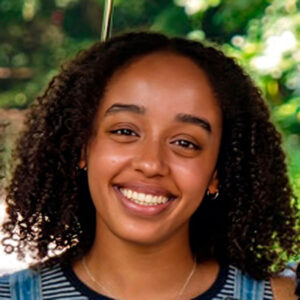 Samra McCullin is a fourth-year student at George Mason University majoring in Geography with a minor in GIS. Samra’s first introduction to the discipline was a human geography class that she took in high school, where she found passion in the intersection of social, environmental, and physical sciences. In her undergraduate coursework she is constantly surprised at how she is able to exercise both her creative and analytical strengths. The freedom of a multidisciplinary major has allowed her to explore many subgenres within geography, her favorites being tourism, transportation, and sustainable development. Following graduation in the spring, Samra intends to pursue her masters in Geographic and Cartographic Sciences, working towards a professional career in digital cartography. Samra feels lucky to have found geography as a career path so early into her academic journey and hopes that through her work as a Communities Support Intern for the AAG, she can help more people find purpose and belonging within the discipline.
 At the 2025 AAG Annual Meeting in Detroit, I had the incredible opportunity of serving as both a session chair and presenter for the 11th Symposium on Human Dynamics Research. This year’s symposium, themed “Human Dynamics and GeoAI,” marked a major evolution of geographic thought—building on a decade of intellectual contributions that have redefined how we understand human-environment interactions in increasingly multifaceted physical and virtual worlds. Thanks to Dr Xinyue Ye, Department of Landscape Architecture and Urban Planning, Texas A&M University and Dr Xiao Huang, Department of Environmental Sciences, Emory University, for allowing me to take up such a monumental adventure—one that has shaped my experience of AAG for the better.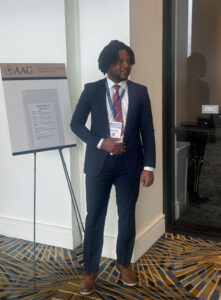


 Cadence Bowen is a senior at Kent State University majoring in Geography with a minor in Geographic Information Science (GIS). Originally from rural Arkansas, her move to the densely populated Northeast Ohio region led to her fascination with the distinction between rural and urban geographies. Her interests include tourism in rural fishing communities, Native American and Alaskan Native geography, regional disparities in early geographic education, environmental gentrification, and urban mapping techniques using open-source GIS. Her goal as a geographer is to advocate for the importance of geographic literacy through forms of digital media sharing. Outside of her academic goals, Cadence enjoys spending her summers traveling and taking on seasonal positions. Last summer, she spent her time working in the service industry in Seward, Alaska, learning more about how tourism affects economies that rely heavily on commercial and sport fishing and local indigenous communities, specifically the Qutekcak Native Tribe. She is super excited to take on the role of being AAG’s Media and Science Communications intern this summer and expand her knowledge of geographic research and media.
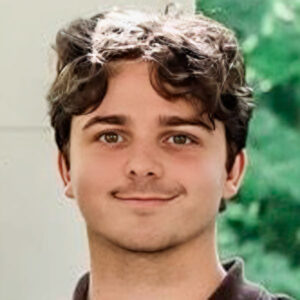 Wyatt Gaines graduated summa cum laude from West Virginia University in May 2025 with a major in International Studies and minors in Geographic Information Science and Conservation Ecology. His interdisciplinary academic background informs his interest in applying geographic research to real-world challenges—a passion he brings to his work with the AAG and its diverse initiatives. Outside of academics, Wyatt enjoys weightlifting, studying languages, and watching movies. Since graduating, he has moved to Japan to work part-time as an American Youth Ambassador at the American Pavilion at the 2025 Osaka World Expo. He is honored to serve as one of AAG’s Community Support interns for the summer term. After his time with AAG, Wyatt plans to continue working in the NGO and nonprofit sectors and pursue graduate study.