

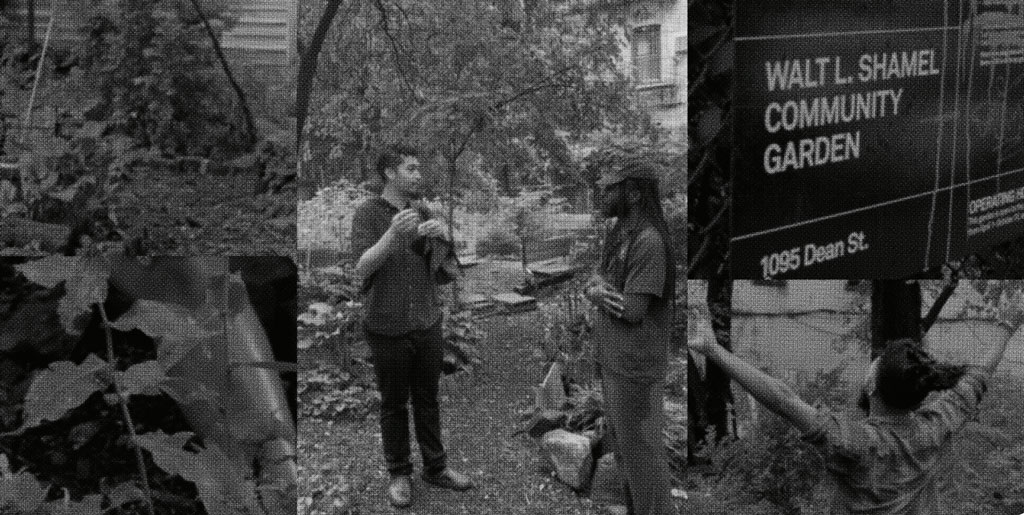
Across New York City, grassroots organizers, cultural workers, and community stewards are actively transforming urban space through collective care, ecological integration, and autonomous infrastructure. Grounded in the traditions of Black geography, land stewardship, and local mutual aid, this session brings together leaders who cultivate belonging and resilience at the intersection of the built and natural environments.
Featuring perspectives from the Brooklyn-Queens Land Trust, Field Meridians, and The BlaQue Resource Network, the panelists will explore how neighborhood-based initiatives—ranging from community gardens and seedkeeping to mobile food pantries and political education—serve as vital sites of spatial justice and collective healing. Together, they will share insights from their work in Crown Heights, Southeast Queens, and beyond, addressing the urgency of preserving land histories, building local food ecologies, and practicing transformative care in times of ecological loss and structural displacement.
Through a conversational talkback, this panel highlights how community-led placemaking and relationships with land and memory offer living blueprints for deeply rooted, liberated futures.
 Teona Williams, (she/her), organizer and moderator, is a Black feminist historian and assistant professor of Geography, and co-director of the Black Ecologies Lab at Rutgers University. A daughter of the Black South, her work is shaped by intimate histories of land, loss, and survival across rural and urban landscapes. Her family’s roots trace to Rocky Mount, North Carolina, where her great-grandparents purchased the former cotton plantation on which their ancestors had been enslaved—an act of Black worldmaking forged in the afterlives of slavery. That land, however, did not remain secure. When rural gentrification reared its familiar violence, her family was forced to permanently relocate to Washington, D.C., marking the first of two displacements that would profoundly shape her intellectual and political commitments. At twelve, she experienced displacement again, as her neighborhood along what was formerly known as Rhode Island Avenue became one of the early sites of urban gentrification in the city. She comes to this work as a Black feminist historian nurtured by rural and urban Black women cultural workers—women who understood that there was life after death, and who modeled how survival, care, and refusal might be practiced in the ruins of racial capitalism. Her research explores disaster and hunger as central forces shaping Black feminist ecologies in the twentieth century. Drawing from Black geographies, African American and environmental history, and Black feminist theory, she examines how catastrophe has been lived, contested, and reimagined by Black communities from the 1930s through the 1990s. Her current work follows a cadre of rural Black feminists who articulated expansive visions of food sovereignty, overhauled antiblack disaster relief regimes, and fought relentlessly for universal basic income, radical land reform, and food and clean water as fundamental human rights. Across her scholarship, Williams is concerned with how Black women have theorized and practiced worldmaking at what often feels like the end of the world.
 Cody Israel, (they/them), is an organizer, artist, and civil servant. Their work by day includes analyzing the investments for the pension systems of the City of New York. Outside of work, they are president of the Walt L. Shamel Community Garden located on 1095 Dean Street as well as a board member of the Brooklyn-Queens Land Trust. During the tenure of their presidency, they have coordinated with local mutual aid groups, affinity groups, and community boards to facilitate political education, nature workshops, movie screenings, and mutual aid efforts to further promote the growth of the Crown Heights community. Their work centers agentic approaches to placemaking and ecological integration with the built and natural environment. Cody is currently a graduate student at Hunter College studying Urban Planning and has a bachelor’s degree from Lehigh University in finance.
 mariam osman, (she/they), is a Somali-American cultural worker, seedkeeper, storyteller, aspiring botanist and beekeeper, and lifelong student of the living world. Drawn to the wisdom held in plants, rivers, and communities, they are guided by questions of how we learn to live well with one another in times marked by displacement, ecological loss, and violence.
Their work explores the psychosocial impacts of state violence and the possibilities for collective healing, weaving together interests in clinical psychology, political and human ecology, permaculture, evolutionary biology, and the cultural lives of plants. They are especially interested in systems of care—how people cultivate belonging, resilience, and reciprocity through relationships with land, food, medicine, memory, and one another.
mariam is a facilitator with Field Meridians, an artist collective committed to strengthening local food ecologies in Brooklyn, New York. Through neighborhood gatherings, ecological education, and collective study, they help create spaces where people can reconnect with place and imagine more rooted futures. Their work is animated by a simple belief: that healing begins in relationship, to each other, to the land and waters beneath our feet, and to the more-than-human worlds that make life possible.
 Aleeia Abraham, (she/her), is a prominent digital marketer, entrepreneur, and community organizer based in Queens, New York, recognized for her transformative grassroots leadership and advocacy. She is the founder and creator of The BlaQue Resource Network (BRN), a massive action-oriented collective launched in February 2020 that has grown to empower over 80,000 members across Southeast Queens. A native of Springfield Gardens and an alumna of CUNY Queens College, Abraham leverages her extensive background in social media marketing and event curation to drive local economic growth, civic engagement, and wellness. Under her leadership, the network established BlaQue Community Cares, a non-profit initiative that operates a critical mobile food pantry for food-insecure families. Her profound impact on the community has earned her a New York City Council Citation and widespread recognition as a powerful force for local mutual aid and Black-owned business elevation.