
Multi-ethnic group of students walking away on campus after class, going back home or to dormitory


The Generation Alpha Project Task Force

Nurturing Undergraduate Geography Education


Formed in September 2024, the Generation Alpha Project is centered on the Gen Alpha or Gen A children born after 2010 who will start entering college in 2028. This AAG initiative on nurturing undergraduate geography education is broadly focused on developing strategies to support and expand geographic undergraduate education in the United States. The task force is exploring a number of key questions that might inform such strategies, such as these clustered around three key themes:

  • What factors lead high school seniors to indicate geography as a potential college major?
  • Could the growing AP human geography program be better leveraged as a source of future geography majors and how?
  • What are the key factors that lead first and second year college students to declare a major in geography?
  • What are the types of geographic research that best capture the attention of prospective students and how could this work be better shared with future geographers?
  • Would better messaging about geography careers lead more high school and college students to consider majoring in geography (and what is the best way to do this)?
  • What are the key characteristics of geography departments that have growing numbers of undergraduate geography majors?
  • Are there lessons to be learned from the growth of geography programs in other countries that could be applied to the U.S.?
  • How important are introductory classes for geography departments with a growing number of undergraduate students?
  • What are the most promising strategies for attracting a diverse mix of geography undergraduate students?
  • What are promising and distinctive areas for which undergraduate geography programs may distinguish themselves (e.g, community engaged research, geospatial courses, study away)?
  • How might undergraduate geography growth strategies vary across different types of institutions (flagship Ph.D. granting universities, undergraduate focused public universities, private liberal arts colleges, tribal colleges, HBCUs, community colleges, etc.)?
  • How might geography departments best develop synergies between their undergraduate and graduate programs?
Background and Context

Strengthening Geography’s Future Through Undergraduate Education

The strength of any discipline ultimately relates to the size and quality of its undergraduate population. Geography undergraduates not only represent the future of the discipline, but they figure highly in university metrics and funding schemes, and serve as a barometer of public interest in the field. While U.S. geography graduate programs are arguably among the best in the world, and the AAG annual meeting is the largest annual gathering of geographers, the Achilles heel of geography in the United States has always been the relatively small size of its undergraduate population.

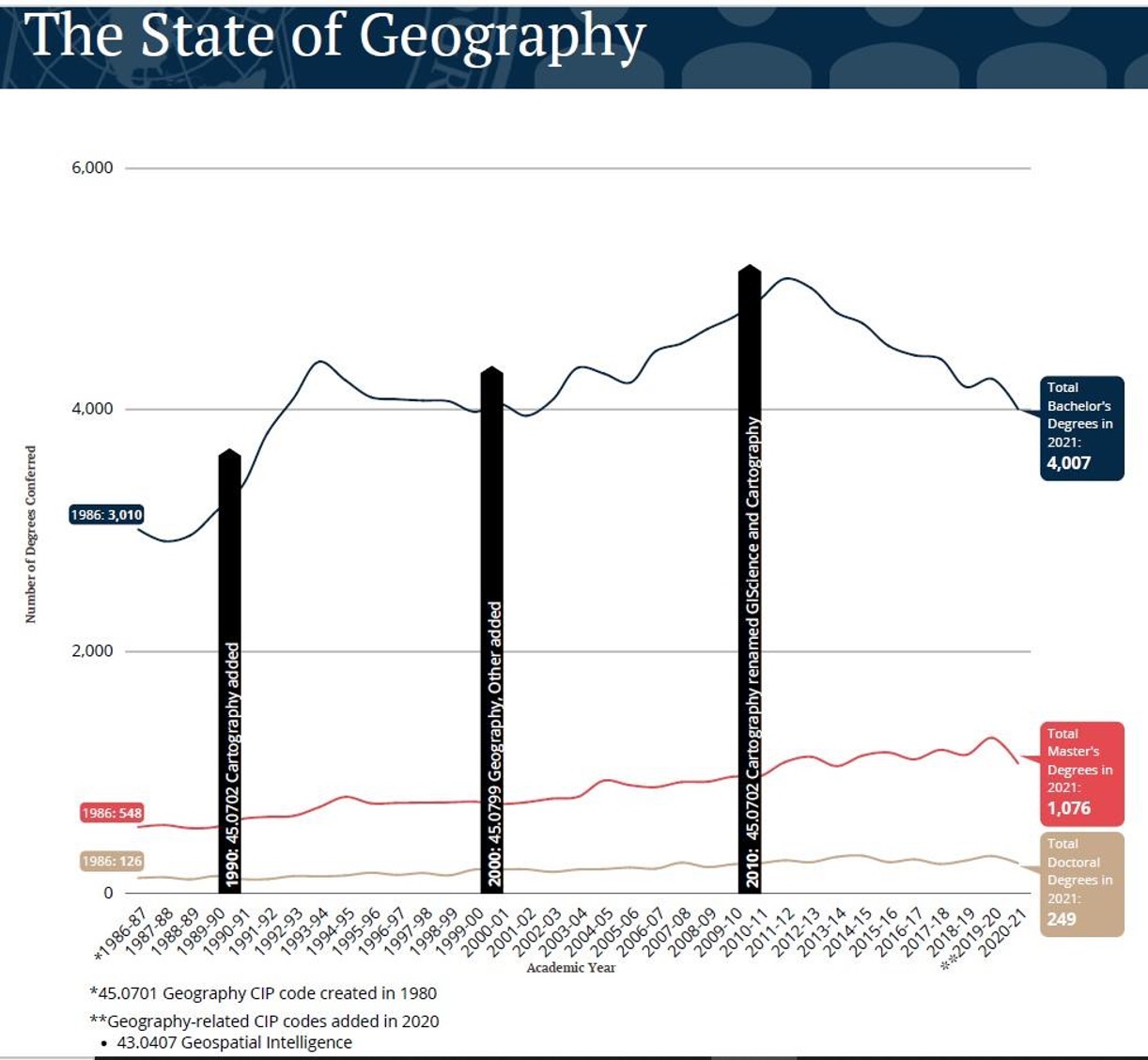
Explanations for geography’s relatively small size in U.S. higher education (and especially its small undergraduate numbers) abound, from the discipline’s “false start” in the U.S., to its meager presence in so-called elite colleges and universities (which serve as influencers in the higher ed industry), to a weak footprint in U.S. K-12 education, to Americans’ apathy for learning about other parts of the world, to a perception that geographic training does not lead to defined career opportunities (Murphy 2018; Kaplan 2021). Of course, geography’s undergraduate population has had its moments of expansion, such as after WWII (when U.S. higher education was expanding across the board) and in the 1990s and 2000s — which some attribute to the emergence of geospatial technologies as well as problems that geographers were well equipped to study, such as globalization and climate change (Murphy 2018). More recently, however, geography’s undergraduate population has been shrinking, although not as quickly as some other fields in the humanities and the social sciences, as shown in this figure (AAG 2022).

Geography Degrees Conferred in the USA, are as follows: Bachelors total in 1986 were 3,010 and in 2021 were 4,007; total Masters in 1986 were 548 and in 2021 were 1,076; and total Doctoral degrees in 1986 were 126 and in 2021 were 249
Figure 1: Geography Degrees Conferred in the USA, 1986-2021. Source: AAG 2022.

The more recent contraction in geography’s undergraduate population is a major challenge for the discipline and the AAG could play a role in developing broad strategies for addressing the problem before it is too late. Already we are beginning to see some departmental closures and mergers which is worrying — especially noted by the AAG Healthy Departments Committee. Some of the drivers are more structural in nature and are impacting U.S. higher education writ large, such as the demographic cliff — declining numbers of high school seniors, especially in the U.S. and Northeast (Grawe 2018), increasing public doubts about the value of a university education — especially among political conservatives (Tough 2023), and an increasingly vocational focus among parents and students following the 2007 financial crisis. These system wide challenges have been a particular problem for geography given its disproportionate presence in public universities and limited public understanding of the field’s value. The COVID pandemic was another challenge that hit geography especially hard as a “discovery” major that many students learn about from their peers — and therefore were less aware of during a period of prolonged social isolation (Giovenco et al. 2022).

Leadership

Generation Alpha Project Task Force

  • William “Bill” Moseley (Chair), AAG Past President and DeWitt Wallace Professor of Geography, Macalester College
  • Greg Hill (Vice Chair), John D. Horn High School, Texas
  • Chris Sneddon, Dartmouth College, New Hampshire
  • Heidi Lannon, Sante Fe College, Florida
  • Samantha Serrano, Conant High School, Hoffman Estates, Illinois
  • Max Lu, Kansas State University, Kansas
  • Alec Brownlow, DePaul University, Illinois
  • Ryan Weichelt, UW Eau Claire, Wisconsin
  • Brian King, Penn State University, Pennsylvania
  • Mary Ann Cunningham, Vassar College, New York
  • Jane Southworth, University of Florida, Florida
  • Erin Fouberg, Northern State University, South Dakota
  • Hilary Hungerford, Utah Valley University, Utah
  • Benjamin Ofori-Amoah, School of Environment, Geography and Sustainability, Western Michigan University, Michigan
  • David Kaplan, Kent State University, Ohio
  • Rebecca Summer, Portland State University, Oregon
  • Mark Barnes, Morgan State University, Baltimore, Maryland
  • Alyson Mabie, graduate student, University of Washington, Seattle, Washington
  • Coline Dony, AAG Staff
Data Collection and Outcomes

From Insight to Action: The Task Force Approach

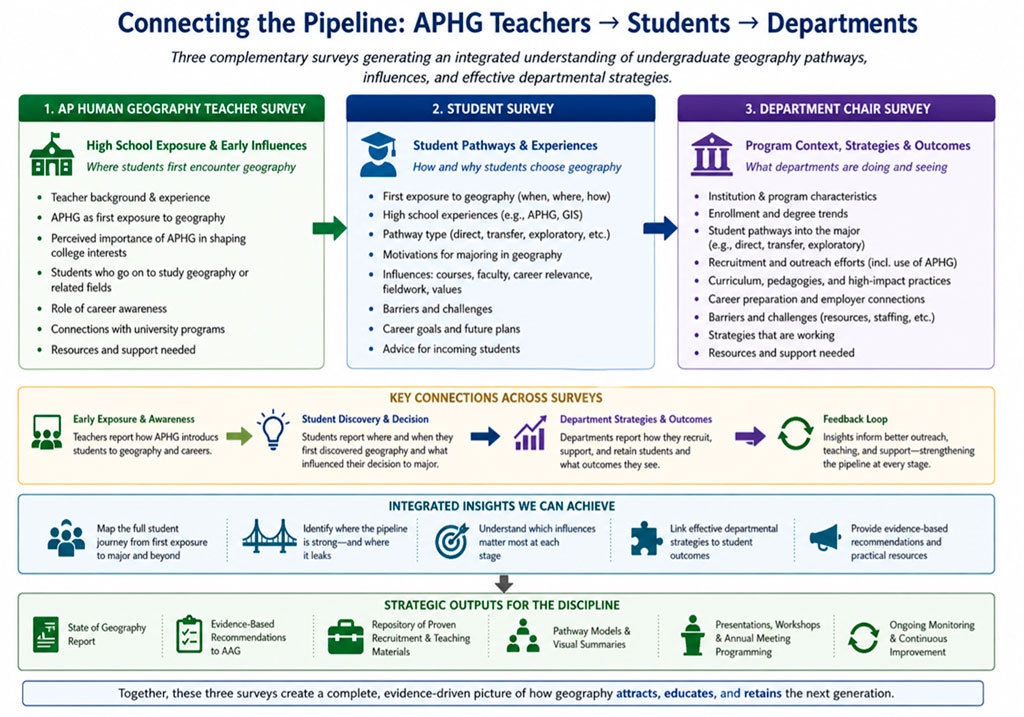
The task force’s work is organized around two complementary efforts: gathering data from across the geography education pipeline and producing strategic recommendations and resources. To inform this work, the task force will conduct surveys of high school geography teachers, undergraduate students, and geography department chairs to better understand experiences, challenges, and opportunities across the field. These insights will directly inform key outcomes, including recommendations to the AAG Council and the development of the 2027 State of Geography Report.

Graphic showing how Connecting the Pipeline: AP Human Geography Teachers, Students and Departments will inform the work of the task force

References