Christine MacKrell Interns at AAG for Summer Semester

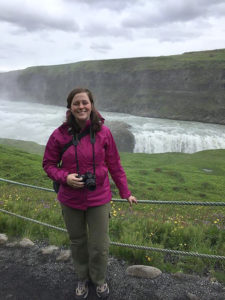
Christine MacKrell recently completed her bachelor of arts in geography from the University of Mary Washington where she also majored in political science and completed a certificate in geographic information systems. She will be attending George Washington University in the fall working toward a master of science. Her geographic research focuses on race and place, public memory, and issues of gender.

In her spare time, she loves making music, hiking, and gardening.

    Share

Great Plains/Rocky Mountains Division Team Takes 2017 World Geography Bowl Title

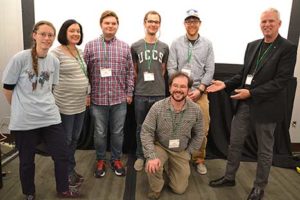
AAG President Glen MacDonald (far right) presented prizes to winners, including the winning Great Plains/Rocky Mountains Division team above. (Photograph for AAG by Becky Pendergast)

The Great Plains/Rocky Mountains Division team won first place in the 2017 World Geography Bowl (WGB), an annual quiz competition for teams of college-level geography students representing the AAG’s regional divisions. First runner-up was Southeast Division team and second runner-up was the Southwest Division team. This was the 24th year for AAG hosting during its Annual Meeting in Boston.

Read more about this year’s event.

Contestants are selected by regional divisions via a competitive process, which in many divisions includes participation in a regional geography bowl held at the regional division’s annual meeting. Each participant in the World Geography Bowl receives a travel stipend, co-sponsored by the AAG and that student’s regional division, greatly offsetting expenses for attendance at the national meeting.

Learn more about the WGB.

The competition is fully staffed by volunteers, who write and edit questions and help run the proceedings as judges, scorekeepers, and moderators. To become involved, read more about the process or contact WGB executive director Jamison Conley, (West Virginia U.) at Jamison [dot] Conley [at] mail [dot] wvu [dot] edu.

Anyone interested in becoming a sponsor or donating prizes of books, gift certificates, software, etc., may contact AAG’s WGB liaison Kelsey Taylor at ktaylor [at] aag [dot] org.

Note: This post has been updated to state that this was the 24th year the bowl was held. A previous version erroneously stated that this was the 28th year.

    Share

2017 J. Warren Nystrom Award

Four recent geography PhDs, finalists in the 2017 J. Warren Nystrom Award competition, presented high-quality research papers on April 6 during a special session at the AAG Annual Meeting in Boston.

The Nystrom Award is an annual prize for a paper based upon a recent doctoral dissertation in geography.

In Fall 2016 the Nystrom Award Review Committee considered all the papers submitted and selected four candidates to advance to the final round of the competition.

The finalists and the papers that they presented at the Annual Meeting were:

  • Paul Holloway, University of Texas at Austin – “Incorporating Movement-Related Resource Dynamics Into Species Distribution Modelling”
  • Molly Polk, University of Texas at Austin – “Practicing Critical Physical Geography in the Tropical Andes”
  • Jamie Shinn, West Virginia University – “Governing Environmental Variability: Insights on adaptive management from the Okavango Delta, Botswana”
  • Case Watkins, James Madison University – “Complex landscapes in the African diaspora: Five centuries of palm oil development on Bahia’s Dendê Coast”

After careful deliberation, Case Watkins was chosen as the 2017 winner. Mr. Watkins was unable to attend the AAG Awards Luncheon on April 9 to collect his certificate and cash prize of $1,000.

All finalists have been invited to submit their papers for consideration for publication in one of the AAG’s journals, The Professional Geographer.

This award is made from a fund established by John Warren Nystrom, who served as the AAG’s Executive Director from 1966 to 1979. Nystrom was an exceptional educator who taught geography for many years at Rhode Island College, University of Pittsburgh, George Washington University, and Florida Atlantic University. He published a number of geography textbooks and periodicals on U.S. relations with the European Community, Canada and Latin America. Beyond academia, he had a long and productive career in international relations as a senior official in the Foreign Policy Department at the U.S. Chamber of Commerce, a partner in the international relations consulting firm of Allen, Murden and Nystrom, and a Senior Fellow at The Brookings Institution. He also represented the United States at UNESCO, the United Nations’ educational, scientific, and cultural organization.

    Share

Library of Congress Publishes New Book, “Picturing America: The Golden Age of Pictorial Maps”

Designed to educate, amuse, or advertise, pictorial maps were a clever and colorful component of print culture in the mid-20th century, often overlooked in studies of cartography. A new book published by the Library of Congress in association with the University of Chicago Press, “Picturing America: The Golden Age of Pictorial Maps,” by Stephen J. Hornsby, celebrates these vibrant maps, tracing their development and proliferation from the 1920s to the 1970s. Learn more.

    Share

New Books: April 2017

Every month the AAG compiles a list of newly-published books in geography and related areas. Some are selected for review in the AAG Review of Books.

Publishers are welcome to send new volumes to the Editor-in-Chief (Kent Mathewson, Editor-in-Chief, AAG Review of BooksDepartment of Geography and Anthropology, Louisiana State University, Baton Rouge, LA 70803).

Anyone interested in reviewing these or other titles should also contact the Editor-in-Chief.

April 2017

The Autonomous City: A History of Urban Squatting by Alexander Vasudevan (Verso Books 2017)

 Beans: A History by Ken Albala (Bloomsbury 2017)

The Boatman: Henry David Thoreau’s River Years by Robert M. Thorson (Harvard 2017)

Children in the Holocaust and its Aftermath: Historical and Psychological Studies of the Kestenberg Archive by Sharon Kangisser Cohen, Eva Fogelman, and Dalia Ofer (eds.) (Berghahn Books 2017)

Development Arrested: The Blues and Plantation Power in the Mississippi Delta by Clyde Woods (Verso Books 2017)

Earth System History, Fourth Edition by Steven M. Stanley and John A. Luczaj (W.H. Freeman 2015)

Familiar Stranger: A Life Between Two Islands by Stuart Hall and Bill Schwarz (ed.) (Duke University Press 2017)

Farmland Preservation: Land for Future Generations by Wayne J. Caldwell, Stew Hilts, and Bronwynne Wilton (eds.) (University of Manitoba Press 2017)

The Great Regression by Heinrich Geiselberger (ed.) (Polity Books 2017)

Handbook on Geographies of Technology by Barney Warf (ed.) (Edward Elgar Publishing 2017)

Hydraulic City: Water & the Infrastructures of Citizenship in Mumbai by Nikhil Anand (Duke University Press 2017)

Kanaka Hawai’i Cartography: Hula, Navigation, and Oratory by Renee Pualani Louis (Ohio State University Press 2017)

Land! The Case for an Agrarian Economy by John Crowe Ransom and Jason Peters (ed.) (University of Notre Dame Press 2017)

The Lima Reader: History, Culture, Politics by Carlos Aguirre and Charles F. Walker (Duke University Press 2017)

The Long Shadows: A Global Environmental History of the Second World War by Simo Laakonen, Richard P. Tucker, and Timo Vuorisalo (eds.) (Oregon State University Press 2017)

Natural Hazards: Explanation and Integration Second Edition by Burrell E. Montz, Graham A. Tobin, and Ronald R. Hagelman, III (Guilford Press 2017)

 Picturing America: The Golden Age of Pictorial Maps by Stephen J. Hornsby (University of Chicago Press 2017)

 A Research Agenda for Cities by John Rennie Short (ed.) (Edward Elgar Publishing 2017)

Reassessing the Transnational Turn: Scales of Analysis in Anarchist and Syndicalist Studies by Constance Bantman and Bert Altena (eds.) (PM Press 2017)

Reimagining Home in the 21st Century by Justine Lloyd and Ellie Vasta (eds.) (Edward Elgar Publishing 2017)

 San Miguel de Allende: Mexicans, Foreigners, and the Making of a World Heritage Siteby Lisa Pinley Covert (University of Nebraska Press 2017)

 Space After Deleuze by Arun Saldanha (Bloomsbury 2017)

 Unsteady Flow In Open Channels by Jurjen Battjes and Robert Jan Labeur (Cambridge University Press 2017)

Volcanoes: Encounters through the Ages by David M. Pyle (Bodleian Library Press 2017)

Whither the Waters: Mapping the Great Basin from Bernardo de Miera to John C. Fremont by John L. Kessell (University of New Mexico Press 2017)

 World Regional Geography: Global Patterns, Local Lives, Seventh Edition by Lydia Mihelic Pulsipher, Alex Pulsipher, and Ola Johansson (MacMillan Education 2017)

    Share

The International Encyclopedia of Geography is Here

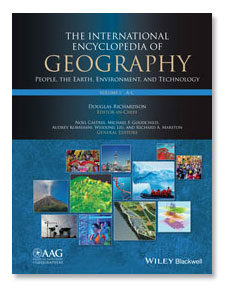
The AAG and an international team of distinguished editors and authors announce a new major reference work for Geography: The International Encyclopedia of Geography: People, the Earth, Environment, and Technology.

Available as an online resource and as a 15-volume full-color print set published by Wiley, this is an invaluable resource for libraries, geographers, GIScientists, students and academic departments around the globe. Updated annually, this Encyclopedia is the authoritative reference work in the field of geography for decades to come.

Douglas Richardson is the Editor-in-Chief, supported by five General Editors (Noel Castree, Michael Goodchild, Audrey Kobayashi, Weidong Liu and Dick Marston) each responsible for major thematic areas, and a team of expert Section Editors covering various subthemes.

  • Contains more than 1,000 entries ranging from 1,000 to 10,000 words offering accessible introductions to basic concepts, sophisticated explanations of complex topics, and information on geographical societies around the world
  • Assembles a truly global group of more than 900 scholars hailing from over 40 countries, for a comprehensive, authoritative overview of geography around the world
  • Provides definitive coverage of the field, encompassing human geography, physical geography, geographic information science and systems, earth studies, and environmental science
  • Brings together interdisciplinary perspectives on geographical topics and techniques of interest across the social sciences, humanities, science, and medicine
  • Features full color throughout the print version and more than 1,000 illustrations and photographs
    Annual updates to the online edition

Read 15 free sample articles selected by the editors:

Order your Encyclopedia today!

    Share

AAG 2017 Boston Special Policy Events — The 2016 U.S. Elections: Implications for Geography and Beyond

AAG 2017 Boston — Special Policy Events

The 2016 U.S. Elections: Implications for Geography and Beyond

This series of sessions will focus on analysis and research on the 2016 U.S. election, and what the results may mean for geography, the nation, and our planet.  

  • This special track features the session, “The 2016 U.S. Elections: Implications for Geography and Beyond,” a high-profile panel session, chaired and organized by AAG President Glen M. MacDonald, with Sarah Witham Bednarz, Texas A&M University; Alexander B. Murphy, University of Oregon; Douglas Richardson, American Association of Geographers; Derek H. Alderman, University of Tennessee; Victoria A. Lawson, University of Washington; Julie Winkler, Michigan State University, among others. This special session will be held on Saturday, April 8, 2017, from 5:20 p.m. – 7:00 p.m. in Room 312 of the Hynes Convention Center in Boston.
  • The panel session, “Need for Public Intellectuals in a Trump America: Strategies for Communication, Engagement, and Advocacy,” organized by AAG Vice President Derek Alderman, will take place on Thursday, April 6, from 10:00 a.m. – 11:40 a.m. in Room 312 of the Hynes Convention Center.

View the full list of sessions within this featured theme.

You can easily add sessions and events of interest to your schedule in the AAG Mobile App or in your online program.

    Share

AAG 2017 Boston Featured Theme — Uncertainty and Context in Geography and GIScience: Advances in Theory, Methods, and Practice

AAG 2017 Boston — Featured Theme

Uncertainty and Context in Geography and GIScience:
Advances in Theory, Methods, and Practice

Uncertainty and context pose fundamental challenges in geographic research and GIScience. Geospatial data are imbued with error (e.g., measurement and sampling error), and understanding of the effects of contextual influences on human behavior and experience are often obfuscated by various types of uncertainty (e.g., contextual uncertainties, algorithmic uncertainties, and uncertainty arising from different spatial scales and zonal schemes). To generate reliable geographic knowledge, these uncertainties and contextual issues will be addressed within the special theme.

  • The Opening plenary of the Uncertainty and Context theme features keynote presentations by Mei-Po Kwan (University of Illinois at Urbana-Champaign) and Michael Goodchild (University of California) on “New Developments and Perspectives on Context and Uncertainty.” David Berrigan (National Cancer Institute) will be a discussant. Tim Schwanen (University of Oxford) will chair the plenary.  This plenary session is on Thursday, April 6, from 10:00 a.m. – 11:40 a.m. in the Independence West room at the Sheraton.
  • The Closing plenary of the Uncertainty and Context theme features Tim Schwanen, University of Oxford; Wenzhong Shi, The Hong Kong Polytechnic University; Jamie Pearce, University of Edinburgh; and Daniel A. Griffith, U. of Texas at Dallas. This plenary session is on Saturday, April 8, from 11:50 a.m. – 1:10 a.m. in the Independence West room at the Sheraton.

View the full list of sessions within this featured theme.

Scientific Committee Co-Chairs

You can easily add sessions and events of interest to your schedule in the AAG Mobile App or in your online program

    Share

Undergraduate Student Activities and Resources at the 2017 Annual Meeting in Boston

The 2017 Annual Meeting is the first since the establishment of the new Undergraduate Student Affinity Group and over 400 undergraduates have already registered to attend! At the Annual Meeting, students are encouraged to network with their peers and colleagues, expand their involvement in and understanding of the discipline of geography, and learn skills to build their careers. To celebrate and engage this important part of the AAG community, there will be events, activities, and resources geared for undergraduate students in attendance in Boston.

• Newcomers’ Guide to the Meeting: Is it your first time attending an Annual Meeting? Check out this guide for tips and tricks to navigating the largest geography conference in the world.

• Suggested Itinerary for Students: Overwhelmed by the thousands of presentations and unsure where to start planning your day? Get started with the suggested itinerary for students, available under “Essentials” in the AAG Mobile app.

• AAG Snapshot Talk on Student Membership: As part of the new AAG Snapshots series at the Annual Meeting, AAG staff will be giving brief informational talks in the AAG Communications Center, including the topic “Make the Most of your Student Membership,” presented on Wed., April 5th at 10 a.m. and Friday, April 7, at 3:20 p.m.

• Scavenger Hunt for Undergrads: Looking for a fun way to explore the Annual Meeting? Tackle our Photo Scavenger Hunt designed for undergraduate attendees to help discover different aspects of the meeting. View and download the “Undergrad Photo Scavenger Hunt” PDF under “Essentials” in the AAG Mobile app. The first two undergraduate students to show their completed photos and checklist to AAG Staff at the AAG Booth will get $20 credit to spend at the AAG Booth (located near registration, 2nd floor of the Hynes Convention Center).

• Undergrad Meetup Area at the International Reception: Music, refreshments, and catching up with colleagues new and old are all features of the International Reception. Find the Undergrad Student Meetup area to connect with fellow undergraduates, entire a raffle for an AAG Swag Pack, learn more about the new Undergraduate Student Affinity Group, and add to our graffiti wall by drawing the logo, mascot, or name of your university! The International Reception takes place Friday, April 7, 7:00 – 9:00 p.m. in Ballroom B, on the third level of the Hynes Convention Center. Don’t miss it!

• Undergraduate Student Affinity Group Business Meeting – Want to help steer the direction of the new Undergraduate Student Affinity Group? Want to build leadership experience and add service activities to your resume? Attend the 1st USAG business meeting and consider running for a position on the board! The USAG Business Meeting is on Thursday, April 6th, from 8:10 to 9:10pm in the Vineyard Room on the 4th Floor of the Marriott.

• AAG Jobs & Careers Center and the AAG Careers in Geography Fair: Looking for career mentoring, career resources, workshops to improve your skills, or even a chance to speak with potential employers? Be sure to check out the numerous sessions and workshops at the Jobs & Careers Center as well as the employers you can speak to on site at the AAG Careers in Geography Fair. Both will be located on the Second Level of the Hynes Convention Center, in and around Rooms 203, 204, and 205.

• World Geography Bowl – Attend and cheer on fellow students competing in this annual event! The bowl takes place on Saturday, April 8, from 7:00 p.m. – 11:00 p.m. in Rooms 101-105 on the Plaza Level of the Hynes Convention Center.

• Geographers March for Science — Sign the Banner: The AAG has partnered with the March for Science. In addition to supporting the march in many ways, the AAG also will have a large banner that will be carried at the March for Science event in Washington, D.C. on Earth Day, April 22. The banner will be in Boston during the Annual Meeting at the AAG Communications Center (near registration) for any attendees who would like to sign their name on the banner to indicate their support. Undergraduates represent the future of geography; we welcome your important signatures to the banner!

In addition to the official meeting hashtag, #AAG2017, consider also using #AAGUndergrads to interact with other undergraduates in attendance and to build your peer and professional network via social media.

Undergraduate students can join the AAG for just $38 per year and receive a range of member benefits including online access to scholarly journals and publications, exclusive access to the Jobs in Geography listings, and reduced rates for Annual Meeting and other event registration. Joining the Undergraduate Student Affinity Group only costs an additional $1 per year. Check out the USAG website and USAG Twitter account for more information.  For questions, contact cluebbering [at] aag [dot] org.

    Share

Snapshot of Some Past VGSP Visits

The Visiting Geographical Scientist Program seeks to stimulate interest in geography and Gamma Theta Upsilon (GTU) by sponsoring visits by prominent geographers to colleges and universities across the country — especially in small departments that do not have the resources to bring in well-known speakers. Below are examples of the experiences and presentation materials of past visits listed in alpha order by speaker.

    Share