Doing Geography in the Age of Coronavirus or How is Everybody Coping?
You hear it from everyone you know: these are strange and frightening times. While most of us have witnessed major disease outbreaks from afar – Ebola, SARS, Swine Flu – it is another thing to encounter something so directly, so personally, so comprehensively. Pandemic: what once seemed part of a grim historical record has smashed into our contemporary reality.

If you are one of the lucky ones, you are reading this inside your comfortable home, self-isolating, dashing out only to gather the most essential items. If you are one of the lucky ones, you are struggling to refit your classroom activities, your research, your office operations, your interactions with colleagues, and your accessibility to other people within this extraordinary era – pushing everything from the physical to the virtual realm. Maybe you also have children at home who want to be with their friends, or now need to be home-schooled. A hassle for sure, but hopefully something we will come through.
Of course not everyone is so lucky. Some are still on the front lines, making this strange new world tenable for the rest of us. Medical care workers of all sorts, people working for essential services or industries, people who must put themselves in the middle of this pandemic every single day. Still others are ill from the disease or care for sickened loved ones. And then there are those who have lost their jobs because of virus-related shutdowns or whose existing precarity threatens to push them over the edge. Poor pupils worried about the loss of their school lunches and struggling without secure internet connections. Students blocked from conducting their long-planned research and who may also be anxious about paying their rent. Job seekers who have just seen their prospects shrivel up. And junior scholars fearing how this might affect their tenure clock.

In my columns I have tried to touch on issues that affect some of us. The coronavirus threat is an issue that affects ALL of us in a way unimaginable just a few short weeks ago. It is important for us to remember that while the effects and the worry are universal, the outcomes are uneven. What for some of us may be an annoying inconvenience can prove to be truly horrific for others.

For those of us leading the AAG, the past two months have been challenging but manageable. As it became clear that the novel coronavirus would be so much more than a small disruption, we made the difficult decision to cancel our annual meeting, the first cancellation since the United States entered World War II. While the decision seems obvious now, we knew that many, many of our members would be seriously disappointed as the annual meeting is one of the highlights of their year.  We also realized that all of the careful planning conducted by the AAG staff and so many in the membership would be upended.

Even before we decided to cancel the in-person meeting, the staff was working on ways to allow some of the existing sessions to be conducted virtually. So far we have 150 virtual sessions ready for the AAG conference week. The platforms that are being assembled should allow for a fairly smooth operation for those who participate and attend. If you have already registered for the Denver meeting, you can attend these sessions free of charge and use your registrations for future meetings, while others pay a nominal fee. We will continue with the AAG council meeting (virtually of course) and hold the AAG business meeting. And we have a prepared a wonderful book, The Rocky Mountain West: A Compendium of Geographic Perspectives, which is available on the AAG website.

Of course there are so many aspects of the AAG annual meeting that cannot be done virtually and several of these will be postponed. Many of the themes for Denver will continue in Seattle (along with some new themes) and participants are invited to continue their sessions as they had already intended. I have reached out to the marquee participants for our Denver meeting and most have agreed to return next year. The presidential plenary will be a joint affair with president-elect Amy Lobben and myself looking at issues of marginalization, accessibility, and expanding the geography community. Past-president Sheryl Luzzadder-Beach will be able to present her address next year. We are working to make sure all of this year’s honorees will get their rightful due at next year’s Awards Luncheon. And the best news is that the AAG will host the annual meeting in Denver after all, in March 2023. It will be an opportunity for us to make good on all the work and preparations conducted by the local arrangements committee and local professionals.

Our annual meetings are so much more than sessions. They are opportunities for us to affirm our place in the geographical community. They provide a way for people to meet and connect with those they have only encountered on paper or online. They give students a much-needed boost in their professional development and networking. And they reignite old friendships and foster new ones. To continue with this, we hope that geographers consider some of the other options offered in Fall 2020. I have long championed the value of regional meetings, and this will be an opportunity for many of us to explore these. While we had intended to provide publicity for the regional meetings in Denver, we will be sure to advertise these over the summer. Other meetings, such as Race Ethnicity and PlaceGeography 2050 and the Applied Geography Conference should go forward as we overcome this affliction.

How this novel coronavirus changes us is open to speculation. But I have no doubt that the modifications to our society and to our geography will be profound, exceeding the transformations wrought by 9/11. Everything from personal hygiene to store design will harbor the possibility of a new pandemic. Right now, geographers can provide the necessary analytics and visual tools to help all of us understand the impact of the virus today. Looking toward the future, there will be ample opportunity for geographers to unpack all of the implications of this unprecedented and devastating disease.

But now is a time to step back. Many people are hurting. Many more are scrambling. First, take care of yourselves and your families. Then take care of those to whom you are directly connected – your students and the people who depend on you – inasmuch as you can do so. Look out for those who may be fearful and alone; there are more like this than you think. Be kind to one another. Keep your physical distance, but preserve and enhance your social community. The world has become a scary place. We need connections – now more than ever. Please help make these connections happen.

— Dave Kaplan
AAG President

DOI: 10.14433/2017.0070
    Share

‘The Professional Geographer’: COVID-19 Announcement

To the authors, readers, reviewers, and staff members who contribute their energy and insight to The Professional Geographer,

I am grateful to this community of scholars and practitioners, whose contributions to The Professional Geographer have helped maintain its high quality and excellent reputation. Your dedication to scholarship and reflections on practice have put The Professional Geographer in a strong position to weather the unprecedented challenge of the COVID-19 pandemic.

Right now, all of us are experiencing intense personal and professional demands. As teachers and professionals, we must move our work online, with increasing requests of our students and colleagues. As parents and caregivers of family and friends, and as individuals, we are called upon to cope with change, uncertainty, economic stress, and threats to our own and loved ones’ health.

In recognition of these realities, and to respond to our community’s needs, The Professional Geographer will adjust its customary timetables for submissions and reviews to accommodate everyone who will need extra time this year because of increased professional and personal obligations. Our team will make every effort possible to move the editorial process along smoothly, working within the realistic timeframes needed by each person we work with, as the need arises. For example, we may need to extend the review period for a submitted paper, or give an author extra time to make revisions. Editorial decisions, which rely on voluntary peer-reviews, may be prolonged as a result.

In short, we expect to slow down the production process in the coming months, to help our contributors and staff rise to the unexpected challenges of this global public health crisis. Production of The Professional Geographer will not stop, however. Perhaps now more than ever, our discipline needs the excellent scholarship and professional reflections the journal provides on how and with what tools we learn about the world and work to solve its problems.

As the editor of a journal that has evolved over 70 years to fulfill this mission, I am confident that even this challenge will lead us to become more robust, once we get through this tunnel. I look forward to working with you. Together we will endure this challenging moment. I ask for your patience and resilience, and thank you for your support of our community.

Editor, The Professional Geographer

Heejun Chang

    Share

‘The AAG Review of Books’: COVID-19 Announcement

It has been my pleasure to serve as Editor in Chief for the AAG Review of Books for eight years. As I work on the transition to a new incoming editor, to prepare for the rest of 2020, we have been served up with an unexpected challenge, in the form of the COVID-19 crisis.

The publishing industry is already reacting to this public health emergency, moving back publication dates and slowing editorial schedules. A ripple effect in timelines and publication dates for the Review is inevitable. Coupled with this reality, we also need to be responsive to the personal and professional needs of our reviewers and staff, as they manage unanticipated family and professional obligations at this difficult time.

Accordingly, we expect to slow down the pipeline of new book reviews during this first part of 2020, which will affect our timetables for the next several issues.

Please rest assured that we will continue to work toward providing timely, well-considered reviews of the most current books concerning geography, geospatial public policy, and global geopolitical issues. We expect that the timing of our work will be influenced by these significant external forces at work in all of our lives and the publishing industry this spring.

I greatly appreciate your patience and understanding during the coming months. Thank you for your contributions to the journal, your contributions to the field, and your readership.

Editor, the AAG Review of Books

Kent Mathewson

    Share

‘Annals of the AAG’: COVID-19 Announcement

The Long View

When the Annals was launched in 1911, penicillin did not yet exist. As Editors, we are taking the long view on the COVID-19 pandemic. While the journal has persevered through many global crises, the present moment is clearly not business as usual.

We recognize these are exceptional times that are creating unusual burdens for individuals and communities. Many people are taking on additional duties as they cope with self-isolation and social distancing; cancelled classes, school and childcare; caring for and assisting older people and those with underlying health conditions; and the very real needs of students, staff and colleagues in our institutions. Those with caring responsibilities are facing more demands on their time, not fewer. These caring responsibilities are diverse and include friends, neighbors, colleagues and students—not just family members or dependent children.

We have chosen not to suspend our journal activities or operations for a set period, given the uncertain duration of this crisis. Instead, we are slowing things down, in order to stay nimble and responsive to differential challenges, capacities, and needs of our staff, contributors, and community members. Editorial decisions and copy-editing will be slower than usual; the window of reviewing will be extended and adapted to personal circumstances; responses and communications may be uneven or delayed. The months ahead will test all of us in different ways. Through difficult times, we ask for your patience.

Most important, we ask that our readers put care and community first. Peer review and academic publishing is, at its core, an act of goodwill—it requires sustained, thoughtful engagement with others, a kind of relation-building. We fully recognize and respect that not all members of our community are in a position to submit or review papers at this time. If you are able to engage in peer review, we will work with you to fully take account of your circumstances.

In the months to come, we expect to see trials and tests like never before, requiring us to pull together as a community. In this community, we find strength and hope. Reflecting on the recent words of Leo Varadkar, the Irish Taoiseach, we take some inspiration: “in the years to come, let them say of us: when things were at their worst, we were at our best.”

Editors, Annals of the American Association of Geographers

Ling Bian, David R. Butler, Katie Meehan, Kendra Strauss

    Share

‘GeoHumanities’: COVID-19 Announcement

Not Business as Usual: A Message from the Editors of GeoHumanities

There is little about being an academic in the current time that can be called “business as usual”. Academic publishing is no exception. It is the joint act of many people – authors, reviewers, readers, people in the offices of publishers and professional societies such as the AAG, editors, and many others. All of us live in communities that have been, and increasingly will be, shaped by the COVID-19 pandemic.

We join with our fellow AAG editors in choosing not to suspend our journals’ activities or operations for a set period, given the uncertain duration of this crisis. Instead, we are slowing things down, to allow more space and time for listening to the different challenges, capacities, and needs of our staff, contributors, and community members. Editorial decisions and copy-editing will be slower than usual; the window of reviewing will be extended and adapted to personal circumstances; and responses and communications may be uneven or delayed. The months ahead will test all of us in different ways. Through difficult times, we ask for your patience.

Alongside our fellow AAG editors, we ask that all of us who contribute to the existence of our journals put care of self and others first. Submission of papers and peer review are, we believe, at their core, a means of building, maintaining and sharing an academic community. They require sustained, thoughtful engagement with others – a relation-building founded on trust, generosity and empathy as well as rigour, honesty and accountability. This engagement takes many forms, works to different tempos, and is itself immersed in a world of cares and responsibilities. For many of us, ‘not business as usual’ means taking time to simply care for others and ourselves; for others, it means slowly taking stock of events, and reserving our voice until a time when we feel a contribution is feasible and useful. As such, we urge critical conversations on the links that have been, and continue to be, drawn between academic publishing, productivity, and career progression within academia. Universities and the apparatus that surrounds them can, and will, frame articles as measures of academic ‘belonging’ and ‘success’, reducing the work involved to metrics, and arguably glossing the many values that scholarship can provide to both the individuals undertaking it and their potential audiences. This framing can also erase or ignore other sites where other practices are cherished and valued – including caring for ourselves and others – practices that are especially important during times of crisis.

Please take good care.

Editors, GeoHumanities

Tim Cresswell and Deborah Dixon

    Share

Geographers Act on COVID19


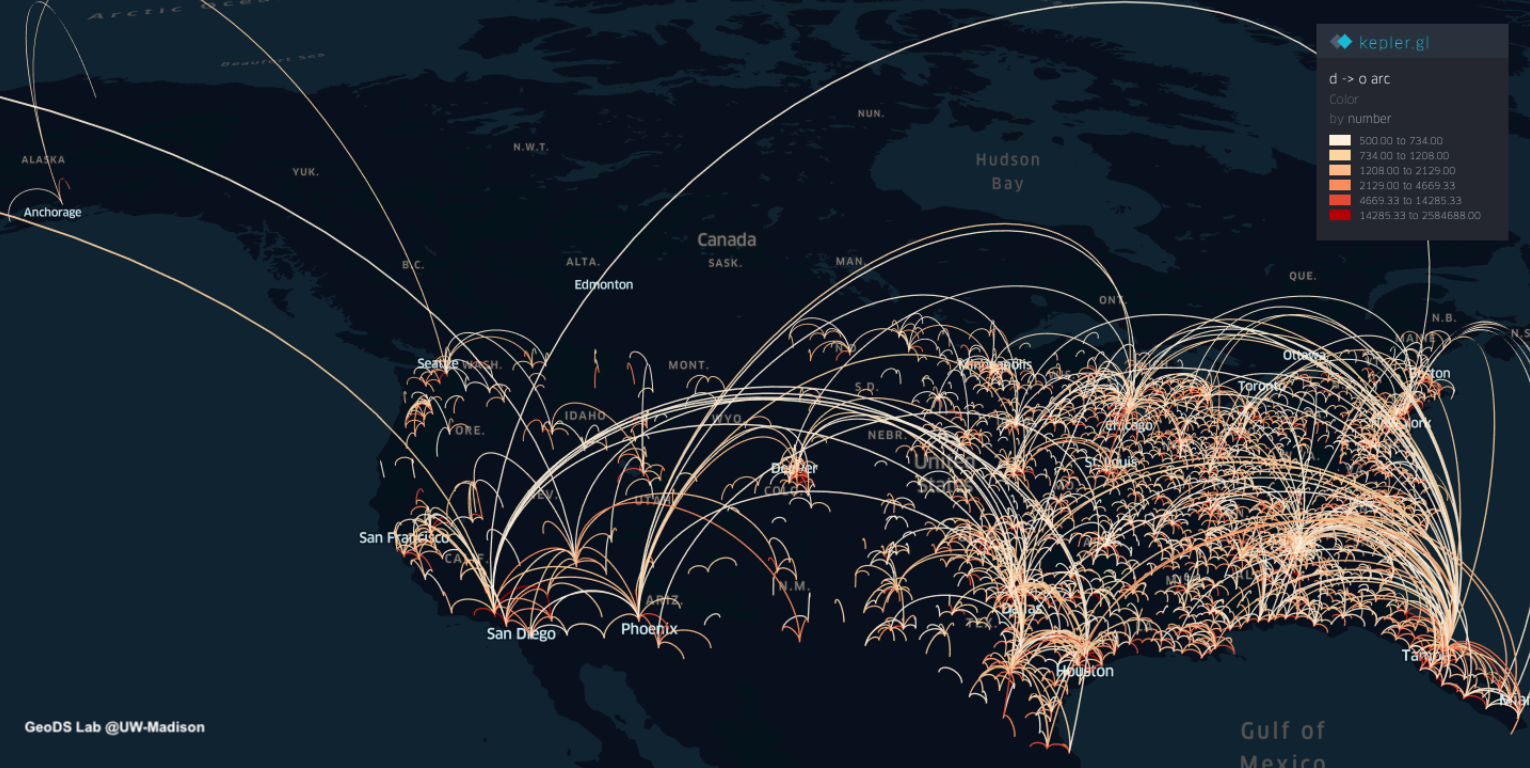
GeoDS Lab at University of Wisconsin, Madison. County-level Spring 2020 travel data from March shows thousands of trips generated in the U.S., which may help explain the rapid growth of infection cases across the country.

On March 23, AAG asked how our members and followers are responding to the COVID19 pandemic. We got an extraordinary range of responses from all over the world. Here are just a few:

Addressing vulnerability. Rafael Pereira of Brazil’s Institute for Applied Economic Research (Ipea) is working with a team using transportation modelling and geolocated data to map where vulnerable people live in areas with difficult access to health care facilities in the largest 20 cities of Brazil; David Garcia is working with the Phillipines-based geospatial collective he founded, The Ministry of Mapping, to crowdsource the location, treatment capacity, and equipment needs of all health facilities there, while also working with a clinical psychologist to provide emotional support to the mappers themselves as they examine painfully difficult data. Jim Herries is working with a team at Esri to provide a wide variety of visualizations, including a map of where America’s seniors live, and under what conditions.

Spotting patterns and susceptibilityGeographers responded rapidly to examine disease transmission data at the local and regional level. Examples include the Northeastern Pennsylvania Alliance dashboard using data from Johns Hopkins University and Esri’s ArcGIS platform; Clio Andris at the Friendly Cities Lab at Georgia Tech mapping how our movements connect us; and Song Gao’s team’s modeling of potential transmission in Wisconsin. Geographers are also instrumental in tracking the impact of social distancing on disease transmission, as well as changes to air quality due to changes in social interactions (Descartes Labs).

Reflecting on context and historySome geographers offer perspectives, op eds, essays, and interviews on the significance of COVID-19. Tim Cresswell of the University of Edinburgh reflects on how mobility has shaped the pandemic: “Turbulence has made certain aspects of our normal, taken-for-granted and never questioned mobile worlds visible.” At University of Saskatchewan, post-doc Chris Marsh was frustrated by the lack of Canadian-centric projections, and made his own. Medical geographer Graham Mooney of Johns Hopkins University has offered nearly a dozen interviews to major media outlets on what previous pandemics can teach us about COVID-19. And William Moseley of Macalester College participated in a quick-response UN-sponsored effort to understand global food security issues in light of COVID-19. His op ed on emerging food security issues in Africa due to the pandemic is here.

Do you know about a geographer’s work to respond to COVID-19? Contact Lisa Schamess, AAG Director of Communications.

    Share

Going Global or How Best to Recognize the Internationalization of the AAG; Plus – an Addendum to my Previous Column

We have always been the “AAG” but five years ago the membership overwhelmingly decided to change the full title from the Association of American Geographers to the American Association of Geographers. I remember being part of the Council when this change was discussed. It went beyond verbal tweaking and reflected our best efforts to recognize that the AAG was no longer just an organization of U.S.-based geographers. Instead we had become a community in which geographers from many countries gather.

The value of internationalization was promoted especially by past President Kavita Pandit. In her columns, she recognized that higher education has become more international. With geography leading the way, we must welcome and validate students from around the world and incorporate study abroad curricula in our programs. Kavita was not alone in pointing to the importance of international geography. Past presidents such as Victoria Lawson, Ken Foote, and Derek Alderman, among many others have spoken to the need to extend our reach and our knowledge beyond national borders.

For me the internationalization of geography and of the AAG has been a godsend. Over 20 years ago I met a number of geographers from Finland who regularly attended the national meetings — resulting in long and fruitful collaborations that continue to this day. I have also collaborated with geographers from France and Italy who regularly partake in our yearly conference. And I am delighted to renew friendships each year with geographers from a whole host of different countries.

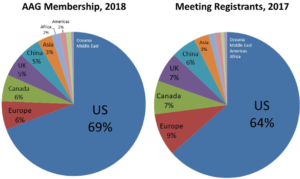
Unlike the International Geographical Union (IGU), the AAG is not structured as a super-organization made up of various national geographic societies. But we are growing ever more international and becoming a vital meeting space for geographers from around the world. In 2018, 3,476 members came from outside the United States, comprising 31 percent of all members. This is up from 22 percent international membership in 2013. The following charts show the breakdown by the largest countries and then by broad regions. International membership is led by Canada, China, and the United Kingdom, with over 90 other countries represented. Many of these geographers travel to our annual meeting to present and to network. Here the international presence is even greater, with fully 36 percent of attendees arriving from outside the United States.

This international presence adds tremendous value to our organization. This has been recognized already in several ways. We have implemented the Developing Regions initiative, which provides low-cost membership to geographers in several countries where access might otherwise be too dear. On the editorial side, we just selected two new Annals editors, both of whom work at institutions outside the United States. And about a quarter of our editorial boards are also international. What is more, I have been working with the presidents of the Canadian Association of Geographers and the European Association of Geographers to foster greater collaboration across national geographical societies.

We should move forward to the next level. Now is the time to consider international representation that better reflects our membership and puts force behind the meaning of our name change in 2015. For this reason, I am in favor of adding a dedicated international councilor, somebody who comes from an institution outside the United States. Right now international geographers have little representation. All U.S.-based geographers also belong to regional divisions, with their own regional councilor. Yet, with the exception of a few Canadian provinces folded into these AAG divisions such as NESTVAL, there is no dedicated representation for international members.

Why should we accord international members this special status? As with other groups, we could try to increase international representation through the nominations process, creating a larger pool of non-U.S. candidates for our existing “national” councilor and vice president slots. But this would be slow and unsteady — with few guarantees. In the last 10 years, we have had only two vice president and three councilor nominations from outside the United States. Of these, only past President Audrey Kobayashi from Canada was elected under our standard process.

Moreover, the AAG is intrinsically geographical in its own organization, befitting the nature of our field. Just as we divide the United States into nine geographical regions for the sake of governance, to bring an AAG experience closer to home and to represent the concerns of different parts of the United States, so we should pursue the unique advantages of recognizing the geographies of the one-third of our membership who do not live in any of these regions.

A dedicated international councilor would ensure that the AAG Council always has a representative from outside the United States. And while “international” encompasses the vastness of the world, there are relevant concerns that an international councilor could address and that would be common to members from Europe, Asia, Africa, and Latin America. Such concerns include the difficulties of access to U.S.-based meetings, potential linguistic issues, visa problems (particularly prevalent in this political environment), and better strategies for linking the AAG to geography societies around the world. I believe that an international councilor would add a great deal to our discussions and provide a hitherto underrepresented perspective.

While we have a team of people working on the particulars, I should emphasize that this reflects my personal views. The details behind creating this position will need to be worked out and approved by Council, and I will not go into them here. We may also consider a trial run, much as we did with our Student Councilor, so that we can see how well this idea works in practice and make modifications if need be. But make no mistake — the time has come to represent the international reach of our organization. The time has come to elect an International Councilor.


Addendum

As the latest in the lineup of AAG presidents charged with writing a weekly column, I would like to thank all of you who offer praise, reflections, insights, and corrections around the themes brought out each month. February’s column, Beyond the Academic 1 Percent, garnered more than its usual share of comments. Some of you noted omissions in my map of geography programs, which has been quite helpful in revising our comprehensive database of geography programs. Others agreed with the main premise of the column, in the need for greater institutional diversity and sympathy with the basic points.

There were also some critiques related to what was perceived by some as my denigrating geography at elite universities, especially Ivy League universities. My “unpopular” opinion was intended to be controversial and I will stick by my major view: the lack of large Ph.D. programs at Yale, Harvard, Princeton, and others has had some drawbacks, especially in regard to visibility — as many have pointed out over the years. But judging from the evidence among other disciplines, it has also had a salutary effect of making institutional geography more equitable. People can disagree about which is more important.

One thing we can all agree on, however, is the value of having strong geography programs at elite private institutions. Like all of you, I would like to see geography as an option for every undergraduate major. Many students tend to pick colleges first and then consider their majors, and it is a serious lapse not to have a geography degree among the options. Strong geography programs at colleges like MiddleburyMacalesterVassar, and Mount Holyoke (to name just a few) should be encouraged and replicated across the country. The undergraduate geography program at Dartmouth College has been a true standout in this regard. Its faculty continue to contribute to the discipline while they introduce geography to legions of highly talented and demographically diverse students, who go on to become leaders in the field. These institutions are truly beacons in our geographical landscape, and our discipline would be a lot poorer without their presence and energy.

— Dave Kaplan
AAG President

DOI: 10.14433/2017.0069

    Share

What will be Presented at the 2020 AAG Meeting?

Jeong Chang Seong, Chul Sue Hwang, Ana Stanescue, Yubin Lee, and Youngho Lee

A total of 4,893 papers and posters are scheduled to be presented at the Denver AAG Annual Meeting in April this year (numbers as of February 2, 2020). In order to help meeting participants and fellow geographers to sketch out what is going to be presented at the meeting, we summarized the AAG 2020 presentation submissions using keywords network analysis methods.

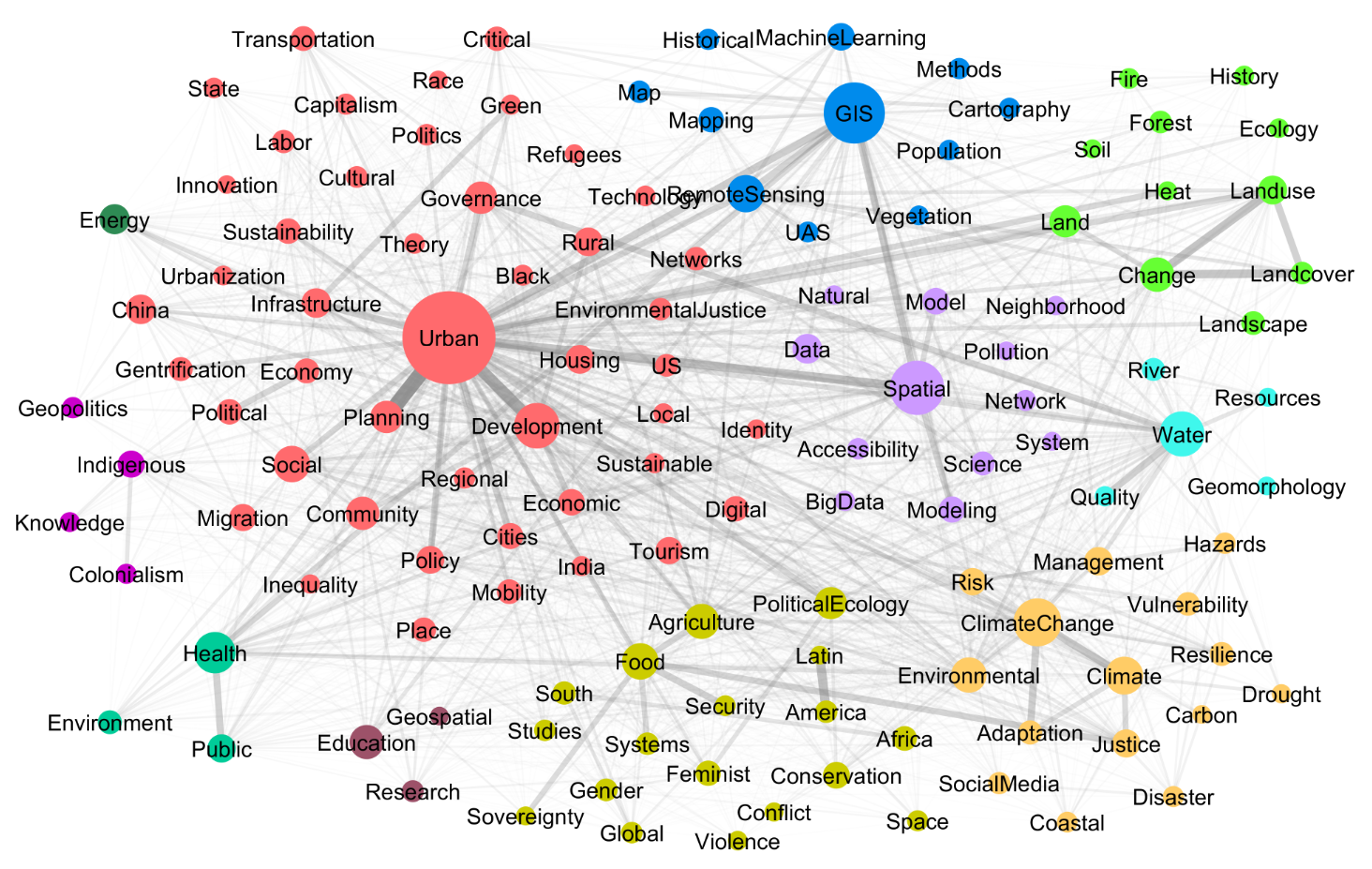
We collected all keywords from the presentation submissions. They were preprocessed with deletion, concatenation, standardization, normalization, and conversion techniques. A total of 21,954 keywords were split into single-word keywords. Any duplicate words in each record were also deleted. A total of 6,521 unique keywords were identified. We used 40 as the keyword frequency threshold for network visualization. As a result, a keywords network diagram was constructed with 129 keywords as shown in Figure 1. In the figure, circle sizes reflect keyword frequencies, edge widths indicate co-occurrences between two keywords, and circle colors indicate cluster memberships.

Figure 1. A keywords network constructed with the 2020 AAG presentation submissions

Urban (532) was identified as the most frequent keyword at the 2020 AAG Annual Meeting, followed by GIS (322), Spatial (276), Climate Change (234), Development (218), Water (215), Health (191), Climate (168), Remote Sensing (164), Social (158), and Food (158). Each number in parentheses indicates the frequency of the keyword.

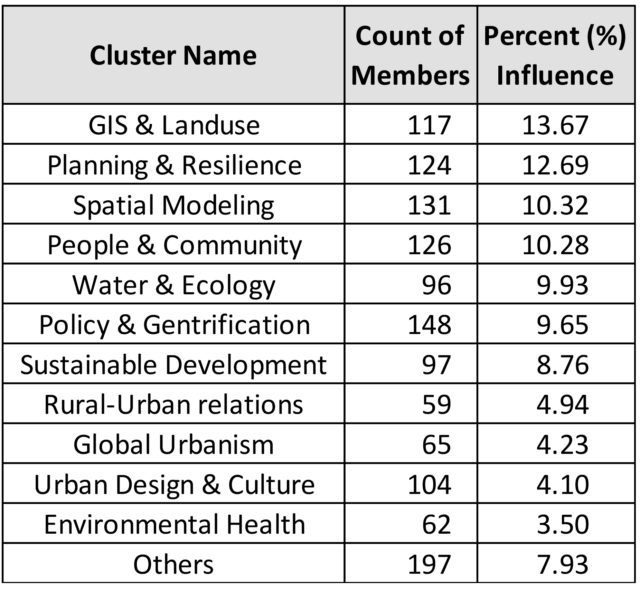
When a keywords network clustering algorithm was applied, keywords were grouped into 12 topical clusters as shown in Table 1. The Urban cluster had the largest number (1522) of keywords as members. When the influence of each cluster was measured with the eigenvector centrality, the Urban cluster was also most influential by taking 28.12% of all possible connections among keywords. When only the Urban papers were analyzed, eleven Urban sub-clusters were identified, and their percent influences and member keyword counts are shown in Table 2.  No particular topic stands out in the Urban research. Rather, several topics are very competitive.

Table 1. Clusters of AAG 2020 Presentations
Table 2. Sub-clusters of Urban Research

Some other interesting watch points are also found in the AAG 2020 presentation submissions. Firstly, this year’s 4,893 presentations are significantly less than last year’s 6,026 presentations. Secondly, the Spatial Data Science theme is independent of the GIS theme. It appears to be a much more influential cluster than GIS. Thirdly, the Urban cluster doesn’t seem to be a proprietary estate for traditional urban geographers. It embraces various expertise like GIS, data science and modeling, land use and landcover, water, ecology, and environmental health. Indeed, Urban is rather a solid entity calling diverse geographers. Finally, it will be interesting to see what will happen to the HealthWaterEducationGeopolitics, and Ontology clusters. Will they keep tenures at the AAG 2021 Meeting at Seattle?

Acknowledgment: This research was supported by the MSIT (Ministry of Science, ICT), Republic of Korea, under the High-Potential Individuals Global Training Program (IITP-2019-0-01603) supervised by the IITP (Institute for Information & Communications Technology Planning & Evaluation). We also thank AAG for supporting data for this research, and thank Dr. Coline Dony, AAG Senior Geography Researcher, for encouraging us to submit this article to the AAG Newsletter. 

DOI: 10.14433/2017.0068

About the Authors
Jeong Chang Seong, Ph. D., is a professor of geography at University of West Georgia (UWG), Carrollton, GA
Chul Sue Hwang, Ph. D., is a professor of geography at Kyung Hee University (KHU), Seoul, South Korea
Ana Stanescu, Ph. D., is an assistant professor of computer science at University of West Georgia, Carrollton, GA
Yubin Lee is a graduate student at KHU who is currently performing a visiting research at UWG
Youngho Lee is a graduate student at KHU who is currently performing a visiting research at UWG

    Share

New Books: February 2020

Every month the AAG compiles a list of newly-published books in geography and related areas. Some are selected for review in the AAG Review of Books.

Publishers are welcome to send new volumes to the Editor-in-Chief (Kent Mathewson, Editor-in-Chief, AAG Review of BooksDepartment of Geography and Anthropology, Louisiana State University, Baton Rouge, LA 70803).

Anyone interested in reviewing these or other titles should also contact the Editor-in-Chief.

PLEASE NOTE: Due to current public health policies which have prompted the closing of most offices, we are unable to access incoming books at this time. We are working on a solution during this transition and will continue our new books processing as soon as we can. In the meantime, please feel free to peruse previous books from our archived lists.

February 2020

The Saguaro Cactus : A Natural History by David Yetman, Alberto Burquez, Kevin Hultine, and Michael Sanderson (University of Arizona Press 2020)

Wild Blue Media: Thinking through Seawater by Melody Jue (Duke University Press 2020)

Intimate Geopolitics: Love, Territory, and the Future on India’s Northern Threshold by Sara Smith (Rutgers University Press 2020)

Panic City: Crime and the Fear Industries in Johannesburg by Martin J. Murray (Stanford University Press 2020)

Assembling Moral Mobilities : Cycling, Cities and the Common Good by Nicholas A Scott (University of Nebraska Press 2020)

    Share

Sean O’Brien

Education: Master’s in Geographic Information Science (University of Minnesota), B.S. in Geography (University of Minnesota)

Describe your job. What are some of the most important tasks or duties for which you are responsible?
I work in the Enterprise Research and Analytics group. The foundation of my job involves creating and maintaining our geographic datasets, as well as creating self-service mapping applications where our employees can go to explore and export maps, data, and reports. The main responsibilities of my job involve supporting our business lines with their geographic analysis needs. Going along with that, I do a lot of in-depth analysis for specific projects. I do things such as analyzing branch usage, and where customers who use branches are coming from. I also support the team that decides where to put new assets such as branches and ATMs.

What attracted you to this career path?
I discovered GIS when I was in college. I had an interest in geography, but I was also interested in statistics. I talked to an advisor who told me about GIS, so I decided to take a class to check it out. On the first day of class we all got a sheet of paper and rulers, and were instructed to draw points on a blank sheet of paper, and then draw these lines and points in a specific manor around those initial seed points. After doing this for about fifteen minutes I was instructed to erase some of the lines, and the instructor informed us that we had created a Voronoi Diagram (also known as Thiessen Polygons). This diagram creates polygons around each seed point, and any point within that polygon is closest to that seed point compared to the other seed points. The real-life example the instructor used was plotting points for a chain restaurant on a map. He then drew the polygons and explained that this is how I could find the closest restaurant from wherever I was in the city. After all that we were told that there was GIS software that could do what we just did in a matter of seconds, and that was just the tip of the iceberg for what that software was capable of. At that point I knew I wanted to learn much more about GIS. Once I started to learn more, I knew this is what I wanted to do for a career.

How has your education/background in geography prepared you for this position?
Taking geography classes as an undergraduate student was very helpful to prepare me for my future jobs. Understanding geography is a critical foundation to a GIS career path. Things like surveying, GPS, projections, and coordinate systems were required knowledge for all of my positions. Cultural geography also plays a role in my current position. Ideas such as demographics, cultural movements, and Tobler’s First Law of Geography (near things are more related than distant things) is all useful knowledge in my current role. Why do people live in certain places? What tendencies do people in specific regions have? How does the geography of a place impact people’s behaviors? Understanding people as it relates to geography is critical in a GIS/Geography business.

What geographic skills and information do you use most often in your work? What general skills and information do you use most often?
For geographic skills and information: Understanding projections and coordinate systems is always needed in a GIS line of work. It is the foundation to most GIS operations. The other most useful geographic skill is understanding the geographic software. I use it all day every day, so being familiar with the software and the geographic functions inside of it is critical. Census and related demographic datasets are used frequently in my line of work. It is very useful to be able to take tabular data, attach it to a geography, and then parse that data out by other geographies. Most geographic data is useful in business. Data such as geographic boundaries, road networks, addresses, and demographics are all used on a regular basis.

For general skills: In my work, understanding basic statistics and math is needed on a regular basis. I deal with a lot of tabular information, so having a grasp of regression, correlation, and statistical and geographic patterns is key to being able to analyze data. Related to tabular data, knowledge of Excel is required. Many things I do require me to deliver data in an Excel format. The other skill I use frequently is coding with Python. I automate geographic tasks using the code which is a critical part of being a GIS Analyst as it allows me to free up my time from doing monotonous and repetitive tasks. The final general skill I use most often is understanding and working with databases. U.S. Bank has tons of data, so understanding how databases are structured, and how to query that data is key to getting my job done.

Are there any skills or information you need for your work that you did not obtain through your academic training? If so, how/where did you obtain them?
Most of the skills I need were at least touched on during academic training. However, there are two skills that I’ve learned that were never touched on in school. The first one is how to present analysis to executives. This is something that isn’t brought up in school, but it’s very important to be able to craft a succinct story that an executive can understand. I cannot just dump data, create a chart, or regurgitate a bunch of stats and expect executives to understand what I’m trying to say. There are a couple good books that go over the main concepts of how to present data. I’ve also learned a lot from my peers and how they’ve presented things in the past.

The other skill that I did not learn in school was networking. Networking is very important both when looking for a job, and while working in a large company. Sometimes our GIS team needs to sell ourselves to others in the company. We find the right people, explain how we can help them out, and then deliver great work. If this process works, we can become a trusted partner for many business lines, and we can become respected by more business lines and executives.

Do you participate in hiring, screening, or training of new employees? If so, what qualities and/or skills do you look for?
In my current and previous jobs I have read through resumes and interviewed prospects. When reading through resumes, there are a few key things I like. One is concise information. For me and others in my position, reading through resumes is a pain because it’s tedious and it takes away from my main work. If I have to read through dozens of resumes and I come across a four-page resume, I’m likely to skim through in hopes that I find relevant information. In my opinion a good resume would be one page. I would start by listing your current job, and then list projects you’ve done that are directly related to the top qualifications and/or skills listed in the job posting. Try to use the exact verbiage used in the posting. This is what I’m looking for.

When interviewing, be sure to dress nicely. I personally don’t look for a suit and tie, but I would recommend a dress shirt and dress pants at a minimum. When I am interviewing for a position, I try to follow the STAR method of answering questions – “Situation,” “Task,” “Action,” and “Result.” When I’m interviewing, I’m not necessarily looking for that format of an answer, but that method makes sure you hit the main points when answering a question, and it allows you to not go off on an irrelevant tangent.

And of course, try to be nice. The people who are interviewing you will most likely be your manager or peer. They’re looking for people who will be easy to work with.

What advice would you give to someone interested in a job like yours?
First I would recommend getting at least an associate’s degree in geography or GIS. Learning the base theory is integral to understanding how to do things in the main GIS software. Second, I would become as familiar as possible with GIS software. Almost every GIS job looks for experience in ArcGIS. I think the future of GIS involves more coding than one might think. Learning something like Python, which is one of the easiest languages to learn, is a really good start. Once you get a good foundation you can try to branch out from there if needed. Finally, I think having at least a little exposure to things like statistics, IT infrastructure, and database management is beneficial. Once you get your foot in the door you can learn more about those as the job requires.

What is the occupational outlook for career opportunities in your field/organization, esp. for geographers?
Overall, I think the outlook is good. GIS spans across so many different professional fields, and more industries and entities are discovering the benefits of it. Even small cities and counties are investing in resources to improve their geographic analysis capabilities. Furthermore, more data has become available for consumption, allowing more analysis to be done. On that point, the demand for geographic data has grown to the point where there are entire companies dedicated to gathering and maintaining it.

I’ve had three GIS jobs – One in city government, one in consulting, and now one in private business. Currently, all three of those teams I was on have more people working with GIS today versus the day I started. There were also people within the consulting firm whose jobs were not related to GIS, but they were learning GIS on the job because it helped them with their work.

At U.S. Bank, I think we’re showing other business lines and executives what we’re capable of, and so the demand for our services has grown. I believe in the future that even smaller businesses will think of GIS as less of a luxury, and more of a necessity.

    Share