Geoffrey Martin

Geoffrey J. Martin was born on March 9, 1934, in Ilford, Essex, England, and passed away on October 7, 2024, in Woodbridge, Connecticut.

Martin dedicated his life to the study and teaching of geography, specializing in the history of geographic thought. He taught as Professor Emeritus at Southern Connecticut State University for over 30 years beginning in 1966, and served as the official archivist for the American Association of Geographers (AAG) for over three decades.
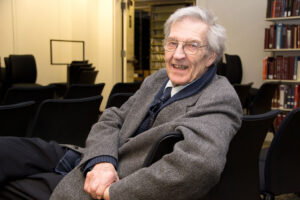
Leading geography historian and AAG Archivist Geoffrey Martin gave rare glimpses into the history of geography to a near-capacity crowd honoring his career on Thursday, January 21, 2016, in the Geography and Map Division at the Library of Congress in Washington, D.C.
Leading geography historian and AAG Archivist Geoffrey Martin gave rare glimpses into the history of geography to a near-capacity crowd honoring his career on Thursday, January 21, 2016, in the Geography and Map Division at the Library of Congress in Washington, D.C. Credit: Becky Pendergast

His meticulous research and passion for the history of geography were evident in his numerous publications. As a young academic, Martin was drawn to three figures in American geography, who had shaped the discipline in the first half of the twentieth century: Mark Jefferson, Ellsworth Huntington and Isaiah Bowman. All studied at Harvard under William Morris Davis, the man who played a founding role in the establishment of the academic discipline in America. Mark Jefferson: Geographer (1968), Ellsworth Huntington: His Life and Thought (1973), and The Life and Thought of Isaiah Bowman (1980) are considered some of his most influential work that provide deep insights into the evolution of geographical thought in the United States.
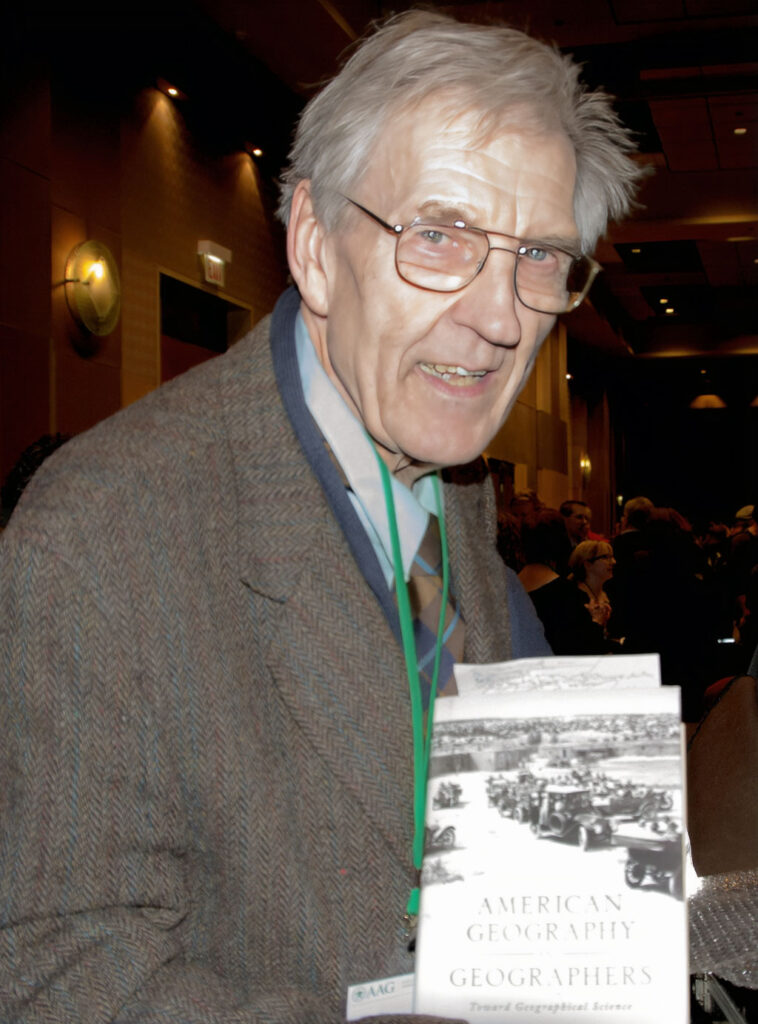
Geoffrey Martin shows a brand-new copy of his book, American Geography and Geographers: Toward Geographical Science, during the international reception at the 2015 AAG annual meeting held in Chicago.
Geoffrey Martin shows a brand-new copy of his book, American Geography and Geographers: Toward Geographical Science, during the international reception at the 2015 AAG annual meeting held in Chicago. Credit: Becky Pendergast

Following the publication of this trilogy, Martin then set out on a grander project: to tell the larger story of American geography and geographers: American Geography and Geographers: Toward Geographical Science. Covering the period from 1870 to 1970, Martin took 17 years to research and write this publication. It is a testament to Martin’s meticulous attention to detail — pursuing every lead, uncovering every possible manuscript, and tracking down every living person to interview. This publication was unanimously selected as the inaugural recipient of the Humboldt Book Award for Enduring Scholarship in Geography from the AAG Review of Books. Those who knew him professionally knew that this book fulfilled his ultimate professional goal—to offer as complete a history of American geography as had been attempted to that point.

Beyond his scholarly achievements, Martin was known for his generosity and mentorship. He inspired countless students and colleagues with his enthusiasm and commitment to the discipline. In the course of more than five decades of research, he visited 17 countries, consulted 300 archival holdings, accumulated 115,000 manuscripts, and personally corresponded with more than 100 people.

His interests surpassed being a professor. He earned money as a road gang laborer, itinerant chess player in chess cafes in London and New York, substitute grade-school teacher, professional wrestling announcer, and assistant to a poisonous snake catcher in the Everglades. As a chess player, he was in the Guinness Book of World Records for decades for a simultaneous display he did while still in the UK against 142 opponents.

The loss of Dr. Geoffrey Martin is deeply felt by all who had the privilege of knowing him. His contributions have not only enriched our understanding of the discipline’s history, but his legacy will continue to influence the field of geography for generations to come.
    Share

Susan Mary Berta

Dr. Susan Mary Berta passed away Wednesday May 22, 2024, at her residence in Terre Haute, Indiana. She was a professor at Indiana State University’s (ISU) Department of Earth and Environmental Systems, where she retired in 2021. She started her career at ISU in 1986, later serving as the department chairperson from 2002-2009.  She was also the Interim Coordinator of the Science Education Program from 2005-2007. She published over 25 journal articles and reports, with specializations in physical geography, geomorphology, and remote sensing, in addition to supervising the research of and mentoring 13 graduate students.

Born July 29, 1957, in Flint, Michigan, she received a B.A. degree in Physical Geography from the University of Michigan-Flint and graduate degrees in Geography: M.S. from Oklahoma State University and Ph.D. from the University of Oklahoma. Her master’s degree research involved using remote sensing technology and GIS, as well as field verification, to identify prospective locations of “natural areas” throughout Oklahoma for “wilderness” status consideration. Ph.D. work involved using aerial and satellite data to map periglacial landscapes in the Sangre de Cristo Mountains of Colorado. As a graduate student, she assisted in three-week wilderness “research adventures” and later offered field camp at ISU for undergraduate and graduate students for 10 summers. Her favorite part of her professional career was always the research, field trips, and friendships accumulated throughout the years.

Berta’s heart belonged to the Terre Haute Humane Society, where she volunteered for over 30 years and served as a member of their Board of Directors. She also served as a Director on the Board at the Ouabache Land Conservancy, partaking as a member since 2013.

    Share

Michael Libbee

Dr. Michael James Libbee, born on December 9, 1945, passed away on January 28, 2024, after a brief illness.

A graduate of West Genesee High School in Camillus, New York in 1963, Michael Libbee received his bachelor’s degree from the University of Oklahoma in 1967, and his master’s degree and Ph.D. in Geography from Syracuse University. From 1982-2020, he was Professor of Geography at Central Michigan University, spearheading the creation of four endowments and generating over $8 million in grants for the furtherance of geographic education.

Various research interests spanned environmental studies and geospatial technologies, but Dr. Libbee was specifically passionate about advancing geographic literacy and promoting the use of technology in geographical research and teaching. He published numerous articles and book chapters ranging from geographical education in North America to geographic professional development in journals such as The Professional Geographer and the Journal of Geography. In 1989 he co-founded the Michigan Geographic Alliance, with the goal of strengthening geography and environmental education in Michigan. To this day, the organization provides networking and professional development events for teachers and educational materials to classrooms across the state. His passion for education and geography was one of his trademark characteristics, and his infectious enthusiasm inspired countless students and teachers.

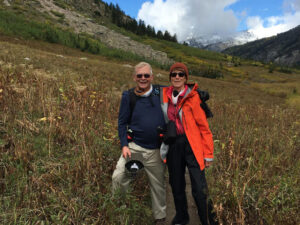
Michael Libbee and his wifeDr. Michael Libbee was the beloved husband of Kristin Sheridan, whom he married in 1971. Throughout their 53-year marriage, they shared numerous adventures together, and were often seen biking or walking their loyal canine companion, PJ. Dr. Libbee will forever be remembered for his generosity, love for his family, and dedication to his students. His legacy will continue in the lives of those he has touched.
    Share

Healthy Departments Initiative

Convening of Care

Dennis James Dingemans

Dennis James Dingemans was born and grew up in rural southern Minnesota, graduating from Albert Lea High School. He received his B.A. in History from the University of Chicago and then drove his 1949 Cadillac to San Francisco.

In 1968, Dennis was part of a diverse cohort accepted into the geography graduate program at the University of California Berkeley. Carl Sauer enjoyed Dennis’s stories about his Dutch immigrant father and growing up in Midwestern farming country, yet Dennis was attracted to the urban geography and planning courses at UCB. He became an advisee of Jay Vance. His dissertation (1975) was a study of how the morphology of the East Bay suburbs was being changed by the spread of townhouses, a house type from the central city. In short, his work focused on a piece of Vance’s model of a “city of realms.”  In addition to supping at Vance’s table of urban and transportation geography, Dennis also found his ideas shaped by Professors Glacken, Hooson, Luten, Parsons, Pred, and (in planning) Webber. A summer study tour to Yugoslavia reinforced an interest in the geography of Eastern Europe and the Soviet Union.

Dennis spent his professional career (1972-2005) at the University of California Davis. He taught topical courses on urban and economic geography, regional courses on Eastern Europe, China, and the world, and techniques courses on quantitative methods and urban field geography.  He won teaching awards from the UCD Academic Senate and the National Council for Geographic Education, and his lively lectures sprinkled with humor and bon mots were popular. He taught freshman seminars on Davis, the Bay Area, and Northern California, incorporating field experiences and works of both nonfiction and fiction, a favorite being Ecotopia.

Dennis’s research included work on townhouses, land use controls, redlining, defensible space, billboards, gasoline purchasing behavior, and (with his wife and fellow geographer Robin Datel) historic preservation and ethnic and immigrant geographies in American cities. The latter interest emerged from supervising the dissertation of his advisee Susan Hardwick on patterns of Russian settlement in the Sacramento region. Field inventories and cultural landscape slides were hallmarks of Dennis’s engaging scholarship. Dennis did a lot of university service, recognizing it as an important way to grow awareness and understanding of geography on campus. He served on and chaired numerous college and academic senate committees. He was a popular adviser for several programs in addition to Geography—International Relations, Community Development, and Environmental Planning and Management.

The Association of Pacific Coast Geographers, the AAG’s westernmost division, was Dennis’s favorite professional organization for fostering and enjoying the discipline that shaped his life. He gave 22 papers at annual meetings stretching across five decades. He served on many committees, co-organized the 1987 annual meeting, led field trips, mentored student participants, co-edited the APCG Yearbook, and was vice-president and president of the association.

Dennis lived an important life of service outside academic circles. He served on the City of Davis Design Review Commission and Planning Commission, as well as other city-appointed committees related to housing and economic development.  He worked for or against numerous local ballot measures related to planning, housing, open space, transportation, and energy issues. For a decade he served as Director of the Hattie Weber Museum of Davis, the local history museum, creating space for visitors to share their own stories. Dennis led the museum’s long and successful campaign to preserve Davis’s only WPA-financed building. He guided field excursions under the auspices of the Yolo County Historical Society, providing geographical perspectives on local people and places.

In addition to Dennis’s contributions to geography via his research, teaching, and service, his interest in the discipline was shared with his two sons. Theodore, a paleoecologist, earned a Ph.D. in Geography from the University of Nevada Reno and Franklin, a data engineer, obtained a B.A. in Geography from UC Berkeley.

Submitted with permission by Robin E. Datel and the Davis Enterprise

    Share

AAG Appoints New Director to GISCI Board

white GISCI logo on light green background

Photo of Darcy BoellstorffPhoto of Michael ScottIn August, AAG member Darcy Boellstorff, Ph.D., GISP stepped onto the GIS Certification Institute (GISCI) Board of Directors. She replaces Michael Scott, GISP, geography faculty and Dean of the Henson School of Science and Technology at Salisbury University. Scott previously served for ten years as one of AAG’s two representatives. 

Boellstorff currently is both a professor and Chair of the Department of Geography at Bridgewater State University in Bridgewater, Massachusetts. Now in her third term as department chair, she has had a focus on guiding the department through undergraduate program curriculum changes, with the goal of making geography more accessible to students by highlighting the concepts of sustainability, climate resilience, conservation, and global systems.  

Boellstorff’s work has focused on increasing the visibility of geospatial tools and applications across disciplines and university administration. In summer 2024, her department will offer a new GIS graduate certificate program through the university’s College of Continuing Studies. The development of this program is focused on aligning learning outcomes with regional employment outlook and skills needs, and outside professional GIS certification pathways for new GIS professionals to pursue.  

The GIS Certification Institute (GISCI) is a non-profit organization that promotes the advancement of proficient GIS professionals through its international GISP® (Certified GIS Professional) certification program. The Institute fosters rigorous professional and ethical standards, community engagement, and professional mentoring within the GIS industry. GISCI’s member organizations include the American Association of Geographers (AAG), National States Geographic Information Council (NSGIC), University Consortium for Geographic Information Science (UCGIS), and the Urban and Regional Information Systems Association (URISA). More information about the GISCI is available at www.gisci.org 

    Share