A Golden Opportunity for Geography or How Can We Harness the Growth in AP Human Geography?
I am from a generation when high school classes (at least in my urban public school) were not terribly challenging. This was through no fault of the teachers, who had to contend with a broad range of students and overcrowded classrooms, but it meant that many of us coasted through high school, only to be stunned by the difficulty of our first college classes. As for geography—Fuhgeddaboudit! Geography was not taught in my high school and I expect that was true in much of the United States.1

Things have changed. Dual enrollment programs now allow high school students to attend their local college or university and receive credit at both institutions. This used to be a major hassle and now is a breeze. And high schools themselves offer many more Advanced Placement courses and exams. The AP program was still pretty small potatoes in most school districts until the 1980s and 1990s when the number of schools providing at least one AP course doubled and then tripled. AP courses are now available in well over half of US high schools—an outlet for students wishing to take rigorous courses plus obtain college credit if they score well on the AP exam.

The foresight of a few geographers and the extraordinary assistance of the AAG enabled us to develop an exam for AP Human Geography in the 1990s.2 Today AP Human Geography is the fastest growing AP course, increasing five-fold over the past 10 years. It is one of the 10 highest enrolled of all AP subjects. No longer folded into “social studies” or “earth science,” geography—at least human geography—finally has a place of its own in the secondary school curriculum.

AP Human Geography introduces whole cohorts of K–12 educators to geography, perhaps even expanding the numbers of education majors who decide to concentrate in this discipline. It provides a bit of extra pay and fellowship for the nearly 1,000 geography teachers, professors and grad students who descend on Cincinnati every June for the annual APHG grading. This event and others foster greater interactions between high school teachers and college faculty, expanding the community of geography.

That being said, the AP program and APHG has come under its share of criticism, and I want to address two points here. The first questions whether the AP Human Geography curriculum is as rigorous as the same course in college. Not surprisingly, this is echoed for all AP courses; some universities have even refused to accept AP credit as a consequence. I believe that such concerns are unfounded. True, many AP Human Geography teachers did not major in Geography, but the same could be said of many instructors brought in to teach at the college level. The textbooks are the same, and the AP Human Geography curriculum is well thought out and comprehensive. In addition, AP Human Geography courses are taught over an entire year, allowing for a great deal more content. In order to obtain any college credit at all students must score a 3 or better on the AP exam. In 2019, only about half of all students who took the APHG exam scored a 3, 4, or 5—scores required to get college credit. The other half of test-takers effectively “failed” the exam. Show me a college class where half the students fail, and I will show you a class where the instructor has been replaced. AP tests are tough, and the grading is far tougher than what students experience in college. Research results show that these AP students performed better in subsequent geography courses than did those students who took Human Geography in college.

The second critique has to do with whether AP Human Geography effectively cannibalizes college geography courses, as incoming students no longer need human geography as part of their distribution requirements. This may deserve some study and practice on how to move these students into other geography courses. But this possibility may be more than offset by using this one course to spearhead a Geography major or minor. Research for other AP subjects has shown a strong relationship between how well students perform in an AP subject and their likelihood of majoring in that subject in college.

In a previous column, I spoke about trends in Geography majors. Given this spectacular growth in AP Human Geography we would expect a similar trajectory for Geography majors, with a 5–7 year lag. But this is not the case. The number of Geography majors has remained flat even as successful APHG test takers have zoomed. One reason could be the preponderance of APHG as a 9th grade subject, as students who take it go on to other fields because the high schools offer no additional geography opportunities.

This is probably not going to change. But it represents a path of opportunity for all colleges and university Geography departments. At the larger level, inviting AP Human Geography teachers to special conference activities can be eye opening and inspiring for all. Since 2015, the American Geographical Society has held the Geography Teacher Fellows Initiative that, among other things, invites Human Geography teachers to their annual Geography2050 Symposium in New York, including special workshops and year-round activities to continue the engagement. The AAG has also initiated an APHG meeting at the AAG annual meeting. This comes with a special price for teachers to attend and allows for more workshopping and networking. We are now also introducing some of these workshops to regional meetings, with a few to be piloted this fall and hopefully a more comprehensive roll-out in 2020. There has been more energy around this issue than I have ever seen before, and it can help provide training, connections, and a sense of community for all Human Geography teachers.3

Beyond these initiatives, I propose taking steps at a smaller level. All geography departments are situated among numerous high schools, several of which teach AP Human Geography. The map below4 shows the numbers and relative percentages of students earning credit in the course by state. Clearly some states—notably Texas and Florida—have robust programs, mainly because they require more of their students to take AP courses. But many other states are catching up. The high school closest to me just initiated an AP Human Geography course three years ago and it is quite popular.
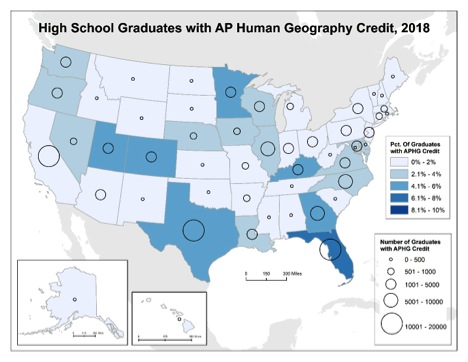
While these data are quite general, there are a couple of ways for interested faculty to acquire information more specific to them. One option is to look up the high schools teaching APHG in your state, and create some connections between the teachers, their class, and your department. Perhaps invite teachers and students to come over for Geography Awareness Day, or ask if you can talk with their class about what a geography degree has to offer. One PhD student has already piloted such a program to connect AP Human Geography high school teachers with Geography departments from local colleges and universities. Since many colleges and universities gain their students from neighboring communities, this early intervention could yield benefits further down the line.

Another option is to find those students who have completed APHG at your institution and then invite them to come to departmental events and to consider becoming a major or a minor. These data are not available publicly, but the names of such students can be requested from the Registrar’s office. I tried this myself, and while it required a bit of paperwork, it was ultimately successful.

Not one of these ideas is a magic bullet. Building up connections and enrollment can be a long and drawn-out process. But small steps might allow us to take advantage of something truly spectacular. We can seize this golden opportunity and invigorate geography throughout higher education. In this instance, I would love to hear of any successes AAG members have had with connecting to AP Human Geography.

— Dave Kaplan
AAG President

DOI: 10.14433/2017.0061

  1. In those more enlightened education systems outside the US, geography was and continues to be a vital subject in secondary school.
  2. A few useful sources relating this history and current prospects: Murphy (2000), Scholz (2014), Lanegran and Zeigler (2016), Bednarz (2016)
  3. This only applies to Human Geography, but we may also consider how to engage teachers of AP Environmental Science.
  4. Map created by Jessica Reese, based on data from the College Board and the US Census. Inspired by the maps and analysis in Jones and Luna (2019).
    Share

The Mental Health Challenge or Relieving Anxiety and Depression for Students and Faculty

About 18 years ago, one of my Masters students calmly mentioned that she had been undergoing a tremendous amount of anxiety, and had seen a doctor about it. I was floored! This particular student exemplified “no drama.” She was motoring through her Master’s thesis research and writing while effectively assisting me on one of my research projects. To think that Carol (not her real name) was suffering this sort of debilitating stress was a revelation. And then she said, “But Dave, everybody I know is suffering.”

I remember stress from college, graduate school and as a professor. High levels of tension were considered a badge of honor—some sort of endurance test—but these types of “masculinist” environments can leave some people unnecessarily wounded. Five years ago, past-president Mona Domosh described how her early experience of job uncertainty and loneliness opened up bouts of depression. The inability to talk about these issues only prolonged her despair.

Far more undergraduates report severe psychological disorders to counselors, including depression, anxiety, hopelessness, suicidal thoughts, eating problems and substance abuse. Stress begins early, as high school students suffer from “achievement pressure,” overcoaching, and a need to load college applications with all manner of activities and plaudits.

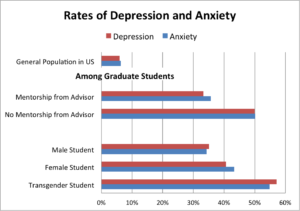
Graduate students can be overwhelmed by mental distress. A recent survey of mostly Ph.D. candidates showed that 39 percent were moderately to severely depressed, with slightly higher rates for women and much higher rates among transgender students. These incidences greatly surpass the general U.S. population, which are within a percentage point or so of most other countries. Students are hurting. The reasons behind their stress are obvious: overwork, strained relationships with advisors, feeling a lack of support, worries about the future, and a reluctance to talk about these problems. In one tragic case, a graduate student committed suicide because he felt bullied into publishing work that was incorrect.

Faculty also suffer. This is especially true of those still awaiting full-time employment, working under precarious conditions as adjuncts. Yet professors everywhere contend with pressures to produce as the bar reaches ever higher. Lawrence Berg and others liken this to the anxiety instilled in the neoliberal university, where conditions of competition, inequality, and economization of labor prevail. Faculty may have once been free to define their own scholarship, but there is now a greater focus on differentiating winners from losers. A report from the U.K.—where this economization of faculty is further along—discusses the unrelenting pressure to procure grant money and to publish, publish, publish. The increasing use of metrics all around only aggravates the burden.

Mental health challenges, and the tensions that produce them, will only worsen. It seems that we live in a more competitive age. Social media exposes too much information, flagging our inadequacies and failures. I can only shudder at the thought of how people applying for graduate school and for faculty positions can witness, in real time, the experiences of every other applicant.

Strong mentoring relationships help ease the burden of anxiety and depression. (D.A. Peterson, U.S. Department of State)

Breaking the culture of silence is critical. People need to feel they can talk to other people, in confidence, about their problems. Sometimes professional therapy is absolutely required. But pressure can often be relieved through sympathy, reassurance, and the realization that others have many of the same struggles. Beyond this, universities and colleges can provide accessible and affordable mental health care, put in a robust referral system, and make it easier for people to take a leave if so indicated. The AAG has initiated a mental health affinity group with the charge “to explore how the organized practices of the academy are implicated in the current state of mental health among students, faculty and staff across university campuses and in doing so, consider ways that we might create healthier environments.” [AAG login required]

A toxic academic culture that looks the other way when students and colleagues are harassed engenders feelings of worthlessness and saps motivation. Cases in geography and in academia as a whole have exposed the perniciousness of what used to be acceptable behavior. The AAG has developed its Harassment Free guidelines, and we seek better ways to address the problem at conferences and in workplaces. But of course this only covers a small part of the terrain. Eradicating harassment wherever it occurs should be the goal.

Departments should instill a culture of friendliness. In my view, there are few people so important, or who are engaged in such significant research, to be allowed to get away with being nasty or even indifferent to others. Yet we seem too willing to forgive jerks, particularly those deemed “successes” because they are well-known in their field or bring in a lot of grant money. Such values, whether propagated by chairs, advisors, professors, or fellow students, are inimical to a healthy academic culture. People should observe certain norms of civility, treating everyone with a level of respect and also providing a level of accessibility. While it is hard to change human behavior and everybody lapses once in a while, our collective mental health would improve tremendously if people were just a bit kinder.

So much of the stress of academic life comes from the high incidence of rejection. Students and junior professors are under the gun to publish articles and get grants. They look around and compare themselves to what seems an unending string of successes. But much like Facebook displays a carefully curated collection of congratulations, cute children, and exotic travel experiences, a senior professor’s cv does not represent the real struggles she has endured. A so-called “failure cv”—proposed a few years ago—is a way to remind us of the hard and often unrewarding work we do. If made public, it also shows that there are no glide paths to success.

Professors must set standards and educate students in the best way they know, and these challenges can be made easier with clear access and instructions. I recall too many professors who would spring something on their class, not for any purpose but because they had not gotten their act together. A student’s well-being is supported by instructors who are prepared for each class, show reasonable flexibility, and express sympathy and openness. Yet a recent survey showed that only half of college graduates reported having any meaningful relationship with faculty or staff. I always try to remember that many students worry about contacting their professor, or intruding on her time. Closing the door, either literally or figuratively, because more important work must be done sends a signal of relative value. Of course it is necessary to sequester ourselves at times, but we must make sure we are available, responsive (yes—even on weekends when the need and anxiety on the other side is great), and caring.

To that end, we need to publicize our understanding, sympathy, and availability. Last year, a colleague in another program sent around a message that she suggested we share with our students. I and several other faculty followed up with emails to students saying we understood that the end of the semester can be stressful, that it was important for students to take care of their mental and physical health, that we would be available to speak anytime to anyone with problems, and to refer them to someone who could help. The email really struck a chord. Students felt that they were not quite so alone.

Mental health is complex, and some issues are severe enough that they need to be tackled professionally. But would it not help everybody, those simply stressed and those truly in despair, if they could feel the meaning behind these words? We are here. For you.

— Dave Kaplan
AAG President

DOI: 10.14433/2017.0060

Data from:

World Health Organization (2017). Depression and Other Common Mental Disorders: Global Health Estimates. Geneva: Licence: CC BY-NC-SA 3.0 IGO.

Evans, Teresa M, Lindsay Bira, Jazmin Beltran Gastelum, L Todd Weiss & Nathan L Vanderford (2018). Evidence for a mental health crisis in graduate education. Nature Biotechnology 36, 282–284

    Share

Lester Rowntree

Geographer Lester Rowntree was most at home exploring landscapes, to both appreciate and protect their cultural and ecological diversity. As a gifted educator, he enthusiastically shared what he learned and inspired his students to engage with the natural world.  Les (the name he preferred) was an environmental geographer by training who loved nothing more than to walk in the oak woodlands, sail across the San Francisco Bay, or climb in the Sierra Nevada or the Cascades for the sheer joy of it.  He made his impact on the disciplines of geography and environmental studies through teaching at San José State University, writing textbooks, scholarly articles on the cultural landscape, and a lifetime of research and activism working with California’s natural environment. He was a superb mentor for geographers of any age, making time for long discussions, careful listening, and wise advice. Les passed away on August 30th in his Berkeley home after a long struggle with cancer.  He was 80 years old.


As a scholar Les was most known for a series of important essays on cultural landscape interpretation.  He and his wife, archaeologist Meg Conkey, co-authored an influential paper in 1980 titled “Symbolism and the Cultural Landscape” that appeared in the Annals of the Association of American Geographers.  Another influential piece was the 1996 essay “The Cultural Landscape Concept in American Human Geography” which appeared in Concepts in Human Geography edited by Carville Earle, Kent Mathewson, and Martin Kenzer. He also was a prolific textbook author. In the 1980s he joined geographer Terry Jordan to co-author The Human Mosaic: A Thematic Introduction to Cultural Geography, a project he worked on for seven editions. He then collaborated with Martin Lewis, Marie Price and William Wyckoff for over 20 years on two world regional geography books, Diversity Amid Globalization: World Regions, Environment, Development (seven editions) and Globalization and Diversity: Geography of a Changing World (six editions). The books introduced a thematic structure for world regions while conceptually linking areas through globalization processes.  The most recent edition of Globalization and Diversity was published in 2019. The best part about working with Les on these books was the way he approached it, with joy, high energy, purposefulness, and a dash of irreverence.


Although he wrote about the world, Lester Bradford Rowntree was a native Californian who cared deeply about his home.  Born by the Pacific Ocean in Carmel on December 22, 1938, he spent his youth in what he called a “quaint village of artists, bohemians, and other interesting folk”.  In the post-war years his parents moved to Berkeley, where his father was a member of the Berkeley Fire Department.  Les attended school there, graduated from Berkeley High School, and was elected class president. His college years were restless as he struggled to find a subject that would keep his attention as much as the mountains and the sea, and toward the end he’d fondly recollect summers spent in fire lookouts and hanging out with climbers at the fabled Camp 4, near Yosemite Falls.  He took time off, served in the US Army, and was eventually stationed in Germany where he wrote for Stars & Stripes. His time in Europe introduced him to the Alps, a place that he returned to for his doctoral research.  After being honorably discharged from the army as a conscientious objector, he eventually returned to California and San José State University where he earned a BA in Geography in 1966.  He then went to the University of Oregon where he earned his MA (1970) and PhD (1971) studying the human ecology of mountain systems.


With a PhD in hand, he returned to San José State University (SJSU) to teach.  For over 30 years he taught in the Departments of Geography and Environmental Studies, introducing thousands of students to his passion for environmental geography and landscape interpretation, and steering a long list of students to graduate studies. While at SJSU he chaired the Department of Environmental Studies from 1995-2005. That department, established in 1970, was one of the first of its kind in the country. He retired from SJSU as Professor Emeritus in 2005 to focus on his writing, activism and love of the outdoors. He held Visiting Scholar and Research Associate appointments at the University of California, Berkeley since 2005.


Perhaps the most personal scholarly project of his career was Hardy Californians: A Woman’s Life with Native Plants, which was published in 2006 by the University of California Press.  A monograph by the same title was first published in 1936 by (Gertrude) Lester Rowntree, Les’s grandmother, with whom he shared the identical name. His grandmother lived in the Carmel Highlands and was a pioneering expert on California’s native flora. Les took enormous pride in re-introducing his grandmother’s path-breaking work to a new generation of ecologists and botanists. He also enjoyed writing popular environmental essays for Bay Nature.  Two excellent examples of the teacher/scholar writing to a broader audience are: “When it Rains it Pours: Atmospheric Rivers and Drought”; and “Forged by Fire: Lightning and Landscape at Big Sur” in which he returns to his lifelong interest in the impact of fire on the landscape.


Even though teaching required a long commute to San José, Les eventually returned to the Berkeley Hills to live in 1987 with his wife Meg Conkey, who at that time was appointed to the Department of Anthropology as a Professor of Archeology at UC Berkeley. Their home was regularly filled with visiting scholars, friends and family. Summers often included research, especially at Meg’s field site in the Dordogne, north of the French Pyrénées, with frequent travel to a family summer home in Maine. Les and Meg also shared a devotion to Cal sports and regularly attended women’s basketball and men’s football games.  Les passed away in his home with a view of the ‘hardy Californian’ native plants that filled their garden. He is survived by his wife Meg, daughters Erika and Alicechandra, three grandchildren, and his brother Rowan and sister Pat. There are plans for a memorial in November.


Marie Price and Paul F. Starrs

    Share

Jane Daniels

This profile was originally published in 2012 by Dr. Joy Adams

While growing up as a first-generation Czech American in a small community near Milwaukee, Jane Daniels developed a keen interest in her own heritage as well as the cultural backgrounds and customs of others. However, she didn’t consider heritage as a potential career path until she took a graduate course in historic preservation at The University of Wyoming while pursuing her master’s degree in international studies and environmental conservation. “I instantly saw the overlap between heritage and my undergraduate training in geography and environmental studies,” she says. “I saw it as an opportunity for doing something that was meaningful to me and that I had been trained in.”

Jane’s undergraduate education at The University of Wisconsin-Madison was excellent preparation for her position with Colorado Preservation, Inc., a private, nonprofit statewide historic preservation organization. “As geographers, we have a tendency to look at the world in a broad sense,” she explains. Preparing a proposal explaining why a site should be preserved and developing plans for how it should be interpreted require her to analyze a wide array of data. Jane needs to consider the site’s historical, cultural, political and economic contexts as well as material aspects of the surrounding landscape, such as transportation networks, zoning restrictions, and local architecture. She also needs to carefully evaluate the costs, benefits, opportunities, and limitations of each potential project. In her opinion, professionals with an interdisciplinary background that combines the liberal arts and the natural sciences are particularly well-equipped for this sort of work.

Jane’s position as Director of Preservation Programs encompasses a number of additional responsibilities, including developing funding strategies, financial reporting and budgeting, public relations, and hiring contractors. Cooperating with a broad, diverse group of stakeholders is a key skill, which requires well-developed abilities in oral communication, writing, and public speaking. Jane also got on-the-job training in several important areas that weren’t included in her university curricula, specifically real estate, financial management, and architecture and construction. She strongly recommends that aspiring preservationists seek hands-on experience in the field. Before joining Colorado Preservation, Inc., in 2008, Jane was the Executive Director of the Main Street Program in Laramie, Wyoming, and she previously worked in the private sector as a consultant to rural communities and in the public sector for the City of Madison.

Jane’s ideal job candidates also demonstrate consistency in their interestsand a commitment to pursuing them. On working in the nonprofit sector, she observes: “There’s an opportunity to become more personally invested in whatever work you’re doing. There’s a chance that you’ll fall in love with the buildings and projects you work with, so we tend to work very hard and become passionate.” Volunteer work provides evidence of one’s dedication to the cause as well as tangible experience in various aspects of historic preservation. “There are many opportunities to get involved without applying for a job outright,” Jane reports.

The current housing slump has slowed real estate markets, but this situation has opened doors for historic preservation. With new construction down, there is increased demand for the preservation and restoration of existing structures. Furthermore, growing interest in sustainable development, economic revitalization, and livable communities all have positive implications for the field, which is growing and gaining recognition. As historic properties are increasingly  acknowledged as “worth preserving,” there is more room for people in the field who are specialists like Jane as well as for those who may not be experts just yet, but who can offer relevant knowledge and skills.

    Share

Claire Dwyer

It is a very great sadness to bring news of the death of our dear friend and colleague, Claire Dwyer. She was diagnosed with a rare and serious form of cancer last year, and died peacefully on Sunday afternoon (14th July). She will be missed by so many of us in the geographical community and beyond.

Claire spent most of her academic career at University College London, where she undertook her PhD research on the identities of young British Muslim women.  She joined the Departmental academic staff as a lecturer in 1995.  However, she was also an international figure – some of the strongest influences on her ideas and interests were formed during her Masters course at Syracuse, which followed her undergraduate degree at Oxford. She had formal visiting fellowships at York University in Toronto, at UBC in Vancouver, at Uppsala and Utrecht universities, and was a regular speaker at events in the USA and Singapore.

Claire’s research made a vital contribution to social geography.  Her early focus on gender, religion and ethnicity remained at the core of that contribution, but her work developed in new and distinctive directions, on transnational consumption in explorations of diasporic South Asian fashion, on innovation in qualitative methods, and in the critical analysis of the growth of faith schools in the UK. Throughout her career, her critical feminism underpinned her thinking and her approach. She was one of the co-authors of Geographies of New Femininities in 1999, and was active in the growth and success of the RGS-IBG Gender and Feminist Geography Research Group, serving on its committee for fifteen years.

Claire’s most recent research on the creativities of suburban faith communities played to her strengths.  She had a real gift for putting people at their ease, and brought together different publics with artists and other creative professionals in a series of genuinely participatory projects. She was also a great leader of a diverse project team with many different skills and talents.  The work drew upon both her academic expertise, but also her religious faith – she had a brilliant capacity to listen and understand the beliefs, practices and creativities of people with different faiths, an empathy that was generous but also critical and questioning.

Claire’s career was also marked by a strong commitment to teaching at undergraduate and postgraduate levels alike. She cared deeply about her students, leading courses in social geography and in migration and transnationalism, and was always in great demand as a dissertation supervisor.  She founded and convened a successful Masters programme in Global Migration, linked to the Migration Research Unit, of which she was co-director. She was committed to the development of new generations of scholars in social geography, particularly in issues of migration, diaspora, identity, gender and religion. She had an extraordinary record of PhD supervision, supervising over 20 projects to completion. Many of these PhD students are now significant academics in their own right. Even now, there are 10 further projects in progress at UCL where Claire was either first or second supervisor. The loss of her drive and direction of new scholars is a loss not only to UCL, but also to the wider discipline.

Claire’s academic achievements are impressive, but what has been re-emphasized to us all in the short time since she died is how much she meant to people.  She combined intelligence with great generosity, a willingness to put others before herself, and an ability to bring out the best in people. Her sound judgment, collegiality and extensive experience meant that she was always a reliable, wise and empathetic colleague to turn to for advice.  She was a passionate and critical academic always engaged in the latest work and debates, but also had a life beyond, and a refreshing sense of wider priorities. Her family was at the centre of her life, and particularly she had great love and pride for her two sons. Our thoughts and for many of us, our prayers, are with them, her husband Paul, and her family.

Claire was awarded a Chair at UCL in 2018, and she was sad that illness prevented her from giving her inaugural and celebrating her career with colleagues and friends.  We will now celebrate those achievements in different ways. We are hoping to arrange events in the near future to honour her life and work.

You can post tributes and memories of Claire on the UCL website: www.geog.ucl.ac.uk/claire-dwyer-condolences-memories.


Ben Page, Geography, University College London.

David Gilbert, Geography, Royal Holloway University of London.

    Share

AAG Announces 2018 Book Awards

The AAG is pleased to announce the recipients of the three 2018 AAG Book Awards: the John Brinckerhoff Jackson Prize, the AAG Globe Book Award for Public Understanding of Geography, and the AAG Meridian Book Award for Outstanding Scholarly Work in Geography. The AAG Book Awards mark distinguished and outstanding works published by geography authors during the previous year, 2018. The awardees will be formally recognized at the Awards Luncheon during the 2019 AAG Annual Meeting in Washington, D.C.

The John Brinckerhoff Jackson Prize

This award encourages and rewards American geographers who write books about the United States which convey the insights of professional geography in language that is both interesting and attractive to lay readers.

David G. Havlick, Bombs Away: Militarization, Conservation, and Ecological Restoration (University of Chicago Press, 2018)
David Havlick’s Bombs Away takes us on a rich journey to some of the world’s best examples of former military lands undergoing ecological restoration. He probes the cultural and environmental consequences of this process and explores what happens to localities that were once bombed, fortified, and militarized spaces. The result is a beautifully-written and theoretically-informed narrative that exemplifies a new area of nature-society research, asks relevant questions about ecological restoration on former military lands, and illuminates an important, previously underappreciated type of cultural landscape, both in the United States and beyond.

The AAG Globe Book Award for Public Understanding of Geography

This award is given for a book written or co-authored by a geographer that conveys most powerfully the nature and importance of geography to the non-academic world.

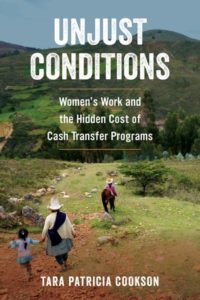
Tara Patricia CooksonUnjust Conditions: Women’s Work and the Hidden Cost of Cash Transfer Programs (University of California Press, 2018)
Tara Patricia Cookson’s outstanding book Unjust Conditions: Women’s Work and the Hidden Cost of Cash Transfer Programs is an elegantly written and accessible portrait of how rural women in Peru experience and cope with the often hidden and detrimental socioeconomic demands of a much-heralded development program. Through careful, self-aware ethnographic methods, Cookson (currently a Postdoctoral Research Scholar in the Department of Geography at the University of British Columbia) presents a powerful counter-argument to the fashionable yet problematic practice of “data-driven development”. Unjust Conditions should be required reading for students, scholars, the general public, and—most importantly—practitioners of development searching for innovative and socially just alternatives to conventional development thinking.

 The 2018 AAG Meridian Book Award for Outstanding Scholarly Work in Geography

This award is given for a book written by a geographer that makes an unusually important contribution to advancing the science and art of geography.

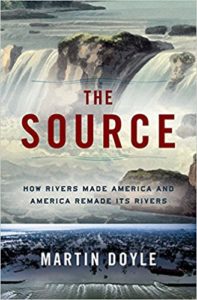
Martin DoyleDuke University, The Source: How Rivers Made America and America Remade its Rivers (W.W. Norton, 2018)
Martin Doyle’s The Source is one of those rare books that advances both the science and art of geography. The Source is at once an environmental and political history of the United States. Doyle simultaneously provides an invaluable story of how rivers are intimately entangled with both the construction of the physical landscape, and an empirical study of how power has been etched onto that same landscape. Doyle adeptly picks apart some of the most intriguing connections among the various levels of governing bodies that are charged with dealing with water in the United States. The analysis shows how rivers not only contribute to the organization of a household via running water and indoor plumbing but also link to shaping cities beyond mere settlement, into the building of the nation itself. Well-researched and accessibly written, Doyle’s The Source embodies the spirit of the AAG Meridian Award.

    Share

Douglas Gress

Education: Ph.D. in Geography (State University of New York at Buffalo), M.B.A. in International Business (Yonsei University, Seoul, South Korea), B.A. in International Studies (State University of New York at Buffalo), Diploma in Korean Language and Culture (The Defense Language Institute, CA)

What attracted you to a career in education?
I grew up in a home where there was a lot of emphasis on the benefits of higher education. As a way to get me interested in university, my parents had my older brother take me to an economics class at his university. I remember the professor of the lecture was engaging, organized, and incredibly knowledgeable, and I thought to myself that was something I might like to do one day. Even while serving in the army, I noticed how some of my peers were better teachers than others, and in university I constantly took note of who my best professors were and their qualities. I was an active student, so I appreciated a great class and involved guidance, and I tried to learn from them. Years later, working first on my M.B.A. thesis and then my Ph.D. dissertation, I became hooked on the research process, and took advantage of opportunities to actually teach over the course of my studies.  So in the end, a career in higher education meant being able to do research that interests me and being able to teach, too.  Bingo! Perfect job for me.  I never saw myself doing the same thing every day, day in and day out.

How has your education/background in geography prepared you for this position?
I’m an American, yet I’ve spent half of my life as an expat and my entire professional career has been overseas. Geography has greatly informed my experience. Some topics within economic geography, such as exchange rates or investment, have provided me with useful information on living overseas long term. In broader terms, geography’s approach to culture and how organizations and institutions across space are impacted has been extremely valuable.

Had I not received my Ph.D. in economic geography from SUNY Buffalo, I obviously would not have the job I do today. Formally, it was a top-notch program that provided me with a great education from some of the leading names in the field. Informally, I owe much to the professors that mentored me for their great advice and early career guidance.

What geographic skills and information do you use most often in your work? What general skills and information do you use most often in your work?
The geographic skills I use at work differ depending on whether I’m engaging with undergraduate or graduate students. In undergraduate classes, you teach about your discipline and its roots, and how to tie theory and geographic perspectives to students’ lives and the world around them today. Graduate classes allow you to delve into more advanced theory and application.

General skills that I consider important would be classroom preparation and administration. Otherwise, I’ve learned how to do things more ‘the Korean way’ over the years. Social skills are eminently important here, but it’s a high context culture, so there are a lot of unwritten norms and rules, and a lot of communication takes place ‘between the lines’.  This informs both teaching and how I perform my role in the department.

Are there any skills or information you need for your work that you did not obtain through your academic training? If so, how/where did you obtain them?
I was fortunate to have had a background in Korean language and culture prior to starting my academic career here, but not everyone is as fortunate.  If you find yourself interested in working in a particular country, I’d urge you to begin studying the language and culture as well in advance as possible. I’m not saying you can’t succeed working abroad without this background, but it certainly makes life easier and more enjoyable.

I wish I had taken graduate courses in teaching. Over the years I’ve developed what I hope is an effective teaching style, but why re-invent the wheel? Education courses provide an opportunity to teach and, more importantly, to be critiqued.  I learned via observation and while working my way up the academic food chain.  Students pick up on whether or not you have a passion for what you teach, and I hope that has helped me over the years as well.  I love what I do.

Do you participate in hiring, screening, or training of new employees? If so, what qualities and/or skills do you look for?
Yes.  I look for both hard and soft qualities in a candidate. Hard qualities include having the requisite Ph.D. and publications, and that goes for even early career hires. I also look at research agendas to see if they’re a good fit with the department. Will they be able to engage and advise our student body? Beyond that, I look for verifiable teaching experience in the target discipline and some demonstration of service. In terms of soft skills, I look for people who are personable and motivated. It sounds cliché, but we look for team players, and that is especially critical in Korea where there is a decidedly collectivist culture.

What do you find most interesting/challenging/inspiring about your work?
The great thing about economic geography is its breadth. My interests and passions have guided my research and teaching. I work at a huge university with students and scholars from all over the world, and they’re all doing interesting things.  I’m always going to special lectures or engaging with visiting students and faculty.

The biggest challenge is probably being able to maintain a work-life balance while staying on top of your diversified workload. You want to be productive, but you don’t want to get burned out.  In my case, one challenge might be that I do a lot of my work and day-to-day interactions in Korean, though I might not consider it a challenge per se.   Challenging? Sure, but it keeps the days interesting and it forces me to keep working on my Korean.

By and large, inspiration for me comes from teaching. It’s amazing when undergrads get interested in economic geography and start making connections to what we do in class and the world around them, when you see those wheels turning.  Having been at SNU for quite some time now, watching the development of grad students has also been inspirational. The increasing depth of their critical thinking ability on one hand, and then the development of their writing over time on the other.

What advice would you give to someone interested in a career in academia?
The market has changed a bit since I first started.  I would say that if you want to become a professor at an R1 university, start managing your career when you begin graduate school. Don’t just take the requisite classes, get cross-training as well.  Pick up a GIS certificate, for example, or bone up on a different sub-discipline (e.g. spatial statistics, urban geography, etc.) by taking a few extra courses. You might wonder why, but look at the ads coming out these days. Budgets are tight, so a lot of departments are looking for scholars who can wear multiple hats.

Also, be realistic and be ready to move. If you’re serious about becoming a professor at an R1 school, mission number one is to get that first tenure track job. A post-doc is all well and good, but it won’t start your tenure clock, and statistics tell us that the majority of the tenure track jobs go to those either on ABD status, or who graduated one to two years prior. If an opportunity presents itself, it may not be directly related to your research or teaching interests, it may not be at an R1 school, it may not even be in a geography department, and it might not be located where you ultimately want to settle down. Most professors I know didn’t begin and end their careers at the same university, and most have worked in more than one state or country. Working your way up often means moving around a bit.

What is the occupational outlook for career opportunities in your field/organization, esp. for geographers?
It seems that the academic job market has bounced back a bit from the trough it hit after the economic meltdown. Still, a lot of the jobs are adjunct or visiting positions, and for any given hiring season, there are more applicants than there are positions. Many jobs are also requiring increased teaching loads, but not cutting back on the publishing expectations. Your first job might not be a dream job. I think the odds are better for anyone with multiple skill sets (e.g. economic geography plus GIS or urban geography).  There’s a glut of highly qualified, well published early career scholars from around the world, so you need to set yourself apart somehow.

    Share

AAG Announces Launch of Geography.com for 2018 Geography Awareness Week

The American Association of Geographers (AAG) is pleased to announce the launch of Geography.com in conjunction with the celebration of Geography Awareness Week, November 11-17, 2018. The website is a joint venture and collaboration between the AAG and Esri, designed for educational purposes and the promotion of the discipline.

Geography.com is intended as an outreach tool for site visitors to learn more about what geography is, what geography offers, and career opportunities available in the field. The intended audience includes the general public and students (high school and undergraduates), as well as educators, parents, and federal agencies or other organizations seeking information about geography. The website can also be used as a resource to help departments recruit undergraduate students to their programs.

Many professional geographers do not discover the field and its related career opportunities until after they have started their undergraduate education, graduate education, or even at some stage after they have entered the workforce. Geography.com is part of the ongoing efforts of the AAG and other organizations to introduce students and the general public to a discipline that offers multiple career paths, as well as information to better understand the world.

Esri has donated the use of the Geography.com domain for this important educational outreach effort. Relatedly, the AAG’s domain, Geography.org, will lead directly to Geography.com in an effort to increase the visibility and discoverability of this outreach tool. That domain previously directed to the AAG’s own home webpage.

About AAG

The American Association of Geographers is a nonprofit scientific and educational society founded in 1904 that contributes to the advancement of geography. Its 12,000+ members from nearly 100 countries share interests in the theory, methods, and practice of geography, which they cultivate through the AAG’s Annual Meeting, scholarly journals, and online newsletter. The AAG promotes discussion among its members and with scholars in related fields, in part through the activities of its 70 specialty and affinity groups. AAG members are geographers and related professionals who work in the public, private, and academic sectors in a wide range of careers. Visit us at aag.org.

    Share

Dwayne Parks joins AAG as Accounting Specialist

The AAG is pleased to announce that Dwayne Parks has joined the AAG Staff at the association’s headquarters in Washington, D.C. as an Accounting Specialist. Dwayne has over 17 years of experience working with organizational data in both New York City and the Washington, D.C. metro area. Throughout this timeframe, Dwayne has managed employee payroll and record keeping in both the legal and healthcare industries including companies such as Edmond Scientific Company, Encore Legal Solutions, and Ikon Document Services (formerly Nightrider Copy Service and Alco Standards).

Dwayne holds an associates degree from Elizabeth Brant School of Business. He has also worked to provide financial reports to his former employers and is certified in QuickBooks for Federal Contractors by the Federal Contractor Services Network. In his spare time, he was volunteer head coach for the Lee Mount Vernon Sport Club over the past 8 years, from 2009-2017. The team always ranked as a number 1 or number 2 seed. Dwayne thought it was “wonderful to watch a child develop from having little skills to developing great skills.” He coached the same group of boys from 4th to 12th grades. The team was more than a team… they were a family!

    Share

Jeremy Tasch

Education: Ph.D. in Geography (Clark University), M.S. in Energy Management and Policy (University of Pennsylvania), B.A. in Geography (Temple University)

What attracted you to a career in education?
Just prior to completing my undergraduate degree, I was hired by the Geography Field Division of the US Census Bureau.  This was my first full-time opportunity in cartography and data handling; but shortly after I felt that working as a consultant might be a better fit for me. I worked part-time in a city planning position and completed a graduate degree in energy management, and then was employed as an energy consultant. Working as a consultant allowed me to work throughout the US, but as it turned out I was more interested in exploring international employment opportunities, and decided to pursue a Ph.D. for the opportunity to conduct international field research. Five months after completing my international doctoral fieldwork I was employed as a country director for an international NGO. For about five years I was involved in educational reform, civil society development, and youth empowerment programs.  But it was through my work with individuals at all levels — from high school students to ministers of education — that I understood the advice I had received from a geography professor years previously. In response to a question regarding why he chose to teach rather than do something “practical,” he replied, “Education promotes change, development and emancipation.” I realized that education has the power to bring change to individuals and society, and I was convinced to return to the classroom as a professor.

How has your education/background in geography prepared you for this position?
Geography taught me that knowledge is best understood outside of the classroom.  My interests led me to conduct research in Azerbaijan, Belarus, Italy, Latvia, Kazakhstan, Kyrgyz Republic, Norway, and throughout Russia. Geography helped me develop a geographical imagination, a way to ask questions spatially and identify (potential) solutions. I honed my geographic imagination through field research in Pacific Russia, followed by a professional position in the Caucasus, from where I moved to Alaska. I not only taught in Alaska, but also helped create new programs and departments in geography, environmental studies, and international studies. Now at Towson, I have been returning to the Caucasus, Central Asia, and Pacific Russia — likely more often than the administration might prefer.

What geographic skills and information do you use most often in your work? What general skills and information do you use most often in your work?
I use a wide variety of tools to communicate geographic information, ranging from the as-expected maps, statistics, and reports to TV, the Internet, and other types of media. And to encourage other geographers who do not use GIS, I’ll mention that the last time I explicitly used GIS in a job was while a grad student working part time with the USGS.  As this list conveys, the differences between what is geographic and what is “general” can be quite small. It speaks to the need for geography to be positioned as a foundational component in the general education of everyone — a place geography actually does occupy in many countries. Competency in more than one language, though generally taken for granted by non-US based geographers, is another critical skill that is often overlooked in the US. I think back to a recent discussion on the skills expected of our geography majors in which only a minority of our faculty tried to convince the majority of the importance of language proficiency as a skill. I would have had a very different career were it not for a high school counselor who first advised me to study a second language.

Are there any skills or information you need for your work that you did not obtain through your academic training? If so, how/where did you obtain them?
As an ABD, I was one of three candidates invited for an interview, but I wasn’t hired. The employer gently explained that the other finalists demonstrated evidence of supervisory and program management experience.  Although I had made it a point to supplement my core geography classes with electives while a student, I was disappointed to realize that this was inadequate for this professional position.  It was through other positions that I learned skills such as financial management, personnel supervision, diplomacy and negotiation, program administration, public outreach and marketing.  These skills might not seem to align with geography, but I credit my background in geography for giving me the transferrable skills to manage programs, to help connect with international audiences, and to engage in different cultures.  My education in geography generally helped me to coordinate programs in a manner that strengthened relationships among diverse stakeholders, and my knowledge of cartography specifically helped me to communicate to a broad constituency using a variety of media.

Do you participate in hiring, screening, or training of new employees? If so, what qualities and/or skills do you look for?
I was involved in hiring and training while serving as the director of an international NGO.   I sought skills in foreign language proficiency, written and oral communication, experience working with international organizations, and the ability to manage one’s time and meet budget guidelines. More subjectively, I looked for collegiality and humor, understated confidence, buy-in for networked management, creativity, and flexibility.

What do you find most interesting/challenging/inspiring about your work?
Geography is a calling both inside and outside of the classroom. My work has allowed me to share ideas, communicate concepts, and encourage and participate in fascinating conversations through many roles. I will admit, with a bit of reflection and some nostalgia, that my daily professional work outside of academia seemed more dynamic: The range of issues with which I dealt and that impacted others’ lives seemed more immediate; and the tangible results of my projects were inspirations to myself and, I hope, to others.

What advice would you give to someone interested in a career in academia?
The path into academia is somewhat straightforward, though not necessarily easy. Practicing geography outside of academia is less so. My first advice (for those thinking outside academia) is to get a copy of the small, but extremely helpful book, Practicing Geography.  That book offers a wealth of websites, guidance, ideas and strategies to pursue a career in geography in diverse and surprising ways.  I would also request vacancy announcements from services such as USAJobs.gov, Idealist.org, and from specific organizations that operate in regions and specialties of interest.

What is the occupational outlook for career opportunities in your field/organization, esp. for geographers?
My answer is trite, but if a geographer is curious and analytical in applying their knowledge to real-world problem solving effectively, then career opportunities are excellent. But with a caveat — as graduates take on debt, a larger family, and material belongings it may become more difficult to accept some of the entry-level international positions that require a lighter suitcase.

    Share