Moving Forward on Climate Change and Professional Ethics
A few weeks ago, the National Oceanic and Atmospheric Administration (NOAA) announced that atmospheric CO2 concentrations, at 419 ppm, have now reached 150% of their pre-industrial levels – the highest in more than four million years, when sea levels were about 24 meters higher, the global average surface temperature almost 4ºC warmer than today, and the first modern humans had more than three million years yet to appear on earth.   The world-historical COVID-19 pandemic, still wreaking havoc across the mostly unvaccinated globe, temporarily decreased emissions, but not enough to be detectable in rising atmospheric CO2 levels. NOAA has recently defined new “normal” temperatures that are significantly higher than those in the past.  

As I write, a hazardous and extreme heat wave has gripped the Southwestern US, stretching power grids to their limits and threatening heat deaths. The entire Western United States is also in the throes of a severe drought that is expected to last all summer.  Indeed, global warming has contributed significantly to changing what would have otherwise been a moderate drought in the Southwestern US into a megadrought worse than has been seen for almost a millennium. This year, drought is predicted to lead to another ruinous, record-breaking fire season, on the heels of nightmarish 2020 fire season in the Western US – and around the world. It is also affecting access to safe drinking water and forcing farmers to make difficult decisions about what crops to keep, which will likely lead to higher food prices. 

None of this is news to geographers, so why start my first column as AAG president with a reminder of the ongoing climate devastation?  There are several reasons, beyond my embodied experience of consecutive days of record-shattering heat in my home state of Colorado. (These days, my kids and I have taken to sleeping in a tent on our back porch – itself a privilege.)  First, geographers have been at the forefront of research on climate change, adaptation, resilience, and climate justice, but our research as geographers is often not acknowledged in the press or known to the public; this is relevant to the visibility, and ultimately health, of the discipline. Second, climate change is one of four primary policy campaigns that AAG will be undertaking over the next 1-2 years. Through the release of the new AAG website, expected later in 2021, geographers will be able to more easily engage with legislation and policy related to climate change.   

Third, I want to use this opportunity to highlight the work of the Climate Action Task Force, which has been led by Professor Wendy Jepson and which I joined in 2020.  As a reminder, this task force was formed by Council to undertake the task of realizing the goals of a 2019 member petition: to reduce CO2 emissions related to the Annual Meeting commensurate with what the IPCC states is needed to limit warming to 1.5 C  — that is, a 45% reduction (from 2010 levels) by 2030.  In doing so, the Task Force is seeking ways to position AAG as a leader and model of how large organizations can respond to climate change in a manner that both meets the needs of their members and is environmentally and socially just.   

A 45% reduction is not a trivial change; it’s not a tweak around the margins of business as usual. Achieving this goal would mean a radical transformation in how the AAG stays financially solvent, and perhaps how we form our identities as geographers.  As such, AAG can only move forward through extensive member participation and dialogue about what this means and how we might get from here to there.  These conversations have already begun. At the virtual meeting this spring, the Task Force hosted a collaborative keynote panel of anthropologists who shared their creative and inspiring reflections and experiences on climate-friendly and accessible conferencing, as well as two roundtables of dialogue amongst geographers representing different types of institutions, career stages, and social identities to consider the meaning of annual in-person meetings to their careers, and share ideas for future formats that would be less carbon intensive and yet meet geographers’ needs.   

Going forward, The Professional Geographer will soon publish a Focus Section that presents a variety of perspectives on low-carbon annual meetings.  The Climate Action Task Force is looking forward to community commentary on these contributions and further brainstorming through the new AAG website.  Looking down the road, AAG will also be performing a financial analysis of different future meeting models, working collaboratively with the AAG Regions on a climate-forward initiative, encouraging the formation of meeting nodes, and further soliciting all members’ input through a survey.  I will revisit these important issues in future columns.  

* * * 

If AAG action on climate change has seemed a long time coming to some members, so too has an update of the AAG Statement on Professional Ethics, last revised more than a decade ago, in 2009, long before the implementation of the Professional Conduct Policy. Indeed, graduate students have recently argued that it is outdated, too long, confusing, and falls short of providing clear guidance, especially compared to those of other scholarly organizations.  I am happy to share, therefore, that at its Spring 2021 meeting, AAG Council unanimously approved a revised Statement on Professional Ethics, which can be accessed here. AAG will soon make it readily available for review whenever a member joins or renews, and during the Annual Meeting registration process. 

The impetus for this came from the report of the AAG Geography and Military Study Committee, which was formed in 2017 by AAG Council in response to a member petition calling on the AAG to study the engagement of Geography with US military and intelligence communities vis-à-vis safety, labor demand, curriculum, academic freedom, and ethics, and to offer concrete recommendations based on its report.  Both the Report and the timing of the resulting process have subsequently been subject to critique.  What I want to focus on here, though, are several of the Report’s recommendations that Council voted in Fall 2020 to accept, including: 


Revise the AAG code of ethics statement and policy as it relates to the ethical issues that may arise from military-funded research. This should include comparing the AAG statement (current and proposed) with the codes of ethics related to research developed by other disciplines such as the American Anthropological Association (AAA) and the American Psychological Association (APA) as well as the Department of Defense (DoD) statement of ethics as it relates to research. 


and 


Update and revise the AAG Statement on Professional Ethics (every few years). With new and revised updates, encourage members of the association to read them as part of the membership renewal and meeting registration processes. 


In response to this Report, Council also approved the formation of an implementation committee, which I chaired, to update the ethics statement.   

The committee began its work by consulting other professional organizations’ statements of ethics and, based on those models, revised the 2009 Statement to focus on practical and easily memorable principles and actions.  The committee also integrated references to the 2020 Professional Conduct Policy, removed discussion of issues regulated elsewhere (such as regarding the confidentiality of student grades), updated the language regarding new technologies, and explicitly mentioned the ethics of geographers’ engagements with the military, intelligence, security, policing and warfare where specifically relevant, but with an eye toward a Statement broad enough to cover all ethical obligations. It was a significant undertaking conducted over a short period of time, and I want to sincerely thank the committee members for putting in so much, and such thoughtful, time and effort to this task: Council member Richard Kujawa (Saint Michael’s College), Sue Roberts (UKY), Reuben Rose-Redwood (UVic), and former AAG president Eric Sheppard (UCLA). 

Of course, no Statement of Ethics is ever final or perfect, especially as ethics themselves are not a matter that can be settled once and for all. Thus, the AAG should become proactively engaged with the question of ethics, on an ongoing basis. This is already starting to happen, not only with plans for Council to revisit and update the Statement every three years, but also with the ongoing GeoEthics Webinar Series, a partnership between AAG, Esri, and the Center for Spatial Studies at UC-Santa Barbara. Once the AAG’s new website is up and running, we hope to offer a list of links and publications on ethics and geography, and provide a space for feedback for all AAG members, including reactions to the Ethics statement, additional resources, and other discussion. 

If ethics are, in part, about doing no harm, then a commitment to act to reduce the future harms of climate change is one in accordance with our stated ethical principles.  I also want to point out that both the new Statement on Professional Ethics and the work of the Climate Change Task Force are ultimately the results of member petitions to Council.  Both petitions have sparked concrete actions that are moving the AAG forward in a positive direction toward addressing the pressing challenges facing the earth and its peoples in the 21st century.   

DOI: 10.14433/2017.0094


Please note: The ideas expressed in the AAG President’s column are not necessarily the views of the AAG as a whole. This column is traditionally a space in which the president may talk about their views or focus during their tenure as president of AAG, or spotlight their areas of professional work. Please feel free to email the president directly at emily [dot] yeh [at] colorado [dot] edu to enable a constructive discussion. 
    Share

Want a Thriving Department? Focus on Undergraduate Success

I cannot think of a person in higher education who has not felt the pressure of maintaining and growing undergraduate enrollments. Undergraduates, who make up the large majority of the student body, are the people we devote most of our instructional efforts toward, and—as administrators constantly point out—are university’s primary source of revenue through tuition and fees. At public institutions, undergraduate success is also the primary focus of state legislatures looking at higher education metrics and state funding. Geography departments may literally live or die depending on their ability to maintain robust undergraduate enrollments and recruit majors.

I don’t think it’s pessimistic to suggest that a geography faculty member can’t control national economy, demographics, or tuition costs. So, what is a geography professor or department to do? The answer is simple:

Focus on undergraduate student success.

While many faculty seem to intuitively know how their programs can adapt to changing student needs and are able to naturally connect with undergraduate students, some of the rest of us get stuck in the culture and traditions of how we approach undergraduate education and interaction. So, I sought some pointers from the experts: undergraduate advisors (especially Dr. Leslie McLees, Undergraduate Program Director in Geography at University of Oregon). We identified some key ways in which faculty can address changing needs of students, through curriculum, advising, and experience. I don’t have room to adequately address overall student experience, so I’ll focus on the two areas in which faculty and undergraduate students formally interact.

Curriculum for a Changing Discipline

Students want to know that their degrees matter, and rather than dismissing the question of relevance, we need to embrace it. If we cannot justify why our degree matters, how can we expect students to do so, much less parents and legislators?

To prove relevance, we should teach students about geography and how to be professional geographers. We can continually adapt curriculum to the changing discipline and needs of students through modernized geography classes and sequences, professional development courses, and flexible, personalized major tracks.

Like it or not, a current trend seems to be the blurring of traditional discipline boundaries in favor of problem-based programs. A modernized geography curriculum represents current and future trends in the discipline, the changing physical and human landscapes of our planet, and ways to be professionals addressing the problems and opportunities posed by those changes.

One of the things that frustrates me is holding on to previous curricular sequences and class names. There has recently been a robust conversation about this on the AAG listserve that challenges holding onto course names such as: Human Geography, Geomorphology, GIS… The anthropology department on my campus has an introductory course titled: Pirates and Piracy. What do you think sounds more interesting to an undergraduate student, Pirates and Piracy or Introduction to Human Geography? When my sons were UO students, they took the anthropology version.

A focus on undergraduate success is vital for geography departments. [image: Tamarcus Brown]
Another way to translate the need for a four-year degree is to integrate professional development or career management into the curriculum.

Don’t bristle. We’re not talking about vocational training.

Rather, we’re suggesting professional development through traditional routes such as internship or research experiences. Or, streamlined and direct experiences through a professional development course geared towards geography students. We have such a course in our department at the University of Oregon and it has been popular and successful. Moving beyond simply writing resumes and cover letters, it requires critical reflection on skills that students develop at college, training on how to tell their stories about developing those skills, practice in reaching out to people in the workforce, and development of a portfolio that forces them to articulate their proposed career paths. Think of it as a new-age capstone course that requires students to translate the sometimes lofty and theoretical content taught and learned in traditional geography courses into thinking about what it means to BE a professional, paid geographer.

And choices! Our undergraduate students have grown up with more choice than I could have even imagined. Recently, my husband Andrew and I were discussing network TV. Specifically, we were both complaining that our parents never let us stay up late enough to watch the entire episode of Wonderful World of Disney on Sunday night (turns out we both had to go to bed by 8:30pm). What’s half of the Wonderful World going to do for us? So, we both opted out. Our 8-year old minds couldn’t even imagine on-demand TV. And, yet, that’s how our kids have grown up.

That availability of choice has translated to demands for flexibility in our majors and curriculum choices.

Many colleges and universities are responding and offering programs with: enhanced flexibility, personalization (almost a design-your-own-major), and the absence of bottlenecks (i.e. removal of intense vertical integration that keeps students from completing specific required courses).

Advising and Experience Go Together

Approaches to advising vary considerably, but there has been a national trend towards centralized campus advising, which offers an opportunity to connect students to the many resources available on campuses, ranging from mental health and spaces for minoritized groups to financial aid, as well as classical guidance on major choice and requirements to obtain their degree. However, generating excitement about a relatively unknown discipline—which is unfortunately where geography usually lives—is difficult for a central advisor who lacks knowledge in the discipline and understanding of how a specific student’s interests can integrate with the major to provide skills that help them beyond their degree.

That level of advising takes place in departments.

Many geography programs designate an Undergraduate Director who is the face of the program for undergraduates. This UD is the ambassador and advocate both around campus and within geography. Maintaining strong connections with centralized advising not only helps those central advisors learn more about geography, but also helps identify our majors early, which means less time-to-degree, better within-major advising, and earlier connections with faculty and peers. Within the department, the UD not only understands the curriculum in-depth, but also moves advising beyond the checklist of classes to take. They are able to help students translate their course experiences into real-world relevance.

For many, the advisor is one of the closest relationships students will develop with faculty. Advising is more than classes. It is listening to a student and to students in general, hearing their concerns, and communicating with them to empower them to take charge of their learning and their future.

More than any other discipline, geography represents the dynamically changing physical and human planet. But, faculty and academia have…a bit of a pace problem. If we want geography to continue and thrive, we must keep up. We may have to let go of our ideal traditional geography program and the way we have always advised students.

In exchange, we may find ourselves building rather than simply teaching. And…launching alumni into the world who can think critically, engage responsibly, connect synthetically, and question routinely.

In other words, they’ll become geographers.

But, there is no “they” out there who will do it for us. As one of my senior colleagues once told me,

We are the They.


I’d like to thank Dr. Leslie McLees for providing ideas for this column (particularly in the area of advising). Contact her if your department is interested in learning more about integrating professional development into your geography program or discussing the possibilities of supporting a strong undergraduate program. lmclees [at] uoregon [dot] edu

—Amy Lobben
AAG President and Professor at University of Oregon
lobben [at] uoregon [dot] edu

DOI: 10.14433/2017.0086


Please note: The ideas expressed in the AAG President’s column are not necessarily the views of the AAG as a whole. This column is traditionally a space in which the president may talk about their views or focus during their tenure as president of AAG, or spotlight their areas of professional work. Please feel free to email the president directly at lobben [at] uoregon [dot] edu to enable a constructive discussion.

    Share

Robert Thomas Kuhlken

Robert Thomas Kuhlken, retired professor of geography and former geography department chair at Central Washington University, died on January 1, 2021. He was 67.

Kuhlken was a lifelong scholar, educator, and tireless observer of the natural world. He was more comfortable outdoors than in, and always eager to explore new terrain. He studied at the University of Virginia at Wise and Oregon State University and was awarded a Fulbright fellowship to study agricultural terracing in the Fiji Islands while earning his doctoral degree in geography from Louisiana State University.

His specialization in human geography and his focus on land management fit perfectly with his desire to learn and explore. He favored traveling via public transportation on excursions throughout Mexico, South America, Polynesia, New Zealand, and Europe to get an unfiltered view of the local culture.

Kuhlken brought the results of these travels to the classroom, sharing his firsthand experience with his students. He taught college geography for more than three decades, spending most of his career at Central Washington University in Ellensburg, Washington, where he retired in 2015 as professor emeritus in geography.

He taught thousands of students at CWU. Countless first-year students with little knowledge of the rest of the world were captivated by Kuhlken’s enthusiastic spirit of adventure, his colorful stories, and deep insights into human and physical landscapes across the globe.

Kuhlken also taught courses focused on cultural geography, Oceania and North America, and urban and regional planning. His planning courses drew, in part, on his nearly 10 years of experience as a professional planner in Oregon before beginning his academic career. Quite a few of his students have gone on to successful careers as planners themselves.

As a scholar, Kuhlken’s work emphasized cultural ecology, historical geography, and environmental literature. He co-authored A Rediscovered Frontier: Land Use and Resource Issues in the New West which Rowman & Littlefield published in 2006.

He also published on topics as varied as Pacific archeology, zydeco music, and arson. In more recent years, his passion for fishing led to new scholarship on the geography of recreational fishing and the sport of angling.

More than anything, Kuhlken loved to be outdoors with friends and family—hiking, fishing, sailing, biking, gardening or just feeding the birds in the backyard. In remembrance, please donate to the National Park of your choice.

He is survived by his wife, Cynthia McGill Kuhlken; his stepson, Jeff Acker; and his brothers William Kuhlken, Kevin Kuhlken, and Karl Kuhlken.

    Share

Joanna Thompson-Anselm

Education: Honours B.A. in Geography and Urban Studies (York University), Bachelor of Education (York University)

Describe your job. What are some of the most important tasks or duties for which you are responsible?
My job as subject head is to ensure quality geography programming for all students in our building and to mentor staff to develop their own professional geography knowledge to stay current with pedagogical demands and content.  I work with staff and students to determine what current geographic issues are of interest and important to them and then help develop a program that is responsive to those interests.  It is really important that we are continually reviewing geotechnology’s part in helping us inquire more deeply about geographic issues, but also transferrable and other geography-specific skills that are needed for students to be employable in the 21st century.  To create a robust program that serves the whole student, this requires ongoing professional development both in teaching and learning strategies as well as current trends in geography.

What attracted you to this career path?
I have always known that I wanted to be a teacher, but I didn’t know that I wanted to be a geography teacher until I met my high school geography teacher, Mr. Meikle.  The way that he engaged us in anecdotes, case studies and simulations that made me realize that my passion was really about understanding why people and things are different in different parts of the world.  I am inspired daily to work with staff to come up with engaging ways to have students learn important skills, but at the same time have fun and be excited to ask more questions about the world they live in.  As value in our subject area has been dwindling in my community over the past few years, I’m more impassioned than ever to work on creating relevant and meaningful geography tasks for the students I work with.  Students and parents need to understand that geography brings together all other disciplines and includes very employable skills in a globalized world.   As Michael Palin, past president of the Royal Geographical Society, has remarked: “Geography explains the past, illuminates the present, and prepares us for the future.  What could be more important than that?”

With regards to working as a course writer for Queen’s University, this is the newest chapter of my life. I’ve chosen to explore this in order to help people find their own passion to develop quality geography programming in our schools.  I believe that in order for geography to be more recognized as a valuable subject area, it should be taught by teachers who are inspired to look at it in new and different ways. My goal is to develop a culture of creative and critical educators who will engage their students in meaningful work that will make an impact on their communities.  I want to encourage teachers to try something new that will allow their students to explore and be challenged by geography content and skills.

How has your education/background in geography prepared you for this position?
My degrees in geography and education have given me the credentials to teach geography in Ontario, but most of my education has been on the job and through professional development offered through the York Region District School Board or OAGEE (Ontario Association of Geographic and Environmental Educators) and through the networks I have created for myself.  In our discipline, content is changing daily and approaches to teaching are changing equally rapidly in response to technological development, student engagement and workforce demands.  Continually trying to find ways to showcase that geography teachers are relevant is an ongoing educational and marketing experience!  I have recently presented on gamification in the classroom to a group of educators at the IDEAS Conference at the University of Calgary, but the learning of gamification came from professional reading and collaborating with colleagues.  The learning and education of a geography teacher never ends!

What geographic skills and information do you use most often in your work? What general skills and information do you use most often?
These days I find myself using a lot of spatial analysis skills to come up with my tasks and hooks for students and to help them dig more deeply into their own geographic inquiries.  For example, the ability to use spatial skills to interpret a thematic map or analyze an aerial photo to see if a location contains the features I am looking for to develop a task to engage my students is critical.  The geography teachers in our department often look at spatial data to ask or answer questions about content we are working on, and sometimes we look at it together and are excited by the information we have found that we can now share with students!  We often use our geographic thinking concepts of interrelationships, spatial significance, pattern and trend and geographic perspective to help students see the complexity of geographic problems and how they are interconnected with other subjects like science, business and urban planning.

One important general skill I use on a daily basis is communication, which I use in a variety of contexts from discussing programming needs with our administrators, to teaching students about the applications of geotechnology, to speaking with parents about student progress and needs.  Data management and critical thinking skills are also essential when organizing groups of students, plotting curriculum standards into themes for student learning and scaffolding that learning for best success.  Lastly, I routinely use the skill of time management – forgotten by many of us!  With all the responsibilities that come along with my job, it’s important that I make agendas, checklists and review my goals for work, home and recreation to keep a balanced life.

Are there any skills or information you need for your work that you did not obtain through your academic training? If so, how/where did you obtain them?
My geography/urban studies degree mainly focused around human geography, urban dynamics and some physical geography foundations.  Cartography was not a mandatory course, so I left university without much learning about GIS.  Now I feel that it is my duty to be informed about various geotechnologies, specifically public domain ones, so that I can build a more relevant and accessible program that develops employable skills in my students.  Google Tourbuilder, Timelapse, Earth, and Maps have all been useful platforms for which I’ve had to learn the capabilities to be able to instruct my students directly or pair them with a problem solving task.

Do you participate in hiring, screening, or training of new employees? If so, what qualities and/or skills do you look for?
In the public education system, subject heads are not allowed to be involved in the hiring process.  However, once teachers have been hired and assigned to our department, it is then my job to mentor them and offer professional development opportunities.  I really value teachers who have a sense of excitement about geography and a drive to be creative in their activity planning, assessments and lesson delivery.  It is always exciting to work with someone who is equally invested and interested in taking risks in the classroom with their program delivery.  They don’t even have to be geography teachers, just people who are willing to learn, refine, collaborate and take risks to improve student learning experiences in geography.  I also value working with teachers who have strengths that complement my own.  For example, it is a huge asset to have someone who is more proficient than I am in geotechnology and Google Apps so that I can learn from them in building my own competencies.

What advice would you give to someone interested in a job like yours?
I would highly suggest seeking mentorship from an in-service geography teacher who knows how to network, find resources, is well connected with outside organizations and loves their job.  These are the qualities of a person who will be able to give you sound advice and encourage you to become the teacher you want to be.  I would also suggest taking pedagogical risks in the classroom and exercising your creativity.  Work ethic and creativity are also things that can really set people apart.

What is the occupational outlook for career opportunities in your field/organization, esp. for geographers?
It is difficult to say what the career opportunities look like for geographers in terms of being a geography teacher or instructional leader, as so much of it has to do with the particular school board.  In the Toronto District School Board they have subscribed to the model of “super heads” in which an instructional leader is responsible for supporting curricula from multiple subject areas.  In my school board, geography subject heads are still distinctive, but there is growing concern about how long we can stay that way without being amalgamated into a “social studies” subject head that would include other departments.

As for being a geography teacher, I believe that the future is bright.  The headlines everyday speak to global issues such as those associated with climate change, genocide, globalization, and geopolitics.  People are beginning to recognize the importance of geographers in helping to bring together all of the pieces from different disciplines in order to help solve these complex problems.  I hope I can play an important role in that!

    Share

Tim Fullman

Education: Ph.D. in Geography (University of Florida), M.S. in Interdisciplinary Ecology (University of Florida), B.S. in Animal Biology (University of California, Davis)

Describe your job. What are some of the most important tasks or duties for which you are responsible?
My job can be broadly defined in two buckets: 1) conducting novel research to better understand wildlife species and their behavior as a means of informing management and conservation, and 2) reviewing and commenting on development proposals or other management actions to advocate for use of the best available scientific information in decision-making.

My current research focuses on caribou movement, habitat use and response to human activities in northern Alaska. In partnership with scientists from federal, state, and regional agencies, industry, and non-governmental organizations, I conduct primary research to identify key caribou migration areas and seasonal habitats and to understand what impacts development may have on caribou populations and the people that rely on them. This information is shared with policy makers to inform decisions about new development proposals, helping to identify where negative impacts to caribou and people can be reduced and what areas should be avoided to provide habitat for caribou and other species. We also publish our findings in peer-reviewed scientific journals to share the information with the broader scientific community.

When new development proposals or management plans, such as environmental impact statements, are made available for public comment by the government, I review them to see how the current state of science regarding caribou is represented. If there are statements or conclusions that appear contrary to scientific understanding, then I make this clear as part of public comments submitted by my organization or other partner groups. For example, during the recent planning process to open the coastal plain of the Arctic National Wildlife Refuge for oil and gas leasing, I provided thorough review and numerous comments about ways that impacts to important caribou calving and post-calving habitat was misrepresented and made suggestions for improvement. The hope is that such efforts will lead to stronger final decisions that balance the needs of people, wildlife, and a healthy environment.

What attracted you to this career path?
In many ways I stumbled into my career field. As I was nearing completion of my Ph.D. I sought a job as a professor. I applied for various jobs, but nothing came of it. Then I saw a posting for a large herbivore ecologist to study caribou movement in Alaska. I had never been to Alaska, nor studied caribou, but having studied elephants in southern Africa I knew something about large herbivore movement, so I applied and got the job. I am so glad that I did!

Working for a non-profit conservation organization has been an excellent fit for me. I get to do research that is tangibly applied to make a difference for conservation. I also have greatly appreciated the flexibility and emphasis on work-life balance shown by my organization. With two young children, I am grateful to avoid the publish or perish mentality faced by friends in academia. I still do scientific research and publish, but do not face the same pressures of possibly losing my job if I do not publish enough.

I also get to step into other opportunities, like serving on the Western Arctic Caribou Herd Working Group. This advisory group of Alaska Native subsistence hunters, reindeer herders, hunting guides, transporters and conservationists works together to ensure the long-term conservation of the Western Arctic Caribou Herd and the people who rely upon it. I have also been able to pursue my interest in building bridges between the scientific and faith communities in Alaska, such as with a series of talks by Dr. Katharine Hayhoe about climate change, energy development and Anchorage that I helped organize in 2019. These opportunities add variety to my work.

How has your education/background in geography prepared you for this position?
I pursued a degree in geography to add a spatial mindset and tools to my wildlife ecology background. This training served me well and was a large part of why I got my job, even without having experience in Alaska or with caribou. Over the last six years working in Alaska, I have met several other geographers working broadly in the field of conservation for universities, agencies and non-profit groups. Our ability as geographers to think spatially about challenges and solutions is very important to enabling us to serve as problem solvers, especially when it comes to land management over broad spatial scales. In addition to the spatial perspective, the specific tools I honed during my geography degree continue to be critically important in both my research and other conservation activities. Whether it is analyzing spatial animal movement datasets or creating maps of areas where caribou calving habitat is expected to be lost under different development proposals, my geography training features strongly in my current work.

What geographic skills and information do you use most often in your work? What general skills and information do you use most often?
I use GIS skills regularly – obtaining/creating spatial data, analyzing it with respect to other data, and creating visualizations to share with colleagues or for publications. I also spend a great deal of my time working in R to conduct analyses, many of which are spatial in nature. While not an exclusively geographic skill, this is one that I learned while earning my geography degree. General skills include scientific writing and communication, strategic thinking and problem solving, and public engagement – from meeting with resource managers, to stakeholders, to community members in the region where I do my research, to members of the general public.

Are there any skills or information you need for your work that you did not obtain through your academic training? If so, how/where did you obtain them?
Yes. Wildlife ecology is a rapidly changing field, with new tools and technologies being developed frequently. One of the most important things I took away from my geography Ph.D. is learning how to learn – the ability to teach myself new things. Now, I may need to learn a new statistical approach, or about a new remote sensing data source, or how to use a platform like Google Earth Engine, yet the baseline of skills I have built during my academic training and the wide array of resources available on the internet, along with the knowledge sets of colleagues who are willing to share their expertise, have been invaluable in allowing me to attain these things.

Do you participate in hiring, screening, or training of new employees? If so, what qualities and/or skills do you look for?
I have served on one hiring committee as well as in the onboarding of new employees. Specific skills vary widely depending on the position. In general, however, we want someone who is passionate about the mission of our organization to unite people to protect America’s wild places. We want someone who thinks strategically and creatively about how to fulfil that mission. We also want someone who cares about doing these things in an equitable and inclusive manner, recognizing that this unfortunately has not been the case too often in the past.

What advice would you give to someone interested in a job like yours?
Build a strong toolkit that includes both analytical skills and a demonstrated ability to communicate clearly in both written and spoken formats. It is important to show what you can do through experiences working with people in communities, even as you conduct research. This shows that you can not only do sound science, but also engage well with stakeholders and other interested parties. In the past, getting hired in many non-profit groups was strongly influenced by who you knew and the connections you had. While this still may be important for many organizations, I am noticing a trend away from this in my organization and some others. There is a recognition that such a perspective reinforces the lack of diversity in many conservation organizations and that we need to be more intentional about casting a wider net and really focusing on must-have skills, rather than prior relationships, when making hiring decisions. This could create new opportunities for job seekers. In light of this, search widely for potential positions that may fit your interests and do not give up even if you do not have specific experience in the field to which you are applying. If you have the necessary skills you still could be very successful in a given role.

What is the occupational outlook for career opportunities in your field/organization, esp. for geographers? At our organization, jobs for researchers are relatively rare. We have hired only one other scientist in the six years that I have been here. There are, however, other opportunities for geographers. For example, we hired both a Cartographer and Enterprise GIS Manager since I started working for The Wilderness Society and have two GIS analysts on staff. While people seem to like working for our organization and turnover is low, there will undoubtedly be other opportunities from time to time in the future. Other organizations may have additional opportunities, both in scientific and non-scientific positions. For example, one of our partner organizations posted both permanent positions for GIS analyst/data managers and short-term positions for staff to work on a specific project over the last few years.

    Share

Yasuyuki (Yas) Motoyama

Education: Ph.D. in City and Regional Planning (University of California, Berkeley), Master of Public Administration (Cornell University), B.A. (University of Wisconsin-Madison)

Describe your job. What are some of the most important tasks or duties for which you are responsible?
As a background, the Kauffman Foundation was a philanthropic entity to promote entrepreneurship. I summarize my tasks into three categories: The first is research. Kauffman Foundation was one of the few foundations with internal research functions. Second, it was engagement with policymakers and practitioners. There was a philosophy that we had to make an impact on society by using our research products, which meant we had to engage with people who were on the front line of making and promoting entrepreneurship. I gave a number of presentations and consultation to policymakers and entrepreneurship support organizations. Third, it was grant management. As a foundation, we provided grants, and I was primarily in charge of research grants to academic institutions.

What attracted you to this career path?
A unique combination of the three functions describe above: research, engagement in policy and practice, and grant making to academic institutions. A possibility of making a real impact on society.

How has your education/background in geography prepared you for this position?
Traditionally, entrepreneurship was studied by business and economics disciplines, which only perceived entrepreneurship as an individual or corporate phenomenon. Lately, people have been finding that entrepreneurship is actually a local phenomenon as every entrepreneur is supported by entrepreneurship organizations, mentors, peer entrepreneurs, etc. in a regional context. In other words, a geographic or spatial perspective was important, and geography-trained researchers were needed.

What geographic skills and information do you use most often in your work? What general skills and information do you use most often?
I used some GIS-related skills, but perhaps the most important one was knowledge of various kinds of data related to entrepreneurship and its geographic context. For example, it’s important to know not only the availability of self-employment data in the Census or American Community Survey, but also the geographic scale that you can analyze. Then, the Business Dynamics Statistics by the Census Bureau provides different entrepreneurship data with a different geographic scale.

Are there any skills or information you need for your work that you did not obtain through your academic training? If so, how/where did you obtain them?
Most academics are theory and publication oriented, and I find that geographers are more so than other disciplines, such as city planning and business administration. When it comes to the question about how we can apply that knowledge to policymakers, I was finding that my graduate school prepared me little. By interacting with mayors, governors, as well as intergovernmental organizations, such as Council of State Governments and National League of Cities, I had to learn how policymakers think and what kind of information can benefit them or lead them to action.

Do you participate in hiring, screening, or training of new employees? If so, what qualities and/or skills do you look for?
Yes, I was involved in the recruitment process for entry and midlevel positions. I think what we looked for were three traits essential for general social science researchers: The first one is curiosity. What kind of problem or question do you have? What are your methods for analyzing tentative answers? The second is flexibility. Unlike the academic world where there are standard research products and protocols, foundation research can evolve into different dimensions, so every researcher needs to identify different needs and audience for every research project. The third is interpersonal skills. Most of the work including research and engagement was team work, so you need to be able to communicate effectively with people of different backgrounds.

What advice would you give to someone interested in a job like yours?
Most foundations do not have a standard recruitment process or publicized job market, so you need to think outside the box and be creative. Many foundations may not post job openings, but hire in a highly opportunistic way when they see a good candidate. So do your homework by researching every foundation and every foundation officer that you can relate to. If you see a potential fit, approach it proactively, and you should usually contact the director level people.

What is the occupational outlook for career opportunities in your field/organization, esp. for geographers?
The job market for foundations is not large. However, it is one of the few places that do not experience a major decline during an economic crisis, thanks to large endowments by founders. So while it may not be big or growing, it is a relatively stable market.

    Share

Patricia Syvrud

Education: M.B.A. (University of Southern California), B.S. in Business Administration (University of New Hampshire), Graduate Gemologist (G.G.) designation (Gemological Institute of America), coursework in Physical Geology, Mineralogy and Optical Mineralogy (University of Sao Paulo, Brazil)

Describe your job. What are some of the most important tasks or duties for which you are responsible?
I oversee the marketing, promotion and management of new programs within the University of Delaware’s Department of Geography: the new B.S. in GIScience and Environmental Data Analytics, the GIScience graduate certificate,  and  the new Minerals, Materials and Society (MMS) program including the MMS graduate certificate. In addition to fundraising for research, sourcing graduate internships, program promotion and managing the administration of the MMS graduate certificate program, I also oversee the development of the Jewelry Development Impact Index, a socio-economic index for the jewelry trade.

What attracted you to this career path?
Even though the entirety of my working career prior to UD has been in the jewelry industry, I have always been attracted to education and academia.  My passion lies with responsible sourcing and responsible minerals trade and addressing the issues surrounding the most vulnerable part of the extractives supply chain, artisanal and small-scale miners (ASM). Applying location-specific GIScience and understanding supply chain risk are robust tools for making a positive impact on the ASM sector.

How has your education/background in geography prepared you for this position?
Arriving in academia and specifically in geography and responsible sourcing has been a culmination of many years’ effort, education and experience. Although my education is in business, physical geology, mineralogy and gemology, geography-specific knowledge and awareness has had a huge impact on the work I’m currently involved in, including as a member of the Board of Directors of the U.S. Kimberley Process Authority (USKPA: https://www.uskpa.org/) and the Governance Committee of the Public Private Alliance for Responsible Minerals Trade (PPA: https://www.resolve.ngo/site-ppa/default.htm)

What geographic skills and information do you use most often in your work? What general skills and information do you use most often?
Given the many blockchain initiatives in the responsible minerals and jewelry trade, skill in and understanding how to harness location-specific data is particularly important in enhancing the transparency and sustainability of extractive supply chains.

Given the varied tasks involved with my position at UD, my skills in project/program management and oversight are utilized daily. As a marketer for the programs, my ease and skill as a public speaker and networker, and ability to work with others are also called upon regularly.

Are there any skills or information you need for your work that you did not obtain through your academic training? If so, how/where did you obtain them?
My most valuable skill NOT obtained through academic training is public speaking.  A certain part of this is inherent in my DNA, i.e., not having a fear of speaking in front of small and large groups, and the rest is practice and experience.

What advice would you give to someone interested in a job like yours?
Follow your passion and think outside the box. If you can’t find a job in your area of interest, don’t be afraid to volunteer your time which can lead to employment opportunities.

What is the occupational outlook for career opportunities in your field/organization, esp. for geographers?
The US Department of Labor’s Bureau of Labor Statistics predicts 15 percent growth in the need for geographic information specialists between 2018 and 2028, much faster than the average for all occupations.

    Share

Going Global or How Best to Recognize the Internationalization of the AAG; Plus – an Addendum to my Previous Column

We have always been the “AAG” but five years ago the membership overwhelmingly decided to change the full title from the Association of American Geographers to the American Association of Geographers. I remember being part of the Council when this change was discussed. It went beyond verbal tweaking and reflected our best efforts to recognize that the AAG was no longer just an organization of U.S.-based geographers. Instead we had become a community in which geographers from many countries gather.
The value of internationalization was promoted especially by past President Kavita Pandit. In her columns, she recognized that higher education has become more international. With geography leading the way, we must welcome and validate students from around the world and incorporate study abroad curricula in our programs. Kavita was not alone in pointing to the importance of international geography. Past presidents such as Victoria Lawson, Ken Foote, and Derek Alderman, among many others have spoken to the need to extend our reach and our knowledge beyond national borders.

For me the internationalization of geography and of the AAG has been a godsend. Over 20 years ago I met a number of geographers from Finland who regularly attended the national meetings — resulting in long and fruitful collaborations that continue to this day. I have also collaborated with geographers from France and Italy who regularly partake in our yearly conference. And I am delighted to renew friendships each year with geographers from a whole host of different countries.

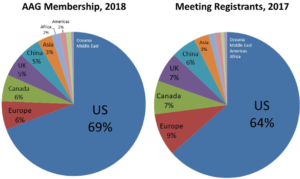
Unlike the International Geographical Union (IGU), the AAG is not structured as a super-organization made up of various national geographic societies. But we are growing ever more international and becoming a vital meeting space for geographers from around the world. In 2018, 3,476 members came from outside the United States, comprising 31 percent of all members. This is up from 22 percent international membership in 2013. The following charts show the breakdown by the largest countries and then by broad regions. International membership is led by Canada, China, and the United Kingdom, with over 90 other countries represented. Many of these geographers travel to our annual meeting to present and to network. Here the international presence is even greater, with fully 36 percent of attendees arriving from outside the United States.

This international presence adds tremendous value to our organization. This has been recognized already in several ways. We have implemented the Developing Regions initiative, which provides low-cost membership to geographers in several countries where access might otherwise be too dear. On the editorial side, we just selected two new Annals editors, both of whom work at institutions outside the United States. And about a quarter of our editorial boards are also international. What is more, I have been working with the presidents of the Canadian Association of Geographers and the European Association of Geographers to foster greater collaboration across national geographical societies.

We should move forward to the next level. Now is the time to consider international representation that better reflects our membership and puts force behind the meaning of our name change in 2015. For this reason, I am in favor of adding a dedicated international councilor, somebody who comes from an institution outside the United States. Right now international geographers have little representation. All U.S.-based geographers also belong to regional divisions, with their own regional councilor. Yet, with the exception of a few Canadian provinces folded into these AAG divisions such as NESTVAL, there is no dedicated representation for international members.

Why should we accord international members this special status? As with other groups, we could try to increase international representation through the nominations process, creating a larger pool of non-U.S. candidates for our existing “national” councilor and vice president slots. But this would be slow and unsteady — with few guarantees. In the last 10 years, we have had only two vice president and three councilor nominations from outside the United States. Of these, only past President Audrey Kobayashi from Canada was elected under our standard process.

Moreover, the AAG is intrinsically geographical in its own organization, befitting the nature of our field. Just as we divide the United States into nine geographical regions for the sake of governance, to bring an AAG experience closer to home and to represent the concerns of different parts of the United States, so we should pursue the unique advantages of recognizing the geographies of the one-third of our membership who do not live in any of these regions.

A dedicated international councilor would ensure that the AAG Council always has a representative from outside the United States. And while “international” encompasses the vastness of the world, there are relevant concerns that an international councilor could address and that would be common to members from Europe, Asia, Africa, and Latin America. Such concerns include the difficulties of access to U.S.-based meetings, potential linguistic issues, visa problems (particularly prevalent in this political environment), and better strategies for linking the AAG to geography societies around the world. I believe that an international councilor would add a great deal to our discussions and provide a hitherto underrepresented perspective.

While we have a team of people working on the particulars, I should emphasize that this reflects my personal views. The details behind creating this position will need to be worked out and approved by Council, and I will not go into them here. We may also consider a trial run, much as we did with our Student Councilor, so that we can see how well this idea works in practice and make modifications if need be. But make no mistake — the time has come to represent the international reach of our organization. The time has come to elect an International Councilor.


Addendum

As the latest in the lineup of AAG presidents charged with writing a weekly column, I would like to thank all of you who offer praise, reflections, insights, and corrections around the themes brought out each month. February’s column, Beyond the Academic 1 Percent, garnered more than its usual share of comments. Some of you noted omissions in my map of geography programs, which has been quite helpful in revising our comprehensive database of geography programs. Others agreed with the main premise of the column, in the need for greater institutional diversity and sympathy with the basic points.

There were also some critiques related to what was perceived by some as my denigrating geography at elite universities, especially Ivy League universities. My “unpopular” opinion was intended to be controversial and I will stick by my major view: the lack of large Ph.D. programs at Yale, Harvard, Princeton, and others has had some drawbacks, especially in regard to visibility — as many have pointed out over the years. But judging from the evidence among other disciplines, it has also had a salutary effect of making institutional geography more equitable. People can disagree about which is more important.

One thing we can all agree on, however, is the value of having strong geography programs at elite private institutions. Like all of you, I would like to see geography as an option for every undergraduate major. Many students tend to pick colleges first and then consider their majors, and it is a serious lapse not to have a geography degree among the options. Strong geography programs at colleges like MiddleburyMacalesterVassar, and Mount Holyoke (to name just a few) should be encouraged and replicated across the country. The undergraduate geography program at Dartmouth College has been a true standout in this regard. Its faculty continue to contribute to the discipline while they introduce geography to legions of highly talented and demographically diverse students, who go on to become leaders in the field. These institutions are truly beacons in our geographical landscape, and our discipline would be a lot poorer without their presence and energy.

— Dave Kaplan
AAG President

DOI: 10.14433/2017.0069

    Share

Sean O’Brien

Education: Master’s in Geographic Information Science (University of Minnesota), B.S. in Geography (University of Minnesota)

Describe your job. What are some of the most important tasks or duties for which you are responsible?
I work in the Enterprise Research and Analytics group. The foundation of my job involves creating and maintaining our geographic datasets, as well as creating self-service mapping applications where our employees can go to explore and export maps, data, and reports. The main responsibilities of my job involve supporting our business lines with their geographic analysis needs. Going along with that, I do a lot of in-depth analysis for specific projects. I do things such as analyzing branch usage, and where customers who use branches are coming from. I also support the team that decides where to put new assets such as branches and ATMs.

What attracted you to this career path?
I discovered GIS when I was in college. I had an interest in geography, but I was also interested in statistics. I talked to an advisor who told me about GIS, so I decided to take a class to check it out. On the first day of class we all got a sheet of paper and rulers, and were instructed to draw points on a blank sheet of paper, and then draw these lines and points in a specific manor around those initial seed points. After doing this for about fifteen minutes I was instructed to erase some of the lines, and the instructor informed us that we had created a Voronoi Diagram (also known as Thiessen Polygons). This diagram creates polygons around each seed point, and any point within that polygon is closest to that seed point compared to the other seed points. The real-life example the instructor used was plotting points for a chain restaurant on a map. He then drew the polygons and explained that this is how I could find the closest restaurant from wherever I was in the city. After all that we were told that there was GIS software that could do what we just did in a matter of seconds, and that was just the tip of the iceberg for what that software was capable of. At that point I knew I wanted to learn much more about GIS. Once I started to learn more, I knew this is what I wanted to do for a career.

How has your education/background in geography prepared you for this position?
Taking geography classes as an undergraduate student was very helpful to prepare me for my future jobs. Understanding geography is a critical foundation to a GIS career path. Things like surveying, GPS, projections, and coordinate systems were required knowledge for all of my positions. Cultural geography also plays a role in my current position. Ideas such as demographics, cultural movements, and Tobler’s First Law of Geography (near things are more related than distant things) is all useful knowledge in my current role. Why do people live in certain places? What tendencies do people in specific regions have? How does the geography of a place impact people’s behaviors? Understanding people as it relates to geography is critical in a GIS/Geography business.

What geographic skills and information do you use most often in your work? What general skills and information do you use most often?
For geographic skills and information: Understanding projections and coordinate systems is always needed in a GIS line of work. It is the foundation to most GIS operations. The other most useful geographic skill is understanding the geographic software. I use it all day every day, so being familiar with the software and the geographic functions inside of it is critical. Census and related demographic datasets are used frequently in my line of work. It is very useful to be able to take tabular data, attach it to a geography, and then parse that data out by other geographies. Most geographic data is useful in business. Data such as geographic boundaries, road networks, addresses, and demographics are all used on a regular basis.

For general skills: In my work, understanding basic statistics and math is needed on a regular basis. I deal with a lot of tabular information, so having a grasp of regression, correlation, and statistical and geographic patterns is key to being able to analyze data. Related to tabular data, knowledge of Excel is required. Many things I do require me to deliver data in an Excel format. The other skill I use frequently is coding with Python. I automate geographic tasks using the code which is a critical part of being a GIS Analyst as it allows me to free up my time from doing monotonous and repetitive tasks. The final general skill I use most often is understanding and working with databases. U.S. Bank has tons of data, so understanding how databases are structured, and how to query that data is key to getting my job done.

Are there any skills or information you need for your work that you did not obtain through your academic training? If so, how/where did you obtain them?
Most of the skills I need were at least touched on during academic training. However, there are two skills that I’ve learned that were never touched on in school. The first one is how to present analysis to executives. This is something that isn’t brought up in school, but it’s very important to be able to craft a succinct story that an executive can understand. I cannot just dump data, create a chart, or regurgitate a bunch of stats and expect executives to understand what I’m trying to say. There are a couple good books that go over the main concepts of how to present data. I’ve also learned a lot from my peers and how they’ve presented things in the past.

The other skill that I did not learn in school was networking. Networking is very important both when looking for a job, and while working in a large company. Sometimes our GIS team needs to sell ourselves to others in the company. We find the right people, explain how we can help them out, and then deliver great work. If this process works, we can become a trusted partner for many business lines, and we can become respected by more business lines and executives.

Do you participate in hiring, screening, or training of new employees? If so, what qualities and/or skills do you look for?
In my current and previous jobs I have read through resumes and interviewed prospects. When reading through resumes, there are a few key things I like. One is concise information. For me and others in my position, reading through resumes is a pain because it’s tedious and it takes away from my main work. If I have to read through dozens of resumes and I come across a four-page resume, I’m likely to skim through in hopes that I find relevant information. In my opinion a good resume would be one page. I would start by listing your current job, and then list projects you’ve done that are directly related to the top qualifications and/or skills listed in the job posting. Try to use the exact verbiage used in the posting. This is what I’m looking for.

When interviewing, be sure to dress nicely. I personally don’t look for a suit and tie, but I would recommend a dress shirt and dress pants at a minimum. When I am interviewing for a position, I try to follow the STAR method of answering questions – “Situation,” “Task,” “Action,” and “Result.” When I’m interviewing, I’m not necessarily looking for that format of an answer, but that method makes sure you hit the main points when answering a question, and it allows you to not go off on an irrelevant tangent.

And of course, try to be nice. The people who are interviewing you will most likely be your manager or peer. They’re looking for people who will be easy to work with.

What advice would you give to someone interested in a job like yours?
First I would recommend getting at least an associate’s degree in geography or GIS. Learning the base theory is integral to understanding how to do things in the main GIS software. Second, I would become as familiar as possible with GIS software. Almost every GIS job looks for experience in ArcGIS. I think the future of GIS involves more coding than one might think. Learning something like Python, which is one of the easiest languages to learn, is a really good start. Once you get a good foundation you can try to branch out from there if needed. Finally, I think having at least a little exposure to things like statistics, IT infrastructure, and database management is beneficial. Once you get your foot in the door you can learn more about those as the job requires.

What is the occupational outlook for career opportunities in your field/organization, esp. for geographers?
Overall, I think the outlook is good. GIS spans across so many different professional fields, and more industries and entities are discovering the benefits of it. Even small cities and counties are investing in resources to improve their geographic analysis capabilities. Furthermore, more data has become available for consumption, allowing more analysis to be done. On that point, the demand for geographic data has grown to the point where there are entire companies dedicated to gathering and maintaining it.

I’ve had three GIS jobs – One in city government, one in consulting, and now one in private business. Currently, all three of those teams I was on have more people working with GIS today versus the day I started. There were also people within the consulting firm whose jobs were not related to GIS, but they were learning GIS on the job because it helped them with their work.

At U.S. Bank, I think we’re showing other business lines and executives what we’re capable of, and so the demand for our services has grown. I believe in the future that even smaller businesses will think of GIS as less of a luxury, and more of a necessity.

    Share

Geospatial Brain Power

Does learning GIS improve spatial reasoning capabilities in high schoolers? A team from six universities is studying the students—and their brains—to find out.

A group of researchers from six American universities are studying what effect spatial education has on the development of the spatial thinking and reasoning skills of high school students. The research team wants to find out how the students, who use GIS technology for class projects, go about solving complex reasoning problems and whether their brains are physically changing in response to spatial learning.

With more emphasis on science, technology, engineering, and mathematics (STEM) courses in the American secondary school curriculum, an increasing number of students want to pursue STEM degrees at universities and the well-paying careers available to them upon graduation.

Students who take STEM classes often become innovators.

While spatial reasoning and analysis are frequently applied in careers that fall under the STEM umbrella, these important skill sets aren’t formally included in the secondary school curriculum. Instead, they are introduced incidentally in STEM-related classes when students encounter spatial concepts in the assignments.

“Spatial thinking plays a very important role in the learning and practice of STEM-related disciplines,” said Bob Kolvoord, dean of the College of Integrated Science and Engineering at James Madison University (JMU) in Harrisonburg, Virginia. “Many of the most important discoveries in science involved a critical spatial insight, such as the structure of the Benzene ring or the DNA molecule.”

The Geospatial Semester

One way to teach high school students spatial reasoning and help them retain those skills is to add GIS coursework to the curriculum. Broadly speaking, spatial reasoning covers all thinking that has a spatial component. This includes geospatial reasoning, which is geographic in nature. Spatial analytics methodologies often include the examination of physical features such as the respective size, shape, and position of the objects or sites being studied and how they interact with nearby elements in their environment.

The Geospatial Semester is now in 30 high schools.

To help introduce students to spatial reasoning, Kolvoord in 2005 cofounded the Geospatial Semester (GSS) with his colleague Kathryn Keranen, an adjunct professor at JMU.  The GSS program offers high school juniors and seniors the opportunity to take GIS classes at their own schools while earning university credit at JMU. The program started at 4 high schools in Virginia but has expanded to include 30 high schools in Virginia, Oregon, and Illinois.

“We wanted to develop an educational program that exposed students to more problem-based learning through projects that require collaboration, and the use of GIS in their coursework was a good fit,” said Kolvoord. More than 4,000 students have participated in GSS thus far. Past student projects have explored a variety of issues related to the environment, renewable energy, wildlife, transportation, and public safety.

An Analytical Methodology for Spatial Cognition

Postulating that the students who participated in the Geospatial Semester had increased their spatial reasoning abilities, Kolvoord assembled a team to study whether exposure to GIS changes students’ high-level STEM spatial thinking ability. The team developed testing procedures to determine how these changes occur at both the cognitive and neurological levels.

Kolvoord’s chief collaborator on the team is David Uttal, professor of psychology and education at Northwestern University, where he works in the area of spatial thinking in STEM education. Other members include Adam E. Green, an associate professor of psychology at Georgetown University who specializes in cognitive neuroscience; David Kraemer, assistant professor of education in the Department of Psychological and Brain Sciences at Dartmouth College; and Emily Grossnickle Peterson, an assistant professor in the School of Education at American University, along with graduate students at all four institutions. Nora Newcombe, a professor of psychology at Temple University and the principal investigator at the school’s Center for Spatial Intelligence and Learning, advises the team.

Kolvoord said that his and Uttal’s approach to the research has evolved over the last 10 years. They started by interviewing students and assessed their final class projects. Students have used GIS to study a wide range of topics including elk habitats, hurricanes, air quality in relation to California wildfires, and even school locker usage.

“We initially found that the GIS students used more spatial language and exhibited stronger problem-solving skills than other students,” Kolvoord said. “We then added other collaborators to the team to more fully examine how the cognitive and behavioral aspects of the testing results connect.”

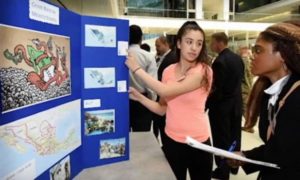
Two students who were recently enrolled in the Geospatial Semester present their final projects at a National Geospatial-Intelligence Agency (NGA) forum.

The researchers also explored the students’ spatial thinking abilities using standard psychometric measures. These include the mental rotation test (MRT), where a person—selecting from a series of options—matches the shape of one figure to another figure by mentally rotating them, and the embedded figures test (EFT), where the test taker recognizes geometric shapes from a bigger and more complex image.

Also, the students were interviewed and asked to answer questions such as these: Why do you think gas or milk prices differ from gallon to gallon or brand to brand? How would you predict what the price would be for each gallon or brand? If you were trying to increase recycling in your community or to run for a local political office, how would you go about running your campaign?

“There are both spatial and nonspatial ways to solve these problems. By analyzing their answers, we examined both their use of spatial language and their problem-solving abilities,” Kolvoord said. “We have ways to tease apart the interviews to look at how the students identify a problem, how they reason with the data, how they draw a conclusion, how they cite spatial data, and how they cite spatial representation. And the data we are collecting is really, really interesting. We have found that the open-ended problem-solving capabilities achieved by the GSS students seem to be making a difference in the development of their cognitive abilities that we can quantify.”

The research also includes performing neuroimaging of the brains of students in the study groups, using functional magnetic resonance imaging (fMRI) technology. These tests determine whether physical changes in the brain actually occur with spatial learning, according to Kolvoord. “This allows us to develop biological inferences about how these changes occur and explain the effects of spatial education on core spatial abilities as well as high-level spatial thinking,” he said.

Grants from the National Science Foundation and the Center for Spatial Intelligence and Learning support the team’s work.

Kolvoord said the research he and other team members are doing is bridging a critical gap between the analytical work being performed in the cognitive neuroscience laboratory and its real-world application in the classroom. Testing students provides the researchers with definitive, real-world data on what improves spatial cognition.

“More than two decades of research on how the brain performs spatial cognition has provided us with a reasonably clear understanding of the process,” he said. “Our longtime, active engagement with those schools that teach the Geospatial Semester gives us access to a group of students exposed to a unique form of STEM education that is deliberately designed around spatial thinking and reasoning. Because of our access to these students, we believe that this may be the first research that employs longitudinal data analysis to measure how learning in a real-world high school changes the brain.”

What Researchers Have Learned So Far

The study included a test group of 79 students who had experience in learning and using GIS technology, and a control group of 130 students who hadn’t enrolled in GSS. Pre- and posttest data was collected on all 209 students, who came from both urban and suburban school districts and were demographically diverse.

The scan results have shown so far that there was a significant effect on the GSS students when they mentally processed the embedded figures task.

“Specifically, there were differences in activation in the parietal region of the brain, which is related to spatial reasoning,” Kolvoord said. “Students who took GSS had a greater blood flow in this region from pretest to posttest compared to the control group, implying greater activation.”

Since this analysis was done for all students participating in the tests, researchers feel optimistic about the results. They haven’t yet found out whether there is any increased white matter connectivity in the brains of the GSS students, but the researchers plan to continue work on that aspect of the project.

“While we have not completed the final analysis of all of our test results, we see differential improvement in the GIS students [compared to the control group] on STEM problem-solving skills, including problem definition and arguing from evidence,” Kolvoord said. “These abilities apply broadly across STEM and other disciplines, as they are the key skills in critical thinking.”

The research team will conduct a second series of experiments to determine the duration of GIS instruction that is needed to improve cognitive reasoning abilities.

To learn more about the GSS program, visit the Geospatial Semester website. This video from the National Science Foundation’s 2018 STEM for All Video Showcase, describes the GSS program and the neural impacts of spatial education.

    Share