Gary Hausladen, long-time professor of geography at University of Nevada, Reno, died on April 8, 2013, at the age of 66. During his more than 25 years at the university, he was respected and honored by all. His awards include the university’s Alan Bible Teaching Excellence Award, College of Arts & Sciences and the Tibbitts Distinguished Teacher Award, the university system’s Regents’ Teaching Award. He also received CASE’s Nevada Professor of the Year for Excellence in Teaching, National Council for Geographic Education’s Distinguished Teaching Achievement Award and the Wilbur S. Shepperson Humanities Book Award for Western Places, American Myths: How We Think About the West.
Hasladen earned his Ph.D. in 1983 and M.A. in 1979 in geography from Syracuse University and received his B.A. in 1969 in political science from Stanford University. After attending Stanford, he joined the Air Force and served as a C130 pilot in Vietnam and Cambodia. During his military service, he became fluent in Russian and later traveled to Moscow as a Fulbright Scholar.
Before settling down at the U. of Nevada, Reno, he taught at the University of Massachusetts, Amherst, and at Southwest Texas State University. During his time in Nevada, he established and served as the director of the Geography Alliance in Nevada (GAIN) to support teachers in building solid foundations in geography for students in grades K-12.
He was married to his wife Marilyn for 46 years and had three children.
I am writing with respect to recent concerns expressed to the Association by a number of members regarding the amendment to the US Senate Full-Year Continuing Appropriations Act of 2013, proposed by Senator Coburn (R-OK) to the Mikulski-Shelby Amendment (SA 26) to H.R. 933, and passed on March 20, 2013. The amendment places unprecedented restrictions on Federally funded social science research by allowing only political science research that promotes “national security or the economic interests of the United States.”
I fully share these members’ concerns about this development: Such actions make very explicit an intention to impose political/ideological conditionality on academic research, which has become an increasingly disturbing trend in the US and Canada. I have been in consultation with Doug Richardson and John Wertman in the AAG DC office (John being our DC liaison), and with the presidents and executive directors of the American Political Science Association (APSA) and the American Sociological Association (ASA), to learn as much as I can about what is being done and what can/should be done.
There is an important context to all of this: The AAG has worked closely for over a decade with colleagues at the AAAS, the AAU, the Consortium of Social Science Associations (COSSA), the American Council of Learned Societies (ACLS), the Coalition for National Science Funding (CNSF), and many others, in responding to numerous threats to federal research funding for the social sciences, and indeed all scientific disciplines. These activities, summarized by John Wertman in his initial response to Professor Anna Secor’s inquiry, are reported on regularly in the ‘Washington Monitor’ segment of the AAG Newsletter. It is also important to recognize that the AAG, like its cognate academic associations, has a non-profit status that extremely limits the Association from political lobbying directed at individual pieces of legislation.
Since March 20, AAG actions with respect to the Coburn Amendment include:
A central role in shaping the response of COSSA, an advocacy organization promoting attention to and Federal funding for the social and behavioral sciences in Washington. COSSA is very concerned and active on this issue; Doug Richardson is a member of its Executive Committee.
Regular communication with APSA, to coordinate efforts. (See the letter attached from Michael Brintnall, executive director of the APSA.) APSA believes that the best way to remedy the situation they find themselves in is to work through the political process to try to gain support for restoring the funding for political science at NSF, and has requested that the AAG urge its members to meet with their local Congressional representatives to make their concerns known.
The anticipated result of these actions is a joint response, including a letter to Congressional leaders from dozens of organizations, and a coordinated plan for media and grass-roots activists, in addition to ongoing legislative activities on Capitol Hill
A formal statement from the Association, opposing the Congressional actions against political science, will be discussed for action during the AAG Council meeting April 7-8.
If you have any suggestions of further actions and strategies for the Association to consider, please contact Doug Richardson and John Wertman, who I know are keen to hear members’ ideas. Personally, I know too little about beltway politics to say what is most effective there, but I do know something about social activism, and this is where AAG members have the opportunity, indeed responsibility, to do their part in fighting such developments. Effective social action is multi-valent and multi-scalar; local activism does make a difference. Contacting your representatives and senators can be important, particularly when you are not preaching to the converted: There is a reason why online advocacy organizations ask us to make these calls when push comes to shove. Another local strategy, currently under consideration by the ASA, is bringing local and national social scientists (and if possible a local business leader) to meetings in the district offices of strategic members of congress to discuss why social science research is vital in their terms. Our regional AAG associations could also play an important role in this regard.
No doubt, there are many more smart ideas out there for the Association to tap into, both for this particular challenge, and for future ones. Again, please do not hesitate to make suggestions, but also offer your time and take actions that you think will work in your communities. As for any collective action, in the final analysis the Association’s strength stems from the commitments of its individual members.
Eric Sheppard
President
Association of American Geographers
Share
President's Column
Digital Earth?
As geographers, we revel in the attention our discipline garners with the explosion of geographic information technologies and georeferenced data. We cannot be complacent, however: digital earth is not simply a digital atlas, nor should we limit ourselves to visualizing its ever-more complex patterns. Digital earth is nothing less than a potential shift in how the earth is inhabited. As scholars of space-time and nature-society relations, it behooves us to critically assess emergent trajectories of digitization and advise on their implications. Failure to make the best of our expertise in this domain may well amount to another disciplinary opportunity lost. I cannot pretend to do more than raise some aspects I am familiar with, seeking to provoke a disciplinary conversation.
We should be attending to how digitization is transforming space-time, often counter-intuitively. Location is increasingly at the forefront of our daily use of digital information, in ways that arguably undermine appreciation of how geography shapes our practices and imaginaries. Glued to the node and link geography of our GPS navigator, the wormhole capabilities of google Earth, or (soon) our wearable devices, we do not need to stop and ask directions. Having thrown away their street or even world atlases, however, people can lose a sense of the broader geographical context shaping these links and nodes. Digital earth creates the capacity to connect in multiple ways with almost any location from seemingly anywhere, reminiscent of Marshall McLuhan’s global village. Yet most peoples’ usage is profoundly local, as my undergraduates demonstrate when I ask them to map their social network and cell phone contacts. Cyberspace evokes the promise of a new, post-scalar flat ontology, the spatial equivalent of net neutrality. Yet access varies dramatically at even the most local scales (geo-digital divides), reflecting the persistent ‘last mile’ problem (that connectivity is determined by the capability of your interface and/or your ability to purchase better connectivity). Further, the actual power-geometries of Cyberspace reinforce pre-existing geopolitical and geoeconomic hierarchies (mapped onto the earth’s surface, cyber-infrastructures display a remarkable similarity to persistent post-colonial geographies of air and sea travel). Digital earth reinforces individuality and segmented worlds as its participants tailor their geographies to their wishes and preconceptions, while simultaneously fostering unexpected, unstable connectivities. Yet it also enables cybersurveillance and panoptic power, ranging from Google harvesting private information during its ‘street view’ drive-bys, to drones with the power to sweep into the micro-environments of everyday life (not only in Yemen but coming soon to your community).
Digital earth entails a two-way relationship between space and society, a socio-spatial dialectic that human geographers of all stripes are equipped to help make sense of. How is digital earth altering spatial behavior, and that behavior shaping digital earth? How is this emergent digital earth co-implicated with everyday cultural practices, in homogenizing and differentiating ways? Geographers have written much, recently, about the financialization of contemporary imaginaries, norms, practices and identities; what about their digitization? How does an emergent, ever-shifting digital earth intersect with geopolitics, state capacities and the spatialities of contentious politics? How is digital earth productive of new economic geographies of server-farms, cables, and ICT clusters and pipelines? How is it altering (and altered by) work relations, geographies of production and consumption, and the commodification of space-time itself? Finally, what about digitized space-time? Cyberspace is a relational space, bound up with faster and more complex temporalities that must also be part of our analysis.
Digital earth is closely co-implicated with shifting research practices and theoretical and philosophical inclinations. The complexity paradigm that has accompanied, and in many ways been made possible by, digitization (the rapid advancement of computing power), has triggered renewed interest in quantitative empiricism. Yet it also has generated renewed interest in dialectical reasoning (also in the physical sciences) while resonating closely with post-prefixed ‘continental’ philosophies. ‘Big data’ are all the rage: georeferenced, quantifiable and requiring the skills of spatially trained analysts to analyze rigorously. Big data draw our attention to the micro-scale, precisely because this is what they make visible: Individual firms, buildings, roads, neurons and genes (all digitally mapped). In so doing, what are the dangers of retreating into reductionist, empiricist science and methodological individualism (the view that all explanation should be built up from the micro-scale)? ‘Small data’ (field work, ethnography, focus groups) seem to represent the opposite extreme, but are also being transformed by digitization. Consider, for example, how long-standing practices of photography, videography and recording have changed, in terms of not only ease of use but also who participates. Indeed, digitization and participatory research paradigms have emerged hand in hand. Big and small data cultures and methodological norms have been brought together in surprisingly productive ways, as in qualitative and feminist GIS. Across this methodological spectrum, digitization is throwing up deep ethical questions, revolving around privacy, access to information and investigator-subject relations, that institutional review boards’ current norms and practices seem ill-equipped to deal with.
Biophysical geography may seem less complexly affected by digitization, but this remains an open question. Clearly, digital earth entails a revolution in observational techniques and possibilities, ranging from new satellite capabilities to micro-sensors and cameras placed in ecosystems, under oceans and on animals. These promise novel insights, albeit running the dangers of reductionism and empiricism noted above. Yet digitization is also affecting biophysical processes and the more-than-human world in ways that we have yet to fully appreciate. These range from the materials extracted from the more-than-human world in order to produce digital technologies, to digital technologies that seek to emulate non-human beings, to GMOs (and their patenting) and cyborgs. Digitization has been promoted as reducing our environmental footprint—e.g., the paperless society—but some research finds the opposite (remember those promises that digitization would ease our work week?).
Digitization is altering space, place, networks, scales, and nature-society relations. For geographers, around the world and in collaboration with academic and non-academic partners, studying this emergent digital earth is a massive research opportunity. But we also bear a responsibility. These are not ‘out there’ processes that society must accept and adjust to. Critical analysis of the emergence and socionatural implications of digital earth will be vital to making it emancipatory rather than exploitative, and geographers should be leading this effort.
Every month the AAG compiles a list of newly-published books in geography and related areas. Some are selected for review in the AAG Review of Books.
Publishers are welcome to send new volumes to the Editor-in-Chief (Kent Mathewson, Editor-in-Chief, AAG Review of Books, Department of Geography and Anthropology, Louisiana State University, Baton Rouge, LA 70803).
Anyone interested in reviewing these or other titles should also contact the Editor-in-Chief.
March 2013
Antonio Negri: Modernity and the Multitude. Murphy, Timothy. Malden, MA: Polity Books 2012. $24.95 Paper (ISBN 978-0-7456-4320-5).
Portuguese and Luso-Asian Legacies in Southeast Asia, 1511–2011 Volume 1, The Making of the Luso-Asian World: Inticacies of Engagement. Jarnagin, Laura. Durham, NC: Duke University Press 2011. $22.95 Paper (ISBN 978-0-8223-5401-7).
Climate Change and Human Mobility: Challenges to the Social Sciences. Hastrup, Kirsten and Karen Fog Olwig. Cambridge, England: Cambridge University Press 2012. $99 Cloth (ISBN 978-1-107-02821-0).
Climate Change and Society. Urry, John. Malden, MA: Polity Books 2011. $22.95 Paper (ISBN 78-0-7456-5037-1).
Climate Wars: What People Wll Be Killed for in the 21st Century. Welzer, Harald. Malden, MA: Polity Books 2012. $25 Cloth (ISBN 978-0-7456-5145-3).
Creamy and Crunchy: An Informal History of Peanut Butter, the All-American Food. Krampner, Jon. New York, NY: Columbia University Press 2012. $27.95 Cloth (ISBN 978-0-231-16232-6).
Crime Modeling and Mapping Using Geospatial Technologies. Leitner, Michael, ed. New York, NY: Springer 2013. $179.00 Cloth (ISBN 978-94-007-4996-2).
Drinking History: Fifteen Turning Points in the Making of American Beverages. Smith, Andrew F. New York, NY: Columbia University Press 2012. $29.95 Cloth (ISBN 978-0-231-15116-0).
Ecologies and Politics of Health. King, Brian, and Kelley A. Crews. New York, NY: Routledge 2012. $160 Cloth (ISBN 978-0-415-59066-2).
Everything Sings: Maps for a Narrative Atlas, 2nd Edition. Wood, Denis. Los Angeles, CA: Siglio 2013. $32 Paper (ISBN 978-1-938221-02-6).
Figures Infrastructures: An Atlas of Roads and Railways. Cattoor, Bieke and Bruno De Meulder. Amsterdam, The Netherlands: SUN 2011. $30.00 Cloth (ISBN 978-94-6105-1189).
Fish. Desmore, Elizabeth and J. Samuel Barkin. Malden, MA: Polity Books 2011. $19.95 Paper (ISBN 978-0-7456-5020-3).
Fixing the Sky: The Checkered History of Weather and Climate Control. Fleming, James Rodger. New York, NY: Columbia University Press 2010. $24.95 Paper (ISBN 978-0-231-14413-1).
From the Ground Up: Community Gardens in New York City and the Politics of Spatial Transformation. Eizenberg, Efrat. Farnham, England: Ashgate 2013. $99.95 Cloth (ISBN 978-1-4094-2909-8).
Germany in Central America: Competitive Imperialism, 1821–1929. Schoonover, Thomas. Tuscaloosa, AL: University of Alabama Press 2012. $34.95 Paper (ISBN 978-0-8173-5413-8).
International Students and Scholars in the United States: Coming from Abroad. Alberts, Heike C. and Helen D. Hazen, eds. New York, NY: Palgrave Macmillan 2013. £54.50 Cloth (ISBN 978-1-137-02446-6).
Landscapes of Capital: Representing Time, Space and Globalization in Corporate Advertising. Goldman, Robert and Stephen Papson. Malden, MA: Polity Books 2011. $24.95 Paper (ISBN 978-0-7456-5208-5).
Life on a Rocky Farm: Rural Life near New York City in the Late Nineteenth Century. Barger, Lucas C. Albany, NY: State University of New York Press 2013. $19.95 Paper (ISBN 978-1-4384-4602-8).
Linked Data: A Geographic Perspective. Hart, Glen and Catherine Dolbear. Boca Raton, FL: CRC Press 2013. $119.95 Cloth (ISBN 978-1-4398-6995-6).
Little White Houses: How the Postwar Home Constructed Race in America. Harris, Dianne. Minneapolis, MN: University of Minnesota Press 2013. $39.95 Paper (ISBN 978-0-8166-5456-7).
Local Histories/Global Designs: Coloniality, Subaltern Knowledges, and Border Thinking. Mignolo, Walter D. Princeton, NJ: Princeton University Press 2012. $26.95 Paper (ISBN 978-0-691-15609-5).
Markets of Sorrow, Labors of Faith: New Orleans in the Wake of Katrina. Adams, Vincanne. Durham, NC: Duke University Press 2013. $22.95 Paper (ISBN 978-0-8223-5449-9).
Masters of the Universe: Hayek, Friedman, and the Birth of Neoliberal Politics. Stedman Jones, Daniel . Princeton, NJ: Princeton University Press 2012. $35 Cloth (ISBN 978-0-691-15157-1).
Mobility and Migration in Indigenous Amazonia: Contemporary Ethnoecological Perspectives. Alexiades, Miguel N. New York, NY: Berghahn Books 2012. $34.95 Paper (ISBN 978-0-85745-797-4).
New Mexico’s Spanish Livestock Heritage: Four Centuries of Animals, Land, and People. Dunmire, William W.. Albuqueque, NM: University of New Mexico Press 2013. $34.95 Cloth (ISBN 978-0-8263-5889-3).
On the Rim of the Caribbean: Colonial Georgia and the British Atlantic World. Pressly, Paul M. Athens, GA: University of Georgia Press 2013. $24.95 Paper (ISBN 978-0-8203-4503-1).
Parks, Peace, and Partnership: Global Initiatives in Transboundary Conservation. Quinn, Michael S., Len Broberg, and Wayne Freimund. Calgary, Canada: University of Calgary Press 2012. $45.95 Paper (ISBN 978-1-55238-642-2).
Picturing Algeria. Bourdieu, Pierre. New York, NY: Columbia University Press 2012. $27.50 Cloth (ISBN 978-0-231-14842-9).
Prague, Capital of the Twentieth Century: A Surrealist History. Sayer, Derek. Princeton, NJ: Princeton University Press 2013. $35 Cloth (ISBN 978-0-691-04380-7).
Printing a Mediterranean World: Florence, Constantinople, and the Renaissance of Geography. Roberts, Sean. Cambridge, MA: Harvard University Press 2013. $49.95 Cloth (ISBN 978-0-674-06648-9).
Properties of Biolence: Law and Land Grant Struggle in Northern New Mexico. Correia, David. Athens, GA: University of Georgia Press 2013. $24.95 Paper (ISBN 978-0-8203-4502-4).
Rising Seas: Past, Present, Future. Gornitz, Vivien. New York, NY: Columbia University Press 2013. $40 Paper (ISBN 978-0-231-14739-2).
River Republic: The Fall and Rise of America’s Rivers. McCool, Daniel. New York, NY: Columbia University Press 2012. $34.5 Cloth (ISBN 978-0-231-16130-5).
Silent Violence: Food, Famine, and Peasantry in Northern Nigeria. Watts, Michael J. Athens, GA: University of Georgia Press 2013. $28.95 Paper (ISBN 978-0-823-4445-4).
The Environmental Advantages of Cities: Countering Commonsense Antiurbanism. Meyer, William B. Cambridge, MA: MIT Press 2013. $25.00 Paper (ISBN 978-0-262-51846-8).
The Geographies of Canada. Tremblay, Rémy and Hugues Chicoine, eds. Pierterlen, Switzerland: Peter Lang 2013. $45.95 Paper (ISBN 978-2-87574-017-5).
The Last Blank Spaces: Exploring Africa and Australia. Kennedy, Dane. Cambridge, MA: Harvard University Press 2013. $35 Cloth (ISBN 978-0-674-04847-8).
The New Scramble for Africa. Carmody, Pádraig. Malden, MA: Polity Books 2011. $24.95 Paper (ISBN 978-0-7456-4785-2).
The Omnivorous Mind: Our Evolving Relationship with Food. Allen, John S. Cambridge, MA: Harvard University Press 2012. $25.95 Cloth (ISBN 978-0-674-05572-8).
The Politics of Climate Change, 2nd Edition. Giddens, Anthony. Malden, MA: Polity Books 2011. $19.95 Paper (ISBN 978-0-7456-5515-4).
The Qing Opening to the Ocean: Chinese Maritime Policies, 1684–1757. Zhao, Gang. Honolulu, HI: University of Hawai’i Press 2013. $56 Cloth (ISBN 978-0-8248-3643-6).
The Summits of Modern Man: Mountaineering after the Enlightenment. Hansen, Peter H. Cambridge, MA: Harvard University Press 2013. $35 Cloth (ISBN 9780674047990).
The Tyranny of Science. Feyerabend, Pauk. Malden, MA: Polity Books 2011. $17.95 Paper (ISBN 978-0-7456-5190-3).
The Urban Wisdom of Jane Jacobs. Sonia Hirt, ed. New York, NY: Routledge 2013. $110 Cloth (ISBN 978-0-415-52599-2).
The Wrath of Capital: Neoliberalism and Climate Change Politics. Parr, Adrian. New York, NY: Columbia University Press 2012. $29.5 Cloth (ISBN 978-0-231-15828-2).
Timber. Dauvergne, Peter and Jane Lister. Malden, MA: Polity Books 2011. $19.95 Paper (ISBN 978-0-7456-4928-3).
Towards Co-Creation of Sciences: Building on the Plurality of Worldviews, Values and Methods in Different Knowledge Communities. Haverkort, Bertus, Freddy Delgado Burgoa, Darshan Shankar, and David Millar. New Delhi, India: Nimby Books 2012. $ Paper (ISBN 978-81-90570-4-4).
Two Cheers for Anarchism: Six Easy Pieces on Autonomy, Dignity, and Meaningful Work and Play. Scott, James C. Princeton, NJ: Princeton University Press 2012. $24.95 Cloth (ISBN 978-0-691-15529-6).
Value in Marx: The Persistence of Value in a More-Than-Capitalist World. Henderson, George. Minneapolis, MN: University of Minnesota Press 2013. $22.50 Paper (ISBN 978-0-8166-8096-2).
Working Knowledge: Making the Human Sciences from Parsons to Kuhn. Isaac, Joel. Cambridge, MA: Harvard University Press 2012. $49.95 Cloth (ISBN 978-0-674-06574-1).
Share
Annual Meeting
Los Angeles, the Improbably Sustainable City
By Stephanie Pincetl
To many, even Angelenos, Los Angeles is the poster child of all that is unsustainable. Sprawling, polluted, car dependent, center-less, the importer of water, devoid of culture and urbanity, Los Angeles is seen as the antithesis of a sustainable city. But some basic indicators show how Los Angeles, and its surrounding county, may now be different from the stereotypes. There are surprising attributes of its urban form, products of the 20th century urban boom and restless ambition. While not a high-rise city like Tokyo or even parts of Sao Paolo, Los Angeles is the densest metropolitan region in the United States. Its form and morphology are such that sustainability infrastructure can be deployed: distributed generation for electricity, and the land capacity for storage; room for urban farming and water reinfiltration projects, land for more small and large parks, and greening. Further densification is possible, too, and if implemented delicately and artfully, will further the goal of beautiful, transit-friendly, walkable neighborhoods that support vibrant communities and businesses at all scales. Yet homeowner associations actively oppose any increase in density in single-family zones, a common problem in many cities that impedes further sustainability success.
Metro Exposition Line, Culver City Station, 2012 (Esirgen/Wikimedia Commons)
There are a few more surprising facts about the city’s path to greater sustainability. Derided as profligate, the city of Los Angeles only uses about 117 gallons per person per day, the least amount of water per capita of all U.S. cities over 1 million people. And its water importation has remained the same since the 1970s despite the addition of a million more inhabitants. Programs for the recycling and reuse of waste water are being implemented as part of a region-wide effort to become more water self-reliant, giving the Bay Delta and the Owens Valley respite and relieving pressure on the Colorado River.
Largely believed to be devoid of public transit, the countywide METRO has the most extensive bus system in the country serving 1,433 square miles, operating 2,000 peak hour buses; and there are 80 miles of rail. Ridership is second only to New York and higher than Chicago. Bus and rail systems combine more than 2 million daily boardings, roughly 10 percent of the trips on a typical workday, and accommodate bicycles. Transit fares are among the least expensive in the world at $1.50 for an unlimited distance.
Its network of bus rapid transit corridors and rail is being accompanied by green mixed-use development along transit boulevards. These transportation improvements have contributed to the city being well on its way to a reduction of greenhouse gas emissions below 1990 levels by 2030, with The Los Angeles Department of Water and Power reducing its GHG emissions 21 percent below 1990 levels already. The utility has also just approved feed in tariffs for rooftop solar and is committed to a coal free energy future by 2020.
An improbably sustainable city?
To be clear, the Los Angeles region is like most large urban regions. It is far from sustainable but it has the potential of being a humane metropolis. It is important to remember that the region grew up in a time of resource abundance: abundance of land, water, fossil fuels, building materials, and federal, state, and local funding. It developed incrementally, small town by small town, growing and creating a dense urbanized plain, retaining fragmented governance. Los Angeles County alone has 88 cities. Yet, in the midst of this historic legacy, a new commitment for collaboration is emerging around climate change and the need for better coordination to achieve regional change. The Los Angeles Regional Collaborative for Climate Action and Sustainability (housed at UCLA’s Institute of the Environment and Sustainability) is a county-level collaborative of sub-regional councils of government, cities, METRO, nonprofit organizations and businesses working to develop a plan to move the region forward in climate adaptation and mitigation. Using the best available regional climate science developed by UCLA and USC, energy analysis and GHG accounting from UCLA, members of the collaborative are engaged in identifying best management practices to be implemented region wide and strategies for adaptation appropriate for different communities, depending on climate impacts. This initiative represents a remarkable transformation at the regional scale. Instead of each local entity competing for scarce resources and developing new initiatives on their own, there is genuine collaboration. Research at UCLA is revealing patterns of energy and water use across the region, overlaid with county parcel assessor data and census data, informing policy and scholarly understanding of the region’s dynamics.
The sustainable development model for the future of Los Angeles is at a crossroads. It has a choice of going toward something like Tokyo/Vancouver—integrated transit-oriented clusters of connected walkable neighborhoods—or a business as usual model that includes a series of dense clusters with walls and gates for the elite surrounded by slums like Sao Paolo. Seventeen percent of Los Angeles residents live below the poverty line, and the city is tax poor, as is California in general. There is a significant and widening divide. Either direction is possible and there are signs of both patterns emerging. And the city is constrained by extraordinarily high thresholds for raising new taxes or fees, the result of Proposition 13, the 1978 property tax cutting measure, and subsequent tax restricting propositions extending to other taxes and to routine fees as well. Thus, improbably sustainable in many ways, parks and green infrastructure are being built, GHG reduction measures (including transit expansion) are being implemented, densification is occurring. But also the project-by-project, struggle-by-struggle, penny-by-penny approach may not achieve the larger transformation necessary for a livable, sustainable city in the long run.
Stephanie Pincetl spincetl [at] ioes [dot] ucla [dot] edu
Director, California Center for Sustainable Communities
Institute of the Environment and Sustainability
UCLA
Los Angeles County is home to 10 million people—more than any other county in the U.S. It includes the City of Los Angeles and 87 other cities. Although interconnected with four adjacent counties in a massive metropolitan area of over 17 million residents, Los Angeles County has always had the region’s greatest ethnic diversity.
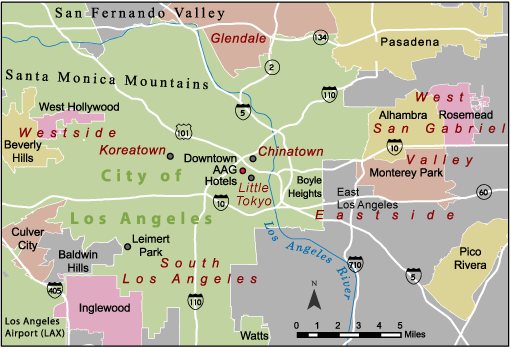
In this article we look briefly at ethnic trends in the county up to 2010 and then focus on the larger ethnic residential and commercial concentrations, often called enclaves. Lastly, we discuss two smaller concentrations easily accessible from your hotel in Downtown Los Angeles. All eight enclaves are located on the accompanying map.
In 1960, non-Hispanic Whites comprised 80 percent of Los Angeles County’s population, but since then their numbers have been decreasing, due especially to moves to outlying counties and to other states and increased immigration of other groups. Now only 28 percent of county residents are Whites. Despite this general decline of Whites, immigration has tripled Armenian numbers since 1980, with 170,000 now living in the county.
The largest ethnic group in the county is Hispanics, or Latinos, who make up 48 percent of the total. About 80 percent of Latinos are of Mexican origin, followed by Salvadorans and Guatemalans. The next largest groups are Asians (13 percent) and Blacks (8 percent). Black numbers have decreased since 1990, although the four outlying counties have shown gains as many Blacks sought lower-priced housing in more distant locales. Asian immigration has led to rapid growth over several decades so that now there are over 300,000 each of Filipinos and Chinese, with Koreans and Japanese each numbering over 100,000.
Ethnic enclaves in Los Angeles County. Names of ethnic enclaves are indicated in red italicized type. Los Angeles City is shown in light green, other selected incorporated places in various tints, and remaining areas in dark gray. Smaller ethnic enclaves and places are located by dots.
Larger Enclaves
Only about half of the people in most ethnic groups live in any geographical concentration of their group, but we sketch here several of the largest and best known enclaves.
Mexicans in the Eastside. Although Los Angeles was founded by the Spanish in 1781 and was later part of an independent Mexico, California became U.S. territory in 1848. English-speaking Whites soon established their control, and many Mexicans lost their land holdings while most Mexicans were relegated to low-paying and menial jobs.
Railroad connection to Eastern states in the 1880s led to a rapid in-migration of Whites. After 1900 increasing congestion and aging structures in Downtown led to a program of urban renewal. This had the effect of moving Mexicans from the old Plaza area eastward across the Los Angeles River into newly developed Boyle Heights and nearby rural areas. Throughout the twentieth century, as the Mexican population has grown by immigration and natural increase, many Mexicans have moved farther east into suburbs of the San Gabriel Valley that had previously been almost all White. The Eastside’s oldest sections, Boyle Heights and East Los Angeles, have its lowest incomes and are over 75 percent Mexican, but incomes are higher and populations more mixed farther east.
Whites in the Westside. West of the Los Angeles River, this loosely defined area was built up as suburbs beginning in the 1920s and remains two-thirds White and mostly middle- and upper-class. Except for newer sections of Downtown, the Westside contains most of Los Angeles’ major office buildings, higher-paying jobs, and expensive homes. It excludes the older, poor, and more racially mixed Hollywood, but it stretches from about five miles west of Downtown westward past the independent cities of Beverly Hills and West Hollywood. The Westside extends from the Santa Monica Mountains on the north to approximately Pico Blvd. on the south, with White percentages increasing in wealthier neighborhoods, especially those near and in the mountains.
The Westside contains the most prestigious residential areas of the city and, together with Downtown, represents the city’s center of economic power. A reflection of the social and economic divide between Whites and both Mexicans and Blacks is the fact that most Westside Whites never venture into the Eastside or South Los Angeles.
Blacks in South Los Angeles. To the south of Downtown and Interstate 10 is another older suburb, once a home to both Whites and Blacks. When racial segregation became legal and widespread in the 1920s, Whites began moving out of the area to newer housing. With their departure, and restrictions on the areas in which Blacks (and Asians and Mexicans, too) could rent or buy houses, a large area (formerly called South Central) extending south past Watts developed into a mostly Black and poor ghetto.
Beginning in the 1950s, as residential segregation lost its legal support, some middle-class Blacks left South Los Angeles, often moving westward, prompting many Whites to depart. There are now important middle-class and more affluent Black populations in Inglewood and the Baldwin Hills, and Leimert Park on Crenshaw Blvd. has become the leading center of Black cultural life. Since 1990 Blacks have moved into many other parts of the city that had been very White, such as the San Fernando Valley to the north. Over the last half-century the departure of middle-class Blacks from older settlements has exacerbated problems such as poor schools, gangs, and crime in those areas, where poverty and unemployment remain major problems.
However, demand for single-family housing by Mexicans and Central Americans has kept home prices fairly high, and homeowning Blacks have found a ready market. The net effect is that South Los Angeles east of Interstate 110 has become well over half Latino, resulting in stores and churches catering to both Black and Latino populations.
Chinese in the West San Gabriel Valley. Beginning in the 1970s a Chinese immigrant began to develop America’s first suburban Chinatown a few miles east of Downtown, choosing Monterey Park as its focus. With advertisements in Hong Kong and Taiwan calling it the “Chinese Beverly Hills,” he attracted many families who bought land, apartment buildings, and businesses. Before the arrival of Chinese, the West San Gabriel Valley was mostly White but with some Mexicans and Japanese. Immigration has resulted in a steadily expanding Chinese, Taiwanese, and Chinese-Vietnamese area focused on Monterey Park, Arcadia, Alhambra, and Rosemead, with these groups now comprising 46 percent of the four cities’ total population. With many immigrants bringing in money for home purchase and other investments, some Chinese in the West San Gabriel Valley have bought expensive homes and opened a full range of businesses and services. More affluent Chinese and other Asians often settled in newer homes farther east in the county, in Walnut, Diamond Bar, or Cerritos.
Armenians in Glendale. Although Armenian immigrants have been settling in Los Angeles for over a century, the pleasant suburban city of Glendale has recently become especially attractive to Armenians from Iran. In the late 1970s many Iranian families, anticipating the downfall of the Shah and subsequent persecution, sent family members to Los Angeles. The exodus continued into the early 1980s, with Iranians at that time having to sneak themselves and valuables out of the country. Among the several ethnic and religious groups represented by these Iranians, some Armenians settled in Glendale and were joined by Armenians from Lebanon. Others followed in classic chain migrations. Immigrants bought businesses and opened new ones, as well as Armenian schools and churches. As the Armenian presence in Glendale has grown steadily over recent decades, Latino numbers have declined. Armenians now comprise 32 percent of the city’s total population.
Koreans in Koreatown. This small area only a couple of miles west of Downtown is the single greatest focus of Korean life in the city. It contains a full range of businesses and services for Koreans, most of who travel in from outlying suburbs for work, shopping, health care, or other activities. Koreatown has seen much investment by Korean companies over several decades, but after 2000, construction of new apartments, office buildings, and stores, as well as continued renovations of older structures, really took off. At the same time more middle- and upper-class Korean families moved there from South Korea or from various Los Angeles suburbs. The area is residentially multiethnic, with Latinos typically in lower-rent apartments and Koreans, other Asians, and Whites in more expensive housing. With the intense gentrification and higher rental prices over the past decade, the percentage of Latinos has diminished and the percentage of Asians increased. Now, Koreans constitute about a third of the area’s population.
Downtown Enclaves
The following areas can be visited quite easily via Dash buses, which run every 7–10 minutes until 7 PM (only $.25 a ride). Go online or ask the concierge to show you the map of the Dash routes.
Chinatown. Initially developed in the 1930s as a focus for tourist shopping and a replacement for earlier Chinatowns, this newest Chinatown was mostly Cantonese until the 1960s. Then immigrants from different parts of China, Hong Kong and Taiwan began to arrive, and the late ‘70s saw an influx of Chinese from Southeast Asia. This latter group bought property, built shopping centers, and opened shops and restaurants so that by 1990 they owned the majority of businesses. They energized Chinatown economically, especially the section south of College Street. Altogether, Chinatown is quite multiethnic, with only two-thirds of its residents Chinese of one origin or another.
Chinatown contains fewer than two percent of the Chinese in the county, and its residents are poorer and less educated than Chinese elsewhere in the county. Although it’s convenient for tourists to visit Chinatown, it’s not typical of Chinese settlement in Los Angeles.
Little Tokyo. This area has been home to Japanese since the beginning of the 20th century except for the period of internment during World War II. Beginning in the 1970s, with the assistance of Japanese Americans and government subsidies, nearly all the old structures have been demolished to make room for the new hotels, banks, shopping centers, and apartment buildings visible today. Prior to the ‘70s, most Japanese in Los Angeles had moved to suburbs so that modern Little Tokyo has long been known more as a Japanese American cultural and commercial center than a place of residence. Visiting Japanese businessmen and tourists stay in Little Tokyo’s hotels, and its shops and restaurants are popular with Japanese and other residents of Los Angeles.
Further Exploration
We hope this brief introduction and the accompanying map have given you a taste of L.A.’s ethnic diversity and some of its patterns. Those wishing to learn about other ethnic groups and enclaves in L.A. can consult our book The Ethnic Quilt, which covers 34 different groups and is now available online at Professor Turner’s personal website.
James P. Allen, Professor Emeritus of Geography, California State University, Northridge
Eugene Turner, Professor, California State University, Northridge
Last month, I advocated decentering the production of geographical knowledge. This month, I explore online revolutions in information flows, and the tensions these pose for decentering geographical knowledge. At the heart of these is a tension in the power-geometries of cyberspace itself—which is far from the flat world/global village visions of its most ardent proponents. This is the tension between those advocating net neutrality, envisioning cyberspace as a virtual place of communicative action where all participate and mutually engage, and those seeking an ordered cyberspace, aligned with existing economic and political power: Anonymous vs. a corporate-state complex.
On the visionary end of this spectrum, cyberspace (particularly the increasingly georeferenced Web 2.0) is a massive, online distributed geographic information system—replete with multifaceted, multi-media georeferenced information, connecting seemingly objective data with views of and opinions about the world. Cyberspace problematizes what counts as data, belief and knowledge, empowering all to contribute to such discussions and representations, in ways that are simultaneously emancipatory and problematic. At the other end, are the Intranets that partition cyberspace, surveillance technologies and cyber-warfare. At one end, self-organization, multiplicity and emergence: decentered knowledge production and volunteered geographical information. At the other, a hierarchy, shaped by the usual geographical suspects (powerful Anglophone institutions, concentrated in elite spaces of the global North).
These tensions also characterize the online production and dissemination of academic knowledge. Two aspects have received considerable recent attention: Open access (OA) publishing and massive open online courses (MOOCs). I imagine that, like me, you regularly receive email solicitations from OA publishers and journals, offering to publish your scholarship or pedagogic writing or place you on their editorial boards. Sorting out the merits of OA publishing is a challenge: As for cyberspace in general, crowd sourcing is simultaneously pathbreaking and hazardous. MOOCs have resulted in hundreds of courses with casts of tens of thousands, with Geography virtually absent: I have found just two MOOC Geography courses, on GIS and mapping. On the one hand, is our visceral belief in academic knowledge as a public good (once largely publicly funded) that should be freely available to anyone. On the other, are concerns about emergent hierarchies of knowledge/power favoring those who can position themselves to persuade others.
With respect to OA publishing, we can distinguish between a ‘green’ vision and a ‘gold’ model. In the green vision, digital repositories make scholarly manuscripts immediately publicly accessible at no cost. In the gold model, authors pay an article processing charge (APC) to a publisher that releases the latter’s copyright control so that the publication can become OA: “Pay to say.” The gold model is rapidly trumping the green vision. The UK Government accepted recommendations from the 2011 Finch Report, that all (particularly public funded) published research be OA, preferring the gold model. The UK Research Councils now require this for their funded research, triggering similar initiatives in North America, the European Union, Japan, Australia and Brazil. In response, Anglophone journals are quickly implementing the gold model: The APC for the Annals and The Professional Geographer will be $2,950. Harvard University instituted a policy under which faculty authors grant Harvard the right to distribute their scholarly articles ‘for any non-commercial purpose.’ While the Harvard ‘dash’ repository is green, Harvard’s right to deposit an article published in a major journal may push its faculty to pay APCs. Such moves toward the commodification of open access, shaped by major players in the production and dissemination of knowledge raise major questions: Who has the money to pay APCs? This disadvantages geographers whose research neither attracts nor requires external funding, and less resourced academic institutions. If funding agencies pay APCs (as envisioned in the UK), how will they decide which scholarship deserves such funding? What are the opportunity costs of setting aside money for this purpose? Will this enhance the influence of funders, and the private sector more generally, over academic research?
Here, as elsewhere, commodification challenges academic freedom. Since most academic publishers are already supported by the pro bono labor of authors, referees and (decreasingly) academic editors, one alternative is to invest this labor in journals that are freely available (e.g. ACME), or non-profit (e.g. Human Geography). Yet displacing the highly profitable private-sector journal publishers will remain difficult. This is particularly the case because of the question of determining the quality of information in cyberspace. Here, academics are more comfortable with hierarchies, whereby expertise certifies quality. Yet, as our institutions seek quick fixes to the self-appointed task of measuring (indeed, commodifying) scholarly output, adopting citation and impact scores popularized by ISI Thomson or Google, it is vital to critique and reimagine such measures.
MOOCs have exploded since the term was coined in 2008, exhibiting the same tensions. As originally envisioned, the cMOOC (‘connectivist’) is an open, online educational experience in which all participants contribute knowledge, engaging with and learning from one another. But the xMOOC has come to dominate: a top down educational model, whereby an MIT course, say, (one of the most active providers) is offered to all comers. There are now half a dozen cyberfirms coordinating free xMOOC offerings from an increasing number of universities, worldwide. The challenge, as for OA and cyberspace in general, is making money: xMOOCs have yet to crack the commodification barrier, whereby students would be willing to pay to enroll. Key to this, again, is demonstrating quality, by persuading those institutions currently trusted as quality education providers to endorse or accredit xMOOCs.
What do OA and MOOCs suggest for decentering the production of geographical knowledge? If commoditized models predominate, then order and hierarchy will displace the participatory mutual engagement and learning central to such decentering. The same hierarchies, voices, institutional locations and languages will prevail.
LeRoy Myers, a former professor of geography and city planner, died Feb. 17, 2013. A native of Pennsylvania, Myers studied at Penn State where he earned his bachelor’s degree. He later graduated from the University of Michigan with a master’s in geography. As a professor of geography, he taught at Slippery Rock University and WVU. Myers also worked in city planning for the cities of Williamsport, Meadville, and Lima in Ohio.
LeRoy also served in the army during World War II. His love of travel took him to all of Europe and much of East Asia, Africa, and Australia. Myers had a talent for photography and served as a member of the Masonic Lodge.
He is survived by two step children (Susan Miller and David Swanson) and relatives in the Clintonville, Pa., area.
Every month the AAG compiles a list of newly-published books in geography and related areas. Some are selected for review in the AAG Review of Books.
Publishers are welcome to send new volumes to the Editor-in-Chief (Kent Mathewson, Editor-in-Chief, AAG Review of Books, Department of Geography and Anthropology, Louisiana State University, Baton Rouge, LA 70803).
Anyone interested in reviewing these or other titles should also contact the Editor-in-Chief.
March 2013
Antonio Negri: Modernity and the Multitude. Murphy, Timothy. Malden, MA: Polity Books 2012. $24.95 Paper (ISBN 978-0-7456-4320-5).
Portuguese and Luso-Asian Legacies in Southeast Asia, 1511–2011 Volume 1, The Making of the Luso-Asian World: Inticacies of Engagement. Jarnagin, Laura. Durham, NC: Duke University Press 2011. $22.95 Paper (ISBN 978-0-8223-5401-7).
Climate Change and Human Mobility: Challenges to the Social Sciences. Hastrup, Kirsten and Karen Fog Olwig. Cambridge, England: Cambridge University Press 2012. $99 Cloth (ISBN 978-1-107-02821-0).
Climate Change and Society. Urry, John. Malden, MA: Polity Books 2011. $22.95 Paper (ISBN 78-0-7456-5037-1).
Climate Wars: What People Wll Be Killed for in the 21st Century. Welzer, Harald. Malden, MA: Polity Books 2012. $25 Cloth (ISBN 978-0-7456-5145-3).
Creamy and Crunchy: An Informal History of Peanut Butter, the All-American Food. Krampner, Jon. New York, NY: Columbia University Press 2012. $27.95 Cloth (ISBN 978-0-231-16232-6).
Crime Modeling and Mapping Using Geospatial Technologies. Leitner, Michael, ed. New York, NY: Springer 2013. $179.00 Cloth (ISBN 978-94-007-4996-2).
Drinking History: Fifteen Turning Points in the Making of American Beverages. Smith, Andrew F. New York, NY: Columbia University Press 2012. $29.95 Cloth (ISBN 978-0-231-15116-0).
Ecologies and Politics of Health. King, Brian, and Kelley A. Crews. New York, NY: Routledge 2012. $160 Cloth (ISBN 978-0-415-59066-2).
Everything Sings: Maps for a Narrative Atlas, 2nd Edition. Wood, Denis. Los Angeles, CA: Siglio 2013. $32 Paper (ISBN 978-1-938221-02-6).
Figures Infrastructures: An Atlas of Roads and Railways. Cattoor, Bieke and Bruno De Meulder. Amsterdam, The Netherlands: SUN 2011. $30.00 Cloth (ISBN 978-94-6105-1189).
Fish. Desmore, Elizabeth and J. Samuel Barkin. Malden, MA: Polity Books 2011. $19.95 Paper (ISBN 978-0-7456-5020-3).
Fixing the Sky: The Checkered History of Weather and Climate Control. Fleming, James Rodger. New York, NY: Columbia University Press 2010. $24.95 Paper (ISBN 978-0-231-14413-1).
From the Ground Up: Community Gardens in New York City and the Politics of Spatial Transformation. Eizenberg, Efrat. Farnham, England: Ashgate 2013. $99.95 Cloth (ISBN 978-1-4094-2909-8).
Germany in Central America: Competitive Imperialism, 1821–1929. Schoonover, Thomas. Tuscaloosa, AL: University of Alabama Press 2012. $34.95 Paper (ISBN 978-0-8173-5413-8).
International Students and Scholars in the United States: Coming from Abroad. Alberts, Heike C. and Helen D. Hazen, eds. New York, NY: Palgrave Macmillan 2013. £54.50 Cloth (ISBN 978-1-137-02446-6).
Landscapes of Capital: Representing Time, Space and Globalization in Corporate Advertising. Goldman, Robert and Stephen Papson. Malden, MA: Polity Books 2011. $24.95 Paper (ISBN 978-0-7456-5208-5).
Life on a Rocky Farm: Rural Life near New York City in the Late Nineteenth Century. Barger, Lucas C. Albany, NY: State University of New York Press 2013. $19.95 Paper (ISBN 978-1-4384-4602-8).
Linked Data: A Geographic Perspective. Hart, Glen and Catherine Dolbear. Boca Raton, FL: CRC Press 2013. $119.95 Cloth (ISBN 978-1-4398-6995-6).
Little White Houses: How the Postwar Home Constructed Race in America. Harris, Dianne. Minneapolis, MN: University of Minnesota Press 2013. $39.95 Paper (ISBN 978-0-8166-5456-7).
Local Histories/Global Designs: Coloniality, Subaltern Knowledges, and Border Thinking. Mignolo, Walter D. Princeton, NJ: Princeton University Press 2012. $26.95 Paper (ISBN 978-0-691-15609-5).
Markets of Sorrow, Labors of Faith: New Orleans in the Wake of Katrina. Adams, Vincanne. Durham, NC: Duke University Press 2013. $22.95 Paper (ISBN 978-0-8223-5449-9).
Masters of the Universe: Hayek, Friedman, and the Birth of Neoliberal Politics. Stedman Jones, Daniel . Princeton, NJ: Princeton University Press 2012. $35 Cloth (ISBN 978-0-691-15157-1).
Mobility and Migration in Indigenous Amazonia: Contemporary Ethnoecological Perspectives. Alexiades, Miguel N. New York, NY: Berghahn Books 2012. $34.95 Paper (ISBN 978-0-85745-797-4).
New Mexico’s Spanish Livestock Heritage: Four Centuries of Animals, Land, and People. Dunmire, William W.. Albuqueque, NM: University of New Mexico Press 2013. $34.95 Cloth (ISBN 978-0-8263-5889-3).
On the Rim of the Caribbean: Colonial Georgia and the British Atlantic World. Pressly, Paul M. Athens, GA: University of Georgia Press 2013. $24.95 Paper (ISBN 978-0-8203-4503-1).
Parks, Peace, and Partnership: Global Initiatives in Transboundary Conservation. Quinn, Michael S., Len Broberg, and Wayne Freimund. Calgary, Canada: University of Calgary Press 2012. $45.95 Paper (ISBN 978-1-55238-642-2).
Picturing Algeria. Bourdieu, Pierre. New York, NY: Columbia University Press 2012. $27.50 Cloth (ISBN 978-0-231-14842-9).
Prague, Capital of the Twentieth Century: A Surrealist History. Sayer, Derek. Princeton, NJ: Princeton University Press 2013. $35 Cloth (ISBN 978-0-691-04380-7).
Printing a Mediterranean World: Florence, Constantinople, and the Renaissance of Geography. Roberts, Sean. Cambridge, MA: Harvard University Press 2013. $49.95 Cloth (ISBN 978-0-674-06648-9).
Properties of Biolence: Law and Land Grant Struggle in Northern New Mexico. Correia, David. Athens, GA: University of Georgia Press 2013. $24.95 Paper (ISBN 978-0-8203-4502-4).
Rising Seas: Past, Present, Future. Gornitz, Vivien. New York, NY: Columbia University Press 2013. $40 Paper (ISBN 978-0-231-14739-2).
River Republic: The Fall and Rise of America’s Rivers. McCool, Daniel. New York, NY: Columbia University Press 2012. $34.5 Cloth (ISBN 978-0-231-16130-5).
Silent Violence: Food, Famine, and Peasantry in Northern Nigeria. Watts, Michael J. Athens, GA: University of Georgia Press 2013. $28.95 Paper (ISBN 978-0-823-4445-4).
The Environmental Advantages of Cities: Countering Commonsense Antiurbanism. Meyer, William B. Cambridge, MA: MIT Press 2013. $25.00 Paper (ISBN 978-0-262-51846-8).
The Geographies of Canada. Tremblay, Rémy and Hugues Chicoine, eds. Pierterlen, Switzerland: Peter Lang 2013. $45.95 Paper (ISBN 978-2-87574-017-5).
The Last Blank Spaces: Exploring Africa and Australia. Kennedy, Dane. Cambridge, MA: Harvard University Press 2013. $35 Cloth (ISBN 978-0-674-04847-8).
The New Scramble for Africa. Carmody, Pádraig. Malden, MA: Polity Books 2011. $24.95 Paper (ISBN 978-0-7456-4785-2).
The Omnivorous Mind: Our Evolving Relationship with Food. Allen, John S. Cambridge, MA: Harvard University Press 2012. $25.95 Cloth (ISBN 978-0-674-05572-8).
The Politics of Climate Change, 2nd Edition. Giddens, Anthony. Malden, MA: Polity Books 2011. $19.95 Paper (ISBN 978-0-7456-5515-4).
The Qing Opening to the Ocean: Chinese Maritime Policies, 1684–1757. Zhao, Gang. Honolulu, HI: University of Hawai’i Press 2013. $56 Cloth (ISBN 978-0-8248-3643-6).
The Summits of Modern Man: Mountaineering after the Enlightenment. Hansen, Peter H. Cambridge, MA: Harvard University Press 2013. $35 Cloth (ISBN 9780674047990).
The Tyranny of Science. Feyerabend, Pauk. Malden, MA: Polity Books 2011. $17.95 Paper (ISBN 978-0-7456-5190-3).
The Urban Wisdom of Jane Jacobs. Sonia Hirt, ed. New York, NY: Routledge 2013. $110 Cloth (ISBN 978-0-415-52599-2).
The Wrath of Capital: Neoliberalism and Climate Change Politics. Parr, Adrian. New York, NY: Columbia University Press 2012. $29.5 Cloth (ISBN 978-0-231-15828-2).
Timber. Dauvergne, Peter and Jane Lister. Malden, MA: Polity Books 2011. $19.95 Paper (ISBN 978-0-7456-4928-3).
Towards Co-Creation of Sciences: Building on the Plurality of Worldviews, Values and Methods in Different Knowledge Communities. Haverkort, Bertus, Freddy Delgado Burgoa, Darshan Shankar, and David Millar. New Delhi, India: Nimby Books 2012. $ Paper (ISBN 978-81-90570-4-4).
Two Cheers for Anarchism: Six Easy Pieces on Autonomy, Dignity, and Meaningful Work and Play. Scott, James C. Princeton, NJ: Princeton University Press 2012. $24.95 Cloth (ISBN 978-0-691-15529-6).
Value in Marx: The Persistence of Value in a More-Than-Capitalist World. Henderson, George. Minneapolis, MN: University of Minnesota Press 2013. $22.50 Paper (ISBN 978-0-8166-8096-2).
Working Knowledge: Making the Human Sciences from Parsons to Kuhn. Isaac, Joel. Cambridge, MA: Harvard University Press 2012. $49.95 Cloth (ISBN 978-0-674-06574-1).
Share
President's Column
Public Geographies
How should geographers engage with the world? Building on an initiative of Michael Burawoy, ex-president of the American Sociological Association, I propose that more disciplinary effort be put into public geographies.
One of the great features of geography is that it is grounded—not just because we study the earth, but in the sense that geography is intimately related to everyday life. Almost everything people (and other beings) do on a daily basis engages consciously or unconsciously with the geographies that both find themselves within, and create. (This is why emergent digital technologies shaping communication and interaction are increasingly geographical: Web 2.0.) As academic geographers, we find ourselves quite removed from these everyday geographies. Our expertise, and social credibility, stem from academic credentials, but self-referentiality and abstraction for abstraction’s sake make it harder to transcend the ivory tower. Some seek to make geography more socially relevant by applying academic knowledge to policy issues. Applied, policy-relevant geographies are important, and we should lament any dearth of these and the lack of impact of geographers’ policy recommendations. But how else can we engage with the world, and to which effect? Policy geographies tend to feed into social hierarchies. Often they are directed toward the socially influential, addressing their agendas, priorities and perspectives on society and nature. As policy geographers know all too well, recommendations that are tangential to the concerns of, or address questions not posed by, those paying for advice, run the risk of being filed away. Yet, even well-intentioned elite priorities and perspectives are often distant from the priorities of what the Occupy movement dubbed the 99 percent. (Consider how peoples’ frustration with politicians has become endemic worldwide, as elected politicians’ actions seem increasingly irrelevant or impotent.) Taking advantage of our groundedness, public geographies would engage directly with such alternative priorities.
Public geographies take many forms, but always involve pedagogy, whether in research-oriented universities, community colleges, K-12 classrooms, or alternative teaching initiatives (like the Experimental College of the Twin Cities and Freedom University). Teaching brings geography directly to the diverse populations making up our societies, a vital opportunity not only to provoke critical geographic thinking about socionature but also for us to learn from these students’ diverse perspectives and experiences. Other important venues for prosecuting public geographies include opinion columns, blogs, video documentaries, and social networking tout court. One neglected geographical opportunity to reach the general public is producing ‘trade’ books that engage with and provoke reflection by the general public. Economists and physicists have had much success and influence this way: Why not us? We also should consider the rapid emergence of MOOCs—massive open online courses—an initiative dominated in the U.S. by universities that do not offer geography.
On the societal end of the discipline, public geographies might also involve revealing peoples’ landscapes of living and protest, erased in the name of development (cf. The Peoples’ Guide to Los Angeles). They might involve narrating more broadly peoples’ geographies as an antidote to official accounts, or supporting community geographers. They might involve participant action research, working with communities and collectivities on issues identified by them, empowering their members as co-researchers. They might involve work about and in conversation with diverse economies, social and environmental justice, indigenous and (more-than) human rights.
For those whose scholarship focuses more squarely on biophysical and nature/society issues, public geographies would contest perspectives shaped by market-friendly, state-oriented and corporate agendas. These might include focusing on the biodiversity of places and the sustainability of species marginalized in dominant societal agendas. They might document the climatic and geomorphological effects of such agendas, assessing their viability or desirability. They might connect with societal issues of environmental justice as well as justice for the more-than-human world. For those focused on cartography and other geographical information technologies, public geographies might include community and critical cartography, public participation GIS, or the development of alternative geographic information architectures to facilitate the influence and livelihood possibilities of disadvantaged communities.
Undertaking public geographies entails attending to the challenges and opportunities of working in a geographically differentiated world: e.g., those of working with proximate vs. more distant groups; in places that vary dramatically in terms of culture, ecologies, etc.; at scales ranging from the household to the globe (acknowledging the heterogeneity and inequality at every scale); and working through (and shaping) the connectivities linking places and scales together. Public geographies should be well attuned to such differentiations, by their very nature, yet critically engaging across them remains a major challenge. The ambition should be global, but from the bottom-up rather than top-down.
Public geographies cannot stand alone: Academic and applied geographies are every bit as important, each gaining strength from the others. Without a basis in academic geographies, we have little legitimacy to bring to public issues. In my experience, communities look to geographers for expertise as much as we look to them, and our academic training is the foundation for what we can offer. By the same token, applied/policy geographers offer real-world expertise that can be vital for shifting policy agendas toward public priorities, and for facilitating engagement with existing policy priorities.
The time seems propitious for public geographies: In the United States, community-university partnerships and public engagement are all the rage. Nevertheless, there remain few incentives for students and faculty to pursue public geographies. Academic success is tied to research with impact, measured in citations and policy influence, with teaching also shaped by institutional priorities. Elite universities’ rhetoric talks the talk of public scholarship without walking the walk: It remains too often a pro bono activity, to be undertaken in addition to everything else. Here is where smaller universities and colleges have a real advantage: They are often more directly connected with non-elite communities and their students. In my visits to regional AAG meetings last fall, with elite institutions generally conspicuous by their absence, I was impressed by the kinds of public geographies presented there. Advancing public geographies, then, may require leadership from outside the elite geography programs.
AAG Members get exclusive access to publications, prominent journals, unique advocacy, grant, scholarship and professional opportunities with access to industry focus communities, and event discounts, including our annual meeting.
Some content may only be accessible if you belong to specific Specialty or Affinity Groups. You can still update your membership below. You will need to go through the Join flow, but you do not need to repurchase your membership unless it is expired or about to expire.
To provide the best experiences, we use technologies like cookies to store and/or access device information. Consenting to these technologies will allow us to process data such as browsing behavior or unique IDs on this site. Not consenting or withdrawing consent, may adversely affect certain features and functions.
Functional
Always active
The technical storage or access is strictly necessary for the legitimate purpose of enabling the use of a specific service explicitly requested by the subscriber or user, or for the sole purpose of carrying out the transmission of a communication over an electronic communications network.
Preferences
The technical storage or access is necessary for the legitimate purpose of storing preferences that are not requested by the subscriber or user.
Statistics
The technical storage or access that is used exclusively for statistical purposes.The technical storage or access that is used exclusively for anonymous statistical purposes. Without a subpoena, voluntary compliance on the part of your Internet Service Provider, or additional records from a third party, information stored or retrieved for this purpose alone cannot usually be used to identify you.
Marketing
The technical storage or access is required to create user profiles to send advertising, or to track the user on a website or across several websites for similar marketing purposes.
To provide the best experiences, we use technologies like cookies to store and/or access device information. Consenting to these technologies will allow us to process data such as browsing behavior or unique IDs on this site. Not consenting or withdrawing consent, may adversely affect certain features and functions.
Functional
Always active
The technical storage or access is strictly necessary for the legitimate purpose of enabling the use of a specific service explicitly requested by the subscriber or user, or for the sole purpose of carrying out the transmission of a communication over an electronic communications network.
Preferences
The technical storage or access is necessary for the legitimate purpose of storing preferences that are not requested by the subscriber or user.
Statistics
The technical storage or access that is used exclusively for statistical purposes.The technical storage or access that is used exclusively for anonymous statistical purposes. Without a subpoena, voluntary compliance on the part of your Internet Service Provider, or additional records from a third party, information stored or retrieved for this purpose alone cannot usually be used to identify you.
Marketing
The technical storage or access is required to create user profiles to send advertising, or to track the user on a website or across several websites for similar marketing purposes.