Matthieu Giroud

Matthieu Giroud, Associate Professor at Université Paris-Est Marne-la-Vallée, and noted critical geographer specializing in urban social change, was killed at the Bataclan concert hall during the terrorist attacks in Paris on November 13, 2015.

Matthieu Giroud was born on September 24, 1977. He was from the village of Jarrie just south of Grenoble in southeastern France.

Giroud began his geographical studies in the Institute of Alpine Geography at Joseph Fourier University in Grenoble. He then moved to England and gained a bachelor’s degree in geography at the University of Leeds in 1999.

He returned to Joseph Fourier University for a master’s degree in geography, his research looking at the evolution of a historic neighborhood of Grenoble. This was followed by a Diploma of Advanced Studies in 2003 at the University of Poitiers, in Migrinter, a research center specializing in international migration, spaces and society. His focus was on immigration and inter-ethnic relations, specifically in Grenoble.

Giroud remained at the University of Poitiers for his doctorate, under the supervision of Françoise Dureau. He studied two old working class neighborhoods – Berriat Saint-Bruno in Grenoble (France) and Alcântara in Lisbon (Portugal) – and examined how they were being affected by urban renewal. His thesis, entitled “Résister en habitant? Renouvellement urbain et continuités populaires en centre ancient” was completed in 2007 and received mention très honorable avec felicitations, the highest academic distinction awarded in the French academic university system. He was also awarded the 2008 thesis prize by the French National Geography Committee.

He continued working on various research projects at the Migrinter research center on migration and urban change while also passing the national qualification to become a university lecturer. He then moved to Blaise Pascal University in Clermont-Ferrand in 2008 where he spent four years as Maître de conférences en géographie (Associate Professor equivalent).

In 2012 Giroud moved to the University of Paris East at Marne-la-Vallée where he was Associate Professor in geography and a member of the multidisciplinary research unit Analyse Comparée des Pouvoirs (Comparative Analysis of Powers).

His ongoing research focused on the social effects of gentrification including resistance and evictions; spatial mobilities and living spaces; and critical analysis of contemporary urban development.

Giroud attended the AAG Annual Meeting in New York in 2012, presenting a paper on “Gentrification and the contested representations of the popular.” He questioned the assumptions often made by public authorities that the process of gentrification is an effective means of revitalizing declining urban areas by drawing attention to the existing inhabitants of such neighborhoods and the tensions experienced and expressed as their spaces are rebranded.

Giroud coordinated the translation of David Harvey’s Paris: Capital of Modernity, published in French in 2012. He was also the co-editor, with Cécile Gintrac, of Villes contestées: Pour une géographie critique de l’urbain (Contested cities: for a critique of urban geography), the first French reader of critical urban studies, published in 2014. At the time of his death he was involved in several major research projects on urban change.

Aside from his academic success and promising career ahead, Giroud loved music, soccer, cities, life and friendship. He leaves behind a son, aged 3, and a wife, Aurélie, expecting their second child.

    Share

Susan W. Hardwick

Susan Hardwick, professor emerita at the University of Oregon and national leader in the field of geography education, passed away on November 11, 2015, at the age of 70, after a brief illness.

Susan Louise Wiley was born on May 9, 1945 in Greensburg, PA. After completing her secondary education at Slippery Rock High School in 1963 she moved to Slippery Rock University for a bachelor’s degree in Education and Social Science / Geography, graduating in 1967.

Hardwick began her teaching career in a one-room schoolhouse at Honcut Middle School in Oroville, California in 1968. This was followed by a master’s degree in Geography from California State University, Chico, with a thesis entitled “Chinese Settlement in Butte County, California: 1860-1920.”

In 1974 she moved to the Department of Earth Sciences at Cosumnes River College, a community college in Sacramento, CA, where she stayed until 1986, teaching and serving as chair of the department. During this time she also spent a year as Director of Ethnographic Research for the City of Sacramento.

Concurrently she undertook doctoral studies at the University of California, Davis. Her thesis, completed in 1986, was entitled “Ethnic Residential and Commercial Patterns in Sacramento with Special Reference to the Russian-American Experience.”

Next Hardwick returned to the Department of Geography and Planning at California State University, Chico, between 1986 and 1997 holding posts as Assistant Professor, Associate Professor and Professor. She also spent the last three years as the university’s co-coordinator of the Literacy and Learning Program.

She moved to Texas State University in San Marcos in 1997 as Professor of Geography and Associate Director of the Gilbert M. Grosvenor Center for Geographic Education. In 2000 came her final move, this time to the Department of Geography at the University of Oregon.

Hardwick’s early interests in the geographies of immigration continued throughout her career, in both research and teaching. Focusing on the North American context, she was interested in migration flows and spatial patterns, shifting identities of immigrants and refugees, and urban social landscapes. Her extensive publication record contains scores of books, book chapters and articles on the ways in which racial and ethnic differences shaped North American towns and cities. She was particularly known for her long-running work on Russian immigrants in North America.

In recent years she had also focused on Canada, particularly the migration experiences, spatial patterns and transnational identities of immigrants at the Canada-U.S. borderland. She spent several years as a Senior Research Fellow on the Metropolis Project at the University of British Columbia and Simon Fraser University during which time she was the Principal Investigator on a number of projects. One of her most recent publications was a co-edited volume with Francophone geographer, Remy Tremblay, called Transnational Borders, Transnational Lives: Academic Mobility at the Borderland (University of Quebec Press, 2014) telling the stories of a selected group of geographers who migrated to one side to another of the Canada-US border. She left four publications in progress including work on the role of immigrants in the development of the United States, the Klu Klux Klan in Oregon, and the lives of Russian Americans in the Pacific Northwest.

Hardwick’s other major area of activity – in teaching, scholarship and activism – was geographic education. Oregon colleague Alec Murphy said, “It is hard to name any major development in geography education over the past few decades that does not in some way bear Susan’s imprint. She was a tireless and effective champion of the cause.”

Among her many accomplishments, she played a critical role in crafting the original and revised versions of the National Geography Standards and co-hosted “The Power of Place,” a hugely successful Annenberg public television series for educators. She also spearheaded the development of an online training program for teachers of AP Human Geography, and played a central role in bringing to fruition the “Road Map for the Large-Scale Improvement of K–12 Geography Education.”

She was a co-author for three widely used textbooks: My World Geography (Pearson Prentice Hall, 2011) currently being used by thousands of middle school geography and social studies students; The Geography of North America: Environment, Political Economy, and Culture (Prentice Hall, 2nd edition 2012) for college and university level regional geography courses; and Geography for Educators: Standards, Themes, and Concepts (Prentice Hall, 1996) a text that has been used by thousands of pre-service and in-service geography and social studies teachers.

University of Oregon colleague W. Andrew Marcus said, “Susan’s tireless efforts, her innovation in creating new programs and her capacity to build bridges where other people saw chasms, have given her a special place in the pantheon of scholars who have changed education.”

Hardwick’s professional service contributions were legion. Most notably, she served the National Council for Geographic Education as president and vice president of research and external relations. At different points during her career she sat on the national councils of both the Association of American Geographers and the American Geographical Society, taking the lead on many initiatives for those organizations. She was also an active member of the editorial board of the Journal of Geography for more than a decade. She was a great contributor to other professional organizations in the U.S. with a geographic remit, including the Association of Pacific Coast Geographers and the National Geographic Society.

Although she retired in 2010, Hardwick remained active in the geography department at the University of Oregon, teaching two courses each year, mentoring graduate students and future teachers, and serving as co-director of the university’s graduate summer program in geographic education.

Over the years, Hardwick’s commitment and achievements in different areas – scholarship, teaching effectiveness, service, leadership and mentoring – were widely lauded.

In recognition of her scholarship on the evolving ethnic geography of cities in the United States and Canada, she received the Distinguished Scholar Award from the Ethnic Geography Specialty Group of the Association of American Geographers in 2001.

She was recognized throughout her career for her teaching effectiveness. From California State University, Chico she received a series of awards: the Meritorious Professional Promise Award in 1987, the Professional Achievement Award in 1994, the Outstanding Teaching Award in 1994, and the Outstanding Professor Award in 1995. In 1995 she was selected out of more than 23,000 California faculty for the statewide Outstanding Professor Award, and in 1999 she was selected as the California State Nominee for the Carnegie Foundation’s Outstanding Professor of the United States award. From the University of Oregon she twice received the Rippey Innovative Teaching Award (2003-2005, 2008-2010).

Hardwick’s service to her various institutions was also recognized: California State University, Chico (Outstanding Faculty Member Award, 1987), Texas State University (Outstanding Faculty Service Award, 1999), and the University of Oregon (Outstanding Service to the Department Award, 2001-2002 and 2009-2010).

For her contribution to geography education, Hardwick received the California Geographical Society’s Outstanding Statewide Geographical Educator Award in 1988 and the National Council for Geographic Education’s Distinguished University Educator Award in 1994. She was further lauded for her extraordinary service and leadership in advancing geography education with the AAG’s Gilbert Grosvenor Honors for Geographic Education in 2006 and in 2013 with the George J. Miller Award for Distinguished Service, the highest award given by the National Council for Geographic Education.

Hardwick gave many years of service to the discipline as an outstanding mentor and this was recognized by the National Council for Geographic Education’s National Outstanding Mentor Award in 2008 and the AAG’s Excellence in Mentoring Award in 2014. Such were her distinguished contributions that, shortly before her death, the AAG Council decided to name the latter award after her: it is now the Susan Hardwick Excellence in Mentoring Award.

In sum, Hardwick’s contributions across academic scholarship, geography education, and professional service were remarkable. Her resume is a phenomenal record of dedication and achievement. Although she worked tirelessly in her professional life, she also found time to spend with her family, especially enjoying her grandchildren, travelled the world with her husband (North America Europe, Russia, Southeast Asia, Central and South America), wrote non-fiction, and simply enjoyed the blustery central Oregon coast where she lived.

Many grieve for the loss of such a wonderful friend and colleague. AAG Executive Director Doug Richardson, described Susan Hardwick as “universally beloved in the discipline. A very kind, caring person, open, constructive and helpful at all times.” Colleague W. Andrew Marcus said, “We will miss her terribly, but take solace in knowing that her influence lives on in so many ways.”

She leaves behind her husband and fellow geographer, Donald Holtgrieve; 3 sons, James, David and Randal; and 3 grandchildren, Paige, Austin and Annabelle.

With thanks to Alec Murphy for much of the material in this obituary

    Share

International AAG Members Contribute to Timely Book

Four AAG members Tiit Tammaru, University of Tartu; Szymon Marcińczak, University of Łódź; Maarten van Ham, Delft University of Technology & University of St. Andrews; and Sako Musterd, University of Amsterdam, make up an international team of researchers which has edited a new book, Socio-Economic Segregation in European Capital Cities. East meets West. The book offers an account of the spatial dimension of rising inequalities in Europe. Since it’s release in late August, the volume has been noted in more than 50 articles, presentations and interviews, including in The Guardian and El Pais.

    Share

Tony Hambly

Tony Hambly, an eccentric and well-loved teacher, who taught geography at schools in Zimbabwe and South Africa for 46 years, passed away on October 30, 2015, aged 73.

Anthony Hambly was born in October 1942 in Bulawayo, Southern Rhodesia (now Zimbabwe) and educated nearby at Falcon College.

His father was a Latin teacher. While Tony also loved the subject and had intentions of following in his footsteps, his father warned of a dying subject with few job prospects. Meanwhile an enthusiastic teacher sparked his interest in geography and Hambly transferred his affections.

He studied for a Bachelor of Arts degree in psychology and geography at Rhodes University in Grahamstown, South Africa. He also obtained a teaching diploma which he later followed up with a Bachelor of Education degree through the University of South Africa.

Hambly began teaching in 1964 in Southern Rhodesia. His first post was as a geography teacher at Churchill School in Harare. From there he went on to become head of geography at Jameson High School in Kadoma, then moved to Oriel Boys’ School in Harare, where he was also deputy headmaster.

He moved his family to South Africa in 1978 to take up a post as the head of geography at Treverton College. Over the years he taught all sorts of subjects including Latin, English, music and maths, but geography remained his main love.

“Geography is topical, it’s relevant, and it’s all around you,” said Hambly in an interview in 2011. “It’s about modern life and why things work. It’s a mixture of all subjects — physics, biology, history, economics — geography is at the middle of it all. Geography examines current topics, housing problems, economic problems, why this river runs where it does, why it rains, why it doesn’t rain.”

Hambly believed that the key job of a teacher was to teach critical thinking. He said: “With any subject it’s important to develop critical thinking, not accepting things at face value and simply accepting what people say. If I’ve produced some discriminating thinkers then I’ve succeeded as a teacher.”

This he achieved through an eccentric teaching style. Fellow Treverton College geography teacher, Dave Purdon, said Hambly was an “absolute character but a teacher at heart. He loved children and he found ways to really connect with them. He always said to me that he didn’t teach, he ‘told stories.’”

He was also well-known across the country as the chairperson of the Flat Earth ­South Africa (FESA), an offshoot of the Flat Earth Society, an organization that believes the Earth is flat rather than round. It started as a bit of a joke but became a means of stimulating critical thinking among students.

Hambly was always active in the wider life of the college, producing several dramatic productions, as well as coaching rugby and cricket at all levels. He also served as deputy headmaster between 1980 and 2003.

Outside the classroom, he was part of the team that set the geography exam for the Independent Examinations Board in South Africa. He also edited a number of textbooks for Heinemann.

After 30 years at Treverton College, Hambly moved to Maritzburg Christian School in Pietermaritzburg in 2008 where he taught for two further years before retiring at the end of 2010.

After retirement, he remained actively involved in education, working on new textbooks, generating teaching-support materials, and co-authoring a new atlas for South Africa.

Hambly will be remembered as a quirky but ­well-loved character. Colleagues and friends paid tribute to someone who taught ­life-long lessons rather than standard classroom lectures. He is survived by his wife Maureen and their two daughters, Clare and Vivienne.

    Share

New Books: October 2015

Every month the AAG compiles a list of newly-published books in geography and related areas. Some are selected for review in the AAG Review of Books.

Publishers are welcome to send new volumes to the Editor-in-Chief (Kent Mathewson, Editor-in-Chief, AAG Review of Books, Department of Geography and Anthropology, Louisiana State University, Baton Rouge, LA 70803).

Anyone interested in reviewing these or other titles should also contact the Editor-in-Chief.

October, 2015

    Share

A Taste of New Deal Alphabet Soup in San Francisco

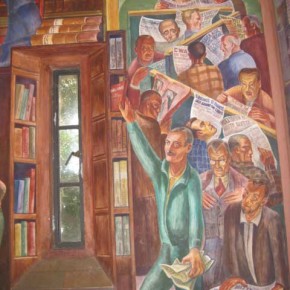
One of several controversial panels at Coit Tower. A library scene painted by Bernard Zakheim, in which patron (fellow muralist John Langley Howard) pulls a copy of Das Kapital from the shelf. Photo: Shaina Potts for the Living New Deal. Mural: Bernard Zakheim

Coming to San Francisco for the annual meeting next spring will mean inevitably traversing a landscape transformed by the New Deal. For those landing at the San Francisco or Oakland Airports, The Works Progress Administration (WPA), Public Works Administration (PWA), and State Emergency Relief Administration (SERA) all had a hand in their growth into major airports. Crossing over the majestic western span of the Bay Bridge is to rely on the New Deal as well. In 1936 when it was completed at the hands of the WPA, the bridge was the longest suspension bridge in the country. From the bridge, many visitors quickly pick out one of the city’s most visible landmarks, Coit Tower, where the entire interior is covered in New Deal frescos. With funds from the Public Works of Art Project (PWAP), the New Deal’s first public arts program, twenty-six artists spent six months in 1934 creating murals of depression era life and the state’s history. The murals were carefully restored last year and are once again on view to the public as a monument not just to California but a historical moment when the federal government invested directly in the arts, infrastructure and its poorest citizens.

Pieces of San Francisco’s history, like that of Coit Tower, are relatively well known. But the extent of the structural and aesthetic improvements made to the city are just now being recovered by a team of researchers and volunteers at the Living New Deal project. Founded and directed by Berkeley Geographers Richard Walker and Gray Brechin (a longer history of the project is available on our website), the Living New Deal works to rediscover, catalog and map the sites of New Deal art and infrastructure. To many people’s surprise, there are no complete records of New Deal programs; this in part because of their emphasis on ending the Depression as quickly as possible, and in part because of long standing efforts to obscure the New Deal’s success in doing just that. Given the enormity of its scope, over the last decade the Living New Deal has grown into a national collaboration of geographers, researchers from disciplines ranging from art history to economics, students, many amateur historians and untold numbers of volunteers submitting information on what the “alphabet soup” of programs created in their regions. In the same spirit of serving the public good that defined the original New Deal, our group works to make all of the information gathered for our database and map freely available via the web, publications and frequent presentations around the country.

The Living New Deal’s origins in the Bay Area are reflected in the density of New Deal sites already uncovered in and around San Francisco. Those first years of research revealed that no corner of the city was left untouched by WPA, PWA, CWA, CCC or one of the other agencies. As shown on the project’s map, the city is literally dotted with parks, playgrounds, schools and public buildings, street and sewer improvements, murals, sculptures, and other works of art. Neighborhoods famous for other reasons turn up New Deal touches everywhere. A walk through the Castro includes sidewalks still stamped with WPA logos. Chinatown’s St. Marys square is home to a 14-foot tall statue of Sun Yat-Sen by the renowned sculptor Beniamino Bufano, paid for by the Federal Arts Project (FAP). Golden Gate Park is chock full of New Deal improvements that endless hippies, yuppies, and tourists have made use of for nearly eight decades without ever likely considering their origins. Federal funds flowed far beyond just the major cities however, even to Republican led communities like Berkeley (yes, it was a different place in the 1930s), where civic structures like the high school and post office are adorned with art extolling the public value of knowledge and beauty. Just slightly further afield are trails and open spaces made possible by the work of the Civilian Conservation Core (CCC), meant to provide even the most destitute Americans access to the therapeutic dimensions of the “great outdoors.” Of course many of those spaces are still readily accessible to us today. The list of New Deal sites that we take advantage of in the 21st century goes on and on, and grows with every passing week of new discoveries.

While the Living New Deal works to reveal and promote the legacy of work in the name of the public good, the archive and map make apparent that this legacy is in no way free of the problematic politics and mainstream thought of the time from which it emerged. From environmental destruction (note how much “reclaimed” land the airport occupies), to the racist representations and exclusions of indigenous peoples in art celebrating California’s colonial history, to the complicated first “progressive” efforts at public housing (coupled with policies that underwrote the mass suburbanization of whites), the Bay Area contains it all.

In juxtaposition to the relics we find abhorrent in the present, the city also contains projects so radical that they have been raising the ire of civic leaders and the “business community,” for decades; probably none more so than the murals at the Rincon Annex. Created by Russian born artist Anton Refregier, who “wanted to paint the past, not as a romantic backdrop, but as part of the living present, a present shaped by the trauma of depression, strikes, and impending war” (Brechin, 2013), the murals adorn the interior of a beautiful post-office building. The works themselves, however, depict a much more violent history underlying San Francisco’s history, beginning with Sir Francis Drake holding a bloodied sword (his hand infamously reappears emerging from a Nazi flag in a later panel, connecting the original conquest to the rise of Fascism), the murals continue on to show a much “truer” depiction of the Mission system, the beating of Chinese during anti-immigrant riots, the murder of striking workers, and the general hardship that befell many of San Francisco’s pre-war inhabitants. Despite many efforts to stop the murals from being produced in the first place and censorship, they are still on display at the building and open to the public—just a few blocks from the Ferry Building.

For those who will be at the conference, several current and former team members from the project will be on hand and always excited to discuss the New Deal. For those who would like to explore New Deal sites on their own, this is San Francisco, so there is of course “an app for that.” Local public media network KQED worked with the Living New Deal and California Historical Society to create an iPhone and Android app called “Let’s Get Lost,” which features interactive tours of both Coit Tower and Rincon Annex Murals. Or, for the adventurous geographers looking to get out and explore, an actual print map of a self-guided tour of New Deal sites in San Francisco is available.

Geographers who won’t be attending the meeting are still able to explore the legacies of the New Deal in their own regions via the project’s website and interactive map. The Living New Deal has just begun to scratch the surface of what was created by the alphabet soup of federal projects, and strongly encourages interested persons with knowledge of unlisted or incomplete entries for their area to be in touch! Whether in the Bay, another town, or the vast rural and wilderness spaces of the US, the Living New Deal hopes our project will encourage our fellow geographers to look for clues to how the New Deal continues to shape not just the history of the country but the places we inhabit every day.

    Share

Elizabeth J. Leppman

Elizabeth Leppman, a respected geographer with broad interests across cultural and historical geography, latterly at Walden University, passed away on September 21, 2015, at the age of 71, after a struggle with cancer.

Elizabeth Jane Leppman was born on December 6, 1943, in Chicago, although she lived in Moorestown, NJ, during most of her childhood. Her father was a German immigrant and she remembered a steady stream of international visitors to their home, sparking an early interest in geography.

After receiving a B.A. from Middlebury College she started her career as a cartographer with Rand McNally. She later received a master’s degree from York University in Toronto and a doctorate from the University of Georgia.

Her PhD thesis, completed in 1997, was entitled “Choices in the Rice Bowl: Geography of Diet in Liaoning Province, China.” Her study examined the difference in nutritional levels and quality of food between city and countryside dwellers. Despite increasing migration to the cities, a reduction in the rural-urban divide, and the modernization of peasant lifestyles, she observed a clear distinction in food behavior between the city and countryside. The work was later published as a book Changing Rice Bowl: Economic Development and Diet in China (2005).

Leppman’s interest in the geography of food and diet continued, along with interests in cultural geography and the geography of religion, the latter spanning religious and sacred landscapes, especially in Appalachia and Central Minnesota, and missions, especially in China and Appalachia, and their worldview. She wrote various scholarly articles and book chapters in each of these fields.

Over the years, Leppman had teaching appointments at Millersville University in Pennsylvania, Miami University of Ohio, St. Cloud State University in Minnesota, the University of Kentucky and Eastern Kentucky University. Most recently she was on the faculty at Walden University where she taught geography and other social science courses.

She was committed to geography education and had a key role in the writing and editing of a number of textbooks, atlases and handbooks for teachers. These included: Teaching Map and Globe Skills, K-6: A Handbook (1982), Working with Historical Maps: Integrating Geography and History Skills (1997), the Student Atlas of World Politics, 6th edition (2004) co-authored with John Allen, Australia and the Pacific (2005), and Exploring Geography Through Primary Sources (2011).

Leppman served terms as editor of the Journal of Geography, published by the National Council for Geographic Education, and also as editor of Geography of Religions and Belief Systems, the online journal of the AAG’s specialty group.

She was a member of the AAG since 1975. Her involvement in a diverse range of specialty groups – including China, Cultural Geography, Geography of Religions and Belief Systems, Health and Medical Geography, Historical Geography, Political Geography, and Study of the American South – reflected her varied interests within geography.

Her geographic passions spilled over into the rest of her life. She enjoyed travel, photography, Chinese art and culture, local and state history, and many other interests. She was also a devoted parishioner in Episcopal churches in the many communities where she lived, latterly in Lexington, KY, where she was involved with Good Shepherd Episcopal Church and was a committed volunteer at Mission Lexington, among other community activities.

Leppman accomplished much and liked to keep busy. Her family said: “Elizabeth’s life was always dominated by her present list of projects and by future even more ambitious ones…”

She is survived by her brother John, daughter Karen, son Bradford, grandchildren Tyler and Kelsey, and cat Peaches.

    Share

Piash Debnath Interns at AAG for Fall Semester

Piash Debnath is a senior at George Mason University double majoring in geography and environmental and sustainabilities studies. He’s currently the geography department’s first and only learning assistant (LA). As an LA, he co-teaches an undergraduate geography class giving students exposure to and better understanding of the discipline allowing them to possibly pursue a minor or major. After graduating, he plans to pursue a masters in geographic and cartographic sciences and a graduate certificate in environmental GIS and biodiversity conservation. He hopes to work for a non-profit that utilizes GIS technology in environmental issues. Currently, he’s a member of Gamma Theta Upsilon and the president of the Bengali Patriots Association. Born and raised in Bangladesh, he wants to be able to use his skills to create maps to help protect the environment.

In his spare time he enjoys playing tennis, volunteering at Novant Prince William hospital and exploring the wilderness.

    Share

Kelsey Taylor Joins AAG Staff as Research Assistant

The AAG  is pleased to announce that Kelsey Taylor has joined the association staff as a Research Assistant at its headquarters in Washington, D.C. Kelsey has served as an intern at the association for the previous three semesters while completing her undergraduate degree and has worked on a number of grant projects during her time at the AAG. In her new role, she will contribute to AAG research projects and preparation for the 2016 Annual Meeting in San Francisco.

Kelsey holds a bachelor’s degree in environmental studies and philosophy from The George Washington University and is currently in her first year of GWU’s geography master’s program. While her background is primarily focused in physical geography, her current research interests include urban sustainability, urban planning, political geography, and mapmaking. In addition to her work at the AAG, Kelsey serves as a graduate teaching assistant for a writing-intensive undergraduate course in urban sustainability and an introductory course in human geography.

Outside of her academic interests, Kelsey enjoys indoor and outdoor rock climbing, hiking and continuing to explore everything Washington, D.C. has to offer.

    Share

Newsletter – September 2015

PRESIDENT’S COLUMN

Do The Right Thing

SWB_december-5
Bednarz

By Sarah Witham Bednarz

It is that time of the year again. I hear the scurry of my colleagues sorting through old folders, re-organizing class notes. The copy machine is chugging along, spewing syllabi. The line outside the IT staff office is long with instructors seeking assistance in posting to their websites or the campus learning management system. The odd student is lurking, interested in changing his or her schedule or seeking advice on courses to take. Anticipation is in the air. A fresh start. The angst of the first class.

Alas, for too many of my fellow geographers the start of the teaching season is greeted with groans. It means less time for research. Earlier this year I read a particularly bitter yet entertaining commentary in the Chronicle of Higher Education by Jacques Berlinerblau entitled Teach or Perish. In his broad ranging rant about higher education, Berlinerblau makes a few points that resonate with me. Continue Reading.

Recent columns from the President

IN MEMORIAM

AAG Atlas Awardee Julian Bond

Bond
Bond

Julian Bond, renowned civil rights activist and recipient of the AAG’s prestigious Atlas Award, passed away on August 15, 2015, aged 75.

In 2014, Bond was awarded the Association of American Geographers’ prestigious Atlas Award, designed to recognize and celebrate outstanding accomplishments that advance world understanding in exceptional ways, whether in science, politics, scholarship, the arts, or in war and peace. At the Annual Meeting in Tampa, he delivered a presentation on “Race Around the World,” focusing on how civil rights figures and organizations shaped and changed American foreign policy, before being presented with his award by AAG President, Julie Winkler.

Julian Bond played a central role in America’s civil rights movement, spanning student protest and activist politics to institutional leadership and academia. Although his fight for social justice was focused on race, he also campaigned for peace, gay rights and the environment, among other issues. He was a charismatic figure with a reputation for charm alongside his persistent opponent of the stubborn remnants of white supremacy. In the few days before his death, after he was suddenly taken ill, his wife reported that he remained ever the optimist, finding reasons to laugh.

Learn More.

ANNUAL MEETING

Call for Participation: Geography Careers Events at AAG 2016

We seek a diverse group of individuals representing a range of employment sectors, organizations, academic and professional backgrounds, and racial/ethnic/gender perspectives to participate in a range of geography careers events at AAG 2016. We are seeking members to be career mentors as well as to lead and facilitate workshops, panel, and paper sessions. If interested, please send an email to careers [at] aag [dot] org, specifying your topic(s) and activity(s) of interest, and attach your current c.v. or resume. For best consideration, submit your information by November 18, 2015.

Learn More.

Organize, Lead a Field Trip in San Francisco

The AAG is currently seeking ideas and proposals for field trips in San Francisco and the Bay Area for the upcoming AAG Annual Meeting. Proposals should be submitted by December 18, 2015.

Submit a field trip form or contact Cendy Chou at 703-964-1240 x 12 or cchou [at] conferencemanagers [dot] com for assistance or more information. Learn More.

FOCUS ON SAN FRANCISCO

image1-300x180-1
Powell Street Parklet (SF Pavement to Parks Program, San Francisco Planning Department)

Geographies of Sustainability in the San Francisco Bay Area

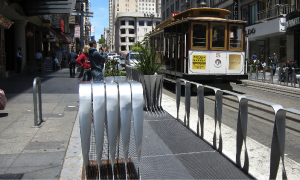
When geographers descend on San Francisco next year for the annual American Association for Geography meeting, most will undoubtedly stroll past one of the Powell Street parklets, located near the downtown conference hotels. Designed by landscape architect Walter Hood, with funding from Audi, the parklets are celebrated by Dwell magazine for beautifying one of the city’s most trod upon blocks with “torqued aluminum railing, drought-tolerant plants, and enough space for pedestrian-choked Powell Street to breathe” (Britt 2011). One of Dwell’s favorite aspects of the parks’ design is how they narrow the cable-car lined Powell Street to two lanes, effectively prohibiting automobile traffic. The Powell Street parklets are hardly an unusual sight in bike-friendly San Francisco – the city’s Pavement to Parks program has supported sixty similar sidewalk spaces (See San Francisco’s Pavement to Parks Program for a map of the city’s parklets). While most parklets don’t take over car lanes, they do occupy parking spaces, and most include bike racks – encouraging this “greener” mode of travel. As popular, year-round destinations, many parklets are sponsored by neighborhood businesses, as they facilitate other kinds of green circulation and consumption. Learn More.

[Focus on San Francisco is an on-going series curated by the Local Arrangements Committee to provide insight on and understanding of the geographies of San Francisco and the Bay Area]

NEWS

Upcoming AAG Award Applications and Nominations Due in September

Deadlines are fast approaching for a number of AAG awards. To nominate someone or apply on your own behalf, please follow the links highlighted in each award listed for instructions or additional information.

AAG Enhancing Diversity Award honors those geographers who have pioneered efforts toward or actively participated in efforts toward encouraging a more diverse discipline over the course of several years. Deadline for nominations is September 15, 2015.

The AAG Excellence in Mentoring Award is given annually to an individual geographer, group, or department who has demonstrated extraordinary leadership in building supportive academic and professional environments in their departments, associations, and institutions and guiding the academic and or professional growth of their students and junior colleagues. Deadline for nominations is September 15, 2015.

The AAG Honorary Geographer award recognizes excellence in research, teaching, or writing on geographic topics by non-geographers. Deadline for nominations is September 15, 2015.

The AAG Stanley Brunn Award for Creativity in Geography is given annually to an individual geographer or team that has demonstrated originality, creativity, and significant intellectual breakthroughs in geography. Deadline for nominations is September 20, 2015.

The J. Warren Nystrom Award supports an annual prize for a paper based upon a recent dissertation in geography. Deadline for applications is September 22, 2015.

MORE NEWS

POLICY UPDATES

Denali-MtMcKinley-300x199-1
Photo courtesy U.S. National Park Service.

Old Name Officially Returns to Nation’s Highest Peak

The story of America is told by the names on the land. When you hear names like Kentucky and Kennesaw, Klamath and Kodiak, your mind immediately starts to turn over all manner of associated thoughts of what you may have experienced or learned or even what you may imagine about that place. Geographic names often serve as a mental index and guide to help organize our knowledge of American geography and history.

Most of the time the names of places seem quite mundane because they are so basic in our everyday lives. They are invisible, unremarkable elements of the way we think and communicate. Yet, to borrow a phrase from Sir Francis Bacon*, names carry “much impression and enchantment.” When people disagree about the right name of a place, then the importance of geographic names becomes clearly evident. Read More.

SPECIAL TO AAG

New Orleans 10 Years Later

A special package courtesy The Nation magazine on movement building and the resilience of New Orleans on the 10th anniversary of Hurricane Katrina.

EVENTS CALENDER

Submit News to the AAG Newsletter. To share your news, submit announcements to newsletter [at] aag [dot] org.

    Share