
AAG Seeks Observers To Attend United Nations Climate Change Conference

The American Association of Geographers has been granted Observer Organization status to the United Nations Framework Convention on Climate Change (UNFCCC). With this formal designation, the AAG is permitted to submit to the UNFCCC Secretariat its nominations for representatives to attend the United Nations Climate Change Conference that will take place from November 7-18, 2016 in Marrakesh, Morocco (COP-22/CMP12).

Prior to midnight Monday, July 25, 2016 persons interested in being nominated to attend by the AAG must be a current member of the AAG and provide the following information (in this exact format, please) via email to cmannozzi [at] aag [dot] org along with a copy of these instructions:

Note: All information must be as it appears in the official photo identification which the participant will present at the registration desk.

·      Salutation (Mr. Ms. Dr. etc.):

·      Given / First name:

·      Family name:

·      Functional title:

·      Department:

·      Organization:

·      Date of birth (DD/MM/YYYY):

·      Country which issued Passport:

·      Identification document number (Passport number):

·      E-mail address:

·      Telephone where you can be reached for questions about your application:

·      Dates within the range of November 7 – 18  for which you will be actually attending the COP sessions

·      A very brief paragraph describing your interest and purpose for attending the COP sessions

·      A statement agreeing with the terms of these instructions for nomination

Identification number, date of birth and name are for identification verification only and will not be made available to anyone outside of the AAG or the UNFCCC. Date of birth will also be used to signal nomination of minors.

AAG nominees will be provided with a copy of nomination documentation for eventual presentation at the Conference registration desk in Marrakesh, Morocco. The UN will provide a quota to the AAG which may restrict the number of participants or the dates for which nominees may be approved for attendance. This quota will be provided to the AAG after July 25, 2016.

All nominees must have their own source of financial support to attend and make all necessary travel, insurance, visa, and logistical arrangements for themselves; the AAG is not providing any funds or other support for travel or participation. Nominees also must release the AAG from any and all financial or legal liability during their period of participation and refrain from making proclamations, claims, announcements, or other statements as being the official position of the association or its membership. Attendees must also adhere to the codes of conduct and follow the guidelines for participation as outlined by the United Nations  (see https://unfccc.int/files/parties_and_observers/ngo/application/pdf/coc_guide.pdf).

Upon return, attendees will submit a brief trip report to the AAG Executive Director, Doug Richardson, drichardson [at] aag [dot] org

We will share more information on schedules, logistics, and accommodation for COP-22 as soon as it is made available to us.
    Share

Maggie Busek Interns at AAG for Summer Semester

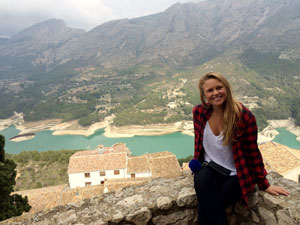
AAG intern Maggie Busek studied abroad in Spain for a semester in 2015. In this photo, she she’s pictured in Guadalest.

Maggie Busek is a junior at George Washington University pursuing a major in international affairs concentrating in contemporary cultures and societies, as well as minors in Spanish and cross-cultural communication. Maggie’s interests include anthropology, world health issues, and international politics. After graduation, Maggie intends to work towards a master’s degree in public health or international development and hopes to eventually work abroad. In her spare time, Maggie enjoys exploring DC, traveling, and kayaking.

    Share

Greg Elmes, Retired WVU geography Professor Receives Lifetime Achievement Award

Greg Elmes, professor emeritus in the Department of Geology and Geography at West Virginia University was recently honored with a Lifetime Achievement award by the West Virginia Association of Geospatial Professionals for his dedication to the study and promotion of geographic information systems (GIS).

Though Elmes retired from teaching courses at West Virginia University in 2015, he remains active in research in the geography department and with the West Virginia GIS Technical Center, housed in the department.

He has more than 30 years of experience in geographic information systems and the application of GIS techniques to societal issues such as public health, industrial geography, forensics, crime mapping, and public safety.

“It is a recognition of the time devoted to both GIS and promoting GIS as an economic development and environmental tool for the state of West Virginia,” said Trevor Harris, Eberly Distinguished Professor of Geography. “Greg has devoted his life to this university, this department, this tech center, and to the state.”

Most recently Elmes co-edited the 2014 book, “Forensic GIS: The Role of Geospatial Technologies for Investigating Crime and Providing Evidence,” a book of case studies written for researchers, practitioners and students.

The book discusses a wide range of technologies and applications for geographic, or location-based, information systems in forensic science, and serves as a review of geospatial technology—the collecting, storing, processing and examining of geographic information—as it applies to criminal justice.

Elmes earned a bachelor’s degree in geography from the University of Newcastle, United Kingdom, in 1972, a master’s degree. in geography from Pennsylvania State University in 1974, a Ph.D. in geography from Pennsylvania State University in 1979, and a master of science degree in Geographical Information Systems from the University of Edinburgh, United Kingdom. He joined the WVU faculty in 1979.

    Share

New Books: May 2016

Every month the AAG compiles a list of newly-published books in geography and related areas. Some are selected for review in the AAG Review of Books.

Publishers are welcome to send new volumes to the Editor-in-Chief (Kent Mathewson, Editor-in-Chief, AAG Review of Books, Department of Geography and Anthropology, Louisiana State University, Baton Rouge, LA 70803).

Anyone interested in reviewing these or other titles should also contact the Editor-in-Chief.

May 2016

Beyond the City: Resource Extraction Urbanism in South America by Felipe Correa (University of Texas Press 2016)

British Urban Trees: A Social and Cultural History, c. 1800–1914 by Paul A. Elliott (White Horse Press 2016)

City Design: Modernist, Traditional, Green and Systems Perspectives by Jonathan Barnett (Routledge 2016)

Climate Change and the Future of Cities: Mitigation, Adaptation, and Social Change on an Urban Planet by Eric Klinenberg (ed.) (Duke University Press 2016)

Defying Dystopia by Ed Ayres (Transaction 2016)

Disrupted Landscapes: State, Peasants and the Politics of Land in Postsocialist Romania by Stefan Doronel (Berghahn Books 2016)

Dwelling in Conflict: Negev Landscapes and the Boundaries of Belonging by Emily McKee (Stanford University Press 2016)

Ecuadorians in Madrid: Migrants’ Place in Urban History by Araceli Masterson-Algar (Palgrave Macmillan 2016)

El Mall: The Spatial and Class Politics of Shopping Malls in Latin America by Arlene Davila (University of California Press 2016)

Geographies, Mobilities, and Rhythms Over the Life Course: Adventures in the Interval by Elaine Stratford (Routledge 2015)

The Geographies of Social Movements: Afro-Colombian Mobilization and the Aquatic Space by Ulrich Oslender (Duke University Press 2016)

Hitler’s Geographies: The Spatiality’s of the Third Reich by Paolo Giaccaria and Claudio Minca (eds.) (University of Chicago Press 2016)

The Jefferson Highway: Blazing the Way from Winnipeg to New Orleans by Lyell D. Henry Jr. (University of Iowa Press 2016)

Latin America and the Caribbean in the Global Context: Why Care About the Americas? by Betty Horwitz and Bruce M. Bagley (Routledge 2016)

Living Memory: The Social Aesthetics of Language in a Northern Italian Town by Jillian R. Cavanaugh (Wiley-Blackwell 2012)

Manifestly Haraway by Donna J. Haraway (University of Minnesota Press 2016)

A Nice Place to Visit: Tourism and Urban Revitalization in the Postwar Rustbelt by Aaron Cowan (Temple University Press 2016)

The Pandemic Perhaps: Dramatic Events in a Public Culture of Danger by Carlo Caduff (University of California Press 2015)

People and Places: A 21st Century Atlas of the UK by Danny Dorling and Bethan Thomas (Policy Press 2016)

The Political Biography of an Earthquake: Aftermath and Amnesia in Gujarat, India by Edward Simpson (Hurst Publishers 2014)

The Routledge History of American Foodways by Michael D. Wise and Jennifer Jensen Wallach (Routledge 2016)

Shantytown, USA: Forgotten Landscapes of the Working Poor by Lisa Goff (Harvard University Press 2016)

Shaping a World Already Made: Landscape and Poetry of the Canadian Prairies by Carl J. Tracie (University of Regina Press 2016)

South Pole: Nature and Culture by Elizabeth Leane (Reaktion Books 2016)

Touring the West with Leaping Lena 1925 by W.C. Clark, David Dary (ed.) (University of Oklahoma Press 2016)

What the Rest Think of the West: Since 600 AD by Laura Nader (University of California Press 2015)

    Share

Karl W. Butzer

Karl W. Butzer, a geographer, cultural ecologist and environmental archaeologist, who was a world-class scholar and particularly known for his fieldwork in countries across the world, passed away on May 4, 2016, at the age of 81.

Funeral information:

  • Visitation – Thursday, May 12th, 6-7pm, at Weed-Corley-Fish Funeral Services, 2620 S Congress Ave, Austin, TX 78704
  • Rosary – Thursday, May 12th, 7pm, at Weed-Corley-Fish Funeral Services, 2620 S Congress Ave, Austin, TX 78704
  • Funeral mass – Friday, May 13, 11am, at St. John Neumann Catholic Church, 5455 Bee Cave Rd, West Lake Hills, TX 78746

A full obituary will follow soon.

    Share

New Books: April 2016

Every month the AAG compiles a list of newly-published books in geography and related areas. Some are selected for review in the AAG Review of Books.

Publishers are welcome to send new volumes to the Editor-in-Chief (Kent Mathewson, Editor-in-Chief, AAG Review of Books, Department of Geography and Anthropology, Louisiana State University, Baton Rouge, LA 70803).

Anyone interested in reviewing these or other titles should also contact the Editor-in-Chief.

May 2016

Beyond the City: Resource Extraction Urbanism in South America by Felipe Correa (University of Texas Press 2016)

British Urban Trees: A Social and Cultural History, c. 1800–1914 by Paul A. Elliott (White Horse Press 2016)

City Design: Modernist, Traditional, Green and Systems Perspectives by Jonathan Barnett (Routledge 2016)

Climate Change and the Future of Cities: Mitigation, Adaptation, and Social Change on an Urban Planet by Eric Klinenberg (ed.) (Duke University Press 2016)

Defying Dystopia by Ed Ayres (Transaction 2016)

Disrupted Landscapes: State, Peasants and the Politics of Land in Postsocialist Romania by Stefan Doronel (Berghahn Books 2016)

Dwelling in Conflict: Negev Landscapes and the Boundaries of Belonging by Emily McKee (Stanford University Press 2016)

Ecuadorians in Madrid: Migrants’ Place in Urban History by Araceli Masterson-Algar (Palgrave Macmillan 2016)

El Mall: The Spatial and Class Politics of Shopping Malls in Latin America by Arlene Davila (University of California Press 2016)

Geographies, Mobilities, and Rhythms Over the Life Course: Adventures in the Interval by Elaine Stratford (Routledge 2015)

The Geographies of Social Movements: Afro-Colombian Mobilization and the Aquatic Space by Ulrich Oslender (Duke University Press 2016)

Hitler’s Geographies: The Spatiality’s of the Third Reich by Paolo Giaccaria and Claudio Minca (eds.) (University of Chicago Press 2016)

The Jefferson Highway: Blazing the Way from Winnipeg to New Orleans by Lyell D. Henry Jr. (University of Iowa Press 2016)

Latin America and the Caribbean in the Global Context: Why Care About the Americas? by Betty Horwitz and Bruce M. Bagley (Routledge 2016)

Living Memory: The Social Aesthetics of Language in a Northern Italian Town by Jillian R. Cavanaugh (Wiley-Blackwell 2012)

Manifestly Haraway by Donna J. Haraway (University of Minnesota Press 2016)

A Nice Place to Visit: Tourism and Urban Revitalization in the Postwar Rustbelt by Aaron Cowan (Temple University Press 2016)

The Pandemic Perhaps: Dramatic Events in a Public Culture of Danger by Carlo Caduff (University of California Press 2015)

People and Places: A 21st Century Atlas of the UK by Danny Dorling and Bethan Thomas (Policy Press 2016)

The Political Biography of an Earthquake: Aftermath and Amnesia in Gujarat, India by Edward Simpson (Hurst Publishers 2014)

The Routledge History of American Foodways by Michael D. Wise and Jennifer Jensen Wallach (Routledge 2016)

Shantytown, USA: Forgotten Landscapes of the Working Poor by Lisa Goff (Harvard University Press 2016)

Shaping a World Already Made: Landscape and Poetry of the Canadian Prairies by Carl J. Tracie (University of Regina Press 2016)

South Pole: Nature and Culture by Elizabeth Leane (Reaktion Books 2016)

Touring the West with Leaping Lena 1925 by W.C. Clark, David Dary (ed.) (University of Oklahoma Press 2016)

What the Rest Think of the West: Since 600 AD by Laura Nader (University of California Press 2015)

    Share

2016 Annual Specialty and Affinity Group Awards

The AAG has around 65 Specialty and Affinity Groups which bring together AAG members around interests in particular topics, regions or professional communities.

Many of these groups bestow awards for outstanding achievement and service, prizes for papers and posters, and give grants for research and travel to students, faculty and professionals in their respective fields.

Some of these awards were presented at the AAG’s annual Awards Luncheon held in San Francisco on April 2, 2016 and these are listed below. The full list of all 2016 Specialty and Affinity Group Awards will be published on the AAG website in due course.

Special distinctions

Some of the Specialty Groups select established members of their community for their highest recognition.

  • The late Susan Hardwick, who passed away in 2015, was posthumously recognized by the Ethnic Geography Specialty Group for her career accomplishments in ethnic geography scholarship, teaching, and service.
  • Michael Kuby from Arizona State University received the Ullman Award from the Transportation Geography Specialty Group for his outstanding contributions and service to the field of transportation geography.
  • Mei-Po Kwan from the University of Illinois at Urbana-Champaign received the Melinda S. Meade Distinguished Scholarship Award in Health and Medical Geography from the Health and Medical Geography Specialty Group for her outstanding record of research and teaching on health and medical geography, leadership in this area, and service to this community.
  • Dick Marston from Kansas State University received  the Melvin G. Marcus Distinguished Career Award from the Geomorphology Specialty Group.
  • William Moseley from Macalester College received the Kwadwo Konadu-Agyemang Distinguished Scholar on Africa Award
  • John Weeks from San Diego State University received a Lifetime Achievement Award from the Population Specialty Group for his outstanding contributions to the field of population geography through research, teaching, professional services, and mentoring.
  • Julie Winkler from Michigan State University received a Lifetime Achievement Award from the Climate Specialty Group in recognition of her career of excellent research, teaching, and mentoring in climatology, and for outstanding service to the AAG and climate specialty group.
  • Bill Wyckoff from Montana State University was honored as a Distinguished Historical Geographer by the Historical Geography Specialty Group for his research and writing which exemplifies the best in historical geography scholarship.
  • Xinyue Ye from Kent State University was given a Distinguished Service Award from the Regional Development and Planning Specialty Group for his service to the group.

Awards for publications

  • The Geomorphology Specialty Group gave the Grove Karl Gilbert Award for excellence in geomorphological research to Edgardo Latrubesse from the University of Texas at Austin for his paper published in Earth Science Reviews entitled “Large Rivers, Megafans and other Quaternary Avulsive Fluvial Systems: A potential “Who’s Who” in the Geological Record.”
  • The Political Geography Specialty Group gave the Virginia Mamadouh Outstanding Research Award for a journal article or book chapter that makes an innovative, original contribution to the conceptual and/or methodological embrace of political geography to Ian Shaw for his paper published in Area entitled “Force-Full Power, Politics, and Object Oriented Philosophy.” 

Thesis and Dissertation Awards

The Transportation Geography Specialty Group gave two awards to students who completed postgraduate degrees in the last year.

  • Ying Song from the University of Minnesota won the Outstanding Dissertation Award for her doctoral dissertation entitled “Green Accessibility: Measuring the environmental costs of space-time prisms in sustainable transportation planning.”
  • Lea Ravensbergen-Hodgins from the University of Toronto won the Outstanding Master’s Thesis Award for her thesis entitled “Socioeconomic Discrepancies in Children’s Accessibility to Health Promoting Resources: An Activity Space Analysis.”

Student Paper Awards

Many of the Specialty Groups have competitions for student papers or posters given at the AAG Annual Meeting or other events.  The following were awarded with prizes in 2016:

China Geography Specialty Group
  • Yicong Yang, Cornell University “Understanding informal spaces in a Chinese megacity”
Cultural and Political Ecology Specialty Group
  • Lily House-Peters, University of Arizona “Social-Ecological Transformations and Riparian Enclosure: The Production of Spaces of Exclusion and the Uneven Development of Resilience in the Sonoran Borderlands”
Economic Geography Specialty Group
  • Aarti Krishnan, University of Manchester “Expansion of regional value chains: The case of Kenyan horticulture”
Ethnic Geography Specialty Group
  • Scott Markley, University of Tennessee “Examining the Geographies of Infill New Urbanism in Atlanta Suburbs”
European Specialty Group
  • Katherine Newman, University of Victoria “The Gothic Geopolitics of Bram Stoker’s Dracula: Vampires of the Orient in the Jus Publicum Europaeum”
Geographic Information Science and Systems Specialty Group
  • Yoo Min Park, University of Illinois at Urbana-Champaign, 1st Place, Honors Student Paper Competition, “Assessment of Personal Exposure to Air Pollution and Its Effects on Health”
  • Neil Debbage, University of Georgia, 2nd Place, Honors Student Paper Competition, “Sensitivity of Spatial Metrics to Land Use Classification Scheme When Assessing Urban Sprawl Among Large U.S. Metropolitan Areas”
  • Jessica Dozier, San Diego State University, Finalist – Honors Student Paper Competition, “Improve Disaster Communication in Online and Offline Communities Using Social Media (Twitter) and Big Data”
  • Song Gao, UC Santa Barbara, Finalist – Honors Student Paper Competition, “Employing Spatial Analysis in Indoor Positioning and Tracking Using Wi-Fi Access Points”
  • Dapeng Li, University of Utah, Finalist – Honors Student Paper Competition, “Setting Wildfire Evacuation Triggers by Coupling Fire and Traffic Simulation Models: A Spatiotemporal GIS Approach”
Political Geography Specialty Group
  • Amber J. Boll-Bosse (MA Student Paper Award) “Participatory Action Mapping: A pathway for (re)thinking, (re)engaging, and (re)making maps in political geography”
  • Casey Ryan Lynch (PhD Student Paper Award) “Performative Power and Colonizing Assemblages in Post-Coup Honduras”
Population Specialty Group
  • Nathan Trombley, University of Tennessee “Remittance Behavior of US Immigrants”
Qualitative Research Specialty Group
  • Amber Bell-Bosse, University of Kentucky “We are living in a nightmare, and it is so clear to me now”: A Qualitative examination of participatory action mapping”
Regional Development and Planning Specialty Group
  • Yingyu Feng, University of Bristol “The Rise of Inequality? A Spatiotemporal Analysis of Housing Price Disparities in England and Wales During 2001-2015”
Remote Sensing, GIS and Cartography Specialty Groups
  • Laurel Ballanti, San Francisco State University (1st place) “Tree Species Classification Using Hyperspectral Imagery in Muir Woods National Monument and Kent Creek Canyon, California”
  • Fang Fang, West Virginia University (2nd place) “Discriminating tree species using crown-scale measurements: fusing leaf-on Lidar and high-resolution multi-spectral satellite date”
Remote Sensing Specialty Group
  • Wenjie Ji, State University of New York at Buffalo (1st place)
  • Tengyun Hu, Tsinghua University, China (3rd place)
Spatial Analysis and Modeling Specialty Group
  • Debra Blackmore, Portland State University
  • Su Han, San Diego State University
Sexuality and Space Specialty Group
  • Paul Kelaita, University of Sydney, Australia “Queer Infrastructure and Gay Elsewheres”

Awards for research and field study

Jonathan McCombs from the University of Georgia received the Student Field Study Award from the Cultural and Political Ecology Specialty Group for his field research proposal entitled “White Washing Green Spaces: Race and Nature in the Gentrification of Budapest’s Eighth District.”

  • Xiaoyu “Larry” Lu from University of Tennessee received the M. Gordon “Reds” Wolman Doctoral Student Research Award from the Geomorphology Specialty Group for an outstanding research proposal entitled “Connecting Spatio-temporal Domains of Water Erosion Regimes: A Geomorphic Perspective.
  • Kelly Jean Anderson from University of Maryland received the Student Research Award from the Human Dimensions of Global Change Specialty Group for field research entitled “Contextualizing Drivers and Outcomes of Rural to Urban Migration in Sub-Saharan Africa: The Case of Mozambique.”

Other Awards

The Graduate Student Affinity Group gave Professional Development Awards this year to Ningning Chen from National University of Singapore and Mia Renauld from Northeastern University.

The Transportation Geography Specialty Group supported travel to the AAG Annual Meeting to Geoffrey Battista from McGill University and Koos Fransen from Ghent University.

For further information about the annual, periodic and special awards given by Specialty and Affinity Groups, visit their respective webpages. A directory of groups can be found here: https://www.aag.org/cs/about_aag/specialty_groups_2 

    Share

Three Prominent Geographers Honored with Guggenheim Awards

Mei-Po Kwan, Katharyne Mitchell and Laura Pulido have been named 2016 fellows by the John Simon Guggenheim Memorial Foundation.

Mei-Po Kwan, a professor of geography and geographic information science at the University of Illinois at Urbana-Champaign, was selected for her ground-breaking contributions to the discipline of geography in fields spanning environmental health, sustainable cities, human mobility, socio-economic issues in cities, and GIScience. As noted in a recent award citation: “One of the defining characteristics of her research is that it transcends and eschews boundaries” both within geography and beyond.

Kwan plans to use the Guggenheim fellowship to deepen understanding of the uncertain geographic context problem (UGCoP) and to conceive possible methods for mitigating the problem in social science and health research. Read more information about Kwan’s Guggenheim fellowship.

Katharyne Mitchell, a professor of geography at the University of Washington, was selected for her research on xenophobia, citizenship, and the meaning and practices of belonging.

In her time as a Guggenheim Fellow Mitchell will look at the nature of sanctuary and the role of faith-based movements in migration policy and human rights discourse in Europe. Read more information about Mitchell’s Guggenheim fellowship.


Laura Pulido, a professor of American studies and ethnicity at the University of Southern California: Sangre en la Tierra: Towards a Methodology for Engaging with Foundational Racial Violence.

As a Guggenheim Fellow, Pulido will work on a project called, Sangre en la Tierra (Blood in the Soil), which attempts to develop a methodology for encouraging cities to grapple with their histories of foundational racial violence. Read more information about Pulido’s Guggenheim fellowship.

Kwan, Mitchell and Pulido were among 178 scholars, artists, and scientists selected to receive a 2016 Guggenheim fellowship. Guggenheim Fellows are chosen from more than 3,000 highly accomplished applicants “on the basis of prior achievement and exceptional promise.” Guggenheim Fellows “represent the best of the best.”

    Share

Guido Weigend

Guido Weigend, who had a long career as a professional geographer, college dean and professor, and spy, passed away on April 1, 2016, at the age of 96.

Guido Gustav Weigend was born on January 2, 1920, in the small Austrian town of Zeltweg but grew up in Vienna and attended school there. In 1938, at the age of 18, he watched as the German army marched into Austria and annexed his country. Soon afterward, he found himself drafted into the German army. Naturally alarmed by this prospect, his father – then living in Chicago – encouraged him to travel to America.

Like most European refugees of the period, his route was circuitous. He first went to Sofia, Bulgaria where his mother co-owned a coffee shop. There he spoke to someone in the American consulate who successfully helped manage the difficult feat of getting him an exit visa. He left Europe by passing through Italy and North Africa, eventually making his way to the United States.

Weigend was a linguist with facility in several European languages, so his transition to life in America was relatively painless. He took advantage of his good fortune, timing, and location by soon enrolling at the University of Chicago, graduating in 1942. He became a US citizen in 1943.

His talent for languages (he spoke eight) and his familiarity with European geography and cultures was put to quick use by his adopted country. Between March 1943 and December 1945 he served in the US Army in the office of the OSS (forerunner to the CIA), going on several missions behind German lines during the war. It was long suspected, although never completely confirmed by him until late in his life, that he continued with clandestine activities long after the war.

Returning to the University of Chicago after 1945, Weigend completed a master’s degree with a thesis entitled “Water Supply of Central and Southern Germany.” Soon afterward, he began doctoral work, completing his dissertation on “The Cultural Pattern of South Tyrol” in 1949. His dissertation was published by the University of Chicago as Research Paper, No. 3. He proudly considered himself a professional geographer for the rest of his life.

After his return to Chicago, he met and married Areta Kelble after a six week courtship. They had a common link – both had been in Europe during the war, she in the Red Cross. Their long marriage ended with the passing of Areta in 1993.

While working on his doctoral dissertation he taught at Beloit College, Wisconsin, but upon completion of his Ph.D. he accepted a job at Rutgers University, New Jersey, where he spent 27 years on the geography faculty, teaching students, researching and writing. He wrote scholarly articles on many topics, most of them on Europe, and on ports and shipping in general. Two of the articles were published in French, and he reviewed several French and German books in major American journals.

Weigend rose steadily through the ranks at Rutgers from Assistant Professor to Professor. He chaired the Geography Department for 16 years between 1951 and 1967, and he then served as Associate Dean from 1972 to 1976.

In 1976 he headed west to Arizona State University (ASU) where he assumed the position of Dean of Liberal Arts and Professor of Geography. His leadership skills and personal style as Dean of the largest college on campus were especially appreciated during the next eight years as the university continued its transition into a major research institution.

During his years as Dean and afterward, the Weigends frequently hosted parties at their home a few miles from ASU. These gatherings were joyous, entertaining, and stimulating affairs. Invitations were a pleasant and coveted perquisite of their friendship and generosity.

Stepping down from the Dean position in 1984, Weigend took a one-year sabbatical in southern Africa, producing additional scholarly papers, including two on Namibia. Upon his return to Arizona, he re-entered the Geography Department full time, mentoring students, doing research, and providing a living example of how to be a scholar, an administrator, and a gentleman all at the same time. He retired from ASU in 1989, and lived in Phoenix the rest of his life.

Guido and Areta Weigend are survived by the three children that they welcomed into the world: Kenneth Weigend is national sales manager at WR Lynch in the San Francisco Bay Area; Nina Wilkey-Olejarczyk is a physician in Glendale, Arizona; and Cynthia Buness is an attorney in Paradise Valley, Arizona now focused on patient advocacy work.

Written by Malcolm Comeaux, Martin J. Pasqualetti, and Cynthia Buness

    Share

2016 Harm J. de Blij Award for Excellence in Undergraduate Geography Teaching

The 2016 Harm J. de Blij Award is presented to Donald J. Zeigler of Old Dominion University for his long and distinguished career as a teacher of geography to undergraduate students. The Harm J. de Blij Award recognizes outstanding achievement in teaching undergraduate geography including the use of innovative teaching methods. This award is generously funded by John Wiley & Sons in memory of their long-standing collaboration with the late Harm de Blij on his seminal geography textbooks

Don Zeigler has taught geography to undergraduate students at Old Dominion University, Virginia Beach, Virginia, for the past 36 years. During that period, he has taught nearly 200 sections of geography courses representing more than 25 geographical topics.

Zeigler attended to the ever changing student population and course dynamics by using a variety of pedagogical methods, beginning initially with chalk and talk in 1980 and employing video streaming and virtual reality in 2016. His teaching repertoire includes standard lecture classes (serving small to very large course sections), field-based and study abroad courses, problem based learning, and web-based and televised distance learning courses. Zeigler’s commitment to excellence in teaching has led him to design and teach courses fulfilling key university missions, including writing intensive and service learning courses, each with a geographical perspective.

Zeigler began his career at Old Dominion University as a first year faculty member in a major that had not existed the prior academic year. Zeigler was instrumental in building the undergraduate program in geography to its present size today of seven faculty members and 100 geography majors. He has accompanied students on field study trips to Israel, Jordan, the Bahamas and Mexico. “Simply stated, Don Zeigler is the face of Geography at Old Dominion University,” said Dr. Jonathan Leib, current Director of the Geography Program, “His reputation as a teacher, scholar, and as a genuine person permeates the campus and its student body.”

Donald J. Zeigler is recognized for his accomplishments as a gifted teacher, for his role as a mentor for students both within and outside the classroom, and for his continued passion for teaching geography. The American Association of Geographers, John Wiley & Sons Publishers, his friends and colleagues, and his many students from the past 36 years at Old Dominion University congratulate Don as the 2016 recipient of this award for excellence in undergraduate geography teaching. The Harm J. de Blij Award consists of $2,500 in prize money and an additional $500 in travel expenses to attend the AAG Annual Meeting, where the award is annually conveyed.

    Share