AAG Theme: Uncertainty and Context in Geography and GIScience
Uncertainty and context pose fundamental challenges in geographic research and GIScience. Geospatial data are imbued with error (e.g., measurement and sampling error), and understanding of the effects of contextual influences on human behavior and experience are often obfuscated by various types of uncertainty (e.g., contextual uncertainties, algorithmic uncertainties, and uncertainty arising from different spatial scales and zonal schemes). Identifying the “true causally relevant” spatial and temporal contexts that influence people’s behavior and experience is thus also challenging, since people move around in their daily lives and over their life courses and experience the influences of many different contexts. To generate reliable geographic knowledge, these uncertainties and contextual issues will be addressed within the special theme, Uncertainty and Context in Geography and GIScience: Advances in Theory, Methods, and Practice, during the 2017 AAG Annual Meeting in Boston.
The Opening plenary of the Uncertainty and Context theme features a distinguished group of researchers and scholars experienced in addressing the issue of uncertainty. Speakers in this session include Mei-Po Kwan (University of Illinois at Urbana-Champaign) and Michael Goodchild (University of California). David Berrigan (National Cancer Institute) will serve as a Discussant and Tim Schwanen (University of Oxford) will chair this session. This plenary session is on Thursday, April 6, from 10:00 a.m. – 11:40 a.m. in the Independence West room at the Sheraton.
The Closing plenary for this special track will be held on Saturday, April 8, from 11:50 a.m. – 1:10 p.m and features Mei-Po Kwan (University of Illinois at Urbana- Champaign); Tim Schwanen (University of Oxford); Wenzhong Shi (The Hong Kong Polytechnic University); Jamie Pearce (University of Edinburgh); Daniel A. Griffith (University of Texas at Dallas). All attendees are welcome to attend.
To find many additional sessions on this featured theme, consult the AAG website for a full list.
Share
Robert E. Frenkel
Longtime Corvallis resident Robert “Bob” Frenkel, 89, died in Portland on Feb. 20, 2017.
Bob is survived by his wife, Elizabeth “Liz” (Mills) Frenkel; son Stephen Frenkel and wife Judy Walton; and daughter Ann Frenkel and husband Gwido Zlatkes.
He was preceded in death by his sister, Janice Pachner.
Bob was born in New York City in 1927 to Leo and Helen (Wolff) Frenkel. He discovered his lifelong love for the natural world in Central Park — his backyard. He attended Kenyon College in the late 1940s. At Kenyon he survived a jump from a burning dormitory but broke so many bones he was told he’d never walk again. Undaunted, Bob recovered within a year and graduated. He went on to obtain a master’s in metallurgy from UC Berkeley, where he hiked and climbed at every opportunity throughout the Sierras and Cascades.
After working as a metallurgist at Stanford Research Institute (SRI), Bob returned to UC Berkeley in 1959 to follow a career path more closely aligned with his interest in the outdoors. He received a Ph.D. in geography, specializing in ruderal vegetation along California roadsides.
While at SRI Bob met and married Liz, who became a strong partner in his passions for mountains, hiking, environmental activism, international travel, good food and wine, music (particularly chamber music and the Oregon Bach Festival) and family.
Bob and Liz moved to Corvallis in 1965 where Bob joined the geography faculty at Oregon State. His specialty areas were biogeography and plant ecology, particularly in salt marshes. After retiring in the 1990s, he continued to conduct research as an emeritus professor.
Among Bob’s more notable achievements were his seminal work on salt marsh restoration at Oregon’s Cascade Head and his fight to protect the Jackson-Frazier Wetland north of Corvallis in Benton County. The county honored Bob by dedicating the wetland’s boardwalk — which Bob planned, raised money for and even helped build — as the “Bob Frenkel Boardwalk” in 2005.
Bob had a long history of environmental activism, particularly with the Sierra Club and The Nature Conservancy. His Sierra Club involvement began with the Mills Tower Conservation Committee, and included building and maintaining ski huts in the Sierra Nevada, becoming an active member of the Pacific Northwest Chapter, and serving as the first Chair of the Mary’s Peak Group and later as Oregon Chapter Chair.
In 1982 Bob received the Oak Leaf Award from The Nature Conservancy for his outstanding service for land conservation in Oregon, and in 1997 he received the George B. Fell Award for exceptional accomplishments from the Natural Areas Association.
Bob loved to share stories and slideshows of his adventures, from climbing Mt. Orizaba in Mexico, to a six-month bicycle trip through Europe in the early 1950s, to hikes, backpacks, ski tours, and international trips with his family. Though Bob’s memory was cruelly robbed by Alzheimer’s, these memories live on.
A memorial celebration in Corvallis is being planned for late spring.
John Miller Morris, Jr., 64, passed away on February 16, 2017, in a San Antonio hospital after surgery, attended by friends who traveled thousands of miles to come to his bedside. He is survived by a daughter Erin Claire Noakes of Washington D.C. He will be missed by his longtime companion, many friends, colleagues, and neighbors.
John grew up in Amarillo in the Texas Panhandle and his early experiences in the southwest shaped his work, home, and life. He was an Eagle Scout and high school underground newspaper editor demonstrating his civic priorities from an early age. He obtained a bachelor degree (Plan II Honors Program), two master’s degrees (Community & Regional Planning and Slavic Literature and Language), and a doctoral degree (Geography and Planning) from The University of Texas at Austin where he also competed in fencing. His love of the land and his personal heritage was demonstrated through his long involvement in the family’s business, the C.B. Morris Company, one of the first family farm corporations in Texas.
As a scholar, he authored and edited multiple books on his way to his full professorship at the University of Texas at San Antonio, including El Llano Estacado which remains the definitive work on the history, geography, culture and peoples of that region. He also received multiple awards including the UT Regents Outstanding Teaching Award and the Piper Professor Award for his “dedication to the teaching profession and for outstanding academic achievement.”
John was well-respected throughout the state and was a member of many professional organizations including the Texas Institute of Letters, the Texas State Historical Association, and the West Texas Historical Association (current president). He was also a charter member of the Sensitive Men, a monthly brunch/politics/Frisbee fellowship in Austin and a vital member of the Pros & Cons, a group of scholarly colleagues who met monthly for critical dialogue and conviviality.
John was also an integral force in keeping his Austin neighborhood and the surrounding area on RM 2222 beautiful, livable places. He worked tirelessly to improve and expand Long Canyon’s unique hiking trail system. He served on the homeowner’s association board for numerous terms. He worked with developers in the RM 2222 corridor to assure that developments would be tasteful, as unobtrusive as possible, minimize environmental impacts, and in character with the Hill Country.
He was brilliant, outgoing, inquisitive, energetic and unique. One of his many legacies is a 140-year-old Victorian house he rescued from demolition in the west campus area in 1978, moved twice, and lovingly restored in the woods and hills of west Austin. If you would like to share a memory of John or would like more information about memorials, please email friendsofjmm@gmail.com.
Memorial contributions may be made on his behalf to the John Miller Morris UTSA scholarship here: https://giving.utsa.edu/Morris.
AAG to Support Geographers from Countries Affected by Trump Travel Restrictions
The AAG will refund the conference registration fees for any AAG member or attendee who is a citizen of one of the seven countries affected by the U.S. Travel Ban and who by virtue of being outside the United States at this time will not be able to attend the AAG Annual Meeting in Boston. In the interest of giving such members a voice at the conference we also will allow for their abstracts to remain in the program and their oral presentations to be delivered by a registered member able to attend the meeting or their posters to be displayed should they be able to send their posters to the meeting. The AAG also will provide for a Skype or similar teleconference option for these affected participants to present their paper. We will need notification in advance if members affected by the Travel Ban wish to have a surrogate present their talk or poster, or wish to deliver their paper via teleconference.
Boston – Newbury Street Brownstones. Creative Commons License David Ohmer via Compfight.
Every day is a new day in Boston. Parks and green spaces are sprouting up all over, new hotels have recently opened, and more are soon to break ground. New restaurants are joining Boston’s distinctive dining scene and the vibrant Seaport District has added to the city’s already dynamic downtown neighborhoods. Below is an overview of the many diverse neighborhoods in and around Boston.
The Back Bay: The Back Bay was planned as a fashionable residential district, and was laid out as such by the architect Arthur Gilman in 1856. Having traveled to Paris, Gilman was heavily influenced by Baron Haussmann’s plan for the new layout of that city. The result of Gilman’s inspiration is reflected in the Back Bay thoroughfares that resemble Parisian boulevards.
In the mid-19th century, Boston’s Back Bay tidal flats were filled in to form the 450-acre neighborhood, which we now know as the Back Bay. Prior to this time, the Back Bay was used for little more than milling operations.
As the tidal flats were slowly filled in, beginning at the edge of the Public Garden and extending westward, residential construction followed. Because the land filling efforts proceeded slowly, construction advanced concurrently on filled-in lots as they became available. As a result, most blocks in the Back Bay date from approximately the same era and, when viewed in sequence, illustrate the changing tastes in and stylistic evolution of American architecture over the course of the mid- to late 19th and early 20th centuries.
Commercial buildings were erected alongside these residential structures, primarily on Newbury and Boylston Streets. Commercial development began on Boylston Street around 1880 and on Newbury Street in the early 20th century. While new structures were built for some of these commercial ventures, others adapted existing row houses for their purposes. This early example of adaptive reuse helped to maintain the Back Bay’s uniform appearance.
Today, it’s easy to understand why the Back Bay is one of America’s most desirable neighborhoods. Newbury Street, Boylston Street, and Commonwealth Avenue are lined with unique shops, trendy restaurants, and vintage homes, making the Back Bay an extremely fashionable destination for Boston residents and visitors. In fact, it’s not uncommon to spot celebrities strolling up and down these picturesque streets. This bustling neighborhood also houses the two tallest members of Boston’s skyline, the Prudential Center, and the John Hancock Tower, in addition to architectural treasures such as Trinity Church and the Boston Public Library, the first public lending library in the United States.
Beacon Hill: A 19th-century residential area north of Boston Common, Beacon Hill is named for the location of a beacon that once stood here atop the highest point in central Boston. Beacon Hill is now topped by the gleaming gold dome of the State House. Stroll this charming half-square-mile neighborhood filled with townhomes and mansions, to discover a delightful maze of red bricked sidewalks and cobblestone streets with working gas lamps, local boutiques, popular restaurants, and quaint B&Bs.
Winding along the north slope of Beacon Hill is the Black Heritage Trail, which explores the history of Boston’s 19th century African-American community. Highlights along the 1.6 mile trail include: The African Meeting House (1806) – the nation’s oldest existing black church built by free black Bostonians; the Abiel Smith School (1835) – the first public school for black children; and the Hayden House, an important station on the Underground Railway for escaping slaves.
Downtown Crossing: Shoppers can browse for Boston keepsakes, one-of-a-kind gifts and the latest fashions along this bustling pedestrian mall at the intersection of Summer and Washington Streets. Some of Boston’s oldest landmarks can be found here, such as the 19th-century Old South Meeting House, where a meeting of more than 5000 colonists resulted in the Boston Tea Party of 1773.
South End: The historic South End has the largest Victorian brick row house district in the nation, and has recently emerged as a vibrant urban center with fabulous art studios, experimental theaters and independent boutiques and restaurants. Explore it on foot to discover community garden plots, tiny bakeries and some of the city’s best dining.
Fenway/Kenmore Square: While this neighborhood may best be known as the home of the Red Sox and Fenway Park, it is also one of Boston’s academic and cultural hubs. Nearly a dozen of the 70 colleges and universities located in the area can be found here giving the neighborhood an unmistakably energetic feel. Not far from Kenmore Square, you’ll find the Isabella Stewart Gardner Museum, Museum of Fine Arts and Symphony Hall.
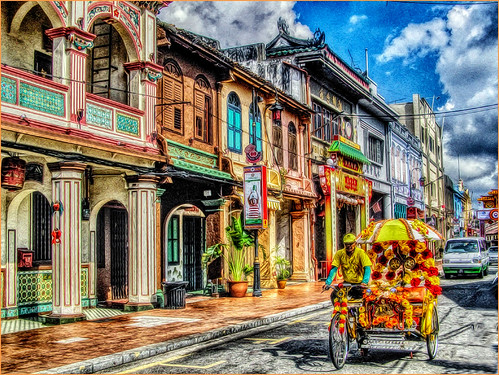
Rickshaw. Bruno Zaffoni via Compfight.
Chinatown: Boston’s Chinatown is the third largest Chinese neighborhood in the country. Renowned for its concentration of restaurants, Chinatown’s converted historic theaters now serve up decadent dim sum feasts. Beyond the neighborhood’s elaborately decorated gate, stroll the alleys for herbal shops, barbecues and Asian markets stocked with vegetables and spices. During the Chinese New Year and August Moon Festival, the streets are filled with dancing dragons, traditional music, and martial arts demonstrations.
Theatre District: Boston’s Theater District hosts an endless array of Broadway shows. Productions at the Colonial Theatre, Opera House Boston, along with the Citi Performing Arts Center, attract theatergoers of all ages. Bordering Chinatown, the area is also home to dozens of restaurants and bars offering fare in a wide range of prices. From Chinese to Thai to upscale contemporary American cuisine, the area is the ideal place for a pre-show meal.
The North End: With dozens of eateries serving homemade pasta, fresh bread, imported olive oil, cannoli, and cappuccino, the North End is infused with the flavor of its rich Italian history. Colonial-era sites are hidden throughout the neighborhood including Paul Revere’s house, the Old North Church, and Copp’s Hill Burying Ground. The North End comes alive in the summertime with feasts, festivals, and processions.
South Boston Seaport District: Boston’s waterfront is a vibrant mix of residential condos, marinas, hotels, artists’ lofts and restaurants. The city’s Institute of Contemporary Art is an architectural masterpiece overlooking the harbor. Nearby, the newly renovated Boston Children’s Museum invites your inner child to enjoy and explore the world around you. The Boston Convention & Exhibition Center also calls the Seaport District home, as does the Seaport Hotel & World Trade Center.
Cambridge:Just a bridge away across the Charles River, MIT and Harvard University help create the progressive flavor of Cambridge. Often referred to as Boston’s Left Bank, it’s the spirited, slightly mischievous side of Boston and has an atmosphere and attitude all its own. Packed with youthful vitality and international flair, it’s a city where Old World meets New Age in a mesmerizing blend of history and technology.
As a captivating, offbeat alternative to Boston’s urban center, the “squares” of Cambridge are charming neighborhoods rich in fine dining, eclectic shopping, theaters, museums and historical sites. Each square is a vibrant, colorful destination with a personality all its own, offering a unique selection of everything from restaurants, shopping, and music to technology and innovation.
As the East Coast’s leading hub for high-tech and biotech, Cambridge has a creative, entrepreneurial spirit. With over 3,000 hotel rooms, Cambridge is also a popular destination for professional meetings and conferences, offering the largest hotel inventory in New England outside of Boston.
Cambridge is the birthplace of higher education in America. Harvard College was founded in 1636, and across town, Massachusetts Institute of Technology (MIT) is known as the epicenter of cyberculture. Both universities house renowned museum collections and tours that are open to the public.
Beyond Boston: In addition to everything within the city limits, some of Massachusetts’ most scenic and historic towns are just a short distance from the city center. There are sights to see at every turn.
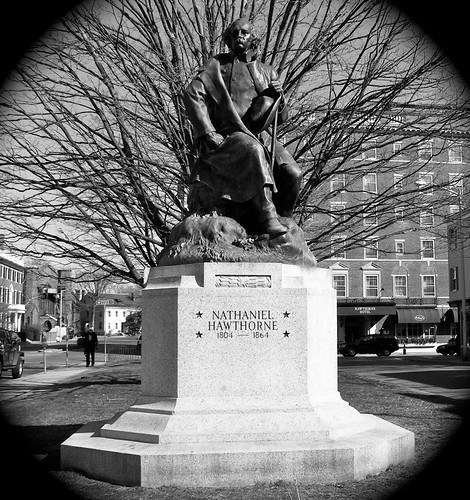
Hawthorne in Bronze, Salem, MA. Melinda Stuart via Compfight.
North of Boston: The charm and lure of the sea draw visitors north. The oceanside town of Winthrop is minutes from downtown Boston. Winthrop’s beaches are popular destinations for festivals and special events throughout the summer.
Five miles from the heart of Boston is a magnificent three-mile stretch of unbroken shoreline in Revere. Sea lovers stroll along the beautiful salt-water marshes and look forward to the annual Sand Sculpting Festival in July.
Nearby, historic Salem is one of the country’s oldest cities, with streets retaining an 18th-century charm. Sites to visit in Salem include The House of the Seven Gables, a National Historic Landmark forever immortalized by author Nathaniel Hawthorne, the Peabody Essex Museum, a museum of international art and culture housing one of the best Chinese art collections outside of China, and the Salem Witch Museum, where you can experience the Salem witch trials of 1692.
Whale-watching expeditions and harbor cruises are popular activities in the Cape Ann towns of Gloucester and Rockport. Both feature fine seafood restaurants, art galleries, and small inns.
Lowell, in the heart of the Merrimack River Valley, was home to the American Industrial Revolution and famed author Jack Kerouac. Lowell’s Heritage State Park and National Historic Park and the Lowell Folk Festival in July should not be missed.
South of Boston: With its close proximity to Boston (eight miles away), convenient access to major highways and public transportation, as well as numerous historic sites and attractions, the town of Quincy is ideally situated to host meetings, conventions, and large tour groups.
Quincy is the birthplace and summer home of presidents John Adams and John Quincy Adams. It also the shops and restaurants of picturesque Marina Bay and nearby destinations for rock climbing and harbor cruises.
An hour’s drive from Boston, Plymouth offers a resort-oriented seaside setting with 21 miles of coastline and a small-town feel. It has become a popular tourist stop and a great destination for meetings and conventions. Visitors can enjoy championship golf courses, whale watching, sailing, and shopping. This is also the place to find attractions such as Plimoth Plantation and the Mayflower II, a full-scale reproduction of the original Pilgrim ship. From now through 2020, Plymouth will be celebrating Plymouth 400, the 400th anniversary of the 1620 Mayflower voyage, the landing of the Pilgrims and the founding of Plymouth Colony.
Just a little further south of Boston is Battleship Cove in Fall River, a maritime heritage museum featuring the world’s largest collection of historic naval ships including the Battleship U.S.S. Massachusetts. Nearby is the New Bedford Whaling Museum, celebrating the region’s rich whaling history.
Also South of Boston are Cape Cod and the islands of Nantucket and Martha’s Vineyard. This area has become a haven for those who seek the peaceful inspiration of natural seaside beauty. Visitors can savor the local seafood delicacies and enjoy excellent beaches. For those looking for something a little more active, fishing, golf, antiquing and shopping abound.
Though the Cape is a world apart from many other destinations in its charms and services, it lies within easy reach of Boston’s Logan International Airport, just 50 miles away. Local flights from Boston to Hyannis are available as well as excellent bus transportation and limousine service. The tip of Cape Cod, Provincetown, can be accessed from Boston on a high-speed ferry that takes only 90 minutes.
Martha’s Vineyard and Nantucket can be reached by ferry from Woods Hole and Hyannis. Air transportation is available from Boston, New York City and several Cape towns to both islands’ airports.
West of Boston: The picturesque towns of Lexington and Concord complement any visit to the Boston area. It was on Lexington Green, in the early morning hours of April 19, 1775, that Captain John Parker of the Colonial Militia announced, “Don’t fire unless fired on. But if they mean to have a war, let it begin here.” Those words and the battle that followed changed the course of history.
Sites to visit in Concord include The Old Manse, Old North Bridge, and the Concord Museum. The Concord Museum has been collecting American artifacts since before the Civil War and features treasures including the “one, if by land, and two, if by sea” lantern immortalized by Longfellow’s “Paul Revere’s Ride.”
Additional sites west of Boston include Waterworks Museum, the deCordova Sculpture Park and Museum and historic Old Sturbridge Village, which brings 19-century New England back to life. Visitors can also go skiing at Wachusett Mountain from late November through early April.
New England: If you were to draw a two-hour circle around Boston, you’d hit all six New England States. Visitors to Boston find that once they are here, it’s easy to get around by train or car to visit the other states that comprise this great region.
Once the showplace of opulence for New York’s high society, today’s visitors to Newport, Rhode Island, can tour its Gilded Age mansions and gardens, shop along the waterfront or enjoy the holidays with re-creations of Victorian parties and concerts. This modern and sophisticated seaside town is just one-and-a-half hours from Boston.
Mohegan Sun Casino in Connecticut is a major destination for glitz and gaming. This hot spot offers slot machines, poker, and blackjack, live entertainment, lounges, hotels, shopping and more. The casino is located two hours southwest of Boston by car, and can also be reached by bus or train.
From the quaint towns of Ogunquit and Kennebunkport to the cosmopolitan flair of Portland or Freeport with its designer outlets and LL Bean flagship store, visitors can explore timeless villages, antique or outlet stores and numerous beaches in Maine.
New Hampshire offers visitors the charm and history of Portsmouth, a rich arts-and-culture scene, and exciting mountain skiing adventures. From the capital city of Burlington on Lake Champlain to small towns and villages, Vermont offers visitors outdoor adventures and artisan experiences.
Second Annual ‘GeoHumanities’ GeoPoetics Poetry Reading
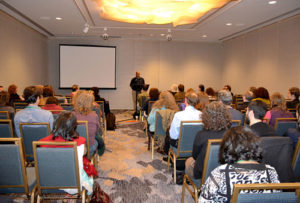
The first annual GeoPoetics Poetry Reading was held on March 29 at the 2016 AAG Annual Meeting in San Francisco. It was organized by the editors of the new AAG journal, GeoHumanities. Cecil Giscombe, University of California – Berkeley, is pictured here during his reading.
GeoHumanities has organized a GeoPoetics poetry reading to take place at the 2017 AAG Annual Meeting in Boston with accomplished poets from Boston and New England. These include Stephen Burt (poet, critic and professor of poetry at Harvard), January O’Neill (poet and professor at Salem State University, executive director of the Massachusetts Poetry Festival), Danielle Legros Georges (faculty member at Lesley University and Boston’s Poet Laureate), Joseph Massey (author of the recent Illocality from Wave books), and Jill McDonough (poet and professor at UMass Boston. Three times recipient of the Pushcart Prize). All of these poets approach place, and particularly the places of Boston and New England, in fresh and slant-wise ways that force us to see our world in new ways.
The first GeoHumanities GeoPoetics Poetry reading took place at the 2016 AAG Annual Meeting in San Francisco. The session featured a range of accomplished Bay Area poets including Cecil Giscombe, Douglas Powell, Mary Burger, Judy Halebsky and Lyn Hejinian. In each case the poets read work that crossed the boundaries of geography and poetry and represented some of the finest examples of “earth writing”. The session attracted a large and enthusiastic audience.
Session Information: GeoHumanities GeoPoetics Poetry Reading at the 2017 AAG Annual Meeting, Boston
Ryan Habron is a senior at the University of Maryland pursuing a B.S. in Geographical Sciences. His focuses include GIS, Computer Cartography, and Remote Sensing. He hopes to use these skills to monitor transportation, and other urban planning tasks in his future career.
During his internship at the AAG, he will work on obtaining attestations from 250 high schools for a proposed AP GIS&T course. He will also work on other related programs and projects, including outreach, research, website and the Annual Meeting.
When not at school or at work he is usually at a Maryland basketball game. Go Terps!
It is fair to say that the recent election has created deep concerns in our community regarding issues of diversity and gender equity. This unease certainly extends far beyond the campuses. In writing about the uncertainty in America’s corporate workplaces a recent article in Bloomberg stated, “Diversity issues have come to the fore as the presidential campaign exposed and deepened bitter divisions on matters such as the treatment of women and minorities.” So, as we enter the potentially troubled waters of 2017, allow me to share some of my thoughts on the fundamental issue of diversity as it relates to our discipline and the AAG.
This past month the University of California reported on our 2017 applicant pool and it makes for enlightening reading in this regard. By the numbers — the UC applicants were 34 percent Chicano/Latino, 30 percent Asian American, 25 percent White, 6 percent African American and about 1 percent American Indian and Pacific Islander. In terms of socioeconomic diversity, 42.4 percent were from low income families and 46 percent would be the first in their families to obtain a degree. On my own campus about 21 percent of the current undergraduate population are Chicano/Latino, 32 percent Asian American, 26 percent white, 5 percent African American and 1 percent American Indian/Pacific Islander. Slightly over 50 percent of UC undergraduate students are women.
This increasing diversity and gender balance amongst university students is of course not just a feature of the University of California. It is part of a long-term national trend. According to the National Center for Education Statistics (NCES) the proportion of Hispanic and Asian/Pacific Islander students in higher education tripled and African American enrollment increased by about 40 percent between 1976 and 2008. Since about 1980 women have been the majority gender amongst undergraduates. The diversity amongst graduate students remains lower than amongst undergraduates, but the NCES data indicate progress towards developing a graduate student body, which more closely resembles the complexion of the nation. The percent of African American graduate students has increased from 6 percent to 12 percent, Hispanics increased from 2 percent to 6 percent and Asians/Pacific Islanders increased from 2 percent to 7 percent. Women now account for a bit more than half of all graduate students. Recent data by NCES also shed some light on the diversity of the faculty. Although the ranks of full professor are largely dominated by White males, there is increasing ethnic and gender diversity in the more junior ranks. One would suspect that this increased diversity in the ranks of associate and assistant professors will propagate upwards into the professorial ranks over time.
Diversity of U.S. university faculty from the U.S. Department of Education, National Center for Education Statistics – https://nces.ed.gov/programs/coe/indicator_csc.asp
There are obvious reasons why, in a healthy and equitable democracy, access to higher education must be open to all regardless of gender, sexual orientation, ethnicity, religion or socioeconomic status. There are also many reasons why diversity bestows benefits to students in the classroom and on the campus in general. The potential added value of greater diversity has been articulated many places including in U.S. News and World Report – 1. Diversity expands worldliness in regards to exposure to people beyond a single social set, 2. Diversity enhances social development, 3. Diversity prepares students for future career success in today’s diverse workplaces, 4. Diversity provides preparation for work in a global society, 5. Diversity drives increases in the student’s own knowledge base, 6. Diversity promotes creative thinking, 7. Diversity enhances self-awareness, 8. Diversity enriches the multiple perspectives developed by higher education. It is not surprising the U.S. News and World Report includes a Diversity Index in its campus rankings.
The value of diversity extends beyond the campus setting and into professional life. For example, a study authored by Vivian Hunt, Dennis Layton, and Sara Prince and released in 2015 by McKinsey and Company examined management data for 366 public companies across a range of industries in the Unites States, Canada, the United Kingdom and Latin America. They found that firms in the top quartile for racial and ethnic diversity were 35 percent more likely to have financial returns above their national industry medians. They also found that companies in the top quartile for gender diversity were 15 percent more likely to have financial returns above their national industry medians. Interestingly, for the United States there was a linear relationship between racial and ethnic diversity and better financial performance. Every 10 percent increase in racial and ethnic diversity in senior management was correlated with an increase in earnings before interest and taxes of 0.8 percent.
Collaborator diversity has also been shown to be a positive driver of research performance. As Jean Vanski, Director of Management and Analysis, Division of Institution and Award Support at the National Science Foundation, has stated “Diversity is important to our mission because different perspectives bring to an enterprise different ways of solving problems.” Katherine Phillips argues in Scientific American that it is not just the diversity of views that is important, but the diversity of the voices expressing those views is also impactful. Differences in race and gender can actually increase the impact of novel or dissonant opinions in group research. There is also a potential payoff to diversity in the communication and impact of the resulting research. In a 2014 commentary published in Nature, Richard B. Freeman and Wei Huang of Harvard discuss an analysis of 2.5 million research papers in which they found greater ethnic homogeneity among authors was associated with publication in lower-impact journals. In contrast, papers by multi-ethnic teams of four or five authors experienced a 5-10 percent advantage in terms of citation numbers.
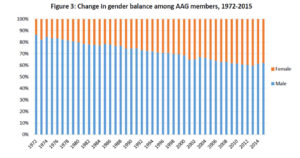
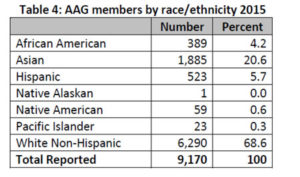
So, with all this in mind, we might ask how our discipline and our association are faring in terms of diversity? As it happens, there is a wonderful AAG Disciplinary Data Dashboard that allows members to explore this question in detail. If you have not visited the Dashboard I highly recommend you take a look. The data therein suggest a positive trajectory, but as of yet incomplete journey. Let’s assume that with almost 12,000 members, the association roughly represents the demography of the discipline as a whole in terms of gender balance and ethnic diversity. Since 1972 the proportion of female members has increased from less than 20 percent to about 40 percent. Close, but not quite parity when measured against the general population or university student proportions. In terms of ethnic diversity we clearly have work to do. Our numbers of African American, Hispanic, Native American/Alaskan and Pacific Islander remain markedly below the proportions of those groups in the general population.
From http://www.aag.org/disciplinarydataFrom http://www.aag.org/disciplinarydata
Some of this may reflect the fact that about a third of our membership is international, but I do not think that wholly explains the disparity between the AAG and the U.S. population. We should also be cognizant that our survey numbers remain incomplete in terms of socioeconomic background, sexual orientation and other attributes that contribute to the full palette of diversity in any society.
As a discipline, and as an association, we are making progress, but work remains. That work must center on making sure that the discipline of geography and the AAG are seen as relevant and valuable to a wider cross-section of the population. Here I believe there are important positive feedbacks to be realized. As we add more geographers from currently under-represented groups we add to the perspectives that geography provides and the voices by which those perspectives are communicated. Our work expands in its relevance and the message of that growing relevance is shared more widely and effectively through having a diverse membership.
We would be remiss if we think of diversity simply in terms of numbers needed to fill-out comparative spread sheets. There has been much work done in business on the challenges of the effective development and capitalization of diversity. This is often referred to as “diversity management.” As Glenn Llopis points out in Forbes Magazine, “Diversity can no longer just be about making the numbers, but rather how an organization treats its people authentically.” To be effectively and authentically diverse an organization must allow its diverse membership to be both meaningfully engaged with the organization and empowered to change operating models and chart new courses. Engagement means more than just giving voice. It means identifying priorities and providing opportunities that are relevant to broader populations. Empowerment to change priorities and operations may mean surrendering of some power by established leaders. However, as Kathy Hannan, National Managing Partner, Diversity & Corporate Responsibility, KPMG LLP, argued in the Forbes piece, “Diversity must move from just a value, to being operational.” I believe that this is the same for our discipline and association.
This all sounds good, but how can it be effected? As diversity has increased in universities and other organizations there can develop a sense of alienation by both the previously dominant or empowered groups and newly arrived and developing groups. Communication and cooperation give way to dismissal and adversity. An article in the Harvard Business Review by Tessa L. Dover, Brenda Major and Cheryl R. Kaiser suggests that in many cases corporate diversity training does little to improve such cultures or alleviate increasing senses of alienation. To overcome these challenges takes more than exposure to training, it takes more than curriculum, it takes doing by each and every one of us. Simon Goring at the Department of Geography, University of Wisconsin-Madison, was part of a team that produced an article in Frontiers in Ecology and the Environment on creating and maintaining diverse and high-performing collaborative research teams. I find the piece quite instructive on how we, as individuals, can promote a healthy diverse organization. The article highlights the importance of Social Sensitivity (empathy, honesty, clarity, integrity, accountability) coupled with Emotional Engagement (shared excitement about goals, personal commitment to the team, trust). Another important element they identify is Team Communication (evenness of talking and listening, lack of dominance, equality of interactions and tone). These values are important for any team or organization, and critical for those which are highly diverse and incorporate members with a variety of markedly different life experiences and perspectives. One might distill this all down to actively showing mutual respect.
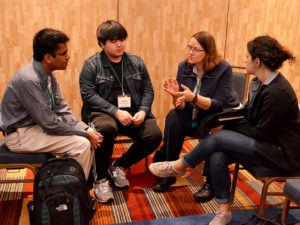
Many of our members have long been working hard in their teaching, research and service to advance the cause of diversity and equity. So too has the Association. The commitment of AAG leadership and staff from past presidents on down has been continuous. I invite you to the read the 2006 Diversity Task Force Report on goals for enhancing diversity. My recent predecessor, Mona Domosh, has written in this column about the importance of diversifying our curriculum. Each year the AAG expressly honors a geographer for their efforts toward encouraging a more diverse discipline. Geography is innately a discipline about diversity and geographers should be better equipped than most to embrace and foster a culture of diversity. If we wish to see our discipline and organization grow and prosper in an increasingly diverse nation we must do so. In addition, we as geographers can and should provide an example of the strength of diversity and the route to overcoming any challenges along that path. Let’s all think about working to achieve this, particularly in our own personal interactions, as we move forward into the New Year.
This past month the Oxford Dictionary named “post-truth” as its 2016 Word-of-the-Year. The word was chosen because it has seen a “spike in frequency this year in the context of the European Union referendum in the United Kingdom and the presidential election in the United States” and “has gone from being a peripheral term to being a mainstay in political commentary.” For scholars and educators the idea that being truthful is now optional should be deeply troubling, as it undermines the ethical and operational foundations upon which we function. In this column I want to explore the turn towards a post-truth world.
Two other similar descriptors have become more widespread in recent years — post-factual and post-rational. I believe that these terms are all part of the same sociological and political trend, but have important differences.
The AAG has announced the selection of seven Honorees who will receive the 2017 AAG Honors in one of four categories. Recipients to be honored at an annual awards luncheon during the AAG Annual Meeting are:
Ruth Fincher, University of Melbourne, AAG Lifetime Achievement Honors
David Robinson, Rutgers University, AAG Lifetime Achievement Honors
Michael Storper, University of California Los Angeles, AAG Distinguished Scholarship Honors
Patrick Bartlein, University of Oregon, AAG Distinguished Scholarship Honors
Julie Winkler, Michigan State University, AAG Ronald F. Abler Distinguished Service Honors
Kent Mathewson, Louisiana State University, AAG Ronald F. Abler Distinguished Service Honors
Michael Pretes, University of North Alabama, AAG Distinguished Teaching Honors
All AAG awards will be presented at the upcoming AAG Annual Meeting in Boston, during a special awards luncheon on Sunday, April 9, 2017.
ANNUAL MEETING
Celebrate the International Encyclopedia of Geography in Boston
Attend the editor’s panel and reception
Join us in celebrating the official launch of the International Encyclopedia of Geography: People, the Earth, Environment, and Technologies in Boston! There will be a brief overview of the Encyclopedia from its general editors, followed by a Q&A session with the general and section editors of this great work. Mark your calendars for 5:20-7:00 p.m. on Friday, April 7, 2017.
Following this session will be the AAG International Reception: A Celebration of the International Encyclopedia of Geography, an event with food, drinks, music, and interaction with the editors. All attendees are invited to attend.
Posters are exhibited for informal browsing with opportunities for individual discussion with poster authors. The AAG will host all themed poster sessions in the Exhibit Hall. Please note that the AAG will add your poster to the session which most closely aligns to your poster’s theme, however if you have a strong preference you may indicate in which poster session you would like to participate in in the “Special Requests” field of the abstract submission console. All abstracts must be submitted by Feb. 23, 2017.
The New England town and its town meeting form of government invoke images of roadside town line signs and real democracy playing out on the floor of a wood stove heated frame town house in a small town somewhere in Boston’s hinterlands. The New England town is a municipality that encompasses an expanse of land and usually includes compact settlements (villages/hamlets) and rural areas. These political units evolved from the seventeenth century needs of people transplanting themselves from England to the shores of Massachusetts Bay. Demands of church and civic governance resulted in a blending of religious and town government affairs in early Massachusetts.
John Winthrop, first governor of the Massachusetts Bay settlements that would develop in and around the Boston locale was a principal player in both Congregationalism and establishing the underpinnings of New England town formation and administration (Rudman 1965). Towns were charged with providing local services: laying out roads and maintaining them, education, police and fire protection, overseeing the poor, passage of ordinances to protect public health and promote the general welfare of the population.
Each year many AAG Specialty and Affinity Groups confer travel grants, hold paper competitions, and bestow honors and awards to their faculty and student members at the AAG Annual Meeting. Notices for these competitions may appear on the relevant specialty group’s website or listserve, or on the AAG News site.
Important Election Information: Update Your Email Address with AAG
The AAG election will be conducted online again, and will take place Jan. 11-Feb. 2, 2017. Each member who has an email address on record with the AAG will receive a special email with a code that will allow them to sign in to our AAG SimplyVoting website and vote. It’s important to update your email address to make sure you will be able to vote. If you know your email address is up to date with us, there’s no need to do anything further.
The AAG’s proposal for a new Advanced Placement course in Geographic Information Science and Technology (AP GIS&T) continues to receive strong interest from high schools, colleges, and universities across the U.S. However, in order to complete the proposal package for the College Board, the AAG needs to collect attestations of interest from at least 250 high schools.
So far 114 high schools have registered their interest in the AP GIS&T course. The AAG invites all members to share the AP GIS&T proposal with high schools in their local community.
Join the #AAGChat on Careers in Geography, Jan. 12, 2017
Mark your calendars and be sure to join us for an #AAGChat on careers in geography. The chat will address the many diverse career opportunities for geographers in a variety of industries and employment sectors and how geography students, graduates and early-career professionals can identify appropriate job openings. We will also discuss the many career resources available through the AAG, including our Jobs in Geography Center, Student Opportunities website, and more!
The chat will occur on Thursday, Jan. 12, 2017, from 3-4 p.m. EST. To participate in the chat, please use the hashtag, #AAGChat. Make sure to follow us on Twitter by searching for our handle, @TheAAG!
Also, be sure to visit our updated social media page to view our previous Twitter Chat held during Geography Awareness Week and learn more about our social media channels and events.
Invest in Geography’s Future with a Tax-Deductible Gift
Tax-deductible donations to AAG Advancing Geography Funds will help the association to generate new geographic knowledge, strengthen geographic education, increase the involvement and raise the visibility of geography in science and policy making settings, and increase geographic knowledge around the world.
Gifts to AAG Advancing Geography Funds may be designated to support specific projects and initiatives or to support the areas of greatest need. A list of AAG Advancing Geography Funds is available at www.aag.org/donate.
To fulfill your pledge by cash, check or other method, please download and complete a pledge form.
AAG has a variety of opportunities for students, un-/underemployed geographers, and scholars outside the discipline to attend and participate in the Annual Meeting.
The Nancy Weiss Malkiel Scholars Award Program is now accepting applications
through December 15, 2016. This opportunity is for tenure-track faculty who are committed not only to research and teaching but also to building a more inclusive scholarly community. Applicants may not be going up for tenure during the award year (2017–18).
David Slater, Emeritus Professor of Political Geography at Loughborough University, UK, who was a leading critical development geographer and known for his work on Latin America, passed away on October 20, 2016.
Slater studied for a bachelor’s degree in geography at Durham University in the mid-1960s which was when he first became interested in geopolitics, seeking to understand international relations in a spatial context. He went on to the London School of Economics, where he completed a doctorate in geography in 1972.
Geographer Michelle Behr Named Chancellor of University of Minnesota at Morris
Michelle Behr, Ph.D., has been named chancellor of the University of Minnesota, Morris. Dr. Behr’s appointment is effective February 6, 2017, pending approval by the Board of Regents.
Dr. Behr is currently the Provost, Senior Vice President for Academic Affairs, and Dean of the College at Birmingham-Southern College (BSC) in Birmingham, AL. Prior to her arrival at BSC, she served variously as a faculty member, department chair, university assessment coordinator, and college dean at several public institutions of higher education.
Dr. Lesley-Ann Dupigny-Giroux Featured in Direction’s Magazine
AAG member Dr. Lesley-Ann Dupigny-Giroux, professor at the University of Vermont, is featured in Direction’s Magazine’s GeoInspirations series. Guest columnist Dr. Joseph Kerski interviewed her and asked her about how she was introduced to geography and her efforts to promote climate literacy and the use of geotechnologies with K-12 teachers and students, and more.
AAG Member Bailey Anderson Wins 2017 British Marshall Scholarship
Bailey Anderson, a Liberal Arts Honors/Geography, and International Relations and Global Studi
es major, at the University of Texas at Austin, has been awarded a 2017 British Marshall Scholarship. As a Marshall Scholar, Bailey will pursue a Master of Philosophy Degree at Oxford University in Geography and The Environment: Water Science, Policy and Management.
Pre-order ‘The International Encyclopedia of Geography’
The AAG and an international team of distinguished editors and authors are in the final stages of preparing a new major reference work for Geography: The International Encyclopedia of Geography: People, the Earth, Environment, and Technology.
This 15-volume work, published by Wiley both in hard copy and online, will be an invaluable resource for libraries, geographers, GIScientists, students and academic departments around the globe. Updated annually, this Encyclopedia will be the authoritative reference work in the field of geography for decades to come.
January 2017 Issue of the ‘Annals of the AAG’ Now Available
The AAG is pleased to announce that Volume 107, Issue 1 (January 2017) of the Annals of the American Association of Geographers is now available.
The Annals contains original, timely, and innovative articles that advance knowledge in all facets of the discipline. Articles are divided into four major areas: Environmental Sciences; Methods, Models, and Geographic Information Science; Nature and Society; and People, Place, and Region.
This issue also contains a special forum on Radical Intradisciplinarity edited by AAG past President, Mona Domosh, featuring 6 articles. It is available for free for the next two months.
February 2017 Issue of ‘The Professional Geographer’ Now Available
The AAG is pleased to announce that Volume 69, Issue 1 (February 2017) of The Professional Geographer is now available.
The focus of The Professional Geographer is on short articles in academic or applied geography, emphasizing empirical studies and methodologies. These features may range in content and approach from rigorously analytic to broadly philosophical or prescriptive. The journal provides a forum for new ideas and alternative viewpoints.
Each issue, the Editor chooses one article to make freely available. In this issue you can read Re
naming and Rebranding within U.S. and Canadian Geography Departments, 1990–2014 by Amy E. Frazier and Thomas A. Wikle for free for the next 3 months.
December 2016 Issue of the ‘African Geographical Review’ Now Available
The AAG is pleased to announce that Volume 35, Issue 3 (December 2016) of the African Geographical Review is now available.
The African Geographical Review is the journal of the Africa Specialty Group of the American Association of Geographers. It provides a medium for the publication of geographical material relating to Africa, seeks to enhance the standing of African regional geography, and to promote a better representation of African scholarship. Articles cover all sub-fields of geography, and can be theoretical, empirical or applied in nature.
This past month the Oxford Dictionary named “post-truth” as its 2016 Word-of-the-Year. The word was chosen because it has seen a “spike in frequency this year in the context of the European Union referendum in the United Kingdom and the presidential election in the United States” and “has gone from being a peripheral term to being a mainstay in political commentary.” For scholars and educators the idea that being truthful is now optional should be deeply troubling, as it undermines the ethical and operational foundations upon which we function. In this column I want to explore the turn towards a post-truth world.
Two other similar descriptors have become more widespread in recent years — post-factual and post-rational. I believe that these terms are all part of the same sociological and political trend, but have important differences. Post-factual does not necessarily mean being untruthful, it may represent situations in which pertinent factual information is either not sought, not considered, not valued, or is simply reviled. The term post-truth implies deliberate provision or knowing acceptance of information that is known to be untruthful. I would suggest the deliberate suppression of factual information would also fall under this rubric. Post-rational suggests situations in which facts, reasoning and logic are deemed unnecessary or even loathed when decisions are taken. The term post-truth is widely used in a sense that captures all three of these issues. In the context of western philosophy and history, an increasingly post-truth world can be seen as a rejection of 300 years of scientific, socioeconomic and political development that was initiated by the Age of Enlightenment in the 18th century.
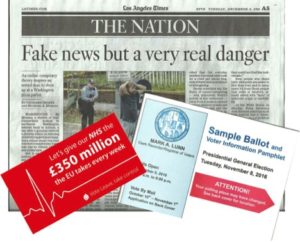
At the moment post-truth phenomenon is sending shockwaves through the body politic and causing concern about the future of democracy. As political economy professor William Davies pointed out this August in The New York Times, “Facts hold a sacred place in Western liberal democracies. Whenever democracy seems to be going awry, when voters are manipulated or politicians are ducking questions, we turn to facts for salvation. But they seem to be losing their ability to support consensus.” The Brexit referendum and U.S. Presidential election offered political pundits much evidence of a turn towards post-truth. For example, a centerpiece of the Brexit Leave campaign was the claim that the EU is taking £350 million a week from the U.K. and that this money could be spent on the National Health System. This figure was so misleading that it drew an official rebuke by the U.K. Statistics Office and yet the Leave campaign continued to cite it. After the election the figure and promise to give those funds to the National Health System was then disavowed by one of the leaders of the Leave campaign, Nigel Farage. Yet due to this post-truth campaigning, some 47 percent of British voters surveyed accepted the figure and an additional 14 percent were uncertain of its legitimacy. Immediately following the vote some 6 percent of the Leave supporters stated they wished they had voted to remain in the EU. Either they did not understand their “protest” vote would count in such a tight election or they did not fully reason the consequences of a vote to leave the EU. This seems to me an example of the post-factual, post-truth and post-rational.
Turning to the U.S. — according the Pulitzer-Prize-winning site Politifact, some 51 percent of the checked statements made by Donald Trump and 12 percent of those by Hillary Clinton were deemed false or worse. Although both candidates appear to have made false statements, the large difference in the proportion of such statements between the eventual President Elect and Hillary Clinton indicates that facts and demonstrable truthfulness were not deciding factors in the election. In some cases the dismissal of facts and truthfulness may be an informed and deliberate choice on the part of the voter. As Salena Zito famously wrote about Donald Trump in The Atlantic, “the press takes him literally, but not seriously; his supporters take him seriously, but not literally.”
Donald Trump’s capacity to win voters’ trust in him as a leader despite a lack of veracity in many of his statements was no doubt honed by his experience in modern broadcast and digital media. It cannot be assumed though that the public recognize political statements as false in all cases. The recent U.S. election was marked by an incredible amount of “fake news” containing lies and outrageous speculations. The fake news problem has become viral due to the ability of its practitioners to use the web to reach huge and widely dispersed audiences. It would be wrong to think that the turn to a post-truth world, fueled in part by a changing media, is a new phenomenon created by these recent elections. Almost two decades ago, Carl Bybee wrote in Journalism & Communication Monographs, “we appear to have moved into a post-factual age where the border between fact and fiction, news and entertainment, information and advertisements has increasingly blurred.”
So, what does this evolving and potentially post-truth word mean for scholarship and geography? Let’s tackle the sciences, as that is the realm I know best. Scientists often decry the divergent views on what is factual or true between themselves and the public. According to a 2015 study by the Pew Research Center, despite the scientific evidence to the contrary and large consensus amongst scientists, 32 percent of the adult U.S. public do not believe in the value of mandatory childhood vaccinations, 63 percent do not feel it is safe to eat genetically engineered foods, 50 percent do not believe in anthropogenic climate change and 35 percent do not believe humans evolved over time. Scientists often lament and ponder why the facts or consensus opinions from our hard work is so widely dismissed, even in instances when there are measurable and repeatable observations (“facts”) to back it up. In some cases, such as the anti-vaccine movement, the contra-factual trend is more or less grass-roots in nature, fueled by personal fears, religious beliefs, political ideologies or misinformation. In other cases, however, public skepticism and dismissal of scientific results arise from sophisticated and large-scale media campaigns and political lobbying by special interests, such as the tobacco or fossil fuel industries. As described in Naomi Oreskes and Erik Conway’s book, Merchants of Doubt, such campaigns, often co-opting scientists, have suppressed facts or spread false information. Healthy skepticism and inquiry is good, deliberate sowing of misinformation is not. In either case, the powerful tool of the Internet now allows the unprecedented spread of both valid factual information and misinformation alike.
Perhaps more troubling in the context of creating a post-truth world are governmental attempts to suppress facts and research. This both denies factual information to the public and policy, but also reinforces messages that facts do not matter and those facts that you do not like can simply be suppressed. For example, as reported in Science, in 2012 the North Carolina legislature passed HB 819, a measure that initially banned the use of scientific sea-level rise projections in coastal planning. This was a response to a scientific study that outlined the dire impacts or projected sea-level rise on the state’s coastline. In Canada, the government of Prime Minister Stephen Harper placed severe restrictions on the public communication of science by Federal scientists. As reported in Nature, The Professional Institute of the Public Service of Canada summed up the situation this way, “Here’s how we do things in the Harper government” — “We muzzle scientists, we cut research and we ignore anyone who doesn’t tell us what we want to hear.” Looking at the recent U.S. election, the The Guardian newspaper interviewed Trump science advisor, Bob Walker, and concluded, “Donald Trump is poised to eliminate all climate-change research conducted by NASA as part of a crackdown on “politicized science.” It remains to be seen if this is an overstatement by the Guardian or an accurate take on the situation ahead.
The issues and concerns outlined above extend beyond the natural sciences. In Canada, the former government of Prime Minister Stephen Harper did away with the mandatory long-form census, a tool vital to collecting social sciences data. A Conservative Party advisor summed up the reasoning succinctly in The National Post newspaper, “If it can’t be measured, future governments can’t pander. I imagine that [in] Stephen Harper’s view, Canada should be a country of individual initiative, not one of collective dependence ‘justified’ through the collection of data.” I am not sure I know of a clearer statement of the cynicism and unethical quest for political expediency that is fueling the march towards a post-truth world.
The healthy and vital debates which we have as scientists and scholars about our research and how we go about it have also been cited as helping drive the movement towards a post-truth world. Andrew Calcutt’s op-ed, entitled “Forget Brexit and Trump, “post-truth” was spawned by the liberal left long ago,” provides a particularly strong take on the role of academic concepts of social constructionism in the current turn towards a post-truth world. Geographer David Demeritt has long worked on social constructionism in the sciences, and in a 2001 paper in the Annals he points out that “This political strategy of social construction as refutation has been pursued by the so-called climate skeptics and other opponents of the Kyoto Protocol.”
So, where does this leave us as individual geographers and the AAG? Because our discipline deals with so many socially, economically, culturally and environmentally relevant issues, we have a particular need to be concerned about this turn towards the post-truth. For example, many of our members work with earth-surface data and support provided by NASA. Defunding those programs would disrupt our work, and also decrease our ability to help inform the public and policy makers about important issues. I can envision many other areas of physical and human geography where the embrace of post-truth policies and public perceptions will be deeply felt by geographers and limit our efforts to contribute geographical knowledge to the public and policy makers.
However, to address these challenges we must move beyond past standard responses. I believe that, as scholars, we must understand that for many people the facts do not “speak for themselves” and that lines on graphs and numbers in tables do not carry the persuasive weight we might think they do. Neither can we assume that somehow our presumed academic authority on a topic translates to public trust. As scholars we progress in part through our skepticism of orthodoxies — why should we expect others, including the public, not to do the same? In his Annals article David Demerritt urges the scientific community to recognize “Science does not offer the final word, and its public authority should not be based on the myth that it does, because such an understanding of science ignores the ongoing process of organized skepticism that is, in fact, the secret of its epistemic success. Instead scientific knowledge should be presented more conditionally as the best that we can do for the moment. Though perhaps less authoritative, such a reflexive understanding of science in the making provides an answer to the climate skeptics and their attempts to refute global warming as merely a social construction.” I quote this passage at length because I believe it pertains not just to scientists and the issue of climate change, but to every sphere in which we, as scholars and teachers of geography, operate and wish to effectively counter the post-truth world. It is important to understand that these efforts demand truthfulness, self-examination and full-disclosure on our part. If recent political events and the rise of the post-truth world tell us anything, it is that facts in-and-of-themselves are not enough, we must also engender trust if we want our messages heard and valued.
As an association the AAG will continue to do what it has long done to monitor and respond to efforts to stifle or censure geographic research, education or the dissemination of geographic knowledge. We will work to make sure that the public and public policy makers have access to, and are informed by, geographic knowledge. We will work to make sure that such efforts support geographers and their work regardless of race, national origin, religion, sexual orientation or disabilities. When appropriate we will join with other scholarly associations in these actions. In these efforts we need the aid of our members in bringing the problems engendered by the post-truth world to the attention of the association and in helping to tackle them. In pursuit of a world that is truthful and rational we have our work to do — both individually and collectively.
AAG Members get exclusive access to publications, prominent journals, unique advocacy, grant, scholarship and professional opportunities with access to industry focus communities, and event discounts, including our annual meeting.
Some content may only be accessible if you belong to specific Specialty or Affinity Groups. You can still update your membership below. You will need to go through the Join flow, but you do not need to repurchase your membership unless it is expired or about to expire.
To provide the best experiences, we use technologies like cookies to store and/or access device information. Consenting to these technologies will allow us to process data such as browsing behavior or unique IDs on this site. Not consenting or withdrawing consent, may adversely affect certain features and functions.
Functional
Always active
The technical storage or access is strictly necessary for the legitimate purpose of enabling the use of a specific service explicitly requested by the subscriber or user, or for the sole purpose of carrying out the transmission of a communication over an electronic communications network.
Preferences
The technical storage or access is necessary for the legitimate purpose of storing preferences that are not requested by the subscriber or user.
Statistics
The technical storage or access that is used exclusively for statistical purposes.The technical storage or access that is used exclusively for anonymous statistical purposes. Without a subpoena, voluntary compliance on the part of your Internet Service Provider, or additional records from a third party, information stored or retrieved for this purpose alone cannot usually be used to identify you.
Marketing
The technical storage or access is required to create user profiles to send advertising, or to track the user on a website or across several websites for similar marketing purposes.
To provide the best experiences, we use technologies like cookies to store and/or access device information. Consenting to these technologies will allow us to process data such as browsing behavior or unique IDs on this site. Not consenting or withdrawing consent, may adversely affect certain features and functions.
Functional
Always active
The technical storage or access is strictly necessary for the legitimate purpose of enabling the use of a specific service explicitly requested by the subscriber or user, or for the sole purpose of carrying out the transmission of a communication over an electronic communications network.
Preferences
The technical storage or access is necessary for the legitimate purpose of storing preferences that are not requested by the subscriber or user.
Statistics
The technical storage or access that is used exclusively for statistical purposes.The technical storage or access that is used exclusively for anonymous statistical purposes. Without a subpoena, voluntary compliance on the part of your Internet Service Provider, or additional records from a third party, information stored or retrieved for this purpose alone cannot usually be used to identify you.
Marketing
The technical storage or access is required to create user profiles to send advertising, or to track the user on a website or across several websites for similar marketing purposes.

 The AAG will refund the conference registration fees for any AAG member or attendee who is a citizen of one of the seven countries affected by the U.S. Travel Ban and who by virtue of being outside the United States at this time will not be able to attend the AAG Annual Meeting in Boston. In the interest of giving such members a voice at the conference we also will allow for their abstracts to remain in the program and their oral presentations to be delivered by a registered member able to attend the meeting or their posters to be displayed should they be able to send their posters to the meeting. The AAG also will provide for a Skype or similar teleconference option for these affected participants to present their paper. We will need notification in advance if members affected by the Travel Ban wish to have a surrogate present their talk or poster, or wish to deliver their paper via teleconference.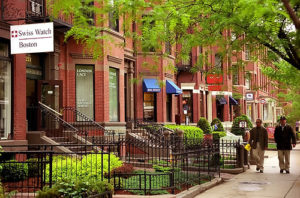
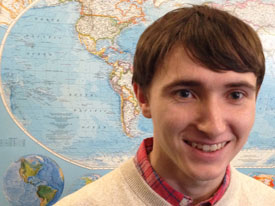 Ryan Habron is a senior at the University of Maryland pursuing a B.S. in Geographical Sciences. His focuses include GIS, Computer Cartography, and Remote Sensing. He hopes to use these skills to monitor transportation, and other urban planning tasks in his future career.
 It is fair to say that the recent election has created deep concerns in our community regarding issues of diversity and gender equity. This unease certainly extends far beyond the campuses. In writing about the uncertainty in America’s corporate workplaces a recent article in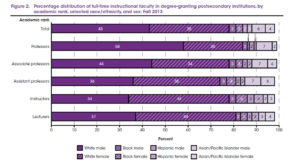
 Many of our members have long been working hard in their teaching, research and service to advance the cause of diversity and equity. So too has the Association. The commitment of AAG leadership and staff from past presidents on down has been continuous. I invite you to the read the 2006
 The AAG has announced the selection of seven Honorees who will receive the 2017 AAG Honors in one of four categories. Recipients to be honored at an annual awards luncheon during the AAG Annual Meeting are:
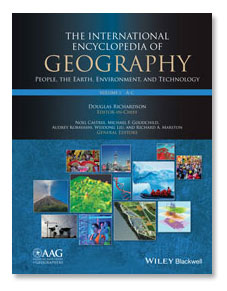 Join us in celebrating the official launch of the International Encyclopedia of Geography: People, the Earth, Environment, and Technologies in Boston! There will be a brief overview of the Encyclopedia from its general editors, followed by a Q&A session with the general and section editors of this great work. Mark your calendars for 5:20-7:00 p.m. on Friday, April 7, 2017.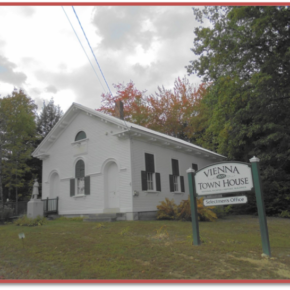
 The AAG election will be conducted online again, and will take place Jan. 11-Feb. 2, 2017. Each member who has an email address on record with the AAG will receive a special email with a code that will allow them to sign in to our AAG SimplyVoting website and vote. It’s important to update your email address to make sure you will be able to vote. If you know your email address is up to date with us, there’s no need to do anything further.
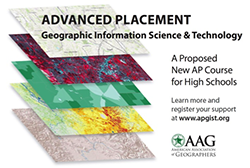 The AAG’s proposal for a new Advanced Placement course in Geographic Information Science and Technology (AP GIS&T) continues to receive strong interest from high schools, colleges, and universities across the U.S. However, in order to complete the proposal package for the College Board, the AAG needs to collect attestations of interest from at least 250 high schools.
 Mark your calendars and be sure to join us for an #AAGChat on careers in geography. The chat will address the many diverse career opportunities for geographers in a variety of industries and employment sectors and how geography students, graduates and early-career professionals can identify appropriate job openings. We will also discuss the many career resources available through the AAG, including our Jobs in Geography Center, Student Opportunities website, and more!
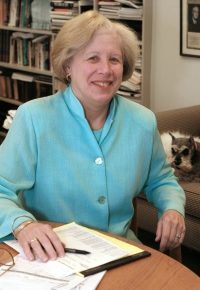 The Nancy Weiss Malkiel Scholars Award Program is now accepting applications
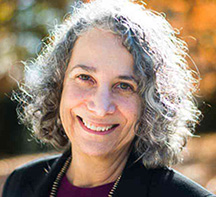 Michelle Behr, Ph.D., has been named chancellor of the University of Minnesota, Morris. Dr. Behr’s appointment is effective February 6, 2017, pending approval by the Board of Regents.
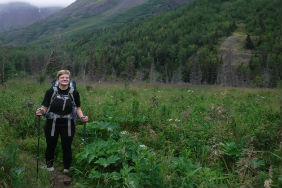 Bailey Anderson, a Liberal Arts Honors/Geography, and International Relations and Global Studi
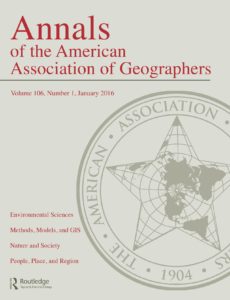 The AAG is pleased to announce that Volume 107, Issue 1 (January 2017) of the Annals of the American Association of Geographers is now available.
 The AAG is pleased to announce that Volume 69, Issue 1 (February 2017) of The Professional Geographer is now available.
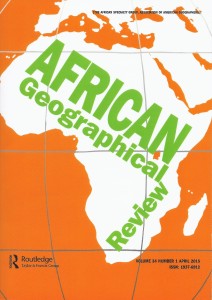 The AAG is pleased to announce that Volume 35, Issue 3 (December 2016) of the African Geographical Review is now available.
 Two other similar descriptors have become more widespread in recent years — post-factual and post-rational. I believe that these terms are all part of the same sociological and political trend, but have important differences. Post-factual does not necessarily mean being untruthful, it may represent situations in which pertinent factual information is either not sought, not considered, not valued, or is simply reviled. The term post-truth implies deliberate provision or knowing acceptance of information that is known to be untruthful. I would suggest the deliberate suppression of factual information would also fall under this rubric. Post-rational suggests situations in which facts, reasoning and logic are deemed unnecessary or even loathed when decisions are taken. The term post-truth is widely used in a sense that captures all three of these issues. In the context of western philosophy and history, an increasingly post-truth world can be seen as a rejection of 300 years of scientific, socioeconomic and political development that was initiated by the Age of Enlightenment in the 18th century.