Keaton Shennan

Education: MS in Geographic Information Science (San Diego State University), BS in Architecture (University of Colorado Denver)

The following profile was compiled by Jessica Embury (San Diego State University) for the Encoding Geography initiative. To learn more, visit: https://www.ncrge.org/encoding-geography/


Please describe your job, employer, and the primary tasks that you perform in your position. 

I am currently a GIS web developer for a mid-sized engineering firm of about 600 people that has offices in Minnesota, Texas, and Colorado. My primary tasks are geospatial scripting for various locations and tracking different types of assets, like cranes and street sweepers. I also work on web mapping applications that are generally used by cities and counties to manage tax data, parcel data, or stormwater information. I work on other applications for the oil and gas industry, like helping manage location audits and tracking different types of surveys on job sites throughout Texas.   

Previously, I’ve worked on EPA projects, like a common operating picture, which was essentially an emergency response platform. It had various assets and information brought into it regarding wildfires and other things. I’ve also worked on geospatial scripting for generating time enabled smoke imagery mosaics where I took cams and files from the Forest Service’s Blue Sky platform and translated that into a time enabled hosted and managed service. 

Other projects I’ve worked on were Native American tribal nations software, like central data management systems for managing water quality, collecting surveys from research scientists, and managing environmental cleanup. 

What is your educational background? How did you initially discover geocomputation and why did you ultimately choose a career that uses geography and computer science? 

My bachelor’s degree is in architecture and that’s where I was first introduced to GIS, in a natural hazards course. It’s how I got interested in wildfires and learning about GIS and what I could do with it. I also took an architectural cartography course which covered using GIS data to visualize changes in Denver, where I went to school.  

After working in architecture for a couple years, I just didn’t enjoy it and I always loved geography so I was hoping I could use some of my experience regarding planning, knowledge of fire, and building codes and somehow apply GIS to work with wildfires. Then, I completed my masters at San Diego State University and did my thesis on geovisualization and descriptive analysis of landscape level wildfire behavior using repeat pass airborne thermal imagery.  

During that time, I developed web applications for visualizing different attributes of landscapes and wildfire behaviors, such as reduced spread. I also did a descriptive analysis and worked on a couple other projects using GIS. 

I ultimately chose a career in geocomputation because I really liked the programming side of it. I thought it was an interesting and powerful skill set for being able to work with GIS data that not a lot of people have. I felt it also helped to have programming skills when I graduated and got into the job market. 

Is GIS usage widespread in architecture education and the industry? 

No, it is primarily used by planners but not really in architecture. If you work with site plans for master planning communities then you might get a little more experience. I worked in multifamily architecture so I got some experience using GIS to edit line work for a community master plan in Colorado, but that was the extent of it. Most architects I’ve met never use GIS. They do a lot of 3D modeling and data information modeling, but that’s about it.  

When you think about geography, what specific background knowledge and conceptual ideas are important and useful to know? 

Something that I feel is really under-represented in geographic education is learning how to work with coordinate systems and geographic versus projected coordinate systems. I run into a lot of issues in my job where people aren’t familiar with those concepts and then they don’t understand why certain tools aren’t working or what data processes are happening.  

Working with different data types and understanding how a database is structured is really helpful, but that’s more specific to a development role. Also, being familiar with common tools and processes for editing vector data and evaluating the accuracy of GPS data. I think having familiarity with GIS and data standards are the most important for a geospatial developer.  

When thinking about computer science, what specific background knowledge and conceptual ideas do you think are important and useful to know? 

For a web GIS developer, understanding how websites work is important,  like what happens when you type in a URL and how data is tasked between different services. For example, if you have a GIS server instance, how do you get data from that? A broad level of knowing how a REST API works is really important and critical for using geospatial data in websites. Also, having a general understanding of relational databases and becoming comfortable with certain programming languages are big skills.  

What procedural knowledge do you think is important and useful to know, from either geography or computer science? 

From geography, or the computer science side of geography, I think it’s really important to be familiar with Esri products like ArcGIS Pro or ArcDesktop, because those are widely used, especially in cities and municipalities. Then, understanding what Esri portal and enterprise are and how to use ArcGIS Online. Even as a developer, I use those tools all the time.  

Getting a little more into the computer science part, it is important to know how to use ArcPy and the ArcGIS Python API, as well as open source software. I haven’t used QGIS recently but I think that’s a good one to learn if you don’t have access to other GIS. Then, being familiar with libraries such as GDAL and OGR for Python is really helpful. Also, knowing how to set up a PostGIS database is a specific skill that’s really helpful for the computer science part. I mainly work with Javascript, Typescript, Python, a little bit of C# (C-Sharp).  

With web development, I also use HTML and CSS. If you’re going to be a web developer, you need to know the basics of vanilla JavaScript, which is what they call using JavaScript without a framework. Understanding how to make a call to a REST endpoint and how to get data from a host or feature service is really important. Generally understanding the life cycle, like a promise in JavaScript is important, so if you get data you’re leaving that response. Then understanding the DOM, the document object model, and how that works. Essentially, how is an html page structured and then, depending on what resources you use, knowing a rest API and how that works. You could also look into a soap API which uses xml. I did run into that a little bit, especially larger scale stuff. We essentially had a big repository for data that was used by Federal Government employees and now it’s translated from xml. So that’s the specific programs stuff.  

Then, for Python, you should know some of the big geospatial libraries and know when it’s appropriate to use certain things and that just takes time. Then, if you want to get a job, it’s helpful to know a framework and have something that you’ve built, have examples of work that you’ve done, no matter how small they are, but have examples of a small portfolio and if you can explain what’s happening behind the scenes – then that’s pretty critical to getting a job in the field. 

What is an example of a social, economic, environmental or other issue that you recently investigated in a project at work? 

We work mostly with environmental issues. I’m currently working on a stormwater asset management program so it uses some hydrological modeling that’s above my head, but essentially it’s a program which can forecast when stormwater basins and ponds will need maintenance, so preserving stormwater ponds in different communities throughout Minnesota.  

Another project I worked on is the EPA common operating picture, and for that I worked on a few different widgets and a web map and one of them, for environmental data, was that smoke mosaic data. We set up a script to run every 24 hours and update daily [to] provide information on particle density for smoke over California, Nevada, and a couple other states in the southwest US. Another component of that was tracking active fire perimeters and if there were active fire parameters within 10 miles of an EPA facility, [then] that would notify people. 

What kind of geographic or computational questions did you ask and think about during your project? 

I’ll talk about the smoke data because that’s really interconnected with air quality, which can be interconnected to a lot of other social and environmental issues related to people who are disproportionately affected by that. The question is, from a technical standpoint, how do we transform these cams and the files into something that’s useful and time-enabled? Then, how do we convey that knowledge to somebody who doesn’t have a GIS background? And how can we make it useful at the scale? So the scale of this data is multiple states, the lower 48 states of the contiguous U.S..  

Knowing how to resample that imagery was important, so how do we make sure that it’s an appropriate scale and spatial resolution for the task at hand? Then, that kind of blended into programming, so this would be kind of a classic geospatial scripting – You’re transforming the data, so you first need to get the data, so you make a request to that site and get the data, unzip it, then you need to organize it. For that dataset we had times in each image file name, so you could just use Python to pull out the dates, and then you need to transform it into the correct projection. You need to reproject those rasters and then, once you do that, you can look at the different types of resampling that you can do. Then, once you have all your data finished and you finished the processing of your data, you then need to work on the final product. So you kind of have these iterative steps to clean the data, get it in a format you want, and make sure it’s displaying correctly at an appropriate spatial resolution or appropriate coordinate system. 

And then, once that’s done, you can do the final task, which is essentially creating an image service that you can just put in a web app that has time enabled on it, which is an Esri specific thing, because if you enable time on this image layer, then you can use all these different filtering tools to visualize the data. 

What types of data did you acquire to support your project? If possible, please identify up to three data sets you utilize the most. 

So we used the BlueSky daily runs from the WebSky platform from the United States Forest Service, which is a research model that they generate for different regions in the U.S.. 

https://tools.airfire.org/websky/v2/#status  

For the EPA, we used a couple different datasets. I don’t know how much I can talk about that, but we did use the classic U.S. main fire perimeter data: the NIFC current wildfire perimeters data set. Currently, we use a lot of parcel tax data, so that’s more specific to city and county level, but I would say we work with that the most. 

What type of content knowledge and skills did you use to evaluate, process, and analyze the data that you gathered for your project? 

For the remote sensing part of that project, it was about understanding the different types of interpolation, such as nearest neighbor, and resampling methods for raster data. Also, being able to identify your destination coordinate system and apply any projections that you need.  

Content knowledge and skills specifically for programming would be understanding how to use Open Source  geoproducts, so in that case it was GDAL to work with raster data. Then principles for more general types of skills like Python programming and using Jupyter notebooks or ArcGIS notebooks to schedule a task to run every 24 hours to get new data and republish the image service. 

As a developer, I get a lot of hard skills but the soft skills can be ignored a little bit. The most important thing I’ve learned is being able to explain to somebody why something is important if they don’t have a background in GIS and being able to distill the work you’re doing and provide a high level summary. That’s something we have to do all the time. An example of this would be when I built a continuous integration continuous development pipeline for a client. What this does is it builds their application tests and it deploys it to wherever they want automatically. So I had to be able to distill this really technical process of backing up and restoring databases and running certain types of integration tests to a client that doesn’t really have a strong computer science background and I’m just a GIS technician. That was for a Tribal Nations organization. So how you distill that knowledge upwards and explain what you’re doing and why it’s meaningful is the most important part of this process. 

How did you apply geography and computer science to communicate the results of your project? Do you have a recent product or publication that you can share as an example? 

I primarily use web applications. I don’t usually use maps very often, unless they’re embedded in a web application. So I do a lot of mapping applications where geovisualization is an important part of that.   

How to display data in a meaningful way is always important, even at city levels, if they have huge data sets, like a lot of utility data sets and storm water and sewer and parcel. A lot of them have tons of data, so how do you display that data in a way that doesn’t get super cluttered or confusing? 

For a recent product, we have a public facing web page. This is another product for oil and gas. There is a video on this website that does a little walkthrough: 

https://www.wsbeng.com/expertise/technology/solutions/datafi/ 

WSB Engineering and Innovate! Inc. are the two companies I’ve worked for. I wanted to work in-person. I think it is important to have that in-person mentorship as a developer. 

Reflecting on your work, how does it align with your personal values and your community or civic interests? 

I’ve been able to explore some environmental issues that generally align well with my personal values. I feel like I get to make a positive impact, and even with fields and sectors of oil and gas that I wouldn’t necessarily see myself working in, I like that I get to help with environmental compliance and making sure that field workers are safe and sticking to appropriate procedures.  

I really enjoyed the work I did for the Environmental Protection Agency. That’s probably been the highlight so far – being able to work for an agency that I admire. Being able to work with the Forest Service is great too. Most of my work is related to environmental issues, which I’m passionate about, but it would also be great to use this data for other civic or social justice projects to see how GIS data can be useful for that.  


This material is based upon work supported by the National Science Foundation under Grants No. 2031418, 2031407, and 2031380 (Collaborative Research: Encoding Geography – Scaling up an RPP to achieve inclusive geocomputational education). Any opinions, findings, and conclusions or recommendations expressed in this material are those of the author(s) and do not necessarily reflect the views of the National Science Foundation 
 

    Share

Confronting the Extremes of Climate Change

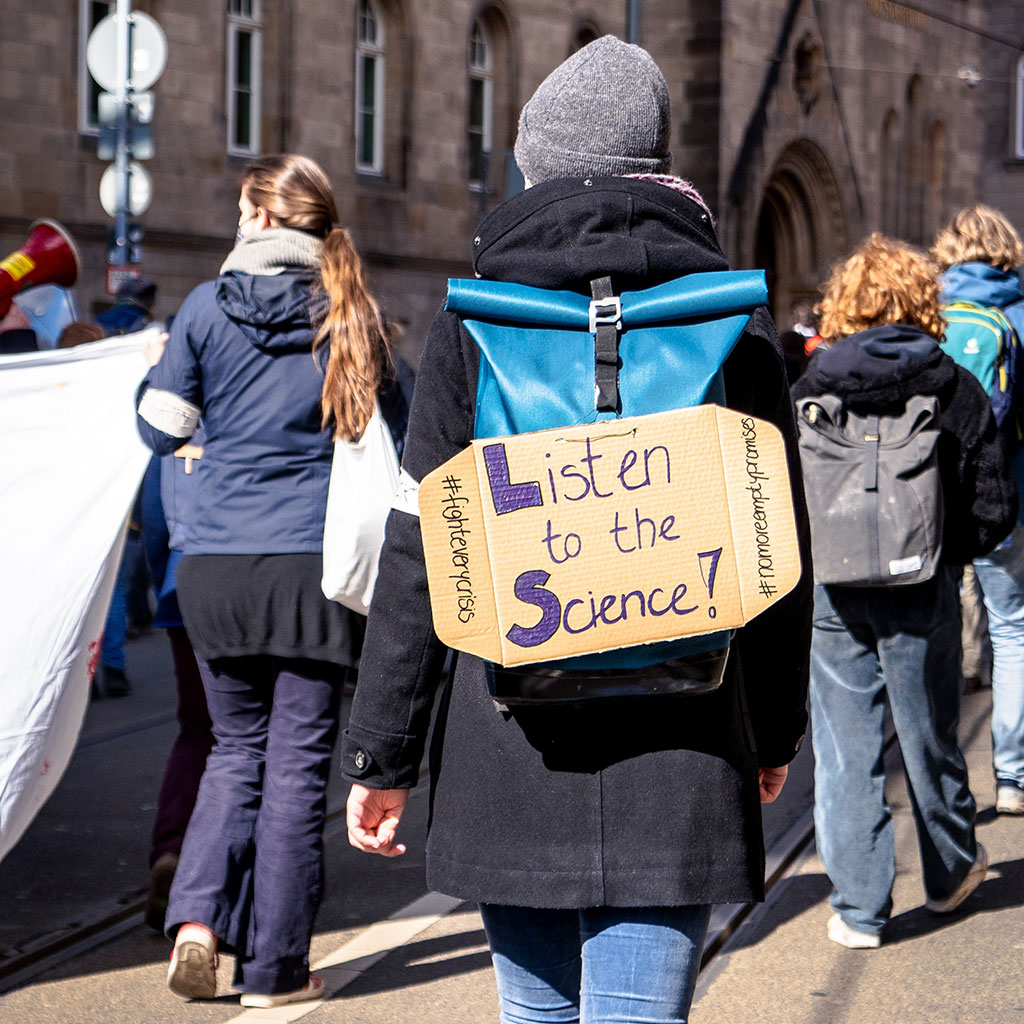
Protesters march for climate change with sign, saying "Listen to the Science" Credit: Mika Baumeister for Unsplash
Credit: Mika Baumeister, Unsplash

Photo of Marilyn Raphael by Ashley Kruythoff, UCLA

It is extremely hot. Again. Everywhere. To date, the 2022 northern summer has been defined by extremely high temperatures and extreme dryness. Across the US, record temperatures are being set. Record temperatures have also been set in the UK and in Europe. Extremely rare wildfires have occurred near London, and across southern Europe numerous wildfires are occurring. Across China heatwaves are becoming hotter and lasting longer and high temperature records are being broken. These extreme temperatures, a clear expression that our climate is changing, are not unique to 2022; the last seven years have been the hottest on record and 2022 is on track to be the eighth. And, the 2018 National Climate Assessment, has noted that not only was the number of hot days increasing every year, but also that the frequency of heat waves in the United States had shifted from an average of two per year in the 1960s to six per year by the 2010s. The extremes are becoming normal, commonplace.  

Who is bearing the brunt?

While our attention is understandably focused on temperature extremes, and the associated wildfires, in this moment, there is sea level rise threatening island countries (nations), global reduction in biodiversity, drought, floods and increasing negative impacts on human health. We are moving inexorably to a world in which it will be distinctly more uncomfortable to live. And while this discomfort is increasingly borne by everyone, it disproportionately affects the poorer, the disadvantaged, among us. The impacts are not equitably distributed, neither globally nor within countries. In fact, as a number of studies show, climate change has a disproportionately larger impact on low-income communities and BIPOC communities around the world.  Some 56% of the world now lives in cities and the warming already due to the urban heat island phenomenon is amplified by the increasingly frequent heatwave occurrence.  

The crisis of climate change is not new

None of the information given in the preceding paragraphs is new to us. The speed with which information is disseminated around the world means that almost everyone has heard some version of this. Almost everyone is aware. But this knowledge, this awareness, does not seem to be spurring us to some unified swift action. Here I am referring to the ordinary citizen as well elected officials. There seems to be a disconnection between the growing recognition of the impacts of climate change and the will to act. This inertia is peculiar, especially considering that when natural disasters occur — hurricanes, earthquakes, etc. — the world (governments as well as individuals) rushes in to provide aid to the stricken regions. As scientists, geographers have been among those sounding the alarm that we are facing a disaster of potentially infinite proportions, one that will affect all of us, yet even we seem unable/helpless to act. How will we — all of us, including those of us who have tried to act — rationalize the general, present inaction in 10 to 20 years from now when we are living with consequences?  

What can we do?

My students continually ask, “What can I, a single person, do to stop climate change?”. This is a question that I am also asked outside the classroom, once people realize that I am a climate scientist. It is an indication that people want to do something to mitigate the effect of climate change, but the size of the problem is so daunting that it is difficult to imagine that an individual can do something that will effect change. This explains some of the inaction that we see — the “problem” is so large that we throw our hands up in despair, we give up. But we shouldn’t. We can do a lot on an individual basis. As my colleague Katharine Hayhoe has pointed out, history is replete with examples of large societal change that did not begin at the top but was spurred by individuals, “ordinary people who used their voices.” Here is an article which lists some simple but effective examples of some things that an individual can do.  

Now, individual action is important and necessary because change begins with the individual. However, we can do a lot more if we are organized. Geographers are fortunate, we have an organization — the AAG — through which we can and should act. Not only on the issue of climate change, but on a variety of issues that are relevant to us as geographers. Am I advocating for the AAG to become a more activist organization? Yes, I am! The good news is that the AAG is already taking some vital steps toward such advocacy:  

  1. We have the Climate Action Task Force (CATF) formed because AAG members petitioned to reduce the level of CO2 emissions generated by our Annual Meetings to one that is commensurate with IPCC recommendations. Quoting immediate past President Emily Yeh, “the Task Force is seeking ways to position AAG as a leader and model of how large organizations can respond to climate change in a manner that both meets the needs of their members and is environmentally and socially just.” I encourage you to read and support what the CATF is doing.  
  2. AAG has issued several statements on climate change, most recently the statement calling for Immediate Executive Action on Climate, urging the Biden Administration to use its executive powers now to rapidly begin to mitigate the present and severe threats of climate change. 
  3. Our recent major overhaul of our website features an Advocacy hub that not only informs members about issues and key policy developments but also provides opportunities to mobilize signatures and actions. Current focus areas are Climate Change, the Geographies of Inclusion, Redistricting, and Supporting Science. I encourage you to visit the site, find out what the organization is doing, and participate. Write to [email protected]  with suggestions for approaches to organized change. 

When we look back 20 years from now, what do we want to say we have done to mitigate climate change? We have the chance to write that script now. We can do this as individuals – even if the steps we take are small, the cumulative effect of small steps is large. especially when taken in concert with other people. The AAG, our organization of geographers, must also act for us and take steps to mitigate climate change 

DOI: 10.14433/2017.0112


Please note: The ideas expressed in the AAG President’s column are not necessarily the views of the AAG as a whole. This column is traditionally a space in which the president may talk about their views or focus during their tenure as president of AAG, or spotlight their areas of professional work. Please feel free to email the president directly at raphael [at] geog [dot] ucla [dot] edu to enable a constructive discussion. 

    Share

Silver Linings in a Mesoscale Convective Complex

Protesters march for climate change with sign, saying "Listen to the Science" Credit: Mika Baumeister for Unsplash
Credit: Mika Baumeister, Unsplash

Photo of Marilyn Raphael by Ashley Kruythoff, UCLA

It is extremely hot. Again. Everywhere. To date, the 2022 northern summer has been defined by extremely high temperatures and extreme dryness. Across the US, record temperatures are being set. Record temperatures have also been set in the UK and in Europe. Extremely rare wildfires have occurred near London, and across southern Europe numerous wildfires are occurring. Across China heatwaves are becoming hotter and lasting longer and high temperature records are being broken. These extreme temperatures, a clear expression that our climate is changing, are not unique to 2022; the last seven years have been the hottest on record and 2022 is on track to be the eighth. And, the 2018 National Climate Assessment, has noted that not only was the number of hot days increasing every year, but also that the frequency of heat waves in the United States had shifted from an average of two per year in the 1960s to six per year by the 2010s. The extremes are becoming normal, commonplace.  

Who is bearing the brunt?

While our attention is understandably focused on temperature extremes, and the associated wildfires, in this moment, there is sea level rise threatening island countries (nations), global reduction in biodiversity, drought, floods and increasing negative impacts on human health. We are moving inexorably to a world in which it will be distinctly more uncomfortable to live. And while this discomfort is increasingly borne by everyone, it disproportionately affects the poorer, the disadvantaged, among us. The impacts are not equitably distributed, neither globally nor within countries. In fact, as a number of studies show, climate change has a disproportionately larger impact on low-income communities and BIPOC communities around the world.  Some 56% of the world now lives in cities and the warming already due to the urban heat island phenomenon is amplified by the increasingly frequent heatwave occurrence.  

The crisis of climate change is not new

None of the information given in the preceding paragraphs is new to us. The speed with which information is disseminated around the world means that almost everyone has heard some version of this. Almost everyone is aware. But this knowledge, this awareness, does not seem to be spurring us to some unified swift action. Here I am referring to the ordinary citizen as well elected officials. There seems to be a disconnection between the growing recognition of the impacts of climate change and the will to act. This inertia is peculiar, especially considering that when natural disasters occur — hurricanes, earthquakes, etc. — the world (governments as well as individuals) rushes in to provide aid to the stricken regions. As scientists, geographers have been among those sounding the alarm that we are facing a disaster of potentially infinite proportions, one that will affect all of us, yet even we seem unable/helpless to act. How will we — all of us, including those of us who have tried to act — rationalize the general, present inaction in 10 to 20 years from now when we are living with consequences?  

What can we do?

My students continually ask, “What can I, a single person, do to stop climate change?”. This is a question that I am also asked outside the classroom, once people realize that I am a climate scientist. It is an indication that people want to do something to mitigate the effect of climate change, but the size of the problem is so daunting that it is difficult to imagine that an individual can do something that will effect change. This explains some of the inaction that we see — the “problem” is so large that we throw our hands up in despair, we give up. But we shouldn’t. We can do a lot on an individual basis. As my colleague Katharine Hayhoe has pointed out, history is replete with examples of large societal change that did not begin at the top but was spurred by individuals, “ordinary people who used their voices.” Here is an article which lists some simple but effective examples of some things that an individual can do.  

Now, individual action is important and necessary because change begins with the individual. However, we can do a lot more if we are organized. Geographers are fortunate, we have an organization — the AAG — through which we can and should act. Not only on the issue of climate change, but on a variety of issues that are relevant to us as geographers. Am I advocating for the AAG to become a more activist organization? Yes, I am! The good news is that the AAG is already taking some vital steps toward such advocacy:  

  1. We have the Climate Action Task Force (CATF) formed because AAG members petitioned to reduce the level of CO2 emissions generated by our Annual Meetings to one that is commensurate with IPCC recommendations. Quoting immediate past President Emily Yeh, “the Task Force is seeking ways to position AAG as a leader and model of how large organizations can respond to climate change in a manner that both meets the needs of their members and is environmentally and socially just.” I encourage you to read and support what the CATF is doing.  
  2. AAG has issued several statements on climate change, most recently the statement calling for Immediate Executive Action on Climate, urging the Biden Administration to use its executive powers now to rapidly begin to mitigate the present and severe threats of climate change. 
  3. Our recent major overhaul of our website features an Advocacy hub that not only informs members about issues and key policy developments but also provides opportunities to mobilize signatures and actions. Current focus areas are Climate Change, the Geographies of Inclusion, Redistricting, and Supporting Science. I encourage you to visit the site, find out what the organization is doing, and participate. Write to [email protected]  with suggestions for approaches to organized change. 

When we look back 20 years from now, what do we want to say we have done to mitigate climate change? We have the chance to write that script now. We can do this as individuals – even if the steps we take are small, the cumulative effect of small steps is large. especially when taken in concert with other people. The AAG, our organization of geographers, must also act for us and take steps to mitigate climate change 

DOI: 10.14433/2017.0112


Please note: The ideas expressed in the AAG President’s column are not necessarily the views of the AAG as a whole. This column is traditionally a space in which the president may talk about their views or focus during their tenure as president of AAG, or spotlight their areas of professional work. Please feel free to email the president directly at raphael [at] geog [dot] ucla [dot] edu to enable a constructive discussion. 

    Share

Resources for Climate Action

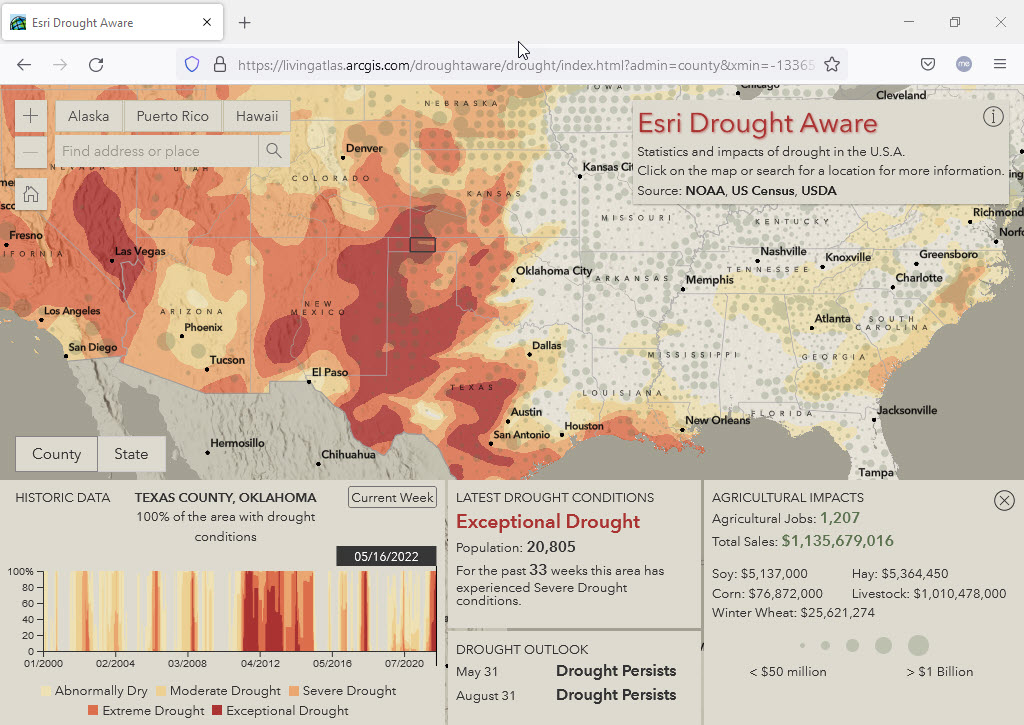
Screenshot of statistics and impacts of drought in the U.S. as mapped in Esri ArcGIS Drought Aware map

This piece by Esri’s Global Education Manager Michael Gould is part of a series of sponsored articles from Esri.


Esri offers a huge collection of resources related to climate and sustainability topics. In 2022 we will publish a collection of learning/teaching resources to help non-climate-specialists at universities (primarily) to introduce climate action topics into their classroom or research activities, with a focus on solutions and opportunities to take action.

Resource Categories

The climate action resource collection is destined to find a home in Esri’s Climate Portal and be composed of packages many of which will include:

  • Datasets, covering physical and social phenomena
  • ArcGIS Learn lesson(s)
  • A StoryMap that sets the stage and provide context to each topic
  • In some cases, lightweb web applications to use when a full GIS implementation is not a requirement.

In order to maximize the general benefit of these resources we are working with collaborators from universities and partner organizations. Some collaborators provide use cases, others subject matter expertise, datasets, and/or frameworks that we can add value to via GIS workflows. One such framework is the collection of Climate Solutions from Project Drawdown. These include topics such as carpooling, bicycle infrastructure, and tree plantation. How can we use ArcGIS to make concrete and quantitative contributions towards those solutions?

Esri has a long track record working on environmental and climate related projects, and a few years back we started hosting a huge collection –hundreds of themes or layers– of curated geographic information: the ArcGIS Living Atlas of the World. Many other Esri resources now draw on that rich data source, and we anticipate that your workflows, classroom exercises, and research projects will do likewise. Not only do you have access to Esri-created data but also to data contributed by collaborators around the world: agencies such as NASA, NOAA, Census, cities and local governments, and commercial partners. You can nominate your own datasets –research results for example– for inclusion in the Living Atlas and the content will be automatically checked for metadata completeness and other measures, and then be human-checked and curated by Esri’s subject matter experts. Once included the dataset is hosted by Esri and made available to GIS users around the world.

In this post, I’ll walk through two scenarios for using these resources to investigate climate issues and developing action plans.

Extreme Drought

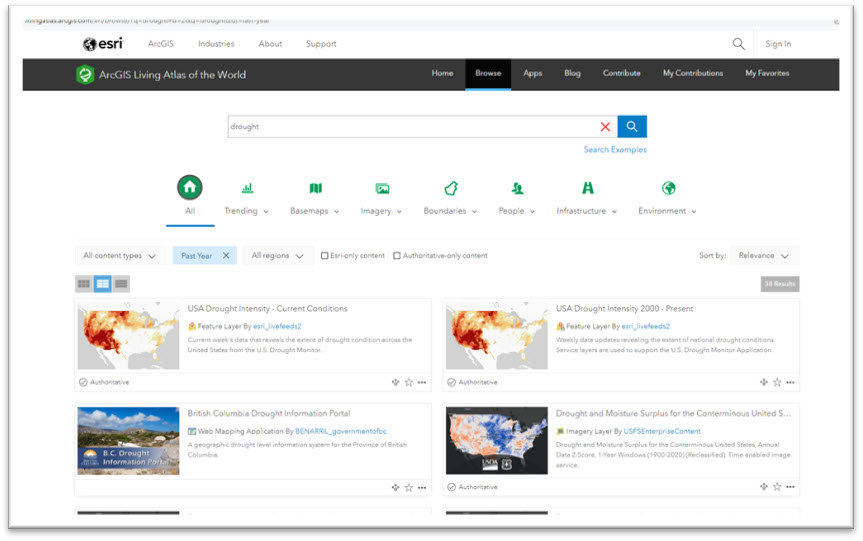
When we search the Atlas on the keyword “climate” and filter on data only from the past year, we find 391 (at the time of this writing) related resources. Try for yourself and experience the diversity of topics, geographical extents, and data contributors.

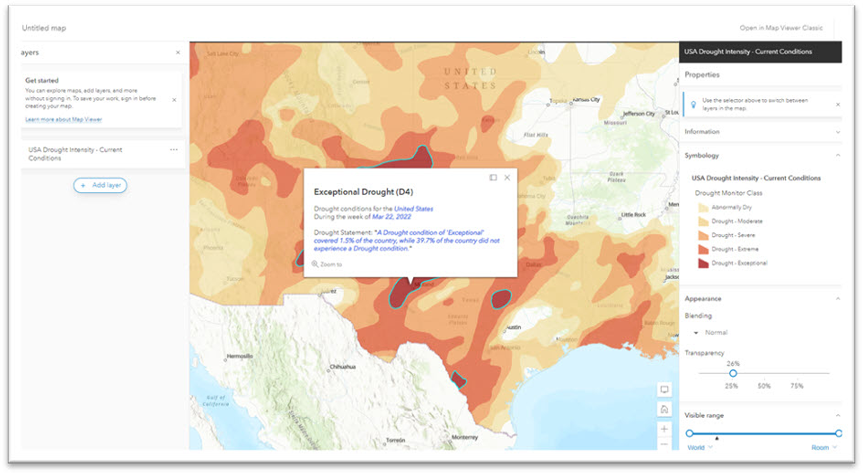
Try other related keywords too, for example environment or drought. The latter points us to NOAA-provided data feeds for the USA, for example US Drought Intensity—Current Conditions which is “live” data updated weekly.

A screenshot of the ArcGIS Living Atlas of the World website
Figure 1. ArcGIS Living Atlas of the World.


A screenshot of a map of drought intensity in the United States
Figure 2. A map of drought intensity in the United States.


This is just one of many examples of up-to-date, climate-oriented data that have been symbolized, pop-ups configured, and made available for your classroom or research projects to be combined with socioeconomic data sources in order to determine who is affected, for example.

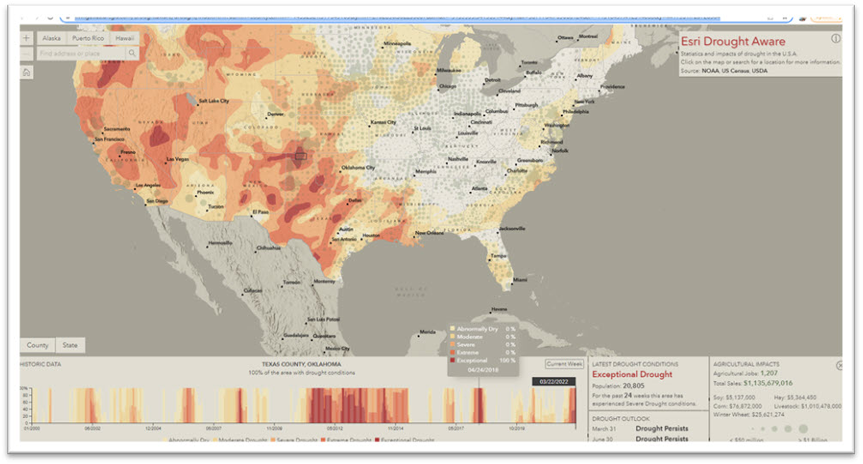
This live-feed feature layer could be used in ArcGIS Pro or the ArcGIS Online Map Viewer, but in this case, it is the basis of the Drought Aware web application that is also hosted on the Living Atlas. In addition to drought data, this app includes layers from the US Census American Community Survey and from the US Department of Agriculture. In the image below, we selected a county in the Oklahoma panhandle and the application queried the drought and underlying census and agricultural data layers to show several indicators below in dashboard style. Texas County, Oklahoma is in a period of extreme drought. While the population is modest (20,000 inhabitants), over $1 Billion of agricultural sales are affected, mostly livestock. Also at the bottom is a time series for that selected county, and we can click on the graph to see drought conditions at any period going back to 2000 (April 2018 selected in this image).

Screenshot of the Drought Aware web app
Figure 3. The Drought Aware app showing historic trends, current conditions, and impacts of drought in the United States.


For more information about the contents and use of the Drought Aware application, one of several thematic “Aware” apps, see creator Dan Pisut’s blog post.

Sea Level Rise

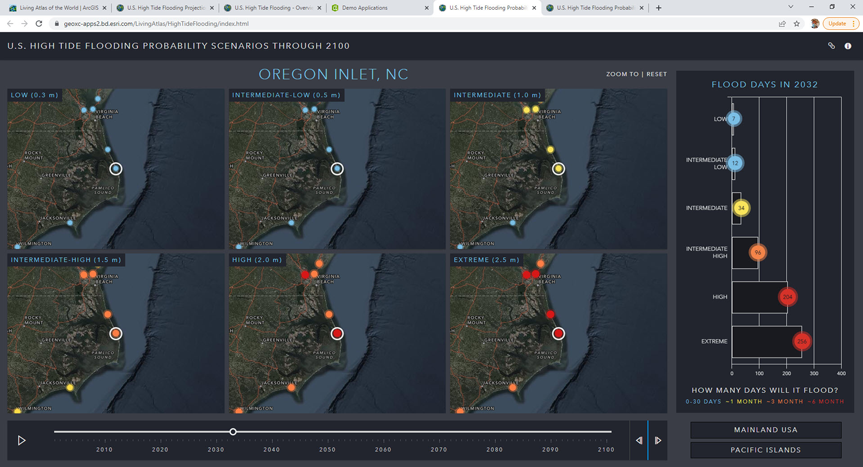
Another climate related issue that can be investigated with GIS is sea level rise, starting with a High Tide Flooding Scenarios dataset also from NOAA. Again that data layer could be used alone, but is included in a web app that compares several flooding scenario predictions through the year 2100. We selected Oregon Inlet, North Carolina, and from the Intermediate flooding model (assuming 1 meter sea level rise) it shows that “sunny day” flooding events would go from 13 (2022) to 34 (2032) days per year. And that’s just in the coming decade and for the fairly conservative Intermediate model: it could be much worse. Try the app for yourself: have a look at the Gulf of Mexico near New Orleans or Houston for example.

Screenshot of maps showing flooding probability
Figure 4. High Tide Flooding Probability Scenarios.


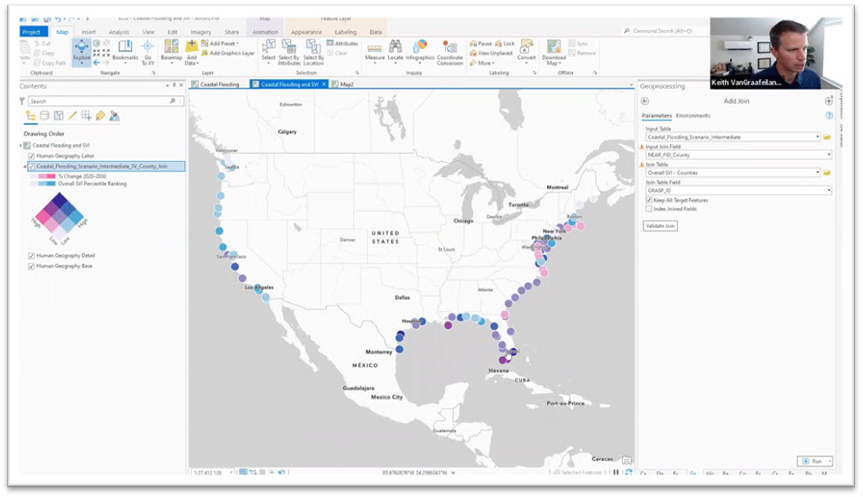
Now, just as with the drought dataset, we can repeat the process known as geo-enrichment to add sociodemographic layers and then drill into specific flooding areas to ask who is or would be affected. We could open the flooding scenarios layer in ArcGIS Pro, select Intermediate, experiment with the time slider, manipulate symbology, and then we can join the CDC Social Vulnerability Index (SVI) 2018 data. SVI data are composed of 15 social factors in 4 themes: Socioeconomic, Housing composition and disability, Minority status and language, and Housing and transportation.

The spatial join used the nearest feature and a 1 Km radius, to create a bivariate map showing percent change in flooding risk and SVI score (see the cube with cyan and magenta symbology) of each location. Colors tending toward purple in the cube indicate high vulnerability.

Screenshot of map showing potential impact of flooding on vulnerable populations
Figure 5. Potential impact of coastal flooding on vulnerable populations.


For more information on this flooding scenario, see this blog post by Keith VanGraafeiland. The javascript code for the High Tide app is available on github.

Create your Own

These are just two examples of climate action workflows that help to help bring home the message of dangerous climate-related phenomena that affect certain populations in certain locations, now and in the future. We encourage you to join us in creating new exercises as part of the Climate Action resource collection, so that other instructors, learners, and researchers can analyze geographic data from their desktop GIS, Map Viewer, or web application. Let’s show the world how GIS can make concrete contributions to climate resilience.

    Share

Brent Sams

Education: Ph.D. in Horticulture (University of Adelaide), Master of Geography (Virginia Tech), B.S. in Geography (University of North Alabama)  

The following profile was compiled by Brendan Vander Weil (Texas State University) for the Encoding Geography initiative. To learn more, visit: https://www.ncrge.org/encoding-geography/ 


Describe your job, employer, and the primary tasks you perform in your position.  

My current role as a Viticulture Research Scientist at E&J Gallo Winery is to design and execute research projects focused on understanding how fruit chemistry/quality change over time and space. I am interested in these changes from the within-vineyard scale to the regional scale. To accomplish this, I (with a lot of help from others) use a wide variety of field measurements (fruit zone light exposure, vine canopy temperature, soil cores, and many others), proximal sensing (electric conductivity, elevation mapping), and remote sensing (satellite, UAV, commercial aircraft). I spend a good deal of time analyzing how these measurements are connected.  

How has your education/background in geography prepared you for this position? 

The interaction of geography and computer science is essential for my role, along with many others in my department. At the project level, I work with different types of datasets that must be organized so that they can be analyzed and interpreted together. I rarely start any of this in GIS, but in a statistics package/program. I don’t have a background in computer science or coding/programming, but these have been very useful skills to develop. Once I have a product/model/application, it needs to be available for use by our stakeholders. This can be a dashboard, a database, or other digestible format which usually implies additional knowledge of other programs or applications. Probably the most specific use of geo-computation in my role is in the geostatistical analyses of grape samples collected from different densities and locations.  

What is an example of applying geography concepts and skills in order to analyze and solve problems in your work? 

Recently, we’ve been working on a project to combine data from multiple vineyards to add statistical robustness to the spatial analysis of low-density grape samples. To validate the method, we divided up the vineyards into fishnet grids to create a Monte Carlo simulation that would iterate through many different combinations of field samples based on their locations.  

What types of geographic questions did you ask and think about in your project? 

We were interested in how wine grape chemistry changed over time and space, and at specific locations from the within-vineyard scale to the regional or statewide scale; how farm management and the environment are connected; and how we could use all of these variables to make predictions about where to find the best fruit. All this information needed to be synthesized and made into something that could be analyzed by a computer. Sometimes in the quantitative analysis world we are faced with qualitative variables and how to incorporate things like, “How does this vineyard manager decide when and how much water to irrigate?.” These then need to be summarized into something we can include in a mathematical model.   

What types of data did you acquire to support your project?  

For this project, we were mostly interested in the chemistry of grapes processed in a lab after the sample location was tagged with a GPS unit. In a related project and at the same locations, we measured soil texture, the fraction of useful light into the fruit zone of the canopy, and yield.  

What types of content knowledge and skills (both geographic and more general) did you use to evaluate, process, and analyze the data you gathered for your project? 

Everything starts with the synthesis of what’s been done, where, and how. Experimental design and sampling strategies are also necessary. There are a lot of measurements specific to grapevines that we used, but general statistical knowledge was also necessary for writing reports, publications, etc. I use R and R Studio quite a bit, as well as several GIS applications with a bunch of different spatial analyses. One specific example is the use of k-means classification with raster datasets to assess patterns that exist between different layers such as interpolated chemistry maps with soil maps or imagery.   

How did you communicate the results of your project (e.g., writing technical reports, making maps and geo-visualizations, creating graphics, data tables, etc.)? Do you have a recent product or publication to share with us as an example?  

There will be a few publications from this data set, as well as reports to internal stakeholders. You can find those publications below:   

  • Sams, B., Bramley, R.G.V., Sanchez, L., Dokoozlian, N.K., Ford, C.M., and Pagay, V. (2022) Remote sensing, yield, physical characteristics, and fruit composition variability in Cabernet Sauvignon vineyards. American Journal of Enology and Viticulture 73, 93-105. 
  • Sams, B., Bramley, R., Sanchez, L., Dokoozlian, N., Ford, C. and Pagay, V. (2022) Characterising spatio-temporal variation in fruit composition for improved winegrowing management in California Cabernet Sauvignon. Australian Journal of Grape and Wine Research. https://doi.org/10.1111/ajgw.12542 
  • Sams, B., Bramley, R., Aboutalebi, M., Sanchez, L., Dokoozlian, N.K., Ford, C.M. and Pagay, V. (2022) Facilitating mapping and understanding of within-vineyard variation in fruit composition using data pooled from multiple vineyards. Australian Journal of Grape and Wine Research. https://doi.org/10.1111/ajgw.12556 

What are the criteria that you use to assess the quality of your results?  

I’m an applied researcher in the private sector, so while the publications are nice, I really want to know if something works. Does it help us do something, save us money, or even make us more money?


This material is based upon work supported by the National Science Foundation under Grants No. 2031418, 2031407, and 2031380 (Collaborative Research: Encoding Geography – Scaling up an RPP to achieve inclusive geocomputational education). Any opinions, findings, and conclusions or recommendations expressed in this material are those of the author(s) and do not necessarily reflect the views of the National Science Foundation 
 

    Share

Member Profile: Tim Fullman

Map showing Arctic Refuge Birds-Eye-View program area created by Marty Schnure

The twice-annual migration of Alaska’s caribou is one of the world’s great journeys. Yet the number of caribou making that trek has been declining for decades due to a variety of factors, including habitat disruption from human activities and a changing environment.

Photo of Tim FullmanGeographer Tim Fullman, senior ecologist with The Wilderness Society, is one of the people working to understand how to conserve the critical habitat on which caribou rely. Using analyses drawn from spatial and interdisciplinary sources, Fullman tracks and predicts herd patterns as they move over Alaska’s public lands. Much of his research focuses on the Western Arctic Caribou Herd (WACH), among the biggest of the state’s 32 caribou herds.
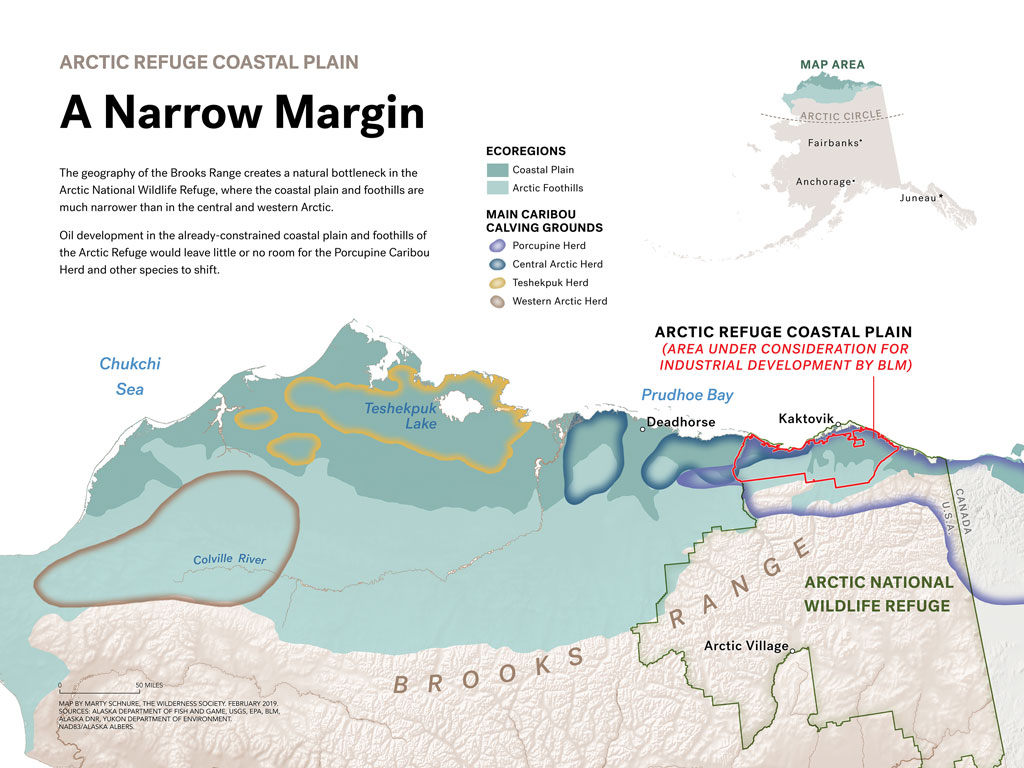
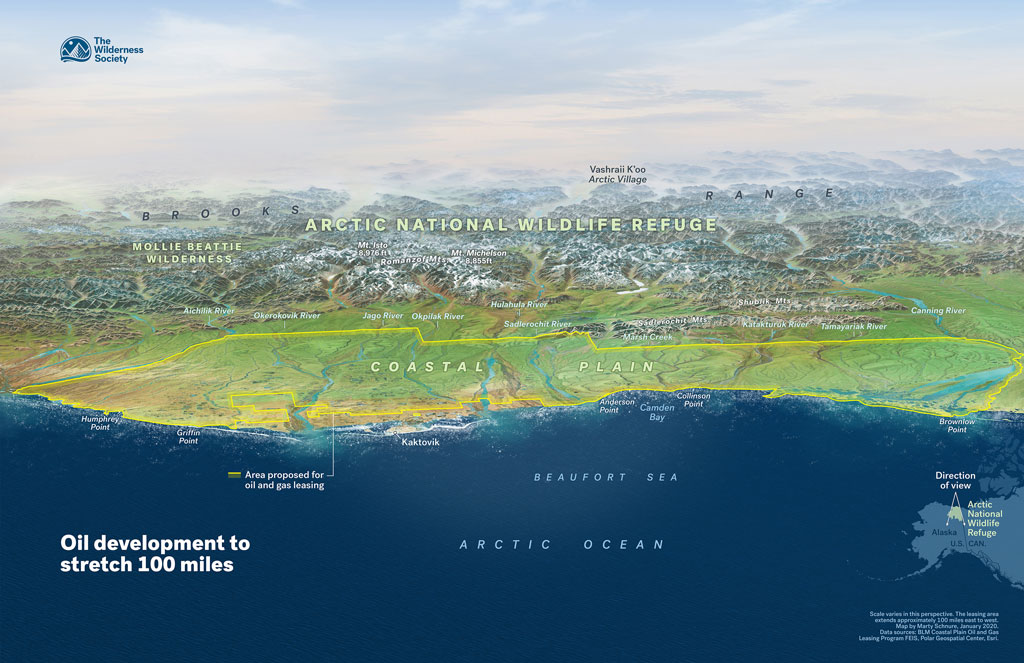
Arctic Refuge Coastal Plain: A Narrow Margin The geography of the Brooks Range creates a natural bottleneck in the Arctic National Wildlife Refuge, where the coastal plain and foothills are much narrower than in the central and western Arctic. Oil development in the already-constrained coastal plain and foothills of the Arctic Refuge would leave little or no room for the Porcupine Caribou Herd and other species to shift.
Arctic Refuge Coastal Plain: A Narrow Margin: The geography of the Brooks Range creates a natural bottleneck in the Arctic National Wildlife Refuge, where the coastal plain and foothills are much narrower than in the central and western Arctic. Oil development in the already-constrained coastal plain and foothills of the Arctic Refuge would leave little or no room for the Porcupine Caribou Herd and other species to shift. Map created by Marty Schnure


Fullman works alongside many partners, from Indigenous community leaders to hunters to tour guides to local, state, and federal wildlife and land professionals. All share a common cause: to preserve the future of Alaska’s caribou in the face of potential impacts from construction projects, energy investments, and climate change. The stakes are high. Alaska’s caribou, once totaling over a million, number 750,000 altogether today. The WACH, alone, has declined by as much as 50 percent since 2004.

In his work, Fullman spends a lot of his time using predictive models, forecasting potential impacts and scenarios that he says are also intimately connected to what we know about now and the past. “To do effective conservation means understanding the past so that we know why things are the way they are now,” he says, “and then using that information now to change the course of the future.”

Geography: The Critical Lens

Starting his career as a wildlife biologist, Fullman discovered that his fieldwork would benefit from an advanced understanding of terrain, place, and migrations. After completing a PhD in geography at the University of Florida, he returned to his work studying large herbivores, this time in Alaska. (Previous research had taken him to southern Africa, where he studied elephants).

Now, he says, his geography expertise takes people by surprise. “In my professional role, I don’t think many people know that I am a geographer, because my title is senior ecologist, and people think of me doing wildlife work,” he says. “Yet I’ve been fascinated as I’ve interacted with more people to come across a number of people with geography backgrounds who are doing work in landscape, ecology, environmental policy, and similar work.”

Why are so many geographers drawn to conservation—or rather, why are many conservationists drawn to geography? “This training seems like it has prepared a number of us to be able to make connections and share, and especially to use maps and other representations to talk about and communicate things in ways that connect with people.”

Geography’s interdisciplinary nature is also a plus: “One of the things that has helped me is that my geography department did not focus a lot on wildlife, but I had colleagues doing human dynamics, economic geography, all sorts of things that fall under the umbrella of geography. I think that prepared me to understand how social science is done, to understand how economics is done, and yet to see the connections where spatial processes and things that happen at space and scale and time influence across all these areas. I think of that as being at the core of geography and what we do.”

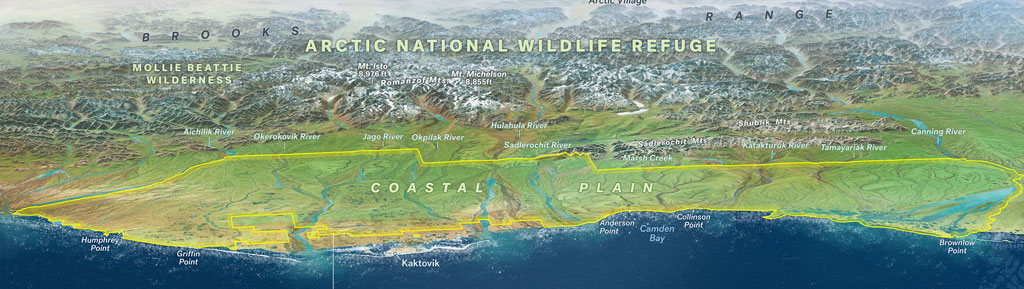
Birds-eye view of the Arctic National Wildlife Refuge coastal plain, known as the 1002 Area, outlined in yellow. This area, which is a critical calving and post-calving habitat for the Porcupine Caribou Herd, was leased by the Bureau of Land Management for its oil and gas program during the Trump Administration. Map created by Marty Schnure


Fullman applies ideas and methods from other disciplines to aid in his modeling work. One of these is circuit theory, adapted by ecologists from the world of electronics, which recently helped Fullman and his colleagues model the impacts of road construction on caribou and other species’ habitat. Another tool is the Monte Carlo simulation, used by Fullman and other researchers to test development restriction scenarios for the National Petroleum Reserve-Alaska (NPR-A): four from the Bureau of Land Management’s current Integrated Activity Plan, and one put forward by the Western Arctic Caribou Herd Working Group, to which Fullman belongs.

Map showing caribou seasonal ranges and proposed development projects created by Marty Schnure
Map showing caribou seasonal ranges and proposed development projects, created by Marty Schnure


Fullman’s training as a geographer has helped him embrace the many perspectives and complex realities of Alaskan habitats. In studying the ancient presence and fragile present of the caribou, he recognizes the long lineage and millennia-old knowledge held by the Indigenous communities within and around the NPR-A. As he brings new tools to the study of the herds, he embraces opportunities to learn and follow traditional ecological knowledge. “I am very classically trained as a scientist but yet through my time in Alaska, it has stretched my view,” he says. “What does it look like to meaningfully combine and blend all the ways of seeing the caribou?”

“Caribou Tell Us a Little Bit About Ourselves”

Fullman’s work contributes to understanding the pressure on caribou, which is part of a much larger and concerning trend of long-range and major migrations of all species—and humans.

“Caribou tell us a little bit about ourselves. They face some of the same challenges we do: warming climate, increasing development, and changing habitat – but with arctic temperatures increasing at double the rate of the rest of the planet, they’re feeling these challenges first,” says Fullman.

“Are we willing in any place to curb our desire to develop?” he asks “There are some places that are too important and too special.”

Find out more about AAG’s work to address climate change
    Share

Member Profile: Lesley-Ann Dupigny-Giroux

Map showing Arctic Refuge Birds-Eye-View program area created by Marty Schnure

The twice-annual migration of Alaska’s caribou is one of the world’s great journeys. Yet the number of caribou making that trek has been declining for decades due to a variety of factors, including habitat disruption from human activities and a changing environment.

Photo of Tim FullmanGeographer Tim Fullman, senior ecologist with The Wilderness Society, is one of the people working to understand how to conserve the critical habitat on which caribou rely. Using analyses drawn from spatial and interdisciplinary sources, Fullman tracks and predicts herd patterns as they move over Alaska’s public lands. Much of his research focuses on the Western Arctic Caribou Herd (WACH), among the biggest of the state’s 32 caribou herds.

Arctic Refuge Coastal Plain: A Narrow Margin The geography of the Brooks Range creates a natural bottleneck in the Arctic National Wildlife Refuge, where the coastal plain and foothills are much narrower than in the central and western Arctic. Oil development in the already-constrained coastal plain and foothills of the Arctic Refuge would leave little or no room for the Porcupine Caribou Herd and other species to shift.
Arctic Refuge Coastal Plain: A Narrow Margin: The geography of the Brooks Range creates a natural bottleneck in the Arctic National Wildlife Refuge, where the coastal plain and foothills are much narrower than in the central and western Arctic. Oil development in the already-constrained coastal plain and foothills of the Arctic Refuge would leave little or no room for the Porcupine Caribou Herd and other species to shift. Map created by Marty Schnure


Fullman works alongside many partners, from Indigenous community leaders to hunters to tour guides to local, state, and federal wildlife and land professionals. All share a common cause: to preserve the future of Alaska’s caribou in the face of potential impacts from construction projects, energy investments, and climate change. The stakes are high. Alaska’s caribou, once totaling over a million, number 750,000 altogether today. The WACH, alone, has declined by as much as 50 percent since 2004.

In his work, Fullman spends a lot of his time using predictive models, forecasting potential impacts and scenarios that he says are also intimately connected to what we know about now and the past. “To do effective conservation means understanding the past so that we know why things are the way they are now,” he says, “and then using that information now to change the course of the future.”

Geography: The Critical Lens

Starting his career as a wildlife biologist, Fullman discovered that his fieldwork would benefit from an advanced understanding of terrain, place, and migrations. After completing a PhD in geography at the University of Florida, he returned to his work studying large herbivores, this time in Alaska. (Previous research had taken him to southern Africa, where he studied elephants).

Now, he says, his geography expertise takes people by surprise. “In my professional role, I don’t think many people know that I am a geographer, because my title is senior ecologist, and people think of me doing wildlife work,” he says. “Yet I’ve been fascinated as I’ve interacted with more people to come across a number of people with geography backgrounds who are doing work in landscape, ecology, environmental policy, and similar work.”

Why are so many geographers drawn to conservation—or rather, why are many conservationists drawn to geography? “This training seems like it has prepared a number of us to be able to make connections and share, and especially to use maps and other representations to talk about and communicate things in ways that connect with people.”

Geography’s interdisciplinary nature is also a plus: “One of the things that has helped me is that my geography department did not focus a lot on wildlife, but I had colleagues doing human dynamics, economic geography, all sorts of things that fall under the umbrella of geography. I think that prepared me to understand how social science is done, to understand how economics is done, and yet to see the connections where spatial processes and things that happen at space and scale and time influence across all these areas. I think of that as being at the core of geography and what we do.”

Birds-eye view of the Arctic National Wildlife Refuge coastal plain, known as the 1002 Area, outlined in yellow. This area, which is a critical calving and post-calving habitat for the Porcupine Caribou Herd, was leased by the Bureau of Land Management for its oil and gas program during the Trump Administration. Map created by Marty Schnure


Fullman applies ideas and methods from other disciplines to aid in his modeling work. One of these is circuit theory, adapted by ecologists from the world of electronics, which recently helped Fullman and his colleagues model the impacts of road construction on caribou and other species’ habitat. Another tool is the Monte Carlo simulation, used by Fullman and other researchers to test development restriction scenarios for the National Petroleum Reserve-Alaska (NPR-A): four from the Bureau of Land Management’s current Integrated Activity Plan, and one put forward by the Western Arctic Caribou Herd Working Group, to which Fullman belongs.

Map showing caribou seasonal ranges and proposed development projects created by Marty Schnure
Map showing caribou seasonal ranges and proposed development projects, created by Marty Schnure


Fullman’s training as a geographer has helped him embrace the many perspectives and complex realities of Alaskan habitats. In studying the ancient presence and fragile present of the caribou, he recognizes the long lineage and millennia-old knowledge held by the Indigenous communities within and around the NPR-A. As he brings new tools to the study of the herds, he embraces opportunities to learn and follow traditional ecological knowledge. “I am very classically trained as a scientist but yet through my time in Alaska, it has stretched my view,” he says. “What does it look like to meaningfully combine and blend all the ways of seeing the caribou?”

“Caribou Tell Us a Little Bit About Ourselves”

Fullman’s work contributes to understanding the pressure on caribou, which is part of a much larger and concerning trend of long-range and major migrations of all species—and humans.

“Caribou tell us a little bit about ourselves. They face some of the same challenges we do: warming climate, increasing development, and changing habitat – but with arctic temperatures increasing at double the rate of the rest of the planet, they’re feeling these challenges first,” says Fullman.

“Are we willing in any place to curb our desire to develop?” he asks “There are some places that are too important and too special.”

Find out more about AAG’s work to address climate change
    Share

How Can We Reduce Geography’s Carbon Footprint? The AAG’s Climate Forward Initiative

Translating Geography Degrees into Environmental, Conservation, and Sustainability Work

Wayfinding: Young Geographers Unearth Clue to Climate Change in the Andes

Map showing Arctic Refuge Birds-Eye-View program area created by Marty Schnure

The twice-annual migration of Alaska’s caribou is one of the world’s great journeys. Yet the number of caribou making that trek has been declining for decades due to a variety of factors, including habitat disruption from human activities and a changing environment.

Photo of Tim FullmanGeographer Tim Fullman, senior ecologist with The Wilderness Society, is one of the people working to understand how to conserve the critical habitat on which caribou rely. Using analyses drawn from spatial and interdisciplinary sources, Fullman tracks and predicts herd patterns as they move over Alaska’s public lands. Much of his research focuses on the Western Arctic Caribou Herd (WACH), among the biggest of the state’s 32 caribou herds.

Arctic Refuge Coastal Plain: A Narrow Margin The geography of the Brooks Range creates a natural bottleneck in the Arctic National Wildlife Refuge, where the coastal plain and foothills are much narrower than in the central and western Arctic. Oil development in the already-constrained coastal plain and foothills of the Arctic Refuge would leave little or no room for the Porcupine Caribou Herd and other species to shift.
Arctic Refuge Coastal Plain: A Narrow Margin: The geography of the Brooks Range creates a natural bottleneck in the Arctic National Wildlife Refuge, where the coastal plain and foothills are much narrower than in the central and western Arctic. Oil development in the already-constrained coastal plain and foothills of the Arctic Refuge would leave little or no room for the Porcupine Caribou Herd and other species to shift. Map created by Marty Schnure


Fullman works alongside many partners, from Indigenous community leaders to hunters to tour guides to local, state, and federal wildlife and land professionals. All share a common cause: to preserve the future of Alaska’s caribou in the face of potential impacts from construction projects, energy investments, and climate change. The stakes are high. Alaska’s caribou, once totaling over a million, number 750,000 altogether today. The WACH, alone, has declined by as much as 50 percent since 2004.

In his work, Fullman spends a lot of his time using predictive models, forecasting potential impacts and scenarios that he says are also intimately connected to what we know about now and the past. “To do effective conservation means understanding the past so that we know why things are the way they are now,” he says, “and then using that information now to change the course of the future.”

Geography: The Critical Lens

Starting his career as a wildlife biologist, Fullman discovered that his fieldwork would benefit from an advanced understanding of terrain, place, and migrations. After completing a PhD in geography at the University of Florida, he returned to his work studying large herbivores, this time in Alaska. (Previous research had taken him to southern Africa, where he studied elephants).

Now, he says, his geography expertise takes people by surprise. “In my professional role, I don’t think many people know that I am a geographer, because my title is senior ecologist, and people think of me doing wildlife work,” he says. “Yet I’ve been fascinated as I’ve interacted with more people to come across a number of people with geography backgrounds who are doing work in landscape, ecology, environmental policy, and similar work.”

Why are so many geographers drawn to conservation—or rather, why are many conservationists drawn to geography? “This training seems like it has prepared a number of us to be able to make connections and share, and especially to use maps and other representations to talk about and communicate things in ways that connect with people.”

Geography’s interdisciplinary nature is also a plus: “One of the things that has helped me is that my geography department did not focus a lot on wildlife, but I had colleagues doing human dynamics, economic geography, all sorts of things that fall under the umbrella of geography. I think that prepared me to understand how social science is done, to understand how economics is done, and yet to see the connections where spatial processes and things that happen at space and scale and time influence across all these areas. I think of that as being at the core of geography and what we do.”

Birds-eye view of the Arctic National Wildlife Refuge coastal plain, known as the 1002 Area, outlined in yellow. This area, which is a critical calving and post-calving habitat for the Porcupine Caribou Herd, was leased by the Bureau of Land Management for its oil and gas program during the Trump Administration. Map created by Marty Schnure


Fullman applies ideas and methods from other disciplines to aid in his modeling work. One of these is circuit theory, adapted by ecologists from the world of electronics, which recently helped Fullman and his colleagues model the impacts of road construction on caribou and other species’ habitat. Another tool is the Monte Carlo simulation, used by Fullman and other researchers to test development restriction scenarios for the National Petroleum Reserve-Alaska (NPR-A): four from the Bureau of Land Management’s current Integrated Activity Plan, and one put forward by the Western Arctic Caribou Herd Working Group, to which Fullman belongs.

Map showing caribou seasonal ranges and proposed development projects created by Marty Schnure
Map showing caribou seasonal ranges and proposed development projects, created by Marty Schnure


Fullman’s training as a geographer has helped him embrace the many perspectives and complex realities of Alaskan habitats. In studying the ancient presence and fragile present of the caribou, he recognizes the long lineage and millennia-old knowledge held by the Indigenous communities within and around the NPR-A. As he brings new tools to the study of the herds, he embraces opportunities to learn and follow traditional ecological knowledge. “I am very classically trained as a scientist but yet through my time in Alaska, it has stretched my view,” he says. “What does it look like to meaningfully combine and blend all the ways of seeing the caribou?”

“Caribou Tell Us a Little Bit About Ourselves”

Fullman’s work contributes to understanding the pressure on caribou, which is part of a much larger and concerning trend of long-range and major migrations of all species—and humans.

“Caribou tell us a little bit about ourselves. They face some of the same challenges we do: warming climate, increasing development, and changing habitat – but with arctic temperatures increasing at double the rate of the rest of the planet, they’re feeling these challenges first,” says Fullman.

“Are we willing in any place to curb our desire to develop?” he asks “There are some places that are too important and too special.”

Find out more about AAG’s work to address climate change
    Share