UT McClung Museum Receives Large Gift of Rare Maps
Almost 200 rare maps of Europe and other parts of the world created between the 1500s and 1800s now belong to the University of Tennessee, Knoxville.
The UT McClung Museum of Natural History and Culture recently received the large gift from private donors.
Twenty of the maps are currently on display in UT’s Burchfiel Geography Building. These, and the other maps housed in the museum’s collections, will be used for exhibition and teaching at the museum. They also will be used for undergraduate and graduate coursework on the history of maps and mapmaking from the 16th century onward and the importance of such maps to navigation, world politics, business and trade, agriculture, exploration, colonialism and warfare.
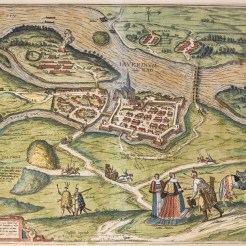
A bird’s-eye view of Gyor in Hungary; made by Georg Braun and Frans Hogenberg in Cologne, 1598.
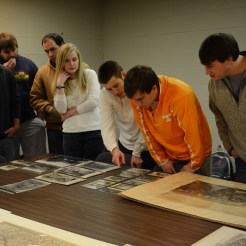
Students in Jovana Babovic’s Central European Cities class discuss political power, cultural perception and urban development as they view 17th- and 18th-century maps in the McClung Museum’s object study room.
“This collection of maps is a meaningful addition to our resources available for teaching, and several UT faculty have already taken advantage of the availability of the maps as a tool for inspiring meaningful discussions in their classrooms about cultural identity, political boundaries and change, as well as socioeconomic conditions,” said Lindsey Waugh, the McClung Museum’s coordinator of academic programs.
Most of the 191 maps are copperplate engravings with painstakingly applied hand color. They were created by mapmaking giants of the 16th to 18th centuries, including Gerard Mercator, the famous cartographer who was the first to plot the straight-line courses (Mercator projection) typical on today’s maps; Abraham Ortelius, the creator of the first modern atlas; Nicholas Visscher, whose family made some of the most famous maps during the golden age of Dutch mapmaking; and Guillaume DeLisle, popular for his maps of newly explored Africa and the Americas.
The gift came to the museum from Jeffery M. Leving, attorney and founder of Fathers’ Rights in Chicago. Two additional maps were gifted by Orrin Lippoff of Brooklyn, New York, and Robert J. Isakson of Mobile, Alabama. The museum worked closely with W. Graham Arader III, owner of Arader Galleries and a longtime UT donor, who facilitated these gifts.
Henri Grissino-Mayer, professor in the UT Department of Geography, noted that the maps will serve both the department and museum’s missions “to teach students, professors and visitors the importance of space and place in human history, that to know where things are is to know better why they are.”
The gift supplements the museum’s existing natural history print collection, which includes more than 3,000 16th- to 19th-century prints of animals, plants and exploration around the world and is one of the strongest collections of natural history prints in the region.
For more information about the McClung Museum and its collections and exhibits, visit https://mcclungmuseum.utk.edu.
Every month the AAG compiles a list of newly-published books in geography and related areas. Some are selected for review in the AAG Review of Books.
Publishers are welcome to send new volumes to the Editor-in-Chief (Kent Mathewson, Editor-in-Chief, AAG Review of Books, Department of Geography and Anthropology, Louisiana State University, Baton Rouge, LA 70803).
Anyone interested in reviewing these or other titles should also contact the Editor-in-Chief.
Mapping Native America: Cartographic Interactions between Indigenous Peoples, Government and Academia; Volume I: Cartography and the Government by Daniel G. Cole and Imre Sutton (eds.) (Daniel G. Cole 2014, https://www.createspace.com/4911389)
Mapping Native America: Cartographic Interactions between Indigenous Peoples, Government and Academia; Volume II: Cartography and the Academy by Daniel G. Cole and Imre Sutton (eds.) (Daniel G. Cole 2014, https://www.createspace.com/4911626)
Mapping Native America: Cartographic Interactions between Indigenous Peoples, Government and Academia; Volume III: Cartography and Indigenous Autonomy by Daniel G. Cole and Imre Sutton (eds.) (Daniel G. Cole 2014, https://www.createspace.com/4911691)
Op-Ed: #KickOutTheKKK: Challenging White Supremacy at UNC
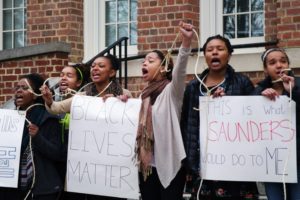
Figure 1. UNC students protesting for the renaming of Saunders Hall as Hurston Hall (courtesy of The Daily Tar Heel/Claire Collins)
On May 28, 2015, the Board of Trustees at the University of North Carolina (UNC) at Chapel Hill voted to rename Saunders Hall—the building in which the Geography Department is located—following months of student protest that garnered national attention. Nearly a century ago, this building was named in honor of William L. Saunders (1835—1891), a white supremacist who played a leading role in the Ku Klux Klan of North Carolina during the nineteenth century. When the name was bestowed in 1920, the university’s Board of Trustees listed Saunders’ leadership in the KKK as one of his accomplishments deserving recognition. Naming a building for Saunders was therefore a clear attempt to inscribe the legacy of white supremacy into the very fabric of the university’s cultural landscape. And the fact that the building’s name endured for over 90 years speaks to how legacies of anti-black racism are a largely unquestioned and taken-for-granted aspect of our everyday surroundings, both on and off university campuses. We say “largely” because the power of every racialized landscape never goes completely unchallenged, and Saunders Hall was no exception.
Over the years, students led various efforts to have this building renamed, particularly during the anti-apartheid struggles of the 1980s and early 1990s. For example, 25 years ago, students published an op-ed about Saunders’ legacy in the independent student newspaper at UNC, declaring: “Building should not be named for former KKK grand dragon” (Robinson and Hafer in Daily Tar Heel, 1990). These calls to rename Saunders Hall encountered institutional resistance and were largely ignored by university administrators (Chapman, 2006; Babatunde, 2015).
When resistance to renaming places is articulated, it usually takes the form of an argument that the act of renaming will “erase history”—an argument that surfaced, in recent debates over renaming Saunders Hall, among some progressive as well as conservative voices. Yet a distinction must certainly be drawn between acknowledging the past and bestowing honor upon a historical figure through commemoration. The naming of university buildings after individuals is, without question, a case of the latter. As UNC’s Policy on Naming University Facilities and Units states, “[t]he act of naming a University facility or unit for a person … is the conferral by the University of a high and conspicuous honor.” Maintaining a building named in Saunders’ honor, particularly in the face of anti-racist calls to remove it, thus signified the university’s ongoing commitment to honoring the legacy of white supremacy on campus.
Even in 2015, the campaign to rename Saunders Hall was hard fought and proponents, who included geography faculty and students among others, faced considerable opposition. The student activist group, The Real Silent Sam Coalition, held protests on campus and via social media that galvanized national media coverage, drawing on a creative array of tactics—from performance art, the spoken word, poetry, a capella singing, artwork, t-shirts, banners, a manifesto, and the #KickOutTheKKK hashtag to the dramatic reenactment of racist speech from a 1913 Confederate memorialization on campus. The coalition also reproduced a document from the university archives, and regularly posted it around the building all spring, illustrating that the building had not been named despite William Saunders’ role in the KKK, but in fact because of it. Saunders’ position as “Head of the Ku Klux Klan of North Carolina” was indeed acknowledged in Board of Trustees’ proceedings in 1920 as one of his positive contributions, listed only after his status as a Confederate officer, and above his positions as Secretary of State, Treasurer, and Compiler and Editor of the Colonial Records of North Carolina. While the latter position has been the one most frequently identified by the university in recent years as the main reason for naming Saunders Hall, which then housed the History Department, it is evident that much more was at play in naming the building after Saunders as “one of the master minds of North Carolina,” amounting to a kind of victory lap for supporters of the KKK in the state and the university. Shedding light on this history of white supremacy in the campus landscape, the protests garnered support for change among UNC students, staff, and faculty, along with opposition, compelling the Board of Trustees to respond.
In May 2015, the Board of Trustees eventually approved the removal of Saunders’ name from the Hall in a 10-3 vote, but they also passed a 16-year moratorium on any further campus name changes and chose the generic and booster-laden name of “Carolina Hall” to replace that of Saunders, reflecting deep anxieties over the conservation of the university’s signature landscape at a moment of rapid cultural change. The renaming of Saunders Hall is an important achievement but in some ways remains a low bar to set for the naming of university buildings; that is, for students to take classes in a building that is not named for a KKK leader from a brutal period of racial terror in central North Carolina.
Student activists had demanded—and continue to demand—that the building carry the name “Hurston Hall,” to memorialize African American writer Zora Neale Hurston and challenge UNC’s gendered politics, as well as its racialized politics, of public memory (The Real Silent Sam Coalition, 2015). During the 1930s, Hurston was the first black student to attend UNC when she studied with Pulitzer Prize-winning playwright Paul Green. Since African Americans were not allowed to enroll during the Jim Crow era, there is no official record of Hurston’s attendance. UNC’s Board of Trustees used this fact to avoid consideration of Hurston’s name despite strong and vocal student support. Seventy-five years ago, when courts forced the university to desegregate (at least on a token basis), it was African American men who were first enrolled, revealing the complex entanglements of racism and sexism in the campus’ lived history. Even today there are only 16 buildings named for women at UNC, with the vast majority of cases being those of women who were part of a joint naming with their husbands. Only 8 UNC buildings are named for African Americans, and women of color are remembered in the monikers of a mere 4 campus buildings (or 2.5% of the total).
Importantly, the Real Silent Sam Coalition’s struggle in Chapel Hill is part of a growing movement to reconsider why college buildings are named after white supremacists (Svokos, 2015). Such debates are particularly active at schools in the South, such as Clemson, Duke, East Carolina, Radford, and Winthrop, yet similar efforts have arisen across the border in Canada as well. In British Columbia, for instance, students at the University of Victoria unsuccessfully lobbied to rename Joseph Trutch Residence Hall in 2010, which honors a politician known for dramatically reducing First Nations reserve lands in the province. One key challenge for activists is that momentum behind student-led movements is hard to sustain from one cohort of students to the next, a fact university administrators use to their advantage by simply waiting for collective amnesia to sink in again once a vocal group of students graduates. In such cases, faculty can help sustain the memory of past struggles by sharing the history and tactics of social movements with each incoming cohort of university students.
As the situation in Chapel Hill illustrates, geographers are especially well-equipped to play a leading role in social justice struggles over the production of commemorative landscapes on college campuses and beyond. In particular, the discipline of geography has much to offer to understanding and intervening within debates over the politics of place by challenging institutional authorities and university communities to reassess the meanings, values, and identities inscribed into campus geographies through place naming and other forms of commemoration. Even after name changes are made, the need among students for understanding both the contemporary and historical contexts of symbolic practices of naming are no less acute; perhaps more so, as the case of the newly dubbed Carolina Hall suggests.
While some of the most provocative ideas about anti-racism and social change originate at universities, academic geographers could surely do much more to challenge the complicity of their own campus landscapes in perpetuating racism and sexism. With this mind, we call on our fellow geographers at other universities to begin conducting close and critical readings of their own university campuses, engaging the student body and broader public in challenging the legacy of white supremacy that has been etched into the names of buildings, streets, stadia, and parks that collectively form the commemorative landscapes of higher education in America.
Reuben Rose-Redwood, University of Victoria
Derek Alderman, University of Tennessee at Knoxville
Altha Cravey, University of North Carolina at Chapel Hill
Scott Kirsch, University of North Carolina at Chapel Hill
Omololu Refilwe Babatunde, University of North Carolina at Chapel Hill
Josh Inwood, University of Tennessee at Knoxville
Every month the AAG compiles a list of newly-published books in geography and related areas. Some are selected for review in the AAG Review of Books.
Publishers are welcome to send new volumes to the Editor-in-Chief (Kent Mathewson, Editor-in-Chief, AAG Review of Books, Department of Geography and Anthropology, Louisiana State University, Baton Rouge, LA 70803).
Anyone interested in reviewing these or other titles should also contact the Editor-in-Chief.
The Anomie of the Earth: Philosophy, Politics, and Autonomy in Europe and the Americas by Federico Luisetti, John Pickles and Wilson Kaiser (eds.) (Duke University Press 2015, https://www.dukeupress.edu/The-Anomie-of-the-Earth)
The Colorado Plateau VI: Science and Management at the Landscape Scale by Laura F. Huenneke, Charles van Riper III, Kelley A. Hays-Gilpin (eds.) (University of Arizona Press 2015, http://www.uapress.arizona.edu/Books/bid2511.htm)
Dan Gade, emeritus professor at the University of Vermont, and a geographer with diverse interests who pursued fieldwork on four continents over four decades, passed away on June 15, 2015, aged 78.
Daniel Wynne Gade was born in Niagara Falls, NY, on September 28, 1936. He completed his bachelor’s degree at Valparaiso University, IN, in 1959, immediately followed by an MA at University of Illinois at Champaign-Urbana (1960), then an MS (1961) and PhD (1967) both at the University of Wisconsin-Madison.
His doctoral research examined ecological relationships in peasant societies, and a grant from the National Academy of Sciences–National Research Council underwrote his fieldwork in southern Peru. His thesis was entitled “Plant use and folk agriculture in the Vilcanota Valley of Peru: a cultural-historical geography of plant resources” and he began to emerge as a leading proponent of the so-called Berkeley school of geographical thought.
Gade was appointed by the University of Vermont (UVM) in 1966, one of four dedicated young geographers tasked with establishing a new geography department to offer courses at both undergraduate and graduate levels. He remained at UWM for his whole career enjoying a succession of promotions in the geography department and a ten-year stint as Chair of the Latin American Studies Program (1977-87).
Over the years, the courses he taught were primarily in the fields of cultural geography, cultural ecology (with the anthropology department), and the geography of Latin America. For more than a decade, he also taught an elective course, always heavily subscribed, on the geography of wine.
In broadest terms, Gade’s scholarship examined the many kinds of connections that tie humans, in their cultural and temporal settings, to the earth and its resources. This took him into various academic subfields including cultural-historical geography, environmental history, ethnobiology, cultural ecology, and biogeography.
Gade’s wide-ranging research interests were underpinned by fieldwork. In fact, he was an enthusiastic field geographer energized by distant, exotic lands and cultures. He undertook research projects in various countries of Latin America, France, Italy, Madagascar, Ethiopia, Spain, Portugal and Quebec. He received support from the Social Science Research Council for further work in Peru in 1970, and from the National Geographic Society in 1977 for a project in the western Amazon. He received a Fulbright Research Award for work in Madagascar in 1983; a research grant in 1989-90 from the Comite Conjunto of the Government of Spain to do research in the Archivo General de Indias in Seville; and another Fulbright Award to visit Brazil and Argentina in 1993.
This varied field research resulted in publications on topics as diverse as: the verticality of Peruvian Indian agriculture, the concept of nature and culture, cultural history of coca leaf, manioc ecology, lightning and religion, Madagascar’s deforestation problem, the shaman as an archetype, appellation controlee of a French wine, ethnobotany and Nazi ideology, hyena predation in Ethiopia, and synanthropy of the American crow.
Gade authored five books, around 150 articles and book chapters in five languages in a wide variety of anthropological, geographical and interdisciplinary publications, and more than 50 book reviews. His publications were of consistently high quality, and often cited. For years, he was the U.S. correspondent for the Bibliographie Geographique Internationale and an editor of the Handbook of Latin American Studies prepared at the Library of Congress in Washington.
During his final year before retirement, the UVM Graduate College designated Gade a University Scholar in the Social Sciences and Humanities. Although he retired in 1999 and became professor emeritus, he continued with his academic work, starting with a residential fellowship at the Camargo Foundation in Cassis, France in 2000.
Retirement saw a continuation of his prodigious publications output, with dozens of papers and book reviews, and, of particular note, three major books. Madagascar: Madagasikara (McDonald and Woodward, 1996) was a primer giving an overview of the physical geography and climate, culture and traditions, society and economy of the island nation. Nature and Culture in the Andes (University of Wisconsin Press, 1999) was a suite of graceful, sweeping essays on the relations between landscape and people in the Andean countries of South America. This a masterful work pulled together disparate themes and materials, and weaving scientific analysis with personal reflections. More recently, Curiosity, Inquiry, and the Geographical Imagination (Peter Lang, 2011) was also a wonderful piece of academic writing about intellectual curiosity as the driving force in scholarly endeavor. In typical Gade style, it combined the empirical with the philosophical and reflexive, and straddled the borders between geography, history, anthropology, and other disciplines. Six weeks before his death, Gade submitted another manuscript to publishers in New York: Spell of the Urubamba, a series of essays combining geography, history and anthropology.
Gade was a member of the Conference of Latin Americanist Geographers who gave him the Eminent Latin Americanist Career Award in 1993. He was also a member of Association of American Geographers and received the Robert Netting Award in 2011 in recognition of distinguished scholarship linking geography and anthropology. In addition, he was a member of the American Geographical Society, the International Mountain Society, and the Society of Ethnobiology.
Gade had an unusually diverse intellectual curiosity about the world and his work manifested an unwavering love of fieldwork. Over the decades he inspired thousands of students and was widely respected by his peers who have described him as “one of the most traveled and cosmopolitan scholars in cultural and historical geography” (Stanley D. Brunn, University of Kentucky) and “a master cultural geographer” (Kent Mathewson, Louisiana State University).
Dan is survived by his beloved wife of 49 years, Mary Scott Killgore Gade, their son, Christopher Pierre Gade, and his granddaughter, Skyler Scott Gade. His wish was for some of his ashes be buried on Camel’s Hump in Vermont and the rest on an Inca terrace in the Urubamba Valley in Peru.
Campbell Pennington, a distinguished geographer who spent his career studying the material cultures and languages of indigenous peoples of northern Mexico, passed away on June 13, 2015, aged 97.
Campbell White Pennington was born on February 2, 1918 in Campbell’s Corner (now Farragut), Tennessee, moving to Austin, Texas, in the early 1920s with his parents, six brothers and a great aunt.
Education and culture were integral parts of Pennington’s upbringing, due in large part to the influence of four women. Foremost among these was his mother, a graduate of Wofford College, who insisted that her children read and “behave in a proper way.” In the home of two spinster sisters who lived across the road he was exposed to art, oriental rugs, pressed linens, classical music, porcelain and crystal, sterling cutlery, fine food, and language, while another lady neighbor gave him piano lessons.
Pennington often recalled the time his father gave him 25 cents, put him on a streetcar, pointed toward the University of Texas (UT), and said “Scat!” At UT, he completed a BA in history (1947) and an MA in sociology (1949). He also met Donald D. Brand, a prominent Latin Americanist geographer, who would not entertain thoughts of him pursuing a PhD at Johns Hopkins or Syracuse, insisting instead that he go to the University of California at Berkeley.
The notion of studying in the Bay Area was met with enthusiasm, as Pennington had enjoyed the culture of San Francisco while on leave from his Army duties at a POW camp for captured German soldiers.
Pennington’s days at Berkeley produced some of his fondest memories, especially of people, including William M. Denevan, Yi-Fu Tuan and James J. Parsons. But it was the great Carl Sauer who was his intellectual hero. When Pennington expressed an interest in the native people of the Sierra Madre of northern México, it was Sauer who endorsed him without reservation.
Pennington set out in the early 1950s to conduct field research in what would become his “beloved Chihuahua.” In no small way, his interest in northern México was sparked by his great uncle, Gordon Campbell White, who was director of the Mexican division of the Southern Pacific Railroad in the early 20th century.
Completed in 1959, Pennington’s dissertation was published with the title “The Tarahumar of Mexico: Their Environment and Material Culture” (1963, 1996). Subsequent research resulted in books on The Tepehuan of Chihuahua: Their Material Culture (1969) and The Pima Bajo of Central Sonora, Mexico (1980). He never finished The Mountain Pima of Maicoba, Sonora: Their Material Culture but chapter drafts and notes are archived in the Nettie Lee Benson Latin American Library at The University of Texas at Austin. Plants he collected while conducting field work in México were identified by B.L. Turner and are curated in UT’s herbarium.
In the course of conducting field research in places accessible only by mule or on foot, he also did archival research. Records maintained by 17th and 18th century Jesuit missionaries were of particular fascination, in part because of what they said about material culture, but also because of what they contained in regard to indigenous languages. Pennington compiled dictionaries of three Sonoran languages, two of which are now extinct, Ópata and Eudeve. The former was never published but exists in manuscript form in the Benson Library while dictionaries of Pima and Eudeve in 1979 and 1981 respectively.
All of his writing was done on a typewriter, much of it on an IBM Selectric. Close friends remember well his quest for a type ball with foreign letters and accents! Pennington was the consummate letter writer. Although he never relinquished his typewriter–using it later for notes and envelopes–he was an early adopter of computers. He purchased his first when he was 80 years old, and quickly began using email and was adroit with the internet.
A teacher as well as a scholar, Pennington held three academic positions. The first was at the University of Utah (1957-1964), an institution with a strong reputation in the publishing of research on native peoples of the Americas. Next, he went to Southern Illinois University (1964-1974) where he worked closely with anthropologists, J. Charles Kelley and Carroll L. Riley, producing a book entitled Man Across the Sea: Problems of Pre-Columbian Contacts (1971) that was translated and republished in Japanese. He also collaborated with geographer John F. Rooney on a project that resulted in the publication of This Remarkable Continent: An Atlas of United States and Canadian Society and Cultures (1982).
Pennington was enticed back to Texas, accepting the position as Head of the Department of Geography at Texas A&M University (1974-1984). With geography being alongside the departments of oceanography, meteorology and geology within the College of Geosciences, he insisted that his faculty become good teachers. He contributed to his own mandate by teaching a course on the geography of Texas that became popular almost immediately. His efforts paid off handsomely, and to this day the department teaches more students than the other three departments combined.
He was also a visionary who made some important hiring decisions that broadened the scope of the department’s previous narrow cultural focus. Notable in this regard was his hiring of geomorphologist Kenneth L. White, historical geographer Peter Hugill, and urban and quantitative geographer Robert Bednarz. He was also instrumental in establishing the career of Daniel D. Arreola, an acclaimed geographer of the Texas-México borderlands.
Pennington was an inspiration to scholars working in northern México, particularly Robert Bye, Gary Paul Nabhan, and William E. Doolittle. He instantly became a supporter and friend of anyone and everyone interested in the region, typically addressing them as “Young sir.” He held no sense of propriety, sharing freely information, experiences, insights, and wisdom. He was also a great supporter of undergraduate students, employing many as landscapers and home improvement carpenters.
Pennington underwent quadruple bypass heart surgery shortly after he retired. In order to be closer to family, he moved to San Marcos in the early 1990s, and later to Austin. He never expected to live as long as he did. After a cancer diagnosis, he had to have his bladder removed and recovered from the operation much to his own surprise. He moved back to San Marcos and considered himself fortunate to have the financial means to live comfortably for many years. The last several years of his life were enhanced by Frances Pedraza, who looked after his every need, patiently and respectfully.
Pennington enjoyed classical music and recalled fondly many of the concerts he attended, including two performances by Sergei Rachmaninoff. He had a large art collection that included paintings by Texas landscape artists Dawson Dawson-Watson and Julian Onderdonk. Food was also important to him. He had quite diverse tastes and was an excellent cook himself. His elegant dinner parties were very special occasions; a few graduate students found them overwhelming.
Although not reserved, Campbell Pennington was a beacon of tolerance and humility. He would doubtless say this memorial statement is: “apropos of absolutely nothing.” To those who knew him well, he was truly a larger-than-life character. As per his instructions, his ashes will be scattered in Copper Canyon in the Sierra Madre Occidental in the southwestern part of Chihuahua state of northwestern Mexico.
Contributed by William E. Doolittle, The University of Texas at Austin
NIMHD: Building Population Health Research Capacity in the U.S. Affiliated Pacific Islands
The United States-Affiliated Pacific Islands (USAPI) consist of the U.S. territories of American Samoa, Guam, the Commonwealth of the Northern Mariana Islands, the Federated States of Micronesia, Republic of the Marshall Islands, and Republic of Palau. The U.S. is responsible for the essential operations, health, education, and defense for these jurisdictions. The residents of these jurisdictions are considered to be a U.S. health disparity population. The National Institutes of Health (NIH), however, acknowledges that this geographic region has received very little NIH support to conduct health and health disparities research.
According to NIH, there is a “critical” need to collect basic epidemiological and health services data for populations residing in USAPI. In many available studies of datasets, data for USAPI populations are aggregated with data for Native Hawaiians or Asians Americans. There is further recognition that the research infrastructure for local organizations, including universities, departments of public health, healthcare organizations, or health-focused community organizations, which are likely to be best positioned to collect such information, may not be sufficiently developed to conduct large-scale population health research.
To this end, the National Institute of Minority Health and Health Disparities (NIMHD) has issued a funding opportunity announcement, Building Population Health Research Capacity in the U.S. Affiliated Pacific Islands (RFA-MD-15-011), designed to (1) build capacity of organizations in the USAPI to conduct population health research, and (2) support population health research projects that will provide novel data for USAPI populations and serve as the foundation for future research efforts.
Potential research topic areas may include: help-seeking patterns and barriers regarding formal healthcare as well as integrative or indigenous medicine, community-level needs that are not adequately addressed by existing community-based preventive or health promotion interventions; type, intensity, and quality of healthcare received; and the incidence/prevalence of infectious and non-communicable chronic disease and of risk factors for these conditions.
NIMHD: Advancing Health Disparities Interventions Through Community-Based Participatory Research
Research supported by the National Institutes of Health (NIH) has resulted in an increasing growth in knowledge of the complexity of the interactive factors influencing health across the life course. There is extensive research evidence that report poorer health outcomes for socially disadvantaged populations, including low-income and racial and ethnic groups. Many community health promotion and disease prevention programs fail for various reasons that include the lack of a participatory approach or cultural sensitivity, despite the recommendation for tailored and multilevel interventions.
The National Institute of Minority Health and Health Disparities (NIMHD) within NIH has released a funding opportunity announcement (FOA), Advancing Health Disparities Interventions Through Community-Based Participatory Research (RFA-MD-15-010), seeking applications designed to support promising community interventions using community-based participatory research (CBPR) principles and approaches aimed at reducing and eventually eliminating health disparities. The FOA follows a 2012-issued FOA, NIMHD Community-Based Participatory Research (CBPR) Initiative in Reducing and Eliminating Health Disparities: Planning Phase, (RFA-MD- 12-006).
NIMHD’s CBPR program goal is to promote and support collaborative interventions that involve all of the relevant components in the translational research process: planning, implementing, evaluating, and dissemination. In the health disparities framework, this includes partnership approaches that focus on changing the determinants of health or the community conditions and environment. It is a research approach that may begin with a needs assessment to identify a health-related issue for action, or a community-led proposal on an identified need or matter of importance to the community.
For NIMHD’s purpose, the FOA identifies “community” as referring to a population that may be defined by geography, race, ethnicity, culture, gender, illness or other health condition, or to groups that have a common health-related interest or cause. Appropriate research intervention topics include, but are not limited to: adversity and chronic stress, tobacco use and substance abuse, healthy sexual behaviors, intentional or unintentional injuries and violence, preventive behaviors, and healthy lifestyle behaviors. The Institute is also interested in the specific research areas of multi-level interventions that include a combination of individual group and/or community-level intervention components, interventions that include health information technology applications and/or social media elements, and interventions that draw upon existing community resilience or strengths.
This FOA is open to current NIMHD CPBR planning grantees and their community coalitions, and to other applicants poised to implement and evaluate promising broad scale interventions using CBPR methods. The intervention study is required to take place in the U.S. or U.S. Territories or Possessions. Applications are due August 3, 2015.
Many of us teach courses that are shaped by anti-colonial and antiracist scholarship. We include readings and topics in our classes that provide our students with frameworks for better understanding issues of inequality. We have compelling ‘how-to’ stories of what it means to incorporate race, ethnicity and anti-colonial perspectives into our classrooms.[1] We have monographs, edited collections, special issues, and a lengthy list of pertinent journal articles that explicitly and implicitly interrogate the social construction of race, black geographies, and anti-colonial struggles.[2] But I would argue that still, with all of this, for the most part, we are writing, teaching, and recreating white geographies: by ‘we’ I mean almost all of us (including me); by ‘white’ I mean ways of seeing, understanding, and interrogating the world that are based on racialized and colonial assumptions that are unremarked, normalized, and perpetuated.
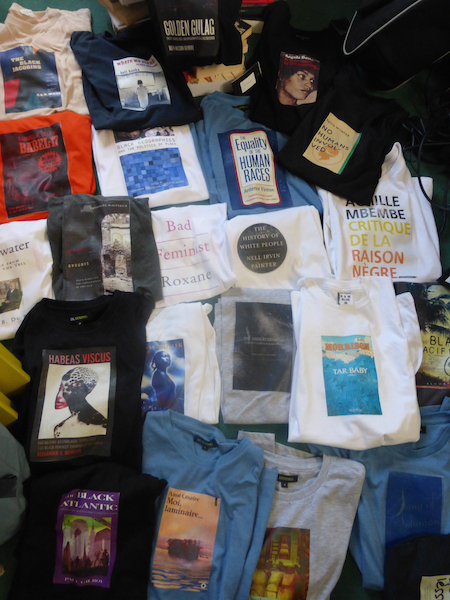
T-shirts from the AAG Subconference For Black Lives Matter ‘T-shirt Book Bloc’ noted in Angela Last’s blog, “Mutable Matter.
I understand that what I am saying is provocative. According to the Merriam Webster online dictionary, to provoke is, “to cause the occurrence of (a feeling or action): to make (something) happen,” and that is indeed what I hope this column will do. I want to raise the question of the whiteness of geography’s curriculum as part of the larger picture of geography’s whiteness, and to ask what we (as individuals, as geographers, as departments, as the AAG) have done about it and what we can do. As Audrey Kobayashi and Linda Peake noted 15 years ago, “no understanding of geography is complete, no understanding of place and landscape comprehensive, without recognizing that . . . geography, both as discipline and spatial expression . . . is racialized.”[3] I’m suggesting that we are still working with an incomplete and non-comprehensive understanding of geography, and I’m hoping to provoke us to change that.
I’ve borrowed the title of this column from an initiative based at University College London [4] that struck a deep chord with me for many reasons. First, we all know that demographically speaking geography is indeed a very white discipline,[5] and changing that fact – despite the whole-hearted and resourced efforts on the part of many folks through many years – has proven quite difficult.[6] As one of our AAG councillors noted at our recent meeting, there are many interlocking pieces that need to be addressed and it’s difficult to know where and how to intervene. But rethinking what we teach – an important piece of that puzzle – seems a very tangible and do-able thing; in fact, if we consider ourselves any good at all as teachers, this rethinking is something we do all the time. Second, the provocation of calling a curriculum ‘white’ works to shake up our notion of the purported objectivity of the scholarship we make and teach, of the unremarked and therefore normalizing assumptions built into our syllabi, and at least for me, serves to question how I’ve conceptualized my courses including my choice of topics and readings. And third, the timing is right; we now have a considerable body of scholarly literature within geography to draw on (in addition to literature in related fields), and, equally important, the energy and commitment to do the work from key parts of our discipline – from graduate students through academic leaders.
I’m certainly not the first person, of course, to raise this important issue. Drawing on an already active movement, the AAG diversity task force recommended in its 2006 report that “departments should review their curricula to determine the degree of commitment to diversity and, if necessary, create courses that make the curricula more relevant to today’s racially diverse society. Courses that address certain areas may be needed, for example:
Race and space in the maintenance of structures of domination, subordination, and inequality
Intersectionality and space (i.e. the intersection of race, class, gender, sexuality)
The ideology of white supremacy and the use of space to maintain it
The spatialities of white privilege
Racial residential segregation and racial inequality: the causes and consequences
The ghetto, barrio and ethnic enclave: their origin, persistence, and consequences
The racialization of immigrants of color
Environmental racism
Critical race theory
Space-and race-based public policies
Race, concentrated poverty and economic restructuring”[7]
Following through on this recommendation, in conjunction with the others made in this important report, is vital to addressing the whiteness of geography and its curriculum. But since 2006, our departments and universities have faced severe financial and organizational challenges concomitant with the global recession and the increasing neoliberalization of academic life. As I’ve noted in previous columns, the pressures on us as teachers, scholars and mentors are often immense; academic success is counted in numbers of publications, not numbers of students that we’ve challenged.
And so we need help. We can start by sharing syllabi, readings, bibliographies, topics, relevant media, etc. But this alone won’t lead to change; we need assistance in learning to recognize our ‘white’ assumptions, and we need training in how to take those new understandings into the classroom. It’s been clear to me for a while that teaching/mentoring is by far the most political act – in the sense of enacting social change – that I can ever hope to accomplish. I will be able to accomplish more with a less ‘white’ geography curriculum. How should we proceed? I’m looking forward to hearing your responses.
AAG Members get exclusive access to publications, prominent journals, unique advocacy, grant, scholarship and professional opportunities with access to industry focus communities, and event discounts, including our annual meeting.
Some content may only be accessible if you belong to specific Specialty or Affinity Groups. You can still update your membership below. You will need to go through the Join flow, but you do not need to repurchase your membership unless it is expired or about to expire.
To provide the best experiences, we use technologies like cookies to store and/or access device information. Consenting to these technologies will allow us to process data such as browsing behavior or unique IDs on this site. Not consenting or withdrawing consent, may adversely affect certain features and functions.
Functional
Always active
The technical storage or access is strictly necessary for the legitimate purpose of enabling the use of a specific service explicitly requested by the subscriber or user, or for the sole purpose of carrying out the transmission of a communication over an electronic communications network.
Preferences
The technical storage or access is necessary for the legitimate purpose of storing preferences that are not requested by the subscriber or user.
Statistics
The technical storage or access that is used exclusively for statistical purposes.The technical storage or access that is used exclusively for anonymous statistical purposes. Without a subpoena, voluntary compliance on the part of your Internet Service Provider, or additional records from a third party, information stored or retrieved for this purpose alone cannot usually be used to identify you.
Marketing
The technical storage or access is required to create user profiles to send advertising, or to track the user on a website or across several websites for similar marketing purposes.
To provide the best experiences, we use technologies like cookies to store and/or access device information. Consenting to these technologies will allow us to process data such as browsing behavior or unique IDs on this site. Not consenting or withdrawing consent, may adversely affect certain features and functions.
Functional
Always active
The technical storage or access is strictly necessary for the legitimate purpose of enabling the use of a specific service explicitly requested by the subscriber or user, or for the sole purpose of carrying out the transmission of a communication over an electronic communications network.
Preferences
The technical storage or access is necessary for the legitimate purpose of storing preferences that are not requested by the subscriber or user.
Statistics
The technical storage or access that is used exclusively for statistical purposes.The technical storage or access that is used exclusively for anonymous statistical purposes. Without a subpoena, voluntary compliance on the part of your Internet Service Provider, or additional records from a third party, information stored or retrieved for this purpose alone cannot usually be used to identify you.
Marketing
The technical storage or access is required to create user profiles to send advertising, or to track the user on a website or across several websites for similar marketing purposes.