Every month the AAG compiles a list of newly-published books in geography and related areas. Some are selected for review in the AAG Review of Books.
Publishers are welcome to send new volumes to the Editor-in-Chief (Kent Mathewson, Editor-in-Chief, AAG Review of Books, Department of Geography and Anthropology, Louisiana State University, Baton Rouge, LA 70803).
Anyone interested in reviewing these or other titles should also contact the Editor-in-Chief.
David Lowenthal Receives the British Academy Medal
David Lowenthal was awarded the 2016 British Academy medal for The Past Is a Foreign Country—Revisited (Cambridge University Press, 2015). The medal honors “a landmark academic achievement which has transformed understanding in the humanities and social sciences” in a book that explores “the manifold ways in which history engages, illuminates and deceives us in the here and now.”
David Lowenthal engages a panel during “Author Meets Critic: The Past is a Foreign Country—Revisited,” a special session at the 2016 AAG annual meeting in San Francisco.
Lowenthal, emeritus professor of geography and honorary research fellow at University College London, was invited to the 2016 AAG Annual Meeting in San Francisco for a special “Author Meets Critics” session. There he talked about The Past is a Foreign Country—Revisited before panelists Diana K. Davis (UC Davis), Marie D. Price (George Washington University), and Dydia Delyser (CSU Fullerton), gave their understandings and opinions on the book.
The British Academy medal is greatly deserved for his work. Thirty years ago he wrote The Past Is a Foreign Country, which became a classic text. The Revisited text explores anew how we celebrate, expunge, contest and manipulate the past. He reveals the past as an almost entirely new realm, so transformed over three decades as to demand an equally new book.
It has been a long, hot summer. In July, the National Aeronautics and Space Administration (NASA) released its analysis of global temperatures for the first six months of 2016. Each of these months has set a record for global temperatures. Taken together, this marks the warmest six-month period since the record began in 1880. The temperatures for the first half of 2016 were about 1.3 degrees Celsius warmer than the late 19th century average. This is not a trivial amount.
Two weeks ago, the National Oceanic and Atmospheric Administration (NOAA) released its analysis of August 2016 temperatures and found that it marks the 16th straight month of record-breaking temperatures for the globe. California, where I am writing this, is really feeling the heat. High evapotranspiration rates have locked the state in a condition of severe to exceptional drought according to the U.S. Drought Monitor.
Noam Chomsky to Receive AAG Atlas Award in Boston
The AAG has selected Noam Chomsky as the recipient of its 2017 AAG Atlas Award, the association’s highest honor. The AAG Atlas Award is designed to recognize and celebrate outstanding, internationally-recognized leaders who advance world understanding in exceptional ways.
Chomsky’s wide-ranging intellect and impassioned work have long inspired geographers. And his highly-regarded contributions on contemporary topics concerning globalization and the intersections between geography, economics and politics are of great interest to AAG members.
Noam Chomsky will engage in a conversational interview with AAG Executive Director Doug Richardson, as he has several times previously, at this year’s AAG Annual Meeting in Boston. This special interview with Chomsky will also serve as the keynote session to kick off Mainstreaming Human Rights in Geography and the AAG, one of three main Themes of the 2017 AAG Annual Meeting.
Geographies of Bread and Water in the 21st Century
The Contributions in the Geographies of Bread and Water in the 21st Century Theme will address the complex demands and challenges of food and water provision over the 21st century. Of particular interest are the roles of physical, social, cultural and technological geographical research, education and public communication in formulating and implementing monitoring, adaptation and mitigation strategies.
Glen MacDonald’s Presidential Opening Plenary: Bread and Water in the 21st Century on Wednesday, April 5, 2017, will also serve as the keynote session for this featured theme.
Papers and sessions from all disciplines, subfields, and perspectives are welcome to submit to this theme. The submission deadline is October 27, 2016.
Uncertainty and Context in Geography and GIScience: Advances in Theory, Methods, and Practice
Uncertainty This theme within the 2017 AAG Annual Meeting will explore research frontiers and advances in theory, method, and research practice that address the challenges of uncertainty and context in geography and GIScience.
Papers and sessions from all disciplines, subfields and perspectives (e.g., geography, public health, sociology, transportation, urban studies, etc.) are welcome.
Mainstreaming Human Rights in Geography and the AAG
This special theme within the 2017 AAG Annual Meeting will explore intersections of Human Rights and Geography, and will build on the AAG’s initiatives to mainstream human rights in geography and the AAG. An Interview with Noam Chomsky by Doug Richardson will keynote this theme at the 2017 Boston Annual Meeting.
Papers and sessions from all disciplines, subfields, and perspectives are welcome to submit to this theme. The submission deadline is October 27, 2016.
Just a 30-minute train ride north of Boston is Salem, Massachusetts, one of America’s oldest and curious cities. Located on the North Shore of Massachusetts, Salem was one of the most significant colonial and early American seaports as well as having a rich New England history with glory and intrigue. Salem is a small, compact and walkable historic city with just over 40,000 residents and hundreds of colonial-era buildings along with more than 60 restaurants, cafes and coffee shops. Over a million tourists visit annually with Halloween, October 31, being the peak where upwards of 70,000 people come to celebrate.
Much of the city’s cultural identity is defined by the Salem Witch Trials of 1692, 63 years after the founding of the city. Salem is widely known as “Witch City” with the High School’s nick name being “the Witches,” police cars have witch logos, one of the elementary schools is Witchcraft Heights Elementary School and it is hard to walk a single block without seeing witch T-shirts and other occult paraphernalia. The city even has a Harry Potter shop, and in 2015 a local witch successfully sued a local warlock! The culture of witchcraft in Salem as a symbol of Salem is a conscious product promoted by the city and its businesses to drive tourism and was mostly created in the second half of the 20th century.
The AAG has proposed a new Advanced Placement course in Geographic Information Science and Technology (AP GIS&T) designed to introduce high school students to the fundamentals of geographic information science and applications of geospatial technologies for spatial analysis and problem solving.
For AP GIS&T to become a reality, the AAG needs 250 U.S. high schools to attest to their interest and capacity to offer the course. Similarly, 100 colleges and universities need to declare their willingness to offer credit to students who demonstrate a proficiency on the AP GIS&T exam.
AAG Launches New Undergraduate Student Affinity Group
The American Association of Geographers will launch a new affinity group specifically for undergraduate students. The Undergraduate Student Affinity Group (USAG) will be an international community of students studying geography, offering opportunities to network and socialize, get advice on graduate study and careers, and take part in academic events.
Undergraduate students can join the AAG for just $38 and receive full membership benefits including access to scholarly journals and publications, exclusive access to the Jobs in Geography listings, participation in the knowledge environments, and reduced rates for Annual Meeting and other event registration. They can join USAG for an additional $1.
New Council Award Recognizing Outstanding Graduate Student Papers at Regional Meeting
Becoming more involved in the AAG facilitates strengthening professional networks, volunteering, taking part in scholarly activities, advancing academic studies, etc. Graduate students can register to attend their fall regional division meeting and submit their paper at that time to be eligible to win the Council Award for Outstanding Graduate Student Paper at a Regional Meeting.
Each awardee will receive $1,000 in funding for use towards the awardee’s registration and travel costs to the AAG Annual Meeting.
AAG has a variety of opportunities for students, un-/underemployed geographers, and scholars outside the discipline to attend and participate in the Annual Meeting.
Department of Education Seeks Nominations for National Assessment Governing Board
The Department of Education seeks candidates for four open seats on its National Assessment Governing Board (NAGB). The Board sets policy for the National Assessment of Educational Progress (NAEP), a nationally representative measure of U.S. students’ knowledge and abilities in core academic subjects. NAEP is broadly recognized as the gold standard in testing. NAGB is composed of 26 members consisting of “governors, state legislators, chief state school officers, a local school superintendent, local and state school board members, principals, classroom teachers, curriculum and testing experts, a business representative, a representative of nonpublic schools, and members of the general public, including parents.”
Specifically, NAGB seeks to fill the following positions: elementary school principal, general public representative (2 positions), and a testing and measurement expert. Nominations are due October 28, 2016.
The American Geographical Society (AGS) is now accepting applications for the AGS Council Fellowship. The fellowship is open to all student members of the American Geographical Society, both Masters and Doctoral students. Each fellowship is worth $1,500 and four will be awarded in the spring.
Upon completion of the research, fellowship recipients are strongly encouraged to submit an article based upon their research to one of the AGS publications, such as the Geographical Review. The deadline is November 1.
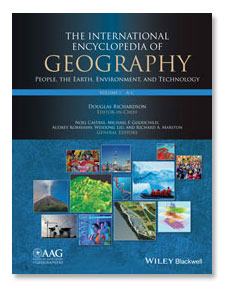
Pre-order ‘The International Encyclopedia of Geography’
The AAG and an international team of distinguished editors and authors are in the final stages of preparing a new major reference work for Geography: The International Encyclopedia of Geography: People, the Earth, Environment, and Technology.
This 15-volume work, published by Wiley both in hard copy and online, will be an invaluable resource for libraries, geographers, GIScientists, students and academic departments around the globe. Updated annually, this Encyclopedia will be the authoritative reference work in the field of geography for decades to come.
November 2016 Issue of ‘The Professional Geographer’ Now Available
The AAG is pleased to announce that Volume 68, Issue 4 (November 2016) of The Professional Geographer is now available.
The focus of The Professional Geographer is on short articles in academic or applied geography, emphasizing empirical studies and methodologies. These features may range in content and approach from rigorously analytic to broadly philosophical or prescriptive. The journal provides a forum for new ideas and alternative viewpoints.
Each issue, the Editor chooses one article to make freely available. In this issue you can read Change in the World City Network, 2000-2012 by Ben Derudder and Peter Taylor for free for the next 3 months.
AAG Releases New Edition of Guide to Geography Programs
The AAG Guide to Geography Programs in the Americas, or The Guide, includes detailed information on undergraduate and graduate geography programs in the United States, Canada, and Latin America, including degree requirements, curricula, faculty qualifications, program specialties, financial assistance, and degrees completed.
The 2015-2016 edition of The Guide is now available as a free PDF document. The AAG has also published an interactive, companion map where users can search for programs by location, degree type, field of interest, and regional focus.
‘AAG Review of Books’ Launches Database to Commemorate New Milestone
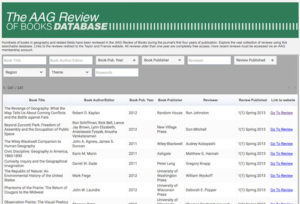
Since launching in 2013, TheAAG Review of Books has published more than 250 book reviews, marking a new milestone for the journal. To celebrate this landmark, and to enable easier exploration of the vast collection of reviews, the AAG has launched a new searchable database.
Readers can now search the full list of all books reviewed in the journal by title, author, reviewer, theme and other categories. They can then follow a direct link to the review. More reviews will be added to the database as each new issue of the journal is published.
Environmental Sciences Section Editor Sought for ‘Annals of the AAG’
The AAG seeks applications and nominations for the Environmental Sciences section editor for the Annals of the American Association of Geographers. The new section editor will be appointed for a four-year editorial term that will commence on January 1, 2017.
The appointment will be made by fall 2016. A letter of application that addresses both qualifications and a vision for the Environmental Sciences section should be accompanied by a complete curriculum vitae. Nominations and applications should be submitted by Friday, October 7, 2016.
The Association of Pacific Coast Geographers (APCG) is soliciting applications for the next Editor of the Yearbook, the scholarly journal of the APCG. This annual journal, first printed in 1935 and now in Volume 78, includes full-length peer-reviewed articles and abstracts of papers from their annual meeting. Published by the University of Hawai’i Press for the APCG, the Yearbook is now part of Project MUSE, a widely used scholarly database that provides full-text coverage for 167 journals.
The five-year term will begin immediately, and includes funding to hire a student assistant, graphics editing, and copy production.
The APCG is the Pacific Coast Regional Division of the Association of American Geographers, serving eight western states, British Columbia, and Yukon. Prospective editors should send a brief statement of interest to APCG President, Stephen Cunha (sc10 [at] humboldt [dot] edu).
IN MEMORIAM
Ary J. Lamme III
Ary J. Lamme III, a cultural and historical geographer who was Emeritus Professor at the University of Florida, passed away in September 2016 at the age of 76. Lamme was a long-time member of the American Association of Geographers and recognized for 50 years of continuous membership in 2014. He will be remembered fondly by many former colleagues. Lamme leaves behind his wife, Sandra, and two adult children, Laurel and Ary Johannes IV.
Larry Hamilton, emeritus professor of natural resources at Cornell University, who played a leading role in the worldwide conservation of mountain areas, passed away on October 6, 2016, at the age of 91.
Lawrence Stanley Hamilton was born in Toronto in 1925. He couldn’t wait to get out of the city and started working in logging camps in the North Woods during the summers while he was still a teenager. During the Second World War he served in the Royal Navy Fleet Air Arm as a pilot. Both his early connection to forests and his exposure to the horrors of war went on to shape the rest of his life.
After the war Hamilton enrolled at the University of Toronto to study forestry while also working as Zone Forester in Ontario. For postgraduate studies he moved to the College of Forestry at Syracuse University, completing his master’s degree in 1950 with a dissertation entitled “An economic analysis of the cutting of sugar maple (Acer saccharum Marsh.) in small woodlots in the vicinity of Syracuse.” This was followed by a doctorate in natural resource policy at the University of Michigan; his dissertation, completed in 1962, was entitled “An analysis of New York State’s Forest Practice Act.”
Hamilton joined the Department of Natural Resources at Cornell University in 1951 and stayed there for 30 years before becoming professor emeritus. He was an exceptional educator, advisor, and pioneer of courses in forest ecology, watershed studies, interdisciplinary collaboration, and international resource issues. In the early 1970s, he produced one of the first documentations of tropical rainforest deforestation (Venezuela) and mangrove destruction (Trinidad).
In 1980 he moved to Hawaii and spent the next 13 years as a Senior Fellow in the Environment and Policy Institute at the East-West Center, an institution which aims to promote technological and cultural interchange between people in the United States, Asia and the Pacific region. He traveled all over the region including Thailand, Western Samoa, Nepal, Indonesia, and Australia doing pioneering education in forest hydrology and tropical forestry, convening workshops and authoring hundreds of applied conservation publications.
While in Asia Hamilton became interested in mountains, recognizing them as unique and very delicate ecosystems, and suggesting that conservation efforts that work in many other environments can be devastating for mountains.
Since the 1970s he had been a member of the International Union for the Conservation of Nature’s (IUCN) Commission on National Parks and Protected Areas (subsequently known as the World Commission on Protected Areas (WCPA)), but it was during the 1980s that he began to draw the Commission’s attention to mountains.
Hamilton and a small group of fellow scientists launched a concerted call for mountain conservation, publishing “The State of the World’s Mountains: A Global Report.” They took their message to a wider audience as “An Appeal for the Mountains,” which was presented to the 1992 United Nations Conference on Environment and Development (Rio Earth Summit) and became the basis for the mountain chapter in Agenda 21. This effort, and the ensuing awareness of mountain ecology, is the work of which Hamilton said he was most proud.
Over the next 25 years, under his leadership, the mountain theme became an important element of the WCPA’s work and he built a strong global network of mountain enthusiasts and experts. He brought them together in numerous WCPA mountain workshops including Hawaii (1991), Australia (1995), Canada (1996) and South Africa (2003).
On the ground he provided guidance and advice to mountain protected areas including parks and reserves in Australia, Bhutan, Canada, Ecuador, USA and Nepal. He championed tropical montane cloud forests, corridors of ecological connectivity, trans-border cooperation for conservation and peace, understanding of mountains as water towers, and the spiritual/cultural values of mountains.
His formidable paper legacy is to be found in almost 400 publications including: IUCN guidelines on Transboundary Protected Areas for Peace and Co-operation (2001) and Planning and Managing Mountain Protected Areas (2004); and Managing Mountain Protected Areas: Challenges and Responses for the 21st Century (2004). He made special mountain contributions to PARKS (1996), the IUCN Bulletin (2002), and a World Heritage publication (2002). From 1992 until 2015, he also edited 89 editions of the quarterly newsletter Mountain Protected Areas Update.
For his work Hamilton received the New York State Conservation Council’s Forest Conservationist of the Year award (1969); the Environmental Achiever Award from the UN Environment Program (1987); the IUCN/WCPA Packard International Parks Merit Award (2003); Hawai’i University’s Distinguished Scientist award for work on Cloud Forest Conservation (2004); the Gold Medal for Mountain Conservation Leadership from the King Albert I Memorial Foundation in Switzerland (2004); and Honorary IUCN Membership (2008).
In 1993 Hamilton and his wife moved to Vermont to be near family. They set up home in the small rural community of Charlotte where they loved the natural surroundings and the four seasons. They also liked the sense of neighborliness and civic participation, and Hamilton was proud to be a local tree warden. He also served for over two decades as a trustee of The Nature Conservancy (TNC) Vermont where he shared his expertise through many local conservation initiatives. Just two days before his death, he was delighted to learn that they named the trail in the local TNC forest preserve the “Hamilton Trail.”
As well as the local engagement, bigger conservation issues continued to concern him. For example, in 2011 he travelled to Washington, DC to protest at the White House against the Tar Sands Pipeline Initiative. Beyond his conservation activism, he was also a pacifist and was an active member of Veterans for Peace.
Lawrence Hamilton’s life was grounded in a love of nature. He said, “If I can be responsible for saving one little chunk, I will have had a successful life.” In reality, his life’s work ensured the protection of mountain areas passing through whole continents, and their preservation as biological and cultural treasures for our future generations. He will be remembered for his vision, commitment, enthusiasm and youthful energy. Although not a geographer per se, his academic work and practical action was an inspiration to many, including members of the AAG’s Mountain Geography Specialty Group.
Larry is survived by his wife of 36 years, Linda; children Bruce, Anne and Lynne; as well as seven grandchildren and one great-grandchild.
Sally Eden, professor of Human Geography at the University of Hull, UK, whose research explored issues of environmental perception, sustainable food production and consumption, passed away peacefully in September 2016 after a period of illness.
Sally E. Eden was born in 1967. She studied for a bachelor’s degree at the University of Durham followed by a doctorate at the University of Leeds.
Her first academic posts were at the University of Bristol and Middlesex University where she taught geography and environmental studies before joining the Department of Geography at the University of Hull in 1998 where she served for the last 18 years.
Eden’s research explored how people relate to the environment through consumption, leisure, knowledge and policy.
One strand of work investigated how nongovernmental organizations use and communicate environmental information, and how environmental science is used to influence policy and consumption. For this she focused on water environments, researching how river restoration is designed and justified and how laypeople get involved with and make sense of river management in the UK.
Another area of research was how ideas of sustainable consumption, environmentally friendly products and green lifestyles are constructed, legitimated, sold, understood and put into practice (or not). She explored these issues through case studies such as the environmental certification of organic food, sustainably farmed fish and well managed forests.
From 2013-15 she was Co-Investigator on a major project funded jointly by the UK Research Councils called Digital Economy: Food Trust. The goal was to explore how digital tools can promote more sustainable production and consumption of food through connecting producers and consumers. It involved the creation of three prototype apps – ‘Food Cloud’, ‘FoodCrowd’ and ‘Shopstamp.’ One of these, for example, enabled shoppers to scan QR codes on food products to access information about the farm where the item was produced.
Eden’s work was widely published in leading journals of geography, environment and rural studies. Sadly she passed away before publication of her book, Environmental Publics (Routledge, December 2016). This volume explores how ordinary people think about the environment as they go about their daily lives; how they engage with environmental issues in different contexts of work, leisure and home; and whether thinking about the environment make them do things differently.
Eden was a member of the AAG and a regular attendee at the Annual Meetings. She was also one of the Section Editors for the AAG’s The International Encyclopedia of Geography: People, the Earth, Environment, and Technology (Wiley, 2017). She was responsible for the “Environmental Policy, Management, and Governance” section, and also wrote three entries for the encyclopedia: Environmental Science, Environmental Restoration, and Environmental Issues and Public Understanding (the latter with Hilary Geoghegan). The AAG team will remember her as an excellent editor as well as a lovely person with whom to work. Her colleagues at the University of Hull and beyond will miss her greatly.
Every month the AAG compiles a list of newly-published books in geography and related areas. Some are selected for review in the AAG Review of Books.
Publishers are welcome to send new volumes to the Editor-in-Chief (Kent Mathewson, Editor-in-Chief, AAG Review of Books, Department of Geography and Anthropology, Louisiana State University, Baton Rouge, LA 70803).
Anyone interested in reviewing these or other titles should also contact the Editor-in-Chief.
Those of us alive today are witnessing one of the most profound events in all of human history — and it is an event, which is fundamentally geographic in nature. The transformation we are experiencing is the concentration of the majority of the world’s population into urban areas.
Although much has been made of the United Nations report that declared as of 2008 half the world’s population live in urban areas, this trend has been a long-term feature of the 20th and 21st centuries. In 1900 only about 10 percent to 15 percent of the world’s population lived in urban areas.
The trend towards greater urbanization accelerated from the 1950s and shows no indication of stopping. The United Nations estimates that by 2050 some 70 percent of the world population will live in urban areas. In terms of absolute numbers that means in just 34 years there will be some 6.4 billion city dwellers.
AAG Offers Suite of New Resources for Students and Job Seekers
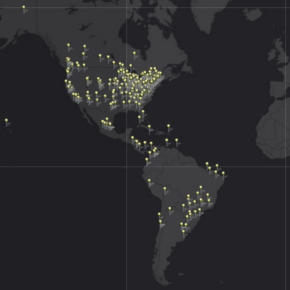
Students looking for information about undergraduate and graduate degree programs, as well as currently available graduate assistantships, internships, and postdoc positions in geography now have a suite of resources available from the AAG.
AAG Guide to Geography Programs in the Americas – Our popular guide to undergraduate and graduate programs in all areas of geography has been enhanced with a new interactive map. Easy-to-use search tools allow students explore and discover geography programs by degree type, region, and program specialization.
AAG Student and Postdoc Opportunities Website – This site features a variety of graduate assistantships, internships, and postdoctoral researcher positions in the discipline. Academic departments may post their student and postdoc opportunities on the site at no charge.
AAG Jobs in Geography Center – Job seekers can begin their search on this site, which offers the latest geography-related job openings in the academic, public, private, and nonprofit sectors, along with a wide array of practical resources that can assist students with career planning and the job hunt.
AAG To Feature Three Themes at Annual Meeting in Boston
Each year, the AAG identifies a few themes for its Annual Meeting to help focus discussion and provide a fresh and engaging structure to the conference program. Current themes include:
Please see the links above for more information about how to get involved with these themes.
Attendees are also invited to develop sessions relevant to the meeting’s location or influenced by political and intellectual trends within the discipline. As always, any topic relevant to geography is welcome at the AAG annual meeting. For more information, contact Oscar Larson, AAG conference director, at meeting [at] aag [dot] org.
In addition to the these three major themes, the AAG Annual Meeting will also feature 6,000 presentations, posters, and workshops by leading scholars, researchers, and educators.
The AAG seeks panelists, mentors, and workshop leaders for career and professional development events for its annual meeting, April 5–9, 2017, in Boston. A diverse group of individuals representing a broad range of employment sectors, organizations, academic and professional backgrounds, and racial/ethnic/gender perspectives are encouraged to apply. Email careers [at] aag [dot] org, specifying topic(s) and activity(s) of interest, and attach a current C.V. or resume. For best consideration, please submit your information by November 17, 2016.
AAG To Offer On-site Childcare During 2017 Annual Meeting
For the third consecutive year, the AAG is pleased to announce that it is continuing full-time, professionally managed and staffed on-site childcare services for the annual meeting at the Boston Sheraton Hotel. Childcare services will be provided by Accent on Children’s Arrangements, Inc., which will design and run a children’s program called Camp AAG April 5-9, 2017.
Daydreams and Nightmares in the Northern Forest: A Quarter Century of Change
Source: LL Bean company, reproduced by permission.
The Northern Forest is a term used by forest activists, policy wonks and some geographers to describe the forested regions of upstate New York, Vermont, New Hampshire and Maine. This is a region of scattered population, glaciated hills and valleys, many lakes and rivers, and several substantial mountain ranges (Irland, 1999; 2011). In its fall displays of color, the red and yellow maples and birches are studded by dark green pines and spruce.
It is virtually the last redoubt of native brook trout populations; in a few coastal Maine streams tiny surviving runs of Atlantic salmon cling to life. This region was accustomed to long-standing private ownership by paper companies, well-established timber families, and Kingdom Owners– descendants of New York wealth from the 1890’s, with their lakes and “Adirondack Camps.”
The region has an aura of remoteness and wilderness character, regularly burnished by writers and artists since Thoreau’s visits in the 1840’s and the glowing paintings of Hudson River School artists. Into countless households each year, the mail order catalogs of the L.L. Bean Company arrive, with covers displaying appealing images of wild solitude. They become the suburbanites’ mental picture of the Northwoods.
Visitors were often stunned, then, to drive into the woods and see logging trucks, recent clearcuts, and for sale signs for wildland lots. Many wanted something done about it.
The AAG has proposed a new Advanced Placement course in Geographic Information Science and Technology (AP GIS&T) designed to introduce high school students to the fundamentals of geographic information science and applications of geospatial technologies for spatial analysis and problem solving.
For AP GIS&T to become a reality, the AAG needs 250 U.S. high schools to attest to their interest and capacity to offer the course. Similarly, 100 colleges and universities need to declare their willingness to offer credit to students who demonstrate a proficiency on the AP GIS&T exam.
AAG Launches New Undergraduate Student Affinity Group
The American Association of Geographers will launch a new affinity group specifically for undergraduate students. The Undergraduate Student Affinity Group (USAG) will be an international community of students studying geography, offering opportunities to network and socialize, get advice on graduate study and careers, and take part in academic events.
Undergraduate students can join the AAG for just $38 and receive full membership benefits including access to scholarly journals and publications, exclusive access to the Jobs in Geography listings, participation in the knowledge environments, and reduced rates for Annual Meeting and other event registration. They can join USAG for an additional $1.
New Council Award Recognizing Outstanding Graduate Student Papers at Regional Meeting
Becoming more involved in the AAG facilitates strengthening professional networks, volunteering, taking part in scholarly activities, advancing academic studies, etc. Graduate students can register to attend their fall regional division meeting and submit their paper at that time to be eligible to win the Council Award for Outstanding Graduate Student Paper at a Regional Meeting.
Each awardee will receive $1,000 in funding for use towards the awardee’s registration and travel costs to the AAG Annual Meeting.
AAG Welcomes Julio Arguello, Jr as Social Media and Website Content Manager
The AAG is pleased to welcome Julio Arguello, Jr. as the Social Media and Website Content Manager. He has more than 15 years of digital communications, IT, membership and publications management experience in the nonprofit sector.
Julio will collaborate with AAG’s communications group to oversee AAG’s engagement across its social media communities, including Twitter, Facebook, LinkedIn and YouTube. He will monitor media channels, post information, interact with users, and curate and write web content. He will also contribute to organizing project-related campaigns.
Nominate Deserving Colleagues for Three AAG Awards
Deadlines for nominations for three AAG awards are fast approaching this month. Don’t miss out on sending in a recommendation for a worthy colleague. The deadline is September 15.
Visiting Geographical Scientist Program Accepting Applications
The Visiting Geographical Scientist program (VGSP) is accepting applications for the 2016-17 academic year. VGSP sponsors visits by prominent geographers to small departments or institutions that do not have the resources to bring in well-known speakers.
The purpose of this program is to stimulate interest in geography and is targeted for students, faculty members and administrative officers. Participating institutions select and make arrangements with the visiting geographer.
The 2016 next testing window for the GISCI Geospatial Core Technical Knowledge Exam® as a part of the GISP Certification has been scheduled for December 3-10, 2016, and will be administered by PSI Online through their worldwide testing facilities in a computer based testing (CBT) format.
The Exam application form and testing center locations are now available on the GISCI web site, and an Exam Application portal has been developed and is available for direct Exam application.
National Humanities Center 2017-2018 Call for Fellowship Applications
The National Humanities Center will offer up to 40 residential fellowships for advanced study in the humanities for the period September 2017 through May 2018. Applicants must have a doctorate or equivalent scholarly credentials. Mid-career scholars as well as senior scholars are encouraged to apply.
Applicants submit an application form, a curriculum vitae, a 1000-word project proposal, and three letters of recommendation. Applications and letters of recommendation must be submitted online by October 18, 2016.
Pre-order ‘The International Encyclopedia of Geography’
The AAG and an international team of distinguished editors and authors are in the final stages of preparing a new major reference work for Geography: The International Encyclopedia of Geography: People, the Earth, Environment, and Technology.
This 15-volume work, published by Wiley both in hard copy and online, will be an invaluable resource for libraries, geographers, GIScientists, students and academic departments around the globe. Updated annually, this Encyclopedia will be the authoritative reference work in the field of geography for decades to come.
AAG Releases New Edition of Guide to Geography Programs
The AAG Guide to Geography Programs in the Americas, or The Guide, includes detailed information on undergraduate and graduate geography programs in the United States, Canada, and Latin America, including degree requirements, curricula, faculty qualifications, program specialties, financial assistance, and degrees completed.
The 2015-2016 edition of The Guide is now available as a free PDF document. The AAG has also published an interactive, companion map where users can search for programs by location, degree type, field of interest, and regional focus.
‘AAG Review of Books’ Launches Database to Commemorate New Milestone
Since launching in 2013, TheAAG Review of Books has published more than 250 book reviews, marking a new milestone for the journal. To celebrate this landmark, and to enable easier exploration of the vast collection of reviews, the AAG has launched a new searchable database.
Readers can now search the full list of all books reviewed in the journal by title, author, reviewer, theme and other categories. They can then follow a direct link to the review. More reviews will be added to the database as each new issue of the journal is published.
Environmental Sciences Section Editor Sought for ‘Annals of the AAG’
The AAG seeks applications and nominations for the Environmental Sciences section editor for the Annals of the American Association of Geographers. The new section editor will be appointed for a four-year editorial term that will commence on January 1, 2017.
The appointment will be made by fall 2016. A letter of application that addresses both qualifications and a vision for the Environmental Sciences section should be accompanied by a complete curriculum vitae. Nominations and applications should be submitted by Friday, October 7, 2016.
Geoffrey Martin Receives Humboldt Book Award for Enduring Scholarship in Geography
The AAG Review of Books (AAGRB) has selected Professor Geoffrey Martin’s monumental book, American Geography and Geographers, as the inaugural recipient of the Humboldt Book Award for Enduring Scholarship in Geography.
The award was selected from all of the books reviewed during the first four years of The AAG Review of Books. The selection committee chaired by the Editor-in-Chief of the AAGRB unanimously agreed on selection ofAmerican Geography and Geographers as the inaugural awardee for the Humboldt Book Award for Enduring Scholarship in Geography.
AAG Welcomes Julio Arguello Jr. as Social Media and Website Content Manager
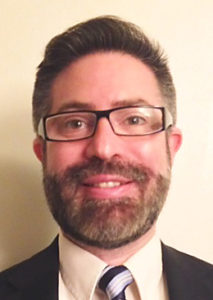
The AAG is pleased to announce that Julio Arguello, Jr. has joined the association as the Social Media and Website Content Manager at its headquarters in Washington, D.C. Julio has more than 15 years of digital communications, IT, membership and publications management experience in the nonprofit sector. He holds a bachelor’s degree in English from Towson State University.
Julio previously worked for the Association of Maternal & Child Health Programs (AMCHP) where he was the Digital Communications Manager in charge of online communications and social media strategies, including AMCHP’s website. Prior to that position, Julio served as the organization’s Publications & Member Services Manager.
Julio will collaborate with AAG’s communications group to oversee AAG’s engagement across its social media communities, including Twitter, Facebook, LinkedIn and YouTube. He will monitor media channels, post information, interact with users, and curate and write web content. He will also contribute to organizing project-related campaigns.
In his free time, Julio enjoys playing tennis, taking long walks and exploring Washington, D.C., watching films, and the theater and opera.
Those of us alive today are witnessing one of the most profound events in all of human history — and it is an event, which is fundamentally geographic in nature. The transformation we are experiencing is the concentration of the majority of the world’s population into urban areas. Although much has been made of the United Nations report that declared as of 2008 half the world’s population live in urban areas, this trend has been a long-term feature of the 20th and 21st centuries. In 1900 only about 10 percent to 15 percent of the world’s population lived in urban areas. The trend towards greater urbanization accelerated from the 1950s and shows no indication of stopping. The United Nations estimates that by 2050 some 70 percent of the world population will live in urban areas. In terms of absolute numbers that means in just 34 years there will be some 6.4 billion city dwellers.
Source: United Nations, World Urbanization Prospects, The 2007 Revision Highlights
It is not just the proportion of the world’s population living in cities that is increasing. We are also witnessing an agglomerative effect wherein the relative population size of certain cities and their metropolitan areas is increasing at a remarkable pace. This is creating a global constellation of megacities which have populations greater than 10 million. As of 2015 there were at least 35 such megacities. For comparison, in 1985 there were less than 10.
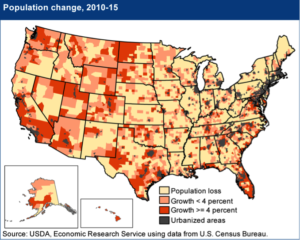
The trend of rural exodus is not confined to the developed world. Between 2007 and 2050 rural populations in the world’s less developed regions are expected to decline by 17 percent or some 440 million people. Unlike the 20th century, it is outmigration from the countryside in least developed regions that will drive the global rural exodus numbers going forward.
Although the urbanization we are witnessing is a global phenomenon it can hardly be called flat and featureless in terms of finer scale geographic detail. At present the percentage of the population living in urban areas varies greatly by country and world region. According to data from the World Bank, 82 percent of the population in North America live in urban areas. In contrast, the urban percentage in Sub Saharan Africa is 38 percent. In East Asia the percentage of urban dwellers is 57 percent, but this represents a remarkable rise from a base of 22 percent in 1960. Over that same period China has seen its percentage of urban population more than triple, from 16 percent to 56 percent. The distribution and growth of megacities also shows geographic patterning. Tokyo, with approximately 40 million people, is the world’s largest megacity. However, Shanghai and Jakarta are not far behind and growth in the latter may well make Indonesia the home of the world’s largest megacity in the near future. It is notable that eight of the 10 largest megacities are in Asia. In fact, contrasting with the relatively high proportions of urban dwellers in Europe and the United States, only a handful of megacities are found in these regions. These include Moscow, Paris, London, New York and Los Angeles. As a final point, this agglomerative process is likely to intensify in Asia and Africa as overall populations grow and rural exodus accelerates.
The trajectory towards increasing urbanization presents two sets of research challenges to geographers. The first revolves around the fundamental question of how do we classify a specific place, a population or a process as being ‘urban’? Carl Haub, senior demographer at the Population Reference Bureau, has raised this question. He points out that the U.N. focuses upon population sizes typical of larger cities. However, many people living in smaller communities may well follow a relatively urban lifestyle and consider themselves more urbanite than rural. The U.N. itself recognizes this difficulty and has no universal definition, “Because of national differences in the characteristics that distinguish urban from rural areas, the distinction between the urban and the rural population is not yet amenable to a single definition that would be applicable to all countries or, for the most part, even to the countries within a region” (U.N. Department of Economic and Social Affairs). Some of the apparent shift from rural to urban in the U.N. data reflects the growth of smaller communities to a population size that crosses the urban classification threshold in that country. In fact though, not much may have changed for the inhabitants. An alternative would be to classify livelihood as agrarian versus non-agrarian, but this too is nebulous. As geographer Michael Pacione instructs in his text, “Urban Geography: A Global Perspective,” urban can mean many things — population size and density, economic base, administrative structure, etc.
The spatial designation of one locale as urban and one place as rural is also problematic. An interesting remote sensing study published in 2009 by Annemarie Schneider of the Department of Geography at the University of Wisconsin and her co-authors grappled with this. They pointed out that multiple criteria exist to make such a distinction when classifying imagery as urban or rural. Schneider et al favored an approach of developing regional specific criteria for classifying a given locale as urban. From their analysis they concluded that only about 0.5 percent of the earth’s land area could be classified as urban. When one reflects on the large proportion of humans now occupying urban areas this is a remarkable spatial concentration of people. However, things may not be so simple. Geographer Karen Seto, now at the Yale School of Forestry and the Environment, and her colleagues in their paper, “Urban land teleconnections and sustainability,” have also grappled with how one defines urban. They point out that place-based classifications, such as those typical of remote-sensing land-use products, make an artificial dichotomy between the urban and the rural when in fact there is a continuum of land uses and very indistinct spatial boundaries. Using a processes-based perspective that appreciates this continuum and the flows that connect across it is more realistic, and would appreciably expand the land area we might consider urban.
One can imagine that as the nature of economies, telecommunications and the geographies of employment change and become less spatially limited, so too will the geographies of the urban and the urban-rural continuum. In addition, rural economies, demographies and geographies are changing. In the Unites States family farms are replaced by large corporate farms. Mechanization further decreases agricultural workforce needs. At the same time networked urbanites find affordable accommodations or space for start-ups in these increasingly available rural locales. Though agglomeration of these networked or commuting exurbanite populations increase, types of labor shift to non-agrarian and rural regions become increasingly urbanized in function if not in physical form. The hinterlands surrounding the San Francisco Bay Area are an example. At the same time, the inner city cores which experienced depressed real estate markets due to the flight of upper and middle classes and manufacturing are being redeveloped and gentrified in many cities. This in turn is pulling people back to denser urban cores.
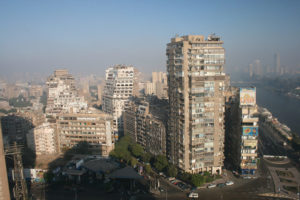
Cairo, Egypt, is one of the world’s megacities with a population estimated to be around 20 million people. (Photo courtesy Glen M. MacDonald)
Geographers have a major role in studying and determining how the term urban is defined. In this case the focus will need to be both on the spatial and the process-oriented perspectives. Considering the paragraph above we might ask what is the comparative experience in the new Asian megacities in terms of spatial form and processes that link urban populations? Will the patterns of urban evolution experienced in more developed countries also occur in less developed countries? Geographers have been at the lead of considering such questions. Karen Seto’s work is one recent example. We might also consider work in the tradition of the late Neil Smith as represented in his 2002 paper, “New Globalism, New Urbanism: Gentrification as Global Urban Strategy.” In it he not only spoke about the global spread of the gentrification, but also provided a much wider take on globalization, urbanism and the rise of the Asian, South American and African megacities.
The second set of questions in geography’s wheel house concern the socioeconomic, cultural and environmental implications of increasing urbanization and the growth of global megacities. Here geographers have been at the forefront. Work spans from the quantitative study of regional economic geography and the agglomerative process of urban growth to the qualitative analysis of how ethnicity, gender of sexual orientation shape individual experiences and perceptions of urban space and place. Geographers such as Michael Dear, Allen Scott, Edward Soja, Michael Storper and Jennifer Wolch of the Los Angeles School of Urbanism have had global impact through their work on the functioning and increasing economic, social and cultural dominance of the world’s global cities. The rise of Critical GIS, which directly links geography’s growing technical capacity for spatial analysis with social theory and qualitative methods is a newer and particularly exciting development. Geographer Mae-Po Kwan and her students have been recognized leaders in these efforts. Here is an approach that can provide new insights not just on the geographies within cities, but also help come to terms with the spatial and functional complexity of the urban-rural continuum.
Geographers have, to their credit, been aware that we are not just studying regression models and pixels, but the lives and futures of real people. There is the deep vein of social awareness and advocacy that permeates much of the work of urban geographers. David Harvey, who arguably stands as the preeminent urban social theorist of our time, has led the way to a melding of scholarship and social responsibility. For over 40 years, starting with the seminal work “Social Justice in the City” and continuing with a multitude of deeply reasoned works including the 2012 book, “Rebel Cities: From the Right to the City to the Urban Revolution”, Harvey and his students have set the standard for the discipline.
The relationship between urbanization and the environment in the 21st century is also critical and an area where geographers have much to contribute in terms of research and education. This matters both in terms of urban impacts on the physical and biological environment and in terms of the environmental quality for urbanites. As one of many examples of the former, a paper published this week in Nature authored by Sean Maxwell, a Ph.D. student in the School of Geography, Planning and Environmental Management at the University of Queensland in Australia, concluded that urban development was the third greatest extinction threat to species classified as threatened or near-threatened by the International Union for Conservation of Nature and Natural Resources (IUCN) Red List. In fact, the threat to biodiversity by urbanization was found to be almost twice as great as that offered by climate change. From the study of urban heat islands, spatial patterns of air, water and soil pollutants, and health threats to the geographies of parks and outdoor recreational spaces for cities and their neighborhoods, geographers have a strong role to play in the study of urban environmental quality and urban environmental justice. In her 2000 Annals article, “Rethinking Environmental Racism: White Privilege and Urban Development in Southern California,” Laura Pulido, formerly of the University of Southern California and now a Professor of Geography at the University of Oregon, brings together the strands of environment, social justice and racism in a critical assessment of how cities can fail to serve their citizens and the geographies of such injustices. This follows the tradition in urban human geography where scholarship is combined with advocacy.
In closing I reflect upon a figure entitled “The nature of human geography” in Michael Pacione’s text, “Urban Geography: A Global Perspective” in which he has placed Urban Geography at the center of all the other sub-disciplines from Physical Geography to Social Geography to Cultural Geography, etc. This might appear to be hubris, but in the 21st century and for our discipline it is not unreasonable. With most of the world’s population arguably urbanized and this trend to continue, and with cities and megacities having such impacts on global economies, culture, politics, health, the environment, etc., urban geography is indeed of critical importance. We have had a strong tradition in this area and going forward I would hope to see that urban geography can indeed form a center of gravity which brings human and physical geographers to work as teams tackling the research, education and policy challenges that the urbanized 21st century brings. This is also an important nexus where those geography departments which are twinned with planning can build bridges and collaborations that will benefit both parties. There is a long history of urban geographers receiving training in planning or being appointed to planning departments as faculty. Let’s capitalize more on these linkages. It seems to me the AAG Annual Meeting can serve as an ideal venue to bring together human geographers, physical geographers and planners in focused sessions to share work and plot collaborations on urban issues. I wonder how our journals might also serve as catalysts? The 21st century is the world of the city, and geography can capitalize upon great traditions and great potential to help understand and improve this evolving new world. Your ideas on how the AAG can help are welcome!
Join the conversation and share your thoughts on Twitter #PresidentAAG.
Every month the AAG compiles a list of newly-published books in geography and related areas. Some are selected for review in the AAG Review of Books.
Publishers are welcome to send new volumes to the Editor-in-Chief (Kent Mathewson, Editor-in-Chief, AAG Review of Books, Department of Geography and Anthropology, Louisiana State University, Baton Rouge, LA 70803).
Anyone interested in reviewing these or other titles should also contact the Editor-in-Chief.
AAG Members get exclusive access to publications, prominent journals, unique advocacy, grant, scholarship and professional opportunities with access to industry focus communities, and event discounts, including our annual meeting.
Some content may only be accessible if you belong to specific Specialty or Affinity Groups. You can still update your membership below. You will need to go through the Join flow, but you do not need to repurchase your membership unless it is expired or about to expire.
To provide the best experiences, we use technologies like cookies to store and/or access device information. Consenting to these technologies will allow us to process data such as browsing behavior or unique IDs on this site. Not consenting or withdrawing consent, may adversely affect certain features and functions.
Functional
Always active
The technical storage or access is strictly necessary for the legitimate purpose of enabling the use of a specific service explicitly requested by the subscriber or user, or for the sole purpose of carrying out the transmission of a communication over an electronic communications network.
Preferences
The technical storage or access is necessary for the legitimate purpose of storing preferences that are not requested by the subscriber or user.
Statistics
The technical storage or access that is used exclusively for statistical purposes.The technical storage or access that is used exclusively for anonymous statistical purposes. Without a subpoena, voluntary compliance on the part of your Internet Service Provider, or additional records from a third party, information stored or retrieved for this purpose alone cannot usually be used to identify you.
Marketing
The technical storage or access is required to create user profiles to send advertising, or to track the user on a website or across several websites for similar marketing purposes.
To provide the best experiences, we use technologies like cookies to store and/or access device information. Consenting to these technologies will allow us to process data such as browsing behavior or unique IDs on this site. Not consenting or withdrawing consent, may adversely affect certain features and functions.
Functional
Always active
The technical storage or access is strictly necessary for the legitimate purpose of enabling the use of a specific service explicitly requested by the subscriber or user, or for the sole purpose of carrying out the transmission of a communication over an electronic communications network.
Preferences
The technical storage or access is necessary for the legitimate purpose of storing preferences that are not requested by the subscriber or user.
Statistics
The technical storage or access that is used exclusively for statistical purposes.The technical storage or access that is used exclusively for anonymous statistical purposes. Without a subpoena, voluntary compliance on the part of your Internet Service Provider, or additional records from a third party, information stored or retrieved for this purpose alone cannot usually be used to identify you.
Marketing
The technical storage or access is required to create user profiles to send advertising, or to track the user on a website or across several websites for similar marketing purposes.

 David Lowenthal was awarded the 2016 British Academy medal for The Past Is a Foreign Country—Revisited (Cambridge University Press, 2015). The medal honors “a landmark academic achievement which has transformed understanding in the humanities and social sciences” in a book that explores “the manifold ways in which history engages, illuminates and deceives us in the here and now.”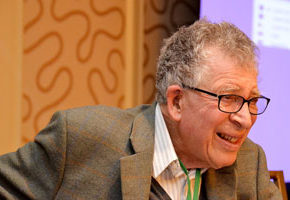
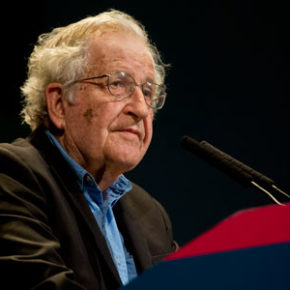 The AAG has selected Noam Chomsky as the recipient of its 2017 AAG Atlas Award, the association’s highest honor. The AAG Atlas Award is designed to recognize and celebrate outstanding, internationally-recognized leaders who advance world understanding in exceptional ways.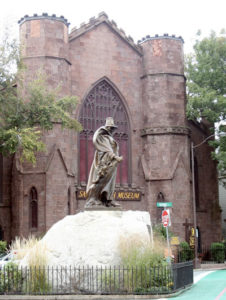
 The AAG has proposed a new Advanced Placement course in Geographic Information Science and Technology (AP GIS&T) designed to introduce high school students to the fundamentals of geographic information science and applications of geospatial technologies for spatial analysis and problem solving.
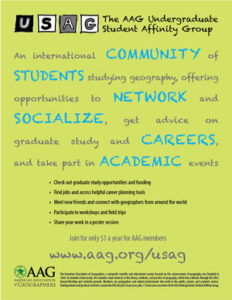 The American Association of Geographers will launch a new affinity group specifically for undergraduate students. The Undergraduate Student Affinity Group (USAG) will be an international community of students studying geography, offering opportunities to network and socialize, get advice on graduate study and careers, and take part in academic events.
 Becoming more involved in the AAG facilitates strengthening professional networks, volunteering, taking part in scholarly activities, advancing academic studies, etc. Graduate students can register to attend their fall regional division meeting and submit their paper at that time to be eligible to win the Council Award for Outstanding Graduate Student Paper at a Regional Meeting.
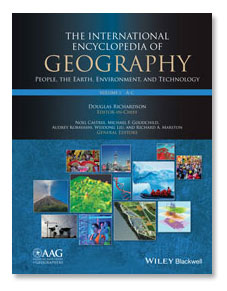 The AAG and an international team of distinguished editors and authors are in the final stages of preparing a new major reference work for Geography: The International Encyclopedia of Geography: People, the Earth, Environment, and Technology.
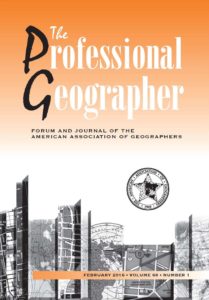 The AAG is pleased to announce that Volume 68, Issue 4 (November 2016) of The Professional Geographer is now available.
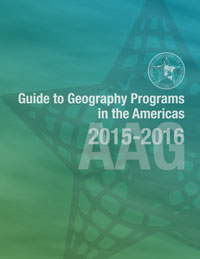 The AAG Guide to Geography Programs in the Americas, or The Guide, includes detailed information on undergraduate and graduate geography programs in the United States, Canada, and Latin America, including degree requirements, curricula, faculty qualifications, program specialties, financial assistance, and degrees completed.
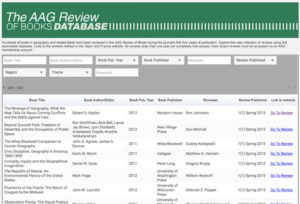 Since launching in 2013, The AAG Review of Books has published more than 250 book reviews, marking a new milestone for the journal. To celebrate this landmark, and to enable easier exploration of the vast collection of reviews, the AAG has launched a new searchable database.
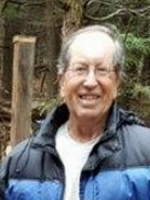 Ary J. Lamme III, a cultural and historical geographer who was Emeritus Professor at the University of Florida, passed away in September 2016 at the age of 76. Lamme was a long-time member of the American Association of Geographers and recognized for 50 years of continuous membership in 2014. He will be remembered fondly by many former colleagues. Lamme leaves behind his wife, Sandra, and two adult children, Laurel and Ary Johannes IV.
 AAG Offers Suite of New Resources for Students and Job Seekers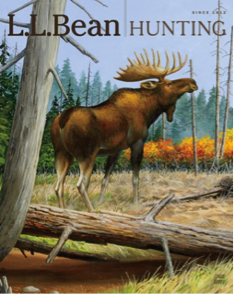

 The AAG and an international team of distinguished editors and authors are in the final stages of preparing a new major reference work for Geography: The International Encyclopedia of Geography: People, the Earth, Environment, and Technology.
 Since launching in 2013, The AAG Review of Books has published more than 250 book reviews, marking a new milestone for the journal. To celebrate this landmark, and to enable easier exploration of the vast collection of reviews, the AAG has launched a new searchable database.
 The AAG is pleased to announce that Julio Arguello, Jr. has joined the association as the Social Media and Website Content Manager at its headquarters in Washington, D.C. Julio has more than 15 years of digital communications, IT, membership and publications management experience in the nonprofit sector. He holds a bachelor’s degree in English from Towson State University.
 Those of us alive today are witnessing one of the most profound events in all of human history — and it is an event, which is fundamentally geographic in nature. The transformation we are experiencing is the concentration of the majority of the world’s population into urban areas. Although much has been made of the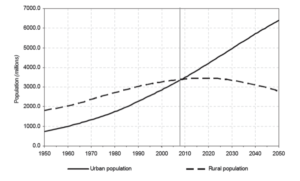
 The trend of rural exodus is not confined to the developed world. Between 2007 and 2050 rural populations in the world’s less developed regions are expected to decline by 17 percent or some 440 million people. Unlike the 20th century, it is outmigration from the countryside in least developed regions that will drive the global rural exodus numbers going forward.