Geographic Ignorance, the Iran War, and the End of US Hegemony

Great powers die when they needlessly fritter away their advantages. While I was never a fan of US hegemony, it did confer benefits to the country’s economy and its citizens. The War in Iran is the crowning blow to a year-long string of reckless moves that effectively destroy American hegemony by undermining the country’s moral positions, weakening its economy, and entangling the nation in an unwinnable war. A deeper understanding of geography could have mitigated such miscalculations, something future political leaders and the US public need to better understand if further missteps are to be avoided.
First, the current US administration has taken a sledgehammer to the existing world order built on multilateralism and a commitment to basic human rights. This system was erected in the mid-20th century by the US and its allies in the wake of two devastating world wars. While the US and other powers violated the rules of engagement in a number of instances, there was enough of a commitment to multilateral institutions and fundamental principles that the system ensured a modicum of stability and shared economic benefits. The current administration’s zero-sum view of the world cannot comprehend the advantages that come with cooperation and soft power—and it has done everything possible to undermine multilateralism and destroy US bilateral foreign assistance.
In unilaterally blundering into the war in Iran, the US administration made no attempt to bring along other allies and then was shocked when European countries were unwilling to assist in the endeavor. The crowning blow came on April 7 when President Trump threatened to destroy Iranian civilization if the regime did not comply with his demands: “A whole civilization will die tonight, never to be brought back again.” Let us be clear that such wanton mass destruction is defined by international law as a war crime. This was a major breach of international moral strictures, shattering whatever remained of principled American leadership, and these statements were swiftly denounced by the Pope and other religious leaders.
Second, the debt-sponsored spending of the current administration has reached historic heights. The US national debt has now hit $39 trillion, and over the past year we have seen the fastest accumulation of a trillion dollars in debt outside of the pandemic. As of early April, the US had spent $28 billion on the war in Iran, a figure that keeps climbing. Such massive debt accumulation, coupled with cuts in research spending, will undoubtedly weaken the US economy for years to come, effectively diminishing economic might as a major component of US power on the world stage.
Geographical Perspective Is Badly Needed
Third, since February 28, the US has actively been engaged in military attacks on Iran (although we are in the midst of a shaky ceasefire as I write). This war of choice is an enormous strategic blunder as the US administration has plunged the country in an unwinnable conflict by failing to comprehend: 1) the cultural geography of Iran, 2) the daunting physical geography of the Strait of Hormuz (a major pinch point through which 20% of global oil and liquified natural gas pass), and 3) the ongoing vulnerability of the US economy to global oil shocks.
The US administration has grossly misread the cultural, social and political geography of Iran. Iran, formerly Persia, is one of the oldest nation states in the world, with organized settlements dating back to 3200-4000 BC and the first Persian Empire emerging in 550 BC (Achaemenid Empire). The result is not just an ancient cultural complex, but a relatively large country (with 90-some million people) with a strong national identity. This is also a region where the US has behaved badly in the past, supporting a covert coup to oust a democratically elected prime minister in 1953, and then installing Shah Mohammad Reza Pahlavi who ruled until the Iranian Revolution in 1979. While there had been social unrest and internal discontent with the Islamic Regime in recent months and years, the lack of a more robust, organized resistance movement, and a formidably repressive regime, meant that a popular uprising in the wake of US and Israeli air attacks was unlikely. Even with an Iranian public that feels deep antipathy towards its rulers, such an uprising became even more unlikely when the US president made genocidal calls for the destruction of Iran’s civilization, effectively alienating a population with a deep sense of pride in its country.
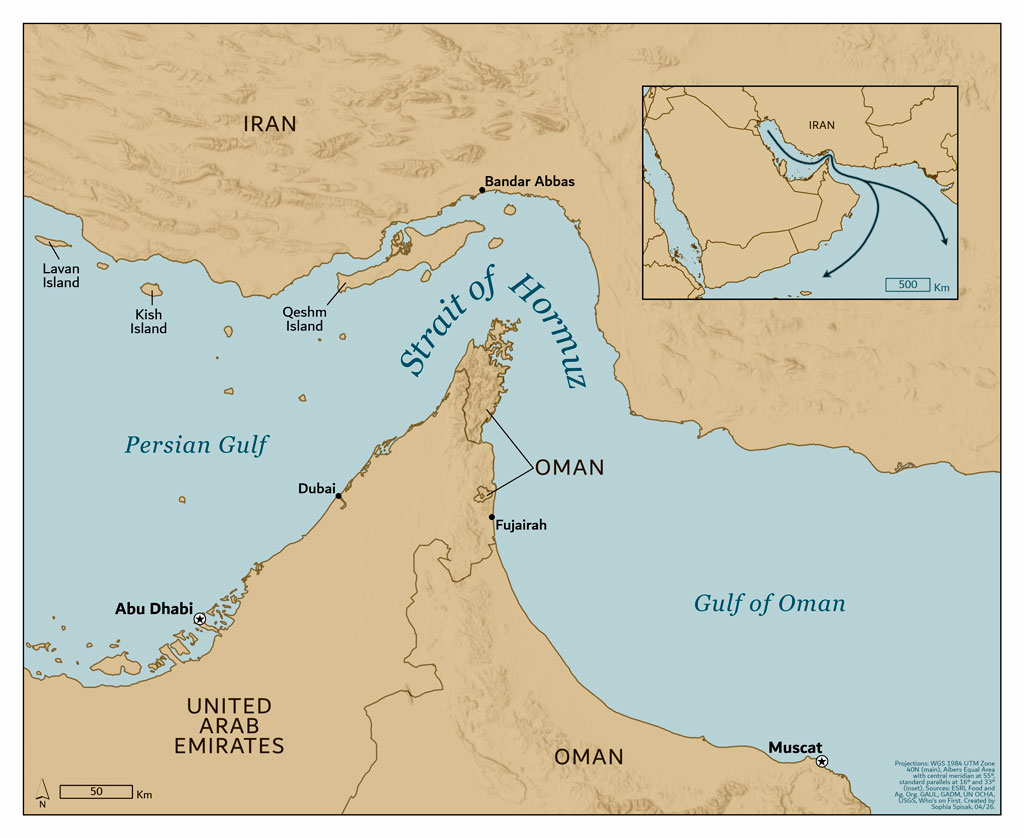
The Strait of Hormuz is a physical pinch point in the global trade of oil and liquified natural gas. Exports originating in the Persian Gulf must pass through this strait controlled by Iran and Oman (although more so by Iran) (see map below). Iran’s extensive coastline is better suited for controlling the Persian Gulf and the Strait compared to its smaller, southern neighbors. More specifically, Iran’s long, continuous and mountainous coastline, coupled with multiple islands, and a relatively narrow deep-water channel through which large ships can pass, allows them to effectively monitor and mount guerrilla attacks on passing ships. As has been noted elsewhere, Iran does not need to halt all shipping, but only sporadically hit a few targets in order to bring a halt to all commercial shipping. It is increasingly clear that the US Administration and its war planners underestimated the import and difficulty of controlling this area.
The United State is still heavily dependent on fossil fuel consumption, with the current administration having abandoned all attempts to build up alternative energy sources. While other countries have worked hard to develop fossil fuel independence, the US administration has refused to understand that a fossil fuel-based economy is not only problematic in environmental terms, but it also leaves the country vulnerable to shocks in the global energy system. Although the US is the largest fossil fuel energy producer in the world, and largely creates what it needs, energy prices are deeply intertwined, meaning that disruptions in one part of the system reverberate throughout the world. As such, the US President’s claim that a closed Strait of Hormuz is not his problem represents a fundamental misunderstanding of how global energy market’s function. It also means that the US is still deeply vulnerable to the energy price shocks created by the closing of the Strait of Hormuz, including less obvious consequences such as higher fertilizer prices for farmers (which will impact food prices) and more profits for oil exporting adversaries such as Russia.
The War in Iran will be a Pyrrhic victory for the US at best. While the US president may eventually claim some sort of win, in the process he will have destroyed the country’s moral credibility and soft power, permanently set back the American economy, and created an unstable quagmire in Iran. The end result will be a hastened end to US hegemony brought about by hubris, cultural arrogance, and ignorance of geography.
Please note: The ideas expressed in the AAG President’s column are not necessarily the views of the AAG as a whole. This column is traditionally a space in which the president may talk about their views or focus during their tenure as president of AAG, or spotlight their areas of professional work. Please feel free to email the president directly at moseley@macalester.edu to enable a constructive discussion.