

Regional Meeting Lollapalooza: Remarkable Spaces for Grassroots Innovation and Discussion

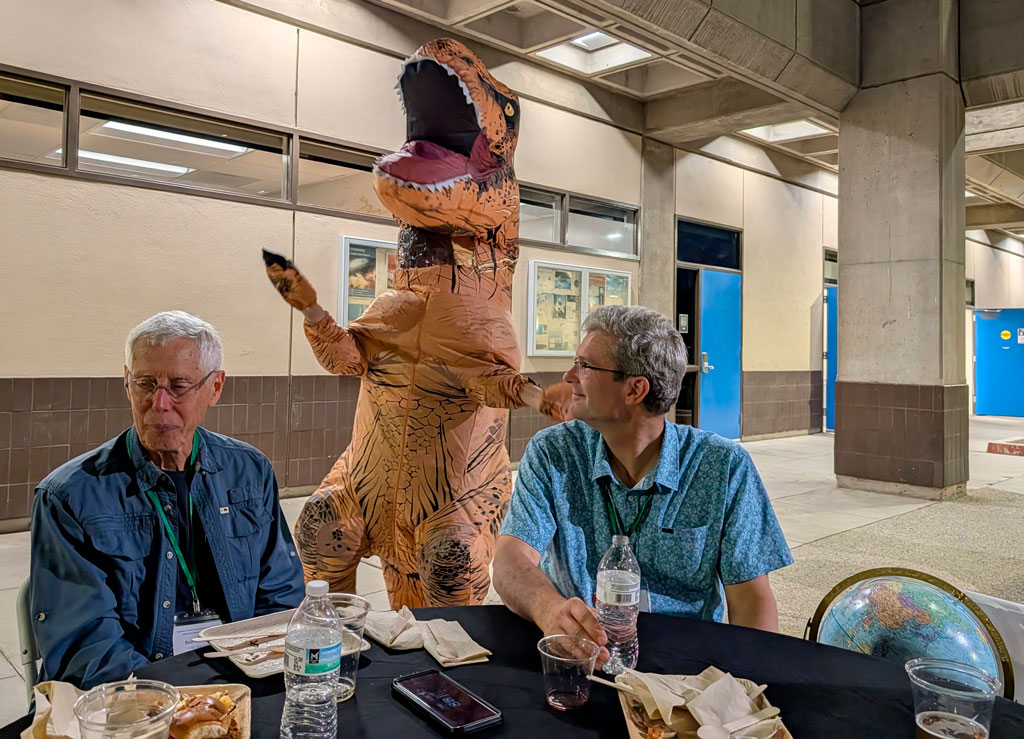
An person dressed in a dinosaur costume entertains attendees at the APCG regional division meeting
Dancing dinosaur at the Annual Meeting of the Association of Pacific Coast Geographers (APCG) in Santa Clarita, CA. Credit: Michael Pretes

William Moseley

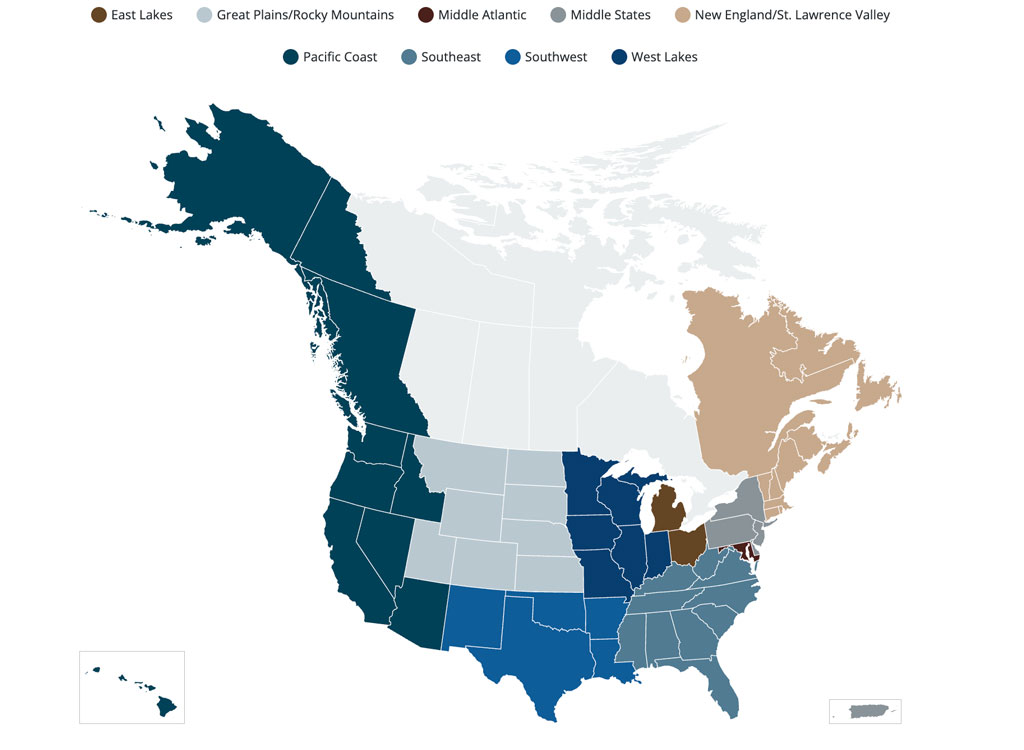
I grew up in the Chicago area, where we have an annual lakefront, summer music festival known as Lollapalooza, featuring an eclectic collection of genres and artists. This event is fun, experimental, inflected with regional traditions, and brimming with youthful, creative energy. More generically, lollapalooza refers to something extraordinary and a way I have come to think about our AAG regional meetings. This fall I had the pleasure of attending four AAG regional division meetings: Pacific Coast, Great Plains and Rocky Mountains, Southwest, and Middle States (see figure). These encounters have been tremendous opportunities for me to meet and learn from our members. Here I reflect on some broad themes across all of the meetings, as well as some key take home messages that I gleaned from each region.

Map showing color-coded shapes including states and provinces in AAG's nine Regional Divisions
AAG Regional Divisions


Cutting across all of the regions, I was deeply impressed by the presence, energy and insights of geography students, both graduate and undergraduate. If you are ever feeling down about the headwinds facing our discipline, just spend time with our students and you will come away feeling inspired and optimistic about the future. From their scholarly endeavors shared in talks and posters, to their competitive zeal at geography bowls, to their willingness to engage in hallway conversations, I was captivated.  I also have even greater appreciation for the contributions of international students to our discipline (even beyond what I have written about previously). Their presence was notable in all of the regional meetings and they help ensure that a broad range of life experiences are brought to bear on the emerging research produced by our discipline.

I also continue to be struck by the limited presence of R1 faculty at many regional meetings. Of course, there are notable exceptions to this broader trend and I also understand that this is a not a new phenomenon. I further understand some of the reasons for this (and I am also guilty of such transgressions). Many faculty are stretched in terms of time and/or resources to attend a second or third academic conference. As such, they prioritize a national meeting where the largest number of people in their subfield are sharing their latest research findings. What is lost is stronger bonds between different types of institutions in a region as well as an opportunity for undergraduate and master’s level students to potentially meet a future advisor.

Beyond these broader themes, I was really struck by the individual character of each region and some unique lessons I learned in each place. The meeting of the Association of Pacific Coast Geographers (APCG) took place at the College of the Canyons in Santa Clarita, CA. There our outdoor barbecue on the second evening was graced by the presence of a dancing dinosaur (see Figure 2) and later that night a person in a gorilla costume briefly entered the auditorium for the keynote lecture (attesting to the fun and quirky ambiance of APCG meetings). More seriously, I was really struck by role that community colleges play in this region as a critical pipeline for future geographers (and something the discipline could build on more broadly). Some of the fastest growing geography programs in the region, such as San Diego State University, source many of their majors from surrounding community colleges. The APCG meeting also took place on a community college campus, College of the Canyons.

An person dressed in a dinosaur costume entertains attendees at the APCG regional division meeting
Dancing dinosaur at the Annual Meeting of the Association of Pacific Coast Geographers (APCG) in Santa Clarita, CA. Credit: Michael Pretes


This year’s Great Plains Rocky Mountain (GPRM) regional meeting in Omaha, NE was a joint meeting with the National Council for Geographic Educations (NCGE), our sister organization that counts many high school geography teachers among its ranks. This innovative experiment of two meetings in the same place with some cross over events created a space for bridges to be built between the parallel universes of high school and college geographers. It allowed myself and two members of the AAG taskforce on geography undergraduate education to run a workshop on the high school-to-college geography pipeline for secondary school teachers and university instructors, to speak to a mixed audience at an evening banquet, and to have dinner with the leadership of the NCGE. I could see the NCGE meeting joining with other regions in the future and I believe we could do even more to bring college faculty and high school teachers together.

The meeting of the Southwest Division of the AAG (SWAAG) took place in Las Cruces, New Mexico and was hosted by New Mexico State University. In addition to a keynote address, I participated in several panel discussions, including one on academic freedom. There I learned of state government initiatives in Texas and Oklahoma to audit course syllabi and reading lists. I further came to understand that certain words and topics are being advised against in course titles, such as decolonizing, liberation and resistance. This situation is alarming to me both personally and professionally (e.g., I have publications using several of these ‘trigger’ words). More significantly, maintaining academic freedom is a core value of the AAG and something it fights for on the national level. Nonetheless, at this regional meeting, I was deeply impressed by the way faculty were sharing experiences and advice on how to navigate such challenging circumstances. It also served as a reminder that our local experiences of speech suppression, censorship or freedom can vary greatly (and we need to be sensitive to the fact that the actions and decisions of the AAG might play out differently across regional contexts).

Lastly, the Middle States Division of the AAG (MSAAG) met at Montclair State University in Montclair, NJ. There I was impressed by the presence of deeply engaged high school teachers and their students, many of whom presented research posters. The quality of their research was striking and I believe this is an innovation that could be experimented with in other regions. What could be a better recruitment tool than to have high school students attend research presentations by grad students, or to have a professor engage with a high schooler about their project and encourage them to think about a geography degree in college.

My journey across these events left me feeling inspired by the energy and insights of our students, encouraged by the experimentation in each division, and better in-touch with political currents and challenges. This is not to say the fall AAG regional meetings are flawless, some suffer from low attendance or limited organization, but I see these as vital encounters to be improved up, not dismissed or marginalized. Fortunately, the support of AAG staff for the regions has begun to bear fruit, building on the recommendations of an AAG task force report released on the topic some five years ago. Just like a summer music festival, these are fun spaces to experience the diversity, energy and creativity of our discipline.


Please note: The ideas expressed in the AAG President’s column are not necessarily the views of the AAG as a whole. This column is traditionally a space in which the president may talk about their views or focus during their tenure as president of AAG, or spotlight their areas of professional work. Please feel free to email the president directly at [email protected] to enable a constructive discussion.
 

    Share

Academic Freedom and the Need for Geographers as Public Intellectuals

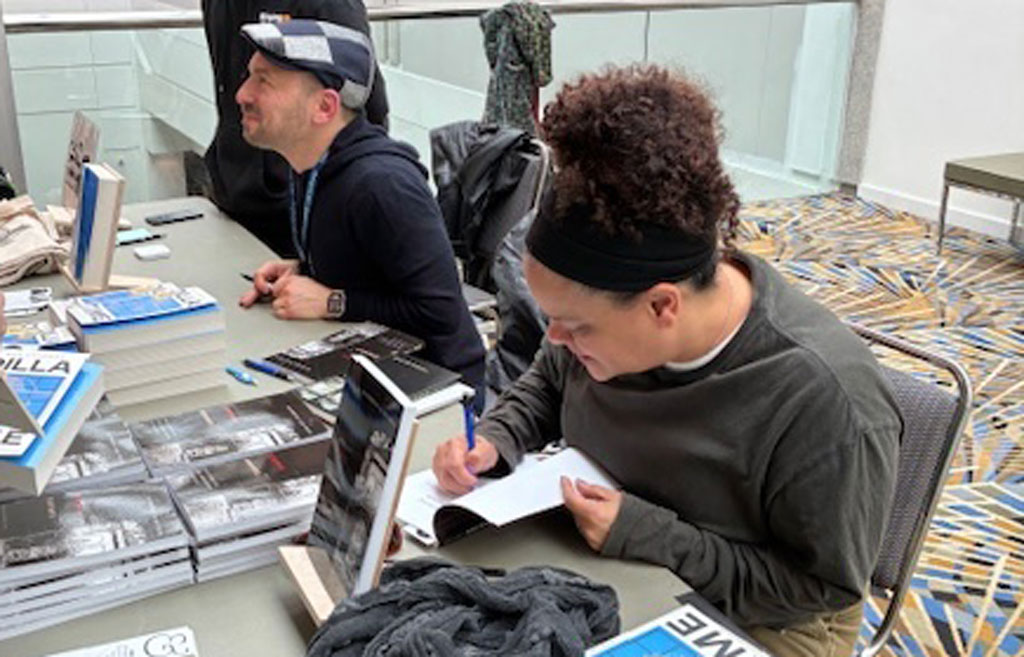
Geographer Katherine McKittrick and colleague Dan Charna participate in a joint book-signing at AAG 2025 in Detroit. Credit: Lisa Schamess, AAG

William Moseley

Free speech and academic freedom are increasingly under siege in the United States, with the scope and scale of speech repression nearly unprecedented. At the same time, the U.S. government is currently engaged in a vast array of domestic and foreign policy shifts, from changes in environmental regulations and naming conventions at home, to the closing of USAID operations and retreat from multilateralism abroad. Despite efforts to silence critics, these policy and program shifts deserve thoughtful public conversations that involve geographers. We need geographers as public intellectuals to continue to voice their perspective on the policies and programs of our government and others.

The tradition of the public intellectual (a form of public geography) may be contrasted with that of the ivory tower academic. Public intellectuals are scholars who take the time to address an important public debate or policy issue when they have relevant expertise and an informed perspective to offer. The public intellectual practice is more well developed in Europe, where academics regularly participate in policy discussions and are considered normal actors in public discourse. In fact, many European universities expect their faculty to comment on public issues and acknowledge this is in tenure and promotion criteria. In contrast, this practice is less well developed in the United States, with such engagement sometimes viewed as inappropriate. This distance between the American academy and public policy discussions has contributed to the ivory tower phenomenon, arguably making it more challenging for the U.S. public to feel connected to universities, their faculty and students.

To the extent that academics do participate in public policy discussions in the U.S., some disciplines tend to be over-represented, most notably economics and political science. That said, analysis that a student and I undertook over a decade ago showed that for a small discipline, geography was punching above its weight, outpacing allied disciplines such as anthropology, geology, and biology in terms of op-ed productivity per member. The geographic perspective is critical for adding to public policy discussions, be it in terms of nuance regarding spatial patterns, scale, coupled-human-environment systems or deep regional knowledge. As former AAG president Alec Murphy has argued: “our understanding of issues and problems will be impoverished if geographical perspectives are not part of the mix.”

The AAG considers the support of free speech and academic freedom to be core to its mission and has offered programming to this end. For example, in 2023, the AAG initiated the Elevate the Discipline cohort of 15 geographers to receive year-long support and training in techniques for public scholarship to inform public policy. In late October of this year, the AAG hosted a panel for department and program chairs seeking to support their faculty in terms of academic freedom. Furthermore, I am happy to report that we still have many geographers who continue to offer their perspectives on the issues of the day. Herewith three examples.

In early October, Christopher F. Meindl, associate professor of geography at the University of South Florida, published a commentary entitled “Florida’s 1,100 natural springs are under threat — a geographer explains how to restore them.” In this piece, Meindl drew on his own research as a human-environment geographer, and recent book on Florida springs, to provide context and recommendations for restoring these important natural assets.

Second, while we often think of public scholarship appearing in the form of commentaries, some geographers also write books that are more accessible to a public audience. A good example of this is Yolonda Youngs’ recent book, Framing Nature, about the social construction of nature in Grand Canyon National Park. Hearing Youngs present on her book at the recent meeting of the Association of Pacific Coast Geographers, I appreciated how she explained deliberately writing the book for a public audience, even tearing up portions of a previous draft and re-writing it in a way that would be more accessible.

Lastly, geographer and cartographer Margaret Wickens Pearce was recently recognized as a MacArthur Foundation Fellow (aka genius award) for her groundbreaking work “creating maps that foreground Indigenous Peoples’ understanding of land and place.” Her approach highlights another form of public scholarship, working respectfully with communities to bring their perspectives into conversation with broader publics. As a Potawatomi Nation tribal member, Pearce was well positioned to undertake this work.

Today, we need the geographer as public intellectual more than ever. Engaging in this manner requires a certain amount of backbone and privilege, the ability to write for broader publics, and good timing.

Writing for a general audience has always required some willingness to endure negative feedback. Now we have an added layer of hostility and professional risk to anything perceived as critical. In mid-September, the U.S. president argued that television coverage that is critical of him or his administration’s policies is illegal (a point that was unsubstantiated and challenged). Several academics, including geographers, have also lost their jobs or been put on administrative leave for comments they made on social media following Charlie Kirk’s murder. While the climate of fear these comments and actions have engendered is palpable, and some members of our community are in more precarious positions than others, now is not the time for those in privileged positions to be silent.

The unfortunate reality is that tenured and U.S.-born professors in blue states are often in less precarious positions than others. As such, at this time I would especially encourage those with privilege to contribute as public intellectuals where appropriate. When writing, it is always important to stick to positions and perspectives that are informed by one’s scholarship. Doing so makes one’s arguments more defensible.

Writing for broader publics is also quite different than writing for academic audiences. While we generally learn to write for academic audiences as graduate students, most of us are not taught to write for non-specialists. Writing for a general audience is a skill that needs to be developed. As mentioned previously, the AAG’s “Elevate the Discipline” program offered media and advocacy training to a group of geographers working on climate change and society. Some departments and faculty members have also been more proactive than others in mentoring and collaborating with students in this approach to writing. For example, former AAG president Derek Alderman, as well as Jordan Brasher, worked alongside Ph.D. candidate Seth Kannar, who was first author on a 2025 commentary for The Conversation entitled “From Greenland to Fort Bragg, America is caught in a name game where place names become political tools.” This was no doubt a valuable experience for an early career geographer, showing that it is possible to make connections between our research and current policy discussions.

Lastly, unlike most academic articles, the timing of many (but not all) commentaries is critical so they dovetail with the news cycle. This is challenging for many academics, as it means dropping what you are doing and writing something quickly so that it is relevant to a burning, public debate. Reporters may also call for background information or perspective on an issue, and one needs to set aside their current work to think through a thoughtful response. Even more challenging are live media interviews on radio or television. A good example of this is former AAG president Glen MacDonald who was interviewed widely by major news outlets, including on the nightly news in 2018 in L.A. about the Camp Fire ravaging the state at that time. This is hard but important work, and geographers almost always add critical depth and perspective to the conversation.

While academic freedom is under siege in the United States today, we now need geographers as public intellectuals more than ever. Fear is a powerful weapon and those in less precarious positions need to push back in support of a robust civil society and the power of the fourth and fifth estates. In so doing, geographers bring valuable perspectives to the debate, bridge the gap between academia and the public, and demonstrate the vitality and relevance of our discipline.


Please note: The ideas expressed in the AAG President’s column are not necessarily the views of the AAG as a whole. This column is traditionally a space in which the president may talk about their views or focus during their tenure as president of AAG, or spotlight their areas of professional work. Please feel free to email the president directly at [email protected] to enable a constructive discussion.
    Share

The War in Gaza and an Inclusive AAG Process for a Thoughtful Response

Magnifying glass highlighting Gaza on a larger map.

William Moseley

The AAG will hold a special meeting on October 3 in response to a membership petition asking the association “to endorse the BDS campaign for an academic boycott of Israeli academic institutions, and for financial disclosure and divestment of any AAG funds invested in corporations or state institutions profiting from the ongoing oppression of the Palestinian people.” Our bylaws state that if more than 10% of members sign a petition with a valid call, then the AAG will host such a special meeting. As this is a divisive issue, I write to clarify three points: 1) my personal perspective on the war in Gaza (which you deserve to know, but is irrelevant to the position of the AAG), 2) the AAG process for responding to troubling world events, and 3) some of the factors the AAG Council will need to consider before arriving at a decision on an appropriate AAG response to the situation in Gaza.

First, my own views. The situation in Gaza is deeply concerning and distressing to me personally. As some of you may know, much of my scholarship and United Nations (UN) policy work has dealt with food security and agricultural development in the Global South, often from a political ecology perspective. As per the Integrated Food Security Phase Classification (IPC) system, famine was officially declared in Gaza on August 22, 2025, confirming what many had long argued was an unfolding humanitarian crisis. It is significant and sobering that this respected and cautious UN-backed food security monitoring group concluded that all three thresholds that define a famine had been crossed. It calls the famine in Gaza “entirely man-made.” It further notes that there are “half a million people facing catastrophic conditions characterized by starvation, destitution and death.” The IPC report on Gaza comes nearly two years into an armed conflict with Israel that was triggered by the October 7, 2023 attack by Hamas. Israeli restrictions have limited the flow of food and aid into Gaza. I believe in the right to food as enshrined in the Universal Declaration of Human Rights and I stand against using food as a weapon of war. I also recognize the right of Israel to exist, condemn the October 7 attack and support a two-state solution. However, let it be clear that my own personal views matter no more than anyone else’s in our community and that the central question is whether and how the AAG might respond to this terrible situation. The AAG Council must make the best possible decision in relation to its mission and values, with the fullest possible input of our membership and according to our bylaws.

Second, what is the AAG’s process for considering a response to such a crisis? The AAG Council, the democratically elected representatives of the membership, has a legal and ethical obligation to consider actions called for in a membership petition or — in some cases — to decide how to respond to a crisis or government decision. In considering potential responses, the AAG Council must do so in a way that is in the best interest of the organization (also known as fiduciary responsibility). Typically, Council deliberations on potential actions include an analysis of relevant background information and occur without the active participation of the broader membership. However, because this deliberation was triggered by a membership petition, the AAG will engage in an open and transparent information collection process before the AAG Council arrives at a decision. The synchronous meeting of the membership on October 3 is intended to answer questions and kick-off an inclusive information collection process that provides the greatest potential for all members to participate. The process will involve a 60-day period in which any AAG member may asynchronously comment on a draft background document that will inform Council decision-making in regard to a potential AAG response to the situation in Gaza. This written comment option will be complemented by two AAG Council listening sessions (one closed session and one open to all members), both during the 60-day period. Members can sign up to share their perspectives on this matter with Council, starting on October 3. Once the background information collection period is complete, the AAG Council will deliberate on the best course of action, taking into account the concerns and perspectives of the membership as well as the mission and wellbeing of the organization.

Contrary to some views circulating, the October 3 zoom meeting will not entail an open debate among the AAG membership on the best course of action, nor a presentation by the petitioners or other groups (although this could happen in a subsequent listening session), nor a live vote of the membership. To undertake an open debate would be challenging (imagine an open zoom meeting with hundreds of members asking to speak). Furthermore, privileging some perspectives in featured presentations would be less than inclusive. Lastly, while I have received dozens of emails asking for a membership vote on the BDS proposal, this approach is not called for in our bylaws. Previous AAG membership votes have never been directly undertaken in response to a petition, but rather for an election, a bylaw change (such as the AAG name change) or on an issue at the request of the AAG Council.

Third, once the membership comment phase is complete, what types of issues might the AAG Council need to consider before arriving at a decision on an appropriate AAG response to the situation in Gaza? There are a range of potential responses, including divestment of AAG funds from organizations profiting from the oppression of the Palestinian people, an academic boycott of Israeli universities, endorsing BDS as a political movement, making a public statement about the situation in Gaza, calling for a vote of the membership on an action proposal, or no action. As noted previously, Council will need to consider all facets and nuances of these potential actions and make a decision that is consistent with the values and the well-being of the organization. In terms of our values, the AAG is committed to principles of justice, equity, diversity, and inclusion as outlined in the JEDI strategic plan and adopted by the organization in 2020. The AAG is also opposed to both Islamophobia and antisemitism, and we are dedicated to creating venues for free and open discussion of academic ideas.

While I could not possibly summarize all aspects the Council will need to consider (many of which will be in the aforementioned background document), let me just mention a couple issues that may be of interest to the membership. First, because of the work of the AAG’s climate action committee, we adopted socially responsible investment screening a few years ago. As a result, the AAG’s relatively small endowment (about 1.1% the size of my college’s endowment for example) does not have investments in the fossil fuel industry, arms manufacturing or occupied territories. Second, while the AAG could issue a statement about the situation in Gaza without violating nonprofit laws, endorsing BDS as a political movement may have complications. To wit, nonprofits, or 501(c)3 organizations, in the United States have strict restrictions on political endorsements. Furthermore, given that anti-BDS laws exist in 38 states, a BDS endorsement might inhibit our members in those states from using public funds to attend a regional or national AAG meeting. Lastly, the AAG is committed to academic freedom and we need to think carefully about any actions that might impede the free and open exchange of ideas.

In sum, the war in Gaza is deeply troubling, as were the attacks in Israel on October 7, 2023. While this issue has the potential to divide our membership, I have faith in the transparent and inclusive process that the AAG has embraced in its deliberations on the best potential response. While I understand that some of our members may be frustrated that we are debating this issue at all, or that the decision-making process is not moving quickly enough, it is important that we do this well. Healthy organizations are able to openly and fairly discuss contentious issues if they have a clear process for doing so. I am confident that our community will emerge from these deliberations stronger than ever.


Please note: The ideas expressed in the AAG President’s column are not necessarily the views of the AAG as a whole. This column is traditionally a space in which the president may talk about their views or focus during their tenure as president of AAG, or spotlight their areas of professional work. Please feel free to email the president directly at [email protected] to enable a constructive discussion.
    Share

The Dismantling of Public Research Funding and the Need to Invest in a Better Future

William Moseley

Geographic research has improved the human condition, enhanced long-term environmental sustainability, strengthened the economy, fostered human understanding of the planet, and facilitated learning of those students engaged in the knowledge production process. While some research is funded by the private sector to specific ends, the bulk of scientific inquiry is a public good that benefits the larger society and is supported by governments whose citizenry ideally understand the long-term benefits of scientific research. While what I have presented above is the ideal, it actually works in many cases. Unfortunately, the public funding of scientific research in the United States has been willingly dismantled over the past nine months to the detriment of the academy, geography, and American society.

In 2010, the National Research Council published Understanding the changing planet: Strategic directions for the geographical sciences (written by a committee chaired by former AAG president Alec Murphy). This report set out an ambitious research agenda for the discipline, articulating big questions for geographers to tackle with significant societal impacts. Geographers in the US and around the world have aggressively worked on those questions over the past 15 years (relating to the environment, population, health, food, and migration to name a few) and arguably made the world a better place. I truly believe that a society that supports scholarly research is investing in the future and acting on the belief that we can do better. To arbitrarily defund research is to not look forward, to not have hope for a better world, and to doubt our capacity to enhance human understanding.

A society that supports scholarly research is investing in the future and acting on the belief that we can do better.”


As a fundamentally field-based discipline, geographers often need external funding to do the work we do. For example, in July I was fortunate to be in rural Tanzania with three research students and local university partners trying to better understand the food and nutrition security implications of primary schools that employ agroecological practices on their farms to produce food for their lunch programs. While our findings will hopefully have implications for the way we understand environmental sustainability, agroecology and nutrition security, just as important was the development of future scholars and international scientific exchange that was a byproduct of this process. This was a pilot project supported by seed money from my university and for which I had intended to seek external support, a prospect that now feels increasingly unlikely as the current administration has bludgeoned the National Science Foundation (NSF) and other federal agencies that support scientific research. My story is just one of many that have rippled across our discipline, cutting short the knowledge production process, the training of future scholars, and transnational scientific collaboration.

Cuts to scientific research funding in recent months have been devastating. The White House’s proposed budget for FY26 for the National Science Foundation (NSF) would reduce the agency’s budget by 55 percent, bringing its annual budget down to $3.6 billion from the $9 billion appropriated in FY2024, and a similar range of funds available in 2025. This latest proposed cut was preceded by the termination of hundreds of millions of dollars in research funding that had previously been awarded.

  • In February, the AAG published an open letter decrying the devastating cuts to the NSF’s Human-Environment and Geographical Sciences (HEGS) Program (while geographers have been successful obtaining grants from a number of NSF programs, this is the flagship program for the discipline). Then in early March, the AAG was one of 48 learned societies signing an open letter asking congress to protect science.
  • Proposed cuts to the U.S. State Department’s Fulbright Program will entirely eliminate it and in June the oversight board of this prestigious program resigned after political appointees cancelled the awards of almost 200 American professors who were scheduled to go oversees to undertake research and teaching, and put in jeopardy those of another 1200 foreign scholars who were to receive support for academic exchanges in the US.
  • The U.S. Department of Education has cancelled this year’s Fulbright-Hays Program that has supported the international research of U.S. professors and students for over 60 years. The loss of this program was part of a larger executive action to dismantle the U.S. Department of Education, with the AAG signing on to a joint statement against such actions in March 2025.

These are just some of the cuts to federal programs that support geographic scholarship. Of course, research costs money, and some research projects are more impactful than others, but to indiscriminately cut research funding across the broad undermines the prospect of a better future. Important advances in science are often generational in nature. Rarely do the biggest breakthroughs come in a single year, decade, or even career. Research funding is the fundamental connector that sustains research across generations. It’s not just a feel-good activity to use research funding for training future scholars: it is the lifeline of discovery, innovation, and progress.

Judiciously allocated public funding is critical to the advancement of scientific understanding, to the careers of geographers and to the training of their students. Over the course of my career, for example, I have benefitted from four federal research grants, two from the NSF and two from the Fulbright-Hays Program (likely placing me somewhere in the middle of what is typical for an academic geographer). When I was younger, these grants helped launch my career and as I grew older, they helped me train future scholars. The competitive application process helped me refine my research questions and methodology, and subsequent service on several NSF panels allowed me to better understanad the care and thought that went into prioritizing which type of research to support with scarce public dollars. From my time on such panels, I still remember Tom Baerwald (former NSF Program Director and AAG past president) and colleagues showing us the research innovation S curve (or the Isserman curve), slowly starting with basic research and the trial and error search for good questions (A and B), to the steep climb and rapid innovation phase (C), to the tapering off and research saturation plateau (D and E) (see figure 1). Our task, as a scientific panel, was to identify sound projects situated at the start of the rapid innovation phase. It was an extremely rigorous process, led by panels of faculty working on a mostly pro-bono basis, and with many more good projects on offer than NSF would be able to fund.

The Isserman (science innovation) Curve illustrates cumulative knowledge vs projects over time.
Figure 1: The Isserman (science innovation) Curve; Source: Baerwald, T. J. (2013). The legacy of Andrew Isserman at the U.S. National Science Foundation. International Regional Science Review, 36(1), 29-35.


Geography needs to more strongly make a case for government support of knowledge production as central to a better future. Communicating the value of scientific research to broader publics is important as scholarship and universities have become targets in the US culture wars. Part of this will be about articulating a geographic research agenda for the future. What are the key questions moving forward that geographers are particularly well equipped to answer and how will geographical perspectives on those challenges help everyday people and the environment? It has been 15 years since the NRC published Understanding the changing planet. Despite the strong anti-intellectual political currents of our time, now is the moment to more forcefully articulate the value of geographic inquiry and a research agenda for a better a better future.


Please note: The ideas expressed in the AAG President’s column are not necessarily the views of the AAG as a whole. This column is traditionally a space in which the president may talk about their views or focus during their tenure as president of AAG, or spotlight their areas of professional work. Please feel free to email the president directly at [email protected] to enable a constructive discussion.
    Share

A Matter of Survival: Building Better Connections Between High School and College Geography

William Moseley

Some 283,000 students took the Advanced Placement Human Geography (APHG) exam this year, according to the College Board. Imagine if we could persuade even five percent of those students to major in geography at the college level. That would be 14,500 students a year, a number that is over 3.5 times the current number of students who graduate with a major in geography each year in the United States. This is untapped potential waiting to be leveraged at a time when many geography departments in the US are facing serious, if not existential, threats. We can and must do more to build better connections between high school and college geography.

In order to survive and thrive, any discipline needs at least two ingredients. The first is dynamic and cutting-edge research. A discipline makes a mark in the intellectual marketplace if it contributes to a better understanding of the world. Geography has arguably done well in this regard, and the AAG supports the scientific enterprise via its annual and regional meetings as well as its journals.

A discipline makes a mark in the intellectual marketplace if it contributes to a better understanding of the world.


The second ingredient is a robust student body, both at the undergraduate and graduate levels. While US graduate programs in geography attract students from around the world, our undergraduate programs are relatively small and increasingly under threat. This is a problem at both a practical and philosophical level. At a practical level, undergraduate numbers are increasingly seen by administrators as a key indicator of long-term viability, and it is this pool of students that feeds, at least in part, graduate programs and the ranks of professional geographers. At a more philosophical level, many would argue that our population is better equipped to navigate the world and be responsible citizens when they have geographical training. The problem is that the number of undergraduate geography majors has fallen in the US by some 20% since 2011 (see Figure 1). How do we reverse this trend and rebuild and expand the undergraduate geography population in the US?  The AAG is exploring this challenge very seriously and I am pleased to be part of an AAG taskforce on geography undergraduate education.


Bar chart showing the slow, but steady growth of geography degrees conferred between 1986 and 2021. Bachelor's degrees grew at the highest rate, but began to fall in 2012.
Figure 1: Geography Degrees Conferred in the USA, 1986-2021. Note: The * and ** refer to geography-related Classification of Instruction (CIP) codes created in 1980 and 2020, respectively. Source: AAG, 2022.

.

This past June I spent two weeks in Cleveland, Ohio preparing for and then grading AP Human Geography (APHG) exams (along with hundreds of other college and high school geographers). The irony is that I don’t like grading, but this is not why I have attended these events for over ten years. I go for the community, the opportunity to connect with high school and college geographers who teach the courses that introduce students to our discipline. These teachers are the foot soldiers of geography and it is their work that powers the long-term viability of our discipline as a field of study. I wish more university geographers and graduate students would participate in this event and, if you have not already done so, I would encourage you to consider attending in-person in the future.

The APHG story is a remarkable one. Starting with the first exam in 2001, at the behest of a small group of dedicated high school and college geography teachers, and supported by the AAG, the number of APHG exam takers has grown by leaps and bounds over the past 25 years (see Figure 2). The program is not perfect. For example, some 70 percent of high school students take the exam when they are freshmen, a stage when many believe young people are not ready for college level material. But the year-long course is comprehensive and rigorous, often representing the only exposure an American student will have to geography during their high school career.


This line chart shows the rapid growth of AP Human Geograhy Exams from 2001-2025. The chart line starts at 3272 and ends with 282,650.
Figure 2: AP Human Geography Exams, 2001-2025. Source: College Board. Source: Lisa Benton-Short and Dan Snyder, using data from Educational Testing Services, 2025


In my informal conversations with many APHG teachers, I have learned that there are a number of things we could do to better capitalize on the increasingly large number of students who take the APHG exam each year.  Here are some preliminary suggestions for consideration.

First, even if they deeply enjoy geography as a subject, many high school students and their parents simply don’t know what one might do with a geography degree in terms of a potential career. This is a significant roadblock because it prevents students (and their parents) from seriously considering geography when they apply to college. While the AAG provides information on geography-related careers, we could do more to offer information that is accessible and tailored to high schoolers.

Second, many high school social studies teachers have limited university training in geography. As such, one of the key ways they learn how to teach the APHG curriculum is via AP summer institutes (AP sponsored summer training courses offered by certified, veteran high school instructors and college faculty). These courses could also provide teachers with more geography career-related information and tips on how to integrate it into their courses. For example, what types of professions are available to those who specialize in urban geography, GIS and cartography, or environmental geography? I would encourage APSI instructors to start doing more of this on their own accord, but they could also use more support from the College Board and the AAG.

Third, I believe that college geography departments and individual geographers have a responsibility to make connections with high school geography teachers near and far as a critical form of service to the discipline.  As discussed previously, the way I have done this is through my engagement with the annual reading (or scoring) of the APHG exam, but others do this by becoming involved with their state level geography alliances (where they exist) or by reaching out to local high schools. In my case, these connections have led to guest lectures in high school classrooms, the co-authoring of articles with high school teachers and countless informal discussions about geography material. College geography students, perhaps coordinated and facilitated by local chapters of Gamma Theta Upsilon (GTU), the geography honor society, could also connect with local high school geography teachers to speak in their classrooms and share their experiences as geography majors. Let’s be honest, for an audience of high schoolers, college students are likely to be far more persuasive in terms of marketing our discipline.

If we are to survive and thrive as a discipline, geography needs to grow its base of undergraduate geography majors. We would be foolish to not build stronger connections with a rapidly expanding APHG program that represents an enormous pool of potential future students. A strong house needs a solid foundation. Please join me in helping to strengthen ours.


Please note: The ideas expressed in the AAG President’s column are not necessarily the views of the AAG as a whole. This column is traditionally a space in which the president may talk about their views or focus during their tenure as president of AAG, or spotlight their areas of professional work. Please feel free to email the president directly at [email protected] to enable a constructive discussion.
    Share

Embracing geography as an international discipline

William Moseley

In an increasingly multi-polar world, rife with resurgent ethno-nationalist and isolationist tendencies, geography needs to emphasize its international perspectives and connections, not pull back from them or play them down. While geography may be a relatively small discipline in the United States, its strength is its grounded understanding of our intensely interconnected world and its global reach as a field of study.

The U.S. has a long history of isolationist tendencies, based in part on the fiction that we can wall ourselves off from the rest of the world (Figure 1). What this ignores are the myriad of ways in which we are connected to other parts of the planet, both historically and in the present. Geographers are exceptionally good at explaining and theorizing these connections and this must remain a bedrock of geographic scholarship and teaching.

3D image of globe showing only the United States mainland and states of Alaska and Hawaii floating on a blue sphere.
Figure 1:  In 2006, National Geographic and its partners launched a five-year campaign, “My Wonderful World,” addressed to students. The campaign challenged the American educational deficits that contribute to Americans’ isolationist views. Source: National Geographic Society


The view that countries can exist in isolation is problematic and counterproductive. It contributes to zero-sum game thinking, the idea that one group or country loses if another wins. A nuanced geographic understanding of the world challenges this view by highlighting the many ways one place on the planet is connected to others in terms of material and cultural flows, as well as shared environmental phenomena. In many cases, the world is a global commons. In seeking to maximize our own return, we often undermine our collective well-being.

I would argue, and researchers have shown, that publics educated in geographic perspectives better understand the inter-connected nature of the world and that we have a shared interest in working together. This has policy implications from the local to the global scale, be it SNAP (formerly known as Food Stamp) benefits for the hungry person next door or emergency food assistance for someone on the other side of the planet. We help our neighbors not just because it is the right thing to do, but ultimately because it is also in our shared self-interest. As the late Minnesota senator Paul Wellstone used to say: “We all do better when we all do better.”

We help our neighbors not just because it is the right thing to do, but ultimately because it is also in our shared self-interest.

American geography has been constantly nourished and re-invigorated by its international connections. International geography faculty and students who come to the United States to work and study contribute to the dynamism of our discipline on so many levels. In my graduate school days, for example, three of the five members of my dissertation committee and half of my student cohort were international. In my liberal arts college geography department today, roughly 30 percent of the faculty and 20 percent of the undergraduate students were born and raised in other parts of the world. Their talents, insights and energy make our discipline a cutting-edge science. This is why the actions of the current U.S. administration vis à vis international students and faculty are so deeply problematic. By harassing our colleagues and students, denying visa applications, deporting people and policing contrarian views, the current U.S. administration is undermining science writ large and especially disciplines like geography that have deep international connections. This is why the AAG signed on to a letter condemning the targeting of foreign scholars in April 2025.

Beyond our colleges and universities, scholarly exchange across national borders is critical for advancing geographic knowledge. This means welcoming foreign scholars into the U.S. for conferences and research, as well as supporting U.S.-based scholars who attend conferences and undertake research abroad.

The AAG annual meeting has long been an important forum where geographers from all over the world gather to exchange ideas and advance geographic understanding. Despite the unwelcoming tone and problematic border procedures of the current administration, some 26 percent of the annual meeting attendees in Detroit came from institutions outside of the U.S. (and have averaged about 40 percent over the past 10 years). I want to personally thank those who came to the meeting and encourage you and others to come back next year. Science must transcend nationalist politics and we (the U.S. geographical community) really need your support and understanding in this difficult political moment. I also want to thank the AAG staff who worked diligently to facilitate the visits of international scholars to attend our annual meeting (by, for example, issuing letters in support of visa applications and monitoring international arrivals at the meeting). I am also proud that the AAG has programs that support international scholars, such as a discounted membership fee for those based in the Global South.

On the flipside, and acknowledging the federal funding cuts that have decimated research and travel budgets, U.S.-based scholars need to keep engaging in scientific forums outside of the U.S. One of the more obvious spaces to engage with the international geographic community is in various meetings organized under the auspices of the International Geographic Union (IGU), an international umbrella organization for national level geographic societies around the world. While the IGU holds big congresses every four years, with regional meetings in-between the congresses, I have found engagement with IGU commissions (akin to AAG specialty groups) to be especially rewarding. Many of these commissions organize smaller conferences where you really get to know other geographers and explore new regions.

Geography prospers when it leans into its international perspectives and connections. Geographers must continue to educate students and broader publics about the interconnected nature of our world. Furthermore, American geography’s secret weapon is its international linkages, from non-U.S. faculty and students, to conferences with diverse participation. The constant mixing of insights and life experiences from the across the U.S. and around the world fuels a formidable scholarly engine. We don’t build walls in geography, we reach across them.


Please note: The ideas expressed in the AAG President’s column are not necessarily the views of the AAG as a whole. This column is traditionally a space in which the president may talk about their views or focus during their tenure as president of AAG, or spotlight their areas of professional work. Please feel free to email the president directly at [email protected] to enable a constructive discussion.
    Share

Welcoming a New President to AAG—Interview with Bill Moseley

Image of digital dots and lines forming a gavel on a desk. Credit: Conny Schneider, Unsplash
Credit: Conny Schneider, Unsplash

Photo of Patricia Ehrkamp

William MoseleyFor the last President’s Column of her term, President Patricia Ehrkamp sits with incoming President William Moseley about his experiences within the discipline and his aspirations for her upcoming leadership at AAG. The following conversation offers insight into the new directions for the 2025-26 presidency.

PE: Thanks for making time to meet, Bill.

WM: Great to be here. Thank you.

PE: So a good place to start is maybe to ask you, what brought you to geography?

WM: Well, I was born and raised in the U.S. So like a lot of people who grew up in the U.S., I had very minimal geography in my K-12 education. Where I was an undergraduate, there was no geography department. Same thing where I got my master’s degrees: an M.S. in Environmental Policy and an M.P.P. in International Public Policy. The University of Michigan previously had a geography department, and there were some geographers around in different programs, but no department when I was there. That said, when I was master’s student in the school of Natural Resources at the University of Michigan, my master’s thesis was on Indigenous soil management in West Africa and I remember reading Piers Blakie’s Political Economy of Soil Erosion (a foundational text in political ecology). That was my first clue that geographers might do something more than maps and memorizing capitals.

Then I lived and worked in a variety of African countries as a development professional before I became an academic geographer. I worked for Save the Children UK, which is a British nonprofit. I was in Mali, Zimbabwe, Malawi, and Lesotho, and when I was in Southern Africa there was a big hunger mapping project and a lot of the staff involved with that project were geographers who’d been trained in the UK. It was that group that started explaining to me what geography really was, which got me even more interested.

And then, I think, towards the end of a 10-year development career, I was having a bit of an existential crisis. I was wrestling with challenges in development. A big one was sort of the limits of bottom-up participatory development. Very good things could be happening at the grassroots level. But if they clashed with national-level policy or the programs of international institutions, they just couldn’t go very far.

So there was that challenge I was wrestling with. I had also worked for different development institutions in Washington, DC, like the World Bank and USAID. And there I was encountering people that were kind of out of touch with the grassroots. This was the 1990s. It was the heyday of neoliberal economic reform, and I was in the young professionals program at the World Bank, bright young people who meant well, but they didn’t really understand the grassroots consequences of the policies they were designing.

And so I think geography and its multi-scalar understanding of the world, became a way for me to think through those problems. I actually took my first geography course as a PhD student at the University of Georgia.

We had moved there because my wife got a job with Care International in Atlanta, and I didn’t really know what to do with myself. So why not get a PhD? And for the reasons I explained, I had been growing increasingly interested in geography and the University of Georgia had the only PhD. Program in geography in the whole state. So that’s what led me to geography.

PE: That’s interesting. It’s so opposite from my experience! I think I told you I started in fifth grade with geography classes [growing up in Germany]. So. But it’s fascinating. I had a class in college on development, geography, and some of the same issues that you just raised came up then as well.

So then, my next question is, knowing what you know about the field. Now, what would you tell, or what do you tell students about what makes geography so relevant to the questions and issues of the day?

WM: I think about how the policy making world in the Anglo-American context is really dominated by political scientists and economists. They’re the ones whose perspectives you often read or hear about in news programs. Geography has a really different angle to offer on issues. We need to speak up so that this perspective enters the public discourse.

There are often three aspects of this perspective that I highlight to students. Because I’m a nature-society geographer (my entryway into geography) one of the aspects I emphasize is the multi-scalar perspective. At the local level, a person interacting with the environment—It could be a farmer or anyone—we just can’t look at them in isolation. We need to think about their situated agency. They’re not just randomly deciding to grow cotton or corn. But they’re influenced by government policies and regional trading relationships, and the programs of international institutions.

The second piece that I really appreciate is that it’s not just the biophysical dimensions of environmental questions we examine, but the political, social, and economic aspects. And I think I’m especially taken with the work of scholars like Michael Watts, coming out of the political ecology tradition, and showing us that the way a community and society is organized deeply influences how we experience environmental fluxes, from drought to climate change. These things are deeply interconnected, so you can’t talk about the environment as an exogenous force. It’s more relational.

And then the third aspect I emphasize reflects the influence of post-structuralism, and thinking about the influence of discourse and narratives, and how our dominant paradigms and worldviews shape how we perceive the world. I experienced this firsthand as a development worker. Certain received wisdoms or things that I had learned in school (such as ideas about population growth, deforestation and desertification), influenced how I viewed the landscape. Then subsequently, in grad school, I had to deconstruct these ideas. It was kind of a mind-blowing experience to read scholars (such as Fairhead and Leach’s Misreading the African Landscape) who were interrogating the ideas that had shaped my thinking as a development worker

I think those three things, the multi-scalar approach to thinking about the human-environment interface, the biophysical and the social dimensions of environmental questions, as well as post-structuralism’s attention to discourse: These are the unique aspects of the geographic lens that I emphasize when talking to students.

PE: I agree, it’s getting past conventions. and the things we are used to hearing, and thinking differently and coming up differently with solutions also.

So let’s shift gears a little bit. What prompted you to run for office in AAG?

WM: I think part of it was seeing other people I knew run for office. Kavita Pandit was on my dissertation committee at the University of Georgia, and seeing her, and what she did as AAG President, was important.

I also know Past AAG President Alec Murphy pretty well, and I really respected the work that he did on public scholarship ,and he was a great mentor to me. AAG Past President Derek Alderman was a grad school friend and I actually worked for him as a teaching assistant, Seeing the work Derek did with the AAG was inspiring and he was also very supportive of public scholarship (something I value). These folks made me realize that one could do this and that it was important work.

Also, I think there’s this idea of giving back. So many people have helped me out and been good mentors to me. There’s so much good work that gets done that isn’t recognized. And so, as a community, we need senior scholars who can step up and help those who are coming up. Obviously, this is something you’ve worked on very hard with your important work on mentorship.

And then, maybe lastly, as I work at an institution that serves undergrads only, I felt that perhaps I have something to contribute in terms of thinking about the importance of undergraduate education relative to the rest of the larger discipline of geography.

PE: I think those are good reasons, and especially having benefited from great mentors and being able to give some of that back or pay it forward in so many ways.

WM: Exactly.

PE: You mentioned the undergraduate students. I wanted to ask what initiatives and projects you’re thinking about for your time as AAG President, what can we expect you to focus on?

WM: So undergraduate education is one of them. I am very interested in pathways into geography and the future of geography, which is thinking about younger geographers coming up through K-12, education and the importance of the undergraduate years. It’s sort of shocking to me that, and — I’ve always known that we were a small discipline in the United States, but 10-15 years ago there were only around 5,000 students in the U.S. who graduated with undergraduate majors in geography, and that’s subsequently declined 20% (AAG 2022). So this is a bit of an existential crisis. We’re not going to have a future if we don’t continue to have younger geographers coming up. I have established a task force to  analyze pathways into geography. We’re calling it the Gen A project. This is the cohort of students that just started their first year in high school.

PE: I love it.

WM: So there’s that. I continue to be very interested in promoting public scholarship. It’s something I’ve done for a long time and I especially think, in the current political moment, with threats to democratic institutions and threats to the Academy, and threats to the way the U.S. engages with other parts of the world, that we need people to speak up, particularly people in positions of privilege, because there are other people who are under threat and can’t do that.

I’m also very interested in continuing to ensure that all forms of diversity are well represented within the AAG. This includes institutional diversity:  R1s, and also R2s, and R3s;  bachelor’s- and associates’- degree-granting institutions, tribal colleges, HBCUs, all the other Minority Serving Institutions, the whole lot.

I’m an international scholar and I’ve been thinking a lot about our relationship in the U.S. with geography associations in other parts of the world.  And even though we might disagree with the politics of different regimes in power, I think it’s important that geography as an international discipline stretch across those political boundaries and work together.

The last piece that I’m interested in promoting is the relationship between academic geography and public policy making at different scales. You know: the IPCC on climate change, for example. I’ve done a lot of this type of work internationally related to food security (for the UN High Level Panel of Experts for Food Security and Nutrition). But we also have different science policy interfaces within lower levels of government within different countries. This is important work and the geographic perspective needs to be heard in these arenas.

PE: Lots of work to do for geographers. You bring lots of energy to this. But I do think no time like the present to get engaged.

I also wanted to ask, speaking about getting engaged or being engaged: What would you say to a member who considers volunteering or serving in office for the AAG

WM: We need good people to step up and serve. I do think the AAG is very democratic. And unlike some other organizations (where I’ve seen people become entrenched and serve in leadership roles for a long period of time), I believe there’s a healthy changing of the guard within the AAG. This creates lots of opportunities for different people to serve and to be represented. I would encourage people, if they put their name forward and it doesn’t work out the first time, to not be discouraged, and to put their name forward again. Because we need good people and new energy to keep the dynamism of the organization going.

PE: Right, I totally agree. I’ve been enjoying my time on Council, and I’m also glad that I’m handing over some responsibilities to you soon, and look forward to all the things that you’ll be doing, together with the rest of Council and everybody else who volunteers.

So is there anything else you’d want to say that I didn’t ask you?

WM: Well, maybe just one more further thing on the last question you asked. I think when you do step up and become involved with the AAG, you get to meet people from across the country and around the world. You learn how the association works and you demystify AAG governance. You know that process. You’re helping out, but you also learn a ton. I have certainly: over the past year I’ve had a very, very steep learning curve.

PE: Yes, it is a steep learning curve. But I will second the part of getting to know people from across the country and the world, and from all of these different organizations and institutions. That has been one of the most fun aspects for me as well.

Well, thank you for stepping up and for spending time talking with me today. I wish you the best of luck in your presidency.

WM: Thank you very much.  I look forward to it.

Source for undergraduate data: AAG, 2022. The State of Geography: Data and Trends in Higher Education.


Please note: The ideas expressed in the AAG President’s column are not necessarily the views of the AAG as a whole. This column is traditionally a space in which the president may talk about their views or focus during their tenure as president of AAG, or spotlight their areas of professional work. Please feel free to email the president directly at [email protected] to enable a constructive discussion.
    Share

Staying Engaged

Attendees explore a giant map of Michigan displayed in the Huntington Center atrium during AAG 2025 in Detroit

Photo of Patricia Ehrkamp

This year’s Annual Meeting in Detroit provided a welcome opportunity to meet up with geographers, learn about their scholarship, make space for conversations about our discipline, generate new ideas, and also address the challenges brought about by the rapidly shifting political climate in the United States. News about looming travel bans led some of our members to change their plans to travel to Detroit, but our ongoing commitment to offering hybrid meeting possibilities allowed AAG staff to pivot, switch registrations to virtual participation, and convert sessions to hybrid format on very short notice, occasionally within a couple of hours. Numerous sessions addressed our collective challenges, including broader attacks on science, research funding, and funding for education. Despite these challenges, we also took the time to celebrate geography, including our colleagues who won awards and honors by the AAG and by our specialty groups. Gathering in Detroit felt energizing and restorative, as I’ve heard from many of you who reached out. It was great to be in the company of geographers who do amazing work in research, education, and practice—who make spaces of possibility, despite the times.

The work of the AAG does not stop when our Annual Meetings end, however. And it is my hope that we can carry the positive energy from our last gathering into the next several months to support our work as geographers, and on behalf of geography. As we have returned to our home institutions, we continue to collaborate with institutional alliances, and to build new coalitions with other professional and scientific organizations to represent the interests of geographers. AAG’s Geography Faculty Development Alliance is getting ready for another set of virtual summer workshops for Early Career Faculty, as well as workshops for Department Leaders. Both these workshops will take place in June. And individual specialty groups offer regular writing group meetups via Zoom, or early career peer review workshops throughout the year. Our work at AAG goes on year-round, and I am especially grateful for the work of the JEDI committee, which has gone above and beyond to compile resources for our members, and has established office hours to hear members’ concerns.

I have learned and deeply appreciate our collective commitments to strengthening our discipline and creating an association that is able to face the challenges of our present and future. We cannot do this work without our members!


As my time as AAG President is drawing to a close, I wanted to take this opportunity to invite and encourage you to stay engaged—or to become more regularly involved with AAG. My service as AAG President has taught me the importance of volunteer work for our organization, and the value of working with colleagues as we continue to stand by our commitments to broaden the tent of geography. Serving on AAG’s Council has been an honor and an education. I have learned so much from my colleagues on Council, including about their areas of expertise, the breadth of contributions that our discipline makes to knowledge production, and the uneven challenges that geographers contend with across a variety of institutions and careers. AAG’s Student Councilors, in particular, have made sure that the challenges of early career geographers remain front and center in our conversations; the Student Day at our Annual Meeting is one of the reflections of their work. Beyond Council meetings, I was able to attend several of AAG’s regional division conferences that brought home the uneven geographies of demographic change as well as the challenges to funding, to our classrooms, and to academic freedom. And I have learned and deeply appreciate our collective commitments to strengthening our discipline and creating an association that is able to face the challenges of our present and future. We cannot do this work without our members!

How to Get More Involved in AAG

There are multiple ways of getting involved with AAG, for example, by running for office as National Councilor or Student Councilor, engaging through your regional division as regional councilor, or running as vice-president/president of a regional division or of our national association. In my October 2024 column, I introduced AAG’s headquarters and sketched out AAG’s governance structure, including the AAG Council that serves as the governing board of our 501(c)(3) non-profit organization. AAG Council is responsible for the financial health and stability of our organization, makes decisions on behalf of all our members, and providing guidance for departments, including through our Statement on Professional Ethics for geography practitioners and publishing best practices for evaluating Public and Engaged Scholarship in different institutions. As the elected governing body of the AAG, Council represents our members and their collective interests, and advocates on behalf of our discipline as a whole.

There are other ways of being involved with AAG, of course. Many of you already serve on the boards of specialty and affinity groups, or you are active in your regional divisions by serving on boards, organizing sessions, workshops, and/or field trips for the fall meetings. In addition to these, AAG has a number of standing committees (such as the JEDI committee) that serve in advisory function to Council, for example on finances or our publications. All committees support our mission as a professional and educational association, and all of our standing and elected committees generally need geographers who are willing to serve. One of the reasons why we were able to seamlessly convert sessions to hybrid format in Detroit on short notice is a direct outcome of the Climate Action Committee’s work over the years. Originating as a task force in 2019, the CAC’s actions and advice to AAG Council has cemented AAG’s commitment to hybrid Annual Meeting formats in efforts to meet our goals of significantly reducing AAG’s Greenhouse Gas Emissions.

As we look forward to summer and fall, you will be seeing calls for nominations for various committees whose members are elected, including the Nominating Committee, and the Honors Committees. The Nominating Committee works to put together the slate of talented candidates willing to serve for the AAG’s highest offices, and the Honors Committee has the difficult—if fun—task to select nominees for AAG’s various honors. Other committees are appointed. If you are approached, please consider serving. Or nominate yourself. Being involved with AAG is a highly rewarding experience. Serving our community of geographers is part and parcel of building a stronger community of geographers—which I find critically important in these challenging times.


Please note: The ideas expressed in the AAG President’s column are not necessarily the views of the AAG as a whole. This column is traditionally a space in which the president may talk about their views or focus during their tenure as president of AAG, or spotlight their areas of professional work. Please feel free to email the president directly at [email protected] to enable a constructive discussion.
    Share

Meeting in Detroit, and Meeting the Moment

Word cloud created by Patricia Ehrkamp to complement her column including the major words: Detroit; movements; agency; communities; land; talk; indigenous; reparations; urban; returns; black; anishinaabe; ways; etc.

Photo of Patricia Ehrkamp

When I first considered “Making Spaces of Possibility” as the theme for our 2025 Annual Meeting, it would have been difficult to imagine how much the world of geography and higher education would be in turmoil by now. Rapid policy shifts in the U.S. with regard to funding for geographic research and the scientific enterprise more broadly, restrictions on academic freedom and the topics we can teach, drastic challenges to the institutions of democracy, and the looming upheaval in geopolitical alliances in the world were not what I anticipated when envisioning our Annual Meeting this year. Alas, this is where we find ourselves.

As our conference in Detroit is approaching, I wanted to take a moment to reflect on the importance of such a gathering as geography scholars, educators, and practitioners come together. We do so in order to exchange scholarly findings and insights, think about geographic futures, and collectively contribute to geographic knowledge production. Gathering, collaborating, thinking, debating—sometimes fiercely, and organizing for better futures strike me as critically important in the current moment, a moment that seems intent on undermining the very foundations and principles of our work. My hope is that gathering in Detroit will energize us and strengthen our commitments to working toward more equitable futures. The Annual Meeting program is a testament to these commitments, and I am very much looking forward to learning from and with geographers later this month.

Speakers in this year’s presidential plenary will address how geographers and interdisciplinary scholars may contribute to Making Spaces of Possibility, spaces that allow for imagining and enacting more equitable worlds, that are tuned into local and global processes, and respect and validate the experiences of diverse residents, advocates, and activists. Drawing on their respective fields of expertise, Kyle T. Mays, Natasha Myhal, and Jessi Quizar take on these questions with regard to racial capitalism, land, sovereignty, ecological restoration, and repair. Thinking through questions of reparations, ecological restoration, and care, as these talks will do, the speakers highlight how geographers can engage in meaningful scholarship and political actions that affect positive change. Their scholarship also reminds us that organizing for change takes time, energy, and dedication. I look forward to hearing our speakers’ arguments in depth, and to the questions and conversations that these talks will spark.

After all, geographers have been making spaces of possibility for a long time. Whether these are our classroom spaces, research labs, reading groups, activism, or community mapping efforts (we honor Gwendolyn Warren this year for her innovation and advocacy in this field!) As an institution, the AAG has been fostering geographic research, education, and geographic careers for over 120 years, through journal publications, annual and regional meetings, and advocacy on behalf of our discipline and members. Along the way, our organization has evolved—for the better, as far as I’m concerned. We have been working toward broadening the tent of geography, insisted on valuing different viewpoints, affirming different research approaches and a broad range of topics, and considering how, as geographers, we can continue to make significant contributions to making this world a better place for all its inhabitants. At the same time, we have created more inclusive and accessible spaces for participating in meetings and the discipline more broadly.

While we prepare for the Annual Meeting, write our talks, and make plans to meet up with colleagues, collaborators, and friends, I also wanted to highlight opportunities for taking immediate action. If you are able to and feel so inclined, please join this week’s Stand Up For Science March in Washington DC or the numerous local events across the U.S. And please continue to call your elected representatives. There are numerous good reasons to urge Congress to protect NOAA, restore funding for science and/or for international education and exchange programs such as Fulbright, which have long been supporting geographers, geographic research, and teaching.

I also wanted to highlight opportunities for taking immediate action. If you are able to and feel so inclined, please join this week’s Stand Up For Science March in Washington DC or the numerous local events across the U.S. And please continue to call your elected representatives.

Over the past few weeks, AAG has continued to build coalitions with other scientific and professional organizations. We have signed on to several initiatives, including a letter to Congress to restore access to Federal public data. Earlier this week, AAG was one of 48 professional organizations to call on Congress to protect the future of science. The full letter, representing 100,000 scientists and experts through their professional organizations, is available here. Similarly, just last week AAG signed on alongside more than 550 organizations to urge Congress to protect the National Oceanic and Atmospheric Agency (sign-ons are still being accepted). The AAG JEDI Committee issued a confirmation last week that the work to uphold diversity, equity, and inclusion in geography will continue. And of course, we will continue to champion NSF and work toward restoring funding and staff to the Human-Environment and Geographical Sciences Program.

As important as these activities are in the short term, we cannot stop there. One of the priorities for AAG’s next 10-year long-term plan is to strengthen support for geography departments. Among other ideas, we’re working on expanding our year-round offers of online workshops and webinars, including those for department leaders. All of these new plans will take some time to map out and implement. I am heartened to see, however, that our colleagues are already thinking about the consequences of policy shifts. Beth Mitchneck and Stephanie A. Goodwin encourage departments and institutions to consider amending tenure and promotion rules for early career scholars who experience research delays or interruptions while lawsuits and advocacy for restoring funding play out. It is wonderful to see that their arguments build on AAG’s JEDI and advocacy work, and research collaborations fostered by AAG.

As we return to Detroit, I very much hope that the meeting will energize us, allow us to build better support structures, and generate a variety of ideas and conversations about geography, catalyze future research, and inspire geographers to continue making spaces of possibility. I look forward to seeing many of you there.


Please note: The ideas expressed in the AAG President’s column are not necessarily the views of the AAG as a whole. This column is traditionally a space in which the president may talk about their views or focus during their tenure as president of AAG, or spotlight their areas of professional work. Please feel free to email the president directly at [email protected] to enable a constructive discussion.

    Share

Working toward positive change, despite it all

Colorful tiles form a mosaic of a sun; Credit: Emily Jackson, Unsplash
Credit: Emily Jackson, Unsplash

Photo of Patricia Ehrkamp

For many geographers, the past few weeks have brought major shifts in policies that adversely affect our work across higher education, non-profit organizations, Federal agencies, and research institutions. Data sources, including the US Census, are changing. While “CDC’s website is being modified to comply with President Trump’s Executive Orders,” various organizations are working to preserve and make the data available. The U.S. Agency for International Development (USAID) is in the midst of controversy, with severe ramifications for critical humanitarian work across the globe and the (potential) loss of jobs for thousands of workers. These sweeping changes to Federal agencies mean serious challenges for scientific research, and for higher education. Data on the impact of NIH funding in your own state is available here. Broad swaths of geographic scholarship are affected as funding agencies such as the National Institutes of Health (NIH) limit indirect cost payments, and the National Science Foundation (NSF) is establishing new guidance with regard to what type of research remains fundable and under what conditions.

In these frenzied times, I have heard from AAG members who feel angry, anxious, and often helpless. Early career researchers on my own campus and elsewhere, in particular, worry that they may not be able to realize their futures and careers as they imagined. In the midst of recent confusion around a Federal payment freeze, post-docs and graduate students who receive salaries or stipends directly from the US government experienced payment delays that caused hardships. Feelings of fear and anxiety in this era of growing uncertainty are understandable, and I want to assure you that you are not alone. AAG stands by our earlier commitments to academic freedom and our support for all geographers across the breadth of geographic inquiry. We value our colleagues whose broad range of backgrounds, experiences, and skills enrich our discipline and society more broadly. I have spoken to many geographers in recent days, and they are here to help, to offer conversations and advice. So, I encourage you to talk to your colleagues, get guidance from supervisors and leadership in your institutions, and to discuss your plans with your advisors and mentors. These may be conversations about short-term decisions regarding field work, conference travel, and visits to archives, or longer-term career planning. If you have concerns that seem beyond your institution’s or workplace’s ability for guidance, please reach out to us at [email protected].

In these times, I find it useful to remember that anxiety, fear, and helplessness may be exactly what the current administration intends to create as it seeks to quash opposition with its firehose approach to overwhelm, exhaust, and even traumatize people. As we are processing the onslaught of information and attacks on democratic institutions, it is important to remind ourselves that we are still only in the early stages of these frenzied changes. I have found that staying informed about these intentions and developments helps reduce some of the surprise and shock. More changes are to come, many of which have been foreshadowed in the Project 2025 document, which this BBC article usefully puts into perspective (the article also links to the full report). Several organizations such as the Council on Governmental Relations, the Council of Nonprofits, and the American Council on Education have been compiling relevant information on executive orders or offer podcasts that address the ongoing assault on research, education, rights, and democracy. This is not an exhaustive list. But I find that accessing information from reputable organizations—rather than trying to keep up with every notification and update from social media and news sites—allows me to step back and process information on my own terms.

In recent days, several lawsuits have gotten under way that challenge the legality of executive orders and administrative actions, including the attacks on DEI work and -workers. These legal cases will take time. In the meantime, AAG is working with the coalition of the American Council of Learned Societies to assess and address the shifting legal and funding landscapes, and to consider how and when to organize responses that will require broader support than any single organization can provide. AAG’s JEDI committee is collecting resources and information materials to support our members. We are proceeding with care and caution because we do not want to inadvertently put AAG members at risk.

As an immigration scholar, I know that the onslaught of Executive Orders which target vulnerable people feels both cruel and somewhat familiar; the first Trump administration targeted immigrants and pursued well over 1,000 changes to existing immigration policies, including revoking legal statuses and restricting various visas. The Migration Policy Institute has compiled a helpful list of the current administration’s actions taken so far in the realm of immigration. Legal guidance for dealing with immigration enforcement agencies is available from multiple sources, including the ACLU. I mention this information, in particular, as sanctuary policies of cities and university campuses are under threat. And so are international students, faculty, and staff on our campuses whose political viewpoints may become grounds for revoking their visas and deporting them—in yet other ways of undermining academic freedom.

In the midst of this intentionally inflicted chaos and confusion, I urge you to take a deep breath and to take care of yourself. If you’re able to, please support those in more vulnerable positions. Letting policymakers know what you think about legislative changes remains an important avenue for action. If you are in the U.S. and so inclined, you may call your elected representatives in Washington DC to ensure your voice is being heard. Please make sure to call their local/state offices in addition to their offices on Capitol Hill, which can be reached at (202) 224-3121.

Taking care also means taking breaks from the news, engaging in self-care, and doing work and organizing that is possible and meaningful to you. Self-care will not dismantle the systems of oppression that traumatize and create new vulnerabilities. But self-care is and needs to be part of preserving our ability to stay focused on what matters, including our work as geographers. There is still the need to educate, to study the consequences of climate change, wildfires, flooding, and intensified hurricanes as well as affordable housing and challenges to democracy, to understand geopolitics, and to work toward food security and climate justice—to mention but a few of the urgent questions that geographers collectively address. Very little, if anything, is gained if trauma manifests as anger and aggression toward others. So, please do what is necessary to take care of your health and well-being, whether that’s taking breaks from screens, going for a walk or to the gym, meditating, being with friends and family, reading a novel, or watching a movie. And please make sure to seek out counseling if self-care strategies are not enough.

Our Annual Meeting in Detroit next month will bring ample opportunities for conversations, collaborations, and community building with other geographers. The preliminary program lists several sessions that center on the changing spaces of and challenges to higher education. There are workshops on research methods for students, as well as mentoring sessions that highlight career opportunities across non-profit, government, and industry sectors for early career geographers. Yet other sets of sessions specifically address questions of diversity, equity, and inclusion. I am confident that these sessions, along with those focused on geographic research, will generate ideas of how our work can continue within the new legal and political frameworks. AAG’s JEDI committee has also organized a number of listening sessions that will make space for discussions of concerns.

I look forward to the conversations that will emerge as we get together and exchange our experiences and insights, develop further strategies for teaching, share the results of our research, and imagine together how we can continue to do the important work that geographers have been doing and need to continue to do. AAG remains committed to being a home for all geographers and to working toward positive change, to doing it together, even—and especially—in these challenging times.


Please note: The ideas expressed in the AAG President’s column are not necessarily the views of the AAG as a whole. This column is traditionally a space in which the president may talk about their views or focus during their tenure as president of AAG, or spotlight their areas of professional work. Please feel free to email the president directly at [email protected] to enable a constructive discussion.

    Share