I am now in my ninety-first year and am writing this from my home in White Bear Lake, Minnesota. Presently I am in a home hospice care program in which I expect to spend whatever time remains to me. I am writing this in lieu of a much more extensive memoir in which I had hoped to present, as a major part of my legacy, a detailed account of my richly spent lifetime. But, even in this greatly abbreviated narrative my life story will, I believe, be of interest to numerous potential readers. Many of them knew/know me in respect to one or another aspect of my diverse career, but have little or no knowledge of the others. I also hope that this account will impart useful lessons to groups with whom I identify and, perhaps, induce them to work harder in support of causes – workable world government, human rights, global education (especially in geography), and others — that we jointly support.
To enhance its readability, this account is written in the third person to make it less open to the criticism that I, the writer, am guilty of undue self-promotion. It goes without saying that, like all other human beings, I have my share of shortcomings, but I have chosen here to focus on the positive.
Joseph E. Schwartzberg
Born in Brooklyn, New York on February 5, 1928, Joseph Schwartzberg was the second of four children of Philip and Frances Schwartzberg. He and his siblings were born within a span of less than six years. All six members of the family participated in the operation of their small clothing store. They lived in two rooms behind the store during the bad years of the depression and in an apartment immediately above it when times were good. Joe graduated from Erasmus Hall High School in 1945 and in 1949 from Brooklyn College (cum laude), where he majored in geology.
During World War II Joe spent parts of three summers working on farms to support the war effort: a poultry farm on a then defunct New Deal cooperative homestead project in New Jersey; a poultry and tobacco family farm in the Connecticut River Valley; and a large cattle ranch near Houston, Texas. When it became apparent that the war in the Pacific would shortly end, Joe quit his job and hitchhiked to various cities in Mexico, all the way to Acapulco on the Pacific coast. This was, arguably, the most noteworthy of his numerous hitchhiking trips – in North America, Europe and Asia — that Joe made during the course of a life marked by extensive travel.
During his years in college Joe was active in a number of student organizations. He was president of Beta Delta Mu, an interracial fraternity (quite rare in those days); and was the manager and a (not particularly good) member of the collegiate wrestling team.
Shortly after earning his B.A, Joe accepted a position as a geographer with the Map Intelligence Branch of the U.S. Army Map Service near Washington, D.C. Simultaneously he worked for his M.A. at the University of Maryland. His master’s thesis (1951), “Old Order Amish and Stauffer Mennonite Communities in Southern Maryland,” was based on field research among the communities named. This work instilled in him a love of fieldwork and an abiding interest in “plain people” and, more generally, in communities with life styles deviating from established norms. During this period, Joe frequently attended Washington’s First Unitarian Church. There, he became familiar with the then burgeoning World Federalist movement. He has maintained his allegiance to the “one world” ideal ever since.
Shortly after the outbreak of war in Korea, Joe was drafted into the U.S. Army. Although he anticipated that he would be sent to Korea immediately on conclusion of his infantry basic training, he was assigned instead to a topographic engineering battalion headquartered in the Presidio of San Francisco. After nine months in that unit he accepted a commission as a 2nd lieutenant and was transferred to Fort Belvoir, Virginia. There he trained for work in a newly created terrain intelligence unit, which was dispatched to Heidelberg, Germany in December 1952. His duties entailed extensive travel in Germany; and his leave time provided additional opportunities for international travel.
After almost three years of military service, Joe, then a 1st lieutenant, took his discharge in Germany. Thus began an extensive period of foreign travel and residence, including four months in Seville, Spain (then still under the rule of Franco) in early 1953; eight months in Paris in 1953-54, studying French language and civilization at the Sorbonne (courtesy of the G.I. Bill of Rights); a month in Israel; brief sojourns in many Islamic nations in North Africa and the Middle East; a half-year touring India and other countries of South Asia; several months in Southeast Asia; and a month in Japan.
During his stay in Paris, Joe drew up a rough draft of a World Constitution, many of whose ideas were incorporated in articles and books published later in his career. Joe’s federalist thinking was later reinforced by his experience in India, the world’s most populous federal polity. Considering that, despite its many serious problems, meager resources and incredibly diverse population, India was able to maintain a viable democracy, convinced Joe that a federalized world, with vastly greater resources, could do so as well.
Joe’s sojourn in India was marked by visits to a number of Gandhian ashrams and government-managed community development projects (some guided by the Ford Foundation); and by the formulation of numerous friendships: with government officials, holy men [sadhus], artists and writers, other travelers, etc. Several of these friendships endured for decades.
In September 1956 Joe embarked on study for a doctoral degree at the University of Wisconsin. He had by then decided to specialize in either South or Southeast Asia, and chose as his advisor the renowned geographer, Richard Hartshorne, notwithstanding the fact that Hartshorne had no Asian experience. That somehow didn’t matter. In 1958 Joe was awarded the first of two year-long fellowships from the Social Science Research Council, the first for field work in India, the second for support while writing his dissertation His field work entailed thousands of miles of travel by bicycle (accompanied by Indian interpreters) to more than 200 villages throughout India. His dissertation, Occupational Structure and Level of Economic Development in India: A Regional Analysis, completed in 1960, was later published as monograph no. 4 of the 1961 Census of India. Working with the Census Commissioner, Joe provided detailed recommendations for the schedule of questions for the 1961 census, as well as a template for decadal census atlases at both the national and state levels.
In 1960, Joe accepted a dual appointment at the University of Pennsylvania, joining the Wharton School’s Department of Geography and Industry and the Department of South Asia Regional Studies, the first such regionally specialized program in the United States. His contacts in the latter department greatly expanded his multi-disciplinary understanding, not only of South Asia, but also of regional studies in general. Several relevant papers on regionalism ensued, as did two seminal papers on the geography of the Indian caste system.
In 1962 Joe was in charge of training, at the University of Pennsylvania, of the first group of Peace Corps volunteers to be sent to Ceylon (now Sri Lanka). He accompanied the PC volunteers to Ceylon for a final month of training, following which he spent almost a year in India as a Fellow of the American Institute of Indian Studies. For most of this period he expanded his previous research.
During this year he met Monique Ribaux, a Swiss medical lab technician working for the malaria eradication program of the World Health Organization. The two were wed in Geneva in December 1963, and subsequently had two sons, Philip (b. 1964) and Paul (b. 1966). They were divorced in 1998.
In the spring of 1964, Joe learned from a colleague at Pennsylvania of a proposal to create a Historical Atlas of South Asia at the University of Minnesota, following the bequest to that institution of the magnificent Ames Library of South Asia. Excited by that challenging initiative, Joe wrote a lengthy memorandum to its two principal faculty supporters specifying what he thought such an atlas should contain. This resulted in an unanticipated invitation for him to come to Minnesota to join the Geography Department and edit the work. He accepted the offer, and moved to Minneapolis with his family that December.
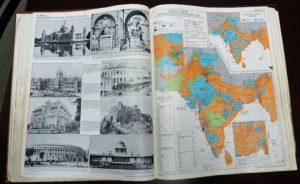
The atlas project took much longer than anticipated. It entailed procurement of numerous research grants, and required roughly 85 person-years of work from a multi-disciplinary team of specialists at Minnesota and the American Geographical Society. First published by the University of Chicago Press in 1978, the work was reissued in an updated edition by the Oxford University Press in 1992, and in a digitized edition by the University of Chicago in 2006. It won the Watumull Prize of the American Historical Association, as the best work on Indian history of the 1978-79 biennium, and an outstanding achievement award from the Association of American Geographers. In 1981 David Watumull observed:
“Over the years, since 1946 when this Prize was instituted, I can … say, without a doubt, that this is the finest and most worthwhile book to be selected.” What makes the work unique is its presentation, not only of the findings of modern historians of South Asia, but also its recreations of the ways in which aspects of that region were made known by numerous actors – both South Asian and outsiders –over more than three millennia.
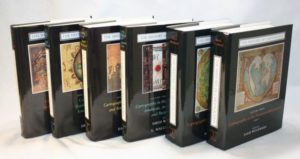
Publication of the atlas led to Joe’s being recruited into what was to become an even larger (and still on-going) project, the preparation of a multi-volume History of Cartography. Apart from offering advice in planning the work (headquartered at the University of Wisconsin), Joe was asked to write an article on the indigenous cartography of South Asia, a subject on which there was then virtually no extant literature. However, years of research in South Asia and neighboring regions – in libraries, museums and private art collections, as well as in the field – uncovered a vastly larger corpus of cartographic and cosmographic artifacts than one might have anticipated. Joe was the associate editor and principal author, by far, of two volumes of the history, one on South Asia and the Islamic World, the other on East Asia, Southeast Asia and Greater Tibet (University of Chicago Press, 1992 and 1994 respectively). In all, he contributed more than 550 pages of text and illustrations for the work. (Particularly remarkable were his 76 pages dealing with the cosmography and cartography of “Greater Tibet,” a subject on which there had been virtually no prior cartographic scholarship.)
Joe’s additional writing in his years at Minnesota (1964-2000) took numerous forms: scores of book reviews, essays in political geography, editorials on contemporary issues and events, numerous articles on the Kashmir dispute, work on folk regions in South Asia, a short monograph relating to the history of exploration, various spin-offs from his work on the history of cartography, and major contributions to several encyclopedias, including the lengthy article on the “Physical and Human Geography [of India]” for the 15th edition of the
Encyclopaedia Britannica on whose advisory board he subsequently served.
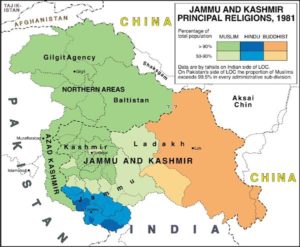
Joe’s writings on Kashmir were focused on promoting a peaceful resolution of the multi-partite disputes over that region. They were based largely on his visits – in 1993, 1994 and 1997 – to all parts of that contested, ethnically diverse state. He conducted interviews, on both sides of the Indo-Pakistani line of control, with a wide range of political actors (UN personnel, civil administrators, military officers, party leaders, dissidents [some in hiding],businessmen, journalists, victims of violence, and others). While his tours in 1993 and 1994 were largely self-financed, that of 1997 was as part of a fact-finding team sponsored by and drawn from the Kashmir Study Group (KSG). This think tank, of which Joe was a founding member, was established in 1996 by Farooq Kathwari (a wealthy Kashmir-American businessman), and was made up mainly of scholars and retired diplomats. Though the published findings and recommendations of the KSG (to which Joe was a principal – but anonymous – contributor), were widely discussed in diplomatic circles in South Asia, North America and Europe, hawkish nationalistic spoilers ultimately prevented their adoption. The KSG still exists; but it is less active than in its early years.
Along with writing, Joe taught thousands of students in a variety of courses and seminars. His most popular courses were introductory human geography (a sweeping overview of how the world is constituted) and political geography (wherein one is challenged – as in the real world – by the necessity of striking a credible balance between idealism and realpolitik). More specialized were his offerings on South and Southeast Asia and on historical cartography. Of particular relevance for his work on global governance were his seminars on “The Geography of Federalism,” “The Law of the Sea” and “A Charter for the New Millennium.” In 1979-80, Joe held a visiting Fulbright professorship at the Center for the Study of Regional Development at Jawaharlal Nehru University in New Delhi, during which he offered a course in population geography and a seminar on field methods.
Attendance at conferences provided Joe with abundant opportunities for travel, either en route to or returning from the conference venue. His participation at the 1992 Rio Summit Conference on the Environment and Development, for example, was followed by extensive travel in South America; and his atlas presentation at the Canberra meeting of the International Congress of Orientalists in 1971 was combined with visits to a number of Pacific Island nations. In all, Joe has traveled to approximately a hundred countries.
Intermittently, Joe served as a consultant to numerous governmental and scholarly agencies in the United States, Canada and India, and as a member of selection committees for various academic awards. For three years (1985-88) Joe was the elected Secretary of the US National Commission of the International Geographic Union. His previously noted work for the Indian census was instrumental in his consulting with the Mandal Commission, tasked with devising a quota system (arguably unwise) for allocating jobs and educational seats for members of so-called “other backward castes.” On October 23, 1959 Asok Mitra, the then Registrar General and Ex-Officio Census Commissioner of India, wrote to Joe as follows: “I am indeed very grateful to you for your letter of 25th September and your very well thought out recommendations for the improvement of the 1961 Census of India. I feel very grateful to you indeed, as these recommendations are by far the most detailed, practicable and important that I have ever received. All of them bear the imprint of a sense of reality.”
In recognition of his scholarly achievements the Department of Geography nominated Joe in 1995 and in 1996 for a highly competitive Regents Professorship, the highest academic honor that the University of Minnesota can bestow. However, neither nomination resulted in success.
Apart from scholarship, Joe was also heavily engaged in service activities on and off campus. On campus, he served (albeit briefly) as Chair of the Department of South Asian and Middle Eastern Studies, as an elected representative in the University Senate and in the Assembly of the College of Liberal Arts, and as a member of numerous committees. For three years (1984-87) he directed the Minnesota Studies in International Development program (MSID), providing unpaid student internships in a number of countries of the global South. He established several MSID programs in India and headed a delegation to Colombia, which led to a program with that nation’s Fundación Social, a business conglomerate guided by the Jesuit teachings of “liberation theology”. For several years following the Colombia visit, Joe was among a group of activists that tried (unsuccessfully) to establish an inner-city cooperative bank based on the Fundación model. In 2009 the University bestowed on Joe its annual “Award for Global Engagement” and the title “Distinguished International Professor Emeritus.”
In the public arena, Joe was also quite active. He served in various capacities in the Minnesota Chapter of the World Federalist Association (later Citizens for Global Solutions), including 14 years as its President. He was also active in several roles in the governance of WFA/CGS at the national level. He chaired WFA’s Policy and Recommendations Committee for several years prior to the establishment of CGS in 2004, and for the following decade was especially active in the World Federalist Institute, a CGS-affiliated think tank. For several decades he served as a member either of the Board, or of the Advisory Council, of the Minnesota Chapter of the United Nations Association.
In 1996 Joe was one of the handful of activists who founded the Minnesota Alliance of Peacemakers, which subsequently grew into an umbrella institution with roughly eighty peace and justice organizational members. In the following year he was a co-founder of the aforementioned Kashmir Study Group. In 1999, Joe was the annual honoree of the Vincent J. Hawkinson Foundation, an entity promoting peace and justice activism in five states of the Upper Midwest of the United States.
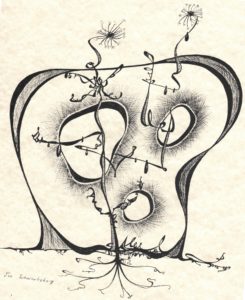
In a non-academic vein, Joe gained a touch of notoriety for his remarkable doodles, hundreds of which were created during tedious staff meetings and conferences in Minnesota and elsewhere. One of these appears to the left.
Additionally, Joe derived much pleasure from writing and illustrating whimsical stories for his children and grandchildren. Among these were Emanuel and Elvis, the story of a forgetful old man’s dependency on his pet elephant. Another favorite was There’s a Frog up Your Nose, a path-breaking four-part trilogy, the contents of which are less disgusting than the title.
Following his formal retirement from the University of Minnesota in 2000, Joe focused more heavily on issues of global governance, working largely with several organizations already named – writing scores of op-ed essays for their respective journals – and with the Academic Council on the United Nations System in whose journal, Global Governance, he published papers on UN peacekeeping and weighted voting. He expanded his advocacy of the latter idea in a monograph published in 2004 by the World Federalist Movement – Institute for Global Policy, Revitalizing the United Nations System: Reform through Weighted Voting. A related monograph, Creating a World Parliamentary Assembly: An Evolutionary Journey, was published by the Berlin-based Committee for a Democratic United Nations in 2012.
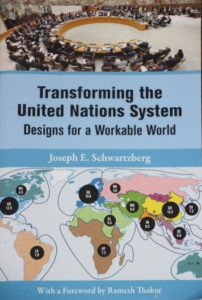
The ideas in these two monographs and in many previous articles – along with many others – were compiled in a book,
Transforming the United Nations System: Designs for a Workable World (TUNS), published by the United Nations University Press in 2013. That work provides a comprehensive set of proposals for moving away from the Westphalian paradigm of unfettered state sovereignty on which the present system of global governance is predicated. Despite – or perhaps because of – its radical nature, Joe’s most recent book has been warmly endorsed by leading global thinkers, including Boutros Boutros-Ghali, Thomas Pickering, Brian Urquhart, Thomas Weiss, Johan Galtung, Alfred de Zayas, Stephen Schlesinger and many others. Joe’s editor at the United Nations University Press wrote to him shortly before publication:
“I don’t think we’ve ever had a book with so much praise and backing from such a prestigious group of endorsers.” The Press then made Joe its first nominee ever for the prestigious Grawemeyer Award for Ideas Improving World Order. (He did not win, however.)
Of all that Joe has written, the most important, potentially, is the following credo, which he composed in 1976:
An Affirmation of Human Oneness
I am a member of the human family, a citizen of the world.
The achievements of men and women throughout the ages are my heritage.
My destiny is bound to that of all my fellow human beings.
What we jointly create forms our bequest to future generations.
May my life serve the good of my family.
May our use of the earth preserve it for those yet to come.
Joe hopes that this statement will be routinely recited at the outset of civic events, school ceremonies and other noteworthy occasions throughout the world, either along with the respective national anthems or independently. Toward that end Joe had the Affirmation translated into 12 major world languages for distribution at the summit Conference on the Environment and Development, which he attended in Rio de Janeiro in 1992. The total number of translations now stands at 43.
In 2001, Joe and his fellow peace and justice activist, Louise Pardee, entered into a domestic partnership and Joe moved from his cramped apartment in Minneapolis to Louise’s spacious lakeside home in suburban White Bear Lake. Since then, Louise has contributed to Joe’s work, editorially and in other ways.
In December 2014, Joe legally established The Workable World Trust, the principal purpose of which is to disseminate and promote the many global governance proposals in his most recent book. The work of the Trust has been carried out with the remarkably efficient and competent support of Ms. Nancy Dunlavy, who legally succeeded Joe as Director of the Trust in 2017. Joe then formally assumed the title of Director Emeritus. In practice, however, the two continue to cooperate on a wide variety of projects; and Joe intends to remain active as long as his health permits.
The Trust has negotiated translations of TUNS into Arabic, Chinese, French, German, Japanese, Russian and Spanish, thereby facilitating virtually worldwide discussion of its reform recommendations. Additionally, a much shorter, less academic Study and Discussion Guide has been prepared for each translation.
The Trust has supported (or is supporting) many projects in addition to those noted above, with beneficiaries in every continent. It has sponsored major conferences, such as the “Creating a Workable World” conference (University of Minnesota, 2015), the “Seminar on Security Council Reform” (UN Church Center, New York, 2016), and the “Commonwealth of Nations as a Vehicle for Sustainable Peace & Development” conference (Brisbane, Australia, 2018). It has also contributed substantial funds in support of conferences and reform advocacy by like-minded groups (e.g. The World Federalist Movement, the Berlin-based Democracy Without Borders, the Brussels-based Center for United Nations Constitutional Research), and provided travel support for youth participation at the Ventotene International Seminar in Italy and a Model UN program in Mexico City. It is also the principal financial backer of the “UN2020” initiative for a General Assembly-backed effort to institute a major reform process to mark the 75th anniversary of the UN’s founding. The Trust has also endowed a Workable World lecture series through the year 2025 in conjunction with the prestigious Nobel Peace Prize Forum, held each year at Augsburg University in Minneapolis. Further, Joe has bequeathed to Augsburg his personal global governance book collection, along with a fund for the enlargement of his bequest. Since its creation, the Trust distributed over $2 million (estimate as of March 2018) in support of numerous undertakings.
In summary, Joe has enjoyed a remarkably rich and rewarding life. He has sought to conduct himself as a World Citizen, in both word and deed. He has demonstrated his willingness to tackle big projects and his ability to bring many of them to successful conclusions, at times independently and at times as part of a team. He has been recognized for the rigor, originality, and social value of his scholarship. He has put forward detailed and practicable proposals for improving global governance through peaceful evolutionary processes. He recognizes the fallibility of human beings and the institutions that they create, and knows that utopia is not attainable. But a workable world is. Joe hopes that his work and that of the Workable Word Trust – which will outlive him – will contribute significantly toward the achievement of that goal and encourage others to join in the struggle to bring it to fruition.
White Bear Lake, Minnesota, August 2018